5 IASB Exposure Draft Amendments to Classification & Measurement of Financial Instruments Proposed amendments to IFRS 9 and IFRS 7
18 May 2023 Agenda Paper 5
Executive Summary
| Project Type | Influencing |
|---|---|
| Project Scope | Moderate |
| Purpose of the paper | The purpose of this paper is to obtain Board feedback and approval for publication of the Draft Comment Letter and the accompanying invitation to comment questions, on the International Accounting Standards Board (IASB)'s Exposure Draft (ED) Amendments to the Classification and Measurement of Financial Instruments: Proposed amendments to IFRS 9 and IFRS 7 issued in March 2023. |
| Summary of the Issue | The IASB's ED addresses concerns raised during the IASB's Post-implementation Review of IFRS 9 – Classification and Measurement project. It proposes amendments to IFRS 9 Financial Instruments and IFRS 7 Financial Instruments: Disclosures. |
| Decisions for the Board | Subject to addressing any comments raised during the meeting, the Board is asked to approve for publication the Draft Comment Letter and Draft Invitation to Comment for stakeholder feedback. |
| Recommendation | The Secretariat recommends that the Board approves for publication the Draft Comment Letter and Draft Invitation to Comment for stakeholder feedback. |
| Appendices | Appendix A Draft Comment Letter Appendix B Draft Invitation to Comment questions |
Background
1In March 2023 the IASB issued Exposure Draft (ED) IASB/ED/2023/2 Amendments to the Classification and Measurement of Financial Instruments: Proposed amendments to IFRS 9 and IFRS 7. The IASB comment period ends 19th July 2023.
2The ED is the IASB's response to feedback received as part of its IFRS 9 Post-implementation Review (PIR) of IFRS 9 – Classification and Measurement project.
3The UKEB highlighted the following key concerns in its response to the IASB's PIR:
- The challenges surrounding the classification of financial instruments with features linked to environmental, social and governance (ESG) concerns, including difficulties with the application of the contractual cash flow characteristics test to such instruments;
- The unclear boundary between contractually linked instruments and non-recourse finance;
- The need for clearer application guidance in relation to amortised cost and the effective interest method, particularly when applying paragraphs B5.4.5 and B5.4.6 of the standard; and
- The potential unintended consequences of the (then) IFRS Interpretations Committee (IFRIC) tentative agenda decision Cash Received via Electronic Transfer as Settlement for a Financial Asset (“Electronic Cash Transfers").
4The concerns raised at 3 a), b), and d) are within the scope of this ED. The issue raised at 3 c) will be included in the IASB pipeline research project Amortised Cost Measurement.
5The IASB's ED proposes amendments to IFRS 9:
- To clarify that settlement date accounting is required when recognising or derecognising a financial asset or a financial liability;
- To permit an entity to deem a financial liability that is settled using an electronic payment system to be discharged before the settlement date if specified criteria is met;
- To clarify the application guidance for assessing the contractual cash flow characteristics of financial assets, including:
- Financial assets with contractual terms that could change the timing or amount of contractual cash flows, for example, those with ESG-linked features;
- Investments in equity instruments designated at fair value through other comprehensive income; and
- Financial instruments with contractual terms that could change the timing or amount of contractual cash flows on the occurrence (or non-occurrence) of a contingent event.
Research and outreach
7To inform the drafting of the Draft Comment Letter (DCL), the Secretariat has conducted desk-based research, including reviewing the IASB ED and other relevant publications from accounting firms.
8In April 2023, the Secretariat discussed the IASB's proposals with the Financial Instruments Working Group (FIWG). At that meeting, it was acknowledged that the assessment of the IASB proposals was in progress and views could continue to evolve. The FIWG shared the following preliminary feedback:
- Some wording on the exposure draft seemed unclear/contradictory. FIWG members were in process of assessing whether the IASB proposals, if finalised as currently drafted, would provide enough clarity to enable consistent application.
- FIWG members welcomed the IASB efforts to address feedback received as part of the IFRS Interpretations Committee Tentative Agenda Decision Cash Received via Electronic Transfer as Settlement for a Financial Asset. However, concerns were noted in relation to the required criteria for the proposals on derecognition of liabilities settled through electronic transfers, in particular:
- inconsistency on the use of the term 'practical' in paragraphs B3.3.8(a) and (b).
- the intended use of terms such as electronic payment system, short and standard administrative process, and
- whether UK electronic payment systems would meet these criteria in a way that achieved a practical outcome.
- FIWG members welcomed the IASB efforts to address concerns on the classification of financial assets raised as part of the IASB Post-implementation Review of IFRS 9 – Classification and Measurement project. However, some concerns were raised on the risk of potential unintended consequences. FIWG members noted:
- It is not clear at what level in the reporting group the SPPI1 test should be performed and therefore guidance on how to interpret 'specific to the debtor' would be welcome.
- The proposed examples to illustrate contractual cash flows that are SPPI appear overly simplistic and arrive directly at a conclusion rather than providing an analysis of how the criteria are met, which would be helpful for entities applying the proposals to other financial assets.
- The clarifications on non-recourse features and contractually linked instruments are welcome, but some refinement to the proposals might be needed. For example this could include, clarifying the implications of residual value for lease receivables that could be included in the underlying pool of financial instruments.
- The likely treatment of common lending features such as additional cost clauses under these proposals.
- On transition, FIWG members welcomed that restatement of comparative information is not required, but there were calls to allow early adoption of the amendments relevant to ESG-linked instruments.
10Outreach work will continue between now and July 2023.
Approach to the comment letter based on this feedback
11The Secretariat consider that the proposals, in their current form, are only partially successful in addressing the concerns raised in paragraph 3 above. We acknowledge that in drafting these proposals the IASB had the objective of making only narrow changes to IFRS 9, and note such a prudent approach is helpful in mitigating any unintended consequences for the wider standard. However, this has placed constraints on the drafting process that, at times, has led to proposals that seem unclear and sometimes contradictory. The proposals are likely to require significant judgement in application, which is may lead to diversity in practice.
12We are therefore faced with a dilemma as to the best way forward, and present the Board with two options for its consideration.
- Option 1: We request the IASB make a small number of critical changes to the standard, sufficient to allow the stakeholders to arrive at a common interpretation of the requirements. This avoids delaying the process and is responsive to stakeholder requests that the issues related to ESG-linked instruments be resolved urgently. It also minimises the risk of unintended consequences to existing accounting treatments under IFRS 9 which may arise anytime the wording of the standard is revised. However, this approach may mean that greater judgement is required when implementing the requirements, and may need subsequent amendments to meet needs any future developments in the ESG-linked financial instruments market.
- Option 2: We request the IASB redraft the proposals with greater clarity. This would delay the project and risk potential consequences of a wider re-opening of the standard. However, this approach may result in a more robust set of requirements that fully consider any unintended consequences from the proposals as well as ensuring that the changes to the standard can withstand any future developments in the ESG-linked financial instruments market.
13On balance, the Secretariat recommend Option 1 as the most appropriate way forward, and have drafted the draft comment letter on this basis. In arriving at this conclusion the Secretariat noted:
- Continuing stakeholder feedback to quickly resolve the ESG-linked instruments issue (multiple stakeholders have requested the relevant amendments be made available for early adoption). Although it should be noted that we have not yet been able to assess the size of the market in these instruments and therefore the urgency to be attached to this request.
- That other IFRS standards also require significant judgement in application and such challenges are therefore not unique to these proposals.
Draft Comment Letter
14The Draft Comment Letter is attached at Appendix A for consideration, and the draft Invitation to Comment questions at Appendix B. The Board is asked the following questions:
Questions for the Board
- Do the Board members agree that the Draft Comment Letter should reflect the approach outlined in Option 1?
- Do Board members have any comments or questions on the Draft Comment Letter at Appendix A or the questions asked in our draft Invitation to Comment questions included at Appendix B?
- Subject to any amendments identified, do Board members approve for publication the Draft Comment Letter at Appendix A and Draft Invitation to Comment questions at Appendix B?
Next steps
15In line with the PIP, outreach with stakeholders will continue between now and July 2023, including via publication of the DCL on the UKEB website and discussion with relevant UKEB Advisory Groups.
16The Final Comment Letter, Feedback Statement and draft Due Process Compliance Statement will be brought to the July meeting for approval by the Board.
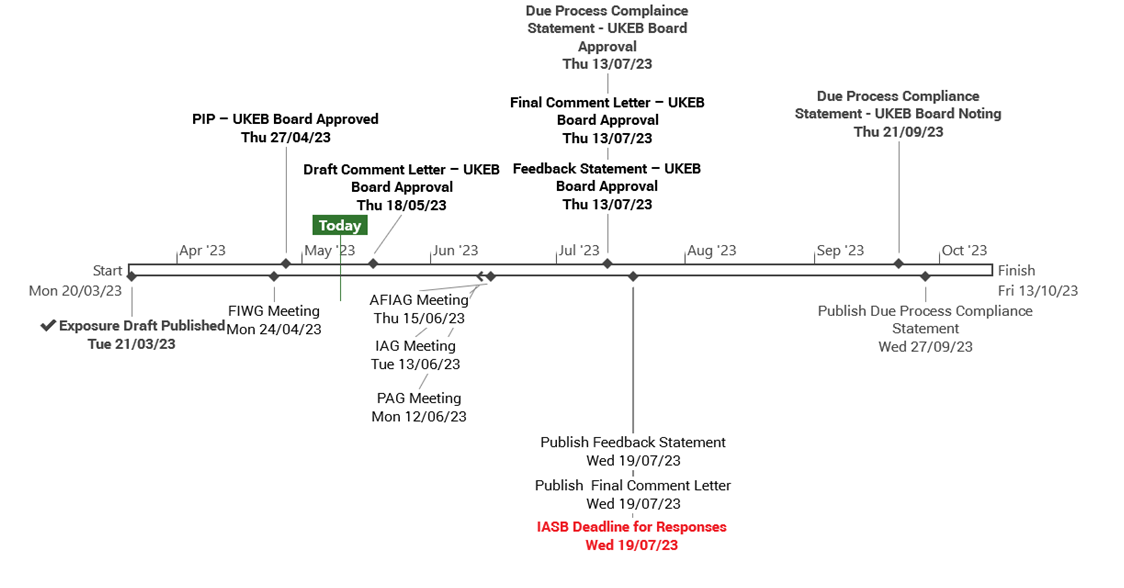
17Further information on the project timeline is presented in the table below.
Classification & Measurement Exposure Draft Timeline
| Date | Milestone | |
|---|---|---|
| Influencing phase | ||
| 24 April 2023 | Outreach with the UKEB FIWG | Complete |
| 27 April 2023 | Board: Education session | Complete |
| 27 April 2023 | Board: Considers the PIP | Complete |
| Secretariat: Revises PIP for any Board comments | ||
| 18 May 2023 | Board: Considers Draft Comment Letter | To be brought to the May 2023 Board |
| Secretariat: Revises DCL for any Board comments | To be completed | |
| May 2023 | Secretariat: Publishes Draft Comment Letter, comment period 30 days. | To be completed |
| May-June 2023 | Further outreach as described in the Project Initiation Plan. | To be completed |
| 13 July 2023 | Board: Considers Final Comment Letter, Feedback Statement, draft Due Process Compliance Statement | To be completed |
| Secretariat: Revises documents for any Board comments. | ||
| 19 July 2023 | IASB comment period ends | To be completed |
| Secretariat: submits Final Comment Letter | ||
| Secretariat: Final Comment Letter and Feedback Statement published on website | ||
| 21 September 2023 | Board: Approves final Due Process Compliance Statement | To be completed |
Timelines
Dr Andreas Barckow Chairman International Accounting Standards Board Columbus Building 7 Westferry Circus Canary Wharf London E14 4HD
XX May 2023
Dear Dr Barckow
Exposure Draft ED/2023/2 Amendments to the Classification and Measurement of Financial Instruments – Proposed amendments to IFRS 9 and IFRS 7
1The UK Endorsement Board (UKEB) is responsible for endorsement and adoption of IFRS Accounting Standards for use in the UK and therefore is the UK's National Standard Setter for IFRS Accounting Standards. The UKEB also leads the UK's engagement with the IFRS Foundation on the development of new standards, amendments and interpretations. This letter is intended to contribute to the Foundation's due process. The views expressed by the UKEB in this letter are separate from, and will not necessarily affect the conclusions in, any endorsement and adoption assessment on new or amended International Accounting Standards undertaken by the UKEB.
2There are currently approximately 1,500 entities with equity listed on the London Stock Exchange that prepare their financial statements in accordance with IFRS.2 In addition, UK law allows unlisted companies the option to use IFRS and approximately 14,000 such companies currently take up this option.3
3We welcome the opportunity to provide comment on the International Accounting Standards Board (IASB) Exposure Draft (ED) Amendments to the Classification and Measurement of Financial Instruments: Proposed amendments to IFRS 9 and IFRS 7 (the Amendments). In developing this letter, we have consulted with stakeholders in the UK, including preparers, accounting firms and institutes and users of accounts.
4We welcome the IASB's responsiveness to the concerns raised by stakeholders, including those in our response4, on the request for information on the Post-implementation Review of IFRS 9 – Classification and Measurement. The UKEB highlighted the following concerns:
- The potential unintended consequences for the derecognition of financial liabilities arising from the IFRS Interpretations Committee tentative agenda decision Cash Received via Electronic Transfer as Settlement for a Financial Asset.
- Making it easier for financial instruments with ESG-linked features to achieve amortised cost accounting in circumstances where they are, in substance, basic lending transactions.
- The need for further guidance on the application of the effective interest method, particularly in relation to the application of IFRS 9 paragraphs B5.4.5 and B5.4.6.
- The need for increased clarity in distinguishing between non-recourse finance and contractually linked instruments when applying the cash flow characteristics test.
5We note and welcome that the ED addresses most of these matters, with the remaining item addressed in the IASB pipeline project Amortised Cost Measurement. Our main observations and recommendations are set out in the paragraphs that follow. Responses to the IASB's specific questions about the ED are included in the Appendix to this letter.
Appendix A
Questions on ED Amendments to the Classification and Measurement of Financial Instruments
Question 1 – Derecognition of a financial liability settled through electronic transfer
Paragraph B3.3.8 of the draft amendments to IFRS 9 proposes that, when specified criteria are met, an entity would be permitted to derecognise a financial liability that is settled using an electronic payment system although cash has yet to be delivered by the entity.
Paragraphs BC5-BC38 of the Basis for Conclusions explain the IASB's rationale for this proposal.
Do you agree with this proposal? If you disagree, please explain what aspect of the proposal you disagree with. What would you suggest instead and why?
Overview
A1We welcome the IASB's proposal to create an option when accounting for the derecognition of liabilities settled through electronic cash transfers. This acknowledges that such technology has different characteristics to other forms of payment, including greater speed and certainty of settlement. Without this option the clarification that settlement date accounting is required may be too disruptive and costly for those with using other methodologies. However, we are concerned that the proposals, in their current form, may only have limited success in addressing this.
A2We consider that the successful implementation of the proposals depends on whether the criteria for use of the option reflect common UK electronic payment systems, without imposing disproportionate operational cost on entities. Our initial analysis has identified doubts as to whether these new requirements would allow some major UK payment systems, such as BACS, to achieve the proposed accounting without incurring disproportionate disruption and costs. [NB: Our analysis is ongoing, and our final comment letter will be updated to reflect any additional findings].
Ability to stop, withdraw or cancel
A3Paragraph B3.3.8(a) specifies that "the entity has no ability to withdraw, stop or cancel the payment instruction" and is likely to be particularly problematic in this regard. For many UK payment systems, the point at which there is no ability to cancel a payment (Time Cancellation ("TC")), subsequent to the issuance of the payment instruction (Time of Instruction, "TI"), but then is subject to a number of other operational complexities, including:
- TC varies by type of electronic payment system.
- For each electronic payment system TC may vary by instructing bank.
- TC could also be subject to individual circumstances related to factors such as what time or day both TI and TC occurred.
- Entities are likely to use multiple electronic payment systems depending on their business needs, and may have more than one banking relationship.
A4An example of this would be the BACS system, one of the highest volume electronic payment processing systems in the UK. Once a payment instruction is issued, BACS has an approximate three-day processing cycle but entities have an approximate one-day window for cancellation, the exact timing of which varies depending on which bank they use.
A5We consider that, the system and operational costs to capture the different TC for each payment to enable derecognition of the associated liability may be disproportionate to the benefit gained, thus limiting the take up of this beneficial option.
A6Instead, we recommend that the accounting should aim to reflect the substance of the electronic payment processes by focusing on the actual commercial practice. The cancellation window for electronic payments is relatively short when compared to other payment methods such as cheques. As a result, most electronic payments are not cancelled subsequent to instruction. Additionally, current experience shows that electronic cash transfers are short term in duration. This reduces the opportunity for potential abuse across reporting dates, which can be readily detected via a review of cancelled payments.
A7This suggests that the most appropriate criterion is one that allows derecognition of the liability for electronic payments at the point the instruction for the payment is made (TI). We think such an approach to accounting will be readily understood by users and will improve consistency amongst preparers.
A8If the IASB chooses to proceed with the existing drafting in the proposals then consideration should be given to how the cash-in-transit for such transactions will be reflected. Where prior to settlement the liability fails the test for derecognition, but cash has left the bank account, clarification of whether the cash-in-transit in the electronic payment system is considered a cash equivalent would be useful to prevent diversity of practice.
Other considerations
A9It is not clear why the “no ability to access the cash” criterion at B3.3.8(b) and the "settlement risk” criterion at B3.3.8(c) are included as separate tests. In the UK, we are not aware of any examples where an entity could pass one test but fail the other. Once access to cash has been removed, there is no further settlement risk (in the absence of bank/settlement system collapse). Similarly, if there is no settlement risk then an entity can have no ability to withdraw or move the cash. In the interests of a concise, streamlined standard it may be beneficial to remove the criterion at B3.3.8(b)entirely or delete the final sentence at B3.3.9, as below.
Exposure Draft text (with UKEB markup)
B3.3.8 Notwithstanding the requirement in paragraph B3.1.2A to apply settlement date accounting, an entity is permitted to deem a financial liability (or a part of a financial liability)—that will be settled with cash using an electronic payment system—to be discharged before the settlement date if, and only if, the entity has initiated the payment instruction and:
- the entity has no ability to withdraw, stop or cancel the payment instruction;
- the entity has no practical ability to access the cash to be used for settlement as a result of the payment instruction; and
- the settlement risk associated with the electronic payment system is insignificant.
B3.3.9 For the purposes of applying paragraph B3.3.8(c), settlement risk is insignificant if the characteristics of the electronic payment system are such that completion of the payment instruction follows a standard administrative process and the time between initiating a payment instruction and the cash being delivered is short. However, settlement risk would not be insignificant if the completion of the payment instruction is subject to the entity's ability to deliver cash on the settlement date.
A10In the absence of a definition of “electronic payment system” there appears confusion amongst UK stakeholders as to what is the intended universe of electronic payment systems. In our analysis to-date we have considered four main types of payment systems:
- Those that move money from a bank account shortly after a payment instruction (for example in the UK these include BACS, Faster Payments, CHAPS and SWIFT).
- Those that move money from a bank account on a regular basis established in advance (in the UK these include Direct Debit and Standing Orders).
- Card based payments, including debit cards and credit cards.
- Other digital payment methods including Apple Pay, Google Pay and Paypal (where the underlying payment mechanism may be linked to items A10a. or A10c. above).
A11Based on our initial analysis it seems possible some systems will never meet the ED criteria for use of the option as currently drafted, effectively falling permanently outside its scope. It is possible the IASB did not intend some payment systems, such as those described at A10d, to be within the scope of these proposals. Our stakeholder outreach so far has indicated differing opinions as to whether certain systems were intended to be considered, and whether such payment systems pass the necessary criteria (e.g. credit cards). If it was IASB's intention to exclude certain common payment systems, for example credit cards, clarification of that would be helpful in ensuring consistent practice.
Question 2 – Classification of financial assets – contractual terms that are consistent with a basic lending arrangement
Paragraphs B4.1.8A and B4.1.10A of the draft amendments to IFRS 9 propose how an entity would be required to assess:
- interest for the purposes of applying paragraph B4.1.7A; and
- contractual terms that change the timing or amount of contractual cash flows for the purposes of applying paragraph B4.1.10.
The draft amendments to paragraphs B4.1.13 and B4.1.14 of IFRS 9 propose additional examples of financial assets that have, or do not have, contractual cash flows that are solely payments of principal and interest on the principal amount outstanding.
Overview
A12We welcome the IASB's work in this area, which we previously identified as a deficiency with the requirements of IFRS 95. We believed that in the absence of clear guidance inconsistent accounting practices would develop. Our stakeholders previously told us and still assert that financial instruments which, but for the ESG-linked feature, would be considered basic lending should be measured at amortised cost. We also highlighted that the purpose of ESG-linked features in such instruments is to change behaviour by incentivising positive ESG behaviour in borrowers. It is important that the accounting treatment does not undermine such social purpose and continues to provide users with the most decision useful information on basic lending transactions.
A13We believe the proposals, in their current form, are only partially successful in addressing these concerns. In drafting these proposals we acknowledge that the IASB has attempted to make only limited changes to IFRS 9, and note such a prudent approach is helpful in mitigating any unintended consequences of changing the standard more widely. However, this led to proposals that are unclear, sometimes contradictory, and early feedback from our stakeholders is that they may require significant judgement in execution. This could lead to considerable diversity in practice. Our detailed observations and recommendations are included in paragraph A16 below.
A14Once finalised, these ED proposals are likely to lead to a greater number of instruments qualifying for amortised cost accounting. This would further emphasise the need to provide greater clarity on the application of the effective interest rate calculation for such instruments (particularly the requirements described at paragraphs B5.4.5 and B5.4.6 of IFRS 9). We note that this forms part of the IASB's pipeline project Amortised Cost Measurement and encourage the IASB to commence that pipeline project as soon as possible.
A15Finally, we are concerned that the test at paragraph B4.1.10A, requiring that the contingent event (in this case the ESG-linked feature) be specific to the debtor, may make it more difficult for ESG-linked features to achieve their social purpose of changing behaviour. Banks may be less inclined to provide basic lending products if amortised cost accounting cannot be used, due to the impact on their regulatory capital and volatility of earnings. If "specific to the debtor” is interpreted narrowly e.g. at the borrowing entity level, then ESG targets set at the parent or consolidated group level would not meet the criteria for amortised cost accounting. In practice, such targets are often set at group level as this provides the most meaningful information about the ESG performance of the business as a whole. An entity specific approach could open these requirements to structuring opportunities, potentially attracting accusations of greenwashing, e.g. a subsidiary with strong ESG performance receives the incentive, while the overall ESG performance of the group remains poor. If accounting policy is not to undermine the social construct of such instruments, [it should be made clear that consideration of group targets is acceptable under the proposals test NB: this suggestion is subject to ongoing stakeholder outreach ]. We include some suggested wording for achieving this in paragraph A16a below. However, we agree with the IASB that reference to ESG targets external to the group (for example to an industry index) is beyond the scope of basic lending and should not meet the test at B4.1.10A as “specific to the debtor”.
Specific feedback
A16Should IASB wish to proceed with the existing approach outlined in the ED we note below the minimum changes we believe are required to clarify key areas, reduce diversity in application, and minimise unintended consequences:
- There are a number of ways the IASB could make clear that group, parent and similar ESG targets as discussed at paragraph A15 are acceptable to meet the criteria at ED paragraph B4.1.10A. The most straight forward would be to define “specific to the debtor”. Alternatively, a lighter touch approach could be including the concept in one of the examples included in the standard to demonstrate this intent. In the example at paragraph B.4.1.13 the description of Instrument EA could be modified to say "if the debtor achieves a contractually specified reduction in the group's consolidated greenhouse gas emissions"
- The examples of analysis shown in ED paragraphs B4.1.13 and B4.1.14 are simplistic, and the analysis column arrives directly at the conclusion without any analysis of how each of the relevant criteria described at paragraph B4.1.7.A – B4.1.10A are met. We recommend the analysis column be revised to show this assessment against the criteria. It would also be helpful to include some examples where the answer is less obvious to better illustrate the application of the criteria. We would be happy to assist IASB staff identify or test suitable examples.
- To achieve amortised cost accounting the requirements at ED paragraph B4.10A and BC67 require that contingent events be specific to the debtor. This creates an issue for 'additional cost' clauses, which are a widespread feature of lending contracts in the UK, and could lead to large numbers of basic lending contracts failing this test and being reclassified from amortised cost to fair value accounting. Such clauses are not specific to the debtor but ensure that the lender is protected from the impact of changes to the interpretation, administration or application of relevant laws or regulations. We believe that protective clauses, such as 'additional cost' clauses, are consistent with basic lending and relate to the creditor's “cost associated with extending credit” as described at BC67. Accordingly, to avoid large numbers of contracts no longer meeting the contractual cashflow requirements, we recommend that paragraph B4.10A and BC67 should be changed to accommodate such clauses. This may be achieved by [explicitly noting that contingent events that address the costs associated with extending credit are not subject to this test NB: this recommendation is subject to ongoing stakeholder outreach].
- The criteria at B4.1.8A on “direction and magnitude of the change” has caused some confusion amongst stakeholders, both in terms of understanding the nature of the requirement and its application. It states that "a change in contractual cashflows is inconsistent with a basic lending arrangement if it is not aligned with the direction and magnitude of the change in basic lending risks or costs”. To provide clarity and reduce the risk of diversity in practice, we recommend moving the requirement to paragraph B4.1.10, where other changes to contractual cashflows are discussed, and incorporating some of the text from BC52 and BC70 as shown below.
Exposure Draft text (with UKEB markup)
B.4.1.10A In applying paragraph B4.1.10, an entity shall assess whether contractually specified changes in cash flows following the occurrence (or non-occurrence) of any contingent event would give rise to cash flows that are solely payments of principal and interest on the principal amount outstanding. This assessment shall be done irrespective of the probability of the contingent event occurring (except for non-genuine contractual terms as described in paragraph B4.1.18). For a change in contractual cash flows to be consistent with a basic lending arrangement, the occurrence (or non-occurrence) of the contingent event must be specific to the debtor and aligned with the direction and magnitude of the change in basic lending risks or costs. The occurrence of a contingent event is specific to the debtor if it depends on the debtor achieving a contractually specified target, even if the same target is included in other contracts for other debtors. However, the resulting contractual cash flows must represent neither an investment in the debtor (for example, contractual terms that entitle the creditor to a share of the debtor's revenue or profits) nor an exposure to the performance of specified assets (see also paragraphs B4.1.15-B4.1.16). A change in contractual cash flows is aligned with the direction and magnitude of the change in basic lending risks or costs, for example when an increase in the credit risk of a borrower is reflected in an increase, and not a decrease, in the interest rate of the financial asset.
Question 3 – Classification of financial assets – financial assets with non-recourse features
The draft amendments to paragraph B4.1.16 of IFRS 9 and the proposed addition of paragraph B4.1.16A enhance the description of the term 'non-recourse'.
Paragraph B4.1.17A of the draft amendments to IFRS 9 provides examples of the factors that an entity may need to consider when assessing the contractual cash flow characteristics of financial assets with non-recourse features.
Paragraphs BC73-BC79 of the Basis for Conclusions explain the IASB's rationale for these proposals.
Do you agree with these proposals? Why or why not? If you disagree, please explain what aspect of the proposals you disagree with. What would you suggest instead and why?
Financial assets with non-recourse features
A17The UKEB generally supports the proposals outlined in this section. Stakeholders have told us that ED paragraph B4.1.16A describing non-recourse features could be read very narrowly, which would likely exclude most items other than waterfall arrangements from the non-recourse guidance. If this was not the IASB's intent then further explanation to clarify this matter would be helpful.
Question 4 – Classification of financial assets – contractually linked instruments
The draft amendments to paragraphs B4.1.20–B4.1.21 of IFRS 9, and the proposed addition of paragraph B4.1.20A, clarify the description of transactions containing multiple contractually linked instruments that are in the scope of paragraphs B4.1.21–B4.1.26 of IFRS 9.
The draft amendments to paragraph B4.1.23 clarify that the reference to instruments in the underlying pool can include financial instruments that are not within the scope of the classification requirements of IFRS 9.
Paragraphs BC80-BC93 of the Basis for Conclusions explain the IASB's rationale for these proposals.
Do you agree with these proposals? Why or why not? If you disagree, please explain what aspect of the proposals you disagree with. What would you suggest instead and why?
Contractually linked instruments
A18We welcome the IASB's efforts to clarify the distinction between non-recourse finance and contractually linked instruments. The proposals now make it clear that contractually linked instruments are considered a subset of non-recourse finance for IFRS reporting purposes. However, this clarification gives rise to potential further confusion that both the non-recourse and contractually linked instrument contractual cashflow tests may apply to contractually linked instruments, as one is a subset of the other. This could lead to diversity in practice, and we therefore recommend a further clarification that contractually linked instruments only need to be assessed using the criteria at ED paragraphs B4.1.21 – B4.1.26.
A19The text now makes clear that items which are in substance bilateral secured lending arrangements are assessed under the non-recourse finance rules. [NB: we are still consulting stakeholders on these proposed changes].
A20With reference to the underlying pool of assets ED paragraph B4.1.23 refers to lease receivables. The current text could be interpreted as implying that lease receivables would always meet the proposed cashflow characteristics test, which we do not believe was the IASB's intent. We note that the IASB has already considered clear helpful guidance on this issue in the IASB staff paper presented to the September IASB meeting6. That paper noted that leases may have cashflows characteristics similar to solely payments of principal and interest, but may have other features such as exposure to residual value risk or to residual value guarantees that would fail to meet the characteristics of the contractual cashflows test. We recommend that this guidance is included in this section of the proposals, and provide suggested wording below.
Exposure Draft text (with UKEB markup)
B4.1.23 The underlying pool must contain one or more instruments that have contractual cash flows that are solely payments of principal and interest on the principal amount outstanding. For the purpose of this assessment, the underlying pool can include financial instruments that are not within the scope of the classification requirements (see Section 4.1 of this Standard) for example, lease receivables that have contractual cash flows that are equivalent to payments of principal and interest on the principal amount outstanding. However, an entity must assess the effects of any other features of the financial instrument for compliance with the contractual cashflow requirements. For example some lease receivables may be subject to residual value risk or guarantees, or may have variable lease payments which are linked to an index. Such features would typically not be considered consistent with a basic lending arrangement.
Question 5 – Disclosures – investments in equity instruments designated at fair value through other comprehensive income
For investments in equity instruments for which subsequent changes in fair value are presented in other comprehensive income, the Exposure Draft proposes amendments to:
- paragraph 11A(c) of IFRS 7 to require disclosure of an aggregate fair value of equity instruments rather than the fair value of each instrument at the end of the reporting period; and
- paragraph 11A(f) of IFRS 7 to require an entity to disclose the changes in fair value presented in other comprehensive income during the period.
Paragraphs BC94-BC97 of the Basis for Conclusions explain the IASB's rationale for these proposals.
Do you agree with these proposals? Why or why not? If you disagree, please explain what aspect of the proposals you disagree with. What would you suggest instead and why?
Disclosure – Investments in equity instruments designated at fair value through other comprehensive income
A21We understand the IASB has proposed these changes in relation to feedback in the previous consultation requesting the recycling to profit or loss of fair value changes previously recognised in other comprehensive income once an investment is disposed of. We do not believe this is an issue of widespread concern in the UK.
A22The IASB's response, to provide additional disclosure on changes in the fair value of equity instruments, including for those investments derecognised in the reporting period, provides users of financial statements with additional relevant information on this topic. We agree with these proposals.
Question 6 – Disclosures – contractual terms that could change the timing or amount of contractual cash flows
Paragraph 20B of the draft amendments to IFRS 7 proposes disclosure requirements for contractual terms that could change the timing or amount of contractual cash flows on the occurrence (or non-occurrence) of a contingent event. The proposed requirements would apply to each class of financial asset measured at amortised cost or fair value through other comprehensive income and each class of financial liability measured at amortised cost (paragraph 20C).
Paragraphs BC98-BC104 of the Basis for Conclusions explain the IASB's rationale for this proposal.
Do you agree with these proposals? Why or why not? If you disagree, please explain what aspect of the proposal you disagree with. What would you suggest instead and why?
Disclosure – Contractual terms that could change the timing or amount of contractual cashflows.
Disclosure Objectives
A23The proposals in paragraphs 20B and 20C of the ED add requirements to disclose the nature of contingent events specific to the debtor, quantitative information about the range of changes that could result from those contractual terms and the carrying amount of instruments subject to such terms. However they do not specify the objective of the proposed new disclosure, nor how users of financial statements are likely to use this information. In our comment letter7 to the IASB on Targeted standards-level Review of Disclosure project we recommended the use of such objectives, as stakeholders find them useful when applying judgement to what should be disclosed and the best way to do so. We understand the use of such general and specific objectives, explaining investors' information needs, are in future to be used by the IASB when developing disclosure requirements. We recommend such a disclosure objective is included in these proposals.
Scope of Disclosure
A24Our stakeholders have highlighted concerns that the broad nature of the proposals at paragraphs 20B and 20C may mean that entities are required to disclose potentially irrelevant information that obscures more useful information about variations in contractual cashflows. Additionally, preparers are concerned that the quantitative information on the range of changes to contractual cashflows by class of financial asset may create a very wide range, that proves time consuming to prepare but then is not useful for investor decision-making.
A25We also note that such broad requirements increase the risk of boilerplate disclosures, and in this instance also risks duplication of, or inconsistency with, disclosure requirements that already exist elsewhere within IFRS. For example, IFRS 7 B10A already requires similar disclosures for liabilities to assist users in assessing liquidity risk, and the proposed amendments in exposure draft Non-current Liabilities with Covenants address disclosure related to covenants in IAS 1 Presentation of Financial Statements.
A26We recommend that the IASB reconsiders the scope of these disclosures with a view to removing duplication with requirements existing elsewhere. As part of this we recommend that disclosures related to credit event contingencies be removed from scope, as disclosures related to breach of covenants and factors relevant to credit impaired loans are adequately addressed in the expected credit loss requirements of this standard.
Question 7 – Transition
Paragraphs 7.2.47-7.2.49 of the draft amendments to IFRS 9 would require an entity to apply the amendments retrospectively, but not to restate comparative information. The amendments also propose that an entity be required to disclose information about financial assets that changed measurement category as a result of applying these amendments.
Paragraphs BC105-BC107 of the Basis for Conclusions explain the IASB's rationale for these proposals.
Do you agree with these proposals? Why or why not? If you disagree, please explain what aspect of the proposals you disagree with. What would you suggest instead and why?
Transition
A27We support the proposed transition requirements, including the requirement not to restate comparatives.
A28UK stakeholders continue to stress the urgency of resolving the classification and measurement requirements for financial instruments with ESG-linked features. Accordingly, we recommend that early adoption be permitted for the amendments relevant to this, including paragraphs B4.1.7A – B4.1.16.
Appendix B
IASB Exposure Draft Amendments to the Classification and Measurement of Financial Instruments: Proposed amendments to IFRS 9 and IFRS 7 - Draft Invitation to Comment questions
The Secretariat propose the following questions be included in the Invitation to Comment accompanying the Draft Comment Letter for this project.
| Theme | Question |
|---|---|
| 1 Electronic cash transfers | The exposure draft requires that settlement date accounting shall apply when derecognising a financial asset or financial liability (unless an entity applies paragraph B3.1.7 regular-way transactions) or uses the new proposed election for financial liabilities settled by electronic cash transfers at B3.3.8. |
| Do you believe the criteria at B3.3.8-10 could be successfully applied to the common UK electronic payment systems? | |
| 2 Electronic cash transfers | If so, would the outcome be practical to implement? Please include any qualitative or quantitative information on the cost of doing so if you are aware of this. |
| 3 Electronic cash transfers | Do you have any other comments you would like to make on the proposed amendments related to the derecognition of liabilities settled through electronic transfers? |
| 4 Classification of Financial Assets | Do you agree, that for the purposes of assessing contractually specified changes in cashflows following a contingent event (B.4.1.10A) for an ESG-linked financial instrument, the use of ESG targets set elsewhere in the entity group/at consolidated level should be permitted? Please explain why. |
| 5 Classification of Financial Assets | Do you have any other comments you would like to make on the proposed amendments to the Classification of Financial Assets? |
| 8 Disclosure | Do you agree with the IASB proposals for amendments to the disclosure of investment in equity instruments designated at fair value through other comprehensive income? |
| 9 Disclosure | Do you agree with the UKEB's draft conclusion that the proposed disclosure requirements for contractual terms that could change the timing or amount of contractual cashflows are too broad? How would you recommend modifying these proposals? |
| 10 Transition | Do you agree with the UKEB's recommendation that amendments relevant to the classification of ESG-linked financial instrument be made available for early adoption? |
| 11 Transition | Do you agree with the IASB's transition proposals, including the proposal not to restate comparative information? |
| 12 All | Are there any other comments you would like to make on the proposals in this exposure draft? |
Footnotes
-
Solely payments of principal and interest on the principal amount outstanding (SPPI). ↩
-
UKEB calculation based on LSEG and Eikon data", May 2023. This calculation includes companies listed on the Main market as well as on the Alternative Investment Market (AIM). ↩
-
UKEB estimate based on FAME, Companies Watch and other proprietary data. ↩
-
Comment letter to the IASB on the Post-implementation Review of IFRS 9 - Classification and Measurement, 28 January 2022 https://assets-eu-01.kc-usercontent.com/99102f2b-dbd8-0186-f681-303b06237bb2/41e29e45-0a23-4452-b010-99a65adb8650/Final%20Comment%20Letter%20-%20Post%20Implementation%20Review%20of%20IFRS%209%20-%20Classification%20and%20Measurement.pdf ↩
-
AP16B Financial assets with non-recourse features and contractually linked instruments, paragraph 51-54, September 2022 https://www.ifrs.org/content/dam/ifrs/meetings/2022/september/iasb/ap16b-ccfc-financial-assets-with-non-recourse-features-and-clis.pdf ↩
-
Final comment letter, IASB Exposure Draft ED/2021/3, 17 December 2021 https://assets-eu-01.kc-usercontent.com/99102f2b-dbd8-0186-f681-303b06237bb2/86412a90-0d00-40a0-9415-8325c030e272/Final%20Comment%20Letter%20-%20Disclosure%20Requirements%20in%20IFRS%20Standards%E2%80%94A%20Pilot%20Approach.pdf ↩