11 Connectivity – UKEB Staff Paper Liabilities and provisions
27 April 2023 Agenda Paper 11
Executive Summary
| Project Type | Monitoring |
|---|---|
| Project Scope | Significant |
| Purpose of the paper |
This is the second staff paper in a series of preparatory papers, focusing on connectivity between the International Sustainability Standards Board (ISSB) [draft] IFRS Sustainability Disclosure Standards and International Accounting Standards Board (IASB) Accounting Standards.
The aim of the series of papers is to enable the UKEB to consider the key matters related to connectivity and to develop its own position. This paper focuses on connectivity regarding liabilities and provisions.
Summary of the Issue
The ISSB is currently developing a Request for Information (RFI) to inform its initial two-year work plan. As at March 2023 the IFRS Foundation website indicated that the ISSB RFI will be issued in May 2023.
One of four potential projects in the ISSB RFI may include a project that focusses on integration in reporting. This project may include a discussion of the requirements in draft IFRS S1 General Requirements for Disclosure of Sustainability-related Financial Information and draft IFRS S2 Climate-related Disclosures in relation to connected information, i.e. the connection between the sustainability disclosures and the financial statements.
In parallel, the IASB has activated a project named 'Climate-related Risks in the Financial Statements' which seeks to address stakeholder feedback from the Third Agenda Consultation. This related to the potential for inconsistent application of IFRS Accounting Standards in relation to climate-related risks in financial statements.
This paper contains two appendices:
Appendix A: Potential connectivity issues between Sustainability Disclosure Standards and Accounting Standards: Liabilities and Provisions (Staff paper). This paper discusses areas of potential overlap or misalignment from a user's perspective, possible solutions and provides illustrative examples. Due to the common background for each topic in the series, a separate background paper has been prepared [Appendix B] to avoid repetition.
Appendix B: Connectivity Background
The first section of this paper explains the interaction of the preparatory paper series with the UKEB Due Process. The paper then comments on the nature of 'connected information', relationship between the IASB and ISSB standards and requirements, implications for issuing new standards and next steps.
Decisions for the Board
The Board is not asked to make any decisions. The following questions are relevant in relation to each of the appendices.
Appendix A: Potential connectivity issues between Sustainability Disclosure Standards and Accounting Standards: Liabilities and Provisions 1. Does the Board have any comments, questions or additional topics regarding potential connectivity issues noted in the paper?
Recommendation
The Board to consider and discuss the potential connectivity issues in relation to the liabilities and provisions.
Appendices
- Appendix A: Potential connectivity issues between Sustainability Disclosure Standards and Accounting Standards: Liabilities and Provisions (Staff paper)
- Appendix B: Connectivity Background
Appendix A: Potential connectivity issues between Sustainability Disclosure Standards and Accounting Standards: Liabilities and Provisions (Staff paper)
Introduction
1. This is the second staff paper in a series of preparatory papers, focusing on connectivity between the International Sustainability Standards Board (ISSB) [draft] IFRS Sustainability Disclosure Standards and International Accounting Standards Board (IASB) IFRS Accounting Standards.
2. The objective of these papers is to enable the UKEB to consider the key matters related to connectivity and to develop its own position in relation to connectivity matters. This paper focuses on potential connectivity issues with liabilities and provisions.
3. The appendices to this paper include the following items:
a) Appendix A: Disclosure Examples - includes examples from annual reports of the UK's FTSE 350 companies; b) Appendix B: Extracts from IFRS Sustainability Disclosure Standards - includes a summary of the relevant requirements of IFRS S1 General Requirements for Disclosure of Sustainability-related Financial Information (S1) and [draft] IFRS S2 Climate-related Disclosures (S2); and c) Appendix C: Extracts from IFRS Accounting Standards - extracts from the Accounting Standards relating to liabilities and provisions.
Illustrative examples
4. The table below reflects current examples of potential overlap or misalignment regarding liabilities and provisions in FTSE 350 Annual Reports.
5. The table illustrates disconnects using climate-related disclosures based on the Task Force on Climate-related Disclosures (TCFD) as a proxy for S2 requirements and the financial statements.
| Judgements, assumptions, and estimates | Narrative reporting e.g., TCFD disclosures | Financial Statement asset related disclosures | Connectivity questions |
|---|---|---|---|
| Prominent descriptions of material climate risks (transition and physical), impacting the entity | Limited or no disclosure of the financial effect of these risks on liabilities or provisions. | Why were the climate-related risks not referenced in the financial statements? To what extent were the potential impacts considered in the entity's key judgements and estimates? | |
| Discount rates and best estimates | Disclosure of the entity's strategy to address the impact of long-term physical or transition risks, particularly with respect to decommissioning provisions | No financial quantification of climate-related assumptions affecting management's best estimate of decommissioning provisions | Have climate-related matters been considered in the calculation of decommissioning provisions? If not, why not? If reflected, to what extent? |
| Onerous contract provisions | Impact of climate change on onerous contract provisions, other provisions or contingent liabilities including decommissioning or environmental rehabilitation | Limited or no disclosure regarding how climate change has affected or may affect provisions or contingent liabilities | Which contracts were affected and to what extent? How do the expectations around climate change affect existing provisions or contingent liabilities? |
| Lease liabilities and expected credit losses | Disclosure of plans to address climate-related risks and the current and anticipated financial effects on leased assets and financial assets | Limited disclosure regarding how climate-related risks have impacted the expected cash flows to be received from loans and, lender's exposure to credit losses. | What were the significant judgements made by management in assessing the impact of climate-related risks on Expected Credit Loss (ECL)? |
| Segmental reporting and disaggregation | Plans disclosed to restructure the business along new product lines to ensure the entity remains sustainable in the long term | Segmental reporting does not reflect the new business lines or impacts on any existing business lines, including related liabilities | Were there any impacts on provisions or contingent liabilities due to the decision to change in business strategy? |
| Emerging areas | New regulatory risks noted regarding legislation for carbon emission penalties | Limited or no disclosure regarding implications of regulatory impact of carbon emission costs and associated liabilities | What is the potential impact on the entity if emissions penalties are regulated? Is the business still sustainable? |
Areas of potential overlap or misalignment
Liabilities and provisions
Current and anticipated financial effects
Recognition Issue
6. Once the ISSB Standards are adopted for use in a jurisdiction, companies will be required to provide sustainability disclosures providing information about the current and anticipated financial effects of sustainability-related risks, as required under per paragraph 22(a) of S1.
Potential impacts
7. When assessing the financial statements of the entity, users may therefore expect to see the current financial effects related to those sustainability disclosures recognised in the related liabilities and provisions. In addition, users may also expect to see the anticipated future effects recognised in provisions or as part of the disclosures of contingent liabilities in the financial statements.
8. These expectations may be higher where the entity's sustainability disclosures include:
a) Information on how significant sustainability-related risks and opportunities have affected its most recently reported financial position, financial performance and cash flows and, for which there is a significant risk that there will be a material adjustment to the carrying amounts of assets and liabilities reported in the financial statements within the next financial year (S1 paragraph 22 (a) and (b)). b) Quantitative disclosures of the anticipated financial effects.
9. Users may consider these disclosures indicate that an outflow is probable (IAS 37 Provisions, Contingent Liabilities and Contingent Assets paragraph 14(b)) (IAS 37), leading to an expectation that a provision would be recognised under the requirements of IAS 37.
10. Users may assume that quantification for sustainability disclosure purposes indicates that a reliable estimate (IAS 37 paragraph14(c)) has been made and therefore provision or contingent liability has been identified.
Solution considerations
11. In the UKEB Comment Letter1 to the ISSB on the Exposure Drafts S1 and S2 it was noted that there were certain inconsistencies between the proposed requirements and IFRS Accounting Standards. One of the examples of connectivity issues included the recognition of liabilities.
12. The Conceptual Framework requires a present obligation to exist for recognition of a liability (paragraph 4.27 'a present obligation that exists as a result of past events'), whereas there is no equivalent requirement (as appropriate for future-focused sustainability disclosures) in S1. For example, the ISSB standard may require the disclosure of an entity's hypothetical expenditure to introduce new technology to reduce pollution. However, if there is no present obligation, IFRS Accounting Standards would not require the recognition of any liability.
13. In addition, information about the reliability or objectivity of financial information to indicate the effect of the requirements of S1, may reduce instances of greenwashing and assist with understandability. The UKEB Comment Letter also recommended the ISSB consider a ‘reliability of disclosures’2 approach to assist users to assess the objectivity of the information, and to form expectations as to when the sustainability information would likely be reflected in the financial statements.
Trigger points for recognition and disclosure
Recognition and disclosure issue
14. While both ISSB and IASB standards deal with uncertainties regarding the future, it may not always be clear to users when disclosures under S1 and S2 would trigger recognition or disclosure of liabilities or how that may differ from the treatment under IAS 37. For example:
a) Entities may have different interpretations of whether a 'significant risk of material adjustment' under S1 (paragraph 22(b)), which is the threshold in S1 requiring entities to disclose information about a material adjustment to the carrying amounts of liabilities reported in the financial statements within the next financial year, would equate to a 'probable outflow of resources' under IAS 37. IAS 37 requirements trigger recognition of a provision or disclosure of a contingent liability in the financial statements. b) Disclosures of climate related targets and transition plans required by S2 are likely to be longer-term in nature, potentially requiring a higher degree of judgement. This level of uncertainty may not meet the requirements of a 'constructive obligation' as specified in IAS 37 paragraph 17 (b) which states that a constructive obligation is created where the event creates valid expectations in other parties that the entity will discharge the obligation.
Potential impacts
15. Entities interpretations of significant risk or the longer-term nature of sustainability-related risks may not trigger either disclosure or recognition under IAS 37. The differences between these approaches may give users the perception of lack of connectivity between the sustainability and financial reporting and lead to reduced comparability between entities.
Solution considerations
16. The ISSB may also wish to consider requiring entities to explain material disconnects that would assist users' understanding of the entity's general purpose financial reporting.
Climate targets and transition plans
Recognition and disclosure issue
17. Where an entity discloses sustainability-related targets (e.g., net-zero emission targets) and transition plans to achieve those targets, users may anticipate that a constructive obligation may arise, resulting in a liability or a provision being recognised in the financial statements. However, not all sustainability disclosures will or should lead to provisions or contingent liabilities being recognised in the entity's financial reporting. For example, where the events or actions associated with the entity's sustainability-related targets and transition plans do not yet meet the criteria for recognising a provision (IAS 37 paragraph14) or disclosing a contingent liability (IAS 37 paragraphs 16, 23 and 26) at the balance sheet date.
Potential impacts
18. Depending on the nature and extent of information disclosed on the entity's sustainability-related targets and transition plans, users may continue to struggle to connect this information with the financial statements.
Solution considerations
19. The IASB and ISSB may wish to consider a collaborative approach to clarify when disclosure of the anticipated financial effects of sustainability-related targets and transition plans would trigger recognition of a provision or disclosure of a contingent liability under IAS 37 in the financial statements. In particular, the two boards may wish to consider aligning their terminology between e.g., 'significant risk' S1 (paragraph 22(b)) and 'probable' as used in IAS 37.
20. The IASB may consider exploring introducing guidance and/or illustrative examples in this area. For example, it could add an illustrative example to IAS 37 to demonstrate when disclosures from sustainability-related targets and transition plans may trigger recognition of provisions or disclosure of contingent liabilities. However, the IASB would need to consider any potential guidance in a broader context than sustainability matters, as there may also be implications where an entity discloses other targets and transition plans not related to sustainability.
Conflict with IFRS Accounting Standards
Conflict with accounting standards
21. The UKEB Comment Letter to the ISSB noted that 'Under existing proposals in ED S1, disclosure may be required under the ISSB Sustainability Disclosure Standards which undermines the protections provided under IFRS Accounting Standards.' 3. IAS 37 provides for entities' that need to maintain confidentiality of provisions for future litigation if that disclosure would seriously prejudice its position in a legal dispute.
22. In January 2023 the ISSB tentatively agreed that commercially sensitive information related to sustainability-related opportunities would be exempted from S1 in limited circumstances4 however, the exemption was not extended to commercially sensitive climate-related risks.
23. Therefore, while an entity may be exempt from disclosing information on provisions or disclosing contingent liabilities for sustainability-related risks in its financial statements, it would still be required to provide information on those climate-related risks in its sustainability disclosures.
Potential impacts
24. In certain circumstances, this misaligned approach could seriously prejudice an entity's legal position, for example, where an entity is in dispute with another party regarding the entity's failure to meet climate-change mitigation.
25. In addition, where commercially sensitive information regarding climate-related risks had been included within an entity's sustainability disclosures, users may anticipate that the entity would not apply the exemption provided in IAS 37 as the information would be in the public domain and therefore no longer commercially sensitive. However, to avoid potentially prejudicing its legal position the entity may still choose to use the exemption under IAS 37 (paragraph 92).
26. S1 paragraph 22(c) requires entities to disclosure current and committed investment plans, planned sources of funding and how the financial position is expected to change over time. When an entity has omitted information regarding commercially sensitive climate-related opportunities it may be unclear to a user if there is a material mitigation on the disclosure climate-related risks or nature of the impact on an entity's current and committed investment plans, planned sources of funding or how the financial position is expected to change over time.
Solution considerations
27. In considering whether to extend the exemption in S1 to such commercially sensitive risks, the ISSB discussions centred on the appropriateness of asymmetry between the disclosure requirements for risks versus opportunities. For example, the ISSB staff noted that investors may be exposed to downside risk if entities do not disclose commercially sensitive risks to their business. However, it is equally important to provide information to investors about potential upside benefits, even if that information is commercially sensitive to balance their investment decisions.
28. The exemption in IAS 37 paragraph 92 does not distinguish between risks and opportunities in the same way that the exemption in S1 does.
29. To assist users to connect this information the ISSB may wish to redeliberate and expand their requirements to cater for commercially sensitive risks and align to the approach in IAS 37.
Next Steps
30. The UKEB Secretariat will circulate this draft staff paper to UKEB Sustainability Working Group (SWG), National Standards Setters SWG and UKEB Advisory Groups for comment. Stakeholders' comments, along with UKEB feedback will be added to the paper and included for noting at the May UKEB meeting.
Question for the Board
1. Does the Board have any comments, questions or additional topics regarding potential connectivity issues noted in the paper?
Find the ISSB Staff Paper here
Disclosure Examples
A1. AstraZeneca noted in their TCFD Statement that while the assessment of climate risk formed part of their risk management processes it was not currently considered a principal risk for the Group. This statement helps to set users expectations regarding liabilities or provisions concerning climate risk in the financial statements.
'Failure to meet regulatory and ethical expectations on environmental impact, including climate change' is a component of the Group's risk landscape but is not currently considered to be a Principal Risk for the Group.'
AstraZeneca 2022 TCFD Statement6
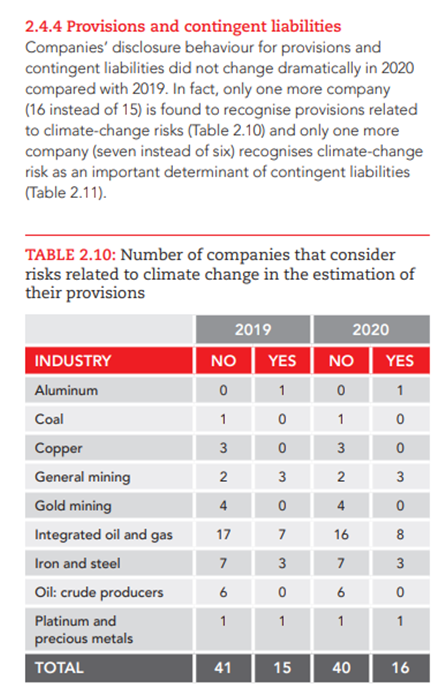
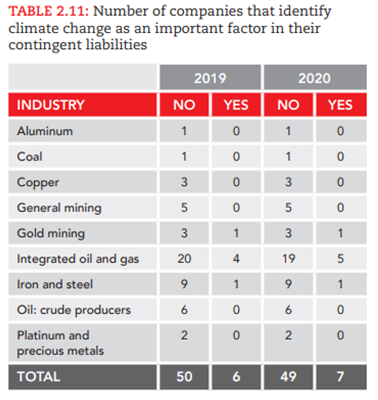
A2. The extracts below from the joint ACCA and University of Glasgow research on risk-related disclosures in extractive industries7 found limited disclosure relating to recognising climate-change in provisions and contingent liabilities.
2.4.4 Provisions and contingent liabilities Companies' disclosure behaviour for provisions and contingent liabilities did not change dramatically in 2020 compared with 2019. In fact, only one more company (16 instead of 15) is found to recognise provisions related to climate-change risks (Table 2.10) and only one more company (seven instead of six) recognises climate-change risk as an important determinant of contingent liabilities (Table 2.11).
A3. The FRC noted in their TCFD Disclosures and Climate in the Financial Statements8 thematic that Shell had a transparent internal best estimate regarding future oil price assumptions.
8. Climate change in the financial statements
Oil price assumptions
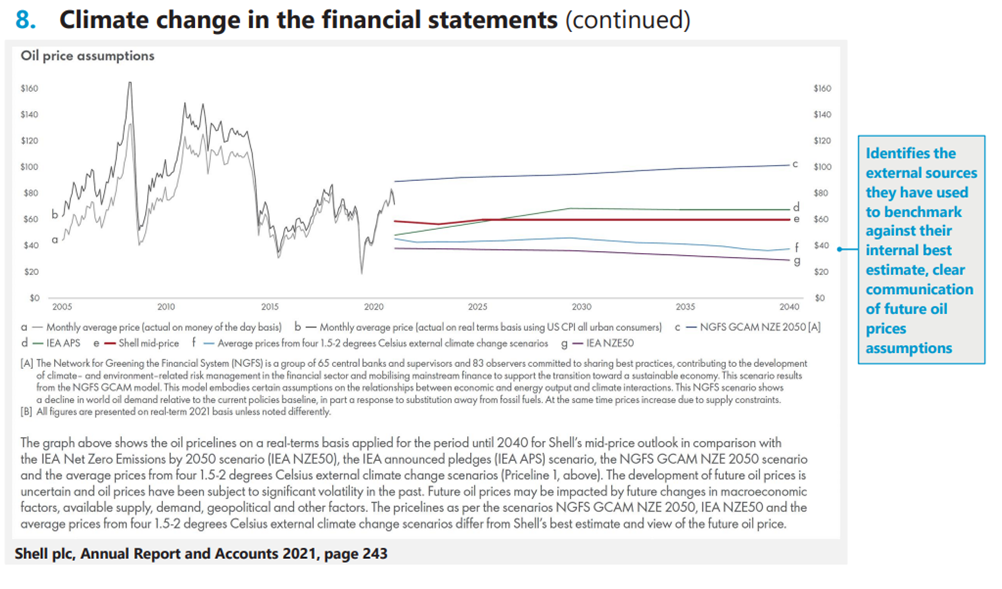
Identifies the external sources they have used to benchmark against their internal best estimate, clear communication of future oil prices assumptions
a - Monthly average price (actual on money of the day basis) b - Monthly average price (actual on real terms basis using US CPI all urban consumers) c - NGFS GCAM NZE 2050 [A] d - IEA APS e - Shell mid-price Average prices from four 1.5-2 degrees Celsius external climate change scenarios g - IEA NZE 50 [A] The Network for Greening the Financial System (NGFS) is a group of 65 central banks and supervisors and 83 observers committed to sharing best practices, contributing to the development of climate- and environment-related risk management in the financial sector and mobilising mainstream finance to support the transition toward a sustainable economy. This scenario results from the NGFS GCAM model. This model embodies certain assumptions on the relationships between economic and energy output and climate interactions. This NGFS scenario shows a decline in world oil demand relative to the current policies baseline, in part a response to substitution away from fossil fuels. At the same time prices increase due to supply constraints. [B] All figures are presented on real-term 2021 basis unless noted differently.
The graph above shows the oil pricelines on a real-terms basis applied for the period until 2040 for Shell's mid-price outlook in comparison with the IEA Net Zero Emissions by 2050 scenario (IEA NZE50), the IEA announced pledges (IEA APS) scenario, the NGFS GCAM NZE 2050 scenario and the average prices from four 1.5-2 degrees Celsius external climate change scenarios (Priceline 1, above). The development of future oil prices is uncertain and oil prices have been subject to significant volatility in the past. Future oil prices may be impacted by future changes in macroeconomic factors, available supply, demand, geopolitical and other factors. The pricelines as per the scenarios NGFS GCAM NZE 2050, IEA NZE50 and the average prices from four 1.5-2 degrees Celsius external climate change scenarios differ from Shell's best estimate and view of the future oil price.
Shell plc, Annual Report and Accounts 2021, page 243
Appendix B: Extracts from IFRS Sustainability Disclosure Standards
Financial effects of sustainability-related risks and opportunities
B1. S1 requires the disclosure of material information about sustainability-related financial risks and opportunities and sets out general reporting requirements. S2 is an application of S1 but specific to climate-related risks and opportunities. These standards focus primarily on financial disclosures as opposed to criteria for recognition or measurement.
B2. S1 (paragraph 22) and S2 (paragraph 14) require an entity to explain the anticipated financial effects of sustainability-related risks and opportunities over the short, medium and long term regarding the most recently reported financial position, financial performance and cash flows. In addition, an entity is required to explain how its strategy will address these risks and opportunities and how that may affect the entity's financial position and performance over time.
B3. Specifically, an entity needs to disclose information on how significant sustainability-related risks and opportunities have affected its most recently reported financial position, financial performance and cash flows and, for which there is a significant risk that there will be a material adjustment to the carrying amounts of assets and liabilities reported in the financial statements within the next financial year (S1 paragraph 22 (a) and (b)).
B4. The relevant sections of these draft standards relevant to connectivity with liabilities and provisions are set out below.
[draft] IFRS S1
B5. Paragraphs 42–44 of S1 set out the requirements for 'connected information' and note that sustainability information may also need to be linked to the financial statements. This includes providing information to enable users of general-purpose financial reporting to assess the connections between the sustainability-related risks and opportunities, and to assess how information about these risks and opportunities are linked to information in the general-purpose financial statements. It also requires a description of the relationships between different pieces of information, which includes the requirement to connect narrative information on governance, strategy and risk management to related metrics and targets.
B6. To promote alignment with the financial statements the ISSB has specified requirements to enable users to connect the disclosures where required. S1 proposes that sustainability-related financial disclosures are:
a) prepared for the same reporting entity and reporting period as the related financial statements (paragraph 66); b) provided at the same time as the financial statements and within the general-purpose financial report (paragraph 66); and c) include financial data and assumptions that are consistent with the corresponding financial data and assumptions in the financial statements, to the extent possible (paragraph 80) [considering IFRS Accounting Standards4].
[draft] IFRS S2
B7. When specifically considering climate-related matters, S2 (paragraph 14), requires an entity to disclose:
a) how climate-related risks and opportunities have affected its most recently reported financial position, financial performance and cash flows; b) information about the climate-related risks and opportunities identified in (a) for which there is a significant risk that there will be a material adjustment to the carrying amounts of assets and liabilities reported in the financial statements within the next financial year; c) how it expects its financial position to change over time, given its strategy to address significant climate-related risks and opportunities, reflecting: 1. its current and committed investment plans and their anticipated effects on its financial position (for example, capital expenditure, major acquisitions and divestments, joint ventures, business transformation, innovation, new business areas and asset retirements); 2. its planned sources of funding to implement its strategy; and d) how it expects its financial performance to change over time, given its strategy to address significant climate-related risks and opportunities; and e) if the entity is unable to disclose quantitative information for paragraph 14(a)–(d), an explanation of why that is the case.
B8. Paragraph 22 (b) also requires that, for the disclosures relevant to the cross-industry metric categories (as required by paragraph 21), an entity should explain the connections between information disclosed and amounts in the financial statements.
B9. S2 requires entities to disclose climate-related targets, including performance against and progress towards those targets. Entities are also required to disclose their transition plans, which include actions planned to transition toward a lower-carbon economy.
Exemption for commercially sensitive information for sustainability-related opportunities
B10. In January 2023, the ISSB introduced an exemption in IFRS S1 to permit an entity to exclude commercially sensitive information from its disclosure of sustainability-related opportunities. The ISSB also considered but rejected the idea of expanding the exemption to sustainability-related risks. Consequently, entities would have to disclose information about these risks regardless of commercial sensitivity.
B11. An entity applying the exemption would instead disclose the fact that it has used the exemption. It would not be able to use commercial sensitivity as a justification for broad non-disclosure.
Appendix C: Extracts from IFRS Accounting Standards
C1. IFRS Accounting Standards use specific criteria to determine when an entity can recognise a liability or a provision or when to disclose a contingent liability. Therefore, while an entity's strategy to address sustainability-related risks and opportunities may sometimes meet the accounting criteria for recognition or disclosure, it is also possible that it may fail to meet the accounting criteria for recognition or disclosure in the financial statements until an unspecified future period.
C2. This tension between the reporting on sustainability matters and reporting in financial statements is already visible in countries, like the UK, where reporting on these matters is already required. However, except for mandatory TCFD for all large entities, sustainability reporting is not formally standardised.
C3. While accounting standards do not specifically cover climate-related risks or opportunities the IASB has issued guidance that indicates that they adequately cater for all material risks or opportunities9 The accounting standards relevant to the recognition and measurement of liabilities and provisions and the disclosure requirements are set out below.
Conceptual Framework
C4. While the Conceptual Framework does not apply directly to financial statements, one of its purposes is to assist all parties to understand and interpret the IFRS Accounting Standards. Hence relevant extracts from the Conceptual Framework are set out below.
Definition of a liability
C5. The Conceptual Framework (CF paragraph 4.26) defines a liability as a present obligation of the entity to transfer an economic resource as a result of past events.
Recognition criteria
C6. For a liability to exist (CF paragraph F 4.27), three criteria must all be satisfied:
a) the entity has an obligation; b) the obligation is to transfer an economic resource; and c) the obligation is a present obligation that exists as a result of past events.
Measurement
C7. The CF also specifies the concept of measurement (paragraph F 4.54) as involving the assigning of monetary amounts at which the elements of the financial statements are to be recognised and reported.
IAS 1 Presentation of Financial Statements
Disclosure
C8. IAS 1 Presentation of Financial Statements requires certain disclosures in relation to significant judgements and sources of estimation uncertainty as follows.
C9. Paragraph 122 requires disclosure of judgements, apart from those involving estimation, that have the most significant effect on the amounts disclosed in the financial statements.
C10. Paragraph 125 requires disclosure of information about those assumptions or sources of estimation uncertainty that have a significant risk of resulting in a material adjustment to the carrying amounts of assets or liabilities in the next financial year, including details of the nature of those assets and liabilities and their carrying amount.
C11. Paragraph 129 provides examples of the type of disclosures that may be required to address the requirements of paragraph 125. This includes examples of the nature of the assumption or estimation uncertainty, sensitivity disclosures and explanation of changes to past assumptions.
IAS 8 Accounting Policies, Changes in Accounting Estimates and Errors
Disclosure
C12. IAS 8 Accounting Policies, Changes in Accounting Estimates and Errors (paragraph 39) requires disclosures with respect to the nature and amount of changes in accounting estimates that has an effect in the current period or is expected to have an effect in a future period. An example of this is estimating a provision for warranty obligations, applying IAS 37.
IAS 37 Provisions, Contingent Liabilities and Contingent Assets
Definition of a provision
C13. Paragraph 10 of IAS 37 Provisions, Contingent Liabilities and Contingent Assets defines provisions as liabilities of uncertain timing or amount.
C14. Paragraph 10 also sets out the definition of an obligating event, which is an event that creates a legal or constructive obligation that results in an entity having no realistic alternative to settling that obligation. Legal obligations arise from a contract, legislation of other operation of law, while constructive obligations arise from an entity's actions, through which it has indicated to others that it will accept certain responsibilities, and as a result has created a valid expectation that it will discharge those responsibilities.
Recognition criteria for a provision
C15. Paragraph 14 sets out the criteria for a provision to be recognised as:
a) an entity has a present obligation (legal or constructive) as a result of a past event; b) it is probable that an outflow of resources embodying economic benefits will be required to settle the obligation; and c) a reliable estimate can be made of the amount of the obligation.
C16. Paragraph 17 (b) states that a constructive obligation is created where the event creates valid expectations in other parties that the entity will discharge the obligation.
C17. Where it is not probable that a present obligation exists, an entity discloses a contingent liability, unless the possibility of an outflow of resources embodying economic benefits is remote (paragraph 23)
C18. Paragraph 26 states that, in the extremely rare case where no reliable estimate can be made, a liability exists that cannot be recognised, but disclosed as a contingent liability.
Contingent liabilities
C19. Paragraph 16 sets out that if the criteria for a provision are not met, such as in the case of contingent liabilities, no provision is recognised. Contingent liabilities include:
a) present obligations that arise from past events but that are not recognized because an outflow is not probable and/or a reliable estimate cannot be made; and b) possible obligations that arise from past events and whose existence will be confirmed only by uncertain future events that are not wholly within the entity's control.
C20. Contingent liabilities are not recognised (paragraph 27), but disclosed (paragraph 28), unless the probability of an outflow is remote.
Contingent assets
C21. IAS 37 paragraphs 31–35 contain guidance on contingent assets. Although these are not the focus of this paper, they are relevant to the discussion of connectivity. Contingent assets are the asset-equivalent of the second type of contingent liabilities described above, i.e. they are possible assets rather than possible obligations. Similar to contingent liabilities, they are disclosed and not recognized.
Measurement of a provision
C22. Paragraph 36 of IAS 37 states that amount recognised as a provision should be measured as the best estimate of the expenditure required to settle the present obligation at the end of the reporting period.
C23. Paragraph 37 goes on to state that the best estimate of the expenditure required to settle the present obligation is the amount that an entity would rationally pay to settle the obligation at the end of the reporting period or to transfer it to a third party at that time.
C24. The entity's management needs to exercise judgement when estimating the outcome and financial effect, considering experience of similar transactions and, in some cases, reports from independent experts. The evidence considered to support the estimate should also include any additional evidence provided by events after the reporting period (paragraph 38).
C25. There are various ways in which to deal with uncertainties surrounding estimating the amount to be recognised for a provision including:
a) For a large population of items, determined the 'expected value' by weighting all possible outcome by their associated probabilities. Where there is a continuous range of possible outcomes, and each point in the range is as likely as the any other, the mid-point of the range should be used (paragraph 39). b) Where a single obligation is being measured, the individual most likely outcome may be the best estimate of the liability (paragraph 40). It is important, however, to still consider other possible outcomes. Where other possible outcomes are either mostly higher or mostly lower than the lost likely outcome, the best estimate will be a higher or lower amount.
C26. Paragraph 41 states that the provision is measured before tax, as the tax consequences of the provision, and changes in it, are dealt with under IAS 12 Income Taxes.
Disclosure
C27. IAS 37 paragraphs 84–92 sets out the disclosure requirements and entities would disclose, for provisions and contingent liabilities their nature, an indication of uncertainties about the amount or timing of related outflows, and possible reimbursements. For provisions, entities would also disclose major assumptions about future events, and for contingent liabilities, entities would also disclose an estimate of their financial effect (where practicable). For contingent assets, entities would only need to disclose their nature and an estimate of their financial effect (where practicable).
Exemption from disclosing commercially sensitive information
C28. IAS 37.92 exempts these disclosures 'in extremely rare cases' when disclosure can be expected to prejudice seriously the entity's position in a dispute with other parties. In such cases, the entity would instead disclose the general nature of the dispute together with the fact that, and reason why, the information has not been disclosed.
Appendix B: Connectivity Background
Context and interaction with UKEB due process
Context
B1. The ISSB has taken a tentative decision to issue a Request for Information (RFI), to inform their initial two-year work plan, in May 2023. One of the four potential projects in the RFI may include a project that focusses on integration in reporting. The project may include a discussion of the requirements in IFRS S1 and IFRS S2 in relation to connected information in the financial statements.
B2. Due to the closeness of the publication of the ISSB RFI it is critical that the UKEB begin to develop a fuller understanding of this new area so that it can provide a meaningful and evidence-based response to the ISSB on a timely basis.
B3. In addition, the IASB agreed, at its March 2023 meeting for a project to commence on 'Climate-related Risks in the Financial Statements'. This project has commenced due to the fact that the ISSB has completed its deliberations on its first two Standards, Draft IFRS S1 General Requirements for Disclosure of Sustainability-related Financial Information (S1) and IFRS S2 Climate-related Disclosures, so the IASB has a stable set of decisions to inform their project.
B4. The scope of the UKEB work1 is to assess the overlap and connectivity between the requirements of IFRS Sustainability Disclosure Standards and those of IFRS Accounting Standards, as well as the information that results from the application of the two sets of standards. We will consider the content of the two ISSB Exposure Drafts2 and any practical needs for connectivity arising from their application via a series of papers for discussion by the UKEB Board.
B5. The UKEB Secretariat are therefore developing a series of preparatory papers which consider the connectivity themes between the ISSB [draft] IFRS Sustainability Disclosure Standards and IFRS Accounting Standards for consideration and discussion by the UKEB. It is intended that this work will be of benefit to both the ISSB and the IASB as they develop their work plans.
UKEB Due Process
B6. As this work is preparatory, fact finding in nature and does not seek to form any policy positions, a Project Initiation Plan (PIP) is not required. Stakeholder feedback will be sought from UKEB Advisory and Working Groups to help inform the Board discussion and enrich feedback to the ISSB and IASB.
B7. In accordance with the UKEB Due Process, when the ISSB issue an RFI, a formal PIP will be presented to the UKEB at the June meeting for consideration.
Connected information
B8. Draft IFRS S1 General Requirements for Disclosure of Sustainability-related Financial Information (S1) contains a section regarding ‘connected information’3 which proposes that an entity will be required to provide users of general-purpose financial reporting with information that enables them to assess the connections between:
a) various sustainability-related risks and opportunities; b) the governance, strategy and risk management related to those risks and opportunities, along with metrics and targets; and c) sustainability-related risks and opportunities and other information in general purpose financial reporting, including the financial statements.
B9. The IASB has communicated4 that accounting standards adequately cater for all material risks, including those arising from sustainability-related issues.
B10. However, there is a growing concern and demand from stakeholders in the UK to improve the connectivity between the narrative reporting on sustainability related financial effects with the associated impacts on the financial statements. Examples of studies carried out and reports issued are those by Carbon Tracker5 and the FRC's Thematic Review 6.
B11. Stakeholder views will be sought from UKEB Advisory and Working Groups as well as other National Standard Setters (NSS) and presented for discussion meetings of the International Forum of National Standard Setters (IFASS). When the ISSB RFI project on connectivity is issued, formal outreach with UK stakeholders will be conducted as part of the response to the ISSB.
B12. We consider interoperability i.e. alignment between IFRS Sustainability Disclosure Standards and other jurisdictional sustainability initiatives (e.g., EFRAG's ESRS and the climate related disclosures proposed by the SEC) to be out of scope.
Relationship between the IASB and ISSB Standards
B13. A key relationship between the IASB and ISSB standards is that they are intended to provide information about an entity for the same reporting period and at the same time. They aim to primarily provide relevant and timely information to meet investors requirements. However, it is unclear how investors will be able to connect the two types of information and understand the impact on the entity's profitability or financial position.
B14. In the UK, the working assumption is that the information will be presented in the Annual Report as entities are required to incorporate Task Force on Climate-Related Financial Disclosures (TCFD) in their Strategic Report.
B15. From a practical operational perspective, preparers will need to ensure there is adequate communication between internal ESG reporting teams (who may be unfamiliar with accounting standards) and financial reporting teams (who may be unfamiliar with sustainability standards) to ensure connectivity within the Annual Report. As the information will be required at the same time, for the same financial period and across an entity's value chain, there will also be implications and connectivity requirements for data, systems, processes, and controls.
Differences and similarities between the standards
B16. There are several differences between proposed IFRS Sustainability Disclosure Standards and the current IFRS Accounting Standards. Due to the forward-looking nature and longer time frames of sustainability risks and opportunities, the ISSB standards will likely require reporting entities to provide descriptions, numbers, or ranges of numbers in the narrative disclosures that won't necessarily connect directly to the financial statements.
B17. As the information is prepared on a different basis, it is unlikely to be identical. However, users still need to be able to make connections, where appropriate, and understand the financial effects of sustainability matters, both in the narrative disclosures as well as in the financial statements, to the extent relevant.
B18. Key differences identified so far include:
a) Timeframe - sustainability disclosures require the disclosure of the financial effects over the short, medium, and long term but do not define those periods. IAS 1 Presentation of Financial Statements requires management to look at least 12 months from the end of the reporting period and requires the distinction to be made between current and non-current assets and liabilities. b) Perspective - while accounting standards consider forward looking information such as with impairment testing and useful economic lives, the amounts generally reflect historic cost values7. Sustainability disclosures are forward looking in nature and use scenarios, assumptions and estimates to forecast a range of possible future outcomes. c) Scope - sustainability disclosures require material information about sustainability-related risks and opportunities across a company's 'value chain'. The value chain is defined as the 'full range of activities, resources and relationships related to a company's business model and the external environment in which it operates'. Accounting standards have a narrower definition of scope related to the legal reporting entity or group of companies. d) Recognition – Reporting levels of greenhouse gas emissions require measurement and there is an increased focus on emissions and emission rights which may lead to an expectation around recognition of related assets or liabilities. This would not necessarily lead to an immediate recognition of an asset or liability in the financial statements8 but may lead to their recognition in a later period. e) Assurance - IFRS financial statements are typically subject to independent audit by an established network of experienced audit professionals. It is yet to be determined what level of assurance will be required for sustainability disclosures or who might undertake that work.
B19. The key similarities
a) Adapted from IFRS Accounting Standards – primarily IAS 1 Presentation of Financial Statements and IAS 8 Accounting Policies, Changes in Accounting Estimates and Errors. The ISSB has also redeliberated to use concepts from IFRS Accounting Standards. For example, entities are required to use information that is 'reasonable and supportable and available without undue cost or effort' which is consistent with IFRS 9 Financial Instruments. b) Materiality - the ISSB redeliberated and tentatively agreed to use the same definition of material as IFRS Accounting Standards to ensure investors understand sustainability risks and opportunities i.e. ‘Information is material if omitting, misstating or obscuring it could reasonably be expected to influence investor decisions.’9 c) Publication and reporting period – entities are required to disclose sustainability-related financial information as a part of general-purpose financial reporting. This is intended to ensure that financial statement information and sustainability-related financial disclosures can be considered together.
IASB accounting standards: disclosure requirements
B20. IAS 1 provides several overall disclosure requirements that are in addition to requirements specified in other topic-specific standards (for example those in IAS 36 Impairment of Assets and IAS 16 Property, Plant and Equipment). These overall requirements provide an 'understanding' for stakeholders in relation to:
a) Fair presentation (para. 17) and Materiality and aggregation (para. 31): 'provide additional disclosures when compliance with the specific requirements in IFRSs is insufficient to enable users to understand the impact of particular transactions, other events and conditions on the entity's financial position and financial performance.' b) Structure of the notes (para. 112c): The notes shall: ... '(c) provide information that is not presented elsewhere in the financial statements but is relevant to an understanding of any of them.' c) Accounting policy information (para. 117): disclose material accounting policy information – i.e., when considered together with other information included in an entity's financial statements, it can reasonably be expected to influence decisions that the primary users of general-purpose financial statements make on the basis of those financial statements.' d) Judgements (para. 122): judgements that management has made in the process of applying the entity's accounting policies and that have the most significant effect on the amounts recognised in the financial statements.' e) Sources of estimation uncertainty: a further requirement (paras. 125, 129) to: 'disclose information about the assumptions [the company] makes about the future, and other major sources of estimation uncertainty at the end of the reporting period, that have a significant risk of resulting in a material adjustment to the carrying amounts of assets and liabilities within the next financial year.'
ISSB sustainability disclosure standards: requirements
B21. Draft IFRS S1 and S2 require the disclosure of the financial effects of sustainability and climate-related risks and opportunities. Draft IFRS S2 specifically requires the disclosure of information regarding an entity's exposure to climate-related risks and opportunities, including current and anticipated impacts on its business model, financial statements and cash flows.
B22. Draft IFRS S2 requires disclosure of quantitative information (single amounts or a range) unless an entity is unable to do so. In that situation, an entity must disclose qualitative information. The objective of the approach is to allow investors to connect between different sustainability-related risks and opportunities and to understand how those items relate to the entity's financial statements.
B23. Specific disclosures are required for physical (e.g. flood risk), transition (e.g. regulatory change risk) and climate-related opportunities (e.g. new technology) in relation to their current and anticipated financial effects:
a) Financial impacts: how significant climate-related risks and opportunities have affected its most recently reported financial position, financial performance and cash flows. b) Quantitative and qualitative: if the entity is unable to disclose quantitative information, an explanation of why that is the case is required and qualitative disclosures are required. c) Material risk: for information identified in (a) above for which there is a significant risk that there will be a material adjustment to the carrying amounts of assets and liabilities reported in the financial statements within the next financial year. d) Changes in financial position: how the entity expects its financial position to change over time, given its strategy to address significant climate-related risks and opportunities, reflecting: 1. its current and committed investment plans and their anticipated effects on its financial position (for example, capital expenditure, major acquisitions and divestments, joint ventures, business transformation, innovation, new business areas and asset retirements); and, 2. its planned sources of funding to implement its strategy. e) Timeframe: how an entity expects its financial performance to change over the short, medium and long terms, given its strategy to address significant climate-related risks and opportunities (for example, increased revenue from or costs of products and services aligned with a lower-carbon economy, consistent with the latest international agreement on climate change; physical damage to assets from climate events; and the costs of climate adaptation or mitigation). f) Reporting Boundary – disclosures are required regarding significant climate-related risks and opportunities in an entity's value chain and where in that chain the significant climate-related risks and opportunities are concentrated.
Issuing new standards or amending existing standards
B24. In developing their respective standards, the IASB and ISSB would need to retain at the forefront of their decision-making that, both investors and entities think in a 'connected' way about the linkup between financial statements and sustainability disclosures. The pressure for this connectivity is expected, in the first instance, for items that are material to communicate in both the financial statements and the sustainability disclosures. However, the need for connectivity is likely to become pervasive as further standards are developed by the ISSB.
B25. The draft IFRS Sustainability Disclosure Standards have highlighted that entities cannot consider sustainability and climate-related issues in isolation. Consideration of how the sustainability-related reporting relates to the financial statements is essential, especially if any additional or new risks to the entity are identified because of that process. It is, therefore, possible that the new sustainability disclosure standards also have implications for the application of existing IFRS Accounting Standards. Some examples of the potentially affected application of IFRS Accounting Standards, include:
a) Assets: 1. Recognition. 2. Measurement (depreciation and revaluation models). 3. Impairment. 4. Expected credit losses related to financial assets. b) Liabilities and provisions: 1. Confidential and commercially sensitive information. 2. Recognition. c) Fair value measurement. d) Disclosures: 1. Purpose and objectives of sustainability disclosures. 2. Scope of estimation uncertainty. 3. Communicating levels of uncertainty – hierarchy of disclosures. 4. Risk disclosures relating to financial assets, non-financial assets and liabilities. 5. Sustainability policy disclosures. 6. Reporting of outcomes against previously disclosed plans. 7. Internal transfer pricing vs internal carbon pricing. e) Other considerations 1. Scope of consolidated information. 2. Control. 3. Exemption from disclosure. f) Conceptual Framework and materiality: Implications for the Conceptual Framework.
B26. It is also likely that, in this new way of considering reporting by entities, the opposite is also true, and that issuing new or amended IFRS Accounting Standards may also have implications for the IFRS Sustainability Disclosure Standards.
Next steps
B27. The topics of future papers are shown in the table below. They are based on the themes noted above and identified in the UKEB staff paper presented at the January 2023 meeting of IFASS.
| UKEB meeting | Connectivity Topics | Status |
|---|---|---|
| March | Asset recognition, measurement, and impairment | Complete |
| April | Liabilities and provisions | In progress |
| May | Fair value and measurement | |
| June | Disclosures | Pipeline |
| July | Other considerations | |
| September | Conceptual Framework |
Footnotes
-
UKEB Comment Letter to ISSB [draft] IFRS S1 and [draft] IFRS S2 (page 17, paragraph B15 c) ↩↩
-
Letter from Lord Callanan to the International Sustainability Standards Board regarding their Exposure Drafts IFRS S1 and IFRS S2 (1 August 2022). ↩
-
Note: only the text of the ISSB Exposure Drafts was available at the time of writing this paper. ↩↩
-
Conceptual Framework [paragraphs 3.4-3.6] notes that financial statements are prepared for a specified period of time and provide comparative information and under certain circumstances forward-looking information. ↩↩
-
Conceptual Framework [paragraph 3.10] A reporting entity is an entity that is required, or chooses, to prepare financial statements. A reporting entity can be a single entity or a portion of an entity or can comprise more than one entity. A reporting entity is not necessarily a legal entity. ↩↩
-
Conceptual Framework [paragraph 5.6] Only items that meet the definition of an asset, a liability or equity are recognised in the statement of financial position. ↩↩