13 Items to note
Appendix A: ISSB General Update
ISSB March Board meeting
A1The ISSB met remotely on 16 March 2023 and discussed the following items:
A2The ISSB Update with the tentative decisions made at the ISSB's March 2023 can be found here.
ISSB supplementary April meeting
A3The ISSB held a supplementary remote meeting on 4 April and discussed [draft] IFRS S1General Sustainability-related Disclosures (S1) transition relief3.
A4The updates relevant to the UKEB remit are reflected in the tables below. The full ISSB Update for the supplementary April meeting with all tentative decisions can be found here.
ED IFRS S1 and S2: Summary of ISSB's tentative decisions
A5The tables below set out a summary of relevant tentative decisions made by the ISSB in its March and 4 April 2023 meetings and notes the alignment to the proposals and recommendations in the UKEB Comment Letter on [draft] S1 and [draft] IFRS S2 Climate-related Disclosures (S2).
| Meeting date | ED Proposal | UKEB comment letter | ISSB tentative decision4 |
|---|---|---|---|
| Effective Date and transitional arrangements | |||
| February 2023 4 April 2023 | TBC | Noted the absence of an endorsement mechanism, a low level of user and preparer readiness and suggested consideration of phased effective dates and use of safe harbour provisions. Suggested effective dates could be considered with insight gained from field testing with a range of preparers and jurisdictions to determine if phasing some of the more challenging disclosure requirements may be required. | a) That both draft S1 and draft S2 would be effective for annual reporting periods beginning on or after 1 January 2024. b) Early adoption is permitted, but only if an entity applies both IFRS S1 and IFRS S2 at the same time. c) Transitional reliefs and tentatively agreed that entities will be temporarily permitted to: i. separately report their sustainability-related financial disclosures later than the publication of their financial statements; ii. not be required to use the GHG Protocol Corporate Standard when initially applying IFRS S2, and iii. not be required to disclose Scope 3 GHG emissions. |
| At the 4 April ISSB meeting it was tentatively agreed that: a) A transition relief will be introduced for draft IFRS S1 allowing an entity to report on only climate-related risks and opportunities in the first year it applies draft IFRS S1 and draft IFRS S2. b) The one-year transition relief would not change the effective date of IFRS S1. The requirements in IFRS S1 would still apply to the extent they relate to the disclosure of climate-related financial information. c) This transition relief would have no effect on the application of or requirements in IFRS S2. The ISSB clarified that comparative information for climate-related financial information would be required in the second year of application. | |||
| [UKEB Secretariat view: The additional initial transitional relief regarding draft IFRS S1are likely to be welcomed by UK stakeholders, especially medium and small entities who may find the comprehensive level of compliance challenging. However, due to the low level of readiness stakeholders may find the early effective dates challenging.] |
ISSB's April 17–21 2023 meeting
A6The ISSB is due to meet 17–21 April 2023 in Frankfurt, Germany. The board will be discussing:
Consultation on Agenda Priorities
- Due process steps and permission to publish the Request for Information5.
International Applicability of the SASB Standards
A7As the ISSB April meeting coincides with the UKEB papers being issued, a verbal update of the relevant points will be provided at the UKEB April meeting. A short summary of the ISSB 17–21 April papers is included below for information.
ISSB Agenda Priorities
A8The ISSB staff have recommended a 120-day comment period after having evaluated the alternatives and taken into consideration the time stakeholders need to consider the RFI and provide high-quality responses.
A9Subject to the ISSB's approval, the RFI will be published in May 2023, and the comment period will end in September 2023. The ISSB will request feedback primarily via electronic survey, rather than traditional comment letters to facilitate a timelier analysis of feedback. Stakeholders will still be able to submit comments in an open text style.
A10ISSB staff plan to present an analysis of the RFI feedback in the fourth quarter of 2023.
SASB Standards
A11The ISSB staff are seeking ratification from the ISSB for the Exposure Draft Methodology for Enhancing the International Applicability of the SASB Standards. The staff will seek approval for a 90-day comment period and request the ISSB to confirm it is satisfied that the applicable due process requirements have been met.8
A12This Exposure Draft details the methodology proposed to be used by the ISSB for amending SASB Standards metrics to enhance their international applicability. It also includes the proposed approach for updating the digital SASB Standards Taxonomy to reflect amendments made to the SASB Standards. The proposed scope excludes all SASB Standards metrics included in S2 as amendments for climate-related metrics were included in that proposed standard.
IFRS Foundation updates
A13IASB Chair Andreas Barckow and ISSB Chair Emmanuel Faber published a joint article entitled “Connectivity—what is it and what does it deliver?”9 The article states that together they can ensure that there are no incompatibility of concepts, gaps or unintended overlaps between IASB and ISSB Standards.
A14The IFRS Foundation has published a blog10 from the Integrated Reporting Foundation, which is now a part of the IFRS Foundation. The blog promotes the use of the Integrated Reporting Framework and provides examples where preparers have successfully adopted the framework.
UK updates
A15In March 2023, the UK Government published an update to the 2019 Green Finance Strategy: Mobilising Green Investment 2023 Green Finance Strategy11, which confirms the government's support for IFRS Sustainability Disclosure Standards and sets out the intention to launch a formal assessment mechanism, following publication of IFRS S1 and S2. The decision regarding endorsement of the final standards for use in the UK should be made within 12 months of their publication.
A16The Financial Conduct Authority (FCA) received around 240 responses to its consultation on Sustainability Disclosure Requirements (SDR) and investment labels, which closed on 25 January 2023. To take account of the significant response, the Policy Statement on the new requirements, which was scheduled for publication in H1 2023, is now expected in Q3 2023. The proposed effective dates will be adjusted accordingly12.
International updates
A17The European Commission13 has requested EFRAG prioritise implementation support for the first Set of European Sustainability Reporting Standards (ESRS). Commissioner McGuinness has publicly called on EFRAG to prioritise its efforts on capacity building for the implementation of the first set of ESRS over the preparatory work for the draft sector-specific standards.
A18The first Chair and members of the Canadian Sustainability Standards Board (CSSB) have been announced14. The board will be Chaired by Charles-Antoine St-Jean. The CSSB Implementation Committee, which is providing transitional oversight until the permanent oversight structure is determined, also appointed three members who bring sustainability expertise from across Canada's market.
Appendix B: IFASS April 2023
Connectivity – Assets (Staff paper)
Connectivity – Asset recognition, measurement, and impairment
Staff paper presented to IFASS in April 2023
Introduction
B1At the January 2023 IFASS meeting, the UK Endorsement Board (UKEB) Secretariat presented an introductory staff paper regarding the connectivity between sustainability reporting and financial statements. That paper was developed in consultation with the Canadian Accounting Standards Board (AcSB).
B2A poll was conducted, as part of that presentation, which resulted in 95% of participants placing a high level of importance on the connectivity between sustainability disclosures and financial reporting.
B3As the majority of IFASS members considered connectivity to be important, the UKEB and a number of other National Standard Setters (NSS) established a NSS Sustainability Forum15. The purpose of the NSS Sustainability Forum is to: develop an understanding of connectivity issues between IFRS Accounting Standards and IFRS Sustainability Disclosure Standards; consider possible solutions that would address the stakeholder need for connectivity between information presented in companies' sustainability reports and financial reports; and, share them with the International Sustainability Standards Board (ISSB) and the International Accounting Standards Board (IASB) as they develop high quality international standards.
B4This new UKEB Secretariat paper considers the implications for asset recognition, measurement, and impairment. The paper reflects the UKEB Secretariat's initial research on this topic. The paper does not represent the views of the UKEB, as a whole, or individual Board Members.
IASB and ISSB Activities
B5Since the January meeting, both the IASB and the ISSB have made announcements regarding connectivity16.
B6The IASB has activated a maintenance project to explore “whether and how companies can provide better information about climate-related risks in their financial statements”17 and the ISSB has announced that one of the four projects tentatively agreed in the Request for Information (RFI) will relate to "integration in reporting". The ISSB project will reference the requirements of connected information in [draft] IFRS S1 General Requirements for Disclosure of Sustainability-related Financial Information (S1) and [draft] IFRS S2 Climate-related Disclosures (S2).
B7This UKEB Secretariat paper, together with the preparatory research of the other NSS, has been prepared to provide a useful basis for discussion, regarding connectivity within jurisdictions, and to support both the ISSB and the IASB as they progress their projects.
Relationship between the IASB and ISSB Standards
B8A key relationship between the IASB and ISSB standards is that they are intended to provide information about an entity for the same reporting period, at the same time, and to inform the same set of primary users. They aim to, primarily, provide relevant and timely information to meet investors requirements. However, it is unclear how investors will be able to connect the sustainability and financial information to enable them to understand the full impact on the entity's profitability or financial position.
B9In the UK, the working assumption is that the information will be presented in the Annual Report as entities are required to incorporate Task Force on Climate-Related Financial Disclosures (TCFD) in their Strategic Report, which is a sub-set of their Annual Report.
B10At a practical operational level, preparers will need to ensure there is adequate communication between internal ESG reporting teams (who may initially be unfamiliar with accounting standards) and financial reporting teams (who may be unfamiliar with sustainability standards) to ensure connectivity within the consolidated Annual Report. As the information is expected to be reported at the same time, for the same financial period, and across an entity's value chain, there will also be implications and connectivity requirements for data, systems, processes, and controls.
B11Appendix one to this paper outlines both the requirements of IFRS S1 and IFRS S2 as well as the IFRS Accounting Standards in relation to assets.
Areas of potential overlap or misalignment
Stakeholder feedback
B12The UKEB Secretariat discussed and sought feedback on the themes in this paper with the SWG18, the UKEB Investor, Preparer, Accounting Firms and Institutions Advisory Groups19, the NSS Sustainability Forum, and the Corporate Reporting User Forum. The feedback from these groups is reflected in this section of the report.
B13The table below sets out the examples tested with the various stakeholder groups and some summary questions raised by investors and other users of accounts. The views of the various stakeholder groups included below are based on discussions of these examples.
| Narrative reporting e.g., TCFD disclosures | Financial Statement asset related disclosures | Connectivity questions from users | |
|---|---|---|---|
| Judgements and estimates | Prominent descriptions of material climate risks, mitigations and opportunities impacting the entity | Limited or no disclosure of the financial effect of these potential events on assets in the balance sheet | Why were the climate-related risks or opportunities not referenced in the financial statements? To what extent were the potential impacts considered in the entity's key judgements and estimates? |
| Discount rates and impairment tests | Disclosure of the entity's strategy to address long term assets affected by physical or transition risks | No financial quantification of climate-related assumptions affecting management's best estimate of recoverable asset amounts | Have climate-related matters been considered in any asset impairment calculations? If not, why not? If reflected, to what extent? |
| Useful economic lives and depreciation | Plans to replace long-lived material assets to reduce carbon emissions to achieve net zero targets | Limited of no disclosure regarding how climate targets have been reflected in asset useful lives, or associated changes in depreciation or amortisation models. | Which type of assets were affected and to what extent? If an assets useful life was reduced to what extent was depreciation accelerated? |
| Segmental reporting and disaggregation | Plans disclosed to restructure the business along new product lines to ensure the entity remains sustainable in the long term | Segmental reporting does not reflect the new business lines | What is the status of the new product lines? Are these lines operating independently or are they integrated with existing product lines? |
| Recognition of non-economic benefits | Significant effort relating to staff wellbeing or additional costs on assets to ensure lower long term carbon emissions | All costs expensed. Amount of spend on sustainability related activities not separately disclosed | This is now an area of increasing relevance for users. There is a long-term non- economic benefit from this cost. Why can it not be recognised as an asset and amortised? |
| Emerging areas | New transaction types as the result of sustainable activities such as the recognition of carbon emission rights as assets. | Diversity of accounting treatment of carbon emission rights and related costs | These types of transactions are increasing in frequency and obtaining more significance for users. |
B14Excerpts of disclosures from FTSE 350 entity annual reports related to assets are included in Appendix Two for information.
User perspectives
B15Both IFRS S1 and S2, and accounting standards, cater for uncertainties regarding future events. However, it may not be obvious to users when disclosures under IFSR S1 and S2 would trigger either recognition or impairment of an asset in the financial statements.
B16Without clear 'sign-posting' this may reduce comparability and result in confusion for users. The table below provides types of examples of disconnects currently experienced by users between narrative reporting e.g., TCFD disclosures regarding climate-related matters and the financial statements.
B17When the ISSB draft disclosure standards are mandated, users will expect to find narrative information on the financial effects of significant sustainability and climate-risks and opportunities on an entity's financial position, financial performance, and cash flows. In addition, they will also expect to have visibility on the anticipated effects over the short, medium, and long term, including how these risks and opportunities are included in the entity's financial planning.
B18Where an entity has identified that climate-related risks or opportunities have a material impact and may have disclosed targets (e.g., net-zero emissions targets) and transition plans, users will want to be able to understand the direct connection to the financial statements.
B19Users have indicated what they would expect, but are often not provided with, to enable them to make this connection in relation to how assets have been recognised, measured, or impaired in the financial statements:
Judgements and estimates
B20A specific statement and explanation when climate matters were not considered as a factor in significant judgements and estimates in the financial statements. For example, where management have considered climate-related risks and opportunities and concluded that there was no material impact on the current financial statements. Clear disclosure when climate risk was a source of estimation uncertainty with a significant risk of material adjustment in the next financial period. For significant judgements, disclosure of sensitivities used and whether they are aligned to those used for scenario analysis.
Impairment reviews
B21Disclosure and explanation of when material climate risks have intentionally not been considered as a factor for impairment or estimates regarding asset values in the financial statements. For example, the assets useful economic life (UEL) may end before the relevant emissions target is due to be achieved. Where climate has been a factor in asset impairment calculations or sensitivities, disclosure of this fact and the effect on cash flow projections or discount rates used.
Useful economic lives of assets (and depreciation and revaluation models)
B22Disclosure of which assets (if any) UEL has been affected by climate risk or the transition to a low carbon economy. Where UEL has been impacted, an explanation of how climate risk had been considered and any changes in depreciation or revaluation models as a result. This should be aligned to any stated net zero targets and be consistent with statements made in the narrative reporting.
Segmental reporting and disaggregated disclosures
B23Where an entity prominently discusses climate opportunities, or new business lines to meet a climate target, these should be explained in the segmental reporting or in disaggregated revenue information. Users have indicated they consider this information material regardless of actual amounts involved as it provides insight into what actual action the entity is undertaking.
Non-economic benefits
B24Users also expressed mixed views on whether non-economic benefits from climate-related expenditure should be recognised as assets. However, they also noted that this would have wider implications on the definitions of assets in the Conceptual Framework and the current accounting standards.
Emerging areas
B25Users noted new transaction types, as the result of sustainable activities, such as the recognition of carbon emission rights as assets (credits or allowances), for which guidance and practice tended to vary, reduced comparability.
Preparers perspective
Adequacy of Accounting Standards
B26Preparers recognised that disclosures, regarding sustainability and climate-related risks and opportunities, have increased in relevance and priority for investors. However, they also considered that both the Conceptual Framework and relevant accounting standards, in general, were adequate and did not support the need for new climate related accounting standards in relation to asset recognition, measurement, or impairments.
Accounting principles and non-economic benefits
B27Preparers noted challenges with users' understanding of accounting principles and rules regarding asset recognition. For example, where an entity had not discussed climate impacts in the financial statements, there can be an incorrect assumption that the entity had failed to consider it at all. They noted that where there was no material financial impact from climate change on the current financial statements, legitimately, no climate related disclosures would be required.
B28Preparers also found that some users queried the rationale for why material costs related to advertising or staff training are not recognised as assets on the balance sheet as this cost can provide a future economic benefit. Preparers explained that, as the spend did not meet the accounting requirement for asset recognition, it was expensed in the statement of income and expenditure.
B29They also noted similar queries from users regarding spend which may deliver a longer-term sustainable outcome to the organisation or wider society in which it operates but did not present a current quantifiable economic benefit.
Reporting Implications
B30Several preparers noted that their organisations were now considering separating their sustainability disclosures from the annual report to avoid cluttering the financial statements. They intend to create a separate sustainability report and would provide cross references to the financial statements.
Potential solutions
B31Preparers considered that any required sign posting for users should be included in the narrative disclosures to avoid clutter in the financial statements. This could include, for example, a statement that management had considered the impacts of climate but found that there was no material impact. Therefore, no reference is made in the financial statements.
B32Another preparer commented that the recognition 'gateway' used IFRS 6 Exploration for and Evaluation of Mineral Resources may be useful for determining how climate-related opportunities could be assessed for asset recognition.
B33A preparer commented that the use of note disclosures in the financial statements may assist users to understand the nature of spend related to anticipated non-economic benefits.
B34A preparer advised that due to the frequency of user queries relating to asset impairments they had chosen to disclose an ageing profile for the relevant non-current assets. This had been found helpful for users to understand the context for the entity's impairment considerations.
Accounting Firms and Institutions
Adequacy of Accounting Standards
B35Accounting Firms and Institutions also viewed both the Conceptual Framework and relevant accounting standards as being broadly adequate. However, they also recognised that was a currently a lack of connectivity between the front and back half of annual reports and that some form of 'bridge' was required.
Emerging areas
B36It was noted that new types of climate-related transactions were occurring, such as carbon credits, and were likely to become more material over time. Members were aware that a balance needs to be maintained between the recognition of both assets and liabilities for these types of transactions. For example, where carbon credits are recognised as an asset, but regulators had not yet mandated emissions penalties, a question arises regarding whether a liability may also need to be recognised. Further guidance from the IASB was considered necessary.
Reporting Implications
B37Some accounting firms supported the adoption of the Integrated Reporting Framework as it may solve connection issues. However, other firms noted application challenges and a lack of support from some preparers for this framework.
B38Connectivity challenges were also noted at an operational and cultural level in terms of 'ESG' teams being involved in preparing the annual report and the emphasis on connectivity. It was noted that, while financial reporting teams generally already had robust systems and controls in place, the ESG teams were still developing these capabilities and were less familiar with public scrutiny from investors and regulators.
Potential solutions
B39This group also considered the use of specific note disclosures in the financial statements as an effective way to communicate key sustainability messages to users and to avoid the risk of over disclosure and risk of obfuscation in the financial statements.
B40An accounting firm suggested that a specific section at the end of the narrative report could be created to communicate the extent to which the financial effects as noted would or would not be disclosed in the financial statements. This approach could seek to both educate and manage users' expectations.
Next Steps
B41The UKEB team will work with the NSS Sustainability Forum to develop a series of papers focussing on connectivity issues between sustainability disclosure standards and accounting standards. Papers currently planned for discussion at future UKEB meetings include:
- Liabilities and provisions
- Confidential and commercially sensitive information
- Recognition
- Fair value and measurement
- Disclosures
- Purpose and objectives of sustainability disclosures
- Scope of estimation uncertainty
- Communicating levels of uncertainty – hierarchy of disclosures
- Risk disclosures relating to financial assets
- Sustainability policy disclosures
- Reporting of outcomes against previously disclosed plans
- Internal transfer pricing vs internal carbon pricing
- Other considerations
- Scope of consolidated information
- Control
- Exemption from disclosure
- Conceptual Framework
- Implications for the Conceptual Framework and materiality
Appendix One
IFRS Sustainability Disclosure Standards
Financial effects of sustainability-related risks and opportunities
B42IFRS S1 requires the disclosure of material information about sustainability-related financial risks and opportunities and sets out general reporting requirements. IFRS S2 is specific to climate-related risks and opportunities and includes a measurement approach for greenhouse gas emissions across an entities value chain.
B43IFRS S1 (paragraph 22) and S2 (paragraph 14) require an entity to explain the anticipated financial effects of sustainability-related risks and opportunities over the short, medium and long term regarding the most recently reported financial position, financial performance and cash flows. In addition, the entity is required to explain how its strategy addresses these risks and opportunities and how it may affect the entity's financial position and performance over time.
B44The sections of these draft standards relevant to connectivity with asset recognition, measurement, and impairment are set out below.
[draft] IFRS S1
B45Paragraphs 42 to 44 of IFRS S1 set out the requirements for 'connected information' and note that sustainability information may also need to be linked to the financial statements. This includes providing information to enable users of general-purpose financial reporting to assess the connections between the sustainability-related risks and opportunities, and to assess how information about these risks and opportunities are linked to information in the general-purpose financial statements. It also requires a description of the relationships between different pieces of information, which includes the requirement to connect narrative information on governance, strategy and risk management to related metrics and targets.
B46To promote alignment with the financial statements the ISSB has specified requirements to enable users to connect the disclosures where required. Draft IFRS S1 (paragraph 66) proposes that sustainability-related financial disclosures:
- are prepared for the same reporting entity and reporting period as the related financial statements;
- are provided at the same time as the financial statements and within the general-purpose financial report;
- include financial data and assumptions that are consistent with the corresponding financial data and assumptions in the financial statements, to the extent possible (paragraph 80) [considering IFRS Accounting Standards];
[draft] IFRS S2
B47When specifically considering climate-related matters, S2 (paragraph 14), requires an entity to disclose:
- how climate-related risks and opportunities have affected its most recently reported financial position, financial performance and cash flows;
- information about the climate-related risks and opportunities identified in (a) for which there is a significant risk that there will be a material adjustment to the carrying amounts of assets and liabilities reported in the financial statements within the next financial year;
- how it expects its financial position to change over time, given its strategy to address significant climate-related risks and opportunities, reflecting:
- its current and committed investment plans and their anticipated effects on its financial position (for example, capital expenditure, major acquisitions and divestments, joint ventures, business transformation, innovation, new business areas and asset retirements);
- its planned sources of funding to implement its strategy; and
- how it expects its financial performance to change over time, given its strategy to address significant climate-related risks and opportunities; and
- if the entity is unable to disclose quantitative information for paragraph 14(a)–(d), an explanation of why that is the case.
B49In addition, it would need to provide quantitative information about the financial effects unless it is unable to do so, in which case it would provide qualitative information.
B50Draft IFRS S2 requires entities to disclose climate-related targets, including performance against and progress towards those targets. Entities are also required to disclose their transition plans, which include actions planned to transition toward a lower-carbon economy.20
IFRS Accounting Standards
B51In contrast, IFRS Accounting Standards use specific criteria to determine when an entity can recognise an asset or should conduct a review for impairment. Therefore, while an entity's strategy to address sustainability-related risks and opportunities may sometimes meet the accounting criteria for recognition or impairment, it is also possible that it may fail to meet the accounting criteria for recognition in the financial statements until an unspecified future period.
B52This tension between the reporting on sustainability matters and reporting in financial statements is visible in countries, like the UK, where reporting on these matters is already required. However, except for mandatory TCFD for all large entities, sustainability reporting is not formally standardised.
B53While accounting standards do not specifically cover climate-related risks or opportunities, the IASB has issued guidance that indicates that they adequately cater for all material risks or opportunities21. The accounting standards, relevant to asset recognition, measurement, and impairment and the disclosure requirements, are set out below.
Conceptual Framework
Definition of an asset
B54The Conceptual Framework (CF) (paragraph F 4.4(a)) defines an asset as a resource controlled by the entity as a result of past events and from which future economic benefits are expected to flow to the entity.
Recognition criteria
B55An asset is recognised (CF paragraph F 4.44) in the balance sheet when it is probable that the future economic benefits will flow to the entity and the asset has a cost or value that can be measured reliably.
Measurement
B56The CF also specifies the concept of measurement (paragraph F 4.54) as involving the assigning of monetary amounts at which the elements of the financial statements are to be recognised and reported.
IAS 1 Presentation of Financial Statements
Disclosure
B57IAS 1 Presentation of Financial Statements requires certain disclosures in relation to significant judgements and sources of estimation uncertainty, as follows:
- Paragraph 122 requires disclosure of judgements, apart from those involving estimation, that have the most significant effect on the amounts disclosed in the financial statements.
- Paragraph 125 requires disclosure of information about those assumptions, or sources of estimation uncertainty, that have a significant risk of resulting in a material adjustment to the carrying amounts of assets or liabilities in the next financial year, including details of the nature of those assets and liabilities and their carrying amount.
- Paragraph 129 provides examples of the type of disclosures that may be required to address the requirements of paragraph 125. This includes examples of the nature of the assumption, or estimation uncertainty, sensitivity disclosures and an explanation of changes to past assumptions.
IAS 8 Accounting Policies, Changes in Accounting Estimates and Errors
Disclosure
B58IAS 8 Accounting Policies, Changes in Accounting Estimates and Errors (paragraph 39) requires disclosures with respect to the nature of, and amount of, changes in accounting estimates that have an effect in the current period or are expected to have an effect in a future period. This includes changes in depreciation and amortisation methods and useful lives of assets (see IAS 16 and IAS 38 below)
IAS 36 Impairment of Assets
Definitions
B59According to IAS 36 Impairment of Assets paragraph 6, an impairment loss is the amount by which the carrying amount of an asset, or a cash-generating unit, exceeds its recoverable amount. Recoverable amount is defined as the higher of value in use and fair value less costs of disposal.
Impairment indictors
B60Paragraphs 12–14 describe some indications that an impairment loss may have occurred. If any of those indications is present, an entity is required to make a formal estimate of recoverable amount.
B61Indicators of impairment include:
- significant changes in the market,
- regulatory environment,
- changes to an entity's plans for the asset,
- increases in market interest rates or other rates of return that may indicate the discount rate used in value in use calculations has changed. Where this could lead to a material reduction in the recoverable amount.
Measurement
B62Paragraphs 18–57 set out the requirements and considerations when determining the recoverable amount of an asset. It requires that value in use should be calculated considering the current condition of the assets in the CGU. Therefore, any cash flows arising from improving or enhancing an asset's performance should not be taken into account.
B63The calculation of fair value less costs of disposal should include expenditure of enhancing an asset if a market participant would be expected to incur such expenditure in order to meet regulatory requirements or customer expectations.
Disclosure
B64Paragraphs 134–135 require disclosures about cash-generating units (CGUs) or groups of CGUs irrespective of whether or not an impairment loss (or reversal) is recognised in the period. These disclosures are primarily around the assumptions and estimates used in determining value in use or fair value less costs of disposal, whichever supports the recoverable amount and include:
- The key assumptions to which the recoverable amount is most sensitive.
- A description of management's approach to determining values for key assumptions.
- Whether those values are consistent with external sources of information and past experience and, if not, explain how and why they differ.
- The discount rate(s) applied.
- Where a change in a key assumption is reasonable possible and would cause the carrying amount to exceed the recoverable amount, disclose:
- The amount by which the recoverable amount exceeds the carrying amount (the 'headroom').
- The value assigned to the key assumption.
- The amount by which the value assigned to the key assumption must change, after incorporating any consequential effects of that change on the other variables, for the headroom to be completely eroded.
IAS 16 Property, Plant and Equipment
Recognition
B65IAS 16 paragraph 7 stipulates that the cost of an item of property, plant and equipment shall be recognised as an asset if, and only if:
- it is probable that future economic benefits associated with the item will flow to the entity; and
- the cost of the item can be measured reliably.
Measurement
B66According to IAS 16 paragraph 15, an item of property, plant and equipment (PPE) is measured at cost at initial recognition.
B67Measurement after recognition involves depreciation of the asset, with the depreciable amount of an asset being allocated on a systematic basis over its useful life (paragraph 50). Determining the depreciable amount and depreciation rate and method involves making assumptions about the period over which the entity expects to benefit from using the asset as well of its residual value.
B68Entities are required to review the useful life and residual value of an asset at least at each financial year-end and, if expectations differ from previous estimates, the change(s) shall be accounted for as a change in an accounting estimate in accordance with IAS 8 Accounting Policies, Changes in Accounting Estimates and Errors (paragraph 51).
B69Measurement after recognition also involves impairment of an asset, if required (paragraph 63), by applying IAS 36 Impairment of Assets (see paragraph 27 to 30 of this paper).
Disclosure
B70Paragraph 73(b) and (c) to disclose the depreciation and useful lives of asset.
B71Paragraph 76 requires, in accordance with IAS 8, an entity to disclose the nature and effect of a change in an accounting estimate that has an effect in the current period or is expected to have an effect in subsequent periods. For property, plant and equipment, such disclosure may arise from changes in estimates with respect to:
- residual values;
- the estimated costs of dismantling, removing or restoring items of property, plant and equipment;
- useful lives; and
- depreciation methods.
IAS 38 Intangible Assets
Recognition
B72IAS 38 paragraph 21 states that an intangible asset is recognised if, and only if:
- it is probable that the expected future economic benefits that are attributable to the asset will flow to the entity; and
- the cost of the asset can be measured reliably.
B73Paragraph 22 of IAS 38 further stipulates that an entity is required to assess the probability of expected future economic benefits using reasonable and supportable assumptions that represent management's best estimate of the set of economic conditions that will exist over the useful life of the asset.
Measurement
B74An intangible asset is initially measured at cost (paragraph 24). Measurement after recognition entails an entity assessing whether the useful life of an intangible asset is finite or indefinite and, if finite, the length of, or number of production or similar units constituting, that useful life (paragraph 88).
B75According to paragraph 104, an entity is required to review the amortisation period and amortisation method for an intangible asset with a finite useful life at least each financial year-end. Changes in the useful life or the expected pattern of consumption of future benefits needs to be accounted for as changes in accounting estimates, in accordance with IAS 8.
B76An intangible asset with an indefinite useful life is not amortised (paragraph 109), but the entity is required to assess at least each accounting period whether events and circumstances continue to support an indefinite useful life assessment for that asset. If they do not, the change in the useful life assessment from indefinite to finite is required to be accounted for as a change in an accounting estimate in accordance with IAS 8.
B77Paragraph 111 stipulates that when determining whether an intangible asset is impaired, an entity applies IAS 36.
Disclosure
B78Paragraph 118 (a) and (b) requires an entity to disclose whether the useful lives are indefinite or finite and, if finite, the useful lives or the amortisation rates used, as well as the amortisation methods used for intangible assets with finite useful lives.
B79For assets with indefinite useful lives, paragraph 122 requires that an entity discloses the carrying amount of that asset and the reasons supporting the assessment of an indefinite useful life, including describing the factor(s) that played a significant role in determining that the asset has an indefinite useful life.
IFRS 8 Operating Segments
Reportable segments
B80IFRS 8 Operating Segments requires that an entity reports separately information about each reportable segment that has been identified in accordance with paragraphs 5–10, with reportable segments being operating segments that, among other criteria, is a component of an entity whose operating results are regularly reviewed by the entity's chief operating decision maker to make decisions about resources to be allocated to the segment and assess its performance.
IFRS 9 Financial Instruments
Impairment of financial assets
B81IFRS 9 Financial Instruments (paragraph 5.5.17) requires that entities measure expected credit losses of a financial instrument in a way that reflects:
- an unbiased and probability-weighted amount that is determined by evaluating a range of possible outcomes;
- the time value of money; and
- reasonable and supportable information that is available without undue cost or effort at the reporting date about past events, current conditions and forecasts of future economic conditions.
B82Paragraph 5.5.18, states that when measuring expected credit losses, entities need not necessarily identify every possible scenario but need consider the risk or probability that a credit loss occurs by reflecting the possibility that a credit loss occurs and the possibility that no credit loss occurs, even if the possibility of a credit loss occurring is very low.
Appendix Two
B83For context, the excerpts below provide examples from FTSE annual reports where researchers have identified good examples of connected climate-related information, and also examples where improvement is required.
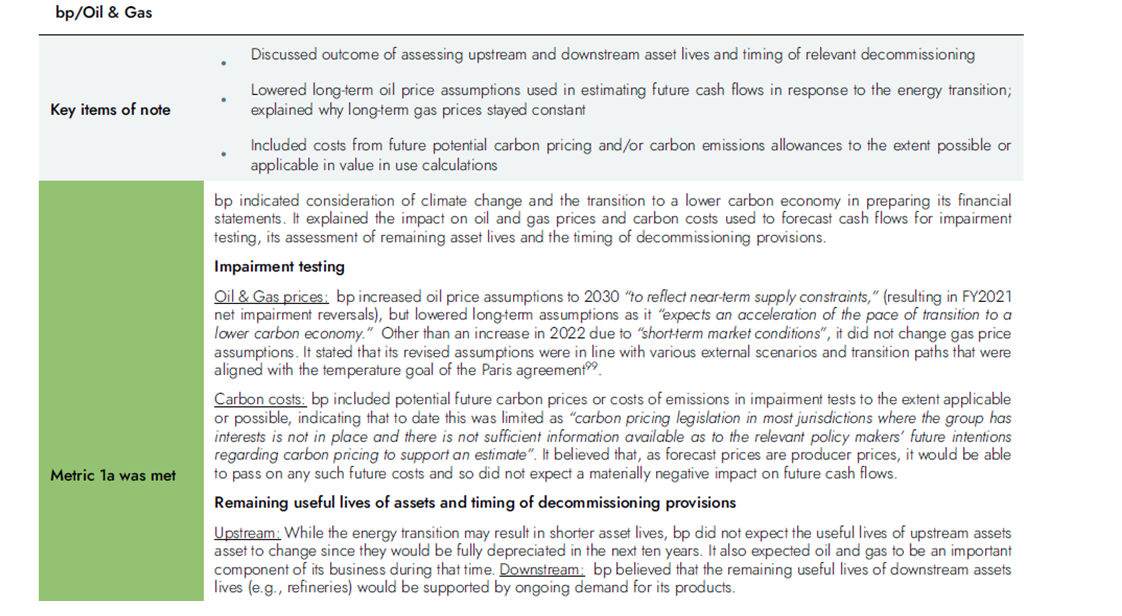
B84Good example: Carbon Tracker noted British Petroleum's (BP) disclosure of impairment and useful lives of assets as a 'good' example.
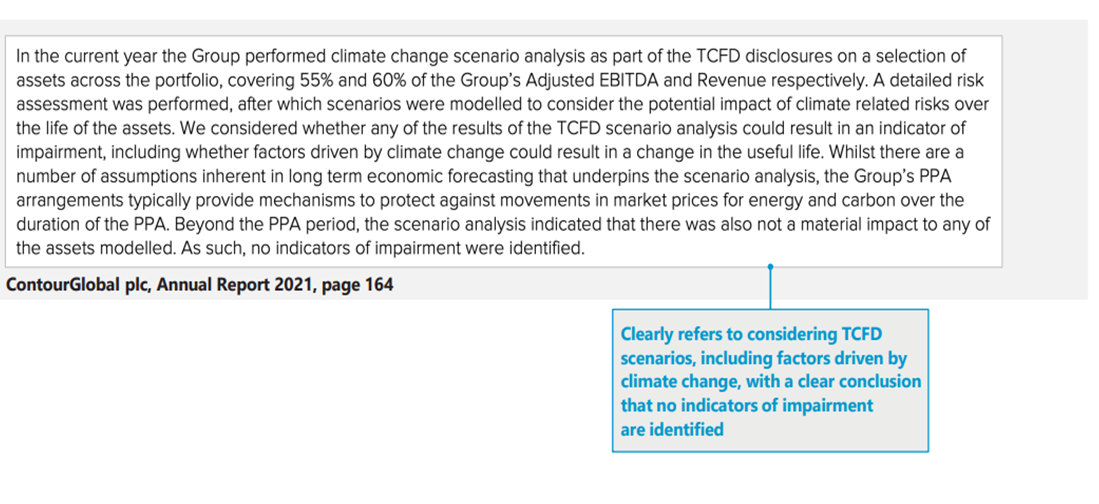
B85Good example: The Financial Reporting Council (FRC) noted in their latest Climate Thematic that Contour Global disclosure of impairment and useful lives was both consistent with TCFD and provided a clear conclusion on impairment.
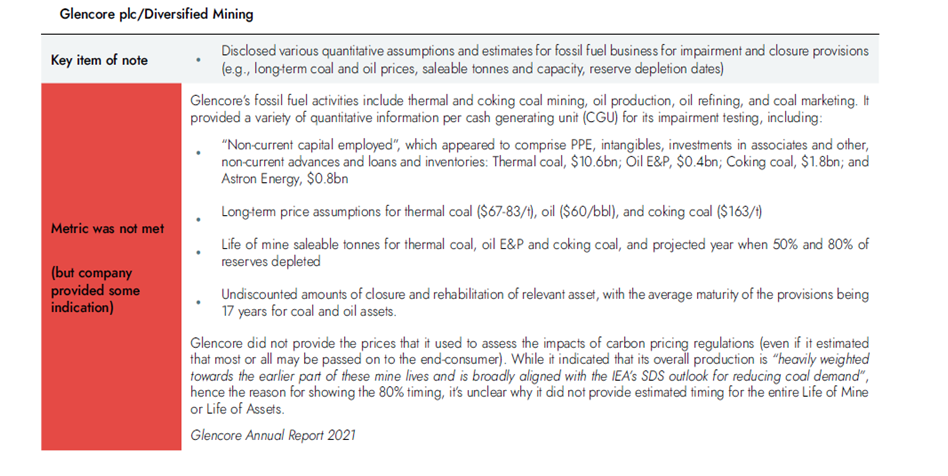
B86Improvement required: Carbon Tracker23 noted room for improvement in Glencore's financial statements in relation to impairment and useful lives of assets disclosures.
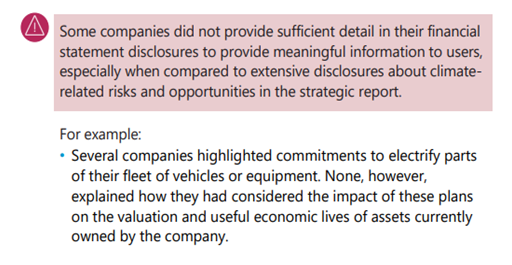
B87Improvement required: The FRC25 also noted that some companies had provided insufficient detail in their financial statement's disclosures, especially when compared to extensive disclosures on climate in their strategic reports.
Footnotes
-
Update on Consultation on Agenda Priorities ↩
-
International Applicability of the SASB Standards ↩
-
IFRS S1 transition relief ↩
-
Extracted from relevant ISSB Update. ↩
-
ISSB agenda paper Due process steps and permission to publish the Request for Information ↩
-
ISSB agenda paper Ratification of the Methodology Exposure Draft ↩
-
ISSB agenda paper Proposed Exposure Draft ↩
-
The IFRS Foundation’s Due Process Oversight Committee (DPOC) agreed that the ISSB can reduce the minimum RFI consultation period from 120 to 90 days, subject to the ISSB’s decision. ↩
-
IASB and ISSB Article: Connectivity—what is it and what does it deliver? ↩
-
IFRS Foundation Blog: Integrated thinking in action: Governance ↩
-
Mobilising green investment: 2023 green finance strategy, March 2023 ↩
-
FCA updates on its Sustainability Disclosure Requirements (SDR) and investment labels consultation ↩
-
Opening address by Commissioner McGuinness at the launch of 2023 PwC CEO Report - Europe ↩
-
Charles-Antoine St-Jean named Chair of the Canadian Sustainability Standards Board; first members appointed ↩
-
National Standard Setters Sustainability Forum - Terms of Reference and Members ↩
-
Connectivity—what is it and what does it deliver? Article by IASB Chair Andreas Barckow and ISSB Chair Emmanuel Faber (23 March 2023) ↩
-
IASB initiates project to consider climate-related risks in financial statements (23 March 2023) ↩
-
The UKEB established a multi-stakeholder Sustainability Working Group (SWG). The purpose of the SWG is to provide advice to support the Secretariat in carrying out duties under the remit, to consider the overlap between ISSB Sustainability Disclosure Standards and IASB Accounting Standards. ↩
-
ISSB redeliberation ↩
-
Effects of climate-related matters on financial statements (2020) ↩
-
Source: Carbon Tracker (Still flying blind), pg.72 ↩
-
Source: FRC Thematic review of TCFD disclosures, pg.108 ↩
-
Source: Carbon Tracker (Still flying blind), pg.78 ↩
-
Source: FRC Thematic review of TCFD disclosures, pg.89 ↩