5 International Tax Reform—Pillar Two Model Rules (Amendments to IAS 12)
23 February 2023 Agenda Paper 5
Executive Summary
Project Type: Influencing and Endorsement Project Scope: Narrow-scope
Purpose of the paper
This paper provides the Board with the following:
- A Project Initiation Plan (PIP) for the influencing and endorsement phases of the project relating to the IASB's proposed amendments to IAS 12 Income Taxes; and
- A draft comment letter (DCL) on the IASB Exposure Draft International Tax Reform – Pillar Two Model Rules.
Summary of the issue
The Pillar Two Model Rules introduce a 15% minimum tax rate for groups with turnover of €750m or above. Stakeholders have expressed concern over the complexity of accounting for deferred tax in respect of Pillar Two taxes and have highlighted that the need for clarity is urgent. In response, the IASB has published an exposure draft (ED) proposing a mandatory temporary exception from accounting for deferred tax arising from the Pillar Two Model Rules and a series of disclosures (the Amendments). It plans to finalise and issue the Amendments in Q2 2023.
To address the urgency of this project and the fact that the influencing work is expected to be very closely followed by the need to assess the Amendments for UK adoption, the draft PIP covers both the influencing and endorsement work. It proposes that the UKEB will complete its influencing work by Q2 2023 and endorsement work by Q3 2023.
The DCL supports the IASB's objectives and makes recommendations to enhance the ED's proposals.
Decisions for the Board
PIP
1. The Board is asked to consider and approve:
- the PIP's approach, planning both the influencing and endorsement project phases.
- one of the two options set out for the influencing phase timeline (whether to publish a DCL or not); and
- one of the two options for the endorsement phase timeline (to take the endorsement decision in July or September).
2. Subject to those decisions, approve the PIP.
DCL
3. Subject to addressing any comments raised during the meeting, the Board is asked to approve the DCL.
Recommendation
1. The Secretariat recommends that:
- the Board approves the draft PIP's approach, planning both the influencing and endorsement project phases.
- the Board approves option one – to publish a DCL for the influencing phase timeline and
- the Board approves option one – to consider an adoption package for endorsement in July for the endorsement phase timeline.
2. The Secretariat recommends that the Board approves the PIP.
3. The Secretariat recommends that the Board approves the DCL.
Appendices
- Appendix A [Draft] Project Initiation Plan
- Appendix B Draft Comment Letter
Purpose
1. This paper provides the Board with the following:
- A Project Initiation Plan (PIP) for the influencing and endorsement phases of the project relating to the IASB's proposed amendments to IAS 12 Income Taxes; and
- A draft comment letter (DCL) on the IASB Exposure Draft International Tax Reform – Pillar Two Model Rules.
Background
2. The Pillar Two model rules introduce a minimum tax rate for entities and groups with turnover of €750m or above. In jurisdictions where an entity or group's effective tax rate is below 15%, the model rules require the entity or group to top up the tax it pays to that rate.
3. Stakeholders have expressed concern around the complexities of accounting for income taxes in respect of the Pillar Two model rules, and especially around accounting for deferred taxes.
4. In response to this stakeholder feedback, the IASB published the Exposure Draft (ED) International Tax Reform—Pillar Two Model Rules on 9 January 2023.
5. Stakeholders highlighted to the IASB that there is an urgent need for clarity due to the expected enactment of the Pillar Two model rules in 2023 across multiple jurisdictions, including the UK. The IASB therefore plans to introduce the amendments to IAS 12 on an accelerated timetable. The ED is open for comment for 60 days until 10 March 2023, and the IASB aims to finalise any amendments in Q2 2023.
6. Information on the background to the ED was included in the meeting papers for the January 2023 Board meeting (see Paper 5, the IASB general update), and the December 2022 Board meeting (see Paper 6, the IASB general update). An education session on the tax reform was also provided to the Board as part of its private meeting in January 2023. A private Education session specifically on the ED requirements is also scheduled at the February private Board meeting.
7. We have conducted outreach activities to inform our DCL and PIP. In early February, we organised two roundtables, one for accounting firms and institutes by invitation only, and a publicly advertised session aimed at preparers and investors. Both had over 20 attendees. We also discussed the ED at the Investors Advisory Group in February.
Project Initiation Plan (PIP)
8. The draft PIP is attached at Appendix A for consideration and approval. The PIP covers both the influencing and endorsement phases of the project and the Board is specifically asked to approve this approach.
9. The Board is also requested to decide its preferred option for:
- The influencing phase – whether to:
- issue a DCL for public approval, albeit for a short comment period (Option 1); or
- issue the comment letter to the IASB without a public comment period (Option 2).
- The endorsement phase – whether to consider the adoption package for approval:
- At the July Board meeting, after a 7-day comment period for the draft endorsement criteria assessment (Option 1); or
- At the September Board meeting, after a 72-day comment period for the draft endorsement criteria assessment (Option 2).
10. The Secretariat recommends option one for the influencing phase and option one for the endorsement phase.
Questions for the Board
1. The Board is asked to consider and approve:
- the PIP's approach, planning both the Influencing and Endorsement project phases.
- one of the two options set out for the Influencing phase timeline (whether to publish a DCL or not); and
- one of the two options for the Endorsement phase timeline (to take the endorsement decision in July or September).
2. Subject to those decisions, approve the PIP.
Draft Comment Letter (DCL)
11. The DCL is attached for consideration and approval.
12. Subject to approval of the Secretariat's recommended option in the PIP, we propose to issue the DCL for a short comment period. Our DCL is broadly in support of the IASB's ED, but we have suggested a number of enhancements.
Potential additional recommendation on draft paragraph 88C
13. In addition to the recommendations already included in the DCL, we have drafted a potential additional recommendation to simplify paragraph 88C (the recommendation for a general disclosure requirement). This is to address concerns by stakeholders (especially preparers) that, as drafted, the disclosures required by paragraph 88C may not be sufficient to achieve the objective of the disclosure requirement, and at worst, could be misleading.
14. The advantage of including the recommendation for a general disclosure requirement is that it offers a more principle-based solution to the challenges and concerns around the current paragraph 88C. It should give preparers increased flexibility and ensure that disclosures reflect management's own analysis, while still addressing investors' needs for understanding of a group's exposure to reputational and fiscal risk.
15. The disadvantage of including the recommendation for a general disclosure requirement is that it risks delaying the IASB in its deliberations, and being perceived as doing so. However, this risk is mitigated to some extent by the statement in the cover letter that we do not recommend the IASB delay the publication of the Amendment solely to perfect the disclosures.
16. The additional recommendation would involve including the following paragraphs between paragraphs A17 and A18 as a complement to our existing recommendations on 88C, and, potentially, in the cover letter as well.
However, given the challenges and concerns noted above, we recommend that the IASB considers replacing the detailed requirements in paragraph 88C with a more general requirement to provide information sufficient to meet the objective, namely to help users of the accounts assess the entity's exposure to paying top-up tax. As different parts of the Pillar Two model rules are enacted and then become effective around the world, groups will have to report on many different economic and legal scenarios. A more flexible requirement, along the lines of that suggested here, could facilitate the provision of relevant information tailored to an entity's circumstances.
UK stakeholders we consulted agreed that the disclosures required by paragraph 88C during the period when the Pillar Two model rules are substantively enacted but not yet effective are likely to have a limited
17. lifespan (probably only one or two years). For this reason too, a general disclosure requirement may be more appropriate than specific detailed requirements which may not meet the overall objective in all scenarios.
For example, a general disclosure requirement could include wording such as: "In periods in which Pillar Two legislation is enacted or substantively enacted, but not yet in effect, an entity shall provide information to enable users to assess an entity's exposure to paying Pillar Two top-up tax, the jurisdictions that are the primary cause of such exposure and, to the extent a reliable estimate can be made, the expected quantitative impact".
18. The Board is asked whether the recommendation for a general disclosure requirement should be included in the DCL.
19. If the Board consider that the recommendation for a general disclosure requirement should be included in the DCL, the Board is asked whether it should be in the Appendix only, or in both the cover letter and the Appendix.
Questions for the Board
3. Subject to addressing any comments raised during the meeting, the Board is asked to approve the DCL.
Next steps
19. The Board is asked to take decisions to determine the timeline and next steps.
Appendix A: Project Initiation Plan
| Project Type | Influencing, endorsement and adoption |
|---|---|
| Project Scope | Narrow-scope |
Purpose
A1. This paper sets out the plan to influence and to assess whether to adopt1 the narrow-scope Amendments International Tax Reform – Pillar Two Model Rules2 to IAS 12 Income Taxes (the Amendments), currently issued by the IASB as an Exposure Draft (ED).
A2. The UKEB's statutory functions mean that it must consider the Amendments against the statutory adoption criteria before their formal adoption for use in the UK. UK entities cannot use the Amendments until formal adoption has taken place.
A3. The Organisation for Economic Co-Operation and Development (OECD) Pillar Two model rules propose a worldwide 15% tax rate, which the UK is likely to enact by summer 2023. Stakeholders have expressed concerns that it is not clear how IAS 12 applies to Pillar Two taxes and that accounting for deferred tax arising from the Pillar Two model rules would not be practicable and could lead to diversity in practice. Given the urgency of the Amendments and the IASB's accelerated timetable, this PIP addresses both the influencing and the endorsement and adoption stages of the project together.
Background
A4. In December 2021, the OECD finalised the model rules for Pillar Two, one of the two Pillars designed to address the tax challenges presented by the globalisation and digitalisation of the economy.
A5. The Pillar Two model rules introduce a minimum tax rate for multinational groups and entities with turnover of €750m or above. In jurisdictions where a group's effective tax rate is below 15%, the Pillar Two model rules require the entity to increase the tax it pays to that rate, by applying a top-up tax.
A6. Stakeholders have expressed concerns to the IASB around whether tax arising under the model rules is in all circumstances an income tax within the scope of IAS 12, and around the uncertainty over how to account for deferred tax arising from the top-up tax. Questions raised include:
- which tax rate to use to measure deferred taxes;
- whether additional temporary differences arise from the Pillar Two model rules, i.e. is it possible to link the recovery or settlement of the carrying amount of assets or liabilities directly to future top-up tax payments; and
- whether domestic temporary differences should be remeasured.
A7. Some stakeholders have also commented that accounting for deferred tax arising from Pillar Two top-up tax could be extremely complex and that the costs of doing so might therefore outweigh the benefits to users.
A8. Stakeholders have further observed that this matter is urgent, as at least two jurisdictions have already enacted Pillar Two legislation and others, including the UK, are expected to do so by summer 2023.
A9. In response, the IASB published the ED proposing to amend IAS 12 on 9 January 2023. The ED seeks to provide relief for affected entities and avoid inconsistent application of IAS 12.
Description of the Amendments to IAS 12
A10. The proposed Amendments to IAS 12 are described briefly in the table below.
| Narrow-scope Amendments to IAS 12: International Tax Reform – Pillar Two model rules | | Header 2 | |----------|----------| | Data 1 | Data 2 |
Project plan rationale
A11. The following considerations have shaped the project plan.
The Amendments are narrow in scope
A12. The Amendments require affected groups – those with turnover of €750m or above – to disclose current tax income or expense in respect of Pillar Two top-up tax separately. However, they introduce a temporary exception from deferred tax accounting in respect of that specific tax.
A13. Groups would therefore in other respects maintain their current approach to accounting for deferred tax. The Amendments are intended to provide users with insight into a group's exposure to paying top-up tax without undue cost or effort for preparers, while preventing diversity in accounting for deferred tax on Pillar Two.
The need for clarity is urgent
A14. Some jurisdictions, including the UK, plan to enact or to substantively enact the Pillar Two model rules into domestic legislation by summer 2023.
A15. Given the expected timetables for enactment of the legislation and issue of the Amendments, if the UKEB does not adopt the Amendments as soon as possible, the proposed exception from deferred tax accounting may not be available to groups with summer year ends or for the interim reports of groups with December year ends.
A16. In order to assess the potential number of groups affected, we have carried out preliminary profiling on IFRS reporters with May to September year ends listed on the London Stock Exchange, which are likely to be in scope of the Pillar Two model rules. Of the 26 reporters identified, two reporters typically have their financial statements approved in July, one in August and nine in September. The rest typically have their financial statements approved in October or later.
| Year end date | Number of groups | Date of approval of financial statements | Number of groups |
|---|---|---|---|
| May | 1 | July | 1 |
| June | 9 | July | 1 |
| August | 1 | ||
| September | 7 | ||
| July | 2 | September | 1 |
| October | 1 | ||
| August | 3 | September | 1 |
| October | 2 | ||
| September | 11 | November | 8 |
| December | 3 | ||
| Total | 26 | 26 |
A17. Although not explicitly addressed by the relevant legislation [SI 2019/685], our understanding3 is that if UK adoption occurs before the approval of the relevant financial statements, entities are able to apply a standard or amendment issued by the IASB, where that standard or amendment itself permits or requires early adoption.
A18. The ED paragraph 98M(a) requires both the exception, and disclosure that the exception has been taken (paragraphs 4A and 88A), to be “immediately and retrospectively” applied. It requires the additional proposed disclosures (paragraphs 88B-88C) to be applied for annual reporting periods beginning on or after 1 January 2023. We consider therefore that the ED's requirements would need to be applied prior to the date of adoption.
A19. If the Amendments are adopted before a group's financial statements are approved, the group should apply the exception from deferred tax accounting, disclose that it has done so and make any other additional disclosures required.
Project milestones
A20. A proportionate approach is proposed, incorporating the mandatory milestones listed in paragraph 6.11 of the UKEB's Due Process Handbook (Handbook)4. The table below provides a brief description of the work we have done and that we intend to do as part of this project.
A21. [For certain steps, the table includes two options. The Board is asked to decide (a) whether to issue a DCL for public consultation and (b) its preferred endorsement and adoption timeline. Further explanations and recommendations are set out below the table. Text pertaining to the two options is in square brackets throughout this document as we will publish the PIP with the approved options only.]
| Milestone/activity | Brief description | Status |
|---|---|---|
| Influencing | ||
| Technical project added to UKEB technical work plan (mandatory) [Handbook 4.30(d)] | Added to UKEB technical work plan. | Completed. |
| Education session on tax reform (optional) [Handbook 4.10] | HMRC Pillar Two policy experts provided an explanation of the background to the reform and of how Pillar Two works. | Completed at the January 2023 private Board meeting. |
| Desk-based research (optional) [Handbook 5.9] | The Secretariat has reviewed: - The OECD model rules - OECD guidance on the Pillar Two model rules - UK draft legislation - The IASB's work on the Amendments (staff papers, ED) - The Basis for Conclusions to the ED - Accounting manuals and press releases for guidance and illustrative examples | In progress. |
| Outreach activities (mandatory) [Handbook 5.11] | We have gathered input from the Investors Advisory Group, and held roundtables with (a) preparers and investors and (b) accounting firms and institutes. We have also distributed a questionnaire to selected preparers requesting information on the costs and benefits of endorsing or not endorsing the Amendments. | Completed. |
| Education session on accounting Amendments (optional) [Handbook 4.10] | Short education session on the need for the Amendments with UKEB Secretariat team. | To be brought to February 2023 private Board meeting |
| Project Initiation Plan (mandatory) [Handbook 5.4 to 5.8 and 5.13 to 5.14] | This paper. | To be brought to February 2023 Board meeting |
| DCL published for comment (generally mandatory) [Handbook paragraphs 5.13 to 5.17 and 3.95] | [Option One The Secretariat will publish the approved DCL for public comment, albeit for a short period (see timelines below).] [Option Two The Secretariat will issue the final comment letter directly to the IASB without public consultation. Instead, the Secretariat would organise such further targeted outreach sessions as were identified as appropriate.] | As soon as possible after the February 2023 Board meeting |
| Additional Board meeting scheduled to agree FCL | Extraordinary meeting scheduled to approve FCL for publication. | Scheduled for 7 March |
| UKEB submits FCL before IASB comment period ends (mandatory). [Handbook paragraph 5.18] | IASB comment period ends 10 March 2023. | To be completed. |
| Feedback statement and due process compliance statement for influencing stage of project (mandatory) [Handbook paragraphs 5.19 and 5.23] | Secretariat publishes Feedback Statement and Due Process Compliance Statement on UKEB website. | To be completed. |
| Endorsement and adoption (after IASB redeliberates and publishes final Amendments) | ||
| Desk-based research (optional) [Handbook 6.17] | The Secretariat will review: The IASB's further work on the Amendments Accounting manuals and press releases for guidance and illustrative examples Comment letters on the ED received by the IASB from UK stakeholders. | To be completed. |
| Issue of a DECA (mandatory) [Handbook 6.23 to 6.26] | The Secretariat will develop a draft Endorsement Criteria Assessment (DECA) to assess whether the Amendments meet the UK's statutory requirements for adoption. | To be completed. |
| Outreach activities (mandatory) | Publish DECA for stakeholder comment on the UKEB website. The Secretariat also intend to reach out directly to UK stakeholders who have previously provided feedback to the IASB and/or UKEB. We will also discuss the DECA with the UKEB advisory groups, as timing allows. | To be completed. |
| Consultation period for the DECA (mandatory) [Handbook 6.28 and 6.29 and 3.9] | [Option One The DECA will be issued for comment for 14 days, the minimum time to consult on a DECA.] [Option Two The DECA will be issued for comment for 72 days, a longer period, but still shorter than the 90 days recommended by the Handbook.] | To be completed. |
| Project closure [Handbook 6.30] | The project closure process for endorsement projects will comprise the following mandatory steps. Preparation of an adoption package by the Secretariat comprising: the final Endorsement Criteria Assessment (ECA), Feedback Statement, the Adoption Statement, the text of the UK-adopted international accounting standard amendments, and a Due Process Compliance Statement for the project; and Voting on the adoption of the Amendments. | To be completed. |
Resources allocated
A22. On the basis of this project plan, we consider that a project team consisting of one Project Manager, technical support and oversight from a Senior Project Director, input will be obtained from the economics team for the long-term public good assessment, and communications support should ensure the project timelines are achievable.
Setting up an ad-hoc advisory group is not necessary
A23. Given the narrow-scope nature of the Amendments and initial feedback, it is not considered necessary to set up a separate, ad-hoc advisory group specific for this project. However, in order to gather feedback, we have held project-specific roundtables for (a) accounting firms and institutes and (b) preparers and investors.
Project timelines
A24. The project timelines address both the influencing and the endorsement and adoption phases of the project. [NB: We have set out below two options for the timeline for the influencing phase, and two options for the timeline for the endorsement and adoption phase. The final PIP will only include the options approved at the Board meeting.]
Influencing stage
A25. [Option one allows for the DCL to be published with a seven-day comment period. This option is feasible as the Handbook does not stipulate a minimum comment period for a DCL. Taking this option allows for public input to the comment letter while enabling the Board to meet the IASB's accelerated timetable.
A26. However, the comment period may be too short to allow many stakeholders to respond in a meaningful way. Some stakeholders may miss the comment deadline. Pursuing this option will require the Secretariat to prepare a Feedback Statement.]
A27. [Option two does not require a DCL to be published for public consultation. Not issuing a DCL for public comment is permissible under the Handbook.
A28. This option could be seen as more pragmatic as we may not receive meaningful feedback in the short comment period envisaged and it would reduce Secretariat work on the Amendments by removing the need for a Feedback Statement. However, this approach is less transparent as it does not allow for formal public input to the comment letter.]
A29. [We recommend option one. This option is transparent and follows the recommended due process as far as possible, albeit with reduced timescales.]
Endorsement and adoption stage
A30. [Option one proposes an endorsement decision in July, assuming the IASB publishes the Amendments by early June.
A31. This timeline would minimise the risk that groups wishing to apply the Amendments (in particular the exception from deferred tax accounting for Pillar Two top-up taxes) would be unable to do so, should the Board decide to adopt them. For example, reporters with May, June or July period ends, whose financial statements are approved in August or September – or even at the very end of July – would be able to apply the Amendments.
A32. The disadvantage would be that the Draft Endorsement Criteria Assessment (DECA) would be published with a significantly reduced timeframe for preparation and public consultation. Relevant points could therefore be omitted from the final ECA.]
A33. [Option two proposes an endorsement decision in September, assuming the IASB publishes the Amendments by early June.
A34. The advantage of this option is that it would allow for a longer comment period of 72 days. This period would still be shorter than the 90-day comment period recommended, but not mandated, by the Due Process Handbook.
A35. The disadvantage of this option is that reporters with May, June or July period ends, whose financial statements are approved in July, August or (depending on the precise date of adoption) September, would not be able to apply the exception from deferred tax accounting, should the Board decide to adopt the Amendments. This could lead to diversity in practice and increased costs for preparers.]
A36. [We recommend option one. This option would allow preparers with summer year ends to apply the exception, minimising diversity in practice and preparer costs.]
A37. If the IASB does not issue the Amendments by early June (contrary to the current expectation), the project plan would be reassessed and new proposals brought back to the Board.
Timelines
Influencing Phase – Option One: DCL published with a shortened comment period
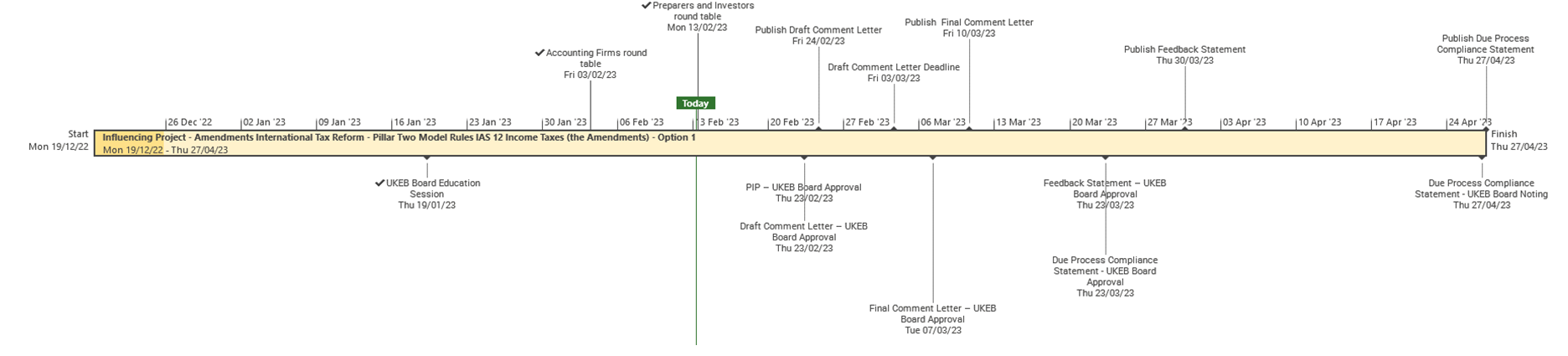
Influencing Phase – Option Two: DCL not published for public comment

Endorsement and Adoption Phase – Option One: The UKEB decides whether to adopt in July
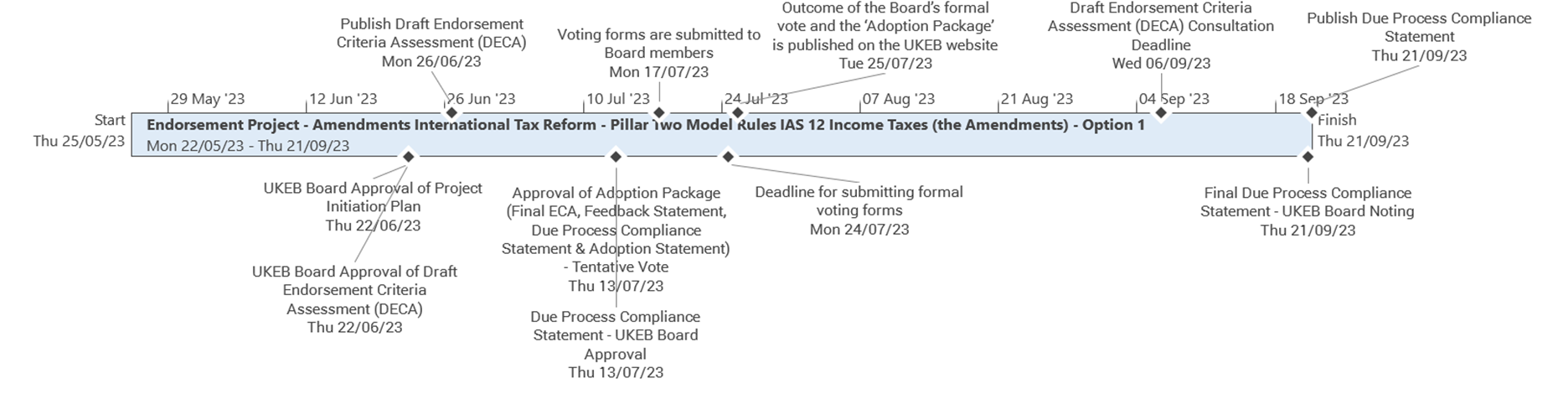
Endorsement and Adoption Phase – Option Two: The UKEB decides whether to adopt in September
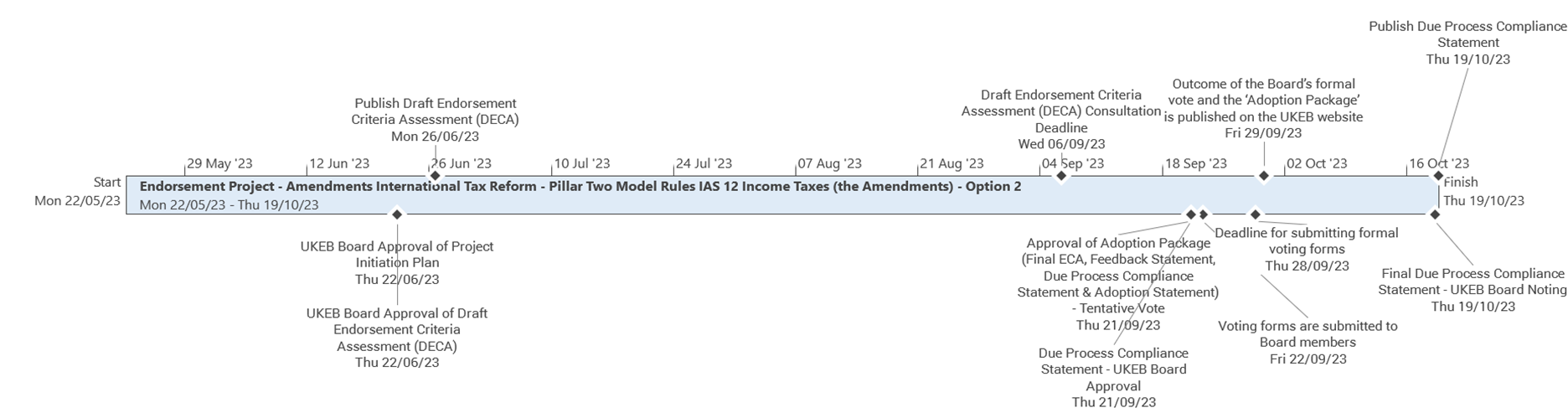
Resources allocated
| Date | Milestone |
|---|---|
| Influencing phase | |
| 9 January 2023 | IASB published Exposure Draft with 60-day comment period |
| 19 January 2023 | Board: Introductory discussion of proposed Amendments (public meeting) and education session on tax reform (private meeting) |
| February 2023 | Outreach including roundtables |
| 23 February 2023 | Board: Discusses and approves PIP and DCL. Secretariat: Revises DCL for Board comments. |
| 24 February 2023 | Secretariat: Publishes DCL (7-day comment period from 24 February to 3 March) |
| Late February – early March | Secretariat: Alerts key stakeholders to publication of DCL |
| 7 March 2023 | Additional board meeting scheduled for approval of Final Comment Letter |
| 10 March 2023 | IASB comment period ends Secretariat: submits Final Comment Letter Secretariat: Final Comment Letter published on website |
| 23 March 2023 | Board: Discusses and approves Feedback Statement and Due Process Compliance Statement for influencing phase of project |
| April-May 2023 | IASB redeliberates |
| May 2023 | IASB publishes final Amendments |
| Endorsement and adoption phase | |
| 22 June 2023 | Board: Discusses and approves DECA and PIP (revised if necessary) |
| 26 June 2023 | Secretariat: Publishes DECA with 14-day comment period to 10 July 2023 |
| 6 July 2023 | Secretariat: Prepares the adoption package and a draft Due Process Compliance Statement for the project. |
| 13 July 2023 | Board: Considers an adoption package for approval and considers the draft Due Process Compliance Statement for the project. Board members provide a tentative vote. |
| w/c 17 July 2023 | Voting form is sent to board members. |
| w/c 24 July 2023 | Board: Deadline for submitting vote Publication of adoption decision |
| 21 September 2023 | Board: Final Due Process Compliance Statement for noting. |
| 14 September 2023 | Secretariat: Prepares the adoption package and a draft Due Process Compliance Statement for the project. |
| 21 September 2023 | Board: Considers an adoption package for approval and considers the draft Due Process Compliance Statement for the project. Board members provide a tentative vote. |
| 22 September 2023 | Voting form is sent to board members. |
| w/c 25 September 2023 | Board: Deadline for submitting vote Publication of adoption decision |
| 19 October 2023 | Board: Final Due Process Compliance Statement for noting. |
A22. On the basis of this project plan, we consider that a project team consisting of one Project Manager, technical support and oversight from a Senior Project Director, input will be obtained from the economics team for the long-term public good assessment, and communications support should ensure the project timelines are achievable.
Setting up an ad-hoc advisory group is not necessary
A23. Given the narrow-scope nature of the Amendments and initial feedback, it is not considered necessary to set up a separate, ad-hoc advisory group specific for this project. However, in order to gather feedback, we have held project-specific roundtables for (a) accounting firms and institutes and (b) preparers and investors.
Appendix B: Draft Comment Letter
Dr Andreas Barckow Chairman International Accounting Standards Board Columbus Building 7 Westferry Circus Canary Wharf London E14 4HD
7 March 2023
Dear Dr Barckow
Exposure Draft ED/2023/1 International Tax Reform – Pillar Two Model Rules: Proposed amendments to IAS 12
The UK Endorsement Board (the UKEB) is responsible for endorsement and adoption of IFRS for use in the UK and therefore is the UK's National Standard Setter for IFRS. The UKEB also leads the UK's engagement with the IFRS Foundation on the development of new standards, amendments and interpretations. This letter is intended to contribute to the Foundation's due process. The views expressed by the UKEB in this letter are separate from, and will not necessarily affect the conclusions in, any endorsement and adoption assessment on new or amended International Accounting Standards undertaken by the UKEB.
There are currently approximately 1,500 entities with equity listed on the London Stock Exchange that prepare their financial statements in accordance with IFRS Standards.6 In addition, UK law allows unlisted companies the option to use IFRS and approximately 14,000 such companies currently take up this option.7
We welcome the opportunity to provide comment on the International Accounting Standards Board (IASB) Exposure Draft (ED) International Tax Reform: Pillar Two Model Rules (the Amendments). In developing this letter, we have consulted with a number of stakeholders, including preparers, accounting firms and institutes and users of accounts.
We support the IASB's objectives as well as the accelerated timetable for the development of the Amendments. In the light of the uncertainties surrounding the application of IAS 12 Income Taxes to Pillar Two income taxes, and in particular the challenges in accounting for deferred tax arising from the Pillar Two model rules, we consider it important to provide clarity and minimise the risk of diversity in accounting practice.
Accelerated timetable
We agree that the project needs to be treated as urgent. Pillar Two legislation has already been enacted in at least two jurisdictions, and multiple jurisdictions are expected to enact it this year. In the UK, legislation implementing Pillar Two model rules (enacting both the Income Inclusion Rule (IIR) and a Domestic Minimum Tax (DMT)) is expected to be laid in the next Finance Bill. While parliamentary timetables are inherently uncertain, this legislation is currently expected to be substantively enacted8 before the House of Commons goes into its summer recess (provisionally scheduled for 20 July 2023). In the UK, both the IIR and DMT are expected to apply to financial accounting periods beginning on or after 31 December 2023.
Given this expected timetable for substantive enactment of the legislation in the UK, absent the Amendments, UK entities may need to reflect Pillar Two income taxes in their deferred tax accounting from mid-2023 onwards. This could affect the interim accounts of entities with December year ends and the annual accounts of entities with year ends from May 2023 onwards. Provisional data indicates there are at least ten listed and a number of unlisted IFRS reporters in the UK with May or June year ends that are likely to fall within the scope of the Pillar Two model rules.
The UKEB would need to endorse the Amendments before those groups are able to use the proposed exception from deferred tax accounting. Consequently, the UKEB welcomes the IASB's accelerated timetable.
Mandatory temporary exception and 'sunset clause'
We agree with the introduction of a mandatory exception from accounting for deferred tax arising from the Pillar Two model rules and agree that the mandatory exception should be temporary. We also agree with the absence of a 'sunset clause'. This will allow the IASB to consider how Pillar Two income taxes should be addressed within IAS 12 without undue pressure. The IASB may wish to add a review of the exception to its future workplan.
Detailed comments on ED proposals
As stated above, the UKEB supports the objectives of the Amendments. We recognise that the IASB has sought to require disclosures that will provide insight into an entity's potential exposure to Pillar Two top-up taxes without resulting in undue cost or effort for preparers. We also appreciate that the disclosures required during the period when the tax is substantively enacted but not yet effective are likely to have a maximum lifespan of one or two years. We would not therefore recommend the IASB delay the publication of the Amendment solely to perfect those disclosures. However, based on our analysis and on our outreach to date with UK stakeholders, we have identified some potential enhancements to the draft disclosure requirements.
We have answered the ED's specific questions in the Appendix to this letter. Our main recommendations are set out in the following paragraphs.
1. We recommend that the IASB incorporates the objective of the disclosure requirement, i.e. “to help users assess an entity's exposure to paying top-up tax" (ED/2023/01 paragraph BC19) in the disclosure requirement itself at paragraph 88C. Highlighting the objective of the disclosure would assist preparers and auditors in making judgements about what information users would find most relevant.
2. ED paragraph 88C(b) and (c) require: “In periods in which Pillar Two legislation is enacted or substantively enacted, but not yet in effect, an entity shall disclose for the current period only: [...]
- the jurisdictions in which the entity's average effective tax rate (calculated as specified in paragraph 86) for the current period is below 15%. The entity shall also disclose the tax expense (income) and accounting profit for these jurisdictions in aggregate, as well as the resulting weighted average effective tax rate.
- whether assessments the entity has made in preparing to comply with Pillar Two legislation indicate that there are jurisdictions:
- identified in applying the proposed requirement in (b) but in relation to which the entity might not be exposed to paying Pillar Two income taxes; or
- not identified in applying the proposed requirement in (b) but in relation to which the entity might be exposed to paying Pillar Two income taxes."
UK preparers and accounting firms expressed concerns that paragraph 88C (b) may result in qualitative and quantitative information that does not meet the objective expressed at BC19. They commented that the jurisdictional effective tax rate on an IAS 12 basis could be a poor proxy for the jurisdictional effective tax rate on a Pillar Two basis. We understand that the disclosures under paragraph 88C (c) are designed to indicate cases when an entity is aware that the information provided under paragraph 88C (b) may be insufficient in isolation. However, preparers expressed concerns that 88C (c) does not provide a sufficient corrective:
- If an entity has not completed its Pillar Two assessments, it might provide no information under 88C (c) at all.
- 88C (c) does not require any quantitative information. Listing jurisdictions under paragraph 88C (c) would not give any indication as to the quantum of tax exposure in the relevant jurisdictions, so even with this additional information the disclosure under 88C (b) could be insufficient.
We recommend, therefore, that in addition paragraph 88C (c) should, as a minimum, require disclosure of the amount of the quantitative information provided under paragraph 88C (b) that relates to the jurisdictions identified under paragraph 88C (c).
3. UK investors considered that requiring disaggregated quantitative disclosure at paragraph 88C (b) and (c) would be more useful information for users than the proposed aggregated disclosure.
We support the IASB's proposals regarding disclosures in periods in which Pillar Two legislation is in effect and regarding the effective date and transition.
If you have any questions about this response, please contact the project team at [email protected].
Yours sincerely
Pauline Wallace Chair UK Endorsement Board
Appendix 1 Questions on ED International Tax Reform: Pillar Two Model Rules
Question 1—Temporary exception to the accounting for deferred taxes (paragraphs 4A and 88A)
IAS 12 applies to income taxes arising from tax law enacted or substantively enacted to implement the Pillar Two model rules published by the OECD, including tax law that implements qualified domestic minimum top-up taxes described in those rules.
The IASB proposes that, as an exception to the requirements in IAS 12, an entity neither recognise nor disclose information about deferred tax assets and liabilities related to Pillar Two income taxes.
The IASB also proposes that an entity disclose that it has applied the exception.
Paragraphs BC13-BC17 of the Basis for Conclusions explain the IASB's rationale for this proposal.
Do you agree with this proposal? Why or why not? If you disagree with the proposal, please explain what you would suggest instead and why.
1. For the reasons set out in the Basis for Conclusions, we support the proposed approach of requiring entities to neither recognise nor disclose information about deferred tax assets and liabilities related to Pillar Two income taxes.
2. We consider that this requirement will enhance the comparability of financial statements whilst providing entities with relief from the cost and complexities of deferred tax accounting in relation to Pillar Two income taxes.
3. We agree that the mandatory exception should be temporary. We also agree with the absence of a 'sunset clause'. This will allow the IASB to consider how Pillar Two income taxes should be addressed within IAS 12 without undue pressure. The IASB may wish to add a review of the exception to its future workplan.
4. Furthermore, we support the requirement for entities to state that they have applied the mandatory exception. We consider that this disclosure requirement will provide clarity over the accounting approach taken and increase users' confidence in the comparability of the financial statements.
5. IAS 12 applies to accounting for income taxes.9 Paragraph BC9 of the ED observes: "Stakeholders generally agree that top-up tax is an income tax – in the scope of IAS 12 Income Taxes – in the consolidated financial statements of the ultimate parent entity of a group subject to the Pillar Two model rules. However, they have said that it is unclear whether top-up tax is an income tax in the financial statements of a group's subsidiaries [...]". However, while the Amendments may be interpreted as implying that all taxes arising from Pillar Two are income taxes in the scope of IAS 12, the Amendments do not provide an explicit statement to that effect. This may risk increasing diversity in practice in the financial statements of a group's subsidiaries, thereby reducing the comparability of financial statements.
6. In order to provide clarity in this area, the IASB could consider removing the word “income” from the first sentence in paragraph 4A, so that it reads “This Standard applies to income taxes arising from tax law enacted or substantively enacted to implement the Pillar Two model rules [...]”.
7. Alternatively, the IASB could consider stating that it deems Pillar Two tax legislation to give rise to income taxes in the scope of IAS 12 for the purposes of the Amendments, for example, using the following wording in paragraph 4A: “[...] Such tax law is deemed to give rise to income taxes. It is hereafter referred to as 'Pillar Two legislation' and the taxes arising from it are referred to as ‘Pillar Two income taxes' [...]."
Question 2—Disclosure (paragraphs 88B-88C)
The IASB proposes that, in periods in which Pillar Two legislation is enacted or substantively enacted, but not yet in effect, an entity disclose for the current period only:
- information about such legislation enacted or substantively enacted in jurisdictions in which the entity operates.
- the jurisdictions in which the entity's average effective tax rate (calculated as specified in paragraph 86 of IAS 12) for the current period is below 15%. The entity would also disclose the accounting profit and tax expense (income) for these jurisdictions in aggregate, as well as the resulting weighted average effective tax rate.
- whether assessments the entity has made in preparing to comply with Pillar Two legislation indicate that there are jurisdictions:
- identified in applying the proposed requirement in (b) but in relation to which the entity might not be exposed to paying Pillar Two income taxes; or
- not identified in applying the proposed requirement in (b) but in relation to which the entity might be exposed to paying Pillar Two income taxes.
The IASB also proposes that, in periods in which Pillar Two legislation is in effect, an entity disclose separately its current tax expense (income) related to Pillar Two income taxes.
Paragraphs BC18-BC25 of the Basis for Conclusions explain the IASB's rationale for this proposal.
Do you agree with this proposal? Why or why not? If you disagree with the proposal, please explain what you would suggest instead and why.
Disclosures in periods in which Pillar Two legislation is enacted or substantively enacted, but not yet in effect
8. We support the introduction of requirements for entities to disclose their exposure to Pillar Two income taxes once legislation is enacted or substantively enacted but not yet in effect. We consider that this requirement will go some way to mitigating the absence of deferred tax accounting for Pillar Two income taxes.
9. UK stakeholders agreed that the key objective of the disclosures should be to provide users of accounts with an indication of groups' exposure to paying additional (top-up) taxes. Based on paragraph BC19, this appears to be the overall objective of the disclosures in paragraph 88C. We understand that detailed quantitative information about an entity's exposure to Pillar Two income taxes will not initially be available because of the requirement to produce financial statements significantly ahead of the first Pillar Two return. Therefore, we agree that the IASB has sought to require disclosures that will provide insight without resulting in undue cost or effort.
10. Preparers we spoke to raised no concerns over their practical ability to provide the proposed disclosures under paragraph 88C. However, stakeholders (particularly preparers) expressed concerns that, as drafted, those disclosures may not be sufficient to achieve the objective and, at worst, could be misleading (see paragraph 13 below).
Paragraph 88C (a)
11. UK stakeholders questioned the clarity of paragraph 88C (a) – for example, what does 'information about legislation' mean? They considered that the requirement in its current form would likely lead to disclosure of varying quality and potentially to lengthy disclosure of little informational value. Preparers were particularly concerned that the requirement does not appear to allow for the exercise of materiality judgements in the provision of this information (for example, regarding an entity's operations in each relevant jurisdiction).
12. For example, if a parent company's jurisdiction has enacted the Pillar Two Income Inclusion Rule, information about legislation enacted but not yet effective in subsidiary jurisdictions could be of minimal relevance from a group perspective. Nevertheless, such disclosure could appear to be required by 88C (a). We recognise, therefore, that entities and auditors will need to use judgement when meeting this requirement.
Paragraphs 88C (b) and (c)
13. UK preparers and accounting firms expressed concerns that paragraph 88C (b) may provide qualitative and quantitative information that does not meet the objective expressed at BC19. They commented that the jurisdictional effective tax rate calculated on an IAS 12 basis could be a poor proxy for the jurisdictional effective tax rate calculated on a Pillar Two basis.10
14. We understand that the disclosures under paragraph 88C (c) are designed to indicate cases when an entity is aware that the information provided under 88C (b) may be insufficient in isolation. UK preparers commented that the existence of 88C (c) highlights the inadequacy of the IAS 12 paragraph 86 effective tax rate as a proxy. Further, preparers expressed concerns that paragraph 88C (c) does not provide a sufficient corrective. First, if an entity has not completed its Pillar Two assessments, it might provide no information under 88C (c) at all. In addition, 88C (c) does not require any quantitative information. Listing jurisdictions under paragraph 88C (c) would not give any indication as to the quantum of tax exposure in the relevant jurisdictions, so even with this additional information the disclosure under 88C (b) could be insufficient. We recommend, therefore, that in addition 88C (c) should, as a minimum, require disclosure of the amount of the quantitative information provided under 88C (b) that relates to the jurisdictions identified under 88C (c).
15. UK investors considered that requiring disaggregated disclosure at 88C (b) and (c) would be more useful information than the proposed aggregated disclosure. It would give users a better understanding of a group's exposure to reputational and fiscal risk. Even when not material from a quantitative perspective, information may be qualitatively material to users of the accounts.
16. Should the IASB decide to retain 88C (a), (b) and (c), we would strongly recommend incorporating the objective of the disclosure, i.e. “to help users assess an entity's exposure to paying top-up tax” (ED/2023/01 paragraph BC19), in the disclosure requirement at paragraph 88C. Highlighting the objective of the disclosure would assist preparers and auditors in making judgements about what information users would find most relevant.
17. UK preparers further noted that paragraphs 88C (a), (b) and (c) require detail on the jurisdiction-by-jurisdiction impact of the Pillar Two model rules during the period between the Pillar Two model rules being enacted and coming into effect that exceeds the information required once Pillar Two legislation is in effect. UK preparers thought that the reason for requiring this additional detail for a short interim period only was unclear. They were concerned that the reduction in detail once Pillar Two was effective could be perceived as a lack of transparency. We recommend that the IASB considers whether this subsequent reduction in the level of information is intended and, if so, setting out the rationale in the Basis for Conclusions.
Disclosures in periods in which Pillar Two legislation is in effect
18. We support the proposed requirement for entities to disclose their current tax expense in relation to Pillar Two income taxes separately, once Pillar Two is effective. We consider that separate disclosure will provide useful information on the impact of this new international tax, usefully compensating also for the temporary exception from deferred tax accounting for Pillar Two income taxes.
19. However, IAS 12 has not previously required separate disclosure of a specific tax. We therefore recommend that the IASB includes the rationale for requiring this disclosure – which will be ongoing – within the Basis for Conclusions.
Question 3—Effective date and transition (paragraph 98M)
The IASB proposes that an entity apply:
- the exception—and the requirement to disclose that the entity has applied the exception—immediately upon issue of the amendments and retrospectively in accordance with IAS 8 Accounting Policies, Changes in Accounting Estimates and Errors; and
- the disclosure requirements in paragraphs 88B-88C for annual reporting periods beginning on or after 1 January 2023.
Paragraphs BC27-BC28 of the Basis for Conclusions explain the IASB's rationale for this proposal. Do you agree with this proposal? Why or why not? If you disagree with the proposal, please explain what you would suggest instead and why.
20. We agree with the IASB's proposals regarding the effective date and transition.
Footnotes
Footnotes
-
The UK's statutory requirements for adoption of international accounting standards are set out in the International Accounting Standards and European Public Limited-Liability Company (Amendment etc.) (EU Exit) Regulations SI 2019/685. ↩
-
The ED and Basis for Conclusions can be accessed here: https://www.ifrs.org/content/dam/ifrs/project/international-tax-reform-pillar-two-model-rules/exposure-draft-and-comment-letters/iasb-ed-2023-international-tax-reform-pillar-two.pdf ↩
-
The Secretariat's expectation is that the UK position should be consistent with that in the EU. ↩
-
Paragraph 3.9 states: "The UKEB may decide not to undertake a 'mandatory' milestone for a particular project (refer to paragraph 3.6 above). The UKEB should discuss the reasons for this decision at a public Board meeting. The PIP of the applicable project should clearly outline these reasons." ↩
-
UKEB calculation based on LSEG and Eikon data. This calculation includes companies listed on the Main market as well as on the Alternative Investment Market (AIM). ↩
-
UKEB estimate based on FAME, Companies Watch and other proprietary data. ↩
-
In the UK, 'substantive enactment' is generally taken to be when a Finance Bill has been passed by the House of Commons and is awaiting only passage through the House of Lords and Royal Assent. ↩
-
IAS 12 paragraph 2 states that "For the purposes of this Standard, income taxes include all domestic and foreign taxes which are based on taxable profits." ↩
-
For example, we have been told that a group could have an effective tax rate, calculated under IAS 12 paragraph 86, in a jurisdiction that is under 15% for specific reasons, such as a significant asset disposal which is exempt under a substantial shareholding rule or a participation exemption. Such a transaction would lower the jurisdictional effective tax rate under IAS 12 paragraph 86 but, we were informed, would not affect the group's jurisdictional effective tax rate for Pillar Two purposes. ↩