8 Climate related risks – Research Project PIP
23 February 2023 Agenda Paper 8
| Project Type | Thought Leadership |
|---|---|
| Project Scope | Limited scope |
Purpose of the paper
This paper provides the Board with a draft Project Initiation Plan (PIP) for the limited-scope research project to consider the reporting of climate-related risks in financial statements.
Summary of the Issue
The UKEB Regulatory Strategy 2023/24 (draft)1 includes a research project 'Reporting climate-related matters in financial statements' in the workplan. The PIP at Appendix A explains the proposed purpose, objectives, scope, approach, and deliverables for the project.
Decisions for the Board
1Do UKEB members have any comments on the proposed objectives, methods, outcomes, timing, or resources?
2Do the members consider that deliverable 4 [Research Report] should be included or postponed?
3Does the Board approve the draft PIP, including bolstering the staff resource by the use of an external researcher to support the research?
Recommendation
The Secretariat recommends that the Board approves the draft PIP and the proposed use of an external researcher.
Appendices
Appendix A Draft Climate-related risks in financial statements Project Initiation Plan (PIP)
Appendix A: Climate-related risks - Research Project PIP
| Project Type | Thought Leadership |
|---|---|
| Project Scope | Limited scope |
Overview
1This paper provides the Board with a draft PIP for the project to consider the reporting of climate-related risks in the financial statement.
2The UKEB Regulatory Strategy 2023/24 (draft) includes a research project 'Reporting climate-related matters in financial statements' in the workplan.
3The UKEB delegated functions include responsibility for “participating in and contributing to the development of a single set of international accounting standards.” Undertaking pro-active thought leadership activities is key to the UKEB's ability to effectively deliver this statutory function. The UKEB's Terms of Reference (ToR) further explain that regarding thought leadership, it shall proactively participate in the development of new global accounting standards, for example by undertaking research.
4In addition, in August 2022, the Department for Business, Energy, and Industrial Strategy (BEIS) requested2 the UKEB carry out work to consider the overlap or impact of the proposed ISSB Sustainability Disclosure Standards with those issued by the International Accounting Standards Board (IASB).
5The IASB has added a pipeline project ‘Climate-related Risks in the Financial Statements', after noting in its Feedback Statement on the Third Agenda Consultation that stakeholders had commented on inconsistent application of IFRS Accounting Standards to climate-related risks; and there was insufficient information disclosed about climate-related risks in the financial statements3.
6While IASB staff noted that underlying causes of any deficiencies in reporting were unclear, they also observed that, “...the ISSB's work on climate-related disclosures (and sustainability-related financial information more broadly) could provide the IASB with helpful insights about potential improvements to the information provided in the financial statements about climate-related risks4”.
7In response, the IASB added a pipeline project ‘Climate-related Risks in the Financial Statements' with three objectives:
- research the causes of stakeholders' concerns about inconsistent application and insufficient information.
- research whether the IFRS Foundation's educational material on the Effects of climate-related matters on financial statements and the application of the ISSB's future standard on climate-related disclosures help to address these concerns; and
- consider whether and, if so, what narrow-scope actions might be needed.
8In Q1, 2023 the IASB announced that the pipeline project 'Climate-related Risks in the Financial Statements' will be activated in 2023. However, at the time of writing, the project has not been added to the IASB Workplan.
9The ISSB is currently developing a Request for Information (RFI) to inform its two-year work plan. The ISSB has advised that it intends to issue the RFI in the first half of 2023. The approach will include both foundational work, which will build on draft IFRS S1 General Requirements for Disclosure of Sustainability-related Financial Information (S1) and draft IFRS S2 Climate-related Disclosures (S2), and potential research and standard setting projects. The ISSB has tentatively agreed that one of the projects it will propose in the RFI will be a joint project with the IASB regarding connectivity in reporting5.
10Stakeholders appear to be giving increasing importance to connectivity, as demonstrated by several recent studies and reports in the UK highlighting the disconnect between Task Force on Climate-related Financial Disclosures6 (TCFD) disclosures on climate-related risks to companies' business models in the front half of companies' Annual Reports7 and information disclosed in their financial statements8. As both S1 and S2 use TCFD as its basis, the TCFD-based research is an appropriate proxy for the proposed ISSB Standards and their expected connectivity with IASB standards. For example:
- Carbon Trackers October 2022 report ‘Still Flying Blind9: The Absence of Climate Risk in Financial Reporting' noted,” Most of the companies reviewed10 did not provide sufficient evidence that their financial statements included the impacts of material climate-related matters. The failure to provide this information raises questions about whether companies are reflecting the financial consequences of climate risk and the energy transition within their financial statements”.
- The FRC Corporate Reporting Review (CRR)'s July 2022 thematic11 review assessed both TCFD disclosures and climate-related reporting in the financial statements of 25 carbon intensive, large premium listed companies in the UK. The FRC noted,” Some companies did not provide sufficient detail in their financial statement disclosures to provide meaningful information to users, especially when compared to extensive disclosures about climate-related risks and opportunities in the strategic report." In addition, that,” Only a small portion of companies disclosed the impact of climate change on amount recognised in the financial statements".
- PWC's April 2022 report ‘The green shoots of TCFD reporting'12 found that only 8% of the first 50 published annual reports by FSTE 350 companies in 2021 quantified the estimated financial impact of climate risks in their strategic report. They noted that when financial information was disclosed in the financial statements it was often a brief statement that climate change was not material.
- ACCA and the Adam Smith Business School Research Report 'Companies' readiness to adopt IFRS S2 climate-related disclosures'13 focussed on the 100 companies with the highest average GHG emissions over the three-year period 2018-2020 in the construction materials and chemicals industries (50 from each industry) worldwide, which provided annual reports in English. The objective of the ACCA report was to determine the 'preparedness' of these industries to provide the disclosures proposed in S2. While the authors found that companies in both industries exhibit a moderate overall level of the climate-related disclosures prescribed by S2, one of key findings was that companies exhibited very low scores for the Financial Statements disclosures. They noted that, “there is a low level of climate-related disclosure pertinent to an entity's financial position, performance, and cash flows” and that “this finding is of particular interest as these disclosures refer to the integration of the 'front-end' of companies' annual reports with the 'back-end' (i.e., financial statements)".
Objective of the project
11A research project on reporting climate-related matters in financial statements is consistent with the UKEB's statutory functions as well as the request for additional work on connectivity by the Government. In addition, the evidence gathered will help the UKEB to obtain insight on the UK companies' existing experience of reporting on climate-related risks. This will help the Board provide evidence-based responses to the IASB, on its project on climate-related risks, and to the ISSB, on its RFI on its future agenda setting which is expected to include connectivity matters.
12The objective of the research is to develop a body of evidence, using FTSE 350 annual reports to identify disconnects between TCFD and SECR narrative disclosures in the front half of the annual report and the disclosure of the associated financial effects in the financial statements. The project would also aim to document the process, to ensure the research could be repeated to gauge the level of improvements in connectivity over time. To avoid duplication and repetition, the research approach will seek to build upon existing TCFD-based research. In particular, the approach will seek to build on previous work in the UK by other organisations.
13The context of the research project is:
- Understanding the current issues already identified regarding the reporting of climate-related risks in financial statements.
- Assess the areas of disconnect between the TCFD and SECR disclosures and the financial statements as well as potential factors and stakeholder perspectives on potential factors causing disconnects and the impact of ISSB disclosure requirements on these gaps.
- Assess the operational readiness of small, listed companies to meet the ISSB's sustainability disclosure requirements; and
- Compilation of a final report incorporating all research outcomes. [Potential area to postpone, as the research outcomes are devised so that they can be issued as standalone papers.]
14While the intention is to achieve all of these outcomes, it is also recognised that it may not be possible due to issue all in the timing for the issuance of the ISSB RFI or IASB workplan. The Board may, therefore, wish to consider removing or postponing outcome (d) as it would have the least overall impact to the overall project objectives.
15Details on each area of the proposed research set out in paragraph 13 are included below. For each deliverable, a description of the objectives, proposed methodology for the gathering of evidence, expected outcomes, timing and resources are set out below for consideration.
Deliverable One: Assessment of current research
Objective
16To understand the current issues already identified regarding the reporting of climate-related risks in financial statements. This will enable the UKEB to be aware of research already completed and to identify areas of further investigation.
Methodology
17Identify and assess current UK focussed and global TCFD based research, identify key themes and potential causes. Conduct a high-level review for potential climate-related risk disclosure issues between the EU's ESRS and the SEC's Climate Rules with ISSB standards.
Outcome
18A reference document containing a high-level summary of the key findings from recent research regarding issues identified in the reporting of climate-related risks in financial statements. The document will also identify potential further areas for focussed UKEB research.
Timing and resources
19This activity could be started immediately by a Project Manager and is likely to require between one to two months to complete.
Deliverable Two: Analysis of 2022 annual reports
20This deliverable will be based on a representative sample of FTSE 350 2022 annual reports.
Objective
21Conduct a gap analysis based on TCFD and SECR disclosures in the front half of 2022 annual reports and the related disclosures of the financial effects in the financial statements14.
Methodology
22The research will be based on a representative sample of FTSE 350 2022 annual reports and use TCFD disclosures as a proxy for S2 disclosures. The sample will be weighted towards industries considered to be heavier carbon emitters but also seek to include companies from a range of industries.
23The annual report deep dives will be initially limited to nine annual reports consisting of three companies (one from each of the FTSE 100, 250 and 350) across 3 industries. This will help inform the amount of time taken to complete the reviews and provide an indication as to whether a review of a bigger sample of annual reports can be accommodated within the timeframe. We aim to update the Board on progress, the available options and recommended next steps at that stage.
24The deep dives will be desktop research and will compare TCFD and SECR narrative disclosures in the front half of annual reports to the financial effects reported in the financial statements using IFRS Accounting Standards and consider whether any analogies can be drawn in relation to adoption of S1 and S2.
25Based on the type of climate-related sustainability risks and opportunities that could be reasonably be expected to impact the organisation and their industry, assess the extent to which these are considered in the narrative reporting and disclosed in the financial statements.
26The analysis will consider the following areas for climate-related risk disclosures in the Strategic Report:
- Materiality for the company based on externally accessible factors such as industry, entity's business model, etc.
- A principle or embedded risk?
- Specific metrics and targets
- Quantification.
27The analysis will compare across the following areas for climate-related risk disclosures in the financial statements:
- Were climate-related risks mentioned?
- What disclosures were provided and how they were linked with the disclosures in the Strategic Report
- Were any financial effects quantified?
28As many UK companies operate globally and have multiple listings, they are likely to be impacted by the European Union's (EU) ESRS and the United States' (US) SEC Climate Rules. A secondary outcome from this deep dive research may therefore also permit consideration of potential interoperability issues with these standards, where available.
Outcome
29A report including the following:
- an analysis of the extent of the gaps identified, including any significant gaps by company size and industry;
- an overview of the potential analogies that can be drawn on the impact of the adoption of S1 and S2 may have on climate-related risk reporting in the financial statements;
- a summary of stakeholder views obtained from UKEB working and advisory groups on the analysis.
Timing and resources
30The gap analysis work will be conducted primarily by UKEB Project Manager, while the financial reporting analysis to consider inclusion of climate related risks will be conducted primarily by the external researcher15. Both deliverables will be progressed in parallel.
31A majority of UK listed companies have December year-ends and tend to start publishing their annual reports from end of February onwards. As a result, the work is expected to commence fully from mid-March 2023. Once commenced the work is estimated to take between three to four months to complete.
Deliverable Three: Operational readiness of smaller entities
Objective
32At a high level, assess the operational readiness of smaller listed entities to provide the ISSB disclosure requirements and connect them to their financial reporting, and the extent to which any temporary exceptions proposed by the ISSB may support these organisations to achieve compliance.
Methodology
33Document and assess the ISSB's scalability approach and S2 redeliberations regarding proportionality and the extent of exceptions. Seek stakeholder feedback and examples via the UKEB Sustainability Working Group and Advisory Groups to form an initial view of companies' readiness to report climate-related risks in the financial statements, with a specific focus on small, listed companies. This work will also chart the impacts anticipated from the ISSB's proposed proportional approach and proposed temporary exceptions in S1.
Outcome
34A case study which provides an indicative assessment of the state of small, listed companies' ability to meet the ISSB disclosure requirements and the impact on them of the proportional approach and proposed temporary exceptions.
Timing and resources
35This deliverable would be conducted primarily by a UKEB Project Director in conjunction with the UKEB Sustainability Working Group and Advisory Group members. It will be dependent on the deliverables 1 and 2 to provide context for the smaller listed companies. It is estimated to take between one to two months to complete.
Deliverable Four: Research report
36All the above research deliverables are set up to be issued as standalone research papers or reports. This deliverable is included here as a potential option. However, it will only be developed if time and resources permit. If this capacity becomes available, we will update the Board on progress, the available options and recommended next steps at that stage.
Objective
37Develop an evidence-based final report, including an executive summary, and incorporating all research deliverables. The report will become a vital resource for UK stakeholders, as they consider feedback to the ISSB RFI project on connectivity and for the IASB as they progress the 'Climate-related risks in financial statements' project.
Methodology
38Develop a brief executive summary that notes the objective, scope, approach, and key outcomes. An outline of the structure of the final report is shown below.
Outcome
39A detailed single, comprehensive report based on the body of evidence developed during the work on Deliverables One to Three.
Timing and resources
40This deliverable is dependent on the completion of all project deliverables. It would be conducted primarily by UKEB staff, with support from the external researcher. It will therefore be developed in parallel with the other deliverables.
Questions for the Board
1Do UKEB members have any comments on the proposed objectives, method, outcomes, timing, or resources?
2Do the members consider that deliverables 4 [Research Report] should be included or postponed?
Key planning assumptions, constraints, and timeline
Key planning assumptions and constraints
41Given the limited resource available within the UKEB Secretariat, the immediate focus will be on-boarding an external researcher, with an investment background, to work alongside UKEB staff to review the approach and design of the desktop research. The initial activity will consist of an assessment of the existing TCFD based research and a high-level review for potential interoperability issues between the EU's ESRS and the SEC's Climate Rules with ISSB standards.
42The annual report deep dives will initially be limited to nine 2020 FTSE 350 annual reports. Based on the outcome of this work, it may be necessary to reconsider the scope of approach based on the availability of resources or time available. At the conclusion of this stage of work, options and a recommendation for next steps will be presented to the UKEB for consideration.
43It is expected that several of the activities to be undertaken as part of this project will result in opportunities to collaborate with, and contribute to, other UKEB projects. For example, there is a potential overlap with the Intangibles research project. We will actively look for ways to incorporate cross-sectional thinking and help ensure maximum impact for this thought leadership project.
44Once the project has concluded, there may be an opportunity to work with academics and academic journals using the final report to support further research. The UKEB Academic Advisory Group would play a key role in considering whether to recommend any further research in this area to the UKEB.
Stakeholder outreach
45Investor focus: The Conceptual Framework for Financial Reporting16 identifies the primary users of financial reports as existing and potential investors, lenders and other creditors that cannot require entities to provide information directly to them. The project will, therefore, focus primarily on investors' requirements, as they rely on General Purpose Financial Statements (GPFS) to provide useful information.
46Stakeholder outreach: Formal stakeholder outreach will not be conducted as part of this research project. The UKEB is in the process of establishing both a Sustainability Working Group (SWG) and, at the Secretariat level, a National Standard Setters (NSS) Sustainability Forum. Once established, these groups will be the main form of outreach on draft project deliverables. The UKEB will also seek to engage UKEB Advisory Groups, as appropriate, but this is expected to be less frequent as the members of the SWG will be drawn form existing UKEB Advisory Groups.
Resource
47In addition to outreach and technical support from the UKEB SWG and Advisory Groups, the project currently expects the following level of input from the technical staff:
- 0.75 FTE project director [0.5 FTE of a project director on a consistent basis and 0.25 of a project director to support key deliverables];
- 0.25 FTE project manager to support research and contribute to specific deliverables on a consistent basis; and
- External researcher: two days a week, initially for three months
48It is also important to acknowledge that additional research opportunities and outputs could emerge, or be identified, while the project is underway. Any significant changes to the research approach, outputs, timetable, or costs will be presented to the Board.
Questions for the Board
3Does the Board approve the use of an external researcher to support the project?
Risks
49The timing and scope of the ISSB's RFI connectivity project has not been clarified further than the intention to issue in H1, 2023. Our current planning assumes that it will be issued in late June 2023 and, we expect, similar to the IASB's agenda consultations, that it will have a 180-day consultation period.
50While we are aware that the IASB's 'Climate risk reporting in financial statements' project will be started in 2023, the timing and scope has not yet to be confirmed. We are planning on the assumption that the IASB will commence the project once the ISSB RFI consultation period has closed.
51The UKEB SWG has yet to be established but is anticipated to be mobilised in the near term.
52The method and approach to the initial deep dives will be discussed with the researcher once onboard. The scope or approach to the deep dive may be subject to change based on their assessment and recommendations.
53The UKEB project timelines and milestones will need to remain flexible to respond to developments at the ISSB and IASB to ensure the UKEB outputs are timely and have maximum impact on the activities of both boards.
Project closure
54Each output will comply with the expected due process requirements appropriate to the nature of the output.
Project timeline
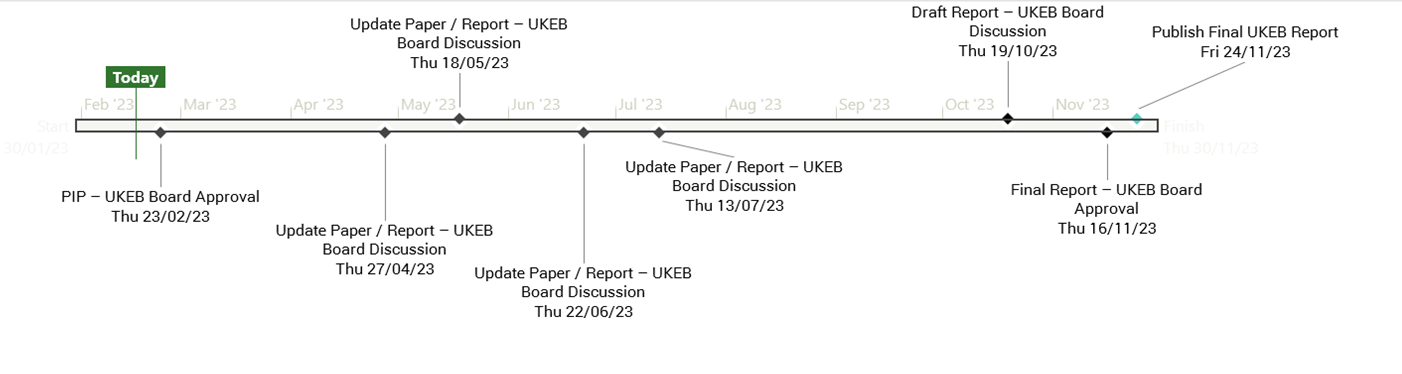
55The proposed high-level project timeline is as follows (a graphical representation is included on the next page). Note that dates are indicative only, and subject to revision by the Board as the project develops:
| Expected Date | Deliverable 1 | Expected Milestones Deliverable 2 | Deliverable 3 |
|---|---|---|---|
| February 2023 | - Project Initiation Plan approval - Commencement of work |
||
| March 2023 | Commencement of work | ||
| April 2023 | UKEB to consider report | Update for the Board | |
| May 2023 | Update for the Board | Commencement of work | |
| June 2023 | UKEB to consider report | ||
| July 2023 | UKEB to consider report | ||
| September 2023 | Commencement of final report (Deliverable 4) | ||
| October 2023 | UKEB to consider draft report (Deliverable 4) | ||
| November 2023 | UKEB to consider final report (Deliverable 4) |
Footnotes
Footnotes
-
UKEB Regulatory Strategy 2023/24 (draft) ↩
-
Letter from Lord Callanan to the International Sustainability Standards Board regarding their exposure drafts IFRS S1 and IFRS S2 (1 August 2022). On 7 February 2023, the Government announced a machinery of government update creating a new Department for Business and Trade. The UKEB is now a partner body of the Department for Business and Trade. ↩
-
Third Agenda Consultation - Projects to add to the work plan ↩
-
IASB Agenda paper Ref 24A, April 2022 para 24 (c) ↩
-
ISSB Consultation on Agenda Priorities - Projects to be included in request for information ↩
-
TCFD requires all large listed, unlisted and LLPs to report on a mandatory basis, within the Strategic Report Financial for years beginning on or after 6 April 2022. Metrics and target require the disclose of Scope 1, Scope 2 and, if appropriate, Scope 3 greenhouse gas (GHG) emissions, and the related risks. ↩
-
SECR is the principal regulatory regime for reporting emissions and associated information and is intended to complement the TCFD disclosures. SECR requires businesses to include their greenhouse gas emissions, energy consumption and energy efficiency action by quoted and large unquoted companies in their annual Directors' report (for companies) or the Energy and Carbon Report (for large LLPs) for financial years beginning on or after 1 April 2019. ↩
-
Financial Conduct Authority (FCA), via its listing rules, requires that certain UK premium listed companies and standard listed companies include a statement in their annual financial report which sets out whether they have made disclosures consistent with the TCFD's framework. These rules came into force for accounting periods beginning on or after 1st January 2022. ↩
-
Still Flying Blind: The Absence of Climate Risk in Financial Reporting (October 2022) ↩
-
134 carbon-exposed companies that are key to "driving the global net zero emissions transition" and include those companies that contribute to up to 80% of global industrial greenhouse gas emissions. ↩
-
CRR Thematic review of TCFD disclosures and climate in the financial statements (July 2022) ↩
-
The green shoots of TCFD reporting: An analysis of the first 50 companies to report under the Listing Rules (April 2022) ↩
-
Companies' readiness to adopt IFRS S2 climate-related disclosures (August 2022) ↩
-
Note - the initial sample will be on 9 FTSE 2022 annual reports ↩
-
Note - this and all other assumptions regarding estimated researcher effort are subject to change as the researcher will need to validate once on boarded to the project team. ↩
-
See Chapter 2: Objective, usefulness and limitations of general purpose financial reporting ↩