7. IAS 1 Presentation of Financial Statements - Narrow Scope Amendments 2020 and 2022
17 November 2022 Agenda Paper 7
Executive Summary
| Project Type | Endorsement Project |
|---|---|
| Project Scope | Limited (Narrow Scope Amendments) |
| Purpose of the paper | |
| International Accounting Standards Board (IASB) issued its Amendments to IAS 1 Non-current Liabilities with Covenants in October 2022. The purpose of this paper is to provide an update to the Board on the link between the IASB's IAS 1 Presentation of Financial Statements Narrow Scope Amendments issued in 2020 and in 2022. | |
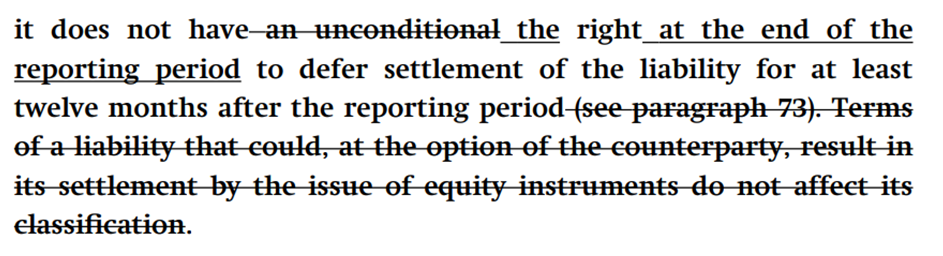
| Summary of the Issue | |
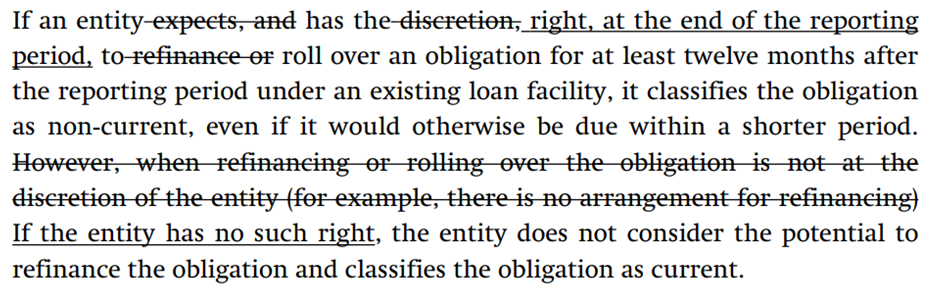
| On 31 October 2022 the IASB published amendments to IAS 1 Non-current Liabilities with Covenants (the 2022 Amendments). These amendments address stakeholders' feedback on the January 2020 amendments to IAS 1 Classification of Liabilities as Current or Non-current1 (the 2020 Amendments). Both Amendments have an effective date of 1 January 2024 and neither has been endorsed for use in the UK. | |
| This paper provides information on: the background to, and summary of, the 2020 Amendments; the Board's influencing activities on the 2022 Amendments; and the new requirements in the final version of the 2022 Amendments that were not part of the Exposure Draft. | |
| The Secretariat considers that the 2020 and 2022 Amendments will need to be assessed for adoption together, and if appropriate adopted simultaneously, given their interaction. This paper sets out a tentative timeline for the project. |
Decisions for the Board
The Board is not asked to make any decisions. The following questions are relevant for the Board's discussion:
- 1Do Board members have any questions or comments on the Background (paragraphs 1 – 30)?
- 2Does the Board have any comment on the proposed next steps, including developing an approach based on assessing the two sets of amendments together (paragraphs 31) and the tentative timeline for the project (paragraph 33)?
- 3Do Board members agree that a consolidated text, incorporating both the 2020 and 2022 amendments, would be useful as they consider the two sets of amendments (paragraph 34)?
Recommendation
- N/A
Appendices
- Appendix A: Key paragraphs from the 2020 Amendments
- Appendix B: The IASB's proposals in its ED, the UKEB's response in our comment letter, and the tentative decisions made by the IASB
- Appendix C: Key paragraphs from the 2022 Amendments
Background
The objective
-
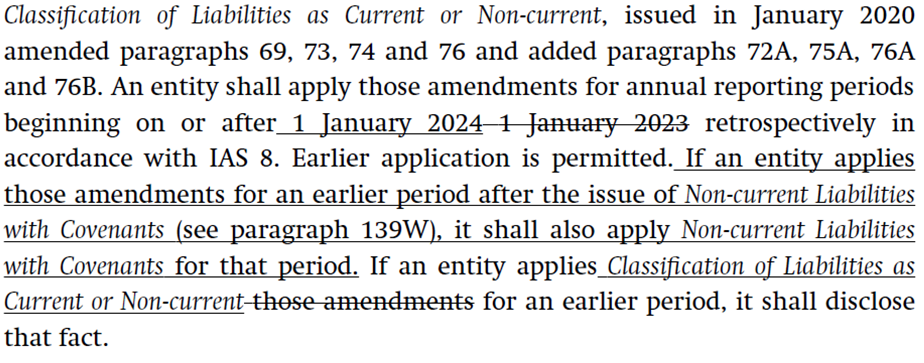
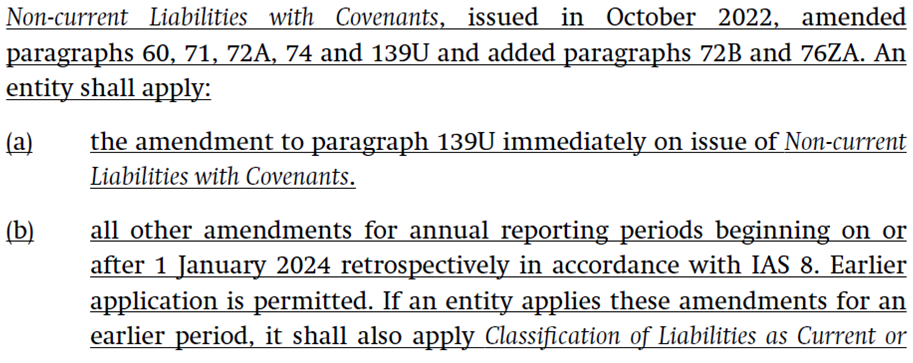
1On 31 October 2022 the IASB published amendments to IAS 1 Non-current Liabilities with Covenants2 (the 2022 Amendments). These amendments address stakeholders' feedback on the classification of liabilities as current or non-current when applying requirements introduced in January 2020 amendments to IAS 1 Classification of Liabilities as Current or Non-current3 (the 2020 Amendments) that are not yet in effect.
-
2The amendments are focused on clarifying the classification of liabilities as current or non-current. So, while quite narrow and limited in scope, they have the potential to impact virtually every company preparing financial statements in accordance with international accounting standards. The classification of liabilities communicates important information to users about the likely pressures on the working capital of companies and can impact important metrics such as solvency and liquidity.
-
3Both sets of Amendments now have an effective date of 1 January 2024 and neither has been adopted for use in the UK. The Board was not formed when the 2020 Amendments were developed but it actively influenced the 2022 Amendments.
-
4This paper provides an overview of the requirements of each of the Amendments. We also outline stakeholder views that we are aware of at this point in time.
The 2020 amendments to IAS 1: Classification of Liabilities as Current or Non-current
Overview
-
5In January 2020, the IASB issued narrow scope amendments to IAS 1 Classification of Liabilities as Current or Non-current. Appendix A reproduces the paragraphs from the 2020 Amendments.
-
6The amendments are focussed on clarifying one of the criterion in IAS 1 for classifying a liability as non-current: the requirement for an entity to have the right to defer settlement of the liability for at least 12 months after the reporting period.
-
7The genesis of the 2020 Amendments were submissions received by the IFRS Interpretations Committee in the early 2010s requesting clarification of the criteria for the classification of a liability as either current or non-current. The issues
-
8concerned whether the classification requirements of paragraph 69(d) of IAS 1 were consistent with the circumstances detailed in paragraph 73.
-
9The submitters considered that these two paragraphs were asymmetrical and requested further guidance on the classification of different types of debt as either current or non-current. In their view, having an unconditional right to defer settlement (specified in paragraph 69(d)) was irreconcilable with having the discretion to refinance or roll over an obligation (specified in paragraph 73).
-
10Following outreach on this topic, the Interpretations Committee recommended a proposed amendment to IAS 1 as part of the 2010-2012 Cycle Annual Improvements to IFRS Standards to clarify that the refinancing arrangement detailed in paragraph 73 of the Standard should only result in a non-current classification if the arrangement was with the same lender and on the same or similar terms. That proposal included guidance on the nature of 'same or similar terms' that was linked to the derecognition requirements for financial liabilities in IFRS 9 Financial Instruments.
-
11Many respondents raised concerns about the proposed amendments and at its March 2013 meeting the IASB agreed not to proceed with the proposed amendments and began to develop alternative amendments.
-
12An Exposure Draft Classification of Liabilities was issued in 20154. The IASB received a substantial amount of feedback that led to significant revisions over the next 5 years with the final amendments being published in 2020.
The amendments:
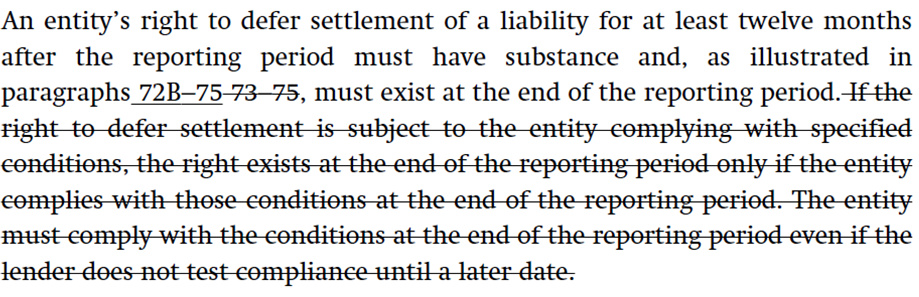
- a)specify that an entity's right to defer settlement must exist at the end of the reporting period (Paragraphs 69(d), 72A and 73);
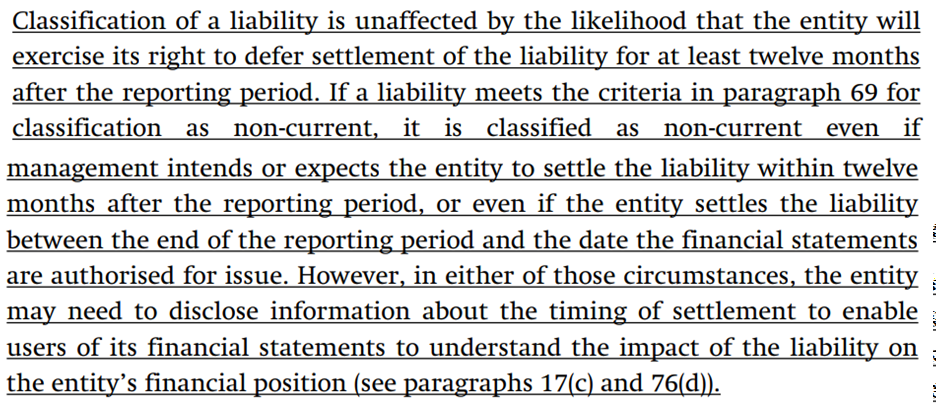
- b)clarify that classification is unaffected by management's intentions or expectations about whether the entity will exercise its right to defer settlement (Paragraph 75A);
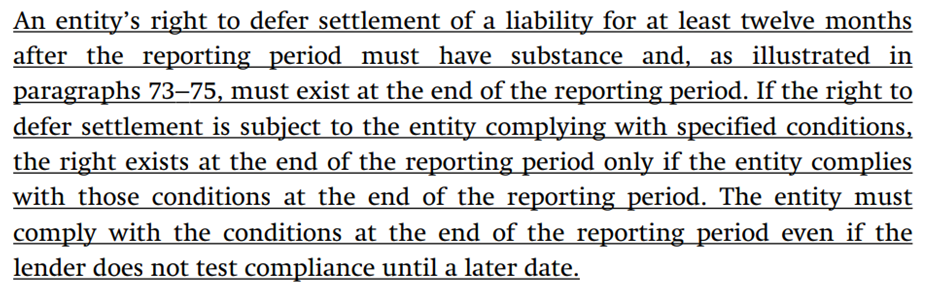
- c)clarify how lending conditions affect classification (Paragraph 72A); and
-
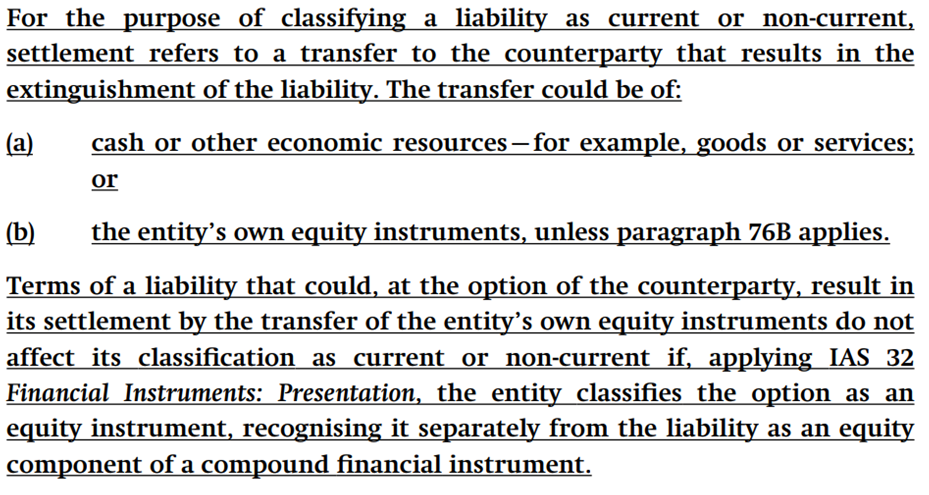
d)clarify requirements for classifying liabilities an entity will or may settle by issuing its own equity instruments (Paragraph 76A).
-
13As the Board is aware, Paragraph 72A subsequently caused concern with stakeholders (see below) which led to the 2022 Amendments.
-
14We are not currently aware of any significant concerns with other elements of these amendments, bearing in mind that they are not yet effective. This was also confirmed at the October 2022 UKEB's Preparers Advisory Group meeting where, with the exception of the Paragraph 72A matter, no significant concerns were raised.
Stakeholder concerns with Paragraph 72A of the 2020 Amendments
-
15In 2021, stakeholder concerns about Paragraph 72A led to consideration by the IFRS Interpretations Committee (Interpretations Committee) of the application of the 2020 amendments. Specifically, the Interpretations Committee considered classification of a liability as current or non-current when a company's right to defer settlement is subject to compliance with covenants within 12 months of the reporting date and the company is not compliant with such covenants at the reporting date.
-
16This led to the Interpretations Committee issuing a tentative agenda decision (TAD) which stated that as the company would not have a right to defer settlement of the liability it would present the related liability as a current liability in its balance sheet. Respondents to the TAD were critical of the conclusion and highlighted unintended consequences arising from the 2020 Amendments and the TAD.
-
17The IASB's response was a tentative decision to amend IAS 1 with respect to classification (as current or non-current), presentation and disclosures of liabilities where an entity's right to defer settlement for at least 12 months is subject to the entity complying with conditions after the reporting period. This was subsequently published as IASB Exposure Draft (ED) Non-current Liabilities with Covenants in November 2021.
-
18In the ED, the IASB proposed to amend IAS 1 to specify that “specific conditions”, with which a company must comply after the reporting date, do not affect the classification of a liability as current or non-current at that date. Instead, a company would be required to:
- a)present non-current liabilities with covenants separately on the face of its balance sheet; and
-
b)disclose information in the notes about the covenants with which it must comply within 12 months of the reporting date.
-
19The Board engaged in influencing activities, including stakeholder outreach and desk-based research, and submitted a comment letter in response to that ED.
The 2022 Amendments to IAS 1: Non-current Liabilities with Covenants
-
20On 31 October 2022 the IASB published amendments to IAS 1 Non-current Liabilities with Covenants (2022 Amendments).
-
21Appendix B summarises the IASB's proposals in its ED, the UKEB's response in its comment letter5, and the final amendment published by the IASB. We are pleased to note that many of the changes made in the published final amendment align with recommendations in the UKEB comment letter.
-
22Appendix C reproduces the primary paragraphs from the 2022 Amendments including those referenced below.
New additions to the final 2022 Amendments
-
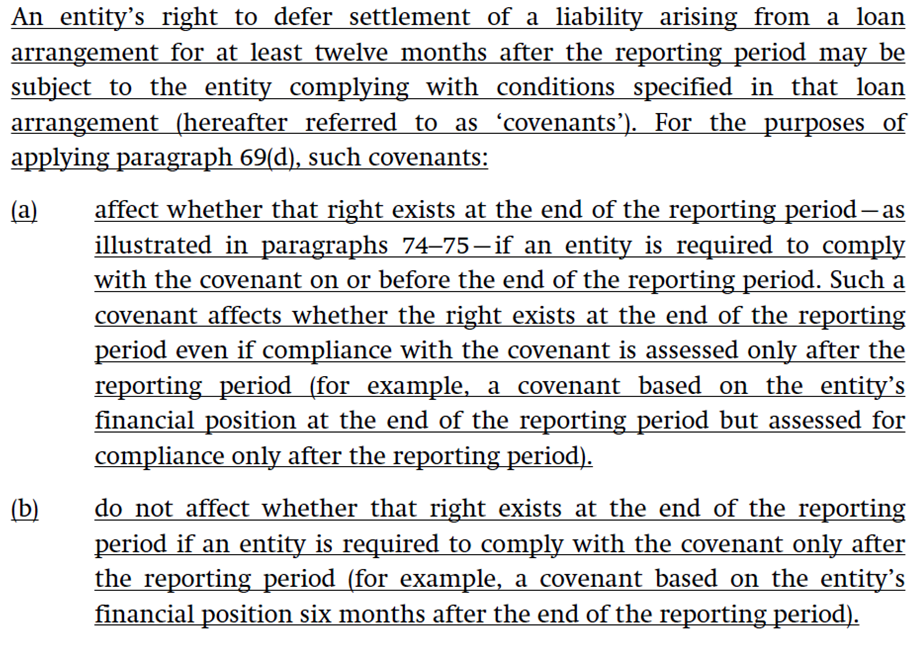
23The term "covenant” has been defined in paragraph 72B (as conditions specified in a loan arrangement) and is subsequently used in paragraph 74 (not reproduced) replacing the words “condition of”. This clarification is consistent with the recommendation in the UKEB comment letter.
-
24More significantly, the disclosure requirements have been substantially rewritten (Paragraph 76ZA). The UKEB comment letter supported the objective of enhancing disclosure in the notes to provide useful information that enables users of financial statements to assess the risk that a liability classified as non-current could become repayable within twelve months. However, we suggested that a number of the proposed requirements were deleted as we did not consider that they were directly relevant to the disclosure objective. Those requirements were deleted and replaced with different requirements.
-
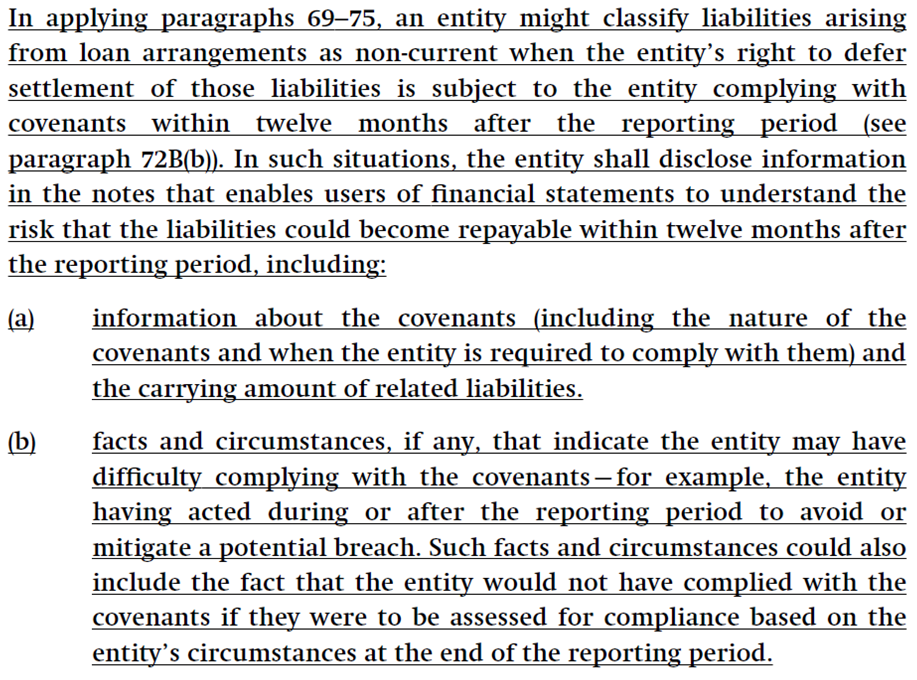
25The revised disclosure requirements are that where a company has non-current liabilities subject to covenants in the next twelve months, the company shall disclose information in the notes that enables users of financial statements to understand the risk that the liabilities could become repayable within twelve months after the reporting period, including:
- a)information about the covenants (including the nature of the covenants and when the entity is required to comply with them) and the carrying amount of related liabilities.
-
b)facts and circumstances, if any, that indicate the entity may have difficulty complying with the covenants—for example, the entity having acted during or after the reporting period to avoid or mitigate a potential breach. Such facts and circumstances could also include the fact that the entity would not have complied with the covenants if they were to be assessed for compliance based on the entity's circumstances at the end of the reporting period.
-
26Finally, the IASB has clarified in Paragraph 139U that a company would need to adopt both sets of amendments at the same time. Again, this is consistent with the recommendations in the UKEB comment letter.
-
27We undertook brief preliminary outreach with both the Preparers Advisory Group and the Accounting Firms & Institutes Advisory Group in the same week that the Amendment was published.
-
28Members of the Preparers Advisory Group noted some preliminary concerns with the new additions to the 2022 Amendments, including:
- a)The intended meaning of "loan arrangement" in paragraph 72B.
- b)The extent of the disclosure expected in accordance with paragraph 76ZA(a) and the application of materiality.
-
c)The interpretation of “may have” in paragraph 76ZA(b), and the type of threshold it implies.
-
29However, no one raised any of these as fatal flaws with the Amendments.
-
30Members of the Accounting Firms & Institutes Advisory Group indicated broad agreement that the amendments were a significant improvement, and that the matters identified at the Preparers Advisory Group would most likely be resolved through the implementation phase.
Next steps
Endorsement
-
31As the 2022 Amendments amend the 2020 Amendments in a significant way, the Secretariat considers that both sets of amendments should be assessed for adoption together and, if appropriate, adopted simultaneously. This will also enable the concurrent implementation of those two sets of amendments by companies, as envisaged by the IASB.
-
32The Secretariat expects to continue outreach and desk-based research to identify any concerns with the 2020 and/or 2022 Amendments until the end of 2022 with the aim of developing an approach to the endorsement project.
-
33A Project Initiation Plan, including the findings and a project timeline, is currently scheduled to be presented at the January 2023 Board meeting. Broadly, this would permit a Draft Endorsement Criteria Assessment (DECA) to be discussed at the Board's February 2023 meeting. This should allow for final adoption to be completed by Q4 2023.
-
34The Secretariat is making enquiries as to whether the IASB intends to publish a consolidated text incorporating both the 2020 and 2022 Amendments. If not, we intend to prepare such a text so the Board can review the amendments in the round.
Appendix A: Key paragraphs from the 2020 Amendments
A1. A1Paragraph 69(d):
A2. A2Paragraph 72A:
A3. A3Paragraph 73:
A4. A4Paragraph 75A:
A5. A5Paragraph 76A and B:
Appendix B: IASB's proposals in its ED, the UKEB's response in our comment letter, and the tentative decisions made by the IASB
| IASB proposal | UKEB final position6 | Final Amendment |
|---|---|---|
| That the classification of a liability as current or non-current should be based on conditions that exist at the end of the reporting period, even if that compliance is only tested later. | We agreed in principle with this approach. However, we believed that "specified conditions” either needed to be defined or the term "condition" should be used. We also recommended some redrafting for clarity. | The IASB retained this proposal but has been some rewording in the final standard to enhance clarity of the paragraph |
| When an entity classifies a liability subject to conditions as non-current, it would be required to disclose information in the notes that enables users of financial statements to assess the risk that the liability could become repayable within twelve months. | We supported the objective of enhancing disclosure in the notes to provide useful information that enables users of financial statements to assess the risk that a liability classified as non-current could become repayable within twelve months. However, we suggested that a number of the proposed requirements were deleted as we did not consider that they are directly relevant to the disclosure objective. | The IASB has made a number of modifications to the specific disclosure requirements proposed in the original ED. The proposals we suggested be deleted have been removed. A specific requirement to disclose information about facts and circumstances that indicate the entity may have difficulty complying with covenants when it is required to do so has been added. |
| IASB proposal | UKEB final position7 | Final Amendment |
|---|---|---|
| To require an entity to present separately, in its statement of financial position, liabilities classified as non-current for which the entity's right to defer settlement for at least twelve months after the reporting period is subject to compliance with specified conditions within twelve months after the reporting period. | We did not support this proposal for a number of reasons, including concerns that few liabilities would not meet these conditions, and that such a requirement was not consistent with a principle-based approach to financial accounting. | The IASB has deleted this requirement. It is to be replaced with a requirement to disclose the carrying amount of non-current liabilities with covenants in the notes together with information on the nature of the covenants and when the entity is required to comply with them. |
| To clarify circumstances in which an entity does not have a right to defer settlement of a liability for at least twelve months after the reporting period. | We believed the proposals in paragraph 72C(b) were likely to lead to diversity in practice and have unintended consequences when it comes to classification. We recommended deletion of paragraph 72C. | The IASB has deleted paragraph 72C. |
| To require retrospective application of the amendments and defer the effective date of the 2020 Amendments to no earlier than 1 January 2024. | We agreed but noted that entities should not be able to early adopt the 2020 amendments without also adopting these amendments. | The IASB retained this proposal but has made it clear that entities cannot early adopt the 2020 Amendments without also adopting the 2022 Amendments. |
Appendix C: Key paragraphs from the 2022 Amendments
C1 C1Paragraph 72A:
C2 C2Paragraph 72B:
C3 C3Paragraph 76ZA
C4 C4Paragraph 139U
C5 C5Paragraph 139W
Footnotes
Footnotes
-
Classification of Liabilities as Current or Non-current (Amendments to IAS 1) (ifrs.org) ↩
-
IASB-IAS2022-1 – Final Amendment: Non-current Liabilities with Covenants - Amendment to IAS 1 (ifrs.org) ↩
-
Classification of Liabilities as Current or Non-current (Amendments to IAS 1) (ifrs.org) ↩
-
Exposure Draft: Classification of Liabilities-Proposed Amendments to IAS 1 (ifrs.org) ↩
-
IFRS - Exposure Draft and comment letters: Non-current Liabilities with Covenants ↩
-
Feedback Statement - Non-Current Liabilities with Covenants ↩
-
Feedback Statement - Non-Current Liabilities with Covenants ↩