6. IFRS 17 – Implementation Update
17 November 2022 Agenda Paper 6
Executive Summary
| Project Type | Influencing |
| Project Scope | Significant |
| Purpose of the paper | The purpose of this paper is to provide a brief update on the implementation of IFRS 17 Insurance Contracts in the UK. In particular, the paper provides high-level information on whether any significant new issues are emerging and on disclosures made by insurance companies to date. |
| Summary of the Issue | IFRS 17 is effective from 1 January 2023 and was adopted by the UKEB for use in the UK in May 2022. At the time the Endorsement Criteria Assessment was finalised, the UKEB was aware that certain implementation and interpretation issues were not fully resolved. The UKEB's IFRS 17 Feedback Statement makes reference to continuing to engage with UK stakeholders during the implementation and initial application of the Standard, in particular in relation to: |
| - reinsurance to close (RITC) transactions in the Lloyd's market; and | |
| - the allocation of the contractual service margin (CSM) for annuities. | |
| The Secretariat has made limited enquiries to ascertain the status of these issues and to determine whether any significant new issues have emerged since the completion of our endorsement project. Industry representatives have highlighted an interpretation issue concerning the presentation of premiums receivable in respect of expired coverage. | |
| The paper also provides a brief update on the disclosures made by insurers so far of the expected impact of IFRS 17 on their accounts. | |
| Decisions for the Board | The Board is not asked to make any decisions. However, Board members are invited to ask questions or provide comments on any of the matters raised in this update. |
| Recommendation | N/A |
| Appendices | Appendix A Examples of disclosures |
Background
1IFRS 17 Insurance Contracts is effective from 1 January 2023. The UKEB adopted the Standard for use in the UK in May 2022.
2At the time the IFRS 17 Endorsement Criteria Assessment1 (ECA) was finalised, the UKEB was aware that certain implementation and interpretation issues were not yet fully resolved. The UKEB's IFRS 17 Feedback Statement2 makes reference to continuing to engage with UK stakeholders during the implementation and initial application of the Standard.
3In particular, the Feedback Statement refers to monitoring the following two endorsement issues3 in the context of the UKEB's overall conclusions on UK long term public good:
- reinsurance to close (RITC) transactions in the Lloyd's market; and
- the allocation of the contractual service margin (CSM) for annuities.
4In addition, when considering feedback on the completeness of the technical accounting issues addressed in the ECA, the Feedback Statement4 refers to issues raised by stakeholders relating to the accounting treatment of:
- premium receivables from intermediaries; and
- 'hybrid' contracts.
5Although both these issues were considered to be primarily interpretation issues rather than endorsement issues, the ECA recognised that this distinction is not always clear cut. The Feedback Statement noted that the UKEB would monitor these issues during the IFRS 17 implementation and initial application period.
6The Secretariat has made limited enquiries to ascertain the status of all the above issues and brief updates are provided below.
7Enquiries about significant new issues, emerged since the completion of the UKEB's adoption of the Standard, highlighted an interpretation issue that was not addressed in the ECA, concerning premiums receivable in respect of expired coverage. A brief explanation is also provided below.
8Our limited enquiries have been made primarily through the Association of British Insurers (ABI) and its IFRS 17 reporting working groups, and we are grateful for the ABI's assistance. In addition, we have held follow-up calls with three insurers and with the IASB staff.
Issues in the context of the UK long term public good
RITC transactions
9The ECA5 noted a developing view that RITC contracts would be treated as reinsurance contracts under IFRS 17 and that, on that basis, the application of IFRS 17 was expected to result in an additional operational burden. In addition, some stakeholders challenged whether the accounting would reflect the economic substance of the transactions or result in understandable information. Further, stakeholders had concerns about the potential impact of IFRS 17 on Lloyd's market efficiency and on competition.
10The ECA concluded that the expected accounting was consistent with that for reinsurance more generally and for liabilities under IFRS 9. Overall, any initial risks to understandability needed to be balanced against the objectives of enhanced reliability and comparability. In addition, given the evidence obtained about the potential impact of IFRS 17, the ECA concluded that it seemed unlikely that the Standard would have a significant adverse impact on the UK insurance industry.
11The accounting for RITC transactions was not raised at the call we attended with the ABI's IFRS 17 reporting working group for general insurers in October 2022. From a follow-up call with one of the insurers that had raised concerns during our endorsement project, we understand that the issue is currently not material to that insurer as the relevant changes in syndicate participation levels have been small. More generally, higher inflation and political instability were currently thought to act as a disincentive to companies taking on portfolios of claims liabilities. An audit firm confirmed the view that currently there were not many insurers reporting under IFRS that would be impacted at a group level by this issue.
12Nevertheless, we have been informed that discussions are ongoing to further consider the question of how to account for RITC transactions under IFRS 17. A focus of the discussions is whether RITC contracts should indeed be treated as reinsurance and, consequently, whether continued recognition of the underlying insurance contract liabilities by the members of the closing year of account (the ceding members) would be appropriate. We understand there is not yet a consensus on this question.
CSM allocation for annuities
13The allocation of the CSM for annuities was considered a priority issue in the ECA7. The IFRS Interpretations Committee received a submission on the issue and at the time the ECA was finalised had issued a tentative agenda decision, subsequently ratified by the IASB in July 2022.
14The ECA noted that the Interpretation Committee's (then tentative) agenda decision removed one source of potential diversity in practice and that an approach in line with that decision would satisfy the technical accounting criteria. However, the need to apply judgement remained and, given the extent of the continued concerns over the agenda decision, the UKEB considered that the issue should be a focus of a post-implementation review of IFRS 17.
15In addition, the ECA set out the concern of some UK stakeholders that IFRS 17's requirements may result in accounting outcomes that have a material and detrimental impact on the annuity market.
16Feedback from the ABI indicates that this issue was not raised at their IFRS 17 reporting working group for life insurers in October 2022. From a follow-up call with one of the insurers that had raised concerns during our endorsement project we understand that they have been able to develop an approach to CSM allocation that is acceptable both internally and to their auditors. The pattern of recognition of CSM (profit) under the agreed method does not entirely match that expected under their originally preferred method, but the approach is considered an acceptable compromise, including for portfolios of deferred annuities8. We do not have details of the approach but understand that it includes determining a 'target' CSM at the point of vesting that is broadly equivalent to that which would be determined for an individual annuity sold at that point (in other words an 'economic reference point'). It is understood that several of the main annuity providers are adopting broadly similar approaches.
17As stated in the IFRS 17 Feedback Statement, the allocation of CSM should be a focus of any post-implementation review of the Standard.
Additional issues raised in feedback on the DECA
Premium receivables from intermediaries
18The question in relation to premium receivables from intermediaries (such as brokers) is essentially whether they fall to be accounted for under IFRS 17 or under IFRS 9 Financial Instruments. This affects the data that needs to be gathered and the design of accounting systems. If IFRS 9 is applied, the receivables are not included in the measurement of fulfilment cash flows under IFRS 17 but recognised as a separate asset under IFRS 9. The effect is to 'gross up' the statement of financial position, but generally there is no direct impact on the income statement.
19The matter was considered to be an interpretation issue and, at the time the ECA was finalised, it was understood that the concern was not widespread and that appropriate solutions might yet be found. Our recent enquiries indicate that the issue is not yet resolved. One developing view is that the appropriate accounting depends on the contractual arrangements: that is, in broad terms, whether the insurer must fulfil its obligations to the policyholder even if it has not received the premium from the intermediary. If not, balances held by the intermediary are expected to be in the scope of IFRS 17.
20However, the interaction of the two standards is not wholly clear and some stakeholders are concerned that diversity in practice could result from the interpretation of similar contractual arrangements. Further, from an operational perspective, insurers may not always be able to obtain the information from intermediaries that would be needed if they had to apply IFRS 99. The issue is prevalent across the global insurance industry and discussions have commenced with the IFRS Interpretations Committee on the matter. The Interpretations Committee Pipeline on the IFRS website contains two submissions on this issue.
'Hybrid' contracts
21Contracts referred to as ‘hybrid' contracts are those where the policyholder has the option to invest in both unit-linked and with-profits funds. Contracts containing no significant insurance risk would be classified as investment contracts, so hybrid contracts invested 100% in unit-linked funds would be classified as investment contracts under IFRS 9. Those invested 100% in with-profits would fall within the scope of IFRS 17, and for contracts lying between those extremes judgement needs to be applied. The concern was expressed that this could lead to arbitrary classification divisions and operational complexity.
22The Feedback Statement noted that the topic had been assessed in developing the DECA, including by the insurance Technical Advisory Group. While acknowledging the degree of judgement required and the risk of diversity in practice remaining, it had been concluded that this was primarily an interpretation issue.
23This issue has not been raised with us since the issue of the ECA and was not referred to by insurers in our recent enquiries. We have been informed by one audit firm that, to their knowledge, and to the extent the issue is material, insurers have been able to develop models to account for the investment and with-profits components appropriately.
New issues emerging
Premiums receivable in respect of expired coverage
24We have been made aware of an interpretation issue concerning the presentation of cash inflows receivable, for example premiums receivable, related to expired coverage (that is, to past insurance services). This matter was not referred to in feedback on the DECA or in the ECA.
25The issue can arise when cash flows relating to expired coverage have not yet been settled and we understand is common in relation to reinsurance contracts, which might be subject to premium adjustments or net settled in arrears. IFRS 17 distinguishes between the liability for remaining coverage (LRC) and the liability for incurred claims (LIC) and the question is whether, to the extent such receivables relate to past service, they should be included in the LIC.
26We have been informed that this is primarily a concern for general insurers applying the premium allocation approach and that the issue affects only the disclosure of insurance liabilities (with no impact on the income statement). In addition, insurers are concerned about potential operational complexity should such receivables need to be included in the LIC. This reflects a concern that in some circumstances receivables would need to be tracked and moved from LRC to LIC, or allocated between them, to reflect the level of services already provided.
27Insurers and auditors have been unable to reach consensus on the question and the IFRS Interpretations Committee has been approached on the matter. The request is still in the preliminary research stage and at the time of writing is not included in the Interpretations Committee Pipeline.
Disclosures of the impact of IFRS 17
28The following paragraphs provide a high-level overview of the disclosures made so far of the expected impacts of IFRS 17. It is based on a brief review of the financial results published by a limited number of UK insurers.
Disclosure requirements
29IAS 8 Accounting Policies, Changes in Accounting Estimates and Errors requires the disclosure of the expected impacts that new standards issued but not yet effective will have on an entity's accounts at initial application.
30IAS 8.30 states “when an entity has not applied a new IFRS that has been issued but is not yet effective, the entity shall disclose this fact and known or reasonably estimable information relevant to assessing the possible impact that application of the new IFRS will have on the entity's financial statements in the period of initial application".
31IAS 8.31 specifies that an entity should consider disclosing the following to comply with the requirement set out in IAS 8.30:
- the title of the new IFRS;
- the nature of the impending change or changes in accounting policy;
- the date by which application of the IFRS is required;
- the date as at which it plans to apply the IFRS initially; and
- either:
- a discussion of the impact that initial application of the IFRS is expected to have on the entity's financial statements; or
- if that impact is not known or reasonably estimable, a statement to that effect.
33In relation to quantitative disclosures, the following considerations will be relevant:
- whether it is possible to reasonably estimate the impact on the accounts on first application; and
- whether it would be possible to gain assurance over any quantitative information which is available.
34Quantitative disclosures to consider may include:
- the impact on shareholder equity as at the opening balance sheet date;
- the impact on shareholder equity as at the initial application date of 1 January 2023; and
- the impact on 2022 full year profit.
35Quantitative disclosures could be given by means of a range of expected impacts and could be enhanced by outlining the key drivers of any material changes.
Disclosures made by insurers to date
36None of the insurers reviewed, with the exception of HSBC, included quantitative information in their Basis of Preparation disclosures in their 2021 accounts relating to the IAS 8 requirements outlined above. HSBC estimated that there would be a two-thirds reduction in the reported profit and equity of its insurance business.
37HSBC also reported positive feedback from analysts for having been first to provide information on the high-level indicative impact. However, based on our limited review, other insurers said that they were unable to provide a reasonable estimate of the quantitative impact of IFRS 17.
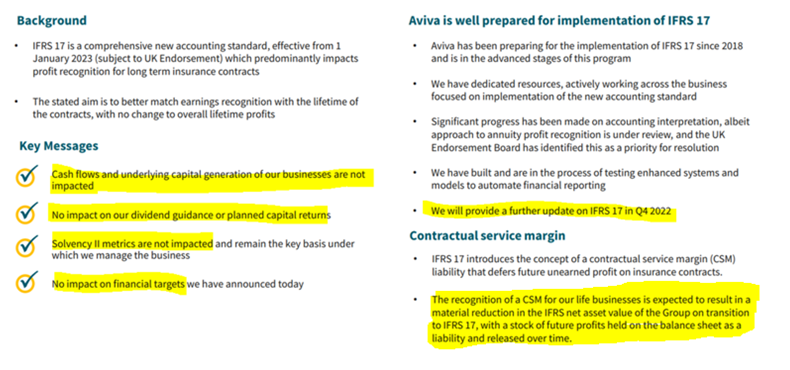
38Although many insurers stated that there would be a significant impact on group equity and short-term profitability, several did highlight that there would be no impact on solvency or their ability to pay dividends.
39Appendix A provides some examples of the disclosures made recently.
Expectations for future reporting
40Several insurers have indicated that they will provide details of the financial impact of IFRS 17 in their 2022 results announcements (expected late February/early March 2023) which may be in the form of guidance rather than absolute amounts.
41For entities that report quarterly, there may be an increased expectation from users that quantitative data be disclosed in their 2022 full year results as Q1 2023 results prepared under IFRS 17 would need to be ready relatively soon afterwards (there is generally a two month gap).
42All insurers will have to report under IFRS 17 for H1 2023 at the latest (H1 results are usually published in August).
43The European Securities and Markets Authority issued guidance10 in May 2022 outlining their expectations relating to IFRS 17 disclosures in 2022 interim and annual financial statements. Although not applicable to UK listed entities, it provides a useful guide on expected best practice in this area. The guidance noted an expectation that, for most insurers, reasonably estimable information relevant to assessing the possible impact of the application of IFRS 17 would be available in time for 2022 half-year reporting, and that the 2022 full year results should provide the quantitative impact of the application of IFRS 17.
Next steps
44We will continue to monitor IFRS 17 implementation and expect to bring a further update to the Board once 2022 accounts have been published.
45Board members are invited to ask questions or provide comments on any of the matters raised in this update.
Appendix A: Examples of disclosures
A1. Prudential
a) 2021 Annual Report:
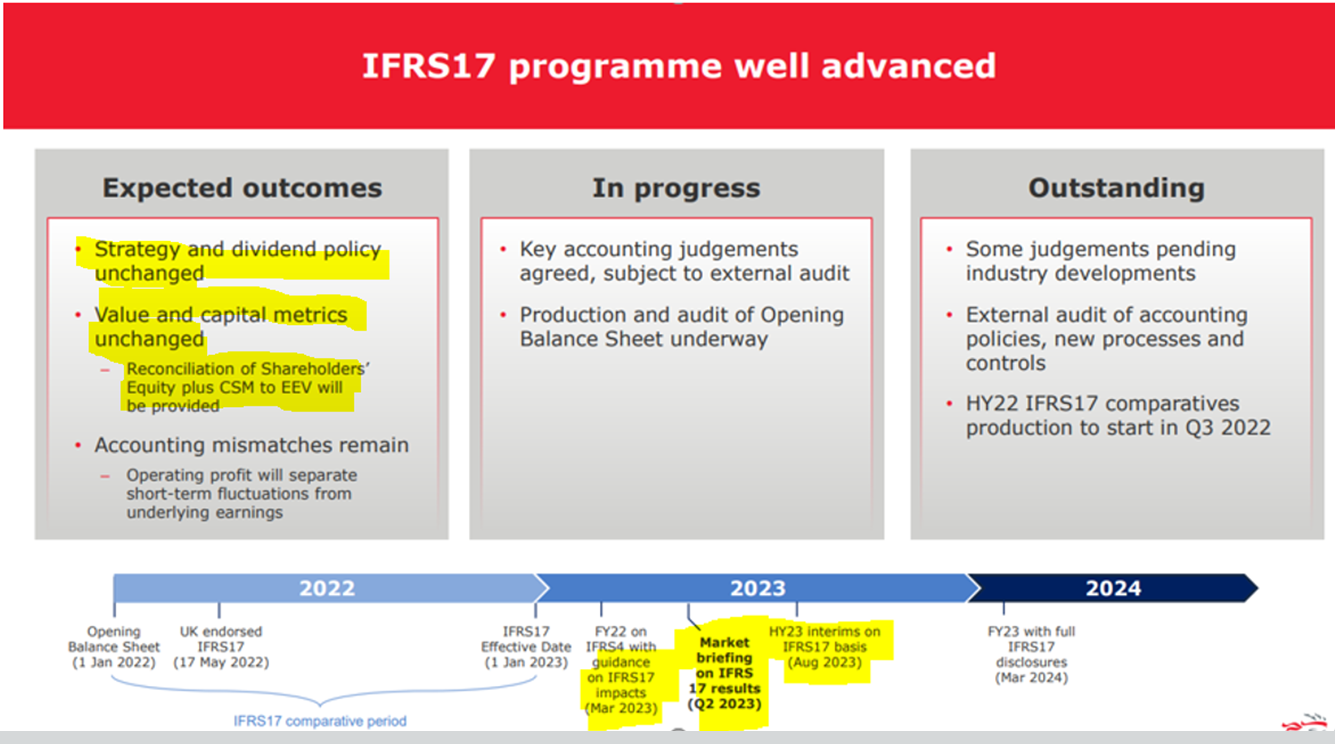
In order to transition to IFRS 17, the amount of deferred profit, being the CSM at transition date, needs to be determined. IFRS 17 requires this CSM to be calculated as if the standard had applied retrospectively. However, if this is not practical an entity is required to choose either a modified retrospective approach or to determine the CSM by reference to the fair value of the liabilities at the transition date (1 January 2022). The approach for determining the CSM will have a significant impact on both shareholders' equity and on the amount of profits on in-force business in future reporting periods. The Group expects all three approaches to be applied on transition, depending on the information that is available to be used for the different groups of contracts of the Group.
programme. A number of sub-committees are also in place to provide governance over the technical interpretation and accounting policies selected, design and delivery of the programme. During 2021, the Group has made significant progress with the build and testing of new actuarial and finance systems. It is not practicable to provide reliable estimates of the quantitative impact on the Group's results and financial position for the 2021 Annual Report.
b) HY 2022 Results Presentation:
A2. HSBC – 2021 Annual Report:
results announcement. For the purpose of planning the Group's financial resources, our initial assumption (based on analysis of the expected 2022 position) is that the accounting changes may result in a reduction in the reported profit of our insurance business by approximately two thirds on the transition to IFRS 17, albeit with a range of expected outcomes. A similar impact is expected on the equity of the insurance business, primarily
IFRS 17 'Insurance Contracts'
The Committee will oversee the transition to IFRS 17 and consider the wider strategic implications of the change on the insurance business.
Earlier in 2021, management provided an update on the potential impact of IFRS 17 on HSBC's reported numbers in the financial statements, and conducted a walk-through of the relevant disclosure requirements applicable to HSBC, including an introduction to GAAP and potential non-GAAP metrics to support investor communications during and after the transitional period. In response to questions from GAC members, including from the Chair, relating to the overall financial management of the insurance business, a separate session was organised with the Chair of the GAC on 16 June 2021. The meeting covered different aspects of insurance financial management, with a particular focus on interest rate management and business strategy. Since then, HSBC released further information on the impact of IFRS 17 on HSBC's reported numbers, as part of the third quarter 2021 earnings release statement, as well as providing a briefing to analysts on IFRS 17. Feedback from analysts so far has been positive, particularly given HSBC was the first to provide high-level indicative impact based on planning assumptions. In December 2021, management provided an update on the disclosure of performance metrice on adoption of IFRS 17 including ite
A3. Lloyds - H1 2022 Results Announcement:
The standard has been endorsed as effective from 1 January 2023, with a transition date of 1 January 2022 (reflecting the starting point for comparative results), and management is currently unable to quantify with reasonable assurance the estimated impact on transition to IFRS 17. This is because implementing the methodology for contract modifications, guaranteed annuity options, coverage units for the annuity business and the confidence level for the risk adjustment is ongoing and clarity on these areas is anticipated in the third quarter of 2022. The calculation of the transition impact of IFRS 17 will be completed during the second half of 2022. The Group will provide a summary of the transitional impacts in the future accounting developments note in the 2022 Annual Report and Accounts and expects to publish a more detailed transitional document in the first quarter of 2023.
A4. Aviva
a) 2021 Annual Report:
The Group is in the advanced stages of implementation of IFRS 17. However, as some material judgements are still under consideration, a reasonable estimate of the financial impacts cannot be provided at this stage.
b) FY 2021 Results Presentation:
Footnotes
-
The IFRS 17 ECA can be found here ↩
-
The IFRS 17 Feedback Statement can be found here ↩
-
See page 12 of the Feedback Statement ↩
-
See page 17 of the Feedback Statement ↩
-
See ECA paragraphs 4.181 - 4.204 and Appendix B (pages 164 - 167) ↩
-
Current practice under IFRS 4 generally includes derecognition of liabilities when participation decreases. ↩
-
See ECA paragraphs 3.20 - 3.70 and 4.157 - 4.169 ↩
-
Likely to arise in the context of bulk purchase annuities (BPA). ↩
-
In certain scenarios, such as the default of the intermediary, the presentation of any resulting loss would depend on whether the receivables were accounted for under IFRS 9 (impairment loss) or IFRS 17 (recognition of onerous contracts). ↩
-
ESMA32-339-208 Public Statement "Transparency on implementation of IFRS 17 Insurance Contracts". ↩