3.0 [Revised draft] Due Process Handbook
Project Type: UKEB Set-up Project Scope: N/A
Executive Summary
Purpose of the paper
This paper presents a revised draft version of the Due Process Handbook (the "Handbook") for Board approval. A timeline for the publication and finalisation of the Handbook is included.
Summary of the Issue The Handbook was issued for comment on 21 February 2022 and was open for comment until 6 June
- The Board discussed the comments received at its July and September 2022 meetings. The Secretariat addressed all these comments in the revised draft version of the Handbook.
The Appendices to this paper include a clean version (Agenda paper 3 Appendix 1) and a tracked version (Agenda paper 3 Appendix 2) of the revised draft of the Handbook. We have also included a summary of main changes made to the revised draft of the Handbook derived from the Board's discussions (Agenda paper 3 Appendix 3).
A copy of the draft Handbook that was originally published for public comment can be found here.
Decisions for the Board
Board members are asked:
- For comments on the form and content of the revised draft of the Handbook; and
- Subject to any comments made at the meeting, whether they approve that the revised draft of the Handbook can be finalised for publication.
Recommendation:
We recommend that, subject to the amendments or additions, the Board approves the Handbook for publication.
Appendices
| Appendix 1 | [Revised draft] Due Process Handbook—(clean) version |
|---|---|
| Appendix 2 | [Revised draft] Due Process Handbook—(tracked) version |
| Appendix 3 | Summary of main changes made to the [Revised Draft] Due Process Handbook |
Introduction
1The UKEB published for public consultation its (draft) Due Process Handbook (the "Handbook") on 21 February 2022. The draft Handbook was open for comment until 6 June 2022. The Board received 6 comment letters1. The UK oversight body (FRC) provided additional feedback via email on 14 June 2022 and on 19 August 2022 which was shared with Board members in full.
2At the July 2022 and September 2022 Board meetings2, the Board reviewed and provided comments on the Secretariat's preliminary assessment and planned drafting amendments on the issues identified by respondents (both substantive and non-substantive).
3The Secretariat has addressed Board members' comments in the revised draft version of the Handbook (see Appendix 1). The Secretariat has also provided a summary of the main changes made to the revised draft version of the Handbook derived from those Board's discussions (see Appendix 3).
Structure of the papers
4This paper asks for approval of the revised draft version of the Handbook. For this purpose, we are providing separate papers as follows:
- Agenda Paper 3: Appendix 1—Clean version of [Revised draft] Due Process Handbook.
- Agenda Paper 3: Appendix 2—Tracked version of [Revised draft] Due Process Handbook. This paper also indicates how some paragraphs and sections of the version for comment have been moved around. In particular:
- to avoid duplication, the description of the following milestones: ‘project initiation plan’, ‘desk-based research’ and ‘outreach activities’ in Sections 5–7 was moved to Appendix A ‘Description of common milestones’.
- paragraphs 10.1–10.14 (that were included as part of Section 10 “Supporting the work of the IFRS Interpretations Committee”) were moved to Section 5 "Influencing process".
- paragraphs 11.1–11.5 (that were included as part of Section 11 “Due process compliance statement”) were moved to Appendix A.
- Agenda Paper 3: Appendix 3—Summary of main changes made to the [Revised draft] Due Process Handbook.
Questions for the Board
1Does the Board have any comments on the form and content of the revised version of the Handbook?
2Does the Board agree that, subject to suggestions by the Board at this meeting, the revised version of the Handbook can be finalised for publication?
3Does the Board have any comments on the next steps and timeline?
Next steps and timeline
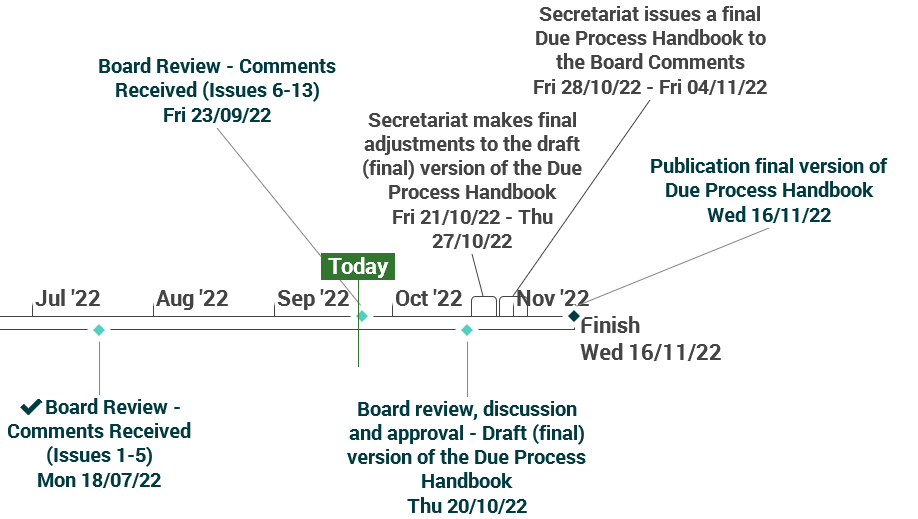
5Subject to amendments or additions required by the Board, our plan for finalising the revised version of the Handbook is set out in the table below and diagram in the next page.
Timeline
| Date | At a public Board meeting: | Status |
|---|---|---|
| 18 July 2022 | Feedback summary—Main (substantive) matters identified discussion (Issues 1–5) | Completed |
| 23 September 2022 | Feedback summary—Main (substantive) matters identified discussion (Issues 6–13) | Completed |
| 20 October 2022 | Board review, discussion, and approval of (revised draft) version of the Due Process Handbook | This meeting |
| 21–27 October | Secretariat makes any final adjustments to the revised version of the Due Process Handbook derived from the comments received at the October 2022 meeting | To be completed |
| 28 October 2022 | Secretariat shares a final revised version of the Due Process Handbook for final review by the Board Comments due by Friday 4 November 2022 | To be completed |
| Mid-November 2022 | Publication of final Due Process Handbook |
Appendix 1: [Revised Draft] Due Process Handbook
October 2022
Table of contents
| Section | Contents | Paragraphs |
|---|---|---|
| 1 | Introduction | 1.1–1.4 |
| 2 | Statutory functions of the UKEB | 2.1 |
| 3 | Terms of Reference and Guiding Principles | 3.1–3.9 |
| 4 | Governance activities | 4.1–4.36 |
| 5 | Influencing process | 5.1–5.33 |
| 6 | Endorsement process | 6.1–6.44 |
| 7 | Thought leadership and research programme | 7.1–7.39 |
| 8 | Post-implementation reviews | 8.1–8.39 |
| 9 | Advisory groups | 9.1–9.22 |
Appendices
| Appendix A | Description of common milestones |
|---|---|
| Appendix B | Relationship between Statutory Instruments and other governance documents for the UK Endorsement Board |
| Appendix C | Terms of Reference outline for advisory groups |
1 Introduction
1.1The purpose of the Due Process Handbook (Handbook) is to set out the due process that the UK Endorsement Board (UKEB) follows in carrying out its statutory functions, which consist of:
- influencing the development of international accounting standards3 and the other activities of the International Accounting Standards Board (IASB) and the IFRS Interpretations Committee; and
- endorsing and adopting a new international accounting standard, an amendment to an international accounting standard or an IFRIC Interpretation (thereafter ‘a new or amended standard’) for use in the UK.
1.2This Handbook also describes additional due process steps that the UKEB follows for:
- carrying out its thought leadership activities and developing its own research programme;
- performing its own post-implementation reviews;
- setting up and operating advisory groups; and
- ensuring it complies with the required due process steps in this Handbook.
1.3The Secretary of State for the Department of Business, Energy and Industrial Strategy (BEIS) delegated the functions relating to influencing, endorsing and adopting international accounting standards for application in the UK to the UKEB in May 20214. The Secretary of State maintains a regular review of the performance of the UKEB in exercising those functions. The UK Financial Reporting Council (FRC) oversees the effective governance of the UKEB and its adherence to the due processes set out in this Handbook. It also provides operational support. The FRC does not have the power to direct the UKEB in relation to the determination of its programme of work or the outcome of its technical decision-making5.
2 Statutory functions of the UKEB
2.1The following statutory functions were delegated to the UKEB6, as follows:
Regulation 5 of SI 2019/685:
> '(a) the adoption of international accounting standards for use within the United Kingdom, with a view to harmonising the financial information presented by the companies required by section 403(1) of the Companies Act 2006 to prepare their accounts in accordance with UK-adopted international accounting standards, in order to ensure— > >
-
>
- a high degree of transparency and international comparability of financial statements; and >
- the efficient allocation of capital, including the smooth functioning of capital markets in the United Kingdom; and >
Regulation 8 of SI 2019/685 also requires consultation:
> 'Before adopting an international accounting standard under regulation 6, the Secretary of State must consult such persons as the Secretary of State considers to be representative of those with an interest in the quality and availability of accounts, including users and preparers of accounts.'
Regulation 11 of SI 2019/685:
> '(1) The Secretary of State must publish a statement setting out the Secretary of State's policy on what amounts to a significant change in accounting practice, and must keep this policy statement under review. > > (2) Paragraphs (3) and (4) apply in relation to the adoption of any standard by the Secretary of State under regulation 6 which the Secretary of State considers likely to lead to a significant change in accounting practice. > > (3) The Secretary of State must— > >
-
>
- carry out a review of the impact of the adoption of the standard; and >
- publish a report setting out the conclusions of the review no later than 5 years after the date on which the standard takes effect (being the first day of the first financial year in respect of which it must be used). >
Regulation 17 of SI 2019/685 also requires that the UKEB Board (hereafter 'Board') report to the Secretary of State on its activities:
> '(1) The body must, at least once in each calendar year for which the delegation regulations are in force, make a report to the Secretary of State on— > >
-
>
- the discharge of the functions transferred to it, and >
- such other matters as the Secretary of State may by regulations require.’ >
3 Terms of Reference and Guiding Principles
Terms of Reference
3.1The Terms of Reference7 (ToR) further elaborate on the UKEB’s role and responsibilities as they relate to the statutory functions. The UKEB’s key responsibilities include:
- Considering and deciding whether to endorse and adopt new or amended international accounting standards for application in the UK8. This includes a formal endorsement criteria assessment as set out in SI 2019/685.
- Influencing the development of IFRS. The UKEB will follow, contribute to and monitor debates on IASB’s and IFRS Interpretations Committee’s9 projects; consult with UK stakeholders to obtain their views; highlight any concerns to the IASB at different stages of their projects, including the development of the IASB’s agenda; and respond to IASB’s draft proposals and consultations (including a request for information on an IASB post-implementation review)10.
- Deciding on the work plan for UKEB post-implementation reviews, for UKEB research and thought leadership activities, and undertaking those activities to contribute to the development of financial reporting internationally, after public consultation on possible projects to be included11.
- Ensuring that there is an open and transparent due process including a public consultation process with UK stakeholders on items such as draft comment letters to the IASB or, draft endorsement criteria assessments.
- Reporting to the FRC Board, in relation to the UKEB's effective operation, governance and adherence to the Due Process Handbook.
- Reporting to the Secretary of State for BEIS in relation to the performance of the UKEB's statutory functions.
3.2The ToR are set by the Secretary of State for BEIS and adopted by the UKEB.
Guiding Principles
3.3Paragraphs 4.1–4.5 in Section 4 of the ToR require the UKEB to act at all times in accordance with the following guiding principles (along with a brief description):
- Accountability—includes consulting with UK stakeholders that are affected by financial reporting, undertaking activities and due process procedures in a timely manner and providing a rationale for the decisions it makes. The UKEB is accountable to:
- its stakeholders (e.g. users, preparers, academics, accounting firms, accounting bodies and regulators);
- its oversight body (the FRC) in relation to its effective operation, governance and adherence to the Due Process Handbook; and
- the Secretary of State for BEIS in relation to the performance of its statutory functions.
- Independence—to ensure that it acts in the UK's long term public good and that it is independent from other organisations or stakeholder groups, including the FRC and BEIS, in respect of the performance of its statutory functions, including its technical decision making.
- Transparency—to determine its technical decisions after having assessed the relevant evidence received and having followed its Due Process Handbook. To undertake its activities in a transparent manner so that stakeholders are aware of current projects and understand how decisions have been made (e.g. by making the formal comment letters submitted to the UKEB publicly available12 on a timely basis).
- Thought leadership—to:
- lead and represent the UK on international accounting standards and reporting;
- represent UK views in international fora with the aim of influencing debate;
- engage with accounting and reporting and endorsement and adoption bodies in other jurisdictions, in order to improve influence and understand best practice; and
- pro-actively participate in the development of new global accounting standards for example by undertaking research.
3.4These guiding principles are embedded into the processes described in this Handbook.
Milestones and proportionality of due process activities
3.5This Handbook specifies mandatory milestones as well as other milestones (not labelled as 'mandatory') that will guide the UKEB in performing its required due process steps on individual projects. These milestones build on the UKEB's statutory functions (as described in Section 2), its Terms of Reference and its Guiding Principles (as described above in this section) and its Governance activities (as described in Section 4).
3.6Milestones labelled as 'mandatory' should always be undertaken and reflected in the project initiation plan (PIP) for each specific project. Milestones not labelled as 'mandatory' may also be considered, as appropriate, and if undertaken will also be reflected in the PIP.
3.7The activities undertaken to achieve the milestones for each project should be proportionate so as to achieve an overall approach that is proportionate to the significance, urgency, complexity (i.e. nature or scope), size, expected timeline, and expected interest or controversy attached to the project.
3.8Examples of the application of a proportionate approach include:
- It is expected that for 'major' projects or for complex projects with major amendments, the activities undertaken would be far more extensive than for other 'minor' projects (i.e. amendments that meet the IASB's criteria for annual improvements or for narrow-scope amendments13), where some activities such as desk-based research or outreach activities may be somewhat more limited.
- The public consultation for proposed annual improvements or for a narrow-scope amendment may be limited to a request for feedback on the UKEB's website and a news alert to subscribers to the UKEB website.
- The consultation for a tentative agenda decision issued by the IFRS Interpretations Committee requiring an urgent response, may be undertaken only with a selected group or number of stakeholders.
Reviewing due process activities
3.9The UKEB may decide to undertake a review of a major project after its completion so that any "lessons learnt" can be incorporated into the process for future projects.
4 Governance activities
Quorum of attendance
4.1Section 5 of the UKEB's ToR sets out, amongst other requirements, the quorum for the Board meetings. This requires that a minimum of sixty percent of the appointed members (including the UKEB Chair as an appointed member) must attend a meeting of the Board (ToR, paragraph 5.1).
Voting process for endorsement decisions
4.2A decision to adopt a new or amended standard must be made at a public Board meeting by at least two-thirds of the Board members, including the Chair as an appointed member (ToR, paragraph 5.2). However, those decisions to adopt a new or amended standard are tentative only. These decisions must be formalised by circulation outside the meeting by a formal written vote (in paper or electronic form) and the vote constitutes proper evidence of the decisions of members of the Board (including the UKEB Chair as an appointed member). Each Board member has one vote.
4.3Following the conclusion of a final written vote, in relation to the decision in paragraph 4.2, the outcome of that vote shall be made public on the UKEB website within 3 working days. Publication of the results of the vote constitute the adoption of the new or amended standard by the UKEB, on a date specified by the UKEB (ToR, paragraph 5.3).
4.4Where the vote to adopt a new or amended standard does not reach the required majority, the UKEB Chair may, after consultation with external parties including BEIS, choose to ask the Board to return to the vote. This may include asking the Board to vote on part of the new or amended standard if it appears that this will have the required support. A subsequent decision to adopt the part of the new or amended standard must be made by at least two-thirds of the members of the Board (ToR, paragraph 5.4).
4.5Where a vote by the Board to adopt a new or amended standard, in whole or in part, did not reach the required majority and, in the opinion of the UKEB Chair, there is no prospect of such majority being reached, the UKEB Chair must provide a written explanation of circumstances to the Secretary of State within 10 working days of the failure to adopt. The Secretary of State may require further evidence. The UKEB Chair must inform Board members of any recommendations by the Secretary of State (ToR, paragraph 5.5).
Voting process for approving or reviewing the UKEB's Due Process Handbook
4.6The Board approves the Due Process Handbook or a revision to this Handbook at a public meeting. This approval does not require a formal written vote by the Board. It requires the support of a simple majority of the Board members present at the meeting, with approval given in a public meeting. Following this approval, it will be published on the UKEB website.
Voting process for other decisions
4.7Other decisions at public meetings such as approving a comment letter to be submitted to the IASB or a decision to approve the publication of a UKEB research output do not require a formal written vote by the Board. They require the support of a simple majority of the Board members present at the meeting, with approval given in a public meeting.
Transparency of meetings and stakeholder observers
4.8The UKEB's ToR set out the operating procedures that the UKEB applies in carrying out its responsibilities. Those procedures include the frequency and form of Board meetings (in Section 6 of the ToR), as well as rules for observers attending these meetings (in Section 7 of the ToR).
4.9The Board may hold meetings in person, by webcast, or by telephone or other similar means. In deciding the format of meeting, the UKEB Chair should take into consideration public access and attendance (ToR paragraph 6.2).
4.10Regular meetings of the Board are planned as far in advance as is practicable to help the UKEB Secretariat (thereafter 'Secretariat'), Board members, official observers (with speaking rights) of the Board, and stakeholders, prepare for those meetings. The meetings calendar is published on the UKEB website and is updated regularly.
4.11Meetings will be held in public and open to attendance by members of the public (as non-speaking observers). However, the Board may hold certain discussions in private or in the presence of invited observers with speaking rights only. For instance:
- Meetings held to discuss administrative issues (ToR paragraph 5.6); or
- Education sessions held before public Board meetings, for example, to enable Board members to improve their understanding of new or complex proposals or standards.
4.12Only Board members and observers with speaking rights will have the right to speak at Board meetings. Other individuals may be invited by the UKEB Chair to speak at all or part of any meeting, as and when appropriate (ToR, paragraph 7.2).
4.13Only public meetings are recorded and, whenever practicable, webcast live. Recordings of public meetings are made available on the UKEB website.
Minutes from Board Meetings
Minutes for public Board meetings
4.14Minutes for public Board meetings summarise the Board discussion and decisions reached.
4.15Section 9 of the UKEB's ToR sets out the requirement to minute UKEB public meetings and any decisions made by the Board to ensure stakeholders are informed about the UKEB's activities, including tentative decisions made by Board members to adopt a new or amended standard before those decisions are formalised by a written vote (refer to paragraph 4.2 of this Handbook). In line with these requirements:
- The Secretary to the Board (i.e. the Operations Director, or their nominee) minutes the meetings and decisions of the UKEB, including recording the names of those present and in attendance. (ToR paragraph 9.2). The Secretariat is responsible for ensuring that the minutes reflect the Board's decisions at each meeting.
- The minutes for each Board public meeting are circulated to Board members for approval and once approved are published and made available on the UKEB website as soon after the meeting as practicable and usually within 10 working days following the meeting (ToR paragraphs 9.2–9.3).
4.16The minutes for public meetings serve to inform interested parties about the progress made on technical projects in a timely manner.
Minutes for private Board meetings
4.17Minutes for private Board meetings summarising the Board discussion and decisions reached, (such as on the areas mentioned in paragraph 4.11 of this Handbook) and other appropriate sections may be made public at the discretion of the Board by publishing them on the UKEB website.
UKEB Secretariat papers
4.18Section 8 of the UKEB's ToR sets out requirements for the notice and papers for public meetings.
4.19The Secretariat is responsible for developing papers with recommendations and supporting analysis of technical issues for consideration by the members of the Board.
4.20The objective of the Secretariat papers is to provide enough information for members of the Board to make informed decisions on technical matters. In developing these papers, the Secretariat is expected to conduct research, stakeholder outreach and to seek advice from members of the Board. However, recommendations ultimately reflect the Secretariat's views, after consideration of the information obtained.
4.21The Board agenda and Secretariat papers for each public meeting are usually made available on the UKEB website no later than 5 working days, before they are scheduled for discussion at a Board meeting (ToR, paragraph 8.3). This is to allow Board members.
4.22Also, only in exceptional circumstances, and taking into consideration the Guiding Principles, the UKEB Chair may, at their absolute discretion, decide that all or part of certain Secretariat papers used for discussion by the Board at public meetings should not be made publicly available (ToR, paragraph 8.4). This may be, for example, if releasing that information could breach UK law, commercial confidentiality or prejudice the conduct of public affairs. However, such circumstances are expected to be rare.
4.23Secretariat papers used for discussion by the Board at private Board meetings are not made publicly available.
4.24The Secretariat may supplement papers orally at a Board meeting, for example, to provide an update on recent events.
Keeping stakeholders informed
4.25As a part of the guiding principle of transparency (ToR paragraph 4.4), the UKEB is committed to keeping its stakeholders and the general public informed about its activities. The principal means of communication between the UKEB and its stakeholders is through public meetings, and the posting of relevant information and documents on the UKEB website.
4.26In particular, the UKEB publishes on its website:
- its work plan, meeting schedules and agenda;
- its progress on individual projects or Board's deliberations and compliance with due process by posting:
- public Secretariat papers to be discussed at public Board meetings;
- minutes for public Board meetings summarising the Board discussion and decisions reached after approval by the Board (ToR, paragraph 9.2);
- links to the recordings of public Board meetings; and
- the draft/final comment letters submitted to the IASB, draft/final Endorsement Criteria Assessments and project closure documents such as feedback statements, due process compliance statements or adoption statements;
- media and information releases relating to its activities;
Footnotes
4.22Also, only in exceptional circumstances, and taking into consideration the Guiding Principles, the UKEB Chair may, at their absolute discretion, decide that all or part of certain Secretariat papers used for discussion by the Board at public meetings should not be made publicly available (ToR, paragraph 8.4). This may be, for example, if releasing that information could breach UK law, commercial confidentiality or prejudice the conduct of public affairs. However, such circumstances are exp.
4.23Secretariat papers used for discussion by the Board at private Board meetings are not made publicly available.
4.24The Secretariat may supplement papers orally at a Board meeting, for example, to provide an update on recent events.
Keeping stakeholders informed
4.25As a part of the guiding principle of transparency (ToR paragraph 4.4), the UKEB is committed to keeping its stakeholders and the general public informed about its activities. The principal means of communication between the UKEB and its stakeholders is through public meetings, and the posting of relevant information and documents on the UKEB website.
4.26In particular, the UKEB publishes on its website:
- its work plan, meeting schedules and agenda;
- its progress on individual projects or Board's deliberations and compliance with due process by posting:
- public Secretariat papers to be discussed at public Board meetings;
- minutes for public Board meetings summarising the Board discussion and decisions reached after approval by the Board (ToR, paragraph 9.2);
- links to the recordings of public Board meetings; and
- the draft/final comment letters submitted to the IASB, draft/final Endorsement Criteria Assessments and project closure documents such as feedback statements, due process compliance statements or adoption statements;
- media and information releases relating to its activities;
- IASB's or IFRS Interpretations Committee's consultation documents open for comment that are part of the projects included in the UKEB's workplan, by providing links to these documents on the IASB's website;
- the formal comment letters submitted to the UKEB and unsolicited comment letters, where the respondent has not requested confidentiality; and
- access to educational materials or webinars.
4.27All public materials, including those related to the UKEB due process, are freely available on the website.
Complaints process
4.28The UKEB's complaints policy will be accessible on its website 14. The UKEB reviews complaints on its standard of service, the behaviour of its personnel and on any action or lack of action by personnel affecting an individual or group when exercising or failing to exercise the UKEB's functions.
UKEB's work plan
4.29The UKEB's work plan is comprised of a set of technical projects that the UKEB manages.
4.30As a starting point, the UKEB assumes that where a technical issue is significant enough to be added to the IASB's work plan, similar issues exist in the UK and therefore merits addition to the UKEB's technical workplan. The Board, in consultation with the Technical Director, prioritises individual projects and resource allocation based on the factors mentioned in paragraphs 4.32–4.33 of this Handbook.
4.31The UKEB's work plan includes the projects mentioned below. This list follows the order of standard development and adoption but does not attach any priority.
- Research projects derived from the UKEB's thought leadership and research programme 15;
- Influencing projects that include technical issues identified by the IASB 16 and by the IFRS Interpretations Committee that give rise to:
- proposals for minor or narrow-scope amendments to international accounting standards that meet the IASB's criteria for annual improvements or for narrow-scope amendments 17;
- proposals for new standards or major amendments to existing standards;
- research proposals or requests for information (for example on IASB's post-implementation reviews or on consultations on the IASB's workplan);
- draft IFRIC Interpretations; and
- IFRIC tentative agenda decisions where the Board has decided to respond to the IFRS Interpretations Committee 18.
- UKEB's own post-implementation review projects 19
- Endorsement projects 20, which include the endorsement and adoption of new or amended standards;
- International Sustainability Standards Board's (ISSB) projects that have an overlap with IASB projects 21.
Prioritising technical projects in the UKEB's work plan
4.32In prioritising and allocating resources to individual projects, the level of activities should be proportionate to the issue being addressed. To help assess the issue, the Board considers various factors, including:
- the importance of the issue to UK stakeholders (e.g. users, preparers, academics, accounting firms, accounting bodies and regulators, and others interested in financial reporting);
- the effect an issue has or is expected to have on the UK economy or UK entities using UK-adopted international accounting standards, including both the number of entities affected and the size of the effect;
- interactions with other current or proposed projects on the work plan;
- the urgency of the issue;
- the need to align with the IASB effective date of a new or amended standard; and
- the availability of staff resources.
4.33The assessment is not limited to using the IASB's assessment of the potential impact of a project as the UKEB's remit is different. The IASB considers the potential impact on many jurisdictions whereas the UKEB is assessing the potential impact from a UK perspective. This may mean that in the UK the UKEB allocates a different significance for a project when compared with the IASB. For example, where UK entities do not frequently undertake the types of transactions addressed in an IASB project, the project would be allocated a lower significance and a reduced number of outreach activities would be planned.
Updating the UKEB's work plan
4.34The UKEB's work plan is updated regularly to reflect estimated project timelines based on recent Board decisions. It is presented for approval at the Board private meetings and once approved, is uploaded onto the UKEB website.
4.35When a project is completed or otherwise discontinued (e.g. by the IASB), it is removed from the UKEB's work plan.
Consulting on the UKEB's work plan
4.36The UKEB consults on its work plan every year as part of its consultation on its Regulatory Strategy as required by paragraph 3.2(j) of the ToR 22.
5. Influencing process
Overview of the UKEB's influencing process
5.1The UKEB shares a common objective with other national standard setters, that of influencing the development and maintenance of high-quality, understandable, enforceable and globally accepted international accounting standards after consulting 23 with the public and gathering stakeholder feedback on documents for comment.
5.2The UKEB's influencing activities also involve the proactive monitoring by the Secretariat of a range of projects being undertaken by the IASB and IFRS Interpretations Committee. As part of UKEB public meetings, the Secretariat provides the Board with a general update on the progress and decisions being made by the IASB on active projects, on the matters discussed at IFRS Interpretations Committee meetings, and on the matters discussed by the ISSB. The Board discussions may result in the identification of specific concerns or areas of focus for future work by the UKEB 24 and where appropriate, the UKEB may consider communicating this feedback to the IASB and/or to the IFRS Interpretations Committee 25.
Milestones
5.3The milestones for influencing projects (except for tentative agenda decisions 26) are shown below. In undertaking activities to achieve those milestones, the UKEB should take a proportionate approach (refer to paragraphs 3.5–3.8 of this Handbook).
- Project initiation plan (mandatory).
- Desk-based research.
- Outreach activities (mandatory).
- Draft comment letter (generally mandatory unless there is limited time to consult).
- Final comment letter (mandatory).
- Project closure, including:
- A feedback statement (mandatory only if a draft comment letter is issued); and
- A due process compliance statement (mandatory).
Project initiation plan (mandatory)
5.4At the commencement of an influencing project, a Project Initiation Plan (PIP) should be prepared for approval by the Board at a public meeting.
5.5The objective of the PIP for an influencing project is to assess the potential impact and scale of the proposals being addressed as part of the project and, consequently, the level of analysis and outreach that should be undertaken in line with a proportionate approach (refer to paragraphs 3.5–3.8 of the Handbook).
5.6For a description and content of the PIP refer to paragraphs A1–A2 in Appendix A of this Handbook.
5.7If changes arise subsequent to commencement of a project and these changes are significant because they change the nature or scope of a project, the project PIP will be updated to address those changes. The revised PIP is tabled for noting at public meetings, giving Board members the opportunity to discuss if necessary.
5.8The project plan included in the PIP forms the basis for compliance with the due process steps set out in this Handbook (refer to paragraphs A12–A14 for the description of a 'due process compliance statement').
Desk-based research
5.9Desk-based research may be undertaken to assist with the assessment of proportionality and to gather evidence on the issue under consideration. For a description and content of this type of research refer to paragraph A3 in Appendix A of this Handbook.
Outreach activities (mandatory)
5.10In line with its guiding principle of accountability (ToR paragraph 4.2(d)), the UKEB gathers input, views, opinions or feedback from UK stakeholders on specific projects to influence the development of a proposal for a new or amended standard and to build robust and evidence-based recommendations to the IASB.
5.11The UKEB will always undertake some outreach activity to gather input on influencing projects. The amount and type of outreach to be undertaken, together with the rationale, will be highlighted in the PIP.
5.12For a description of the potential outreach activities that could be undertaken refer to paragraphs A4–A8 in Appendix A of this Handbook.
Draft comment letter (generally mandatory)
5.13A draft comment letter will be issued in most circumstances unless it is impractical (see paragraph 5.17).
5.14A draft comment letter explains the UKEB's preliminary response to an IASB's or an IFRS Interpretations Committee's consultation document. It is made available for public consultation on the UKEB website once approved by the Board. This letter is normally preceded or accompanied by an Invitation to Comment that sets out the matters on which feedback is sought.
5.15The consultation period for a draft comment letter is not less than 30 days unless this period is shortened (refer to paragraph 5.16).
Draft comment letter with a shorter consultation period
5.16The UKEB may decide to issue a draft comment letter with a reduced comment period of less than 30 days when there is limited time to consult (i.e. due to the urgency of an issue and to the existence of reduced comment periods as set out by the IASB 27).
5.17If issuing a draft comment letter is not practical (e.g. because the deadline to respond to the IASB makes it impossible), the UKEB will still carry out outreach activities to obtain input from UK stakeholders 28.
Final comment letter (mandatory)
5.18The UKEB considers the stakeholder feedback received on the draft comment letter or from other outreach undertaken and uses this input to issue a final version of the comment letter to the IASB. The Board approves the final comment letter at a public meeting. The final comment letter is submitted to the IASB and posted on the UKEB website. The comment letters submitted to the UKEB (where the respondent has not requested confidentiality) are also posted on the UKEB website.
Project closure
Feedback statement (mandatory only if a draft comment letter is issued)
5.19Consultation feedback received on the draft comment letter and any other input and feedback derived from other outreach activities is recorded, assessed, the evidence evaluated, and reported in a feedback statement.
5.20For a description of the purpose and content of a feedback statement refer to paragraphs A9–A11 in Appendix A of this Handbook.
5.21The Board discusses and provides comments on a draft Feedback Statement and approves the final feedback statement for publication.
5.22A feedback statement is published on the UKEB website, usually at the same time as the final comment letter is submitted to the IASB.
Due process compliance statement (mandatory)
5.23The Secretariat summarises the due process activities undertaken in a closing control report called 'due process compliance statement'. For a description and content of this statement refer to paragraphs A12–A14 in Appendix A of this Handbook.
5.24The (draft) due process compliance statement is initially presented to the Board along with the final comment letter and feedback statement for approval.
5.25The Board discusses, provides comments and approves a (draft) due process compliance statement at a public Board meeting. A final version of this compliance statement is brought to the Board for noting at a subsequent meeting.
5.26Once the final version of the due process compliance statement has been noted by the Board it is published on the UKEB website.
Influencing tentative agenda decisions
5.27The IFRS Interpretations Committee publishes tentative agenda decisions to explain why a standard-setting project should not be added to the IASB's work plan to address a question submitted. The comment period for a tentative agenda decision is normally 60 days 29.
5.28When the Board reviews the Secretariat's update on the IFRS Interpretations Committee's activities as part of its monitoring activities (refer to paragraph 5.2) the Board decides whether to respond to a tentative agenda decision.
5.29The UKEB expects to respond to a limited number of tentative agenda decisions published by the IFRS Interpretations Committee. Some factors to consider when deciding whether to respond may be:
- The degree of impact of the IFRS Interpretations Committee tentative agenda decision on UK companies (for example, in cases where the tentative agenda decision is expected to affect a significant number of UK companies);
- Disagreement with the analysis performed by the IFRS Interpretations Committee; or
- Usefulness of the explanations and clarifications included in the tentative agenda decision.
5.30The Board might also choose to respond to a tentative agenda decision even if it agrees with the analysis performed by the IFRS Interpretations Committee, to provide public support of the tentative agenda decision. For example, this may apply in cases where others have expressed disagreement with the analysis in the tentative agenda decision.
5.31If an issue discussed by the IFRS Interpretations Committee arises outside the usual Board meeting cycle, the UKEB Chair can approve initiation of work on the tentative agenda decision.
Project milestones for tentative agenda decisions
5.32Given that the consultation period for a tentative agenda decision is usually 60 days, which is much shorter than for other IASB's due process documents, the UKEB will not be able to follow all the milestones in paragraph 5.3. However, some outreach activities will be undertaken, e.g. consultation with a representative group of stakeholders and/or with members of the UKEB's standing and/or ad-hoc advisory groups.
5.33After considering comments from UK stakeholders on tentative agenda decisions, the UKEB may decide to recommend that the IFRS Interpretations Committee:
- confirms the IFRS Interpretations Committee's decision to publish an agenda decision 30;
- revises (or abandons) the IFRS Interpretations Committee's tentative agenda decision; or
- refers the matter to the IASB to consider adding a standard-setting project to the IASB's work plan.
6. Endorsement process
UK Statutory requirements for endorsement and adoption
6.1New or amended standards issued by the IASB are not part of UK-adopted international accounting standards until the UKEB has endorsed and adopted those standards 31.
6.2The primary objective of endorsing and adopting international accounting standards for use in the UK as set out in SI 2019/685 32 is to harmonise the financial information presented by relevant companies.
6.3This is to ensure:
- a high degree of transparency and international comparability of financial statements; and
- the efficient allocation of capital, including the smooth functioning of capital markets in the United Kingdom.
6.4The regulatory power embodied in the UKEB's endorsement and adoption function lends weight and authority to the UKEB's influencing activity.
6.5The UKEB adopts international accounting standards for use within the UK, in accordance with Regulations 6–9 in SI 2019/685 (these Regulations are described below).
6.6Regulation 6 – permits the adoption of a standard in part only and/or to extend an option available as part of a standard. The Regulation states that this may occur 'in exceptional circumstances'. Regulation 6(3)(b) indicates that the amended standard (i.e. the part-adopted standard) would need to meet the endorsement criteria set out in Regulation 7.
6.7Regulation 7 – requires that an international accounting standard only be adopted if:
- 'the standard is not contrary to either of the following principles—
- an undertaking's accounts must give a true and fair view of the undertaking's assets, liabilities, financial position and profit or loss;
- consolidated accounts must give a true and fair view of the assets, liabilities, financial position and profit or loss of the undertakings included in the accounts taken as a whole, so far as concerns members of the undertaking;
- the use of the standard is likely to be conducive to the long term public good in the United Kingdom; and
- the standard meets the criteria of understandability, relevance, reliability and comparability required of the financial information needed for making economic decisions and assessing the stewardship of management.
6.8Regulation 8 – contains a requirement to consult those with an interest in the quality and availability of accounts, including users and preparers, before adopting a standard.
6.9Regulation 9 – sets out the requirement to publish a final decision on adopting a new or amended international accounting standard.
Overview of UKEB endorsement and adoption process
6.10The UKEB applies its own process before it decides to endorse and adopt a new or amended international accounting standard. This process is to ensure the Board fulfils its statutory responsibility relating to endorsement and adoption of international accounting standards (described in paragraphs 6.2–6.9) for the endorsement and adoption of a new or amended standard into UK-adopted international accounting standards. This process takes place after a new or amended standard has been issued by the IASB and before the standard is effective. This process is described below.
Milestones
6.11The milestones for endorsement and adoption projects are listed below. In undertaking activities to achieve these milestones, the UKEB should take a proportionate approach (refer to paragraphs 3.5–3.8 of this Handbook):
- Project initiation plan (mandatory).
- Desk-based research.
- Outreach activities (mandatory).
- Draft Endorsement Criteria Assessment (DECA) (mandatory).
- Project closure, including vote on adoption as well as the following documents:
- Final Endorsement Criteria Assessment (ECA) (mandatory).
- Feedback statement (mandatory).
- Due process compliance statement (mandatory).
- Adoption statement (mandatory).
- Publication of the documents set out in (e) (mandatory).
Project initiation plan (mandatory)
6.12A Project Initiation Plan should be prepared for approval by the Board at a public meeting at the commencement of an endorsement project.
6.13The objective of the PIP for an endorsement project is to assess the potential impact and scale of the new or amended standard and, consequently, the level of analysis and outreach that should be undertaken in line with a proportionate approach (refer to paragraphs 3.5–3.8 of the Handbook).
6.14For a description and content of the PIP refer to paragraphs A1–A2 in Appendix A of this Handbook.
6.15If changes arise subsequent to commencement of a project and these changes are significant because they change the nature or scope of a project, the project PIP will be updated to address those changes. The revised PIP is tabled for noting at public meetings, giving Board members the opportunity to discuss if necessary.
6.16The project plan included in the PIP forms the basis for compliance with the due process steps set out in this Handbook (refer to paragraphs A12–A14 for the description of a 'due process compliance statement').
Desk-based research
6.17Desk-based research may be undertaken to assist with the assessment of proportionality and to gather evidence on the issue. For the description and content of this research refer to paragraph A3 in Appendix A of this Handbook.
Outreach activities (mandatory)
6.18In line with its guiding principle of accountability (ToR paragraph 4.2(d)), the UKEB gathers input, views, opinions or feedback from UK stakeholders to determine whether a specific 'endorsement project' meets the UK's statutory requirements for endorsement and adoption (refer to paragraph 6.7 for a description of these requirements).
6.19The UKEB will always undertake some outreach activity to gather input on the DECA. The amount and type of outreach to be undertaken, together with the rationale, will be highlighted in the PIP. The responses received during the influencing phase may also be relevant in deciding the level of outreach for endorsement projects.
6.20For a description of the potential outreach activities that could be undertaken refer to paragraphs A4–A8 in Appendix A of this Handbook.
6.21As a minimum, Regulation 8 of SI 2019/685 requires the UKEB to consult with a representative range of stakeholders before adopting an international accounting standard. In this instance publication of the DECA on the UKEB's website and notifying UK stakeholders is sufficient. This will occur in the following situations:
- Where amendments to international accounting standards are minor and meet the criteria for annual improvements or for narrow-scope amendments.
- Where there is limited time to consult e.g. for an urgent narrow-scope amendment issued by the IASB where it shortens the period between publication date and effective date of the amendment 33 and the amendment is urgently required to be adopted by entities.
6.22For more complex projects that include major amendments, the UKEB may need or decide to conduct more extensive outreach activities due to the nature and/or size of the amendment or standard to be endorsed and adopted and/or the response to consultation at the influencing stage. This is, for example, when:
- an amendment or standard changes an area of accounting that affects most UK entities applying UK-adopted international accounting standard; or
- an amendment or standard changes an area of accounting that affects a small number of UK entities applying UK-adopted international accounting standards but it is a major change.
Draft Endorsement Criteria Assessment (DECA)
6.23A Draft Endorsement Criteria Assessment (DECA) is a mandatory milestone before endorsing and adopting a new or amended international accounting standard and constitutes a formal assessment of whether the new or amended standard meets the endorsement criteria. These criteria are set out in paragraph 6.7 of this Handbook.
Content
6.24In general, a DECA addresses the following:
- Introduction: legislative framework and approach to the assessment:
- Purpose of the DECA;
- Summary and explanation of legislative background to endorsement criteria; and
- Description of endorsement criteria (including text of criteria from SI 2019/685) and what is meant by each criterion;
- Rationale for the new or amended international accounting standard, i.e. summary background, context and objectives and main accounting requirements;
- Whether the standard is not contrary to the principle that an entity's accounts or consolidated accounts must give a true and fair view (SI 2019/685 Regulation 7(1)(a)) 34;
- Whether use of the new or amended standard is likely to be conducive to the long term public good in the UK (SI 2019/685 Regulation 7(1)(b)), including:
- whether the use of the standard is likely to improve the quality of financial reporting;
- the costs and benefits that are likely to result from the use of the standard, including consideration of the costs that would be incurred if the standard was not adopted;
- whether the use of the standard is likely to have an adverse effect on the economy of the UK, including on economic growth.
- Whether the standard meets the criteria of relevance, reliability, comparability and understandability required of the financial information needed for making economic decisions and assessing the stewardship of management (SI 2019/685 Regulation 7(1)(c)); and
- Whether the new or amended standard meets the criteria for a post-implementation review and, if so, the timing of that review in line with the requirements in Section 8 'Post-implementation reviews' of this Handbook.
6.25Where one or more Board members are considering not supporting the endorsement and adoption of a new or amended standard, the relevant matter(s) and concern(s) of the Board member should be reflected in the DECA, so that it is included in the public consultation.
6.26A DECA is approved by the Board at a public meeting and made available for public consultation on the UKEB website.
6.27The consultation period for a DECA is not less than 90 days unless this period is shortened (refer to paragraph 6.28).
DECA with a shorter consultation period
6.28The UKEB may decide to issue a DECA with a consultation period of not less than 14 days when there is limited time to consult (e.g. for an urgent narrow-scope amendment issued by the IASB where the period between publication date and effective date is short and the amendment is urgently required to be adopted by entities).
Project closure
6.29The project closure process for endorsement projects comprises the following steps:
- Preparation of an 'adoption package' by the Secretariat (mandatory); and
- Voting on the adoption of a new or amended standard (mandatory).
Adoption package
6.30The following paragraphs set out a description of the content of the individual documents included in the 'adoption package' which are:
- A final Endorsement Criteria Assessment (ECA);
- A feedback statement;
- A due process compliance statement; and
- An adoption statement.
Final Endorsement Criteria Assessment (ECA) (mandatory)
6.31The UKEB considers the stakeholder feedback received on the DECA and uses this input to issue a final version of the Endorsement Criteria Assessment (final ECA).
Feedback statement (mandatory)
6.32Consultation feedback received on the DECA (and any other input and feedback derived from other outreach activities) is recorded, assessed, the evidence evaluated, and reported in a feedback statement.
6.33For a description of the purpose and content of a feedback statement refer to paragraphs A9–A11 in Appendix A of this Handbook.
6.34The Board discusses and provides comments on a draft Feedback Statement and approves the final feedback statement for publication.
6.35A feedback statement is published on the UKEB website, usually at the same time as the final ECA is finalised.
Due process compliance statement (mandatory)
6.36The Secretariat summarises the due process activities undertaken in a closing control report called 'due process compliance statement'. For a description and content of this Statement refer to paragraphs A12–A14 in Appendix A of this Handbook.
6.37The Board discusses, provides comments and approves a (draft) due process compliance statement at a public Board meeting. A final version of this compliance statement is brought to the Board for noting at a subsequent meeting.
6.38Once the final version of the due process compliance statement has been noted by the Board it is published on the UKEB website.
Adoption statement (mandatory)
6.39The adoption statement includes:
- a statement that the new or amended standard has been:
- adopted for use within the UK, in compliance with the requirements in Regulations 7 and 8 of SI 2019/685 and reasons for this decision; or
- been partially adopted in accordance with paragraph (3) of Regulation 6 of SI 2019/685 and any reasons for this decision;
- when applicable, reasons for extending the scope of undertakings eligible to use an option in the standard in accordance with paragraph (4) of Regulation 6, setting out the full details;
- a description of the financial years in respect of which that standard must be used; and
- the wording of the adopted standard (in a separate document); and
- a list of the Board members that approved the adoption of the new or amended standard.
6.40On an annual basis, the UKEB updates the new or amended international accounting standards that have been adopted during the year into a consolidated text of UK-adopted international accounting standards 35.
Voting on the adoption of a new or amended international accounting standard (mandatory)
6.41Decisions on the endorsement and adoption of a standard or amendment are made at public Board meetings and follow the requirements of the UKEB's Terms of Reference as follows:
- Quorum attendance – a minimum of sixty percent of the appointed members 36 are required to attend a meeting of the Board (ToR, paragraph 5.1).
- Decision-making – an affirmative written vote of at least two-thirds of all of the appointed Board members (ToR, paragraph 5.2), is required for the decision to be passed. Each member of the Board has one vote.
6.42The 'adoption package' is discussed at a public meeting and a tentative vote is taken on the adoption of a new or amended international accounting standard. This vote is formalised by circulation outside the meeting by a formal written vote (in paper or electronic form), and that written vote constitutes proper evidence of the decision of the members of the Board.
6.43Where a Board member does not support the endorsement and adoption of a new or amended standard, that is reflected in the Board member's vote and as part of the Board discussions that have taken place (for example, on the DECA or on the feedback received on this assessment).
6.44Publication of the outcome of an affirmative formal written vote on UKEB website 37 is accompanied by the following documents:
- a copy of the new or amended international accounting standard;
- a copy of the 'adoption package' that includes:
- A final Endorsement Criteria Assessment (ECA);
- A feedback statement;
- A due process compliance statement; and
- An adoption statement.
7. Thought leadership and research programme
Objectives of thought leadership
7.1As part of the guiding principle of thought leadership, paragraph 4.5 of the UKEB's ToR states that the UKEB is committed to:
- lead the UK debate on international accounting standards and reporting;
- participate pro-actively in the development of new global standards, for example by undertaking research;
- represent UK views in international fora with the aim of influencing debate; and
- engage with accounting, reporting, endorsement and adoption bodies in other jurisdictions, in order to improve influence and understand best practice.
Leading the UK debate
7.2The UKEB leads the UK debate on international accounting standards and reporting by:
- actively engaging and collaborating with UK stakeholders on areas that concern UK stakeholders during the process of developing its own views, with the aim of building robust and evidence-based recommendations. The UKEB achieves this by:
- identifying key stakeholder groups, preparing outreach plans, and taking suitable approaches to each stakeholder group;
- giving UK stakeholders a platform to provide specialist input on areas of concern through roundtables, forums, workshops, panel discussions or
(iv) An adoption statement.
7 Thought leadership and research programme
Objectives of thought leadership
7.1 As part of the guiding principle of thought leadership, paragraph 4.5 of the UKEB’s ToR states that the UKEB is committed to:
- lead the UK debate on international accounting standards and reporting;
- participate pro-actively in the development of new global standards, for example by undertaking research;
- represent UK views in international fora with the aim of influencing debate; and
- engage with accounting, reporting, endorsement and adoption bodies in other jurisdictions, in order to improve influence and understand best practice.
Leading the UK debate
7.2 The UKEB leads the UK debate on international accounting standards and reporting by:
- actively engaging and collaborating with UK stakeholders on areas that concern UK stakeholders during the process of developing its own views, with the aim of building robust and evidence-based recommendations. The UKEB achieves this by:
- identifying key stakeholder groups, preparing outreach plans, and taking suitable approaches to each stakeholder group;
- giving UK stakeholders a platform to provide specialist input on areas of concern through roundtables, forums, workshops, panel discussions or
-
- education sessions organised by the UKEB or through the UKEB's advisory groups;
- soliciting UK stakeholders' comments on public consultation documents and/or UKEB's draft comment letters;
- arranging, where appropriate, for IASB Board members and/or for IASB staff to participate in UKEB's outreach events to enable first-hand understanding of any concerns or views expressed by UK stakeholders;
- acting as a conduit for UK feedback on IASB consultations; and
- developing and presenting the UKEB’s own thought leadership material to promote UK views and lead the accounting debate at relevant international fora.
Participating proactively in the development of global standards
7.3 The UKEB proactively participates in the development of new global accounting standards by:
- engaging with UK stakeholders and collecting evidence on relevant technical issues (that may not be considered by the IASB or other national standard-setters or regional organisations e.g. EFRAG) and communicating such evidence to the IASB and to other national standard-setters or regional organisations;
- developing potential ways to improve or remedy deficiencies in international accounting standards; and
- working closely with others on long-term proactive work to stimulate debate on financial reporting matters on the IASB agenda at an early stage in the standard-setting process.
Representing UK views in international fora with the aim of influencing debate
7.4 The UKEB directly influences the IASB Board and maintains a global presence on the international financial stage by:
- identifying and promoting the appointment of UK representatives to IASB’s consultative groups, subject to available UKEB resources. For example, to the IASB’s Accounting Standards Advisory Forum (ASAF) to ensure that UK input on major technical issues related to the IASB’s standard-setting activities is discussed and considered in this forum;
- maintaining effective relationships, communication and presence with the IASB and other national standard-setters or regional organisations subject to available UKEB resources. For example, by:
- participating in the World Standard-Setters conference organised by the IASB to share international accounting standards implementation and application experiences with other standard-setters around the world;
-
- participating in other international accounting forums organised by other parties independently (e.g. International Forum of Accounting Standard-Setters (IFASS)); or
- regularly attending (in person or remotely) key meetings and conferences of international financial reporting bodies to ensure adequate analysis and input, including expressing UK views;
- communicating outcomes from international engagements to UK stakeholders, to assist in identifying concerns with international proposals;
- issuing articles, podcasts or videos, to stimulate debate on a particular matter or technical issue. The Board does not express any opinion or tentative views on the matters presented in such papers or reports; and
- obtaining input from, and engaging with, stakeholders to inform our views.
Engaging with other bodies in other jurisdictions
7.5 Regular contact between the UKEB and the FRC as well as with other national standard-setters or regional organisations in other jurisdictions is expected to increase the understanding, awareness and support for UK views, thereby, allowing the UKEB to lead on the accounting debate.
7.6 The UKEB and other national standard-setters or regional organisations can interact in a range of ways including developing joint thought leadership and research documents, regular and ad-hoc emails, conferences and roundtables, blogs, articles, regional forums or telephone exchanges.
Research programme
Objective
7.7 Research is generally directed to identify specific issues associated with projects that are on the UKEB’s work plan. As such, research may be expected to have a problem-solving orientation38 by collecting evidence on the nature and extent of the perceived shortcomings of, and assessing potential ways, to improve or to remedy a deficiency in international accounting standards.
7.8 This type of research helps the UKEB:
- identify a new research project that could potentially be included in the UKEB’s work plan;
- assist the IASB in the identification of a new technical issue (for example, in response to the IASB’s five-yearly agenda consultation request) and in the analysis of potential solutions; or
- provide effective technical input into IASB proposals forming part of IASB’s current agenda.
7.9 Where resources are available, other more explorative research may also be performed by the UKEB to include the consideration of broader financial reporting matters, such as how financial reporting is evolving, and to encourage international debate on financial reporting matters. This type of research may be formally added to the UKEB’s technical agenda.
7.10 Research may be undertaken by the UKEB on its own or collectively with others (i.e. national standard-setters or regional organisations, regulators, academics and other interested parties); the latter when there are topics of mutual interest.
Main outputs
7.11 A research project may give rise to a single output or multiple outputs. The common categories of research outputs derived from the UKEB’s research programme are explained below:
- Discussion papers, as documents that include an overview of specified technical issues, including possible approaches to addressing these issues;
- Requests for information or feedback on a matter related to technical projects or broader consultations. For example, seeking comments on the UKEB’s technical work plan, post-implementation reviews, or help in assessing the practical implications of a potential financial reporting requirement;
- Research papers, to contribute to wider discussions on cross-cutting issues in financial reporting;
- Bulletins, to promote and stimulate debate within the UK on specific accounting matters; or
- Research studies, as documents that summarise the input received from quantitative or qualitative studies or surveys on particular topics.
7.12 A research document that includes the Board’s preliminary views would be accompanied by an invitation to comment on those preliminary views. By contrast, a research document that summarises research, outreach or stakeholder feedback on a particular accounting topic, would not normally include an invitation to comment.
Milestones
7.13 The milestones are:
| Research documents that include an invitation to comment | Milestones applicable to: Other research documents |
|---|---|
| (a) Identification of issues for research (mandatory); | (a) Identification of issues for research (mandatory); |
| (b) Project initiation plan (mandatory); | (b) Project initiation plan (mandatory); |
| (c) Desk-based research; | (c) Desk-based research; |
| (d) Outreach activities; | (d) Outreach activities; |
| (e) Draft research document (mandatory); | (e) – |
| (f) Preliminary summary of comments received; | (f) – |
| (g) Final research document (mandatory); | (g) – |
| (h) Project closure includes: | (h) – |
| (i) Feedback statement (mandatory); and | |
| (ii) Due process compliance statement (mandatory). | |
| (i) Approval and publication (mandatory) | (i) Approval and publication (mandatory) |
Identification of issues for research (mandatory)
7.14 The Secretariat may identify or may receive research proposals for inclusion in the UKEB workplan. Any suitable proposals that the UKEB Chair has agreed should go forward are discussed at a public Board meeting and approved by the Board (e.g. via presentation of a PIP for approval). Proposals may arise from the Secretariat’s own research, from a Board member, from consulting with the UKEB’s advisory groups or from comments and information gained from public hearings, fieldwork (refer to paragraphs A7–A8 of this Handbook) as well as stakeholder comment letters.
Project initiation plan (mandatory)
7.15 A Project Initiation Plan (PIP) should be prepared for approval by the Board at a public meeting at the commencement of a research project.
7.16 The objective of the PIP for a research project is to assess the potential impact and scale of the research project and, consequently, the level of analysis and outreach that should be undertaken in line with a proportionate approach (refer to paragraphs 3.5–3.8 of the Handbook).
7.17 For a description and content of a PIP refer to paragraphs A1–A2 in Appendix A of this Handbook.
7.18 If changes arise subsequent to commencement of a project and these changes are significant because they change the nature or scope of a project, the project PIP will be updated to address those changes. The revised PIP is tabled for noting at public meetings, giving Board members the opportunity to discuss if necessary.
7.19 The project plan included in the PIP forms the basis for compliance with the due process steps set out in this Handbook (refer to paragraphs A12–A14 for the description of a ‘due process compliance statement’).
7.20 If the research is carried out collectively with other parties (i.e. national standard-setters or regional organisations, regulators, academics or others) then agreement on the following will be achieved before commencement of work:
- the responsibilities and expectations of each party involved, including expectations about use of the project output;
- whether the project will present only an analysis of the facts or whether it will contain views or recommendations; and
- the expected output (i.e. research paper, discussion paper or request for information), copyright and publication rights over the output.
Desk-based research
7.21 Desk-based research may be undertaken to assist with the assessment of proportionality and to gather evidence on the issue. For a description and content of this type of research refer to paragraph A3 in Appendix A of this Handbook.
Outreach activities
7.22 In line with its guiding principle of accountability (ToR paragraph 4.2(d)), the UKEB may gather input, views, opinions or feedback from UK stakeholders on specific research projects or technical matters to contribute to the development of its thought leadership and research programme.
7.23 For a description of the potential outreach activities that could be undertaken refer to paragraphs A4–A8 in Appendix A of this Handbook.
Additional milestones for a research document that includes an invitation to comment
Draft research document (mandatory)
7.24 A draft research document may be issued on a particular topic that explains the Board’s preliminary views and that asks for stakeholder feedback on these views. It is made available for public consultation on the UKEB website once approved by the Board (by following the requirements in paragraph 7.39 of this Handbook). This research document is normally preceded or accompanied by an invitation to comment that sets out the matters on which feedback is sought.
7.25 The consultation period for a research document that includes an invitation to comment, the consultation period is 90 days.
7.26 Where the research document is on a topic that is urgent the Board may set a shorter consultation period. The rationale for a shorter consultation period will be given in the PIP.
Preliminary summary of feedback received
7.27 After the consultation period has ended, the Secretariat may decide to bring a preliminary summary of the feedback received for Board review and discussion. This summary can also be used to provide input into the feedback statement.
Final research document (mandatory)
7.28 Where the Board has published a draft research document, the UKEB considers the stakeholder feedback received on the draft research document and uses this input to issue a final research document. The Secretariat will bring a final revised version of the research document for Board approval at a public meeting.
Project closure
Feedback Statement (mandatory)
7.29 Consultation feedback received on a research document and any other input and feedback derived from other outreach activities is recorded, assessed, the evidence evaluated, and reported in a feedback statement.
7.30 For a description of the purpose and content of a feedback statement refer to paragraphs A9–A11 in Appendix A of this Handbook.
7.31 The Board discusses and provides comments on a draft Feedback Statement and approves the final feedback statement for publication.
7.32 A feedback statement is published on the UKEB website, usually at the same time as the final research document is approved by the Board.
Approval and publication of a final research document (mandatory)
7.33 The Board approves a final research document at a public meeting by following the requirements in paragraph 7.39 of this Handbook.
Due process compliance statement (mandatory)
7.34 The Secretariat summarises the due process activities undertaken in a closing control report called ‘due process compliance statement’. For a description and content of this statement refer to paragraphs A12–A14 in Appendix A of this Handbook
7.35 The (draft) due process compliance statement is initially presented to the Board along with the final research document and feedback statement for approval.
7.36 The Board discusses, provides comments and approves a (draft) due process compliance statement at a public Board meeting. A final version of this compliance statement is brought to the Board for noting at a subsequent meeting.
7.37 Once the final version of the due process compliance statement has been noted by the Board it is published on the UKEB website.
Milestones for other research projects
7.38 The milestones for research projects that do not include an invitation to comment are the same as those noted in paragraphs 7.13(a)–(d) and (i).
Approval and publication of all research documents (mandatory)
7.39 The Board approves all research documents at a public meeting. This approval does not require a formal written vote by the Board. It requires the support of a simple majority of the Board members present at the meeting, with approval given in a public meeting. Following the approval of a research document, it will be published on the UKEB website.
8 Post-implementation reviews
Introduction
8.1 The objective of a post-implementation review is to undertake a review of the impact of the adoption of an international accounting standard. The process for carrying out such a review will vary depending on the regulation in SI 2019/685 used to adopt the standard into UK law, as explained below:
- For a standard adopted under Regulation 639 (i.e. adopted by the UKEB for use within the UK) that is a ‘significant change in accounting practice’, the UKEB is required to follow the requirements in paragraph 3 of Regulation 11 in SI 2019/685. The process will vary depending on whether or not the IASB undertakes a post-implementation review for the standard and whether the IASB completes this review within the timeframe stipulated by paragraph 3 in Regulation 11 (i.e. no later than 5 years after the date on which the standard takes effect). This process is further explained in paragraphs 8.3–8.39.
- For a standard adopted under Regulation 440 (i.e. adopted by the European Union before the end of the Transition Period 31 December 2020), the requirements in Regulation 11 in SI 2019/685 for post-implementation reviews do not apply and consequently, the UKEB is not required to undertake such a review.
8.2 The UKEB may decide to initiate subsequent reviews from time to time of the Standards mentioned above (i.e. those adopted under Regulation 4 or under Regulation 6 but outside the timeframe set out in legislation), in accordance with paragraph 4 of Regulation 1141. This may be, for example, in a situation where there are significant unexpected changes to financial reporting or unexpected costs or challenges arising from the application of a particular standard which call for the need to undertake a review of that Standard. In this case, the UKEB should follow the ‘Process for carrying out a UKEB Post-implementation review’ in paragraphs 8.14–8.37 of this Handbook.
Process for a Standard adopted under Regulation 6
Introduction
8.3 A standard adopted under Regulation 6 that is considered to lead to a ‘significant change in practice’, is subject to the requirements in paragraph 3 of Regulation 11 which requires the UKEB to:
- ‘carry out a review of the impact of the adoption of the standard [i.e. where the standard is likely to lead to a ‘significant change in accounting practice’]; and
- publish a report setting out the conclusions of the review no later than 5 years after the date on which the standard takes effect (being the first day of the first financial year in respect of which it must be used)’.
Meaning of 'significant change in accounting practice'
8.4 A ‘significant change in accounting practice’ occurs when it has a widespread effect on many entities or a material effect on many entities or a more fundamental effect on a few entities. It usually occurs when a new standard is issued by the IASB42.
8.5 The UKEB is required to explain in the Project Initiation Plan (PIP) that is specific to the post-implementation review project, how the UKEB has reached the conclusion that a standard constitutes a ‘significant change in accounting practice’. The PIP is subject to Board approval at a public meeting43.
Process for undertaking a post-implementation review for a Standard adopted under Regulation 6
8.6 The obligations in paragraph 8.1(a) of this Handbook can be substantially fulfilled by influencing and responding to an IASB’s post-implementation review in accordance with the process described in paragraphs 8.7–8.10. Paragraphs 8.11–8.13 describe the process that should be followed if:
- the IASB does not complete its post-implementation review within the timeframe stipulated by Regulation 11;
- the IASB undertakes a post-implementation review of a standard that the UKEB has not designated as a ‘significant change in accounting practice’; or
- the IASB does not undertake a post-implementation review of a standard that the UKEB has designated as a ‘significant change in accounting practice’.
Influencing an IASB Post-implementation review
8.7 The IASB conducts post-implementation review to assess the effect of a new international accounting standard or of a major amendment to an international accounting standard44. This review normally begins after the new requirements have been applied internationally for two years45. The IASB commences its post-implementation review with a request for information which sets out the initial identification and assessment of the matters to be examined.
8.8 The UKEB promotes awareness on its website of an IASB post-implementation review.
8.9 The influencing process set out in Section 5 of this Handbook applies to the UKEB response to a request for information on an IASB post-implementation review. This process includes, the preparation of a project initiation plan, desk-based research, carrying out outreach activities (including consultation with UK stakeholders and its advisory groups), preparing a draft and a final comment letter and preparing project closure documents such as a feedback statement and a due process compliance statement.
8.10 In addition to the process described above and once the IASB has completed its post-implementation review, the UKEB explains in a separate report46 how the UKEB feedback has been addressed by the IASB as well as any additional UK-specific impacts of adoption of that standard by the UKEB. This report will include:
- an overview of the IASB post-implementation review and of the UKEB’s influencing process and its timeline;
- background information to the international accounting standard under review;
- a summary of the evidence gathered and findings;
- UKEB’s conclusions of the review; and
- recommendations or steps it plans to take, if any, as a result of the review.
8.11 If the IASB does not complete its post-implementation review within the timeframe stipulated by paragraph 3 in Regulation 11 (i.e. no later than 5 years after the date on which the standard takes effect), the UKEB must at least issue a report describing the impact of the adoption of the standard and its preliminary conclusions on the review47 until the IASB completes its own review. Once the IASB has completed its post-implementation review the UKEB will issue a separate (final) report in accordance with paragraph 8.10 of this Handbook.
8.12 If the IASB undertakes a post-implementation review of a standard that the UKEB has not designated as a ‘significant change in accounting practice’, the UKEB is not required to carry out its own post-implementation review in accordance with Regulation 11 but is required to influence such a review by following the process in paragraphs 8.7–8.9.
8.13 If the IASB does not undertake a post-implementation review of a standard that the UKEB has designated as a ‘significant change in accounting practice’ the UKEB, is required by paragraph 3 of Regulation 11 to undertake its own post-implementation review This review will be completed no later than 5 years after the date on which the international accounting standard takes effect, in accordance with paragraph (3)(b) of Regulation 11. The process for undertaking a UKEB post-implementation review is described below in paragraphs 8.14–8.39.
Process for carrying out a UKEB Post-implementation review
8.14 Each post-implementation review that the UKEB carries out has two phases as described below.
First phase of a UKEB post-implementation review
8.15 In the first phase of a post-implementation review, the UKEB sets out the scope of the review, on the basis of targeted consultation48 with stakeholders that represent different stakeholder communities, (e.g. users, preparers, academics, accounting firms, accounting bodies and regulators) to gather their input, views, opinions or feedback on technical matters. These initial consultations help the UKEB establish the questions to ask in the public request for information.
8.16 The milestones for the first phase are:
- Project initiation plan (PIP) (mandatory);
- Desk-based research;
- Initial consultation (mandatory); and
- Publication of a request for information (mandatory).
Project initiation plan (mandatory)
8.17 A Project Initiation Plan (PIP) should be prepared for approval by the Board at a public meeting at the commencement of a post-implementation review project.
8.18 The objective of the PIP for a post-implementation review project is to assess the need to undertake a post-implementation review of an international accounting standard.
8.19 For a description of a PIP refer to paragraphs A1–A2 in Appendix A of this Handbook.
8.20 If changes arise subsequent to commencement of a project and these changes are significant because they change the nature or scope of a project, the project PIP will be updated to address those changes. The revised PIP is tabled for noting at public meetings, giving Board members the opportunity to discuss if necessary.
8.21 The project plan included in the PIP forms the basis for compliance with the due process steps set out in this Handbook (refer to paragraphs A12–A14 for the description of a ‘due process compliance statement’).
Desk-based research
8.22 Desk-based research may be undertaken to assist with the assessment of proportionality and to gather evidence on the need for a PIR. This may include review of:
- the IASB’s and the UKEB’s previous work on the issue to identify the issues that were important or contentious during the development of the standard, which should be identifiable from the basis for conclusions, project summary, feedback statement or effect analysis of the relevant standard;
- any relevant research, including that performed by the Secretariat and academics; and
- any issues brought to the UKEB’s attention prior to the commencement of the post-implementation review.
8.23 Some additional activities that could be undertaken are described in paragraph A3 in Appendix A of this Handbook.
Initial consultation (mandatory)
8.24 The Board and its Secretariat consults with stakeholders to help identify areas where unexpected costs or implementation problems were encountered.
8.25 This initial review draws on the broad network of UKEB related bodies and interested parties, such as the UKEB’s advisory groups, and other outside groups of, for example, preparers, auditors or users. The purpose of these consultations is to inform the UKEB so that it can establish an appropriate scope for the review. The extent of consultation needed for this phase will depend on the international accounting standard being reviewed and pre-existing information about the implementation of that standard.
Publication of a request for information (mandatory)
8.26 When the UKEB is satisfied that it has sufficient information to establish the scope of the review it will issue a request for information on the post-implementation review of the international accounting standard.
8.27 A request for information sets out the matters for which the UKEB is seeking feedback together with a rationale for the information being sought and any initial assessment by the UKEB of the impact of the international accounting standard. It also describes the reasons for undertaking such review (in line with Regulation 11).
8.28 Publication of a request for information does not require a formal written vote by the Board. It requires the support of a simple majority of the Board members present at the meeting, with approval given in a public meeting.
8.29 The consultation period for a request for information is 90 days.
8.30 Where the request for information is on a topic that is urgent the Board may set a shorter consultation period. The rationale for a shorter consultation period will be given in the PIP.
Second phase of a UKEB post-implementation review
8.31 In the second phase the UKEB collects and reviews information, via the request for information issued during the first phase and other outreach, to help it assess the impact of international accounting standard being reviewed. During this evidence-gathering phase of the post-implementation review the UKEB also conducts outreach activities to engage with different stakeholders.
8.32 The milestones for the second phase are:
- Outreach activities (mandatory); and
- Project closure: issue of a final report (mandatory) and a due process compliance statement (mandatory).
Outreach activities (mandatory)
8.33 The amount of outreach to be undertaken, together with the rationale, will be highlighted in the PIP.
8.34 For a description of the potential outreach activities that could be undertaken refer to paragraphs A4–A8 in Appendix A of this Handbook.
Project closure for a UKEB Post-implementation review
Final report (mandatory)
8.35 Input and feedback received on the UKEB request for information and derived from other outreach activities is recorded, assessed, the evidence evaluated, and then incorporated into the analysis and discussion of the technical issues in a report.
8.36 When the UKEB has completed its deliberations, it presents its findings in a final report49 that includes:
- an overview of the UKEB post-implementation review process and its timeline;
- background information to the international accounting standard under review;
- a summary of the evidence gathered and findings;
- UKEB’s conclusions of the review; and
- a summary of the outreach activities and sources of stakeholder comments.
Due process compliance statement (mandatory)
8.37 For a UKEB post-implementation review, the Secretariat summarises the due process activities undertaken in a closing control report called ‘due process compliance statement’. For a description and content of this statement refer to paragraphs A12–A14 in Appendix A of this Handbook
8.38 The Board discusses, provides comments and approves a (draft) due process compliance statement at a public Board meeting. A final version of this compliance statement is brought to the Board for noting at a subsequent meeting.
8.39 Once the final version of the due process compliance statement has been noted by the Board it is published on the UKEB website.
9 Advisory groups
Introduction
9.1 The UKEB undertakes targeted consultation by appointing its own standing and ad-hoc advisory groups with the purpose of gathering technical advice, and other input on its projects or other technical matters (e.g. UK-specific implementation issues).
9.2 Members of advisory groups comprise experts that:
- provide advice and recommendations on specific agenda projects for example by sharing:
- knowledge and understanding of financial reporting issues and/or concerns raised by UK stakeholders; and
- up-to-date insight into developments and market sentiment on financial reporting matters, helping develop a timely understanding of any concern areas;
- deliver best practice, practical experience, and expertise as well as potential solutions that can improve the quality of information; and
- help amplify the UKEB’s views across the UK reporting community and drive the debate of contemporary issues.
9.3 In carrying out their work, advisory groups have regard to the UKEB’s Terms of Reference and Guiding Principles (refer to Section 3 of this Handbook).
Composition of advisory groups
Types of advisory groups
9.4 Advisory groups are not decision-making bodies, but advisory in nature and can be standing or ad-hoc. Their characteristics are described in the table below:
| Type | Standing | Ad-hoc |
|---|---|---|
| Duration | Advisory group with an indefinite life. Intended to be long-lived. | Intended to be short-lived for a pre-defined time or set duration and is project-based. |
| Description | Provides regular and focused input on a wide range of strategic and technical issues. | Provides focused input on specific technical issues. May support the implementation and/or transition to a new international accounting standard50 |
| Members– stakeholder | Usually includes stakeholders from a particular industry, sector or stakeholder type (i.e. preparers, auditors or users). It can also include a ‘mix’ of stakeholders with shared interests51. | Usually includes a ‘mix’ of senior professionals from different stakeholder groups but with a specialist knowledge of the specific issue or technical area relevant to the group. It can also include a narrower (even single) stakeholder group when appropriate to a particular project (e.g. users or academics only for particular project, e.g. research project). |
| Benefits | Benefits are the same as for both standing and ad-hoc advisory groups. Enables the Board to access regular and timely advice on areas of specialist knowledge and receive a real-world view of the impact of proposals, generally on major projects. |
Types of participants
9.5 Participants in a UKEB’s advisory group (standing or ad-hoc) may originate from the following stakeholder groups:
- Users – those with practical experience in analysing and using financial information as users of financial reporting information. Users include ‘buy-side’ fund managers, institutional investors and retail investors as well as participants from ‘sell-side’ investment banks and ratings agencies.
- Preparers – those with considerable practical experience of financial reporting and provide knowledge and understanding of the financial reporting issues faced by IFRS reporters. Preparers have backgrounds in large or small, listed or unlisted UK-based companies applying international accounting standards.
- Academics – researchers with expertise and experience in the use of accounting by individuals, organisations and government. This group could include researchers with interests in accounting policy, governance and environmental issues, quantitative analysis, wider corporate reporting and economics.
- Accounting firms – those with a close interest in the use and implementation of international accounting standards. Accounting firms have insights to share on the use of international accounting standards by a range of different sectors and on any concerns arising from that use. They include large and medium-sized professional services firms in the UK.
- Accounting Bodies – those with a close interest in the use and implementation of international accounting standards and providing insights on current and emerging issues.
- Regulators – those that regulate or supervise a particular industry or business activity. Regulators have insights to share on the use of international accounting standards by different sectors and on any concerns arising from that use.
Operating procedures
Approval for the creation of an advisory group
9.6 The establishment of an advisory group is approved at a Board meeting by a majority of Board members present at that meeting.
Terms of reference
9.7 Each advisory group has its own Terms of Reference, setting out:
- the advisory group’s purpose and responsibilities;
- membership rules;
- meetings and administrative arrangements; and
- date of approval of the Terms of Reference and process for making changes.
9.8 An outline of the content of the Terms of Reference applicable to each advisory group
Operating procedures
Approval for the creation of an advisory group
9.6 The establishment of an advisory group is approved at a Board meeting by a majority of Board members present at that meeting.
Terms of reference
9.7 Each advisory group has its own Terms of Reference, setting out:
- the advisory group's purpose and responsibilities;
- membership rules;
- meetings and administrative arrangements; and
- date of approval of the Terms of Reference and process for making changes.
9.8 An outline of the content of the Terms of Reference applicable to each advisory group (i.e. standing or ad-hoc) is included in Appendix C of this Handbook.
Recruitment
9.9 Consistent with the UKEB's guiding principles of accountability and transparency, all recruitment for advisory groups should be via a public advertisement, inviting applications. Appointments should be based on interviews with Board members and members of the Secretariat. The Board retains the option to make the occasional direct appointment, however, this would need to be in exceptional circumstances, for example where there are few experts in a particular area or no other expert is forthcoming.
Appointments and membership
9.10 In selecting members, the UKEB Chair seeks to ensure that the membership in the advisory groups is diverse in terms of skills, experience, background, race and other characteristics, and achieves a gender balance.
9.11 Members of advisory groups are appointed in their personal capacity. Alternates are not permitted.
9.12 Membership of an advisory body (including the chair) is approved by a majority of Board members present at a meeting. Once approved, the members of an advisory group are listed on the UKEB's website.
9.13 Depending on the advisory group's nature and purpose, the UKEB Chair may appoint a chair for the advisory group who may be either: an advisory group member, a Board member or a Secretariat member.
9.14 Members of advisory groups are appointed for an initial term of up to three years renewable for a second term of up to three additional years, or the length of the project (e.g. for ad-hoc groups). The length of term may be shortened or lengthened if circumstances warrant. There will be staggered rotation of members to ensure continuity on the advisory group. Changes to appointments arising from such reviews are approved by the Board at a private meeting. The membership of the advisory group is then updated on the UKEB's website.
Meetings
9.15 Administrative support to the advisory group will be provided by the Secretariat as necessary, including organising meetings and updating members about the project's progress.
9.16 Technical papers for meetings of advisory groups will generally be prepared by Secretariat or members of the advisory group, as appropriate. These papers are confidential unless all members of the group agree to share them more widely (e.g. present them at a public Board session).
9.17 Board members are welcome to attend any meetings of an advisory group.
9.18 Meetings of advisory groups are closed and held in private. The Secretariat will report a summary of the output from the group to the Board at a public meeting.
9.19 Meetings of advisory groups may be held in the presence of invited observers with speaking rights only if the chair deems it beneficial to the work of the group.
9.20 Members of advisory groups will be expected to:
- review all relevant material before the meeting;
- provide specialist knowledge and technical advice in line with the purpose and responsibilities of the group's Terms of Reference;
- make evidence-based and objective contributions, to the extent possible;
- aim for consensus-building wherever possible and, to that end, be prepared to be challenged on their views and open to consideration of other members' perspectives;
- remain respectful and professional in all interactions with other members of the group and with the Secretariat; and
- attend all meetings.
Frequency for ad hoc advisory groups
9.21 Once work on a project commences, the Board and/or the Secretariat may consult advisory groups when it is beneficial to the project to do so.
Effectiveness review
9.22 The Board will evaluate the purpose and effectiveness of each advisory group every three years (or more frequently, if circumstances warrant), to assess each group as to whether:
- It is continuing to serve the function for which it was established. The Board revises the Terms of Reference applicable to each advisory group as necessary.
- The composition continues to be appropriate. This will include appointments and re-appointments of members. Any changes to membership are approved by the Board at a private meeting. The membership of the advisory group is then updated on the UKEB website.
Appendix A—description of common milestones
The following milestones are common across projects. Each section in the Handbook indicates whether any of these milestones are mandatory or not.
Project initiation plan
A1. A project initiation plan is a process control document that is issued at the commencement of a technical project for approval by the Board. It is used to incorporate a technical project into the UKEB's work plan.
A2. The PIP outlines the approach to the project, including:
- An overview of the project including a description of the project objective and proposed timeline. In addition, for:
- an endorsement project, the proposed timeline should reflect the intention to complete the UKEB's endorsement considerations in advance of the effective date of the particular project; and
- a post-implementation review project, the PIP should provide an overview of the post-implementation review and the reasons for undertaking this review, including how the UKEB has reached the conclusion that a standard that was subject to such review constitutes a 'significant change in accounting practice' (if applicable).
- a description of milestones including appropriate stakeholder engagement that will be undertaken to achieve those milestones;
- available and required resources for the project (including whether those resources are already allowed for in the annual plan or budget);
- expected output. For example, for:
- an influencing project, a draft/final comment letter to the IASB;
- an endorsement project, a draft/final Endorsement Criteria Assessment;
- a research project, any of the outputs mentioned in paragraph 7.11 of the Handbook (could be either a single output or multiple outputs);
- a post-implementation review project, a draft/final comment letter to the IASB (when influencing IASB's post-implementation reviews) or a request for information (for UKEB's own post-implementation reviews);
- If applicable, the factors considered to justify departing from the required consultation period for a specific project (as specified in this Handbook); and
- consideration of the need to receive input from one or more advisory groups.
Desk-based research
A3. Desk-based research usually includes a review of the IASB's previous work on this issue. It may also include, for example, a review of literature, academic papers, financial statements or of past papers or reports by other national standard-setters, regional organisations (e.g. EFRAG) or by other stakeholders (e.g. users, preparers, academics, accounting firms, accounting bodies and regulators). Additionally, the UKEB could liaise with national standard-setters or with regional organisations who have carried out influencing activities or are in the process of performing such activities on the same (or related) project.
Outreach activities
A4. The outreach activities that the UKEB undertakes may include some or all of the following:
- convening and obtaining input from standing advisory groups and/or ad-hoc advisory groups52;
- meetings and/or interviews with stakeholders (e.g. users, preparers, academics, accounting firms, accounting bodies and regulators);
- undertaking fieldwork (refer to paragraphs A.7–A8);
- email communications with subscribers to the UKEB website accompanied by an associated news alert;
- a request for feedback on the project's webpage;
- the commissioning of external economic studies (i.e. data gathering and analysis conducted by external consultants to assess aspects of the economic impact of a standard on the UK); and
- arranging informal meetings with IASB members and/or staff and/or with other national standard-setters or regional organisations and their participation in UK outreach events.
A5. Liaison with the IASB when undertaking outreach on an IASB due process document, e.g. an exposure draft, may enhance the efficiency and effectiveness of the UKEB's work. Examples of benefits could include:
- enhanced credibility and attraction of outreach events if conducted jointly with the IASB; and
- greater insight into technical issues.
A6. The UKEB will maintain full transparency about its interaction with stakeholders including the IASB. Steps will include:
- maintaining a public register of meetings of the UKEB Board Members and senior members of the Secretariat and stakeholders; and
- being transparent about the sources of information used in UKEB material.
Fieldwork
A7. Examples of fieldwork may include some or all of the following:
- Surveys—organised to gather data, information, and facts on a specific subject;
- Field tests—include testing the application of technical proposals as if they were already in effect, to assess the understandability of the requirements and/or the resulting implementation issues. Field tests can be based on, for example:
- the completion of case studies;
- asking participants to assess how a technical proposal would apply to actual transactions;
- asking users how they process information; or
- assessing how accounting systems may be affected;
- Workshops or interviews—bring interested parties together and allow for in-depth analysis (for example to assess how technical proposals might be interpreted or applied) or to ensure the correct understanding of the results of a survey or field test.
- Public events—meetings with a larger number of interested stakeholders and organisations to listen to, and exchange views on, specific topics. These could take the form of roundtables, discussion forums, webinars and webcasts. These public events provide stakeholders with the opportunity to better understand and present their views on developing proposals.
A8. Fieldwork can focus on one or more specific groups of stakeholders (e.g. users, preparers, academics, accounting firms, accounting bodies and regulators).
Feedback Statement
A9. The purpose of a feedback statement is to inform stakeholders how the UKEB has responded to, or has addressed, the main comments or views received from stakeholders who participated in outreach events or submitted comment letters on a specific project.
A10. A feedback statement demonstrates the UKEB's adherence to its overarching guiding principles as follows:
- Accountability to stakeholders who submitted comment letters and/or participated in outreach, to the FRC as oversight body, and others, that the UKEB is taking account of stakeholders' views and fulfilling its due process obligations.
- Transparency about how the main comments or views have been addressed.
- Independence in that the UKEB acts in the UK's long term public good and is independent in its assessment of comments or views received from stakeholders and in determining the content of its final comment letter to the IASB.
A11. Although the objective of all feedback statements is the same, the form and content will be proportionate to the objective of the underlying document, e.g. discussion papers have different objectives from exposure drafts. In general, a Feedback Statement includes the following content:
- an objective;
- summary background. For example, a brief description of the:
- IASB's proposal(s) (for an influencing project);
- the new or amended standard (for an endorsement project);
- the research document that invited comments (for a research project);
- an explanation of the main feedback received through comment letters or outreach activities on:
- the draft comment letter (for an influencing project);
- the DECA (for an endorsement project);
- the research document that invited comments (for a research project);
- a description of the UKEB's response (i.e. how comments or views received from stakeholders have been addressed) in:
- the final comment letter (for an influencing project);
- the final ECA (for an endorsement project); and
- the final research report (if applicable).
- a summary of the outreach activities and sources of stakeholder comments, e.g. from individual stakeholder meetings, formal responses to draft comment letters or to a DECA, or via other outreach events.
Due process compliance statement
A12. A due process compliance statement (DPCS) is a closing report that summarises the due process activities undertaken compared with those agreed by the Board in the PIP. It retrospectively validates that the process undertaken complied (or not) with the PIP.
A13. The DPCS fulfils the following objectives:
- provides a record of the activities undertaken by the Secretariat to comply with the UKEB's due process;
- provides a basis for holding the Secretariat accountable to the Board for the due process procedures that it follows in practice; and
- informs the Board about the work undertaken. If discrepancies are identified in respect of the milestones and activities that were described in the PIP, the due process compliance statement provides an explanation as to why, and how those milestones and/or activities still meet due process requirements.
Content
A14. The due process compliance statement includes the following sections:
- Project details:
- If influencing an IASB's due process document: title, date of publication and comment letter deadline;
- If a UKEB's thought leadership/research project: project title, date of publication, comment letter deadline (if applicable); or
- If endorsing an IASB standard or amendment: title, date of publication and the IASB's effective date.
- A due process steps undertaken covering the following areas:
- Project preparation (i.e. the PIP and/or a revised version of the PIP and desk-based research);
- Communications (e.g. public meetings, documents posted on the UKEB website);
- Outreach activities (e.g. advisory groups, fieldwork undertaken);
- Preparation of documents for public comment (e.g. draft comment letter for influencing activities);
- Project finalisation and project closure (e.g. final comment letter, feedback statement for influencing activities);
- Metrics or evidence to demonstrate that the process was undertaken as agreed in the PIP and/or in the revised version of this plan (if applicable) (e.g. number of meetings held);
- An explanation of why the Secretariat decided not to undertake a due process step for a given project, if relevant (i.e. why an outreach activity specified in the PIP was not undertaken); and
- A conclusion as to whether, in the Secretariat's opinion, applicable due process steps have been complied with.
Appendix B—Relationship between Statutory Instruments (SI) and other governance documents for the UK Endorsement Board
Relationship between SI and documents for the Endorsement Board
Diagram illustrating the relationship between Statutory Instruments (SI) and other governance documents for the UK Endorsement Board.
The diagram shows an "Overarching statutory framework" which includes: - Statutory Instrument 2019/685: - Secretary of State's responsibility for the adoption of international accounting standards - Basis for adoption of international accounting standards - Procedural requirements - Reporting obligations - Power for Secretary of State to delegate adoption function - Regulation 2021/609: - Delegation of Secretary of State's functions to the UKEB enabling the UKEB to exercise functions of the Secretary of State under Chapter 3 of Part 2 of Statutory Instrument 2019/685
These statutory instruments lead to: - BEIS (Department for Business, Energy & Industrial Strategy) - FRC Board (Financial Reporting Council) - Endorsement Board (UKEB)
Also shown is a "Memorandum of Understanding" box indicating a "Working relationship between the parties" which points to BEIS, FRC Board, and Endorsement Board.
Separately, "Other key documents" are listed: - Due Process Handbook: - Appropriate due process procedures for work undertaken - Requirements relating to public consultation - Terms of Reference: - Membership - Role and responsibilities - Guiding principles - Procedures for meetings - Reporting responsibilities
Appendix C—Terms of Reference outline for advisory groups
Terms of Reference
1 Name, purpose and responsibilities
- Name [of advisory group], purpose and responsibilities to the Board and/or to the Secretariat.
- Guiding principles and compliance with legislative framework.
2 Membership
- Appointments and membership. Description of how members are selected and duration of membership.
- Size: minimum and maximum number of members.
- What the Board and/or the Secretariat expect from the members of the advisory group and consequences of failing to meet the expectations set out in the terms of reference (for example dismissal after non-attendance at a certain number of meetings, etc).
3 Meetings and administrative arrangements
3.1 Process for holding meetings:
- Indication that meetings of advisory groups:
- are closed and held in private;
- may be held in the presence of invited observers with speaking rights only if the chair deems it beneficial to the work of the group;
- Requirements for attendance and an indication that alternates are not permitted;
- Location, duration (i.e. number of hours), and frequency (i.e. number of meetings per month and/or per year); and
- Indication of who will act as the chair of the advisory group.
3.2 Notice of meetings and agendas. State obligation for the Secretariat to:
- Make available meeting agendas and papers only for the members of the advisory groups before the meeting; and
- Provide summary minutes of meetings and to publish them on the website.
4 Remuneration for members
- Indication that members will not be remunerated and that they will be entitled to claim expenses in line with the FRC's policy.
5 Approval of Terms of Reference and changes
- Date of approval of the Terms of Reference and process for making changes to these terms.
UK Endorsement Board [Revised Draft] Due Process Handbook (Agenda Paper 3: Appendix 2)
February–October 2022
2 The UKEB was established through The International Accounting Standards and European Public Limited-Liability Company (Amendment etc.) (EU Exit) Regulations 2019 (Statutory Instrument 2019 No. 685 (SI 2019/685): https://www.legislation.gov.uk/uksi/2019/685/made
3 This term has the meaning given in SI 2019/685 by referring to Article 2 of Regulation (EC) No 1606/2002 of the European Parliament and of the Council of 19 July 2002 on the application of international accounting standards: '...'international accounting standards' shall mean International Accounting Standards (IAS), International Financial Reporting Standards (IFRS) and related Interpretations (SIC-IFRIC interpretations), subsequent amendments to those standards and related interpretations, future standards and related interpretations issued or adopted by the International Accounting Standards Board (IASB)'.
1. Introduction
1.1 The purpose of the Due Process Handbook (Handbook) is to sets out the due process that the UK Endorsement Board (UKEB) follows in carrying out its statutory functions, which consist of: assessing the appropriateness of international accounting standards for use in the UK. International accounting standards are developed and issued by the International Accounting Standards Board (IASB). In doing so, it describes the due process that the UKEB follows in:
- influencing the development of international accounting standards2 and the other activities of the International Accounting Standards Board (IASB) and the IFRS Interpretations Committee; and
- endorsing and adopting a new international accounting standard, an amendment to an international accounting standard or an IFRIC Interpretation (thereafter 'a new or amended standard') international accounting standards for use in the UK.
1.2 This Handbook also describes additional due process steps that the UKEB follows for:
- carrying out its thought leadership activities and developing its own research programme;
- performing its own post-implementation reviews;
- setting up and operating advisory groups; and
- ensuring it complies with the required due process steps in this Handbook.
[Former paragraph 1.3(a)-(b) in the version for comment is now part of paragraphs 3.5–3.7]
1.3 The Secretary of State for the Department of Business, Energy and Industrial Strategy (BEIS) delegated the functions relating to influencing, endorsing and adopting international accounting standards for application in the UK to the UKEB in May 20215. The Secretary of State maintains a regular review of the performance of the UKEB in exercising those functions. The UK Financial Reporting Council (FRC) oversees the effective governance of the UKEB and its adherence to the due processes set out in this Handbook. It also provides operational support. The FRC does not have the power to direct the UKEB in relation to the determination of its programme of work or the outcome of its technical decision-making6.
1.4 This Handbook forms one of the key documents of the UKEB. A diagram of the relationship between these documents can be found in Appendix AB.
2 Statutory functions of the UKEB
2.1 The following statutory functions were delegated to the UKEB7, as follows:
Regulation 5 of SI 2019/685:
'(a) the adoption of international accounting standards for use within the United Kingdom, with a view to harmonising the financial information presented by the companies required by section 403(1) of the Companies Act 2006 to prepare their accounts in accordance with UK-adopted international accounting standards, in order to ensure—
- a high degree of transparency and international comparability of financial statements; and
- the efficient allocation of capital, including the smooth functioning of capital markets in the United Kingdom; and
(b) participating in and contributing to the development of a single set of international accounting standards.'
Regulation 8 of SI 2019/685 also requires consultation:
'Before adopting an international accounting standard under regulation 6, the Secretary of State must consult such persons as the Secretary of State considers to be representative of those with an interest in the quality and availability of accounts, including users and preparers of accounts.'
Regulation 11 of SI 2019/685:
‘(1) The Secretary of State must publish a statement setting out the Secretary of State's policy on what amounts to a significant change in accounting practice, and must keep this policy statement under review.
(2) Paragraphs (3) and (4) apply in relation to the adoption of any standard by the Secretary of State under regulation 6 which the Secretary of State considers likely to lead to a significant change in accounting practice.
(3) The Secretary of State must—
- carry out a review of the impact of the adoption of the standard; and
- publish a report setting out the conclusions of the review no later than 5 years after the date on which the standard takes effect (being the first day of the first financial year in respect of which it must be used).
(4) The Secretary of State may carry out subsequent reviews from time to time, and in the event of doing so the Secretary of State must publish a report setting out the conclusions of any review conducted.'
Regulation 17 of SI 2019/685 also requires that the UKEB Board (hereafter 'Board') report to the Secretary of State on its activities:
'(1) The body must, at least once in each calendar year for which the delegation regulations are in force, make a report to the Secretary of State on—
- the discharge of the functions transferred to it, and
- such other matters as the Secretary of State may by regulations require.'
3 Terms of Reference and Guiding Principles
Terms of Reference
3.1 The Terms of Reference (ToR) further elaborate on the UKEB's role and responsibilities as they relate to the statutory functions. The UKEB's key responsibilities include:
- Considering and deciding whether to endorse and adopt8 new or amended international accounting standards for application in the UK9. This includes a formal endorsement criteria assessment as set out in SI 2019/685 which assesses the impact on UK entities.
- Influencing the development of IFRS. The UKEB will follow, and contribute to and monitor debates on IASB's and IFRS Interpretations Committee's projects10, and consult with UK stakeholders (as appropriate)11 to obtain their views highlight any concerns to the IASB at different stages of their projects, including the development of the IASB's agenda; and, responding to IASB's draft proposals and develop
(4) The Secretary of State may carry out subsequent reviews from time to time, and in the event of doing so the Secretary of State must publish a report setting out the conclusions of any review conducted.'
Regulation 17 of SI 2019/685 also requires that the UKEB Board (hereafter 'Board') report to the Secretary of State on its activities:
'(1) The body must, at least once in each calendar year for which the delegation regulations are in force, make a report to the Secretary of State on
- the discharge of the functions transferred to it, and
- such other matters as the Secretary of State may by regulations require.'
3. Terms of Reference and Guiding Principles
Terms of Reference
3.1The Terms of Reference (ToR) further elaborate on the UKEB's role and responsibilities as they relate to the statutory functions. The UKEB's key responsibilities include:
- Considering and deciding whether to endorse and adopt new or amended international accounting standards for application in the UK63. This includes a formal endorsement criteria assessment as set out in SI 2019/685 which assesses the impact on UK entities.
- Influencing the development of IFRS. The UKEB will follow, and contribute to and monitor debates on IASB's and IFRS Interpretations Committee's10 projects, and consult with UK stakeholders (as appropriate14) to obtain their views; highlight any concerns to the IASB at different stages of their projects, including the development of the IASB's agenda; and, responding to IASB's draft proposals and consultations (including a request for information on an IASB post-implementation review)12.
- Deciding on the work plan for UKEB post-implementation reviews, and for UKEB research and thought leadership activities, and undertaking those activities to contribute to the development of financial reporting internationally, after public consultation on possible projects to be included13.
- Ensuring that there is an open and transparent due process including a public consultation process (as appropriate14) with UK stakeholders on items such as draft comment letters to the IASB or, draft endorsement criteria assessments and research documents.
- Reporting to the FRC Board, in relation to the UKEB's effective operation, governance and adherence to the Due Process Handbook.
- Reporting to the Secretary of State for BEIS in relation to the performance of the UKEB's statutory functions.
3.2The ToR are set by the Secretary of State for BEIS and adopted by the UKEB.
Guiding Principles
3.3Paragraphs 4.1–4.5 in Section 4 of the ToR require the UKEB to act at all times in accordance with the following guiding principles (along with a brief description):
- Accountability—includes consulting with UK stakeholders that are affected by financial reporting, undertaking activities and due process procedures in a timely manner and providing a rationale for the decisions it makes. The UKEB is accountable to:
- its stakeholders (e.g. users, preparers, academics, accounting firms, accounting bodies and regulators);
- its oversight body (the FRC) in relation to its effective operation, governance and adherence to the Due Process Handbook; and
- the Secretary of State for BEIS in relation to the performance of its statutory functions.
- Independence—to ensure that it acts in the UK's long term public good and that it is independent from other organisations or stakeholder groups, including the FRC and BEIS, in respect of the performance of its statutory functions, including its technical decision making.
[Paragraphs 3.5–3.7 below are based on former paragraph 1.3(a)–(b) in the version for comment. Tracked changes show how these paragraphs were amended to reflect the outcome of the Board's discussions]
Milestones and proportionality of due process activities
3.5This Handbook specifies mandatory to be achieved milestones and as well as other milestones (not labelled as 'mandatory') that will guide the UKEB ion performing its required due process steps on individual projects. may also be considered, as appropriate, to achieve an overall approach to the project that is proportionate to the significance and complexity (i.e. nature or scope) of the project (i.e. relevant standard or amendment), size of the issue and the expected timeline. These milestones build on the UKEB's statutory functions (as described in Section 2), its Terms of Reference and its Guiding Principles (as described above in this section) and its Governance activities (as described in Section 4).
3.6Milestones labelled as 'mandatory' should always be undertaken and reflected in the project initiation plan (PIP) for each specific project. Milestones not labelled as 'mandatory' may also be considered, as appropriate, and if undertaken, they will also be reflected in the PIP.
3.7The activities undertaken to achieve the milestones for each project should be proportionate so as to achieve an overall approach that is proportionate to the significance, urgency, complexity (i.e. nature or scope), size, expected timeline, and expected interest or controversy attached to the project.
[Paragraph 3.8 below was originally paragraph 5.3 in the version for comment. Tracked changes show how this paragraph was amended to reflect the outcome of the Board's discussions]
3.8Examples of the application of a proportionate approach include:
iltIt is expected that for 'major' projects or for complex projects with major amendments, the activities undertaken would be far more extensive than for other 'minor' projects (i.e. amendments that meet the IASB's criteria for annual improvements or for narrow-scope amendments16), where some activities such as desk-based research or outreach activities may be somewhat more limited.- The public consultation for proposed annual improvements or for a narrow-scope amendment may be limited to a request for feedback on the UKEB's website and a news alert to subscribers to the UKEB website
an issues paper on the UKEB website, with an associated news alert. - The consultation for a tentative agenda decision issued by
IFRICthe IFRS Interpretations Committee due to itsurgencyrequiring an urgent response, may be undertaken only with a selected group or number of stakeholders.
Reviewing due process activities
3.9The UKEB may decide to undertake a review of a major project after its completion so that any "lessons to be learned" can be incorporated into the process for future projects.
4. Governance activities
Quorum of attendance and decision making
4.1Section 5 of the UKEB's ToR sets out, amongst other requirements, the quorum for the Board meetings. This requires that a minimum of sixty percent of the appointed members (including the UKEB Chair as an appointed member) must attend a meeting of the Board (ToR, paragraph 5.1).
Voting process for endorsement decisions
4.2A decision to adopt a new or amended standard or amendment to a standard or an IFRIC Interpretation must be made at aan UKEB public Board meeting by at least two-thirds of the Board members, including the Chair as an appointed member (ToR, paragraph 5.2). However, those decisions to adopt a standard or amendment to a standard or to adopt an IFRIC Interpretation a new or amended standard are tentative only. These decisions must be formalised by circulation outside the meeting by a formal written vote (in paper or electronic form) and the vote constitutes proper evidence of the decisions of members of the Board (including the UKEB Chair as an appointed member). Each member of the Board member has one vote.
4.3Following the conclusion of a final written vote, in relation to the decision in paragraph 4.2, the outcome of that vote shall be made public on the UKEB website within 3 working days. Publication of the results of the vote on a standard or part standard will, where the result is to adopt a standard in whole or in part, constitute the adoption of the new or amended at standard by the UK Endorsement BoardUKEB, on a date specified by the UK Endorsement BoardUKEB (ToR, paragraph 5.3).
4.4Where the vote to adopt a new or amended standard or amendment or interpretation does not reach the required majority, the UKEB Chair may, after consultation with external parties including BEIS, choose to ask the Board to return to the vote. This may include asking the Board to vote on part of the standard, amendment or interpretation new or amended standard if it appears that this will have the required support. A subsequent decision to adopt the part of the standard or part amendment to a standard or part interpretation new or amended standard must be made by at least two-thirds of the members of the Board (ToR, paragraph 5.4).
4.5Where a vote by the Board to adopt a standard, amendment, or interpretation new or amended standard, in whole or in part, did not reach the required majority and, in the opinion of the UKEB Chair, there is no prospect of such majority being reached, the UKEB Chair must provide a written explanation of circumstances to the Secretary of State within 10 working days of the failure to adopt. The Secretary of State may require further evidence. The UKEB Chair must inform members of the Board members of any recommendations by the Secretary of State (ToR, paragraph 5.5).
Voting process for approving or reviewing the UKEB's Due Process Handbook
4.6The Board approves the Due Process Handbook or a revision to this Handbook at a public meeting. This approval does not require a formal written vote by the Board. It requires the support of a simple majority of the Board members present at the meeting, with approval given in a public meeting. Following this approval, it will be published on the UKEB website by at least two-thirds of the Board members including the UKEB Chair. The decision must be formalised by circulation outside the meeting by a formal written vote (in paper or electronic form) and the vote constitutes proper evidence of the decisions of members of the Board (including the UKEB Chair as an appointed member). Each member of the Board has one vote.
Voting process for other decisions
4.7Other decisions at public meetings such as approving a comment letter to be submitted to the IASB or a decision to approve the publication of a UKEB research output do not require a formal written vote by the Board. They require the support of a simple majority of the Board members present at the meeting, with approval given in a public meeting.
Transparency of meetings and stakeholder observers
4.8The UKEB's ToR set out the operating procedures that the UKEB applies in carrying out its responsibilities. Those procedures include the frequency and form of Board meetings (in Section 6 of the ToR), as well as rules for observers attending these meetings (in Section 7 of the ToR).
4.9The Board may hold meetings in person, by webcast, or by telephone or other similar means. In deciding the format of meeting, the UKEB Chair should take into consideration public access and attendance (ToR paragraph 6.2).
4.10Regular meetings of the Board are planned as far in advance as is practicable to help the UKEB Secretariat (thereafter 'Secretariat'), Board members, official observers (with speaking rights) of the Board, and stakeholders, prepare for those meetings. The meetings calendar is published on the UKEB website and is updated regularly.
4.11Meetings will usually be held in public and open to attendance by members of the public (as non-speaking observers). However, the Board may hold certain discussions in private or in the presence of invited observers with speaking rights only. For instance:
- Meetings held to discuss administrative issues and other non-technical matters (ToR paragraph 5.6); or
- Education sessions held before public Board meetings, for example, to enable Board members to improve their understanding of new or complex proposals or standards or seek clarification about technical matters in Secretariat papers
4.12Only Board members and observers with speaking rights will have the right to speak at Board meetings. Other individuals may be invited by the UKEB Chair to speak at all or part of any meeting, as and when appropriateThe UKEB Chair may invite others to attend meetings as advisors when specialised input is required. Such persons may be invited to speak at all or part of any meeting, as and when appropriate. (ToR, paragraph 7.2).
4.13Only public meetings are recorded and, whenever practicable, webcast live. Recordings of public meetings are made available on the UKEB website.
Minutes from Board Meetings
Minutes for public Board meetings
4.14Minutes for public Board meetings summarise the Board discussion and decisions reached.
4.15Section 9 of the UKEB's ToR sets out the requirement to minute UKEB public meetings and any decisions made by the Board to ensure stakeholders are informed about the UKEB's activities, including tentative decisions made by Board members to adopt a new or amended standard before those decisions are formalised by a written vote (refer to paragraph 4.2 of this Handbook). In line with these requirements:
- The Secretary to the UKEB
Board(i.e. the Operations Director, or their nominee) minutes the meetings and decisions of the UKEB, including recording the names of those present and in attendance. (ToR paragraph 9.2). The Secretariat is responsible for ensuring that the minutes reflect the Board's decisions at each meeting. - The minutes for each Board public meeting are circulated to
all UKEBBoard members for approval and once approved are published and made available on the UKEB website as soon after the meeting as practicable and usually within 10 working days following the meeting (ToR paragraphs 9.2–9.3).
4.16The minutes for public meetings serve to inform interested parties about the progress made on technical projects in a timely manner.
Minutes for private Board meetings
4.17Minutes for private Board meetings summarising the Board discussion and decisions reached, (such as on the areas mentioned in paragraph 4.10–11 of this Handbook) and other appropriate sections may be made public at the discretion of the Board by publishing them on the UKEB website.
UKEB Secretariat papers
4.18Section 8 of the UKEB's ToR sets out requirements for the notice and papers for public meetings.
4.19The Secretariat is responsible for developing papers with recommendations and supporting analysis of technical issues for consideration by the members of the Board.
4.20The objective of the Secretariat papers is to provide enough information for members of the Board to make informed decisions on technical matters. In developing these papers, the Secretariat is expected to conduct research, stakeholder outreach and to seek advice from members of the Board. However, recommendations ultimately reflect the Secretariat's views, after consideration of the information obtained.
4.21The Board agenda and Secretariat papers for each public meeting are usually made available on the UKEB website no later than 5 working days, before they are scheduled for discussion at a Board meeting (ToR, paragraph 8.3). This is to allow Board members enough time to consider and assess the Secretariat's recommendations. It is the responsibility of the UKEB members to assess whether they have sufficient information and time to be able to make decisions based on Secretariat's recommendations. Secretariat papers may have to be distributed closer to the meeting date, in exceptional circumstances only, and with the prior approval of the UKEB Chair. For example, if an urgent issue has arisen.
4.22Also, only in exceptional circumstances, and taking into consideration the Guiding Principles, the UKEB Chair may, at their absolute discretion, decide that all or part of certain Secretariat papers used for discussion by the Board at public meetings should not be made publicly available (ToR, paragraph 8.4). This may be, for example, if releasing that information could breach UK law, commercial confidentiality or prejudice the conduct of public affairs. However, such circumstances are expected to be rare.
4.23Secretariat papers used for discussion by the Board at private Board meetings are not made publicly available.
4.24The Secretariat may supplement papers orally at a Board meeting, for example, to provide an update on recent events.
[Former paragraphs 4.24–4.25 in the version for comment were moved to Section 5—Outreach activities section]
[Former paragraph 4.26 in the version for comment was deleted as it is considered repetitive with paragraph 4.30]
The UKEB may consult stakeholders that represent different communities for their input on the following:
- on IASB's proposals for comment for new or amended international accounting standards or on IASB's research work (i.e. discussion papers, research papers or requests for Information) included as part of the IASB's agenda (refer to Section 5—Influencing process); or on an IASB request for information on a post-implementation review (refer to Section 8—Post-implementation reviews, sub-section on 'Influencing IASB Post-implementation reviews');
- on proposals for amendments to international accounting standards or for Draft IFRIC Interpretations issued by the IFRS Interpretations Committee (refer to paragraph 10.5 in Section 10—Supporting the work of the IFRS Interpretations Committee);
- on a limited number of tentative agenda decisions issued by the IFRS Interpretations Committee (refer to Section 10—Supporting the work of the IFRS Interpretations Committee, subsection on 'Considering whether to respond to a tentative agenda decision');
- before endorsing and adopting a new or amended international accounting standard in the UK (refer to Section 6—Endorsement process). A Draft Endorsement Criteria Assessment (DECA) is a mandatory milestone before endorsing and adopting a new or amended international accounting standard, as it constitutes a formal assessment of whether the new or amended international accounting standard meets the endorsement criteria;
- on UKEB's research and thought leadership work in line with its guiding principle of accountability and thought leadership (refer to Section 7—Thought leadership and research programme); and
- on UKEB's post-implementation review work (refer to Section 8—Post-implementation reviews, sub-section on 'Processes for a UKEB Post-implementation review').
Keeping stakeholders informed
4.25As a part of the guiding principle of transparency (ToR paragraph 4.4), the UKEB is committed to keeping its stakeholders and the general public informed about its activities. The principal means of communication between the UKEB and its stakeholders is through public meetings on technical issues, and the posting of relevant information and documents on the UKEB website.
4.26In particular, the UKEB publishes on its website:
- its work plan, its meeting schedules and agenda;
- its progress on individual projects or Board's deliberations and compliance with due process by posting:
- public Secretariat papers to be discussed at public Board meetings;
- minutes of the
for publicBoard meetingssummarising the Board discussion and decisions reached's main decisions at its public meetings after approval by the Board (ToR, paragraph 9.2); - links to the recordings of public Board meetings; and
- the draft/final comment letters submitted to the IASB, draft/final Endorsement Criteria Assessments and project closure documents such as feedback statements, due process compliance statements or adoption statements;
- media and information releases relating to its activities;
- IASB's or IFRS Interpretations Committee's consultation documents open for comment that are part of the projects included in the UKEB's workplan, by providing links to these documents on the IASB's website;
- the formal comment letters submitted to the UKEB and unsolicited comment letters, where the respondent has not requested confidentiality; and
- access to educational materials or webinars.
Complaints process
4.28The UKEB's complaints policy will be accessible on its website17. The UKEB reviews complaints on its standard of service, the behaviour of its personnel and on any action or lack of action by personnel affecting an individual or group when exercising or failing to exercise the UKEB’s functions.
UKEB's technical work plan
4.29The UKEB's technical work plan is comprised of a set of technical projects that the UKEB manages. The UKEB's technical
4.30As a starting point, the UKEB assumes that where a technical issue is significant enough to be added to the IASB's technical work plan, similar issues exist in the UK and the project containing the technical issue will consider addingtherefore merits addition to the UKEB's technical workplan. The Board, in consultation with the Technical Director, then prioritises individual projects and allocates resources to them resource allocation based on the factors mentioned in paragraphs 4.32–4.33 of this Handbook.
4.31The UKEB's work plan includes the projects mentioned below. This list follows a logical the order of standard development and adoption order (i.e. how projects occur, rather than but does not attach reflecting any particular priority). Influencing activities do usually precede adoption activities for a particular project:
Other technical issues derived from the UKEB's ownResearch thought leadership projects derived from the UKEB's and thought leadership and research programme;18 (i.e. UKEB's research papers)- Influencing projects that include technical issues identified by the IASB19 and technical issues identified by the IFRS Interpretations Committee that give rise to:
- proposals for minor or narrow-scope amendments to international accounting standards that meet the IASB's criteria for annual improvements or for narrow-scope amendments20.
- proposals for new standards or major amendments to existing standards;
- research proposals or requests for information (for example on IASB's post-implementation reviews or on consultations on the IASB's workplan);
- draft IFRIC Interpretations; and
- IFRIC tentative agenda decisions
thatwhere the Board has decided itwillto respond to the IFRS Interpretations Committee21.
or from the UKEB's own post-implementation review projects22- Adoption Endorsement projects23, which include the endorsement and adoption and endorsement of new or amended standards;
- International Sustainability Standards Board's (ISSB) projects that have an overlap with IASB projects24.
- the importance of the issue to UK stakeholders (e.g. users, preparers, academics, accounting firms, accounting bodies and regulators, and others interested in financial reporting);
- the effect an issue has or is expected to have on the UK economy or UK entities and the UK economy using UK-adopted international accounting standards, including both the number of entities affected and the size of the effect;
- interactions with other current or proposed projects on the work plan;
- the urgency of the issue; and
- the need to align with the IASB effective date of a new or amended standard; and
- the availability of staff resources.
4.33The assessment is not limited to using the IASB's assessment of the potential impact of a project as the UKEB's remit is different. The IASB considers the potential impact on many jurisdictions whereas the UKEB is assessing the potential impact from a UK perspective. This may mean that in the UK the UKEB allocates a different significance for a project when compared with the IASB. For example, where UK entities do not frequently undertake the types of transactions addressed in an IASB project, the project would be allocated a lower significance and a reduced number of outreach activities would be planned.
Updating the UKEB’s work plan
4.34The UKEB's technical work plan is updated regularly to reflect estimated project timelines based on recent Board decisions. It is presented for approval at the Board private meetings and once approved, is uploaded onto the UKEB website.
4.35When a project is completed or otherwise discontinued (e.g. by the IASB), it is removed from the UKEB's work plan. There may be other instances when a project may be removed (e.g. when a project is discontinued by the IASB).
Consulting on the UKEB's work plan
4.36The UKEB consults on its work plan every year as part of its consultation on its Regulatory Strategy as required by paragraph 3.2(j) of the ToR26.
5. Influencing process
Overview of the UKEB's influencing process
5.1The UKEB shares a common objective with other national standard setters, that of influencing the development and maintenance of high-quality, understandable, enforceable and globally accepted international accounting standards after consulting27 with the public and gathering stakeholder feedback on documents for comment.
5.2the UKEB has the evidence, facts and real-life examples to understand the impact of those proposals for UK companies and their investors; and
5.3UK views are considered during the development and improvement of international accounting standards (including IFRIC Interpretations).
5.4The UKEB's influencing activities also involve the proactive monitoring by the Secretariat of a range of projects being undertaken by the IASB and IFRS Interpretations Committee. As part of UKEB public meetings, Tthe Secretariat provides the Board with a general update on the progress and decisions being made by the IASB on active projects, and on the matters discussed at IFRS Interpretations Committee meetings, and on the matters discussed by the ISSB. The Board discusses the update at a public meeting and discussions may result in the identification of specific concerns or areas of focus for future work by the UKEB28 and where appropriate, the UKEB may consider communicating this feedback to the IASB and/or to the IFRS Interpretations Committee29.
Milestones
5.3The milestones for influencing projects (except for tentative agenda decisions30) are shown below. In undertaking activities to achieve those milestones, the UKEB should take a proportionate approach (refer to paragraphs 3.5–3.8 of this Handbook).
- Project initiation plan (mandatory).
- Desk-based research.
- Outreach activities (mandatory).
- Draft comment letter (generally mandatory unless there is limited time to consult).
- Final comment letter (mandatory).
- Project closure, including:
- A feedback statement (mandatory only if a draft comment letter is issued); and
- A due process compliance statement (mandatory).
[Former paragraphs 5.2–5.3 in the version for comment are now part of paragraphs 3.5–3.7. Former paragraph 5.6 in the version for comment is now part of paragraphs A1–A2 in Appendix A]
Project initiation plan (mandatory)
5.4At the commencement of an influencing project, For a technical project to be incorporated into the UKEB's work plan, a a Project Initiation Plan (PIP) is prepared for approval should be prepared for approval by the Board at a public meeting at the commencement of an influencing project.
5.5The objective of the PIP for an influencing project is to assess the potential impact and scale of the proposals being addressed as part of the project and, consequently, the level of analysis and outreach that should be undertaken in line with a proportionate approach (refer to paragraphs 3.5–3.8 of this Handbook).
5.6For a description and content of the PIP refer to paragraphs A1–A2 in Appendix A of this Handbook.
5.7If changes arise subsequent to commencement of a project and these changes are significant because they change the nature or scope of a project, for example, as a result of the input received from outreach activities, the project PIP can will be updated to address those changes. The revised PIP is tabled for noting at public meetings, giving Board members the opportunity to discuss if necessary.
5.8The project plan included in the PIP forms the basis for compliance with the due process steps set out in this Handbook (refer to paragraphs A12–A14 for the description of a 'due process compliance statement') 11.2(c) of this Handbook).
Desk-based research
5.9Desk-based research may be undertaken to assist with the assessment of proportionality and to gather evidence on the issue under consideration. For a description and content of this type of research refer to paragraph A3 in Appendix A of this Handbook.
[Paragraph 5.11 in the version for comment, is now paragraph A5 in Appendix A. Paragraph 5.13 in the version for comment, is now reflected in paragraphs 3.5–3.7 of this Handbook. Former paragraphs 5.15–5.19 in the version for comment, are now part of paragraphs A4–A8]
Outreach activities (mandatory)
5.11The UKEB promotes awareness and generally responds to all IASB projects that are relevant to the UK.
5.10In line with its guiding principle of accountability (ToR paragraph 4.2(d)), the UKEB gathers input, views, opinions or feedback from UK stakeholders on specific projects to influence the development of a proposal for a new or amended standard and to build robust and evidence-based recommendations to the IASB.
5.12The UKEB will always undertake some type of outreach activity to gather input on influencing projects. The amount and type of outreach to be undertaken, together with the rationale, will be highlighted in the PIP.
5.12For a description of the potential outreach activities that could be undertaken refer to paragraphs A4–A8 in Appendix A of this Handbook.
Draft comment letter (generally mandatory)
5.13A draft comment letter will be issued in most circumstances unless thisit is not impractical (see paragraph 5.17).
5.14A draft comment letter, explainssing the UKEB's preliminary response to an IASB's or an IFRS Interpretations Committee's consultation document. It is made available for public consultation on the UKEB website once approved by the Board. This letter is normally preceded or accompanied by an Invitation to Comment that sets out the matters on which feedback is sought.
5.15The consultation period for a draft comment letter is not less than 30 days unless this period is shortened (refer to paragraphs 5.16–5.17).
Draft comment letter with a shorter consultation period
5.16The UKEB may decide to issue a draft comment letter with a reduced comment period of less than 30 days when there is limited time to consult (i.e. due to the urgency of an issue and to the existence of reduced comment periods as set out by the IASB31).
5.17If issuing a draft comment letter is not practical (e.g. because the deadline to respond to the IASB is such that it is not makes it impossible), the UKEB will still carry out outreach activities to obtain input from UK stakeholders32.
5.15The UKEB may decide to issue a draft comment letter with a consultation period of less than 30 days when any of the situations described below are present:
5.16Where amendments to international accounting standards are minor and meet the IASB's criteria for annual improvements or for narrow-scope amendments.
5.17Where there is limited time to consult (e.g. for an urgent narrow-scope amendment issued by the IASB where it shortens the consultation period for an exposure draft from its usual 120 days33).
Final comment letter (mandatory)
5.18The UKEB considers the stakeholder feedback received on the draft comment letter or from other outreach undertaken and uses this input to issue a final version of the comment letter to the IASB. The Board approves the final comment letter at a public meeting. The final comment letter is submitted to the IASB and posted on the UKEB website. The comment letters submitted to the UKEB (where the respondent has not requested confidentiality) are also posted on the UKEB website.
Project closure
[Former paragraphs 5.25–5.27 in the version for comment, are now part of paragraphs A9–A11 in Appendix A]
Feedback statement (mandatory only if a draft comment letter is issued)
5.19Input and Consultation feedback received on a the draft comment letter (and any other input and feedback derived from other outreach activities) may beis recorded, assessed, the evidence evaluated, and reported in a feedback statement.
5.20For a description of the purpose and content of a feedback statement refer to paragraphs A9–A11 in Appendix A of this Handbook.
5.21The Board discusses and provides comments on a draft Feedback Statement and approves the final feedback statement for publication.
5.22A feedback statement is published on the UKEB website, usually at the same time as the final comment letter is submitted to the IASB.
Due process compliance statement (mandatory)
5.23The Secretariat summarises the due process activities undertaken in a closing control report called 'due process compliance statement'. For a description and content of this Statement statement refer to paragraphs A12–A14 in Appendix A Section 11 of this Handbook.
5.24The (draft) due process compliance statement is initially presented to the Board along with the final comment letter and feedback statement for approval.
5.25The Board discusses, and provides comments and approves on a (draft) due process compliance statement and approves the final version of this statement at a public Board meeting. A final version of this compliance statement is brought to the Board for noting at a subsequent meeting.
5.26Once the final version of the due process compliance statement has been noted by the Board it is published on the UKEB website A due process compliance statement is published on the UKEB website, usually at the same time as the feedback statement.
[The section below reproduces former paragraphs 10.7–10.13 in the version for comment (Section 10 "Supporting the work of the IFRS Interpretations Committee"). Tracked changes show how new content was added and how some of those paragraphs were amended to reflect the outcome of the Board's discussions]
Influencing tentative agenda decisions
5.27The IFRS Interpretations Committee publishes tentative agenda decisions to explain why a standard-setting project should not be added to the IASB's work plan to address a question submitted. The comment period for a tentative agenda decision is normally 60 days34.
5.28When the Board reviews the Secretariat's update on the IFRS Interpretations Committee's activities as part of its monitoring activities (refer to paragraph 5.2) the Board decides whether to respond to a tentative agenda decision.
5.29The UKEB expects to respond to a limited number of tentative agenda decisions published by the IFRS Interpretations Committee. Some factors to consider when deciding whether to respond may be:
5.21The Board discusses and provides comments on a draft Feedback Statement and approves the final feedback statement for publication.
5.22A feedback statement is published on the UKEB website, usually at the same time as the final comment letter is submitted to the IASB.
Due process compliance statement (mandatory)
5.23The Secretariat summarises the due process activities undertaken in a closing control report called 'due process compliance statement'. For a description and content of this Statement refer to paragraphs A12–A14 in Appendix A Section 11 of this Handbook.
5.24The (draft) due process compliance statement is initially presented to the Board along with the final comment letter and feedback statement for approval.
5.25The Board discusses, and provides comments and approves on a (draft) due process compliance statement and approves the final version of this statement at a public Board meeting. A final version of this compliance statement is brought to the Board for noting at a subsequent meeting.
5.26Once the final version of the due process compliance statement has been noted by the Board it is published on the UKEB website.
[The section below reproduces former paragraphs 10.7-10.13 in the version for comment (Section 10 "Supporting the work of the IFRS Interpretations Committee"). Tracked changes show how new content was added and how some of those paragraphs were amended to reflect the outcome of the Board's discussions]
Influencing tentative agenda decisions
5.27The IFRS Interpretations Committee publishes tentative agenda decisions to explain why a standard-setting project should not be added to the IASB's work plan to address a question submitted. The comment period for a tentative agenda decision is normally 60 days34.
5.28When the Board reviews the Secretariat's update on the IFRS Interpretations Committee's activities as part of its monitoring activities (refer to paragraph 5.2) the Board decides whether to respond to a tentative agenda decision.
5.29The UKEB expects to respond to a limited number of tentative agenda decisions published by the IFRS Interpretations Committee. Some factors to consider when deciding whether to respond may be:
- The degree of impact of the IFRS Interpretations Committee tentative agenda decision on UK companies (for example, in cases where the tentative agenda decision is expected to affect a significant number of UK companies);
- Disagreement with the analysis performed by the IFRS Interpretations Committee; or
- Usefulness of the explanations and clarifications included in the tentative agenda decision.
5.30The Board might also choose to respond to a tentative agenda decision even if it agrees with the analysis performed by the IFRS Interpretations Committee, to provide public support of the tentative agenda decision. For example, this may apply in cases where others have expressed disagreement with the analysis in the tentative agenda decision.
5.31If an issue discussed by the IFRS Interpretations Committee arises outside the usual Board meeting cycle, the UKEB Chair can approve initiation of work on the tentative agenda decision.
Project milestones for tentative agenda decisions
5.32the UKEB will broadly follow the milestones in paragraph 5.3 of this Handbook to influence tentative agenda decisions issued by the IFRS Interpretations Committee that the UKEB considers have relevance for the UK. However, none of these milestones are mandatory and will only be followed using a proportionate approach. For example, Given that the consultation period for a tentative agenda decision is usually 60 days, which is much shorter than for other IASB's due process documents (normally 60 days35), the UKEB will not be able to follow all the milestones in paragraph 5.3. However, some outreach activities will be undertaken, e.g. have very limited time in which to consult. In this situation it may be more appropriate for the UKEB to consultation with a representative group of stakeholders and/or with members of the UKEB's standing and/or ad-hoc advisory groups, rather than making a draft comment letter available for comment on the UKEB website.
5.33After considering comments from UK stakeholders on tentative agenda decisions, the UKEB may decide to recommend that the IFRS Interpretations Committee:
- confirms the IFRS Interpretations Committee's decision to publish an agenda decision36;
- revises (or abandons) the IFRS Interpretations Committee's tentative agenda decision; or
- refers the matter to the IASB to consider adding a standard-setting project to the IASB's work plan.
6. Endorsement process
UK Statutory requirements for endorsement and adoption
6.1New or amended international accounting standards issued by the International Accounting Standards Board (IASB) are not part of UK-adopted international accounting standards until the UKEB has endorsed and adopted those standards37.
6.2The primary objective of endorsing and adopting international accounting standards for use in the UK as set out in SI 2019/68538 is to harmonise the financial information presented by relevant companies.
6.3This is to ensure:
- a high degree of transparency and international comparability of financial statements; and
- the efficient allocation of capital, including the smooth functioning of capital markets in the United Kingdom.
6.4The regulatory power embodied in the UKEB's endorsement and adoption function lends weight and authority to the UKEB's influencing activity.
6.5The UKEB adopts international accounting standards for use within the UK, in accordance with Regulations 6–9 in SI 2019/685 (these Regulations are described below).
6.6Regulation 6 permits the adoption of a standard in part only and/or to extend an option available as part of a standard. The Regulation states that this may occur 'in exceptional circumstances'. Regulation 6(3)(b) indicates that the amended standard (i.e. the part-adopted standard) would need to meet the endorsement criteria set out in Regulation 7. [This was paragraph 6.7 in the version for comment and it was moved here]
6.7Regulation 7 requires that an international accounting standard only be adopted if:
- 'the standard is not contrary to either of the following principles—
- an undertaking's accounts must give a true and fair view of the undertaking's assets, liabilities, financial position and profit or loss;
- consolidated accounts must give a true and fair view of the assets, liabilities, financial position and profit or loss of the undertakings included
- in the accounts taken as a whole, so far as concerns members of the undertaking;
- the use of the standard is likely to be conducive to the long term public good in the United Kingdom; and
- the standard meets the criteria of understandability, relevance, reliability and comparability required of the financial information needed for making economic decisions and assessing the stewardship of management.
6.8Regulation 8 contains a requirement to consult those with an interest in the quality and availability of accounts, including users and preparers, before adopting a standard. 6.9Regulation 9 sets out the requirement to publish a final decision on adopting a new or amended international accounting standard.
Overview of UKEB endorsement and adoption process
6.10The UKEB applies its own process before it decides to endorse and adopt a new or amended international accounting standard. This process is to ensure the Board fulfils its statutory responsibility relating to endorsement and adoption of international accounting standards (described in paragraphs 6.2–6.89) for the endorsement and adoption of an IASB standard or amendmenta new or amended standard into UK-adopted international accounting standards. This process takes place after a new or amended standard has been issued by the IASB and before the standard is effective. This process is described below.
[Former paragraphs 6.11-6.12 in the version for comment are now part of paragraphs 3.5-3.7]
Milestones
6.11The milestones for endorsement and adoption projects are listed below. In undertaking activities to achieve these milestones, the UKEB should take a proportionate approach (refer to paragraphs 3.5–3.8 of this Handbook):
- Project initiation plan (mandatory).
- Desk-based research.
- Minimum oOutreach activities (mandatory).
- Public consultation on a Draft Endorsement Criteria Assessment (DECA) (mandatory).
- Project closure, including vote on adoption as well as, including the following documents:
- Final Endorsement Criteria Assessment (ECA) (mandatory).
- Feedback statement (mandatory).
- Publication of the documents set out in (f)(e) (mandatory).
Project initiation plan (mandatory)
[Former paragraphs 6.15-6.16 in the version for comment are now part of paragraphs A1-A2]
6.12A Project Initiation Plan should be prepared for approval by the Board at a public meeting at the commencement of an endorsement project. For a new or amended international accounting standard to be endorsed and adopted by the UKEB, a project initiation plan (PIP) is prepared for approval by the Board. 6.13The objective of the PIP for an endorsement project is to assess the potential impact and scale of the new or amended standard and, consequently, the level of analysis and outreach that should be undertaken in line with a proportionate approach (refer to paragraphs 3.5–3.7 of the Handbook).
6.14For a description and content of the PIP refer to paragraphs A1–A2 in Appendix A of this Handbook.
6.15If changes arise subsequent to commencement of a project and these changes are significant because they change the nature or scope of a project, for example, as a result of the input received from outreach activities, the project PIP can will be updated to address those changes. The revised PIP is tabled for noting at public meetings, giving Board members the opportunity to discuss if necessary.
6.16The project plan included in the PIP forms the basis for compliance with the due process steps set out in this Handbook (refer to paragraphs A12–A14 for the description of a ‘due process compliance statement’) 11.2(c) of this Handbook).
[Former paragraph 6.20 in the version for comment is now paragraph A3]
Desk-based research
6.17Desk-based research may be undertaken to assist with the assessment of proportionality and to gather evidence on the issue. For the description and content of this research refer to paragraph A3 in Appendix A of this Handbook
[Former paragraph 6.22 in the version for comment is now reflected in paragraphs 3.5-3.7 of this Handbook]
Minimum Outreach activities (mandatory)
6.18In line with its guiding principle of accountability (ToR paragraph 4.2(d)), the UKEB gathers input, views, opinions or feedback from UK stakeholders to determine whether a specific ‘endorsement project’ meets the UK’s statutory requirements for endorsement and adoption (refer to paragraph 6.7 for a description of these requirements).
6.19The UKEB will always undertake some type of outreach activity to gather input on the DECA. The amount and type of outreach to be undertaken, together with the rationale, will be highlighted in the PIP. The responses received during the influencing phase may also be relevant in deciding the level of outreach for endorsement projects.
6.20For a description of the potential outreach activities that could be undertaken refer to paragraphs A4–A8 in Appendix A of this Handbook.
6.21As a minimum, Regulation 8 of SI 2019/685 requires the UKEB to consult with a representative range of stakeholders before adopting an international accounting standard. The UKEB’s minimum outreach activities are to consult with a representative range of stakeholders. In this instance publication of the DECA on the UKEB's website and notifying UK stakeholders is sufficient. This will occur in the following situations:
- Where amendments to international accounting standards are minor and meet the criteria for annual improvements or for narrow-scope amendments.
- Where there is limited time to consult e.g. for an urgent narrow-scope amendment issued by the IASB where it shortens the period between publication date and effective date of the amendment39 and the amendment is urgently required to be adopted by entities.
6.22For more complex projects that include major amendments, the UKEB may need or decide to conduct larger number of more extensive outreach activities due to the nature and/or size of the amendment or standard to be endorsed and adopted and/or the response to consultation at the influencing stage. This is, for example, when:
- an amendment or standard changes an area of accounting that affects most UK entities applying UK-adopted international accounting standard; or
- an amendment or standard changes an area of accounting that affects a small number of UK entities applying UK-adopted international accounting standards but it is a major change.
6.19The outreach activities that could be undertaken to gather input, views, opinions or feedback are the same as those described in Section 5 of this Handbook (paragraphs 5.15–5.19). The level and content of the responses received during the influencing phase may also be relevant to deciding the level of outreach
Draft Endorsement Criteria Assessment (DECA)
6.23A Draft Endorsement Criteria Assessment (DECA) is a mandatory milestone before endorsing and adopting a new or amended international accounting standard and constitutes a formal assessment of whether the new or amended standard meets the endorsement criteria. These UKEB endorsement criteria is are set out in paragraph 6.5–6.7 of this Handbook.
Content
6.24In general, a DECA considers and addresses the following:
- Introduction: legislative framework and approach to the assessment:
- Purpose of the DECA;
- Summary and explanation of legislative background to endorsement criteria; and
- Description of endorsement criteria (including text of criteria from SI 2019/685) and what is meant by each criterion;
- Rationale for the new or amended international accounting standard, i.e. summary background, context and objectives and main accounting requirements;
- Technical criteria assessment: Whether the standard is not contrary to the principle that an entity's accounts or consolidated accounts must give a true and fair view (SI 2019/685 Regulation 7(1)(a))40;
- Whether use of the new or amended standard is likely to be conducive to the long term public good in the UK (SI 2019/685 Regulation 7(1)(b)), including:
- whether the use of the standard is likely to improve the quality of financial reporting;
- the costs and benefits that are likely to result from the use of the standard, including consideration of the costs that would be incurred if the standard was not adopted; and
- whether the use of the standard is likely to have an adverse effect on the economy of the UK, including on economic growth;
- Whether the standard meets the criteria of relevance, reliability, comparability and understandability required of the financial information needed for making economic decisions and assessing the stewardship of management (SI 2019/685 Regulation 7(1)(c)); and
- whether the standard is not contrary to the principle that an entity's accounts must give a true and fair view (SI 2019/685 Regulation 7(1)(a)).
- Whether the new or amended standard meets the criteria for a post-implementation review and, if so, the timing of that review in line with the requirements in Section 8 ‘Post-implementation reviews’ of this Handbook.
6.25Where one or more Board members are considering not supporting the endorsement and adoption of a new or amended standard, the relevant matter(s) and concern(s) of the Board member should be reflected in the DECA, so that it is included in the public consultation.
6.26A DECA is approved by the Board at a public meeting and made available for public consultation on the UKEB website.
6.27The consultation period for a DECA is not less than 90 days unless this period is shortened (refer to paragraph 6.28).
DECA with a shorter consultation period
6.28The UKEB may decide to issue a DECA with a consultation period of not less than 14 days when there is limited time to consult (e.g. for an urgent narrow-scope amendment issued by the IASB where the period between publication date and effective date is short and the amendment is urgently required to be adopted by entities).
Project closure
6.29The project closure process for endorsement projects comprises the following steps:
- Preparation of an A‘Adoption PPackage’ by the Secretariat (mandatory); and
- Voting on the adoption of a new or amended international accounting-standard (mandatory).
Adoption package
6.30The following paragraphs set out a description of the content of the individual documents included in the ‘adoption package’ which are:
- A final Endorsement Criteria Assessment (ECA);
- A feedback statement;
- A due process compliance statement; and
- An adoption statement.
Final Endorsement Criteria Assessment (ECA) (mandatory)
6.31The UKEB considers the stakeholder feedback received on the DECA and uses this input to issue a final version of the Endorsement Criteria Assessment (final ECA).
Feedback statement (mandatory)
6.32Consultation feedback received on the DECA (and any other input and feedback derived from other outreach activities) is recorded, assessed, the evidence evaluated, and reported in a feedback statement.
6.33For a description of the purpose and content of a feedback statement refer to paragraphs A9–A11 in Appendix A of this Handbook.
6.34The Board discusses and provides comments on a draft feedback Statement and approves the final feedback statement for publication.
6.35A feedback statement is published on the UKEB website, usually at the same time as the final ECA is finalised.
[Former paragraphs 6.36-6.37 in the version for comment are now part of paragraphs A4-A8 in Appendix A]
Due process compliance statement (mandatory)
6.36The Secretariat summarises the due process activities undertaken in a closing control report called 'due process compliance statement'. For a description and content of this Statement refer to paragraphs A12–A14 in Appendix A of this Handbook.
6.37The Board discusses, provides comments and approves a (draft) due process compliance statement at a public Board meeting. A final version of this compliance statement is brought to the Board for noting at a subsequent meeting.
6.38Once the final version of the due process compliance statement has been noted by the Board it is published on the UKEB website.
Adoption statement (mandatory)
6.39The adoption statement includes:
- a statement that the new or amended standard has been:
- adopted for use within the UK, in compliance with the requirements in Regulations 7 and 8 of SI 2019/685 and reasons for this decision; or
- been partially adopted in accordance with paragraph (3) of Regulation 6 of SI 2019/685 and any reasons for this decision;
- when applicable, reasons for extending the scope of undertakings eligible to use an option in the standard in accordance with paragraph (4) of Regulation 6, setting out the full details;
- a description of the financial years in respect of which that standard must be used; and
- the wording of the adopted standard (in a separate document); and
- a list of the Board members that approved the adoption of the new or amended standard.
6.40On an annual basis, the UKEB updates the new or amended international accounting standards that have been adopted during the year into a consolidated text of UK-adopted international accounting standards41.
Voting on the adoption of a new or amended international accounting standard (mandatory)
6.41Decisions on the endorsement and adoption of a standard or amendment are made at public Board meetings and follow the requirements of the UKEB's Terms of Reference as follows:
- Quorum attendance—a minimum of sixty percent of the appointed members42 are required to attend a meeting of the Board (ToR, paragraph 5.1).
- Decision-making—an affirmative written vote of at least two-thirds of all of the appointed Board members (ToR, paragraph 5.2), is required for the decision to be passed. Each member of the Board has one vote. A situation where the two-thirds majority cannot be obtained may restart the endorsement and adoption process (ToR, paragraph 5.4)43.
6.42The ‘adoption package’ is discussed at a public meeting and a tentative vote is taken on the adoption of a new or amended international accounting standard. This vote is formalised by circulation outside the meeting by a formal written vote (in paper or electronic form), and that written vote constitutes proper evidence of the decision of the members of the Board.
6.43Where a Board member does not support the endorsement and adoption of a new or amended standard, that is reflected in the Board member's vote and as part of the Board discussions that have taken place (for example, on the DECA or on the feedback received on this assessment). If they wish, the reason for this view may be recorded in the minutes.
6.44Publication of the outcome of an affirmative formal written vote on UKEB website44 is accompanied by the following documents:
- a copy of the new or amended international accounting standard;
- a copy of the ‘adoption package’ that includes:
- A final Endorsement Criteria Assessment (ECA);
- A feedback statement;
- A due process compliance statement; and
- An adoption statement.
Next step after the adoption of a new or amended standard
1.2The UKEB website should provide an indication about whether the recently adopted (new or amended) standard meets the criteria for a post-implementation review and, if so, the timing of that review (refer to Chapter 8 ‘Post-implementation reviews’ of this Handbook).
7. Thought leadership and research programme
Objectives of thought leadership
7.1As part of the guiding principle of thought leadership, paragraph 4.5 4.5 of the UKEB’s ToR states that the UKEB is committed to:
- lead the UK debate on international accounting standards and reporting;
- participate pro-actively in the development of new global standards, for example by undertaking research;
- represent UK views in international fora with the aim of influencing debate; and
- engage with accounting, reporting, endorsement and adoption bodies in other jurisdictions, in order to improve influence and understand best practice.
Leading the UK debate
7.2The UKEB leads the UK debate on international accounting standards and reporting by:
- actively engaging and collaborating with UK stakeholders on areas that concern UK stakeholders during the process of developing its own views, with the aim of building robust and evidence-based recommendations. The UKEB achieves this by:
- identifying key stakeholder groups, preparing outreach plans, and taking suitable approaches to each stakeholder group;
- giving UK stakeholders a platform to provide specialist input on areas of concern through roundtables, forums, workshops, panel discussions or education sessions organised by the UKEB or through the UKEB’s advisory groups;
- soliciting UK stakeholders’ comments on public consultation documents and/or UKEB’s draft comment letters;
- arranging, where appropriate, for IASB Board members and/or for IASB staff to participate in UKEB’s outreach events to enable first-hand understanding of any concerns or views expressed by UK stakeholders;
- acting as a conduit for UK feedback on IASB consultations; and
- developing and presenting the UKEB’s own thought leadership material to promote UK views and lead the accounting debate at relevant international fora.
Participating proactively in the development of global standards
7.3The UKEB proactively participates in the development of new global accounting standards by:
- engaging with UK stakeholders and collecting evidence on relevant technical issues (that may not be considered by the IASB or other national standard-setters or regional organisations e.g. EFRAG) and communicating such evidence to the IASB and to other national standard-setters or regional organisations;
- developing potential ways to improve or remedy deficiencies in international accounting standards; and
- working closely with others on long-term proactive work to stimulate debate on financial reporting matters on the IASB agenda at an early stage in the standard-setting process.
Representing UK views in international fora with with the aim of influencing debate
7.4The UKEB directly influences the IASB Board and maintains a global presence on the international financial stage by:
- identifying and promoting the appointment of UK representatives to IASB’s consultative groups, subject to available UKEB resources. For example, to the IASB’s Accounting Standards Advisory Forum (ASAF) to ensure that UK input on major technical issues related to the IASB’s standard-setting activities is discussed and considered in this forum;
- maintaining effective relationships, communication and presence with the IASB and other national standard-setters or regional organisations subject to available UKEB resources. For example, by:
- participating in the World Standard-Setters conference organised by the IASB to share international accounting standards implementation and application experiences with other standard-setters around the world;
- participating in other international accounting forums organised by other parties independently (e.g. International Forum of Accounting Standard-Setters (IFASS)); or
- regularly attending (in person or remotely) key meetings and conferences of international financial reporting bodies to ensure adequate analysis and input, including expressing UK views;
- communicating outcomes from international engagements to UK stakeholders, to assist in identifying concerns with international proposals; and
- issuing articles, podcasts or videos, to stimulate debate on a particular matter or technical issue. The Board does not express any opinion or tentative views on the matters presented in such papers or reports; and
- obtaining input from, and engaging with, stakeholders to inform our views.
Engaging with other bodies in other jurisdictions
7.5Regular contact between the UKEB and the FRC as well as with other national standard-setters or regional organisations in other jurisdictions is expected to help increase the understanding, awareness and support for UK views, thereby, allowing the UKEB to lead on the accounting debate.
7.6The UKEB and other national standard-setters or regional organisations can interact in a range of ways including developing joint thought leadership and research documents, regular and ad-hoc emails, conferences and roundtables, blogs, articles, regional forums or telephone exchanges.
Research programme
Objective
7.7Research is generally directed to identify specific issues associated with projects that are on the UKEB’s technical work plan. As such, research may be expected to have a problem-solving orientation45 by collecting evidence on the nature and extent of the perceived shortcomings of, and assessing potential ways, to improve or to remedy a deficiency in international accounting standards.
7.8This type of research helps the UKEB:
- identify a new research project that could potentially be included in the UKEB’s work plan;
- assist the IASB in the identification of a new technical issue (for example, in response to the IASB’s five-yearly agenda consultation request) and in the analysis of potential solutions; or
- provide effective technical input into IASB proposals forming part of IASB’s current agenda.
7.9Where resources are available, other more explorative research may also be performed by the UKEB to include the consideration of broader financial reporting matters, such as how financial reporting is evolving, and to encourage international debate on financial reporting matters. This type of research may be formally added to the UKEB’s technical agenda.
7.10Research may be undertaken by the UKEB on its own or collectively with others (i.e. national standard-setters or regional organisations, regulators, academics and other interested parties); the latter when there are topics of mutual interest.
Main outputs
7.11A research project may give rise to a single output or multiple outputs. The common categories of research outputs derived from the UKEB’s research programme are explained below:
- Discussion papers, as documents that include an overview of specified technical issues, including possible approaches to addressing these issues and preliminary/final views from the Board and an Invitation to Comment;
- Requests for information or feedback on a matter related to technical projects or broader consultations. For example, seeking comments on the UKEB’s technical work plan, post-implementation reviews, or help in assessing the practical implications of a potential financial reporting requirement;
- Research papers, to contribute to wider discussions on cross-cutting issues in financial reporting;
- Bulletins, to promote and stimulate debate within the UK on specific accounting matters; or
- Quantitative Research studies, as documents that summarise the input received from quantitative or qualitative studies or surveys on particular topics.
7.12A research document that includes the Board’s preliminary views would be accompanied by an invitation to comment on those preliminary views. By contrast, a research document that summarises research, outreach or stakeholder feedback on a particular accounting topic, would not normally include an invitation to comment.
Milestones
7.13The milestones for research projects are:
| Milestones applicable to: Research documents that include Board's preliminary views and an invitation to comment | Other research documents |
|---|---|
| (a) Identification of issues for research (mandatory); | (a) Identification of issues for research (mandatory); |
| (b) Project initiation plan (mandatory); | (b) Project initiation plan (mandatory); |
| (c) Desk-based research; | (c) Desk-based research; |
| (d) Outreach activities; | (d) Outreach activities; |
| (e) Draft research document (mandatory); | (e) – |
| (f) Preliminary summary of comments received; | (f) – |
| (g) Final research document (mandatory); | (g) – |
| (h) Project closure includes: | (h) – |
| (i) Feedback statement (mandatory); and | |
| (ii) Due process compliance statement (mandatory). | |
| (i) Approval and publication (mandatory) | (i) Approval and publication (mandatory) |
[Former paragraphs 7.13-7.14 in the version for comment are now part of paragraphs 3.5-3.7]
Identification of issues for research (mandatory)
7.14The Secretariat may identify or may receive research proposals for inclusion in the UKEB workplan. Any suitable proposals that the UKEB Chair has agreed should go forward are discussed at a public Board meeting and approved by the Board (e.g. via presentation of a PIP for approval). Proposals may arise from the Secretariat’s own research, from a Board member, from consulting with the UKEB’s advisory groups or from comments and information gained from public hearings, fieldwork (refer to paragraphs 5.18–5.19 of this Handbook) as well as stakeholder comment letters.
Project initiation plan (mandatory)
7.15A Project Initiation Plan (PIP) should be prepared for approval by the Board at a public meeting at the commencement of a research project.
7.16The objective of the PIP for a research project is to assess the potential impact and scale of the research project and, consequently, the level of analysis and outreach that should be undertaken in line with a proportionate approach (refer to paragraphs 3.5–3.8 of the Handbook).
7.17For a description and content of a PIP refer to paragraphs A1–A2 in Appendix A of this Handbook.
[Former paragraph 7.18 in the version for comment is now part of paragraphs A1-A2 in Appendix A]
7.18If changes arise subsequent to commencement of a project and these changes are significant because they change the nature or scope of a project, for example, as a result of the input received from outreach activitiesthe project PIP can will be updated to address those changes. The revised PIP is tabled for noting at public meetings, giving Board members the opportunity to discuss if necessary.
7.19The project plan included in the PIP forms the basis for compliance with the due process steps set out in this Handbook (refer to paragraphs A12–A14 for the description of a ‘due process compliance statement’) 11.2(c) of this Handbook).
7.20If the research is carried out collectively with other parties (i.e. national standard-setters or regional organisations, regulators, academics or others) then agreement on the following will be achieved before commencement of work:
- the responsibilities and expectations of each party involved, including expectations about use of the project output;
- the project will present only an analysis of the facts or whether it will contain views or recommendations; and
- the expected output (i.e. research paper, discussion paper or request for information), copyright and publication rights over the output.
[Paragraph 7.22 in the version for comment, is now paragraph A3 in Appendix A.]
Desk-based research
7.21Desk-based research may be undertaken to assist with the assessment of proportionality and to gather evidence on the issue. For a description and content of this type of research refer to paragraph A3 in Appendix A of this Handbook.
Outreach activities
7.22Outreach is conducted with stakeholders that represent different stakeholder communities, (e.g. users, preparers, academics, accounting firms, accounting bodies and regulators) In line with its guiding principle of accountability (ToR paragraph 4.2(d)), to the UKEB may gather their input, views, opinions or feedback from UK stakeholders on specific research projects or technical matters to contribute to the development of its thought leadership and research programme.
7.23For a description of the potential outreach activities that could be undertaken refer to paragraphs A4–A8 in Appendix A of this Handbook.
Additional milestones for a research document that includes an invitation to comment
Draft research document (mandatory)
7.24A draft research document may be issued on a particular topic that explains the Board’s preliminary views and that asks for stakeholder feedback on these views. It is made available for public consultation on the UKEB website once approved by the
7.18 If changes arise subsequent to commencement of a project and these changes are significant because they change the nature or scope of a project, for example, as a result of the input received from outreach activitiesthe project PIP can will be updated to address those changes. The revised PIP is tabled for noting at public meetings, giving Board members the opportunity to discuss if necessary.
7.19 The project plan included in the PIP forms the basis for compliance with the due process steps set out in this Handbook (refer to paragraphs A12–A14 for the description of a ‘due process compliance statement’) 11.2(c) of this Handbook).
7.20 If the research is carried out collectively with other parties (i.e. national standard-setters or regional organisations, regulators, academics or others) then agreement on the following will be achieved before commencement of work:
- the responsibilities and expectations of each party involved, including expectations about use of the project output;
- whether the project will present only an analysis of the facts or whether it will contain views or recommendations; and
- the expected output (i.e. research paper, discussion paper or request for information), copyright and publication rights over the output.
[Paragraph 7.22 in the version for comment, is now paragraph A3 in Appendix A.]
Desk-based research
7.21 Desk-based research may be undertaken to assist with the assessment of proportionality and to gather evidence on the issue. For a description and content of this type of research refer to paragraph A3 in Appendix A of this Handbook.
Outreach activities
7.22 Outreach is conducted with stakeholders that represent different stakeholder communities, (e.g. users, preparers, academics, accounting firms, accounting bodies and regulators) In line with its guiding principle of accountability (ToR paragraph 4.2(d)), to the UKEB may gather their input, views, opinions or feedback from UK stakeholders on specific research projects or technical matters to contribute to the development of its thought leadership and research programme.
7.23 For a description of the potential outreach activities that could be undertaken refer to paragraphs A4–A8 in Appendix A of this Handbook.
Additional milestones for a research document that includes an invitation to comment
Draft research document (mandatory)
7.24 A draft research document may be issued on a particular topic that explains the Board's preliminary views and that asks for stakeholder feedback on these views. It is made available for public consultation on the UKEB website once approved by the Board (by following the requirements in paragraph 7.39 of this Handbook). This research document is normally preceded or accompanied by an invitation to comment that sets out the matters on which feedback is sought.
7.25 Where a research document includes The consultation period for a research document that includes an invitation to comment, the consultation period is 90 days.
7.26 Where the research document is on a topic that is narrow in scope and/or urgent the Board may set a shorter consultation period. The rationale for a shorter consultation period will be given in the PIP.
Preliminary summary of feedback received
7.27 After the consultation period has ended, the Secretariat may decide to bring a preliminary summary of the feedback received for Board review and discussion. This summary can also be used to provide input into the feedback statement.
Final research document (mandatory)
7.28 Where the Board has published a draft research document, the UKEB considers the stakeholder feedback received on the draft research document and uses this input to issue a final research document. The Secretariat will bring a final revised version of the research document for Board approval at a public meeting.
Project closure
Feedback Statement (mandatory)
7.29 Input and Consultation feedback received on a research document and any other input and feedback derived from other outreach activities is recorded, assessed, the evidence evaluated, and reportedmay be and then incorporated into the analysis and discussion of the technical issues in a feedback statement. For the objectives and content of this statement refer to paragraphs 5.24–5.29 of this Handbook
7.30 For a description of the purpose and content of a feedback statement refer to paragraphs A9–A11 in Appendix A of this Handbook.
7.31 The Board discusses and provides comments on a draft Feedback Statement and approves the final feedback statement for publication.
7.32 A feedback statement is published on the UKEB website, usually at the same time as the final research document is approved by the Board.
Approval and publication of a final research document (mandatory)
7.33 The Board approves a final research document at a public meeting by following the requirements in paragraph 7.39 of this Handbook.
Due process compliance statement (mandatory)
7.34 For a research project that involves issuing a research document that invites stakeholder comments, theThe Secretariat summarises the due process activities undertaken in a closing control report called 'due process compliance statement'. For a description and content of this Statement-statement refer to paragraphs A12–A14 in Appendix A Section 11 of this Handbook
7.35 The (draft) due process compliance statement is initially presented to the Board along with the final research document and feedback statement for approval.
7.36 The Board discusses, provides comments and approves a (draft) due process compliance statement at a public Board meeting. A final version of this compliance statement is brought to the Board for noting at a subsequent meeting.
7.37 Once the final version of the due process compliance statement has been noted by the Board it is published on the UKEB website.
Milestones for other research projects
7.39 The Board approves all research documents at a public meeting. This approval does not require a formal written vote by the Board. It requires the support of a simple majority of the Board members present at the meeting, with approval given in a public meeting. Following the approval of a research document, it will be published on the UKEB website.
8. Post-implementation reviews
[Former paragraph 8.1 in the version for comment was deleted following the Board's discussions].
8.1 A post-implementation review (PIR) assesses the effect of a new international accounting standard or of a major amendment to an international accounting standard and determines whether:
- the requirements in international accounting standards result in entities providing financial information that is useful in making informed economic decisions;
- there are any significant unexpected changes to financial reporting or operating practices resulting from the application of the international accounting standard;
- there are unexpected costs or challenges in applying the international accounting standard;
- there are any areas of the international accounting standard that represent interpretation challenges and, as a result, impair the consistent application of the international accounting standard; and
- the international accounting standard is understandable and it is being applied as intended, and whether preparers are able to report the information reliably.
Introduction
8.1 The objective of a post-implementation review is to undertake a review of the impact of the adoption of an international accounting standard. The process for carrying out such a review will vary depending on the regulation in SI 2019/685 that was used to adopt the standard into UK law, as explained below:
- For a standard adopted under Regulation 645 (i.e. adopted by the UKEB for use within the UK) that is a ‘significant change in accounting practice', the UKEB is required to follow the requirements in paragraph 3 of Regulation 11 in SI-2019/685. The process will vary depending on whether or not the IASB undertakes (or not) a post-implementation review for the standard and whether the IASB completes this review within the timeframe stipulated by paragraph 3 in Regulation 11 (i.e. no later than 5 years after the date on which the standard takes effect). This process is further explained in paragraphs 8.3–8.3947.
- For a standard adopted under Regulation 446 (i.e. adopted by the European Union before the end of the Transition Period 31 December 2020), is not subject to the requirements in Regulation 11 in SI 2019/685 for post-implementation reviews do not apply and consequently, the UKEB is not required to undertake such a review. However, if the UKEB is considering whether to undertake a review, see paragraph 8.2.
8.2 The UKEB may decide to carry outinitiate subsequent reviews from time to time of the Standards mentioned above (i.e. those adopted under Regulation 4 or under Regulation 6 but outside the timeframe set out in legislation), in accordance with paragraph 4 of Regulation 1147. This may be, for example, in a situation where there are significant unexpected changes to financial reporting or unexpected costs or challenges arising from the application of a particular standard which call for the need to undertake a review of that Standard. In this case, the UKEB should follow the 'Process for carrying out a UKEB Post-implementation review' in paragraphs 8.14–8.37 of this Handbook.
Process for a Standard adopted under Regulation 6
[The paragraphs below are based on former paragraphs 8.6–8.8 in the version for comment and have been revised after the Board discussion].
Introduction
8.3 Paragraph 3 in Regulation 11 in SI 2019/685 contains a requirement to A standard adopted under Regulation 6 that is considered to lead to a ‘significant change in practice’, is subject to the requirements in paragraph 3 of Regulation 11 which requires the UKEB to:
- 'carry out a review of the impact of the adoption of the standard [i.e. where the standard is likely to lead to a 'significant change in accounting practice']; and
- publish a report setting out the conclusions of the review no later than 5 years after the date on which the standard takes effect (being the first day of the first financial year in respect of which it must be used)'.
8.7 Paragraph 4 in Regulation 11 in SI 2019/685 contains a requirement to:
- carry out subsequent reviews from time to time; and
- publish a report setting out the conclusions of any review conducted.
Meaning of ‘significant change in accounting practice’
8.4 A 'significant change in accounting practice' usually when a new accounting standard is issued by the IASB-occurs when it has a widespread effect on many entities or a material effect on many entities or a more fundamental effect on a few entities. It usually occurs when a new standard is issued by the IASB48. A new standard meets a 'significant change in accounting practice' as it will usually have a widespread effect on many entities or a material effect on a few entities
8.5 The UKEB is required to explain in the Project Initiation Plan (PIP) that is specific to the post-implementation review project, how the UKEB has reached the conclusion that a standard constitutes a 'significant change in accounting practice'. The PIP is subject to Board approval at a public meeting49.
Process for undertaking a post-implementation review for a Standard adopted under Regulation 6
[The paragraph below is based on former paragraph 8.9 in the version for comment. This paragraph was revised after the Board discussion].
8.6 The IASB undertakes a post-implementation review of each new standard. As a result, theThe obligations in paragraph 8.1(a) of this Handbook Regulation 11 in Sl 2019/685 can be substantially fulfilled for most international accounting standards by influencing and responding to an IASB's post-implementation reviews (refer to paragraphs 8.2–8.5 of this Handbook)in accordance with the process described in paragraphs 8.7–8.10. Paragraphs 8.11–8.13 describe the process that should be followed if:
- the IASB does not complete its post-implementation review within the timeframe stipulated by Regulation 11;
- the IASB undertakes a post-implementation review of a standard that the UKEB has not designated as a ‘significant change in accounting practice'; or
- the IASB does not undertake a post-implementation review of a standard that the UKEB has designated as a ‘significant change in accounting practice'.
[The paragraphs below are based on former paragraphs 8.2–8.5 in the version for comment and have been revised after the Board discussion].
Influencing an IASB Post-implementation review
8.7 The IASB is required to conducts a post-implementation reviews of each new IFRS Standard or major amendment to assess the effect of a new international accounting standard or of a major amendment to an international accounting standard50. This review normally begins after the new requirements have been applied internationally for two years51. The IASB commences its post-implementation review with a request for information which sets out the initial identification and assessment of the matters to be examined.
8.8 The UKEB's work on influencing the development of international accounting standards includes monitoring and responding to IASB post-implementation reviews of international accounting standards The UKEB promotes awareness on its website of an IASB post-implementation review.
8.9 The influencing processes set out in Section 5 of this Handbook applies to the UKEB response to a request for information on an IASB post-implementation review. These processes This process includes, the preparation of a project initiation plan, desk-based research, carrying out outreach activities consulting stakeholders and its advisory groups for input (including consultation with UK stakeholders and its advisory groups), preparing a draft and a final comment letter and preparing project closure documents such as a feedback statement and a due process compliance statement.
8.5 The UKEB informs stakeholders in a feedback statement how it has responded to, or has addressed, the main comments or views received from stakeholders. In addition, the UKEB summarises the due process activities undertaken in a 'due process compliance statement'.
8.6 Once the IASB has completed its post-implementation review, the Board reviews and explains in a separate report how the UKEB feedback has been addressed by the IASB.
[The paragraph below is based on former paragraphs 8.5 and 8.31 in the version for comment]
8.10 In addition to the process described above and once the IASB has completed its post-implementation review, the Board-UKEB explains in a separate report52 how the UKEB feedback has been addressed by the IASB as well as any additional UK-specific impacts of adoption of that standard by the UKEB. This report will include:
- an overview of the IASB post-implementation review and of the UKEB's influencing process and its timeline;
- background information to the international accounting standard under review;
- a summary of the evidence gathered and findings;
- UKEB's conclusions of the review; and
- recommendations or steps it plans to take, if any, as a result of the review.
8.11 If the IASB does not complete its post-implementation review within the timeframe stipulated by paragraph 3 in Regulation 11 (i.e. no later than 5 years after the date on which the standard takes effect), the UKEB must at least issue a report describing the impact of the adoption of the standard and its preliminary conclusions on the review53 until the IASB completes its own review. Once the IASB has completed its post-implementation review the UKEB will issue a separate (final) report in accordance with paragraph 8.10 of this Handbook.
[The paragraph below is based on former paragraph 8.10 in the version for comment with additional edits].
8.12 When If the IASB undertakes a post-implementation review of a standard that the UKEB has not designated as a 'significant change in accounting practice', the UKEB is not required to carry out its own post-implementation review in accordance with Regulation 11 but is required to influence such a review by following the process in paragraphs 8.7–8.9.
8.13 If the IASB does not undertake a post-implementation review on a new international accounting of a standard that the UKEB has designated as and it is a significant change in accounting practice the UKEB must perform, is required by paragraph 3 of Regulation 11 to undertake its own post-implementation review of the standard to test its continuing relevance in line with the requirements in Regulation 11 in Sl 2019/685. This review should be completed no later than 5 years after the date on which the international accounting standard takes effect, in accordance with paragraph (3)(b) of Regulation 11. The process for undertaking a UKEB post-implementation review is described below in paragraphs 8.14–8.3947.
[The following section reproduces paragraphs 8.11–8.32 of the version for comment with additional edits]
Process for carrying out a UKEB Post-implementation review
8.14 Each post-implementation review that the UKEB carries out has two phases as described below.
First phase of a UKEB post-implementation review
8.15 In the first phase of a post-implementation review, the UKEB sets out the scope of the review, on the basis of targeted consultation54 with stakeholders that represent different stakeholder communities, (e.g. users, preparers, academics, accounting firms, accounting bodies and regulators) to gather their input, views, opinions or feedback on technical matters. These initial consultations help the UKEB establish the questions to ask in the public request for information.
8.16 The milestones for the first phase are:
- Project initiation plan (PIP) (mandatory);
- Desk-based research;
- Initial consultation (mandatory); and
- Publication of a request for information (mandatory).
Project initiation plan (mandatory)
8.17 A Project Initiation Plan (PIP) should be prepared for approval by the Board at a public meeting at the commencement of a post-implementation review project.
8.18 The objective of the PIP for a post-implementation review project is to assess the need to undertake a post-implementation review of an international accounting standard.
8.19 For a description of a PIP refer to paragraphs A1–A2 in Appendix A of this Handbook.
8.20 If changes arise subsequent to commencement of a project and these changes are significant because they change the nature or scope of a project, for example, as a result of the input received from outreach activities, the project PIP can will be updated to address those changes. The revised PIP is tabled for noting at public meetings, giving Board members the opportunity to discuss if necessary.
8.21 The project plan included in the PIP forms the basis for compliance with the due process steps set out in this Handbook (refer to paragraphs A12–A14 for the description of a ‘due process compliance statement’) 11.2(c) of this Handbook).
Former paragraph 8.15 in the version for comment is now part of paragraphs A1–A2 in Appendix A
Desk-based research
8.22 Desk-based research may be undertaken to assists with the assessment of proportionality and to gather evidence on the need for a PIR. This may include review of:
- the IASB's and the UKEB's previous work on the issue to identify the issues that were important or contentious during the development of the international accounting standard, which should be identifiable from the basis for conclusions, project summary, feedback statement or effect analysis of the relevant standard;
- any relevant research, including that performed by the Secretariat and academics; and
- any issues brought to the UKEB's attention prior to the commencement of the post-implementation review.
8.23 Some additional activities that could be undertaken are described in paragraph A3 in Appendix A of this Handbook.
[Former paragraph 8.17 in the version for comment is now part of paragraph A3 in Appendix A]
Initial consultation (mandatory)
8.24 The Board and its Secretariat may also consults with stakeholders to help identify areas where unexpected costs or implementation problems were encountered.
8.25 This initial review draws on the broad network of UKEB related bodies and interested parties, such as the UKEB's advisory groups, and other outside groups of, for example, preparers, auditors or users. The purpose of these consultations is to inform the UKEB so that it can establish an appropriate scope for the review. The extent of consultation needed for this phase will depend on the international accounting standard being reviewed and pre-existing information about the implementation of that standard.
Publication of a request for information (mandatory)
8.26 When the UKEB is satisfied that it has sufficient information to establish the scope of the review it issues will issue a request for information on the post-implementation review of the international accounting standard.
8.27 A request for information sets out the matters for which the UKEB is seeking feedback together with a rationale for the information being sought and any initial assessment by the UKEB of the impact of the international accounting standard. It also describes the reasons for undertaking such review (in line with Regulation 11).
8.28 Publication of a request for information does not require a formal written vote by the Board. It requires the support of a simple majority of the Board members present at the meeting, with approval given in a public meeting.
8.29 The consultation period for a request for information is 90 days.
8.30 Where the request for information is on a topic that is narrow in scope and/or urgent the Board may set a shorter consultation period. The rationale for a shorter consultation period will be given in the PIP.
Second phase of a UKEB post-implementation review
8.31 In the second phase the UKEB collects and reviews information, via the request for information issued during the first phase and other outreach, to help it assess the impact of international accounting standard being reviewed. During this evidence-gathering phase of the post-implementation review the UKEB also conducts outreach activities to engage with different stakeholders.
8.32 The milestones for the second phase are:
- Outreach activities (mandatory); and
- Project closure: issue of a final report (mandatory) and a due process compliance statement (mandatory).
Outreach activities (mandatory)
8.33 The amount of outreach to be undertaken, together with the rationale, will be highlighted in the PIP.
8.34 For a description of the potential outreach activities that could be undertaken refer to paragraphs A4–A8 in Appendix A of this Handbook. The outreach activities that could be undertaken to gather input, views, opinions or feedback are the same as those described in Section 5 of this Handbook (paragraphs 5.15–5.19).
Project closure for a UKEB Post-implementation review
Final report (mandatory)
8.35 Input and feedback received on the UKEB request for information and derived from other outreach activities is recorded, assessed, the evidence evaluated, and then incorporated into the analysis and discussion of the technical issues in a report.
8.36 When the UKEB has completed its deliberations, it presents its findings in a final report55 that includes:
- an overview of the UKEB post-implementation review process and its timeline;
- background information to the international accounting standard under review;
- a summary of findings and next steps, including areas for potential improvement and amendmentthe evidence gathered and findings;
- UKEB's conclusions of the review; and
- a summary of the outreach activities and sources of stakeholder comments, e.g. from individual stakeholder meetings, formal responses to the request for information or via other outreach events.
Due process compliance statement (mandatory)
8.37 For a UKEB post-implementation review, the Secretariat summarises the due process activities undertaken in a closing control report called 'due process compliance statement'. For a description and content of this statement refer to refer to paragraphs A12–A14 in Appendix A Section 11 of this Handbook.
8.38 The Board discusses, provides comments and approves a (draft) due process compliance statement at a public Board meeting. A final version of this compliance statement is brought to the Board for noting at a subsequent meeting.
8.39 Once the final version of the due process compliance statement has been noted by the Board it is published on the UKEB website.
9. Advisory groups
Introduction
9.1 The UKEB undertakes targeted consultation by appointing its own standing and ad-hoc advisory groups with the purpose of gathering technical advice, and other input on its projects or other technical matters (e.g. UK-specific implementation issues).
9.2 Members of advisory groups comprise experts that:
- provide advice and recommendations on specific agenda projects for example by sharing:
- knowledge and understanding of financial reporting issues and/or concerns raised by UK stakeholders; and
- up-to-date insight into developments and market sentiment on financial reporting matters, helping develop a timely understanding of any concern areas;
- deliver best practice, practical experience, and expertise as well as potential solutions that can improve the quality of information; and
- help amplify the UKEB's views across the UK reporting community and drive the debate of contemporary issues.
9.3 In carrying out their work, advisory groups have regard to the UKEB's Terms of Reference and Guiding Principles (refer to Section 3 of this Handbook).
Composition of advisory groups
Types of advisory groups
9.4 Advisory groups are not decision-making bodies, but advisory in nature and can be standing or ad-hoc. Their characteristics are described in the table below:
| Type | Standing | Ad-hoc |
|---|---|---|
| Duration | Advisory group with an indefinite life. Intended to be long-lived. | Intended to be short-lived for a pre-defined time or set duration and is project-based. |
| Description | Provides regular and focused input on a wide range of strategic and technical issues. | Provides focused input on specific technical issues. |
| May support the implementation and/or transition to a new international accounting standard56. | ||
| Members – stakeholder type | Usually includes stakeholders from a particular industry, sector or stakeholder type (i.e. preparers, auditors or users). | Usually includes a 'mix' of senior professionals from different stakeholder groups but with a specialist knowledge of the specific issue or technical area relevant to the group. |
| It can also include a 'mix' of stakeholders with shared interests57. | It can also include a narrower (even single) stakeholder group when appropriate to a particular project (e.g. users or academics only for particular project, e.g. research project). | |
| Benefits | Benefits are the same as for both standing and ad-hoc advisory groups. | |
| Enables the Board to access regular and timely advice on areas of specialist knowledge and receive a real-world view of the impact of proposals, generally on major projects. |
Types of participants
9.5 Participants in a UKEB's advisory group (standing or ad-hoc) may originate from the following stakeholder groups:
- Users – those with practical experience in analysing and using financial information as users of financial reporting information. Users include 'buy-side' fund managers, institutional investors and retail investors as well as participants from 'sell-side' investment banks and ratings agencies.
- Preparers – those with considerable practical experience of financial reporting and provide knowledge and understanding of the financial reporting issues faced by IFRS reporters. Preparers have backgrounds in large or small, listed or unlisted UK-based companies applying international accounting standards.
- Academics – researchers with expertise and experience in the use of accounting by individuals, organisations and government. This group could include researchers with interests in accounting policy, governance and environmental issues, quantitative analysis, wider corporate reporting and economics.
- Accounting firms – those with a close interest in the use and implementation of international accounting standards. Accounting firms have insights to share on the use of international accounting standards by a range of different sectors and on any concerns arising from that use. They include large and medium-sized professional services firms in the UK.
- Accounting Bodies – those with a close interest in the use and implementation of international accounting standards and providing insights on current and emerging issues.
- Regulators – those that regulate or supervise a particular industry or business activity. Regulators have insights to share on the use of international accounting standards by different sectors and on any concerns arising from that use.
Operating procedures
Approval for the creation of an advisory group
9.6 The establishment of an advisory group is approved at a Board meeting by a majority of Board members present at that meeting.
Terms of reference
9.7 Each advisory group has its own Terms of Reference, setting out:
- the advisory group's purpose and responsibilities;
- membership rules;
- meetings and administrative arrangements; and
- date of approval of the Terms of Reference and process for making changes.
9.8 An outline of the content of the Terms of Reference applicable to each advisory group (i.e. standing or ad-hoc) is included in Appendix B-C of this Handbook.
Recruitment
9.9 Consistent with the UKEB's guiding principles of accountability and transparency, all recruitment for advisory groups should be via a public advertisement, inviting applications. Appointments should be based on interviews with Board members and members of the Secretariat. The Board retains the option to make the occasional direct appointment, however, this would need to be in exceptional circumstances, for example, where there are few experts in a particular area or no other expert is forthcoming.
Appointments and membership
9.10 In selecting members, the UKEB Chair seeks to ensure that the membership in the advisory groups is diverse in terms of skills, experience, background, race and other characteristics, and achieves a gender balance.
9.11 Members of advisory groups are appointed in their personal capacity. Alternates are not permitted.
9.12 Membership of an advisory body (including the chair) is approved by a majority of Board members present at a meeting. Once approved, the members of an advisory group are listed on the UKEB's website.
9.13 Depending on the advisory group's nature and purpose, the UKEB Chair may appoint a chair for the advisory group who may be either: an advisory group member, a Board member or a Secretariat member.
9.14 Members of advisory groups are appointed for an initial term of up to three years renewable for a second term of up to three additional years, or for the length of the project (e.g. for ad-hoc groups). The length of term may be shortened or lengthened if circumstances warrant. There will be staggered rotation of members to ensure continuity on the advisory group. Changes to appointments arising from such reviews are approved by the Board at a private meeting. The membership of the advisory group is then updated on the UKEB's website.
Meetings
9.15 Administrative support to the advisory group will be provided by the Secretariat as necessary, including organising meetings and updating members about the project's progress.
9.16 Technical papers for meetings of advisory groups will generally be prepared by Secretariat or members of the advisory group, as appropriate. These papers are confidential unless all members of the group agree to share them more widely (e.g. present them at a public Board session).
9.17 Board members are welcome to attend any meetings of an advisory group.
9.18 Meetings of advisory groups are closed and held in private. The Secretariat will report a summary of the output from the group to the Board at a public meeting.
9.19 Meetings of advisory groups may be held in the presence of invited observers with speaking rights only if the chair deems it beneficial to the work of the group.
9.20 Members of advisory groups will be expected to:
- review all relevant material before the meeting;
- provide specialist knowledge and technical advice in line with the purpose and responsibilities of the group's Terms of Reference;
- make evidence-based and objective contributions, to the extent possible;
- aim for consensus-building wherever possible and, to that end, should be prepared to be challenged on their views and open to consideration of other members' perspectives;
- remain respectful and professional in all interactions with other members of the group and with the Secretariat; and
- attend all meetings.
Frequency for ad hoc advisory groups
9.21 Once work on a project commences, the Board and/or the Secretariat may consult advisory groups when it is beneficial to the project to do so.
Effectiveness review
9.22 The Board will evaluate the purpose and effectiveness of each advisory group every three years (or more frequently, if circumstances warrant), to assess each group as to whether:
- It is continuing to serve the function for which it was established. The Board revises the Terms of Reference applicable to each advisory group as necessary.
- The composition continues to be appropriate. This will include appointments and re-appointments of members. Any changes to membership are approved by the Board at a private meeting. The membership of the advisory group is then updated on the UKEB website.
[The content of Section 10 was transferred to Sections 4 and 5 of the revised Handbook as indicated below]
10. Supporting the work of the IFRS Interpretations Committee
Introduction
[The content of paragraph 10.1 in the version for comment is reflected in paragraph 4.3. The content of paragraphs 10.2–10.4 in the version for comment are reflected in Section 5 in paragraphs 5.1(b) and 5.2].]
10.1 The IFRS Interpretations Committee is the IASB's interpretative body that 'assists the [IASB] Board in improving financial reporting through timely assessment, discussion and resolution of financial reporting issues identified to it within the IFRS framework'58. It does so by, amongst other things:
- to the IASB to add a standard-setting project to its work plan when certain criteria in the IASB and IFRS Interpretations Committee Due Process Handbook59 are met. This is done in the form of a proposal for a narrow-scope amendment or an annual improvement, i.e. amendments that meet the IASB's criteria for annual improvements or for narrow-scope amendments60;
- developing a proposal for a Draft IFRIC Interpretation (that is later ratified by the IASB); and
- recommending that the IASB does not add a standard-setting project to its work plan, instead publishing an agenda decision to address application questions.
10.2 The UKEB supports the IASB's and the IFRS Interpretations Committee's work by ensuring that UK views are views are considered during the development and improvement of international accounting standards (including IFRIC Interpretations). This is achieved by:
- monitoring the work of the IFRS Interpretations Committee;
- influencing and adopting amendments to international accounting standards and IFRIC interpretations;
10 Supporting the work of the IFRS Interpretations Committee
Introduction
10.1 The IFRS Interpretations Committee is the IASB's interpretative body that 'assists the [IASB] Board in improving financial reporting through timely assessment, discussion and resolution of financial reporting issues identified to it within the IFRS framework'59. It does so by, amongst other things:
to the IASB to add a standard-setting project to its work plan when certain criteria in the IASB and IFRS Interpretations Committee Due Process Handbookto the IASB to add a standard-setting project to its work plan when the criteria in the IASB and IFRS Interpretations Committee Due Process Handbook60 are met. This is done in the form of a proposal for a narrow-scope amendment or an annual improvement, i.e. amendments that meet the IASB's criteria for annual improvements or for narrow-scope amendments61;- developing a proposal for a Draft IFRIC Interpretation (that is later ratified by the IASB); and
- recommending that the IASB does not add a standard-setting project to its work plan, instead publishing an agenda decision62 to address application questions.
10.2 The UKEB supports the IASB's and the IFRS Interpretations Committee's work by ensuring that UK views are considered during the development and improvement of international accounting standards (including IFRIC Interpretations). This is achieved by:
- monitoring the work of the IFRS Interpretations Committee;
- influencing and adopting amendments to international accounting standards and IFRIC Interpretations;
(a) Monitoring IFRS Interpretations Committee work
10.3 The Secretariat monitors projects developed by (or with the assistance of) the Interpretations Committee and reports them to the Board on a regular basis (i.e. proposals for amendments, IFRIC Interpretations or tentative agenda decisions).
10.4 The Secretariat may consider:
- undertaking outreach activities ahead of the IFRS Interpretations Committee issuing proposals before a due process document is published; and
- delivering an update on matters discussed at Interpretations Committee meetings at Board meetings, with the objective of raising awareness at Board meetings on the issues being discussed; whether the Board would like to respond and possible interactions with the UKEB's other activities and projects.
(b) Influencing and adopting amendments to international accounting standards and IFRIC Interpretations
10.5 The UKEB follows the requirements in Section 5 of this Handbook for influencing proposals for amendments to international accounting standards (i.e. annual improvements, narrow-scope amendments) and for influencing Draft IFRIC Interpretations.
10.6 The UKEB follows the requirements in Section 6 of this Handbook for the endorsement and adoption of amendments to international accounting standards and for the endorsement and adoption of final IFRIC interpretations.
(c) Considering whether to respond to a tentative agenda decision
10.7 The UKEB expects to respond to a limited number of tentative agenda decisions published by the IFRS Interpretations Committee. Some factors to consider when deciding whether to respond may be:
The degree of impact of the IFRS Interpretations Committee tentative agenda decision on UK companies (for example, in cases where the tentative agenda decision is expected to affect a significant number of UK companies);
Disagreement with the analysis performed by the IFRS Interpretations Committee; or
Usefulness of the explanations and clarifications included in the tentative agenda decision.
10.8 The Board might also choose to respond to a tentative agenda decision even if it agrees with the analysis performed by the IFRS Interpretations Committee, to provide public support of the tentative agenda decision. For example, this may apply in cases where others have expressed disagreement with the analysis in the tentative agenda decision.
10.9 When the Board reviews the update on the IFRS Interpretations Committee's activities it decides whether to respond to a tentative agenda decision.
10.10 If an issue discussed by the IFRS Interpretations Committee arises outside the usual Board meeting cycle, the UKEB Chair can approve initiation of work on the tentative agenda decision.
Project milestones for tentative agenda decisions
10.11 The UKEB will broadly follow the milestones in paragraph 5.1 in Section 5 of this Handbook to influence tentative agenda decisions issued by the IFRS Interpretations Committee that the UKEB considers have relevance for the UK. However, none of these milestones are mandatory and will only be followed using a proportionate approach. For example, given that the consultation period for a tentative agenda decision is shorter than for other IASB's due process documents (normally 60 days64), the UKEB will have very limited time in which to consult. In this situation it may be more appropriate for the UKEB to consult with a representative group of stakeholders and/or with members of the UKEB's standing and/or ad-hoc advisory groups, rather than making a draft comment letter available for comment on the UKEB website.
10.12 The activities undertaken to achieve these milestones should also be proportionate to the issue(s) being addressed.
10.13 After considering comments from UK stakeholders on tentative agenda decisions, the UKEB may decide that the IFRS Interpretations Committee: - confirms the IFRS Interpretations Committee's decision to publish an agenda decision; - revises (or abandons) the IFRS Interpretations Committee's tentative agenda decision; or - refers the matter to the IASB to consider adding a standard-setting project to the IASB's work plan.
(d) Informing the IFRS Interpretations Committee of significant issues raised by UK stakeholders
10.14 The UKEB may decide to inform the IFRS Interpretations Committee of issues raised or identified by UK stakeholders as potential agenda items (i.e. for potential inclusion on the IASB's and/or on the IFRS Interpretations Committee's work programme). In doing so, the UKEB follows the procedures for the 'Identification of Matters' in the IASB and IFRS Interpretations Committee Due Process Handbook65.
11 Due process compliance statement
Introduction and objective
11.1 For each project, the Secretariat assesses whether it has complied with the due process activities as set out in Section 4 (Governance activities), Section 5 (Influencing Process), Section 6 (Endorsement process), Section 7 (for research documents that invite stakeholder comments), Section 8 (for a UKEB post-implementation review) and Section 10 (when influencing proposals for amendments to international accounting standards or for Draft IFRIC Interpretations66) of this Handbook, as applicable to the subject matter of the project.
11.2 The Secretariat summarises the due process activities undertaken in a closing control report called 'due process compliance statement'. This report fulfils the following objectives:
- provides a record of the activities undertaken by the Secretariat to comply with the UKEB's due process activities;
- provides a basis for holding the Secretariat accountable to the Board for the due process procedures that it follows in practice; and
- informs the Board about the work undertaken compared with that agreed in the project initiation plan (PIP). The due process compliance statement retrospectively validates that the process undertaken complied with the PIP (or not). If discrepancies are identified this report provides an explanation as to why, and how the activities still meet due process requirements.
Content
11.3 The due process compliance statement includes the following sections:
Project details: - If influencing an IASB's due process document: title, date of publication and comment letter deadline; - If a UKEB's thought leadership/research project: project title, date of publication, comment letter deadline (if applicable); or - If endorsing an IASB standard or amendment: title, date of publication and the IASB's effective date.
- A description of due process steps undertaken covering the following areas:
- Project preparation (i.e. the PIP and/or a revised version of the PIP and desk-based research);
- Communications (e.g. public meetings, documents posted on the UKEB website);
- Outreach activities (e.g. advisory groups, fieldwork undertaken);
- Preparation of documents for public comment (e.g. draft comment letter for influencing activities);
- Project finalisation and project closure (e.g. final comment letter, feedback statement for influencing activities);
- Metrics or evidence to demonstrate that the process was undertaken as agreed in the PIP and/or in the revised version of this plan (if applicable) (e.g. number of meetings held);
- An explanation of why the Secretariat decided not to undertake a due process step for a given project, if relevant (i.e. why an outreach activity specified in the PIP was not undertaken); and
- A conclusion as to whether, in the Secretariat's opinion, applicable due process steps have been complied with.
11.4 The Board discusses and provides comments on a (draft) due process compliance statement and approves the final version of this statement at a public Board meeting.
11.5 A due process compliance statement is published on the UKEB website, usually at the same time as the feedback statement.
Appendix A—description of common milestones
The following milestones are common across projects. Each section in the Handbook indicates whether any of these milestones are mandatory or not.
These milestones were originally included in Sections 5–7 of the Handbook. They have been transferred to Appendix A to avoid duplication.
Project initiation plan
A1. A project initiation plan is a process control document that is issued at the commencement of a technical project for approval by the Board. It is used to incorporate For a technical project to be incorporated into the UKEB's work plan.
A2. The PIP outlines the approach to the project, including:
- An overview of the project including a description of the project objective and proposed timeline. In addition, for:
- an endorsement project, the proposed timeline should reflect the intention to complete the UKEB's endorsement considerations in advance of the effective date of the particular project; and
(ii)a post-implementation review project, the PIP should provide an overview of the post-implementation review and the reasons for undertaking this review, including how the UKEB has reached the conclusion that a standard that was subject to such review constitutes a 'significant change in accounting practice' (if applicable).
- a description of milestones and planned activities including appropriate stakeholder engagement that will be undertaken to achieve those milestones;
- available and required resources for the project (including whether those resources are already allowed for in the annual plan or budget);
- expected output. For example, for:
- an influencing project, a draft/final comment letter to the IASB;
(ii)an endorsement project, a draft/final Endorsement Criteria Assessment;(iii)a research project, any of the outputs mentioned in paragraph 7.11 of the Handbook (could be either a single output or multiple outputs);(iv)a post-implementation review project, a draft/final comment letter to the IASB (when influencing IASB's post-implementation reviews) or a request for information (for UKEB's own post-implementation reviews);
(e)If applicable, the factors considered to justify departing from the required consultation period for a specific project (as specified in this Handbook); and(f)consideration of the need to receive input from one or more advisory groups.
A3. For projects that meet the IASB's criteria for annual improvements or for narrow-scope amendments a PIP is prepared but is tabled for noting at public meetings, giving Board members the opportunity to discuss if necessary.
Desk-based research
A4.A3. Desk-based research assists with the assessment of proportionality and to gather evidence on the issue. This will usually includes a review of the IASB's previous work on this issue. It may also include, for example, a review of literature, academic papers, financial statements or of past papers or reports by other national standard-setters, regional organisations (e.g. EFRAG) or by other stakeholders (e.g. users, preparers, academics, accounting firms, accounting bodies and regulators). Additionally, the UKEB could liaise with national standard-setters or with regional organisations who have carried out influencing activities or are in the process of performing such activities on the same (or related) project.
Outreach activities
A5.A4. The outreach activities that the UKEB undertakes may include some or all of the following:
- convening and obtaining input from standing advisory groups and/or ad-hoc advisory groups67;
- meetings and/or interviews with stakeholders (e.g. users, preparers, academics, accounting firms, accounting bodies and regulators);
- undertaking fieldwork (refer to paragraphs A.7–A8);
consultation on draft comment letter (refer to paragraphs 5.20–5.21);email communications with subscribers to the UKEB website accompanied by an associated news alert;- a request for feedback on the project's webpage;
- the commissioning of external economic studies (i.e. data gathering and analysis conducted by external consultants to assess aspects of the economic impact of a standard on the UK); and
- arranging informal meetings with IASB members and/or staff and/or with other national standard-setters or regional organisations and their participation in UK outreach events.
A6.A5. Liaison with the IASB when undertaking outreach on an IASB due process document, e.g. an exposure draft, may enhance the efficiency and effectiveness of the UKEB's work. Examples of benefits could include:
- enhanced credibility and attraction of outreach events if conducted jointly with the IASB; and
- greater insight into technical issues.
A7.A6. The UKEB will maintain full transparency about its interaction with stakeholders including the IASB. Steps will include:
- maintaining a public register of meetings of the UKEB Board Members and senior members of the Secretariat and stakeholders; and
- being transparent about the sources of information used in UKEB material.
Fieldwork
A8.A7. Examples of fieldwork may include some or all of the following:
- Surveys—organised to gather data, information, and facts on a specific subject;
- Field tests—include testing the application of technical proposals as if they were already in effect, to assess the understandability of the requirements and/or the resulting implementation issues. Field tests can be based on, for example:
- the completion of case studies;
- asking participants to assess how a technical proposal would apply to actual transactions;
- asking users how they process information; or
- assessing how accounting systems may be affected;
- Workshops or interviews—bring interested parties together and allow for in-depth analysis (for example to assess how technical proposals might be interpreted or applied) or to ensure the correct understanding of the results of a survey or field test.
- Public events—meetings with a larger number of interested stakeholders and organisations to listen to, and exchange views on, specific topics. These could take the form of roundtables, discussion forums, webinars and webcasts. These public events provide stakeholders with the opportunity to better understand and present their views on developing proposals.
A9.A8. Fieldwork can focus on one or more specific groups of stakeholders (e.g. users, preparers, academics, accounting firms, accounting bodies and regulators).
Feedback Statement
A9. The purpose of a feedback statement is to inform stakeholders how the UKEB has responded to, or has addressed, the main comments or views received from stakeholders who participated in outreach events or submitted comment letters on a specific project.
A10. A feedback statement demonstrates the UKEB's adherence to its overarching guiding principles as follows:
- Accountability to stakeholders who submitted comment letters and/or participated in outreach, to the FRC as oversight body, and others, that the UKEB is taking account of stakeholders' views and fulfilling its due process obligations.
- Transparency about how the main comments or views have been addressed.
- Independence in that the UKEB acts in the UK's long term public good and is independent in its assessment of comments or views received from stakeholders and in determining the content of its final comment letter to the IASB.
A11. Although the objective of all feedback statements is the same, the form and content will be proportionate to the objective of the underlying document, e.g. discussion papers have different objectives from exposure drafts. In general, a Feedback Statement includes the following content:
- an objective;
- summary background. For example, a brief description of the:
- technical IASB's proposal(s) (for an influencing project);, i.e. summary background;
- the new or amended standard (for an endorsement project);
(iii)the research document that invited comments (for a research project);
- an explanation of the main feedback received through comment letters or outreach activities on:
- the draft comment letter (for an influencing project);
- the DECA (for an endorsement project) through comment letters or outreach activities;
(iii)the research document that invited comments (for a research project);
(e)a description of the UKEB's response (i.e. how comments or views received from stakeholders have been addressed) in:(iv)in the final comment letter (for an influencing project);- the final ECA (for an endorsement project); and
(vi)the final research report (if applicable).
(e)a summary of the outreach activities and sources of stakeholder comments, e.g. from individual stakeholder meetings, formal responses to draft comment letters or to a DECA, or via other outreach events.
Due process compliance statement
A12. A due process compliance statement (DPCS) is a closing report that summarises the due process activities undertaken compared with those agreed by the Board in the PIP. It retrospectively validates that the process undertaken complied (or not) with the PIP. are summarised in a closing control report called 'due process compliance statement'. A12.A13. The DPCS is report fulfils the following objectives:
- provides a record of the activities undertaken by the Secretariat to comply with the UKEB's due process activities;
- provides a basis for holding the Secretariat accountable to the Board for the due process procedures that it follows in practice; and
- informs the Board about the work undertaken compared with that agreed in the project initiation plan (PIP). The due process compliance statement retrospectively validates that the process undertaken complied with the PIP (or not). If discrepancies are identified in respect of the milestones and activities that were described in the PIP, the due process compliance statement is report provides an explanation as to why, and how those milestones and/or activities still meet due process requirements.
Content
A13.A14. The due process compliance statement includes the following sections:
- Project details:
- If influencing an IASB's due process document: title, date of publication and comment letter deadline;
- If a UKEB's thought leadership/research project: project title, date of publication, comment letter deadline (if applicable); or
- If endorsing an IASB standard or amendment: title, date of publication and the IASB's effective date.
- A description of due process steps undertaken covering the following areas:
- Project preparation (i.e. the PIP and/or a revised version of the PIP and desk-based research);
- Communications (e.g. public meetings, documents posted on the UKEB website);
- Outreach activities (e.g. advisory groups, fieldwork undertaken);
- Preparation of documents for public comment (e.g. draft comment letter for influencing activities);
- Project finalisation and project closure (e.g. final comment letter, feedback statement for influencing activities);
- Metrics or evidence to demonstrate that the process was undertaken as agreed in the PIP and/or in the revised version of this plan (if applicable) (e.g. number of meetings held);
- An explanation of why the Secretariat decided not to undertake a due process step for a given project, if relevant (i.e. why an outreach activity specified in the PIP was not undertaken); and
- A conclusion as to whether, in the Secretariat's opinion, applicable due process steps have been complied with.
Appendix B—Relationship between Statutory Instruments (SI) and other governance documents for the UK Endorsement Board
Diagram: Relationship between SI and documents for the Endorsement Board
The diagram illustrates the governance framework and key documents for the UK Endorsement Board.
Overarching statutory framework: - Points to Statutory Instrument 2019/685: - Secretary of State's responsibility for the adoption of international accounting standards - Basis for adoption of international accounting standards - Procedural requirements - Reporting obligations - Power for Secretary of State to delegate adoption function - Points to Regulation 2021/609: - Delegation of Secretary of State's functions to the UKEB enabling the UKEB to exercise functions of the Secretary of State under Chapter 3 of Part 2 of Statutory Instrument 2019/685
Memorandum of Understanding: - Describes "Working relationship between the parties" - Connects to "BEIS" and "FRC Board" which both connect to Endorsement Board
Other key documents: - Points to Due Process Handbook: - Appropriate due process procedures for work undertaken - Requirements relating to public consultation - Points to Terms of Reference: - Membership - Role and responsibilities - Guiding principles - Procedures for meetings - Reporting responsibilities
Appendix C—Terms of Reference outline for advisory groups
Terms of Reference
1 Name, purpose and responsibilities - Name [of advisory group], purpose and responsibilities to the Board and/or to the Secretariat. - Guiding principles and compliance with legislative framework.
2 Membership - Appointments and membership. Description of how members are selected and duration of membership. - Size: minimum and maximum number of members. - What the Board and/or the Secretariat expect from the members of the advisory group and consequences of failing to meet the expectations set out in the terms of reference (for example dismissal after non-attendance at a certain number of meetings, etc).
3 Meetings and administrative arrangements
3.1 Process for holding meetings: - Indication that meetings of advisory groups: - are closed and held in private; - may be held in the presence of invited observers with speaking rights only if the chair deems it beneficial to the work of the group; - Requirements for attendance and an indication that alternates are not permitted; - Location, duration (i.e. number of hours), and frequency (i.e. number of meetings per month and/or per year); and - Indication of who will act as the chair of the advisory group.
3.2 Notice of meetings and agendas. State obligation for the Secretariat to: - Make available meeting agendas and papers only for the members of the advisory groups before the meeting and - publish them on the website report a summary of the output from the group to the Board at a public meeting.
4 Travel and expenses policyRemuneration for members
- Indication that of whether members will not be remunerated and that they will be entitled to claim expenses in line with the FRC's policyare reimbursed for reasonable travel and other costs incurred in participating in the group's activities.
5 Approval of Terms of Reference and changes - Date of approval of the Terms of Reference and process for making changes to these terms.
[Revised Draft] Due Process Handbook – main changes¹
| Handbook section² | Paragraph reference | Main change |
|---|---|---|
| Section 1– Introduction | 1.1 | - The objective of the Due Process Handbook has been clarified. |
| Section 3– ToR and Guiding Principles | 3.5–3.8 | - New paragraphs 3.5–3.7 (originally paragraphs 1.3(a)–(b) in the version for comment) were amended to clarify the application of the proportionate approach. |
| 3.9 | - This new paragraph was included to highlight that the UKEB may undertake a review of a major project after its completion so that any “lessons learnt” can be incorporated into the process for future projects. | |
| Section 4– Governance activities | 4.6 | - This new paragraph was included to describe the voting process for approving or reviewing the UKEB’s Due Process Handbook. |
| 4.28 | - This new paragraph provides a link to the UKEB's complaints policy. | |
| 4.31 | - This paragraph clarifies the list of projects that are included in the UKEB's work plan. This list includes the International Sustainability Standards Board (ISSB) projects that have an overlap with IASB projects. | |
| 4.32(e) | - The “need to align with the IASB effective date of a new or amended standard” was added as a new factor for prioritising technical projects in the work plan. | |
| 4.36 | - This new paragraph was added to state that the UKEB consults on its work plan as part of its consultation on its Regulatory Strategy. | |
| Section 5– Influencing process | 5.2 | - This paragraph indicates that the Secretariat proactively monitors the activities from the IASB, the IFRS Interpretations Committee and the ISSB and provides the Board with a general update that is discussed at a public Board meeting. |
| 5.3 and 5.11 | This paragraph clarifies that: - “Outreach activities” is a mandatory activity – the UKEB will always undertake some type of outreach activity for influencing projects. - The UKEB generally issues a draft comment letter (DCL). - A feedback statement is mandatory only if a DCL is issued. |
|
| Section 6– Endorsement process | 5.10 | - This paragraph clarifies the objective for carrying out outreach activities. |
| 5.16 | - In this paragraph, the following circumstance for shortening the comment period of a DCL was dropped (i.e. Where amendments to international accounting standards are minor and meet the IASB's criteria for annual improvements or for narrow-scope amendments"). | |
| 5.17 | - This paragraph was added to indicate that the UKEB will carry out outreach activities in the absence of a DCL. | |
| 5.27–5.33 | - These paragraphs were moved to Section 5 from Section 10 “Supporting the work of the IFRS Interpretations Committee” to explain how the UKEB influences tentative agenda decisions and to refer to the milestones involved in this process. | |
| 6.11 and 6.19 | This paragraph clarifies that: - “Outreach activities” is a mandatory milestone – the UKEB will always undertake some type of outreach activity for endorsement projects. - The “other outreach activities” milestone was deleted. |
|
| 6.18 | - This paragraph clarifies the objective for carrying out outreach activities for endorsement projects. | |
| 6.24(d)(ii) | - This paragraph clarifies that the analysis of costs and benefits from using a standard (included in the DECA) should consider in addition, the costs that would be incurred if the standard was not adopted. | |
| 6.24(f) | - This paragraph clarifies that the DECA should include an analysis of whether the new or amended standard meets the criteria for a post-implementation— review and the timing of such review. | |
| 6.28 | - In this paragraph, the following circumstance for shortening the comment period of a DECA was dropped (i.e. Where amendments to international accounting standards are minor and meet the IASB's criteria for annual improvements or for narrow-scope amendments"). | |
| 6.41(b) | - In this paragraph the following was deleted: A situation where the two-thirds majority cannot be obtained may restart the endorsement and adoption process to align this paragraph with paragraph 5.2 of the ToR). | |
| 6.43 | - This paragraph has been amended to indicate that when a Board member does not support the endorsement and adoption of a new or amended standard, this is reflected in the Board member's vote and as part of the Board discussions that have taken place. | |
| A2(a)(i) | - This paragraph clarifies that the proposed timeline for an endorsement project (included in the project initiation plan or 'PIP') should reflect the intention to complete the UKEB's endorsement considerations in advance of the effective date of the specific project. | |
| Section 7– Thought leadership and research programme | 7.11 | - This paragraph clarifies that a research project may give rise to a single output or multiple outputs. The PIP for a research project, should reflect any of the outputs mentioned in paragraph 7.11 of the Handbook (refer to paragraph A2(d)(iii)). |
| - In this paragraph, the reference to "quantitative studies" in paragraph 7.11(e) was removed and replaced by "research studies" as documents that summarise the input received from quantitative or qualitative studies or surveys on particular topics. | ||
| 7.12 | - This paragraph clarifies that research document that includes the Board's preliminary views would be accompanied by an invitation to comment on those preliminary views. By contrast, a research document that summarises research, outreach or stakeholder feedback on a particular accounting topic, would not normally include an invitation to comment. | |
| 7.13 | - This paragraph clarifies the milestones applicable to research documents that include the Board's preliminary views and that invite stakeholder comments and milestones for other type of research documents. | |
| 7.14 | - This paragraph clarifies that "Identification of issues for research" is a mandatory milestone. | |
| 7.22 | - This paragraph clarifies that "Outreach activities” is not mandatory (i.e. because for example, some types of research may just include for example, desk-based research) | |
| 7.26 | - The following situation for shortening the comment period of a research document was dropped: "when the research document is on a topic that is narrow in scope" | |
| Section 8– Post-implementation reviews | 8.1 | - This paragraph was included to clarify the different processes applicable to post-implementation reviews of standards adopted under different regulations (i.e. standards adopted under Regulations 4 and 6 and subsequent reviews). |
| 8.4–8.5 | - In this paragraph, the definition of 'significant change in accounting practice' was amended. The UKEB should explain in the PIP how the UKEB has reached the conclusion that a standard constitutes a 'significant change in accounting practice' | |
| 8.11–8.13 | These paragraphs describe the processes that will be followed if: - the IASB does not complete its post-implementation review within the timeframe stipulated by Regulation 11; - the IASB undertakes a post-implementation review of a standard that the UKEB has not designated as a ‘significant change in accounting practice'; and - the IASB does not undertake a post-implementation review of a standard that the UKEB has designated as a 'significant change in accounting practice'. |
|
| 8.30 | The following situation for shortening the comment period of a request for information was dropped: "when the request for information is on a topic that is narrow in scope". |
Footnotes
-
This document has been prepared for the UK Endorsement Board (UKEB) members and its staff. It has not been approved by the UKEB Board. This document is not intended to be relied upon for any purpose and should not be distributed to any other party without the prior written consent of the UKEB Secretariat. No responsibility for loss occasioned to any person acting or refraining from acting as a result of any material in this document can be accepted by the UKEB. This document includes content for illustrative purposes only. ↩
-
The UKEB follows the due process and governance requirements of the UK Government in relation to the discharge of its functions. ↩↩
-
This term has the meaning given in SI 2019/685 by referring to Article 2 of Regulation (EC) No 1606/2002 of the European Parliament and of the Council of 19 July 2002 on the application of international accounting standards: '...'international accounting standards' shall mean International Accounting Standards (IAS), International Financial Reporting Standards (IFRS) and related Interpretations (SIC-IFRIC interpretations), subsequent amendments to those standards and related interpretations, future standards and related interpretations issued or adopted by the International Accounting Standards Board (IASB)'. ↩
-
The International Accounting Standards (Delegation of Functions) (EU Exit) Regulations 2021 No. 609 (SI 2021/609). https://www.legislation.gov.uk/uksi/2021/609/made/data.pdf ↩
-
The UKEB is a company limited by guarantee (Company No. 12937740). ↩↩
-
The UKEB comprises two boards, the UK Endorsement Board and the UKEB Advisory Committee. For a description of the UKEB's organisational structure, see Section 9, Advisory groups. ↩↩
-
The UKEB is a public sector body. For the purposes of this Handbook, it is sometimes referred to as 'the UKEB' or 'the Board' depending on the context. 'UKEB' is sometimes used when referring to the organisation as a whole (i.e. the Board and the Secretariat). ↩↩
-
For example, the IFRS Foundation's due process for IFRS Standards. ↩↩
-
The UKEB's responsibilities include the endorsement and adoption of new or amended international accounting standards and IFRIC Interpretations, the post-implementation review of adopted IFRS Standards, contributing to the development of IFRS Standards and influencing the IFRS Interpretations Committee. ↩↩↩
-
The UKEB's overarching objective is to enhance the quality of financial reporting in the UK for the public good. The UKEB's main objective is to endorse and adopt new or amended international accounting standards and IFRIC Interpretations that are suitable for application in the UK. ↩↩
-
These documents clarify the UKEB's mandate and provide further details on its governance structure. ↩↩
-
Statutory Instrument 2019/685, The International Accounting Standards and European Public Limited-Liability Company (Amendment etc.) (EU Exit) Regulations 2019, available on legislation.gov.uk. ↩↩↩
-
Regulation 2021/609, The International Accounting Standards (Delegation of Functions) (EU Exit) Regulations 2021, available on legislation.gov.uk. ↩
-
Memorandum of Understanding between the Department for Business and Trade (DBT), the Financial Reporting Council (FRC) and the UK Endorsement Board (UKEB), available on the UKEB website. ↩↩
-
Terms of Reference of the UKEB, available on the UKEB website. ↩↩
-
For example, the European Financial Reporting Advisory Group (EFRAG). ↩↩
-
For more information, refer to paragraph 4.31, which provides details on the list of projects included in the UKEB's work plan. ↩↩
-
The UKEB Board comprises between nine and 12 members including the Chair. ↩↩
-
For example, representatives from the FRC and the Department for Business and Trade (DBT). ↩↩
-
The UKEB’s website provides additional information on upcoming meetings and how to attend. ↩
-
For example, to a technical project for which a significant impact on UK entities is identified and, for which, there is sufficient evidence that the UKEB can contribute to the development of the standard, or, for which, a significant change in accounting practice is expected. ↩↩
-
For example, for an influencing project, a draft comment letter to the IASB. ↩↩
-
Such as an IASB Discussion Paper, Exposure Draft, or Request for Information. ↩↩
-
The UKEB's Terms of Reference define the overall objectives of the UKEB and describe the Board's responsibilities. ↩↩
-
This includes any amendment, clarification or Interpretation. ↩↩↩
-
The UKEB's Terms of Reference state that the UKEB shall act for the public good and promote the relevance, reliability, comparability and understandability of financial information, which is provided through general purpose financial reports. ↩↩
-
For example, a Draft Comment Letter or a Draft Endorsement Criteria Assessment (DECA). ↩↩
-
For example, the IASB has a due process that sets out the steps that it follows for the development of IFRS Standards. ↩↩
-
For example, where the UKEB Board wishes to consult with a specific group of stakeholders. ↩↩
-
Refer to paragraphs 8.3–8.7 in the IASB and IFRS Interpretations Committee Due Process Handbook. ↩↩
-
For example, where the UKEB Board wishes to consult with a specific group of stakeholders, or where the IASB is undertaking a public consultation on a similar topic. ↩↩
-
For example, where the IASB is undertaking a public consultation on a similar topic. ↩↩
-
The UKEB's Terms of Reference. ↩
-
Refer to paragraph 4.31. ↩
-
This includes any amendment, clarification or Interpretation. ↩
-
The UKEB's Terms of Reference. ↩
-
For example, where the UKEB Board wishes to consult with a specific group of stakeholders, or where the IASB is undertaking a public consultation on a similar topic. ↩
-
For example, where the UKEB Board wishes to consult with a specific group of stakeholders. ↩
-
The UKEB's Terms of Reference. ↩
-
For more details, refer to paragraphs A.1 to A.22 in Appendix A, which describe the common milestones applicable across all projects. ↩
-
For example, the UKEB's Terms of Reference. ↩
-
This includes any amendment, clarification or Interpretation. ↩
-
For example, as for narrow-scope amendments. ↩
-
For example, where the IASB is undertaking a public consultation on a similar topic. ↩
-
For example, accounting bodies and auditors have both a close interest in the use and implementation of international accounting standards and both have insights to share on the use of standards and on any concerns arising from that use. ↩
-
Refer to paragraph 1.3 in the IASB and IFRS Interpretations Committee Due Process Handbook, IFRS Foundation, (August 2020). The Conceptual Framework describes the objective of and concepts for general purpose financial reporting. It is a practical tool that helps the Board to develop requirements in IFRS Standards based on consistent concepts (refer to paragraph 4.20 in the same Handbook). ↩
-
Refer to paragraph 5.16 in the IASB and IFRS Interpretations Committee Due Process Handbook. ↩
-
For 'Annual improvements' refer to the criteria in paragraphs 6.10–6.14 in the IASB and IFRS Interpretations Committee Due Process Handbook. For 'narrow-scope' amendments refer to the criteria in paragraph 5.16 of the same Handbook. ↩
-
Agenda decisions explain why a standard-setting project has not been added to the IASB's work plan to address a question submitted and, in many cases, include explanatory material that explains how the applicable principles and requirements in IFRS Standards apply to the transaction or fact pattern described in the agenda decision. Refer to paragraphs 8.3–8.7 in the IASB and IFRS Interpretations Committee Due Process Handbook. ↩
-
The IFRS Foundation is the organisation responsible for developing IFRS Standards. ↩
-
Refer to paragraph 8.2 in the IASB and IFRS Interpretations Committee Due Process Handbook. ↩
-
Refer to paragraphs 5.15 to 5.16 in the IASB and IFRS Interpretations Committee Due Process Handbook. ↩
-
This is when the UKEB follows the requirements in Section 5 of the Handbook when influencing proposals for amendments or for Draft IFRIC Interpretations. ↩
-
Refer to Section 9–Advisory groups of this Handbook. ↩
-
The main changes summarised in this paper are derived from the discussions that took place at the Board meetings in July and September 2022. See Agenda Paper 3 (July 2022) and Agenda Paper 3 (September 2022). ↩
-
No major changes were made to Section 2 'Statutory functions of the UKEB' or to Section 9 'Advisory groups'. As explained in the cover note, paragraphs in Sections 10–11 in the version for comment were moved to Section 5 and Appendix A of the Handbook. ↩