5.0 ISSB Exposure Drafts – Final Comment Letter
Executive Summary
| Project Type | Influencing |
|---|---|
| Project Scope | Significant |
Purpose of the paper
The purpose of this paper is to obtain Board feedback and approval for:
- publication of the Final Comment Letter (“FCL”), on the International Sustainability Standards Board (“ISSB”)'s exposure drafts (“EDs”) IFRS S1 General Requirements for Disclosure of Sustainability-related Financial Information (“IFRS S1”) and IFRS S2 Climate Related Disclosures (“IFRS S2”);
- publication of the Feedback Statement; and,
- the draft Due Process Compliance Statement (“DPCS”).
Summary of the Issue
The newly formed ISSB issued its first two EDs, seeking comments by 29 July 2022. The UKEB project encompassed both EDs due to the close alignment of their content and comment deadlines. A single Draft Comment Letter (“DCL”), incorporating views on both ISSB EDs, was published on the UKEB website on 27 May
- The DCL underpinned the UKEB's stakeholder outreach.
The FCL welcomes the first ISSB issued standards and congratulates the ISSB on their timely production. It includes constructive feedback of stakeholder views and suggests ways to improve their clarity and tackle perceived difficulties.
Subject to the UKEB's approval of the FCL at this meeting, it will be submitted to the ISSB in time for its deadline and published on the UKEB website soon thereafter.
Decisions for the Board
Subject to any comments at this meeting, the Board is asked to approve for publication:
- the final comment letter; and
- the feedback statement.
The Board is also asked for comments on the draft due process compliance statement.
Recommendation
The Secretariat recommend that the Board approves the final comment letter for submission to the ISSB, and the feedback statement for publication on the project website.
Appendices
| Appendix 1 | Final Comment Letter – IFRS S1 & IFRS S2 |
| Appendix 2 | Feedback Statement |
| Appendix 3 | Draft Due Process Compliance Statement |
Background
1In November 2021, in response to calls from the G20, IOSCSO, and others, the IFRS Foundation announced the formation of a new Board, the ISSB¹, at COP 26. The purpose of the ISSB is to develop, in the public interest, a comprehensive global baseline of high-quality sustainability disclosure standards to meet investors' information needs.
2The expectation is that the information disclosed under these standards will need to be on the same reliable, decision-useful footing as reporting under the IFRS accounting standards.
UK Framework
3In the UK, the Companies Act 2006 requires UK registered entities to report on ESG matters within their annual reports. As most other jurisdictions do not require such disclosures, the UK is several reporting cycles ahead and considered to be a global leader on reporting on ESG matters. However, even here the introduction of mandatory reporting under ISSB issued standards will require a significant step change.
4The Department for Business, Energy and Industrial Strategy (BEIS) sets the reporting requirements, both financial and non-financial (ESG matters) for UK registered entities under Company Law. Changes to both the primary and secondary legislation may be required for UK registered entities to be required to report under them.
The ISSB - Current Position and Exposure Drafts
5The ISSB currently consists of a Chair, a Vice Chair and 6 members². Whilst the Board is now quorate, recruitment for the remaining members continues. It is proposed that the full Board of 14 members is in place by the third quarter of 2022.
6In March 2022, the International Sustainability Standards Board (ISSB) issued its first two EDs, IFRS S1 General Requirements for Disclosure of Sustainability-related Financial Information³ and IFRS S2 Climate Related Disclosures⁴.
7The EDs are based on the prototypes developed by the IFRS Foundation's Technical Readiness Working Group⁵ (TRWG). Those prototypes were developed with reference to the IASB frameworks and standards, recommendations from the Task Force on Climate-Related Financial Disclosures (TCFD) and incorporated the industry-based standards of the Sustainability Accounting Standards Board (SASB)⁶. The prototypes were released publicly at the COP 26⁷ conference in November 2021.
8The comment period was set for 120 days and concludes on 29 July 2022. Now that the ISSB is quorate, the EDs will be redeliberated once the consultation period has closed. The ISSB will then consider the feedback in the second half of 2022 and the current expectation is that it will issue the final standards by the end of the year. The IFRS Foundation's Due Process Oversight Committee was consulted on the approach and raised no objections.
9It is intended that the standards will apply prospectively, and that entities will have relief from disclosing comparatives in the first year of application. An effective date will be set when the standards are finalised.
IFRS S1 General Requirements for Disclosure of Sustainability-related Financial Information
10IFRS S1 sets out the proposed general reporting requirements for the disclosure of all significant sustainability-related financial information⁸. The information is intended to enable primary users of the entity's general purpose financial reporting to assess the entity's enterprise value to determine whether to provide resources to it. The ED has been adapted from IAS 1 Presentation of Financial Statements⁹ and is intended to perform a similar function for ISSB Standards. That is, IFRS S1 requirements are not limited to climate-related matters and are intended to provide a framework for all future ISSB issued standards.
IFRS S2 Climate Related Disclosures
11IFRS S2 is a thematic disclosure standard and sets out the proposed requirements for identifying, measuring and disclosing climate-related risks and opportunities¹⁰. The standard is designed to enable users of general-purpose financial reporting to assess an entity's exposure to, and management of, climate-related risks and opportunities, across markets, to facilitate capital allocation and stewardship.
12The standard is structured around the TCFD four core elements of governance, strategy, risk management, and metrics and targets.
UKEB Influencing project
13At its 19 May meeting, the Board agreed to the publication of the proposed Draft Comment Letter (DCL) and Invitation to Comment. These were published on 27 May 2022.
14The FRC published its response to the ISSB's EDs on 27 June 2022. The FCA published its response on 8 July 2022. Whilst all efforts have been made to ensure that the UK's regulators' overall response is consistent, the bodies play different roles in the UK corporate reporting framework and so the responses provide comments from different perspectives.
15Following publication of the DCL, the UKEB Secretariat commenced a programme of outreach in line with the UKEB's draft Due Process Handbook. Early on, we were concerned that identifying stakeholders to engage with and securing their time could be difficult, particularly given the tight timescales involved and the limited scope of the UKEB remit.
16However, we have been pleasantly surprised with the overwhelming number of stakeholders and other interested parties keen to discuss the overlap between IFRS accounting standards and sustainability standards.
17In total, we engaged with 270 stakeholders, representing 139 organisations. Over 150 participants registered to attend the UKEB webinar with the ISSB and FCA, which was very well received. Additionally, in the 6 working days since a recording of the webinar was published on the website, it has already been viewed 24 times.
18The level of engagement was commensurate with that of a much larger project, running over a longer time period. The high-level of interest in this area illustrates stakeholders' eagerness for the final standards to provide a globally consistent baseline for sustainability disclosures that can be integrated across jurisdictions and used by companies from all sectors and sizes.
Economic assessment
19To support the development of the UKEB's response to the ISSB, and to help explain the potential economic impacts on UK stakeholders, the economics team have:
- engaged with the London Stock Exchange Group to discuss the prevalence of sustainability and climate reporting among UK listed companies. Unfortunately, there is not yet a consolidated repository providing detail on which companies report under which sustainability framework;
- merged data provided by sustainability framework and standard providers with other market data, such as Reuters-Eikon, to derive the approximate prevalence of sustainability reporting for listed companies for 2021-year ends; and
- referenced the BEIS impact assessment¹¹ for the policy intervention regarding mandating of TCFD climate-related financial disclosures in April 2022.
20This research has been incorporated into the Final Comment Letter to provide context for the status of sustainability reporting in the UK.
Research & Outreach
21At its 21 April 2022 meeting, the Board agreed the Project Implementation Plan (PIP) for work to commence to look at the overlap between IASB and ISSB issued standards, develop a communications strategy, and actively engage with UK stakeholders (including government departments and regulators) and other national standard setters.
Desk-based research
22To inform the drafting of the DCL, the following desk-based research was conducted:
- a high level ‘top down' review of the standards' principles and concepts followed by a detailed 'bottom up' review comparing between the ISSB EDs and relevant IASB standards;
- a review of the structures of the EDs in comparison with IASB standards to ensure any differences are easily identifiable; and
- consideration of overlap between the EDs and the disclosure requirements in IASB issued standards.
Outreach with UK stakeholders
23As per the Project Initiation Plan, the Secretariat has:
- Issued the Draft Comment Letter;
- met with over 80 preparers, users, accounting firms and stakeholder representative bodies, to explore their views on how reporting will work in practice, whether the disclosures will be useful and comparable, and to identify any areas of concern or difficulty;
- hosted a webinar with the ISSB, FCA, preparers and users of financial statements, which over 150 people registered for;
- observed a series of WEF and FRC hosted roundtables;
- attended a webinar for standard setters held by the ISSB;
- held discussions with other national standard setters;
- promoted the draft comment letter through the UKEB and stakeholder representative groups social media platforms;
- published one stakeholder submission on the DCL, on the public project website; and,
- worked in coordination with BEIS and other UK regulators. We hosted a session at the start of our webinar to provide stakeholders with a clear view of the Government's position. This featured speakers from the UKEB, the FCA, BEIS and the FRC. We have also engaged with these bodies to ensure the UK's feedback is aligned and that it takes the issues and concerns of all UK stakeholders into account.
UKEB Final Comment letter
24The FCL for Board discussion is included at Appendix 1 to this paper. Key changes compared to the draft comment letter are highlighted in paragraphs 26-27 below.
25Due to the close association between the two EDs, we have co-ordinated the UK response as a single project, to avoid repetition. We are, therefore, submitting one comment letter covering both EDs. There are three appendices to the draft comment letter:
- Appendix A: Legislative and Stakeholder Readiness;
- Appendix B: Questions and comments on [draft] IFRS S1; and,
- Appendix C: Questions and comments on [draft] IFRS S2.
IFRS S1
Draft Comment Letter
26The following high-level points were made in the DCL:
- a number of areas where the baseline may have been set too high to initially encourage maximum participation were highlighted.
- changes to certain definitions or the creation of new definitions to provide clarity and reduce the breadth of the proposals were proposed.
- inconsistencies between these proposals and the requirements of IFRS standards where we consider further alignment is needed, or where signposting may be helpful to assist users and improve understandability of the general purpose financial reports were highlighted.
- learnings from our stakeholder outreach and field testing on the recent IASB Exposure Draft Disclosure Requirements in IFRS Standards – A Pilot Approach, recommending the use of specific objectives, multiple examples and other findings which may benefit this standard were shared.
- extensive field testing to provide an evidence base for the proposals, which will provide useful information on practical concerns, effective date and likely costs and benefits was recommended.
Final Comment Letter
27Following our extensive outreach and stakeholder engagement, we make the following additional points in the FCL:
- the importance of proportionate transition measures has been emphasised and we have made pragmatic suggestions for achieving prompt adoption. [Paragraph B20].
- the list of terms requiring definition or further clarity has been expanded to include additional terms suggested by stakeholders. [Summarised in paragraph B19].
- we have clarified previous text to make clear that while sustainability and accounting standards are not expected to be the same, extra effort may be required to assist understandability between sustainability disclosures and financial statements. In addition, the potential for group relief has been proposed. The discussion of comparative information at B15f was expanded to include observations on inconsistency in stakeholder interpretation of these requirements [Paragraph B15, B44].
- we suggest one approach to signalling the reliability of disclosures may be to use a Level 1/2/3 hierarchy, similar to that used in IFRS 13 Fair Value Measurement [Paragraph B15].
- feedback on the treatment of joint ventures and associates was expanded to reflect stakeholder concerns [Paragraph B24].
- discussion on the mandatory reference to an open-ended list of external documents was updated to reflect that although stakeholders agree these should be guidance only for the framework standard S1, certain of these may be mandatory in the subject specific standards such as S2, following appropriate due process [Paragraph B31].
- discussion on the timing of publication was updated to reflect challenges faced by some regulated entities [Paragraph B40, B42].
- as large companies reported that they would require a 2 year lead time (minimum) in order to comply with the standards, we have suggested proportional transition provisions for smaller companies and less advanced economies [ParagraphB20, B50].
IFRS S2
Draft Comment Letter
28The DCL did not include response to all of the questions in the ED as some were out of the UKEB's remit. However, where stakeholders had views on these questions, we committed to sharing them with the ISSB. In this vein, we shared stakeholder feedback: i) on Appendix B to the ED, which contains the SASB industry standards; and, ii) challenges with stakeholder capacity to provide comprehensive feedback to ISSB when several jurisdictions have issued draft climate-related standards, concurrently.
29Due to the EDs close alignment, we cross referenced, as appropriate to comments in [draft] IFRS S1 to avoid duplication.
30The following high-level points were made in the DCL:
- We noted the challenge with defining 'climate related risks and opportunities', but also considered that the proposed approach of relying on TFCD and SASB may be too broad and result in challenges with application and, consequently, assurance. We suggested in the DCL that the ISSB considers using or adapting an existing definition, providing additional guidance, and fielding testing the approach with stakeholders, to validate.
- We suggested that the effective date for the ED should be earlier than that of IFRS S1, due to familiarity with TCFD disclosures in the UK.
Final Comment Letter
31Following our extensive outreach and stakeholder engagement, we make the following additional points in the FCL:
- stakeholders supported a definition or further guidance on the term 'climate-related risks and opportunities' and in addition, users also requested more clarification regarding the terms 'short, medium and long' term to ensure consistency [Paragraph C17].
- noted that several users observed that some aspects of the exposure draft may be considered too aspirational. Suggested that the ISSB consider indicating a minimum level of climate disclosures, phased implementation dates or safe-harbour provisions, for smaller companies and jurisdictions where this reporting is still evolving [Paragraphs C37-C40].
- Recommended SASB Standards are included as guidance only, until the IFRS Foundation has concluded its full due process [Paragraph C5].
- recommend the ISSB provides cross references in both [draft] IFRS S2 and any future thematic standards to [draft] IFRS S1 to avoid unnecessary duplication [Paragraphs C10 – C11].
- Noted that in contrast to larger preparers, smaller preparers considered the cost to be potentially significant and that most users considered that the benefits of preventing greenwashing and enabling them to make better capital allocation decisions would outweigh the costs [Paragraphs C25-C29].
Questions for the Board
| 32Does the Board have any comments or suggestions regarding the proposed FCL? |
| 33Subject to any comments at the meeting, does the Board approve the FCL for submission to the ISSB? |
Feedback Statement
34The Feedback Statement for Board discussion is included at Appendix 2 to this paper.
35The Feedback Statement provides a summary of the views of the UK stakeholders who engaged with the UKEB during our outreach activities in May and June 2022. It also sets out the initial views the UKEB expressed in the DCL and our updated position, as set out in the FCL.
Questions for the Board
| 36Does the Board have any comments or suggestions regarding the proposed Feedback Statement? |
| 37Subject to any comments at the meeting does the Board approve the publishing of the Feedback Statement on the UKEB website? |
Draft Due Process Compliance Statement
38The draft DPCS for Board discussion is included at Appendix 3 to this paper.
39This will be updated following the July 2022 Board meeting and the final draft will be tabled for noting by the Board at its September 2022 meeting.
Questions for the Board
| 40Does the Board have any comments or suggestions regarding the draft Due Process Compliance Statement? |
Next Steps
41Following agreement by the Board, the Final Comment Letter will be submitted to the ISSB. The FCL and the Feedback Statement will be published on the UKEB website.
42The Due Process Compliance Statement will be brought for noting to the September 2022 Board meeting.
Project Plan
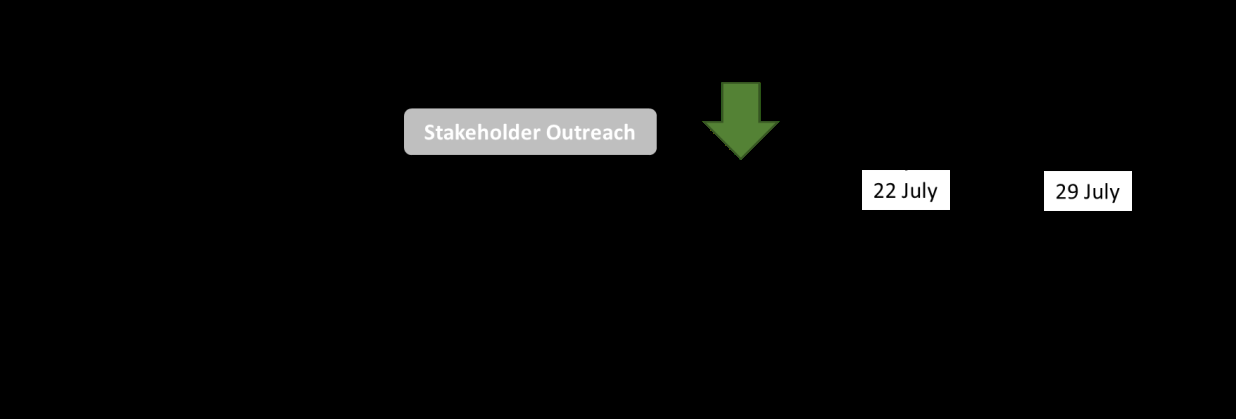
This diagram outlines the project plan, starting with "Project Initiation Plan (PIP) Approved".
It then shows "UKEB meetings" with dates: 21 April, 19 May, 23 June, 18 July, 22 July, 29 July. An arrow from 21 April points to "Update on progress (Technical Update)". An arrow from 18 July points to "Final Comment Letter(s) Submission to ISSB". Underneath the timeline: Between 19 May and 23 June: "UKEB webinar". Between 23 June and 18 July: "Draft Comment Letter(s)". Between 18 July and 22 July: "Final Comment letter(s)", "Final Feedback Statement", "Draft Due Process Compliance Statement". At 29 July: "ISSB Comment Letter deadline".
Appendix 1: Final Comment Letter
Mr Emmanuel Faber Chairman International Sustainability Standards Board IFRS Foundation Opernplatz 14 60313 Frankfurt am Main Germany
22 July 2022
Dear Mr Faber
Invitation to Comment: Exposure Drafts S1: General Requirements for Disclosure of Sustainability-related Financial Information and S2: Climate-related Disclosures.
1This letter is intended to contribute to the Foundation's due process. The views expressed by the UKEB in this letter are separate from, and will not necessarily affect the conclusions in, any endorsement and adoption assessment on new or amended International Accounting Standards undertaken by the UKEB.
2There are currently approximately 1,500 entities, with equity listed on the London Stock Exchange, that prepare their financial statements in accordance with IFRS Standards¹². In addition, UK law allows unlisted companies the option to use IFRS and approximately 14,000 UK registered entities take up this option¹³.
3We welcome the opportunity to provide comment on both ISSB's Exposure Drafts: S1 General Requirements for Disclosure of Sustainability-related Financial Information and S2 Climate-related Disclosures.
UK Legislative Framework for Sustainability Reporting
4The Department for Business, Energy, and Industrial Strategy (BEIS) sets the reporting requirements, both financial and non-financial (ESG matters) for UK registered entities under Company Law. Since 2013, the Companies Act 2006 has required all large and medium sized, UK registered entities to file a Strategic Report as part of their publicly available Annual Report. Quoted companies are additionally required to include information about environmental matters (including the impact of the company's business on the environment); the company's employees; and, social, community and human rights issues.
5The UK was also the first G20 country to make climate reporting mandatory. Under the FCA Listing Rules, the nearly 900 premium listed companies are required to report on a comply or explain basis, against the recommendations of the Taskforce for Climate-related Financial Disclosures (TCFD) for accounting periods beginning on or after 1 January 2021 (see more details on this in Appendix A to this letter). In January 2022, changes to the Companies Act 2006 extended the requirement to provide TCFD disclosures to all large companies & LLPs¹⁴, over 1,300, for financial years starting on or after 6 April 2022.
6The UK remains committed to an international approach to sustainability reporting to help ensure investors and other stakeholders have access to consistent and reliable information on how companies are addressing sustainability matters. As such, the Government intends to the establish a framework for the endorsement and adoption of ISSB issued standards for use in the UK. However, there is currently limited information on the likely time required for the legislative processes to complete. We understand that this is a consistent global theme, with several other jurisdictions in a similar position to the UK.
7Currently, no single UK organisation has been delegated a statutory function to consider and adopt ISSB standards for use in the UK. The UK Government has therefore asked the UK Endorsement Board (UKEB), the Financial Reporting Council (FRC), and the Financial Conduct Authority (FCA) to respond to the International Sustainability Standards Board's (ISSB) consultation on the Exposure Drafts, according to their respective regulatory objectives and functions.
8The UKEB is responsible for the endorsement and adoption of international accounting standards for use in the UK. The UKEB also leads the UK's engagement with the IFRS Foundation (Foundation) on the development of new accounting standards, amendments and interpretations. Therefore, the content of this letter is provided from the perspective of the UK's National Standard Setter for IASB issued standards.
9The FRC is the UK regulator of auditors, accountants and actuaries. It sets codes, standards and guidance to support corporate reporting, corporate governance and stewardship, audit and actuarial work. It has responded in that capacity. The FCA will provide views from their perspective as the UK's securities regulator.
10Finally, while the Bank of England does not intend to provide a formal response to the Exposure Drafts, it is contributing to the response of the Basel Committee on Banking Standards (BCBS) and the International Association of Insurance Supervisors (IAIS).
11Therefore, until the establishment of a legislative framework for adoption of the ISSB standards in the UK, the UKEB will be considering the overlap between IASB and ISSB issued standards.
12To develop our draft response, we have undertaken desk-based research and a significant amount of stakeholder outreach¹⁵ to identify potential areas of overlap between IFRS Accounting Standards and IFRS Sustainability Disclosure Standards, and any other implications from these standards for the production of IFRS financial statements. This outreach has included: one-to-one interviews with preparers, investors and accounting firms; sessions with stakeholder representative bodies; and a very well received webinar, with over 150 registrants, which featured an expert panel including investors, preparers and regulators discussing the key concerns highlighted by UK stakeholders.
13Due to the close association between the exposure drafts, we have coordinated our response as a single project. This single comment letter, therefore, covers both drafts. At Appendix A we include high level comments, in relation to the jurisdictional legislative imperatives that we think the ISSB needs to be aware of when considering the stakeholder feedback, as well as other key considerations of the proposals themselves. Our responses to the detailed questions for each draft are included in appendices B and C to this letter.
UKEB's support for IFRS Sustainability Standards
14The UKEB has keenly supported the establishment of the ISSB¹⁶. The UKEB considers that global standards for sustainability have the potential to be as significant for the market and stakeholder transparency as International Financial Reporting Standards (IFRS). The Board also recognises the need for close alignment and connectivity between financial and sustainability reporting to ensure that the information will provide investors with high-quality, comparable, and decision-useful information.
15Since the IFRS Foundation announced its intention to establish a new Board to develop and issue sustainability standards, at COP 26, in November 2021, the speed of its development has been admirable. The ISSB has kept up the pace and the UKEB offers is congratulations on delivering the exposure drafts to an incredibly tight timeline. The production of these comprehensive standards in such a short space of time is proof of the ISSB's competence and capability in this area.
16The speed of the exposure drafts' publication has also allowed time for meaningful conversation, regarding their quality and content, to commence so that the final standards are principles based and will operate effectively alongside IASB issued standards. The UKEB firmly believes that ISSB standards should act as a minimum global baseline that is built on by local regulators and jurisdictions. We would like as many jurisdictions as possible to be able to implement this baseline, as doing so will provide improved information to UK users of financial statements, particularly those who invest on a global basis. Therefore, this comment letter is aimed at ensuring the IFRS sustainability disclosure standards, when published, are capable of being adopted at local jurisdiction level from the outset.
17The UKEB also believes that, based on the content of the current exposure drafts, the final standards will deliver meaningful and consistent information to investors and other relevant stakeholders, so that a significant uptake of the standards can be ensured from the outset.
UKEB's recommendations on due process
18In Appendix A to this letter, we share our perspective, as a national standard setter, about the readiness of legislators, users, preparers, and their advisers to work with the sustainability standards. These are based on lessons learned from influencing and observing the IASB's standard setting process as well as our recent experiences of formally adopting IFRS for use in the UK.
19Stakeholders across the globe are aware of the direction of travel concerning international sustainability disclosure standards and that the ISSB is leading that journey. The Foundation's due process requirements are built on the principles of transparency, full and fair consultation, considering the perspectives of those affected by IFRS Standards globally, and accountability. This influenced calls for the Foundation to establish a sister Board to develop and issue sustainability standards, and stakeholders expect the same due process to be followed, as a minimum.
20The UKEB's assessment of the state of readiness of stakeholders, both in the UK and in other jurisdictions¹⁷, is that it is currently lower than may be required for reporting under the proposed standards. Considering this, stakeholders' expectations regarding comprehensive due process and the unique opportunity to harmonise sustainability frameworks, we recommend that the ISSB board considers the following options as it redeliberates stakeholder feedback:
- Undertake field testing of the proposed standards with a range of preparers of different sizes, different jurisdictions and sustainability topics beyond climate. Users of financial statements should also be invited to provide feedback on the proposed disclosures;
- Establish standard-specific transition resource groups. Jurisdictions with more experience of TCFD reporting could be asked to provide implementation lessons learned;
- Use the knowledge gained from field testing and feedback from the transition resource groups to inform the draft standards' effective dates and to identify potential areas for phasing or sequencing of requirements to promote global adoption;
- Identify and include specific disclosure objectives, illustrative examples, and non-mandatory educational guidance to assist preparers; and
- Prepare for an early Post Implementation Review, ideally earlier than those normally scheduled by the IASB for IFRS Accounting Standards.
Detailed Feedback on the ISSB Exposure Drafts
[Draft] IFRS S1 General Requirements for Disclosure of Sustainability-related Financial Information:
21We welcome the exposure draft and support the need for a general requirements framework for sustainability-related information. We acknowledge the many areas of alignment with the IASB's Conceptual Framework for Financial Reporting (the “Framework”), IAS 1 Presentation of Financial Statements and IAS 8 Accounting Policies, Changes in Accounting Estimates and Errors, and believe this will improve connectivity within the financial reports and help stakeholders to better understand the information presented.
22Based on our extensive outreach to both users and preparers of financial reports we have provided detailed responses to the questions in the ED, which are included within Appendix B to this letter. The following, however, are worth highlighting:
- Achieving a global baseline: The proposals are ambitious and require complete disclosure of all material sustainability-related risks and opportunities. This would appear to go beyond what is typically regarded as a "baseline", or the foundation for a “building blocks” approach, as it is hard to imagine what further could be added to the disclosures by other regulators or local jurisdictions. If ISSB are to continue to use this language we recommend further thought be given to how a "baseline" relates to the objective of completeness, and how this is articulated in the proposals. This is discussed in paragraphs B4 and B20 of Appendix B. That said, we, and many stakeholders we spoke to, think it appropriate ISSB set robust standards and we would not wish to see the proposals watered down. We acknowledge this creates a considerable challenge to ensure this high benchmark does not act as a deterrent for timely and widespread global adoption.
- Proportionality and transition measures: To overcome this challenge it is critical the final standards are capable of reflecting entities circumstances and allow sufficient transition measures to facilitate timely adoption. We recommend a pragmatic approach which is proportionate, encourages prompt adoption, and acknowledges entities will need to tackle the learning curve, gather data, and implement the necessary systems and processes over a shorter period of time than for accounting standards. Both users and preparers have told us it is likely that reporting will initially be imperfect for these reasons, particularly for sustainability topics beyond the existing climate related disclosures but will improve over the first few reporting cycles. To aid consistency of application and comparability of the resulting information, we think it beneficial if transition relief measures are included in the standards rather than set at local jurisdiction level. Our suggestions for transition are further described in paragraph B20 of Appendix B and include the use of phased implementation dates (early adoption permitted), safe-harbour provisions, and providing further examples and non-mandatory educational guidance.
- Importance of business model-focused disclosures: Users are clear that the most useful disclosures for them are those directly linked to the entities' business models. While business model is defined and included in the exposure drafts, we
Footnotes:
[Draft] IFRS S1 General Requirements for Disclosure of Sustainability-related Financial Information
-
We welcome the exposure draft and support the need for a general requirements framework for sustainability-related information. We acknowledge the many areas of alignment with the IASB's Conceptual Framework for Financial Reporting (the “Framework”), IAS 1 Presentation of Financial Statements and IAS 8 Accounting Policies, Changes in Accounting Estimates and Errors, and believe this will improve connectivity within the financial reports and help stakeholders to better understand the information presented.
-
Based on our extensive outreach to both users and preparers of financial reports we have provided detailed responses to the questions in the ED, which are included within Appendix B to this letter. The following, however, are worth highlighting:
- Achieving a global baseline: The proposals are ambitious and require complete disclosure of all material sustainability-related risks and opportunities. This would appear to go beyond what is typically regarded as a "baseline", or the foundation for a “building blocks” approach, as it is hard to imagine what further could be added to the disclosures by other regulators or local jurisdictions. If ISSB are to continue to use this language we recommend further thought be given to how a "baseline" relates to the objective of completeness, and how this is articulated in the proposals. This is discussed in paragraphs B4 and B20 of Appendix B. That said, we, and many stakeholders we spoke to, think it appropriate ISSB set robust standards and we would not wish to see the proposals watered down. We acknowledge this creates a considerable challenge to ensure this high benchmark does not act as a deterrent for timely and widespread global adoption.
- Proportionality and transition measures: To overcome this challenge it is critical the final standards are capable of reflecting entities circumstances and allow sufficient transition measures to facilitate timely adoption. We recommend a pragmatic approach which is proportionate, encourages prompt adoption, and acknowledges entities will need to tackle the learning curve, gather data, and implement the necessary systems and processes over a shorter period of time than for accounting standards. Both users and preparers have told us it is likely that reporting will initially be imperfect for these reasons, particularly for sustainability topics beyond the existing climate related disclosures but will improve over the first few reporting cycles. To aid consistency of application and comparability of the resulting information, we think it beneficial if transition relief measures are included in the standards rather than set at local jurisdiction level. Our suggestions for transition are further described in paragraph B20 of Appendix B and include the use of phased implementation dates (early adoption permitted), safe-harbour provisions, and providing further examples and non-mandatory educational guidance.
- Importance of business model-focused disclosures: Users are clear that the most useful disclosures for them are those directly linked to the entities' business models. While business model is defined and included in the exposure drafts, we are concerned this important topic does not receive sufficient prominence. While we have no desire to change the structure of the document, emphasising the relationship between the business model and risks to future cashflows in the entity strategy would enhance other stakeholders' understanding of the direct link with financial reporting and their assessment of enterprise value. This is discussed at paragraph B8 of Appendix B.
- Scope and definitions: The proposed scope of ED S1, and associated definitions, was raised by almost all the UK stakeholders we consulted as a key area of concern. As highlighted in Appendix B of this letter and summarised in paragraphs B9, B10, and B19 we find the current drafting of the scope potentially too broad, and certain definitions unclear. Defining the term “sustainability" and further clarifying other definitions would help in this regard. Stakeholders are also confused by the use of both “material” and “significant”, on the face of it often interchangeably. As discussed in paragraph B19 of Appendix B to this letter, we see no reason why “material” could not be used for all purposes. If both terms are to remain in the proposals, then clearer explanation as to their respective meaning and use is required.
- External documents: We are also concerned that the requirements of ED paragraph 51, linking to an open-ended list of external documents, are too broad to be mandatory in a framework standard. While we support the need for additional guidance for stakeholders, we would not wish it to become a barrier to entry for those wishing to participate in the global baseline. UK stakeholders have told us that in the framework standard ED S1 these documents should be referenced as guidance only. It is possible that relevant and appropriate sections of the documents referred to in ED paragraph S1 may in due course form a mandatory part of subject specific standards such as S2, following appropriate due process in creating and approving those standards. Should these documents remain as mandatory requirements in S1, then the list of documents should be shorter, and ISSB should issue explicit guidance as to how any contradictions between the documents in this list of current and future publications are to be dealt with. These matters are further discussed in paragraphs B30 and B31 of Appendix B to this letter.
- Illustrative examples: To assist with consistent application of the proposed standard, and any other future standards, it would be helpful to stakeholders if the ISSB included specific objectives for disclosure items as discussed at paragraph B5d, B6 and B20 of Appendix B, and illustrative examples and non-mandatory educational guidance as discussed at paragraph B36 of Appendix B. This may provide opportunity to include selected examples from the externally linked documents (ED paragraph 51) described above. To discourage boilerplate disclosures multiple examples of acceptable disclosure for each scenario could be provided.
- Field Testing: We recommend that prior to finalising these standards, particularly ED S1 which is entirely untested, field-testing involving users and preparers of different sizes, jurisdictions, and sustainability topics beyond climate is undertaken. This will provide valuable information about practical issues, effective dates and transition relief, and likely costs and benefits. ISSB should also consider the learnings from the UK FTSE companies who applied the TCFD regime this year, and how best these lessons could be shared with other UK companies (who under the UK regime chose to "explain” rather than “comply”), and other jurisdictions where entities and investors may be less familiar with the implications of gathering and reporting such information.
- Leveraging IASB experience: This is a key area where ISSB could leverage the existing due process already followed by the IASB. As the IASB has significant experience of coordinating field testing we recommend that the ISSB consider leveraging that experience to ensure the standards are underpinned by a solid evidence base that reflect the organisation's global remit.
- Alignment with IFRS Accounting Standards: In addition to the above points, we have also noted certain other inconsistencies between these proposals and the requirements of IFRS Accounting Standards. We do not suggest sustainability standards need to be identical to accounting standards, but rather highlight these as areas where additional signposting may be needed to aid connectivity or understandability, or where further alignment may provide clarity to the drafting of the proposals. These can be found at Appendix B paragraphs B5, B7, B15, and B27.
[Draft] IFRS S2 Climate-related Disclosures
- Stakeholders strongly supported the close alignment of the exposure draft with the TCFD Recommendations as it has been applied in practice, tested in the UK and the value of the framework has been globally proven. These have been voluntarily in use for several years in the UK and are now mandatory for certain companies. Given that familiarity we have, so far, heard fewer concerns with the proposals at a high level. Detailed responses to the questions posed in the exposure draft are included within Appendix C to this letter. The following, however, are worth highlighting:
- Scope and definitions: While stakeholders appreciate the challenges of a prescriptive definition for ‘climate related risks and opportunities', they also considered the approach of relying on TFCD and SASB standards may be too broad and result in challenges in application for stakeholders who may not be familiar with those standards (refer to paragraphs C3 and C4 in Appendix C). Several users also recommended that more guidance should be included regarding the 'short, medium and long' term to ensure consistency (refer to paragraphs C17 in Appendix C). We recommend the ISSB consider using or adapting an existing definition and fielding testing this with a range of stakeholders to validate. Users also noted that this approach would support the objective of achieving a global climate baseline.
- Duplication: Several preparers observed that there is significant repetition from [draft] IFRS S1 in the exposure draft. This approach made [draft] IFRS S2, and potentially future thematic standards unnecessarily lengthy and too cluttered. We recommend the ISSB take the opportunity to reduce the length of the exposure draft using cross referencing where appropriate, for both [draft] IFRS S1 and future thematic standards (refer to paragraph C5 in Appendix C).
- Due Process: While stakeholders supported the use of SASB standards to standardise industry-based metrics, they also valued the comprehensive due process of the IFRS Foundation. Some stakeholders considered that, while the SASB standards were still being developed for global application they should be referred to as guidance only until the Foundations due process is complete (refer to paragraph C10 – C11 in Appendix C).
- Effective Date: Some large preparers advised that, due to their familiarity with TCFD reporting they did not anticipate significant additional effort to meet the requirements of the exposure draft. However, due to the extension of some TCFD requirements and the wider requirements of [draft] IFRS S1 they would require at least two reporting cycles from the effective date to implement. Several users observed that the current quality of TCFD reporting was low and appeared to still be in the early stages. We therefore recommend assessing the effective date in the context of insight gained from field testing with a range of preparers and jurisdictions to determine if phasing some of the more challenging disclosure requirements may be required. (refer to paragraphs C31-35 in Appendix C).
- Cost v Benefits: Larger preparers who had already developed robust systems and process for reporting TCFD disclosures did not anticipate significant additional costs or benefits. Smaller preparers, who were not currently making these disclosures considered the cost to be potentially significant in terms of data and systems development and to achieve alignment with their financial reporting timetable. Most users considered that the benefits of preventing greenwashing and enabling them to make better capital allocation decisions would outweigh the costs. Users also noted that cost of failure to harmonise sustainability frameworks was likely to result in a higher ongoing cost for all stakeholders (refer to paragraphs C25-C29 in Appendix C).
- Global climate baseline: Several users noted that some aspects of the exposure draft may be considered too aspirational i.e., that it may be seen as a hurdle as opposed to target. Their concern was that some less mature jurisdictions or smaller companies may feel the requirements are over whelming and suggested the ISSB consider indicating a minimum level or phased approach of climate disclosures, recognising that climate measurement methodologies were still developing. They felt this approach may result in wider and earlier global adoption (refer to paragraphs C37-C40 in Appendix C).
If you have any questions about this response, please contact the project team at [email protected]
Yours sincerely
Pauline Wallace Chair UK Endorsement Board
Appendix A: Legislative and Stakeholder Readiness
A1 In this Appendix, we share our perspective, as national standard setter, about the readiness of legislators, users, preparers, and their advisers to work with the sustainability standards. These are based on lessons learned from influencing and observing the IASB standard setting process as well as our recent experiences of formally adopting IFRS for use in the UK.
A2 We hope these insights will be helpful during the ISSB's re-deliberations and in the development of high-quality sustainability standards that are capable of being applied consistently across jurisdictions.
A3 We remain ready to work with the ISSB to help achieve global acceptance and adoption of their standards.
Legislative readiness
A4 The UKEB firmly believes that IFRS sustainability standards should act as a minimum global baseline, that is built on by local regulators and jurisdictions. We would like as many jurisdictions as possible to be able to implement this baseline, as this will provide improved information to UK users of financial statements, particularly those who invest on a global basis.
A5 The UK Government has committed to implementing climate reporting requirements across the economy – from corporates to asset managers and asset owners.
A6 Expectations were first set out in the Green Finance Strategy7 and elaborated on in a Roadmap towards mandatory TCFD disclosures8, published in November 2020. Implementation measures have since been introduced by the FCA, via the UK Listing Rules, and the relevant Government departments, including BEIS.
A7 More recently, the UK Government committed to adopting the ISSB issued standards, for use by UK registered entities, in the Green Finance Roadmap9, published in October 2021. This commitment was a core component of the economy wide Sustainability Disclosure Requirements (SDR) regime.
A8 BEIS has committed to issuing public consultations on the proposed regulatory changes required to mandate the use of IFRS sustainability standards under the Companies Act 2006. Similarly, the FCA expects to consult on amending its rules for listed issuers, to reference the IFRS sustainability standards rather than the TCFD's recommendations. The full process is likely to take a couple of years to complete.
A9 This is also likely to be the case in other jurisdictions and, for the aim of globally consistent and comparable disclosures to be achieved, stakeholders need certainty of the requirements both at the international and local jurisdictional level.
A10 While stakeholders understand that IFRS sustainability standards are to be adopted in the UK, lack of full engagement with the draft standards may persist until there is further clarity on the adoption status of the standards, the entities likely to be in scope, and how the disclosures will be integrated into the current Companies Act reporting framework.
International readiness
A11 We congratulate the IFRS Foundation, Technical Readiness Working Group members and the ISSB for the speed of delivery, following the announcement at the COP 26 conference, in November 2021. We recognise the urgency and high priority given to sustainability and climate-related matters by stakeholders globally, and we support the transitional approach adopted to publish the Exposure Drafts before the ISSB Board was quorate. We also understand that the rationale for this approach was to balance the need to advance the urgent work of the ISSB with the requirement to obtain stakeholder views.
A12 We are, however, conscious of the global lack of experience and knowledge in this area, demonstrated by the limited number of pre-existing sources of information to draw on. We also understand that similar projects, to consider options for adoption and endorsement framework for these standards, are being initiated in other jurisdictions. This further adds to the existing domestic and international uncertainties and risks as potential for wider international debate and consultation is curtailed due to the short time available for consultation.
A13 Our standard setting experience has made us keenly aware of the benefits of ensuring stakeholders have sufficient time to fully understand the requirements of new standards, consider any additional data or systems needs and field test them to flush out any implementation issues. Where a wide range of stakeholder views have not been adequately sought and addressed as part of the due process, there can be a high risk of the need for re-exposure or, at worst, the need to fully overhaul a defective standard before it is implemented. We are, therefore, concerned that stakeholder engagement may have been unnecessarily limited by the 120-day comment period. In the comment letter, we suggest several options the ISSB could consider, to mitigate these potential risks.
User readiness
A14 Whilst some sophisticated investors are aware of the benefits for sustainability reporting, recent media coverage10 demonstrates that this is not a universal view. We consider that users of company annual reports will also need significant time to educate themselves and understand the impacts of the standards for this new area of reporting. In addition, they are concurrently assessing the recently published EU and SEC sustainability standards.
A15 Users will then also need time to prepare operationally, e.g. to update their analytical models, allocate sufficient resource and conduct training etc., to be able to work effectively with the sustainability standards.
Preparer readiness
A16 The UK is several reporting cycles ahead of most other jurisdictions in this space, as The Companies Act 2006 already requires certain entities to report on ESG matters and the FCA introduced the requirement for premium listed companies to make disclosures, on a comply or explain basis, under TCFD standards for accounting periods from 1 January 2021. However, even here the introduction of mandatory reporting under ISSB issued standards will require a significant step change.
A17 For context, based on 2021 year-end reports, we estimate that of 422 UK TCFD reporters11, 93 were companies or groups listed on the London Stock Exchange with a combined market capitalisation of £1.16 trillion, representing approximately 40% of total market capital. According to SASB, 70 UK companies use their framework and of those, 54 were listed companies with a combined market capitalisation of £1.21 trillion, representing approximately 42% of total market capital12.
A18 While this is commendable progress, there are a significant number of listed companies that have not yet reported under TCFD. Early indications are that a number of the entities required to report on a comply or explain basis, under the FCA's Listing Rules, opted to explain why they had not made any disclosures. This is in line with challenges previously noted by the UK's Financial Reporting Council (FRC), with the quality of reporting and the poor links between the sustainability narrative and the financial statements13.
A19 In October 2021, BEIS conducted an impact assessment on the TCFD policy intervention and estimated that it would affect approximately 1,300 UK businesses with a best estimate cost of £1.42 billion14. This clearly anticipates a significant amount of organisational change and time will be required to provide this level of sustainability reporting across all industries.
A20 As will be the case in many jurisdictions, while preparers understand that the UK intends to endorse ISSB Standards15, without ISSB standards formally adopted for use, they are likely to struggle to adequately design and implement the required systems, and processes to obtain the data required to meet the reporting requirements.
A21 For the reasons set out in this Appendix, we feel that there is sufficient time for the ISSB to carry out field testing with a range of different sized entities, to ensure that IFRS sustainability standards are suitable for use by entities across jurisdictions.
Appendix B: Questions on Exposure Draft General Requirements for Disclosure of Sustainability-related Financial Information.
Question 1: Overall approach
The Exposure Draft sets out overall requirements with the objective of disclosing sustainability-related financial information that is useful to the primary users of the entity's general purpose financial reporting when they assess the entity's enterprise value and decide whether to provide resources to it.
Proposals in the Exposure Draft would require an entity to disclose material information about all of the significant sustainability-related risks and opportunities to which it is exposed. The assessment of materiality shall be made in the context of the information necessary for users of general purpose financial reporting to assess enterprise value.
- Does the Exposure Draft state clearly that an entity would be required to identify and disclose material information about all of the sustainability-related risks and opportunities to which the entity is exposed, even if such risks and opportunities are not addressed by a specific IFRS Sustainability Disclosure Standard? Why or why not? If not, how could such a requirement be made clearer?
- Do you agree that the proposed requirements set out in the Exposure Draft meet its proposed objective (paragraph 1)? Why or why not?
- Is it clear how the proposed requirements in the Exposure Draft would be applied together with other IFRS Sustainability Disclosure Standards, including the [draft] IFRS S2 Climate-related Disclosures? Why or why not? If not, what aspects of the proposals are unclear?
- Do you agree that the requirements proposed in the Exposure Draft would provide a suitable basis for auditors and regulators to determine whether an entity has complied with the proposals? If not, what approach do you suggest and why?
B1 The ED clearly sets out that an entity within the scope would be required to identify and disclose material information about all the sustainability-related risks and opportunities to which it is exposed. However, the ED appears to create very broad requirements, beyond that which would be commonly understood as a "baseline".
B2 Due to the broad scope it is likely that there will be significant variation in how companies/jurisdictions understand and choose to report on these topics, making it difficult to achieve consistency and comparability of the resulting information. Providing a clear set of definitions of key terms and minimum disclosures is more conducive to achieving those objectives. This is discussed further in paragraphs B19 and B31-B33 below.
B3 Stakeholders expect that the requirements set out in this ED are to be applied together with the requirements of other ISSB standards. However, it is not clear whether the open ended list of documents which “shall be” referred to in paragraph 51 of the ED will subsequently form the basis of future ISSB standards. This is discussed further in paragraph B30 and B31 below.
B4 We note there is a practical tension between the ISSB's objective for complete reporting of sustainability-related financial information, as noted at ED paragraph 2 (and throughout the proposals), and the concept of a baseline. which is typically a set of common disclosures that can, with some effort, be achieved by many at reasonable cost in the short term, leaving space for local jurisdictions, regulators, and future standards to develop further, as necessary. By contrast, a complete set of disclosures requires no further regulatory or jurisdiction-specific development. We recommend that further consideration is given to both the objective of completeness within the context of creating a global baseline, and how this is articulated in the proposals. One way to address this issue would to specify mandatory and non mandatory requirements within the standard as discussed at paragraph B20d below.
B5 While considering the question of overall approach, additionally, we note that:
- IASB has been working on its Disclosure Initiative, a portfolio of projects to improve the effectiveness of disclosure in financial statements, for many years and we encourage ISSB to ensure the learnings from this extensive work are considered. To this end, we have highlighted in this letter stakeholder feedback received during our consultation on the 2021 IASB Exposure Draft Disclosure Requirements in IFRS Standards – A Pilot Approach (the “Disclosure Pilot"), where relevant to this ED.
- The use of many elements of the IFRS conceptual framework (the “Framework”), within the ED, should aid the understanding of stakeholders who are familiar with these concepts from IFRS reporting. We note that paragraph 2.36 of the Framework, which addresses understandability, does not appear to be reflected in the ED. Given the potentially technical and complex nature of sustainability disclosures we see merit in including the acknowledgement at paragraph CF2.36 that "...reports are prepared for users who have a reasonable knowledge....even well informed and diligent users may need to seek the aid of an advisor...”
- Similar IFRS Accounting Standards, such as IAS 1, include a Purpose section in the standard, which provides helpful contextual information for those applying the standard. In the ED, the Introduction section acts in a similar way, but is not intended to form part of the final text. We recommend that the ED introduction is incorporated as a Purpose section in the final standard.
- During our recent field tests for the IASB Disclosure Pilot consultation, preparers of accounts observed that the inclusion of specific objectives and information on users' intended use of the required information was helpful in producing high quality disclosure. While the ED goes some way toward providing general objectives (for example at ED paragraphs 12, 14, 25, and 27 when discussing the core content objectives), creating specific objectives for the other, detailed, disclosures required by the ED would likely improve the quality of reporting.
- The ED's Appendix C discussion of verifiability does not include reference to the Framework paragraph 2.31 explanation that verification methods may be direct or indirect, nor does it include a description of these methods. Given the range of subject matter that could potentially be included in sustainability disclosure requirements in the future, we recommend that including a similar paragraph in S1 Appendix C would be helpful to preparers needing to apply judgement as to the most useful information to present.
Question 2: Objective (paragraphs 1-7)
The Exposure Draft sets out proposed requirements for entities to disclose sustainability-related financial information that provides a sufficient basis for the primary users of the information to assess the implications of sustainability-related risks and opportunities on an entity's enterprise value.
Enterprise value reflects expectations of the amount, timing and uncertainty of future cash flows over the short, medium and long term and the value of those cash flows in the light of the entity's risk profile, and its access to finance and cost of capital. Information that is essential for assessing the enterprise value of an entity includes information in an entity's financial statements and sustainability-related financial information.
Sustainability-related financial information is broader than information reported in the financial statements that influences the assessment of enterprise value by the primary users. An entity is required to disclose material information about all of the significant sustainability-related risks and opportunities to which it is exposed. Sustainability-related financial information should, therefore, include information about the entity's governance of and strategy for addressing sustainability-related risks and opportunities and about decisions made by the entity that could result in future inflows and outflows that have not yet met the criteria for recognition in the related financial statements. Sustainability-related financial information also depicts the reputation, performance and prospects of the entity as a consequence of actions it has undertaken, such as its relationships with, and impacts and dependencies on, people, the planet and the economy, or about the entity's development of knowledge-based assets.
The Exposure Draft focuses on information about significant sustainability-related risks and opportunities that can reasonably be expected to have an effect on an entity's enterprise value.
- Is the proposed objective of disclosing sustainability-related financial information clear? Why or why not?
- Is the definition of 'sustainability-related financial information' clear (see Appendix A)? Why or why not? If not, do you have any suggestions for improving the definition to make it clearer?
B6 The general objective of disclosing sustainability-related financial information is clear. However, as discussed at paragraph B5d, stakeholder feedback from our recent work on the IASB Disclosure Pilot consultation suggests that providing specific objectives for disclosures and information on how users will use the information may lead to higher quality reporting. Field testing the proposals, particularly for non-climate related disclosures that are entirely new to all stakeholders, with both preparers and users of annual reports may assist in ensuring that the proposals meet the stated objective.
Question 2b: Definition of users
B7 The ED definition of users, as being primary users of financial statements, would benefit from further explanation. Given the nature of sustainability topics, the disclosures are likely to be of interest to a wide community of users beyond investors. For example, in the UK the Companies Act16, requires directors of companies to have consideration of the interests of employees, business relationships with customers and suppliers, and the impact of operations on the community and environment. The extent to which the standards cater for needs of such groups is worth explaining. As a comparator, the Framework paragraphs 1.5-1.11 acknowledge that other members of the public may find the reports useful, but the reports are not primarily addressed to these groups. Additionally, the Framework describes users as being "... those who must rely on general purpose financial reports for much of the financial information they need". Clarity in this area will assist those needing to make judgements as to the most useful information to disclose, assist jurisdictions in identifying any further measures they may wish to implement locally, and help manage any expectation gap that may arise from other potential groups of users.
Question 2b: Business model
B8 We believe that an explanation of the relationship between the business model and risk to future cashflows would enhance stakeholders' understanding of enterprise value and the links with financial reporting. Users of financial statements have told us that approaching such explanations through the lens of the business model aids in their understanding of business performance, and best practice reporters often approach such explanation “through the eyes of management”. We do not believe fundamental changes are needed to the structure of the document, but rather the importance of the business model is emphasised within the existing framework. One way to do this is to use illustrative examples or guidance which demonstrate this business model view of disclosure.
Question 2b: Sustainability-related financial information
B9 Many stakeholders have told us the reference to “sustainability-related financial information" is unclear, as the term “sustainability” has not been defined. As a result, the requirement is potentially very broad – to provide insight on “risks and opportunities that affect enterprise value” could incorporate a wide range of factors, far beyond what would be traditionally regarded as “sustainability". To ensure consistency and comparability, a shared understanding of the boundaries of “sustainability” is important. Some stakeholders have suggested that entities could be required to state the definition of sustainability they use for the purpose of these disclosures. We believe this is a less effective solution as it could lead to inconsistency of application.
B10 We do not believe defining “sustainability” would cause delay to the proposals. The UK already requires certain companies to provide a non-financial and sustainability information statement within their Annual Report. The list of matters which that statement must contain could be used as a basis for defining “sustainability". Those matters are: climate-related financial disclosures; environmental matters (including the impact of the company's business on the environment); the company's employees; social matters; respect for human rights; and, anti-corruption and anti-bribery matters. Other alternative definitions (such as that provided by the United Nations and referred to in paragraph BC 30 of the proposals) could also be used and added to the list of defined terms.
B11 Our stakeholders' assumption is that the definition of “sustainability-related financial information" means that to meet the requirements of the proposed standard, financial as well as non-financial information may need to be provided. For example, we expected that the UK legislative requirements for certain entities to provide their energy and carbon usage within their Directors' Report could be within scope. There the required disclosures include: the annual quantity of emissions, in tonnes of carbon dioxide, resulting from; and the figure, in kWh, of energy consumed from; activities for which the company is responsible, involving the combustion of gas, or consumption of fuel for transport.
B12 However, the use of the phrase "financial information” throughout the document has caused widespread confusion as some initially thought there would be an equivalent standard to S1 dealing with non-financial information. We do not believe this is ISSB's intent, and advise that to avoid such confusion, it may be better to remove the reference to "financial" and simply refer to “sustainability-related information”. This may go some way to avoiding confusion between the different basis of preparation of IFRS Accounting Standards financial information and the requirements of this standard, discussed at paragraph B27.
Question 2b: Enterprise value
B13 Enterprise value is described in paragraph 5 of the ED objectives as reflecting expectations of future cashflows. As discussed in paragraph B11 above we expect non-financial information will be disclosed as part of the proposed disclosures. While we agree expected future cashflows are important to the assessment of enterprise value, the paragraph 5 explanation does not acknowledge the more nuanced, intangible, aspects of the total enterprise value. While some users of financial reporting told us they found the use of enterprise value in this context useful, other stakeholders found this overly simplistic unless a more holistic definition could be arrived at. We recommend the definition should be broadened to acknowledge such other factors.
Question 3: Scope (paragraphs 8-10)
Proposals in the Exposure Draft would apply to the preparation and disclosure of sustainability-related financial information in accordance with IFRS Sustainability Disclosure Standards. Sustainability-related risks and opportunities that cannot reasonably be expected to affect users' assessments of the entity's enterprise value are outside the scope of sustainability-related financial disclosures.
The Exposure Draft proposals were developed to be applied by entities preparing their general purpose financial statements with any jurisdiction's GAAP (so with IFRS Accounting Standards or other GAAP).
Do you agree that the proposals in the Exposure Draft could be used by entities that prepare their general purpose financial statements in accordance with any jurisdiction's GAAP (rather than only those prepared in accordance with IFRS Accounting Standards)? If not, why not?
B14 In theory, there appears no reason why the proposed requirements could not be used by entities which use local GAAP, providing any contradictions in those requirements are adequately addressed by that jurisdiction. Additionally, stakeholders have questioned whether any forms of “group relief” from disclosure are intended to be available (for example for subsidiaries if the information is published in consolidated parent company accounts). We request ISSB to consider this, but acknowledge this may be best dealt with at local jurisdiction level.
B15 We note that there are certain inconsistencies between these requirements and IFRS Accounting Standards. We acknowledge that ISSB's remit means that it would require disclosure of information that has not met the requirements for inclusion in the related financial statements. However, we, and most stakeholders we have consulted, acknowledge the importance of connectivity between the sustainability disclosures and financial reporting in the annual accounts. So, whilst we would not suggest that accounting standards and sustainability standards should be identical, we do consider that extra effort in these areas may be required to ensure understandability, and to clearly articulate the connection between sustainability disclosures and the financial statements. Examples of such contradictions between IFRS Accounting Standards and the ED include:
- Recognition of liabilities – the Framework requires a present obligation to exist for recognition of a liability (paragraph 4.27 “a present obligation that exists as a result of past events”), whereas there is no equivalent requirement (as appropriate for future focused sustainability disclosures) in the ED. For example, the ISSB standard would require the disclosure of an entity's proposed, hypothetical, expenditure to introduce new technology to reduce pollution. However, if there are no firm plans in place or contracts entered into, IASB standards will not impose a requirement to recognise a liability or provision in the financial statements. While ISSB standards should not mirror the IFRS Accounting Standards view of recognition, making effort to provide information to link the sustainability information to the related numbers (if any), or the lack thereof, in the financial statements may aid understandability. In addition, information about the maturity or objectivity of numbers provided for ISSB purposes may reduce instances of greenwashing and assist with understandability.
- Hierarchy of disclosures – One potential approach to provide clearer signaling on the reliability of disclosures may be to disclose a hierarchy of numeric disclosures, similar to the fair value hierarchy described in paragraph 73 of IFRS 13 Fair Value Measurement. That requires identification of whether numbers have been based on Level 1 inputs (externally quoted prices), Level 2 inputs (observable inputs other than quoted prices) or Level 3 inputs (internally modelled numbers). ISSB could adopt this approach to consider either the objectivity of inputs, for example Level 1 may be market or openly sourced scientific data whilst Level 3 would be solely internally modelled. Alternatively, ISSB could use this approach to consider maturity of the sustainability activities, for example Level 1 for initiatives that are already operational, Level 2 for initiatives which will be operational in the short term, and Level 3 to describe less mature initiatives. In the above, an example of expenditure to introduce a new technology to reduce pollution, could provide information to link the sustainability information about this initiative to information in the financial statements (or a statement this expenditure has not yet met the criteria for recognition in the financial statements), which, together with this hierarchy of disclosure, could help support disclosure of emergence pattern of the expenditure as well as expectations of (subsequent) recognition in the financial statements. This would then provide investors with the ability to consider, and monitor over time, such trends on emergence patterns.
- Funding sources – similarly, the requirement to disclose funding sources for such early-stage plans (which may be insufficiently mature to qualify for IFRS Accounting Standards liability recognition), appears very hypothetical in nature. It is likely more decision useful information could be provided in cases where plans are relatively mature, whereas only high level statements could be made about funding for initiatives further in the future. While some users have expressed enthusiasm for this proposal, it is not clear that the benefit to users (particularly from uncertain information far in the future) merits the cost incurred by companies required to disclose it. Our thoughts on next steps to gather an evidence base regarding cost/benefit are described at paragraph B20(i) and B54 below
- Confidentiality/commercially sensitive information – IAS 37 Provisions, Contingent Liabilities and Contingent Assets acknowledges the need to maintain confidentiality of provisions for litigation if that would prejudice an entity's position in a legal dispute. Under existing proposals in this ED, disclosure may be required under ISSB standards which undermine the protections provided under IFRS Accounting Standards.
- Reporting of outcomes against previously disclosed plans – IFRS Accounting Standards do not require the subsequent reporting of outcomes against previously disclosed numbers. Where uncertainty exists in relation to financial risks, it is more common to use sensitivity testing in financial reports to illustrate a range of potential outcomes of the risk event (for example, impairment provisions under IFRS 9 Financial Instruments). We note the publication of sensitivity analysis is also required by the ED, as is the restatement of sustainability-related comparative information from the prior period. While users of financial reporting have told us they find this requirement to report outcomes useful, it is unclear whether the additional costs would outweigh the benefits. It is possible information generated from the processes described at B15a and B15b above may achieve a similar outcome. Our thoughts on next steps to gather an evidence base regarding cost/benefit are described at paragraph B20(i) and B54 below.
- Restatement of comparatives – the requirement to restate comparatives to reflect updated estimates, and explain any difference from previously published numbers, exceeds the requirements in IFRS Accounting Standards, where such treatment is only required in the case of error or retrospective application of a change in accounting policy. We believe further implementation guidance is required as our stakeholders – both preparers and users – appear to be interpreting this requirement in different ways. Some feel every material estimate disclosed should be considered with the benefit of hindsight and potentially restated. Others interpret the requirements to mean that, when there is a material change to preparation of the estimates, such as a new methodology being introduced or a new source of improved data obtained, then associated comparative numbers should be restated. Further explanation is necessary to achieve consistency of application.
Question 4: Core content (paragraphs 11-35)
The Exposure Draft includes proposals that entities disclose information that enables primary users to assess enterprise value. The information required would represent core aspects of the way in which an entity operates.
This approach reflects stakeholder feedback on key requirements for success in the Trustees' 2020 consultation on sustainability reporting, and builds upon the well-established work of the TCFD.
Governance
The Exposure Draft proposes that the objective of sustainability-related financial disclosures on governance would be:
to enable the primary users of general purpose financial reporting to understand the governance processes, controls and procedures used to monitor and manage significant sustainability-related risks and opportunities.
Strategy
The Exposure Draft proposes that the objective of sustainability-related financial disclosures on strategy would be:
to enable users of general purpose financial reporting to understand an entity's strategy for addressing significant sustainability-related risks and opportunities.
Risk management
The Exposure Draft proposes that the objective of sustainability-related financial disclosures on risk management would be:
to enable the users of general purpose financial reporting to understand the process, or processes, by which sustainability-related risks and opportunities are identified, assessed and managed. These disclosures shall also enable users to assess whether those processes are integrated into the entity's overall risk management processes and to evaluate the entity's overall risk profile and risk management processes.
Metrics and targets
The Exposure Draft proposes that the objective of sustainability-related financial disclosures on metrics and targets would be:
to enable users of general purpose financial reporting to understand how an entity measures, monitors and manages its significant sustainability-related risks and opportunities. These disclosures shall enable users to understand how the entity assesses its performance, including progress towards the targets it has set.
- Are the disclosure objectives for governance, strategy, risk management and metrics and targets clear and appropriately defined? Why or why not?
- Are the disclosure requirements for governance, strategy, risk management and metrics and targets appropriate to their stated disclosure objective? Why or why not?
Question 4: Disclosures
B16 The general objective of disclosing information on governance, strategy, risk management and metrics and targets are clear. However, we note that, asides from the largest multinationals who have implemented TCFD, the objectives are also all largely untested. Field testing with entities of different sizes, and incorporating sustainability topics other than climate, would assist in ensuring ED S1 successfully meets these objectives, is developed from an evidence base, and provides insight as to necessary lead time and cost/benefit considerations.
B17 As discussed at paragraph B5d, we believe that, in addition to the general disclosure objectives noted above, providing specific objectives for each section of disclosures, and information on how users will use the information provided (consistent with the IASB's Disclosure Pilot project), may lead to higher quality reporting.
B18 The strategy objectives in ED S1 paragraph 15(b) require disclosure of the effects of significant sustainability-related risks and opportunities on the business model. Further to our comments in paragraph B8, without a clear requirement to explain the entity's business model first, this potentially valuable disclosure may become meaningless., or lost amongst other disclosures.
Question 4: Definitions
B19 Following consultation with UK stakeholders we believe that the clarification of certain definitions would assist with consistent understanding and application. These include:
- the term “users” as discussed in paragraph B7, the term “sustainability”, as discussed in paragraphs B9 and B10, the term “enterprise value” as discussed in paragraph B13 and guidance on materiality as discussed in paragraphs B32 and B35.
- the use of the term “significant” rather than “material” in certain parts of the document, such as the requirement to “manage significant sustainability-related risks and opportunities”. This has caused some confusion amongst stakeholders, and we see no reason why the term “material”, which is well understood and provides a clear linkage to financial reporting in the accounts, could not be used throughout the document. Should both terms remain, then a clear definition of each, and further information on how and when they are to be used, is required.
- the term “neutral” should be defined, possibly by summarising the discussion at Appendix C10 for inclusion in the Defined Terms in Appendix A. Consideration should be given as to whether the well-established concept of “fair” (rather than "neutral") may be a better fit for what ISSB is trying to achieve, as it encompasses the holistic view of information presented in addition to the characteristics of individual items of information.
- consideration for a definition, or further guidance, for the term 'business model'.
Question 4: Baseline
B20 We support ISSB in setting a robust standard that can be adopted promptly and applied consistently. However we find the description of the proposals as a "baseline" inconsistent with the requirements described in ED S1. As noted at paragraphs B4 and B52 the objectives appear to seek complete disclosure of all material sustainability-related information, which goes beyond the concept of what is normally understood as a "baseline". This represents a considerable challenge to timely global adoption. Both users and preparers have told us that timely adoption is important, and they acknowledge that consequently reporting will initially be imperfect but improve over the first few reporting cycles. We recommend a pragmatic approach which is proportionate, encourages prompt adoption, and acknowledges that the quality of disclosure may improve over the initial years as entities tackle the learning curve, gather
data, and implement the necessary systems and processes. To aid consistency of application and comparability of the resulting information we think it beneficial if transition relief measures are included in the standards rather than set at local jurisdiction level. Actions which could assist with this include:
- Clarify the scope and key definitions as recommended in paragraphs B9, B10 and B19 above.
- Make greater use of specific disclosure objectives and information on how users are likely to use the information to help entities make judgements on the information to include;
- Provide more illustrative examples and non-mandatory educational guidance. To discourage boilerplate disclosures multiple examples of acceptable disclosure for each scenario could be provided;
- Consider how proportionality could best be applied to the proposals. This may include splitting the ED's proposed requirements into mandatory and optional requirements;
- Consider phased effective dates (with the ability to early adopt). Examples of more challenging areas that may benefit from phasing include sensitivity analysis, value chain disclosures and the production of the proposed sustainability information at the same time as the financial statements. Generally reporting of climate disclosures is more advanced (at least in the UK) than other sustainability disclosures, so phasing along these lines could also be considered.
- Alternatively, the ISSB could consider a longer period of adoption, with the ability to early adopt so that leaders in the field can commence reporting promptly and by doing so provide examples for others to work towards. This would also assist with developing capacity and capability in the market as resource with the relevant levels of skills is likely to be scarce in the early years of adoption.
- Consider more widespread use of "unless impracticable" or similar language.
- Consider other initial safe-harbour provisions.
- Undertake field testing, particularly of non-climate sustainability topics, to understand the disclosures that are most difficult to prepare but valuable to users. This will assist with judgements about immediate application versus phasing of requirements as well as where additional guidance can be most beneficially added to assist with consistent application.
Question 5: Reporting entity (paragraphs 37-41)
The Exposure Draft proposes that sustainability-related financial information would be required to be provided for the same reporting entity as the related general purpose financial statements.
The Exposure Draft proposals would require an entity to disclose material information about all of the significant sustainability-related risks and opportunities to which it is exposed. Such risks and opportunities relate to activities, interactions and relationships and use of resources along its value chain such as:
- its employment practices and those of its suppliers, wastage related to the packaging of the products it sells, or events that could disrupt its supply chain;
- the assets it controls (such as a production facility that relies on scarce water resources);
- investments it controls, including investments in associates and joint ventures (such as financing a greenhouse gas-emitting activity through a joint venture); and
- sources of finance.
The Exposure Draft also proposes that an entity disclose the financial statements to which sustainability-related financial disclosures relate.
- Do you agree that the sustainability-related financial information should be required to be provided for the same reporting entity as the related financial statements? If not, why?
- Is the requirement to disclose information about sustainability-related risks and opportunities related to activities, interactions and relationships, and to the use of resources along its value chain, clear and capable of consistent application? Why or why not? If not, what further requirements or guidance would be necessary and why?
- Do you agree with the proposed requirement for identifying the related financial statements? Why or why not?
B21 The requirement to provide sustainability-related financial information for the same reporting entity as the related financial statements is reasonable and is consistent with the desire to promote stronger relationships between the information in the financial statements and the other general purpose financial reporting.
B22 We support the requirement to provide information about sustainability-related risks and opportunities along the value chain. However, the scope of the information required from the value chain may be costly or difficult for companies to obtain and verify, depending on their location in the value chain. Further information should be gathered to understand the cost-benefit balance of this requirement. Field testing across a range of companies, and disclosures other than climate, may be one way to achieve this.
B23 Further to our comments in paragraph B8 we suggest that sustainability-related risks and opportunities along the value chain should be defined in the context of the entity's business model. To assist consistency of application, it may be helpful to provide guidance or illustrative examples to assist entities in making judgements about how far along the value chain should be assessed.
B24 We support the concept in ED paragraph 41 that other IFRS Sustainability Disclosure Standards will be used to specify how an entity is required to disclose its significant sustainability-related risks and opportunities related to associates, joint ventures etc. However, we recommend the drafting of paragraph 41 is clarified. Currently it suggests such disclosure is not required under ED S1, while paragraph BC53 states that “the effects arising from these investments are included", but the information on associates, joint ventures etc has not been specified to allow flexibility to “facilitate better interaction with existing materials”. These statements appear contradictory and greater clarity would likely improve consistency of application. Stakeholders have also observed that obtaining information from associates and joint ventures has complexities similar to obtaining information from companies in the value chain, due to lack of control over those entities. Accordingly, our comments on the value chain also apply to the requirements for joint ventures and associates. To improve consistency of application and comparability we recommend that further guidance be issued specifying whether the full associate/joint venture metrics should be disclosed, or just the entities “share” of these. e.g.50% in the case of a 50:50 joint venture.
B25 In the UK, it is expected that reporting under ISSB issued standards will be required within the Annual Report. For jurisdictions that take this approach, it will be clear which financial statements relate to the sustainability reporting. However, some jurisdictions may introduce a separately published document for disclosures under ISSB issued standards, which could be made publicly available at a different time to the related financial statements. Therefore, we agree with the proposed requirement to identify the related financial statements as it will provide clarity for users.
Question 6: Connected information (paragraphs 42-44)
The Exposure Draft proposes that an entity be required to provide users of general purpose financial reporting with information that enables them to assess the connections between (a) various sustainability-related risks and opportunities; (b) the governance, strategy and risk management related to those risks and opportunities, along with metrics and targets; and (c) sustainability-related risks and opportunities and other information in general purpose financial reporting, including the financial statements.
- Is the requirement clear on the need for connectivity between various sustainability-related risks and opportunities? Why or why not?
- Do you agree with the proposed requirements to identify and explain the connections between sustainability-related risks and opportunities and information in general purpose financial reporting, including the financial statements? Why or why not? If not, what do you propose and why?
B26 The requirements are clear on the need for connectivity between various sustainability-related risks and opportunities. We agree with the concept of identifying and explaining the connections between sustainability-related risks and opportunities and information in general purpose financial reporting, including the financial statements, as we believe this provides better information for users.
B27 To assist users in understanding the information presented, further thought should be given to explaining the different bases of preparation of the sustainability-related information and that included in the financial statements. Examples of difference we have identified include:
- the sustainability related information and IFRS Accounting Standard information use different explanations of materiality, and different bases of recognition;
- historic cost conventions are largely used for IFRS Accounting Standard information while the information in the ED is mostly prospective and forward looking; and,
B28 This needs to be clearly explained to users. Additionally, some aspects may need legislative underpinning at local jurisdictional level. It may be best that ISSB maintain flexibility in this area and allow this need to be managed by local jurisdictions. We would be happy to work further with ISSB to explore possible routes to achieve this.
Question 7: Fair presentation (paragraphs 45-55)
The Exposure Draft proposes that a complete set of sustainability-related financial disclosures would be required to present fairly the sustainability-related risks and opportunities to which an entity is exposed. Fair presentation would require the faithful representation of sustainability-related risks and opportunities in accordance with the proposed principles set out in the Exposure Draft. Applying IFRS Sustainability Disclosure Standards, with additional disclosure when necessary, is presumed to result in sustainability-related financial disclosures that achieve a fair presentation. To identify significant sustainability-related risks and opportunities, an entity would apply IFRS Sustainability Disclosure Standards. In addition to IFRS Sustainability Disclosure Standards to identify sustainability-related risks and opportunities, the entity shall consider the disclosure topics in the industry-based SASB Standards, the ISSB's non-mandatory guidance (such as the CDSB Framework application guidance for water
- and biodiversity-related disclosures), the most recent pronouncements of other standard-setting bodies whose requirements are designed to meet the needs of users of general purpose financial reporting, and sustainability-related risks and opportunities identified by entities that operate in the same industries or geographies.
To identify disclosures, including metrics, that are likely to be helpful in assessing how sustainability-related risks and opportunities to which it is exposed could affect its enterprise value, an entity would apply the relevant IFRS Sustainability Disclosure Standards. In the absence of an IFRS Sustainability Disclosure Standard that applies specifically to a sustainability-related risk and opportunity, an entity shall use its judgement in identifying disclosures that (a) are relevant to the decision-making needs of users of general purpose financial reporting; (b) faithfully represent the entity's risks and opportunities in relation to the specific sustainability-related risk or opportunity; and (c) are neutral. In making that judgement, entities would consider the same sources identified in the preceding paragraph, to the extent that they do not conflict with an IFRS Sustainability Disclosure Standard.
- Is the proposal to present fairly the sustainability-related risks and opportunities to which the entity is exposed, including the aggregation of information, clear? Why or why not?
- Do you agree with the sources of guidance to identify sustainability-related risks and opportunities and related disclosures? If not, what sources should the entity be required to consider and why? Please explain how any alternative sources are consistent with the proposed objective of disclosing sustainability-related financial information in the Exposure Draft.
B29 Subject to our recommendations to tighten the definition of certain terms discussed in this letter and summarised at paragraph B19, we believe the proposal is clear.
B30 We are concerned that the requirements of ED paragraph 51, linking to an open-ended list of external documents, are too broad to be mandatory in a framework standard. While we support the need for additional guidance for stakeholders, we would not wish it to become a barrier to entry for those wishing to participate in the global baseline. A significant disadvantage of including such a wide list as part of a baseline may permit cherry picking of disclosure requirements and lead to a lack of consistent and comparable information, both between companies and over time. During our 2021 stakeholder outreach and field-testing in relation to the IASB Disclosure Pilot consultation, stakeholders repeatedly highlighted to us that they preferred a single source of reference for mandatory disclosure requirements rather than having to refer to multiple sources. We think given the nature of the requirements in this ISSB ED, that feedback applies here too.
B31 UK stakeholders have told us that in the framework standard ED S1 these documents should be referenced as guidance only. It is possible that relevant and appropriate sections of the documents referred to in ED paragraph 51 may in due course form a mandatory part of subject specific standards such as S2, following appropriate due process in creating and approving those standards. One way to address these concerns is to amend paragraph 51 from "an entity shall refer” to “an entity may refer”, reverting these documents' status to useful guidance rather than mandatory requirements. Should these documents remain as mandatory requirements in S1, then the list of documents should be shorter, and ISSB should issue explicit guidance as to how any contradictions between the documents in this list of current and future publications are to be dealt with.
Question 8: Materiality (paragraphs 56-62)
The Exposure Draft defines material information in alignment with the definition in IASB's Conceptual Framework for General Purpose Financial Reporting and IAS 1. Information 'is material if omitting, misstating or obscuring that information could reasonably be expected to influence decisions that the primary users of general purpose financial reporting make on the basis of that reporting, which provides information about a specific reporting entity'.
However, the materiality judgements will vary because the nature of sustainability-related financial information is different to information included in financial statements. Whether information is material also needs to be assessed in relation to enterprise value.
Material sustainability-related financial information disclosed by an entity may change from one reporting period to another as circumstances and assumptions change, and as expectations from the primary users of reporting change. Therefore, an entity would be required to use judgement to identify what is material, and materiality judgements are reassessed at each reporting date. The Exposure Draft proposes that even if a specific IFRS Sustainability Disclosure Standard contained specific disclosure requirements, an entity would need not to provide that disclosure if the resulting information was not material. Equally, when the specific requirements would be insufficient to meet users' information needs, an entity would be required to consider whether to disclose additional information. This approach is consistent with the requirements of IAS 1.
The Exposure Draft also proposes that an entity need not disclose information otherwise required by the Exposure Draft if local laws or regulations prohibit the entity from disclosing that information. In such a case, an entity shall identify the type of information not disclosed and explain the source of the restriction.
- Is the definition and application of materiality clear in the context of sustainability-related financial information? Why or why not?
- Do you consider that the proposed definition and application of materiality will capture the breadth of sustainability-related risks and opportunities relevant to the enterprise value of a specific entity, including over time? Why or why not?
- Is the Exposure Draft and related Illustrative Guidance useful for identifying material sustainability-related financial information? Why or why not? If not, what additional guidance is needed and why?
- Do you agree with the proposal to relieve an entity from disclosing information otherwise required by the Exposure Draft if local laws or regulations prohibit the entity from disclosing that information? Why or why not? If not, why?
B32 We agree the definition of materiality is clear in the context of sustainability-related financial information, subject to our comments on the “enterprise value" guidance discussed at paragraph B33. However, during our work on the IASB Disclosure Pilot some stakeholders observed there could be difficulties in applying materiality judgement to disclosures in IFRS Accounting Standards, with which they were very familiar. Effectively applying materiality judgements to unfamiliar material such as ISSB issued standards may prove even more challenging, and we recommend further guidance and examples are provided to assist preparers and auditors to do so. This could, for example, provide guidance on understanding relevant information and the consistent use of information, which would assist with application.
B33 The explicit link between materiality and enterprise value explained in ED paragraph 57 and elsewhere in the document, makes the proposals difficult to apply to not-for-profit organisations, as the value of such organisations may not be driven by expectations of future cashflows as described in paragraph 5. Further, as noted at paragraph B13 above, the guidance in paragraph 5 would benefit from further clarity regarding the nature of enterprise value. Some preparers and investors have questioned whether the explicit reference to enterprise value and cashflows is helpful in making materiality judgements, and that information which is decision useful to users may be broader than the criteria described in the proposals. We support ISSB's use of the same definition of materiality used in IFRS accounting standards but suggest ISSB reconsider the guidance referring to enterprise value as the current drafting may not serve the best interests of stakeholders.
B34 The ED notes that information should not be obscured, and we think it may be helpful to provide further examples of how information may be “obscured”. IAS 1 paragraph 7 provides language which would work well for this purpose.
B35 We think the existing definition of materiality may be too broad for a global baseline requirement. However, this can be simply resolved by creating a definition of sustainability, as discussed at paragraphs B9 and B10. This would narrow the focus of materiality to that relevant to the defined understanding of “sustainability". In paragraph B32 above we noted that providing further guidance to assist in understanding relevant information, and consistent use of information may aid in application of the definition. Alternatively, ISSB could chose to incorporate this information within the definition.
B36 To assist implementation, we suggest the implementation guidance be expanded to provide further examples. Alternatively, to keep the ISSB standards succinct, non-mandatory educational guidance could be used. Following stakeholder outreach and field testing our response to IASB's 2021 Disclosure Pilot consultation recommended that multiple examples of disclosure be provided to prevent any single example being used as a "disclosure checklist".
B37 [No comment is provided on the proposed relief as we consider this question to be out of UKEB scope].
Question 9: Frequency of reporting (paragraphs 66-71)
The Exposure Draft proposes that an entity be required to report its sustainability-related financial disclosures at the same time as its related financial statements, and the sustainability-related financial disclosures shall be for the same reporting period as the financial statements.
Do you agree with the proposal that the sustainability-related financial disclosures would be required to be provided at the same time as the financial statements to which they relate? Why or why not?
B38 We welcome the proposal to report sustainability-related financial disclosures at the same time as the financial statements, as we believe this provides users with a holistic view of the entity's performance. We are concerned that some elements of the proposals (such as, reporting along the value chain and the restatement of comparative information) may prove time consuming, resource-intensive and, potentially, cause delay in publishing the financial statements. This creates a tension between the ability to provide holistic information and the ability to provide timely information. While the very largest companies may be able to accommodate such demands, that may not be the case for other companies.
B39 Given the novel nature of the requirements, in particular for S1, we strongly recommend field testing the proposals, in different jurisdictions, with entities of varying sizes, and with sustainability topics beyond climate. This will help ISSB to obtain a better understanding of their impact, potential hurdles to implementation as well as helping to identify workable solutions. Alternatively, the requirement to report at the same time as the financial statements could be phased in over a longer period of time via transition relief discussed in paragraph B20 to allow entities time to develop the necessary reporting systems.
B40 Regulated companies have told us that there may be a tradeoff between the most relevant and reliable information and the production of timely information, particularly when there is a timing difference between the publication of the financial statements and regulatory filing dates. For example, if regulatory filing dates for sustainability information were, say, 6 weeks after the financial reporting date the reporter would need to choose whether to publish data that may be over 10 months old, or publish more timely estimates of what may later appear in the regulatory return. If that estimate was to vary from the later regulatory report, then there is risk of providing two different publicly available metrics for the same item in the same reporting period, which would likely create confusion for users). The number of companies affected by this situation may increase in future should sustainability issues become increasingly regulated. We believe further consideration should be given to this situation, and cross referencing to regulatory information, as discussed at B42, may be an effective compromise solution.
Question 10: Location of information (paragraphs 72-78)
The Exposure Draft proposes that an entity be required to disclose information required by the IFRS Sustainability Disclosure Standards as part of its general purpose financial reporting–i.e. as part of the same package of reporting that is targeted at investors and other providers of financial capital.
However, the Exposure Draft deliberately avoids requiring the information to be provided in a particular location within the general purpose financial reporting so as not to limit an entity's ability to communicate information in an effective and coherent manner, and to prevent conflicts with specific jurisdictional regulatory requirements on general purpose financial reporting.
The proposal permits an entity to disclose information required by an IFRS Sustainability Disclosure Standard in the same location as information disclosed to meet other requirements, such as information required by regulators. However, the entity would be required to ensure that the sustainability-related financial disclosures are clearly identifiable and not obscured by that additional information.
Information required by an IFRS Sustainability Disclosure Standard could also be included by cross-reference, provided that the information is available to users of general purpose financial reporting on the same terms and at the same time as the information to which it is cross-referenced. For example, information required by an IFRS Sustainability Disclosure Standard could be disclosed in the related financial statements.
The Exposure Draft also proposes that when IFRS Sustainability Disclosure Standards require a disclosure of common items of information, an entity shall avoid unnecessary duplication.
- Do you agree with the proposals about the location of sustainability-related financial disclosures? Why or why not?
- Are you aware of any jurisdiction-specific requirements that would make it difficult for an entity to provide the information required by the Exposure Draft despite the proposals on location?
- Do you agree with the proposal that information required by IFRS Sustainability Disclosure Standards can be included by cross-reference provided that the information is available to users of general purpose financial reporting on the same terms and at the same time as the information to which it is cross-referenced? Why or why not?
- Is it clear that entities are not required to make separate disclosures on each aspect of governance, strategy and risk management for individual sustainability-related risks and opportunities, but are encouraged to make integrated disclosures, especially where the relevant sustainability issues are managed through the same approach and/or in an integrated way? Why or why not?
B41 We support the ED's requirement to disclose information required by the sustainability standards, as part of its general-purpose financial reporting. We agree with the decision not to require the information to be provided in a specific location. This provides the necessary flexibility to accommodate the reporting frameworks in local jurisdictions, and for entities to tell their story in the most effective way.
B42 We support the proposal that information can be included by cross reference. However, from discussions during the IASB Disclosure Pilot outreach, we note it is important such information is required, not only on the same terms and at the same time as the financial information, but also that the cross-referenced information has integrity/ persists for appropriate duration. For example, if linking to information on a website, it would be necessary to ensure continuity of the link is maintained for future periods, when users may once again be referring to that set of general-purpose financial reporting. Due to this, cross references within the same, self-contained, publication are considered more practical than cross references to external information. Cross references to publicly available regulatory information may be valuable, particularly where there are timing differences between financial statements and regulatory filings such as those described in paragraph B40 above, that would result in the published general purpose financial information otherwise having to include estimates or out of date metrics.
B43 We agree it is clear that entities are not required to make separate disclosures on each aspect of sustainability, but rather provide integrated disclosures.
Question 11: Comparative information, sources of estimation and outcome uncertainty, and errors (paragraphs 63-65, 79-83 and 84-90)
The Exposure Draft sets out proposed requirements for comparative information, sources of estimation and outcome uncertainty, and errors. These proposals are based on corresponding concepts for financial statements contained in IAS 1 and IAS 8. However, rather than requiring a change in estimate to be reported as part of the current period disclosures, the Exposure Draft proposes that comparative information which reflects updated estimates be disclosed, except when this would be impracticable –i.e. the comparatives would be restated to reflect the better estimate.
The Exposure Draft also includes a proposed requirement that financial data and assumptions within sustainability-related financial disclosures be consistent with corresponding financial data and assumptions used in the entity's financial statements, to the extent possible.
- Have these general features been adapted appropriately into the proposals? If not, what should be changed?
- Do you agree that if an entity has a better measure of a metric reported in the prior year that it should disclose the revised metric in its comparatives?
- Do you agree with the proposal that financial data and assumptions within sustainability-related financial disclosures be consistent with corresponding financial data and assumptions used in the entity's financial statements to the extent possible? Are you aware of any circumstances for which this requirement will not be able to be applied?
B44 We agree that the intent to provide updated estimates of comparative information has been incorporated into the proposals. We believe it would be helpful to clarify the drafting in ED paragraph 64, which currently suggests that all comparative information should be updated to reflect current estimates, and differences to information published previously explained. However, BC 83 suggests this is only required for material changes in estimates or material errors. As discussed in paragraph B15f above stakeholders have interpreted this requirement in different ways. Greater clarity will improve consistency of application.
B45 As explained in paragraph B15f, this treatment of comparatives is significantly different to that required under IFRS Accounting Standards where this approach is only required in cases of error or retrospective application of change in accounting policy. BC83 suggests the rationale for this difference in treatment is that sustainability standards do not give rise to double entry accounting, which affects reported equity. However, if the requirement is to recalculate all comparatives with updated information on assumptions, this could be a time-consuming exercise for preparers and undermine the information needs of users interested in trend analysis and assessing management's stewardship of the business. It is possible that restating comparatives would aid users in some instances but not in others. For example, distinctions may be able to be drawn between changes in methodology/use of new assumptions for the first time, updates to routine assumptions (e.g., replacing forecast numbers with incurred numbers), and updates based on changes to global benchmarks. In addition, the cost benefit case for the difference between IASB and ISSB reporting is not clear. We recommend field testing across entities of different sizes and jurisdictions, including obtaining user feedback on the field test disclosures, to obtain further information on which requirements are most effective for users and to provide evidence on the cost benefit balance.
B46 We agree it is desirable to use common financial data and assumptions for sustainability-related reporting and IFRS reporting when it makes sense to do so. Given the different guidance for materiality and different practices restating comparatives with fresh assumptions for sustainability reporting, this may not always be possible. Care will need to be taken to explain the different basis of preparation to users. We support paragraph 80 of the ED when it states this is only required "to the extent possible" and we suggest further guidance or examples illustrating such challenges would be useful.
Question 12: Statement of compliance (paragraphs 91-92)
The Exposure Draft proposes that for an entity to claim compliance with IFRS Sustainability Disclosure Standards, it would be required to comply with the proposals in the Exposure Draft and all of the requirements of applicable IFRS Sustainability Disclosure Standards. Furthermore, the entity would be required to include an explicit and unqualified statement that it has complied with all of these requirements.
The Exposure Draft proposes a relief for an entity. It would not be required to disclose information otherwise required by an IFRS Sustainability Disclosure Standard if local laws or regulations prohibit the entity from disclosing that information. An entity using that relief is not prevented from asserting compliance with IFRS Sustainability Disclosure Standards.
Do you agree with this proposal? Why or why not? If not, what would you suggest and why?
B47 [No comment is provided on the proposed relief as we consider this question to be out of UKEB scope.]
B48 It may be helpful to specify in ED paragraph 91 that the financial disclosures comply with all of the mandatory requirements of ISSB standards, rather than all relevant requirements.
Question 13: Effective date (Appendix B)
The Exposure Draft proposes allowing entities to apply the Standard before the effective date to be set by the ISSB. It also proposes relief from the requirement to present comparative information in the first year the requirements would be applied to facilitate timely application of the Standard.
- When the ISSB sets the effective date, how long does this need to be after a final Standard is issued? Please explain the reason for your answer, including specific information about the preparation that will be required by entities applying the proposals, those using the sustainability-related financial disclosures and others.
- Do you agree with the ISSB providing the proposed relief from disclosing comparatives in the first year of application? If not, why not?
B49 We note, like many other jurisdictions, the UK endorsement and adoption mechanism for ISSB standards is yet to be determined and established. Currently, no single UK organisation has been delegated a statutory function to consider and adopt ISSB standards for use in the UK. While stakeholders understand that the UK intends enable the endorsement of ISSB issued standards17, without ISSB standards formally adopted for use in the jurisdiction they are likely to struggle to adequately design and implement the required data, systems, and processes to meet the reporting requirements.
B50 Discussions with stakeholders have identified a range of estimates for the lead time of the effective date. Preparers, particularly large, FTSE 100 listed companies, are most advanced, particularly in reporting climate related disclosures. By comparison, disclosures on other sustainability related topics and reporting by companies of a smaller size, with fewer resources require more time. The amount of lead time may vary depending on the proportionality and transition provisions provided by ISSB, as discussed in paragraph B20. Assuming reasonable transition relief, stakeholder feedback suggests a minimum lead time of two years, though we acknowledge there may be benefit in alignment with the IASB approach of allowing at least three years as an implementation period (with early adoption permitted).
B51 We agree with ISSB providing the proposed relief from disclosing comparative information in the first year of application.
Question 14: Global baseline
IFRS Sustainability Disclosure Standards are intended to meet the needs of the users of general purpose financial reporting to enable them to make assessments of enterprise value, providing a comprehensive global baseline for the assessment of enterprise value. Other stakeholders are also interested in the effects of sustainability-related risks and opportunities. Those needs may be met by requirements set by others, including regulators and jurisdictions. The ISSB intends that such requirements by others could build on the comprehensive global baseline established by the IFRS Sustainability Disclosure Standards.
Are there any particular aspects of the proposals in the Exposure Draft that you believe would limit the ability of IFRS Sustainability Disclosure Standards to be used in this manner? If so, what aspects and why? What would you suggest instead and why?
B52 We support ISSB in setting a robust standard that can be adopted promptly and applied consistently. However, we consider these proposals to be more extensive than that would typically be described as a “baseline". As noted when discussing the core content of the standard at paragraph B20 above, the proposals appear to seek complete disclosure of all material sustainability-related information, which goes beyond the concept of what is normally understood as a “baseline”. And the language used to within the proposals to reflect the objective of completeness alongside the description of a "baseline" requires further clarity as discussed in paragraphs B4 and B20. However, UK stakeholders support ISSB in setting high quality standards and generally thought the "bar had been set in the right place”. This raises a challenge as to how to ensure these requirements do not act as a barrier to entry resulting in a low take up of the standards. This issue, along with our suggestions about what could be done to resolve it, is further discussed at paragraph B20.
Question 15: Digital reporting
The ISSB plans to prioritize enabling digital consumption of sustainability-related financial information prepared in accordance with IFRS Sustainability Disclosure Standards from the outset of its work. The primary benefit of digital consumption as compared to paper-based consumption is improved accessibility, enabling easier extraction and comparison of information. To facilitate digital consumption of information provided in accordance with IFRS Sustainability Disclosure Standards, an IFRS Sustainability Disclosures Taxonomy is being developed by the IFRS Foundation. The Exposure Draft and [draft] IFRS S2 Climate-related Disclosures Standards are the sources for the Taxonomy.
It is intended that a staff draft of the Taxonomy will be published shortly after the release of the Exposure Draft, accompanied by a staff paper which will include an overview of the essential proposals for the Taxonomy. At a later date, an Exposure Draft of Taxonomy proposals is planned to be published by the ISSB for public consultation.
Do you have any comments or suggestions relating to the drafting of the Exposure Draft that would facilitate the development of a Taxonomy and digital reporting (for example, any particular disclosure requirements that could be difficult to tag digitally)?
B53 We support the creation of digital taxonomies and tagging for sustainability standards. When creating taxonomies, we think it will be important to consider how users are informed of the basis of preparation (for example different guidance on materiality and recognition) and level of audit assurance provided, as these may be different between financial statement tags and sustainability information tags.
Question 16: Costs, benefits and likely effects
The ISSB is committed to ensuring that implementing the Exposure Draft proposals appropriately balances costs and benefits.
- Do you have any comments on the likely benefits of implementing the proposals and the likely costs of implementing them that the ISSB should consider in analysing the likely effects of these proposals?
- Do you have any comments on the costs of ongoing application of the proposals that the ISSB should consider?
B54 We have been unable to assess the likely costs and benefits of implementing the proposals due to the short consultation deadline. However, as an endorsement and adoption body that adopts IFRS accounting standards for use in the UK, we can confirm from our experience that cost benefit assessments are often part of the consideration of a new regulation or a new set of requirements to be implemented in a jurisdiction. As such, we recommend that the ISSB build into its project plans field testing of the requirements across different jurisdictions, with entities of different sizes, and on topics other than climate, to obtain an evidence base on likely costs and benefits.
Appendix C: Questions on Exposure Draft Climate-related Disclosures.
Comments have been provided where they are not already adequately covered in the responses to the IFRS S1 General Requirements for Disclosure of Sustainability-related Financial Information in Appendix B. Cross references are made to Appendix B where relevant.
Question 1: Objective of the Exposure Draft
Paragraph 1 of the Exposure Draft sets out the proposed objective: an entity is required to disclose information about its exposure to climate-related risks and opportunities, enabling users of an entity's general purpose financial reporting:
- to assess the effects of climate-related risks and opportunities on the entity's enterprise value;
- to understand how the entity's use of resources, and corresponding inputs, activities, outputs and outcomes support the entity's response to and strategy for managing its climate-related risks and opportunities; and
- to evaluate the entity's ability to adapt its planning, business model and operations to climate-related risks and opportunities.
Paragraphs BC21-BC22 of the Basis for Conclusions describe the reasoning behind the Exposure Draft's proposals.
- Does the objective focus on the information that would enable users of general purpose financial reporting to assess the effects of climate-related risks and opportunities on enterprise value?
- Do you agree with the objective that has been established for the Exposure Draft? Why or why not?
- Do the disclosure requirements set out in the Exposure Draft meet the objectives described in paragraph 1? Why or why not? If not, what do you propose instead and why?
C1 We would like to highlight that the areas identified in our response in Appendix B to Question 1: Overall approach (see paragraphs B1-B5 above) and Question 2: Objectives (see paragraphs B6-B13 above) are equally applicable in the context of the objective of this exposure draft.
C2 Having noted the above, we broadly agree that the objective of the Exposure Draft should focus on the information required by users to assess climate-related risks and opportunities on enterprise value and that the disclosure requirements will meet the requirements of the objectives. We support the alignment with TCFD, SASB and enterprise value as these are familiar to stakeholders and should therefore encourage adoption.
C3 However, we note in the ED Basis for Conclusions (BC49) that the ISSB has chosen not to define the scope of 'climate-related risks and opportunities' and instead a broad approach of alignment with TCFD recommendations and SASB industry-based standards has been adopted. The intention of this approach is to 'facilitate and encourage disclosure of all climate-related risks and opportunities that could affect the assessment of enterprise value'.
C4 Stakeholder have advised us that this approach may be too broad and potentially result in challenges regarding reporting boundaries upon application. Users noted their concern that without a definition or more guidance it may be difficult to achieve a global climate baseline. A user representative group suggested that any definition should be principle based so that it could adapt to as circumstances changed and allow for a neutral assessment of both risks and opportunities. We recommend that the ISSB consider either developing or adapting existing accepted definitions to provide clarity, such as that from the TCFD of the Intergovernmental Panel on Climate Change (IPCC).
C5 Stakeholders also noted that there was significant repetition from [draft] IFRS S1 in the exposure draft. One preparer noted that they had completed a comparison between the exposure drafts and identified only very limited differences. This approach made [draft] IFRS S2, and potentially future thematic standards unnecessarily lengthy and cluttered. We recommend the ISSB consider the use of cross referencing to [draft] IFRS S1 where appropriate for both the proposed climate standard and future thematic standards.
Question 2: Governance
Paragraphs 4 and 5 of the Exposure Draft propose that an entity be required to disclose information that enables users of general purpose financial reporting to understand the governance processes, controls and procedures used to monitor and manage climate-related risks and opportunities. To achieve this objective, the Exposure Draft proposes that an entity be required to disclose information about the governance body or bodies (which can include a board, committee or equivalent body charged with governance) with oversight of climate-related risks and opportunities, and a description of management's role regarding climate-related risks and opportunities.
The Exposure Draft's proposed governance disclosure requirements are based on the recommendations of the TCFD, but the Exposure Draft proposes more detailed disclosure on some aspects of climate-related governance and management in order to meet the information needs of users of general purpose financial reporting. For example, the Exposure Draft proposes a requirement for preparers to disclose how the governance body's responsibilities for climate-related risks and opportunities are reflected in the entity's terms of reference, board mandates and other related policies. The related TCFD's recommendations are to: describe the board's oversight of climate-related risks and opportunities and management's role in assessing and managing climate-related risks and opportunities.
Paragraphs BC57-BC63 of the Basis for Conclusions describe the reasoning behind the Exposure Draft's proposals.
Do you agree with the proposed disclosure requirements for governance processes, controls and procedures used to monitor and manage climate-related risks and opportunities? Why or why not?
C6 We would like to highlight the areas identified in our response in Appendix B to Question 4: Core content B16-B20 are equally applicable here. In addition, we agree with the proposed governance requirements and support the close alignment with the TCFD Recommendations.
C7 Users stressed their support for and the importance of senior management overview of climate related matters and the identification of the accountable governance body and person. They commented that it was particularly important that this accountability was not delegated away from senior oversight.
Question 3: Identification of climate-related risks and opportunities
Paragraph 9 of the Exposure Draft proposes that an entity be required to identify and disclose a description of significant climate-related risks and opportunities and the time horizon over which each could reasonably be expected to affect its business model, strategy and cash flows, its access to finance and its cost of capital, over the short, medium or long term. In identifying the significant climate-related risks and opportunities described in paragraph 9(a), an entity would be required to refer to the disclosure topics defined in the industry disclosure requirements (Appendix B).
Paragraphs BC64-BC65 of the Basis for Conclusions describe the reasoning behind the Exposure Draft's proposals.
- Are the proposed requirements to identify and to disclose a description of significant climate-related risks and opportunities sufficiently clear? Why or why not?
- Do you agree with the proposed requirement to consider the applicability of disclosure topics (defined in the industry requirements) in the identification and description of climate-related risks and opportunities? Why or why not? Do you believe that this will lead to improved relevance and comparability of disclosures? Why or why not? Are there any additional requirements that may improve the relevance and comparability of such disclosures? If so, what would you suggest and why?
C8 We would like to highlight our responses to in Appendix B Question 6: Connected information B276-B28 are equally applicable here. In addition, we consider the requirements to identify and to disclose a description of significant climate-related risks and opportunities sufficiently clear.
C9 Most stakeholders were uncertain regarding the application of the term 'significant' when identifying climate risks or opportunities. At the UKEB outreach event the ISSB clarified that intended process was for preparers to use the SASB industry standards to identify the known ‘significant' climate related risks and opportunities per industry and then to determine which of these were financially material to the organisations enterprise value. It appears that further sign posting of the intended process would assist stakeholders to apply the requirements of paragraph 9 of the exposure draft. As an alternative to ‘significant' phrase several preparers suggested using the term 'principle' risks as this was more familiar and aligned with TCFD terminology but most indicated that the use of 'material' was preferred.
C10 While all stakeholders recognised that it was vital to have standardised set of industry-based metrics, they also placed high value on the Foundations comprehensive due process. Stakeholders noted that while they understood what was required to be disclosed, nearly all considered that more guidance was required in terms of how to report against the SASB metrics. Some stakeholders felt that, at this point in the evolution of the SASB standards they should be used as a reference point and for guidance only until the ISSB due process was complete.
C11 Two users advised that they would be prepared to accept a delay to the proposed finalisation of the standard, by the end of 2022 if that resulted in higher quality, fit for purpose standards that reduced the risk of re-exposure.
Question 4: Concentrations of climate-related risks and opportunities in an entity's value chain
Paragraph 12 of the Exposure Draft proposes requiring disclosures that are designed to enable users of general purpose financial reporting to understand the effects of significant climate-related risks and opportunities on an entity's business model, including in its value chain. The disclosure requirements seek to balance measurement challenges (for example, with respect to physical risks and the availability of reliable, geographically-specific information) with the information necessary for users to understand the effects of significant climate-related risks and opportunities in an entity's value chain.
As a result, the Exposure Draft includes proposals for qualitative disclosure requirements about the current and anticipated effects of significant climate-related risks and opportunities on an entity's value chain. The proposals would also require an entity to disclose where in an entity's value chain significant climate-related risks and opportunities are concentrated.
Paragraphs BC66-BC68 of the Basis for Conclusions describe the reasoning behind the Exposure Draft's proposals.
- Do you agree with the proposed disclosure requirements about the effects of significant climate-related risks and opportunities on an entity's business model and value chain? Why or why not?
- Do you agree that the disclosure required about an entity's concentration of climate-related risks and opportunities should be qualitative rather than quantitative? Why or why not? If not, what do you recommend and why?
C12 We would like to highlight that our comments on business model, value chain and current levels of practical application on Appendix B Question 4: Core content B16-B20 are equally applicable here.
C13 Preparers advised that they value illustrative guidance on concentrations of risk and opportunities for areas that extend beyond the current TCFD disclosures in the exposure draft. These include, but are not limited to, scope three Green House Gas emissions and the extent of value chain disclosures. As noted in Appendix B, paragraph 24 the approach taken with joint ventures and associates was considered by several preparers to problematic.
Question 5: -Transition plans and carbon offsets
Disclosing an entity's transition plan towards a lower-carbon economy is important for enabling users of general purpose financial reporting to assess the entity's current and planned responses to the decarbonisation-related risks and opportunities that can reasonably be expected to affect its enterprise value.
Paragraph 13 of the Exposure Draft proposes a range of disclosures about an entity's transition plans. The Exposure Draft proposes requiring disclosure of information to enable users of general purpose financial reporting to understand the effects of climate-related risks and opportunities on an entity's strategy and decision-making, including its transition plans. This includes information about how it plans to achieve any climate-related targets that it has set (this includes information about the use of carbon offsets); its plans and critical assumptions for legacy assets; and quantitative and qualitative information about the progress of plans previously disclosed by the entity.
An entity's reliance on carbon offsets, how the offsets it uses are generated, and the credibility and integrity of the scheme from which the entity obtains the offsets have implications for the entity's enterprise value over the short, medium and long term. The Exposure Draft therefore includes disclosure requirements about the use of carbon offsets in achieving an entity's emissions targets. This proposal reflects the need for users of general purpose financial reporting to understand an entity's plan for reducing emissions, the role played by carbon offsets and the quality of those offsets. The Exposure Draft proposes that entities disclose information about the basis of the offsets' carbon removal (nature
- or technology-based) and the third-party verification or certification scheme for the offsets. Carbon offsets can be based on avoided emissions. Avoided emissions are the potential lower future emissions of a product, service or project when compared to a situation where the product, service or project did not exist, or when it is compared to a baseline. Avoided-emission approaches in an entity's climate-related strategy are complementary to, but fundamentally different from, the entity's emission-inventory accounting and emission-reduction transition targets. The Exposure Draft therefore proposes to include a requirement for entities to disclose whether the carbon offset amount achieved is through carbon removal or emission avoidance.
The Exposure Draft also proposes that an entity disclose any other significant factors necessary for users of general purpose financial reporting to understand the credibility of the offsets used by the entity such as information about assumptions of the permanence of the offsets.
Paragraphs BC71-BC85 of the Basis for Conclusions describe the reasoning behind the Exposure Draft's proposals.
- Do you agree with the proposed disclosure requirements for transition plans? Why or why not?
- Are there any additional disclosures related to transition plans that are necessary (or some proposed that are not)? If so, please describe those disclosures and explain why they would (or would not) be necessary.
- Do you think the proposed carbon offset disclosures will enable users of general purpose financial reporting to understand an entity's approach to reducing emissions, the role played by carbon offsets and the credibility of those carbon offsets? Why or why not? If not, what do you recommend and why?
- Do you think the proposed carbon offset requirements appropriately balance costs for preparers with disclosure of information that will enable users of general purpose financial reporting to understand an entity's approach to reducing emissions, the role played by carbon offsets and the soundness or credibility of those carbon offsets? Why or why not? If not, what do you propose instead and why?
C14 We would like to highlight our comments on Appendix B Question 3 Scope, paragraph B15(c) and (d) in Appendix B in relation to the disclosure of funding sources and reporting of outcomes against previously disclosure plans which are equally applicable here.
Question 6: Current and anticipated effects
The Exposure Draft proposes requirements for an entity to disclose information about the anticipated future effects of significant climate-related risks and opportunities. The Exposure Draft proposes that, if such information is provided quantitatively, it can be expressed as a single amount or as a range. Disclosing a range enables an entity to communicate the significant variance of potential outcomes associated with the monetised effect for an entity; whereas if the outcome is more certain, a single value may be more appropriate.
The TCFD's 2021 status report identified the disclosure of anticipated financial effects of climate-related risks and opportunities using the TCFD Recommendations as an area with little disclosure. Challenges include: difficulties of organisational alignment, data, risk evaluation and the attribution of effects in financial accounts; longer time horizons associated with climate-related risks and opportunities compared with business horizons; and securing approval to disclose the results publicly. Disclosing the financial effects of climate-related risks and opportunities is further complicated when an entity provides specific information about the effects of climate-related risks and opportunities on the entity. The financial effects could be due to a combination of other sustainability-related risks and opportunities and not separable for the purposes of climate-related disclosure (for example, if the value of an asset is considered to be at risk it may be difficult to separately identify the effect of climate on the value of the asset in isolation from other risks).
Similar concerns were raised by members of the TRWG in the development of the climate-related disclosure prototype following conversations with some preparers. The difficulty of providing single-point estimates due to the level of uncertainty regarding both climate outcomes and the effect of those outcomes on a particular entity was also highlighted. As a result, the proposals in the Exposure Draft seek to balance these challenges with the provision of information for investors about how climate-related issues affect an entity's financial position and financial performance currently and over the short, medium and long term by allowing anticipated monetary effects to be disclosed as a range or a point estimate.
The Exposure Draft proposes that an entity be required to disclose the effects of significant climate-related risks and opportunities on its financial position, financial performance and cash flows for the reporting period, and the anticipated effects over the short, medium and long term—including how climate-related risks and opportunities are included in the entity's financial planning (paragraph 14). The requirements also seek to address potential measurement challenges by requiring disclosure of quantitative information unless an entity is unable to provide the information quantitatively, in which case it shall be provided qualitatively.
Paragraphs BC96-BC100 of the Basis for Conclusions describe the reasoning behind the Exposure Draft's proposals.
- Do you agree with the proposal that entities shall disclose quantitative information on the current and anticipated effects of climate-related risks and opportunities unless they are unable to do so, in which case qualitative information shall be provided (see paragraph 14)? Why or why not?
- Do you agree with the proposed disclosure requirements for the financial effects of climate-related risks and opportunities on an entity's financial performance, financial position and cash flows for the reporting period? If not, what would you suggest and why?
- Do you agree with the proposed disclosure requirements for the anticipated effects of climate-related risks and opportunities on an entity's financial position and financial performance over the short, medium and long term? If not, what would you suggest and why?
C15 We would like to highlight our comments and recommendations in Appendix B Question 3 Scope, paragraph B15 in Appendix B which are equally applicable here.
C16 Having noted the above, we also observe that our points raised in these areas are particularly problematic for current and anticipated effects in this exposure draft. These were also noted as challenges raised by preparers, the Technical Readiness Working Group and issues identified with TCFD implementation with quantification (Basis for Conclusions BC paragraph 99) of anticipated financial affects. We anticipate that due to the limited state of readiness, most preparers will be unable to provide either a single point or a range and will therefore adopt an initially qualitative approach.
C17 Several users recommended that more guidance should be provided regarding the 'short, medium and long term' definitions for preparers. They considered that areas such as asset life (both tangible and intangible), asset replacement and earnings multiple assumptions should be considered for disclosure. In addition, they recommended companies should disclose which timeframe they had attributed to their net zero commitment.
Question 7: Climate resilience
The likelihood, magnitude and timing of climate-related risks and opportunities affecting an entity are often complex and uncertain. As a result, users of general purpose financial reporting need to understand the resilience of an entity's strategy (including its business model) to climate change, factoring in the associated uncertainties. Paragraph 15 of the Exposure Draft therefore includes requirements related to an entity's analysis of the resilience of its strategy to climate-related risks. These requirements focus on:
- what the results of the analysis, such as impacts on the entity's decisions and performance, should enable users to understand; and
- whether the analysis has been conducted using:
- climate-related scenario analysis; or
- an alternative technique.
Scenario analysis is becoming increasingly well established as a tool to help entities and investors understand the potential effects of climate change on business models, strategies, financial performance and financial position. The work of the TCFD showed that investors have sought to understand the assumptions used in scenario analysis, and how an entity's findings from the analysis inform its strategy and risk-management decisions and plans. The TCFD also found that investors want to understand what the outcomes indicate about the resilience of the entity's strategy, business model and future cash flows to a range of future climate scenarios (including whether the entity has used a scenario aligned with the latest international agreement on climate change). Corporate board committees (notably audit and risk) are also increasingly requesting entity-specific climate-related risks to be included in risk mapping with scenarios reflecting different climate outcomes and the severity of their effects.
Although scenario analysis is a widely accepted process, its application to climate-related matters in business, particularly at an individual entity level, and its application across sectors is still evolving. Some sectors, such as extractives and minerals processing, have used climate-related scenario analysis for many years; others, such as consumer goods or technology and communications, are just beginning to explore applying climate-related scenario analysis to their businesses.
Many entities use scenario analysis in risk management for other purposes. Where robust data and practices have developed, entities thus have the analytical capacity to undertake scenario analysis. However, at this time the application of climate-related scenario analysis for entities is still developing.
Preparers raised other challenges and concerns associated with climate-related scenario analysis, including: the speculative nature of the information that scenario analysis generates, potential legal liability associated with disclosure (or miscommunication) of such information, data availability and disclosure of confidential information about an entity's strategy. Nonetheless, by prompting the consideration of a range of possible outcomes and explicitly incorporating multiple variables, scenario analysis provides valuable information and perspectives as inputs to an entity's strategic decision-making and risk-management processes. Accordingly, information about an entity's scenario analysis of significant climate-related risks is important for users in assessing enterprise value.
The Exposure Draft proposes that an entity be required to use climate-related scenario analysis to assess its climate resilience unless it is unable to do so. If an entity is unable to use climate-related scenario analysis, it shall use an alternative method or technique to assess its climate resilience.
Requiring disclosure of information about climate-related scenario analysis as the only tool to assess an entity's climate resilience may be considered a challenging request from the perspective of a number of preparers at this time—particularly in some sectors. Therefore, the proposed requirements are designed to accommodate alternative approaches to resilience assessment, such as qualitative analysis, single-point forecasts, sensitivity analysis and stress tests. This approach would provide preparers, including smaller entities, with relief, recognising that formal scenario analysis and related disclosure can be resource intensive, represents an iterative learning process, and may take multiple planning cycles to achieve. The Exposure Draft proposes that when an entity uses an approach other than scenario analysis, it disclose similar information to that generated by scenario analysis to provide investors with the information they need to understand the approach used and the key underlying assumptions and parameters associated with the approach and associated implications for the entity's resilience over the short, medium and long term.
It is, however, recommended that scenario analysis for significant climate-related risks (and opportunities) should become the preferred option to meet the information needs of users to understand the resilience of an entity's strategy to significant climate-related risks. As a result, the Exposure Draft proposes that entities that are unable to conduct climate-related scenario analysis provide an explanation of why this analysis was not conducted. Consideration was also given to whether climate-related scenario analysis should be required by all entities with a later effective date than other proposals in the Exposure Draft.
Paragraphs BC86-BC95 of the Basis for Conclusions describe the reasoning behind the Exposure Draft's proposals.
- Do you agree that the items listed in paragraph 15(a) reflect what users need to understand about the climate resilience of an entity's strategy? Why or why not? If not, what do you suggest instead and why?
- The Exposure Draft proposes that if an entity is unable to perform climate-related scenario analysis, that it can use alternative methods or techniques (for example, qualitative analysis, single-point forecasts, sensitivity analysis and stress tests) instead of scenario analysis to assess the climate resilience of its strategy.
- Do you agree with this proposal? Why or why not?
- Do you agree with the proposal that an entity that is unable to use climate-related scenario analysis to assess the climate resilience of its strategy be required to disclose the reason why? Why or why not?
- Alternatively, should all entities be required to undertake climate-related scenario analysis to assess climate resilience? If mandatory application were required, would this affect your response to Question 14(c) and if so, why?
- Do you agree with the proposed disclosures about an entity's climate-related scenario analysis? Why or why not?
- Do you agree with the proposed disclosure about alternative techniques (for example, qualitative analysis, single-point forecasts, sensitivity analysis and stress tests) used for the assessment of the climate resilience of an entity's strategy? Why or why not?
- Do the proposed disclosure requirements appropriately balance the costs of applying the requirements with the benefits of information on an entity's strategic resilience to climate change? Why or why not? If not, what do you recommend and why?
Question 8: Risk management
An objective of the Exposure Draft is to require an entity to provide information about its exposure to climate-related risks and opportunities, to enable users of general purpose financial reporting to assess the effects of climate-related risks and opportunities on the entity's enterprise value. Such disclosures include information for users to understand the process, or processes, that an entity uses to identify, assess and manage not only climate-related risks, but also climate-related opportunities.
Paragraphs 16 and 17 of the Exposure Draft would extend the remit of disclosures about risk management beyond the TCFD Recommendations, which currently only focus on climate-related risks. This proposal reflects both the view that risks and opportunities can relate to or result from the same source of uncertainty, as well as the evolution of common practice in risk management, which increasingly includes opportunities in processes for identification, assessment, prioritisation and response.
Paragraphs BC101-BC104 of the Basis for Conclusions describe the reasoning behind the Exposure Draft's proposals.
Do you agree with the proposed disclosure requirements for the risk management processes that an entity uses to identify, assess and manage climate-related risks and opportunities? Why or why not? If not, what changes do you recommend and why?
C20 We would like to highlight our responses provided in Appendix B to Question 4: Core content B16-B20 which are equally applicable here. We agree with the proposed governance requirements and support the close alignment with the TCFD Recommendations.
Question 9: Cross-industry metric categories and greenhouse gas emissions
The Exposure Draft proposes incorporating the TCFD's concept of cross-industry metrics and metric categories with the aim of improving the comparability of disclosures across reporting entities regardless of industry. The proposals in the Exposure Draft would require an entity to disclose these metrics and metric categories irrespective of its particular industry or sector (subject to materiality). In proposing these requirements, the TCFD's criteria were considered. These criteria were designed to identify metrics and metric categories that are:
- indicative of basic aspects and drivers of climate-related risks and opportunities;
- useful for understanding how an entity is managing its climate-related risks and opportunities;
- widely requested by climate reporting frameworks, lenders, investors, insurance underwriters and regional and national disclosure requirements; and
- important for estimating the financial effects of climate change on entities.
The Exposure Draft thus proposes seven cross-industry metric categories that all entities would be required to disclose: greenhouse gas (GHG) emissions on an absolute basis and on an intensity basis; transition risks; physical risks; climate-related opportunities; capital deployment towards climate-related risks and opportunities; internal carbon prices; and the percentage of executive management remuneration that is linked to climate-related considerations. The Exposure Draft proposes that the GHG Protocol be applied to measure GHG emissions.
The GHG Protocol allows varied approaches to be taken to determine which emissions an entity includes in the calculation of Scope 1, 2 and 3—including for example, how the emissions of unconsolidated entities such as associates are included. This means that the way in which information is provided about an entity's investments in other entities in their financial statements may not align with how its GHG emissions are calculated. It also means that two entities with identical investments in other entities could report different GHG emissions in relation to those investments by virtue of choices made in applying the GHG Protocol.
To facilitate comparability despite the varied approaches allowed in the GHG Protocol, the Exposure Draft proposes that an entity shall disclose:
- separately Scope 1 and Scope 2 emissions, for:
- the consolidated accounting group (the parent and its subsidiaries);
- the associates, joint ventures, unconsolidated subsidiaries or affiliates not included in the consolidated accounting group; and
- the approach it used to include emissions for associates, joint ventures, unconsolidated subsidiaries or affiliates not included in the consolidated accounting group (for example, the equity share or operational control method in the GHG Protocol Corporate Standard).
The disclosure of Scope 3 GHG emissions involves a number of challenges, including those related to data availability, use of estimates, calculation methodologies and other sources of uncertainty. However, despite these challenges, the disclosure of GHG emissions, including Scope 3 emissions, is becoming more common and the quality of the information provided across all sectors and jurisdictions is improving. This development reflects an increasing recognition that Scope 3 emissions are an important component of investment-risk analysis because, for most entities, they represent by far the largest portion of an entity's carbon footprint.
Entities in many industries face risks and opportunities related to activities that drive Scope 3 emissions both up and down the value chain. For example, they may need to address evolving and increasingly stringent energy efficiency standards through product design (a transition risk) or seek to capture growing demand for energy-efficient products or seek to enable or incentivise upstream emissions reduction (climate opportunities). In combination with industry metrics related to these specific drivers of risk and opportunity, Scope 3 data can help users evaluate the extent to which an entity is adapting to the transition to a lower-carbon economy. Thus, information about Scope 3 GHG emissions enables entities and their investors to identify the most significant GHG reduction opportunities across an entity's entire value chain, informing strategic and operational decisions regarding relevant inputs, activities and outputs.
For Scope 3 emissions, the Exposure Draft proposes that:
- an entity shall include upstream and downstream emissions in its measure of Scope 3 emissions;
- an entity shall disclose an explanation of the activities included within its measure of Scope 3 emissions, to enable users of general purpose financial reporting to understand which Scope 3 emissions have been included in, or excluded from, those reported;
- if the entity includes emissions information provided by entities in its value chain in its measure of Scope 3 greenhouse gas emissions, it shall explain the basis for that measurement; and
- if the entity excludes those greenhouse gas emissions, it shall state the reason for omitting them, for example, because it is unable to obtain a faithful measure.
Aside from the GHG emissions category, the other cross-industry metric categories are defined broadly in the Exposure Draft. However, the Exposure Draft includes nonmandatory Illustrative Guidance for each cross-industry metric category to guide entities.
Paragraphs BC105-BC118 of the Basis for Conclusions describe the reasoning behind the Exposure Draft's proposals.
- The cross-industry requirements are intended to provide a common set of core, climate-related disclosures applicable across sectors and industries. Do you agree with the seven proposed cross-industry metric categories including their applicability across industries and business models and their usefulness in the assessment of enterprise value? Why or why not? If not, what do you suggest and why?
- Are there any additional cross-industry metric categories related to climate-related risks and opportunities that would be useful to facilitate cross-industry comparisons and assessments of enterprise value (or some proposed that are not)? If so, please describe those disclosures and explain why they would or would not be useful to users of general purpose financial reporting.
- Do you agree that entities should be required to use the GHG Protocol to define and measure Scope 1, Scope 2 and Scope 3 emissions? Why or why not? Should other methodologies be allowed? Why or why not?
- Do you agree with the proposals that an entity be required to provide an aggregation of all seven greenhouse gases for Scope 1, Scope 2, and Scope 3—expressed in CO2 equivalent; or should the disclosures on Scope 1, Scope 2 and Scope 3 emissions be disaggregated by constituent greenhouse gas (for example, disclosing methane (CH4) separately from nitrous oxide (NO2))?
- Do you agree that entities should be required to separately disclose Scope 1 and Scope 2 emissions for:
- the consolidated entity; and
- for any associates, joint ventures, unconsolidated subsidiaries and affiliates? Why or why not?
- Do you agree with the proposed inclusion of absolute gross Scope 3 emissions as a cross-industry metric category for disclosure by all entities, subject to materiality? If not, what would you suggest and why?
C22 Several users noted that while it was desirable to ultimately receive the climate and financial information simultaneously and a critical tool to hold management to account, they did not want this requirement to delay the production of the financial statements.
Question 10: Targets
Paragraph 23 of the Exposure Draft proposes that an entity be required to disclose information about its emission-reduction targets, including the objective of the target (for example, mitigation, adaptation or conformance with sector or science-based initiatives), as well as information about how the entity's targets compare with those prescribed in the latest international agreement on climate change.
The 'latest international agreement on climate change' is defined as the latest agreement between members of the United Nations Framework Convention on Climate Change (UNFCCC). The agreements made under the UNFCCC set norms and targets for a reduction in greenhouse gases. At the time of publication of the Exposure Draft, the latest such agreement is the Paris Agreement (April 2016); its signatories agreed to limit global warming to well below 2 degrees Celsius above pre-industrial levels, and to pursue efforts to limit warming to 1.5 degrees Celsius above pre-industrial levels. Until the Paris Agreement is replaced, the effect of the proposals in the Exposure Draft is that an entity is required to reference the targets set out in the Paris Agreement when disclosing whether or to what degree its own targets compare to the targets in the Paris Agreement.
Paragraphs BC119-BC122 of the Basis for Conclusions describe the reasoning behind the Exposure Draft's proposals.
- Do you agree with the proposed disclosure about climate-related targets? Why or why not?
- Do you think the proposed definition of 'latest international agreement on climate change' is sufficiently clear? If not, what would you suggest and why?
C23 [No comment as we consider this question to be out of UKEB scope.]
Question 11: Industry-based requirements
The Exposure Draft proposes industry-based disclosure requirements in Appendix B that address significant sustainability-related risks and opportunities related to climate change. Because the requirements are industry-based, only a subset will apply to a particular entity. The requirements have been derived from the SASB Standards. This is consistent with the responses to the Trustees' 2020 consultation on sustainability that recommended that the ISSB build upon existing sustainability standards and frameworks. This approach is also consistent with the TRWG's climate-related disclosure prototype.
The proposed industry-based disclosure requirements are largely unchanged from the equivalent requirements in the SASB Standards. However, the requirements included in the Exposure Draft include some targeted amendments relative to the existing SASB Standards. The proposed enhancements have been developed since the publication of the TRWG's climate-related disclosure prototype.
The first set of proposed changes address the international applicability of a subset of metrics that cited jurisdiction-specific regulations or standards. In this case, the Exposure Draft proposes amendments (relative to the SASB Standards) to include references to international standards and definitions or, where appropriate, jurisdictional equivalents.
Paragraphs BC130-BC148 of the Basis for Conclusions describe the reasoning behind the Exposure Draft's proposals to improve the international applicability of the industry-based requirements.
- Do you agree with the approach taken to revising the SASB Standards to improve the international applicability, including that it will enable entities to apply the requirements regardless of jurisdiction without reducing the clarity of the guidance or substantively altering its meaning? If not, what alternative approach would you suggest and why?
- Do you agree with the proposed amendments that are intended to improve the international applicability of a subset of industry disclosure requirements? If not, why not?
- Do you agree that the proposed amendments will enable an entity that has used the relevant SASB Standards in prior periods to continue to provide information consistent with the equivalent disclosures in prior periods? If not, why not?
The second set of proposed changes relative to existing SASB Standards address emerging consensus on the measurement and disclosure of financed or facilitated emissions in the financial sector. To address this, the Exposure Draft proposes adding disclosure topics and associated metrics in four industries: commercial banks, investment banks, insurance and asset management. The proposed requirements relate to the lending, underwriting and/or investment activities that finance or facilitate emissions. The proposal builds on the GHG Protocol Corporate Value Chain (Scope 3) Standard which includes guidance on calculating indirect emissions resulting from Category 15 (investments).
Paragraphs BC149-BC172 of the Basis for Conclusions describe the reasoning behind the Exposure Draft's proposals for financed or facilitated emissions.
- Do you agree with the proposed industry-based disclosure requirements for financed and facilitated emissions, or would the cross-industry requirement to disclose Scope 3 emissions (which includes Category 15: Investments) facilitate adequate disclosure? Why or why not?
- Do you agree with the industries classified as 'carbon-related' in the proposals for commercial banks and insurance entities? Why or why not? Are there other industries you would include in this classification? If so, why?
- Do you agree with the proposed requirement to disclose both absolute- and intensity-based financed emissions? Why or why not?
- Do you agree with the proposals to require disclosure of the methodology used to calculate financed emissions? If not, what would you suggest and why?
- Do you agree that an entity be required to use the GHG Protocol Corporate Value Chain (Scope 3) Accounting and Reporting Standard to provide the proposed disclosures on financed emissions without the ISSB prescribing a more specific methodology (such as that of the Partnership for Carbon Accounting Financials (PCAF) Global GHG Accounting & Reporting Standard for the Financial Industry)? If you don't agree, what methodology would you suggest and why?
- In the proposal for entities in the asset management and custody activities industry, does the disclosure of financed emissions associated with total assets under management provide useful information for the assessment of the entity's indirect transition risk exposure? Why or why not?
Overall, the proposed industry-based approach acknowledges that climate-related risks and opportunities tend to manifest differently in relation to an entity's business model, the underlying economic activities in which it is engaged and the natural resources upon which its business depends or which its activities affect. This affects the assessment of enterprise value. The Exposure Draft thus incorporates industry-based requirements derived from the SASB Standards.
The SASB Standards were developed by an independent standard-setting board through a rigorous and open due process over nearly 10 years with the aim of enabling entities to communicate sustainability information relevant to assessments of enterprise value to investors in a cost-effective manner. The outcomes of that process identify and define the sustainability-related risks and opportunities (disclosure topics) most likely to have a significant effect on the enterprise value of an entity in a given industry. Further, they set out standardised measures to help investors assess an entity's performance on the topic.
Paragraphs BC123-BC129 of the Basis for Conclusions describe the reasoning behind the Exposure Draft's proposals related to the industry-based disclosure requirements.
While the industry-based requirements in Appendix B are an integral part of the Exposure Draft, forming part of its requirements, it is noted that the requirements can also inform the fulfilment of other requirements in the Exposure Draft, such as the identification of significant climate-related risks and opportunities (see paragraphs BC49-BC52).
- Do you agree with the proposed industry-based requirements? Why or why not? If not, what do you suggest and why?
- Are there any additional industry-based requirements that address climate-related risks and opportunities that are necessary to enable users of general purpose financial reporting to assess enterprise value (or are some proposed that are not)? If so, please describe those disclosures and explain why they are or are not necessary.
- In noting that the industry classifications are used to establish the applicability of the industry-based disclosure requirements, do you have any comments or suggestions on the industry descriptions that define the activities to which the requirements will apply? Why or why not? If not, what do you suggest and why?
C24 [No comment as we consider this question to be out of UKEB scope.]
Question 12: -Costs, benefits and likely effects
Paragraphs BC46-BC48 of the Basis for Conclusions set out the commitment to ensure that implementing the Exposure Draft proposals appropriately balances costs and benefits.
- Do you have any comments on the likely benefits of implementing the proposals and the likely costs of implementing them that the ISSB should consider in analysing the likely effects of these proposals?
- Do you have any comments on the costs of ongoing application of the proposals that the ISSB should consider?
- Are there any disclosure requirements included in the Exposure Draft for which the benefits would not outweigh the costs associated with preparing that information? Why or why not?
C25 We would like to highlight our comments on Appendix B Question 16: Costs, benefits and likely effects in paragraph B54 which are equally applicable here.
C26 Preparers welcomed the consolidation of climate reporting frameworks as they anticipated reporting efficiencies and more internal decision useful risk information. However, at this point they were not anticipating significant cost savings arising from the consolidation of frameworks.
C27 Those preparers that had invested in strategic solutions for TCFD reporting advised that the journey had taken several years and required significant investment but that the incremental change introduced in the exposure draft appeared to be limited. Several noted however, the addition of scope three emission and value chain reporting was a significant step change.
C28 Preparers who had either adopted a basic means e.g., spreadsheets for gathering their TCFD disclosures to date or smaller organisations who had not yet started reporting under TCFD, were anticipating significant costs to identify the data, systems, processes, and controls required to meet climate disclosures and align them with their financial reporting processes and timetable.
C29 Most users considered that the benefits of preventing greenwashing and enabling them to make better capital allocation decisions would outweigh the costs of providing that information. One user representative organisation anticipated significant benefits as 'capital will be better allocated and as a result more effectively put to work to facilitate the 'just transition'. Several users also noted that cost of failure to harmonise sustainability frameworks and standards was likely to result in a higher future cost for all stakeholders.
Question 13: Verifiability and enforceability
Paragraphs C21-24 of [draft] IFRS S1 General Requirements for Disclosure of Sustainability-related Financial Information describes verifiability as one of the enhancing qualitative characteristics of sustainability-related financial information. Verifiability helps give investors and creditors confidence that information is complete, neutral and accurate. Verifiable information is more useful to investors and creditors than information that is not verifiable.
Information is verifiable if it is possible to corroborate either the information itself or the inputs used to derive it. Verifiability means that various knowledgeable and independent observers could reach consensus, although not necessarily complete agreement, that a particular depiction is a faithful representation.
Are there any disclosure requirements proposed in the Exposure Draft that would present particular challenges to verify or to enforce (or that cannot be verified or enforced) by auditors and regulators? If you have identified any disclosure requirements that present challenges, please provide your reasoning.
C30 No draft response is provided as verifiability and enforceability are out of scope of the UK Endorsement Board. However, we understand that other UK regulatory bodies will be providing comments on this area in due course.
Question 14: Effective date
Because the Exposure Draft is building upon sustainability-related and integrated reporting frameworks used by some entities, some may be able to apply a retrospective approach to provide comparative information in the first year of application. However, it is acknowledged that entities will vary in their ability to use a retrospective approach.
Acknowledging this situation and to facilitate timely application of the proposals in the Exposure Draft, it is proposed that an entity is not required to disclose comparative information in the first period of application.
[Draft] IFRS S1 General Requirements for Disclosure of Sustainability-related Financial Information requires entities to disclose all material information about sustainability-related risks and opportunities. It is intended that [draft] IFRS S1 General Requirements for Disclosure of Sustainability-related Financial Information be applied in conjunction with the Exposure Draft. This could pose challenges for preparers, given that the Exposure Draft proposes disclosure requirements for climate-related risks and opportunities, which are a subset of those sustainability-related risks and opportunities. Therefore, the requirements included in [draft] IFRS S1 General Requirements for Disclosure of Sustainability-related Financial Information could take longer to implement.
Paragraphs BC190-BC194 of the Basis for Conclusions describe the reasoning behind the Exposure Draft's proposals.
- Do you think that the effective date of the Exposure Draft should be earlier, later or the same as that of [draft] IFRS S1 General Requirements for Disclosure of Sustainability-related Financial Information? Why?
- When the ISSB sets the effective date, how long does this need to be after a final Standard is issued? Please explain the reason for your answer including specific information about the preparation that will be required by entities applying the proposals in the Exposure Draft.
- Do you think that entities could apply any of the disclosure requirements included in the Exposure Draft earlier than others? (For example, could disclosure requirements related to governance be applied earlier than those related to the resilience of an entity's strategy?) If so, which requirements could be applied earlier and do you believe that some requirements in the Exposure Draft should be required to be applied earlier than others?
C31 We would like to highlight our comments on Appendix B Question 13: Effective date B49-B51 which are equally applicable here.
C32 As the exposure draft is based upon the TCFD framework a useful measure of readiness in the UK would be the first year of mandatory reporting under that framework. PWC assessed the first fifty UK listed companies as at April 2022, reporting under the new UK listing rules for mandatory TCFD disclosures. Their report[^18] noted that 38% of companies were able to claim ‘full consistency’ with TCFD framework, 50% had 'more work to do' and only 8% had been able to quantify the financial impact of physical and transitional risks.
C33 One user representative group commented that their assessment of TCFD reporting, even post the FCA listing rules making these disclosures mandatory was that the level of reporting was still 'low and nascent'.
C34 This early evidence appears to indicate that while some UK companies have been voluntarily disclosing under the TCFD framework for several years the majority may still be unable to meet the requirements. However, most large preparers indicated that they anticipated being able to meet the requirements of the exposure draft within two
C35 reporting cycles of the standard being finalised. This would allow time for an operational 'dry run' to refine the data sets, systems, processes and align the climate reporting timetable with the financial reporting timetable.
Question 15: Digital reporting
The ISSB plans to prioritise enabling digital consumption of sustainability-related financial information prepared in accordance with IFRS Sustainability Disclosure Standards from the outset of its work. The primary benefit of digital consumption of sustainability-related financial information, as compared to paper-based consumption, is improved accessibility, enabling easier extraction and comparison of information. To facilitate digital consumption of information provided in accordance with IFRS Sustainability Disclosure Standards, an IFRS Sustainability Disclosures Taxonomy is being developed by the IFRS Foundation. The Exposure Draft and [draft] IFRS S1 General Requirements for Disclosure of Sustainability-related Financial Information Standards are the sources for the Taxonomy.
It is intended that a staff draft of the Taxonomy will be published shortly after the release of the Exposure Draft, accompanied by a staff paper which will include an overview of the essential proposals for the Taxonomy. At a later date, an Exposure Draft of Taxonomy proposals is planned to be published by the ISSB for public consultation.
Do you have any comments or suggestions relating to the drafting of the Exposure Draft that would facilitate the development of a Taxonomy and digital reporting (for example, any particular disclosure requirements that could be difficult to tag digitally)?
C36 We would like to highlight our comments on Appendix B Question 15: Digital reporting paragraph B53 which are equally applicable here.
Question 16: Global baseline
IFRS Sustainability Disclosure Standards are intended to meet the needs of the users of general purpose financial reporting to enable them to make assessments of enterprise value, providing a comprehensive global baseline for the assessment of enterprise value. Other stakeholders are also interested in the effects of climate change. Those needs may be met by requirements set by others including regulators and jurisdictions. The ISSB intends that such requirements by others could build on the comprehensive global baseline established by the IFRS Sustainability Disclosure Standards.
Are there any particular aspects of the proposals in the Exposure Draft that you believe would limit the ability of IFRS Sustainability Disclosure Standards to be used in this manner? If so, what aspects and why? What would you suggest instead and why?
C37 We would like to highlight our comments on Appendix B Question 14: Global baseline paragraph B54 which are equally applicable here.
C38 One user representative group noted that some aspects of the exposure draft may be considered too aspirational to include in a global baseline and if retained could jeopardise adoption. Disclosures relating to internal carbon pricing, the proportion of executive pay related to climate and requirement to review third party standards were identified as being potentially 'too much, too soon' in the exposure draft. They felt some
jurisdictions or smaller companies may feel these were unachievable and suggested the ISSB consider instead setting a minimum set of mandatory climate disclosure requirements. The remainder should be retained but initially be on a 'best endeavors' or phased in basis.
C39 Another user questioned whether the baseline would be perceived as a 'target or a hurdle' as each jurisdiction will have a unique starting point. They called for recognition that as methodologies were still developing e.g. how to measure scope three GHG emissions that the approach of the ISSB would initially be more successful if it was 'less mandatory and more encouraging'.
C40 We recommend that the ISSB consider setting a clear path for smaller companies and companies in jurisdictions with less maturity in climate reporting. This could take the form of progressing from an initial minimum level of climate disclosures to full disclosure. This may include a phased implementation dates (with early adoption permitted) or safe-harbor provisions etc to encourage maximum adoption of the standard.
Question 17: Other comments
Do you have any other comments on the proposals set out in the Exposure Draft?
No further comments.
IFRS S1 General Requirements for Disclosure of Sustainability-related Financial Information and IFRS S2 Climate-related Disclosures
July 2022
- Executive Summary
- Summary of the Issue
- Decisions for the Board
- Recommendation
- Appendices
- Background
- UK Framework
- The ISSB - Current Position and Exposure Drafts
- IFRS S1 General Requirements for Disclosure of Sustainability-related Financial Information
- IFRS S2 Climate Related Disclosures
- UKEB Influencing project
- Economic assessment
- Research & Outreach
- UKEB Final Comment letter
- Questions for the Board
- Feedback Statement
- Questions for the Board
- Draft Due Process Compliance Statement
- Questions for the Board
- Next Steps
- Project Plan
- Appendix 1: Final Comment Letter
- Invitation to Comment: Exposure Drafts S1: General Requirements for Disclosure of Sustainability-related Financial Information and S2: Climate-related Disclosures.
- UK Legislative Framework for Sustainability Reporting
- UKEB's support for IFRS Sustainability Standards
- UKEB's recommendations on due process
- Detailed Feedback on the ISSB Exposure Drafts
- [Draft] IFRS S1 General Requirements for Disclosure of Sustainability-related Financial Information
- [Draft] IFRS S2 Climate-related Disclosures
- Appendix A: Legislative and Stakeholder Readiness
- Appendix B: Questions on Exposure Draft General Requirements for Disclosure of Sustainability-related Financial Information.
- Question 1: Overall approach
- Question 2: Objective (paragraphs 1-7)
- Question 2b: Definition of users
- Question 2b: Business model
- Question 2b: Sustainability-related financial information
- Question 2b: Enterprise value
- Question 3: Scope (paragraphs 8-10)
- Question 4: Core content (paragraphs 11-35)
- Question 4: Disclosures
- Question 4: Definitions
- Question 4: Baseline
- Question 5: Reporting entity (paragraphs 37-41)
- Question 6: Connected information (paragraphs 42-44)
- Question 7: Fair presentation (paragraphs 45-55)
- Question 8: Materiality (paragraphs 56-62)
- Question 9: Frequency of reporting (paragraphs 66-71)
- Question 10: Location of information (paragraphs 72-78)
- Question 11: Comparative information, sources of estimation and outcome uncertainty, and errors (paragraphs 63-65, 79-83 and 84-90)
- Question 12: Statement of compliance (paragraphs 91-92)
- Question 13: Effective date (Appendix B)
- Question 14: Global baseline
- Question 15: Digital reporting
- Question 16: Costs, benefits and likely effects
- Appendix C: Questions on Exposure Draft Climate-related Disclosures.
- Question 4: Concentrations of climate-related risks and opportunities in an entity's value chain
- Question 5: -Transition plans and carbon offsets
- Question 6: Current and anticipated effects
- Question 7: Climate resilience
- Question 8: Risk management
- Question 9: Cross-industry metric categories and greenhouse gas emissions
- Question 10: Targets
- Question 11: Industry-based requirements
- Question 12: -Costs, benefits and likely effects
- Question 13: Verifiability and enforceability
- Question 14: Effective date
- Question 15: Digital reporting
- Question 16: Global baseline
- Foreword
- Context and remit
- Purpose of Feedback Statement
- Outreach approach
- Executive Summary – [draft] IFRS S1
- Executive Summary – [draft] IFRS S2
- Disclaimer
- Contact Us
- Influencing process: EDs IFRS S1 & S2
- Conclusion
Foreword

The UK Endorsement Board (UKEB) welcomes the opportunity to respond to the ISSB EDs IFRS S1 and S2 and contribute to the development of international sustainability disclosure standards.
Our response to the ISSB's consultation reflects the imperative to remain relevant in the face of these significant sustainability challenges for reporting entities around the world and to influence the development of robust standards that can be adopted globally.
The UKEB welcomed significant engagement with stakeholders during the outreach phase of the project. We also engaged with over 100 stakeholders during the UKEB's webcast on this topic. This constructive and insightful feedback has been incorporated into the final comment letter to the ISSB.
We look forward to continuing to engage with ISSB as it redeliberates responses received and seeks to finalise proposals by the end of 2022.
Pauline Wallace Chair, UKEB
Context and remit
-
The UKEB is responsible for endorsement and adoption of IFRS accounting standards for use in the UK and therefore is the UK's National Standard Setter for IFRS. The UKEB also leads the UK's engagement with the IFRS Foundation (Foundation) on the development of new accounting standards, amendments and interpretations.
-
In November 2021, the IFRS Foundation announced the formation of a new International Sustainability Standards Board (ISSB) to develop a comprehensive global baseline of high-quality sustainability disclosure standards to meet investors' information needs. In March 2022, the ISSB issued its first exposure drafts: [draft] IFRS S1 General Requirements for Disclosure of Sustainability-related Financial Information and [draft] IFRS S2 Climate Related Disclosures.
-
The Department for Business, Energy and Industrial Strategy (BEIS) sets the reporting requirements, both financial and non-financial (ESG matters) for UK registered entities under Company Law. BEIS requested that the UKEB assist the UK Government by carrying out work to consider the overlap or impact of the proposed ISSB disclosure standards with those issued by the International Accounting Standards Board (IASB).
Purpose of Feedback Statement
The ISSB requested comments on [draft] IFRS S1 and [draft] IFRS S2 in March 2022 with a comment deadline of 29 July
- Their stated objective in undertaking the consultation was to obtain stakeholder feedback to shape the development and publication of final sustainability standards by December 2022.
[draft] IFRS S1 General Requirements for Disclosure of Sustainability-related Financial Information Requires a company to disclose information that enables investors to assess the effect of significant sustainability-related risks and opportunities on its enterprise value.
[draft] IFRS S2 Climate Related Disclosures Establishes disclosure requirements specific to climate-related risks and opportunities. This feedback statement represents a summary of the views of UK stakeholders during the UKEB's outreach activities during May and June
- It also seeks to provide an explanation for the key changes between the initial views expressed in the UKEB draft and the final comment letters.
Outreach approach
All stakeholder feedback was considered in reaching the UKEB's final comment letter on the proposed standards.
Stakeholder submissions received on the Draft Comment Letter (DCL) were made public on the project website.
During the consultation period, the UKEB and its Secretariat promoted awareness of the DCL and encouraged stakeholders to respond through News Alerts, a specific outreach event, outreach meetings and advertising.
In total 270 stakeholders representing 139 organisations were engaged in the outreach.
Activities included:
- Multiple one to one engagements with stakeholders and stakeholder representative groups
- Hosting a webinar with the ISSB, FCA, preparers and users of financial statements to discuss the draft comment letter
- Observing a series of WEF and FRC hosted roundtables
- Discussions with other national standard setters
- Promotion through UKEB and stakeholder representative groups social media platforms
| Stakeholder type | Stakeholders engaged | Organisations represented |
|---|---|---|
| Users of accounts | 15 | 11 |
| Representative bodies and industry groups¹ | 60 | 5 groups |
| Preparers of accounts | 19 | 8 |
| Accounting firms | 11 | 4 |
| Regulatory Bodies | 5 | 2 |
| UKEB webinar² | 160 | 109 |
| 270 | 139 |
- The representative bodies/industry groups have multiple members often representing a variety of stakeholder types.
- Webinar information is based on registered participants. The recording and presentation pack have been made available on the project webpage, resulting in further viewings.
Executive Summary – [draft] IFRS S1
| Area | UKEB tentative assessment | Stakeholder views | UKEB final assessment |
|---|---|---|---|
| 1 Definitions and scope implications | Definitions: A number of definitions including "sustainability", "significant" and material had not been defined or required further clarification. Scope: Reference to third party documents ('shall consider') in para 51 of [draft] IFRS S1 creates a mandatory requirements to consider broad range of external sources, resulting in comparability and consistency challenges. | Definitions: Stakeholders mostly agreed that these terms should be defined or clarified and brought further terms to our attention that should be included in this point. Further clarity was needed in the drafting of the requirement to restate comparative information as stakeholders were interpreting these requirements in different ways. Scope: Most stakeholders agreed the external documents referenced in the S1 framework proposals should be guidance not mandatory. If the list were to remain mandatory some stakeholders said that the list should be shorter, and therefore more manageable. Some preparers highlighted concerns regarding the proposed disclosures related to joint ventures and associates. | Definitions: The list of terms requiring definition or further clarity was expanded to include terms such as "enterprise value”, "neutral", "significant". Required clarifications to the comparative restatement requirements were explained. Scope: Maintained our position regarding changing this requirement to guidance status in S1, but acknowledged that relevant, requirements from the external documents may be treated as mandatory in subject specific standards such as S2, following appropriate due process. The suggestion to shorten this list of external documents if this requirement remains mandatory was included. Previous text on joint ventures and associates was expanded to include the areas of concern raised by stakeholders. |
| 2 Connectivity within annual reports | Inconsistencies noted with IFRS accounting standards were highlighted to emphasise areas where extra effort may be required to articulate the connection between sustainability disclosures and the financial statements. | Stakeholders mostly agreed with the inconsistencies identified, but noted there was no expectation that sustainability standards and accounting standards should be identical. Many stakeholder also questioned whether group relief from these disclosures may be available. A few stakeholders raised the idea of using a Level 1/2/3 hierarchy similar to that used in IFRS 13 Fair Value Measurement. | The wording was clarified to make it clear that the rules are not expected to be the same, but these are areas highlighted as extra effort may be required to assist understandability between the sustainability disclosures and financial statements. A new section discussing the potential for group relief was added to the letter. The idea of the Level 1/2/3 hierarchy was included and an example provided. |
| Area | UKEB tentative assessment | Stakeholder views | UKEB final assessment |
|---|---|---|---|
| 4 Global baseline | Questioned whether the high bar set in these proposals by ISSB was a baseline or a complete set of (material) proposals. | Stakeholders mostly agreed the proposals were ambitious but thought the bar had been set at the right level and did not want the proposals watered down. They agreed that therefore transition provisions were important to ensure this high standard did not become a barrier to widespread adoption. | Wording was refined to support the proposals but emphasise the importance of transition measures which are proportionate and encourage prompt adoption. A number of pragmatic suggestions as to how this could be achieved were described in the letter. |
| 5 Pace of change | To ensure a high-quality standards and a realistic effective date the ISSB should consider conducting field testing across entities of different sizes and jurisdictions. The pace of change should recognise that most jurisdictions will not have an endorsement mechanism for several years which will be key dependency on companies' ability to design and implement these proposals. | Preparers supported field testing, but also emphasised this should not delay the standard setting process excessively. Some stakeholders observed that field testing was likely to be of more value for ED S1, as the implementation of the TCFD climate disclosures had provided some learnings for the UK. Preparers who commented on lead time considered they would need at least two reporting cycles to meet the new requirements. | Considering the market push towards sustainability disclosures and current progress of the companies, minimum lead time of up to two years (early adoption permitted) would enable large companies to implement these standards. ISSB is suggested to consider proportionality and transition provisions for smaller companies and less advanced economies to facilitate endorsement. |
| 5 Frequency of reporting | The requirement to report sustainability information at the same time and for the same period as financial statements was supported. Disclosures related to value chain, and the restatement of comparatives may potentially cause delays to publishing the financial statements. | Stakeholders supported the concept of having sustainability information available at the same time and for the same period as the financial statements. Concerns were expressed of the operational challenges that this, and certain other new requirements presents and acknowledged the lead time for certain requirements would be more demanding. A regulated firm highlighted concerns about timing misalignment with relevant regulatory returns. | The letter was updated to include discussion of necessary lead times, potential transition provisions to assist with the challenges, and to highlight the issue in relation to regulated firms. |
Executive Summary – [draft] IFRS S2
| Area | UKEB tentative assessment | Stakeholder views | UKEB final assessment |
|---|---|---|---|
| 1 Scope and Definitions | Climate related risks and opportunities should be defined or further guidance provided to ensure consistent application. | Stakeholders supported a definition or further guidance on the term 'climate related risks and opportunities' and users requested more guidance for 'short, medium and long' terms in relation to climate matters to achieve consistency and transparency. | Maintained recommendation for the ISSB to consider using or adapting an existing definition for climate risks and opportunities and also to provide more guidance regarding 'short, medium and long' terms with specific examples provided by users. |
| 2 Duplication | Not commended on in the Draft Comment Letter. | Stakeholders commented that there was unnecessary duplication from [draft] IFRS S1 in the exposure draft. | Letter updated to include a recommendation to use cross reference to [draft] IFRS S1 where appropriate for both the proposed climate and future thematic standards. |
| 3 Due Process | Noted the low level of stakeholder readiness and multiple jurisdictions issuing climate standards in tandem. Risk that stakeholders may need more time to fully digest and respond. Suggested that the effective date for the ED could be earlier than that of IFRS S1, due to familiarity with TCFD disclosures in the UK. | Large preparers who had already started reporting under TCFD felt relatively comfortable with most of the proposed requirements but saw some areas as a 'step change'. However, smaller preparers indicated they would require significant time and education to comply. Stakeholders supported enterprise value focussed industry metrics but also noted the high value placed on a comprehensive due process to ensure high quality and avoid excessive redeliberation's. | Recommendation maintained that the effective date should be assessed in the context of insight gained from field testing with a range of preparers and jurisdictions. Letter updated to recommend that SASB Standards should be initially included as guidance and not mandatory until the IFRS Foundation has concluded its full due process over the standard. |
| Area | UKEB tentative assessment | Stakeholder views | UKEB final assessment |
|---|---|---|---|
| 4 Effective Date | Effective date should take into consideration the outcome of field testing. Phasing some of the more challenging new disclosures may need to be considered to promote wide adoption. | For larger preparers, a two year lead time was generally considered sufficient due to extensions to the TCFD scope and wider scope under [draft] IFRS S1. In contrast, smaller companies were likely to require a longer preparation time. Most users considered that the quality of TCFD reporting still needed to significantly improve. | Letter updated to reflect an indicative two year lead time for larger companies but longer preparation time and transition measures for SMEs and less advanced jurisdictions. Field testing recommended maintained to inform interim requirements. User views on the current quality of TCFD reporting noted. |
| 5 Cost v Benefits | Limited assessment due to short consultation timeframe. | Larger preparers who had robust system in place for TCFD anticipated limited cost or benefits. Smaller companies who had yet to start reporting anticipated significant costs. Most users considered the benefits of reducing greenwashing and better informed decisions regarding the allocation of capital would outweigh the costs. | Noted the potential significant cost impacts on smaller companies and positive view on benefits from users. |
| 6 Global baseline | Strong support for a minimum global baseline for climate that jurisdictions can build upon. | Users noted that some aspects of the exposure draft may be considered too aspirational and that some jurisdictions or smaller companies may feel the requirements were unachievable. | Recommendation added that the ISSB consider indicating an initial minimum level of climate disclosures, phased implementation dates (early adoption permitted) or safe-harbour provisions, which recognise that measurement methodologies for climate were still evolving. |
Disclaimer
This feedback statement has been produced in order to set out the UKEB's response to stakeholder comments received on the ISSB's IFRS S1 General Requirements for Disclosure of Sustainability-related Financial Information and IFRS S2 Climate Related Disclosures and should not be relied upon for any other purpose.
The views expressed in this feedback statement are those of the UKEB at the point of publication. Any sentiment or opinion expressed within this feedback statement will not necessarily bind the conclusions, decisions, endorsement or adoption of any new or amended IFRS by the UKEB.
Contact Us
UK Endorsement Board 1 Victoria Street
| London | SW1H 0ET www.endorsement-board.uk
Influencing process: EDs IFRS S1 & S2
| Step | Required / Optional | Metrics or evidence | UKEB secretariat comments |
|---|---|---|---|
| ### IASB's due process document | |||
| Exposure Draft ED IFRS S1 and IFRS S2 | Published: 31/03/2022 Comment deadline: 29/07/2022 | n/a | |
| ### Project preparation | |||
| Technical project added to UKEB technical work plan and discussed | Required | Project is included in the published technical UKEB Work Plan. | Yes |
| Project preparation and Project Initiation Plan (PIP) | Required | PIP created which includes: - Approach to influencing; - Proposed type of fieldwork; - Involvement of IASB and ISSB staff; - Key milestones and timing; - Initial analysis based on desk based or other research. | Yes |
| Required | Assessment of whether to set up an ad-hoc advisory group | Assessment concluded an ad-hoc group was not necessary as it was not proportionate. | |
| Required | UKEB Board public meeting held to approve PIP | Approved 21/04/22 Board meeting. | |
| Optional | UKEB Education or initial assessment. | Board education session held 20/01/22 covering both exposure drafts. |
| Step | Required / Optional | Metrics or evidence | UKEB secretariat comments |
|---|---|---|---|
| ### Communications | |||
| Communications | Required | UKEB Board public meetings held to discuss technical project | PIP approved at 21/04/22 Board meeting. Draft comment letter approved at 19/05/22 Board meeting. Approval pending. Final Comment Letter, Feedback Statement, Due Process Compliance Statement 18/07/22 Board meeting. |
| Required | Board meeting papers posted and publicly available on a timely basis. | Yes | |
| Required | Project website contains a project description and up to date information. | Yes | |
| ### Outreach activities | |||
| Fieldwork undertaken Public events, roundtables, workshops or interviews with specific groups of stakeholders | Optional | Numbers for stakeholder outreach and venues documented | Approximately 30 virtual meetings held / attended with a range of stakeholders and stakeholder representative bodies. Public outreach event held 30/06/22. Over 150 registrants. Event recorded and made available via UKEB website. Refer to the Feedback Statement for details. |
| Step | Required / Optional | Metrics or evidence | UKEB secretariat comments |
|---|---|---|---|
| UKEB draft comment letter | |||
| Final comment letter | Required | Draft comment letter approved for publication at UKEB public meetings | Approved 19/05/22 Board meeting. |
| Required | Draft comment letter, including deadline for responses, posted on UKEB Website for public consultation | Published: 27/05/22 Comment deadline: 27/06/22 | |
| Required | News Alert published to announce publication | Yes | |
| Required | Public responses on draft comment letter posted on website | One formal comment letter was received. This was published on the project web page on the UKEB website. | |
| UKEB final comment letter | |||
| Final comment letter | Required | Final comment letter approved for publication at UKEB public meeting. | Approval pending: To be reviewed at 18/07/22 Board meeting. |
| Required | Publish final comment letter on UKEB website and submit to ISSB | Approval pending Letter to be published once approved by Board. | |
| Required | News Alert published to announce publication | Approval pending Planned to occur in conjunction with letter publication on UKEB website. | |
| Finalisation | |||
| Feedback statement | Required | Draft Feedback Statement for discussion and review at UKEB public meeting | Approval pending To be reviewed at Board meeting 18/07/22. |
| Required | Feedback Statement posted on UKEB Website | Approval pending To be published once approved by Board. | |
| Required | News Alert published to announce publication | Approval pending Planned to occur in conjunction with FBS publication on UKEB website. | |
| Compliance Statement | |||
| Required | Due Process Compliance Statement approved by UKEB in public meeting | Approval pending To be reviewed at Board meeting 18/07/22. | |
| Required | Due Process Compliance Statement posted on UKEB Website | Approval pending Planned to occur in conjunction with DPCS publication on UKEB website. * |
- This reflects the final wording of this document that will be published on the UKEB website once this document has been Noted at the 18/07/2022 board meeting.
Conclusion
The ISSB published both exposure drafts on 29 March 2022 with a comment deadline of 29 July 2022. There was strong engagement with a range of stakeholders, which supported the development of both the Draft and Final Comment Letters. The project team conducted initial outreach with major accounting firms to test initial views, listen to stakeholder perspectives and identify any potential areas for improvement. Whilst the UKEB draft comment letter (DCL) was open for stakeholder consultation, a number of one-to-one meetings were conducted with a range of UK stakeholders to obtain their views on the UKEB's views in the DCL. In addition, the project arranged a joint public outreach event which included presentations from the FCA, BEIS and FRC and a panel discussion on the draft comment letter with users, preparers, the FCA and the ISSB sharing their perspective. Given the time frame, resources available, broad scope of the EDs and wide impact on companies and industries, this level of engagement was considered appropriate. The projects due process complies with the UKEB Due Process that is in place at the time of writing.
Footnotes
-
IFRS Foundation announces formation of new Sustainability Standards Board ↩
-
IFRS Foundation Appointments update - the ISSB is quorate ↩
-
IFRS S1 General Requirements for Disclosure of Sustainability-related Financial Information ↩
-
IFRS S2 Climate Related Disclosures ↩
-
IFRS Foundation Technical Readiness Working Group ↩
-
According to IFAC The State of Play in Sustainability Assurance (June 2021) of the UK entities surveyed approximately 40% under made sustainability disclosures under TCFD, 35% under GRI Standards, 15% under SASB Standards. ↩
-
Green Finance Strategy - July 2019 ↩
-
A Roadmap towards mandatory climate-related disclosures - November 2020 ↩
-
Greening Finance: A Roadmap to Sustainable Investing - October 2021 ↩
-
Financial Times 10 May, BlackRock warns it will vote against more climate resolutions this year. ↩
-
Source: UKEB - TCFD Status Report 2021 data merged with Eikon data. ↩
-
Source: SASB, Reuters-Eikon. ↩
-
UK FRC Climate Thematic November 2020. ↩
-
See https://www.legislation.gov.uk/ukia/2022/13/pdfs/ukia_20220013_en.pdf ↩
-
UK Government Green Finance Strategy and Green Finance: A Roadmap to Sustainable Investing. ↩
-
See our comment letter on the IFRS Foundation's Exposure Draft (ED) Proposed Targeted Amendments to the IFRS Foundation Constitution to Accommodate an International Sustainability Standards Board to Set IFRS Sustainability Standards Invitation to Comment: Exposure Draft ED/2021/1 Proposed Targeted Amendments to the IFRS Foundation Constitution to Accommodate an International Sustainability Standards Board to Set IFRS Sustainability Standards ↩
-
UK Government Green Finance Strategy and Green Finance: A Roadmap to Sustainable Investing. ↩