3.0 Endorsement of 2021 NSA – Approval of PIP
Project Type: Endorsement and adoption Project scope: Narrow-scope
Purpose of the paper
This paper provides the Board with a draft Project Initiation Plan (PIP) for the project to endorse and adopt the following three narrow-scope amendments issued by the IASB during 2021:
- Amendments to IAS 1 [and IFRS Practice Statement 2]—Disclosure of Accounting Policies,
- Amendments to IAS 8—Definition of Accounting Estimates; and
- Amendments to IAS 12—Deferred Tax related to Assets and Liabilities arising from a Single Transaction.
All these narrow-scope amendments have an effective date of 1 January 2023.
Summary of the issues
The narrow-scope amendments included in this project were issued by the IASB during 2021. The UKEB must consider these amendments for endorsement and formal adoption in the UK before UK entities are able to apply them. The PIP includes the proposed approach and timeline for the project that would facilitate the UKEB's final decision on adoption of the amendments from the 1 January 2023 effective date.
Decisions for the Board
The Board is asked to approve the draft PIP.
Recommendations
The Secretariat recommend that the Board approves the draft PIP.
Appendices
| Appendix 1 | Draft Project initiation Plan (PIP) |
| Appendix 2 | Description of narrow-scope amendments to be considered for adoption |
| Appendix 3 | Main comments by UK respondents and actions taken by the IASB |
APPENDIX 1 – Draft Project Initiation Plan
| Project Type | Endorsement and adoption |
|---|---|
| Project scope | Narrow-scope |
Purpose
1This project sets out the plan to endorse and adopt[^1] three narrow-scope amendments to international accounting standards[^2] issued by the IASB in 2021 (the “2021 Amendments”). The 2021 Amendments have an effective date of 1 January 2023 and earlier application is permitted.
2The UKEB was not able to directly influence the 2021 Amendments as all of the Amendments included in this project were finalised by the IASB before the Statutory Function had been delegated by the Secretary of State to the UKEB[^3].
3The UKEB must consider these amendments for endorsement and formal adoption in the UK so that UK entities are able to apply them from the effective date of the amendments of 1 January 2023.
Background
4The IASB issues narrow-scope amendments to international accounting standards as part of its continuous effort to maintain and improve IFRS and to support their consistent application. Proposals for amendments often arise from questions submitted to the IFRS Interpretations Committee.
5The 2021 Amendments covered in this project are:
(a) narrow in scope. Each one of the amendments meet all of the following the criteria in paragraph 5.16 of the IASB’s Due Process Handbook (see below)[^4];
- "the matter has widespread effect and has, or is expected to have, a material effect on those affected;
- it is necessary to add or change requirements in IFRS Standards to improve financial reporting—that is, the principles and requirements in the Standards do not provide an adequate basis for an entity to determine the required accounting;
- the matter can be resolved efficiently within the confines of the existing Standards and the Conceptual Framework, and
- the matter is sufficiently narrow in scope that the Board or the Interpretations Committee can address it in an efficient manner, but not so narrow that it is not cost-effective for the Board or the Interpretations Committee and stakeholders to undertake the due process required to change a Standard".
(b) were issued and exposed separately for public comment as the IASB considered they merited separate consultation and outreach.
Scope
6The 2021 Amendments covered in this project are shown in the table below. Appendix 2 to this paper provides a brief description of each one of these amendments.
| Date | Title of the Amendment | Issue date |
|---|---|---|
| 12/02/21 | Amendments to IAS 1 Presentation of Financial Statements and to IFRS Practice Statement 2 Making Materiality Judgements (Materiality Practice Statement) [see paragraphs 7–8 below] | Disclosure of Accounting Policies |
| 12/02/21 | Amendments to IAS 8 Accounting Policies, Changes in Accounting Estimates and Errors | Definition of Accounting Estimates |
| 07/05/21 | Amendments to IAS 12 Income Taxes | Deferred Tax related to Assets and Liabilities arising from a Single Transaction |
Exclusions
7IFRS Practice Statement 2 Making Materiality Judgements (Materiality Practice Statement)[^5], provides reporting entities with non-mandatory guidance on making materiality judgements when preparing general purpose financial statements.
8The amendments to Practice Statement 2 provide explanations and application guidance related to the ‘four-step materiality process’ to accounting policy disclosures set out in the IAS 1 amendments. The amendments to Practice Statement 2 have not been included as part of the UKEB’s 2021 narrow-scope amendments project as UK-adopted IAS only comprise the mandatory sections of standards.
EU adoption
9On 2 March 2022 the European Commission (EU) adopted two of the 2021 Amendments included in this project: a) the Amendments to IAS 1 and b) the Amendments to IAS 8.
10At the time of writing this paper the European Financial Reporting Advisory Group (EFRAG) had completed its due process and had submitted its Endorsement Advice to the European Commission supporting the adoption of the Amendments to IAS 12[^7]. We expect that the EU will complete the adoption process for the IAS 12 Amendment later this year.
Key planning assumptions and resources allocated
Assumptions
11We have made the following assumptions in developing this project plan:
a) The 2021 Amendments are narrow in scope
12The 2021 Amendments address concerns about a specific aspect of an international accounting standard without causing major or significant changes in practice (refer to paragraph 5(a) in this paper).
b) The 2021 Amendments have been subject to public consultation
13Given that the 2021 Amendments were exposed for public comment and finalised before the creation of the UKEB (i.e. the Amendments to IAS 1 and IAS 8 were finalised in February 2021 and the Amendments to IAS 12 were finalised in May 2021), neither the Board nor the Secretariat had the opportunity to influence the development of the IASB’s proposals[^8]. However, through desk-based review (refer to the table below paragraph 16 in this paper) we were able to confirm that:
- The comments from UK stakeholders had been fully considered by the IASB when finalising the 2021 Amendments.
- The IASB considered the suggestions made by UK respondents and, where it agreed, incorporated them into the final 2021 Amendments. In situations where the IASB decided not to take forward some of the suggestions made, it provided the rationale for its decisions (i.e. in the basis for conclusions or in IASB staff papers discussing the specific amendment). Appendix 3 to this paper provides a high-level summary of some of the main comments made by UK respondents and the actions taken by the IASB when dealing with those comments.
c) Setting-up an ad-hoc advisory group is not necessary
14Given the narrow-scope nature of the amendments covered in this project the Secretariat do not consider it necessary to set-up a project-specific advisory group.
Resources allocated
15We consider that a project team consisting of one project manager, assistance from the economics team and oversight provided by one Senior Project Director should help ensure the project timelines are achievable. We have based this on the following assumptions:
- The 2021 Amendments are narrow in scope,
- Only the mandatory applicable activity and milestones in the draft UKEB’s Due Process Handbook (the “draft Handbook[^9]”) will be undertaken, and
- expected outreach will adhere to the minimum stipulated in the draft Handbook.
Project milestones
16A proportionate approach, incorporating the mandatory milestones listed in paragraph 6.10 of the draft Handbook as well as other optional activities as appropriate, have been considered. The table below provides a brief description of the work we have done and/or that we intend to do as part of this project.
| Milestone/activity | Brief description | Status | Draft Handbook reference |
|---|---|---|---|
| Project Initiation activities | |||
| Technical project added to UKEB technical work plan (mandatory) | Link to the 2021 Amendments project page included on UKEB website ("Endorsement projects" section). | Done | Paragraph 4.31(c) |
| Education session (optional) | We have organised an Education session for Board members to provide an overview of the narrow-scope amendments issued 2021. | Scheduled for May 2022 | Paragraph 4.10(b) |
| Project Initiation Plan (mandatory) | This paper. | - | Paragraph 6.10(a) |
| Desk-based research | We have reviewed IASB’s previous work on the amendments (i.e. mainly staff papers and feedback summaries). We have also reviewed the basis for conclusions for each final amendment and the responses from UK stakeholders for each one of the 2021 narrow-scope amendments, including: | Done See Appendices 2 and 3 of Paper 3, May 2022 Board pack | Paragraph 6.20 |
| a) comment letters directly submitted to the IASB; and of | |||
| b) EFRAG’s Endorsement Advice Letters to the European Commission. | |||
| Issue of a DECA (mandatory) | The Secretariat will develop a draft Endorsement Criteria Assessment (DECA) to determine whether the UK’s statutory requirements for endorsement and adoption are met for the amendments included in this project. | To be done. We expect to bring the DECA for discussion to the June 2022 meeting. | Paragraphs 6.26–6.29 |
| In parallel to this assessment, we will be piloting a streamlined approach for undertaking economic impact assessments for narrow-scope amendments that is currently being developed by the UKEB. | |||
| Minimum outreach activities (mandatory) | Once the DECA is published for comment on the UKEB website, the UKEB Secretariat’s consultation activities will be focused on obtaining responses on this DECA. | To be done. DECA publication for comment expected in July 2022 | Paragraph 6.21 |
| Consultation period for the DECA | The DECA will be issued for comment for 90 days. | Paragraph 6.30 | |
| Project closure | The project closure process for endorsing projects will comprise the following mandatory steps. | Paragraph 6.32 | |
| a) Preparation of an ‘Adoption Package’ by the Secretariat comprising: the Final Endorsement Criteria Assessment (ECA), Feedback Statement the content of the Adoption Statement and a Due Process Compliance Statement for the project; and | |||
| b) Voting on the adoption of the three amended international accounting standards. |
Project timeline
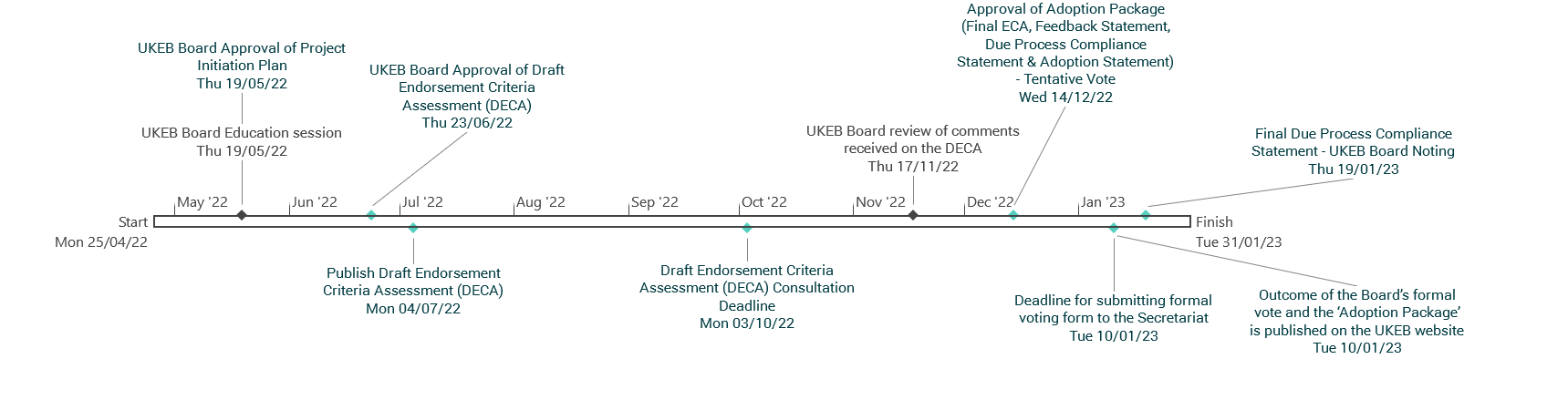
17The proposed high-level project timeline is as follows:
| Date | Milestones |
|---|---|
| 19 May 2022 | • Board approval of Project Initiation Plan (PIP) |
| • Education session (private Board meeting) | |
| 23 June 2022 | Board approval of Draft Endorsement Criteria Assessment (DECA) |
| DECA Consultation period (90 days): July 4, 2022 – October 2, 2022 | |
| 17 November 2022 | Board review of comments received on the DECA |
| 14 December 2022 | Approval of Adoption Package |
| x* January 2023 | Due Process Compliance Statement for noting |
| * A date for the January 2023 Board meeting has not been confirmed at the time of writing. |
Endorsement and adoption of narrow-scope amendments issued 2021 (with an effective date of 1 January 2023) - Upcoming Tasks
High-Level Plan
APPENDIX 2 – Description of narrow-scope amendments to be considered for adoption
I Amendments to IAS 1 – Disclosure of Accounting Policies
| Issued for public comment | Exposure Draft ED/2019/6 Disclosure of Accounting Policies—Proposed amendments to IAS 1 Presentation of Financial Statements [and to IFRS Practice Statement 2 Making Materiality Judgements (Materiality Practice Statement)][^1-a]—issued for public comment on 1 August 2019 (comment period ended 29 November 2019). |
|---|---|
| Title and issue date of final amendment | Disclosure of Accounting Policies (Amendments to IAS 1 [and to IFRS Practice Statement 2]) issued on 12 February 2021. |
| Origin | In March 2017 the IASB published the Discussion Paper Disclosure Initiative—Principles of Disclosure (Discussion Paper) to help it identify and address issues related to the disclosure of information in financial statements prepared by an entity applying IFRS Standards. The Discussion Paper noted that paragraph 117 of IAS 1 required entities to disclose their significant accounting policies and that stakeholders, including primary users of financial statements, differ in their views about what constitutes a significant accounting policy. Feedback on this Discussion Paper recommended the IASB to develop requirements and guidance to help entities make more effective accounting policy disclosures and that the definition of “materiality” in paragraph 7 of IAS 1 be the basis of such requirements. On 18 July 2018, the IASB added the Disclosure of Accounting Policies project to its workplan. The Amendments to IAS 1 build on Definition of Material, the Amendments to IAS 1 and IAS 8 Accounting Policies, Changes in Accounting Estimates and Errors issued by the IASB in October 2018, that clarified the definition of ‘material’. |
| What has changed? | The Amendments to IAS 1: |
| • Amend paragraphs 117 and 122 of IAS 1 to require entities to disclose their "material" accounting policy information rather than their "significant" accounting policies. This is because "significant" is not defined in IFRS Standards whereas "material" is well understood by stakeholders. | |
| • Amend paragraph 117 of IAS 1 to clarify that accounting policy information is material if, when considered together with other information included in an entity's financial statements, it can reasonably be expected to influence the decisions of primary users about the entity. | |
| • Add new paragraph 117A of IAS 1 to clarify that: | |
| o accounting policy information can be judged material because of the nature of the related transactions, other events or conditions, even if the amounts to which that information relates are immaterial. | |
| o not all accounting policy information relating to material transactions, other events or conditions is material. | |
| • Provide examples in new paragraph 117B of IAS 1 of circumstances in which an entity would normally conclude that information about an accounting policy is material to its financial statements. | |
| • Explain in new paragraph 117C of IAS 1 that entity-specific accounting policy information is more useful to users of financial statements than accounting policy information that is standardised, or that duplicates or summarises the requirements of IFRS Standards. However, if an entity discloses such information, it should not obscure material accounting policy information (paragraph 117D). | |
| • Delete the discussion of ‘measurement basis (or bases)’ in former paragraphs 117(a)–(b) and 118 of IAS 1 to enable preparers to apply judgement and thereby disclose only material accounting policy information. For example, information about the measurement basis used by an entity would not be needed when an IFRS Standard requires an entity to use that measurement basis. | |
| • Emphasise in new paragraph 117E of IAS 1 that the Amendments to IAS 1 do not relieve an entity from meeting other disclosure requirements within IFRS Standards. For example, if an entity applying these amendments decides that accounting policy information about intangible assets is immaterial to its financial statements, the entity would still need to disclose the information required by IAS 38 Intangible Assets that the entity had determined to be material. | |
| Transition requirements | The Amendments to IAS 1 are effective for annual periods beginning on or after 1 January 2023, with early application permitted. |
| Changes | In IAS 1, paragraphs 7, 10, 114, 117 and 122 are amended. Paragraphs 117A–117E and 139V are added. Paragraphs 118, 119 and 121 are deleted. There were also consequential amendments to: |
| • paragraphs 21 and B5 of IFRS 7 Financial Instruments: Disclosures; and paragraph 44I was added. These amendments clarify that information about measurement basis (or bases) for financial instruments is expected to be material accounting policy information. | |
| • paragraph 34 of IAS 26 Accounting and Reporting by Retirement Benefit Plans; and to paragraph 5 of IAS 34 Interim Financial Reporting to replace the word ‘significant’ with ‘material’. |
2 Amendments to IAS 8 – Definition of Accounting Estimates
| Issued for public comment | Exposure Draft ED/2017/5 Accounting Policies and Accounting Estimates—Proposed amendments to IAS 8 Accounting Policies, Changes in Accounting Estimates and Errors—issued for public comment on 12 September 2017 (comment period ended 15 January 2018). |
|---|---|
| Title and issue date of final amendment | Definition of Accounting Estimates (Amendments to IAS 8) issued on 12 February 2021. |
| Origin | The IFRS Interpretations Committee informed the IASB that entities faced difficulties in distinguishing changes in accounting policies from changes in accounting estimates. The IASB understood that such difficulties arose because the combination of a definition of one item (accounting policies) with a definition of changes in another item (change in accounting estimate) obscured the distinction between accounting policies and accounting estimates. |
| What has changed? | The Amendments to IAS 8: |
| • Replace in paragraph 5 of IAS 8 the definition of a ‘change in accounting estimate’ with a definition of ‘accounting estimates’ which is anchored in the concept of ‘measurement uncertainty’ in the IASB’s 2018 Conceptual Framework. | |
| • Clarify in paragraph 32 of IAS 8: | |
| o the relationship between ‘accounting policies’ and ‘accounting estimates’ by specifying that an entity develops an accounting estimate to achieve the objective set out by an accounting policy. | |
| o that developing accounting estimates involves the use of judgements and assumptions. | |
| • Specify in new paragraph 32A of IAS 8 that measurement techniques and inputs an entity uses to develop accounting estimates include estimation techniques and valuation techniques. | |
| • Refine the wording in paragraph 34 of IAS 8 to clarify that a change in accounting estimate may result from new information or new developments and is not the correction of an error. | |
| • Specify in new paragraph 34A of IAS 8 that the effects of a change in an input or in a measurement technique used to develop an accounting estimate are changes in accounting estimates unless they result from the correction of prior period errors. | |
| Transition requirements | The Amendments to IAS 8 are effective for annual periods beginning on or after 1 January 2023, with early application permitted. |
| Changes | In IAS 8, paragraphs 5, 32, 34, 38 and 48 and the heading above paragraph 32 are amended. Paragraphs 32A–32B, 34A and 54I and the headings above paragraphs 34 and 36 are added. The heading above paragraph 39 is amended to be a sub-heading of the heading added above paragraph 34. |
3 Amendments to IAS 12 – Deferred Tax related to Assets and Liabilities arising from a Single Transaction
| Issued for public comment | Exposure Draft ED/2019/5 Deferred Tax related to Assets and Liabilities arising from a Single Transaction—issued for public comment on 17 July 2019 (comment period ended 14 November 2019). |
|---|---|
| Title and issue date of final amendment | Deferred Tax related to Assets and Liabilities arising from a Single Transaction (Amendments to IAS 12) issued on 7 May 2021. |
| Origin | The IFRS Interpretations Committee received a request asking whether the initial recognition exemption (IRE) in paragraphs 15 and 24 of IAS 12 applied to transactions, such as leases, that give rise to both an asset and liability on initial recognition and may result in temporary differences of the same amount. The Committee observed that in some cases, the exemption was applied, and in other cases it was not, reducing comparability between financial statements. |
| What has changed? | The IASB decided to narrow the scope of the IRE in paragraphs 15(b) and 24(c) of IAS 12 so that it does not apply to transactions that, on initial recognition, give rise to equal and offsetting taxable and deductible temporary differences. New paragraph 22A further explains that, depending on the applicable tax law, a lease could be an example where equal taxable and deductible temporary differences may arise on initial recognition of the right-of-use asset and the lease liability. The Amendments to IAS 12 also: |
| • Clarify that if the transaction gives rise to equal taxable and deductible temporary differences an entity recognises any deferred tax liability or asset and recognises the resulting deferred tax expense or income in profit or loss (paragraph 22(b) in IAS 12). | |
| • Include an example illustrating the accounting for deferred tax on advance lease payments and initial direct costs. | |
| Transition requirements | The Amendments to IAS 12 are applied for annual periods beginning on or after 1 January 2023, with earlier application permitted. If entities apply the Amendments earlier, they shall disclose that fact. An entity: |
| • Applies the Amendments to IAS 12 to transactions that occur on or after the beginning of the earliest comparative period presented. | |
| • Also recognises deferred tax for all temporary differences related to leases and decommissioning obligations at the beginning of the earliest comparative period presented, with the cumulative effect of initially applying the amendments recognised as an adjustment to the opening balance of retained earnings (or other component of equity, as appropriate) at that date. | |
| Changes | In IAS 12, paragraphs 15, 22 and 24 are amended and paragraphs 22A and 98J–98L are added. |
APPENDIX 3 Main comments by UK respondents and actions taken by the IASB
IAS 1 – Disclosure of Accounting Policies
| Main comments from UK respondents when the amendments were exposed for public comment | Actions taken by the IASB |
|---|---|
| Number of UK stakeholders responding directly to the IASB: 11. These were comprised of 2 accounting and audit representative organisations, 6 accounting firms, 1 standard-setter, 2 user organisations. One of the accounting and audit representative organisations additionally also responded to EFRAG’s draft comment letter. | |
| Almost all respondents supported the proposal to require entities to disclose their ‘material’ accounting policies instead of their ‘significant’ accounting policies. However, a few respondents were concerned that the impact of the new requirements may lead to fewer or reduced disclosures for users. For example, these respondents disagreed with the: | The IASB reaffirmed its position that the guidance in new paragraphs 117A and 117C of IAS 1 will help entities reduce immaterial accounting policy disclosure in the financial statements and will result in a more consistent approach to accounting policy disclosures. |
| • statement in proposed paragraph 117A of IAS 1 that "not all accounting policies relating to material transactions, other events or conditions are themselves material', as accounting policy information relating to material transactions is inherently material and is useful for users. | The IASB also clarified in new paragraph 117B(e) of IAS 1 that when the accounting required by an IFRS Standard is complex or difficult to understand by users, material accounting policy information could include standardised descriptions or information that duplicates the requirements of IFRS Standards. |
| • guidance in proposed paragraphs 117A of IAS 1 and 117C[^1-b] of IAS 1, as this guidance would lead to significant reduced descriptions of their accounting policies. | |
| Two respondents suggested highlighting as part of the Amendments to IAS 1 that disclosing immaterial policies may have the effect of obscuring material information. | The IASB agreed with the feedback received and added new paragraph 117D to IAS 1 to explain that if an entity discloses immaterial accounting policy information, such information should not obscure material information. |
| Most respondents supported the inclusion of examples of circumstances in in determining whether an accounting policy is material (in proposed paragraph 117B of IAS 1). | The IASB agreed with the feedback received and decided to: |
| However, most respondents did not find the example in paragraph 117B(e) of IAS 1 helpful to determine whether an accounting policy is material and proposed combining this example with the guidance in proposed paragraph 117C of IAS 1 which broadly addressed the same issue (i.e. that an entity applies the requirements of an IFRS Standard in a way that reflects the entity’s specific circumstances). | • combine the example in new paragraph 117B(e) of IAS 1 with the guidance in new paragraph 117C of IAS 1 to emphasise the importance of making entity-specific accounting policy disclosures. |
| A few respondents made other suggestions: | • clarify in the Basis for Conclusions that the list of examples in new paragraph 117B of IAS 1 is not exhaustive. |
| • Making clear that the list of examples in proposed paragraph 117B is not exhaustive. | The IASB decided to retain the cross-reference to the requirements in paragraphs 122 and 125 of IAS 1 in new paragraph 117B(d) of IAS 1 as the information required in those paragraphs is likely to be material. |
| • Deleting the reference to paragraphs 122 and 125 of IAS 1[^2-a] in proposed paragraph 117B(d) of IAS 1 because an accounting policy may be assessed as material regardless of whether it relates to an area for which an entity is required to make significant judgements or assumptions. | |
| A few respondents suggested that the IASB should: | The IASB clarified in new paragraph 117A of IAS 1 that accounting policy information can be judged material because of the nature of the related transactions, even if the amounts to which that information relates are immaterial. It did not consider necessary adding back the guidance in paragraph 121 of IAS 1 as it observed that paragraph 38 of IAS 1 requires the disclosure of comparative information about an entity’s accounting policies if this information is relevant to understand the financial statements for the current period. The IASB did not add an explanation about the use of quantitative and qualitative factors in assessing whether accounting policy is material, because it observed that ‘materiality’ depends on the nature and magnitude of information (or both) and consequently, there are already quantitative and qualitative aspects involved in that assessment. |
| • add back the guidance in paragraph 121 of IAS 1 (being deleted by the proposed amendments) that an accounting policy may be significant because of the nature of the entity’s operations even if amounts for current and prior periods are not material; and | |
| • add an explanation that entities should consider both quantitative and qualitative factors when assessing whether an accounting policy should be disclosed. |
IAS 8 – Definition of Accounting Estimates
| Main comments from UK respondents when the amendments were exposed for public comment | Actions taken by the IASB |
|---|---|
| Number of UK stakeholders responding directly to the IASB: 10. These were comprised of 2 accounting and audit representative organisations, 6 accounting firms, 1 standard-setter, 1 investors organisation. One of the accounting and audit representative organisations and the standard-setter additionally also responded to EFRAG’s draft comment letter. | |
| Most respondents said it was helpful to remove from the definition of ‘accounting policies’ the terms ‘conventions’ and ‘rules’, as these terms were not clear. However, they observed that the proposed changes might unintentionally narrow the scope of the definition. Some respondents suggested that the remaining terms of that definition should also be defined, for example, the term "practices" as this term is subject to different interpretations. | The IASB observed that it did not intend to narrow or broaden the scope of what constitutes an accounting policy and after considering the feedback received decided not to amend the definition of ‘accounting policies’ to avoid unintended consequences. |
| All respondents supported the proposals to remove the definition of a ‘change in accounting estimate’ and to provide, instead, a definition of ‘accounting estimates’. The following improvements were suggested by respondents: | The IASB agreed with the suggestions made and amended the definition of "accounting estimates". In addition, the IASB clarified: |
| a) clarify that accounting estimates: | • in paragraph 32 of IAS 8, that an entity develops an accounting estimate to achieve the objective set out by an accounting policy; |
| • are not judgements or assumptions themselves but rather the output of a measurement technique (such as a valuation technique or an estimation technique) that requires an entity to use judgements and assumptions. | • in new paragraph 32A of IAS 8, that estimation techniques and valuation techniques are examples of measurement techniques an entity uses to develop accounting estimates; and |
| • are ‘monetary amounts’ and are subject to ‘measurement uncertainty’ in line with IAS 37[^3-a] and with the 2018 Conceptual Framework[^4-a]. | • in new paragraph 34A of IAS 8 that the effects of a change in an input or measurement technique are changes in accounting estimates unless they result from the correction of prior period errors. |
| b) provide more guidance to distinguish: | |
| • a change in an accounting estimate from the correction of an error as the guidance in paragraph 34 of IAS 8 was not considered sufficient to make this distinction[^5-a]. | |
| • an accounting policy from an accounting estimate. | |
| There were mixed views regarding the IASB’s clarification in proposed paragraph 32B of IAS 8 that selecting a cost formula for interchangeable inventories (i.e. the first in, first out (FIFO) or weighted average cost) constitutes selecting an accounting policy. Half of these respondents observed that this clarification was not consistent with the proposed Amendments to IAS 8 because selecting a cost formula could be viewed as making an accounting estimate. | The IASB decided to remove the proposed clarification in paragraph 32B of IAS 8 as it observed that paragraph 36(a) of IAS 2 Inventories, already states that selecting a cost formula constitutes selecting an accounting policy. The IASB did not to revisit this conclusion because entities rarely change the cost formula used to measure inventories. |
IAS 12 – Deferred Tax related to Assets and Liabilities arising from a Single Transaction
| Main comments from UK respondents when the amendments were exposed for public comment | Actions taken by the IASB | | IAS 1 – Disclosure of Accounting Policies | | | Main comments from UK respondents when the amendments were exposed for public comment | Actions taken by the IASB | | Two respondents suggested highlighting as part of the Amendments to IAS 1 that disclosing immaterial policies may have the effect of obscuring material information. | The IASB agreed with the feedback received and added new paragraph 117D to IAS 1 to explain that if an entity discloses immaterial accounting policy information, such information should not obscure material information. | | Most respondents supported the inclusion of examples of circumstances in in determining whether an accounting policy is material (in proposed paragraph 117B of IAS 1). | The IASB agreed with the feedback received and decided to: | | However, most respondents did not find the example in paragraph 117B(e) of IAS 1 helpful to determine whether an accounting policy is material and proposed combining this example with the guidance in proposed paragraph 117C of IAS 1 which broadly addressed the same issue (i.e. that an entity applies the requirements of an IFRS Standard in a way that reflects the entity’s specific circumstances). | • combine the example in new paragraph 117B(e) of IAS 1 with the guidance in new paragraph 117C of IAS 1 to emphasise the importance of making entity-specific accounting policy disclosures. | | A few respondents made other suggestions: | • clarify in the Basis for Conclusions that the list of examples in new paragraph 117B of IAS 1 is not exhaustive. | | • Making clear that the list of examples in proposed paragraph 117B is not exhaustive. | The IASB decided to retain the cross-reference to the requirements in paragraphs 122 and 125 of IAS 1 in new paragraph 117B(d) of IAS 1 as the information required in those paragraphs is likely to be material. | | • Deleting the reference to paragraphs 122 and 125 of IAS 1[^2] in proposed paragraph 117B(d) of IAS 1 because an accounting policy may be assessed as material regardless of whether it relates to an area for which an entity is required to make significant judgements or assumptions. | | | A few respondents suggested that the IASB should: | The IASB clarified in new paragraph 117A of IAS 1 that accounting policy information can be judged material because of the nature of the related transactions, even if the amounts to which that information relates are immaterial. It did not consider necessary adding back the guidance in paragraph 121 of IAS 1 as it observed that paragraph 38 of IAS 1 requires the disclosure of comparative information about an entity’s accounting policies if this information is relevant to understand the financial statements for the current period. The IASB did not add an explanation about the use of quantitative and qualitative factors in assessing whether accounting policy is material, because it observed that ‘materiality’ depends on the nature and magnitude of information (or both) and consequently, there are already quantitative and qualitative aspects involved in that assessment. | | • add back the guidance in paragraph 121 of IAS 1 (being deleted by the proposed amendments) that an accounting policy may be significant because of the nature of the entity’s operations even if amounts for current and prior periods are not material; and | | | • add an explanation that entities should consider both quantitative and qualitative factors when assessing whether an accounting policy should be disclosed. | |
IAS 8 – Definition of Accounting Estimates
| Main comments from UK respondents when the amendments were exposed for public comment | Actions taken by the IASB |
|---|---|
| Number of UK stakeholders responding directly to the IASB: 10. These were comprised of 2 accounting and audit representative organisations, 6 accounting firms, 1 standard-setter, 1 investors organisation. One of the accounting and audit representative organisations and the standard-setter additionally also responded to EFRAG’s draft comment letter. | |
| Most respondents said it was helpful to remove from the definition of ‘accounting policies’ the terms ‘conventions’ and ‘rules’, as these terms were not clear. However, they observed that the proposed changes might unintentionally narrow the scope of the definition. Some respondents suggested that the remaining terms of that definition should also be defined, for example, the term "practices" as this term is subject to different interpretations. | The IASB observed that it did not intend to narrow or broaden the scope of what constitutes an accounting policy and after considering the feedback received decided not to amend the definition of ‘accounting policies’ to avoid unintended consequences. |
| All respondents supported the proposals to remove the definition of a ‘change in accounting estimate’ and to provide, instead, a definition of ‘accounting estimates’. The following improvements were suggested by respondents: | The IASB agreed with the suggestions made and amended the definition of "accounting estimates". In addition, the IASB clarified: |
|
• in paragraph 32 of IAS 8, that an entity develops an accounting estimate to achieve the objective set out by an accounting policy; |
| • are not judgements or assumptions themselves but rather the output of a measurement technique (such as a valuation technique or an estimation technique) that requires an entity to use judgements and assumptions. | • in new paragraph 32A of IAS 8, that estimation techniques and valuation techniques are examples of measurement techniques an entity uses to develop accounting estimates; and |
| • are ‘monetary amounts’ and are subject to ‘measurement uncertainty’ in line with IAS 37[^3] and with the 2018 Conceptual Framework[^4]. | • in new paragraph 34A of IAS 8 that the effects of a change in an input or measurement technique are changes in accounting estimates unless they result from the correction of prior period errors. |
|
|
| • a change in an accounting estimate from the correction of an error as the guidance in paragraph 34 of IAS 8 was not considered sufficient to make this distinction[^5]. | |
| • an accounting policy from an accounting estimate. | |
| There were mixed views regarding the IASB’s clarification in proposed paragraph 32B of IAS 8 that selecting a cost formula for interchangeable inventories (i.e. the first in, first out (FIFO) or weighted average cost) constitutes selecting an accounting policy. Half of these respondents observed that this clarification was not consistent with the proposed Amendments to IAS 8 because selecting a cost formula could be viewed as making an accounting estimate. | The IASB decided to remove the proposed clarification in paragraph 32B of IAS 8 as it observed that paragraph 36(a) of IAS 2 Inventories, already states that selecting a cost formula constitutes selecting an accounting policy. The IASB did not to revisit this conclusion because entities rarely change the cost formula used to measure inventories. |
IAS 12 – Deferred Tax related to Assets and Liabilities arising from a Single Transaction
| Main comments from UK respondents when the amendments were exposed for public comment | Actions taken by the IASB markdown
Executive Summary
| Project Type | Endorsement and adoption |
|---|---|
| Project scope | Narrow-scope |
Purpose of the paper
This paper provides the Board with a draft Project Initiation Plan (PIP) for the project to endorse and adopt the following three narrow-scope amendments issued by the IASB during 2021:
- Amendments to IAS 1 [and IFRS Practice Statement 2]—Disclosure of Accounting Policies,
- Amendments to IAS 8—Definition of Accounting Estimates; and
- Amendments to IAS 12—Deferred Tax related to Assets and Liabilities arising from a Single Transaction.
All these narrow-scope amendments have an effective date of 1 January 2023.
Summary of the issues
The narrow-scope amendments included in this project were issued by the IASB during 2021. The UKEB must consider these amendments for endorsement and formal adoption in the UK before UK entities are able to apply them. The PIP includes the proposed approach and timeline for the project that would facilitate the UKEB's final decision on adoption of the amendments from the 1 January 2023 effective date.
Decisions for the Board
The Board is asked to approve the draft PIP.
Recommendations
The Secretariat recommend that the Board approves the draft PIP.
Appendices
| Appendix 1 | Draft Project initiation Plan (PIP) |
| Appendix 2 | Description of narrow-scope amendments to be considered for adoption |
| Appendix 3 | Main comments by UK respondents and actions taken by the IASB |
APPENDIX 1 – Draft Project Initiation Plan
| Project Type | Endorsement and adoption |
|---|---|
| Project scope | Narrow-scope |
Purpose
1This project sets out the plan to endorse and adopt[^1] three narrow-scope amendments to international accounting standards[^2] issued by the IASB in 2021 (the “2021 Amendments”). The 2021 Amendments have an effective date of 1 January 2023 and earlier application is permitted.
2The UKEB was not able to directly influence the 2021 Amendments as all of the Amendments included in this project were finalised by the IASB before the Statutory Function had been delegated by the Secretary of State to the UKEB[^3].
3The UKEB must consider these amendments for endorsement and formal adoption in the UK so that UK entities are able to apply them from the effective date of the amendments of 1 January 2023.
Background
4The IASB issues narrow-scope amendments to international accounting standards as part of its continuous effort to maintain and improve IFRS and to support their consistent application. Proposals for amendments often arise from questions submitted to the IFRS Interpretations Committee.
5The 2021 Amendments covered in this project are:
- narrow in scope. Each one of the amendments meet all of the following the criteria in paragraph 5.16 of the IASB’s Due Process Handbook (see below)[^4]; * "the matter has widespread effect and has, or is expected to have, a material effect on those affected; * it is necessary to add or change requirements in IFRS Standards to improve financial reporting—that is, the principles and requirements in the Standards do not provide an adequate basis for an entity to determine the required accounting; * the matter can be resolved efficiently within the confines of the existing Standards and the Conceptual Framework, and * the matter is sufficiently narrow in scope that the Board or the Interpretations Committee can address it in an efficient manner, but not so narrow that it is not cost-effective for the Board or the Interpretations Committee and stakeholders to undertake the due process required to change a Standard".
- were issued and exposed separately for public comment as the IASB considered they merited separate consultation and outreach.
Scope
6The 2021 Amendments covered in this project are shown in the table below. Appendix 2 to this paper provides a brief description of each one of these amendments.
| Date | Title of the Amendment | Issue date |
|---|---|---|
| Disclosure of Accounting Policies | 12/02/21 | |
| Amendments to IAS 1 Presentation of Financial Statements and to IFRS Practice Statement 2 Making Materiality Judgements (Materiality Practice Statement) [see paragraphs 7–8 below] | ||
| Definition of Accounting Estimates | 12/02/21 | |
| Amendments to IAS 8 Accounting Policies, Changes in Accounting Estimates and Errors | ||
| Deferred Tax related to Assets and Liabilities arising from a Single Transaction | 07/05/21 | |
| Amendments to IAS 12 Income Taxes |
Exclusions
7IFRS Practice Statement 2 Making Materiality Judgements (Materiality Practice Statement)[^5], provides reporting entities with non-mandatory guidance on making materiality judgements when preparing general purpose financial statements.
8The amendments to Practice Statement 2 provide explanations and application guidance related to the ‘four-step materiality process’ to accounting policy disclosures set out in the IAS 1 amendments. The amendments to Practice Statement 2 have not been included as part of the UKEB’s 2021 narrow-scope amendments project as UK-adopted IAS only comprise the mandatory sections of standards.
EU adoption
9On 2 March 2022 the European Commission (EU) adopted two of the 2021 Amendments included in this project: a) the Amendments to IAS 1 and b) the Amendments to IAS 8.
10At the time of writing this paper the European Financial Reporting Advisory Group (EFRAG) had completed its due process and had submitted its Endorsement Advice to the European Commission supporting the adoption of the Amendments to IAS 12[^7]. We expect that the EU will complete the adoption process for the IAS 12 Amendment later this year.
Key planning assumptions and resources allocated
Assumptions
11We have made the following assumptions in developing this project plan:
- The 2021 Amendments are narrow in scope
12The 2021 Amendments address concerns about a specific aspect of an international accounting standard without causing major or significant changes in practice (refer to paragraph 5(a) in this paper).
- The 2021 Amendments have been subject to public consultation
13Given that the 2021 Amendments were exposed for public comment and finalised before the creation of the UKEB (i.e. the Amendments to IAS 1 and IAS 8 were finalised in February 2021 and the Amendments to IAS 12 were finalised in May 2021), neither the Board nor the Secretariat had the opportunity to influence the development of the IASB’s proposals[^8]. However, through desk-based review (refer to the table below paragraph 16 in this paper) we were able to confirm that:
- The comments from UK stakeholders had been fully considered by the IASB when finalising the 2021 Amendments.
- The IASB considered the suggestions made by UK respondents and, where it agreed, incorporated them into the final 2021 Amendments. In situations where the IASB decided not to take forward some of the suggestions made, it provided the rationale for its decisions (i.e. in the basis for conclusions or in IASB staff papers discussing the specific amendment). Appendix 3 to this paper provides a high-level summary of some of the main comments made by UK respondents and the actions taken by the IASB when dealing with those comments.
- Setting-up an ad-hoc advisory group is not necessary
14Given the narrow-scope nature of the amendments covered in this project the Secretariat do not consider it necessary to set-up a project-specific advisory group.
15We consider that a project team consisting of one project manager, assistance from the economics team and oversight provided by one Senior Project Director should help ensure the project timelines are achievable. We have based this on the following assumptions:
- The 2021 Amendments are narrow in scope,
- Only the mandatory applicable activity and milestones in the draft UKEB’s Due Process Handbook (the “draft Handbook[^9]”) will be undertaken, and
- expected outreach will adhere to the minimum stipulated in the draft Handbook.
Project milestones
16A proportionate approach, incorporating the mandatory milestones listed in paragraph 6.10 of the draft Handbook as well as other optional activities as appropriate, have been considered. The table below provides a brief description of the work we have done and/or that we intend to do as part of this project.
| Milestone/activity | Brief description | Status | Draft Handbook reference |
|---|---|---|---|
| Project Initiation activities | |||
| Technical project added to UKEB technical work plan (mandatory) | Link to the 2021 Amendments project page included on UKEB website ("Endorsement projects" section). | Done | Paragraph 4.31(c) |
| Education session (optional) | We have organised an Education session for Board members to provide an overview of the narrow-scope amendments issued 2021. | Scheduled for May 2022 | Paragraph 4.10(b) |
| Project Initiation Plan (mandatory) | This paper. | - | Paragraph 6.10(a) |
| Desk-based research | We have reviewed IASB’s previous work on the amendments (i.e. mainly staff papers and feedback summaries). We have also reviewed the basis for conclusions for each final amendment and the responses from UK stakeholders for each one of the 2021 narrow-scope amendments, including: | Done See Appendices 2 and 3 of Paper 3, May 2022 Board pack | Paragraph 6.20 |
|
|||
|
|||
| Issue of a DECA (mandatory) | The Secretariat will develop a draft Endorsement Criteria Assessment (DECA) to determine whether the UK’s statutory requirements for endorsement and adoption are met for the amendments included in this project. | To be done. We expect to bring the DECA for discussion to the June 2022 meeting. | Paragraphs 6.26–6.29 |
| In parallel to this assessment, we will be piloting a streamlined approach for undertaking economic impact assessments for narrow-scope amendments that is currently being developed by the UKEB. | |||
| Minimum outreach activities (mandatory) | Once the DECA is published for comment on the UKEB website, the UKEB Secretariat’s consultation activities will be focused on obtaining responses on this DECA. | To be done. DECA publication for comment expected in July 2022 | Paragraph 6.21 |
| Consultation period for the DECA | The DECA will be issued for comment for 90 days. | Paragraph 6.30 | |
| Project closure | The project closure process for endorsing projects will comprise the following mandatory steps. | Paragraph 6.32 | |
|
|||
|
Project timeline
17The proposed high-level project timeline is as follows:
| Date | Milestones |
|---|---|
| 19 May 2022 | • Board approval of Project Initiation Plan (PIP) |
| • Education session (private Board meeting) | |
| 23 June 2022 | Board approval of Draft Endorsement Criteria Assessment (DECA) |
| DECA Consultation period (90 days): July 4, 2022 – October 2, 2022 | |
| 17 November 2022 | Board review of comments received on the DECA |
| 14 December 2022 | Approval of Adoption Package |
| x* January 2023 | Due Process Compliance Statement for noting |
| * A date for the January 2023 Board meeting has not been confirmed at the time of writing. |
Endorsement and adoption of narrow-scope amendments issued 2021 (with an effective date of 1 January 2023) - Upcoming Tasks
High-Level Plan
APPENDIX 2 – Description of narrow-scope amendments to be considered for adoption
I Amendments to IAS 1 – Disclosure of Accounting Policies
| Issued for public comment | Exposure Draft ED/2019/6 Disclosure of Accounting Policies—Proposed amendments to IAS 1 Presentation of Financial Statements [and to IFRS Practice Statement 2 Making Materiality Judgements (Materiality Practice Statement)][^1-a]—issued for public comment on 1 August 2019 (comment period ended 29 November 2019). |
|---|---|
| Title and issue date of final amendment | Disclosure of Accounting Policies (Amendments to IAS 1 [and to IFRS Practice Statement 2]) issued on 12 February 2021. |
| Origin | In March 2017 the IASB published the Discussion Paper Disclosure Initiative—Principles of Disclosure (Discussion Paper) to help it identify and address issues related to the disclosure of information in financial statements prepared by an entity applying IFRS Standards. The Discussion Paper noted that paragraph 117 of IAS 1 required entities to disclose their significant accounting policies and that stakeholders, including primary users of financial statements, differ in their views about what constitutes a significant accounting policy. Feedback on this Discussion Paper recommended the IASB to develop requirements and guidance to help entities make more effective accounting policy disclosures and that the definition of “materiality” in paragraph 7 of IAS 1 be the basis of such requirements. On 18 July 2018, the IASB added the Disclosure of Accounting Policies project to its workplan. The Amendments to IAS 1 build on Definition of Material, the Amendments to IAS 1 and IAS 8 Accounting Policies, Changes in Accounting Estimates and Errors issued by the IASB in October 2018, that clarified the definition of ‘material’. |
| What has changed? | The Amendments to IAS 1: |
| * Amend paragraphs 117 and 122 of IAS 1 to require entities to disclose their "material" accounting policy information rather than their "significant" accounting policies. This is because "significant" is not defined in IFRS Standards whereas "material" is well understood by stakeholders. | |
| * Amend paragraph 117 of IAS 1 to clarify that accounting policy information is material if, when considered together with other information included in an entity's financial statements, it can reasonably be expected to influence the decisions of primary users about the entity. | |
| * Add new paragraph 117A of IAS 1 to clarify that: | |
| * accounting policy information can be judged material because of the nature of the related transactions, other events or conditions, even if the amounts to which that information relates are immaterial. | |
| * not all accounting policy information relating to material transactions, other events or conditions is material. | |
| * Provide examples in new paragraph 117B of IAS 1 of circumstances in which an entity would normally conclude that information about an accounting policy is material to its financial statements. | |
| * Explain in new paragraph 117C of IAS 1 that entity-specific accounting policy information is more useful to users of financial statements than accounting policy information that is standardised, or that duplicates or summarises the requirements of IFRS Standards. However, if an entity discloses such information, it should not obscure material accounting policy information (paragraph 117D). | |
| * Delete the discussion of ‘measurement basis (or bases)’ in former paragraphs 117(a)–(b) and 118 of IAS 1 to enable preparers to apply judgement and thereby disclose only material accounting policy information. For example, information about the measurement basis used by an entity would not be needed when an IFRS Standard requires an entity to use that measurement basis. | |
| * Emphasise in new paragraph 117E of IAS 1 that the Amendments to IAS 1 do not relieve an entity from meeting other disclosure requirements within IFRS Standards. For example, if an entity applying these amendments decides that accounting policy information about intangible assets is immaterial to its financial statements, the entity would still need to disclose the information required by IAS 38 Intangible Assets that the entity had determined to be material. | |
| Transition requirements | The Amendments to IAS 1 are effective for annual periods beginning on or after 1 January 2023, with early application permitted. |
| Changes | In IAS 1, paragraphs 7, 10, 114, 117 and 122 are amended. Paragraphs 117A–117E and 139V are added. Paragraphs 118, 119 and 121 are deleted. There were also consequential amendments to: |
| * paragraphs 21 and B5 of IFRS 7 Financial Instruments: Disclosures; and paragraph 44I was added. These amendments clarify that information about measurement basis (or bases) for financial instruments is expected to be material accounting policy information. | |
| * paragraph 34 of IAS 26 Accounting and Reporting by Retirement Benefit Plans; and to paragraph 5 of IAS 34 Interim Financial Reporting to replace the word ‘significant’ with ‘material’. |
2 Amendments to IAS 8 – Definition of Accounting Estimates
| Issued for public comment | Exposure Draft ED/2017/5 Accounting Policies and Accounting Estimates—Proposed amendments to IAS 8 Accounting Policies, Changes in Accounting Estimates and Errors—issued for public comment on 12 September 2017 (comment period ended 15 January 2018). |
|---|---|
| Title and issue date of final amendment | Definition of Accounting Estimates (Amendments to IAS 8) issued on 12 February 2021. |
| Origin | The IFRS Interpretations Committee informed the IASB that entities faced difficulties in distinguishing changes in accounting policies from changes in accounting estimates. The IASB understood that such difficulties arose because the combination of a definition of one item (accounting policies) with a definition of changes in another item (change in accounting estimate) obscured the distinction between accounting policies and accounting estimates. |
| What has changed? | The Amendments to IAS 8: |
| * Replace in paragraph 5 of IAS 8 the definition of a ‘change in accounting estimate’ with a definition of ‘accounting estimates’ which is anchored in the concept of ‘measurement uncertainty’ in the IASB’s 2018 Conceptual Framework. | |
| * Clarify in paragraph 32 of IAS 8: | |
| * the relationship between ‘accounting policies’ and ‘accounting estimates’ by specifying that an entity develops an accounting estimate to achieve the objective set out by an accounting policy. | |
| * that developing accounting estimates involves the use of judgements and assumptions. | |
| * Specify in new paragraph 32A of IAS 8 that measurement techniques and inputs an entity uses to develop accounting estimates include estimation techniques and valuation techniques. | |
| * Refine the wording in paragraph 34 of IAS 8 to clarify that a change in accounting estimate may result from new information or new developments and is not the correction of an error. | |
| * Specify in new paragraph 34A of IAS 8 that the effects of a change in an input or in a measurement technique used to develop an accounting estimate are changes in accounting estimates unless they result from the correction of prior period errors. | |
| Transition requirements | The Amendments to IAS 8 are effective for annual periods beginning on or after 1 January 2023, with early application permitted. |
| Changes | In IAS 8, paragraphs 5, 32, 34, 38 and 48 and the heading above paragraph 32 are amended. Paragraphs 32A–32B, 34A and 54I and the headings above paragraphs 34 and 36 are added. The heading above paragraph 39 is amended to be a sub-heading of the heading added above paragraph 34. |
3 Amendments to IAS 12 – Deferred Tax related to Assets and Liabilities arising from a Single Transaction
| Issued for public comment | Exposure Draft ED/2019/5 Deferred Tax related to Assets and Liabilities arising from a Single Transaction—issued for public comment on 17 July 2019 (comment period ended 14 November 2019). |
|---|---|
| Title and issue date of final amendment | Deferred Tax related to Assets and Liabilities arising from a Single Transaction (Amendments to IAS 12) issued on 7 May 2021. |
| Origin | The IFRS Interpretations Committee received a request asking whether the initial recognition exemption (IRE) in paragraphs 15 and 24 of IAS 12 applied to transactions, such as leases, that give rise to both an asset and liability on initial recognition and may result in temporary differences of the same amount. The Committee observed that in some cases, the exemption was applied, and in other cases it was not, reducing comparability between financial statements. |
| What has changed? | The IASB decided to narrow the scope of the IRE in paragraphs 15(b) and 24(c) of IAS 12 so that it does not apply to transactions that, on initial recognition, give rise to equal and offsetting taxable and deductible temporary differences. New paragraph 22A further explains that, depending on the applicable tax law, a lease could be an example where equal taxable and deductible temporary differences may arise on initial recognition of the right-of-use asset and the lease liability. The Amendments to IAS 12 also: |
| * Clarify that if the transaction gives rise to equal taxable and deductible temporary differences an entity recognises any deferred tax liability or asset and recognises the resulting deferred tax expense or income in profit or loss (paragraph 22(b) in IAS 12). | |
| * Include an example illustrating the accounting for deferred tax on advance lease payments and initial direct costs. | |
| Transition requirements | The Amendments to IAS 12 are applied for annual periods beginning on or after 1 January 2023, with earlier application permitted. If entities apply the Amendments earlier, they shall disclose that fact. An entity: |
| * Applies the Amendments to IAS 12 to transactions that occur on or after the beginning of the earliest comparative period presented. | |
| * Also recognises deferred tax for all temporary differences related to leases and decommissioning obligations at the beginning of the earliest comparative period presented, with the cumulative effect of initially applying the amendments recognised as an adjustment to the opening balance of retained earnings (or other component of equity, as appropriate) at that date. | |
| Changes | In IAS 12, paragraphs 15, 22 and 24 are amended and paragraphs 22A and 98J–98L are added. |
APPENDIX 3 Main comments by UK respondents and actions taken by the IASB
IAS 1 – Disclosure of Accounting Policies
| Main comments from UK respondents when the amendments were exposed for public comment | Actions taken by the IASB |
|---|---|
| Number of UK stakeholders responding directly to the IASB: 11. These were comprised of 2 accounting and audit representative organisations, 6 accounting firms, 1 standard-setter, 2 user organisations. One of the accounting and audit representative organisations additionally also responded to EFRAG’s draft comment letter. | |
| Almost all respondents supported the proposal to require entities to disclose their ‘material’ accounting policies instead of their ‘significant’ accounting policies. However, a few respondents were concerned that the impact of the new requirements may lead to fewer or reduced disclosures for users. For example, these respondents disagreed with the: | The IASB reaffirmed its position that the guidance in new paragraphs 117A and 117C of IAS 1 will help entities reduce immaterial accounting policy disclosure in the financial statements and will result in a more consistent approach to accounting policy disclosures. |
| * statement in proposed paragraph 117A of IAS 1 that "not all accounting policies relating to material transactions, other events or conditions are themselves material', as accounting policy information relating to material transactions is inherently material and is useful for users. | The IASB also clarified in new paragraph 117B(e) of IAS 1 that when the accounting required by an IFRS Standard is complex or difficult to understand by users, material accounting policy information could include standardised descriptions or information that duplicates the requirements of IFRS Standards. |
| * guidance in proposed paragraphs 117A of IAS 1 and 117C[^1-b] of IAS 1, as this guidance would lead to significant reduced descriptions of their accounting policies. | |
| Two respondents suggested highlighting as part of the Amendments to IAS 1 that disclosing immaterial policies may have the effect of obscuring material information. | The IASB agreed with the feedback received and added new paragraph 117D to IAS 1 to explain that if an entity discloses immaterial accounting policy information, such information should not obscure material information. |
| Most respondents supported the inclusion of examples of circumstances in in determining whether an accounting policy is material (in proposed paragraph 117B of IAS 1). | The IASB agreed with the feedback received and decided to: |
| However, most respondents did not find the example in paragraph 117B(e) of IAS 1 helpful to determine whether an accounting policy is material and proposed combining this example with the guidance in proposed paragraph 117C of IAS 1 which broadly addressed the same issue (i.e. that an entity applies the requirements of an IFRS Standard in a way that reflects the entity’s specific circumstances). | * combine the example in new paragraph 117B(e) of IAS 1 with the guidance in new paragraph 117C of IAS 1 to emphasise the importance of making entity-specific accounting policy disclosures. |
| A few respondents made other suggestions: | * clarify in the Basis for Conclusions that the list of examples in new paragraph 117B of IAS 1 is not exhaustive. |
| * Making clear that the list of examples in proposed paragraph 117B is not exhaustive. | The IASB decided to retain the cross-reference to the requirements in paragraphs 122 and 125 of IAS 1 in new paragraph 117B(d) of IAS 1 as the information required in those paragraphs is likely to be material. |
| * Deleting the reference to paragraphs 122 and 125 of IAS 1[^2-a] in proposed paragraph 117B(d) of IAS 1 because an accounting policy may be assessed as material regardless of whether it relates to an area for which an entity is required to make significant judgements or assumptions. | |
| A few respondents suggested that the IASB should: | The IASB clarified in new paragraph 117A of IAS 1 that accounting policy information can be judged material because of the nature of the related transactions, even if the amounts to which that information relates are immaterial. It did not consider necessary adding back the guidance in paragraph 121 of IAS 1 as it observed that paragraph 38 of IAS 1 requires the disclosure of comparative information about an entity’s accounting policies if this information is relevant to understand the financial statements for the current period. The IASB did not add an explanation about the use of quantitative and qualitative factors in assessing whether accounting policy is material, because it observed that ‘materiality’ depends on the nature and magnitude of information (or both) and consequently, there are already quantitative and qualitative aspects involved in that assessment. |
| * add back the guidance in paragraph 121 of IAS 1 (being deleted by the proposed amendments) that an accounting policy may be significant because of the nature of the entity’s operations even if amounts for current and prior periods are not material; and | |
| * add an explanation that entities should consider both quantitative and qualitative factors when assessing whether an accounting policy should be disclosed. |
IAS 8 – Definition of Accounting Estimates
| Main comments from UK respondents when the amendments were exposed for public comment | Actions taken by the IASB |
|---|---|
| Number of UK stakeholders responding directly to the IASB: 10. These were comprised of 2 accounting and audit representative organisations, 6 accounting firms, 1 standard-setter, 1 investors organisation. One of the accounting and audit representative organisations and the standard-setter additionally also responded to EFRAG’s draft comment letter. | |
| Most respondents said it was helpful to remove from the definition of ‘accounting policies’ the terms ‘conventions’ and ‘rules’, as these terms were not clear. However, they observed that the proposed changes might unintentionally narrow the scope of the definition. Some respondents suggested that the remaining terms of that definition should also be defined, for example, the term "practices" as this term is subject to different interpretations. | The IASB observed that it did not intend to narrow or broaden the scope of what constitutes an accounting policy and after considering the feedback received decided not to amend the definition of ‘accounting policies’ to avoid unintended consequences. |
| All respondents supported the proposals to remove the definition of a ‘change in accounting estimate’ and to provide, instead, a definition of ‘accounting estimates’. The following improvements were suggested by respondents: | The IASB agreed with the suggestions made and amended the definition of "accounting estimates". In addition, the IASB clarified: |
|
* in paragraph 32 of IAS 8, that an entity develops an accounting estimate to achieve the objective set out by an accounting policy; |
| * are not judgements or assumptions themselves but rather the output of a measurement technique (such as a valuation technique or an estimation technique) that requires an entity to use judgements and assumptions. | * in new paragraph 32A of IAS 8, that estimation techniques and valuation techniques are examples of measurement techniques an entity uses to develop accounting estimates; and |
| * are ‘monetary amounts’ and are subject to ‘measurement uncertainty’ in line with IAS 37[^3] and with the 2018 Conceptual Framework[^4]. | * in new paragraph 34A of IAS 8 that the effects of a change in an input or measurement technique are changes in accounting estimates unless they result from the correction of prior period errors. |
|
|
| * a change in an accounting estimate from the correction of an error as the guidance in paragraph 34 of IAS 8 was not considered sufficient to make this distinction[^5]. | |
| * an accounting policy from an accounting estimate. | |
| There were mixed views regarding the IASB’s clarification in proposed paragraph 32B of IAS 8 that selecting a cost formula for interchangeable inventories (i.e. the first in, first out (FIFO) or weighted average cost) constitutes selecting an accounting policy. Half of these respondents observed that this clarification was not consistent with the proposed Amendments to IAS 8 because selecting a cost formula could be viewed as making an accounting estimate. | The IASB decided to remove the proposed clarification in paragraph 32B of IAS 8 as it observed that paragraph 36(a) of IAS 2 Inventories, already states that selecting a cost formula constitutes selecting an accounting policy. The IASB did not to revisit this conclusion because entities rarely change the cost formula used to measure inventories. |
IAS 12 – Deferred Tax related to Assets and Liabilities arising from a Single Transaction
| Main comments from UK respondents when the amendments were exposed for public comment | Actions taken by the IASB ```
1 The UK's statutory requirements for adoption of international accounting standards are set out in The International Accounting Standards and European Public Limited-Liability Company (Amendment etc.) (EU Exit) Regulations 2019 no. 685 (the Regulations, or SI 2019/685) 2 This term has the meaning given in SI 2019/685 by referring to Article 2 of Regulation (EC) No 1606/2002 of the European Parliament and of the Council of 19 July 2002 on the application of international accounting standards: "...'international accounting standards' shall mean International Accounting Standards (IAS), International Financial Reporting Standards (IFRS) and related Interpretations (SIC-IFRIC interpretations), subsequent amendments to those standards and related interpretations, future standards and related interpretations issued or adopted by the International Accounting Standards Board (IASB)". 3 The Statutory Function was delegated by the Secretary of State to the UKEB on 22 May 2021—The International Accounting Standards (Delegation of Functions (EU Exit) Regulations 2021 No 609: https://www.legislation.gov.uk/uksi/2021/609/contents/made 4 We are quoting paragraph 5.16 of the IASB and IFRS Interpretations Committee Due Process Handbook. 5 Link to IFRS Practice Statement 2 Making Materiality Judgements (Materiality Practice Statement) issued in September 2017. 6 Mandatory pronouncements are IFRS Standards, IAS Standards, Interpretations and mandatory application guidance. Non-mandatory guidance includes basis for conclusions, dissenting opinions, implementation guidance and illustrative examples, together with the IFRS practice statements. This categorisation is set out in the Introduction to the IASB yearly Bound Volumes. 7 Source: EU Endorsement Status Report, 2 May 2022. 8 As mentioned in Appendix 2 to this paper the proposals to amend to IAS 1 were issued in August 2019; the proposals to amend IAS 8 were issued in September 2017 and the proposals to amend IAS 12 were issued in July 2019. 9 https://www.endorsement-board.uk/about-us/due-process. 1 Not discussed in this paper as these are amendments to non-mandatory guidance. Refer to paragraphs 7–8 of the Project Initiation Plan (Agenda Paper 3.1). 1 This paragraph states that entity-specific accounting policy information is more useful to users of financial statements than accounting policy information that is standardised, or that duplicates or summarises the requirements of IFRS Standards. 2 Paragraph 122 of IAS 1 requires the disclosure of the judgements that an entity has made in applying its accounting policies. Paragraph 125 of IAS 1 requires the disclosure of the assumptions an entity makes about the future and other major sources of estimation uncertainty. 3 Paragraph 36 of IAS 37 Provisions, Contingent Liabilities and Contingent Assets states that 'the amount recognised as a provision shall be the best estimate of the expenditure required to settle the present obligation at the end of the reporting period". 4 Paragraph 2.19 of the 2018 Conceptual Framework states that measurement uncertainty arises when 'monetary amounts in financial reports cannot be observed directly and must instead be estimated...". 5 Before the Amendments to IAS 8 paragraph 34 of IAS 8 stated that: "An estimate may need revision if changes occur (...) as a result of new information or more experience. By its nature, the revision of an estimate does not relate to prior periods and is not the correction of an error". 6 According to this proposal, an entity would recognise a deferred tax liability only to the extent that it recognised a corresponding deferred tax asset applying the 'recoverability requirement' in paragraph 24 of IAS 12. For the portion of deferred tax liability not recognised, the recognition exemption would continue to apply. ```