5.0 Research Project Subsequent Measurement of Goodwill – Update
UK ENDORSEMENT BOARD 21 APRIL 2022 AGENDA PAPER 5
Executive Summary
| Project Type | Research |
|---|---|
| Project Scope | Limited scope |
Purpose of the paper
This paper provides an update on the work undertaken on the limited scope research project on subsequent measurement of goodwill since the Board approved the Project Initiation Plan at its January 2022 meeting.
Decisions for the Board
The Board is asked for comments on:
- The initial findings from field-testing and desk-based research, and
- The proposed next steps.
Summary of the Issue
The UKEB is undertaking a limited scope research project on the subsequent measurement of goodwill. The project's objective is to contribute UKEB thought leadership to the IASB's redeliberations on its Discussion Paper Business Combinations: Disclosures, Goodwill and Impairment and to contribute to the ongoing international debate on goodwill.
Since the PIP was approved by the Board in January 2022, research activity has commenced in two principal areas:
- Desk-based research.
- Field-testing.
Recommendation
This paper provides an update and there are no recommendations for the Board.
Appendices
| Appendix 1 | Project update: Subsequent Measurement of Goodwill |
|---|---|
Background
1The UKEB's research project aims to explore the potential impact for UK stakeholders if the IASB's current impairment-only model for the subsequent measurement of goodwill were to change to a hybrid model. Under a hybrid model for the subsequent measurement of goodwill, impairment testing would be supported by an annual amortisation charge, with context provided by supporting disclosure.
2Empirical evidence included in the UKEB Secretariat's 2021 response to the IASB's Discussion Paper Business Combinations: Disclosures, Goodwill and Impairment showed that:
- Goodwill had increased by 69% for the FTSE 350 since the introduction of an impairment-only model for UK IFRS reporters in 2005.
- Under the impairment-only model, goodwill was not impaired in line with changing economic conditions, such as the 2008 global financial crisis.
- The impairment-only model could be leading to over-inflation of some balance sheets.
3Our response recommended exploring a hybrid model for the subsequent measurement of goodwill because:
- Amortising goodwill provides a faithful representation of goodwill as an asset whose benefits are consumed over time. Statement of profit or loss information under a hybrid model would provide relevant information through a faithful representation of the economic benefits consumed in the period.
- Amortisation requires subsequent measurement of individual goodwill balances, and therefore mitigates the shielding effect which arises under the impairment-only model, where goodwill balances can be allocated to large cash-generating units or large groups of cash-generating units.
- Disclosures on management's assumptions about the useful life of goodwill could provide relevant information about the expected economic benefit consumption pattern to users of financial statements.
- A hybrid model could reduce the risk of financial shock due to delayed recognition of impairments.
- If goodwill were split into components for amortisation purposes, the amortisation charge and related disclosures could provide investors with further relevant information and a more faithful representation of the underlying economics following each acquisition.
- A hybrid model would provide more consistency with the subsequent measurement of tangible non-current assets, and there is no clear conceptual basis for a different reporting treatment.
- Recognising goodwill as an asset supports the stewardship function of financial statements and helps to enhance management accountability for acquisitions.
4The Board approved the PIP for the research project at its January 2022 meeting. Since then, the project team has:
- Commenced desk-based research; and
- Commenced field-testing.
Desk-based research
Economic data for 2021 year ends
5We are in the process of updating our analysis of goodwill and impairments for UK-based IFRS reporters for 2021 year-ends. Initial results suggest that the total carrying value of goodwill for the FTSE 350 increased during 2021.1
Monitoring the international debate
6At IASB's March 2022 Capital Markets Advisory Committee2 meeting, investors agreed that international convergence on accounting for goodwill was important3 because of the growing significance of goodwill balances. Investors noted that although they often strip out goodwill and amortisation in their analyses, they would still prefer to have a common starting point.
7At the same meeting, investors also indicated that if amortisation of goodwill were to be introduced, they would like:
- The amortisation charge to be shown on the face of the statement of profit or loss; and
- An analysis of the total amortisation charge into the parts relating to goodwill and the parts relating to other intangible assets.
Determination of the useful life of goodwill
8From desk-based research, we identified that the determination of the useful life of goodwill may be particularly challenging where the primary reason for a business combination is to acquire indefinite-life intangibles or long-tail contracts. Current field-testing and review of relevant UK GAAP annual reports is exploring the feasibility of determining a useful life for goodwill in such cases.
Field-testing
Initial outreach with investors
9We undertook initial outreach with seven investors, representing three different investor organisations, to explore how a hybrid model for subsequent measurement of goodwill could provide relevant information for users of financial statements.
10Investors anticipated the following potential information benefits of a hybrid model:
- Greater insight into the strategic rationale for acquisitions through improved disclosure about the components of goodwill.
- Greater insight into the strategic rationale for acquisitions through insight into assumptions underpinning the determination of the useful life of goodwill.
- Improved management accountability through an analysis of gross goodwill by material acquisition.
- Those insights would help foster debate with companies and enhance investors' ability to hold management to account on acquisition decisions.
11Investors also noted:
- The importance of sufficient information to derive an operating profit figure before amortisation, needed for calculation of return on invested capital. In our view, this could be addressed by a combination of existing disclosure requirements4 and proposals in IASB's General Presentation and Disclosures Project.5
- The usefulness of the disclosure of assumptions underpinning the determination of recoverable amount under the current impairment-only model. We are working to establish how frequently these disclosures are made, given they are required only when goodwill allocated to a cash-generating unit (or group of units) is significant in comparison with the entity's total carrying value of goodwill.6
12Following our initial outreach with investors, we developed a field-testing pack for UK-based IFRS preparers. Field-testers are asked to prepare financial statement extracts and sample disclosures under the hybrid model, and to complete a questionnaire. We intend to continue our outreach with investors by consulting with them on anonymised field-test results, once those results are available in May. Specifically, we will seek investor views on the extent to which field-test results deliver the potential benefits identified in paragraph 10 and address the concerns noted in paragraph 11.
13We will also seek views from investors and other users of financial statements on the relative merits of the hybrid model in comparison to current goodwill reporting, based on anonymised field-test results.
Field-testing launch
14In line with the UKEB's transparency remit, we promoted the field-test publicly through a UKEB subscriber alert, the UKEB website project page, and the UKEB LinkedIn account. Additionally, other partner bodies, including the ICAEW and the FRC helped promote field-testing via their member bulletins and subscriber alerts.
15Eight UK-based IFRS preparers are currently signed up to take part in the field-test. Participants represent a range of sectors, including banking, insurance, biomedical, business services, energy, and transport.
16The field-test questionnaire covers the following areas:
- Expected financial reporting outcomes from a potential transition to a hybrid model.
- Factors to be considered in determining the useful life of goodwill for amortisation purposes, and whether or not the amortisation period for goodwill should be restricted by a cap or subject to a rebuttable presumption.
- Whether prospective or retrospective application of any transition would be preferable, and whether practical expedients would be necessary for legacy goodwill balances.
- Whether the impact of a potential transition would be material.
- Potential consequences of a transition for management compensation schemes, financial stability, audit processes, and other processes and systems.
17In kick-off meetings with field-testers, the following comments in support of a hybrid model were made:
- Leaving goodwill in the balance sheet indefinitely is problematic, as the benefits it represented at acquisition diminish over time.
- A hybrid model might be more reliable than an impairment-only model in a volatile world, where predicting cash flows is increasingly difficult.
18The following concerns were identified in kick-off meetings with preparers:
- Determining the useful life of goodwill may be challenging for some acquisitions and in some sectors. UKEB Secretariat initial view: the field-testing is designed to assess the feasibility of determining the useful life of goodwill. We have previously reviewed UK GAAP financial statements to ascertain how the useful life of goodwill is determined and concluded that in most cases it is possible to determine a useful life of goodwill. Factors commonly considered in the determination of useful life for goodwill included: * the useful life of assets acquired * the expected remaining service life of the assembled workforce * the period over which synergies are expected to be realised * the period of competitive advantage gained by the acquisition * the period over which the business expects to benefit from a regulatory agreement as a result of the acquisition.
- Amortisation is not necessary to enhance management accountability for acquisitions. Accountability can be achieved through disclosures. UKEB Secretariat initial view: The primary benefits of amortisation as part of a hybrid model are a faithful representation of the economics of acquisitions, reflecting the pattern of run-off of benefits over time, and ensuring that assets are not carried above their recoverable amount. A secondary benefit of amortisation is enhancing management accountability for acquisitions. However, we agree that disclosures are a necessary component of the information required to enhance management accountability for acquisitions.
- A hybrid model may lead to an increase in management performance measures (MPMs). UKEB Secretariat initial view: If amortisation of goodwill is required under IFRS, the number of MPMs is unlikely to increase, although there may be an extra adjustment for amortisation of goodwill in deriving an MPM from IFRS figures. An adjustment for amortisation of goodwill when deriving an MPM from IFRS financial statements could provide useful information to investors. In an initial sample of 10 UK IFRS annual reports, all entities already adjust for goodwill and / or amortisation of intangible assets in the calculation of at least one MPM. If this sample of annual reports is representative, it is unlikely that a requirement to amortise goodwill would lead to an increase in the number of MPMs.
19The following suggestions were made by preparers in kick-off meetings:
- There should not be a default period or a cap on the useful life for the purposes of amortisation of goodwill, because this would limit the relevance of any information on the useful life of goodwill. UKEB Secretariat initial view: We agree that a hybrid model has the greatest potential to provide relevant information where there is not a cap on the useful life of goodwill or a rebuttable presumption of a maximum useful life.
- A practical expedient of writing off legacy goodwill to reserves on transition to a hybrid approach should be considered. UKEB Secretariat initial view: There may be practical benefits to this approach but the feasibility and materiality of impacts of retrospective and prospective application should be considered. Our field-test questionnaire seeks to ascertain information about this.
Next steps
20We plan to hold roundtables with auditors, users, and academics to share anonymised and summarised output of field-testing, as set out in the PIP. These roundtables are scheduled to take place in May. We have partnered with the British Accounting and Finance Association (BAFA) Financial Accounting and Reporting Special Interest Group to promote the academic roundtable.
21A draft of the research paper is planned for a later UKEB meeting, as set out in the PIP. The research paper will present final views that consolidate the results of the survey and desk-based research undertaken from October to December 2021 and the results from the current field-test and desk-based research.
Timeline
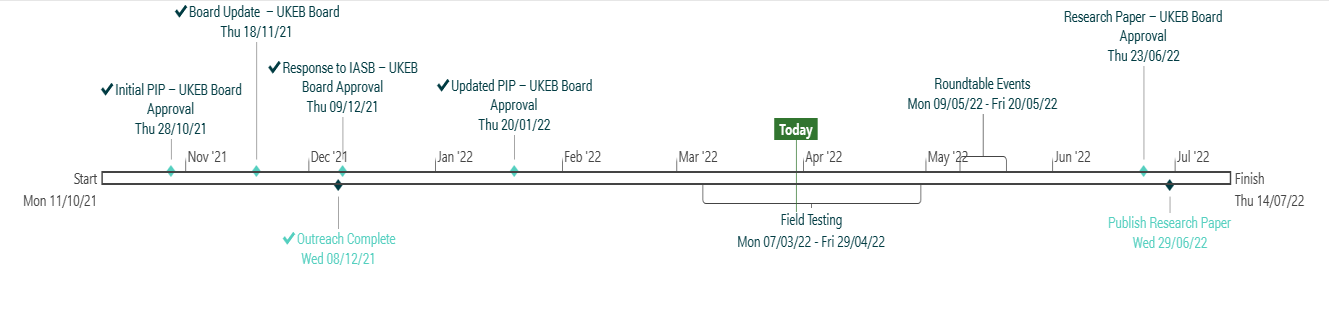
22We received requests from stakeholders participating in field-testing to allow more time for them to complete the questionnaire, given demands of year-end reporting. We are therefore proposing to update the research timeline from that approved by the Board in the PIP in January 2022. We are now proposing bringing the draft research paper to the Board for approval in June 2022 rather than in May 2022.
Questions for the Board
23Does the Board have any comments on:
- The initial findings from field-testing and desk-based research; and
- The proposed next steps
Footnotes
Footnotes
-
Approximately 230 of FTSE 350 entities report goodwill. Data for 2021 year-ends has not yet been uploaded into our external provider's database for approximately 50 of these entities. For the approximately 180 entities for which we currently have data available, on average goodwill has increased by 3.5% from £310bn to £321bn between 2020 and 2021. We expect to bring an analysis of a full data set to a future UKEB meeting. ↩
-
The Capital Markets Advisory Committee (CMAC) provides IASB with independent input from the international community of users of financial statements. ↩
-
In December 2020, the FASB tentatively decided to reintroduce amortisation. ↩
-
IAS 1 paragraph 104 requires disclosure of amortisation expense. ↩
-
The General Presentation and Disclosures project proposes an analysis of operating expenses by nature and an operating profit subtotal in the statement of profit or loss. ↩
-
IAS 36, paragraph 134 ↩