6.0 Subsidiaries without Public Accountability Disclosures— Final Comment Letter
Executive Summary
| Category | Details |
|---|---|
| Project Type | Influencing |
| Project Scope | Significant |
| Purpose of the paper | This paper requests the Board's approval of the comment letter to the IASB and the related feedback statement. |
| Summary of the Issue | IASB's Exposure Draft (ED) Subsidiaries without Public Accountability: Disclosures seeks to develop an accounting standard that permits eligible subsidiaries to apply the recognition, measurement and presentation requirements in full IFRS accompanied by a reduced disclosure regime. At its December 2021 meeting, the Board approved for publication for stakeholder consultation draft comment letter (DCL) that:
|
| Decisions for the Board | The Board is asked for its approval:
|
| Recommendation | We recommend the Board approve the final comment letter and feedback statement for publication, and approve the Due Process Compliance Statement. |
| Appendices | Appendix 1 Draft Final Comment Letter Appendix 2 Draft Feedback Statement Appendix 3 Due Process Compliance Statement |
Background
1The IASB Exposure Draft (ED) Subsidiaries without Public Accountability: Disclosures1 seeks to develop an accounting standard that would permit subsidiaries that do not have public accountability to apply reduced disclosure requirements so long as they apply the recognition, measurement and presentation requirements in full IFRS.
2This IASB project forms part of IASB's Disclosure Initiative, a portfolio of projects exploring how to improve the effectiveness of disclosures in financial reporting. The IASB's ED was published on 26 July 2021 and the comment deadline, was 31 January 2022.
3The IASB added the reduced-disclosure IFRS Standard project to its agenda in response to feedback from stakeholders (mainly preparers) on the Request for Views—2015 Agenda Consultation. It specifically responds to the feedback that groups would prefer their subsidiaries, that do not have public accountability, to prepare their individual financial statements in accordance with IFRS Standards, but with reduced disclosure requirements.
4In the UK, Financial Reporting Standard 101 Reduced Disclosure Framework (FRS 101) permits eligible entities to apply the recognition, measurement and presentation requirements of UK-adopted international accounting standards but with reduced disclosure. The scope of FRS 101 and the ED differ in several ways, including:
- FRS 101 is not restricted to entities without public accountability and is available to ultimate parent companies for their individual financial statements whereas the ED is proposing that only a subsidiary without public accountability can apply the draft standard;
- FRS 101 cannot be applied for consolidated financial statements whereas the ED applies to the consolidated or individual financial statements of subsidiaries and intermediate parents; and
- FRS 101 does not require the financial statements into which the entity is consolidated to be prepared under IFRS—only that they are intended to give a true and fair view. By contrast, the ED is proposing to restrict the scope to subsidiaries whose ultimate or intermediate parent produces consolidated financial statements available for public use that comply with IFRS Standards.
UKEB draft comment letter—key themes
5The UKEB's draft comment letter (DCL) was open for public consultation from 17 December 2021–31 January 2022. The DCL supported the IASB's efforts to develop an IFRS Standard that would permit eligible subsidiaries to apply recognition and measurement requirements in full IFRS, but with a reduced set of disclosure requirements. The DCL:
- broadly agreed with the proposals but recommended that the IASB extends the scope so that an ultimate parent of a group, that does not itself have public accountability, may also take advantage of the reduced-disclosure framework when preparing its individual financial statements.
- suggested that the IASB reviews its ‘bottom-up approach' and consider aligning it more closely with the ‘top-down approach' that the UK experience has demonstrated as being cost effective for preparers and leading to decision-useful information for users. As a minimum, there is merit in developing a clear link between full IFRS and the draft standard, so that subsidiary preparers can easily navigate from the "full IFRS" package they will use in providing the information for the group accounts to the "reduced disclosure" package for their own statutory accounts.
- identified further reductions to the proposed disclosure requirements. Two main areas include the disclosure requirements of IFRS 7 Financial Instruments: Disclosures and IFRS 13 Fair Value Measurement.
- noted that UK groups with only UK registered subsidiaries are likely to prefer to continue to use FRS 101 Reduced Disclosure Framework, and the ED will be attractive to UK groups with overseas subsidiaries, where the group prepares consolidated accounts in accordance with IFRS.
Subsequent UK stakeholder feedback
6Subsequent to the December 2021 Board meeting and publication of the DCL, additional stakeholder outreach included a user survey and interviews with 8 preparers and 4 users. We received one comment letter from an accounting firm. Including the other outreach activities, in total 27 stakeholders, representing 22 organisations, provided feedback via the different formats made available. A breakdown is provided in the table below:
Before publication of DCL
| Type of outreach | Category of stakeholder | Number of organisations represented |
|---|---|---|
| Informal initial feedback | 1 preparer, including 1 technical group | 1, including 1 technical group |
| One to one meeting | 3 regulators | 2 |
| 1 preparer | 1 | |
| Roundtables | 5 auditors | 5 |
| 2 preparers, including 1 professional body | 2, including 1 professional body |
After publication of DCL
| Type of outreach | Category of stakeholder | Number of organisations represented |
|---|---|---|
| One to one meeting | 8 preparers | 6 |
| 4 users | 2 | |
| Comment letter | 1 | 1 |
| Preparer survey | 1 | 1 |
| User survey | 1 | 1 |
Note: the Financial Reporting Council's comment letter on the ED submitted to the IASB can be accessed on the IASB's website here.
Eligibility criteria and scope
7UK stakeholders expressed concerns regarding the eligibility criteria of the ED. Paragraph 6 of the ED requires that an entity is permitted to apply the draft standard in its consolidated, separate or individual financial statements if and only if, at the end of its reporting period, it:
- is a subsidiary;
- does not have public accountability; and
- has an ultimate or intermediate parent that produces consolidated financial statements available for public use that comply with IFRS.
8There are two criteria for entities with public accountability stated in the ED:
- its debt or equity instruments are traded in a public market; or
- it holds assets in a fiduciary capacity for a broad group of outsiders as one of its primary businesses (i.e., banks, credit unions, insurance companies, securities brokers/dealers, mutual funds and investment banks would meet this criterion).
9One preparer from the insurance industry suggested the second criterion for entities with public accountability stated in the preceding paragraph i.e., ‘holds assets in a fiduciary capacity for a broad group of outsiders’ be removed in the definition of public accountability to bring insurance subsidiaries other than ‘captive insurers’ within the scope of the draft standard.
10We note that in July 2019 FRS 101 was amended2 to change the definition of a ‘qualifying entity’, effective from 1 January 2023, such that entities that are both required to comply with Schedule 3 to the Regulations3 and have contracts that are within the scope of IFRS 17 Insurance Contracts may not be qualifying entities. This means that these entities, namely insurers, cannot apply FRS 101.
11We agree with IASB's definition of public accountability as a primary business of banks, insurance companies, securities brokers/dealers, pension funds, mutual funds and investment banks is to hold and manage financial resources entrusted to them by a broad group of clients, customers or members who are not involved in the management of the entities. Because such entities act in a public fiduciary capacity, it has long been agreed in the UK that they are publicly accountable. Therefore, full IFRS disclosures by such entities leads to better financial reporting to the market as a whole, supporting transparency and provision of useful information for users' decision making.
12Other stakeholders were concerned that the criterion of ‘holds assets in a fiduciary capacity for a broad group of outsiders’ requires judgement. For example, it is not clear whether the criterion is met where subsidiaries carry out activities on behalf of clients but do not hold their assets. We note that the IASB has provided some guidance in the Supporting Material for the IFRS for SMEs Standard Module 1—Small and Medium-sized Entities on the interpretation of the criterion ‘fiduciary capacity’ in the definition. A new paragraph has been added at A9 to recommend the IASB to incorporate this guidance in the draft standard.
Question for the Board
Do Board members support retaining the second criteria in the definition of public accountability i.e. ‘holds assets it holds assets in a fiduciary capacity for a broad group of outsiders as one of its primary businesses’?
13In addition, one stakeholder disagreed with the ED restricting the scope to subsidiaries whose ultimate or intermediate parent produces consolidated financial statements available for public use that comply with IFRS Standards. That stakeholder noted that one of the objectives of the ED is to avoid non-publicly accountable subsidiaries from preparing costly disclosures designed for publicly accountable companies. However, the scope as currently drafted would mean that subsidiaries with, for example, an ultimate parent producing US GAAP consolidated financial statements would not be permitted to use the draft standard and will be required to provide full IFRS disclosures which are intended for publicly accountable companies. In the view of that stakeholder, the users of these financial statements and their information needs are not different to those of a subsidiary that has an ultimate or intermediate parent that produces consolidated financial statements available for public use that comply with IFRS Standards. The stakeholder suggested the scope of the draft standard be amended by either:
- following the approach of FRS 101 which requires that the parent of that group prepares publicly available consolidated financial statements which are intended to give a true and fair view (of the assets, liabilities, financial position and profit or loss); or
- requiring that the parent produces financial statements available for public use that comply with IFRS or equivalent frameworks (with appropriate guidance on equivalence).
14We have considered this issue further and some scenarios considering the application of this issue are included in the Appendix to this paper.
15As highlighted in the comment letter, our expectation is that the draft standard will be attractive to UK groups with overseas subsidiaries, where the group prepares consolidated accounts in accordance with IFRS as well as equivalent frameworks. Restricting the draft standard to those subsidiaries whose ultimate or intermediate parent produces consolidated financial statements available for public use that comply with IFRS will limit the uptake of the draft standard. A new paragraph has been added at A8 to bring this issue to IASB's attention. However, that paragraph specifies that the solution is likely to be a local jurisdiction-based one.
16However, we believe that the two proposals suggested by the stakeholder are outside the remit of the IASB. The UKEB Secretariat considers that the interaction between this ED and company law on the application of accounting standards will need further consideration by the UKEB. In particular:
- the interactions between Companies Act 2006 provisions which permits or requires companies to prepare their annual accounts and consolidated financial statements using UK-adopted international accounting standards, and this ED.
- Interactions between UK legislative or regulatory provisions for equivalent accounting regimes and interaction with the proposed standard requirements.
- the interaction with this ED where company law permits an intermediate parent not to prepare consolidated financial statements.
- further analysis of the difference between the UK definition of public interest entities and the notion of public accountability in the ED.
17After submitting our comment letter to the IASB, we plan to undertake further work on this issue to assess the interaction of company law with the eligibility criteria in the ED. We think this will be important input into any future consideration of adoption and use of the draft standard in the UK.
Question for the Board
Do Board members agree that the Secretariat should undertake further work on the interaction of this ED with UK company law?
Approach to developing the proposed disclosure requirements
18UK stakeholders did not support IASB's 'bottom-up approach' in the ED to developing the proposed disclosure requirements, which is consistent with our position in the DCL and initial feedback received. They were concerned that the use of different wording between full IFRS and the draft standard might lead to unclear disclosure requirements and needing a new set of interpretation. Paragraph A10 has been expanded to include this additional concern with IASB's 'bottom-up approach'.
Exemption from producing a statement of cash flows
19One to one meeting with a user (bank lending department) including the response to our user survey (a parent entity i.e. an internal user) indicated agreement with the principles the IASB used to assess users' information needs. In addition, a bank lending department said breakdown of debt is particularly useful to them. This feedback is consistent with that previously received and included in the draft comment letter.
20The DCL and Invitation to Comment included a question regarding exemption from producing asking stakeholders under which circumstances they would support not requiring a statement of cash flows. Preparers strongly supported either a complete exemption from producing a statement of cash flows or an exemption based on materiality for costs saving.
21However, the bank lending department we consulted was strongly against an exemption as the statement of cash flows of subsidiaries provided them with decision useful information i.e. in assessing repayment capacity and any move away from this would reduce the usefulness of the accounts. By contrast, the respondent to our user survey (a parent entity i.e. an internal user) supported an exemption for producing the statement of cash flows for small and medium sized entities or if cash flows is not material to users.
22We believe that an exemption from producing a statement of cash flows would result in loss of useful information particularly for external users including non-controlling interests. In addition, it could be seen as being inconsistent with the fair presentation requirements in paragraph 15 of IAS 1 which requires that financial statements shall present fairly the financial position, financial performance and cash flows of an entity. Paragraph A20 and A21 have been added to highlight these concerns.
The proposed reduced disclosure requirements
23We received mixed views on related party disclosures. Preparers supported an exemption from disclosing related party transaction in accordance with IAS 24 Related Party Disclosures for wholly owned subsidiaries, similar to the exemption in FRS 101. However, the bank lending department we consulted reported that they find related party disclosures useful in understanding transactions within the group particularly if there is intra-group lending. By contrast, the internal user i.e. parent entity supported an exemption for related party disclosures for transactions entered into between two or more members of a group—provided that any subsidiary which is a party to the transaction is either wholly owned by such a member or with a majority shareholding by the ultimate parent. We believe that an exemption from disclosing related party transaction may reduce decision useful information particularly for external users including non-controlling interests and paragraph A28 has been added to highlight this concern.
24Stakeholders supported our recommendation in the DCL for further reductions to the proposed disclosure requirements in relation to IFRS 2 Share-based Payment, IFRS 7, and IFRS 13. One stakeholder suggested addition of a note in the financial statements of the subsidiary to cross refer to the parent or group entity which include the subsidiary's risk management and fair value disclosures. We believe that users of subsidiary financial statements would find this note useful, and a new paragraph has been added at A27 to reflect this recommendation.
25One preparer suggested reduced disclosures for IFRS 15 Revenue from Contracts with Customers. IFRS 15 addressed concerns with the disclosure requirements in the previous revenue Standard i.e. IAS 18 Revenue and IAS 11 Construction Contracts which often resulted in information that was inadequate for investors to understand a company's revenue, and the judgements and estimates made by the company in recognising that revenue. Consequently, we believe further reduced disclosure requirements for IFRS 15 will result in loss of useful information to users of subsidiary financial statements. We therefore support the disclosure requirements for IFRS 15 in the ED aimed at helping investors and other users better understand the nature, amount, timing and uncertainty of revenue and cash flows from contracts with customers. We have therefore not recommended further reduced disclosures for IFRS 15.
Feedback from surveys
26One preparer of subsidiary financial statements, representing the insurance sector responded to our preparer survey after the publication of the DCL. The respondent overall did not support the proposals in the ED, and would not consider changing from FRS 101 to the draft standard. However, the feedback on the proposed disclosure requirements and the disclosure requirements about transition to other IFRS were consistent with previous stakeholders' comment and our position in the DCL. In addition, that respondent:
- suggested the IASB should incorporate consideration of costs and benefits when developing future disclosures for this proposed IFRS that are aligned with the objective of the ED i.e. to reduce costs for preparers. Paragraph A13 has been expanded to include this additional feedback from the preparer survey; and
- expressed concern that requiring full IFRS 17 Insurance Contracts disclosures would be onerous for a subsidiary without public accountability. By contrast, the respondent to our user survey ie a parent entity mentioned that users' information needs would be better served by full IFRS 17 disclosures. The DCL explained the Board's rationale for supporting reduced disclosures for IFRS 17 and remains unchanged.
Other Issues and approval of Comment letter
27A small number of issues raised by stakeholders were considered to be less important and not needing the IASB's attention as (i) they were related to presentation issues rather than disclosure requirements; and (ii) they might distract from the critical issues raised above. During the agenda consultation the IASB made clear that its limited resource is focused on the most critical issues. Accordingly, certain additional items were not included in the comment letter, and we do not believe this is necessary. These issues include:
- non-coterminous year end and different functional currencies between the financial statements of the parent and its subsidiaries.
bremoving the requirement of IAS 1 to present a third balance sheet when there is a change in accounting policy, retrospective restatement or reclassification that has a has a material effect.
Questions for the Board
- Given stakeholder direction not to distract from the critical issues, do Board members agree that it is not necessary to include in our comment letter the issues at paragraph 30 that are not related to disclosures identified by stakeholders?
- Do Board members have any suggested amendments to the comment letter included in Appendix 1, or to the feedback statement at Appendix 2?
- Subject to any suggested amendments, does the Board approve:
- the comment letter for issuance to the IASB?
- the feedback statement for publication on the UKEB website?
- approve the compliance statement for publication on the UKEB's website?
Next Steps
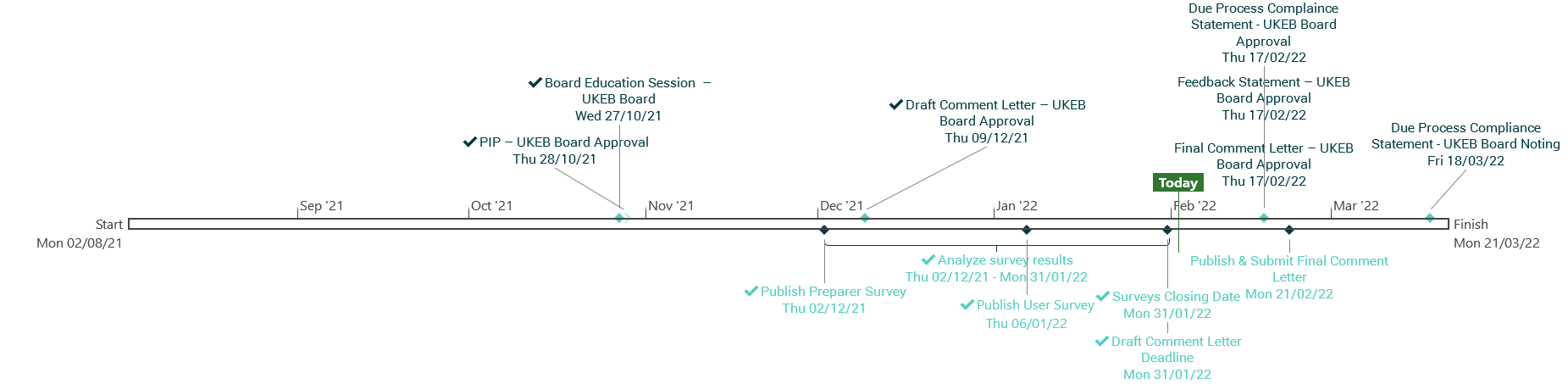
28The next project milestones are set out in the table below and diagram in the next page:
| Date | Milestone | Com plete |
|---|---|---|
| 26 July 2021 | IASB Publishes ED | ✓ |
| 28 October 2021 | Board Meeting Approve PIP | ✓ |
| 02 November 2021 | Publish preparer survey | ✓ |
| 09 December 2021 | Board Meeting Approve Draft Comment Letter | ✓ |
| 17 December 2021 | Publish Draft Comment Letter. | ✓ |
| 06 January 2022 | Publish user survey | |
| 17 February 2022 | Board Meeting Approve Final Comment Letter, Feedback Statement, and Compliance Statement | |
| 21 February 2022 | Submit Comment Letter to IASB | |
| Publish Feedback Statement on website | ||
| 18 March 2022 | Board Meeting Final Compliance Statement to Board for noting |
Timeline diagram showing project milestones and activities from September 2021 to March 2022, including board approvals, survey analysis, and comment letter submissions.
Appendix 1: Analysis of scope issue
A1The eligibility criteria of the ED are outlined below4:
A subsidiary ... 'Subsidiary' is defined in IFRS 10 Consolidated Financial Statements.
... that at the end of the reporting period does not have public accountability ... A company has public accountability if its debt or equity instruments are traded in a public market or if it holds assets in a fiduciary capacity for a broad group of outsiders.
... and has a parent that produces financial statements that comply with IFRS Standards. A subsidiary is eligible if it has an ultimate or intermediate parent that produces consolidated financial statements applying IFRS Standards.
Applying the eligibility criteria of the ED
A2Scenario 1 below illustrates an example where a subsidiary would satisfy the eligibility criteria of the ED:
Scenario 1: Illustrating a subsidiary satisfying the eligibility criteria.
Diagram shows: * Parent (box) with text: "Parent prepares consolidated financial statements applying IFRS." * Arrow from Parent to Subsidiary, labeled "100%". * Subsidiary (box) with text: "The subsidiary does not have public accountability."
A3Scenario 2 illustrates a group structure where the intermediate parent prepares consolidated financial statements applying IFRS but the ultimate parent prepares consolidated financial statements using an equivalent framework:
Scenario 2: Illustrating a group structure where the intermediate parent prepares consolidated financial statements applying IFRS but the ultimate parent prepares consolidated financial statements using an equivalent framework.
Diagram shows: * Ultimate Parent (box) with text: "Parent prepares consolidated financial statements applying an equivalent framework i.e. US GAAP" * Arrow from Ultimate Parent to Intermediate Parent, labeled "100%". * Intermediate parent (box) with text: "Intermediate parent prepares consolidated financial statements applying IFRS Standards" * Arrow from Intermediate parent to Subsidiary, labeled "100%". * Subsidiary (box) with text: "The subsidiary does not have public accountability."
A4Scenario 3 below illustrates an example where strictly applying the eligibility criteria of the ED, the subsidiary would not be eligible to use the draft Standard:
Scenario 3: Illustrating an example where strictly applying the eligibility criteria of the ED, the subsidiary would not be eligible to use the draft Standard.
Diagram shows: * Parent (box) with text: "Parent prepares consolidated financial statements applying an equivalent framework i.e. US GAAP" * Arrow from Parent to Subsidiary, labeled "100%". * Subsidiary (box) with text: "The subsidiary does not have public accountability."
Appendix 1: Questions on ED/2021/7 Subsidiaries without Public Accountability: Disclosures
Dr. Andreas Barckow Chairman International Accounting Standards Board 7 Westferry Circus Canary Wharf London E14 4HD
21 February 2022
Dear Dr Barckow
IASB Exposure Draft ED/2021/7 Subsidiaries without Public Accountability: Disclosures
The UK Endorsement Board (UKEB) is responsible for endorsement and adoption of IFRS for use in the UK and therefore is the UK's National Standard Setter for IFRS. The UKEB also leads the UK's engagement with the IFRS Foundation (Foundation) on the development of new standards, amendments and interpretations. This letter is intended to contribute to the Foundation's due process. The views expressed by the UKEB in this letter are separate from, and will not necessarily affect the conclusions in, any endorsement and adoption assessment on new or amended International Accounting Standards undertaken by the UKEB.
There are currently approximately 1,500 entities with equity listed on London Stock Exchange that prepare their financial statements in accordance with IFRS5. In addition, UK law allows unlisted companies the option to use IFRS and approximately 14,000 such companies currently take up this option6.
We welcome the opportunity to provide comment on the IASB's Exposure Draft Subsidiaries without Public Accountability: Disclosures (the ED). To develop our response our work has included in-house research, a preparer survey, a user survey, and feedback received during stakeholder roundtables and interviews. Based upon this work:
1We support the IASB's efforts to develop an IFRS that would permit eligible subsidiaries to apply recognition and measurement requirements in full IFRS, but with a reduced set of disclosure requirements. It should be noted that subsidiaries without public accountability usually have few users of their financial statements, primarily parent entities, non-controlling shareholders, tax authorities and providers of credit such as bank credit departments. A significant number of these users can request additional information from management and therefore financial statements are not their single source of information. We anticipate that the draft proposals will result in cost savings and reductions in complexity for subsidiaries without public accountability that report to a parent applying IFRS in its consolidated financial statements. Other potential benefits include disclosures that are proportionate to the needs of users of these financial statements and reduced audit work.
2Reflecting on the UK experience we acknowledge the cost of producing full IFRS disclosures in individual entities' financial statements would be disproportionate given the expectation that there will be very few, if any, users external to the group. In the UK Financial Reporting Standard 101 Reduced Disclosure Framework (FRS 101), provides a reduced disclosure framework for qualifying entities. In particular, it allows eligible entities to apply the recognition, measurement and presentation requirements of UK-adopted international accounting standards but with reduced disclosure to reduce the cost of preparing financial statements. FRS 101 can be applied in the individual financial statements of subsidiaries and ultimate parents. Our desk-based research and outreach with stakeholders identified widespread use of FRS 101 in the UK and the resulting positive impact on the cost-effectiveness in preparing financial statements for entities within its scope. We believe that UK groups with only UK registered subsidiaries are likely to prefer to continue to use FRS 101. Stakeholders have told us that the FRS 101 disclosure exemptions are more effective at achieving the objective of reducing the cost of preparing financial statements for such entities when compared with the ED's proposals. However, our expectation is that the draft standard will be attractive to UK groups with overseas subsidiaries, where the group prepares consolidated accounts in accordance with IFRS or equivalent frameworks. Permitting UK and overseas subsidiaries to use the draft standard will achieve uniformity in providing financial information for incorporation in the group financial statements.
3We broadly agree with the proposed scope set out in the ED, that the draft standard would be available only to subsidiaries without public accountability. However, we recommend that the IASB extends the scope so that an ultimate parent of a group, that does not itself have public accountability, may also take advantage of the reduced-disclosure framework when preparing its individual financial statements.
3.4UK stakeholders are concerned by the proposals in the ED paragraph 6 (c), restricting the use of the draft standard to a subsidiary whose ultimate or intermediate parent produces consolidated accounts in accordance with IFRS. We believe this will limit the uptake of the draft standard because non-publicly accountable subsidiaries of those groups in the UK where the group accounts available for public use are prepared on an equivalent framework to IFRS, such as US GAAP, will not be eligible to use the draft standard. The users of these subsidiaries' financial statements and their information needs are no different to subsidiaries whose parents produce group accounts complying with IFRS. Whilst we acknowledge the IASB's rationale for not addressing this issue, we would like to highlight the fact that this issue may warrant local jurisdiction-based solutions that extend the IASB's intended use of the standard.
4We suggest that the IASB reviews its ‘bottom-up approach’ to reduced disclosure and consider aligning it more closely with the ‘top-down approach’ that the UK experience has demonstrated as being cost effective for preparers and which provides decision-useful information for users. As a minimum, there is merit in developing a clear link between full IFRS and the draft standard, so that subsidiary preparers can easily navigate from the "full IFRS" package they will use in providing the information for the group accounts to the "reduced disclosure" package for their own statutory accounts.
5Our stakeholder outreach has identified possible further reductions to some of the disclosures proposed by the ED. Two main areas suggested by UK stakeholders include the disclosure requirements of IFRS 7 Financial Instruments: Disclosures and IFRS 13 Fair Value Measurement. In addition, one stakeholder suggested that subsidiaries should be required to disclose in the notes the name of the entity in the group which undertakes and reports on the risk management for the subsidiary. We support this approach and believe this cross reference will be helpful to the users of the accounts. More information is included in Appendix 1 to this letter.
6It is not entirely clear from the ED how the specific information needs of users of subsidiaries' financial statements were considered when balancing relief for preparers. We believe it is an important consideration to maintain the usefulness of the financial statements to the users of those subsidiaries' financial statements. We recommend the IASB should consider including a clearer articulation of the users' information needs and how these reduced disclosures address them. This should include specific consideration of the information needs of non-controlling shareholders in a subsidiary without public accountability, as these have not been addressed in the ED.
7We are aware of a few entities in the UK, mainly ‘captive insurers’, that issue insurance contracts within the scope of IFRS 17 Insurance Contracts and may be within the scope of this ED. We therefore do not support the ED proposals that subsidiaries that are not publicly accountable should provide the full IFRS 17 disclosure requirements. The concerns about the balance between undue costs for preparers and users’ information needs are equally applicable for these companies. We are concerned that taking this approach to a recently issued standard, i.e. observing its application before arriving at a reduced disclosure framework, could create a precedent for any new IFRS issued in the future. Our preferred approach would be for the IASB to propose reduced disclosures for subsidiaries without public accountability as part of the exposure drafts for any new or amended IFRS.
If you have any questions about this response, please contact the project team at [email protected] Yours sincerely
Pauline Wallace Chair UK Endorsement Board
Objective
Question 1: Objective
Paragraph 1 of the draft Standard proposes that the objective of the draft Standard Subsidiaries without Public Accountability: Disclosures is to permit eligible subsidiaries to apply the disclosure requirements in the draft Standard and the recognition, measurement and presentation requirements in IFRS Standards.
Do you agree with the objective of the draft Standard? Why or why not? If not, what objective would you suggest and why?
A1We support IASB's effort to develop an IFRS with a reduced disclosure framework, permitting subsidiaries without public accountability to prepare their financial statements by applying the recognition and measurement requirements of IFRS with reduced disclosures.
A2It should be noted that there are few external users of financial statements of subsidiaries without public accountability, primarily parent entities, non-controlling shareholders, tax authorities and providers of credit such as bank credit departments. A significant number of these users can request additional information directly from management and therefore are unlikely to rely solely on financial statements for their information needs.
A3The objective of the ED is similar to that of the UK's FRS 101 Reduced Disclosure Framework7, which sets out an optional reduced disclosure framework for the individual financial statements of subsidiaries and ultimate parent entities, that otherwise apply the recognition, measurement and disclosure requirements of UK-adopted IFRS.
A4Feedback from stakeholders identified widespread use of FRS 101 in the UK and a resulting positive impact on cost-effectiveness in preparing financial statements for entities within its scope. The cost of producing full IFRS disclosures in individual entities’ financial statements would be disproportionate given the expectation that there will be very few, if any, users external to the group. We would expect similar benefits in general for entities that opt to use the draft IASB standard given that both standards apply to subsidiaries. However, the use of FRS 101:
- is not restricted to entities without public accountability;
- is available to parent companies when preparing their individual financial statements;
- may not be used for consolidated financial statements; and
- does not require that the financial statements of the parent entity, into which the entity is consolidated, are prepared in accordance IFRS.
A4A5Outreach with preparers indicated that the ED is expected to be attractive to UK groups with overseas subsidiaries, where the group prepares consolidated accounts in accordance with IFRS or equivalent frameworks. Permitting UK and overseas subsidiaries to use the draft standard will achieve uniformity in providing financial information for incorporation in the group financial statements. Such groups can see a number of benefits from aligning the financial reporting framework of their subsidiaries worldwide, including consistency of reporting to the parent for the purposes of preparing the consolidated financial statements and resulting cost savings for both parents and subsidiaries.
Question 2: Scope
Paragraphs 6–8 of the draft Standard set out the proposed scope. Paragraphs BC12–BC22 of the Basis for Conclusions explain the Board's reasons for that proposal.
Do you agree with the proposed scope? Why or why not? If not, what approach would you suggest and why?
A5A6We broadly agree with the proposed scope which is in line with the objective of the project — to provide disclosure relief for subsidiaries whose parent prepares consolidated financial statements applying IFRS.
A7However, we propose that the IASB extends the scope so that ultimate parent of a group, that does not itself have public accountability, may also take advantage of the reduced-disclosure framework when preparing its individual financial statements.
A8UK stakeholders are concerned by the proposals in the ED paragraph 6 (c), restricting the use of the draft standard to a subsidiary whose ultimate or intermediate parent produces consolidated accounts in accordance with IFRS. We believe this will limit the uptake of the draft standard because non-publicly accountable subsidiaries of those groups in the UK where the group accounts available for public use are prepared on an equivalent framework to IFRS, such as US GAAP, will not be eligible to use the draft standard. The users of these subsidiaries’ financial statements and their information needs are no different to subsidiaries whose parents produce group accounts complying with IFRS. Whilst we acknowledge the IASB’s rationale for not addressing this issue, we would like to highlight the fact that this issue may warrant local jurisdiction-based solutions that extend the IASB’s intended use of the standard.
A6A9Whilst we support the definition of public accountability in the ED, stakeholders are concerned that the application of the second criterion in the definition i.e. ‘holds assets in a fiduciary capacity for a broad group of outsiders’ requires judgement, in particular where activities are carried out by subsidiaries on behalf of clients but do not hold their assets. We note that the IASB has provided some guidance in the Supporting Material for the IFRS for SMEs Standard Module 1—Small and Medium-sized Entities8 on the interpretation of the criterion ‘fiduciary capacity’ in the definition. This concept is not currently defined in IFRS and therefore unfamiliar to stakeholders. We therefore recommend this guidance is included in the draft standard to achieve consistency on what is intended by the second criterion ‘fiduciary capacity’ to help reduce the risk of misinterpretation.
Developing the proposed disclosure requirements
Question 3: Approach to developing the proposed disclosure requirements
In developing the proposed disclosure requirements, the Board used the disclosure requirements from the IFRS for SMEs Standard, with minor tailoring, when the recognition and measurement requirements in IFRS Standards and the IFRS for SMEs Standard were the same. When the recognition and measurement requirements differed between IFRS Standards and the IFRS for SMEs Standard, the Board:
- added disclosure requirements for topics or accounting policy options that are addressed in IFRS Standards but omitted from the IFRS for SMEs Standard. To do so, the Board applied (to the disclosure requirements in IFRS Standards for that topic or policy option) the principles it used when developing the disclosure requirements in the IFRS for SMEs Standard.
- deleted disclosure requirements relating to accounting policies available in the IFRS for SMEs Standard but not in IFRS Standards.
The Board applied this approach so the disclosure requirements proposed in the draft Standard would be sufficient to meet the needs of users of the financial statements. After applying that approach, the Board reviewed the outcome and in a limited number of cases, proposed some exceptions.
Paragraphs BC23–BC39 of the Basis for Conclusions explain the Board's reasons for its approach to developing the proposed disclosure requirements.
Do you agree with that approach? Why or why not? If not, what approach would you suggest and why?
A7A10Outreach with stakeholders has indicated some concern with IASB's ‘bottom-up approach’ to developing the proposed disclosure requirements. They note that this approach would require significant effort from preparers to determine the required disclosures since preparers of subsidiary financial statements may not be familiar with the IFRS for SMEs Standard. In addition, a stakeholder expressed concern that the use of different wording between full IFRS and the draft standard might lead to unclear disclosure requirements and as a result a new set of interpretation may develop. Therefore, in their view this approach does not align with the objective of reducing costs for subsidiaries.
A8A11Stakeholders suggest that a ‘top-down approach’, starting with the full IFRS disclosure requirements and considering exemptions, is better and easier to apply in practice. In the UK, this was the approach adopted in developing FRS 101. On the basis of the UK experience, there are a number of additional advantages of this approach. For example, it would result in consistency of language between the draft standard and full IFRS, deemed particularly helpful by stakeholders when transitioning to the draft standard. In addition, the ‘top-down approach’ better reflects the needs of the users of these accounts, who are unlikely to be familiar with the disclosure requirements of the IFRS for SMEs Standard. A further advantage of this approach is that it would facilitate more timely development of reduced disclosures for new standards, as it would not be impacted by the delay between the publication of a new full IFRS and its considerationbypass the need for incorporation into IFRS for SMEs Standard that existsproposed under the current IASB process.
A9A12In light of the stakeholder feedback, we suggest that the IASB reviews its ‘bottom-up approach’ and consider aligning it more closely with the 'top-down approach' that the UK experience has demonstrated as being cost effective for preparers and which provides decision-useful information for users. As a minimum, there is merit in developing a clear link between full IFRS and the draft standard, so that subsidiary preparers can easily navigate from the "full IFRS" package they will use in providing the information for the group accounts to the "reduced disclosure" package for their own statutory accounts.
A10A13We support the principles the IASB used to assess the needs of users of financial statements, as we agree that these users are likely to be focused on information about short-term cash flows, obligations, commitments or contingencies, liquidity, solvency, measurement uncertainties, accounting policy choices and saggregation of amounts in the financial statements. In addition, we recommend that the IASB incorporate consideration of costs and benefits when developing future disclosure requirements for this proposed IFRS that are aligned with the objective of the ED, i.e to reduce the cost of financial reporting for subsidiaries without public accountability.
A11A14We note that the principles explained in paragraph BC34 of the Basis for Conclusions of the ED. However, it is not entirely clear from the ED how the specific information needs of different users of subsidiaries’ financial statements were considered when balancing relief for preparers. For example, the needs of users of accounts of subsidiaries that are 100% owned by the group may be significantly different to those with non-controlling interests outside the group. Similarly, needs of providers of credit may be very different to those of tax authorities. We believe it is an important consideration in developing the disclosure requirements to maintain the usefulness of the financial statements to the users. We recommend the IASB should consider including a clearer articulation of the users’ needs and how these reduced disclosures address them.
A12A15_We are also concerned that the ED does not explain the principles the IASB will consider in maintaining the draft standard in the future to ensure it continues to achieve its objectives of satisfying users’ needs and cost-benefit considerations including reductions of costs for preparers.
Question 4: Exceptions to the approach
Paragraphs BC40–BC52 of the Basis for Conclusions explain the Board's reasons for the exceptions to its approach to developing the proposed disclosure requirements. Exceptions (other than paragraph 130 of the draft Standard) relate to: * disclosure objectives (paragraph BC41); * investment entities (paragraphs BC42–BC45); * changes in liabilities from financing activities (paragraph BC46); * exploration for and evaluation of mineral resources (paragraphs BC47–BC49); * defined benefit obligations (paragraph BC50); * improvements to disclosure requirements in IFRS Standards (paragraph BC51); and * additional disclosure requirements in the IFRS for SMEs Standard (paragraph BC52).
- Do you agree with the exceptions? Why or why not? If not, which exceptions do you disagree with and why? Do you have suggestions for any other exceptions? If so, what suggestions do you have and why should those exceptions be made?
- Paragraph 130 of the draft Standard proposes that entities disclose a reconciliation between the opening and closing balances in the statement of financial position for liabilities arising from financing activities. The proposed requirement is a simplified version of the requirements in paragraphs 44A–44E of IAS 7 Statement of Cash Flows.
- Would the information an eligible subsidiary reports in its financial statements applying paragraph 130 of the draft Standard differ from information it reports to its parent (as required by paragraphs 44A–44E of IAS 7) so that its parent can prepare consolidated financial statements? If so, in what respect?
- In your experience, to satisfy paragraphs 44A–44E of IAS 7, do consolidated financial statements regularly include a reconciliation between the opening and closing balances in the statement of financial position for liabilities arising from financing activities?
Exceptions to the approach
A13A16We broadly agree with the exceptions to the approach to developing the disclosure requirements. However, in some cases we recommend the rationale for making the exceptions are explained more clearly. For instance, the rationale for the exception to the approach relating to improvements to disclosure requirements in IFRS from IFRS 7 Financial Instruments: Disclosures and IFRS 13 Fair Value Measurement is not clear.
A17We support the IASB's rationale in paragraph BC41 of the ED's Basis for Conclusion for removing disclosure objectives in the draft standard i.e it would compel entities to provide the same disclosures as if they had not applied the draft standard. In addition, we believe this will avoid the challenges with the objective approach to disclosures for subsidiaries without public accountability, as highlighted in our comment letter on IASB's ED Disclosure Requirements in IFRS Standards – A Pilot Approach (Proposed Amendments to IFRS13 and IAS 19)9.
A14A18Outreach with preparers suggested that the ED's requirement to include a reconciliation between the opening and closing balances for liabilities arising from financing activities in the statement of financial position would be consistent with information already reported by subsidiaries to parent entities, in order for the parent to comply with paragraphs 44A–44E of IAS 7 Statement of Cash Flows.
A19Preparers indicated they would find this reconciliation easier to prepare compared to preparing a full statement of cash flows for the subsidiary. They suggest that this reconciliation would be more cost effective as the information required by the reconciliation is already reported by subsidiaries to the ultimate parent for the purpose of the disclosure in the consolidated financial statements. In their view, this reconciliation may also provide more useful information to users than a full statement of cash flows.
A20However, a bank lending department we consulted with indicated that information about the cash flows of a subsidiary is useful in assessing repayment capacity, stating that ‘clearly cash is king when lending and we always want the granularity around that’.
A15A21Furthermore, disclosure of a statement of cash flows is consistent with the principles used to assess the users' needs and consistent with the fair presentation requirements in IAS 1 Presentation of Financial Statements which requires the financial statements to present fairly the financial position, financial performance and cash flows of an entity.
The proposed reduced disclosure requirements
Question 5: Disclosure requirements about transition to other IFRS Standards
Any disclosure requirements specified in an IFRS Standard or an amendment to an IFRS Standard about the entity's transition to that Standard or amended Standard would remain applicable to an entity that applies the Standard.
Paragraphs BC57–BC59 of the Basis for Conclusions explain the Board's reasons for this proposal.
Do you agree with this proposal? Why or why not? If not, what approach would you suggest and why?
A22We support IASB's proposal that any disclosure requirements specified in an IFRS about the entity's transition to that Standard would remain applicable to an entity that applies the reduced disclosure IFRS. We believe such transition disclosures would provide useful information to users of subsidiaries’ financial statements. In addition, such disclosure requirements are not recurrent and therefore no significant ongoing cost would be incurred. On balance, we think the benefits of the information to users would outweigh the one-off cost of providing the transition disclosures.
Question 6: Disclosure requirements about insurance contracts
The draft Standard does not propose to reduce the disclosure requirements of IFRS 17 Insurance Contracts. Hence an entity that applies the Standard and applies IFRS 17 is required to apply the disclosure requirements in IFRS 17. Paragraphs BC61–BC64 of the Basis for Conclusions explain the Board's reasons for not proposing any reduction to the disclosure requirements in IFRS 17.
- Do you agree that the draft Standard should not include reduced disclosure requirements for insurance contracts within the scope of IFRS 17? Why or why not? If you disagree, from which of the disclosure requirements in IFRS 17 should an entity that applies the Standard be exempt? Please explain why an entity applying the Standard should be exempt from the suggested disclosure requirements.
- Are you aware of entities that issue insurance contracts within the scope of IFRS 17 and are eligible to apply the draft Standard? If so, please say whether such entities are common in your jurisdiction, and why they are not considered to be publicly accountable.
Disclosure requirements about insurance contracts
A23There are relatively few subsidiaries in the UK that issue insurance contracts within the scope of IFRS 17 and which are not publicly accountable. Those that we have identified are mainly "captive insurers". However, we have reservations about supporting the ED proposals for subsidiaries that are not publicly accountable to provide full IFRS 17 disclosure requirements, as the undue costs for preparers and users’ information needs rationale is similarly applicable for these companies.
A16Furthermore, we are concerned that taking this approach to a recently issued standard, i.e observing its application before arriving at a reduced disclosure framework, could create a precedent for any new IFRS the IASB issues in the future.
A17A24Our preferred approach would be for the IASB to propose reduced disclosures for subsidiaries without public accountability as part of the exposure drafts for any new or amended IFRS.
Question 7: Interaction with IFRS 1 First-time Adoption of International Financial Reporting Standards
Paragraphs 23–30 of the draft Standard propose reduced disclosure requirements that apply to an entity that is preparing its first IFRS financial statements and has elected to apply the Standard when preparing those financial statements.
If a first-time adopter of IFRS Standards elected to apply the draft Standard, the entity would: * apply IFRS 1, except for the disclosure requirements in IFRS 1 listed in paragraph A1(a) of Appendix A of the draft Standard; and * apply the disclosure requirements in paragraphs 23–30 of the draft Standard.
This approach is consistent with the Board's proposals on how the draft Standard would interact with other IFRS Standards.
However, IFRS 1 differs from other IFRS Standards—IFRS 1 applies only when an entity first adopts IFRS Standards and sets out how a first-time adopter of IFRS Standards should make that transition.
- Do you agree with including reduced disclosure requirements for IFRS 1 in the draft Standard rather than leaving the disclosure requirements in IFRS 1?
Paragraphs 12–14 of the draft Standard set out the relationship between the draft Standard and IFRS 1.
- Do you agree with the proposals in paragraphs 12–14 of the draft Standard? Why or why not? If not, what suggestions do you have and why?
Interaction with IFRS I
A18A25We support the IASB's proposal for reduced disclosure requirements for IFRS 1. We believe this approach is proportionate and practical and takes into consideration users' information needs of subsidiaries which are non-publicly accountable entities.
A26We also welcome IASB's clarification of the interaction of the draft standard with IFRS 1. We find the guidance on electing or revoking an election to apply the draft standard helpful and clear.
Question 8: The proposed disclosure requirements
Paragraphs 22–213 of the draft Standard set out proposed disclosure requirements for an entity that applies the Standard. In addition to your answers to Questions 4 to 7:
- Do you agree with those proposals? Why or why not? If not, which proposals do you disagree with and why?
- Do you recommend any further reduction in the disclosure requirements for an entity that applies the Standard? If so, which of the proposed disclosure requirements should be excluded from the Standard and why?
- Do you recommend any additional disclosure requirements for an entity that applies the Standard? If so, which disclosure requirements from other IFRS Standards should be included in the Standard and why?
The proposed reduced disclosure requirements
A19A27Our stakeholder outreach and research work indicate that the proposed disclosure requirements set out in paragraphs 22 to 213 of the ED may be further reduced without unduly impacting the information needs of users. We include below disclosure requirements which we recommend are removed and our rationale:
| Disclosure requirements in the ED | IASB's rationale for adding the disclosures into the draft standard | UKEB's rationale to remove the disclosure requirements in the draft standard |
|---|---|---|
| IFRS 2 Share-based Payment | These disclosures are required by IFRS for SMEs Standard. | We believe the disclosure requirements in the draft standard for share-based payment arrangements are disproportionate and burdensome. Stakeholders shared similar concerns. We recommend the draft standard follows the approach of FRS 101. FRS 101 requires only a description of each type of share-based payment transaction. The other disclosures of IFRS 2 are exempted, provided that the entity: |
| IFRS 7 Financial Instruments: Disclosures FRS 13 Fair Value Measurement | Users of subsidiaries' financial statements could benefit from these disclosure requirements and their inclusion in the draft Standard is supported by the principles used to develop the disclosure requirements in the IFRS for SMEs Standard. These disclosures are not required by IFRS for SMEs Standard. | We note that the disclosure requirements for IFRS 7 and 13 in the draft standard are more extensive than the IFRS for SMEs Standard. These are disproportionately burdensome and add little value to users of subsidiaries' financial statements which often have few users that are external to the group. For example, a specific concern raised by stakeholders is that most groups would have a central treasury function which is used by the parent. Requiring subsidiaries to separately disclose its inter-group hedging would be onerous, costly to produce and unlikely to be useful to users of its financial statements. Furthermore, in particular UK stakeholders have expressed concern regarding the requirements of the ED, paragraph 79(b) to disclose for each class of assets and liabilities measured at fair value a description of the valuation a description of the valuation technique(s) used for recurring and non-recurring fair value measurements categorised within Level 2 and Level 3 of the fair value hierarchy, and the inputs used in the fair value measurement. They find this disclosure onerous. FRS 101 provides disclosure exemptions from IFRS 7 and 13, other than for financial institutions, provided that equivalent disclosures are included in the consolidated financial statements of the group in which the entity is consolidated. We recommend that IASB takes a similar approach, except in relation to the disclosures in IFRS 7 relating to liquidity risk. We note that the draft standard excluded the disclosures on liquidity risk in IFRS 7. This is inconsistent with the principles the IASB used to assess the needs of users of financial statements which include liquidity as one of the pieces of information that these users are likely to be focused on. We therefore recommend that the disclosures on liquidity risk should be required by the draft standard. We consider that this approach is consistent with the focus in the draft standard on users' information needs. In addition, one stakeholder suggested that subsidiaries should be required to disclose in the notes the name of the entity in the group which undertakes and reports on the risk management for the subsidiary. We support this approach and believe this cross reference will be helpful to the users of the accounts. |
A20A28Outreach with preparers strongly supported an equivalent exemption to that in FRS 101, exempting qualifying entities from the requirements in IAS 24 Related Party Disclosures to disclose related party transactions entered into between two or more members of a group, provided that any subsidiary which is a party to the transaction is wholly owned by such a member. However, users have indicated that such disclosures are useful in understanding transactions of subsidiaries within the group. For example, in relation to subsidiaries' financial statements a bank lending department told us that,: ‘related party disclosures cover a broad range of potential exposure and are extremely helpful to understand the connections within a group particularly if there is intra-group lending. We therefore support the disclosure requirements in the ED as an exemption from disclosing related party transactions would result in loss of useful information to users of subsidiary financial statements.
Question 9: Structure of the draft Standard
Paragraphs 22–213 of the draft Standard set out proposed disclosure requirements for an entity that applies the Standard. These disclosure requirements are organised by IFRS Standard and would apply instead of the disclosure requirements in other IFRS Standards that are listed in Appendix A. Disclosure requirements that are not listed in Appendix A that remain applicable are generally indicated in the draft Standard by footnote to the relevant IFRS Standard heading. Paragraphs BC68–BC70 explain the structure of the draft Standard.
Do you agree with the structure of the draft Standard, including Appendix A which lists disclosure requirements in other IFRS Standards replaced by the disclosure requirements in the draft Standard? Why or why not? If not, what alternative would you suggest and why?
Structure of the draft standard
A21A29We find the structure of the draft standard, where the disclosure requirements are organised by IFRS to be sufficiently clear. We also welcome Appendix A of the ED which lists the disclosure requirements in full IFRS that do not apply to entities that apply the draft Standard.
A22A30However, we find the way in which the draft standard sets out the disclosure requirements unhelpful. The ED includes those disclosure requirements that remain applicable via a footnote to eight headings relating to individual IFRS. For instance, for IFRS 16 Leases, a footnote is appended to state that in addition to the disclosure required by the draft standard, paragraph 47 of IFRS 16 which uses the word 'disclose' remains applicable. These footnotes can be confusing when determining the disclosure requirements of the draft standard. To improve the accessibility of the draft standard we recommend these footnotes are replaced with a comprehensive list of disclosure requirements within the main body of the draft standard. This approach would be more helpful and make the draft standard a stand-alone document. This would make it easier to understand as it would avoid the need for users to refer to other IFRS.
Other comments
Question 10: Other comments
Do you have any other comments on the proposals in the draft Standard or other matters in the Exposure Draft, including the analysis of the effects (paragraphs BC92–BC101 of the Basis for Conclusions)?
A23A31IAS 1 Presentation of Financial Statements, paragraph 17(c) requires an entity to provide additional disclosures when compliance with the specific requirements in IFRS is insufficient to enable users to understand the impact of particular transactions, other events and conditions on the entity's financial position and performance. The ED states in footnote 8 that the requirements of IAS 1 paragraph 17(c) remain applicable. Those requirements refer to the additional disclosures to be provided when compliance with the required disclosures does not lead to fair presentation of the underlying transactions. Stakeholders found it difficult to understand how they would apply those requirements in the context of a reduced disclosure regime. We recommend additional guidance on how to apply this requirement in the context of the ED, for example, in the light of the principles used to assess the needs of users of financial statements which are likely to be focused on information about short-term cash flows, obligations, commitments or contingencies, liquidity, solvency, measurement uncertainties, accounting policy choices and disaggregation of amounts in the financial statements in order to achieve fair presentation as required by IAS 1 paragraph 15.
A24A32We strongly support identification of consequential amendments to the draft standard when the IASB publishes an exposure draft of a new or amended IFRS. We believe this is a more efficient approach that would ensure the reduced disclosure requirements for eligible subsidiaries keep pace with standard development for the parent entity's consolidated financial statements.
IASB Exposure Draft ED/2021/7 Subsidiaries without Public Accountability: Disclosures
[DRAFT FOR BOARD REVIEW]
February 2022
The UK Endorsement Board (UKEB) is responsible for endorsement and adoption of IFRS for use in the UK and therefore is the UK's National Standard Setter for IFRS. The UKEB also leads the UK's engagement with the IFRS Foundation (Foundation) on the development of new standards, amendments and interpretations.
The comment letter to which this feedback statement relates forms part of those influencing activities and is intended to contribute to the Foundation's due process. The views expressed by the UKEB in this letter are separate from, and will not necessarily affect the conclusions in, any endorsement and adoption assessment on new or amended International Accounting Standards undertaken by the UKEB.
- Executive Summary
- Background
- UKEB draft comment letter—key themes
- Subsequent UK stakeholder feedback
- Eligibility criteria and scope
- Approach to developing the proposed disclosure requirements
- Next Steps
- Appendix 1: Analysis of scope issue
- Appendix 1: Questions on ED/2021/7 Subsidiaries without Public Accountability: Disclosures
- Purpose of this feedback statement
- The IASB's Exposure Draft
- Summary of IASB's Proposals
- Outreach approach
- 1. Scope
- 2. Definition of public accountability and disclosure requirements about insurance contracts
- 3. Approach to developing the disclosure requirements
- 4. The proposed reduced disclosure requirements
- Disclaimer
- Contact Us
- Appendix 3: Due Process Compliance Statement
Purpose of this feedback statement
This feedback statement presents the views of UK Stakeholders received during the UKEB's outreach activities on the IASB's Exposure Draft Subsidiaries without Public Accountability: Disclosures and explains how the UKEB's comment letter addressed those views.
The IASB's Exposure Draft
This exposure draft forms part of IASB's Disclosure Initiative – Subsidiaries without Public Accountability: Disclosure project. The objective of the project is to develop a voluntary accounting standard that would permit eligible subsidiaries to apply reduced disclosure requirements so long as they apply the recognition, measurement and presentation requirements in IFRS Standards.
This aims to reduce the cost of financial reporting for subsidiaries that report to a parent applying IFRS Standards whilst maintaining the usefulness of the subsidiary's financial statements to users.
Summary of IASB's Proposals
The IASB has developed the disclosure requirements starting with the disclosure requirements in the IFRS for SMEs Standard.
- Scope—describes the eligibility criteria.
- Developing the proposed disclosure requirements—describes the approach to tailoring the disclosure requirements in full IFRS if there is a recognition and measurement difference between IFRS and the IFRS for SMEs Standard.
- Proposed reduced disclosure requirements—set out the proposed reduced disclosure requirements for each related IFRS.
- IFRS 17 Insurance Contracts—requires full IFRS 17 disclosures for subsidiaries that issue insurance contracts with the scope of IFRS 17 and do not have publicly accountability (i.e. captive insurers).
The objective of the ED is similar to that of the UK's FRS 101 Reduced Disclosure Framework.
Outreach approach
The UKEB's outreach activities took place between November 2021 and January 2022.
The outreach approach was underpinned by the UKEB's guiding principles of thought leadership, transparency, independence and accountability.
The outreach activities with UK stakeholders indicated overall support for the objective of the ED but revealed a number of concerns with the proposals.
All comments and views were considered in reaching the UKEB final views on the questions raised.
Outreach activities included: * hosting a series of roundtables events with stakeholder groups which included preparers, auditors/accounting firms ; * discussion with a professional body and a technical group; * one to one meetings with preparers, users and regulators; * an online preparer survey; * an online user survey; * public consultation on the UKEB's draft comment letter; and * a pre-recorded educational video in collaboration with the IASB.
In total 24 stakeholders representing 19 organisations, and two professional body/technical group engaged in outreach activities as follows.
| Stakeholder type | Stakeholders | Organisations represented |
|---|---|---|
| Preparers | 12 | 10 |
| Auditors & Accounting Firms | 5 | 5 |
| Regulators | 3 | 2 |
| Users | 4 | 2 |
| Professional bodies/ technical group* | 2 |
*The professional bodies/technical group have multiple members, often representing a variety of stakeholder types.
1. Scope
| IASB proposal | Initial stakeholder views and UKEB draft position | Further stakeholder views | UKEB final position |
|---|---|---|---|
| A subsidiary would be eligible to apply the draft Standard if it: a) does not have public accountability; and b) has a parent that produces publicly available consolidated financial statements that comply with IFRS. | Scope: |
Scope: |
No change as consistent with the draft position. |
| Eligibility criteria: One stakeholder disagreed with the requirement that the parent company should prepare consolidated financial statements that comply with IFRS as it would prohibit subsidiaries with parent producing non-IFRS consolidated financial statements from applying the draft Standard. | Eligibility criteria: The issue is highlighted in the Comment letter. |
2. Definition of public accountability and disclosure requirements about insurance contracts
| IASB proposal | Initial stakeholder views and UKEB draft position | Further stakeholder views | UKEB final position |
|---|---|---|---|
| An entity has public accountability if: a) its debt or equity instruments are traded in a public market; or b) it holds assets in a fiduciary capacity for a broad group of outsiders as one of its primary businesses. | One stakeholder recommended removing the reference to 'hold assets in a fiduciary capacity for a broad group of outsiders' in the definition of public accountability to allow insurance entities which are not listed on a stock exchange or captive insurers to benefit from the reduced disclosures whilst providing full IFRS 17 Insurance Contracts disclosures. | Explicit support for the ED's definition of public accountability — entities holding assets in a fiduciary capacity are considered publicly accountable in the UK | |
| Stakeholders were concerned that the application of the element of 'fiduciary capacity' requires judgement. | Recommends additional guidance on 'fiduciary capacity' be incorporated in the standard | ||
| Does not propose to reduce the disclosure requirements of IFRS 17 Insurance Contracts for subsidiaries that issue insurance contracts with the scope of IFRS17 and do not have public accountability i.e. captive insurers. | Disagrees with the ED's proposal not to reduce the disclosure requirements of IFRS 17 for subsidiaries that are not publicly accountable. | Mixed views—Most stakeholders generally noted that full IFRS 17 disclosures would be onerous for a subsidiary without public accountability. One stakeholder was of the view that user's information needs are better served with full IFRS 17 disclosures. | Consistent with the draft position. |
3. Approach to developing the disclosure requirements
| IASB proposal | Initial stakeholder views and UKEB draft position | Further stakeholder views | UKEB final position |
|---|---|---|---|
| Uses the disclosure requirements in the IFRS for SMEs Standard as a starting point (the “bottom up” approach). | Disagrees with IASB's ‘bottom-up approach’ and recommends the 'top-down approach' similar to FRS 101. Highlighted the benefits of the 'top-down approach. | Stakeholders supported the ‘top-down approach’ and noted it was easier to apply, is consistent with the project objectives and disclosure requirements in full IFRS. | Consistent with the draft position. |
| Where differences in recognition and measurement requirements in IFRS Standards and in the IFRS for SMEs Standard are identified, tailors the disclosure requirements in IFRS Standards by applying the principles that identify the information that users find important i.e short-term cash flows liquidity and solvency etc. | Supports the proposed principles used to identify users' information needs. | Users agreed with the principles used to identify information needs. | Consistent with the draft position. |
| Stakeholders recommended incorporating consideration of costs and benefits when developing future disclosure requirements. | Recommends consideration of costs and benefits when developing future disclosure requirements for inclusion in the proposed standard. |
4. The proposed reduced disclosure requirements
| IASB proposal | Initial stakeholder views and UKEB draft position | Further stakeholder views | UKEB final position |
|---|---|---|---|
| Set out the proposed reduced disclosure requirements. | Recommends removing the disclosure requirements for: |
Stakeholders agreed with the UKEB draft position on IFRS 2,7 and 13. | Consistent with draft position. |
| Seeks stakeholder views on exempting eligible subsidiaries from preparing a statement of cash flows under certain circumstances. | Stakeholders had mixed views on exemptions for the statement of cash flows and related party disclosures. Preparers strongly supported exemptions on the ground of costs saving, whilst users find them useful information for decision making. | Does not support exemptions for producing a statement of cash flows and related party disclosures. |
Disclaimer
This feedback statement has been produced in order to set out the UKEB's response to stakeholder comments received on IASB's Exposure Draft Subsidiaries without Public Accountability: Disclosures and should not be relied upon for any other purpose.
The views expressed in this feedback statement are those of the UK Endorsement Board at the point of publication. Any sentiment or opinion expressed within this feedback statement will not necessarily bind the conclusions, decisions, endorsement or adoption of any new or amended IFRS by the UKEB.
Contact Us
UK Endorsement Board 8th Floor | 125 London Wall | London | EC2Y 5AS | United Kingdom
Appendix 3: Due Process Compliance Statement
Influencing process: ED Subsidiaries without Public Accountability: Disclosures
| Step | Required / Optional | Metrics or evidence | UKEB secretariat comments |
|---|---|---|---|
| IASB's due process document | |||
| Exposure Draft ED Subsidiaries without Public Accountability: Disclosures | Published: 26/07/2021 Comment deadline: 31/01/2022 | Note: The Board decided to allow additional time, so that the consultation period on the draft comment letter (DCL) closed on 31 January 2022. The Board asked the UKEB Secretariat to communicate the late submission of its final comment letter to the IASB, by approximately three weeks, as well as highlighting the Board's draft position as published in the DCL. | |
| Project preparation | |||
| Technical project added to UKEB technical work plan and discussed | Required | Project is included in the published technical UKEB Work Plan. | Yes |
| Project preparation and Project Initiation Plan (PIP) | Required | PIP created which includes: |
Yes |
| Required | Assessment of whether to set up an ad-hoc advisory group | Not assessed due to project timeframe. | |
| Communications | |||
| UKEB Board public meetings held to discuss technical project | Required | Yes, 28/10/21 Approve PIP 09/12/21 Approve DCL and ITC questions; 17/02/22 Approve FCL, Approve FS, Approve CS. | |
| Board meeting papers posted and publicly available on a timely basis. | Required | Yes | |
| Project website contains a project description and up to date information. | Required | Yes | |
| Educational materials for UKEB made public and posted on website | Optional | Yes,
|
|
| Outreach activities | |||
| Public events, roundtables, workshops or interviews with specific groups of stakeholders | Optional | Numbers for stakeholder outreach and venues documented | Documented in Feedback Statement. All meetings were virtual. |
| Online survey | Optional | Number and results of surveys | 2 surveys (one preparer and one user) received two responses. Feedback provided was consistent with that of other preparers and users who had participated in previous roundtable events etc. |
| UKEB draft comment letter | |||
| Draft comment letter approved for publication at UKEB public meetings | Required | Yes, approved at 09/12/2021 Board meeting | |
| Draft comment letter posted on UKEB Website for public consultation | Required | Yes Published: 17/12/2021 Comment deadline: 31/01/2022 | |
| News Alert published to announce publication | Required | Yes | |
| Public responses on draft comment letter assessed and posted on website | Required | Yes, 1 response received | |
| UKEB final comment letter | |||
| Final comment letter approved for publication at UKEB public meeting. | Required | To be approved at the 17/02/22 Board meeting | |
| Publish final comment letter on UKEB website and submit to IASB | Required | Letter to be published after approval at Board meeting 21/02/22. | |
| News Alert published to announce publication | Required | To take place following posting to website. | |
| Finalisation | |||
| Feedback statement for discussion and review at UKEB public meeting | Required | Feedback Statement to be approved at Board meeting 17/02/22. | |
| Feedback Statement posted on UKEB Website | Required | To take place following Board approval of the Feedback Statement. | |
| News Alert published to announce publication | Required | To take place following posting to website. | |
| Compliance Statement | |||
| Due process Compliance Statement approved by UKEB in public meeting | Required | To consider at 17/02/22 Board meeting. | |
| Due Process Compliance Statement posted on UKEB Website | Required | To take place following Board approval of Compliance statement. |
Conclusion
This ED was published on 26 July 2021 with a comment deadline of 31 January 2022. However, due to Board agenda constraints, the PIP approved at the October 2021 meeting. This meant that the timing of the Board had to choose between a significantly curtailed consultation or a delay to submission of the final comment letter to the IASB. The Board decided that the stakeholder outreach was particularly important on this project and therefore chose the latter option. The likely delay in the UKEB response was highlighted to the IASB's project team. To mitigate the fact that even the extended consultation period overlapped with year-end reporting periods for a large number of UK companies, stakeholder roundtables were held in November and the feedback from these informed the draft comment letter. Stakeholders were also provided other ways of contributing their views on the consultation e.g. a preparer survey open from 02 November 2021 to 31 January 2022 and a user survey open from 06 January to 31 January 2022. In addition, one to one interviews were carried out with preparers and users after publication of the DCL, which contributed to the FCL. These additional outreach activities also mitigated the lack of formal responses to the draft comment letter.
Overall, this project due process complies with the UKEB Due Process that is in place at the time of writing.
Approval
Does the Board approve the Subsidiaries without Public Accountability: Disclosures Due Process Compliance Statement for publication?
Footnotes
-
The ED can be accessed here: https://www.ifrs.org/content/dam/ifrs/project/subsidiaries-smes/ed2021-7-swpa-d.pdf and Basis for Conclusions can be accessed here: https://www.ifrs.org/content/dam/ifrs/project/subsidiaries-smes/ed2021-7-bc-swpa-d.pdf ↩
-
https://www.frc.org.uk/getattachment/5601deae-29ac-48d3-903b-90dc26100a78/Amends-to-FRS-101-WEB-READY.pdf ↩
-
Schedule 3 INSURANCE COMPANIES: COMPANIES ACT INDIVIDUAL ACCOUNTS of The Large and Medium-sized Companies and Groups (Accounts and Reports) Regulations 2008 https://www.legislation.gov.uk/uksi/2008/410/schedule/3/made ↩
-
Paragraph 6 of the ED ↩
-
UKEB calculation based on LSEG and Eikon data. This calculation includes companies listed on the Main market as well as the Alternative Investment Market (AIM). ↩
-
UKEB estimation based on FAME, Companies Watch and other proprietary data. ↩
-
https://www.frc.org.uk/getattachment/79ad656b-f886-4c74-8d09-73281c5a6251/FRS-101-(January-2022)(1).pdf ↩
-
https://www.ifrs.org/content/dam/ifrs/supporting-implementation/smes/module-01.pdf ↩
-
https://assets-eu-01.kc-usercontent.com/99102f2b-dbd8-0186-f681-303b06237bb2/86412a90-0d00-40a0-9415-8325c030e272/Final%20Comment%20Letter%20-%20Disclosure%20Requirements%20in%20IFRS%20Standards%E2%80%94A%20Pilot%20Approach.pdf ↩