7.0 PIR IFRS 9 – Classification & Measurement—Approve Draft Comment Letter
Project Type: Influencing Project Scope: Significant
Executive Summary
Purpose of the paper
The purpose of this paper is to obtain Board feedback and approval for publication of the draft comment letter and accompanying invitation to comment questions on the IASB's Post Implementation Review of IFRS 9.
Summary of the Issue
The IASB has commenced a PIR of IFRS 9 Financial Instruments, focused on the classification and measurement requirements. Separate reviews of the IFRS 9impairment (Expected Credit Loss) and hedge accounting requirements are expected in 2022. The PIR assesses whether the standard is meeting its objectives, can be applied consistently, provides useful information to users, and that implementation costs are as expected. Initial stakeholder outreach has indicated that the IFRS 9 classification and measurement requirements are generally working as intended, with the exception of the cashflow characteristics assessments for some financial instruments. The UKEB draft comment letter highlights these issues, and the invitation to comment will focus on identifying other significant issues. In addition, some stakeholders have suggested that the issues raised by the recent IFRIC tentative agenda decision Cash Received via Electronic Transfer as Settlement for a Financial Asset may be best resolved by via the IFRS 9 PIR process.
Decisions for the Board
The Board is asked to:
- Approve the draft comment letter and invitation to comment questions for stakeholder consultation.
- Consider whether it wishes to make reference to the IFRIC tentative agenda decision Cash Received via Electronic Transfer as Settlement for a Financial Asset in its response to the IASB.
Recommendation
We recommend the Board approves the draft comment letter and invitation to comment questions.
Appendices
- Draft comment letter - PIR IFRS 9
Background
1In July 2014 the IASB issued IFRS 9 Financial Instruments. The Standard was effective for annual periods commencing on or after 1 January 2018. Insurers may defer the effective date until 1 January 2023 to align with implementation of IFRS 17 Insurance Contracts, providing certain conditions are met.
2IFRS 9 replaced IAS 39 Financial Instruments: Recognition and Measurement. IFRS 9 introduced changes to the IAS 39 accounting requirements in three main areas: classification and measurement, impairment (introduction of Expected Credit Losses) and hedge accounting.
3In accordance with its due process, the IASB is required to conduct a post implementation review (PIR) of each new IFRS standard and major amendment. The purpose of the PIR is to assess whether the standard or amendment is meeting its objectives, can be applied consistently, that information is useful to users of financial statements, and that implementation costs are as expected.
4The IASB's possible actions following the PIR are to:
- Produce educational materials;
- Conduct follow-up research work for possible standard setting; or
- Take no action.
5The IASB has commenced its review of IFRS 9 by considering the standard's classification and measurement requirements, together with the related disclosure requirements in IFRS 7 Financial Instruments: Disclosures. Separate RFIs addressing IFRS 9's impairment and hedge accounting requirements are expected in 2022.
UK Stakeholder feedback
6We proposed in the project implementation plan (PIP) for this project that our response to the RFI be responsive to UK stakeholder feedback and therefore focus on areas where stakeholders have particular concerns. This approach supports delivery of a response reflecting UK stakeholder views despite the challenging timetable.
7Stakeholder outreach to date has included publication of a survey, conducting a roundtable with accounting firms, a financial services roundtable (hosted by UK Finance), discussions with two regulators, and observation at a professional body's discussion of the PIR.
8The stakeholder feedback from these events was as follows:
- IFRS 9 classification and measurement requirements are for the most part working as intended.
- There are two significant exceptions to this – financial instruments with ESG features and contractually linked instruments. These issues are explained further in paragraphs 9-13 below.
- Stakeholders strongly believe that the issue related to financial instruments with ESG features is urgent given the nature of the instruments and their expected rate of growth. They believe this issue should be addressed as a matter of urgency by IASB, using a mechanism such as a narrow scope amendment to ensure a solution is developed on a timely basis.
- Stakeholders noted a small number of other IFRS 9 classification and measurement areas that may benefit from improvement. However, they were considered to be less important and not needing the IASB's attention as (i) they might distract from the critical issues raised above and (ii) the likelihood that the action necessary to resolve the issue would be disproportionate to the significance of the issue.
Analysis of key issues
ESG Lending
9Financial assets increasingly include ESG features, and that this is likely to be a permanent and growing trend. A simple example of such a product would be a basic bank loan issued at a reduced interest rate which is predicated on the borrower meeting certain ESG targets. Should those ESG targets not be met the interest rate would rise.
10Concern has been expressed that the inclusion of ESG features may make what are otherwise basic lending arrangements ineligible for amortised cost accounting, as, due to the ESG feature, they fail to pass the SPPI1 test. This does not imply that stakeholders think all ESG products should qualify for amortised cost accounting. Some products are more sophisticated and where appropriate should be accounted for at fair value. This debate centres around identifying the appropriate accounting outcome for products that, if not for the ESG feature, would be considered basic lending.
11Some have suggested that the ESG feature forms part of the bank's profit margin (the bank's contribution to sustainable finance), and hence meets the SPPI test. Others argue that the ESG features are part of the pricing of credit risk, or that the features are de-minimis, and pass the SPPI test for this reason. However, currently there is no clear cut view as to whether such products pass the SPPI test, so that existing practice varies.
12We understand that preparers would prefer such products to qualify for amortised cost accounting. They note that, where the product represents basic lending, amortised cost provides users with more decision useful information. The EIR interest flows are reported as interest income which in various forms is monitored as a key metric. The expected credit loss requirements of IFRS 9 are considered to provide comprehensive and transparent information on the performance of the product.
Contractually Linked Instruments
13Some preparers consider that the drafting in IFRS 9 does not make sufficiently clear which instruments qualify as Contractually Linked Instruments. This has led to inconsistent application, unnecessarily time-consuming analysis and at times counter-intuitive results. We note that the final Contractually Linked Instrument guidance was not subject to an exposure draft during the development of IFRS 9 and therefore this PIR provides an important opportunity for stakeholders to provide feedback on its use.
Draft Comment Letter and ITC
14The draft comment letter (included as Appendix 1 to this paper) acknowledges that for the most part IFRS 9 Classification and Measurement is working as intended, spotlights the two issues where this is not the case, and recommends that the Financial Instruments with ESG features issue are removed from the PIR process and treated as a more urgent issue. The invitation to comment questions ask stakeholders whether there are significant issues associated with any of the other PIR topics.
Questions for the Board
15Do Board members agree with the position taken in the draft comment letter? 16Do Board members agree with the proposed questions to be included in the invitation to comment? 17Do Board members approve the draft comment letter and invitation to comment questions for release for stakeholder consultation?
Other considerations – IFRIC TAD
18In its September 2021 update IFRIC published a tentative agenda decision (TAD) Cash Received via Electronic Transfer as Settlement for a Financial Asset. The IFRIC was asked whether an entity can derecognise a trade receivable and recognise cash on the date the cash transfer is initiated (its reporting date), rather than on the date the cash transfer is settled (after its reporting date). The Committee concluded that an entity derecognises the trade receivable on the date on which its contractual rights to the cash flows from the trade receivable expire; and recognises the cash (or another financial asset) received as settlement for that trade receivable on the same date.
19This TAD received 27 comment letters. A significant number of respondents argued that while the IFRIC conclusion was technically correct when IFRS 9 is applied, the outcome was not ideal and could have far wider ramifications than the narrow set of circumstances considered. Therefore, they recommended that instead of an IFRIC Agenda Decision being published, the matter should be referred to the IASB.
20Most of the respondents who raised concerns, suggest that the matter could instead be considered as part of the PIR of IFRS 9. For example, the ICAEW note in their submission “Whilst the IASB have not included derecognition in the list of topics to be considered as part of the IFRS 9 PIR, it could be discussed under ‘other issues'. This would allow more detailed and further consideration over an appropriate time-scale to be made in proportion with the scale of the issue at hand. We believe this would be appropriate as any decision is likely to have a significant impact".
21The UKEB could choose to comment on this in its response to the PIR, irrespective of any subsequent action taken by IFRIC. We note that strictly speaking this is issue is outside the scope of the PIR, which deals with issues of classification and measurement, not recognition and derecognition. However, the PIR mechanism would allow for thorough examination of the issue, and there is no similar PIR planned for the recognition and derecognition requirements.
22Should the Board wish to include this matter in the letter, example wording has been included in the draft comment letter at paragraphs A12-A16 for the Boards consideration.
Question for the Board
23Does the Board wish to comment on the IFRIC tentative agenda decision in its response to the IFRS 9 PIR?
Next Steps
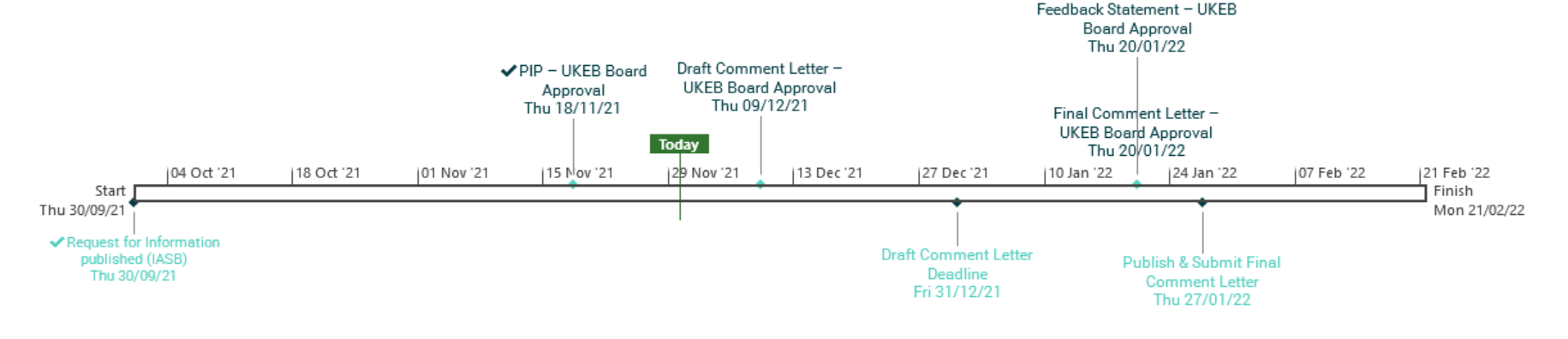
24The next project milestones are as follows:
| Date | Milestone | Complete |
|---|---|---|
| 30 September 2021 | IASB Publish RFI | ✓ |
| 15 November 2021 | Publish stakeholder survey. | ✓ |
| 18 November 2021 Board Meeting | Approve PIP | ✓ |
| 09 December 2021 Board Meeting | Approve Draft Comment Letter | |
| 15 December 2021 | Publish Draft Comment Letter. Deadline for responses 31 December 2021. | |
| 20 January 2022 Board Meeting | Approve Final Comment Letter Approve Feedback Statement | |
| 28 January 2022 | Submit Comment Letter to IASB Publish Feedback Statement on website. |
Dr Andreas Barckow Chairman International Accounting Standards Board 7 Westferry Circus Canary Wharf London E14 4HD
XX January 2022
Dear Dr Barckow
Invitation to Comment: Request for Information - Post-implementation Review: IFRS 9 Financial Instruments Classification and Measurement
The UK Endorsement Board (UKEB) is responsible for endorsement and adoption of IFRS for use in the UK and therefore is the UK's National Standard Setter for IFRS. The UKEB also leads the UK's engagement with the IFRS Foundation (Foundation) on the development of new standards, amendments and interpretations. This letter is intended to contribute to the Foundation's due process. The views expressed by the UKEB in this letter are separate from, and will not necessarily affect the conclusions in, any endorsement and adoption assessment on new or amended International Accounting Standards undertaken by the UKEB.
There are currently approximately 1,500 entities with equity listed on the London Stock Exchange using IFRS Standards2. In addition, unlisted companies have the option to use IFRS and a significant number take up this option.
We welcome the opportunity to provide comment on the IASB's Request for Information – Post-implementation Review: IFRS 9 Financial Instruments Classification and Measurement (RFI). To develop our draft response our work to-date has included in-house research, publication of a stakeholder survey and feedback received during stakeholder roundtables and interviews. [Stakeholder consultation is ongoing and will be concluded before this draft comment letter is finalised.] Based upon this work we note the following:
1Our stakeholder outreach has highlighted that the IFRS 9 classification and measurement requirements generally work as intended and represent an improvement to the previous the rule-based requirements in IAS 39 Financial Instruments: Recognition and Measurement. Our response to the RFI will therefore focus on the two significant areas where we consider that improvement, and potentially standard setting activity, is required. Both areas of concern relate to the application of the contractual cash flow characteristics assessment for financial assets.
Financial instruments with sustainability-linked features
2The IFRS 9 classification and measurement requirements are principles-based and therefore intended to deal with all types of financial instruments. In recent years, financial instruments with ESG3 features (“FIEF”) have become increasingly prevalent and are expected to grow significantly in future. FIEF come in variety of forms, including sophisticated instruments which clearly qualify for fair value treatment under IFRS 9. Our concern lies with financial instruments that, but for the ESG feature, would be considered basic lending and qualify for amortised cost accounting.
A3The IFRS 9 classification and measurement requirements are principles-based and therefore intended to deal with all types of financial instruments, including new financial instruments as they emerge.
A4Subsequent to IFRS 9 being issued financial instruments with ESG4 features (“FIEF”) have become increasingly prevalent, and are expected to grow significantly in future. FIEF come in variety of forms, including sophisticated instruments which clearly qualify for fair value treatment under IFRS 9. The scope of this response and the discussion below relates to financial instruments that, but for the ESG5 feature, would be considered basic lending and qualify for amortised cost accounting
A5We understand that the IFRS 9 requirements do not provide adequate guidance to enable accounting for FIEF that is consistent with the substance of the transactions. Current practice varies, with some considering the ESG feature as part of credit risk, and others considering it a part of the profit margin. Many regard such features to currently meet the de-minimus criteria of IFRS 9 B4.1.18, but acknowledge this is may not be a sustainable argument should these features become more prominent as this asset class continues to evolve and grow.
A6UK stakeholders expressed overwhelming concern that, once material, FIEF that represent basic lending may be required to be accounted for at fair value based on the current IFRS 9 requirements. Where the product in substance represents basic lending, amortised cost provides users with more decision useful information. The EIR interest flows are reported as interest income, which in various forms is monitored as a key metric. The expected credit loss requirements of IFRS 9 are considered to provide comprehensive and transparent information on the performance of the product. Accounting for basic lending instruments at fair value would lose such decision useful information.
A7The nature of basic lending products will evolve over time to meet the changing needs of society. A principles based accounting standard should accommodate such changes in a way that provides decision useful information. To enable such products to pass the cashflow characteristics test, and hence achieve amortised cost accounting (to reflect the substance of the transaction), we recommend that IASB:
- Provide additional examples illustrating the application of the cashflow characteristics assessment to FIEF products;
- Provide further guidance as to permitted elements of credit risk and profit margin relevant to this debate. In doing so IASB should expand on Paragraph B4.1.7A of IFRS 9 which states that 'interest can also include consideration for other basic lending risks' and 'interest can include a profit margin that is consistent with a basic lending arrangement' to clarify the nature of “other basic lending risks” and how ESG features may fit within this. B4.1.7A already specifies liquidity risk and administrative costs as examples of activities which meet these definitions, and this creates precedent to include other helpful examples such as those relevant to FEIF assessments. One way to do this may be to specify cashflows may include "other cashflows based upon contractually pre-determined targets specific to the borrower".
A8In addition, we believe resolution of this issue is needed as a matter of urgency. This product set is expected to experience significant and sustained growth in the near future. Attempting to resolve this issue via the PIR process is considered unlikely to lead to a timely outcome and may exacerbate the inconsistent accounting practices. We urge IASB to address it via a more urgent mechanism than the PIR process.
Contractually linked instruments and non-recourse finance
A9Currently there is limited guidance on the contractual cashflow characteristics assessment in IFRS 9 for contractually linked instruments (CLI) and for non-recourse finance (NRF) transactions. The boundary is not clear and, with the existing guidance, distinguishing between the two is challenging. As CLI requires the underlying portfolio to meet the cashflow characteristics test to achieve amortised cost accounting, and NRF does not, outcomes can be very different (and potentially counterintuitive) depending on the path chosen. We are told the volume of analysis is onerous and costly, and the asset classes impacted diverse and widespread. Examples provided by stakeholders have, with permission, been shared with IASB staff.
A10We strongly recommend the IASB clarify the objective for contractually linked instruments in IFRS 9, to help enhance stakeholder understanding of the transactions intended to be in scope as well as improving the framework for assessment.
A11Improved clarity could also be provided by:
- Providing definitions of key terms in B4.1.20 including “multiple” (we suggest this must be more than two), “tranche” and “issuer", and clarify whether these must be contractual or can be implied (for example a legal vs implicit tranche, whether contractual linkage can be implied when lending to an entity with limited other assets).
- Assessing the most senior tranche as non-recourse finance, leaving the CLI guidance to only apply to tranches which apply credit protection to the structure.
- Clarifying that where lending is provided by a single lender (or multiple lenders acting pari-passu) this is not within the scope of CLI.
- Clarifying what is meant by concentrations of credit risk, particularly in structures with only two parties – a borrower and a single lender (or multiple lenders acting pari-passu).
In addition to the above we have considered the recent IFRS Interpretations Committee (IFRIC) tentative agenda decision (TAD) Cash Received via Electronic Transfer as Settlement for a Financial Asset. Given the widespread implications of the TAD we agree with the stakeholder feedback provided to IFRIC that this matter should be addressed as part of the PIR of IFRS 9. Our thoughts and recommendation on this issue are discussed in paragraphs A12-A16 of Appendix 1.
If you have any questions about this response, please contact the project team at [email protected]
Yours sincerely
Pauline Wallace Chair UK Endorsement Board
Questions on Request for Information: Post Implementation Review IFRS 9, Classification and Measurement
A1Subject to the issues associated with the cashflow characteristics assessment noted below, we have found that the IFRS 9 classification and measurement requirements generally work as intended and are an improvement to the previous the rule-based requirements in IAS 39 Financial Instruments: Recognition and Measurement. Our response to the IASB's Request For Information (RFI) will therefore focus only on Question 3: Contractual Cashflow Characteristics where improvement, and potentially standard setting activity, is required. Individual responses to RFI questions for the other areas that, materially, work as intended will not be provided. We provide comment on the IFRS Interpretations Committee (IFRIC) tentative agenda decision (TAD) Cash Received via Electronic Transfer as Settlement for a Financial Asset at Question 9: Other Matters.
Question 3: Contractual cashflow characteristics
- Is the cash flow characteristics assessment working as the Board intended? Why or why not? Please explain whether requiring entities to classify and measure a financial asset considering the asset's cash flow characteristics achieves the Board's objective of entities providing users of financial statements with useful information about the amount, timing and uncertainty of future cash flows. If, in your view, useful information could be provided about a financial asset with cash flows that are not SPPI applying IFRS 9 (that is, an asset that is required to be measured at fair value through profit or loss applying IFRS 9) by applying a different measurement approach (that is, using amortised cost or fair value through OCI) please explain:
- why the asset is required to be measured at fair value through profit or loss (that is, why, applying IFRS 9, the entity concludes that the asset has cash flows that are not SPPI).
- which measurement approach you think could provide useful information about the asset and why, including an explanation of how that approach would apply. For example, please explain how you would apply the amortised cost measurement requirements to the asset (in particular, if cash flows are subject to variability other than credit risk). (See Section 7 for more questions about applying the effective interest method.)
- Can the cash flow characteristics assessment be applied consistently? Why or why not? Please explain whether the requirements are clear and comprehensive enough to enable the assessment to be applied in a consistent manner to all financial assets within the scope of IFRS 9 (including financial assets with new product features such as sustainability-linked features). If diversity in practice exists, please explain how pervasive the diversity is and its effect on entities' financial statements.
- Are there any unexpected effects arising from the cash flow characteristics assessment? How significant are these effects? Please explain the costs and benefits of the contractual cash flow assessment, considering any financial reporting effects or operational effects for preparers of financial statements, users of financial statements, auditors or regulators. In responding to (a)-(c), please include information about financial instruments with sustainability-linked features (see Spotlight 3.1) and contractually linked instruments (see Spotlight 3.2).
Contractual cash flow characteristics of financial assets
A2To develop our draft response our work to-date has included in-house research, publication of a stakeholder survey and feedback received during stakeholder roundtables and interviews. [Stakeholder consultation is ongoing and will be concluded before this draft comment letter is finalised.] This has identified two significant areas where the cashflow characteristics test is not working as intended, leading to inconsistent application and counterintuitive results. We believe improvement, and potentially standard setting activity, is required in these areas. These issues are described below.
Financial instruments with sustainability-linked features
A3The IFRS 9 classification and measurement requirements are principles-based and therefore intended to deal with all types of financial instruments, including new financial instruments as they emerge.
A4Subsequent to IFRS 9 being issued financial instruments with ESG4 features (“FIEF”) have become increasingly prevalent, and are expected to grow significantly in future. FIEF come in variety of forms, including sophisticated instruments which clearly qualify for fair value treatment under IFRS 9. The scope of this response and the discussion below relates to financial instruments that, but for the ESG5 feature, would be considered basic lending and qualify for amortised cost accounting
A5We understand that the IFRS 9 requirements do not provide adequate guidance to enable accounting for FIEF that is consistent with the substance of the transactions. Current practice varies, with some considering the ESG feature as part of credit risk, and others considering it a part of the profit margin. Many regard such features to currently meet the de-minimus criteria of IFRS 9 B4.1.18, but acknowledge this is may not be a sustainable argument should these features become more prominent as this asset class continues to evolve and grow.
A6UK stakeholders expressed overwhelming concern that, once material, FIEF that represent basic lending may be required to be accounted for at fair value based on the current IFRS 9 requirements. Where the product in substance represents basic lending, amortised cost provides users with more decision useful information. The EIR interest flows are reported as interest income, which in various forms is monitored as a key metric. The expected credit loss requirements of IFRS 9 are considered to provide comprehensive and transparent information on the performance of the product. Accounting for basic lending instruments at fair value would lose such decision useful information.
A7The nature of basic lending products will evolve over time to meet the changing needs of society. A principles based accounting standard should accommodate such changes in a way that provides decision useful information. To enable such products to pass the cashflow characteristics test, and hence achieve amortised cost accounting (to reflect the substance of the transaction), we recommend that IASB:
- Provide additional examples illustrating the application of the cashflow characteristics assessment to FIEF products;
- Provide further guidance as to permitted elements of credit risk and profit margin relevant to this debate. In doing so IASB should expand on Paragraph B4.1.7A of IFRS 9 which states that 'interest can also include consideration for other basic lending risks' and 'interest can include a profit margin that is consistent with a basic lending arrangement' to clarify the nature of “other basic lending risks” and how ESG features may fit within this. B4.1.7A already specifies liquidity risk and administrative costs as examples of activities which meet these definitions, and this creates precedent to include other helpful examples such as those relevant to FEIF assessments. One way to do this may be to specify cashflows may include "other cashflows based upon contractually pre-determined targets specific to the borrower”.
A8In addition, we believe resolution of this issue is needed as a matter of urgency. This product set is expected to experience significant and sustained growth in the near future. Attempting to resolve this issue via the PIR process is considered unlikely to lead to a timely outcome and may exacerbate the inconsistent accounting practices. We urge IASB to address it via a more urgent mechanism than the PIR process.
Contractually linked instruments and non-recourse finance
A9Currently there is limited guidance on the contractual cashflow characteristics assessment in IFRS 9 for contractually linked instruments (CLI) and for non-recourse finance (NRF) transactions. The boundary is not clear and, with the existing guidance, distinguishing between the two is challenging. As CLI requires the underlying portfolio to meet the cashflow characteristics test to achieve amortised cost accounting, and NRF does not, outcomes can be very different (and potentially counterintuitive) depending on the path chosen. We are told the volume of analysis is onerous and costly, and the asset classes impacted diverse and widespread. Examples provided by stakeholders have, with permission, been shared with IASB staff.
A10We strongly recommend the IASB clarify the objective for contractually linked instruments in IFRS 9, to help enhance stakeholder understanding of the transactions intended to be in scope as well as improving the framework for assessment.
A11Improved clarity could also be provided by:
- Providing definitions of key terms in B4.1.20 including “multiple” (we suggest this must be more than two), “tranche” and “issuer", and clarify whether these must be contractual or can be implied (for example a legal vs implicit tranche, whether contractual linkage can be implied when lending to an entity with limited other assets).
- Assessing the most senior tranche as non-recourse finance, leaving the CLI guidance to only apply to tranches which apply credit protection to the structure.
- Clarifying that where lending is provided by a single lender (or multiple lenders acting pari-passu) this is not within the scope of CLI.
- Clarifying what is meant by concentrations of credit risk, particularly in structures with only two parties – a borrower and a single lender (or multiple lenders acting pari-passu).
Question 9: Other matters
- Are there any further matters that you think the Board should examine as part of the post-implementation review of the classification and measurement requirements in IFRS 9? If yes, what are those matters and why should they be examined? Please explain why those matters should be considered in the context of the purpose of the post-implementation review, and the pervasiveness of any matter raised. Please provide examples and supporting evidence when relevant.
A12In its September 2021 update IFRS Interpretations Committee (IFRIC) published a tentative agenda decision (TAD) Cash Received via Electronic Transfer as Settlement for a Financial Asset. The IFRIC was asked whether an entity can derecognise a trade receivable and recognise cash on the date the cash transfer is initiated (its reporting date), rather than on the date the cash transfer is settled (after its reporting date). The IFRIC concluded that: an entity derecognises the trade receivable on the date on which its contractual rights to the cash flows from the trade receivable expire; and recognises the cash (or another financial asset) received as settlement for that trade receivable on the same date.
A13Though we agree this approach complies with a literal reading of the IFRS 9 requirements, it appears to run counter to well established practice. While the TAD addresses only the specific transaction submitted to the Committee, it would appear to have far reaching implications. It is probable that as a direct result of this TAD, entities will have to reconsider their approaches for a wide range of payment systems that were not considered by the IFRIC when it issued its TAD. These include: payment settlement, including cheque payments in lieu of trade payables/ trade receivables; credit card receipts that can be cancelled before they are settled; payments made for a financial liability by electronic transfer; and, intragroup cash transfers straddling a reporting period end. It would also appear that creditors paying accounts payable would also have to review the approach they take to accounting for those transactions.
A14The TAD would potentially require significant analysis by preparers to determine the exact point at which cash is legally transferred. This would require detailed analysis of each transaction type as the timing of extinguishment may not be known without additional information and analysis (e.g. for international transfers legal extinguishment may arise sometime in the middle of the settlement cycle, rather than only at the end). As noted by one respondent to the TAD, both entities involved in a transaction would need to be able to answer questions such as “if the receiver's bank failed after the cash was received by the bank but before the receiver's bank account was credited with the funds, would the receiver have a claim on the payer, or would the payer's obligation be extinguished at this point and the receiver's claim be solely on its own bank?". Obtaining legal advice to establish when routine trade receivables (and trade payables) are extinguished for the different jurisdictions and settlement systems involved will be time consuming, costly and an unnecessary diversion from already established and understood norms in the market.
A15Even if the legal rights can be established to the level required, new accounting will need to be established that addresses the potential mismatch between the timing of the settlement/payment of a receivable and the transfer of cash into/out of accounts. This may now happen earlier or later, which could be impacted by whether the counterparties are using the same paying /receiving bank or different institutions. Entities will be required to create a new class of financial asset/liability to “fill the gap” between, for example, a liability being extinguished and cash arriving to the bank account. This will require the creation of new subledgers and control systems.
A16A significant number of respondents to the IFRIC noted similar concerns and recommended that instead of an IFRIC Agenda Decision being published, the matter should instead be considered as part of the IFRS 9 PIR. The UKEB agrees with this view. Specifically we recommend that the IASB consider (as part of the PIR) applying a similar approach to that already taken for “regular way transactions” (IFRS 9 3.1.2), that is permitting a policy choice to determine the extinguishment of a financial payable (as per IFRS 9 3.3.1) or receivable (as per IFRS 9 3.2.3(a)) at either the commencement or conclusion of a market standard settlement mechanism. We believe that such a treatment could avoid many of the concerns that have been identified with the TAD.
Appendix 2: Questions for the Invitation to Comment
1Do you agree with the views expressed in this draft comment letter? If not please explain why.
2Can you provide further examples of the issues discussed in this letter that we may share with IASB?
3In addition to the contractual cashflow characteristics issues discussed in this letter the IASB's Request for Information (RFI) covers a number of other topics, listed below. Initial outreach on this project suggests that in these areas IFRS 9 is, working materially as intended. Do you agree? If not please explain why and if possible provide an example. When answering this question you may wish to consider:
- Does this approach provide decision useful information for users?
- Does it allow companies to reflect the way they manage financial assets to generate cash flows?
- Is the application guidance clear, can it be applied consistently? If diversity in practice or other practical issues exist, how pervasive are they?
- Have you observed any other unintended consequences of the IFRS 9 Classification & Measurement requirements?
- Do you have any suggestions to improve the IFRS 9 Classification & Measurement requirements?
4Are there any other comments you would like to make on IASB's Post Implementation Review of IFRS 9, Classification and Measurement?
| No. | Topic | Question |
|---|---|---|
| 1 | Classification and Measurement | • Enable entities to align the measurement of financial assets with the cashflow characteristics of the assets and how the entity expects to manage them? |
| • Result in an entity providing useful information to users of financial statements about the amount, timing and uncertainty of future cashflows? | ||
| 2 | Business model for managing financial assets. | • Is the business model assessment working as IASB intended? |
| • Can this assessment be applied consistently? | ||
| • Does this assessment give rise to any unexpected effects and if so how significant are these effects? | ||
| 3 | Contractual cashflow characteristics | • Is the cashflow characteristics assessment working as IASB intended? |
| • Can this assessment be applied consistently? | ||
| • Does this assessment give rise to any unexpected effects and if so how significant are these effects? | ||
| 4 | Equity instruments and other comprehensive income. | • Is the option to present fair value changes on investments in equity instruments in OCI working as IASB intended? |
| • What equity instruments do you elect to present fair value changes in OCI? | ||
| 5 | Financial liabilities and own credit. | • Does the option to present fair value changes on investments in equity instruments in OCI give rise to unexpected effects and if so how significant are these? |
| • Are the requirements for presenting the effects of own credit risk in OCI working as intended? | ||
| • Are there other matters relating to financial liabilities that you think IASB should consider as part of this PIR? | ||
| 6 | Modifications to contractual cashflows. | • Are the requirements for modifications to contractual cashflows working as the Board intended? |
| • Can the requirements be applied consistently? | ||
| 7 | Amortised cost and the effective interest method. | • Is the effective interest method working as IASB intended? |
| • Can the effective interest method be applied consistently? | ||
| 8 | Transition | • Did the transition requirements work as the board intended? |
| • Were there any unexpected effects or challenges? | ||
| 9 | Any other matters. | • Any other matters |
| • Any lessons learned to highlight to IASB. |
A link to the RFI can be found here.
Footnotes
Footnotes
-
To qualify for amortised cost accounting the financial asset must pass both a business model test and a cashflow characteristics (SPPI) test. The SPPI test requires cashflows on the instrument to consist of solely payments of principle and interest consistent with a basic lending arrangement. Basic lending arrangements are said to include consideration for the time value of money, credit and other basic lending risks, certain costs and a profit margin consistent with basic lending. ↩
-
UKEB calculations based on LSEG and Eikon data. ↩
-
These are sustainability-linked features including the Environmental, Social or Governance practices of the entity. ↩
-
These are sustainability-linked features including the Environmental, Social or Governance practices of the entity. ↩↩
-
Where the ESG feature is also considered "basic” such as pre-determined targets specific to the borrower, and not referencing indices or third parties who are not a specific to a party to the contract. ↩↩