3.0 Due Process Handbook – Sweep Issues
Executive Summary
| Project Type | UKEB Set-up |
|---|---|
| Project Scope | N/A |
Purpose of the paper
This paper identifies four sweep issues arising from the comments made by Board members at the November 2021 meeting. For each of the sweep issues identified, this paper: a) Shows the paragraphs of the draft Handbook that gave rise to Board members' concerns and explains those concerns; b) Analyses the problem identified and sets out the Secretariat's recommendations and planned drafting amendments. We also provide a timeline for the publication and finalisation of the Handbook.
Summary of the Issue
Subsequent to the November 2021 Board meeting, the Secretariat has identified four sweep issues on the draft Handbook. These are as follows: a) Issue 1: Minimum consultation periods for UKEB's consultation documents; b) Issue 2: Requirements for approving a Research Paper or a Discussion Paper; c) Issue 3: Requirements for carrying out UKEB post-implementation reviews; and d) Issue 4: Membership terms and requirements for appointing members of advisory groups. Subject to the Board agreement on these issues, Board members are asked for approval to publish the [Draft] Due Process Handbook for consultation.
Decisions for the Board
Board members are asked for comments on the sweep issues identified in this paper and approval for consultation.
Recommendation:
Recommendations for the four issues identified and planned drafting amendments are included in this paper.
Appendices
Appendix A Extracts from the [Draft] Due Process Handbook discussed at the November 2021 meeting.
Purpose
1At the November 2021 Board meeting the Board reviewed and provided comments on a consolidated version of the draft of the UKEB's Due Process Handbook (the "draft Handbook").
2When commenting on the draft Handbook several Board members expressed concerns with some of the items included in the Handbook.
3The Secretariat has identified four sweep issues derived from the comments received on the draft Handbook. The sweep issues discussed in this paper are as follows: a) Issue 1: Minimum consultation periods for UKEB's consultation documents; b) Issue 2: Requirements for approving a Research Paper or a Discussion Paper; c) Issue 3: Requirements for carrying out UKEB post-implementation reviews; and d) Issue 4: Membership terms and requirements for appointing members of advisory groups.
4For each of the sweep issues identified in paragraph 3 above, this paper: a) Shows the paragraphs of the draft Handbook that gave rise to Board members' concerns and explains those concerns; and b) Analyses the problem identified and asks the Board if it agrees with the Secretariat's recommendations and planned drafting amendments.
Issue 1 - Minimum consultation periods
Description
5The draft Handbook currently proposes different minimum consultation periods for the following UKEB consultation documents1:
| Paragraph reference (Handbook) | Type of consultation document | Minimum consultation period |
|---|---|---|
| 5.23 and 10.5 | A Draft Comment Letter for influencing the IASB's proposals for major new (or amended) standards; for annual improvements, narrow-scope amendments and/or Draft IFRIC Interpretations issued by the IFRS Interpretations Committee | 4 weeks unless there are exceptional circumstances2 |
| 6.21 | Draft Endorsement Criteria Assessment (DECA) | 4 weeks unless there are exceptional circumstances3 |
Concerns raised
6Board members suggested allowing more flexibility when setting consultation periods as some projects (i.e. commonly 'major' projects) may require lengthier consultation periods, whereas other 'minor' projects might normally require only shorter consultation periods.
7Board members also recommended the use of consistent terminology across the Handbook when referring to consultation periods (for example, “days” or “weeks”).
Staff analysis and recommendations
8We suggest including a two-tier approach for setting consultation periods to address Board members' concerns. This approach would involve setting consultation periods in two stages: a) First stage: the Handbook will include "standard" consultation periods for commenting on UKEB's draft comment letters, DECAs, or for any of the outputs derived from the UKEB's research programme; and b) Second stage: the Handbook will include examples of factors that could be considered by the Board/Secretariat to justify departures from "standard" consultation periods (i.e. that “standard” consultation periods could be extended or shortened). The Handbook should make clear that these examples are not exhaustive.
9We recommend referring to consultation periods in “days” for all instances.
10Specific consultation periods will be documented in the relevant Project Initiation Plan for each project. Where this deviates from the “standard” period for the type of project an explanation will also be included.
"Standard" consultation periods
11For draft comment letters, we propose a "standard" consultation period of 30 days. We observe that this period would not normally be longer than 30 days because this would require the UKEB to begin discussing potential issues before some of the IASB's/IFRS Interpretations Committee's consultation documents are published, which would in turn require additional resources that are unlikely to be justifiable on Managing Public Money grounds.
12For a DECA, we propose extending the “standard” consultation period from 30 days to 90 days, given that the effective date for a new or amended international accounting standard (i.e. usually two years after publication), allows more time for the entire consultation and adoption process.
13For the outputs from the UKEB's research programme we propose a "standard" consultation period of 90 days. We are of the view that this period is sufficient to allow stakeholders to understand and express their views on the issues included for comment.
| Type of consultation document | Proposed minimum consultation period |
|---|---|
| Draft Comment Letter for influencing the IASB's proposals for major new (or amended) standards; for annual improvements, narrow-scope amendments and/or Draft IFRIC Interpretations issued by the IFRS Interpretations Committee | 30 days |
| Draft Endorsement Criteria Assessment (DECA) | 90 days |
| Primary outputs derived from the UKEB's research programme (i.e. Discussion Papers, Research Papers or Requests for Information-RFI) | 90 days |
Factors to be considered to justify departing from “standard” consultation periods
14We propose including the following indicative factors: a) Whether the UKEB has initiated a particular project (for example, in response to an IASB's or Interpretations Committee's consultation document or an issued new (or amended) international accounting standard); b) The length and/or complexity of the proposals included in an IASB's or Interpretations Committee's consultation document or on an issued final new (or amended) international accounting standard; c) The timing of the document issued for comment and/or after considering the implications of that timing on stakeholders (for example, issuing a document for comment during holiday or busy periods); or d) The "urgency” of a certain project, for example, due to the implementation or effective date of the proposed or final new (or amended) international accounting standard.
15We also propose that these factors will be identified as a non-exhaustive list.
Issue 1. Questions for the Board
a) Do you agree with the inclusion of a two-tiered approach for setting out consultation periods as described in paragraph 8 of this paper? b) Do you agree with the “standard” consultation periods described in paragraphs 11-13 of this paper? c) Do you agree with the inclusion of some indicative factors that could be considered for justifying departures from “standard” consultation periods? Do you agree with the examples described in paragraph 14 of this paper? Do you have other examples that could be included?
Issue 2 - Requirements for approving a Research Paper or a Discussion Paper
Description
16The table below paragraph 7.12 in the draft Handbook describes the three primary outputs derived from the UKEB's proactive Research programme (i.e. Discussion Paper, Research Paper or a Request for Information), including whether these documents are required to be approved by the Board4.
Concerns raised
17One Board member observed that the primary outputs derived from the UKEB's research programme should not be limited to the defined set (namely Discussion Paper, Research Paper and Request for Information) and recommended that this set be kept flexible.
18Other Board members also questioned the need to: a) Require Board's approval5 for the publication of a Research Paper, given that it: (i) includes views from the Secretariat; (ii) is issued by the Secretariat; and (iii) is not required to be discussed by the Board at a public Board meeting. b) Require a formal written vote to approve a Discussion Paper (instead of a simple majority vote), given that it includes preliminary views from the Board (rather than final views). They further observe that requiring a formal written vote would go beyond the requirements in the UKEB's Terms of Reference (ToR) as paragraph 5.2 in Section 5 requires a formal written vote only for adopting a standard or amendment to a standard or an IFRS Interpretation Committee interpretation.
Staff analysis and recommendations
19To address Board members' concerns we suggest: a) Replacing the table with examples of common research outputs that could be derived from the UKEB's research programme; and b) Adding examples of factors that could be considered for determining if the research document constitutes a formal research document that will require Board approval. c) Add a paragraph in section 7 of the Handbook explaining that the determination of Board approval for the specific research output will be documented in the relevant Project Initiation Plan.
20Common categories of research outputs may include: a) Discussion Papers, as documents that include a comprehensive overview of technical issues, possible approaches to addressing these issues and preliminary views from the Board and an Invitation to Comment; b) Requests for Information or feedback on a matter related to technical projects or broader consultations. For example, seeking comments on the UKEB's technical work plan, post-implementation reviews, or help in assessing the practical implications of a potential financial reporting requirement; c) Research Papers, to contribute to wider discussions on cross-cutting issues in financial reporting; d) Bulletins, to promote and stimulate debate within the UK on specific accounting matters; or e) Quantitative studies.
21To help assessing whether a research output is required to be approved and issued by the Board the following factors could be considered: a) Existence of preliminary views from the Board; b) Expected length or level of detail; c) Expectation to be used as part of the outreach activities for a major project (i.e. where major input is needed); d) Inclusion of complex technical issues that are likely require further research; or e) Proposals that are likely to have a significant impact on UK stakeholders.
22We suggest that research outputs that are assessed as needing Board's approval should require a simple majority of the Board members present at a public Board meeting as the approval to publish.
Issue 2. Questions for the Board
a) Do you agree that that the table below paragraph 7.12 in the draft Handbook should be replaced by examples of common categories of research outputs as described in paragraph 20 of this paper? b) Do you agree with the inclusion of some factors that should be considered for determining if a research output requires Board approval? Do you have comments on the examples? c) Do you agree that for research outputs requiring Board approval, this approval should require a simple majority vote of Board members present at a public meeting, as explained in paragraph 22 of this paper?
Issue 3 - Requirements for carrying out UKEB post-implementation reviews
Description
23Paragraphs 8.8-8.10 in Section 8 of the draft Handbook describe the processes followed by the UKEB for carrying out its own post-implementation reviews (PIRs). a) Paragraph 8.8 of the draft Handbook explains that the statutory requirements in Regulation 11 (see Appendix A) can be fulfilled by the UKEB influencing and responding to the IASB's post-implementation reviews. b) Paragraph 8.9 explains that the UKEB (emphasis added): "may consider performing its own post-implementation review of international accountings standards..." and paragraph 8.10 provides two examples of circumstances when this may occur. These are that: (i) the IASB decides not to undertake a detailed post-implementation review on an international accounting standard that has significance in the UK; or (ii) a change in a (revised) international accounting standard is so significant that a review is needed.
Concerns raised
24Board members observe that paragraph 8.9 of the draft Handbook appears to be inconsistent with sub-sections 3-4 of Regulation 11 in SI 2019/685. The inconsistency arises because the draft Handbook implies that post-implementation reviews could be optional, whereas Regulation 11 is not optional, it requires a review of an international accounting standard where the adoption of an international accounting standard is likely to lead to a significant change in accounting practice6.
25Board members also observed that the draft Handbook does not cover the situation where the IASB decides to defer a review of a particular international accounting standard7 so that the IASB review would conclude after the deadline imposed by Regulation 11. They observe that this circumstance should be covered in the Handbook, given that the IASB has more flexibility to defer (or even accelerate) its own post-implementation reviews8.
Staff analysis and recommendations
26We agree with Board members' views that the first sentence in paragraph 8.9 of the [draft] Due Process Handbook (i.e. the UKEB may consider performing its own PIRs) appears to contradict the requirements in Regulation 11 to carry out PIRs. Consequently, we are suggesting a revision of paragraphs 8.6-8.10 of the draft Handbook to clarify the circumstances when the UKEB is required to perform a PIR, making sure that these circumstances are in line with the statutory requirements in Regulation 11.
Proposed wording
27The proposed amended wording to paragraphs 8.6, 8.8 and 8.9 is provided below. We also propose deleting paragraph 8.10. Paragraph 8.7 is not amended and is provided for information purposes only.
8.6 Subsection 3 in Regulation 11 in SI 2019/685 contains a requirement to: (a) "carry out a review of the impact of the adoption of the standard” where the standard is likely to lead to a "significant change in accounting practice”; and (b) "publish a report setting out the conclusions of the review no later than 5 years after the date on which the standard takes effect (being the first day of the first financial year in respect of which it must be used)".
8.7 Subsection 4 in Regulation 11 in SI 2019/685 contains a requirement to: (a) carry out subsequent reviews from time to time; and (b) publish a report setting out the conclusions of any review conducted.
8.8 A "significant change in accounting practice” occurs when a new accounting standard is issued by the IASB. A new standard meets a “significant change in accounting practice” as it will usually have a widespread effect on many entities or a material effect on a few entities. The IASB undertakes a post-implementation review of each new standard. As a result,
Tthe obligations in Regulation 11 in Sl 2019/685 can be fulfilled by influencing and responding to IASB's post-implementation reviews (refer to paragraphs 8.2-8.5 in this Handbook).8.9 When the IASB decides not to undertake a post-implementation review on a new international accounting standard and the impact of the standard is such that it is likely to lead to a significant change in accounting practice in the UK, However, the UKEB may
considermust performing its own post-implementation review of international accounting the standards to test theirits_continuingrelevance in line with the requirements in Regulation 11 in SI 2019/685. This review should be undertakendoneno later than 5 years after the date on which the international accounting standard takes effect, in accordance with paragraph (3)(b) of this Regulation.8.10 The UKEB may decide to perform its own post-implementation review of an international accounting standard when for example: (i) the IASB decides not to undertake a detailed post-implementation review on an international accounting standard that has significance in the UK; or (ii) a change in a (revised) international accounting standard is so significant that a review is needed.
Questions for the Board
a) Does the Board agree that paragraphs 8.6 and 8.9 should be amended to clarify the circumstances when the UKEB is required to perform a PIR in the way described in paragraph 26? Does the Board agree that paragraph 8.10 be deleted?
Issue 4 - Membership terms and requirements for appointing members of advisory groups
Description
28Paragraph 9.14 sets out requirements for advisory group membership terms. This paragraph was revised following the Board members' advice at the October 2021 meeting to: a) set out the terms for the initial appointment of members of advisory groups; and b) allow the staggering of terms to ensure continuity of the advisory group.
29Paragraph 9.14 is reproduced below (emphasis added):
9.14 The membership of an advisory group is reviewed on a regular basis with the possibility that members may be appointable for consecutive terms. Members of advisory groups are appointed for an initial term of up to three years, renewable for a second term of up to three additional years. The length of term for members of advisory groups may be shortened or lengthened if circumstances warrant. to allow for
a. sStaggered rotation of members may be permitted to ensure continuity on the advisory group. Changes to appointments or re-appointments arising from such reviews are approved by the Board.
Concerns raised
30Board members expressed new concerns on the content of paragraph 9.14, mainly that: a) It is unclear who is responsible for reviewing the membership of an advisory group, and why this review is necessary; b) It is unclear what is meant by "regular" when stating that (emphasis added) "the membership of an advisory group is reviewed on a regular basis"; and c) The requirements in paragraph 9.14 allow for the length of the term to be shortened but not lengthened; in addition, there could be additional reasons why a term could be shortened, not just to permit staggering of members.
Staff analysis and recommendations
31To address Board members' concerns we propose a) Deleting the first sentence in paragraph 9.14 (i.e. “The membership of an advisory group is reviewed on a regular basis with the possibility that members may be appointable for consecutive terms"), as paragraph 9.23 in the draft Handbook already indicates that the Board reviews the purpose, composition, and effectiveness of each advisory group every three years (or more frequently, if circumstances warrant); and paragraph 9.12 states that the Board ratifies the membership to an advisory group. b) Indicating in paragraph 9.23 that: (i) reviewing the composition of an advisory group may include appointments and re-appointments of members of advisory groups; and (ii) changes to advisory groups arising from such reviews are approved by the Board; c) indicating more clearly in paragraph 9.14 that: (i) staggered rotation of members is permitted to ensure continuity of the group; (ii) the length of term for members of advisory groups may be lengthened or shortened. Use of the wording “up to three years” is consistent with that used for the terms of the UKEB Board membership in paragraph 2.1 of the Terms of Reference. The difference is permitting the extension of the membership of an ad-hoc group to the length of the project.
32The proposed (amended) wording of paragraphs 9.14 and 9.23 is shown below:
9.14 The membership of an advisory group is reviewed on a regular basis with the possibility that members may be appointable for consecutive terms. Members of advisory groups are appointed for an initial term of up to three years, renewable for a second term of up to three additional years, or for the length of the project (e.g. for ad-hoc groups). The length of term for members of advisory groups may be shortened or lengthened if circumstances warrant. to allow for
a. sStaggered rotation of members may be permitted to ensure continuity on the advisory group. Changes to appointments or re-appointments arising from such reviews are approved by the Board.9.23 The Board will evaluate the purpose, composition (including appointments and re-appointments of members of advisory groups), and effectiveness of each advisory group every three years (or more frequently, if circumstances warrant), to assess whether each group is continuing to serve the function for which it was established. Changes arising from such reviews are approved by the Board. The Board can revises the Terms of Reference applicable to each advisory group as
a resultnecessary.
33We also wish to ask the Board if their preference would be for changes applicable to advisory groups (e.g. appointments/re-appointments) to be decided at a private or at a public meeting? The Secretariat recommends that such changes be made at a private meeting since appointments should only be made public after the person has accepted.
Questions for the Board
a) Does the Board agree with the amendments to paragraphs 9.14 and 9.23? b) Does the Board prefer that changes applicable to advisory groups (e.g. appointments/re-appointments) be decided at a private or at a public meeting?
Next steps and timeline
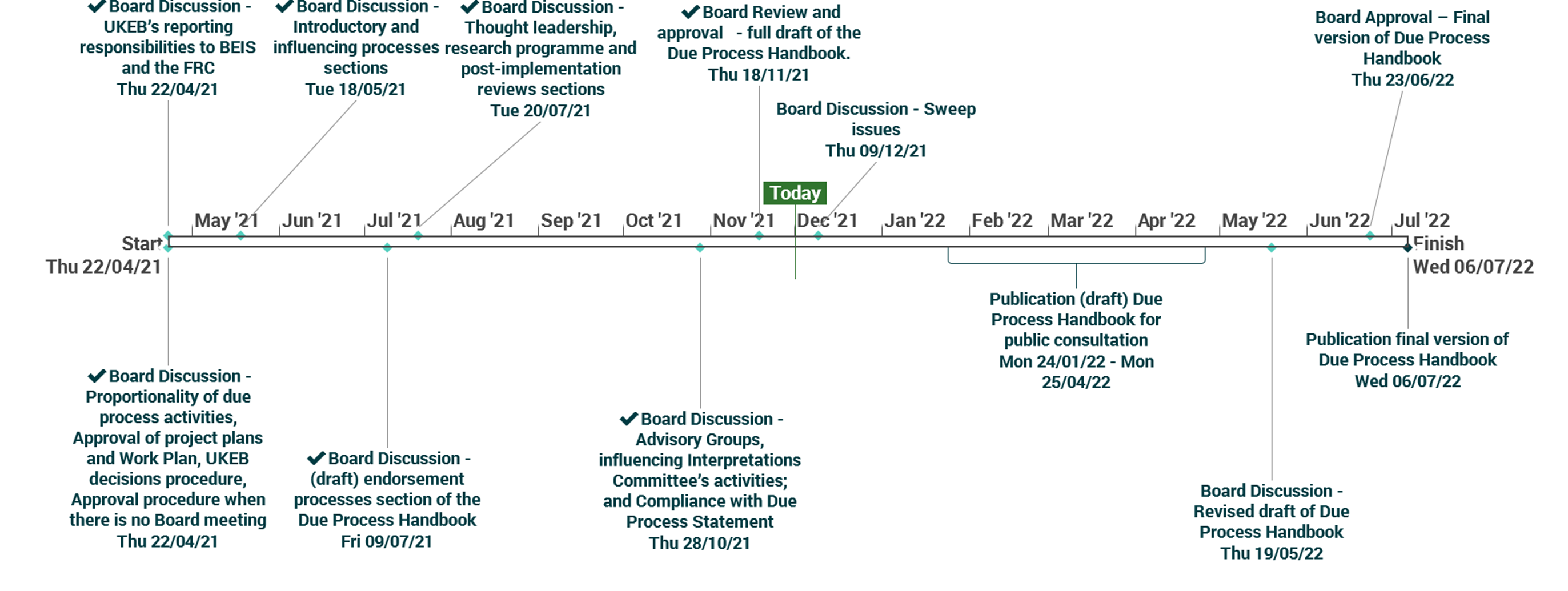
34Subject to the finalisation of the sweep issues discussed in this paper, our plan for the publication of the draft Handbook for public consultation and finalisation is set out in the table below and diagram in the next page.
| Date | At a public Board meeting: |
|---|---|
| 9 December 2021 | Board discussion of sweep issues (this meeting) |
| Public consultation period | 24 January 2021 – 25 April 2022 [~90 days] |
| January–April 2022 | Comments received - review and analysis (UKEB Secretariat) |
| 19 May 2022 | Board review and discussion of revised draft of Due Process Handbook |
| 23 June 2022 | Board approval of final version of Due Process Handbook |
| July 2022 | Publication of Due Process Handbook |
Question for the Board
Does the Board agree that, subject to the finalisation of the sweep issues, the [draft] Due Process Handbook can be published for consultation?
Due Process Handbook Plan - Upcoming Tasks
High Level Plan
Appendix A – Relevant extracts from the (draft) Due Process Handbook9
We reproduce below some relevant extracts from the draft Handbook.
Sweep issue 1: Minimum consultation periods for UKEB's consultation documents
We reproduce below paragraphs 5.23, 10.5, 6.21 and 7.21 of the draft Handbook.
Draft comment letter
5.23 A draft comment letter, explaining the UKEB's preliminary response to an IASB's or an Interpretations Committee's consultation document (refer to Appendix B in this Handbook) is made available for public consultation on the UKEB website once approved by the Board. This letter is normally preceded by an Invitation to Comment that sets out the matters on which feedback is sought. The minimum consultation period for a Draft Comment letter is not less than 4 weeks unless there are exceptional circumstances.
(b) Influencing proposals for amendments or for Draft IFRIC Interpretations
10.5 The UKEB follows the requirements in Section 5 of this Handbook for influencing proposals for annual improvements, narrow-scope amendments and/or Draft IFRIC Interpretations.
Draft endorsement criteria assessment (DECA)
6.21 The minimum consultation period is not less than 4 weeks unless there are exceptional circumstances. During this period, technical staff conducts outreach activities to gather input and feedback. In exceptional circumstance, for example, where an amendment is urgently required to be adopted by entities, the Board may approve a shorter comment period.
Research programme Project Initiation plan
7.21 The UKEB usually allows a minimum of 90 days for comment on such a consultation. If the information request is narrow in scope and/or urgent the UKEB may set a shorter period.
Sweep issue 2: Requirements for approving a Research Paper and a Discussion Paper
We reproduce the table that was included below paragraph 7.12 of the draft Handbook.
Main outputs
7.12 The primary outputs derived from the UKEB's research programme are explained in the table below:
| Type | Discussion Paper | Research Paper | Request for Information |
|---|---|---|---|
| Issued by | The Board. | The Secretariat | The Board. |
| Description | A Discussion Paper includes a comprehensive overview of technical issues, possible approaches to addressing these issues and preliminary views from the Board and an Invitation to Comment. | A Research Paper includes a comprehensive overview of technical issues. It may include possible approaches to addressing these issues and preliminary views from the Secretariat and an invitation to comment. It is prepared by the Secretariat on its own. It may include collaborations from other national standard-setters or bodies. | A Request for Information is a formal request for information or feedback on a matter related to technical projects or broader consultations. This includes seeking comments on the UKEB's technical work plan, post-implementation reviews10, or help in assessing the practical implications of a potential financial reporting requirement. |
| Reflects Board members' views? | Yes - Reflects the Board's analysis and collective view on a particular topic, although the discussion will reflect and convey any significant differences in Board members' views. | No - Reflects views from the Secretariat. | No - It is a request for information and does not reflect views from the Board or from the Secretariat. |
| Discussed at a public Board meeting? | Yes - The matters included in a Discussion Paper are discussed at public Board meetings. | Can be discussed at a public Board meeting to provide some input to the Secretariat. However, a Research Paper will not include any formal or preliminary views from the Board. | Yes - The matters included in a Request for Information are discussed in public Board meetings. However, a Request for Information will not include any formal or preliminary views from the Board. |
| Approval by the Board | To be published a Discussion Paper requires the affirmative vote of at least two-thirds of the members of the Board. The voting is made at a public Board meeting and is indicative only. The vote is formalised by circulation outside the meeting by a written vote (in paper or electronic form), and the vote constitutes proper evidence of the decision of the Board. | To be published a Research Paper requires the support of a simple majority of the full Board members, with approval given in a public meeting. | To be published a Request for Information requires the support of a simple majority of the full Board members, with approval given in a public meeting. |
Sweep issue 3: Requirements for carrying out UKEB post-implementation reviews
We provide below an extract of the requirements in paragraphs 3–4 of Regulation 11 in SI 2019/68511 (emphasis added).
Periodic review by Secretary of State of impact of adopted standard
11.(1) The Secretary of State must publish a statement setting out the Secretary of State's policy on what amounts to a significant change in accounting practice, and must keep this policy statement under review.
11.(2) Paragraphs (3) and (4) apply in relation to the adoption of any standard by the Secretary of State under regulation 6 which the Secretary of State considers likely to lead to a significant change in accounting practice.
11.(3) The Secretary of State must— (a) carry out a review of the impact of the adoption of the standard; and (b) publish a report setting out the conclusions of the review no later than 5 years after the date on which the standard takes effect (being the first day of the first financial year in respect of which it must be used).
11.(4) The Secretary of State may carry out subsequent reviews from time to time, and in the event of doing so the Secretary of State must publish a report setting out the conclusions of any review conducted.
We reproduce below paragraphs 8.8-8.10 of the draft Handbook.
8.8 The obligations in Regulation 11 in SI 2019/685 can be fulfilled for most international accounting standards by influencing and responding to IASB's post-implementation reviews (refer to paragraphs 8.2-8.5 in this Handbook).
8.9 However, the UKEB may consider performing its own post-implementation review of international accounting standards to test their continuing relevance in line with the requirements in Regulation 11 in SI 2019/685. This should be done no later than 5 years after the date on which the international accounting standard takes effect, in accordance with paragraph (3)(b) of this Regulation.
8.10 The UKEB may decide to perform its own post-implementation review of an international accounting standard when for example: a) the IASB decides not to undertake a detailed post-implementation review on an international accounting standard that has significance in the UK; or b) a change in a (revised) international accounting standard is so significant that a review is needed.
Sweep issue 4: Membership terms and requirements for appointing members of advisory groups
We reproduce below paragraphs 9.10, 9.12 and 9.23 of the draft Handbook.
Appointments and membership
9.10 In appointing members, the UKEB Chair seeks to ensure that the membership in the advisory groups is diverse in terms of skills experience, background, race, gender and other characteristics (...)
9.12 Membership to an advisory body is subject to ratification by the Board.
Effectiveness review
9.23 The Board will evaluate the purpose, composition, and effectiveness of each advisory group every three years (or more frequently, if circumstances warrant), to assess whether each group is continuing to serve the function for which it was established. The Board revises the Terms of Reference applicable to each advisory group as necessary.
Footnotes
Footnotes
-
Refer to paragraphs 5.23, 6.21, 7.21 and 10.5 of the draft Handbook which have been reproduced in Appendix A. ↩
-
Exceptional circumstances may include that there is a requirement for an "urgent" amendment in which case a shorter comment period would be permitted. ↩
-
As footnote 2. ↩
-
Refer to Appendix A in this paper. ↩
-
The draft Handbook currently requires the support of a simple majority of the full Board members, for publication of a Research Paper with approval given in a public meeting. ↩
-
The statutory requirements are included in https://www.legislation.gov.uk/uksi/2019/685/made. In Appendix A we reproduced the text of paragraphs 3-4 of Regulation 11 in SI 2019/685 as well as paragraphs 8.8-8.10 in the Handbook. ↩
-
As explained in paragraph 6.49 of the IASB and IFRS Interpretations Committee Due Process Handbook, some circumstances that may prompt the IASB to accelerate or defer a PIR may be: changes in the financial reporting environment and regulatory requirements, concerns about the quality of a Standard that have been expressed by the Advisory Council, the Interpretations Committee, standard-setters or interested parties. ↩
-
As explained in paragraph 6.48 of the IASB and IFRS Interpretations Committee Due Process Handbook, an IASB post-implementation review (emphasis added) "normally begins after the new requirements have been applied internationally for two years, which is generally about 30-36 months after the effective date). ↩
-
Discussed by the Board at its November 2021 meeting. ↩
-
Section 8 of this Handbook 'Post-implementation Reviews' provides an overview of the process that the UKEB follows for conducting its own post-implementation reviews. ↩