3.0 Due Process Handbook

Project Type: UKEB Set-up Project Scope: N/A
Executive Summary
Purpose of the paper
This paper provides the Board with an initial draft of the remaining sections of the Due Process Handbook, covering the processes for:
- Advisory groups;
- Influencing the work of the IFRS Interpretations Committee; and
- Due Process Compliance Statement.
This paper also sets out the timeline for the subsequent completion, public consultation and publication of the Due Process Handbook.
Summary of the Issue
The UKEB's Due Process Handbook (Handbook) will set out the due process it will follow when undertaking its activities to uphold its guiding principles of accountability, independence, transparency and thought leadership.
A clearly set out due process ensures: that the UKEB's views are based on the evidence gathered over the course of its activities, that they contribute to high-quality financial reporting, and maintain accountability and transparency to stakeholders throughout. The Board is developing its Handbook in sections, with a view to publication for stakeholder consultation later in the year.
Decisions for the Board
No decisions are required at this meeting. Board member comments are invited on the sections of the Handbook included in this paper. We would like to draw your attention to the option to bring forward the planned December 2021 decision to publish the Due Process Handbook draft for public consultation to the November 2021 Board meeting, as explained in paragraph 5 of this paper.
Recommendation: N/A
Appendices
- Appendix 1 [Draft] Due Process Handbook—Advisory Groups
- Appendix 2 [Draft] Due Process Handbook—Influencing the work of the IFRS Interpretations Committee
- Appendix 3 [Draft] Due Process Handbook—Due Process Compliance Statement
Purpose
1This paper provides the Board with an initial draft of the remaining sections of the Due Process Handbook (DPH), covering the processes for:
- Advisory groups (DPH Section 9, Agenda Paper 3.1);
- Influencing the work of the Interpretations Committee (DPH Section 10, Agenda Paper 3.2); and
- Due Process Compliance Statement (DPH Section 11, Agenda Paper 3.3).
2This paper also sets out the timeline for the subsequent completion, public consultation and publication of the Handbook.
Background
3The table below outlines the sections of the draft Due Process Handbook reviewed by Board members at previous meetings.
| Public Board meeting | Discussion to solicit views and comments on: |
|---|---|
| 18 May 2021 | Overview and introduction of the Due Process Handbook (sections 1–4). |
| Influencing processes (section 5) of the Handbook | |
| 9 July 2021 | Endorsement processes (section 6) of the Handbook |
| 20 July 2021 | The following sections of the Handbook: |
| * Thought leadership and research programme (section 7); and | |
| * Post-implementation reviews (section 8) | |
| 28 October 2021 | The remaining sections of the Handbook: |
| (this meeting) | * Advisory Groups (section 9); |
| * Influencing the work of the IFRS Interpretations Committee (section 10); and | |
| * Due Process Compliance Statement (section 11). |
Next steps and timeline
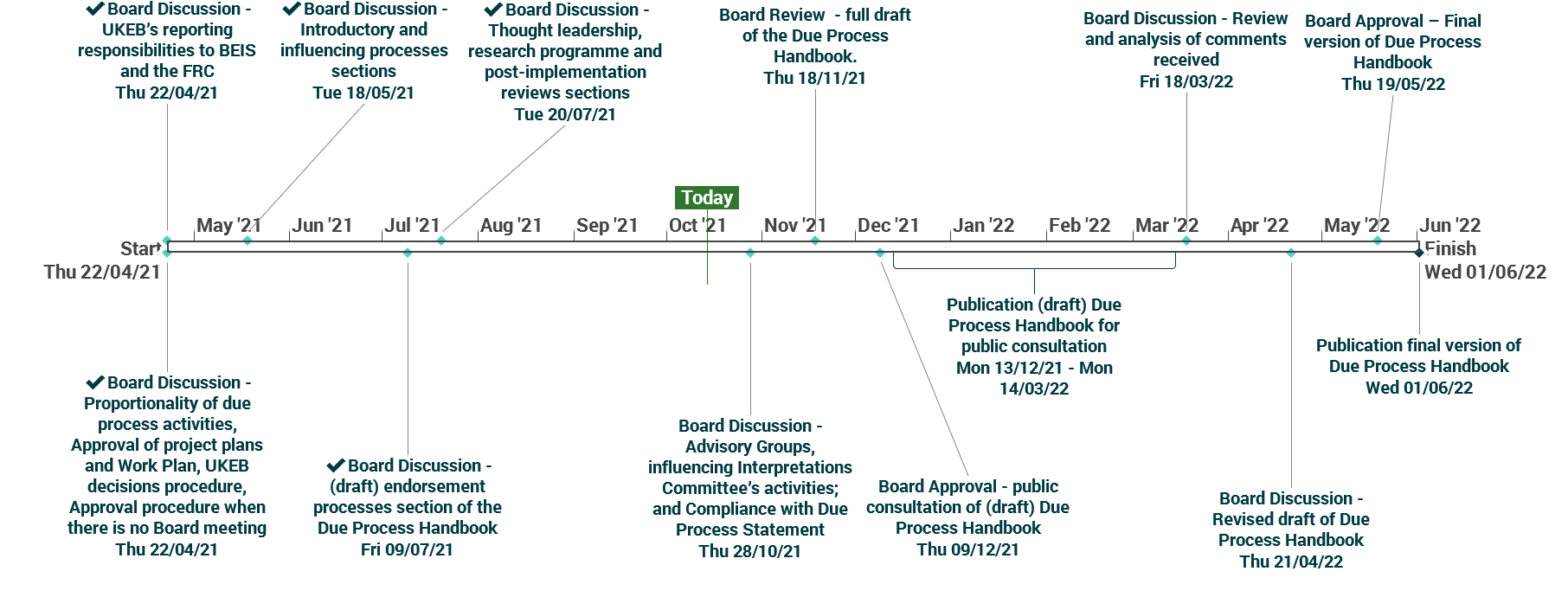
4Our current plan for the completion and future publication of the UKEB's Due Process Handbook is set out in the table below and diagram on the next page.
5As set out below our original plan was to ask the Board members to review the full draft of the Due Process Handbook at the November 2021 meeting and to ask the Board to approve the publication of this draft for public consultation at the December 2021 meeting. We would like to consider an alternative approach where we ask the Board to review and approve this draft for public consultation at the November 2021 meeting, thereby allowing a longer consultation period. We invite views from the Board on this alternative approach.
| Date | At a public Board meeting: |
|---|---|
| 18 November 2021 | Board review of full draft of the Due Process Handbook |
| 9 December 2021 | Board decision on the approval to publish draft Due Process Handbook for consultation |
| w/c 13 December 2021 | Publication of the draft Due Process Handbook for public consultation (3-month comment period until 14 March 2022). |
| Public consultation period | Monday 13 December 2021– Monday 14 March 2022 [~3 months or 90 days] |
| January–March 2022 | Comments received - review and analysis (UKEB Secretariat) |
| Date | At a public Board meeting: |
|---|---|
| 18 March 2022 | Board initial discussion derived from review and analysis of comments received |
| 21 April 2022 | Board review and discussion of revised draft of Due Process Handbook |
| 19 May 2022 | Board approval of final version of Due Process Handbook |
| June 2022 | * Publication of Due Process Handbook |
Due Process Handbook Plan – Upcoming Tasks
High Level Plan
[Draft] Due Process Handbook—Advisory Groups
9 Advisory Groups
Introduction
9.1The UKEB undertakes targeted consultation by appointing its own standing and ad-hoc advisory groups with the purpose of gathering specialist technical advice, views and UK-specific implementation issues on its projects or other technical matters requiring specialist input.
9.2Members of advisory groups comprise subject matter experts that:
- provide advice and recommendations on specific agenda projects for example by sharing:
- knowledge and understanding of financial reporting issues and/or concerns raised by UK stakeholders; and
- up-to-date insight into developments and market sentiment on financial reporting matters, helping develop a timely understanding of any concern areas;
- deliver best practice, practical experience, and expertise as well as potential solutions that can improve the quality of information, and that enhance transparency and accountability; and
- help amplify the UKEB's views across the UK reporting community and drive the debate of contemporary issues in the general corporate reporting community.
Composition of advisory groups
Types of advisory groups
9.4Advisory groups are not decision-making bodies, but advisory in nature and can be standing or ad-hoc. Their characteristics are described below:
| Type | Standing | Ad-hoc |
|---|---|---|
| Duration | Advisory group with an indefinite life. Intended to be long-lived. | Intended to be short-lived for a pre-defined time or set duration and is project-based. |
| Type | Standing | Ad-hoc |
|---|---|---|
| Description | Provides regular and focused input on a wide range of strategic and technical issues. | Provides specialist input on a specific issue or technical project or area of an international accounting standard. May support the implementation and/or transition to a new international accounting standard1 |
| Members | Usually includes stakeholders from a particular industry, sector or stakeholder type (such as preparers, auditors or investors). It can also include a 'mix' of stakeholders with shared interests2. | Reflects a 'mix' of senior professionals from different stakeholder groups but with a specialist knowledge of the specific issue or technical area relevant to the group. |
| Benefits | Enables the Board to access regular and timely advice on areas of specialist knowledge and receive a real-world view of the impact of proposals, generally on major projects. | Benefits are the same as for standing advisory groups. |
Types of participants
9.5Participants in a UKEB's advisory group may originate form the following stakeholder groups:
- Preparers with considerable practical experience of financial reporting and provide knowledge and understanding of the financial reporting issues faced by IFRS reporters. Preparers have backgrounds in large or small, listed or unlisted UK-based companies applying international accounting standards.
- Capital market participants – with practical experience in analysing and using financial information as users of financial reporting information. Capital market participants include "buy-side” fund managers, institutional investors and retail investors as well as participants from "sell-side” investment banks and ratings agencies.
- Academics – researchers with expertise and experience in the use of accounting by individuals, organisations and government. This group could include researchers with interests in accounting policy, governance, quantitative analysis, wider corporate reporting and economics.
- Accounting firms – those with a close interest in the use and implementation of international accounting standards. Accounting firms have insights to share on a range of different sectors' use of international accounting standards and on any concerns arising from that use. They include large and medium-sized professional services firms in the UK.
- Accounting Bodies – with a close interest in the use and implementation of international accounting standards and providing insights on current and emerging issues.
Operating procedures
Approval for the creation of an advisory group
9.6The establishment of an advisory group is subject to Board approval of a majority of Board members.
Terms of reference
9.7Each advisory group has its own Terms of Reference, setting out:
- the advisory group's purpose and responsibilities;
- membership rules;
- meetings and administrative arrangements;
- remuneration for member (if applicable); and
- date of approval of the Terms of Reference and process for making changes.
9.8An outline of the content of the Terms of Reference applicable to each advisory group (i.e. standing or ad-hoc) is included in Appendix [x] of this Handbook3.
Recruitment
9.9Consistent with the UKEB's guiding principles of accountability and transparency, all recruitment for advisory groups should be via a public advertisement, inviting applications. Appointments should be based on interviews with Board members and members of the Secretariat. The Board may wish to retain the option to make the occasional direct appointment, however, this would need to be in exceptional circumstances, for example where there are few experts in a particular area or no other expert is forthcoming.
Appointments and membership
9.10In appointing members, the Chair seeks nominations from anyone possessing relevant expertise, experience and/or viewpoints.
9.11Members are appointed in their personal capacity and may be represented by alternates at the discretion of the Chair.
9.12Membership to an advisory body is subject to ratification by the Board.
9.13Depending on the advisory group's nature and purpose, the UKEB Chair may appoint a Chair for the group who may be either: an advisory group member, an UKEB Board member or a UKEB Secretariat member.
9.14The membership of an advisory group is reviewed on a regular basis with the possibility that members may be appointable for consecutive terms. Changes to appointments arising from such reviews are approved by the Board.
Meetings
9.15Administrative support to the advisory group will be provided by the UKEB secretariat as necessary, including organising meetings and updating members about the project's progress.
9.16Technical papers for meetings of advisory groups will generally be prepared by UKEB Secretariat or members of the advisory group, as appropriate.
9.17Meetings of advisory groups are usually closed and held in private. However, consistent with the UKEB guiding principles of accountability and transparency, the agendas and a summary of the discussions held by advisory groups (without attribution to members) are made available on the UKEB website. Members will be required to treat as confidential all information acquired in the exercise of their function as members. Advice may also sometimes be sought between meeting dates via email, telephone, video conference or other electronic means.
9.18Where the UKEB Secretariat meets in private with an advisory group, it will report a summary of the output from the group to the Board at a public meeting.
9.19Meetings of advisory groups may sometimes be opened to the public and if this is the case, meetings are webcast live (if possible), recorded and the papers discussed made available on the UKEB website. Representatives of other interested organisations that attend as observers may have speaking rights if the Chair deems it beneficial to the work of the group. An advisory group can also, through its Chair, invite other specialists to its meetings for specific agenda items.
9.20Members of advisory groups will be expected to:
- Review all relevant material before the meeting.
- Provide specialist knowledge and technical advice to the Secretariat in line with the purpose and responsibilities of the group's Terms of Reference.
- Make evidence-based and objective contributions, to the extent possible.
- Aim for consensus-building wherever possible and, to that end, should be prepared to be challenged on their views and open to consideration of other members' perspectives.
- Remain respectful and professional in all interactions with other members of the group and with the Secretariat.
- Attend all meetings.
Frequency for ad hoc advisory groups
9.21Once work on a project commences, the Board and/or the UKEB Secretariat may consult advisory groups when it is beneficial to the project to do so.
Effectiveness review
9.22The UKEB will evaluate the purpose, composition, and effectiveness of each advisory committee every three years (or more frequently, if circumstances warrant), to assess whether each group is continuing to serve the function for which it was established. The UKEB revises the Terms of Reference applicable to each advisory group as necessary.
Appendix 3.1.1: [Draft] Terms of Reference outline for advisory groups
Terms of Reference
I Name, purpose and responsibilities
1.1Name [of advisory group], purpose and responsibilities to the Board and/or to the UKEB secretariat.
1.2Guiding principles and compliance with legislative framework.
2 Membership
2.1Composition and the need to perform an annual review of group membership and activities.
2.2Size: minimum and maximum number of members.
2.3Membership terms: Recruitment and appointment process, how often the group membership is reviewed, the length of each term and whether terms can be renewed.
2.4What the Board and/or the UKEB Secretariat expect from the members of the advisory group and consequences of failing to meet the expectations set out in the terms of reference (for example dismissal after non-attendance at a certain number of meetings, etc).
3 Meetings and administrative arrangements
3.1Process for holding meetings:
- Indication of whether meetings are:
- closed and/or open to the public; if meetings are public, an indication of whether observers can attend meetings and/or if they have speaking rights;
- held virtually and/or physically;
- Requirements for attendance and an indication of whether alternates are permitted;
- Location, duration (i.e. number of hours), and frequency (i.e. number of meetings per month and/or per year); and
- Indication of who will act as the Chair of the advisory group;
- make available meeting agendas and papers for the members of the advisory groups before the meeting; and
- publish the agendas and a summary of the output from the group (without attribution to members) on the UKEB website.
3.3If meetings are public, also state obligation to broadcast (and/or record) meetings and to publish agenda papers on the UKEB website.
4 Remuneration for members
4.1Indication of whether members are (or not) remunerated.
4.2Indication of whether members are reimbursed for reasonable travel and other costs incurred in participating in the group's activities.
5 Approval of Terms of Reference and changes
5.1Date of approval of the Terms of Reference and process for making changes to these terms.
[Draft] Due Process Handbook—Influencing the work of the IFRS Interpretations Committee
10 Influencing the work of the IFRS Interpretations Committee
Introduction
10.1The IFRS® Interpretations Committee (Interpretations Committee) is the IASB's interpretative body that “assists the [IASB] Board in improving financial reporting through timely assessment, discussion and resolution of financial reporting issues identified to it within the IFRS framework”4. It does so by, among other things:
- recommending to the IASB to add a standard-setting project to its work plan when certain criteria in the IFRS Due Process Handbook5 are met. This is done in the form of a proposal for a narrow-scope amendment or an annual improvement, i.e. amendments that meet the IASB's criteria for annual improvements or for narrow-scope amendments6;
- developing a proposal for a Draft IFRIC Interpretation (that is later ratified by the IASB); and
- recommending that the IASB does not add a standard-setting project to its work plan, instead publishing an agenda decision to address application questions7.
Supporting the work of the Interpretations Committee
10.2The UKEB supports the IASB's and the Interpretations Committee's work by ensuring that UK views are considered during the development and improvement of international accounting standards (including IFRIC Interpretations). This is achieved by:
- monitoring the work of the Interpretations Committee;
- influencing proposals for annual improvements, narrow-scope amendments and/or Draft IFRIC Interpretations;
- considering whether to contribute comment letters on tentative agenda decisions issued by the Interpretations Committee; and
- informing the Interpretations Committee and/or the IASB of significant issues raised or identified by UK stakeholders for potential inclusion in their work programme.
(a) Monitoring Interpretations Committee work
10.3The UKEB Secretariat monitors projects developed by (or with the assistance of) the Interpretations Committee and reports them to the Board on a regular basis (i.e. proposals for amendments, IFRIC Interpretations or tentative agenda decisions).
10.4The UKEB Secretariat may consider:
- undertaking outreach activities ahead of the Interpretations Committee issuing proposals before a due process document is published; and
- delivering an update on matters discussed at Interpretations Committee meetings at Board meetings, with the objective of raising awareness at UKEB meetings on the issues being discussed; whether the Board would like to respond and possible interactions with the UKEB's other activities and projects.
(b) Influencing proposals for amendments or Draft IFRIC Interpretations
10.5The UKEB follows the requirements of paragraph 5.8 in Section 58 of this Handbook for influencing proposals for annual improvements, narrow-scope amendments and/or Draft IFRIC Interpretations.
(c) Considering whether to respond to a tentative agenda decision
10.6The UKEB expects to respond to a limited number of tentative agenda decisions published by the Interpretations Committee. This may be, for example, in cases where the tentative agenda decision is expected to attract significant interest from UK stakeholders due to the issues included in the tentative agenda decision being controversial in the UK.
10.7When the Board reviews the update on the Interpretations Committee's activities it can then decide whether to respond to a tentative agenda decision.
10.8If an issue discussed by the Interpretations Committee arises outside the usual Board meeting cycle, the Chair can approve initiation of work on the tentative agenda decision.
Project milestones for tentative agenda decisions
10.9The UKEB will broadly follow the milestones in paragraph 5.8 in Section 59 of this Handbook to influence tentative agenda decisions issued by the IFRS Interpretations Committee that it considers to have relevance for the UK. However, these milestones will only be followed to the extent they are appropriate or possible. For example, for tentative agenda decisions it may be more appropriate to consult with a representative group of stakeholders and/or with members of the UKEB's standing and/or ad-hoc advisory groups, rather than making a Draft Comment Letter available for comment on the UKEB website.
10.10The activities undertaken to achieve these milestones should be proportionate to the technical issue(s) being addressed and will depend on its significance for UK stakeholders and on its complexity. The Project Initiation Plan will outline the approach to the technical issue(s) being addressed and describe how the approach taken meets due process requirements.
10.11After considering comments from UK stakeholders on tentative agenda decisions, the UKEB may decide to recommend that the Interpretations Committee:
- confirms the Interpretations Committee's decision to publish an agenda decision;
- revises (or abandons) the Interpretations Committee's decision; or
- refers the matter to the IASB to consider adding a standard-setting project to the IASB's work plan.
(d) Informing the Interpretations Committee of significant issues raised by UK stakeholders
10.12The UKEB may decide to inform the IFRS Interpretations Committee of issues raised or identified by UK stakeholders as potential agenda items (i.e. for potential inclusion on the IASB's and/or IFRS Interpretations work programme). In doing so, the UKEB follows the procedures for the ‘Identification of Matters’ in the IFRS Due Process Handbook10.
[Draft] Due Process Handbook—IFRS Interpretations Committee activities
Appendix 3.2.1: Relevant extracts from section 5 (Influencing processes) of the [revised Draft] Due Process Handbook®
5 Influencing process
Overview of the UKEB influencing process
5.8The mandatory milestones expected to be achieved for influencing projects (except for the situations explained in paragraph 5.10) are:
- Project initiation plan.
- Desk-based research.
- Outreach.
- Draft comment letter.
- Final comment letter.
- Project closure, including Feedback statement and Due Process Compliance Statement.
5.9The activities undertaken to achieve the milestones in paragraph 5.8 should be proportionate to the technical issue(s) being addressed and will depend on its significance for UK stakeholders and on its complexity (i.e. nature or scope). For example, it is expected that for 'major' projects or for complex projects with major amendments, the activities undertaken would be far more extensive than for other 'minor' projects (i.e. amendments that meet the IASB's criteria for annual improvements or for narrow-scope amendments), where some activities such as desk-based research or outreach activities may be somewhat more limited.
5.10For 'urgent' amendments and for tentative agenda decisions issued by the IFRS Interpretations Committee the UKEB will follow broadly the milestones in paragraph 5.8. However, these milestones will only be followed to the extent they are appropriate or possible. For example, making a Draft Comment Letter available for consultation for influencing an urgent amendment or a tentative agenda decision, may not be possible and instead, consulting with a representative group of stakeholders and/or with members of the UKEB's standing and/or ad-hoc advisory groups may be appropriate. However, the UKEB Secretariat should explain what steps will be undertaken and why some steps are being omitted, for Board approval.
[Draft] Due Process Handbook—Due Process Compliance Statement
II Due Process Compliance Statement
Introduction
11.1For each project, the UKEB Secretariat assesses whether it has complied with the UKEB's mandatory (and non-mandatory) due process activities as set out in Section 4 (mandatory activities), Section 5 (Influencing Process), Section 6 (Endorsement Process) and Section 7 (Thought leadership and research programme) of this Handbook.
11.2The UKEB Secretariat summarises the due process activities undertaken in a closing control report called "Due Process Compliance Statement". This report fulfils the following objectives:
- provides a record of the activities undertaken by the UKEB Secretariat to comply with the UKEB's due process activities;
- provides a basis for holding the UKEB Secretariat accountable to the Board for the due process procedures that it follows in practice; and
- informs the Board about the work undertaken compared with that agreed in the Project Initiation Plan (PIP). The Due Process Compliance Statement retrospectively validates that the process undertaken complied with the PIP (or not). If discrepancies are identified this report provides an explanation as to why, and how the activities still meet due process requirements.
11.3The Due Process Compliance Statement includes the following sections:
- Project details:
- If influencing an IASB's due process document: title, date of publication and comment letter deadline;
- If a UKEB's thought leadership/research project: project title, date of publication, comment letter deadline (if applicable); or
- If endorsing an IASB standard or amendment: title, date of publication and the IASB's effective date.
- A description of due process steps undertaken covering the following areas:
- Project preparation (i.e. the PIP and desk-based research);
- Communications (e.g. public meetings, documents posted on UKEB website);
- Outreach activities (e.g. advisory groups, fieldwork undertaken);
- Preparation of documents for public comment (e.g. draft comment letter for influencing activities);
- Project finalisation and project closure (e.g. final comment letter, feedback statement for influencing activities);
- Metrics or evidence to demonstrate that the process was undertaken as agreed in the Project Initiation Plan (e.g. number of meetings held);
- An explanation of why the UKEB Secretariat decided not to undertake a non-mandatory due process step for a given project, if relevant (i.e. why an outreach activity specified in the PIP was not undertaken); and
- A conclusion as to whether, in the UKEB secretariat's opinion, applicable due process steps have been complied with.
11.5A Due Process Compliance Statement is published on the UKEB's website, usually at the same time as the Feedback Statement12.
Appendix 3.3.1: Templates for Due Process Compliance Statement
This Appendix presents two reporting templates for demonstrating to the UKEB how the Secretariat has met the UKEB's due process requirements.
The first template focuses on the due processes followed for influencing international accounting standards using a real-life example (i.e. the project on Rate-Regulated Activities).
The second template focuses on the due processes followed for endorsing and adopting international accounting standards and has been left blank.
The Secretariat does not intend that these templates be an integral part of the Due Process Handbook and they are just presented in this paper for illustration purposes.
Both templates are presented on the next page.
Due Process Compliance Statement: Template for influencing process
This is a reporting template for demonstrating how the UKEB Secretariat has met its due process requirements. This report may be updated from time to time by the UKEB and its Secretariat.
Influencing process
General UKEB requirements: The UKEB influences early in the IASB's standards development cycle in accordance with SI 2019/685 and applies its own processes to ensure new standards address UK concerns and issues.
| Step | Required / Optional | Metrics or evidence | UKEB secretariat comments |
|---|---|---|---|
| Influencing process: Rate-Regulated Activities | |||
| IASB's due process document | |||
| Exposure Draft ED/2021/1 Regulatory Assets and Regulatory Liabilities | Published: 28/01/2021 Comment deadline: 30/07/2021 | ||
| Project preparation | |||
| Technical project added to UKEB technical work plan and discussed | Required | Technical work plan is clear as to scope, timing and other critical aspects of effective planning | Included in PIP |
| Project preparation and Project Initiation Plan (PIP) | Required | PIP draft with outline and approach for influencing project (proportionate to the project) | Yes |
| Required | Assessment of whether to set up an ad-hoc advisory group | Not assessed due to limitation of resource during the early part of this year the UKEB secretariat resource was limited and had to be focused on other priorities that were vital to the setting up of the UKEB, other more significant influencing projects or urgent UK adoption projects. | |
| Required | Assessment of amount of fieldwork to undertake (i.e. surveys, field tests, workshops or interviews, public events) | Yes, outreach will be focused on preparers that have regulatory agreements with 1-2-1 meetings and a survey of users with direct interest in these types of entities | |
| Required | Assessment of whether to involve participation of IASB members or staff in UK outreach events | Yes | |
| Required | Outreach plan for stakeholders outlined and communication approach | Yes | |
| Required | Resources allocated | 1 SPD (Annette Davis) 1 PM (Nkumbulo Mabaso) | |
| Required | UKEB Board public meeting held to approve PIP | Yes, approved 18/05/2021 meeting | |
| Optional | UKEB Education or initial assessment | No, due to the resource constraints and late commencement of project. A brief outline of the ED was given when discussing the PIP | |
| Desk-based research | |||
| Required | Identify relevant research sources and documents | Yes | |
| Optional | Agree hypothesis & questions for research | No | |
| Communications | |||
| Communications | Required | UKEB Board public meetings held to discuss technical project | Yes, 18/05/2021 Approve PIP; 09/07/21 Approve DCL; 17/09/2021 Approve Feedback statement |
| Required | Meeting papers posted and publicly available on a timely basis. | Yes | |
| Required | Project website contains a full description with up-to-date information on the project | Yes | |
| Required | Update UKEB Website | Yes | |
| Required | Evidence that subscriber alerts have occurred | Yes | |
| Optional | Project email address | No, used general email address given the limited outreach being undertaken | |
| Outreach activities | |||
| Advisory groups | |||
| Discussion with standing advisory groups | Optional | Number of advisory group meetings, and evidence of substantive involvement in issues (will depend on nature and size of project and timing of advisory groups meetings) | No, these groups have not yet been set up |
| Optional | Advisory group discussion of Draft Comment Letter | N/A | |
| Discussion with ad-hoc advisory group | Optional | Number of advisory group meetings, and evidence of substantive involvement in issues (will depend on nature and size of project and timing of advisory groups meetings) | No, as no group for RRA has been set up |
| Optional | Advisory group discussion of Draft Comment Letter | N/A | |
| Fieldwork undertaken | |||
| Public events, roundtables, workshops or interviews with specific groups of stakeholders | Optional | Number of meetings held and venues documented | Interviews with 2 preparers likely to be in scope of proposals |
| Optional | Approach identified and brief to panellists/presenters | N/A | |
| Optional | Slides created and any other materials | N/A | |
| Optional | Briefing for Technical Director/Chair | N/A | |
| Online survey | Optional | Number and results of surveys | No, PIP proposed a survey of users but lack of resource and time meant that this was not done |
| Field tests | |||
| Optional | Develop surveys and analyse survey results | N/A | |
| Optional | Number and results of field tests | N/A | |
| Optional | Develop field tests and analyse field test results | N/A | |
| Discussion with IASB, EFRAG and/or other NSS | Optional | Number of meetings held | Discussions with IASB staff, EFRAG staff, AcSB staff AASB staff and the UK Government FREM staff |
| UKEB draft comment letter | |||
| Draft comment letter | Optional | Prepare skeleton and gain internal feedback | No |
| Required | UKEB secretariat sets comment period for response | Yes | |
| Required | Full (draft) comment letter drafted | Yes | |
| Required | Number of UKEB public meetings held for review and approval, in public meeting | Yes, approved 09/07/2021 meeting | |
| Required | Draft comment letter posted on UKEB Website for public consultation | Yes, published 14/07/2021 | |
| Required | News Alert published to announce publication | Yes | |
| UKEB final comment letter | |||
| Final comment letter | Required | Public responses on draft comment letter assessed and posted on website | Yes, we received 1 response |
| Optional | Prepare skeleton and gain internal feedback | No | |
| Required | Number of UKEB public meetings held for review and approval of final comment letter, in public meeting | At 09/07/2021 meeting it was agreed that due to the deadline of 30/07/2021 a sub-group of Board members would review and approved FCL. Sub-group met on 29/07/2021 and approved FCL | |
| Required | Publish final comment letter on UKEB website and submit to IASB | Yes, on 05/08/2021 | |
| Optional | Send final comment letter to national standard-setters and those who have been consulted and others as appropriate | No | |
| Finalisation | |||
| Feedback statement | Required | Draft Feedback Statement for discussion and review at UKEB public meeting | Yes |
| Required | Number of UKEB public meetings held for discussion and approval of feedback statement, in public meeting | Yes, approved 17/09/2021 meeting. | |
| Required | Feedback Statement posted on UKEB Website | Board has not yet agreed on Due Process Compliance Statement section of the DPH and this is an example | |
| Optional | Send publication to those who have been consulted | No | |
| Required | News Alert published to announce publication | Yes | |
| Compliance with Due Process Statement | Optional | Meeting held to review due process steps taken | No |
| Required | Compliance with due process steps statement approved by UKEB in public meeting | Board has not yet agreed on Due Process Compliance Statement section of the DPH and this is an example | |
| Required | Due Process Compliance Statement posted on UKEB Website | N/A | |
| Required | News Alert published to announce publication | N/A |
Conclusion
The PIP explained that the early part of 2021, when the ED was published, the UKEB Secretariat resource was limited and had to be focused on other priorities that were vital to the setting up of the UKEB, other more significant influencing projects or urgent UK adoption projects. The PIP also explained the project was likely to have a significant impact for the small number of UK entities that will be within the scope of the project. Consequently, the activities related to this project were limited and one of the activities, a survey of users was not undertaken.
Approval
Do the Board approve the Rate-Regulated Activities Due Process Compliance Statement for publication?
Due Process Compliance Statement: Template for endorsement process
This is a reporting template for demonstrating how the UKEB Secretariat has met its due process requirements. This report may be updated from time to time by the UKEB and its Secretariat.
Endorsement process
General UKEB requirements: The UKEB adopts international accounting standards for use within the UK, in accordance with SI 2019/685 and applies its own processes before it decides to endorse and adopt a new or amended international accounting standard.
| Step | Required / Optional | Metrics or evidence | UKEB secretariat comments |
|---|---|---|---|
| Endorsement process: [name of project] | |||
| IASB's due process document | |||
| [Title of Standard/Amendment] | Published: [date] Effective date: [date] | ||
| Project preparation | |||
| Project preparation and Project Initiation Plan (PIP) | Required | PIP draft with outline and approach for influencing project (proportionate to the project) | |
| Required | Assessment of whether to set up an ad-hoc advisory group | ||
| Required | Assessment of amount of fieldwork to undertake (i.e. surveys, field tests, workshops or interviews, public events) | ||
| Required | Assessment of whether to involve participation of IASB members or staff in UK outreach events | ||
| Required | Outreach plan for stakeholders outlined and communication approach | ||
| Required | Resources allocated | ||
| Required | UKEB Board public meeting held to approve PIP | ||
| Optional | UKEB Education or initial assessment | ||
| Desk-based research | |||
| Required | Identify relevant research sources and documents | ||
| Optional | Agree hypothesis & questions for research | ||
| Communications | |||
| Communications | Required | UKEB Board public meetings held to discuss technical project | |
| Required | Meeting papers posted and publicly available on a timely basis. | ||
| Required | Project website contains a full description with up-to-date information on the project | ||
| Required | Update UKEB Website | ||
| Required | Evidence that subscriber alerts have occurred | ||
| Optional | Project email address | ||
| Optional | Number of webcasts and podcasts held to provide interested parties with high level updates or other useful information about the technical project | ||
| Optional | Educational materials for UKEB made public and posted on website | ||
| Draft Endorsement Criteria Assessment (DECA) | |||
| Draft DECA | Optional | Prepare skeleton and gain internal feedback | |
| Required | UKEB sets comment period for response on DECA (usually 4 weeks) | ||
| Required | Full (draft) DECA drafted | ||
| Required | Number of UKEB public meetings held for review and approval, in public meeting | ||
| Required | DECA posted on UKEB Website for public consultation | ||
| Required | News Alert published to announce publication | ||
| Outreach activities | |||
| Advisory groups | |||
| Discussion with standing advisory groups | Optional | Number of advisory group meetings, and evidence of substantive involvement in issues (will depend on nature and size of project and timing of advisory groups meetings) | |
| Optional | Advisory group discussion of DECA | ||
| Discussion with ad-hoc advisory group | Optional | Number of advisory group meetings, and evidence of substantive involvement in issues (will depend on nature and size of project and timing of advisory groups meetings) | |
| Optional | Advisory group discussion of DECA | ||
| Fieldwork undertaken | |||
| Public events, roundtables, workshops or interviews with specific groups of stakeholders | Optional | Number of meetings held and venues documented | |
| Optional | Approach identified and brief to panellists/presenters | ||
| Optional | Slides created and any other materials | ||
| Optional | Briefing for Technical Director/Chair | ||
| Online survey | Optional | Number and results of surveys | |
| Optional | Develop surveys and analyse survey results | ||
| Field tests | Optional | Number and results of field tests | |
| Optional | Develop field tests and analyse field test results | ||
| Discussion with IASB, EFRAG and/or other NSS | Optional | Number of meetings held | |
| Finalisation | |||
| Voting | |||
| Vote on adoption package | Required | Evidence of written vote (in paper or electronic form) | |
| Adoption package | |||
| Final Endorsement Criteria Assessment (ECA) | Required | Public responses on ECA assessed and posted on website | |
| Optional | Prepare skeleton and gain internal feedback | ||
| Required | Number of UKEB public meetings held for review and approval of final ECA, in public meeting | ||
| Required | Publish final ECA on UKEB website | ||
| Optional | Send final ECA to national standard-setters and those who have been consulted and others as appropriate | ||
| Feedback statement | |||
| Required | Draft Feedback Statement for discussion and review at UKEB public meeting | ||
| Required | Number of UKEB public meetings held for discussion and review and approval of feedback statement, in public meeting | ||
| Required | Feedback Statement posted on UKEB Website | ||
| Optional | Send publication to those who have been consulted | ||
| Required | News Alert published to announce publication | ||
| Due Process Compliance Statement | |||
| Optional | Meeting held to review due process steps taken | ||
| Required | Compliance with due process steps statement approved by UKEB in public meeting | ||
| Required | Due Process Compliance Statement posted on UKEB Website | ||
| Required | News Alert published to announce publication | ||
| Adoption statement | |||
| Optional | Meeting held to review adoption statement | ||
| Required | Adoption statement approved by UKEB in public meeting | ||
| Required | Adoption statement posted on UKEB Website | ||
| Required | News Alert published to announce publication |
Conclusion
[Conclude whether in the UKEB secretariat's opinion, applicable due process steps have been complied with].
Approval
Do the Board approve the [Project name] Due Process Compliance Statement for publication?
Footnotes
-
This may be the case for an advisory group providing expert perspectives (for example, in the operation of rate-regulatory schemes) or providing input on the implementation of new requirements in an international accounting standard. ↩
-
For example, accounting bodies and auditors have both a close interest in the use and implementation of international accounting standards and both have insights to share on the use of standards and on any concerns arising from that use. ↩
-
[Refer to Appendix 3.1.1 in this paper.] ↩
-
Refer to paragraph 1.3 in the IASB and IFRS Interpretations Committee Due Process Handbook, IFRS Foundation, (August 2020). The Conceptual Framework describes the objective of and concepts for general purpose financial reporting. It is a practical tool that helps the Board to develop requirements in IFRS Standards based on consistent concepts (refer to paragraph 4.20 in the same Handbook). ↩
-
Refer to paragraph 5.16 in the IASB and IFRS Interpretations Committee Due Process Handbook. ↩
-
'Annual improvements' are amendments that meet the criteria in paragraphs 6.10-6.14 in the IASB and IFRS Interpretations Committee Due Process Handbook and are sufficiently minor or narrow in scope that are bundled together in a single Exposure Draft document (even though amendments are unrelated). Narrow-scope' amendments do not meet the criteria for annual improvements but meet the criteria in paragraph 5.16 in the same Handbook and are considered 'narrow' in scope. ↩
-
Agenda decisions explain why a standard-setting project has not been added to the IASB's work plan to address a question submitted and, in many cases, include explanatory material that explains how the applicable principles and requirements in IFRS Standards apply to the transaction or fact pattern described in the agenda decision. Refer to paragraphs 8.3-8.7 in the IASB and IFRS Interpretations Committee Due Process Handbook. ↩
-
[We have reproduced (revised) paragraph 5.8 of the Handbook in Appendix 1 of this paper]. ↩
-
[We have reproduced (revised) paragraph 5.8 of the Handbook in Appendix 1 of this paper]. ↩
-
Refer to paragraphs 5.15 to 5.16 in the IASB and IFRS Interpretations Committee Due Process Handbook. ↩
-
The UKEB Secretariat is in the process of issuing a revised version of the Due Process Handbook. This Appendix reproduces the proposed revised wording for paragraphs 5.8–5.10 in our working draft. ↩
-
A Feedback Statement is a mandatory due process activity as set out in Section 5 (Influencing Process), Section 6 (Endorsement Process) and Section 7 (Thought leadership and research programme) of this Handbook. ↩