10.0 IASB Agenda Consultation – Approve final comment letter and feedback statement
UK ENDORSEMENT BOARD 17 SEPTEMBER 2021 AGENDA PAPER 10
Executive Summary
| Project Type | Influencing |
| Project Scope | Significant |
| Purpose of the paper | |
| The purpose of this paper is to seek the Board's approval to publish the UKEB's Final Comment Letter and Feedback Statement on the IASB's Third Agenda Consultation ('Agenda Consultation'). | |
| Summary of the Issue | |
| The IASB's Third Agenda Consultation was published in March 2021 and IASB's deadline for comments is 27 September 2021. The IASB's Request for Information seeks respondents' views on: | |
| - the strategic direction and balance of the IASB's activities; | |
| - the criteria for assessing the priority of financial reporting issues that could be added to the work plan; and | |
| - new financial reporting issues that could be given priority in the IASB's work plan. | |
| The UKEB's draft response was approved for publication at the UKEB 9 July 2021 board meeting, and the comment period closed on 31 August 2021. The updated response is now presented to the Board for approval for publication. | |
| Decisions for the Board | |
| Board members are asked to: | |
| 1. approve the final response to the IASB. | |
| 2. approve the feedback statement for publication on UKEB's website. | |
| Recommendation | |
| We recommend the Board approves the UKEB Final Comment Letter and Feedback Statement. | |
| Appendices | |
| Appendix 1 Final Comment Letter – Third Agenda Consultation | |
| Appendix 2 Feedback Statement – Third Agenda Consultation |
Background
1The IASB's Request for Information: Third Agenda Consultation¹ was published in March 2021 with a comment deadline of 27 September 2021.
2The Agenda Consultation seeks respondents' views on:
- The strategic direction and balance of the IASB's activities;
- The criteria for assessing the priority of financial reporting issues that could be added to the work plan; and
- Projects that should be given priority in the IASB's work plan.
3At the April 2021 UKEB meeting:
- The Board approved staff's proposed high-level work plan.
- The Board agreed on the following potential high priority projects for consultation with stakeholders: climate-related risks; cryptocurrencies and related transactions; discount rates; government grants; intangible assets and statement of cash flows (including supply chain financing).
- The Board agreed that staff should explore the possibility of recommending that IASB take a thematic approach to projects, whereby the impact of a project across all Standards would be addressed within the project scope.
4At the May 2021 UKEB meeting:
- The Board approved staff's detailed workplan.
- The Board agreed that the response to the IASB should recommend prioritising a small number of high priority projects, commensurate with IASB's indications of available resource (2 – 3 large projects or equivalent). The Board agreed that any other projects should be designated low priority.
- The Board asked staff to review the current IASB workplan for projects that could be delayed or removed to free up capacity.
5At the July 2021 UKEB meeting:
- The Board approved the draft response for publication following the staff's presentation of the results of initial outreach. The published draft response recommended that IASB should:
- Retain sufficient flexibility in its work plan to interact with any future international sustainability standards board
-
- Allocate more resource to digital reporting
- Include a structured and visible research programme within its standard-setting activity
- Prioritise three large high priority projects: climate-related risks, intangible assets, and statement of cash flows and related matters. The intangibles project should scope in crypto-currencies and pollutant pricing mechanisms. All other potential projects identified by the IASB should be treated as low priority.
- Take a thematic approach to the climate-related risks and intangible assets projects, considering the impact of the projects across all Standards to support consistency and efficiency.
- Consider whether any projects on its current work plan could be paused in order to free up resource for the priorities above; specifically, that the Second Comprehensive Review of IFRS for SMEs and the Management Commentary projects should be paused and that the Extractive Activities project should be rationalised.
- The Board re-emphasised that IASB's proposed projects should be categorised as either high or low priority. The concept of a second-tier group of projects was rejected by the Board.
- The Board asked staff to consult with users of IFRS for SMEs on the proposal to pause the Second Comprehensive Review of IFRS for SMEs project.
- The Board asked staff to provide more detail in the illustration of the thematic approach in Appendix 2 to the draft response, and to expand it to cover intangible assets as well as climate-related risks.
Update
6The draft comment letter was published on the website for stakeholder consultation on 14 July 2021. The opportunity to respond to the draft comment letter has been promoted on LinkedIn and board members were tagged in the post.²
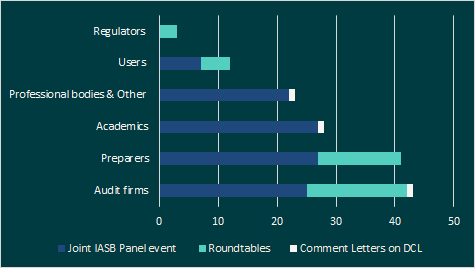
7The UKEB hosted a joint virtual outreach event on 15 July with the IASB. The audience of 108 was made up of 7 users, 27 preparers, 25 auditors, 27 academics and 22 professional body and independent registrations. A recording of the event was subsequently posted on the UKEB's YouTube channel³ and had received 41 views as of 10 September 2021. The event was promoted on LinkedIn and the promotion scored highly on social media engagement statistics.⁴
8Comments and questions from the audience during the outreach event highlighted:
2 https://www.linkedin.com/company/uk-endorsement-board/posts/?feedView=all 3 https://www.youtube.com/watch?v=8BioOiS1JDc&feature=youtu.be 4 High social media engagement scores in comparison to data provided by FRC Comms team for similar events.
- The rise in ESG reporting and the importance of the climate-related risks project;
- The need for IASB to allocate more resource to digital;
- The increasing value of intangibles in the UK economy and the recognition that current financial reporting does not provide sufficient relevant information on intangibles;
- Support for a cross-cutting approach to projects; and
- Appetite for standard-setting where it can significantly enhance benefits for users.
9We received 3 responses to the draft comment letter. One response was from an audit firm and two responses were from individuals. The audit firm and one individual were broadly supportive of our proposals and made some additional points of emphasis or drafting recommendations which we have reflected in our final draft and which are summarised in paragraph 12 below. The second individual recommended several changes to our draft response. Changes recommended by respondents for which we have not updated our response are summarised in paragraph 13 together with the reasons why we chose not to make those changes.
10We believe that the relatively low number of responses is attributable to:
- Widespread support from UK stakeholders for the recommendations in the UKEB draft comment letter. Our initial outreach ahead of the draft comment letter highlighted that the views of different stakeholder groups were largely convergent. Subsequent informal outreach with other stakeholders has also confirmed that their views are aligned to those highlighted in the UEKB draft comment letter, reducing the impetus for them to respond to us.
- The BEIS consultation on Restoring Trust in Audit and Corporate Governance,⁵ which closed on 8 July 2021, having consumed stakeholder bandwidth for consultation responses.
- Publication of the draft comment letter coinciding with the summer vacation period.
11In total 150 stakeholders engaged with the project through round tables, the joint IASB webinar, and responses to the draft comment letter, so we are satisfied with the overall level of stakeholder engagement on the project.
Amendments to draft comment letter
12The draft response has been updated in response to stakeholder feedback for several points of emphasis and clarity, as follows:
5 https://www.gov.uk/government/consultations/restoring-trust-in-audit-and-corporate-governance-proposals-on-reforms
| Added a specific comment that some of the Extractive Activities project content could be incorporated into a broader project on intangibles. | Paragraph 1d |
| Emphasised the potential benefits of the Management Commentary project as well as the benefits of pausing it until the role of ISSB in this area is understood. | Paragraph 1d |
| Reflected respondent feedback that projects should address user needs. | Paragraph 4 |
| Reflected respondent feedback that project on statement of cash flows and related matters should consider consistency with existing IASB projects on presentation and disclosure more generally, rather than focus narrowly on whether the current voluntary disclosures in IAS 7 should become mandatory. | Paragraph 4c |
| Amended proposed redraft of IASB's second criteria for prioritising projects to prevent prioritisation of projects where there are few or no practical issues in application. | Paragraph A4a |
| Clarified that IASB's proposed amendment to IAS 1 in respect of estimation uncertainty relates to disclosure rather than measurement. | Paragraph A9a i |
13We did not update the UKEB comment letter for the following points raised by stakeholders for the reasons given below:
- Comment. IASB's RFI assumes that current resource levels are adequate but then dismisses large projects on the grounds that they require resources that IASB does not have. The UKEB's response accepts that IASB's resources are limited. UKEB staff view. We note that IASB's RFI explains in paragraph 17 that even if IASB were to significantly increase its resources and therefore its activities, stakeholders might have insufficient capacity to engage with the Board, provide high-quality feedback on proposals or implement changes that results from those proposals. We agree with IASB's assessment that stakeholder bandwidth to implement changes is limited.
- Comment. The UKEB's response accepts that opinions of stakeholders, especially investors, are paramount in considering IASB's priorities. UKEB staff view. We agree with this observation and believe this position is key to remaining relevant. We also believe this position is consistent with the Conceptual Framework's statement that the objective of general-purpose financial reporting is: 'to provide financial information about the reporting entity that is useful to existing and potential investors, lenders and other creditors in making decisions relating to providing resources to the entity.' (Conceptual Framework 1.2)
- Comment. Tax, government grants, discount rates and inflation should be categorised as medium priority. UKEB staff view. In view of previous UKEB Board discussions on the benefits of categorising proposed projects as either high or low priority, we have not reinstated a medium priority category.
14We have also updated the draft response with some drafting improvements as shown in track changes in appendix 1.
15Following the guidance from the Board in the 9 July 2021 Board meeting, we reached out to the FRC to ascertain their views on the proposal to pause the Second Comprehensive Review of IFRS for SMEs project in their capacity as the UK GAAP
Approval to publish
16As of 10 September 2021, thirteen comment letters in response to the Third Agenda Consultation had been submitted to IASB. The majority expressed strong support for the IASB to prioritise how it will work with the ISSB. The majority identified climate-related risk and intangibles as high priority projects.
17We have complied with the current due process in project delivery by completing and not deviating from the steps on the work plan approved by the Board at its meeting on 18 May 2021.
18A feedback statement, summarising the overall stakeholder feedback is included at Appendix 2 to this paper.
Questions for the Board
| 19. | 19Do Board members approve the response for publication? |
| 20. | 20Do Board members approve the feedback statement for publication? |
Next steps
21Subject to Board members' comments on the points above, we intend to submit the UKEB final response to the IASB and publish it, together with the feedback statement, on the UEKB website.
22We intend to continue to publicise the UKEB's views on the Agenda consultation and will continue to look out for appropriate opportunities. In recent days, we have accepted the following: we presented on the UKEB response to the Agenda Consultation to the Corporate Reporting Users Forum (CRUF) at its 8 September meeting.
23We are working with the ICAEW (Institute of Chartered Accountants in England and Wales) to publish an article in their Daily Update to members, to coincide with our publication of the UKEB response to the Agenda Consultation.
UK ENDORSEMENT BOARD 17 SEPTEMBER 2021 AGENDA PAPER 10: APPENDIX 1
Dr Andreas Barckow IASB Chair International Accounting Standards Board 7 Westferry Circus Canary Wharf London E14 4HD
(Date)
Dear Dr Barckow
Request for Information: Third Agenda Consultation
The UK Endorsement Board (UKEB) is responsible for endorsement and adoption of IFRS for use in the UK and therefore is the UK's National Standard Setter for IFRS. The UKEB also leads the UK's engagement with the IFRS Foundation (Foundation) on the development of new standards, amendments and interpretations. This letter forms part of those influencing activities and is intended to contribute to the International Accounting Standards Board's (IASB) due process. The views expressed by the UKEB in this letter are separate from, and will not necessarily affect the conclusions in, any endorsement and adoption assessment on new or amended International Accounting Standards undertaken by the UKEB. This letter forms part of those influencing activities and is intended to contribute to the International Accounting Standards Board's (IASB) due process. The views expressed by the UKEB in this letter are separate from, and will not necessarily affect the conclusions in, any endorsement and adoption assessment on new or amended International Accounting Standards undertaken by the UKEB.
There are currently approximately 1,600 listed entities in the UK¹ using IFRS Standards. In addition, unlisted companies have the option to use IFRS and a significant number take up this option.
We welcome the opportunity to respond to the IASB's Third Agenda Consultation. We performed both desk-based research and outreach with our stakeholders to develop our views and to assess their implications for the IASB's future work plan. Our comments on the IASB's Request for Information (RFI) summarise that work and outreach. For detailed responses to the questions in the RFI please see appendix 1 to this letter.
IASB's strategic direction and balance of activities
1At a strategic level we recommend that the IASB reallocates resource to ensure that it:
1 Entities with securities admitted to trading on a UK regulated market. Securities includes listed debt as well as shares.
UK Endorsement Board email: [email protected] website: www.endorsement-board.uk UK Endorsement Board | 8th Floor | 125 London Wall | London | EC2Y 5AS
UK ENDORSEMENT BOARD 17 SEPTEMBER 2021 AGENDA PAPER 10: APPENDIX 1
- retains sufficient flexibility in its workplan to address the interaction between IFRS and any future international sustainability standards developed by its proposed sister Board, the International Sustainability Standards Board (ISSB). As a minimum, we think this will need to include co-ordination with the ISSB on any areas of overlap;
- allocates more resource to its work on digital financial reporting. This work should explore how advances in technology are changing the way investors consume information and assess the extent to which any changes are needed to the IFRS taxonomy and the way in which the Board writes Standards;
- adds to its work on Standards development a structured and cohesive research plan which anticipates and addresses emerging issues. To help alleviate pressure on IASB's resources, the IASB could coordinate with National Standard Setters' research programmes. If an agreement on the scope of the research project can be achieved, then drawing on local expertise and knowledge base in certain jurisdictions may help build capacity and expedite project delivery; and
- that it resources the above priorities
above areas identified in a-c aboveby- Pausing the Second Comprehensive Review of IFRS for SMEs. The IASB's mission is to develop Standards that bring transparency, accountability and efficiency to financial markets around the world, and we recommend that in a time of resource constraint, the most pressing projects underpinning this core mission are prioritised. The IFRS for SMEs is non-mandatory and none of our stakeholders have identified it as currently requiring a comprehensive review.
- Pausing the Management Commentary project. Whilst we recognise the potential for this project to develop user-relevant disclosures in high-priority areas such as climate-related risk and intangibles, we note that – as a Practice Statement it is non-mandatory and that it is important to develop an understanding of whether any of its requirements are likely to be incorporated in the work of the ISSB before continuing to progress on this project.
- Rationalising the Extractive Activities project by considering which aspects could be addressed by focusing on disclosure, which aspects could be addressed within a larger project on intangibles, and which aspects through educational material.
pausing the projects on the Second Comprehensive Review of IFRS for SMEs and Management Commentary and rationalising the Extractive Activities projects from its current work plan. The IASB's mission is to develop Standards that bring transparency, accountability and efficiency to financial markets around the world and we recommend that in a time of resource constraint, the most pressing projects underpinning this core mission are prioritised. IFRS for SMEs is non-mandatory, and none of our stakeholders identified it as currently requiring a comprehensive review. The IFRS reporters in the UK are more interested in the project on Reduced Disclosures for Subsidiaries that are SMEs. Management Commentary is also non-mandatory and before proceeding with work on that
UK ENDORSEMENT BOARD 17 SEPTEMBER 2021 AGENDA PAPER 10: APPENDIX 1
project it is important to develop an understanding of whether any of its requirements are likely to be incorporated in the work of the ISSB. The Extractive Activities project could be addressed by educational material and some aspects of it could be incorporated into a broader project on intangible assets.
2Our recommendations are in line with the rising influence on corporate reporting of ESG² and sustainability³ reporting as well as the increasing use of technology in the production and consumption of corporate reports⁴. We anticipate that these influences will continue to increase over the IASB's coming work cycle.
Priority projects
3Our desk-based research and initial outreach with stakeholders clearly identified three high-priority projects for IASB's next work cycle. The projects address emerging corporate reporting issues which should be prioritised in order for Standards to remain relevant. The projects are climate-related risks, intangibles, and statement of cash flows and related matters.
4We recommend that the projects address user information needs and are scoped as follows:
- Climate-related risks – our outreach identified that the scope of this project should build on the IASB's previous work in this area⁵ and should consist of a cross-standard review to identify and resolve any potential areas of interaction between IFRS and future sustainability standards on climate-related risk.⁶ In addition to the potential amendments to IAS 1 and IAS 36 to capture long-dated climate-related risks identified in the RFI, this would include consideration of, for example, implications for IFRS 9 Financial Instruments of the classification of
2 The rise of ESG reporting is evidenced, for example, by: The IFRS Foundation's consultation on sustainability, the SEC's March 2021 announcement of the formation of a climate and ESG task force, and the Bank of England's stress testing for climate-related risk. 3 We note that the terms ESG reporting and sustainability reporting are often used interchangeably. However, we believe that sustainability reporting is broader in scope than ESG reporting and encompasses reporting on value creation or erosion through any aspect of the entity's activities. For example, we believe sustainability reporting could encompass areas such as business processes, supply chains, brands, customer loyalty, and financial resilience. Our interpretation is aligned to the following statement from the IFRS Foundation's feedback statement on sustainability: 'The Trustees recognise the importance for the public interest of reporting standards that address enterprise value—which capture expected value creation (or erosion) for investors in the short, medium and long term and is interdependent with value creation for stakeholders in the context of social and environmental imperatives. The Trustees understand, based on the feedback to the Consultation Paper, that consistent and comparable disclosures on sustainability matters are needed to bring transparency to financial markets and provide investors with information useful in assessing a company's enterprise value' (IFRS Foundation Trustees Feedback Statement on the Consultation on Sustainability Reporting | April 2021 page 11). 4 The increased use of technology in digital reporting is evidenced by, for example: the requirement for UK entities which prepare consolidated accounts in line with IFRS to i. apply the European Single Electronic Format (ESEF) for financial years beginning on or after 1 January 2021 ii. tag, in XBRL, basic financial information iii. tag notes to the accounts for financial years starting on or after 1 January 2022. 5 IASB's November 2019 article 'IFRS Standards and climate-related disclosures' and November 2020 educational material 'Effects of climate-related matters on financial statements' explain how IFRS Standards recognise the effect of climate-related matters on financial statements, in November 2020 6 Climate is identified as the initial priority area for the development of sustainability standards in the IFRS Foundation Trustees Feedback Statement on the Consultation on Sustainability Reporting, April 2021.
UK ENDORSEMENT BOARD 17 SEPTEMBER 2021 AGENDA PAPER 10: APPENDIX 1
ESG bonds; implications for IFRS 10 Consolidated Financial Statements of whether renewable energy funds meet the investment entity criteria; and implications for IFRS 8 Operating Segments of changes in the regulatory environment due to climate-related risk.
- Intangible assets – intangible assets play an important
a largerrole in the global economy and in the UK economytodaythan they have ever done before. Latest UK Office for National Statistics data show that investment in intangible assets exceeds investment in tangible assets inforUK businesses⁷. Our outreach with stakeholders also indicated that intangible asset reporting this is a key area for development. A comprehensive review of IAS 38 Intangible Assets is necessary to address the extent to which it captures relevant information on intangibles, including crypto-currencies, pollutant pricing mechanisms, software, and development costs, particularly in relation to value creation through scientific and technological innovation. The project should also consider whether more relevant information would be provided if intangible assets held for investment or for trading, such as crypto-currencies or pollutant pricing mechanisms, were addressed within the scope of other IFRS Standards. - Statement of cash flows – understanding cash performance is fundamental, especially as business activities and related activities become more complex.
QOur stakeholders, in particular investors, advised us that recent events have once again reiterated the need for a comprehensive review of IAS 7 Statement of Cash Flows. The concepts and principles in IASB's existing projects on presentation and disclosure should be considered as part of the review of IAS 7 Statement of Cash Flows and applied where appropriate. Specifically, this should address whether current voluntary disclosures should be mandated and whether a review of the statement of cash flows categories in line with the IASB's Exposure Draft General Presentation and Disclosures could improve comparability. The projectit should also address whether a statement of cash flows specifically for financial institutions should be developed and whether the definition of cash and cash equivalents should be updated.⁸
7 Investment in intangible assets grew by 3.3% to £169.2bn between 2017 and 2018, exceeding investment in tangible assets which fell 3.8% to £151bn. https://www.ons.gov.uk/economy/economicoutputandproductivity/productivitymeasures/articles/experimentalestimatesofinvestmentinintangibleassetsintheuk2015/2018 8 IAS 7 paragraph 50 encourages disclosure of i. Amount of undrawn borrowing facilities that may be available for future operating activities and to settle capital commitments ii. The aggregate amount of cash flows that represent increases in operating capacity separately from those cash flows that are required to maintain operating capacity iii. The amount of cash flows arising from the operating, investing and financing activities of each reportable segment
UK ENDORSEMENT BOARD 17 SEPTEMBER 2021 AGENDA PAPER 10: APPENDIX 1
Thematic approach
5Where projects impact multiple Standards, we suggest that IASB applies a thematic approach, whereby amendments to all relevant Standards are addressed as part of the same project and an overarching objective. This approach allows for more consistency across Standards and has potential for greater efficiency in the Standard-setting process.
6A thematic approach would be effective for the climate-related risk and intangibles projects outlined above and we note that a similar approach has been deployed by IASB in the Disclosure Initiative project. We illustrate a thematic approach to the climate-related risk and intangibles projects in Appendix 2.
7In addition, high-priority projects could be grouped by a theme, for example on the theme of retaining relevance. A unifying theme could provide a consistent focus for project scoping and for stakeholder communications.
If you would like to discuss these comments, please contact the project team at [email protected].
Yours sincerely
Pauline Wallace Chair UK Endorsement Board
Appendix 1 Response to questions in IASB's Request for Information Third Agenda Consultation Appendix 2 Illustration of thematic approach
UK ENDORSEMENT BOARD 17 SEPTEMBER 2021 AGENDA PAPER 10: APPENDIX 1
Appendix 1: Questions on Third Agenda Consultation
Question 1: Strategic direction and balance of the Board's activities
The Board's main activities include:
- developing new IFRS Standards and major amendments to IFRS Standards;
- maintaining IFRS Standards and supporting their consistent application;
- developing and maintaining the IFRS for SMEs Standard;
- supporting digital financial reporting by developing and maintaining the IFRS Taxonomy;
- improving the understandability and accessibility of the Standards; and
- engaging with stakeholders.
Paragraphs 14-18 and Table 1 provide an overview of the Board's main activities and the current level of focus for each activity. We would like your feedback on the overall balance of our main activities.
Should the Board increase, leave unchanged or decrease its current level of focus for each main activity? Why or why not? You can also specify the types of work within each main activity that the Board should increase or decrease, including your reasons for such changes.
Should the Board undertake any other activities within the current scope of its work?
A1The current allocation of resource across IASB's maindifferent activity areas is broadly appropriate.
A2However, we recommend that IASB:
- Within its activity on new IFRS, major amendments, and maintenance and consistent application:
- Retains sufficient flexibility in its workplan to address the interaction between IFRS and any future international sustainability standards developed by its proposed sister Board, the International Sustainability Standards Board (ISSB).
- Incorporates a more visible and structured research programme so that responses are developed in real-time for emerging issues. Collaborating with NSS may be an efficient way of achieving this.
- Allocates more resource to digital reporting in order to
(i)Support the strategic development of digital reporting, since it is anticipated that digital production and consumption of financial information will become more prevalent over the IASB's next work cycle; and- Ensure the robustness of the IFRS taxonomy, in order to maximise comparability. An SEC staff analysis of IFRS reporters submitting SEC returns for fiscal years 2018 to 2020 showed 41% use of custom tags on line items in the financial statements and notes in 2018, rising to 43% in
UK ENDORSEMENT BOARD 17 SEPTEMBER 2021 AGENDA PAPER 10: APPENDIX 1
- Comparable data for US GAAP reporters showed that the use of custom tags on line items in the financial statements and notes was much lower, at 18% in 2018 rising to 20% by 2020.⁹
- since it is anticipated that digital tagging and consumption of financial information will become more prevalent.
- Allocates more resource to the priorities identified above by
- Pausing the Second Comprehensive Review of IFRS for SMEs. The IASB's mission is to develop Standards that bring transparency, accountability and efficiency to financial markets around the world, and we recommend that in a time of resource constraint, the most pressing projects underpinning this core mission are prioritised. The IFRS for SMEs is non-mandatory and none of our stakeholders have identified it as currently requiring a comprehensive review. Our outreach indicated strong interest from UK preparers in the IASB's Reduced Disclosures for Subsidiaries Without Public Accountability project, due to anticipated cost savings and reductions in complexity. Given the IASB's resource constraints, we recommend waiting until the impact of the Reduced Disclosures for Subsidiaries Without Public Accountability project on the number and make-up of users of the IFRS for SMEs is more fully understood before continuing with the Second Comprehensive Review of IFRS for SMEs. This would allow the Second Comprehensive Review of IFRS for SMEs to focus on the needs of those stakeholders for whom it continues to be relevant.
- Pausing the Management Commentary project. Whilst we recognise the potential for this project to develop user-relevant disclosures to in high-priority areas such as climate-related risk and intangibles, we note that it as a Practice Statement it is non-mandatory and that it is important to develop an understanding of whether any of its requirements are likely to be incorporated in the work of the ISSB before continuing progress on this project.
- Rationalising the Extractive Activities project by considering which aspects could be addressed by focusing on disclosure, which aspects could be addressed within a larger project on intangibles, and which aspects through educational material.
- d) pausing the projects on the Second Comprehensive Review of IFRS for SMEs and Management Commentary and rationalising the Extractive Activities projects from its current work plan. IFRS for SMEs is non-mandatory and in our initial outreach stakeholders have not indicated a need for the Second Comprehensive Review of SMEs. IFRS reporters in the UK are more interested in the project on Reduced Disclosures for Subsidiaries that are SMEs. Management Commentary is also non-mandatory and before proceeding with work on that project it is important to develop an understanding of whether any of its requirements are likely to be incorporated in the work of the ISSB. The
9 https://www.sec.gov/structureddata/ifrs-trends-2020
UK ENDORSEMENT BOARD 17 SEPTEMBER 2021 AGENDA PAPER 10: APPENDIX 1
Extractive Activities project could be addressed by educational material and some aspects of it could be incorporated into a broader project on intangible assets.
Question 2: Criteria for assessing the priority of financial reporting issues that could be added to the Board's work plan
Paragraph 21 discusses the criteria the Board proposes to continue using when assessing the priority of financial reporting issues that could be added to its work plan. Do you think the Board has identified the right criteria to use? Why or why not? Should the Board consider any other criteria? If so, what additional criteria should be considered and why?
A3We broadly agree that the Board has identified the right criteria to use in assessing the priority of financial reporting issues that could be added to its work plan. However, we recommend some changes below.
A4We recommend that two of the IASB's criteria are redrafted:
- There is a risk that application issues are captured by the second criterion: 'whether there is a deficiency in the way companies report the type of transaction or activity in financial report'. We do not think that this is the IASB's intention. We recommend that this criterion is redrafted as 'whether there is a deficiency in the way companies report the type of transaction or activity and whether that deficiency can be remedied through standard-setting.
Standards for reporting this type of transaction or activity! - The third criterion considers: 'the type of companies the matter is likely to affect, including whether the matter is more prevalent in some jurisdictions than in others.' This suggests that some sectors and jurisdictions will be prioritised over others. Our view is that prevalence should be considered across all sectors and jurisdictions. We therefore recommend that this criterion is redrafted as 'the extent to which the matter is prevalent across jurisdictions and sectors.'
A5We recommend that an additional criterion is added. This criterion should assess whether the project is expected to remain relevant when it reaches implementation stage. The addition of this criteria would prevent projects of limited long-term relevance being added to the work plan.
A6We recommend that the first criterion is redrafted in consultation documents so that it is consistent with the wording in the IASB's due process handbook, and refersreferring to 'users'rather than 'investors.'¹⁰
10 IASB's Due Process Handbook wording iswords this criteria asstates 'the importance of the matter to those who use financial reports' (IASB's Due Process Handbook, August 2020, 5.4b). IASB's Third Agenda Consultation RFI wording iss this criteria asstates 'the importance of the matter to investors' (paragraph 21).states'
UK ENDORSEMENT BOARD 17 SEPTEMBER 2021 AGENDA PAPER 10: APPENDIX 1
Question 3: Financial reporting issues that could be added to the Board's work plan
Paragraphs 24-28 provide an overview of financial reporting issues that could be added to the Board's work plan.
What priority would you give each of the potential projects described in Appendix B—high, medium or low—considering the Board's capacity to add financial reporting issues to its work plan for 2022 to 2026 (see paragraphs 27-28)? If you have no opinion, please say so. Please provide information that explains your prioritisation and whether your prioritisation refers to all or only some aspects of the potential projects. The Board is particularly interested in explanations for potential projects that you rate a high or low priority.
Should the Board add any financial reporting issues not described in Appendix B to its work plan for 2022 to 2026? You can suggest as many issues as you consider necessary taking into consideration the Board's capacity to add financial reporting issues to its work plan for 2022 to 2026 (see paragraphs 27-28). To help the Board analyse the feedback, when possible, please explain: the nature of the issue; and why you think the issue is important.
A7The chart below illustrates our recommended prioritisation of potential projects and is based on feedback from our initial outreach with UK stakeholders and our own desk-based research. The highest priority projects are closest to the centre.
This chart depicts a radial diagram illustrating recommended prioritisation of potential projects. The central circle (highest priority) contains "Intangible assets (including crypto & PPMs)", "Climate-related risks", and "Statement of cash flows and related matters".
Moving outwards, lower priority projects include:
- Top (outer circle): Borrowing costs, Discontinued operations and disposal groups, Foreign currencies
- Middle-left: Negative interest rates, Operating segments, Income taxes
- Middle-right: Commodity transactions, Government grants, Inflation, Discount rates
- Bottom: Expenses – Inventory and cost of sales, Separate financial statements, Other comprehensive income, Variable and contingent consideration, Going concern, Employee benefits, Interim financial reporting.
A8The three highest priority projects are: climate-related risks, intangible assets, and statement of cash flows and related matters. These projects relate to emerging
UK ENDORSEMENT BOARD 17 SEPTEMBER 2021 AGENDA PAPER 10: APPENDIX 1
corporate reporting issues which need to be addressed in order for Standards to remain relevant to the business environment over the coming decade. A9We recommend that these projects are scoped as follows:
- Climate-related risks
- As proposed by IASB, amendments to IAS 1 and IAS 36 to ensure long-dated impacts of climate-related risk are
captured in the financial statements.reflected in the measurement of assets and liabilities. - In addition, to identify and address potential areas of interaction between IFRS and future sustainability standards on climate-related risks¹¹; for example, implications for IFRS 9 Financial Instruments of the classification of ESG bonds; implications for IFRS 10 Consolidated Financial Statements of whether renewable energy funds meet the investment entity criteria and implications for IFRS 8 Operating Segments of changes in the regulatory environment due to climate-related risk. Appendix 2 illustrates the potential scope of this project.
- As proposed by IASB, amendments to IAS 1 and IAS 36 to ensure long-dated impacts of climate-related risk are
- Intangibles
- As proposed by IASB, a comprehensive review of IAS 38. Specifically, this review should address:
- The extent to which IAS 38 captures relevant information on intangibles, including those which are becoming more prevalent, such as crypto-currencies, pollutant pricing mechanisms, software, and development costs, and;
- Whether a separate standard for non-financial assets held for investment would provide more relevant information where intangibles such as crypto-currencies and emissions trading rights are held for investment.
- Statement of cash flows
- As specified by IASB, a comprehensive review of IAS 7. Specifically, this should address whether:
Current voluntary disclosures¹² should be mandated;(ii)(ii) Concepts and principles from IASB's existing projects on presentation and disclosure should be applied to IAS7, for example, Bbuilding on the General Presentation and Disclosures ED work on the statement of profit or loss, a
UK ENDORSEMENT BOARD 17 SEPTEMBER 2021 AGENDA PAPER 10: APPENDIX 1
review of statement of cash flows categories could improve comparability; and
-
(iii)(iii) AWhether astatement of cash flows specifically for financial institutions should be developed; and.(iv)(iv) TheWhether thedefinition of cash and cash equivalents should be updated.
A10We propose that the pollutant pricing mechanisms and crypto-currency projects are addressed within the intangibles project. Appendix 2 illustrates the potential scope of this project.
A11For the climate-related risk and intangibles projects, which involve multiple Standards, we recommend that a thematic approach is taken, whereby the impact across multiple Standards is considered as part of the same project. This approach supports consistency across Standards and potential efficiencies in the standard-setting process. See Appendix 2 for an illustration of the thematic approach.
A12Our stakeholder outreach and research work highlighted that the remaining projects set out in the IASB's Agenda Consultation are low priority. We include our rationale below:
| Project listed by the RFI¹³ | IASB proposed scope per RFI | UKEB rationale for low priority¹⁴ |
|---|---|---|
| Borrowing costs | Review the definition of borrowing costs and qualifying assets in IAS 23. | Low potential for a principles-based solution. A review of a selected sample of FTSE 350 financial statements indicated this is not a prevalent or pervasive issue. |
| Commodities | Develop accounting guidance for commodity loan transactions and other transactions involving commodities. | Where entities hold commodities solely for investment purposes, guidance could be developed as part of a project on non-financial assets held solely for investment purposes ( |
| Discontinued operations and disposal groups | Reconsider the single line-item presentation and develop more effective disclosures, or, undertake a comprehensive review of IFRS 5. | Investors and preparers have raised matters on the application of IFRS 5. In January 2016 the Interpretation Committee concluded that most of these matters would be best addressed by a the planned post-implementation review of IFRS 5. We agree with this conclusion. |
| Discount rates | Reconsider discount rate requirements in all IFRS Standards and, when appropriate, eliminate variations | Whilst there are variations in permitted and required discount rates across IFRS Standards, these can be addressed on a project by project basis (e.g., Business Combinations, Goodwill and Impairment |
13 Projects in this table are presented in alphabetical order.
14 UKEB rationale incorporates includes views from stakeholders during outreach. stakeholder input from initial outreach.
UK ENDORSEMENT BOARD 17 SEPTEMBER 2021 AGENDA PAPER 10: APPENDIX 1
| Project listed by the RFI¹³ | IASB proposed scope per RFI | UKEB rationale for low priority¹⁴ |
|---|---|---|
| in present value measurement techniques. | Project addressed IAS 36 discount rate requirements) and the post-implementation reviews of IFRS 15, IFRS 16 and IFRS 17 which will fall due over the IASB's next work cycle. | |
| Employee benefits | Develop accounting requirements for hybrid pension plans; or, review IAS 19 requirements on discount rates; or, undertake a comprehensive review of IAS 19. | A review of a sample of annual reports for FTSE 350 entities identified that hybrid pension plans are becoming more common for UK IFRS reporters. IASB has issued preliminary guidance on how to apply IAS 19 to hybrid pension plans. The guidance provides an interim solution, so the issue is not acute. A review of IAS 19 requirements on discount rates could be undertaken as part of a broader project on discount rates. |
| Expenses | Develop an IFRS standard for cost of sales, using the principles of IFRS 15; develop detailed guidance on classification of expenses by function in profit or loss; develop enhanced disclosures. | IASB's General Presentation and Disclosures project addresses classification of expenses and disclosures on expenses. During outreach on the Primary Financial Statements project, UK stakeholders did not request further guidance on the areas proposed in the project scope. |
| Foreign currencies | Targeted project to improve aspects of IAS 21, or, a comprehensive review of IAS 21. | The feasibility of achieving a solution that works across multiple jurisdictions is low. Stakeholders have not identified IAS 21 as a priority project in our initial outreach. |
| Going concern | Develop enhanced disclosure requirements for the going concern assumption; develop accounting requirements for entities that are no longer a going concern. | IFRS Standards already contain the principles for effective disclosure of key assumptions and judgements made in determining whether an entity is a going concern. The FRC's July 2020 Covid 19 thematic review indicated that there was scope for improvement in going concern disclosures but this is an application issue rather than a deficiency in financial reporting standards. Mandating enhanced disclosure requirements may undermine the existing principles-based approach which appears to operate effectively in the UK. |
| Government grants | Address optionality of accounting treatment of government grants and address inconsistency with the Conceptual Framework. | Whilst there are inconsistencies with the Conceptual Framework and optionality within the Standard, these are generally understood and stakeholders tell us that they do not cause significant problems in practice. Our desk-based research indicates that ongoing government grants affect only a minority of UK IFRS reporters and are not expected to be significant in value by the time a project would be completed. |
UK ENDORSEMENT BOARD 17 SEPTEMBER 2021 AGENDA PAPER 10: APPENDIX 1
| Project listed by the RFI¹³ | IASB proposed scope per RFI | UKEB rationale for low priority¹⁴ |
|---|---|---|
| Inflation | Assess whether it would be feasible to extend the scope of IAS 29 Financial Reporting in Hyperinflationary Economies to cover economies subject to only high inflation, without amending other requirements of IAS 29. | High inflation is not a prevalent or acute issue for UK IFRS reporters (even those with subsidiaries in inflationary economies). The Bank of England's August |
| Interim reporting | Develop enhanced disclosure requirements and clarify what transition disclosures are required in the first year of applying a new Standard. | Stakeholders have not identified this as an issue in our initial outreach. The FRC's May 2021 Interim Reporting thematic review |
| Negative interest rates | Develop accounting requirements for negative interest rates. | While negative interest rates are possible in the UK, their impact on financial statements is unlikely to be pervasive because they are likely to remain close to zero and because they are unlikely to last for extended periods of time. |
| Operating segments | Review aggregation criteria and improve disclosures. | While operating segment information is important to investors, IASB's 2013 post-implementation review of IFRS 8 concluded that the Standard achieved its objectives and improved disclosures in this area. IFRS 8 is converged with US GAAP Topic ASC 280 which increases the difficulty of making changes to this Standard. We note that FASB's current agenda includes a review of this topic and will monitor the situation. |
| Other comprehensive income | Review all IFRS Standards for consistency with the Conceptual Framework principles for the classification of income and expenses in other comprehensive income. | The potential complexity of this project and challenges in finding a solution that would work across multiple jurisdictions mean that it is unlikely that timely progress would be made, and so this project is not a priority in a time of resource constraint. |
| Separate financial statements | Review of IAS 27 Separate Financial Statements; clarify the accounting in separate financial statements for some transactions between a parent and its subsidiaries; develop more effective disclosures. | This topic has been considered in previous agenda consultations and has not been added to IASB's work plan. The complexity of the project combined with the limited capacity of the Board means it is unlikely that timely progress would be made on the project. |
| Tax | Improve tax disclosures and develop accounting guidance for emerging types of taxes. | While some investor groups have identified the need for greater tax transparency, the feasibility of developing a solution that works across multiple jurisdictions is low given the complexity of this topic. |
UK ENDORSEMENT BOARD 17 SEPTEMBER 2021 AGENDA PAPER 10: APPENDIX 1
| Project listed by the RFI¹³ | IASB proposed scope per RFI | UKEB rationale for low priority¹⁴ |
|---|---|---|
| Variable and contingent consideration | Develop a consistent approach to reporting variable and contingent consideration for all IFRS Standards. | Accounting guidance on emerging types of taxes (such as carbon taxes) could be developed within the scope of the 'Climate-related risks and other emerging risks' project. While there is diversity in practice in reporting transactions involving variable and contingent consideration, these transactions are not sufficiently prevalent in practice to justify a high priority project at a time of resource constraint. |
UK ENDORSEMENT BOARD 17 SEPTEMBER 2021 AGENDA PAPER 10: APPENDIX 1
Question 4: Other comments
Do you have any other comments on the Board's activities and work plan? Appendix A provides a summary of the Board's current work plan.
A13We recommend that IASB undertakes projects on a thematic basis.
A14One way of achieving this is to take a cross-standard approach, as taken by IASB in the Disclosure Initiative. We support this approach as it supports consistency across Standards and efficiencies in the standard-setting process.
A15In addition, projects could be grouped by theme, for example by the theme of retaining relevance as discussed above. Grouping projects by theme could help to retain focus on strategic rationale and the user needs the projects are intended to address. Such a focus could be helpful for communicating the benefits of projects, and at the project scoping stage. [See Appendix 2 for an illustration of the thematic approach.]
A16Our stakeholders, particularly users, identified supply chain finance as an additional high-priority potential project. We note that following IASB's June 2021 board meeting a project on supply chain finance has been added to its current work plan, and so we have not included it in our list of priority projects for the IASB's 2022 – 2026 work plan.
UK ENDORSEMENT BOARD 17 SEPTEMBER 2021 AGENDA PAPER 10: APPENDIX 1
Appendix 2 Illustration of Thematic Approach
The thematic approach looks across Standards and identifies the parts of each Standard relevant to each project. For illustration, the parts of Standards relevant to the climate-related risk project and the intangibles project are described in tables 1 and 2 below.
Table 1: Illustration of thematic approach for Climate-related risks project
| Standard | Aspect |
|---|---|
| IAS 1 Presentation of Financial Statements | Consider whether paragraph 125 should be amended to ensure long-dated impacts of climate-related risks are captured in the financial statements (as identified in IASB's Request for Information). Consider additional consequential amendments, for example to paragraph 129. |
| IAS 2 Inventories | Consider the need for educational material on the impact of transition risk on inventory valuation. |
| IAS 16 Property Plant and Equipment | Consider the need for educational material on the impact of physical risk and transition risk on the measurement of property, plant and equipment. |
| IAS 36 Impairments | Consider whether paragraph 33 (b) should be amended to ensure long-dated impacts of climate-related risks are reflected in the measurement of assets (as identified in IASB's Request for Information). |
| IAS 37 Provisions, Contingent Liabilities and Contingent Assets | Consider whether recognition and disclosure requirements for provisions and contingent liabilities result in sufficient relevant information on climate-related risks. |
| IAS 38 Intangible Assets | Consider whether recognition and measurement requirements provide sufficient relevant information on pollutant pricing mechanisms. Consider the implications of investment in development of climate-risk reduction technologies failing to meet the capitalisation criteria for development costs. |
UK Endorsement Board email: [email protected] website: www.endorsement-board.uk UK Endorsement Board | 8th Floor | 125 London Wall | London | EC2Y 5AS
UK ENDORSEMENT BOARD 17 SEPTEMBER 2021 AGENDA PAPER 10: APPENDIX 1
| Standard | Aspect |
|---|---|
| IFRS 8 Operating Segments | Consider the need for educational material on the potential impact on segmental disclosures of regulatory change to address climate-related risks. |
| IFRS 9 Financial Instruments | Consider the implications of green bonds failing the SPPI test and therefore being classified as Fair Value Through Profit or Loss. |
| IFRS 10 Consolidated Financial Statements | Consider the implications of renewables funds failing to meet the investment entity criteria and therefore, unlike other funds, not being subject to the investment entity exception. |
Table 2: Illustration of thematic approach for intangibles project
| Standard | Aspect |
|---|---|
| IAS 2 Inventories | Consider extending the commodity broker-trader exception in IAS 2 to apply to crypto-currencies and other intangibles held as inventories. |
| IAS 36 Impairments | Consider whether impairment requirements for intangible assets are still appropriate. |
| IAS 38 Intangible Assets | Consider whether the definition of an intangible asset remains fit for purpose given the growing significance of intangibles such as PPMs and software, and review appropriateness of measurement requirements. |
| IFRS 9 Financial Instruments | Consider whether some cryptographic assets (e.g. security tokens) meet the definition of a financial asset and should be accounted for under IFRS 9 |
| Non-financial assets held for investment (new S |
Consider whether a new Standard is necessary for non-financial assets which are held solely for investment purposes. This Standard could apply to intangible assets such as crypto and PPMs as well as to commodities. |
UK ENDORSEMENT BOARD 17 SEPTEMBER 2021 AGENDA PAPER 10: APPENDIX 1
| Projects | IAS 1 | IAS 2 | IAS 16 | IAS 36 | IAS 37 | IAS 38 | IFRS 8 | IFRS 9 | IFRS 10 | Non-financial assets held for investment (new standard) |
|---|---|---|---|---|---|---|---|---|---|---|
| Climate-related risk | • | • | • | • | • | • | • | • | ||
| Intangibles | • | • |
Explanatory note: Under the thematic approach, the impact of projects across Standards is considered. For example, for the climate-related risk project would look across multiple standards and explore:
- IASB's proposed amendments to IAS 1 and IAS 36 to ensure long-dated impacts of climate-related risk are reflected in the measurement of assets and liabilities
- Implications for IFRS 9 Financial Instruments of the classification of ESG bonds
- Implications for IFRS 10 Consolidated Financial Statements of whether renewable energy funds meet the investment entity criteria
- Implications for IAS 37 Provisions, Contingent Liabilities and Contingent Assets of whether environmental damage meets the recognition criteria for provisions
- Implications for IAS 38 Intangible Assets of whether investment in development of climate-risk reduction technologies meets the development cost capitalisation criteria
- Whether additional educational material is needed for:
- Implications for IFRS 8 Operating Segments of changes in the regulatory environment due to climate-related risk.
- Implications for IAS 2 Inventories and IAS 16 Property Plant and Equipment due to climate-related risk.
UKEB Feedback Statement
IASB Third Agenda Consultation September 2021
The UK Endorsement Board (UKEB) is responsible for endorsement and adoption of IFRS for use in the UK and therefore is the UK's National Standard Setter for IFRS. The UKEB also leads the UK's engagement with the IFRS Foundation (Foundation) on the development of new standards, amendments and interpretations.
This feedback statement forms part of those influencing activities and is intended to contribute to the International Accounting Standards Board's (IASB) due process. The views expressed by the UKEB in this letter are separate from, and will not necessarily affect the conclusions in, any endorsement and adoption assessment on new or amended International Accounting Standards undertaken by the UKEB.
- Executive Summary
- Background
- Update
- Amendments to draft comment letter
- Approval to publish
- Next steps
- IASB's strategic direction and balance of activities
- Priority projects
- Thematic approach
- Appendix 1: Questions on Third Agenda Consultation
- Question 1: Strategic direction and balance of the Board's activities
- Question 2: Criteria for assessing the priority of financial reporting issues that could be added to the Board's work plan
- Question 3: Financial reporting issues that could be added to the Board's work plan
- Question 4: Other comments
- Appendix 2 Illustration of Thematic Approach
- UKEB Feedback Statement
- Foreword
- Purpose of this feedback statement
- The IASB's Request for Information
- IASB's main questions
- The UKEB comment letter
- Outreach approach
- Strategic direction: IASB's areas of activity, stakeholder views, and UKEB position
- Criteria used to prioritise projects: IASB's criteria, stakeholder views, and UKEB position
- Priority projects: Stakeholder views and UKEB position
- Outreach events and participants
- Disclaimer
- Contact Us
Foreword

"The UKEB welcomes the opportunity to respond to the IASB's Third Agenda Consultation and to contribute to the development of international financial reporting.
The rise of ESG and the impact of digitisation make this a significant moment in the development of financial reporting. Our response to the IASB's consultation reflects the imperative to remain relevant in the face of these significant changes for reporting entities around the world.
The UKEB welcomed engagement from 150 stakeholders during outreach work on this project. There was strong convergence of views across different stakeholder groups on the high priority projects to be added to IASB's work plan. The constructive and insightful feedback from UK stakeholders has been incorporated into our final comment letter to the IASB.
We look forward to continuing to engage in the debate as IASB deliberates responses received and shapes its forthcoming workplan."
Pauline Wallace, Chair, UK Endorsement Board
Purpose of this feedback statement
This feedback statement presents the views of UK stakeholders heard during the UKEB's outreach activities on the IASB's Third Agenda Consultation and explains how the UKEB's comment letter addressed those views.
The IASB's Request for Information
The IASB's Request for Information (RFI) was published in March 2021 with a comment deadline of 27 September 2021.
The IASB's objective in undertaking this project was to obtain stakeholder feedback to shape its workplan for 2022 – 2026.
The RFI sought stakeholder views on the projects to be added to the IASB's work plan for its next work cycle. It also asked for stakeholder views on the IASB's strategic direction and balance of activities, and the criteria IASB uses to assess whether projects should be added to its work plan.
IASB's main questions
1. IASB's strategic direction and balance of activities
The IASB sought feedback on whether the balance of resources across its main activities was appropriate, or whether the allocation of resource across the main activities should change. (Slide 10 details IASB's main activities).
2. Criteria to assess potential projects for IASB's work plan
The IASB requested feedback on the criteria it uses to decide whether to add a potential project to its work plan. (Slide 11 details IASB's criteria).
3. Priority projects to be added to IASB's work plan
The RFI included details of 22 potential projects that the IASB had identified through initial outreach. Since the IASB has limited capacity to add new projects to its work plan, it asked respondents to assess whether each project was high, medium or low priority. (Slide 13 shows IASB's 22 potential projects).
This is a pie chart divided into three main sections: 1. IASB's strategic direction and balance of activities (largest section) 2. Criteria to assess potential projects for IASB's work plan (medium section) 3. Priority projects to be added to IASB's work plan (smallest section) The chart visually represents the three main questions the IASB focused on.
The UKEB comment letter
The UKEB comment letter expressed the following views on the IASB's main questions:
1. IASB's strategic direction and balance of activities
The UKEB broadly supported the strategic direction and balance of activities, and recommended that the IASB:
- Retain sufficient flexibility in its work plan to interact with any future international sustainability standards board
- Allocate more resource to digital reporting
- Include a structured and visible research programme within its standard-setting activity
- Consider whether any projects on its current work plan could be paused in order to free up resource for the priorities above
*Pollutant pricing mechanisms
2. Criteria to assess potential projects for IASB's work plan
The UKEB agreed with the criteria IASB uses to assess potential projects for its work plan.
In addition, the UKEB recommended that IASB add a criterion to assess whether the potential project is expected to remain relevant when it reaches implementation stage.
The UKEB also recommended that two existing criteria should be redrafted to provide additional clarity.
3. Priority projects to be added to IASB's work plan
The UKEB identified the following projects as high priority:
- Climate-related risks
- Intangible assets
- Statement of cash flows
The UKEB recommended that a cross-standard approach be taken to the climate-related risks and intangible assets projects, to support consistency and efficiency. The UKEB also recommended that the project on intangible assets should incorporate PPMs* and crypto-currencies.
Outreach approach
The UKEB's outreach activities took place between June 2021 and August 2021.
The outreach approach was underpinned by the UKEB's guiding principles of thought leadership, transparency, independence, and accountability.
Outreach activities included:
- Hosting a series of roundtables with stakeholder groups. The stakeholder groups included preparers, audit firms, regulators, and users of financial statements;
- Public consultation through a joint IASB panel discussion;
- Public consultation on the UKEB's draft comment letter; and
- Promotion through social media platforms.
Outreach activities resulted in largely convergent views from stakeholders on the three main questions raised in the IASB's RFI.
All comments and views were considered in reaching the UKEB final views on the questions raised.
Strategic direction: IASB's areas of activity, stakeholder views, and UKEB position
| IASB's area of activity | UKEB draft position | Stakeholder views* | UKEB final position |
|---|---|---|---|
| Developing new IFRS Standards and major amendments to IFRS Standards | Satisfied with the current allocation of resources. However, flexibility must be retained for interaction with any future sustainability standards board and a more structured and visible research programme should be incorporated so that responses are developed in real-time for emerging issues. | Stakeholders strongly supported the UKEB draft position. | As draft position. |
| Maintaining IFRS Standards and supporting their consistent application | |||
| Developing and maintaining the IFRS for SMEs Standard | Pause the Second Comprehensive Review of IFRS for SMEs in order to allocate more resource to higher priority areas. | No objections raised. | No objections raised. |
| Supporting digital financial reporting by developing and maintaining the IFRS Taxonomy | Allocate more resource to digital reporting in order to develop a digital strategy and to support the IFRS taxonomy, given that digital production and consumption of financial information will become more prevalent over the IASB's next work cycle. | Stakeholders strongly supported the UKEB draft position. | As draft position. |
The UKEB and stakeholders supported the current level of resource IASB allocates to its two other main areas of activity (stakeholder engagement and understandability and accessibility of the Standards).
This is a small pie chart showing one segment, labeled "1. IASB's strategic direction and balance of activities". This segment appears to represent a portion of a larger whole, indicating focus on this area.
* Includes stakeholder views from all outreach activities
Criteria used to prioritise projects: IASB's criteria, stakeholder views, and UKEB position
| IASB's criteria for assessing financial reporting issues | UKEB draft position | Stakeholder views* | UKEB final position |
|---|---|---|---|
| Whether there is any deficiency in the way companies report the type of transaction or activity in financial reports. | Recommend the IASB redrafts due to the potential for the current wording to capture application issues. | Strong support for UKEB draft position. | Recommend the IASB redrafts to 'whether there is a deficiency in the way companies report the type of transaction or activity and whether that deficiency can be remedied through standard-setting.' |
| The type of companies that the matter is likely to affect, including whether the matter is more prevalent in some jurisdictions than others. | Recommend the IASB redrafts as the current wording suggests that some sectors and jurisdictions will be prioritised over others. | Strong support for UKEB draft position. | Recommend the IASB redrafts to 'the extent to which the matter is prevalent across jurisdictions and sectors.' |
| The importance of the matter to investors. | Redraft this criteria to be consistent with the current wording in the IASB's Due Process Handbook. | Strong support for UKEB draft position. | Redraft this criteria to be consistent with the current wording in the IASB's due process handbook, which refers to 'users' rather than 'investors.' |
UKEB and stakeholders agree with the three other criteria used by the IASB to prioritise projects. The three other criteria are: 1. How pervasive or acute the matter is likely to be for companies. 2. The potential project's interaction with other projects on the work plan. 3. The complexity and feasibility of the potential project and its solutions and the capacity of the Board and its stakeholders to make timely progress on the potential project.
Additional UKEB proposed criterion
| - | IASB should add a criterion to assess whether the project is expected to remain relevant when it reaches implementation stage. | Strong support for UKEB draft position. | As per draft position. |
This is a small pie chart showing one segment, labeled "2. Criteria to assess potential projects for IASB's work plan". This segment appears to represent a portion of a larger whole, indicating focus on this area.
Priority projects: Stakeholder views and UKEB position
| UKEB draft position | Stakeholder views* | UKEB final position | |
|---|---|---|---|
| Climate-related risks | High priority due to the rise of ESG reporting and the need to engage with and identify synergies with any future sustainability standards board. | Agreed with the UKEB's high priority ranking. | High priority. |
| Intangible assets | High priority due to the transition to knowledge-based economies and investor needs for relevant information on intangible assets. The scope of a project on intangible assets could encompass pollutant pricing mechanisms and cryptocurrencies and related transactions. | Agreed with the UKEB's high priority ranking. | High priority. |
| Statements of cash flow and related matters | High priority due to potential to extend Primary Financial Statements project to a more comprehensive review of the statement of cash flows. The importance of a comprehensive review has been underlined by the recent focus on supply chain finance. | Agreed with the UKEB's high priority ranking. | High priority. |
Slide 13 shows the priority ranking of all projects following stakeholder outreach.
This is a small pie chart showing one segment, labeled "3. Priority projects to be added to IASB's work plan". This segment appears to represent a portion of a larger whole, indicating focus on this area.
* Includes stakeholder views from all outreach activities
This chart illustrates our recommended prioritisation of potential projects based on outreach with UK stakeholders and desk-based research.
The highest priority projects are closest to the centre.
Projects are classified as high priority or low priority. The projects within the central circle are high priority.
The chart is a radial diagram with a central core and concentric rings.
Central Core (High Priority): * Intangible assets (including crypto and PPMs) * Climate-related risks * Statement of cash flows and related matters
Outer Rings (Lower Priority): * Top: Borrowing costs, Discontinued operations and disposal groups, Foreign currencies * Left-Mid: Negative interest rates, Operating segments, Income taxes * Right-Mid: Commodity transactions, Government grants, Inflation, Discount rates * Bottom: Separate financial statements, Other comprehensive income, Variable and contingent consideration, Expenses – Inventory and cost of sales, Going concern, Employee benefits, Interim financial reporting
Outreach events and participants
In total, 150 stakeholders engaged in outreach activities. The graph analyses participants by outreach activity and by type of organisation represented.
Disclaimer
This feedback statement has been produced in order to set out the UKEB's response to stakeholder comments received on the IASB's Third Agenda Consultation Request for Information and should not be relied upon for any other purpose. The views expressed in this feedback statement are those of the UKEB at the point of publication. Any sentiment or opinion expressed within this feedback statement will not necessarily bind the conclusions, decisions, endorsement or adoption of any new or amended IFRS by the UKEB or the Secretary of State.
Contact Us
UK Endorsement Board 8th Floor | 125 London Wall | London | EC2Y 5AS | United Kingdom
[email protected] Web: www.endorsement-board.uk
Footnotes
Footnotes
-
https://www.ifrs.org/content/dam/ifrs/project/third-agenda-consultation/rfi-third-agenda-consultation-2021.pdf ↩
-
https://www.linkedin.com/company/uk-endorsement-board/posts/?feedView=all ↩
-
https://www.youtube.com/watch?v=8BioOiS1JDc&feature=youtu.be ↩
-
High social media engagement scores in comparison to data provided by FRC Comms team for similar events. ↩
-
https://www.gov.uk/government/consultations/restoring-trust-in-audit-and-corporate-governance-proposals-on-reforms ↩
-
Climate is identified as the initial priority area for the development of sustainability standards in the IFRS Foundation Trustees Feedback Statement on the Consultation on Sustainability Reporting | April 2021. ↩
-
Investment in intangible assets grew by 3.3% to £169.2bn between 2017 and 2018, exceeding investment in tangible assets which fell 3.8% to £151bn. https://www.ons.gov.uk/economy/economicoutputandproductivity/productivitymeasures/articles/experimentalestimatesofinvestmentinintangibleassetsintheuk2015/2018 ↩
-
IAS 7 paragraph 50 encourages disclosure of i. Amount of undrawn borrowing facilities that may be available for future operating activities and to settle capital commitments ii. The aggregate amount of cash flows that represent increases in operating capacity separately from those cash flows that are required to maintain operating capacity iii. The amount of cash flows arising from the operating, investing and financing activities of each reportable segment ↩
-
IASB's Due Process Handbook wording this criteria asstates 'the importance of the matter to those who use financial reports' (IASB's Due Process Handbook, August 2020, 5.4b). IASB's Third Agenda Consultation RFI wording this criteria asstates 'the importance of the matter to investors' (paragraph 21). ↩
-
Climate is identified as the initial priority area for the development of sustainability standards in the IFRS Foundation Trustees Feedback Statement on the Consultation on Sustainability Reporting | April 2021. ↩
-
IAS 7 paragraph 50 encourages disclosure of i. Amount of undrawn borrowing facilities that may be available for future operating activities and to settle capital commitments ii. The aggregate amount of cash flows that represent increases in operating capacity separately from those cash flows that are required to maintain operating capacity iii. The amount of cash flows arising from the operating, investing and financing activities of each reportable segment ↩
-
Projects in this table are presented in alphabetical order. ↩
-
UKEB rationale includes views from stakeholders during outreach. ↩