6.0 IFRS 17 – Technical paper CSM allocation
Executive Summary
| Field | Value |
|---|---|
| Project Type | Endorsement |
| Project Scope | Significant |
| Purpose of the paper | At its 20 July 2021 meeting the Board considered a paper on issues arising in respect of the allocation of contractual service margin for annuities. The Board recommended that an appropriate next step would be for industry to prepare a comprehensive technical paper as a basis for an approach to the IASB for formal advice. This paper provides an update on progress towards that objective. The Appendix also sets out a preliminary assessment of IFRS 17's requirements in this area against the endorsement criteria |
| Summary of the issues | IFRS 17’s requirements for the measurement of insurance contracts include areas of significant entity-level judgement, such as in respect of determining coverage units that represent the provision of service under a group of insurance contracts. Different views have emerged as to how coverage units should be determined for annuities, giving rise to certain challenges to the technical accounting criteria. Industry plans to engage with the IASB with a view to developing a consensus to address some of these challenges. |
| Decisions for the Board | No decisions are required at this stage. Board members are asked for comments on: - The technical content of the preliminary assessment; and - Any further analysis or other steps required to enable the assessment to be finalised for inclusion in the DECA. |
| Recommendations | The paper recommends including the assessment set out in Appendix 1 in the DECA, subject to any amendments required by the Board, any drafting refinements and any update necessary to reflect the outcome of industry's engagement with the IASB. |
| Appendices | Appendix 1 Assessment of IFRS 17's requirements in respect of CSM allocation |
Background
1At its 20 July 2021 meeting the Board considered a paper on issues arising in respect of the allocation of contractual service margin (CSM) for annuities. The CSM is the balance sheet item representing the unearned profit the entity will recognise as it provides services in respect of a group of insurance contracts. The issues relate to the recognition of that profit for annuities, including bulk purchase annuities (BPAs), under IFRS 17's general measurement model (GMM).
2As explained in the 20 July 2021 paper, IFRS 17 sets out, at a high level, how CSM should be recognised in profit or loss in each period but does not provide detailed guidance or detailed requirements for particular product types. Significant judgement is required to apply the standard's requirements in the case of annuities and BPAs, including in respect of determining coverage units that represent the provision of service under a group of insurance contracts. The 20 July paper set out the principal different ways in which the standard's requirements are currently being interpreted in the UK.
3Some stakeholders are concerned that, depending on the interpretation of IFRS 17's requirements, the accounting will not fairly reflect the economic substance of the transactions, will not provide useful or understandable financial information and will therefore not meet the technical accounting criteria. These stakeholders are also concerned that an inappropriate accounting outcome could have a material impact on annuity providers and a detrimental impact on the UK annuity market.
4Other stakeholders, however, have a different interpretation of the service provided under these contracts and of how IFRS 17 requires that service to be reflected in the allocation of CSM. They are concerned about the wider implications and unforeseen consequences for other insurance products should their view not prevail.
5As it had not been possible for stakeholders to resolve this issue, the Board recommended that industry, with input from auditors, should prepare a comprehensive technical paper as a basis for an approach to the IASB for formal advice.
Significance for the UK
6It is not possible to accurately assess the impact of different annuity profit recognition approaches as data is not publicly available. However, the 20 July Board paper included illustrative examples showing the difference between the two broad approaches discussed in that paper.
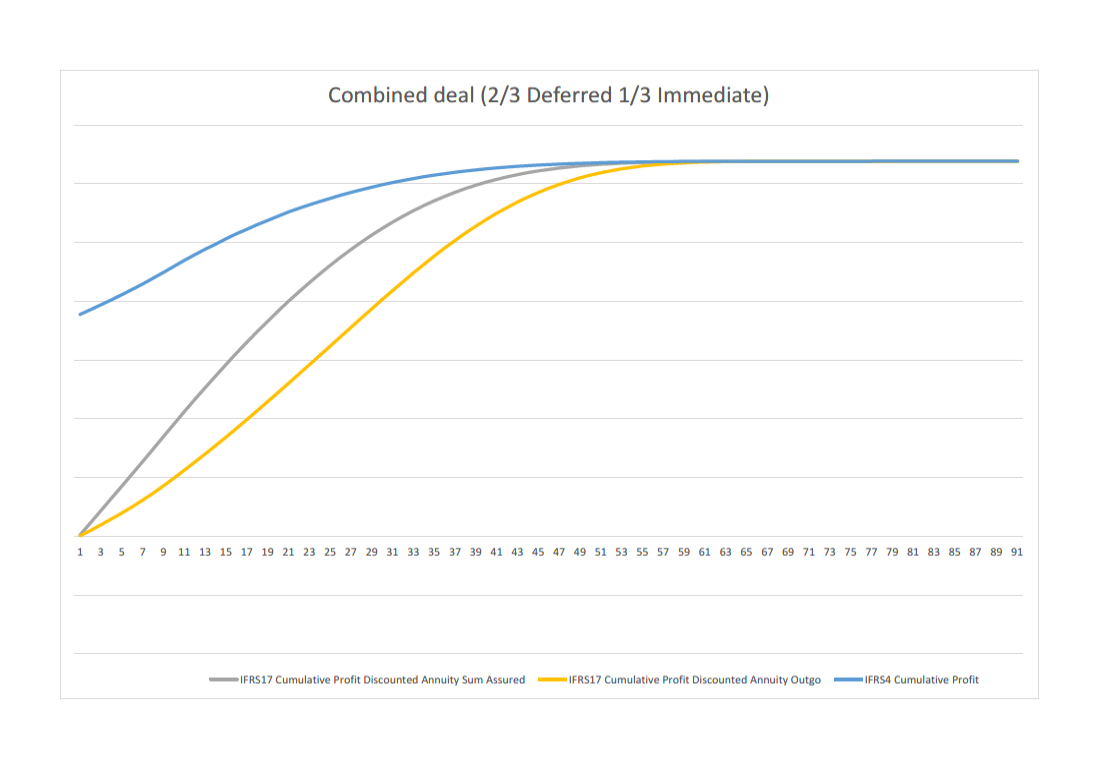
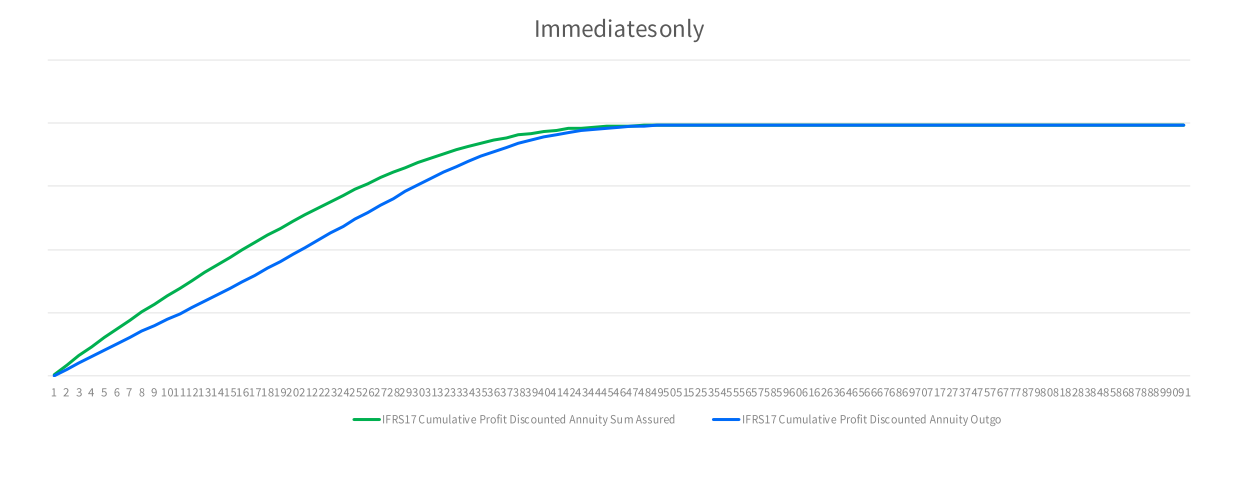
7As an annex to this paper we present two graphs showing the expected profit recognition profile under both those approaches as well as, in one graph, under current accounting. The graphs use illustrative numbers for the vertical scale but the profiles reflect an insurer's actuarial estimates. These show that after only a few years the cumulative profit recognised under the annuity sum assured method would be significantly higher and that the difference persists for a very long period. 1
8To provide some context, the Secretariat notes the following more general information concerning the annuity market:
Individual annuities
-
The individual annuity market is mature and in recent years has declined, due largely to pensions freedoms introduced by the 2014 Pensions Reform Act2. For example, in a 2018 report, PwC3 noted that new individual annuities sold in the UK declined by 78% between 2013 and 2016.
-
Nevertheless, due to the size of the back book, this remains a major business. ABI data from 2019 indicates there were 6.1m pension annuities in the UK. FCA4 information shows that new business was provided by roughly 20 entities, though business is now concentrated in only five main groups5. Assets under management backing annuity liabilities amount to perhaps some £300 billion.6
Bulk purchase annuities
-
By contrast, the BPA business is increasing in significance and is the main growth area within the UK insurance market.
-
BPA transactions amounted to £31.6bn in 2020, as reported by PensionAge7, and Hymans Robertson report that almost £150bn BPA business has been written by eight active market participants in the period 2009 to 2020.8
-
Hymans Robertson forecast BPA transactions to average around £40bn per year up to 2030. Although declining after 2030, their forecast shows continued high levels of BPA transactions up to 2040 (average over £20bn p.a.). The level of transactions is driven by pension schemes' de-risking strategies and buy-outs resulting from sponsor insolvencies.
9Annuity business is long term business, with average policy duration of around 15 years for individual annuities. Average duration in the BPA market is longer, as a significant proportion of contracts are still in the investment phase (deferred annuities). In both cases, however, groups of contracts generally have a very long tail: that is, a relatively small minority of contracts in a cohort may be in force for many decades (for example where benefits pass to a much younger individual). This feature is also apparent from the graph in Appendix 2.
10Our discussions with National Standard Setters in Canada and Australia and our review of EFRAG's Final Endorsement Advice indicate that the allocation of CSM for annuities is a particular UK concern. The issue was not a focus area for EFRAG and is not a significant topic of current debate in Canada or Australia, although we understand annuities are prevalent also in those markets. These jurisdictions are also seeing an increase in the BPA market, though not on the scale observed in the UK.9
Transition to IFRS 17 from current UK accounting practice
11Whichever approach to CSM allocation is adopted under IFRS 17, transition from current accounting practice for annuities will involve a major change in profit recognition approach for UK companies.
12Current accounting under IFRS 4 is heavily based on accounting under old (pre-2005) UK GAAP, as set out in the ABI SORP. Conservative reserves are established at inception for expected future cash outflows but these reserves are generally exceeded by the premiums received (typically single upfront premiums). The difference is recognised immediately as profit. In addition to any gains/losses from experience variances and changes in assumptions, further future margins generally arise from the unwinding of the reserves. The typical profit profile is therefore a large initial gain followed by smaller and declining gains over the contract lifetime. Current accounting practice in the UK is therefore not based on the IFRS 17 principle which stipulates that profit is recognised in line with the provision of service over the coverage period.
13Under IFRS 17 the profit profile for a group of contracts is expected to be smoother, though also declining10. Profit recognition will be significantly slower than under current practice, mainly due to the absence of gains on initial recognition (sometimes referred to as 'day 1 gains').
14Data on the likely transitional impact from this change across the industry is not available to us, but the expectation is for material reductions in equity. The scale of the impact will depend in part on the transition approach adopted: a retrospective approach is likely to lead to greater transitional impacts than a fair value approach, and to greater CSM balances available to release to profit in future periods.11 A fair value approach is expected to be adopted for a large proportion of individual annuity business, including annuities vested from with-profit policies with guaranteed annuity options, due to the earlier inception dates and the impracticality of retrospective application12. By contrast a fully retrospective or modified retrospective approach is expected to be applied to a large proportion of BPA business since inception is the date of acquisition and this market has expanded rapidly in recent years.
Update on status of assessment work
15The 20 July 2021 Board paper described the key elements of the Secretariat's outreach activities on this issue to that point. In summary, the Secretariat's assessment work on this issue includes the following:
- Discussion at the May and July meetings of the Insurance Technical Advisory Group (TAG) 13;
- Desk-top analysis, including reviews of comment letters and other feedback to the IASB during the development and finalisation of the standard;
- Review of results from our preparer survey;
- Review of any technical papers issued by accounting firms or prepared by actuarial and accounting bodies and discussion groups; and
- Discussions with the IASB technical staff and with National Standard Setters in Australia and Canada, and review of EFRAG's conclusions on CSM allocation.
16The Board recommended that an appropriate next step would be for industry to prepare a comprehensive technical paper as a basis for an approach to the IASB for formal advice on the interpretation of IFRS 17's requirements for annuities. We have held further discussions with insurers, the ABI and auditors since July and understand that such a paper is in preparation but has not yet been submitted to the IASB. The paper is expected to present both the main views on the issue (as set out in the 20 July Board paper).
17We anticipate that we will be able to update the Board on further developments in October.
Preliminary endorsement assessment
18Appendix 1 to this paper presents a draft assessment of IFRS 17's principal requirements in respect of CSM allocation against the technical endorsement criteria of understandability, relevance, reliability and comparability. This assessment has been drafted without the benefit of industry's technical paper and may need to be updated in due course to reflect the outcome of industry's engagement with the IASB.
Questions for the Board
| 19. | Does the Board have any comments on the draft assessment in Appendix 1? |
| 20. | Are there any further important considerations that ought to be included in the assessment? |
| 21. | Has the Board identified any further analysis work or other steps required to enable the assessment to be finalised for inclusion in the DECA? |
Proposed next steps
22The Secretariat will update the Board on developments relating to industry's technical paper in October.
23Subject to the Board's comments on the draft assessment set out in Appendix 1 and any further analysis work required, and subject to the outcome of industry's engagement with the IASB, the Secretariat will incorporate the content of the Appendix in the [draft] Endorsement Criteria Assessment.
Annex – illustrative profit recognition profiles
The first chart illustrates the cumulative profit expected to be recognised for a BPA transaction assuming a mix of deferred and immediate annuities. The second chart shows the same but for immediate annuities only. NB: in the first chart the two IFRS 17 profiles are not wholly comparable because the illustration assumes no investment return service under the annuity outgo approach in the deferred phase. The annuity sum assured approach inherently includes profit for both phases.
Appendix 1: [draft] assessment against the technical accounting endorsement criteria
IFRS 17 requirements
Initial recognition
1On initial recognition of a group of insurance contracts, IFRS 17 requires an entity to recognise a Contractual Service Margin (CSM), a component of the asset or liability for the group of insurance contracts that represents the unearned profit the entity will recognise as it provides insurance contract services in the future. [IFRS 17: 32, 38]
2At initial recognition, the CSM is measured at an amount that, unless the group of contracts is onerous, results in no income or expense from:
- the initial recognition of an amount for the fulfilment cash flows;
- any cash flows at initial recognition; and
- the derecognition of any asset or liability from pre-recognition cash flows such as acquisition costs. [IFRS 17:38]
Subsequent measurement
3In each period, an entity will recognise as insurance revenue an amount of CSM representing the insurance contract services provided by the group of insurance contracts in that period. [IFRS 17:44(e)]
4An entity that issues insurance contracts without direct participation features recognises profit when it provides insurance coverage or any service relating to investment activities (investment-return service). [IFRS 17: Appendix A – definition of 'insurance contract services']
5The recognition of the CSM in profit or loss is determined by identifying coverage units that reflect the quantity of benefits provided under the insurance contracts and their expected coverage period. [IFRS 17: B119]
6At the end of the reporting period, the remaining CSM on the balance sheet represents the profit in the group of insurance contracts that has not yet been recognised in profit or loss because it relates to future service. [IFRS 17:43]
Investment return service
7IFRS 17 requires an entity to identify coverage units for insurance contracts considering the quantity of benefits and the expected coverage period of investment-return service, if any, in addition to the insurance coverage. [IFRS 17: BC283A]
8An investment-return service is provided only if:
- An investment component exists, or the policyholder has a right to withdraw an amount;
- the entity expects that amount to include an investment return; and
- the entity expects to perform investment activity to generate that investment return. [IFRS 17: B119B]
Disclosures
9Determining the quantity of benefits provided by an insurance contract considering either investment-return service or investment-related service14 in addition to insurance coverage adds complexity and judgement (IFRS 17: BC366B). Entities are required to disclose quantitative information about when they expect to recognise in profit or loss the CSM remaining at the end of the reporting period, providing time bands. [IFRS 17:109]
10IFRS 17 also requires an entity to disclose significant judgements made in applying the Standard. This includes the approach used to determine the relative weighting of the benefits provided by insurance coverage and investment-return service. [IFRS 17:117(c)(v)]
Determination of CSM amortisation – accounting impact
Initial recognition
11At initial recognition, the CSM is equal to the present value of risk-adjusted future cash inflows less the present value of risk-adjusted future cash outflows. For a group of profitable insurance contracts, no amount is recognised in profit or loss on initial recognition. Profit is instead deferred on the balance sheet and recognised in profit or loss over the coverage period.
12The CSM represents the margin the entity has charged for the services provided, in addition to bearing risk. The expected margin charged for bearing risk is instead represented by the risk adjustment for non-financial risk. [IFRS 17: BC222]
Subsequent measurement
13IFRS 17 contains no requirements or guidance specifically for annuities. IFRS 17's general requirements, however, mean that profits from annuities will be spread over the coverage period. The coverage period is the probability-weighted average duration of the contracts in the group (based on life expectations). The pattern of CSM release will be a matter of judgement and interpretation of the meaning of ‘quantity of benefits' in the context of annuities. [IFRS 17: B119(a)]
14The conditions for recognition of an investment-return service (see paragraph 8 above), and in particular the fact that policyholders have no withdrawal rights once the pay-out phase starts, mean that an investment-return service typically cannot be recognised in the annuity pay-out phase. An exception might arise when guarantee periods apply (i.e. when policyholders or their estate receive payments for the whole of the guaranteed period, irrespective of whether the policyholder dies in that period): in such cases the guaranteed amount may represent an investment component and an investment-return service may be recognised.
15Similarly, in the case of deferred annuities, no insurance coverage can be recognised in the deferred period except to the extent of any death or disability benefit. This is because there can be no insured event leading to a pay-out during the deferral period. For deferred annuities, therefore, the expectation is for an investment-return service to be recognised in the deferred phase and insurance coverage in the pay-out phase.
16When both insurance coverage and investment-return services exist, entities will need to weight coverage units between the two services (i.e. typically between the deferred and pay-out phases).
17The pattern of expected cash flows and the release of the risk adjustment for non-financial risk are already included in the measurement of the fulfilment cash flows. Therefore, they are not relevant factors in determining the satisfaction of the performance obligation and provision of service. [IFRS 17: BC279(a)]
Assessment against the endorsement criteria
18IFRS 17 requires the CSM to be recognised in profit or loss over the coverage period of the group of insurance contracts, and in a pattern that reflects the provision of service. This will result in relevant information because it will enable users to evaluate the performance of an entity in line with the provision of service. This results in faithful representation of an entity's performance obligations and of its financial performance over the coverage period.
19Recognising the CSM in line with the provision of both insurance coverage and an investment-return service will provide relevant information to users of financial statements, reflecting the provision of all services under the contract. This benefit will be particularly important for contracts that have an insurance coverage period that differs from the period in which the policyholder benefits from an investment-return service.15 [IFRS 17: BC293B]
20Recognition of an investment-return service only when the policyholder benefit is not contingent on an insured event (e.g. policyholder survival) is likely to result in relevant information. In other cases, the investment activity serves to enhance the insurance coverage benefits rather than provide a separate benefit. The fact that the IASB specified conditions that are required to identify, but are not determinative of, the existence of an investment-return service, allows entities to consider their facts and circumstances and apply judgement when determining whether an insurance contract that meets the conditions provides an investment-return service, thereby enhancing relevance. [IFRS 17: BC283E]
21The revenue recognition approach in IFRS 17 is broadly consistent with the approach in IFRS 15 Revenue Recognition, because revenue is recognised in line with the provision of service. Recognising revenue in this way increases the understandability of insurers' financial statements and the comparability of their financial statements with financial statements from entities across other industries.
22The disclosures required by paragraph 109 of IFRS 17, showing in which future periods an entity expects to recognise the CSM on the balance sheet, will provide users of accounts with useful information about the expected pattern of service provision, increasing the understandability of financial statements. [IFRS 17: BC283F] More generally, the disclosure required by IFRS 17 paragraph 117 of the significant judgements made in applying the standard, including the inputs, assumptions and estimation techniques used, should help users of accounts to assess the specific approach to CSM allocation applied.
Potential challenges to endorsement criteria and mitigations
23IFRS 17 does not prescribe how an entity should determine the quantity of benefits provided under a contract, and thus how to determine the coverage units and their corresponding weighting. Given the possibility that different methods can be used for this calculation, there is a risk that the IFRS 17's requirements in relation to CSM amortisation will lead to a divergence in application. This could result in financial statements that are less comparable and less understandable, particularly for annuity products given their long duration.
24Determining the quantity of benefits provided under the contract, and hence the amount of CSM to recognise in profit or loss, will require the use of significant judgement. The application of this judgement may lack consistency and/or neutrality and hence introduce a risk to reliability.
25In particular, different views have developed for interpreting the requirements of IFRS 17 to determine coverage units that appropriately reflect the insurance coverage service provided for annuities, including bulk purchase annuities, in the pay-out phase:
- Under one view the quantity of benefits reflects solely the payments made to the policyholder for each period;
- An alternative view is that the quantity of benefits incorporates both the regular payment and the extension of insurance coverage to provide a guaranteed income for the rest of the policyholder's life. The latter is sometimes referred to as the 'peace of mind' service. This is noted to be a key feature of an annuity as the policyholder only retains the ability to make a claim in future periods if the insured event (survival) occurs in the current period.
26However, the risks to comparability and reliability are balanced by the objective of relevance. The IASB decided not to prescribe detailed methodologies for specific product groups but instead chose to adopt a principle-based approach, consistent with other IFRS Standards, requiring entities to use judgement to determine an appropriate treatment for each product group. As noted by the IASB's Transition Resource Group for IFRS 17 (TRG) in May 2018,16 the determination of coverage units is not an accounting policy choice but involves judgements and estimates, applied in a systematic and rational way, to best achieve the principle of reflecting the services provided in each period.
27Determining the service provided to policyholders and the coverage units that reflect the quantity of benefits delivered does not result in a degree of judgement that is excessive or inconsistent with that required under other IFRS Standards. The required disclosures (see paragraph 22 above) should also mitigate concerns about the degree of judgement required.
28Over time, it is likely that a consensus to determining coverage units and hence to CSM allocation for typical UK annuity products will develop. This should reduce the principal concerns over diversity in application and enhance comparability of financial information.
29Further, once entities have made their initial determination of coverage units, subsequent accounting will not require significant judgement. The approach to determining coverage units will be an accounting policy choice so will need to be applied consistently.
30Although additional subjectivity and complexity may be introduced by including an investment-return service in addition to insurance coverage in determining coverage units for insurance contracts without direct participation features, this is balanced by the objective of enhanced relevance (see paragraphs 18-20 above). Further, this risk will be mitigated by the disclosure required by IFRS 17:117(c)(v) of the approach used to determine the relative weighting of insurance coverage and investment-return service.
31The appropriate approach to determining coverage units, for example whether that described in paragraph 25(a) or that in 25(b) above, is essentially a matter of interpretation. As noted by the IASB's TRG in May 2018, different methods can be used to determine the quantity of benefits as long as they achieve the objective of reflecting the insurance service provided in each period. The standard's objective and principles are clear on this question, and current difficulties in finding a consensus in the case of annuities do not necessarily indicate that the technical accounting criteria as a whole are not met.
Footnotes
-
The Act makes the purchase of an annuity with pension savings optional, whereas before it was compulsory ↩
-
PwC (2018), "Navigating the future: UK Life & Pensions: A roadmap to succeed in a fast-changing sector", https://www.pwc.co.uk/insurance/documents/life-insurance.pdf ↩
-
ABI (2020), “UK Insurance & Long-Term Savings - Key Facts", https://www.abi.org.uk/globalassets/files/publications/public/key-facts/abi_key_facts_2021.pdf ↩
-
See https://www.ftadviser.com/pensions/2020/03/04/provider-deals-push-annuity-sales-at-l-g/. Hodge transferred its annuities business to the US insurer RGA in February 2021: https://uk.news.yahoo.com/reinsurance-group-america-agrees-purchase-140000343.html ↩
-
Secretariat estimate based on company financial statements and feedback from stakeholders ↩
-
See https://www.pensionsage.com/pa/Longevity-risk-transfers-reach-record-breaking-558bn-2020.php. Other estimates are provided by Willis Tower Watson: https://www.willistowerswatson.com/en-GB/Insights/2021/01/looking-back-at-2020-de-risking-report-2021 and FITCH: https://www.fitchratings.com/research/insurance/uk-annuity-market-is-growing-quickly-31-03-2021. ↩
-
Hymans Robertson (2021), "Risk Transfer Report" and LCP (2020), "Pensions de-risking report: Buy-ins, buy-outs and longevity swaps" ↩
-
For Canada, Willis Towers Watson reports CAD 4.4bn BPA transactions in 2020 - See https://www.willistowerswatson.com/en-CA/Insights/2021/04/group-annuity-market-pulse-2020-annual-review-and-first-quarter-2021 ↩
-
As noted in the 20 July paper, in broad terms, for a group of contracts more CSM is recognised in the earlier years due to factors including the accretion of interest on the CSM and expectations of policyholder deaths. The release of the risk adjustment also contributes to profit over the duration of the group of contracts but, as the risk adjustment is expected to be relatively small compared with the CSM, it is unlikely to materially affect the overall profit or loss recognised for groups of annuity contracts in individual periods. ↩
-
Information on IFRS 17's transition requirements is included in a separate September Board paper. ↩
-
We understand that the data required for a retrospective approach to transition is typically not considered available for business that incepted earlier than around 2016. ↩
-
Summaries of the Insurance TAG's discussions relating to this topic are available in the meeting summaries on the UKEB website https://www.endorsement-board.uk/endorsement-projects/ifrs-17/technical-advisory-group ↩
-
For insurance contracts with direct participation features, an entity provides an investment-related service by managing the underlying items on the behalf of the policyholder. ↩
-
In June 2020, in response to feedback that IFRS 17 did not appropriately reflect that many contracts combine insurance coverage and service relating to investment activities, and that the timing of provision of service relating to investment activities and insurance coverage might differ, the IASB amended IFRS 17 to permit entities to recognise CSM in profit or loss for the provision of investment-return services, in addition to insurance coverage service. ↩
-
https://www.ifrs.org/content/dam/ifrs/meetings/2018/may/trg-for-ifrs-17/ap05-quantity-of-benefits-for-identifying-coverage-units.pdf https://www.ifrs.org/content/dam/ifrs/meetings/2018/may/iasb/ap02a-ic.pdf ↩