8.0 Lack of Exchangeability draft Project initiation plan and draft comment letter
Project Type: Influencing Project Scope: Limited (Narrow Scope Amendment)

Executive Summary
Purpose of the paper
- Provide the Board with the draft project initiation plan (PIP) for the IASB's Exposure Draft (ED) Lack of Exchangeability for discussion and approval;
- Obtain feedback on the proposed draft comment letter and accompanying invitation to comment questions; and
- Request the Board's approval to publish the draft comment letter and invitation to comment on the website for stakeholder consultation.
Summary of the Issue
IAS 21 The Effects of Changes in Foreign Exchange Rates sets out the exchange rate an entity uses when it reports foreign currency transactions, or a foreign operation's results, in a different currency. The proposed amendments aim to improve the usefulness of the information produced by entities when exchange rates to be used in reporting foreign currency transactions lack exchangeability by:
- helping companies determine whether a currency is exchangeable into another currency;
- specifying the accounting requirements to apply when a currency lacks exchangeability; and
- requiring further disclosures.
The secretariat currently believe the number of UK companies exposed to such circumstances are limited.
Decisions for the Board
- Do Board members approve the draft PIP?
- Do Board members agree with the position taken in the draft comment letter?
- Do Board members agree with the proposed questions to be included in the invitation to comment?
- Do Board members approve the draft comment letter and invitation to comment questions for release for stakeholder consultation?
Recommendation
We recommend the Board approve the draft PIP and publication of the UKEB draft comment letter for stakeholder consultation for 28 days.
Appendices
- Lack of Exchangeability PIP
- Draft Comment Letter – Lack of Exchangeability
- Proposed Invitation to Comment Questions
Background
1The IASB Exposure Draft ED/2021/4 Lack of Exchangeability was published in April 2021. It sets out to improve the usefulness of the information provided to investors by making amendments to IAS 21 The Effects of Changes in Foreign Exchange Rates that would require a consistent approach to determining whether a currency is exchangeable into another currency and, when it is not, determining the exchange rate to use and the disclosures to provide. The comment deadline is 1 September 2021.
2IAS 21 sets out the exchange rate a company uses when it reports foreign currency transactions, or a foreign operation's results, in a different currency. However, the Standard does not set out the exchange rate to use when there is no observable exchange rate the company can use-such as when a currency cannot be converted into a foreign currency. The IASB's proposed amendments to IAS 21 would help companies identify if this situation applies to them and the accounting to apply when it does.
3The amendments were developed in response to a series of questions that came to the IFRS Interpretations Committee (IFRIC) with regard to currency controls in Venezuela.
4The ED introduces a 2-step model for addressing a lack of exchangeability.
a) Step one: assesses exchangeability or a lack thereof. Paragraph A2 states:
A currency is exchangeable into another currency at a measurement date when an entity is able to exchange that currency for the other currency within a time frame that includes a normal administrative delay and through a market or exchange mechanism in which the exchange transaction would create enforceable rights and obligations.
b) Step two: when exchangeability is lacking, estimate the spot exchange rate applying paragraph 19A:
The estimated spot exchange rate shall meet the following conditions assessed at the measurement date:
- a rate at which an entity would have been able to enter into an exchange transaction had the currency been exchangeable into the other currency;
- a rate that would have applied to an orderly transaction between market participants; and
- a rate that faithfully reflects the prevailing economic conditions.
5The amendments also introduce additional disclosure requirements when an entity estimates a spot exchange rate because of a lack of exchangeability. To enable users to understand how the lack of exchangeability affects (or may affect) the entity's financial performance, financial position and cash flows, the entity must disclose:
- the nature and financial effects of the lack of exchangeability;
- the spot exchange rate(s) used;
- the estimation process; and
- the risks to which the entity is exposed because of the lack of exchangeability.
6The UKEB Secretariat's work on this project commenced during June 2021.
Analysis of Key Issues
7We have used desk-based research to inform the development of the PIP (see Appendix 1) and draft comment letter (see Appendix 2). This included a review of comment letters prepared by other National Standard Setters. We have also reached out to a number of companies we believe could be impacted by the amendments and some engagement with them has already commenced.
Project Initiation Plan
8The PIP has been developed on the basis that the amendments are largely uncontroversial and few stakeholders are likely to be impacted by the amendments. We conclude that a short comment period and a light approach to outreach is a proportionate response.
9It should also be noted that, due to timing of UKEB meetings the final comment letter will be provided to the IASB approximately 3 weeks after their comment deadline.
| Question for the Board |
|---|
| 10. Do Board members approve the draft PIP (Appendix 1)? |
Draft Comment Letter
11The draft comment letter broadly agrees with the IASB's proposals but includes some minor suggestions that we believe will help improve the understandability of the requirements for preparers. We intend to publish the draft comment letter on the website for consultation for 28 days.
12We have included questions on the suggested changes to the amendments in the invitation to comment (see Appendix 3) to encourage further stakeholder feedback on these matters.
| Question for the Board |
|---|
| 13. Do Board members agree with the position taken in the draft comment letter (Appendix 2)? |
| 14. Do Board members agree with the proposed questions to be included in the invitation to comment (Appendix 3)? |
| 15. Do Board members approve the draft comment letter and invitation to comment questions for release for stakeholder consultation? |
Next Steps
16The UKEB Secretariat plan to publicise the posting of the draft comment letter and invitation to comment questions on our website via appropriate channels and will make another attempt to engage with a few specific companies we believe may be impacted by the amendments.
17We intend to bring a final comment letter to the 17 September meeting for board approval.
18The PIP contains further information on the project timeline.
Appendix 1: Project Initiation Plan: Lack of Exchangeability
| Project Type | Project Scope |
|---|---|
| Influencing | Limited (Narrow Scope Amendment) |
Overview
1The UKEB statutory functions include responsibility for “participating in and contributing to the development of a single set of international accounting standards."
2The IASB's Exposure Draft (ED) Lack of Exchangeability seeks to improve the usefulness of the information provided to investors by making amendments to IAS 21 The Effects of Changes in Foreign Exchange Rates that would require a consistent approach to determining whether a currency is exchangeable into another currency and, when it is not, determining the exchange rate to use and the disclosures to provide.
3The IASB's ED was published in April 2021 and the comment deadline is 1 September 2021.
4IAS 21 sets out the exchange rate a company uses when it reports foreign currency transactions, or a foreign operation's results, in a different currency. However, the Standard does not set out the exchange rate to use when there is no observable exchange rate the company can use-such as when a currency cannot be converted into a foreign currency. The IASB's proposed amendments to IAS 21 would help companies identify if this situation applies to them and the accounting to apply when it does.
5There are a very limited number of circumstances when a currency becomes non-exchangeable, and as such the number of UK companies affected would be low. However, it is important that the UKEB responds to this consultation as the ED proposals are likely to be incorporated as amendments to IAS 21 and those amendments will need to be considered for endorsement and adoption in the UK. Ensuring the IASB has the opportunity to consider views of UK stakeholders during the amendments' development is key to minimising new concerns being identified during the endorsement and adoption assessment process.
The ED, Basis for Conclusions and Illustrative Examples can be accessed here: IFRS - Exposure Draft and comment letters-Lack of Exchangeability
Objective of the project
6IAS 21 generally requires the use of a spot exchange rate[^2] when an entity reports foreign currency transactions, or a foreign operation's results and financial position, in its financial statements. IAS 21 specifies the exchange rate to use in reporting foreign currency transactions when exchangeability between two currencies is temporarily lacking. However, the Standard does not specify any requirements when a lack of exchangeability is not temporary.
7The IFRS Interpretations Committee (IFRIC) was asked in 2014 and 2018 to consider how an entity determines the exchange rate to use in translating a foreign operation's results and financial position when the foreign operation's functional currency is not exchangeable into the presentation currency. Venezuela was identified as a specific instance where such circumstances existed.
8The IFRIC found evidence of diverse views on how to determine whether a currency is exchangeable into another currency and the exchange rate to use when it is not. Although they concluded the circumstances in which a currency is not exchangeable might arise relatively infrequently, when they do arise economic conditions can deteriorate rapidly. In those circumstances, the diverse views on the application of IAS 21 could lead to material differences in the financial statements of entities affected by a currency that lacks exchangeability.
9The IFRIC concluded that the matter required standard setting and passed the matter to the IASB.
10Having considered the matter, the IASB is proposing:
- Introducing a 2-step model for addressing a lack of exchangeability.
- Step one: assess whether an entity is able to exchange a currency for another; and, if not
- Step two: estimate the spot exchange rate in such a way that it represents the rate the entity would expect to have applied if the currency was exchangeable, this may involve reference to other, observable, rates.
- Additional disclosure requirements when an entity estimates a spot exchange rate because of a lack of exchangeability:
- the nature and financial effects of the lack of exchangeability;
- the spot exchange rate(s) used;
- the estimation process; and
- the risks to which the entity is exposed because of the lack of exchangeability.
Key planning assumptions, constraints and timeline
Comment deadline and resource capacity
11The IASB published the ED in April 2021 and its comment deadline for this project is 1 September 2021. Until recently UKEB secretariat resource has been focused on other more significant influencing projects or urgent UK adoption projects. Whilst work on this project has now commenced, due to the summer recess and timing of the UKEB meetings, we expect to submit the final comment letter on this ED to the IASB following the meeting held on 17 September 2021.
Assumptions
12We have made the following assumptions in developing this project plan:
- Few stakeholders are likely to be impacted by the amendments.
- Desktop research has not identified a large base of stakeholders for engagement prior to development of a draft comment letter.
- A draft comment letter will be presented for Board approval at the 20 July meeting and will be open for stakeholder comment for 28 days.
- The final comment letter will be presented at the 17 September UKEB meeting, and once approved, will be submitted to the IASB.
Outreach
UK stakeholders
13Desktop research has identified a limited number of companies who may have operations that could be affected by the proposals in the ED. These companies will be approached directly for comment.
14Outreach work is planned to occur between June and August.
15The draft comment letter will be published on the website and advertised via the usual channels.
International stakeholders
16We have been in touch with the IASB's project team but, given the very limited expected impact of this project in the UK, do not propose any joint outreach at this stage.
17To understand any global concerns with these IASB proposals we have reached out to other national standard setters. This includes discussions with EFRAG's project team to understand their key areas of concern. EFRAG issued its draft comment letter on the IASB's ED on 3 June 2021 and has a comment deadline of 26 August 2021.
18We have also reached out to staff of the Accounting Standards Board of Canada (AcSB) and the Australian Accounting Standards Board (AASB). Our current understanding is that neither Board intends to submit a comment letter on the proposed amendments.
Project closure
19It is intended that the feedback statement will be presented for Board review at the 17 September Board meeting,. The statement of due process compliance will be presented to the 28 October Board meeting.
Project timeline
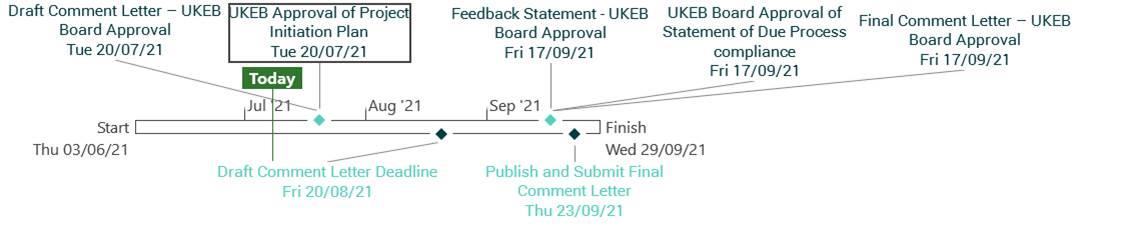
20We are proposing a curtailed project plan, proportionate to the size of the project. As a result, the proposed project timeline will lead to a very short window for stakeholders to consider and provide input on the UKEB's draft comment letter. However, given the expected low impact of the proposals, and their nature as clarifying practice, we believe this is appropriate. The proposed high-level project timeline is included below:
Initial identification of issues
21Our initial desk-based review of the amendments and its requirements have only identified a few minor issues for consideration, discussed in the draft comment letter. Given the limited nature of the amendments and their specific application we are not expecting to hear many concerns from stakeholders.
| Date | Milestones |
|---|---|
| 20 July | Board meeting |
| 23 July | Approve PIP; Approve draft comment letter |
| 20 August | Publish draft comment letter |
| Deadline for responses to draft comment letter | |
| (28 Days from publishing) | |
| 17 September Board meeting | Approve final comment letter; Review feedback statement |
| 20 September | Submit final comment letter to IASB |
| 28 October Board meeting | Approve statement of due process compliance |
Appendix 2: Draft Comment Letter
Dr Andreas Barckow Chairman International Accounting Standards Board 7 Westferry Circus Canary Wharf London E14 4HD
(Date)
Dear Dr Barckow
Invitation to Comment: Exposure Draft ED/2021/4 Lack of Exchangeability (Proposed Amendment to IAS21)
The UK Endorsement Board (UKEB) is responsible for endorsement and adoption of IFRS for use in the UK and therefore is the UK's National Standard Setter for IFRS. The UKEB also leads the UK's engagement with the IFRS Foundation (Foundation) on the development of new standards, amendments and interpretations. This letter is intended to contribute to the Foundation's due process. The views expressed by the UKEB in this letter are separate from, and will not necessarily affect the conclusions in, any endorsement and adoption assessment on new or amended International Accounting Standards undertaken by the UKEB.
We welcome the opportunity to contribute to the debate on accounting for a lack of exchangeability. We support the proposals in the IASB's Exposure Draft (ED), as they provide guidance on an area not covered by the existing Standard. As such, they should reduce any diversity of practice, leading to consistency and comparability of financial statements. We suggest some minor changes and additions to the amendments which we believe add clarity for the IASB to consider. For detailed responses to the questions in the ED please see Appendix 1.
Yours sincerely
Pauline Wallace Chair UK Endorsement Board
Appendix [A]: Questions on Exposure Draft ED/2021/4 Lack of Exchangeability (Proposed Amendment to IAS21)
Question 1: Assessing exchangeability between two currencies.
Paragraph 8 of the draft amendments to IAS 21 specifies that a currency is exchangeable into another currency when an entity is able to exchange that currency for the other currency. Paragraphs A2-A11 of [draft] Appendix A to IAS 21 set out factors an entity considers in assessing exchangeability and specify how those factors affect the assessment.
Paragraphs BC4-BC16 of the Basis for Conclusions explain the Board's rationale for this proposal.
Do you agree with this proposal? Why or why not? If you disagree with the proposal, please explain what you suggest instead and why.
A1We agree the proposed amendments provide preparers with guidance regarding the definition and assessment of a lack of exchangeability that is not temporary. Currently, IAS 21 does not provide such guidance, and the amendments would add clarity to IFRS Standards. This will have the benefit of reducing any potential diversity in practice in this area leading to increased consistency and comparability of financial statements.
A2We agree that the additional paragraphs A2 – A11 are helpful in understanding how to apply Paragraph 8 when determining whether a currency is exchangeable.
Question 2: Determining the spot exchange rate when exchangeability is lacking
Paragraphs 19A-19C and paragraphs A12-A15 of the draft amendments to IAS 21 specify how an entity determines the spot exchange rate when a currency is not exchangeable into another currency.
Paragraphs BC17-BC20 of the Basis for Conclusions explain the Board's rationale for this proposal.
Do you agree with this proposal? Why or why not? If you disagree with the proposal, please explain what you suggest instead and why.
A3We agree with the proposed approach to determining the spot exchange rate when exchangeability is lacking.
A4We suggest some minor redrafting of paragraph 19C, as set out below. This is to address some misleading information included therein when referring to requirements in paragraphs A12 – A15. Those paragraphs appear limited to providing guidance on using an observable or subsequent exchange rate as discussed in paragraph 19B. The current wording of 19C may lead a reader to expect more comprehensive guidance, specifying how an entity determines the spot exchange rate.
19C The requirements in paragraphs A12-A15 specify how an entity applies paragraphs factors to consider when applying paragraph 19A-19B in determining the spot exchange rate when a currency is not exchangeable into another currency when using an observable exchange rate, or the first subsequent exchange rate, to estimate the spot exchange rate.
A5We support the conclusion to propose conditions to be met when estimating a spot exchange rate, rather than specifying detailed requirements on how the estimation should be made. This is consistent with similar requirements in other IFRS standards and allows for a proportionate approach in relation to entity and jurisdiction specific circumstances.
A6We would suggest the IASB consider adding a paragraph to Illustrative Example 4 to help emphasise the objectives of estimating a spot exchange rate when exchangeability is lacking.
IE13 Alternatively, if Entity X had determined that an appropriate observable or subsequent exchange rate did not exist, or it chose not to use one, it should use an estimation technique to determine a spot rate that meets the conditions specified in paragraph 19A.
Question 3: Disclosure
Paragraphs 57A-57B and A16-A18 of the draft amendments to IAS 21 require an entity to disclose information that would enable users of its financial statements to understand how a lack of exchangeability between two currencies affects, or is expected to affect, its financial performance, financial position and cash flows.
Paragraphs BC21-BC23 of the Basis for Conclusions explain the Board's rationale for this proposal.
Do you agree with this proposal? Why or why not? If you disagree with the proposal, please explain what you suggest instead and why.
A7We agree with the disclosure objective and the disclosure requirements proposed in the ED. We believe these disclosure requirements will provide relevant information to users of financial statements, assisting them to understand the effects of estimating the spot exchange rate on the financial statements and the entity's exposure to a currency that lacks exchangeability.
Question 4: Transition
Paragraphs 60L-60M of the draft amendments to IAS 21 require an entity to apply the amendments from the date of initial application, and permit earlier application.
Paragraphs BC24-BC27 of the Basis for Conclusions explain the Board's rationale for this proposal.
Do you agree with this proposal? Why or why not? If you disagree with the proposal, please explain what you suggest instead and why.
A8We agree with the transition requirements proposed. Retrospective application could be difficult and would require the use of hindsight. The approach outlined appears to provide an appropriate level of transparency for users without significant additional burden for preparers.
A9We agree that the amendments to IAS 1 First-time Adoption of International Financial Reporting Standards are appropriate for the impacts of these narrow scope amendments.
Appendix 3: Proposed Invitation to Comment Questions
Lack of Exchangeability
| Question | Draft Comment Letter paragraphs Reference |
|---|---|
| 1 Do you agree with the proposed amendments to paragraph 19C? If not, what alternative would you recommend? | A4 |
| 2 Do you agree with the proposed addition of paragraph IE13? If not, what alternative would you recommend? | A6 |
| 3 Do you have any other comments you would like to make on the IASB proposals or the UKEB draft comment letter? | |
| 4 If the amendments proposed in the IASB's ED are implemented, do you expect any impacts in the UK context? If so, can you describe them, including any estimated costs and benefits? |
[^1]The ED, Basis for Conclusions and Illustrative Examples can be accessed here: IFRS - Exposure Draft and comment letters-Lack of Exchangeability [^2]A spot exchange rate is the exchange rate for immediate delivery.