7.0 Disclosure Requirements in IFRS Standards A Pilot Approach
| Project Type | Influencing |
|---|---|
| Project Scope | Significant |
Executive Summary
Purpose of the paper
This paper provides the Board with a draft Project Initiation Plan (PIP) and draft Comment Letter for the IASB's ED/2021/3 Disclosure Requirements in IFRS Standards – A Pilot Approach’ for discussion and approval. The IASB's ED was published on 25 March 2021. The comment deadline is 21 October 2021, though we note the IASB Board meeting on 21 July will consider extending the deadline to 12 January 2022. Should the deadline be extended a modified PIP will be re-presented to the Board.
Summary of the Issue
This IASB ED seeks to address the “disclosure problem” and proposes four actions:
- Creates Guidance for IASB's use when developing and drafting disclosure requirements. This proposes to largely replace mandatory disclosure items with an objectives-based regime.
- Applies this Guidance to IFRS 13 Fair Value Measurement and proposes amendments to this standard developed by using the new Guidance.
- Applies this Guidance to IAS 19 Employee Benefits and proposes amendments to this standard developed by using the new Guidance.
- Proposes consequential amendments to IAS 34 Interim Financial Reporting and IFRIC 17 Distribution of Non-cash Assets to Owners.
Decisions for the Board
The Board is asked to approve the draft PIP (based on IASB's currently approved deadline) and draft Comment Letter.
Recommendation
We recommend the Board approves the draft PIP and draft Comment Letter.
Appendices
- Draft PIP: Disclosure Requirements in IFRS Standards – A Pilot Approach
- Draft Comment Letter: Disclosure Requirements in IFRS Standards – A Pilot Approach
Appendix 1: Draft Project Initiation Plan: Disclosure Requirements in IFRS Standards – A Pilot Approach
| Project Type | Influencing |
|---|---|
| Project Scope | Significant |
Overview
1SI/2019/685(5)(b) 2 requires the UKEB to be responsible for “participating in and contributing to the development of a single set of international accounting standards.” The proposed project contributes to this work.
2The IASB's Exposure Draft ED Disclosure Requirements in IFRS Standards – A Pilot Approach 3 ("the Disclosure Pilot") seeks to address the “the disclosure problem" of financial statements containing irrelevant information, insufficient relevant information, ineffective communication of the information provided and a checklist approach to disclosure used by some entities.
3This project forms part of IASB's Disclosure Initiative, a portfolio of projects exploring how to improve the effectiveness of disclosures in financial reporting. The IASB's ED was published on 25 March 2021 and the comment deadline is 21 October 2021.
4The ED proposes four actions.
- Creates Guidance for IASB to use when developing and drafting disclosure requirements. This proposes to largely replace mandatory disclosure items with an objectives-based regime where entities can provide disclosure that satisfies the disclosure objectives.
- Applies this Guidance to IFRS 13 Fair Value Measurement and proposes amendments to this standard developed using the new Guidance.
- Applies this Guidance to IAS 19 Employee Benefits and proposes amendments to this standard created using the new Guidance
- Proposes consequential amendments to IAS 34 Interim Financial Reporting and IFRIC 17 Distribution of Non-cash Assets to Owners.
5The ED notes that in addition to the proposed amendments to IFRS 13 and IAS 19, the guidance may potentially be used in the future development of new standards and changes to existing IFRS standards.
6Given the importance placed on disclosure by users of financial statements, the ED's proposals are expected to affect a large number of UK stakeholders, including IFRS preparers, users, auditors and relevant regulators. Ensuring the IASB has the opportunity to consider views of UK stakeholders during the standard's development is key to minimising new concerns being identified during the endorsement and adoption assessment process
Objective of the project
7As noted above this project forms part of IASB's Disclosure Initiative, a portfolio of projects exploring how to improve the effectiveness of disclosures in financial reporting. It seeks to address the “the disclosure problem” of financial statements containing too much irrelevant information, not enough relevant information, ineffective communication of the information provided and some entities taking a checklist approach to disclosure.
8The ED aims to improve the IASB's approach to developing and drafting disclosure requirements in IFRS standards and to help stakeholders improve the usefulness of disclosures for the primary users of financial statements.
The Guidance for IASB
9To achieve the above the ED creates Guidance for IASB to use when developing and drafting disclosure requirements.
10IASB identified a number of barriers to better disclosure based on stakeholder feedback and considered ways to addressing these which would also potentially help improve the disclosure problem. Those barriers and IASB's proposed remedies are as follows:
- Stakeholders have said to IASB that the easiest way to achieve compliance can be to apply disclosure requirements like a checklist. To remedy this IASB propose that companies to comply with disclosure objectives that can only be met by applying judgement.
- Stakeholders have said to IASB that complying with high volumes of prescriptive requirements does not leave time to apply materiality judgements. To remedy this IASB proposes minimising the requirements to disclose particular items of information, thus removing a perceived compliance burden.
- Preparers may not always understand why information is useful, and therefore find it difficult to make effective judgements regarding its disclosure. To remedy this IASB proposes to engage users earlier in the standard setting process, set objectives based on user needs, and explain to preparers how the users are likely to use the information provided.
11The proposed Guidance would lead to mandatory lists of disclosure items in accounting standards being replaced with:
- Overall disclosure objectives – these describe the overall information needs of investors for a particular IFRS Standard and require companies to provide information in the Notes sufficient to meet these needs.
- Specific disclosure objectives – these describe the detailed information needs of investors within an IFRS Standard. These include an explanation of what investors may do with the information. Companies are required to provide information in the Notes sufficient to ensure these needs are met.
- Items of information – provide examples of items of information a company may disclose to satisfy each disclosure objective. In some cases providing this information will be mandatory. These are intended to help companies apply judgement and determine how to satisfy particular disclosure objectives.
12IASB then proceeded to applying the disclosure Guidance to IFRS 13 and IAS 19 with the twin aims of: improving the usefulness of disclosures of financial statements prepared applying those standards; and testing and improving the proposed Guidance itself.
Amendments to IFRS 13 and IAS 19
13The IASB's application of the proposed Guidance to IFRS 13 and IAS 19 results in the lists of mandatory disclosure items in these Standards being replaced with a General Objective, a number of Specific Objectives, descriptions of how users are likely to use the information, and multiple lists of Items of Information.
14The amendments to IFRS 13 and IAS 19 (and consequential changes to IAS 34 and IFRIC 17) arising from this exercise form part of the exposure draft and may be finalised as amendments to these standards when this consultation is finalised.
Consequences of finalising the ED
15If the proposals in the ED are finalised in full then:
- The proposed amendments to IFRS 13 and IAS 19 (and consequential changes to IAS 34 and IFRIC 17) would be enacted with immediate effect;
- The proposed Guidance will be used in standard setting activities in future; and
- The proposed Guidance may be applied to amend other existing IFRS Standards, subject to the normal due process for amendment to a Standard.
Initial identification of issues
16Our initial desk-based review of the standard and feedback from user, preparer, auditor and regulator roundtables has identified the following initial issues with the proposals.
Comparability
17A tension between relevance and comparability arises under these proposals. Companies may disclose different information to meet the same disclosure objective depending on their circumstances. This may result in relevant disclosure but may make comparability between companies more challenging.
Digital reporting
18Reduced consistency in disclosure may make it more difficult for users of digital reporting (or their models which consume financial data) to draw meaningful comparisons between companies and ensure that complete data sets have been received due to the lack of uniformity in reporting.
Application of judgement
19IASB identified that some companies currently struggle to make good judgements and apply materiality correctly when considering disclosure. The proposals increase reliance on judgement, which may exacerbate this problem.
20The Items of Information (some of which are mandatory) continue to be visually presented in a checklist style in the test standards. Behavioural change is complex and it is possible this this may encourage companies who prefer to use a “safe” checklist approach to use the Items of Information in this manner, which would not achieve the desired change.
Audit & enforceability
21The auditability of the proposals needs to be considered. In addition, companies will need to consider their processes to make Boards and Audit Committees comfortable with judgement-based disclosures compared to the previous perceived “safe” lists of mandatory disclosure.
22Regulators will need to ensure the proposals are satisfactory for their needs, and adapt their processes not to query disclosure only because it is different to that of similar companies, if the overall disclosure objectives are met. Regulators have told us working with an objectives based regime can be successful, but is resource intensive. Scaling this approach across more standards has resourcing implications for both regulators and companies. Some stakeholders have suggested that a company's assessment of materiality may need to be disclosed to allow regulators to adequately assess the completeness and effectiveness of reporting.
IFRS 13 amendments
23Based on our initial analysis we do not support the proposed amendments to IFRS 13. We understand that IFRS 13 was chosen for the disclosure pilot as it provided a good example of a standard requiring a high level of materiality judgement. However, we note that the PIR of IFRS 13 concluded that the information required by IFRS 13 is useful to users of financial statements. Further, stakeholders consulted by IASB during this project confirmed that “fair value measurement disclosures applying IFRS 13 generally contain information that meets the needs of users of financial statements”. (BC 59). Given the significant amount of change and consultation in recent months we cannot support significant amendments to a disclosure regime that stakeholders say is working adequately.
Context of amendments
24Based on our initial analysis we have reservations about supporting amendments to either IFRS 13 or IAS 19 without first understanding whether the Guidance described in the ED will be adopted and applied to other IASB projects. If the methodology is not used elsewhere, it will lead to inconsistent principles for disclosures being applied within IFRS.
Key planning assumptions, constraints and timeline
Comment deadline and resource capacity
25IASB comment deadline for this project is 21 October 2021. IASB will consider a request to extend this deadline to 12 January 2022 when it meets on 21 July 2021. Should the deadline be extended we expect to revise this workplan such that the comment letter to IASB is submitted for approval to the December board meeting rather than the October board meeting. The additional time would be used to offer a wider range of field testing dates to increase the appeal of field testing to potential volunteer companies, and to extend the public consultation on the draft comment letter. Any material revisions to the plan would be re-presented to the Board.
26We have commenced activities related to this project and will provide stakeholders a longer than usual comment period to maximise responses in what is a very busy consultation period for both UKEB and our stakeholders.
Assumptions
27We have made the following assumptions in developing this project plan:
- The work will be combination of desk based analysis and outreach with stakeholders.
- That a draft comment letter will be presented for Board approval at the 20 July meeting. The draft comment letter will be open to stakeholder comment for a longer than usual period of six-eight weeks to allow stakeholders the maximum time to engage prior to a final comment letter being presented to the Board at the 28 October 2021 meeting (this is later than the IASB comment deadline of 15 October 2021). .
- IASB will accept a slightly late Comment letter. The IASB project team have already been advised of the timeline for the UKEB project.
Outreach
UK stakeholders
28The ED approach to disclosure is likely to impact a wide range of stakeholders including users and preparers of financial statements, auditors and relevant regulators. To ensure feedback is received from each these communities we have leveraged the recent Agenda Consultation roundtables to also obtain feedback on the ED. These views will be used to inform our draft comment letter, which provides stakeholders a further opportunity for feedback. During the period that the draft comment letter is open to consultation, we plan further interviews with UK regulators and will conduct further individual stakeholder interviews as opportunities arise.
29In addition to the roundtables and draft comment letter, we propose to create a series of educational videos produced jointly with IASB exploring key elements of the proposals. The purpose of these is to educate UK stakeholders and to raise awareness of the proposals and the opportunity to comment.
30We will advertise for volunteers to participate in IASB's field test exercise, and to the extent UK volunteers participate, will conduct this as a joint exercise with IASB. Due to the timing of the field testing, we expect low stakeholder engagement due to half-year reporting commitments and the number of other consultations taking place concurrently in the UK. Should IASB extend their reporting deadline this may improve preparers ability to participate, but this is unlikely to be known until after the IASB July board meeting.
International stakeholders
31We are already in touch with the IASB's project team and have plans in place to record a joint series of educational videos on the ED, which will be hosted on the UKEB website.
32EFRAG issued its draft comment letter on the IASB's ED on 11 May 2021 and has a comment deadline of 15 October 2021. The Australian Accounting Standards Board (AASB) issued its draft comment letter in April 2021 and has a comment deadline of 16 August 2021. We plan to reach out to the both project teams to understand their key areas of concern. We also aim to reach out to the staff of the Accounting Standards Board of Canada (AcSB) and as we understand from previous conversations that the proposals in the ED are of particular interest to them. This outreach should help us obtain further insight into those jurisdictions' views of the requirements proposed in the ED and whether there are overlaps with UK views.
33Outreach work is planned to occur between June and late September.
Project closure
34Consistent with the proposals in the draft Due Process Handbook, the Feedback statement should be approved by the board at the same time as the comment letter.
Project timeline
35The proposed high-level project timeline is as follows:
| Date | Milestones |
|---|---|
| 20 July | Board meeting Approve PIP |
| 20 July | Board meeting Approve draft comment letter |
| 4 August | Publish draft comment letter |
| 1 October | Deadline for responses of 1 Oct |
| 27 October | Board meeting Approve final comment letter & feedback statement |
| 3 November | Submit final comment letter to IASB |
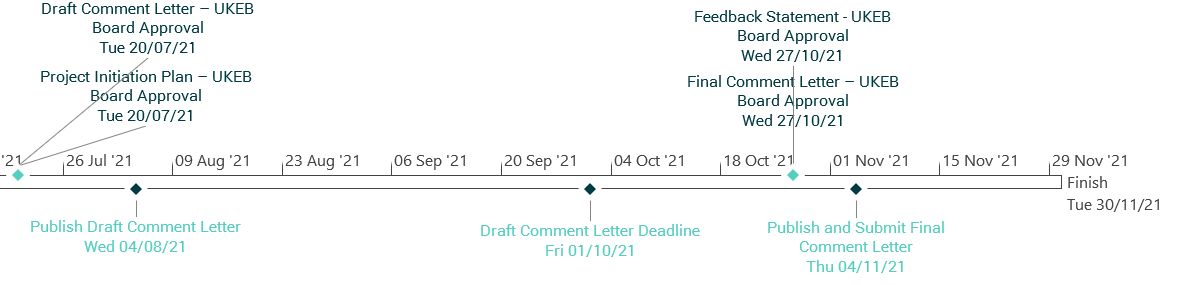
Appendix 2: Invitation to Comment: Exposure Draft ED/2021/3 Disclosure Requirements in IFRS Standards – A Pilot Approach (Proposed Amendments to IFRS13 and IAS 19).
Dr. Andreas Barckow Chairman International Accounting Standards Board 7 Westferry Circus Canary Wharf London E14 4HD
[Date]
Dear Dr Barckow
Invitation to Comment: Exposure Draft ED/2021/3 Disclosure Requirements in IFRS Standards – A Pilot Approach (Proposed Amendments to IFRS13 and IAS 19).
The UK Endorsement Board (UKEB) is responsible for endorsement and adoption of IFRS for use in the UK and therefore is the UK's National Standard Setter for IFRS. The UKEB also leads the UK's engagement with the IFRS Foundation (Foundation) on the development of new standards, amendments and interpretations. This letter is intended to contribute to the Foundation's due process. The views expressed by the UKEB in this letter are separate from, and will not necessarily affect the conclusions in, any endorsement and adoption assessment on new or amended International Accounting Standards undertaken by the UKEB.
We welcome the opportunity to contribute to the debate on disclosure in financial statements. Our work has included in-house research and some initial outreach at our stakeholders' roundtables. Our work on these matters continues and will inform our final comment letter. Our high-level comments from our initial work is as follows:
1We support IASB in its ongoing efforts to make financial statement disclosure more useful and effective. We see merit in the principles-based approach to disclosure described in the Exposure Draft (“ED”) that uses objectives to replace lists of mandatory disclosure.
2However, initial consultation with stakeholders has identified concerns about the practical application of the ED's proposals, including issues of comparability, the impact on digital financial reporting, the application of judgement and issues of audit and enforceability. More information on these issues can be found in appendix 1.
3We do not support the proposed amendments to IFRS 13. We note that both the Post Implementation Review (PIR) and stakeholders consulted by IASB during this project confirmed that the fair value measurement disclosures generally contain information which meets the needs of users. Given the significant amount of change and consultation in recent months we cannot support significant amendments to a disclosure regime that stakeholders say is working adequately. This is discussed further at paragraph A19 of appendix 1.
4Furthermore, we have reservations about supporting amendments to either IFRS 13 or IAS 19 without first understanding whether the Guidance described in the ED will be adopted and applied to other IASB projects. If the methodology is not used elsewhere, it will lead to inconsistent principles for disclosures being applied within IFRS.
If you have any questions about this response please contact the project team at [email protected]
Yours sincerely
Pauline Wallace Chair UK Endorsement Board
The proposed Guidance
| Question 1: Using Overall Disclosure Objectives |
|---|
| Paragraphs DG5-DG7 of this Exposure Draft explain how the Board proposes to use overall disclosure objectives in future. |
| a) Do you agree that the Board should use overall disclosure objectives within IFRS Standards in future? Why or why not? |
| b) Do you agree that overall disclosure objectives would help entities, auditors and regulators determine whether information provided in the notes meets overall user information needs? Why or why not? |
| Question 2: Using specific disclosure objectives and the disclosure problem |
|---|
| Paragraphs DG8-DG10 of this Exposure Draft explain how the Board proposes to use specific disclosure objectives in future. |
| a) Do you agree that specific disclosure objectives, and the explanation of what the information is intended to help users do, would help entities apply judgements effectively when preparing their financial statements to: (i) provide relevant information; (ii) eliminate irrelevant information; and (iii) communicate information more effectively? Why or why not? If not, what alternative approach would you suggest and why? |
| b) Do you agree that specific disclosure objectives, and the explanation of what the information is intended to help users do, would provide a sufficient basis for auditors and regulators to determine whether an entity has applied judgements effectively when preparing their financial statements? Why or why not? |
| Question 3: Increased application of judgement |
|---|
| Paragraphs DG2-DG3 and DG8-DG13 of this Exposure Draft explain why, in future, the Board proposes to: |
| a) use prescriptive language to require an entity to comply with the disclosure objectives. |
| b) typically use less prescriptive language when referring to items of information to meet specific disclosure objectives. |
| An entity, therefore, would need to apply judgement to determine the information to disclose in its circumstances. This approach is intended to shift the focus from applying disclosure requirements like a checklist to determining whether disclosure objectives have been satisfied in the entity's own circumstances. Paragraphs BC188-BC191 of the Basis for Conclusions describe the likely effects of this approach on the behaviour of entities, auditors and regulators towards disclosures in financial statements. Paragraphs BC192-BC212 of the Basis for Conclusions describe the likely effects of this approach on the quality of financial reporting, including the cost consequences of the approach. |
| a) Do you agree with this approach? Why or why not? If not, what alternative approach do you suggest and why? |
| b) Do you agree that this approach would be effective in discouraging the use of disclosure requirements in IFRS Standards like a checklist? Why or why not? |
| c) Do you agree that this approach would be effective in helping to address the disclosure problem? For example, would the approach help entities provide decision-useful information in financial statements? Why or why not? |
| d) Do you agree that this approach would be operational and enforceable in practice? Why or why not? |
| e) Do you have any comments on the cost of this approach, both in the first year of application and in subsequent years? Please explain the nature of any expected incremental costs, for example, changes to the systems that entities use to produce disclosures in financial statements, additional resources needed to support the increased application of judgement, additional audit costs, costs for users in analysing information, or changes for electronic reporting. |
| Question 4: Describing items of information to promote the use of judgement |
|---|
| The Board proposes to use the following less prescriptive language when identifying items of information: 'While not mandatory, the following information may enable an entity to meet the disclosure objective'. Paragraph BC19-BC26 of the Basis for Conclusions describe the Board's reasons for this language and alternative options that the Board considered. |
| Do you agree that the proposed language is worded in a way that makes it clear that entities need to apply judgement to determine how to meet the specific disclosure objective? If not, what alternative language would you suggest and why? |
| Question 5: Other comments on the proposed Guidance |
|---|
| Paragraphs BC27-BC56 of the Basis for Conclusions describe other aspects of how the Board proposes to develop disclosure requirements in IFRS Standards in future applying the proposed Guidance. Paragraphs BC188-BC212 of the Basis for Conclusions explain the expected effects of any disclosure requirements developed using the proposed Guidance. |
| Do you have any other comments on these aspects? Please indicate the specific paragraphs or group of paragraphs to which your comments relate (if applicable). |
Overall and Specific Disclosure Objectives and the Disclosure Problem
A1We support IASB in its ongoing efforts to make financial statement disclosure more effective and useful. We see merit in the principles-based approach to disclosure described in the Exposure Draft (“ED”) that uses objectives to replace lists of mandatory disclosure. We can see that well defined objectives, both general objectives addressing the standard in its entirety, and specific objectives to address specific areas of the standard can be helpful in explaining the need for the information, which will assist companies in applying judgement to disclosure.
A2We particularly welcome the inclusion in the specific objectives of a statement describing users' expected use of the disclosed information. This provides valuable information to assist preparers, auditors and regulators in applying judgement as to what should be included and excluded from the disclosure process. These ideas support IASB's objective to ensure financial statements contain more relevant information and reduce irrelevant information.
Describing Items of Information to promote the use of judgement
A3We find the drafting throughout the ED to be sufficiently clear in its use of prescriptive and non-prescriptive language to be able to differentiate between mandatory and non-mandatory requirements. It is also clear that judgement should be applied to meet the objectives.
Other Comments on the Proposed Guidance
A4Paragraphs BC27-BC56 discuss the proposed process to develop specific disclosure objectives based on understanding users' needs. However the scope of the project is restricted to primary users (BC Table 4) and the list of parties to be consulted appears to consist primarily of investors (paragraph BC36). The term “investor” is also used instead of "user" in many of the IASB supporting materials to this project. We believe this creates the risk that objectives may not meet the needs of primary users as defined in the Conceptual Framework, which are existing and potential investors, lenders and other creditors.. We recommend that the needs of other primary users such as lenders and other creditors are explicitly scoped into the Guidance as groups to be consulted during the development of new disclosures. We further note that user needs may change over time and we suggest the Guidance include a mechanism to periodically consider this and make necessary adjustments.
A5One further consideration for the proposed process to develop specific disclosures is co-ordination with the proposed International Sustainability Standards Board (ISSB), as its activities develop. Whilst the exact nature of the financial statement disclosures that may underpin the ISSB's standards will not become certain for some time, it is important that IASB builds in sufficient flexibility during the development of this project to accommodate any overlaps that arise later down the line.
A6An important important consideration is whether the proposed Guidance is to be adopted for other future or existing standards. For example, if IASB following feedback from this consultation decide not to proceed with the proposed Guidance for other standard setting purposes, we would not support IFRS 13 or IAS 19 being changed in line with these proposals. If the methodology is not used elsewhere, it will lead to inconsistent principles for disclosures being applied within IFRS.
A7We are concerned that the potential amendments to IFRS 13 and IAS 19 are presented as an exposure draft and could proceed to finalisation after this consultation. We do not agree that sufficient rationale has been presented to justify the proposed changes to IFRS 13. This is discussed further at A19 below. By bundling the proposed guidance (future impact) and proposed changes to IFRS 13 and IAS 19 (immediate impact) into a single exposure draft, labelled as a “pilot approach” we question whether stakeholders have sufficient awareness of the significance and immediacy of the changes arising from the IFRS 13 and IAS 19 proposals. We recommend that when the consultation closes IASB consider the degree of stakeholder feedback on the specific detail of the IFRS 13 and IAS 19 proposals to determine whether these proposals would benefit from re-exposure prior to finalisation.
Increased Application of Judgement
A8We have a number of practical concerns regarding the proposals. If the objectives of the project are to be achieved it is important that the proposals will work in practice and be effective in bringing about change. We highlight these concerns below, and are seeking feedback from stakeholders as to their likely impact on the Disclosure Pilot and its objectives.
Comparability
A9Initial outreach with users indicates support for the proposals as they believe the benefits of more relevant disclosure outweigh the potential comparability issues arising from disclosures that are highly tailored to company circumstances or that may changes year-on-year as company circumstances change. They expect teething problems when companies first implement the new approach, but they expect that a commonality of practice will emerge within industries. They note that identifying the correct list of mandatory items will be important, and we recommend IASB consider this when assessing the results of field testing. We will continue to seek feedback from users during the consultation period to ensure users are willing to accept potentially decreased comparability in financial statement disclosure.
Digital Financial Reporting
Taxonomy
A10Stakeholder feedback suggests the current taxonomy can be challenging to apply with gaps and subjective judgements required to tag financial statements. There is a danger that this current situation is further exacerbated in an environment where disclosures are less consistent. We recommend IASB's field testing considers the implications for the new proposals and whether any solutions can be found to help mitigate the risks identified by our stakeholders above
Other Digital Reporting Matters
A11While BC48-49 acknowledge that the project team has worked with the taxonomy team on matters such as application challenges and tagging, the ED does not address the relationship between the proposed disclosure changes and the IASB's future vision for digital reporting and data use. The UKEB draft comment letter on the IASB's agenda consultation recommends IASB allocate more resource to digital reporting as it is anticipated that digital consumption of financial information will become more prevalent. We recommend that IASB explain clearly how the proposed disclosure changes align to their digital strategy prior to introducing change to the disclosure regime. This should also be incorporated into the proposed Guidance as a criteria for the future design and drafting of disclosure.
Application of judgement
A12Companies are already required to apply judgement and disclose all material information in financial statements under IAS 1 and yet the checklist approach persists. While the objectives approach provides further information to assist preparers and auditors in applying the necessary judgement, the risk remains that preparers with sufficient resources continue to present judgement-based disclosure while those lacking resource prefer to create a new checklist, possibly using the optional Items of Information as a basis to do so. We encourage the IASB to ensure companies with different size characteristics are included in the field tests.
A13In addition, preparers will face challenges under the proposed regime in providing sufficient rationale to auditors, Boards and Audit Committees on the judgements they make about information included or excluded from the disclosures under the new regime. However, the additional information on user needs and the use of objective may assist "middle ground” preparers transition to applying a more judgement-based approach. An additional way of nudging companies to avoid the checklist approach may be to present the Items of Information in a visual format which does not resemble a checklist.
A14We intend to seek further feedback from stakeholders during the consultation period on these matters.
Audit and enforceability
A15Providing clear objectives and information about how users expect to use the information is likely to enhance the ability to make good audit judgements.
A16Auditors may, however, experience similar challenges to those described for preparers at A12 and A13 above. Initial outreach with the audit community suggests these proposals are seen as conceptually a step in the right direction, but that application may be challenging, given the safety provided by a checklist approach. We recommend that audit firms are included in the proposed field tests of IFRS 13 and IAS 19 so that potential issues for both preparers and their audit firms can be identified and addressed.
A17IASB note in BC 191 that today auditors “ask only whether an entity has provided the specific piece of information the Standard requires" but under the proposals will need to apply judgement not just to the content of the disclosure, but to the "communication effectiveness of information disclosed”. This appears a more complex and time-consuming process. We recommend that a sufficiently long lead time be allowed for any proposed changes to IFRS 13 and IAS 19 arising from this project to allow audit firms to address the resource and skills consequences of such a change.
A18Regulators are also key to the success of these proposals. Some have suggested that a company's assessment of materiality may need to be disclosed to allow regulators to adequately assess the completeness and effectiveness of reporting. Regulators have told us that ensuring high quality of disclosure with an objectives-based regime is resource intensive. Recent experience working with IAS 1 has shown good results when working with well resourced preparers, auditors and regulatory teams. However, scaling this approach to cover a wider number of standards may exceed available regulatory resources, and add to the regulatory burden of smaller preparers, such as AIM listed companies. This could also impact international comparability as regulatory resources and funding vary by jurisdiction. We recommend IASB work with regulators in different jurisdictions to conduct an impact assessment of the proposals.
The proposed amendments to IFRS 13
| Question 6: Overall disclosure objective for assets and liabilities measured at fair value in the statement of financial position after initial recognition [IFRS 13] |
|---|
| Paragraphs BC62-BC73 of the Basis for Conclusions describe the Board's reasons for proposing the overall disclosure objective for assets and liabilities measured at fair value in the statement of financial position after initial recognition. |
| Do you agree that this proposed objective would result in the provision of useful information that meets the overall user information needs about assets and liabilities measured at fair value in the statement of financial position after initial recognition? If not, what alternative objective do you suggest and why? |
| Question 7: Specific disclosure objectives for assets and liabilities measured at fair value in the statement of financial position after initial recognition [IFRS 13] |
|---|
| Paragraphs BC74-BC97 of the Basis for Conclusions describe the Board's reasons for proposing the specific disclosure objectives about assets and liabilities measured at fair value in the statement of financial position after initial recognition, and discuss approaches that the Board considered but rejected. |
| a) Do you agree that the proposed specific disclosure objectives capture detailed user information needs about assets and liabilities measured at fair value in the statement of financial position after initial recognition? Why or why not? If not, what changes do you suggest? |
| b) Do you agree that the proposed specific disclosure objectives would result in the provision of information about material fair value measurements and the elimination of information about immaterial fair value measurements in financial statements? Why or why not? |
| c) Do you agree that the benefits of the specific disclosure objectives would justify the costs of satisfying them? Why or why not? If you disagree, how should the objectives be changed so that the benefits justify the costs? Please indicate the specific disclosure objective(s) to which your comments relate. |
| d) Do you have any other comments on the proposed specific disclosure objectives? Please indicate the specific disclosure objective(s) to which your comments relate. |
| Question 8 Information to meet the specific disclosure objectives for assets and liabilities measured at fair value in the statement of financial position after initial recognition [IFRS 13] |
|---|
| Paragraphs BC74-BC97 of the Basis for Conclusions describe the Board's reasons for proposing the items of information to meet the specific disclosure objectives about assets and liabilities measured at fair value in the statement of financial position after initial recognition, and discuss information that the Board considered but decided not to include. |
| a) Do you agree that entities should be required to disclose the proposed items of information in paragraphs 105, 109 and 116 of the [Draft] amendments to IFRS 13? Why or why not? If not, what changes do you suggest and how would they help an entity to meet the specific disclosure objective? |
| b) Do you agree with the proposed items of information that are not mandatory but may enable entities to meet each specific disclosure objective? Why or why not? If not, what changes do you suggest and how would they help an entity to meet the specific disclosure objective? |
| Question 9: Specific disclosure objective for assets and liabilities not measured at fair value in the statement of financial position but for which fair value is disclosed in the notes (IFRS 13) |
|---|
| Paragraphs BC98-BC99 of the Basis for Conclusions describe the Board's reasons for proposing the specific disclosure objective for assets and liabilities not measured at fair value in the statement of financial position but for which fair value is disclosed in the notes. |
| a) Do you agree that the proposed specific disclosure objective captures detailed user information needs about assets and liabilities not measured at fair value in the statement of financial position but for which fair value is disclosed in the notes? Why or why not? If not, what changes do you suggest? |
| b) Do you agree that this proposed specific disclosure objective would result in the provision of useful information about assets and liabilities not measured at fair value but for which fair value is disclosed in the notes? Why or why not? |
| c) Do you agree that the benefits of the specific disclosure objective would justify the costs of satisfying it? Why or why not? If you disagree, how should the objective be changed so that the benefits justify the costs? |
| d) Do you have any other comments about the proposed specific disclosure objective? |
| Question 10: Information to meet the specific disclosure objective for assets and liabilities not measured at fair value in the statement of financial position but for which fair value is disclosed in the notes (IFRS 13) |
|---|
| Paragraph BC100 of the Basis for Conclusions describes the Board's reasons for proposing the items of information to meet the specific disclosure objective about assets and liabilities not measured at fair value in the statement of financial position but for which fair value is disclosed in the notes. |
| a) Do you agree that entities should be required to disclose the proposed items of information in paragraph 120 of the [Draft] amendments to IFRS 13? Why or why not? If not, what changes do you suggest and how would they help an entity to meet the specific disclosure objective? |
| b) Do you agree with the proposed items of information that are not mandatory but may enable entities to meet the specific disclosure objective? Why or why not? If not, what changes do you suggest and how would they help an entity to meet the specific disclosure objective? |
| Question 11: Other comments on the proposed amendments to IFRS 13 |
|---|
| Do you have any other comments on the proposed amendments to IFRS 13 in this Exposure Draft, including the analysis of the effects (paragraphs BC214-BC215 of the Basis for Conclusions) and the Illustrative Examples accompanying the Exposure Draft? |
A19We do not support the proposed amendments to IFRS 13. We understand that IFRS 13 was chosen for the disclosure pilot as it provided a good example of a standard requiring a high level of materiality judgement. However, we note that the PIR of IFRS 13 concluded that the information required by IFRS 13 is useful to users of financial statements. Further, stakeholders consulted by IASB during this project confirmed that “fair value measurement disclosures applying IFRS 13 generally contain information that meets the needs of users of financial statements”. (BC 59). Given the significant amount of change and consultation in recent months we cannot support significant amendments to a disclosure regime that stakeholders say is working adequately.
A20If IASB chooses to continue to develop these proposals we ask that the following points are considered. Our general comments in paragraphs A1 – A18 also apply to the proposed amendments to IFRS 13.
A21Whilst the proposed changes to IFRS 13 appear workable we encourage IASB to undertake field testing as we believe it is key to identifying any potential issues. Field tests should include examples of both large and small companies.
A22Some disclosure requirements appear to be disproportionate. Paragraphs 118-121 describe proposed disclosures for assets and liabilities measured at amortised cost but for which fair value in disclosed in the notes. Paragraph 121 suggest that, while not mandatory, "a description of the nature, risks and other characteristics of the classes of assets and liabilities.....this information can be provided by cross reference to where that information is disclosed elsewhere in the financial statements.” This final requirement, particularly as it relates to the risks of fair value measurement, is in addition to existing requirements but also appears to be beyond the scope of what is discussed in BC 98-100. We interpret this to mean that, subject to materiality, disclosures of fair value valuation risk for items carried at fair value, and items carried at amortised cost for which fair value is disclosed in the notes should be the same.
A23Providing the same level of detail for fair value measurement risk for amortised cost assets as fair value assets appears disproportionately burdensome as companies are less likely to undertake the same level of fair value risk and sensitivity testing for amortised cost assets as they are for assets recorded at fair value. Smaller organisations with no or few fair value assets may not have the resources to do this. We recommend this requirement be removed, or if this was not IASB's intention that the drafting be clarified to reflect this.
A24The following example illustrates the point. Consider a bank with a large portfolio of vanilla Loans to Customers, which is recorded at amortised cost. Disclosure of the fair value of this portfolio is currently required by paragraph 25 of IFRS7 and would typically include less information about the risk to fair value measurement than that suggested above. Assuming the portfolio is material disclosure under the old/new regime might appear as follows.
Vanilla Loans to Customers – Amortised Cost
| FV of Amortised cost typical disclosure items | IFRS 7 | ED Para 121 |
|---|---|---|
| FV valuation | ✓ | ✓ |
| FV hierarchy category | ✓ | ✓ |
| Description of valuation technique | ✓ | ✓ |
| Key inputs to valuation technique | * | ✓ |
| Sensitivity of valuation to changes in inputs | ✕ | ✓ |
* disclosed in some cases
The proposed amendments to IAS 19
| Question 12: Overall disclosure objective for defined benefit plans (IAS 19) |
|---|
| Paragraphs BC107-BC109 of the Basis for Conclusions describe the Board's reasons for proposing the overall disclosure objective for defined benefit plans. Do you agree that this proposed objective would result in the provision of useful information that meets the overall user information needs about defined benefit plans? If not, what alternative objective do you suggest and why? |
| Question 13 Specific disclosure objectives for defined benefit plans (IAS 19) |
|---|
| Paragraphs BC110-BC145 of the Basis for Conclusions describe the Board's reasons for proposing the specific disclosure objectives about defined benefit plans, and discuss approaches that the Board considered but rejected. |
| a) Do you agree that the proposed specific disclosure objectives capture detailed user information needs about defined benefit plans? Why or why not? If not, what changes do you suggest? |
| b) Do you agree that the proposed specific disclosure objectives would result in the provision of relevant information and the elimination of irrelevant information about defined benefit plans in financial statements? Why or why not? |
| c) Do you agree that the benefits of the specific disclosure objectives would justify the costs of satisfying them? Why or why not? If you disagree, how should the objectives be changed so that the benefits justify the costs? Please indicate the specific disclosure objective(s) to which your comments relate. |
| d) Do you have any other comments on the proposed specific disclosure objectives? Please indicate the specific disclosure objective(s) to which your comments relate. |
| Question 14 Information to meet the specific disclosure objectives for defined benefit plans (IAS 19) |
|---|
| Paragraphs BC110-BC145 of the Basis for Conclusions describe the Board's reasons for proposing the items of information to meet the specific disclosure objectives about defined benefit plans, and discuss information that the Board considered but decided not to include. |
| a) Do you agree that entities should be required to disclose the proposed items of information in paragraphs 147F, 147M and 147V of the [Draft] amendments to IAS 19? Why or why not? If not, what changes do you suggest and how would they help an entity to meet the specific disclosure objectives? |
| b) Do you agree with the proposed items of information that are not mandatory but may enable entities to meet each specific disclosure objective? Why or why not? If not, what changes do you suggest and how would they help an entity to meet the specific disclosure objective? |
| Question 15 Overall disclosure objective for defined contribution plans (IAS 19) |
|---|
| Paragraphs BC156-BC158 of the Basis for Conclusions describe the Board's reasons for proposing the overall disclosure objective for defined contribution plans. |
| Do you agree that this proposed objective would result in the provision of useful information that meets the overall user information needs about defined contribution plans? If not, what alternative objective do you suggest and why? |
| Question 16 Disclosures for multi-employer plans and defined benefit plans that share risks between entities under common control (IAS 19) |
|---|
| Paragraphs BC159-BC166 of the Basis for Conclusions describe the Board's reasons for proposing which disclosure objectives should apply for multi-employer plans and defined benefit plans that share risks between entities under common control. |
| Do you agree that these proposals would result in the provision of useful information that meets the overall user information needs about these plans? If not, what alternative approach do you suggest and why? |
| Question 17 Disclosures for other types of employee benefit plans (IAS 19) |
|---|
| Paragraphs BC167-BC170 of the Basis for Conclusions describe the Board's reasons for proposing the overall disclosure objectives for other types of employee benefit plans. |
| Do you agree that these proposals would result in the provision of useful information that meets the overall user information needs about these plans? If not, what alternative approach do you suggest and why? |
| Question 18 Other comments on the proposed amendments to IAS 19 |
|---|
| Do you have any other comments on the proposed amendments to IAS 19 in this Exposure Draft, including the analysis of the effects (paragraph BC216 of the Basis for Conclusions) and the Illustrative Examples accompanying the Exposure Draft? |
A25Our general comments in paragraphs A1 – A18 also apply to the proposed amendments to IAS 19.
A26Our initial analysis suggests these proposals are in line with the new disclosure guidance described in the ED, and appear workable though potentially burdensome. [This is an initial view - stakeholders please see Question 9 in the Invitation to Comment].
A27Due to the large number of UK companies that will be affected by the proposed changes to IAS 19, and the range of benefits covered by this disclosure we believe that field testing with a diverse range of companies will be important to identify any potential issues, and we encourage IASB in their plans to do so.
| Question | Ref |
|---|---|
| The proposed Guidance | |
| 1 Do you believe the benefits arising from these proposals are sufficient to outweigh any potential decrease in the comparability of financial statements? Please explain your thoughts. | A8 |
| 2 Do you think these proposals will cause issues with regards to digital reporting? Please explain your concerns and any potential solutions. | A10-11 |
| 3 Do you foresee any practical issues arising from the ED's objectives based disclosure regime? Can you identify any potential solutions those issues? | A12-18 |
| 4 In your opinion are the proposals likely to provide long term benefits to financial reporting that exceed the costs? Can you provide any information on likely costs (qualitative or quantitative)? | |
| The proposed amendments to IFRS 13 and IAS 19. | |
| 5 Do you have any comments on the proposed amendments to IFRS 13? Is there any reason these amendments should not proceed? | A21 |
| 6 Do you have any comments on the proposed amendments to IAS 19? Is there any reason these amendments should not proceed? | A26 |
| Other comments | |
| 7 Do you have any other comments on the exposure draft? |
Footnotes
-
Exposure Draft ED/2021/3 Disclosure Requirements in IFRS Standards – A Pilot Approach The ED, Basis for Conclusions and Illustrative Examples can be accessed here. ↩
-
The International Accounting Standards and European Public Limited-Liability Company (Amendment etc.) (EU Exit) Regulations 2019: https://www.legislation.gov.uk/uksi/2019/685/made ↩
-
The ED, Basis for Conclusions and Illustrative Examples can be accessed here. ↩