4.2 IFRS 17 – Technical paper - CSM Allocation
UK ENDORSEMENT BOARD 20 JULY 2021 AGENDA PAPER 4.2
Executive Summary
| Project Type | Endorsement |
| Project Scope | Significant |
Purpose of the paper
At its 9 July 2021 meeting the Board agreed to an approach to discussing significant issues arising from the assessment of IFRS 17 against the technical accounting criteria1 (see Appendix 2). This paper provides information on an aspect of such an assessment for one of the significant issues, namely the allocation of contractual service margin for annuities. It invites the Board's comments on the technical analysis and seeks the Board's advice on next steps.
Summary of the issues
IFRS 17's requirements for the measurement of insurance contracts include areas of significant entity-level judgement, including in respect of determining coverage units that represent the provision of service under a group of insurance contracts. The requirements give rise to certain challenges to the technical accounting criteria. The technical analysis set out in this paper considers these challenges in the context of the standard's overall principles and objectives.
Decisions for the Board
The Board is not asked to make any decisions at this stage. The paper asks for comments on:
- The technical analysis of the issue and the different views presented
- Potential implications for the assessment against the technical accounting criteria
- Any further analysis and outreach work required to enable the assessment to be drafted.
The paper seeks the Board's advice on next steps
Recommendations
The paper recommends that industry prepares a comprehensive technical paper as a basis for an approach to the IASB for formal advice on the appropriate next step (IASB's Transition Resource Group for IFRS 17 or submission to the Interpretations Committee).
Appendices
| Appendix 1 | IFRS 17 Technical Requirements |
|---|---|
| Appendix 2 | Illustrative example comparing CSM allocation under view A and view B |
Introduction
1Under IFRS 17, the contractual service margin (CSM) is the balance sheet item representing the unearned profit the entity will recognise as it provides services in respect of a group of insurance contracts. This paper deals with the recognition of that profit in profit or loss for annuities2, including bulk purchase annuities3 (BPAs), under IFRS 17's general measurement model (GMM).
2IFRS 17 requires an amount of the CSM for a group of insurance contracts to be recognised in profit or loss in each period to reflect the insurance contract services provided in that period. The standard sets out how that recognition should operate at a high level but does not provide detailed guidance or detailed requirements for particular product types.
3Stakeholder outreach conducted by the Secretariat has not indicated any significant concerns over the application of IFRS 17's requirements for most insurance product types. However, significant judgement is required to apply the standard's requirements in the case of annuities and BPAs, which has resulted in significant debate on the determination of the required accounting. Preparers are concerned that, depending on the interpretation of the standard's requirements, the accounting will not fairly reflect the economic substance of the transactions, will not provide useful or understandable financial information and will therefore not meet the technical accounting criteria.
4The significance of the concerns around this issue has become apparent only in recent months. Stakeholder discussions are ongoing and our analysis and outreach work is continuing. As this issue is still being discussed, the Secretariat has not concluded its assessment. We intend to bring the [draft] endorsement criteria assessment in relation to this topic to a subsequent Board meeting.
5The remainder of this paper is structured as follows:
- Description of IFRS 17's requirements for the allocation of the CSM
- Explanation of the current debate
- Assessment of the potential accounting impact
- Consideration of next steps
6The Board is invited to comment on the technical issue and asked to advise on next steps. Specific questions for the Board are included in the relevant sections of the paper. The Board is not asked to make any decisions at this stage.
CSM Allocation: IFRS 17 requirements and IASB rationale
Initial recognition
7On initial recognition of a group of insurance contracts, IFRS 17 requires an entity to recognise a CSM, a component of the asset or liability for the group of insurance contracts that represents the unearned profit the entity will recognise as it provides insurance contract services in the future (IFRS 17:38).
8At initial recognition, the CSM is equal to the present value of risk-adjusted future cash inflows less the present value of risk-adjusted future cash outflows. For a group of profitable insurance contracts, no amount is recognised in profit or loss on initial recognition. Profit is instead deferred on the balance sheet and recognised in profit or loss over the coverage period.
9The CSM represents the margin the entity has charged for the services provided, in addition to bearing risk. The expected margin charged for bearing risk is instead represented by the risk adjustment for non-financial risk (IFRS 17: BC222).
Subsequent measurement
10In each period, an entity will recognise as insurance revenue, an amount of CSM representing the insurance contract services provided by the group of insurance contracts in that period (IFRS 17: 44(e)). An entity that issues insurance contracts without direct participation features recognises profit when it provides insurance coverage or any service relating to investment activities (investment-return service).
11The recognition of the CSM in profit or loss is determined by identifying coverage units that reflect the quantity of benefits provided under the insurance contracts and their expected coverage period (IFRS 17: B119).
12The pattern of expected cash flows and the release of the risk adjustment for non-financial risk are already included in the measurement of the fulfilment cash flows. Therefore, they are not relevant factors in determining the satisfaction of the performance obligation and provision of service (IFRS 17: BC279(a)).
13At the end of the reporting period, the remaining CSM on the balance sheet represents the profit in the group of insurance contracts that has not yet been recognised in profit or loss because it relates to future service (IFRS 17: 43).
Investment return service
14IFRS 17 requires an entity to identify coverage units for insurance contracts considering the quantity of benefits and the expected coverage period of investment-return service, if any, in addition to the insurance coverage (IFRS 17: BC283A).
15The IASB concluded that recognising the CSM in line with the provision of both insurance coverage and an investment-return service will provide useful information to users of financial statements. This benefit would be particularly important for contracts that have an insurance coverage period that differs from the period in which the policyholder benefits from an investment-return service (IFRS 17: BC293B)4.
16The IASB specified conditions that are required to identify, but do not determine, the existence of an investment-return service, thereby allowing an entity to consider the relevant facts and circumstances and apply judgement when performing their assessment (IFRS 17:BC283E). Although the IASB acknowledged that additional subjectivity and complexity are introduced by including an investment-return service in addition to insurance coverage in determining coverage units for insurance contracts without direct participation features, they concluded that this risk would be mitigated by the related disclosure required by paragraph 109 of IFRS 17. This disclosure provides users of financial information with useful information about the pattern of service provision (IFRS 17: BC283F).
Disclosures
17Determining the quantity of benefits provided by an insurance contract considering either investment-return service or investment-related service5 in addition to insurance coverage adds complexity and judgement (IFRS 17: BC366B)6. Accordingly, entities are required to disclose quantitative information about when they expect to recognise in profit or loss the CSM remaining at the end of the reporting period, providing time bands (IFRS 17:109).
18IFRS 17 also requires an entity to disclose significant judgements made in applying the Standard. This includes the approach used to determine the relative weighting of the benefits provided by insurance coverage and investment-return service (IFRS 17:117(c)(v)).
IASB's Transition Resource Group for IFRS 17
19The allocation of the CSM was discussed by the IASB's Transition Resource Group for IFRS 17 (TRG). Discussion at the May 2018 TRG meeting7 noted that:
- The determination of coverage units is not an accounting policy choice but involves judgement and estimates, applied in a systematic and rational way, to best achieve the principle of reflecting the services provided in each period.
- The objective is to reflect insurance services provided in each period so different levels of service provided across periods should be appropriately reflected in the determination of coverage units.
- Determining the quantity of benefits provided under a contract requires an entity to consider the benefits expected to be received by the policyholder, not the costs of providing those benefits expected to be incurred by the entity.
- The period in which an entity bears insurance risk is not necessarily the same as the coverage period (IFRS 17: BC140-BC142).
- A policyholder benefits from an entity standing ready to meet valid claims, not just from making a claim if an insured event occurs. The quantity of benefits provided therefore relates to the amounts that can be claimed by the policyholder.
- IFRS 17 does not specify a particular method or methods to determine the quantity of benefits. Therefore, different methods can be used to determine the quantity of benefits as long as they achieve the objective of reflecting the insurance service provided in each period. Judgement needs to be applied to determine the method that best reflects the insurance service provided.
Questions for the Board
| 20. Does the Board have any comments or questions on IFRS 17's requirements for recognition of CSM in profit or loss? |
Explanation of the current debate in the UK
21Applying the definitions in IFRS 178 to annuities:
- the insurance risk is that the policyholder lives longer than expected;
- the insured event is policyholder survival.
22As set out above, in broad terms there are two types of service that may be provided to the policyholder: (i) insurance coverage and (ii) investment-return service. The current debate and stakeholder concerns centre on the following key questions:
- On what basis should insurance coverage be recognised for annuities in the pay-out phase: how should coverage units be determined under B119?
- What is the precise nature of the service(s) provided?
- What mechanism should be used for allocation over the coverage period?
- To what extent can an investment-return service be recognised and how should the quantity of benefits be split between insurance coverage and investment-return service?
24Typically, UK annuities in payment (as opposed to deferred annuities) do not meet the conditions for recognition of investment-return service, so for such annuities the issue focuses on question a. in paragraph 23 above9.
25For deferred annuities, including bulk purchase annuities, questions a and b in paragraph 21 are both relevant. The focus of our discussions, however, has been on question a. since we understand that if that question can be resolved then question b. becomes less of a concern.
a) Recognition of insurance coverage: alternative views
26Two opposing views have developed in stakeholder discussions for interpreting the requirements of IFRS 17 to determine coverage units that appropriately reflect the insurance coverage service provided for annuities, including bulk purchase annuities, in the pay-out phase:
- View A: the quantity of benefits reflects solely the payments made to the policyholder for each period; and
- View B: the quantity of benefits incorporates both the regular payment and the extension of the insurance coverage to provide a guaranteed income for the rest of the policyholder's life. The latter is sometimes referred to as the 'peace of mind' service, that ensures the policyholder continues to receive payments for the rest of their life. This is noted to be a key feature of an annuity as the policyholder only retains the ability to make a claim in future periods if the insured event (survival) occurs in the current period.
27There is no debate over the coverage period. It appears to be generally agreed that the coverage period is the probability-weighted average duration of the contracts (i.e. based on life expectations). The coverage period, and therefore the period over which the CSM is recognised, is the same under both View A and View B.
View A - payments made to the policyholder for each period
28Supporters of View A disagree with the assertion that the 'peace of mind' service constitutes insurance service, as defined in IFRS 17. They note that the policyholder is exchanging their premium for a series of cash flows. Services provided to the policyholder are therefore the annuity payments made if the policyholder survives the particular period in question. Under this approach, the quantity of benefits (assuming a level annuity) is equal in each payment period up to the date of death. In essence, survival on the payment date triggers measurement of the benefit, so the quantity of benefits is limited to the amount that can validly be claimed as a result of events that occurred within the period. View A sees the contract as covering a series of insured events.
29View A acknowledges that the stand ready obligation provides value to the policyholder because it represents a transfer of risk from the policyholder to the insurer – the annuity provides certainty over future income for each year of survival. However, View A notes that there is a distinction between bearing insurance risk and providing insurance coverage (IFRS 17: BC140-BC142). The view asserts that in the case of an immediate annuity, claims are contingent on survival to the point at which a claim may be made and argues that if no insured event can take place during the period, and no valid claim made, then no insurance coverage is provided in that period.
30Supporters of View A argue that this approach is consistent with the treatment of other types of contract, for which no insurance coverage is recognised for similar transfer of risk and 'peace of mind' (e.g. reinsurance binders or endowment assurance policies). In addition, the TRG discussed the example of a forward purchase of a fixed rate annuity and staff did not think that an insured event could happen in the period before the annuity started10. Adopting a different approach for annuities therefore risks inconsistency and other unintended consequences.
31In addition, proponents of View A note that the 'peace of mind' service (transfer of risk) exists also in the deferral period and, if insurance coverage could be recognised for that, there would have been no need for the IASB's June 2020 narrow-scope amendment introducing the investment-return service. Our understanding is that only some supporters of View B argue for recognition of insurance coverage in the deferral period.
View B – “annuity sum assured” approach
32Proponents of the annuity sum assured approach consider that annuities provide an additional service, in excess of the annual payments, namely the extension of insurance coverage to provide a guaranteed income for life. They argue that the primary reason policyholders purchase an annuity, rather than an “annuity certain” (a financial instrument with no insurance), is to transfer longevity risk to the insurer. This is the central purpose of the contract.
33View B considers that the total amount the policyholder can be expected to be able to validly claim, given events in the period (i.e. when the insured event of survival occurs in the period), is the total of current and expected future annuity payments. The survival of the policyholder in any period results in them receiving an annuity payment in that period and also retaining the right to receive a guaranteed income for the remainder of their life. View B argues that both should be reflected in the determination of the quantity of benefits.
34Under View B, the quantity of benefits recognised each year for a group of contracts decreases over time. Proponents of view B believe that this is consistent with the transfer of services. That is, in addition to the claims paid, the policyholder benefits from the security of guaranteed future payments. The value of this second benefit decreases over time as the value of the 'sum assured' falls, in other words, each year the policyholder receives their annuity payment, the aggregate amount of the probability-weighted future annuity payments falls. This is consistent with the approach that would be applied for a contract where the maximum benefit decreases over time, such as protection against a falling loan balance.
35An alternative interpretation is that the sum assured reflects the value the policyholder would forfeit if they died. This value falls over time, because each year the value they would forfeit upon death declines.
36Supporters of View B also argue that View A ignores the pricing of annuities and how portfolios of contracts are measured when they change hands in open market transactions. They argue that View B aligns profit recognition with how BPAs are priced in open market transactions between sophisticated willing sellers (pension fund trustees) and sophisticated willing purchasers (large life insurance companies).
b) Recognition of investment-return service
37Supporters of View B argue that while View A is straightforward for individual annuities in payment it does not work well for bulk purchase annuities. In particular it provides no basis for the split of CSM between the investment-return service and insurance coverage and results in an arbitrary division. Annuity contracts are priced for the full duration of the contract, not separately for the investment-return and insurance coverage phases. Determining a weighting of coverage units between the deferred and payment phases would be arbitrary and require significant judgement. These stakeholders consider that View B significantly reduces the level of judgement required because under View B essentially the same basis11 can be used appropriately to determine the quantity of benefits for both types of service across the pay-out and deferral phases.
38As explained above, UK annuities in payment do not typically meet IFRS 17's criteria for recognition of an investment-return service. Some stakeholders consider that the management of investment assets and the generation of a return is fundamental to the service provided even in the pay-out phase. They consider that IFRS 17's conditions are too restrictive and that the ability to recognise an investment-return service in the pay-out phase would alleviate some of their concerns about View A.
39Other stakeholders, however, argue that generation of an investment return is not the purpose of the annuity contract in the pay-out phase and is not the service provided to the policyholder. Importantly, they note that the generation of a return on investment assets is fundamental to nearly all insurance business and that making an exception for annuities could have wide-reaching implications for IFRS 17's core accounting model.
40Feedback from stakeholders has indicated that in some jurisdictions the criteria for the investment-return service are not met in the deferral phase. This may affect UK insurers with overseas business. The CSM for these insurance contracts will need to be recognised solely during the pay-out (insurance coverage) period.
Key areas of disagreement - summary
41In summary, key areas in which stakeholders have failed to reach consensus include:
- how to define the nature of the service provided by annuities;
- whether the release from longevity risk should be recognised as part of the allocation of the CSM or only through the risk adjustment; and
- the appropriate mechanism for recognising the CSM in profit or loss during the pay-out phase.
42There are additional challenges in relation to IFRS 17's requirements for the recognition of an investment-return service.
Accounting implications
43As noted above, the coverage period is the same under both View A and View B so the same total CSM is recognised over the same period. Both approaches generally result in more CSM recognised in the earlier years due to a combination of factors including the accretion of interest on the CSM and expectations of policyholder deaths. However, View B results in a faster recognition of the CSM: profit is recognised earlier.
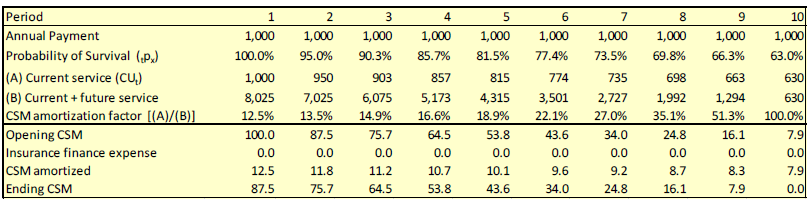
44We understand there is no single agreed or defined methodology for either View A or View B. In broad terms, however, the mechanism under View A applies a formula based on the amount of current benefit as a proportion of the aggregate current and future benefits. Under View B the formula is based on the current best estimate liability (BEL) as a proportion of the present value of the sum of future BELs.12 A Draft Educational Note prepared by the Canadian Institute of Actuaries13 includes the following simplified illustrations of each method:
45Illustrative example of a 10 year immediate annuity with an annual benefit amount of 1000 and no investment-return service. Source: CIA Draft Education Note on Coverage Units December 2019 page 17. This example illustrates View A.
46Illustrative example of a 10 year immediate annuity with an annual benefit amount of 1000 and no investment-return service. Source: CIA Draft Education Note on Coverage Units December 2019 page 19. This example illustrates View B.
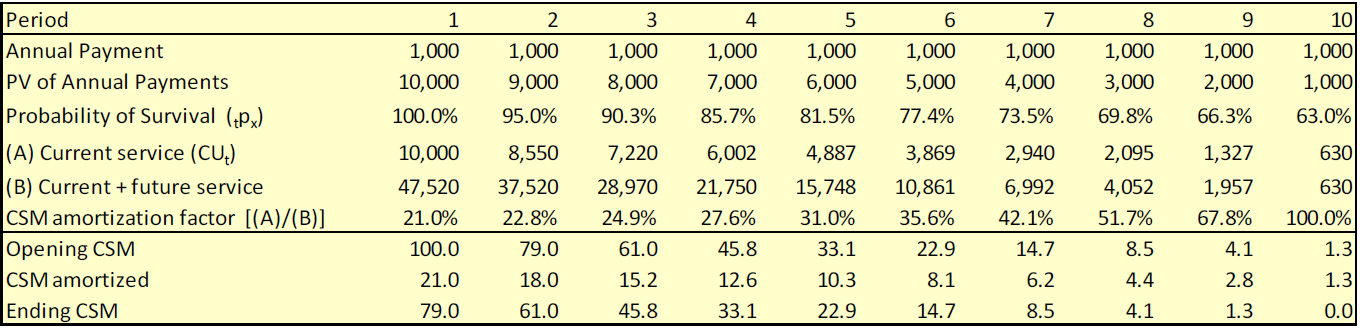
47Under View A the annual CSM recognised in profit or loss declines from 12.5 to 7.9 over the 10 year coverage period, while under View B it declines from 21 to 1.3. The total in each case is 100. The difference between the two approaches may be exaggerated by the relatively short (10 year) coverage period assumed for the illustration. Longer, more realistic coverage periods would generally result in less stark differences.
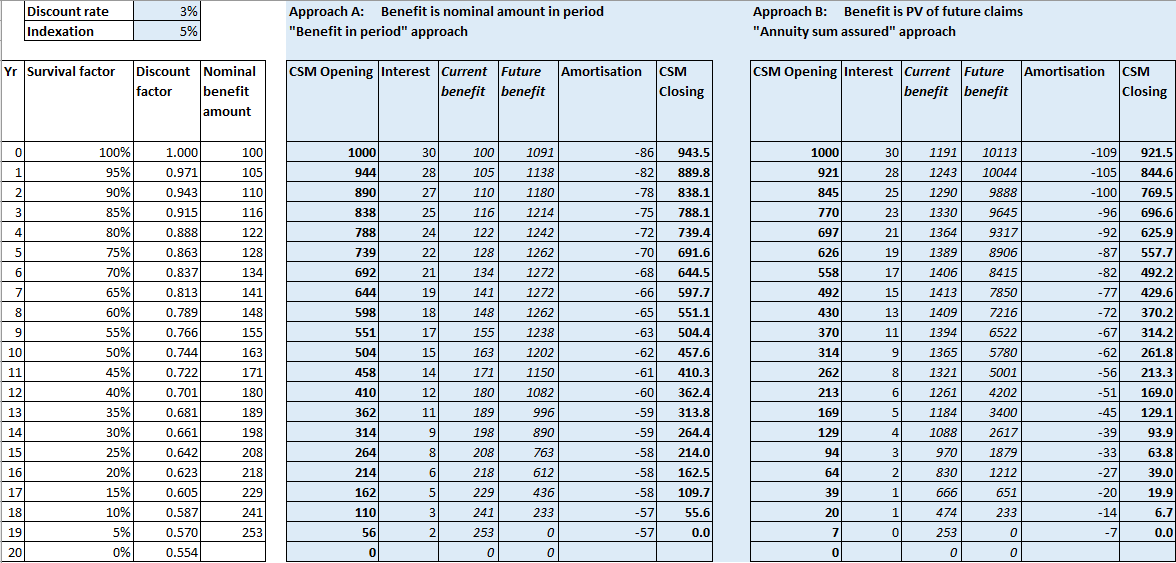
48An alternative more detailed illustration, provided by a stakeholder, is included at Appendix 2. In this illustration, the amount of CSM recognised in profit or loss over the first 5 years is 27% higher under View B.
49Information provided to date by stakeholders suggests that the risk adjustment for groups of annuity contracts is likely to be relatively small compared with the amount of the CSM. The precise pattern of release of the risk adjustment is therefore unlikely to significantly affect the overall profit or loss recognised for groups of annuity contracts in individual periods.
50The quantum of the difference in profit recognition between the approaches is uncertain because data is not publicly available. Work to assess the accounting impact is ongoing but stakeholder outreach to date indicates that this is a material issue for UK insurers. This is exacerbated by the fact that bulk purchase annuities are a major and growing product line. The Hymans Robertson Risk Transfer Report 202114 concluded the total value of risk transfer transactions in 2020 was £30bn. Furthermore, they expect bulk annuity transaction volumes to exceed £40bn a year until the end of the decade.
51Supporters of View B have expressed concerns that, View A will result in:
- an understatement of equity and an overstatement of CSM on transition;
- an understatement of profit and overstatement of the liability on the balance sheet for many years (decades) to come; and
- greater differences between a fair value approach and a retrospective approach on transition.
52Some stakeholders have suggested that a potential consequence of enforcing View A for CSM allocation is that it may encourage structuring transactions such that a secondary market may emerge for bulk purchase annuities where groups of contracts are traded to release profit that has built up in the CSM. This would result in uneven profit recognition in respect of such insurance contracts, undermining a primary objective of IFRS 17.
Endorsement challenges in respect of CSM amortisation
53Work is ongoing in this area so the Secretariat has not completed the drafting of the relevant paragraphs for the DECA. However, depending on whether one supports View A or View B, implications for the assessment against the technical criteria could include the following preliminary assessments.
54IFRS 17 does not prescribe how an entity should determine the quantity of benefits provided under a contract, and thus how to determine the coverage units and their corresponding weighting. Given the possibility that different methods can be used for this calculation, there is a risk that the requirements of IFRS 17 in relation to CSM amortisation will lead to a divergence in application. If two entities adopted View A and View B respectively they would apply different approaches to the allocation of CSM to profit and loss in the pay-out phase and they may apply different bases for determining the split between the investment-return service and insurance coverage. This would result in financial statements that are less comparable. If financial statements are not comparable, they may be less understandable to users of financial statements, who would find it difficult to assess performance.
55Proponents of View B argue that the allocation approach under View A does not reflect the underlying economics of the insurance contract and would therefore result in a less faithful representation, challenging the reliability of the financial information.
Questions for the Board
| 56. Does the Board have any comments or questions on the technical analysis? | |
| 57. Does the Board have any comments on the potential implications for the assessment against the technical accounting criteria? |
Next steps
Outreach activities to date
58At its May 2021 meeting the UKEB Insurance Technical Advisory Group (TAG) discussed a paper on the recognition of the CSM in profit or loss for annuities, including bulk purchase annuities.
59TAG members were divided in their views on whether View A, View B, or both views, were permissible under the standard. It was noted that the issue had been discussed at other fora, including at the ICAEW Insurance Committee.
60Since the May 2021 TAG meeting the Secretariat has conducted a number of follow up discussions with stakeholders to gather further information on the matter and on the different views.
61The Secretariat also met with the IASB technical staff to confirm understanding of the requirements of the Standard in this area and to discuss potential next steps. The IASB staff also provided information on the timelines involved if it were decided that a referral to the International Accounting Standards Board's (IASB) IFRS Interpretations Committee (Interpretations Committee) is necessary to resolve the situation.
62The Secretariat also held discussions with other National Standard Setters to gain an understanding of international perspectives on the issue.
63At its June 2021 meeting the TAG discussed potential next steps to try to resolve the debate on this topic. These discussions are reflected in the following section.
Potential next steps
64At present it seems unlikely that UK stakeholders will reach a satisfactory resolution to the debate. In addition to the continuation of its discussions with stakeholders, therefore, the Secretariat considers there are several further potential steps that could be taken to progress this issue:
- industry prepares a comprehensive technical paper for discussion with IASB technical staff;
- referral to the IASB's TRG for IFRS 17;
- referral to the Interpretations Committee; or
- develop a UK specific solution.
Industry prepares a comprehensive technical paper for discussion with IASB technical staff
65Industry representatives could document the alternative views in a discussion paper, to facilitate a discussion with the IASB technical staff on the measurement requirements.
66The advantages of this approach are that:
- the different views will be clearly and comprehensively articulated (we understand they have not previously been presented in this manner to the IASB technical staff for consideration); and
- the IASB technical staff may be able to provide further explanations or guidance that may help to provide clarity over IFRS 17's requirements.
67The disadvantages of this approach are that:
- any discussion with the IASB technical staff is likely to be private in the first instance and therefore may not provide a sufficiently authoritative or conclusive basis for preparers and auditors;
- the IASB technical staff may prefer not to provide views on the basis that more appropriate due process would be to refer the matter to either the TRG for IFRS 17 or the Interpretations Committee.
Referral to the IASB's TRG for IFRS 17
68Determining the quantity of benefits for identifying coverage units was discussed at the February and May 2018 meetings of the TRG for IFRS 17. The TRG discussed a number of fact patterns, providing illustrative examples for how they may be accounted for in line with the requirements in the Standard.
69At present no future TRG meetings are scheduled. However, the TRG has not been disbanded and it is possible that the IASB might be persuaded to reconvene the TRG to discuss this specific topic.
70The advantages of this approach are that:
- the TRG is formed of insurance industry specialists who can provide specialist knowledge of the fact patterns being discussed;
- the TRG may provide interpretation guidance to provide clarity on determining coverage units for annuities; and
- if the TRG can be reconvened, this may result in a quicker resolution of the issue.
71The disadvantages of this approach are that:
- no TRG meetings are currently scheduled and it is uncertain when an additional meeting could take place, potentially putting pressure on entities' implementation programmes as the transition date approaches; and
- the IASB may conclude that the topic has already been discussed at the TRG and there is limited benefit from presenting it again for further discussion.
72In their discussion with the Secretariat during last month, the IASB technical staff did highlight that this topic has already been discussed by the TRG, although at the time they had not had the time to review in detail or digest the details of this issue. They also expressed a tentative view that reconvening the TRG at this stage in entities' implementation programmes may be unduly disruptive for their wider stakeholder base.
Referral to the Interpretations Committee
73The Interpretations Committee responds to questions about the application of IFRS.
74The following diagram, taken from the IFRS website, summarises the criteria the Interpretations Committee considers when deciding whether a standard-setting project should be added to the workplan15:
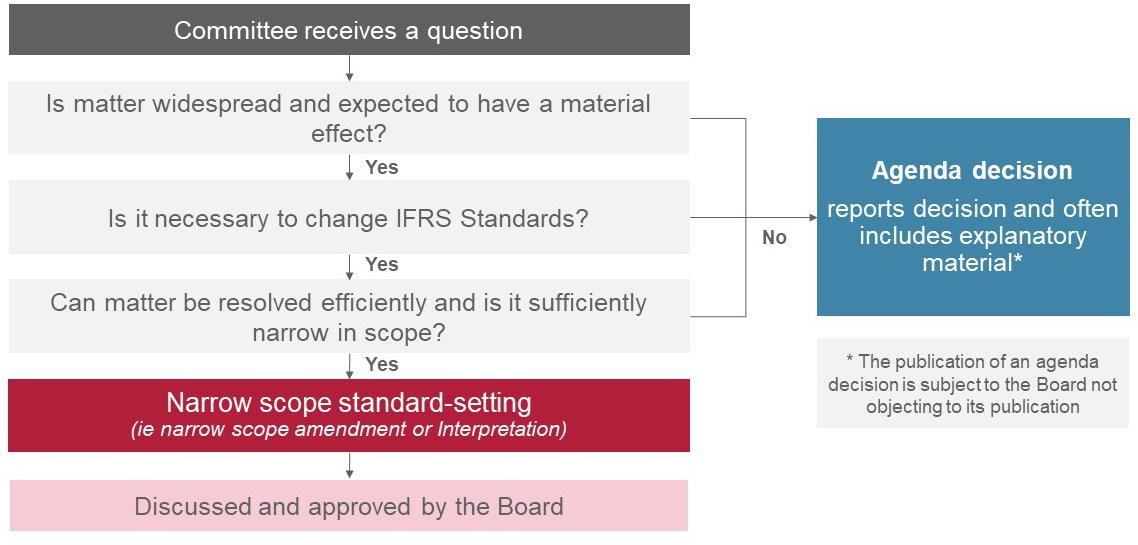
75The Interpretations Committee may decide a question does not meet the requirements for a standard-setting project if it concludes that standard-setting would be:
- unnecessary because, in their view, IFRS 17 provides an adequate basis for an entity to determine the required accounting or because there is no evidence that a widespread financial reporting problem exists; or
- not sufficiently narrow in scope.
76In their recent discussion with the Secretariat, the IASB technical staff indicated that the process from submitting an enquiry to the Interpretations Committee to either reaching an agenda decision or narrow scope standard-setting, takes a minimum of six months and can take longer if an amendment to the standard is necessary. Any amendments to the standard would also need to go through the formal UK adoption process.
77The advantages of this approach are that:
- the Interpretations Committee may provide interpretation guidance that helps provide clarity on determining coverage units; and
- referrals to the Interpretations Committee are public and IASB technical staff papers on this topic may be in the public domain within 2 months of submission.
78The disadvantages of this approach are that:
- although the Interpretations Committee is made up of members providing the best available technical expertise and diversity of international business and market experience relating to the application of IFRS Standards, the committee includes only two members with specialist insurance knowledge;
- the Interpretations Committee may conclude that a submission does not meet the submission criteria (i.e. no further interpretative guidance or amendment to the standard is necessary) and issue an agenda decision; and
- the process will take a minimum of 6 months, which will put pressure on entities' implementation programmes as we approach the implementation date.
79Discussions the Secretariat held with the TAG indicated that although the Interpretation Committee's likely conclusions may take at least 6 months to be formalised, the expected outcome is typically apparent from IASB technical staff research and papers in a shorter time frame, providing useful information more quickly to the industry.
80The TAG also commented that even if the Interpretations Committee declined to take the topic onto their agenda, the agenda decision they issued would typically provide further guidance on the topic.
81The Secretariat suggests that any submission would be on behalf of the Board and would be developed in consultation with, and submitted for approval by, the Board.
UK specific solution
82Some stakeholders have suggested that it might become appropriate for the UKEB to develop a UK-specific solution. For example, this might take the form of UK-specific guidance. While such an approach might result in interpretation guidance that helps provide clarity for UK stakeholders regarding the determination of coverage units, the disadvantages of this approach are that:
- The role of the UKEB is to decide whether to adopt international financial reporting standards and not to provide UK specific guidance.
- Providing UK specific guidance would create a lack of international comparability, contrary to one of the core objectives of IFRS and of the UK endorsement regime.
- The insurance products being discussed are long term and current products may not be consistent with products written in the future: it would be very difficult to ensure that any guidance remained fit for purpose.
83As an initial step, the Secretariat recommends that industry prepares a comprehensive technical paper as a basis for an approach to the IASB for formal advice on the appropriate next step (IASB's Transition Resource Group for IFRS 17 or submission to the Interpretations Committee).
Questions for the Board
| 84. Does the Board have any comments on the potential next steps? | |
| 85. Does the Board have a view on which of the next steps is most appropriate in this case? | |
| 86. Are there any further important considerations that need to be taken into account? |
87Subject to the Board's comments on this topic and the results of any further analysis or outreach work required, the Secretariat will prepare a draft assessment on this topic to be included in the [draft] Endorsement Criteria Assessment.
Appendix 1: IFRS 17 technical references
Definitions
| Coverage period | The period during which the entity provides insurance contract services. This period includes the insurance contract services that relate to all premiums within the boundary of the insurance contract. |
| Insurance contract | A contract under which one party (the issuer) accepts significant insurance risk from another party (the policyholder) by agreeing to compensate the policyholder if a specified uncertain future event (the insured event) adversely affects the policyholder. |
| Insurance contract services | The following services that an entity provides to a policyholder of an insurance contract:
|
| Insurance risk | Risk other than financial risk, transferred from the holder of a contract to the issuer. |
| Insured event | An uncertain future event covered by an insurance contract that creates insurance risk. |
| Liability for incurred claims | An entity's obligation to:
|
| Liability for remaining coverage | An entity's obligation to:
|
Conditions for provision of an investment-return service
| IFRS 17: B119B | |
|---|---|
Insurance contracts without direct participation features may provide an investment-return service if, and only if:
|
Appendix 2
Illustrative example comparing CSM allocation under View A and View B
This is a copy of an illustrative example provided by an insurer16.
| Discount rate | 3% |
|---|---|
| Indexation | 5% |
Footnotes
-
SI 2019/685 requires an assessment of whether IFRS 17 "meets the criteria of understandability, relevance, reliability and comparability required of the financial information needed for making economic decisions and assessing the stewardship of management" [regulation 7 (1) (c)]. In this paper we refer to these criteria collectively as the technical accounting criteria. ↩
-
Under an annuity contract, in return for a lump-sum payment or series of payments, an insurer will issue the policyholder regular disbursements, beginning either immediately or at some future point. ↩
-
Bulk purchase annuity transactions are a method of de-risking pension plans. Buy-in transactions provide security for pension scheme members through an insurance policy to secure all or part of all future pensions and benefits due to be paid to members. Buy-out transactions support trustees who want to settle their pension liabilities. The pension scheme pays a fixed amount up front to the insurer which assumes liability for all future pensions and benefits due to be paid to members. ↩
-
In June 2020, in response to feedback from stakeholders that IFRS 17 did not appropriately reflect that many contracts combine insurance coverage and service relating to investment activities, and that the timing of provision of service relating to investment activities and insurance coverage might differ, the IASB amended IFRS 17 to permit entities to recognise CSM in profit or loss for the provision of investment-return services, in addition to insurance coverage service. ↩
-
An investment-return service is only provided if an investment component exists, or the policyholder has a right to withdraw an amount, and the entity expects that amounts to include an investment return generated by the entity. ↩
-
For insurance contracts with direct participation features, an entity provides an investment-related service by managing the underlying items on the behalf of the policyholder. ↩
-
https://www.ifrs.org/content/dam/ifrs/meetings/2018/may/trg-for-ifrs-17/ap05-quantity-of-benefits-for-identifying-coverage-units.pdf https://www.ifrs.org/content/dam/ifrs/meetings/2018/may/iasb/ap02a-ic.pdf ↩
-
Refer to appendix 1 ↩
-
Some stakeholders disagree that investment-return service should be limited to the deferral phase and argue that IFRS 17's conditions for recognition of an investment-return service are too restrictive. There is therefore an additional issue on this point. See paragraph 37 below. ↩
-
https://www.ifrs.org/content/dam/ifrs/meetings/2018/may/trg-for-ifrs-17/ap05-quantity-of-benefits-for-identifying-coverage-units.pdf ↩
-
In broad terms, under View B the determination of the quantity of benefits uses the best estimate liability or a similar measure as a reference point for both the deferral and pay-out phases ↩
-
The BEL is broadly equivalent to the PV of all future claims ↩
-
https://www.cia-ica.ca/docs/default-source/2019/219131e.pdf ↩
-
https://www.hymans.co.uk/insights/research-and-publications/publication/risk-transfer-report-2021/ ↩
-
https://www.ifrs.org/supporting-implementation/how-we-help-support-consistent-application/#interpretations-committee-process ↩
-
Access to the underlying spreadsheet is available to Board members on request. ↩