4.1 IFRS 17 – Technical paper - Discount rates
Project Type: Endorsement Project Scope: Significant
Executive Summary
Purpose of the paper
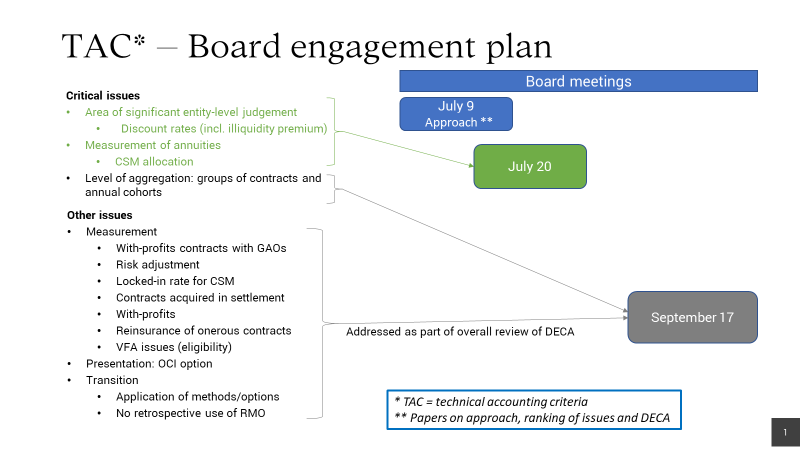
At its 9 July 2021 meeting the Board agreed to an approach to discussing significant issues arising from the assessment of IFRS 17 against the technical accounting criteria1 (see Appendix 2).
This paper provides information on an aspect of that assessment that is considered a priority within the overall endorsement assessment of the standard. It invites the Board's comments on the preliminary assessment set out in Appendix 1 and on any further analysis and outreach work required.
Summary of the issues
IFRS 17's requirements for the measurement of insurance contracts include areas of significant entity-level judgement, including in respect of discount rates. The requirements give rise to certain challenges to the technical accounting criteria. The preliminary assessment, set out in Appendix 1 to this paper, considers these challenges in the context of the standard's overall principles and objectives.
Decisions for the Board
No decisions are required at this stage. Board members are asked for comments on:
- The technical content of the preliminary assessment;
- The approach taken to reporting the results of the assessment; and
- Any further analysis required to enable the assessment to be finalised for inclusion in the DECA.
Recommendations
The paper recommends including the assessment set out in Appendix 1 in the DECA, subject to any amendments required by the Board and any drafting refinements.
Appendices
- Appendix 1: Assessment of IFRS 17's requirements in respect of discount rates
- Appendix 2: Overview of planned Board engagement with the assessment against the technical accounting criteria
Background - IFRS 17's measurement requirements
1IFRS 17 requires groups of insurance contracts to be initially measured as the total of the fulfilment cash flows and the contractual service margin (CSM). The fulfilment cash flows represent an explicit, unbiased and probability-weighted estimate of the present value of the future cash flows that will arise as the entity fulfils the insurance contracts, including a risk adjustment for non-financial risk.
2The measurement of the fulfilment cash flows involves significant judgements, including the determination of the discount rates used to calculate the present value of future expected cash flows. This judgement is a fundamental element of the standard's measurement requirements and is likely to be significant in the measurement of a large proportion of insurance contracts.
Assessment work carried out to date
3The key elements of the Secretariat's assessment work on this issue to date include the following:
- Discussion at meetings of the Insurance Technical Advisory Group (TAG) – see next paragraph;
- Desk-top analysis, including reviews of the IASB's Basis for Conclusions, comment letters and other feedback to the IASB during the development and finalisation of the standard and commentaries issued by accounting firms;
- Review of results from our preparer survey;
- Discussions with users of insurers' accounts, including during our user webinar and roundtable, and review of results from our user survey;
- Review of papers prepared by actuarial bodies, discussions with the FRC actuarial team and with an actuarial academic;
- Discussions with other National Standard Setters and with EFRAG, and review of EFRAG's Final Endorsement Advice.
4Papers on IFRS 17's requirements in respect of discount rates were presented at the September 2020 and December 2020 Insurance TAG meetings. The September paper raised challenges in relation to the standard's requirements, in particular with regard to the use of illiquidity premia, while the December paper set out the Secretariat's preliminary assessment against the technical accounting criteria. Summaries of the Insurance TAG's discussions in response to those papers are available in the meeting summaries on the UKEB website.2
Endorsement challenges in respect of discount rates
5IFRS 17 does not mandate any particular discount rate or, when the appropriate discount rates are not directly observable in the market, any particular estimation technique. Some stakeholders have questioned therefore whether this will impair reliability and/or comparability. In particular, the determination of an illiquidity premium when a bottom-up approach3 is applied is considered to require significant judgement, and some stakeholders have expressed the view that no illiquidity premium should be applied. In addition, the fact that the standard provides a choice of approaches (top-down or bottom-up) may present a risk to comparability between insurers.
6Appendix 1 to this paper presents a draft assessment of IFRS 17's principal requirements in respect of discount rates against the technical endorsement criteria of understandability, relevance, reliability and comparability. It also considers whether those requirements give rise to any cost/benefit concerns.
Questions for the Board
7Does the Board have any comments on:
- The content of the draft assessment?
- The approach taken to reporting the results of the assessment?
8Are there any further important considerations that ought to be included in the assessment?
9Has the Board identified any further analysis work required to enable the assessment to be finalised for inclusion in the DECA?
Proposed next steps
10Subject to the Board's comments on the draft assessment set out in Appendix 1 and any further analysis work required, the Secretariat will incorporate the content of the Appendix in the [draft] Endorsement Criteria Assessment.
Appendix 1:
Discount rates - [draft] assessment against the technical accounting criteria
IFRS 17 requirements
1[In the setting of the DECA, paragraphs 1 to 10 may not be required in full/may need amending.] IFRS 17 requires the discount rates applied to estimates of future cash flows to reflect the time value of money, the characteristics of the cash flows and the liquidity characteristics of the insurance contracts. [IFRS 17:36]
2The standard also requires the discount rates applied to be consistent with observable current market prices (if any) and to exclude the effect of factors that influence such observable market prices but do not affect the future cash flows of the insurance contracts. [IFRS 17:36]
3IFRS 17's application guidance contains further specific requirements regarding the determination of discount rates. When appropriate discount rates are not directly observable in the market, entities shall estimate them. IFRS 17 does not require a particular estimation technique but states that entities shall:
- Maximise the use of observable inputs;
- Reflect all reasonable and supportable information on non-market variables available without undue cost or effort (which shall not contradict available and relevant market data); and
- Reflect current market conditions from the perspective of a market participant. [IFRS 17:B78]
4For cash flows of contracts that do not vary based on returns on underlying items, the discount rate reflects the yield curve in the appropriate currency for instruments that expose the holder to no or negligible credit risk, adjusted to reflect the liquidity characteristics of the group of insurance contracts. [IFRS 17:B79]
5IFRS 17:B80 states that an entity “may determine discount rates by adjusting a liquid risk-free yield curve to reflect the differences between the liquidity characteristics of the financial instruments that underlie the rates observed in the market and the liquidity characteristics of the insurance contracts (a bottom-up approach).”
6IFRS 17:B81 permits an alternative approach to determining the discount rate: “Alternatively, an entity may determine the appropriate discount rates for insurance contracts based on a yield curve that reflects the current market rates of return implicit in a fair value measurement of a reference portfolio of assets (a top-down approach). An entity shall adjust that yield curve to eliminate any factors that are not relevant to the insurance contracts, but is not required to adjust the yield curve for differences in liquidity characteristics of the insurance contracts and the reference portfolio."
7IFRS 17:B74(b) requires cash flows that vary based on the returns on any financial underlying items to be:
- discounted using rates that reflect that variability; or
- adjusted for the effect of that variability and discounted at a rate that reflects the adjustment made.
8IFRS 17:B75 clarifies that the variability is a relevant factor whether it arises from contractual terms or because the entity exercises discretion, and regardless of whether the entity holds the underlying items.
9When cash flows are subject to a guarantee of a minimum return, IFRS 17:B76 states that this must be reflected in the discount rate by way of an adjustment to the rate that reflects the variability of the returns on the underlying items.
Disclosures
10Disclosures required by IFRS 17 on the discount rates used by entities include the following:
- Separate disclosure of amounts in respect of insurance finance income or expenses in the reconciliations from opening to closing balances of insurance contract liabilities (and assets) under IFRS 17:100-101; [IFRS 17:105(c)]
- The amount and an explanation of total insurance finance income or expenses, including its relationship with the investment return on assets; [IFRS 17:110]
- Significant judgements and changes in judgements, including specifying the inputs, assumptions and estimation techniques used. This includes the process for estimating inputs and the approach used to determine discount rates; [IFRS 17:117]
- The yield curve (or range of yield curves) used to discount cash flows; [IFRS 17:120] and
- A sensitivity analysis for each type of market risk showing how profit or loss and equity would have been affected by changes in risk exposures, including the relationship between these sensitivities and those arising from financial assets held by the entity. [IFRS 17:128]
Determination of discount rates – accounting impact
Initial recognition
11On initial recognition of a group of insurance contracts, the rate used to discount future cash flows affects the measurement of the fulfilment cash flows. For profitable contracts the impact of applying a higher or lower rate is reflected in (and offset by) the contractual service margin (CSM) so there is no immediate effect on profit or equity, i.e. applying a higher or lower rate does not lead to an upfront profit or loss.
12For a group of contracts that is only marginally profitable the precise discount rate applied can affect the likelihood that the group is initially assessed as onerous. For a group of contracts that is onerous on initial recognition, the discount rate applied affects the amount of the loss that is initially recognised.
Subsequent measurement
13The unwinding of the discount applied to the fulfilment cash flows is recognised as insurance finance expense, over the period the cash flows are expected to occur. A higher discount rate results in a higher insurance finance expense over that period. For profitable contracts the impact in insurance finance expense of applying a higher or lower rate is offset over the coverage period by the release of the corresponding amount recognised in CSM (see paragraph 11 above). There is likely to be a net impact on profit or loss for individual periods as the pattern of CSM release is unlikely to match precisely the pattern of the discount unwind.
14Any remeasurement of the illiquidity premium in subsequent periods may result in experience adjustments across the duration of the insurance liabilities. These would be recognised in profit or loss as insurance finance income or expense in the period in which they occurred.
15The relationship of total insurance finance income or expenses to total investment income is shown in profit or loss.
Assessment against the endorsement criteria
16[In the setting of the DECA, paragraphs 14 and 15 may not be required/may need amending.] Statutory Instrument 2019 No.6854 sets out the basis for the adoption of international accounting standards. The endorsement criteria dictate that a standard: (i) must not be contrary to the principle that the accounts must give a true and fair view; (ii) should be conducive to the long term public good of the UK; and (iii) must meet the criteria of understandability, relevance, reliability and comparability. The long term public good assessment must have regard to whether use of the standard is likely to improve the quality of financial reporting, the costs and benefits from use of the standard and whether the standard is likely to have an adverse effect on the UK economy.
17The following assessment focuses on the technical accounting endorsement criteria: understandability, relevance, reliability and comparability. The assessment also considers briefly the impact of the standard's requirements in respect of discount rates on costs. [This brief assessment on costs does not replace the full impact assessment of the standard which will be presented to the Board at a later date.]
Recognising the time value of money on a current basis
18The timing of cash flows has a significant impact on most insurers' business model. Recognising the time value of money is central to insurance business and as a concept is well-understood by users of insurers' accounts. Reflecting the timing of future cash flows in their measurement is also consistent with the accounting for other items under IFRS such as pensions, provisions and financial assets. Discounting future cash flows therefore provides relevant and understandable information.
19The requirement to use updated (current) discount rates promotes a faithful representation of an insurer's economic position and helps ensure that changes in risks are reflected on a timely basis, thereby enhancing the reliability and relevance of the accounting information.
Characteristics of the insurance contract cash flows
20IFRS 17 requires the discount rates applied to be based on the characteristics of the cash flows being discounted [IFRS 17:36]. This means that discount rates – and insurance finance expense – reflect the nature of the insurance contract liabilities and thereby provide relevant information.
21Unless assets held are matched perfectly with the liabilities they back, they are likely to be affected differently by changes in market interest rates. Applying discount rates that reflect the characteristics of the contract cash flows rather than asset-based rates promotes transparency and results in a more faithful representation of the insurer's economic position, enhancing reliability and relevance.
22IFRS 17 requires that discount rates reflect the liquidity characteristics of the insurance contracts. Many entities use highly liquid, high quality bonds as a proxy for risk-free rates. However, the holder can often sell such bonds in the market at short notice without incurring significant costs or affecting the market price. By contrast, for many insurance contracts, the insurer cannot be compelled to make payments earlier than when the insured events occur, or before the dates specified in the contract.5 Including liquidity characteristics in the determination of the appropriate discount rate therefore recognises economic characteristics of the liability that are not present in a risk-free but highly liquid asset rate. Considering the effects of liquidity is consistent with the requirements in other IFRS such as the Conceptual Framework and the guidance on impairment of assets. This leads to a more faithful representation of liabilities and insurance finance expense, enhancing reliability, and to more relevant information.
23The 'bottom-up' approach (see paragraph 5 above) is based on highly liquid, high-quality bonds, adjusted to include a premium for the illiquidity. Given the potential difficulty of identifying an illiquidity premium in isolation, IFRS 17 permits a 'top-down' approach based on the expected returns of a reference portfolio of assets, adjusted to eliminate factors not relevant to the liability, for example market and credit risk (see also paragraph 6 above). Judgement is required to determine the credit risk adjustment and the reference portfolio. However, no adjustment for any remaining liquidity differences are required. If, as is expected to generally be the case, the liquidity characteristics of the reference portfolio are closer to those of the insurance liabilities than highly liquid, high-quality bonds, this may help ensure reliable information.6
Discount rates for cash flows that vary based on the returns on underlying items
24As noted above, IFRS 17 requires discount rates to reflect the characteristics of the cash flows being discounted. When cash flows vary based on the returns on underlying items, consistency with this principle requires the use of discount rates that reflect that variability (applying B74-76).
25The measurement of insurance contract liabilities on this basis thereby provides relevant information. It also results in a more faithful representation of the insurer's economic position, enhancing reliability.
Other constraints on the determination of the discount rate
26The requirements that discount rates applied are consistent with observable current market prices, reflecting current market conditions from the perspective of a market participant, and maximise the use of observable inputs means that the rates determined are less subjective, as they do not reflect purely an entity view. This leads to information that is more reliable and more comparable.
27The requirements to exclude non-relevant factors and to reflect all reasonable and supportable information on non-market variables available without undue cost or effort (which shall not contradict available and relevant market data) enhance the relevance of the resulting information.
28As noted in paragraph 10 above, IFRS 17 requires extensive and detailed disclosures in respect of discount rates. These disclosures include explanations of recognised amounts, explanations of significant judgements and the nature and extent of risks arising from the use of discount rates. In addition to these disclosures, IFRS 17:132 requires disclosures on the liquidity risk arising from insurance contracts, including a description of how the entity manages the liquidity risk and separate maturity analyses for insurance contracts issued and reinsurance contracts held.
29In aggregate the disclosures therefore enhance the relevance and understandability of the accounting impact of the discount rates applied.
Challenges to the endorsement criteria
30The fact that IFRS 17 does not mandate any particular discount rate or, when the appropriate discount rates are not directly observable in the market, any particular estimation technique may be considered to impair reliability and/or comparability. In particular, the determination of the illiquidity premium when a bottom-up approach is applied is generally recognised to require considerable judgement. In addition, the fact that the standard provides a choice of approaches (top-down or bottom-up) may present a risk to comparability between insurers.
31IFRS 17 acknowledges the inherent limitations in estimating adjustments to observable rates [IFRS 17:B74]. Accounting requirements that involve significant judgement can present a challenge to reliability and often represent a balance between the demands of relevance and reliability. In the case of discount rates in IFRS 17, there are several factors which serve to mitigate concerns regarding reliability:
- As noted above (paragraph 22), the requirement for consistency with observable current market prices and for maximum use of observable inputs should help make the determination of discount rates less subjective.
- In principle, the application of judgement in this area should not present major difficulties for insurers, as such judgements and estimates are integral to insurance business and insurers have extensive relevant experience.
- The required disclosures (see paragraph 10 above) will provide evidence of the approach taken and facilitate users' assessments of management's judgements.
32IFRS 17's overall objective and principles in this area are clear and the standard's requirements and application guidance mitigate the challenge to reliability. The standard's requirements result in a degree of judgement that is consistent with that required under other IFRS Standards.
33The approach taken by IFRS 17 results in information that is likely to be relevant and reliable for all entities, rather than a more prescriptive approach which results in information that is appropriate in only some circumstances. Absolute precision is not possible but is also not necessary, and appropriate discount rates can be determined without resulting in excessive measurement uncertainty.
34As noted in paragraphs 11–12 above, unless groups of contracts are onerous or only marginally profitable, the discount rate applied in the measurement of fulfilment cash flows does not have an immediate impact on reported profit or equity. Finance income or expense reported in the income statement, and the related disclosures (see paragraph 10(b) above), will provide information on the relationship between insurance finance income or expense and investment income on assets.
35Regarding comparability, the requirements for insurers to use discount rates that are consistent with observable market prices and reflect current market conditions, and to maximise observable inputs, serve to reduce concerns over comparability with other entities.
36The required disclosures also mitigate risks to comparability, in particular those of significant judgements, the inputs, assumptions and estimation techniques used, and the process for estimating inputs and the approach used to determine discount rates. Disclosure of the yield curve used should facilitate comparisons with other insurers. In aggregate the disclosures should highlight differences between entities and facilitate analysis of performance.
Costs of applying the requirements
37It should in most cases be possible to implement IFRS 17’s requirements in respect of the determination of discount rates at minimal additional cost. Any cost of applying the standard's requirements appear reasonable for the benefits gained in terms of relevant information. The option to use a bottom-up or top-down approach should help to ensure entities choose the rate that is most appropriate to their business model, reducing any costs arising on implementation or on-going basis relating to system design and monitoring.
Summary assessment against technical accounting criteria
38On balance, the core requirements of IFRS 17 in respect of the determination and application of discount rates meet the technical accounting criteria of understandability, relevance, reliability and comparability. The overall objective and principles of the standard are clear in this area. Given the inherently judgemental nature of the issue, the approach in IFRS 17 is consistent with the approach in other IFRSs and results in information that is likely to be relevant and reliable for all entities, rather than a more prescriptive approach which results in information that is appropriate in only some circumstances. Absolute precision is not possible but appropriate discount rates can be determined without resulting in excessive measurement uncertainty.
39A future post implementation review (PIR) of IFRS 17 should include analysis of the application in practice of the standard’s requirements in respect of discount rates. Variability in approach or in disclosures should be monitored, and the PIR should consider whether additional guidance and/or disclosures are needed.
Appendix 2:
Technical Accounting Criteria – Board engagement plan
TAC* – Board engagement plan
- Critical issues
- Area of significant entity-level judgement
- Discount rates (incl. illiquidity premium)
- Measurement of annuities
- CSM allocation
- Level of aggregation: groups of contracts and annual cohorts
- Area of significant entity-level judgement
- Other issues
- Measurement
- With-profits contracts with GAOS
- Risk adjustment
- Locked-in rate for CSM
- Contracts acquired in settlement
- With-profits
- Reinsurance of onerous contracts
- VFA issues (eligibility)
- Presentation: OCI option
- Transition
- Application of methods/options
- No retrospective use of RMO
- Measurement
Addressed as part of overall review of DECA
- TAC = technical accounting criteria
- Papers on approach, ranking of issues and DECA
Footnotes
Footnotes
-
SI 2019/685 requires an assessment of whether IFRS 17 "meets the criteria of understandability, relevance, reliability and comparability required of the financial information needed for making economic decisions and assessing the stewardship of management" [regulation 7 (1) (c)]. In this paper we refer to these criteria collectively as the technical accounting criteria. ↩
-
https://www.endorsement-board.uk/endorsement-projects/ifrs-17/technical-advisory-group ↩
-
See paragraphs 5 and 6 of the Appendix for explanations of the bottom -up and top-down approach. ↩
-
See IFRS 17:BC193 ↩
-
IFRS 17:BC196 "The Board expects a reference portfolio will typically have liquidity characteristics closer to the liquidity characteristics of the group of insurance contracts than highly liquid, high-quality bonds. Because of the difficulty in assessing liquidity premiums, the Board decided that in applying a top-down approach an entity need not make an adjustment for any remaining differences in liquidity characteristics between the reference portfolio and the insurance contracts.” ↩