4. IFRS 17 Insurance Contracts Technical Issues
Executive Summary
| Project Type | Endorsement and Adoption |
| Project Scope | Significant |
Purpose of the paper
Following the Board's approval of the IFRS 17 endorsement project plan at the May 2021 Board meeting, this paper sets out the approach to the Board's engagement with technical issues. The paper includes an overview of significant issues and a tentative assessment of their priority.
The paper also provides an updated structure and outline contents for the IFRS 17 [Draft] Endorsement Criteria Assessment (DECA).
Summary of the issues
At its May 2021 meeting the Board agreed to a preliminary review of issues by a sub-group of the Board to determine those that needed to be escalated to the full Board as priority issues, and to covering non-priority issues by way of Board reviews of the DECA. This paper provides the results of the initial review of the issues. Regarding the DECA, the Board recommended revising its structure to provide better balance between technical accounting issues and the long term public good assessment.
Decisions for the Board
The Board is asked to make the following decisions:
- Does the Board agree with the tentative assessment of the priority attributed to significant technical issues to be considered by the Board as part of its assessment of IFRS 17 for adoption in the UK?
- Does the Board approve the revised structure and outline contents for the IFRS 17 DECA?
The paper also invites comments on the process adopted to identify significant endorsement issues, on the analysis of significant issues set out in Appendix 1 and on the DECA structure and contents in Appendix 2.
Recommendations
The paper recommends:
- Approving the tentative assessment of priority issues.
- Approving the revised structure and outline contents for the IFRS 17 DECA.
The Secretariat will continue to participate in discussions and to monitor any developing consensus regarding CSM allocation for annuities; and will continue to monitor developments in the EU's endorsement of IFRS 17.
Appendices
| Appendix 1 | Tentative assessment of priority of significant technical issues |
| Appendix 2 | Draft IFRS 17 DECA outline contents (‘skeleton') |
Background - broad approach agreed at May meeting
1The endorsement assessment of IFRS 17 involves consideration of a number of individual technical issues against the technical accounting criteria1. At its May 2021 meeting the Board considered how the results of that endorsement assessment should best be reported in the DECA.
2The Board agreed in principle to adopting an exceptions-based approach to the technical accounting criteria and to reporting the assessment topic by topic rather than criteria by criteria. The Board noted the importance of specifying the basis for classification of issues as 'significant' for the purpose of addressing them in the DECA. The Board also recommended revising the DECA structure to provide better balance between technical accounting issues and the long term public good assessment.
3At its May 2021 meeting, the Board also discussed how best to provide input to the consideration of issues and the preparation of the DECA. At that meeting, the Board agreed to set up a sub-group to help provide advice to the Secretariat during the preliminary process of assigning priority to the various technical issues for purposes of presentation to the Board. This will help ensure a thorough consideration of priority issues by the Board on a timely basis. This paper sets out the results of the work undertaken by the Secretariat and the sub-group.
4The Board also agreed to covering non-priority issues by way of Board reviews of the DECA.
Development of approach
Identification of 'significant' issues
5The exceptions-based approach approved by the Board in May 2021 means carrying out a detailed analysis against the technical accounting criteria only in relation to significant issues. As noted in the paper presented to the Board in May 2021, in this context 'significant issues' means aspects of the standard:
- where there is a question over whether IFRS 17's requirements on that aspect meet the technical accounting criteria; and
- which have a potentially significant impact in the UK: that is, the issue is likely to be material to at least some companies and/or the efficient and effective functioning of UK capital markets.
6This approach means that detailed analyses against the technical accounting criteria are likely to focus on issues raised by UK stakeholders or which otherwise have been subject to considerable UK debate. All such issues have been discussed with the Insurance Technical Advisory Group (TAG)2.
7The process adopted by the Secretariat to identifying significant issues has extended over a number of months and has been responsive to stakeholder input throughout that period. Principal components of that work include:
- Desktop analysis of the standard, the basis for its requirements, and of commentaries and technical analyses issued by, for example, accounting firms and professional bodies.
- Consideration of feedback from UK stakeholders on IFRS 17 as issued in 2017 and their input to the amendments finalised in 2020, including comment letters submitted to the IASB.
- Review of submissions to EFRAG from UK stakeholders, discussions with EFRAG staff and review of EFRAG's Draft Endorsement Advice.
- Discussions with insurers and the Association of British Insurers, and review of responses to our preparer survey.
- Consideration of investor and analyst views expressed to the IASB during its outreach work3, discussions with UK-based analysts and ratings agencies and review of responses to our user survey.
- Input from the Insurance TAG, initially in developing the group's work plan and subsequently in developing its forward agenda on an ongoing basis.
8A further consideration during this process was to separate out issues that had the potential to be endorsement issues from those that were questions of interpretation or implementation. The Secretariat acknowledges that the distinction between endorsement and interpretation/implementation issues is not always clear cut. However, a number of issues arising from the process set out in paragraph 7 above have been judged to be more in the nature of interpretation or implementation questions so are not included in Appendix 1. For example, such issues could include requirements of IFRS 17 which in general are considered to meet the technical accounting criteria but which are complex or require significant judgement to apply to particular fact patterns.
9The outcome of this process is set out in Appendix 1 Tentative assessment of priority of significant technical issues (see also below paragraphs 14-19).
10We have been able to confirm through our outreach that there are no further significant issues of concern to UK stakeholders that we have not otherwise addressed. For example, our surveys of insurers and users of insurers' accounts asked respondents to highlight issues for consideration during the endorsement assessment. Similarly, in recent meetings with users of accounts we have asked for them to inform us of any additional issues: no new matters have arisen.
11We think this approach is comparable with that adopted by other standard setters tasked with formal adoption of IFRS 17. For example, the approach adopted by EFRAG is described as follows:
“EFRAG has focused its assessment on the requirements it considered most significant in relation to each of the criteria, as per previous documents with Endorsement Advice. EFRAG has accordingly focused on aspects that:
- are fundamental to the accounting for insurance contracts;
- have been subject to substantial debate (evidenced by the comments EFRAG has received from constituents including participants in EFRAG's field-tests and the comment letter due process on the amendments to IFRS 17);
- may be problematic to apply, as evidenced in particular by the results of EFRAG's case-studies; and
- relate to the issues raised by the European Commission in its request for endorsement advice."4
12EFRAG's approach bears similarities to that agreed by the UKEB, with two main differences:
- In practice EFRAG treats (a) to (d) as alternatives, not as cumulative requirements: for example, unlike under our approach, EFRAG would assess and report on a topic if it met (a) alone; and
- (d) is not relevant in the context of the UKEB's assessment.
Questions for the Board
13Does the Board have any comments on the process adopted to identify significant endorsement issues?
Tentative assessment of priority issues
14As noted above, all the significant issues identified have been discussed at Insurance TAG meetings. In line with the approach agreed at the May 2021 Board meeting, we have conducted a preliminary review of those issues and the related Insurance TAG discussion to determine which should be considered priority issues.
15The practical implications of assessing an issue as priority are that:
- Separate papers will be brought to the Board on each priority issue; and
- Time will be specifically allocated in the Board agenda for discussion of those issues.
By contrast, other non-priority significant issues will be reviewed by the Board as part of its overall review of the DECA (i.e. covering more than one topic in one discussion). If any matters are considered to need a more detailed discussion at that stage, it would be possible to bring those separately to the Board.
16Appendix 1 presents a schedule of all technical issues so far identified as significant, with a tentative assessment of those deemed priority endorsement issues. Priority issues are likely to have one or more of the following features:
- They relate to a pervasive aspect of the standard;
- They have generated significant UK public interest and/or controversy;
- They are estimated to be material to UK insurers;
- They are significant to the long term public good assessment of IFRS 17.
17In preparing this Appendix, the Secretariat has received advice from the sub-group of the Board.
18The assessment of priority issues is described as 'tentative' because:
- discussions between insurers and auditors and with the IASB on one potential priority issue - the CSM allocation for annuities are ongoing;
- the EU endorsement and adoption discussions in relation to the annual cohort requirement are also ongoing and the implications for UK adoption of the standard of that EU decision merits detailed consideration.
19The Secretariat will continue to participate in discussions and monitor any developing consensus regarding CSM allocation for annuities. The Secretariat will also continue to monitor developments in the EU's endorsement of IFRS 17. Any developments will be shared with the Board in due course.
Questions for the Board
20Does the Board agree with the tentative assessment of which significant technical issues should be considered priority issues for the Board to consider?
21Does the Board have any other comments on the analysis of significant issues included in Appendix 1?
Revised DECA structure
22To provide better balance between technical issues and the long term public good assessment, the Board recommended revising the DECA structure to give greater prominence to the long term public good assessment. Appendix 2 to this paper presents a revised outline structure and contents for the IFRS 17 DECA.
Questions for the Board
23Does the Board agree with the revised outline structure and contents for the IFRS 17 DECA as set out in Appendix 2?
24Does the Board have any other comments on the IFRS 17 DECA structure and contents?
Proposed next steps
25Our current expectation of engagement with the Board on the technical accounting criteria is set out below. This is subject to the Board's comments on the tentative assessment set out in Appendix 1 and to the results of any further analysis or outreach work required.
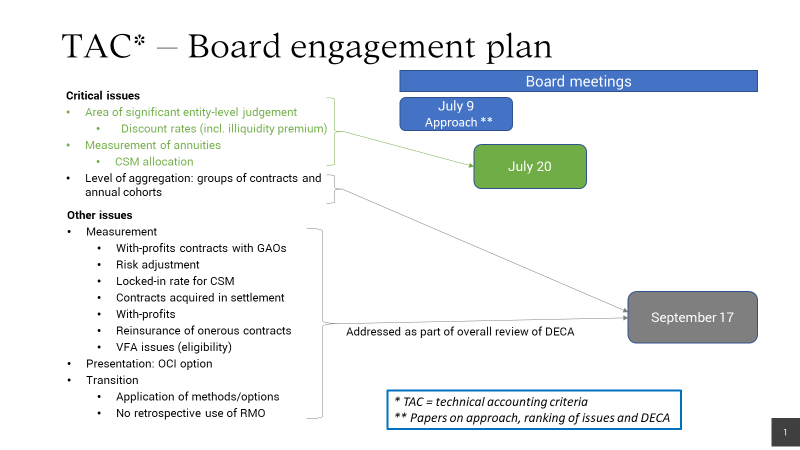
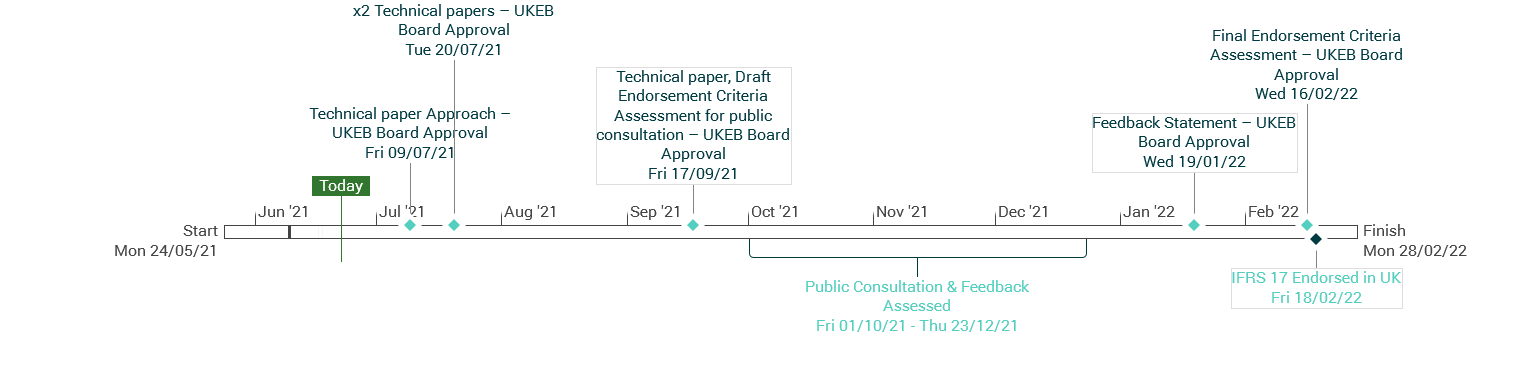
26The Secretariat will draft the DECA according to the structure set out in Appendix 2 and will report in detail on the issues set out in Appendix 1 in the draft. An indicative timeline is set out below.
Project Timeline
Footnotes
Footnotes
-
SI 2019/685 requires an assessment of whether IFRS 17 "meets the criteria of understandability, relevance, reliability and comparability required of the financial information needed for making economic decisions and assessing the stewardship of management" [regulation 7 (1) (c)]. In this paper we refer to these criteria collectively as the technical accounting criteria. ↩
-
https://www.endorsement-board.uk/endorsement-projects/ifrs-17/technical-advisory-group ↩
-
For example, see IASB Board Paper 2A from July 2017, summarising 35 discussions with 153 investors and analysts https://www.ifrs.org/content/dam/ifrs/meetings/2017/july/iasb/ap02a-insurance-contracts.pdf ↩
-
EFRAG Final Endorsement Advice on IFRS 17, Appendix II, paragraph 1 ↩