7. IASB Agenda Consultation draft comment letter
Executive Summary
| Project Type | Influencing |
|---|---|
| Project Scope | Significant |
Purpose of the paper
The purpose of this paper is to obtain Board feedback on the Draft Comment Letter on the IASB's Third Agenda Consultation ('Agenda Consultation').
Summary of the Issue
The IASB's Request for Information: Third Agenda Consultation will shape its priorities in its work plan for 2022 to 2026. The Request for Information seeks respondents' views on:
- the strategic direction and balance of the IASB's activities;
- the criteria for assessing the priority of financial reporting issues that could be added to the work plan; and
- new financial reporting issues that could be given priority in the IASB's work plan.
The IASB's deadline for comments is 27 September 2021. The UKEB Secretariat has undertaken informal stakeholder outreach and desk-based research to inform the Draft Comment Letter.
Decisions for the Board
Do Board members:
- agree with the proposed responses in the draft comment letter to the IASB's detailed questions in the Agenda Consultation?
- approve the publication of the draft comment letter for formal stakeholder consultation?
Recommendation
We recommend the publication of the UKEB Draft Comment Letter for public consultation.
Appendices
| Appendix 1 | Draft Comment Letter – Third Agenda Consultation |
Background
1The IASB's Request for Information: Third Agenda Consultation 1 was published in March 2021 with a comment deadline of 27 September 2021.
2The Agenda Consultation seeks respondents' views on:
- the strategic direction and balance of the IASB's activities;
- the criteria for assessing the priority of financial reporting issues that could be added to the work plan; and
- projects that should be given priority in the IASB's work plan.
3At the April 2021 UKEB meeting Board members:
- Discussed and supported staff's proposed high-level work plan.
- Identified the following projects as high priority from the IASB's list of potential projects for inclusion in its 2022 – 2026 work plan:
- Climate-related risks
- Cryptocurrencies and related transactions;
- Discount rates;
- Government grants; and
- Intangible assets;
- Statements of cash flows (including supply chain financing and consideration of whether supply chain financing should become a separate project).
- Explored the possibility of recommending that the IASB take a thematic approach to its 2022 – 2026 work plan, whereby potential new projects and projects from IASB's existing work plan would be grouped by theme.
4At the May 2021 UKEB meeting, Board members approved the proposed workplan and made the following recommendations to address the capacity concerns highlighted by the IASB:
- The response to the IASB should focus on a shortlist of high priority projects, commensurate with IASB's indications of available resource (2 – 3 large projects or equivalent).
- The current IASB workplan should be assessed for projects that could be delayed or removed to free up capacity.
5In recent weeks the Secretariat has completed desk-based research to inform the draft response. Outreach so far has included, four separate roundtables with stakeholder groups and presentation at the Quoted Companies Alliance's June 2021 Accounting, Auditing and Financial Reporting Expert Group meeting. The stakeholder engagement by stakeholder group is summarised below. The stakeholder feedback has shaped the views reported in the draft comment letter at Appendix 1 to this paper.
| Stakeholder group | UKEB Roundtable Number of attendees | QCA Presentation Number of attendees | Total |
|---|---|---|---|
| Preparers | 8 | 4 | 12 |
| Auditors | 8 | 10 | 18 |
| Users | 4 | 1 | 5 |
| Regulator (FRC) | 3 | 0 | 3 |
| 23 | 15 | 38 |
6A further UKEB-IASB joint virtual outreach event is scheduled for 15 July. The webinar will provide a further opportunity for us to test our views with stakeholders. We will continue to update the analysis above following the joint outreach event.
UKEB draft comment letter
7In our roundtables we asked stakeholders for their views on the questions in the Agenda Consultation and on our initial views on responses to questions asked by the IASB for inclusion in the UKEB's draft comment letter.
Question 1: Strategic direction and allocation of resource
8On IASB's allocation of resource we plan to recommend that: the IASB retains sufficient flexibility in its work plan to address the interaction between IFRS and the future international sustainability standards developed by its proposed sister Board, the International Sustainability Standards Board (ISSB); that it includes a structured and visible research programme to identify and address emerging issues within the resource allocated to Standards development (currently 60%); and a marginal shift to increase the proportion of resource allocated to digital reporting (currently 5%) by reducing that allocated to the IFRS for SMEs Standard (currently 5%).
9Stakeholders generally supported our initial views. There was very strong support for our recommendation that IASB should retain sufficient flexibility in its work plan to address the interaction of IFRS and sustainability standards. They also observed that it was important for the IASB to anticipate and respond quickly to emerging issues and agreed that a structured and visible research programme would be beneficial.
10Stakeholders agreed that IASB should allocate more resource to digital financial reporting given its anticipated growth and potential impact on the IFRS Taxonomy and on how Standards are written.
11Stakeholders felt it was important to maintain the level of resource allocated to stakeholder engagement (currently 20% - 25%) and understandability and accessibility (currently 5%) to support the development of relevant and effective Standards and to ensure their smooth implementation.
12We have reflected these recommendations in the draft comment letter to the IASB.
Question for the Board
| Question for the Board |
|---|
| 13Do Board members agree with our draft response to Q1 in the Agenda Consultation? |
Question 2: Criteria for project acceptance
14We consider that the second criteria (whether there is any deficiency in the way companies report the type of transaction or activity in financial reports) should be redrafted to clarify that it does not capture application issues. We also note that the third criteria (the type of companies that the matter is likely to affect, including if the matter is more prevalent in some jurisdictions than others) implies a hierarchy of jurisdictions and sectors, and recommend that it is redrafted.
15We also asked whether two additional criteria should be considered. These were: whether the project would still be relevant when implemented, and whether cost was proportionate to benefit.
16We also noted that the first criteria in the Request for Information 'the importance of the matter to investors' is different to the IASB's due process handbook 'the importance of the matter to users.' We recommend that the wording used in consultations should be consistent with the IASB's due process handbook.
17Stakeholders agreed with our general support for the criteria used for project selection and supported our recommendations to redraft the first, second and third criteria..
18Stakeholders supported our proposed criteria to consider whether the project would still be relevant when implemented. However, stakeholders generally thought that cost / benefit should not be considered at the project acceptance stage as it was too early to have useful information on cost. Stakeholders considered that cost / benefit considerations were best addressed at the DP stage, in line with current practice.
19Our draft comment letter reflects this stakeholder feedback.
Question for the Board
| Question for the Board |
|---|
| 20Do Board members agree with our draft response to Q2 in the Agenda Consultation? |
Question 3: Priority Projects
21We sought stakeholder views on the following projects which we had identified as potential high priority projects: climate-related risk, crypto currencies and related transactions, discount rates, government grants, intangibles, and statement of cash flows. We also recommended that the scope of the climate-related risk project should be extended to include a cross-cutting review of IFRS Standards and their potential interaction with sustainability reporting on climate-related risk. We noted the potential for a large project on intangibles to include pollutant pricing mechanisms (PPMs) and crypto currencies, and for a potential new standard on non-financial assets held for investment to address financial reporting for PPMs and crypto assets held for investment.
22All stakeholder groups expressed strong support for climate-related risks and intangibles as top priority projects. All stakeholders bar one expressed strong support for statement of cash flows as a top priority project.
23There was extremely strong support for our proposed scope for the climate-related risk project. Stakeholders also agreed that a project on intangibles would be large and significant and could encompass PPMs and crypto. Some stakeholders noted that a project on intangibles should go beyond recognition and measurement to consider intangibles such as customer and staff loyalty and how they add to enterprise value.
24There was interest from auditors and preparers in a potential new standard on non-financial assets held for investment which could cover crypto assets held for investment and PPMs.
25A minority of stakeholders expressed support for a cross-cutting project on discount rates, highlighting that a consistent approach across Standards could facilitate implementation of new Standards.
26There was limited interest in a project on government grants and the general view was that the reporting issues on this topic are understood and do not cause significant problems in practice.
27Auditors expressed support for a project on variable and contingent consideration, in order to reduce divergent practice in this area. A minority of stakeholders highlighted projects on going concern and other comprehensive income as priorities.
28We have therefore incorporated in the draft comment letter recommendations as follows:
- IASB should add three top priority projects to its work plan: climate-related risk, intangibles and statements of cash flows.
- The climate-related risk project should identify areas of potential interaction between IFRS Standards and future sustainability standards on climate.
- Any capacity released by rationalising projects on IASB's current work plan could be allocated to a second tier of projects, consisting of discount rates, government grants, other comprehensive income and variable and contingent consideration.
Question for the Board
| Question for the Board |
|---|
| 29Do Board members agree that climate-related risk, intangibles and statement of cash flows are the top priority projects? |
| 30Should we include the second tier of projects in our draft response in case IASB is able to free up additional resource? |
Q 4 Other comments
31Our initial views identified supply chain finance as an additional high-priority potential project. Users strongly supported this view. We note that following IASB's June board meeting a project on supply chain finance was added to its work plan.
32Our initial view was that some projects from IASB's current work plan could be paused or rationalised in order to reallocate resource. The projects we identified were: The Second Comprehensive Review of IFRS for SMEs, Management Commentary, and Extractive Activities. These projects are lower priority than projects on discount rates, other comprehensive income, variable and contingent consideration and government grants noted above.
33There were mixed views on whether projects on IASB's existing work plan should be paused or rationalised. Some stakeholders were of the view that all current projects should be completed before any new ones started. Others were of the view that a maximum time to complete a project should be allocated at its outset and a hard-stop date applied. Others suggested that fewer projects should be tackled concurrently but that projects should have shorter completion times.
34No specific objections were raised to UKEB proposals to pause The Second Comprehensive Review of IFRS for SMEs or Management Commentary projects. A single concern was raised on our proposal to pause or rationalise the Extractive Activities project, from a stakeholder who supported the development of sector-specific Standards.
35We therefore recommend that IASB should review projects on its existing work plan and consider pausing or rationalising the projects on The Second Comprehensive Review of IFRS for SMEs, Management Commentary, and Extractive Activities.
Thematic approach
36In our outreach we explored three possible thematic approaches with stakeholders. These were:
- A thematic approach by project, where projects identified as high priority could be grouped by themes such as sustainability or reducing optionality in order to emphasise strategic direction, rationale, and provide a reference point during the project scoping phase.
- A thematic approach by core standard group, where Standards on similar areas would be grouped together and potential projects assessed against each core standard group to assess the extent to which existing guidance is sufficient and standard-setting is necessary, and to improve consistency within core standard groups.
- A cross-standard thematic approach, where the consequential impact of projects on other Standards is considered and addressed.
37There was support for a thematic approach where new significant projects are grouped by themes such as sustainability and reducing optionality. However, some concerns were raised about the approach potentially being difficult to apply in practice and leading to delays in scoping.
38There were mixed views on a thematic approach by core standard group. Some recognised its conceptual appeal but many observed it could detract focus from addressing current priorities. Additionally, there is concern that this approach could lead to structuring.
39There was general support for a cross-standard thematic approach as it would encourage a consistent approach to common issues across Standards. Some stakeholders noted that this approach is already used by the IASB, for example in the Principles of Disclosure project. Others noted that it could be applied more extensively, for example discount rates and OCI could be considered across all Standards to encourage consistency, which would help the implementation of new Standards. Stakeholders could see the advantages delivered by this approach i.e. that the future financial reporting developments in the priority areas would be developed in a consistent way. For example, rather than focusing on one aspect of the intangibles issue e.g. the impairment of a type of intangible asset, the IASB should be considering whether the requirements relating to intangibles across all IFRS are fit to address the business developments over the coming decade. A thematic approach could therefore encompass challenges brought on by diverse developments such as cloud computing, crypto currency, new types of software, etc. in a single project. The advantage of this approach is that it would ensure that new financial reporting requirements are consistent and do not lead to new structuring opportunities.
40Our draft comment letter currently recommends:
41That the top priority projects (climate-related risk, intangibles, and statement of cash flows) are grouped on a sustainability theme to encourage strategic focus and appropriate scoping.
42That the top priority projects should be undertaken using a cross standard approach in order to support consistency.
Question for the Board
| Question for the Board |
|---|
| 43Which thematic approach do board members support: |
|
Approval to issue draft comment letter for public consultation
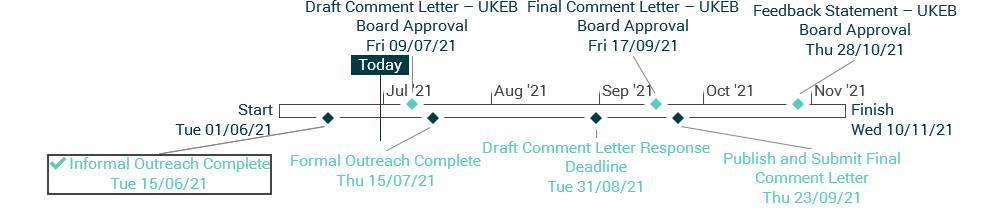
44Subject to board member comments on the items above, we aim to publish the draft comment letter at Appendix 1 on the UKEB website for formal public consultation for a six-week period to 31 August 2021.
Question for the Board
| Question for the Board |
|---|
| 45Does the Board approve the publication of the draft comment letter for public consultation? |
Next Steps
46Subject to board approval, we intend to publish the draft comment letter for a six-week comment period ending 31 August 2021. We aim to bring the final comment letter to the September 2021 UKEB meeting.
47The detailed project timeline is set out below. We intend to provide an update at the late July 2021 UKEB Board meeting.
Project Timeline