8.0 Rate Regulated Activity - Project Plan
Executive Summary
| Project Type | Influencing |
|---|---|
| Project Scope | Significant |
Purpose of the paper
This paper provides the Board with a draft Project Initiation Plan (PIP) for the IASB's Exposure Draft (ED) Rate-Regulated Activities for discussion and approval.
Decisions for the Board
The Board is asked to approve the draft PIP.
Summary of the Issue
This IASB ED seeks to develop an accounting standard that improves the usefulness and comparability of the financial statements of entities that are subject to rate regulation. It was published on 28 January 2021 and the comment deadline is 30 July 2021. In the UK, a small number of entities are subject to rate regulation. However, the impact for those entities is likely to be significant. Additionally, consideration of the ED proposals and responding to this consultation are important to ensuring any future standard incorporating the ED proposals is fit for adoption in the UK. Information on the proposed activities and timeline are set out in the PIP.
Recommendation
We recommend the Board approves the draft PIP.
Appendices
Appendix 1 Draft Rate-Regulated Activities PIP Exposure Draft Regulatory Assets and Regulatory Liabilities—The ED, Basis for Conclusions and Illustrative Examples can be accessed here: https://www.ifrs.org/projects/work-plan/rate-regulated-activities/exposure-draft-and-comment-letters/#consultation
| Project Type | Influencing |
|---|---|
| Project Scope | Significant |
Overview
1SI/2019/685(5)(b)¹ requires the Secretary of State (and hence the UKEB, once powers are delegated (expected to be May 2021)) to be responsible for "participating in and contributing to the development of a single set of international accounting standards."
2The IASB's Exposure Draft ED Regulatory Assets and Regulatory Liabilities² seeks to develop an accounting standard that improves the usefulness and comparability of the financial statements of entities that are subject to rate regulation.
3The IASB's ED was published on 28 January 2021 and the comment deadline is 30 July 2021.
4This project aims to provide information to investors and users that supplements the existing information provided by explaining the effect a regulatory agreement has on the timing of revenue, profit and cash flows.
5In the UK, a small number of entities are subject to rate regulation. However, it is important that the UKEB considers the ED proposals carefully and responds to this consultation as any future standard incorporating the ED proposals will need to be considered for endorsement and adoption in the UK. Ensuring the IASB has the opportunity to consider views of UK stakeholders during the standard's development is key to minimising new concerns being identified during the endorsement and adoption assessment process.
Objective of the project
6In a rate-regulated entity, the rates for goods or services supplied in a period are set in such a way that part of the compensation for goods or services supplied in one period may be included in the rates charged to customers in a different period. This creates a timing difference that makes the information reported in financial statements incomplete.
7The ED considers that the amount and timing of an entity's revenue, profit and cash flows can be significantly affected by rate regulation, because the "regulatory agreement"³ can determine:
- how much compensation an entity is entitled to charge customers ("total allowed compensation") for goods or services supplied in a period; and
- when the entity can include that compensation in the regulated rates charged.
8The ED proposes that entities that are subject to rate regulation (as defined in this project) should reflect the compensation for goods or services supplied as part of its reported financial performance for the period in which it supplies those goods or services. Consequently, an entity would recognise regulatory income and regulatory expense in its income statement, and regulatory assets and regulatory liabilities in its balance sheet. This information would supplement the information that companies already provide by applying IFRS, including IFRS 15 Revenue from Contracts with Customers.
9If the ED is finalised as a new standard, it would replace IFRS 14 Regulatory Deferral Accounts. The IASB published IFRS 14 as an interim standard for entities that are subject to rate regulation and are a first-time adopter of IFRS in January 2014. IFRS 14 defines rate regulation as "a framework for establishing the prices that can be charged to customers for goods or services and that framework is subject to oversight and/or approval by a rate regulator". The standard also included grandfathering provisions that permit a first-time adopter of IFRS, to continue to recognise and measure its regulatory deferral account balances in its first and subsequent IFRS financial statements in accordance with its previous GAAP.
10UK-adopted international accounting standards comprise IAS adopted in the EU as at 31 December 2020 and any standards adopted subsequently. The European Union did not adopt IFRS 14, preferring instead to wait until the IASB had completed its full project on this topic before considering adoption. This means that IFRS 14 is not part of UK-adopted international accounting standards. UK entities that are subject to rate regulation and apply UK-adopted international accounting standards are therefore currently not permitted to recognise regulatory deferral accounts. The new standard, once it is adopted for use in the UK, would require UK entities, subject to rate regulation within the scope of the standard, to commence recognising regulatory assets and regulatory liabilities.
Key planning assumptions, constraints and timeline
Comment deadline and resource capacity
11IASB published the ED in January and its comment deadline for this project is 30 July 2021. During the early part of this year the UKEB secretariat resource was limited and had to be focused on other priorities that were vital to the setting up of the UKEB, other more significant influencing projects or urgent UK adoption projects. Additional resources are being recruited however they are unlikely to commence work until August.
12However, in spite of the resource constraints we are alive to the likely significant impact for the small number of UK entities that will be within the scope of the project. Consequently, we intend to commence activities related to this project and will aim to fit them in around the existing tasks of the UKEB secretariat.
Assumptions
13We have made the following assumptions in developing this project plan:
- The work will be mainly focused on outreach with stakeholders.
- Outreach will be focused on preparers that have regulatory agreements and users with direct interest in these types of entities.
- That a draft comment letter will be presented for Board approval at the 9 July meeting and will only be open to stakeholder comment for a brief period of 2 weeks to ensure the final comment letter can be submitted to the IASB on 30 July.
- That the Board will be willing to approve the final comment letter outside of a scheduled meeting⁴, for example by scheduling an additional meeting or by email circulation.
Outreach
UK stakeholders
14The IASB's project is focused on entities that have regulatory assets and regulatory liabilities, created by a regulatory agreement. Our strategy for outreach is to identify potentially affected entities and discuss the impact of the IASB's proposals on their financial reporting. We expect our outreach to comprise 1-2-1 meetings to discuss the scope and implications of the ED. For example, some initial research has highlighted that stakeholders interested in this topic could include National Grid and United Utilities. Some public sector entities may also be in the scope of any new standard via their use of the Government Financial Reporting Manual (FReM) to produce their annual accounts.
15The private sector preparers will also be asked to identify the users that follow their company. We will develop a survey aimed at users of rate-regulated entities' financial statements to understand the implications of the ED for their analysis of those companies. We will directly approach and request completion of the survey by the users identified as having an interest in this sector as well as publishing it on our website.
International stakeholders
16Other stakeholders that could be contacted include Technical Partners of accounting firms focusing on clients that are rate regulated and Preparer membership organisations, to help us identify other entities that are subject to rate regulation.
17We are already in touch with the IASB's project team and will explore possibilities for joint outreach.
18EFRAG issued its draft comment letter on the IASB's ED on 12 April 2021 and has a comment deadline of 28 July 2021. We have already reached out to EFRAG's project team to understand their key areas of concern. As a number of UK stakeholders provided significant input into the development of the EFRAG position, we have considered the issues carefully to understand the overlap with the issues we have already heard from some UK stakeholders.
19We also aim to reach out to the staff of the Accounting Standards Board of Canada (AcSB). We understand that they have closely followed the development of the proposals in the ED and formed early views on them. We would aim to understanding their view of the requirements proposed in the ED and whether there are overlaps with issues we identify for UK entities.
20Outreach work is planned to occur between May and July.
Project closure
21Consistent with the proposals in the draft Due Process Handbook, the Feedback statement should be published within a month of submitting the UKEB's comment letter to IASB.
Project timeline
22The proposed high-level project timeline is as follows:
| Date | Milestones |
|---|---|
| 18 May | Board meeting Approve PIP |
| 9 July | Board meeting Approve draft comment letter |
| 12 July | Publish draft comment letter |
| 23 July | Deadline for responses of 23 July (2 weeks from 12 July) |
| 27 July | Papers published for additional Board meeting or email circulation with comment deadline for Board members of noon 30 July |
| 30 July | Submit final comment letter to IASB |
| 17 September | Board meeting Review Feedback statement |
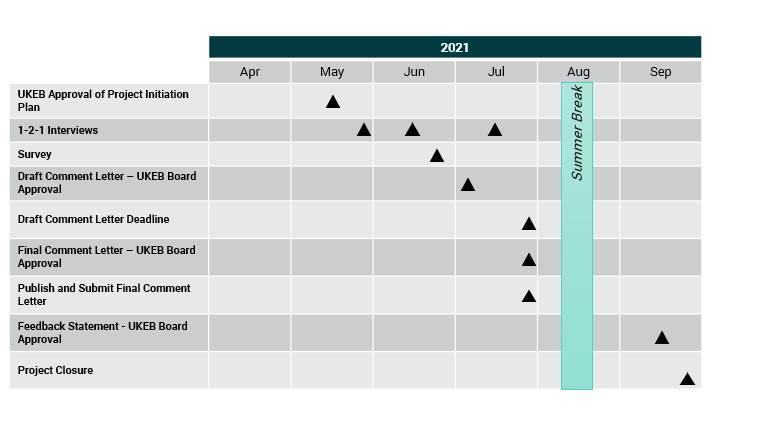
23The proposed timeline will lead to a very short window for stakeholders to consider and provide input on the UKEB's draft comment letter. Options to make the timeline more manageable are:
- arrange an additional Board meeting to approve the draft comment letter;
- approve the draft comment letter via email circulation to the Board before the 9 July meeting; or
- submit the final comment letter after the IASB's consultation deadline.
Initial identification of issues
24Our initial desk-based review of the standard and its requirements has identified some high-level issues related to the scope and applicability of the standard.
Scope and Applicability
25The scope of entities to which the ED would be applicable could be more extensive than one might initially assume because the ED only defines "regulatory agreement" and does not define "regulator" and this could unintentionally bring other entities that are not utilities within the scope of the standard. Initial outreach has identified the provision of services such as public transport, air traffic services and healthcare services could unintentionally be in scope of the standard.
Regulatory Agreement
26The ED focuses on regulatory agreements that have a set of enforceable rights and obligations that determine a regulated rate to be applied in contracts with customers, but it is unclear whether the regulatory agreement can be created by statute or regulation.
Footnotes
Footnotes
-
The International Accounting Standards and European Public Limited-Liability Company (Amendment etc.) (EU Exit) Regulations 2019: https://www.legislation.gov.uk/uksi/2019/685/made ↩
-
The ED, Basis for Conclusions and Illustrative Examples can be accessed here: https://www.ifrs.org/projects/work-plan/rate-regulated-activities/exposure-draft-and-comment-letters/#consultation ↩
-
Regulatory agreement is defined in the ED as "A set of enforceable rights and obligations that determine a regulated rate to be applied in contracts with customers". ↩
-
Scheduled UKEB meetings: 9 July, 20 July, 17 September. ↩