4.0 IFRS 17 Insurance Contracts
| Project Type | Endorsement |
| Project Scope | Significant |
Executive Summary
Purpose of the paper
This paper provides background information on the IFRS 17 endorsement project and an overview of the project plan. It invites the Board's comments on the approach to the endorsement assessment and how they would like to engage with endorsement issues.
Decisions for the Board
The Board is asked to make decisions on:
- The approach to addressing the detailed endorsement criteria in legislation1; and
- Approving the overall project plan and targeted timetable for an endorsement decision.
The paper also asks for comments on:
- What approach the Board recommends to engaging with technical issues;
- The project plan including the underlying assumptions, constraints and risks; and
- The duration of public consultation, the overall endorsement timetable and its interaction with the EU's endorsement timetable.
Summary of the issues
IFRS 17 was issued before the UKEB was established so the Board has to consider adoption of a standard whose development it had no opportunity to influence. The project plan therefore involves more extensive work than might perhaps be expected of endorsement projects in future. The Secretariat has commenced this work, including technical analysis and outreach with stakeholders across the UK insurance sector.
Recommendations
The paper recommends:
- Adopting an exceptions-based approach to the technical accounting criteria and reporting our assessment topic by topic rather than criteria by criteria;
- Approaching both the true and fair view and long term public good assessments from the perspective of IFRS 17 taken as a whole;
- Forming a sub-group of the Board to provide a preliminary review of technical issues and advice as to those to be escalated to the full Board;
- Giving further consideration to the appropriate duration of the public consultation and continuing to monitor developments in the EU's endorsement project.
Appendices
Appendix 1 Draft IFRS 17 DECA outline contents (‘skeleton')
Background
Introduction to IFRS 17 and endorsement
1The International Accounting Standards Board (IASB) started its insurance accounting project over 20 years ago in 1997. Significant outreach activities were undertaken during the standard's development including analysis of more than 700 comment letters and conducting 1400 meetings with stakeholders.
2Pending the development of a comprehensive insurance standard, the IASB issued IFRS 4 as an interim standard. IFRS 4 does not address how to measure insurance contracts but permits the continued use of existing accounting approaches. This results in varying accounting policies across the world and within single insurance groups, and thereby reduces comparability in insurance accounting.
3IFRS 17 Insurance Contracts was issued in 2017. It aims to address the shortcomings of IFRS 4 by introducing comprehensive recognition and measurement requirements for such contracts. However, in response to feedback from stakeholders the IASB issued amendments in June 2020 aimed at making it easier for insurers to explain financial performance.
4IFRS 17 is effective for annual reporting periods beginning on or after 1 January 2023, with earlier application permitted as long as IFRS 9 is also applied from the same date.
5A number of countries have already endorsed IFRS 17 for use within their jurisdictions. These include Canada, Australia, New Zealand and South Africa. In Europe the endorsement process is currently still underway.
6The European Financial Reporting Advisory Group (EFRAG) has submitted its final endorsement advice to the European Commission concluding that, apart from the requirement to apply annual cohorts to intergenerationally-mutualised and cash-flow matched contracts, all the other requirements of IFRS 17 meet the endorsement criteria.
7The fact that IFRS 17 was issued in final form before the UKEB was established means that the Board has to consider adoption of a standard whose development it had no opportunity to influence. The IFRS 17 endorsement project plan therefore involves more extensive work than might perhaps be expected of endorsement projects in future.
8Nevertheless, UK stakeholders have played a significant role throughout the development of the standard. As noted above, the IASB's due process included extensive outreach over many years. A significant number of UK stakeholders took the opportunity to engage directly with the IASB as part of that process. In addition, UK stakeholders contributed to EFRAG's endorsement project, including taking part in the detailed and simplified case studies. UK regulators, including the FRC, also made submissions to the IASB and EFRAG, either separately or via international bodies.
Project activity to date
9The IFRS 17 endorsement project commenced in Q1 2020. To support the technical analysis performed by the UKEB Secretariat, a number of outreach activities have been undertaken to-date in order to gather qualitative and quantitative information about IFRS 17 and its implementation. The principal components of these outreach activities are set out below.
Key components of outreach to date
Engagement with preparers
10Outreach activities with preparers has included:
- Joint webinar with the IASB (May 2020)
- Preparer survey (October 2020)
- Meetings with the industry body the Association of British Insurers (ongoing)
Engagement with users of accounts
11Outreach activities directed at investors and other users has included:
- Joint webinar with the IASB, analyst and ratings agency representatives (March 2021)
- User survey (May 2021)
- User interviews (ongoing)
Other elements of outreach
12Other elements of outreach include:
- Economic study (October 2020) – data gathering and analysis conducted by external consultants to assess aspects of the economic impact of IFRS 17 on the UK
- International liaison – periodic liaison with EFRAG and National Standard Setters
- Other meetings – periodic meetings conducted with other stakeholders, including investors and regulators
- Insurance Technical Advisory Group (TAG) – see below
Insurance Technical Advisory Group
13Following a public call for members, an Insurance Technical Advisory Group (Insurance TAG) was established comprising members from a variety of backgrounds and with a wealth of relevant experience. Members include preparers, auditors, actuarial experts and users of accounts. We also took care to include those with prior experience of adoption of standards for use in specific jurisdictions as well as those with extensive knowledge of particular types of insurance products e.g. life, general or re-insurance.
14The purpose of the Insurance TAG is to provide technical support to the Secretariat in developing advice regarding the adoption of IFRS 17 for use in the UK. The Insurance TAG is an advisory group rather than a decision-making body and its advice will form one element of the evidence that will be considered by the UKEB when making its decision on the adoption of IFRS 17 for use in the UK.
15The Insurance TAG generally meets on a monthly basis. Eight meetings have been held since the group was formed in July 2020. A further two meetings are currently scheduled.
16Technical papers are discussed at each meeting, with a focus on the analysis of IFRS 17 requirements against the technical accounting endorsement criteria2. Discussion papers are drafted either by the Secretariat, TAG members or jointly. An indication of issues covered in TAG discussions to date and items on the forward agenda is included in section three of the draft DECA outline attached as an Appendix to this paper.
17Meetings are held in private, but meeting summaries are publicly available on the UKEB website3.
Approach to the assessment against the technical accounting criteria
18SI 2019/685 requires an assessment of whether IFRS 17 "meets the criteria of understandability, relevance, reliability and comparability required of the financial information needed for making economic decisions and assessing the stewardship of management" [regulation 7 (1) (c)]. In this paper we refer to these criteria collectively as the technical accounting criteria.
Exceptions-based approach
19In carrying out this assessment we shall consider all principal aspects of IFRS 17. However, in the interests of efficiency and effectiveness we propose to carry out a detailed analysis against the technical accounting criteria only in relation to significant issues (an 'exceptions-based approach'). In this context 'significant issues' means aspects of the standard:
- In respect of which there is a question over whether IFRS 17's requirements on that aspect meet the technical accounting criteria; and
- Which have a potentially significant impact in the UK: that is, the issue is likely to be material to at least some companies and/or the efficient and effective functioning of UK capital markets.
20This approach means that detailed analyses against the technical accounting criteria are likely to focus on issues raised by UK stakeholders or which otherwise have been subject to considerable debate. A number of such issues have been taken to the Insurance TAG.
21For example, the measurement of estimated future cash flows for groups of contracts is a fundamental element of IFRS 17 and is addressed in the standard by specific requirements and extensive application guidance. However, based on our work and on information from stakeholders we are not aware of significant endorsement concerns in relation to these requirements. Under an exceptions-based approach we would not therefore expect to include a detailed report on assessment of this issue in the draft Endorsement Criteria Assessment (DECA).
22We have considered an alternative approach which would involve carrying out detailed assessments against the technical accounting criteria for all principal requirements of IFRS 17, regardless of whether a requirement was significant as defined above. However, such an approach risks:
- Ignoring the extensive work carried out and reported by stakeholders during the development of the standard;
- Making sub-optimal use of Secretariat resources; and
- Resulting in a very long DECA, full of clutter, potentially obscuring important points and reducing its clarity and impact.
23Board members have previously expressed general support for such an exceptions-based approach, but emphasised the need for the DECA to explain the approach and ensure that the standard had been considered as a whole. We therefore propose to explain the approach in an introductory section of the DECA.
24Our current expectation is that our analysis against the technical accounting criteria will be included on a topic by topic basis rather than on a criteria by criteria basis. This approach will facilitate dealing fully with an issue in one place in the DECA and should help minimise the risk of repetition, making the DECA more user-friendly.
25Recommendation. we recommend adopting an exceptions-based approach to the technical accounting criteria and including an explanation of this approach in the DECA. We also recommend reporting our assessment on a topic by topic basis.
Questions for the Board
| 26 | Does the Board approve the proposed exceptions-based approach? |
| 27 | Does the Board have any comments on the proposed approach to reporting the results of this work in the DECA? |
Long term public good and true and fair view assessments
28SI 2019/685 requires an assessment of whether any standard to be adopted for use in the UK:
- is not contrary to the principle that an undertaking's accounts must give a true and fair view of the undertaking's assets, liabilities, financial position and profit or loss [regulation 7 (a)]4; and
- is likely to be conducive to the long term public good in the UK [regulation 7 (b)].
29The true and fair view assessment is considered to be an overarching test so needs to be assessed taking the standard as a whole, [including its interaction with other accounting standards]. Similarly, the long term public good assessment involves consideration of the costs and benefits of the standard and of whether use of the standard is likely to have an adverse effect on the UK economy. It seems most appropriate to assess the impact of the standard taken as a whole. For these reasons we propose to ask for the Board's input to these aspects of the endorsement assessment towards the latter part of the endorsement project.
30The question of whether use of IFRS 17 is likely to improve the quality of financial reporting also forms part of the long term public good assessment5. This question could be approached from the perspective of the standard taken as a whole but it could also form part of the consideration of individual technical issues: it could be relevant to consider whether in each specific respect the requirements of IFRS 17 were an improvement over current accounting practice.
31The latter approach would enable the assessment to differentiate between aspects of the standard that represented an improvement and those that did not. However, such an approach might be viewed as inconsistent with the view that the technical accounting criteria should be viewed as an absolute (objective) standard to attain, rather than as a relative (comparative) test. In addition, it would necessitate a description and assessment of current accounting practice in each area. Such an approach would also be likely to result in a greater demand for resources and a longer, more complex DECA.
32Recommendation: we recommend that both the true and fair view and long term public good assessments are approached from the perspective of IFRS 17 taken as a whole.
Questions for the Board
| 33 | Does the Board agree that the true and fair view and long term public good assessments should be approached from the perspective of IFRS 17 as a whole? |
| 34 | In particular, does the Board agree that the question of whether use of IFRS 17 is likely to improve the quality of financial reporting should be considered only from the perspective of the standard taken as a whole? |
Engagement with the Board – technical issues
35The endorsement assessment of IFRS 17 is a significant project involving consideration of a number of individual technical issues against the technical accounting criteria. In addition, the long term public good assessment will need to address a range of factors. The DECA for this project is expected to require a significant amount of time for the secretariat to prepare and for the Board to review.
36The Board's capacity to consider the endorsement assessment and to review the DECA will be constrained by the available number of meetings and available agenda time. We are therefore seeking the Board's views on how best to ensure we obtain Board input to the consideration of issues and the preparation of the DECA.
37The draft DECA outline attached as an Appendix to this paper includes in section three an indicative list of issues that may require the Board's attention. This list is based on the principal topics discussed by the Insurance TAG. A more detailed schedule of these issues will be separately made available to Board members as reference material in Board Intelligence. We consider that these and any similar technical issues will need to be considered topic by topic.
38Options for engaging with the Board on these issues include:
- Taking a separate paper to the Board on each individual topic considered significant (as defined above);
- Taking separate papers to the Board only on those topics considered critical to the endorsement decision (e.g. the top two or three); or
- Forming a sub-group of the Board (of up to four Board members) to provide a preliminary review of technical issues and advice as to those to be escalated to the full Board as 'critical' matters.
39Approaches b) and c) would both involve the Board covering remaining ('non-critical') issues by way of Board reviews of the DECA (thereby covering more than one topic at once). The aim would be to provide early draft sections of the DECA as a basis for Board discussion (e.g. providing sections of the DECA as appendices to Board papers to the extent possible). This is likely to save secretariat drafting time and promote efficiency.
40Recommendation: we recommend approach (c) above. If the Board agrees with this recommendation we suggest that interested Board members contact the secretariat. We also recommend that, to the extent possible, Board papers should incorporate draft sections of the DECA as a basis for Board discussion.
Questions for the Board
| 41 | What approach does the Board recommend regarding the selection of issues for detailed Board papers and discussion? |
| 42 | In particular, how does the Board expect the consideration of non-critical issues to be documented and presented to the Board? |
Project planning
Remaining outreach and other assessment work
43The secretariat's endorsement assessment work is ongoing and is planned to continue in the coming months as the DECA is drafted. Further analysis work on technical issues is still required and two further Insurance TAG meetings are scheduled (May and July).
44Further outreach activities are also planned, including in relation to completion of a user survey, initially launched in April. Key findings will be discussed at an analyst roundtable, scheduled for June 2021, and at additional one-to-one meetings with both preparers and users. The public consultation on the DECA will provide a further opportunity for stakeholders to provide feedback.
45In addition, the Board may wish further work to be undertaken on specific areas identified as part of their consideration of the standard.
Key planning assumptions and constraints
46Resource capacity The UKEB Secretariat team currently only comprises a small number of technical staff, making resource constraints a real challenge to timely delivery of the project. Currently two and a half full time equivalent resources are allocated to the project. This is considered light for a project of this significance. The assigned Project Managers are on secondment and will depart in July and August. Dedicated economist resource, crucial to the development of the impact assessment, will be available only from July. Additional resources are being recruited and are anticipated to start in August, however they may not have IFRS 17 experience.
47UKEB Agenda Capacity As noted above the endorsement assessment of IFRS 17 is a significant project involving the consideration of a number of technical issues and a wide-ranging impact assessment. The capacity of the Board (number of meetings and available time on the agenda) to consider the assessment may act as a constraint on the project timetable. The formation of a Board sub-group to carry out preliminary reviews of potential matters for the Board would mitigate this risk, but Board capacity will need to monitored as the project progresses. The Board may need to consider prioritising IFRS 17 at future meetings to help ensure that the proposed project timetable, including issuance of the DECA for public consultation in early Autumn, remains on track.
48Public Consultation Duration- the current draft project timetable assumes a 90-day public consultation period. This reflects BEIS guidance and is based on the significance of the project to the UK insurance sector. However, as noted above, the IASB's due process included extensive outreach over many years and UK stakeholders have already made extensive use of opportunities to contribute to the development of the standard. We also expect that many stakeholders with an interest in insurers' accounts will already be familiar with the majority of issues likely to be addressed in the DECA.
49In this context the Board may wish to consider whether a shorter (e.g. 60-day) consultation period might be appropriate. If so, the consultation document and communications with stakeholders would need to clearly explain the rationale for a shorter period. This is a decision which could be taken at a later point in the project.
50From a planning perspective a shorter consultation period would provide an element of contingency in the project timetable.
51Regulatory Policy Committee Scope BEIS has confirmed that the IFRS 17 impact assessment is out of scope of their governance and reporting processes. Amongst other things this means that no submission to the Regulatory Policy Committee is required.
52While considered a low likelihood, there is a possibility that this position could change, bringing UKEB impact assessments into scope. This could have a significant impact on the scope of work required and the project timetable e.g. by delaying the timely adoption of the standard.
Questions for the Board
| 53 | Does the board have any preliminary views on the public consultation period? |
| 54 | Does the Board have any other comments on these assumptions and constraints? Are there other factors that serve to mitigate the risks identified? |
| 55 | Is the Board aware of any additional risks that should be managed? |
High level draft IFRS 17 project plan
56Based on the remaining work and the assumptions and constraints noted above, the plan overview below reflects the Secretariat's current view of the potential sequence of events leading to the Board's endorsement decision.
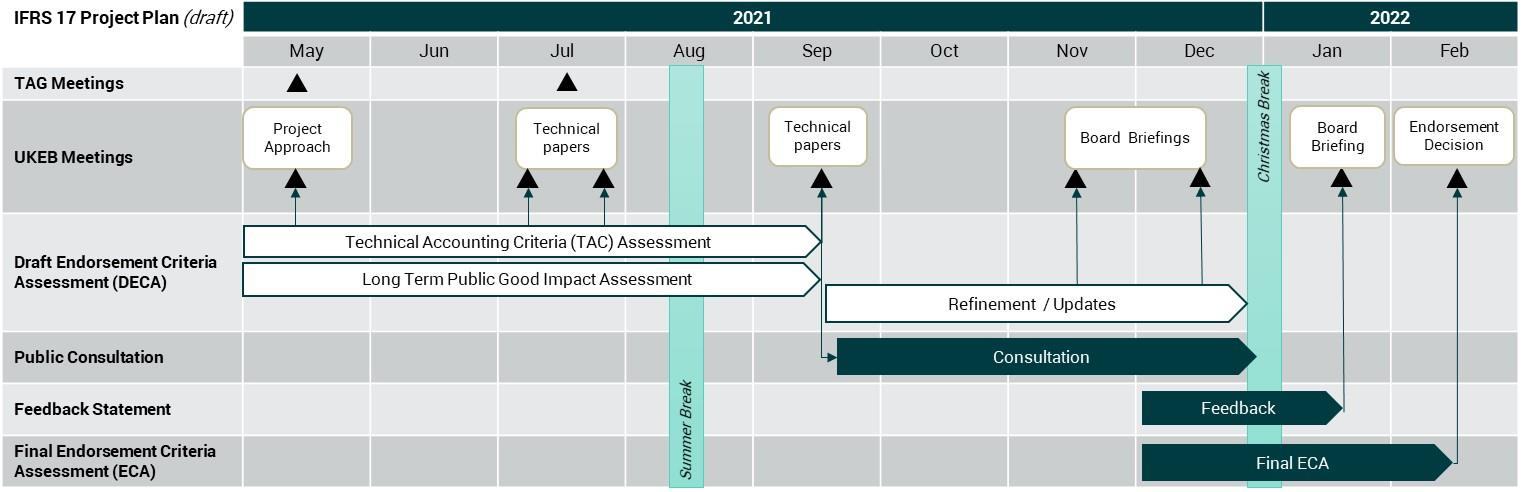
57Following discussion of the overall project approach at the May Board meeting the Secretariat expects to develop the IFRS 17 DECA. An early draft outline of the DECA is attached as an Appendix to this paper.
58It is envisaged that technical issues will be presented at both the July and September UKEB meetings. As a result, the earliest the DECA may be published for stakeholder consultation will be following the September meeting.
59Between September 2021 to February 2022 the Secretariat expects to work on completing the cost benefit analysis, preparing the final Endorsement Criteria Assessment (ECA) and drafting a Feedback Statement. During this period the Board will be briefed monthly on feedback received from stakeholders and on the evolving ECA.
60The current draft timetable envisages Board approval of the ECA and Feedback Statement for publication in February 2022. Preliminary feedback from UK insurers indicates that a UK endorsement decision in Q1 2022 would be manageable.
61The overall project plan and timetable currently contains no contingency so there is a high risk of key milestones being missed should, for example, new issues arise or further work on known issues be required.
62The Board may also wish to consider any potential interaction of the endorsement plan with the EU's IFRS 17 endorsement timetable. EFRAG has issued its final advice but was unable to reach a consensus on the 'annual cohorts issue'. Options for the endorsement of an amended version of IFRS 17 are now being considered by the Accounting Regulatory Committee of the EU Commission. Our assumption is that the EU will aim to complete this process by the end of 2021. A further possibility is that the EU might defer the effective date of the standard for use in the EU.
63Considerations would include:
- The extent to which the Board would wish to take full account of developments relating to EU or other National Standard Setters' adoption of IFRS 17 before determining its own final position;
- The impact on UK stakeholders of a decision by the EU to defer IFRS 17's effective date: for example, how would a desire to avoid the cost of delay be balanced against a desire not to transition to IFRS 17 in advance of EU competitors?
64Recommendation. we recommend giving further consideration to the appropriate duration of the public consultation and continuing to monitor developments in the EU's endorsement project.
Questions for the Board
| 65 | Subject to the key planning assumptions and constraints, does the Board approve the overall project plan including the targeted endorsement decision date? |
| 66 | What are the Board's preliminary views on the impact on the project plan of the EU's endorsement timetable and potential ‘carve-out' from IFRS 17? |
Next Steps
67While the following is dependent on the Board's views on the matters raised above, we expect the principal next steps to include:
- Preliminary discussions on key technical issues with a Board sub-group; and
- Preparation of technical papers for the Board's July meeting.
Appendix 1: [Draft] Endorsement Criteria Assessment skeleton
[DRAFT] Endorsement Criteria Assessment: IFRS 17 Insurance Contracts
Executive Summary [Endorsement Opinion]
To provide summary of key points covering:
- IFRS 17 background, purpose and context
- Key endorsement considerations
- Technical topics – overall view, any areas of concern, areas to monitor/follow up
- Overall true and fair view assessment
- Long-term public good assessment
- Improvement in financial reporting?
- Assessment of costs and benefits
- Summary of [draft] endorsement opinion
Endorsement Criteria Assessment
I Introduction: legislative framework and our approach to the assessment
1.1 Purpose of [Draft] ECA
1.2 Summary and explanation of legislative background to endorsement criteria
1.3 Detail of endorsement criteria (including text of criteria from SI 2019/685)
1.4 Description of how the [draft] Endorsement Criteria Assessment addresses the endorsement criteria:
- Wholistic approach, considering IFRS 17 as a whole – fundamental question is whether and how IFRS 17 improves the quality of financial reporting in the UK
- Outline of [draft] ECA structure and reporting approach – considered whole standard but reporting focused on exceptions/problematic areas
2 Description of IFRS 17
2.1 Background, context and objectives
- Overview of IASB's project – key purpose and objectives:
- High-level picture of current accounting in the UK under IFRS 4 [further detailed consideration included in Section 5 when considering whether IFRS 17 improves the quality of financial reporting]
2.2 Description of IFRS 17's main accounting requirements:
- High-level description of the main principles
- Overview of accounting models (GMM, VFA, PAA) and illustration of how the standard accounts for typical UK product-types
- Presentation requirements (what primary financial statements will look like)
3 'Technical' criteria assessment
3.1 Description of endorsement criteria (relevance, reliability, comparability, understandability) and what is meant by each
3.2 Explain approach adopted: considered whole standard but reporting focused on exceptions/problematic areas
3.3 Summary of IFRS 17's key principles and consideration of whether they support the endorsement criteria
Exceptions-based topic by topic assessment
For each topic we would expect the following to be covered:
- Introduction and description of issue
- Current accounting practice in the UK, to the extent required for understanding
- IFRS 17 requirements
- Assessment against the endorsement criteria
Anticipated topics (illustrative)
Level of aggregation
- Groups of contracts and annual cohorts
Measurement: areas of significant entity-level judgement
- Discount rates
- Risk adjustment
Other measurement
- Contracts which change their nature over time
- Contracts acquired in their settlement period
- With-profits business
- CSM allocation
- GMM: interest accretion on the CSM at the locked in rate
- Reinsurance
- VFA issues (eligibility criteria; risk mitigation option)
Presentation
- OCI option
Transition
- Application of methods/options
4 True and fair view
4.1 Explain purpose: IFRS 17 may be adopted only if the standard is not contrary to the principle that an entity's accounts must give a true and fair view.
4.2 Explain approach: a true and fair view is an overarching concept, to be applied to an entity's financial reporting as a whole. The impact of IFRS 17 is assessed as a whole, rather than at the level of each individual topic. (Specific requirements of IFRS 17 may be referred to in order to explain/evidence the overall assessment.)
4.3 Discussion:
- Considered as a whole, do IFRS 17's requirements represent a coherent whole, designed with consistent principles?
- Will IFRS 17 result in a faithful representation of the effects of insurance contracts on an entity's financial position and performance?
5 Long term public good assessment
5.1 Overview of LTPG assessment – purpose and approach
Will IFRS 17 improve the quality of financial reporting?
5.2 Consideration of expected impact in context of the IASB's stated objectives for IFRS 17
5.3 Comparison with current accounting for insurance contracts in the UK – analysis of extent to which IFRS 17 represents an improvement
5.4 Results of investor and other user outreach
Costs and benefits from applying the standard
5.5 Overview of expected costs and benefits of IFRS 17 and explanation of approach to assessment
Preparers
- Detailed costs for preparers, including implementation costs across people, processes, systems and data, identifying sunk costs
- Benefits for preparers, both tangible and intangible
Users
- Detailed costs for users
- Benefits for users, both tangible and intangible
5.6 Conclusion on costs and benefits
Likely effect on the economy of the UK
5.7 Consideration of implications for transparency and the efficient and effective functioning of capital markets
5.8 Consideration of international alignment – EU, Rest of World
5.9 Consideration of the consequences of not adopting the standard
Overall conclusion on UK public good
5.10 Summary of overall conclusion on UK public good
6 [Draft] Endorsement Criteria Assessment Conclusion
6.1 [To consider whether this section is required given intention to provide an Executive Summary/Endorsement Opinion]
Footnotes
-
https://www.legislation.gov.uk/uksi/2019/685/made ↩
-
Statutory Instrument 2019 No.685 sets out the full basis for the adoption of international accounting standards. Paragraph 7(c) of SI 2019/685 requires that a standard must meet the technical criteria of understandability, relevance, reliability and comparability required of the financial information needed for making economic decisions and assessing the stewardship of management. ↩
-
https://www.endorsement-board.uk/endorsement-projects/ifrs-17/technical-advisory-group ↩
-
Similar criteria are set out in regulation 7 (a) (ii) in respect of consolidated accounts ↩
-
Regulation 7 (2) (a) of SI 2019/685 ↩