3.1 Overview and Introductory Section
UK ENDORSEMENT BOARD 18 MAY 2021 AGENDA PAPER 3: APPENDIX 3.1
I. Introduction
1.1The Due Process Handbook (Handbook) sets out how the UK Endorsement Board (UKEB)1 will assess the appropriateness of international accounting standards2 for use in the UK. International accounting standards are developed and issued by the International Accounting Standards Board (IASB). This Handbook describes the due processes for influencing, [including research and thought leadership activities, and endorsement and adoption of international accounting standards3]. The Handbook also explains how stakeholders are able to participate in those processes.
1.2The Secretary of State for the Department of Business, Energy and Industrial Strategy (BEIS) delegated the functions relating to influencing, endorsing and adopting international accounting standards for application in the UK to the UKEB4. The Secretary of State maintains a regular review of the performance of the UKEB in exercising those functions. The UK Financial Reporting Council (FRC) oversees the effective governance of the UKEB and its adherence to the due processes set out in this Handbook. It also provides operational support. The FRC does not have the power to direct the UKEB in relation to the determination of its programme of work or the outcome of its technical decision-making5.
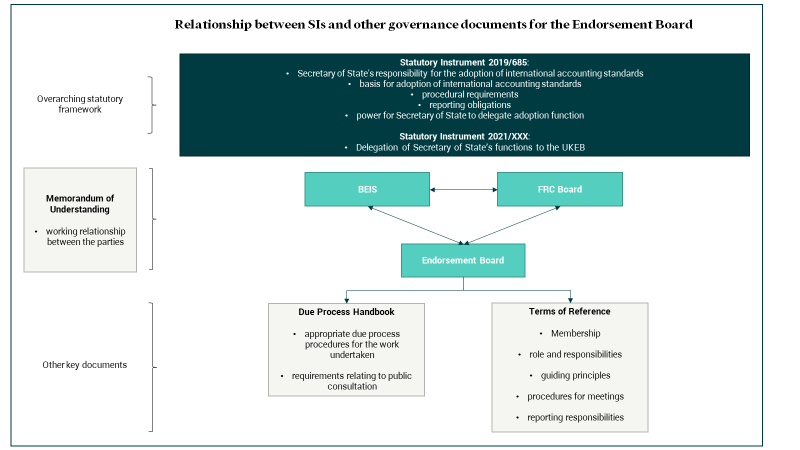
1.3This Handbook forms one of the key documents of the UKEB. A diagram of the relationship between these documents can be found in Appendix A.
2. Statutory functions of the UKEB
2.1Regulation 5 of SI 2019/685 sets out the UKEB's statutory functions, as follows:
"(a) the adoption of international accounting standards for use within the United Kingdom, with a view to harmonising the financial information presented by the companies required by section 403(1) of the Companies Act 2006 to prepare their accounts in accordance with UK-adopted international accounting standards, in order to ensure-
- a high degree of transparency and international comparability of financial statements; and
- the efficient allocation of capital, including the smooth functioning of capital markets in the United Kingdom; and
(b) participating in and contributing to the development of a single set of international accounting standards."
3. Terms of Reference and Guiding Principles
Terms of Reference
3.1The Terms of Reference (ToR) further elaborate on the UKEB's role and responsibilities as they relate to the statutory functions. The UKEB's key responsibilities include:
- Considering and deciding whether to endorse and adopt new or amended international accounting standard for application in the UK. This includes a formal endorsement criteria assessment which assesses the impact on UK entities. Whilst the FRC will provide operational infrastructure and other support to it, the UKEB's technical decision-making shall be independent.
- Ensuring that there is an open and transparent due process including a public consultation process with stakeholders on draft comment letters to the IASB, draft endorsement criteria assessments and other documents such as research discussion papers. This includes providing timely feedback to stakeholders on their contributions.
- Influencing the development of IFRS. The UKEB will follow and contribute to debates on all the IASB's projects, consult with UK stakeholders to obtain their views, highlight any concerns to the IASB at every stage of their project, including the development of its agenda and post-implementation reviews.
- Deciding on the work plan for research activities to contribute to the development of financial reporting internationally, after public consultation on possible projects to be included.
- Reporting to the FRC Board, setting out the extent to which it has complied with the procedures set out in the Due Process Handbook.
3.2The ToR are set by the BEIS Secretary of State and adopted by the UK Endorsement Board. 6
Guiding Principles
3.3Section 4 of the ToR require the UKEB to act at all times in accordance with the guiding principles of:
- Accountability-to be accountable to its stakeholders, its oversight body (the FRC) and the Secretary of State for BEIS in undertaking its statutory functions. This includes consulting with UK stakeholders that are affected by financial reporting, undertaking activities and due process procedures in a timely manner and providing a rationale for the decisions it makes.
- Independence-to ensure that it acts in the UK's long term public good by being independent from other organisations or stakeholder groups, including the FRC and BEIS.
- Transparency-to undertake its activities in a transparent manner so that stakeholders are aware of current projects and understand how decisions have been made.
- Thought leadership-to lead and represent the UK on international accounting standards and reporting.
3.4These guiding principles are embedded into the processes described in this Handbook.
4. Mandatory Due Process Activities
Quorum of attendance and decision-making
4.1The UKEB's ToR (in Section 5) set out, amongst other requirements, the quorum for UKEB meetings. This requires that a minimum of sixty percent of the appointed members (including the Chair) must attend a meeting of the UKEB (ToR, paragraph 5.1).
4.2Decisions made at an UKEB public meeting are indicative only. They are formalised by circulation outside the meeting by a written ballot (in paper or electronic form) and the ballot constitutes proper evidence of the decisions of members (including the Chair) of the UKEB. An affirmative vote of at least two-thirds of the members (including the Chair) of the UKEB, is required for the decision to be passed. Each Member of the UKEB, including the Chair, has one vote.
Transparency of meetings and stakeholder observers
4.3The UKEB's ToR set out the operating procedures that the UKEB applies in carrying out its responsibilities. Those procedures include the frequency and form of UKEB's meetings (in Section 6), as well as rules for observers attending these meetings (in Section 7).
4.4The UKEB may hold meetings in person, by webcast, or by telephone or other similar means. In deciding the format of meeting, the UKEB Chair should take into consideration public access and attendance (ToR paragraph 6.2).
4.5Regular meetings of the UKEB are planned as far in advance as is practicable to help the Secretariat, members of the Board, official observers (with speaking rights) of the Board, and stakeholders prepare for those meetings. The meetings calendar is published on the UKEB's website and is updated regularly.
4.6Meetings will usually be held in public and open to attendance by members of the public (as non-speaking observers). However, the UKEB may hold certain discussions in private or in the presence of invited observers with speaking rights only (for instance those relating to administrative issues and other non-technical matters) (ToR paragraph 5.6).
4.7The Chair of the UKEB may invite others to attend meetings as advisors when specialised input is required. Such invited advisors have the right to speak (ToR, paragraph 7.2).
4.8Meetings are recorded and, whenever possible, webcast live. Recordings of meetings are made available on the UKEB's website.
Minutes from UKEB Meetings
4.9The UKEB's ToR (in Section 9) set out the requirement to minute the meetings and any resolutions decided by the UKEB.
4.10Minutes from the public and private UKEB meetings are made available on the UKEB website once approved by UKEB Members.
Summary of main decisions reached
4.11A summary of the tentative decisions and areas of discussion for each UKEB meeting are published and made available on the UKEB's website as soon after the meeting as practicable and within 10 working days following the meeting (ToR paragraph 9.3). The Secretariat is responsible for ensuring that the meeting summary reflects the UKEB's decisions at each meeting. This summary serves also to inform interested parties about the progress made on technical projects in a timely manner.
UKEB Secretariat papers
4.12Section 8 of the UKEB's ToR set out requirements for the notice of meetings and Secretariat papers.
4.13The UKEB Secretariat is responsible for developing papers with recommendations and supporting analysis of technical issues for consideration by the members of the UKEB.
4.14The objective of the papers is to provide enough information for members of the UKEB to make informed decisions on technical matters. In developing these papers, the UKEB Secretariat is expected to conduct research and to seek advice from members of the UKEB. However, recommendations ultimately reflect UKEB Secretariat's views, after consideration of the information obtained.
4.15The UKEB agenda and Secretariat papers for each public meeting are made available on the UKEB's website no later than 5 working days before they are scheduled for discussion at a UKEB meeting (ToR, paragraph 8.3). This is to allow UKEB members enough time to consider and assess the UKEB Secretariat recommendations. It is the responsibility of the UKEB members to assess whether they have sufficient information and time to be able to make decisions based on UKEB Secretariat recommendations. Secretariat papers may have to be distributed closer to the meeting date, in exceptional circumstances only, and with the prior approval of the Chair. For example, if an urgent issue has arisen.
4.16Also, only in exceptional circumstances, and taking into consideration the Guiding Principles, the Chair may, at their absolute discretion, decide that all or part of certain Secretariat papers should not be made publicly available (ToR, paragraph 8.4). This may be, for example, if releasing that information could breach UK law, commercial confidentiality or prejudice the conduct of public affairs. However, such circumstances are expected to be rare.
4.17The UKEB Secretariat may supplement papers orally at a UKEB meeting, for example, to provide a verbal update on recent events.
Keeping stakeholders informed
4.18As a part of the guiding principle of transparency, the UKEB is committed to keeping its stakeholders and the general public informed about its activities. The principal means of communication between the UKEB and its stakeholders is through public meetings on technical issues, and the posting of relevant information and documents on the UKEB website.
4.19In particular, the UKEB publishes on its website:
- its work and agenda;
- its progress on individual projects or UKEB’s deliberations and compliance with due process by posting:
- public UKEB Secretariat papers;
- online summaries of the UKEB's main decisions after each meeting and recordings of UKEB meetings; and
- materials relating to advisory group meetings and other project-related information.
- media and information releases relating to its activities;
- any IASB consultation documents open for comment by providing links to these documents on the IASB's website;
- the formal comment letters submitted to the UKEB; and
- access to educational materials or webinars.
Appendix A
Relationship between SIs and other governance documents for the Endorsement Board
Footnotes
-
The UKEB was established through The International Accounting Standards and European Public Limited-Liability Company (Amendment etc.) (EU Exit) Regulations 2019 (Statutory Instrument 2019 No. 685 (SI 2019/685): https://www.legislation.gov.uk/uksi/2019/685/made ↩
-
This term has the meaning given in SI 2019/685 by referring to Article 2 of Regulation (EC) No 1606/2002 of the European Parliament and of the Council of 19 July 2002 on the application of international accounting standards: "...'international accounting standards' shall mean International Accounting Standards (IAS), International Financial Reporting Standards (IFRS) and related Interpretations (SIC-IFRIC interpretations), subsequent amendments to those standards and related interpretations, future standards and related interpretations issued or adopted by the International Accounting Standards Board (IASB)". ↩
-
These sections are under development and will be considered at subsequent Board meetings. ↩
-
The International Accounting Standards (Delegation of Functions (EU Exit) Regulations 2021 (SI 2021/XXX) of Functions (EU Exit) Regulations 2021 (SI 2021/XXX). ↩
-
The respective responsibilities of the Secretary of State for BEIS, FRC and UKEB are set out in a Memorandum of Understanding on the UKEB website. ↩
-
The Terms of Reference can be found here: https://assets-eu-01.kc-usercontent.com/99102f2b-dbd8-0186-f681-303b06237bb2/bcf857be-0260-40b2-8e73-2c3123694d4e/UKEB-Terms-of-Reference-2021.03.26.pdf ↩