Project Initiation Plan - Equity Method of Accounting
Purpose
1This paper sets out the plan to influence the proposed amendments to IAS 28 Investments in Associates and Joint Ventures included in the IASB Exposure Draft (ED) IASB ED/2024/7 Equity Method of Accounting—IAS 28 Investments in Associates and Joint Ventures (revised 202x). The ED was published on 19 September 2024 with a consultation period ending on 20 January 2025.
2The ED aims to improve the understandability of IAS 28, and to reduce diversity in practice by answering application questions1 about the equity method of accounting (equity method). The IASB's approach was to identify, explain and apply the principles that underlie IAS 28. As a result, the IASB proposes to restructure and create additional requirements in IAS 28 and proposes three new illustrative examples.
3The IASB emphasises that no fundamental overhaul of the equity method has been undertaken as part of this project2.
4To complement its proposed amendments to IAS 28, the ED also proposes amendments to the following IFRS Accounting Standards to improve disclosure requirements:
- IFRS 12 Disclosure of Interests in Other Entities; and
- IAS 27 Separate Financial Statements.
5The ED also proposes related amendments to IFRS 19 Subsidiaries without Public Accountability: Disclosures3 to provide reduced disclosure requirements for eligible subsidiaries.
Background
6IFRS Accounting Standards require an investor or joint venturer to apply the equity method for investments in associates and joint ventures in its consolidated financial statements. An entity may apply the equity method in its separate financial statements for investments in subsidiaries, joint ventures and associates.
7The IASB's 2015 Agenda Consultation noted that a number of queries on equity accounting, and its interaction with the accounting for other types of interests in other entities, had been raised with the Interpretations Committee. The IASB subsequently added a project on the equity method to its research pipeline to explore ways to address these questions and the resulting diversity in practice in accounting for investments in associates and joint ventures. In 2023 the project was promoted to standard setting, resulting in the publication of this ED.
8The Board has received regular updates on this project in IASB General Update papers between June 2022 and July 20244. The IASB published a summary of tentative decisions in March 2024 and made further tentative decisions in June 2024.
Project plan
9A proportionate approach has been applied in accordance with paragraphs 3.7 and 5.3 of the UKEB's Due Process Handbook. The Secretariat recommends the 'Limited scope' project plan shown below. The factors considered in arriving at this project plan are described in paragraphs 10–22. A timeline for the key project milestones is presented in paragraph 26.
| Key activities | UKEB Due Process Handbook |
|---|---|
| Creation of a Project Initiation Plan (this document) | 5.4-5.8 |
| Mandatory | |
| Desk-based research to support the proportionality assessment including: | 5.9 |
| a) Review of accounting firm manuals and UKEB staff papers regarding the equity method. | Optional |
| b) Review of IASB papers, presentations, meetings, and education materials. | |
| Publication of a Draft Comment Letter for public consultation | 5.13-5.17 |
| a) The DCL will be published on the UKEB website. | Generally mandatory |
| b) Announcement of the publication of the DCL and ITC will be made via the UKEB News Alert publication, and in two LinkedIn posts (one on publication, one shortly before the comment period closes). | |
| c) The DCL and ITC will be issued for comment for the minimum required 30 days. | |
| Stakeholder outreach pre-DCL publication | |
| a) A number of accounting firms were asked for initial feedback on the IASB proposals. | |
| Stakeholder outreach post-DCL publication | 5.10-5.12 |
| a) Stakeholder outreach will be via written responses to the DCL consultation–responses will be published on the UKEB website. | Mandatory |
| b) In addition, the DCL consultation will be highlighted as an item for noting at the forthcoming meetings of the UKEB Advisory Groups and Working Groups that are scheduled during the consultation period. | |
| Final Comment Letter | 5.18 |
| A final comment letter will be created for Board approval, submission to the IASB, and publication on the UKEB website. | Mandatory |
| Project closure | 5.19-5.26 |
| A Feedback Statement and Due Process Compliance Statement will be prepared. Once approved by the Board these documents will be published on the UKEB website. | Mandatory |
Proportionality assessment
Significance and size
IASB project scope
10The IASB objective for this project is to provide clarification to application questions arising under IAS 28 and improve the understandability of the Standard. This approach should provide preparers with solutions to long-standing application difficulties, reduce diversity in practice and lead to more comparable and understandable information for users. Whilst this may result in some entities needing to change their accounting policies, the improved comparability for users is beneficial to the long-term public good.
11As noted at paragraph 3 above, the IASB has not conducted a fundamental review of the requirements of the equity method itself.
Entities affected by the proposals
12The proposals affect entities that:
- are required by IAS 28 to use the equity method to account for investments in associates or joint ventures in consolidated financial statements or in individual financial statements5; and
- choose to use the equity method, as described in IAS 28, to account for investments in associates, joint ventures or subsidiaries in separate financial statements, as permitted by IAS 27.
13Initial outreach to accounting firms indicated that the majority of UK companies do not have material equity accounted investments (or, if they had investments they would not be materially changed by the proposals). However, one firm noted that a minority of companies do have material equity accounted investments, some of which are economically significant entities. Feedback suggested that it is rare for UK entities to use the equity method in their separate financial statements.
14The Secretariat conducted an analysis of Reuters-Eikon data to ascertain the prevalence of associates and joint ventures accounted for using the equity method among UK listed entities. The desktop research allowed the Secretariat to conclude that, among the approximately 1,400 listed entities which apply IFRS in the UK, as of the 2023 year-end:
- Only 22% (305 entities) have recognised holdings in associates and joint ventures using the equity method.
- The total value of these holdings was £123.6 billion, only 1.2% of total assets recognised on balance sheets.
- Only 5% of UK listed entities have investments in associates and joint ventures in excess of 5% of total assets.
- For half of the entities that recognise associates and joint ventures using the equity method, their recognised holdings in associates and joint ventures are 1.1% or less of total assets.
- Holdings in associates and joint ventures are highly concentrated among a few large companies, with the five largest companies accounting for nearly 60% of total holdings, and the largest 20 companies accounting for 85% of total holdings.
15This analysis suggests that, while not negligible, material holdings in associates and joint ventures accounted for using the equity method are not widespread among UK listed companies applying IFRS.
Complexity
16The proposals are intended to provide preparers with clarifications related to the application of the equity method and to improve the understandability of the Standard. As such, we do not believe that the proposals are highly technical or complex.
Expected timeline / urgency
17As noted in paragraph 7, this ED is the culmination of a long running IASB project. There is no indication of any need for urgent resolution or accelerated timeline in the UK.
Expected interest / sensitivity
18There is no indication of wider UK concerns in relation to this project.
19One IASB member indicated an intention to dissent from the proposals in the ED6.
Feedback on the proposals from desk-based research / initial outreach
20Desk-top review by the Secretariat of accounting firm manuals suggests that IAS 28 is silent on the approach to certain aspects of accounting under the equity method. This is consistent with the IASB's findings that there is diversity in practice in application of the equity method. The proposals address some, but not all, such areas identified in the accounting manual review.
21One accounting firm told us that, in their experience, the proposals are broadly aligned with current UK practice. Another accounting firm noted that some entities' investments would not be materially changed by the proposals, and initial analysis found some proposals helpful. However, they expressed concern as to the practicalities of certain proposals for entities with frequent changes in ownership interest, and for the proposed retrospective application of some requirements. It was also noted that retrospective application of the impairment requirements could, theoretically, give rise to counterintuitive results, such as uplifts in the carrying amount. Accounting firm work in analysing the proposals is ongoing.
22IASB analysis identified that the proposal that will likely affect most entities applying the equity method would be the recognition of gains and losses from transactions with (and between) equity accounted investments—an investor would recognise the full gain or loss resulting from all transactions with the associate7. The accounting firms we contacted are still considering the implications of this proposal.
UKEB project scope
23Based on the proportionality assessment above we recommend a 'limited' project scope and the approach described in the project plan reflects this.
Resources allocated
24To undertake the activities described in this project plan a project team has been assigned consisting of 0.75 of a Project Director. The required resources are allowed for in the 2024/25 UKEB plan and budget.
Setting up an ad-hoc advisory body
25The UKEB will not require a separate ad-hoc advisory body for this project. Existing UKEB advisory and working groups have the necessary skills and expertise to support this project and be consulted as outlined in the project plan.
Project timeline
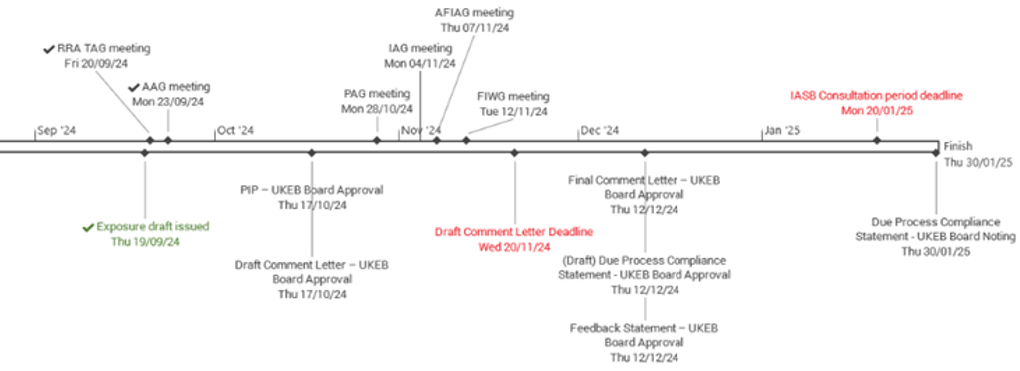
26The proposed high-level project timeline is shown below. This provides a best estimate based on information known at this time. If necessary, a revised PIP will be presented to the Board, to reflect any material changes, as the project progresses.
| Date | Milestones |
|---|---|
| 17 October 2024 | Project Initiation Plan for Board approval |
| Draft Comment Letter for Board approval | |
| Estimated DCL consultation period (30 days): 21 October – 20 November 2024 | |
| 12 December 2024 | Board review of Final Comment Letter, Feedback Statement, draft Due Process Compliance Statement |
| December 2024 | Final Comment Letter submitted to IASB (deadline 20 January 2025) |
| 30 January 2025 | Due Process Compliance Statement for noting. |
27The diagram below is a graphical view of the key milestones and outreach activities described above.
Footnotes
Footnotes
-
Application questions in the scope of the project are set out in the Basis for Conclusions (Table 1 paragraph BC13). Paragraph BC15 Table 2 provides a list of the 10 principles identified as underlying IAS 28. ↩
-
See Basis for Conclusions paragraph BC5 and BC8. ↩
-
IFRS 19 permits subsidiaries that do not have public accountability and meet other specified criteria (eligible subsidiaries) to apply IFRS Accounting Standards with reduced disclosures requirements. It also specifies the disclosure requirements an eligible subsidiary is permitted to apply instead of the disclosure requirements in other IFRS Accounting Standards. ↩
-
Links to the IASB General update papers for this project can be found on the UKEB project webpage here. ↩
-
The term 'individual financial statements' is sometimes used to describe the financial statements of an entity with no subsidiaries (per Basis for Conclusions BC219). ↩
-
See Alternative View AV1 on pages 62-64 of the Basis for Conclusions. Mr Cendon supports the proposals in the Exposure Draft amending the equity method requirements in IAS 28. However, in his opinion, IAS 27 should have been amended to include an option to apply the equity method of accounting differently when the parent has control of the investee (that is, when the investee is a subsidiary) and the entity elects to apply the equity method. ↩
-
Paragraph 28 of IAS 28 requires an investor to restrict the gain or loss recognised in a transaction with an associate to the extent of the unrelated investors' interests in the associate. That requirement applies to both downstream and upstream transactions. The portion of the gain or loss that is not recognised at the date of the transaction is recognised subsequently, when the transferred asset is sold to unrelated third parties or consumed over time. However, paragraphs 25 and B97-B99 of IFRS 10 require an investor to recognise in full the gains or losses on the loss of control of a subsidiary. The proposals aim to eliminate the inconsistency between the requirements in IAS 28 and IFRS 10 when an investor accounts for the sale or contribution of a subsidiary to an associate. ↩