Updated Project Initiation Plan - Goodwill Research Project
Project Type: Research Project Scope: Limited scope

Overview
1The IASB has begun redeliberating the preliminary views in its DP 2020/1 Business Combinations: Disclosures, Goodwill and Impairment (the Discussion Paper). In the Discussion Paper, the IASB supported retaining the impairment-only model for the subsequent measurement of goodwill. Responses to this preliminary view were mixed: some respondents supported maintaining the impairment-only model whereas others recommended the reintroduction of amortisation. The UKEB Secretariat's response advocated a hybrid model for the subsequent measurement of goodwill. In the hybrid model, an annual amortisation charge is supported by impairment testing.
2The proposed project responds to and expands on a request from IASB staff. The IASB discussed its plan for redeliberations on this project at its September 2021 meeting. It agreed that further work would be prioritised to support redeliberations on goodwill measurement. To inform the Board's redeliberations on this topic, IASB staff identified two specific areas of analysis that they intended to carry out with support from national standard setters. These areas were:
- How the useful life of goodwill is determined for amortisation purposes under national GAAP; and
- The potential impacts of transitioning to an amortisation model.
3We have identified two further areas for analysis that we anticipate will be useful to the IASB in its ongoing redeliberations. These areas are:
- How a hybrid model can provide information that is useful for users.
- Cost implications of a hybrid model.
4We recommend field-testing potential transitional arrangements to the hybrid model from the current IFRS impairment-only model. We have discussed the proposed field-testing with IASB staff. IASB staff confirmed that evidence from field-testing would be of interest to them, and that our proposed timeline would allow for that evidence to be considered during the IASB's redeliberations. The IASB has recently updated its plans so that it will decide on the project's direction in H21 2022.
5We intend to publicly promote the field-testing and will seek input from users, preparers, auditors, and academics.
6The proposed field-testing of transitional arrangements will explore:
- The relative merits of prospective and retrospective application;
- The advantages and disadvantages of full retrospective application;
- The factors that management would consider in determining the useful life of goodwill for amortisation purposes if retrospective application were required and how those factors might vary for different acquisitions and components of goodwill;
- Whether any additional disclosures relevant to those factors might also be useful information for users of accounts and if so, what those additional disclosures would be;
- Whether assumptions applied in determining the useful life of goodwill for amortisation purposes would be consistent with assumptions about the allocation of goodwill to cash-generating units for impairment testing purposes, and;
- The cost and resource implications of a potential transition.
7As part of the proposed field-testing, we will also seek UK stakeholder views and evidence on:
- The IASB's proposed disclosures on business combinations.2
- The frequency of trade and assets acquisitions with material goodwill and the implications of these goodwill balances for distributable profits.
8The proposed project contributes to the influencing activities delegated to the UKEB in SI/2019/685(5)(b).3
9Undertaking the project is relevant for the UKEB and its stakeholders because:
- Much of the current debate on the subsequent measurement of goodwill assumes that an amortisation model would result in a loss of useful information by imposing an arbitrary period for the amortisation of goodwill. Field-testing retrospective application of transitional arrangements will provide an opportunity to explore whether a hybrid model, which combines amortisation with regular impairment tests, could provide a more faithful representation and continue to provide information that is relevant to users.
- Goodwill represented approximately 15% of total assets for UK FTSE 350 and AIM entities in 2020; and
- M&A activity by IFRS reporters in the UK is expected to increase in the immediate and medium term.4
Project objectives, scope, and output
8The IASB's objective in undertaking this project is to assemble relevant evidence to underpin their redeliberations on subsequent measurement of goodwill.
9The UKEB's objectives in undertaking this project are to:
- Build the UKEB's reputation as a significant and positive participant in the development of global accounting standards; and
- Demonstrate the UKEB guiding principle of thought-leadership by anticipating IASB's information needs and contributing UK-specific evidence to the international debate on goodwill; and
- Demonstrate the UKEB guiding principle of accountability through outreach to UK stakeholders.
10The intended outputs of the project are:
- A comprehensive analysis in response to the IASB's request; and
- A research paper presenting project findings and conclusions, to be published on the UKEB website.
11Once the research scoped in this PIP is complete, the UKEB may wish to consider further research or developing the research paper in formats suitable for wider publication. We intend to consult with the Board on any additional research or development of the research paper for wider publication before commencing any work outside the scope of this PIP.
12The UKEB will propose presenting the research paper at future international meetings with other global standard setters, including the July 2022 Accounting Standards Advisory Forum (ASAF) meeting and September 2022 International Forum of Accounting Standard Setters (IFASS) meeting.
Approach
13The project approach will comprise desk-based research and stakeholder outreach. The goodwill research project team will be alert to opportunities to co-ordinate with the UKEB's intangibles project team, to ensure efficiency and consistency between the two research projects where appropriate.
14The table in appendix A outlines the proposed questions, initial findings and proposed further work. Secretariat will provide updates to the Board as necessary throughout the project.
Key milestones and proposed timeline
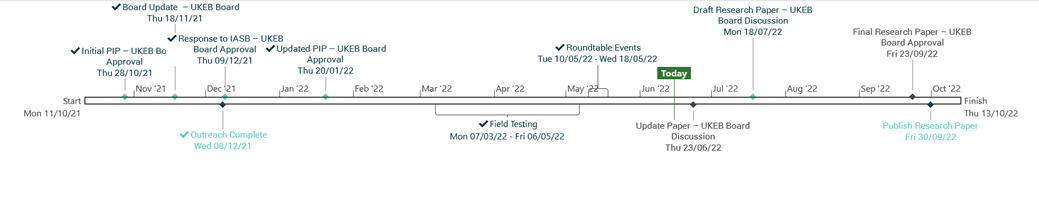
15The proposed high-level project timeline is as follows:
| Month | Activity / Milestone |
|---|---|
| October 2021 | Board meeting: approval of initial PIP |
| October – November 2021 | Desk-based research |
| November 2021 | Outreach activities |
| December 2021 | Board meeting: approve analysis for submission to IASB |
| December 2021 | Share analysis with IASB and publish on UKEB website |
| January 2022 | Board meeting: approval of updated PIP |
| February 2022 | Develop field-testing materials |
| March – April 2022 | Field-testing with stakeholders |
| June 2022 | Board meeting: discuss initial findings from field-test submissions and approve updated PIP |
| July June-2022 | Board meeting: approve draft research paper for publication on UKEB website |
| September 2022 | Board meeting: approve final research paper for publication on UKEB website |
The timeline is shown below:
Assumptions
16We have made the following assumptions in developing this project initiation plan:
- Planned further research will result in sufficient depth and breadth of analysis (planned further research is shown in appendix A).
- There are no significant changes to project scope.
- The resource allocated to the project is 50% of a project director's time and 40% of a project manager's time for the duration of the project. These resources are available and included in the current UKEB budget.
- IASB timelines do not change.
- We will not prepare a feedback statement or a statement of compliance with due process for the project, since neither are required by the current draft of the UKEB Due Process Handbook and would not be the best use of staff resource.
Next Steps
18Subject to Board approval, we will commence the research and analysis activities outlined in Appendix 1.
19Subject to Board approval, we will present the research paper to the UKEB May 2022 Board meeting.
Appendix A: Summary of areas for analysis, initial findings and proposed further research
| Question | Initial Findings | Further Research Proposed |
|---|---|---|
| Section a: Analyses requested by IASB | ||
| 1If IASB decides to reintroduce goodwill amortisation and the transition requires adjusting historical goodwill balances, what are the potential effects of writing-off significant amounts of historic goodwill on transition and amortising the remaining historic goodwill balances on: | ||
| a Financial position | Goodwill exceeded net assets for approximately 11% of FTSE 350 entities in 2019. The proportion of FTSE 350 entities whose goodwill exceeds net assets has remained broadly constant at approximately 11% between 2005 and 2019. | Update analysis for 2020 year-ends. Extend sample to other listed entities outside FTSE 350. Analyse trends by sector and size of entity. Field-testing to: Develop numerical examples illustrating potential impacts of transitioning to an amortisation model. Analyse age profile of goodwill for a sample of UK IFRS reporters to ascertain the value of goodwill that would need to be written off on transition. Research different treatments of goodwill on transition. |
| b Debt covenants | There is no standard approach to the treatment of goodwill in debt covenants. Some include goodwill as an asset when assessing credit and when setting covenant terms whilst others do not. | How a change in subsequent measurement of goodwill could impact existing covenants. Field-testing to provide further insights on the above. |
| c Distributable profits, dividend payments, and capital maintenance | Under the Companies Act 2006 and UK common law, distributions are made by individual companies and not by groups. The group accounts are therefore not relevant for the purpose of determining a company's profits available for distribution, dividend payments or capital maintenance. Amortisation or impairment of goodwill arising on consolidation has no direct impact on distributable profits, dividend payments or capital maintenance. | Field-testing to provide further insight on the frequency of trade and assets business combinations and the materiality of goodwill arising from them. |
| d Listing requirements | An initial review of the UK Listing Rules has not identified any specific requirements regarding financial position. | Further review of relevant sources to identify whether transitioning to an amortisation model would lead to breaches of listing rules and other related requirements. |
| e Tax | There is tax relief for some kinds of goodwill under current UK legislation. | Numerical example to illustrate any impact on current and deferred tax of transitioning to an amortisation model. |
| f Other legal and regulatory requirements | - | Further review of relevant sources to identify whether transitioning to an amortisation model would lead to breaches of other regulatory requirements. |
| 2In national GAAP: | ||
| a Is a default period provided? What are the reasons for setting a default period and how was that default period determined? | UK GAAP requires amortisation of goodwill on a systematic basis over its useful life. Management should make a reliable estimate of the useful life of goodwill. If, in exceptional cases, an entity is unable to make a reliable assessment of the useful life of goodwill, the life shall not exceed 10 years. Earlier UK GAAP contained a rebuttable presumption that the maximum useful economic life of goodwill was 20 years. | Explore why 10 years was set as the cap where management are unable to make a reliable assessment of the useful life of goodwill. |
| b Can entities deviate from a default period based on specific facts and circumstances (rebuttable presumption) and, if so, whether in practice entities tend to rebut that presumption and deviate from the default period, and what evidence is provided to support any deviation? | Our initial sample of large private UK companies has found entities which either: Voluntarily report under IFRS Or Do not have goodwill |
Extend sample of large private UK companies to identify UK GAAP reporters with goodwill. Outreach to UK GAAP preparers, auditors, and regulator to analyse: How a reliable estimate of the useful life of goodwill is made Whether it is assessed separately for each acquisition Cost and resource implications of the assessment Frequency with which the estimate of the useful life of goodwill is revised and reasons why |
| c Is useful life established on the basis of management's best estimate and, if so, whether a list of indicators/factors to be considered is provided (for example: cash flow streams, synergies, payback period), how entities are making these estimates and whether auditors and regulators can, and do, challenge these assumptions? | Experience of auditing estimates of useful life of goodwill | |
| Section B: UKEB staff proposed questions | ||
| 1How can a hybrid model provide useful information for users? | Investor contributions to the international debate suggest that amortisation does not provide useful information, and in fact reduces the decision-usefulness of the financial statements. However, these views are often based on the assumptions that:
|
Further analysis of user responses to IASB's DP and to FASB's goodwill measurement consultation. Field testing and outreach to explore whether and, if so, how:
|
| 2Cost implications of a hybrid model. | International debate has identified concerns that introducing a a hybrid model would create an additional cost burden for entities, given it would require amortisation in addition to impairment testing. | Outreach to preparers, auditors, and users to assess cost implications of preparing and auditing amortisation supported by indicator-only impairment testing compared to costs of an impairment-only model. |
Footnotes
Footnotes
-
IASB's project timeline was updated on 17 December 2022. It reflects IASB's current project plan to decide on the project's direction in H2 2022. Previously IASB's intention was to vote on the proposals in the DP in Q2 2022. ↩
-
The DP proposes disclosure of anticipated synergies, strategic rationale for the business combination, and the metrics used to monitor the business combination. IASB staff have developed illustrative examples of these disclosures which we intend to incorporate in our proposed field-testing. ↩
-
The International Accounting Standards and European Public Limited-Liability Company (Amendment etc.) (EU Exit) Regulations 2019: https://www.legislation.gov.uk/uksi/2019/685/made ↩
-
Source - Lexis Nexis market tracker trend report: Trends in UK Public M&A in 2020. ↩