Project Initiation Plan - Business Combinations - Disclosures, Goodwill and Impairment
Project Type: Influencing Project Scope: Moderate
Purpose
1This paper sets out the plan to influence the proposed amendments to IFRS 3 Business Combinations and IAS 36 Impairment of Assets included in the IASB Exposure Draft (ED) published on 14 March 2024. It was accompanied by the IASB's Basis for Conclusions, a video introducing the ED, as well as a snapshot of the proposals.
Background
2IFRS 31 was issued in 2004 and specifies how entities account for business combinations. In June 2015, the IASB completed the Post-implementation Review (PIR) of IFRS 3 and, in response to the feedback received2, it decided to undertake improvements to the accounting and disclosures for business combinations.
3The IASB's objective of that project was to explore whether companies can, at a reasonable cost, provide investors with more useful information about the business combinations those companies make3. Better information would help investors assess the performance of companies that have made acquisitions and more effectively hold a company's management to account for decisions to acquire those businesses.
4In March 2020, the IASB published a Discussion Paper Business Combinations—Disclosures, Goodwill and Impairment (the "DP"), setting out its preliminary views. After considering the feedback from the DP4, it added the project to its standard-setting programme in December 2022. The ED published on 14 March 2024 is the output of that project.
5The UKEB noted a summary of the IASB's tentative decisions at its October 2023 meeting5 and received an education session on the IASB's proposals in the private Board meeting on 23 February 2024.
Exposure Draft
6The IASB ED includes proposals that attempt to strike a balance to help improve information to investors about acquisitions, particularly the most important (strategic) acquisitions and their subsequent performance, whilst considering cost and risk to companies. A proposed exemption means that companies would not be required to disclose information that compromises the acquisition-date objectives for their acquisitions.
Proposed amendments to IFRS 3 Business Combinations
7The proposals to amend IFRS 3 include:
- disclosing strategic rationale for all material business combinations - 'strategic rationale for undertaking the business combination'; replaces the 'primary reasons for the business combination'7;
- disclosing quantitative information about expected synergies for all material business combinations in the reporting period the acquisition occurs;
- requiring entities to provide information for a subset of 'strategic' business combinations that meet at least one of the closed quantitative and qualitative thresholds9. Such entities would be required to disclose key objectives and related targets that management will use to monitor whether those objectives are being met, and in subsequent periods, disclose the extent to which management's objectives are being met, for as long as management monitors the combination against its acquisition-date targets;
- identifying information to be disclosed by reference to that information reviewed by Key Management Personnel (KMP)10;
- an exemption11 from some disclosing specific information in certain circumstances in which disclosing a particular item of information can be expected to prejudice seriously any of the entity's acquisition-date key objectives for the business combination;
- other disclosure requirements.
8The IASB decided to require a company to disclose information about the performance of acquisitions and expected synergies in the financial statements12.
Proposed Amendments to IAS 36 Impairment of Assets
9The proposals to amend IAS 36, in particular, targeted improvements to the impairment test for cash-generating units (CGUs) where goodwill has been allocated, include:
- simplifying the 'value in use'13 calculation, for impairment testing of all assets to which IAS 36 applies, including CGUs containing goodwill, by:
- removing the constraint on cash flows used to estimate value in use, that prohibits including cash flows arising from future restructuring to which the entity is not yet committed or from improving or enhancing an asset's performance.14;
- removing the requirement to use pre-tax cash flows and pre-tax discount rates, but requiring an entity to disclose the discount rate(s) applied to cash flow projections, and use internally consistent assumptions for cash flows and discount rates regardless of whether value in use is estimated on a pre-tax or post-tax basis;
- clarifying the requirements15 on how an entity allocates goodwill to CGUs and adding to the requirements, including:
- requiring an entity that is applying IFRS 8 Operating Segments to disclose the reportable segments in which CGUs containing goodwill have been allocated; and
- an explanation of the difference between (a) management monitoring 'strategic' business combinations for the purpose of subsequent performance disclosure, and (b) management monitoring a business associated with the goodwill for the purpose of impairment testing.
11The IASB has proposed to retain the requirement to perform the quantitative impairment test, for CGUs containing goodwill, annually in IAS 36.
Project plan rationale
12The following considerations have shaped the project plan.
Initial stakeholder feedback
13Ahead of the publication of the ED, the Secretariat gathered preliminary views from some of the UKEB's Advisory Groups17 on the IASB's tentative decisions. The preliminary feedback from members of these groups indicated overall support for the project objective to provide investors with more useful information about the business combinations those companies make, at a reasonable cost.
14Whilst members supported the disclosure objectives and some of the new disclosure requirements in IFRS 3 and some changes to the impairment test in IAS 36, there were concerns about the usefulness and auditability of some of the proposed disclosure requirements, and the identification of strategic business combinations.
15It was highlighted that some of the proposed disclosures would require significant judgement, such as quantifying expected synergies at acquisition date. In particular, revenue synergies would likely be overly optimistic and lead to challenges in auditing, whilst cost-savings synergies could be commercially sensitive. In addition, aggregating the categories of synergies (as opposed to using the exemption from disclosing the disaggregated categories) to minimise the risks associated with disclosure, would reduce transparency and the resulting information would be less useful.
16Initial feedback also highlighted areas where the wording of the ED and application guidance will require close review to ensure the requirements are clear.
17The UKEB Advisory Groups will be consulted on the proposed amendments in the ED.
Other considerations
Complexity of technical issues
18The proposed amendments to IFRS 3 do not affect recognition and measurement requirements – the changes add disclosure objectives and disclosure requirements.
19Nevertheless, the Secretariat acknowledges that the proposed changes will require entities to gather information that may not be currently available and will include a high level of judgement, which could make auditing and enforcement challenging.
20The proposed amendments to IAS 36, in particular the changes to the impairment test, may affect the impairment of all assets in scope, not just CGUs containing goodwill.
21The IASB project has extended over many years and UK stakeholders have already contributed to the development of the proposed amendments through the PIR of IFRS 3 and the subsequent research project, including the March 2020 DP. Consequently, we expect that some UK stakeholders will already be familiar with the issues that the IASB is trying to address.
Overview of costs and benefits
22Costs and benefits will be investigated further in our outreach.
Outreach
UK Stakeholders
23In addition to the publication of the DCL for general consultation, we propose to undertake a number of specific outreach activities as follows:
- Investors (and other users) roundtable, targeting those users reviewing financial statements of entities that actively engage in acquisitions;
- Discussions with preparers18, focusing on acquisitive entities and those carrying a significant amount of goodwill.
24We plan to promote our outreach and the DCL via the UKEB Advisory Groups and via the social media channels (LinkedIn, News Alerts to subscribers, UKEB website).
25We propose to supplement our outreach with desk-based research19.
International Stakeholders
26We have reached out to the EFRAG project team and will use the feedback from their outreach20 to identify overlaps with issues highlighted by UK stakeholders.
27Discussions with other national standard setters would be added if areas of potential overlap are identified at a later date.
Resources allocated
Resource capacity
28On the basis of this project plan, we consider that a project team consisting of one Project Director, with technical support and oversight from a Senior Project Director, should ensure the project milestones are achievable. Input from the economics team and communications support will be obtained as appropriate.
Setting up an ad-hoc advisory group is not necessary
29Given the scope and nature of the project, it is not considered necessary to set up a separate, ad-hoc advisory group as the existing UKEB Advisory Groups are well placed to provide feedback on this project.
Project timelines
30The ED was published on 14 March 2024 and the IASB 120-day consultation period ends on 15 July 2024.
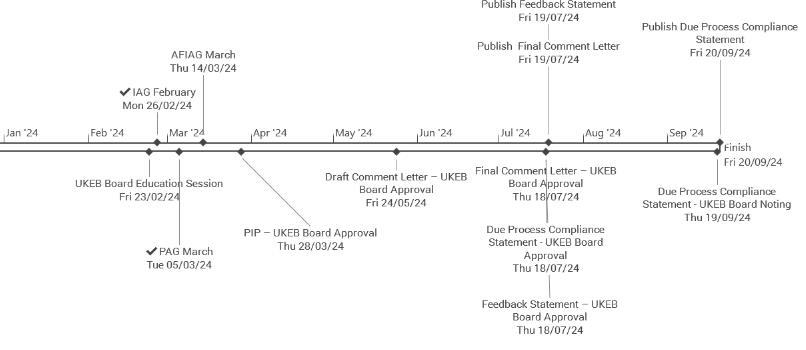
31The primary outreach for this project so far has been the scheduled UKEB Advisory Group meetings in February and March 2024. The project timeline below sets out the other planned work and relevant milestones. The expected project timeline is based on the recommended approach i.e. presentation of the DCL at the UKEB meeting on 24 May 2024 and FCL at the UKEB meeting on 18 July 2024.
Detailed Project Timeline
| Expected Dates | Activities and Milestones |
|---|---|
| January / February 2024 | Secretariat: Preliminary analysis and outreach before publication of ED |
| 23 February 2024 | Board: Education session (Private meeting) |
| 26 February 2024 | Secretariat: Outreach—UKEB Investor Advisory Group (IAG) |
| 5 March 2024 | Secretariat: Outreach—UKEB Preparer Advisory Group (PAG) |
| 14 March 2024 | Secretariat: Outreach—UKEB Accounting Firms and Institutes Advisory Group (AFIAG) |
| 14 March 2024 | IASB: publishes Exposure Draft with 120-day consultation period |
| 28 March 2024 | Board: Discusses and approves Project Initiation Plan (PIP) – this document |
| 12 April 2024 | Secretariat: Outreach—UKEB Academic Advisory Group (AAG) |
| 26 April 2024 | Board: Discusses Technical paper |
| May 2024 | Secretariat: Joint outreach with IASB—User roundtable and Preparer 1:1s |
| 24 May 2024 | Board: Consideration and approval of DCL |
| 31 May 2024 (estimate) | Secretariat: Publishes DCL and Invitation to Comment on website and alerts key stakeholders (as soon as possible after 24 May Board meeting) |
| 1 – 30 June 2024 | Open consultation: 30-day DCL comment period |
| 18 July 2024 | Board: Discusses and approves Final Comment Letter (FCL), Feedback Statement and draft Due Process Compliance Statement |
| 26 July 2024 (estimate) | Secretariat: Submits FCL to IASB and publishes FCL and Feedback Statement on website (as soon as possible after 18 July Board meeting) |
| 19 September | Board: Notes completed DPCS |
| 20 September | Secretariat: Publishes DPCS on website |
Project Initiation Plan: Exposure Draft Business Combinations—Disclosures, Goodwill and Impairment – Proposed timeline
Footnotes
-
IFRS 3 establishes principles and requirements for how an acquirer in a business combination recognises and measures in its financial statements the assets and liabilities acquired, and any interest in the acquiree held by other parties; recognises and measures the goodwill acquired in the business combination or a gain from a bargain purchase; and determines what information to disclose to enable users of the financial statements to evaluate the nature and financial effects of the business combination. ↩
-
The IASB Report and Feedback Statement on the Post-implementation review of IFRS 3 can be found here. ↩
-
See introduction on page 4 of the IASB's Exposure Draft Business Combinations-Disclosures, Goodwill and Impairment, published on 14 March 2024. ↩
-
At the IASB May 2021 meeting the IASB’s preliminary views outlined in the March 2020 Discussion Paper were summarised in Staff paper Agenda 18A. Paragraphs 20 - 49 provide a summary of feedback received on those preliminary views. ↩
-
Appendix B of the UKEB 19 October IASB General Update paper summarises the IASB’s tentative decisions to date. ↩
-
IFRS 3.B64 says “the acquirer shall disclose the following information for each business combination that occurs during the reporting period: (a) the name and a description of the acquiree. (b) the acquisition date. (c) the percentage of voting equity interests acquired. (d) the primary reasons for the business combination and a description of how the acquirer obtained control of the acquiree.” ↩
-
A strategic business combination would be one for which failure to meet any one of an entity’s acquisition-date key objectives would put the entity at serious risk of failing to achieve its overall business strategy. ↩
-
The IASB proposes that acquisitions that meet any one of the thresholds would be strategic acquisitions: * qualitative thresholds—the acquisition results in a company entering a new major line of business or geographical location; or * quantitative thresholds—any one of revenue, operating profit (as defined in the forthcoming IFRS 18 Primary Financial Statements) and assets (including goodwill) of the acquired business constitutes at least 10% of the acquirer’s corresponding amounts. ↩
-
KMP is as defined in IAS 24 Related Party Transactions; the IASB, in its preliminary views, considered using Chief Operating Decision Maker (CODM) as defined in IFRS 8 Operating Segments. ↩
-
The exemption would apply to: * management’s objectives for a strategic business combination and the related targets management will use to monitor whether the objectives for the strategic business combination are being met; * quantitative information about synergies expected to arise from all material business combinations. The exemption would not apply to: * the strategic rationale for all material business combination; and * the actual performance in subsequent periods for strategic business combinations, with reference to the targets management uses to monitor whether the objectives for the business combination are being met. ↩
-
The conceptual framework does not prohibit such information about expected synergies and management’s key objectives and targets from being included in the financial statements (as opposed to the management commentary), since such information is directly linked to the price paid for the acquisition and that price is reflected within the financial statements in the measurement of the assets and liabilities recognised from the acquisition, including goodwill. ↩
-
'Value in use' (VIU) is covered in IAS 36.30–57 and IAS 36.A1–A14 and can be defined as the future cash inflows and outflows arising from the continued use of an asset and from its ultimate disposal. These cash flows are discounted to account for the time value of money and risk. If the carrying amount exceeds the recoverable amount (higher of VIU and Fair value less cost of disposal (FVLCD)), the asset is considered impaired, and entities are required to reduce the value of the asset through an impairment loss. ↩
-
The requirement to assess assets or CGUs in their current condition will be retained. ↩
-
IAS 36.80 currently says “For the purpose of impairment testing, goodwill acquired in a business combination shall, from the acquisition date, be allocated to each of the acquirer’s cash-generating units, or groups of cash-generating units, that is expected to benefit from the synergies of the combination, irrespective of whether other assets or liabilities of the acquiree are assigned to those units or groups of units. Each unit or group of units to which the goodwill is so allocated shall: (a) represent the lowest level within the entity at which the goodwill is monitored for internal management purposes; and (b) not be larger than an operating segment as defined by paragraph 5 of IFRS 8 Operating Segments before aggregation”. ↩
-
Extensive evidence collected by the IASB did not demonstrate a compelling case for change. Such evidence included the UKEB research report Subsequent Measurement of Goodwill: A Hybrid Model published in September 2022, which explored the practical implications of a potential transition to an amortisation model and considered: (a) the effect of reintroducing amortisation of goodwill on reporting outcomes, financial stability and audit processes, systems and costs; and (b) the practical feasibility of transition to an amortisation model, including the feasibility of estimating a useful life of goodwill. ↩
-
The Secretariat met with the Investor Advisory Group (IAG) on 26 February 2024, the Preparer Advisory Group (PAG) on 5 March 2024 and the Accounting Firms and Institutes Advisory Group (AFIAG) on 14 March 2024. It plans to meet with the Academic Advisory Group (AAG) on 12 April 2024. ↩
-
We are hoping to engage with UK stakeholders who responded to the IASB’s March 2020 DP. ↩
-
Desk-top research will include, review of the IASB’s preliminary views in the DP and related stakeholder feedback, other IASB staff papers and tentative decisions, the FRC Thematic review: Business Combinations (Sep-2022), the FRC Thematic review: Impairment of non-financial assets (Oct-2019), the IASB’s project updates at both the 2023 World Standard Setters Conference breakout session and the FASB-IASB joint Education Meeting in September 2023. ↩
-
A summary of key messages and an issues paper for its Draft Comment Letter on BCDGI was presented to the EFRAG FRB meeting on 29 February 2024. ↩