BCUCC presentation for video final
Louise Freeman, UKEB Secretariat Yulia Feygina, IASB Technical Staff 15 March 2021
Copyright © 2021 IFRS Foundation. All rights reserved.
Welcome

Louise Freeman UK Endorsement Board secretariat

Yulia Feygina IASB Technical Staff
The views expressed in this presentation are those of the presenters and not necessarily those of the UK Endorsement Board, the International Accounting Standards Board or the IFRS Foundation, nor are they necessarily reflective of any official policy or position.
Business Combinations under Common Control (BCUCC)
-
Get involved.
-
Formal outreach activities
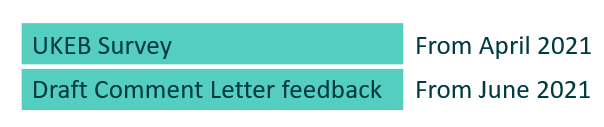
- UKEB Survey From April 2021
- Draft Comment Letter feedback From June 2021
-
IASB deadline for comments is 1 September 2021.
-
Email us with thoughts at any time at [email protected]
Introducing the Discussion Paper
IFRS 3 Business Combinations requires the acquisition method. Business combinations under common control are not addressed by IFRS standards.
Diagram illustrating the relationships and key issues in Business Combinations under Common Control.
The diagram shows a controlling party (P) which has common control over companies A, B, and C. * Company A is identified as the receiving company. * Company C is identified as a business. * A dotted line between C and C indicates a potential transfer or combination.
On the right, three key issues are highlighted: * Similar transactions reported differently * The acquisition method or a book-value method * Such combinations are common * Particular concern of securities regulators
The IASB's preliminary view
How the receiving company should select the method
Flowchart outlining the selection method for business combinations under common control.
-
Does the transaction affect non-controlling shareholders of the receiving company?
- If No: Proceed to Book-value method.
- If Yes: Proceed to next step.
-
Are the receiving company's shares traded in a public market?
- If Yes: Proceed to Acquisition method.
- If No: Proceed to next step.
-
Are all non-controlling shareholders related parties of the receiving company (related-party exception)?
- If Yes: Proceed to Book-value method.
- If No: Proceed to next step.
-
Has the receiving company chosen to use a book-value method, and have its non-controlling shareholders not objected (optional exemption)?
- If Yes: Proceed to Book-value method.
- If No: Proceed to Acquisition method.
Outcomes: * Book-value method * Acquisition method
Introduction to the book value method
-
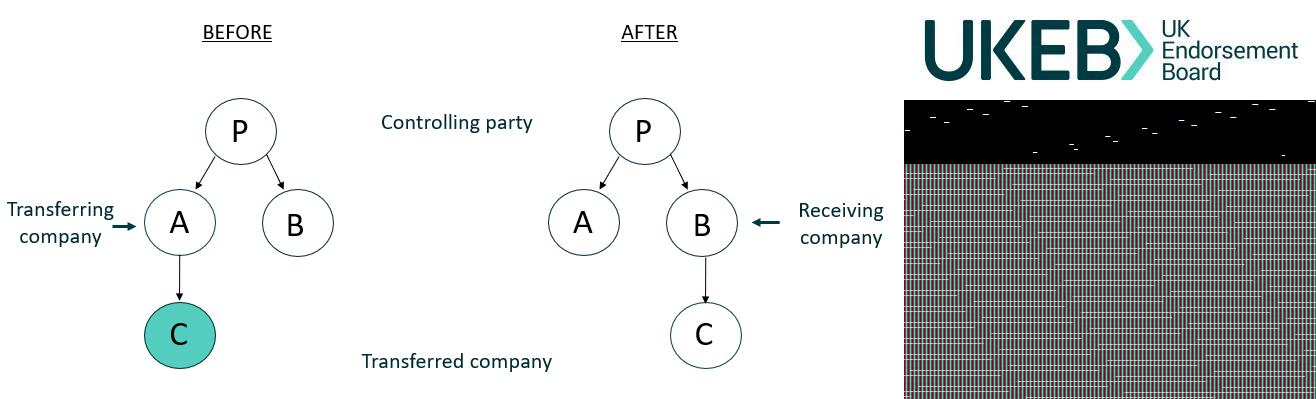
The receiving company accounts for the assets & liabilities acquired at book value.
-
Whose book value? The book value of the transferred company (company C below).
-
Non cash consideration – generally measured at book value. Different (flexible) approach for own shares.
-
Pre-combination information – no restatement.
Introduction to the acquisition method
-
Method is generally the same as for a business combination covered by IFRS 3.
-
Assets & liabilities acquired are recorded at fair value.
-
Goodwill arises if the consideration is greater than fair value of those assets and liabilities.
The IASB's preliminary view
How the receiving company should apply the method
| Acquisition method | Book-value method | |
|---|---|---|
| Overall summary | Generally apply as set out in IFRS 3 Business Combinations | A single book-value method to be specified in IFRS Standards |
| Assets and liabilities received | Measure at fair value. Recognise all identifiable assets and liabilities received | Measure at book value. Recognise only previously recognised assets and liabilities |
| Consideration paid | Measure at fair value | Measure at book value |
| Difference between consideration paid and assets and liabilities received | Recognise any excess as goodwill and any shortfall as a contribution to equity | Recognise as a decrease or increase in equity |
| Pre-combination information | Do not restate to include the transferred company | Do not restate to include the transferred company |
Introduction to disclosure
-
Currently, IFRS 3 disclosure requirements do not apply to BCUCC.
-
The discussion paper suggests:
- Acquisition method – apply IFRS 3 disclosure requirements in full and provide additional information about the transaction price applying IAS 24 Related Party Disclosures.
- Book value method – apply a reduced set of IFRS 3 disclosure requirements.
-
Disclosures are only made at receiving company level (ie would not appear in the consolidated accounts of ParentCo.)
Introduction to disclosure - book value method
-
Aim is to help users evaluate the nature and financial effect of the combination, and understand the expected benefits
-
Requires a subset of the IFRS 3 disclosures including:
- Company name, description, date, voting interests, reason for combination, how the receiving company obtained control.
- Recognised amounts of each major class of assets & liabilities acquired, including those arising from financing activities and defined benefit pension liabilities.
- The carrying amount of any non controlling interest in the transferred company.
- The amount and explanation of any gain or loss recognised in the current reporting period that relates to assets or liabilities received.
- Information about combinations that occur after the end of the reporting period but before the financial statements are authorized.
-
This information is also required in aggregate for individually immaterial combinations that are material collectively.
Discussion
Image of the cover of the IFRS® Standards Discussion Paper DP/2020/2.
The cover displays: * November 2020 * IFRS® Standards * Discussion Paper DP/2020/2 * Business Combinations under Common Control * Comments to be received by 1 September 2021 * Logos for IASB and IFRS
BCUCC Timeline
Formal outreach activities
- UKEB Survey From April 2021
- Draft Comment Letter feedback From June 2021
IASB deadline for comments is 1 September 2021.
No need to wait: get in touch today at [email protected]
IASB resources
The discussion paper
A one page summary of the preliminary views.
A project snapshot explaining the preliminary views.
A webinar on the preliminary views (January 2021).
What do you think?
-
Do you use IFRS and do you expect to be affected?
-
To what extent do ideas in the discussion paper match your existing practices in this area?
-
Do you agree/disagree with the preliminary views you have heard today?
-
Do you see any practical difficulties in implementing these preliminary views?
-
What are the benefits for investors and creditors?
We welcome UK stakeholder views on the topics covered today.
Please email with your questions, views or if you would like to be involved in future outreach activities.
Contact Info
Email: [email protected] Website: https://www.endorsement-board.uk/