Project Initiation Plan - IAS 1 Narrow-scope Amendments 2020 and 2022
| Project Type | Endorsement and adoption |
| Project Scope | Narrow-scope |
Purpose
1This paper sets out the plan to assess whether to adopt1 two narrow-scope amendments2 to IAS 1 Presentation of Financial Statements issued by the IASB:
- Amendments to IAS 1 Classification of Liabilities as Current or Non-current3 (the 2020 Amendments) issued in January 2020; and
- Amendments to IAS 1 Non-current Liabilities with Covenants4 (the 2022 Amendments) issued in October 2022.
2The Amendments have an effective date of 1 January 2024, with earlier application permitted by the IASB.
3The Board was not formed when the 2020 Amendments were developed but it actively influenced the development of the 2022 Amendments. This influencing included submitting a Final Comment Letter5 in March 2022 in response to the IASB's Exposure Draft ED/2021/9 – Non-current Liabilities with Covenants6.
4The UKEB's statutory functions mean that it must consider the Amendments against the statutory adoption criteria before their formal adoption for use in the UK. Given the 2022 Amendments modify the 2020 Amendments and the IASB transition requirements effectively require concurrent adoption of both sets of amendments, the Secretariat proposes that the amendments are considered on a joint basis.
5The Board's aim would be to ensure adoption is completed in good time to permit UK entities to use the amendments on the IASB mandated effective date of 1 January 2024.
Background
6In January 2020, the IASB issued narrow scope amendments to IAS 1 Classification of Liabilities as Current or Non-current. The amendments were focussed on clarifying one of the criteria in IAS 1 for classifying a liability as non-current: the requirement for an entity to have the right to defer settlement of the liability for at least 12 months after the reporting period.
7In 2021, stakeholder concerns about one of the paragraphs introduced in the 2020 Amendments led to the IASB publishing further amendments to IAS 1 Non-current Liabilities with Covenants (the 2022 Amendments) in October 2022.
8The background to both the 2020 and 2022 Amendments was previously discussed by the Board in November 2022 (UKEB meeting, Agenda Paper 77)
Joint assessment and adoption
9The Secretariat proposes that the 2020 and 2022 Amendments should be assessed and, if appropriate, adopted on a joint basis. That is, the assessment will be set out in a single [Draft] Endorsement Criteria Assessment (DECA) that assesses the two sets of amendments together as a package.
10This approach is consistent with the intention of the IASB. The 2022 Amendments are intended to improve the application of the 2020 Amendments and include amendments that supersede previously issued requirements (although unlike in other jurisdictions they were not adopted for use in the UK at the time). The IASB's effective date requirements reinforce this view, making it clear that the 2020 Amendments should only be applied in conjunction with the 2022 Amendments.
11To aid this joint adoption, the IASB provided a combined text of the two sets of amendments as an appendix to the 2022 Amendments. This text is reproduced in Appendix B to this paper.
12In the statutory UK context, joint adoption is consistent with the International Accounting Standards and European Public Limited-Liability Company (Amendment etc.) (EU Exit) Regulations 2019 (SI 2019/685). Regulation 7 outlines the basis upon which an International Accounting Standard8 can be adopted. Though it is framed in the singular, Section 6(c) of the Interpretation Act 19789 states that words in the singular include the plural and words in the plural include the singular unless the contrary intention appears.
13Given the nature of the amendments, and the apparent intention of the IASB, the Secretariat believes that joint assessment and, if appropriate, adoption of the 2020 and 2022 Amendments as a package10, reflecting the operation of the final Standard after amendment, provides the most relevant approach to assessing the endorsement criteria in Section 7 of Sl 2019/685.
Description of the 2020 and 2022 Amendments to IAS 1
14A brief description of the 2020 and 2022 Amendments to IAS 1 is shown in the table below.
| Issued for public comment | Exposure Draft ED/2015/1 Classification of Liabilities11 (proposed amends to IAS 1)—issued for public comment in February 2015 (comment period ended 10 June 2015). Exposure Draft ED/2021/9 Non-current Liabilities with Covenants12 (proposed amends to IAS 1)—issued for public comment in November 2021 (comment period ended 21 March 2022). |
| Title and issue date of final amendments | Classification of Liabilities as Current or Non-current (Amendments to IAS 1)13 issued January 2020. Non-current Liabilities with Covenants (Amendments to IAS 1)14 issued October 2022. |
| Origin | See Background in paragraphs 6 – 8 above and November 2022 UKEB Meeting, Agenda Paper 715 paragraphs 7 – 17 for further detail. |
| What has changed? | When considered together the 2020 and 2022 Amendments to IAS 1:
|
| Transition requirements | The amendments to paragraph 139U (transition and effective date of the 2020 amendments) are effective immediately, with the remaining 2020 and 2022 Amendments to IAS 1 effective for annual periods beginning on or after 1 January 2024, with early application permitted, as long as both amendments are applied at the same time. If an entity applies the Amendments for an earlier period, it shall disclose that fact. The Amendments should be applied retrospectively in accordance with IAS 8 Accounting Policies, Changes in Accounting Estimates and Errors. |
Project plan
15The project plan is guided by the following factors.
The Amendments are narrow in scope
16The Amendments are focussed on clarifying the classification of liabilities as non-current.
17While this issue is relevant to most companies in the UK, the Secretariat does not believe that the clarifications are likely to lead to significant changes in the classification of liabilities for UK companies.
18The disclosure requirements may potentially be more impactful as they require more detailed disclosure than has previously been provided. However, materiality continues to apply as an overarching principle that circumscribes the extent of the requirements.
The Amendments will be assessed on a joint basis
19A joint approach as outlined above is both reflective of the intent of the Amendments and allows for a proportionate approach to the project and stakeholder outreach.
20Development of a single DECA will be more efficient and allow for more effective outreach with stakeholders who can consider, and provide feedback on, a single assessment that addresses the impact of both Amendments which have the same mandated effective date.
The Amendments have been subject to public consultation
21The 2020 Amendments were exposed for public comment as Exposure Draft Classification of Liabilities in 2015 (the 2015 ED), before the creation of the UKEB.
22The IASB received a substantial amount of feedback16 to the 2015 ED. 87 comment letters were received, 14 of which were from stakeholders based in the UK, including the large accounting firms, accounting professional bodies, the FRC and the Corporate Reporting Users Forum (CRUF) (UK) and two preparers17.
23Stakeholders raised a range of matters regarding the proposals and the feedback led to significant revisions over the next 5 years. The final amendments were published in 2020 and were substantially different from those in the 2015 ED.
24The 2022 Amendments were considered by the UKEB and subject to consultation with UK stakeholders18. As discussed with the Board in November 2022, many of the concerns and recommendations from the UKEB's final comment letter were addressed during the finalisation of the 2022 Amendments19.
25Both the 2020 and 2022 Amendments have been discussed with the UKEB's Preparers Advisory Group (PAG) and the Accounting Firms & Institutes Advisory Group (AFIAG). While the PAG raised some preliminary questions about the application of the of 2022 Amendments neither group identified significant concerns about the Amendments, and the AFIAG believed they represented a significant improvement to IAS 1.
Project milestones
26A proportionate approach is proposed, incorporating the mandatory milestones listed in paragraph 6.11 of the UKEB's Due Process Handbook (Handbook)20. The table below provides a brief description of the work we have done and/or that we intend to do as part of this project.
27Note that future dates are subject to subsequent modification, refer to the UKEB work plan for latest information21.
| Milestone/activity | Brief description | Status |
|---|---|---|
| Project initiation activities | ||
| Technical project added to UKEB technical work plan (mandatory) [Handbook 4.30 (d)] |
Added to UKEB technical work plan22. | Completed. |
| Education session (optional) [Handbook 4.10] |
The Board had an education session on the Exposure Draft of the 2022 Amendments in December 2021. The Board has reviewed subsequent updates on the IASB's redeliberations, most recently at the November 2022 Board meeting23. | Completed at November 2022 Board meeting. |
| Project Initiation Plan (mandatory) [Handbook 6.11] |
This paper. | - |
| Desk-based research (optional) [Handbook 6.17] |
The Secretariat has reviewed:
|
Completed. |
Other mandatory milestones
| Milestone/activity | Brief description | Status |
|---|---|---|
| Issue of a DECA (mandatory) [Handbook 6.23–6.26] |
The Secretariat will develop a draft Endorsement Criteria Assessment (DECA) to assess whether the Amendments meet the UK's statutory requirements for adoption. | To be completed. We expect to bring the DECA for discussion to the February 2023 meeting. |
| Minimum outreach activities (mandatory) [Handbook 6.18 - 6.22] |
Publish DECA for stakeholder comment on the UKEB website. The Secretariat also intend to reach out directly to UK stakeholders who have previously provided feedback to the IASB and/or UKEB. We will also discuss the DECA with the UKEB Advisory groups, as appropriate. | To be completed. DECA publication for comment expected in March 2023. |
| Consultation period for the DECA [Handbook 6.28] |
The DECA will be issued for comment for 90 days. | To be completed. DECA comment period expected to be March 2023 – June 2023. |
| Project closure (mandatory) [Handbook 6.30] |
The project closure process for endorsement projects will comprise the following mandatory steps.
|
To be completed. We expect to bring the ECA etc. for discussion to the July 2023 meeting. The final Due Process Compliance Statement is expected to be brought for noting to the September 2023 meeting. |
Resources allocated
28On the basis of this project plan, we consider that a project team consisting of one Project Director supported by a Project Manager should be sufficient to ensure the project timelines are achievable.
29In addition, we plan to obtain input from the economics team to develop the contents of the economic impact assessment.
Setting-up an ad-hoc advisory group is not necessary
30Given the narrow-scope nature of the Amendments and initial feedback, it is not considered necessary to set up a separate, ad-hoc advisory group specific for this project.
Project timeline
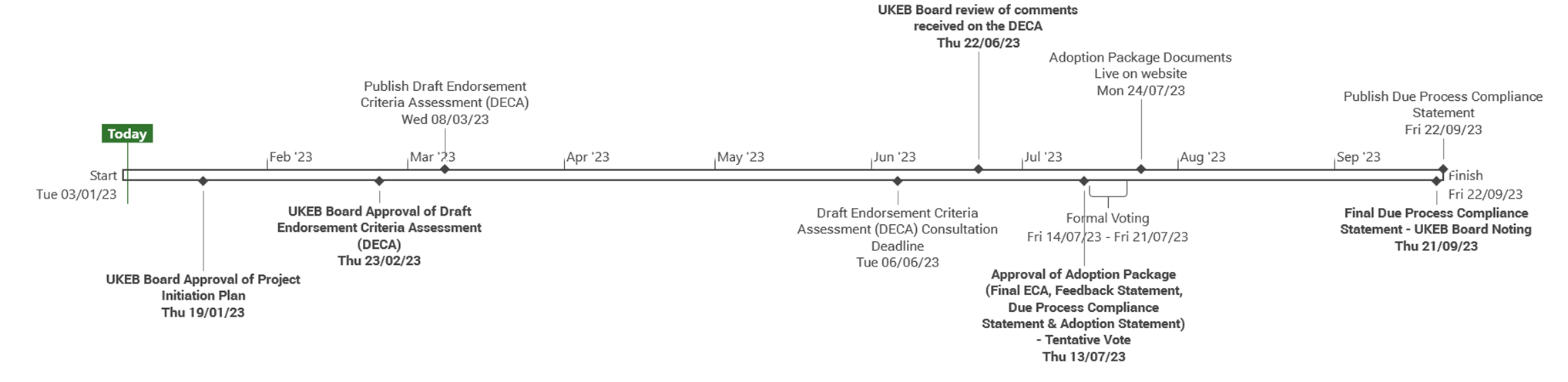
31The proposed high-level project timeline, subject to subsequent modification25, is as follows:
| Date | Milestones |
|---|---|
| 19 January 2023 | Presentation of Project Initiation Plan (PIP) for approval |
| 23 February 2023 | Presentation of Draft Endorsement Criteria Assessment (DECA) for approval |
| DECA consultation period (90 days): 8 March – 6 June 2023 | |
| 22 June 2023 | Board review of comments received on the DECA |
| 13 July 2023 | Consideration of Adoption Package Board members provide a tentative vote |
| 21 September 2023 | Due Process Compliance Statement for noting |
Footnotes
-
The UK's statutory requirements for adoption of international accounting standards are set out in The International Accounting Standards and European Public Limited-Liability Company (Amendment etc.) (EU Exit) Regulations 2019 no. 685 (the Regulations, or SI 2019/685) ↩
-
There was also an interim amendment to the 2020 Amendments (Classification of Liabilities as Current or Non-current—Deferral of Effective Date (Amendment to IAS 1) (ifrs.org)) that changed the application date from 1 January 2022 to 1 January 2023. This was wholly superseded by the 2022 Amendments and therefore adoption would be superfluous. ↩
-
Classification of Liabilities as Current or Non-current (Amendments to IAS 1) (ifrs.org) ↩
-
IASB-IAS2022-1 – Final Amendment: Non-current Liabilities with Covenants - Amendment to IAS 1 (ifrs.org) ↩
-
Final Comment Letter - Non-Current Liabilities with Covenants (Proposed Amendments to IAS 1).pdf ↩
-
Exposure Draft: Non-current Liabilities with Covenants (ifrs.org) ↩
-
November 2022 Paper 7: IAS 1 Presentation of Financial Statements - Narrow Scope Amendments 2020 and 2022 ↩
-
For the purpose of this Regulation, 'international accounting standards' shall mean International Accounting Standards (IAS), International Financial Reporting Standards (IFRS) and related Interpretations (SIC-IFRIC interpretations), subsequent amendments to those standards and related interpretations, future standards and related interpretations issued or adopted by the International Accounting Standards Board (IASB). (Regulation 3, emphasis added) ↩
-
Section 6(c) of the Interpretation Act 1978 (legislation.gov.uk) ↩
-
This is also consistent with the approach taken by EFRAG to assessing these amendments. ↩
-
Exposure Draft: Classification of Liabilities—Proposed Amendments to IAS 1 (ifrs.org) ↩
-
Exposure Draft: Non-current Liabilities with Covenants (ifrs.org) ↩
-
Classification of Liabilities as Current or Non-current (Amendments to IAS 1) (ifrs.org) ↩
-
IASB-IAS2022-1 – Final Amendment: Non-current Liabilities with Covenants - Amendment to IAS 1 (ifrs.org) ↩
-
November 2022 Paper 7: IAS 1 Presentation of Financial Statements - Narrow Scope Amendments 2020 and 2022 ↩
-
IFRS - Exposure Draft and comment letters: Classification of Liabilities (Proposed Amendments to IAS 1) ↩
-
The Linde Group and British Telecommunications (BT) ↩
-
Feedback Statement - Non-Current Liabilities with Covenants (Proposed Amendments to IAS 1).pdf (kc-usercontent.com) ↩
-
See Appendix B of November 2022 Paper 7: IAS 1 Presentation of Financial Statements - Narrow Scope Amendments 2020 and 2022 ↩
-
For latest timeline please see the most recent UKEB work plan ↩
-
The project had also been included in earlier workplans in anticipation of publication of the 2022 Amendments. UKEB technical work plan ↩
-
November 2022 Paper 7: IAS 1 Presentation of Financial Statements - Narrow Scope Amendments 2020 and 2022 ↩
-
For example BDO Bulletin - Non-Current Liabilities with Covenants and Deloitte Need to Know - amendments to IAS 1 ↩
-
For latest timeline please see the most recent UKEB work plan ↩