The IASB Exposure Draft - Regulatory Assets And Liabilities – A Preliminary Economic Assessment
FIRST ECONOMICS www.first-economics.com with support from members of the UK Endorsement Board Secretariat
March 2024
This report was prepared by First Economics with support from members of the UK Endorsement Board (UKEB) Secretariat. The UKEB contributed background knowledge and expertise in accounting/IFRS and on the statutory requirements for the long-term public good assessment. First Economics contributed expertise in economics and the operation of economic regulation in the UK's rate-regulated sectors.
- 1. Introduction
- 2. Rate regulation in the UK
- 3. PROPOSED ACCOUNTING
- 4. COMPANIES IN SCOPE
- 5. WOULD THE PROPOSED ACCOUNTING BETTER REFLECT THE UNDERLYING ECONOMICS?
- 6. ECONOMIC EFFECTS
- 7. CONCLUSIONS
- Appendix 1: Methodology
- Appendix 2: Measurement: estimation of future cash flows
- Appendix 3: References
- Appendix 4: Deferred adjustment mechanisms
- Appendix 5: The cost of capital for the UK's regulated entities
1. Introduction
This report was commissioned by the UK Endorsement Board (UKEB)¹ as an input to its work in assessing the possible impact of a new standard covering Regulatory Assets and Liabilities, if adopted for use in the UK. A proposed new standard (the "exposure draft” (ED)) was published by the International Accounting and Standards Board (IASB) in January 2021.² When issued by the IASB, the new Standard would replace IFRS 14 Regulatory Deferral Accounts.³
At present, there is no specific guidance in IFRS pertaining to the way in which rate-regulated companies should account for income that is be collected from or returned to customers in one particular year due to activities, outcomes or events in a different year. This can make it difficult for users of financial statements to understand regulated companies' underlying financial performance and underlying financial position after taking account of all known future adjustments, true-ups and reconciliations.
The proposed standard specifies the way in which rate-regulated companies should recognise rights to increase revenues in the future (or obligations to reduce revenues in the future) as regulatory assets (or regulatory liabilities) ahead of receipt from (or payment to) customers. The standard also provides for companies to recognise changes in regulatory assets and liabilities as regulatory income and regulatory expense to better reflect their overall financial performance in a given year.
The purpose of this report is to provide information and economic analysis that will inform the UKEB's assessment of the wider economic impact of the new standard. The report is structured into six main parts, as follows:
- section 2 gives an overview of price regulation in the UK's rate-regulated industries;
- section 3 describes the key features of the IASB's proposed standard;
- section 4 provides factual information about the companies that could be affected by the standard;
- section 5 discusses the applicability of the new standard to the specific types of deferred revenue adjustments that are used within UK regulation;
- section 6 examines the possible economic effects that the new standard might be expected to have; and
- section 7 concludes.
The analysis in this report has been informed by 15 qualitative interviews conducted with relevant stakeholders ( preparers, users, regulators) to provide evidence for some of its main arguments. The approach taken to the collection of this evidence is explained in greater detail in Appendix
- The preliminary economic assessment conducted in this report is based on the IASB's accounting proposals as they stand as of December 2023.
2. Rate regulation in the UK
This section of the report:
- provides a brief overview of the system of rate regulation that is used in the UK;
- identifies the main categories of 'deferred adjustment' mechanisms that the UK's rate- regulated entities may encounter; and
- outlines how companies account for deferred adjustments under current IFRS requirements.
The section starts by defining rate-regulated entities, with particular consideration of the UK environment.
2.1 An overview of economic regulation
In most sectors of the UK economy, companies compete with rivals to supply customers with goods and services. In these industries, competition helps to ensure that consumers are able to obtain the products they want at efficient, cost-reflective prices.
There are other sectors of the economy where competition works less well or where there can be no competition at all because of the nature of the product or services provided. For example, economies of scale mean that it would be wasteful for there to be multiple networks of wires and pipes feeding electricity, gas and water into customers' homes. In some of these industries, the UK Government's approach to addressing the possible consequences to consumers has been to establish independent economic regulators to monitor or limit the prices that companies can charge.⁴
For the purposes of the discussion in this paper, a rate-regulated entity is a company that is legally required to comply with a formal price control restriction imposed by an economic regulator.⁵ The price control restriction will typically place a cap on the total amount of revenue that a company is permitted to collect over the course of a year (a "revenue cap") or it will specify that there is a maximum price per unit (a "price cap") that the company must adhere to for some or all of its services.
The exact computation methods that the regulators employ vary from sector to sector, but the price control will usually be calculated in such a way as to ensure that an efficiently run company can recover:
- its operating costs;
- the gradual reimbursement of its capital investment (via 'depreciation');
- its financing costs, or a 'return', including interest payments to lenders (cost of debt) and a reasonable level of profit for shareholders (return on equity); and
- corporation tax payments.
Figure 1 shows a particular type of 'building block' calculation used by regulators. The above- mentioned building blocks are summed together to give a total revenue entitlement, depicted on the right-hand side of diagram.⁶ The left-hand of the schematic shows how the allowances for 'depreciation' and 'return' are in turn informed by the regulator's assumptions about capital expenditure, the value of a company's accumulated asset base, asset lives, and the cost of capital.
Figure 1
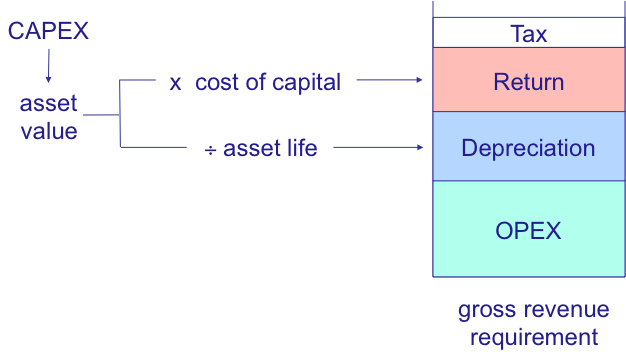
Source: John Earwaker (2024), Guide to economic regulation – part 2.⁷
Matching a price control to costs in this way is not a simple exercise. In the past, UK regulators used to set either fixed revenue cap amounts or fixed price cap amounts for fixed regulatory periods of, say, five years. Nowadays, however, regulators often set formulaic price controls in which the precise amount of money that a company can collect from customers is conditional on particular events that may occur or new information that may emerge over the course of a regulatory period.
A price control formula might therefore take the form:
Revenue cap: Total revenue = £100m + Qₜ + Rₜ + Sₜ + Tₜ + Uₜ +Vₜ
or
Price cap: Price per unit = £10 + Wₜ + Xₜ + Yₜ + Zₜ
where:
- £100m and £10 are simple, illustrative numbers for the 'baseline' revenue or price cap;
- the terms Qₜ to Vₜ and Wₜ to Zₜ are hypothetical conditional adjustment mechanisms that can cause the price control to adjust up or down in accordance with pre-determined rules set by the regulator; and
- the number of adjustment terms in each case is hypothetical and may or may not reflect the actual number of adjustments a company's revenue or price cap contains.
One effect of this design is that the total amount of revenue a company is entitled to collect in respect of the services it provides to customers in a given year may not all be received in that particular year. Some of the above-mentioned adjustment mechanisms may instead operate with a lag such that a company ultimately collects some of its entitlement to revenue in respect of services provided in year x only in year y. The reverse may also apply, so that a company may be told that it has over-collected revenue in year p and has to reimburse customers in year q.
To give one example, many price controls contain a term which provides for unexpected over- or under-recovery of charges against a given revenue/price cap to be returned to customers in the form of lower or higher prices two years later. The adjustment term, say Zt, might therefore be written as:
Zₜ = (Revenue cap t-2 actual revenue t-2) x compound interest
Importantly for the discussion that follows, these lagged adjustment mechanisms (which we will refer to as "deferred adjustment mechanisms” throughout the report) may not necessarily impact revenues/prices directly. UK regulators may instead choose to cater for upward and downward adjustments to a company's “regulatory asset base" (RAB).
BOX 1: THE REGULATORY ASSET BASE (RAB)
The RAB (sometimes also called the regulatory asset value (RAV) or regulatory capital value (RCV))⁸ was originally devised as a running record of regulated companies' historical investments.
Its main purpose is to provide publicly available information on the entitlement to future revenues that firms carry forward to future regulatory periods based on past capital expenditures less any depreciation already recovered through charges in prior years (see Figure 1).
Over time, however, regulators have increasingly reserved the right to add or deduct monies to a RAB for reasons that are not directly related to capital investment – i.e., because they want to commit in advance to giving money to a company or taking money from a company when they set future price controls. Accordingly, a modern-day RAB is therefore probably best thought of as a general-purpose I.O.U. from customers to the company, computed by the regulator, that feeds into the regulator's future price control decisions.
NB: As noted in Figure 1, once made, an addition to (or deduction from) the RAB will affect a company's revenue entitlement in future years in a gradual way through an increase (reduction) in the size of the 'depreciation' building block and an increase (reduction) in the size of the 'return' building block.
The end-result is that modern-day price control arrangements in the UK's rate-regulated industries can comprise a complex mix of starting revenue/price entitlements, formulaic adjustment mechanisms directly impacting revenues (usually over the course of the next price control period) and RAB adjustment rules indirectly impacting future revenues (usually over the course of the life of the RAB).
One consistent feature of UK regulation, however, is that once the rules are set, the regulated company has an entitlement to keep additional profits it makes by out-performing the regulator's formula-based price control. Conversely, the regulated company will bear losses that result from under-performance.
Suppose, for example, that a company's revenue cap in a year t is defined as:
Total revenue = £100m + Qₜ + Rₜ + Sₜ + Tₜ + Uₜ +Vₜ
Suppose also that it turns out that the values of the terms Qₜ to Vₜ sum in a particular year to £5m, giving the regulated entity a net revenue entitlement of £105m.
Under the UK's system of incentive-based regulation, if the company's actual economic costs in that year come in at, say, £90m, the company will typically be entitled to keep some or all of the £15m difference between revenues and costs as extra return for its shareholders. Conversely, if the actual costs are, say, £130m, the company will have to pay some or all of the £25m out of its own pocket, reducing shareholder returns by a commensurate amount.⁹
This makes for a strong financial incentive to minimise costs and maximise other entitlements, hence why UK regulators are said to apply 'incentive-based regulation' to UK regulated companies. In particular, companies can maximise shareholder value in each regulatory period by driving costs down and by maximising out-performance/minimising under-performance against the regulator's price control calculations to the greatest extent possible. This in turn benefits customers in the long term in that when the regulator comes to its scheduled reset of price controls it can lower revenue/price caps in line with the regulated company's lower revealed costs.¹⁰
2.2 Types of deferred adjustment mechanisms
As explained in section 1, the primary focus of this report is on the accounting rules that regulated entities use when dealing with the deferred adjustments the UK regulators build into price controls.
Currently, across the UK rate-regulated industries there is a wide range of mechanisms in place. The exact design of the regulatory rules differs from sector to sector, and sometimes from company to company, depending on the challenges and uncertainties that regulated entities face and the choices that regulators make when they design their price controls. Given this diversity, it is not possible to provide a single, one-size-fits-all description of the types of revenue adjustment applicable to a 'typical' regulated company. However, based on a desktop review of published decision documents (see reference list in Appendix 3), it is possible to outline seven main categories of deferred adjustment mechanism that are in place today across the regulated industries. These mechanisms may:
- provide for unexpectedly high or low revenue collection to be corrected via future price controls (A);
- compensate rate regulated entities for the effects of economy-wide consumer price inflation (B);
- allow unexpected costs or cost savings to be shared with customers (C);
- true-up movements in rate regulated entities' allowed cost of capital (D);
- adjust for changes in the tax regime (E);
- provide companies with financial rewards and penalties in respect of service quality and other performance metrics (F); or
- cover other matters (G).
Within these categories, some of the more common types of deferred adjustment mechanisms are detailed below.
A. Revenue correction
A1. Correction of under-/over-recovery of revenue vs price control
Regulators provide formulaically for any inadvertent under-/over-collection of monies against the fixed price control entitlement for a particular 12-month period to be trued- up via an upward/downward adjustment to a future year's price control.
A2. Volume risk sharing arrangements
Separately from the standard price cap correction factor, aviation industry price controls can provide formulaically for licensees to collect lower/additional allowed revenues in future years if volumes turn out to be higher/lower than expected during a particular 12-month period.
A3. Adjustment for prior year(s) bad debt
Regulators can provide for companies to recoup any 'bad debts' relating to charges invoiced in a prior year that were not paid, to be recouped from higher charges to customers in a subsequent year.
B. Inflation compensation
B1. Inflation indexation
Regulators index rate-regulated companies' RABs in line with RPI or CPI/CPIH inflation. A portion of the annual inflation indexation is intended as partial compensation to companies for their interest expenses, while the remainder covers part of the cost of equity. The higher nominal value of the regulatory asset base resulting from the inflation adjustment then feeds into the calculation of future price controls. ¹¹
B2. Inflation true-ups
The UK's regulators are transitioning from using RPI to using CPI/CPIH as their preferred inflation measure. During this transition, some price control for an additional true-up in the event that the gap between RPI and CPI/CPIH inflation is bigger or smaller than envisaged at the point when a price control is set.
C. Cost sharing
C1. Blanket % sharing of under-/over-spending vs cost allowances
Some regulators provide for under
- and over-spending against the regulator's opex and capex allowances to be shared z% by companies and (100-z)% by customers – e.g., if a company over-spends by £100, it might have to bear, say, the first £50 but is entitled to collect an additional £50 from customers. This can necessitate a deferred adjustment to companies' price controls.
C2. Bespoke cost sharing for specific cost items
In addition, some regulators put in place bespoke sharing or pass-through schemes for specifically named cost items (e.g., business rates, pension costs). These mechanisms can also entail deferred adjustment to companies' subsequent year price controls.
C3. Adjustment for unanticipated capital projects
When a company undertakes more or less investment than had been anticipated in a particular year, the regulatory framework may provide for subsequent formulaic upward and downward adjustment to enable the costs to be recovered via price controls in later years.
C4. True-up for unanticipated input price inflation
Some price controls provide for a regulator's opex and capex allowances to be adjusted up or down in the event of unexpectedly high or low input price inflation (e.g., wage growth, materials price increases). Any resulting under
- or over-recovery of revenues vs adjusted allowances is then trued-up via subsequent year price controls.
C5. Disallowances for inefficiently incurred cost items
A regulator may have the right to lower a company's price control in order to compensate customers for wasteful or inefficient expenditure charged to customers in a prior year.
D. Cost of capital adjustments
D1. True-up for changes in the cost of debt
Price controls may be adjusted up or down if interest rates/payments in a prior year were higher or lower than anticipated.
D2. True-up for changes in the cost of equity
Price controls may be adjusted up or down if the 'risk-free rate' (as measured by UK government gilt yields) in a prior year was higher or lower than anticipated.
E. Tax adjustments
Price controls may be adjusted up or down if changes in tax rates/capital allowances/other tax rules in a prior year can be said to have resulted in higher or lower corporation tax payments.
F. Rewards/penalties for service quality/environmental/etc. performance
Many price controls provide for financial rewards and financial penalties depending on how a company performs against agreed service or environmental benchmarks. The rewards or penalties that a company earns are usually passed through to customers via price controls with a lag.
G. Other regulatory mechanisms
For completeness, there are a large number of deferred adjustment mechanisms that do not fit naturally under any of the preceding headings. UK regulators have wide discretion to add or subtract from price controls due to prescribed events or triggers occurring in a prior year, and they regularly use this flexibility both to shield companies from particular types of risks and/or to provide financial incentives to companies to engage in good behaviours or avoid bad behaviours. This produces a final, miscellaneous category of deferred adjustment mechanisms that are tailored to industry
- or company- specific circumstances.
Importantly for the discussion that follows later in this report, it may be observed that many of the deferred adjustment mechanism types listed above serve to reduce companies' exposure to specific types of risks and to shield companies from macroeconomics risks and market fluctuations. For instance:
- inflation indexation means that regulated companies can worry less than companies operating in a competitive environment about the general level of inflation in the economy;
- where under-/over-recovery correction formulae and volume-adjustment mechanisms are available to a company, the profits made by regulated companies and the returns earned by investors will be less sensitive to changes in the overall level of demand in the economy;
- when a regulator provides for true-ups for changes in input price inflation, or for blanket sharing of over-/under-spending, returns will be less variable in the face of changes in input costs such as wages and commodity prices;
- cost of debt and cost of equity adjustment mechanisms will similarly cushion the effects that changes in economy-wide interest rates and capital market dynamics have on regulated companies' finances; and
- if a regulator trues up for changes in tax rules, it will often be the case that changes in fiscal policies have little or no impact on the value of investments.
2.3 Accounting under current IFRS requirements
Under the current IFRS Accounting Standards requirements, as applicable in the UK, the full effect of deferred revenue adjustments are often not accurately reflected in regulated entities' statutory accounts.
Take, for example, a situation where a rate-regulated entity is entitled to claim additional revenue in a future period to cover costs that arose unexpectedly in the current period. Current accounting requirements prescribe that a company accounts for that revenue only when it is receivable¹² from customers. However, this can result in a somewhat misleading picture for users of financial statements both in the year when unexpected cost is incurred and when additional revenues will fall due.
Box 2¹³
Suppose, by way of illustration, that a company has a price control that permits it to collect £100m per annum to cover £100m of forecast cost. Suppose also that the company encounters additional cost of £20m in year 0 and its regulator's rules permit the company to increase the revenues it collects by an exactly offsetting £20m in year 2.
The company's statement of financial performance will be as set out overleaf
| Year 0 | Year 2 | |
|---|---|---|
| Revenue | £100m | £120m |
| Costs | (£120m) | (£100m) |
| Profit | (£20m) | £20m |
Under current accounting rules, the company reports a loss in year 0, but a profit in year 2, even though there was no net under
- or out-performance against the regulator's total allowed compensation for either period.
The last few years have delivered several real-life situations where rate-regulated companies' underlying financial performance has not always been clearly reflected in published accounts. The table below details four recent examples.
| Table 1 |
|---|
| Case study 1: Revenue over-recovery |
| During the covid pandemic, households and businesses used unusually high and unusually low amounts of water, respectively.¹⁴ The net position at most water companies was that firms under-collected against their regulated revenue caps.¹⁵ Ofwat's regulatory rules permit companies to recoup this under-recovery of revenue from customers in the form of higher prices in later years (via one of the regulatory mechanisms identified under heading B1 in section 3). However, companies' published accounts made no allowance for this future payback, causing firms, in effect, to understate their total allowed compensation during covid. |
| Case study 2: Inflation shock |
| CPI inflation reached a peak of 11.1% in the year to October 2022. This high rate of inflation significantly increased the liabilities of regulated companies that have issued index-linked debt (i.e. debt, the principal of which indexes in line with inflation). Under current IFRS requirements companies must recognise any increase in the value of their liabilities as a finance cost. However, IFRS does not permit companies to recognise the value that inflation indexation added to companies' RABs. This means that higher inflation has resulted in significant reductions in reported profits in regulated industries, even though shareholders have actually been benefiting in economic terms from the current inflation shock (because the increase in total debt liabilities is more than offset by the inflation indexation of the whole of the RAB). |
| Case study 3: Interest rates |
| Interest rates increased very rapidly in 2022 and 2023, as the Bank of England and other central banks strived to bring inflation under control. This resulted in an increase in the cost of regulated companies' new borrowing. Several regulated companies nevertheless benefit from regulatory adjustment mechanisms which provide for the companies to collect extra revenue in future years in recognition of these higher past/current interest costs. These entitlements were not, however, factored into companies' financial statements, creating a potentially misleading impression of these firms' ultimate exposure to higher rates. |
| Case study 4: Changes in tax rules |
| In 2021, the Chancellor announced that the headline rate of corporation tax would increase from 19% to 25% from April 2023. Regulated companies were required under IFRS accounting rules to recognise one-off charges due to the restatement of their brought forward deferred tax liabilities at the new 25% rate. In a number of cases, these charges were sizeable enough that the companies reported a loss for the financial year 2021/22. However, this gave a potentially misleading impression of the financial impact of the tax change because there was no recognition within the financial statements of the very high likelihood that economic regulators will increase regulated revenues in the future regulatory period to match higher future cash tax payments. |
A specialist investor – i.e., an organisation or person with detailed knowledge and understanding of regulators' rule books – may currently possess the wherewithal to build a picture of regulated companies' underlying financial position through these kinds of ups and downs. However, generalist investors – i.e., institutions or individuals who do not have a complete understanding of the complex mechanisms that regulators incorporate into price control decisions or cannot commit the same amount of resources as a specialist investor – could have formed a misleading impression of a regulated entity's underlying profitability after reading the published financial statements.
The need for accounting requirements to convey a more accurate picture of the underlying financial performance and underlying financial position of regulated entities provides the motivation for the Exposure Draft issued by the IASB in January 2021, as discussed in more detail in the next section of the report.
Case study 3: Interest rates
Interest rates increased very rapidly in 2022 and 2023, as the Bank of England and other central banks strived to bring inflation under control. This resulted in an increase in the cost of regulated companies' new borrowing. Several regulated companies nevertheless benefit from regulatory adjustment mechanisms which provide for the companies to collect extra revenue in future years in recognition of these higher past/current interest costs. These entitlements were not, however, factored into companies' financial statements, creating a potentially misleading impression of these firms' ultimate exposure to higher rates.
Case study 4: Changes in tax rules In 2021, the Chancellor announced that the headline rate of corporation tax would increase from 19% to 25% from April
- Regulated companies were required under IFRS accounting rules to recognise one-off charges due to the restatement of their brought forward deferred tax liabilities at the new 25% rate. In a number of cases, these charges were sizeable enough that the companies reported a loss for the financial year 2021/22. However, this gave a potentially misleading impression of the financial impact of the tax change because there was no recognition within the financial statements of the very high likelihood that economic regulators will increase regulated revenues in the future regulatory period to match higher future cash tax payments.
A specialist investor – i.e., an organisation or person with detailed knowledge and understanding of regulators' rule books – may currently possess the wherewithal to build a picture of regulated companies' underlying financial position through these kinds of ups and downs. However, generalist investors – i.e., institutions or individuals who do not have a complete understanding of the complex mechanisms that regulators incorporate into price control decisions or cannot commit the same amount of resources as a specialist investor – could have formed a misleading impression of a regulated entity's underlying profitability after reading the published financial statements.
The need for accounting requirements to convey a more accurate picture of the underlying financial performance and underlying financial position of regulated entities provides the motivation for the Exposure Draft issued by the IASB in January 2021, as discussed in more detail in the next section of the report.
3. PROPOSED ACCOUNTING
3.1 Summary of the exposure draft 16
3.1.1 Aim of the ED
The IASB's ED was published in January
- In a summary of its proposals, the IASB states that it "proposes an accounting model to supplement the information that an entity already provides by applying IFRS Standards. The proposed model is based on the principle that an entity should reflect” all the compensation for goods or services supplied "in a period as part of its reported financial performance for that period."
To reflect the full set of entitlements that a rate-regulated entity has by virtue of its regulatory agreements, the IASB introduces the concept of Total Allowed Compensation (TAC), defined as "the full amount of compensation for goods or services supplied that a regulatory agreement entitles an entity to charge customers through the regulated rates, in either the period when the entity supplies those goods or services or a different period."
The proposed new accounting standard is intended to provide users with an improved picture of the financial position and performance of a company, taking into account the timing differences in revenue recognition. To do so, companies will have to reflect in their statement of financial position:
- regulatory assets – “enforceable present rights to add an amount in determining future regulated rates because part of the total allowed compensation for goods or services already supplied will be included in revenue in the future"; and
- regulatory liabilities – “enforceable present obligations to deduct an amount in determining future regulated rates because the revenue already recognised includes an amount that will provide part of the total allowed compensation for goods or services to be supplied in the future".
Changes to regulatory assets/liabilities will be reflected in their financial performance as:
- "regulatory income to depict a part of the total allowed compensation for goods or services supplied in the current period that was included in revenue in past periods, or will be included in revenue in future periods"; and
- "regulatory expense to depict an amount included in revenue in the current period that provides part of the total allowed compensation for goods or services that were supplied in past periods, or will be supplied in future periods". 17
3.1.2 Scope
The proposals in the Exposure Draft would be applied to an entity when all of the following criteria apply:
- the entity is party to a regulatory agreement; 18
- the regulatory agreement determines the regulated rate that the entity can charge for the goods or services it supplies to customers; and
- part of the total allowed compensation for goods or services supplied in one period is charged to customers through the regulated rates for the goods or services supplied in a different (past or future) period.
3.1.3 Enforceable rights and obligations
Regulatory assets and liabilities are to be identified when an entity that is party to a regulatory agreement has an enforceable right (obligation) to increase (decrease) prices or revenues in a different period. The ED paragraph 9 suggests that whether a right or obligation is enforceable "is a matter of law”. However the guidelines included in paragraphs 27-28 of the ED suggest that "legal enforceability", strictly understood as the ability of taking a counterparty to court in case they don't fulfil an obligation, may not be required to ascertain that an adjustment mechanism gives rise to a regulatory asset or liability.
In the UK, price controls may not give rise to an enforceable right in a strict legal sense. While a regulator can enforce a company's compliance with these conditions, strictly speaking rate-regulated companies may not have a "regulatory agreement” or an “enforceable right" via-a-vis the regulator (e.g., in the event that a regulator rewrites a price control and, in doing so, chooses not to honour an entitlement that flows from a deferred adjustment mechanism). In practice, however, a rate-regulated company can appeal the terms of a price control condition to the Competition & Markets Authority (CMA) and the CMA has on several previous occasions stepped in to ensure that a regulator honours commitments previously made. 19 A company can also seek a judicial review of a regulator's decision under administrative law.
Paragraphs 27 and 28 of the ED indicate, among other things, that a rate-regulated entity will have an enforceable right if, among other factors:
- a regulator has provided clear confirmation that amounts will be added or deducted in determining future rates;
- formal or informal precedent shows that regulators will adhere to, or be made to adhere to, regulatory commitments; and
- the regulated entity is more certain than not that a regulatory asset or a regulatory liability exists.
These conditions are likely to be sufficient to enable UK regulated entities to recognise the value of UK regulators' deferred revenue adjustments, even in the absence of a formal "regulatory agreement" or "enforceable right".
3.1.4 Recognition
An entity would recognise all regulatory assets and liabilities existing at the end of the reporting period and all regulatory income and expense arising during the reporting period.
3.1.5 Measurement
An entity would be required to measure regulatory assets and regulatory liabilities at historical cost, modified for subsequent measurement by using updated estimates of the amount and timing of future cash flows. Appendix 2 provides further detail on the ED requirements for the estimation of future cash flows and discounting.
3.1.6 Presentation
An entity would present:
- in the statement of financial performance, all regulatory income minus all regulatory expense (including regulatory interest income and expense) as a separate line item immediately below revenue, unless it is presented in OCI;
- in the statement of financial position, line items for regulatory assets and regulatory liabilities, separating into current and non-current portions, where appropriate. 20
3.1.7 Disclosures
The ED proposes detailed disclosure requirements for an entity's regulatory assets, liabilities, income and expense. The requirements are in paragraphs 72-85 of the ED.
3.2 Summary of tentative decisions to date (December 2023)
In its deliberations of the proposals in the ED, the IASB has made several tentative decisions. The decisions of greatest economic relevance to UK companies are as follows.
3.2.1 Direct (no direct) relationship
As noted in Section 2, some deferred revenue adjustments in the UK are implemented via adjustments to the value of a company's RAB. When redeliberating the proposals in the ED, the IASB tentatively decided to base accounting requirements for these types of adjustments "on whether there is a direct (no direct) relationship between an entity's regulatory capital base (RCB) and its property, plant and equipment (PPE) (the direct (no direct) relationship concept)". 21
More specifically, in absence of a direct relationship, companies will not be able to recognise:
- the compensation of depreciation when there are differences between the regulatory recovery period and the assets' useful lives as regulatory assets/liabilities; 22 or
- deferred allowable expenses and performance incentives that are added to/deducted from the RAB as regulatory assets/liabilities. 23
The latter of these points is significant for UK rate-regulated entities due to the prevalence of RAB adjustments as a means of implementing deferred adjustments, and because UK regulators often see revenue adjustments and RAB adjustments as interchangeable means of achieving the same economic outcome. The consequences that this aspect of the IASB's tentative decision will have are discussed further in Section 5.2.
In addition, invoking paragraph 5.11 of the Conceptual Framework for Financial Reporting (Conceptual Framework), the IASB noted in several papers that "entities may need to disclose information about recognised and unrecognised assets and liabilities in the notes", however disclosures would be discussed as a separate topic. The IASB's consultative group on rate regulated activities discussed disclosures in November 2023, including for entities with no direct relationship. 24 Disclosures were further discussed at the IASB February 2024 Board meeting. 25
3.2.2 Inflation adjustment
The IASB indicated, by way of an illustrative example, that it has tentatively decided that “the right to add an amount reflecting the inflation adjustment in determining the regulated rates to be charged to customers in a future period is not a right to recover total allowed compensation for goods or services already supplied to customers. Consequently, that right does not meet the definition of a regulatory asset". 26
Subsequently, some stakeholders questioned that position, suggesting that the inflation indexation of the RAB should be accounted for as a regulatory asset. The IASB then tentatively deliberated that "an entity's right to add an amount relating to the inflation adjustment to the regulatory capital base to regulated rates charged in the future would give rise to a regulatory asset if that right is enforceable ... We think that, however, the costs arising from the recognition of that asset would outweigh the benefits of the information provided for users. Consequently, [the IASB] recommends that the final Accounting Standard specifies that an entity should not recognise inflation adjustments to the regulatory capital base as a regulatory asset". 27
It must be noted that the recommendation is for all entities, regardless of whether they have a direct relationship between RAB and PPE. It is of considerable significance to companies whose regulators provide for a real return on an inflation-linked asset base for the reasons discussed later in section 5.2.2.
4. COMPANIES IN SCOPE
This section analyses the entities in scope of the proposed new Standard by identifying (a) the sectors subject to rate regulation and (b) subsequently focusing on those that have deferred adjustment mechanisms in place.
4.1 The UK's Regulators and Rate-regulated Sectors
In the UK, there are seven economic regulators that impose price or revenues caps on companies via legally binding price controls.
A. The CAA
The Civil Aviation Authority (CAA) is the economic regulator for the aviation industry. The CAA regulates airports with substantial market power and the UK's air traffic control business.
C) Airports
The CAA sets conventional 'building block' price controls for Heathrow Airport at periodic intervals, resulting in a cap on average revenue per passenger. (NB: Gatwick Airport, as the other UK airport that is deemed to have substantial market power, does not currently have a formal price cap.)
ii) Air traffic control
The CAA similarly sets 'building block' price controls for National Air Traffic Services (NATS), which are expressed as a cap on the maximum price per chargeable service unit.
B. Ofcom
Ofcom regulates the postal and communications sectors.
C) Post
Most postal prices are unregulated. Ofcom sets just two safeguard price caps on: the cost of second class stamp for standard letters; and a weighted average of the price that Royal Mail charges for sending a large letter of parcel weighing <2kg by second class post. These caps have a simple starting price x annual CPI inflation design.
ii) Telecoms
Ofcom only regulates prices in the telecoms sector when firms have significant market power in an identifiable market. It sets periodic price caps based on its assessment of the forecast efficient cost of specific services.
C. Ofgem
Ofgem regulates gas and electricity markets in Great Britain.
i) Electricity distribution, electricity transmission (onshore), gas distribution and gas transmission
Ofgem sets conventional periodic 'building block' price controls for Britain's regional electricity distribution networks, regional onshore transmission networks, regional gas distribution networks and the national gas transmission network. These controls ultimately take the form of a cap on annual revenues.
ii) Electricity transmission (offshore)
Offshore transmission networks are operated under licences awarded via competitive processes. Companies bid an annual revenue stream, and Ofgem converts the winning offer into a formal regulatory cap on annual revenues.
iii) Interconnectors
Several of the transmission links connecting Britain to other countries' electricity networks are regulated by Ofgem under a cap and floor regime which places maximum and minimum limits on the owners' annual revenues.
iv) Smart meter communications
The national smart meter communications company is regulated under a scheme in which Ofgem conducts annual backward-looking reviews of the company's efficient costs and revenues.
v) System operator
Ofgem sets a periodic 'building block' price controls for the national electricity system operator, resulting in a cap on the operator's annual revenues.
vi) Gas and electricity suppliers
Ofgem periodically sets a cap on the maximum price per unit that gas and electricity suppliers can charge under their standard variable tariffs.
D. Ofwat
Ofwat regulates water and sewerage companies in England & Wales.
i) Water and sewerage undertakers
Ofwat sets conventional 'building block' price controls for appointed water and sewerage undertakers at periodic intervals, resulting in caps on annual revenues for certain activities and caps on average prices for other specified services.
ii) Infrastructure project
Ofwat separately regulates the Thames Tideway project via a stand-alone cap on annual revenues.
E. ORR
The Office of Rail and Road (ORR) regulates Great Britain's rail companies. It sets price controls only for the two main rail network owners.
i) Rail network
ORR conducts five year reviews of network providers' costs and revenue requirements and writes schedules of charges into their access agreements with train operator customers.
F. Utility Regulator
The Northern Ireland Utility Regulator regulates the electricity, gas and water sectors in Northern Ireland.
i) Electricity, gas distribution and gas transmission networks
The Utility Regulator sets conventional periodic 'building block' price controls for NI's electricity network, regional gas distribution networks and gas transmission pipelines. These controls ultimately take the form of a cap on annual revenues.
ii) Electricity system operator
The Utility Regulator sets a periodic 'building block' price control for the national electricity system operator, resulting in a cap on the operator's annual revenues.
iii) Electricity and gas suppliers
The Utility Regulator sets periodic caps on maximum price per unit that the largest electricity and gas suppliers can charge their customers.
iv) Water and sewerage undertaker
The Utility Regulator sets conventional periodic 'building block' price controls for NI's appointed water and sewerage undertaker. This control takes the form of a cap on the basket of tariffs that NI Water can charge its non-domestic customers.
G. WIC
The Water Industry Commission for Scotland (WIC) regulates the water and sewerage industry in Scotland.
i) Water and sewerage undertaker
WIC periodically sets a cap on the permitted annual increase for a basket of tariffs levied by the appointed water and sewerage undertaker.
4.2 Entitles with deferred adjustment mechanisms
Not all of the regulators use deferred adjustment mechanisms. As part of this project, a desktop analysis of the licensees of the seven regulators listed above was conducted to identify which regulated companies currently have deferred adjustment mechanisms in place. This entailed using regulators' websites to identify the list of companies that are licensed by a regulator or otherwise subject to some form of regulatory conditions. The long list of regulated companies obtained was then checked against the policy documents published on the regulators' websites to sort companies into two categories: entities that are subject to deferred adjustment mechanisms and are therefore likely to be in scope; and entities that do not appear to have deferred adjustment mechanisms and are therefore unlikely to be in scope.
The analysis indicates that there are 178 companies that are potentially in scope of the ED – i.e., companies that have regulatory agreements which contain deferred pricing mechanisms that in turn may lead to deferred revenue recognition. This is not meant, however, to be a formal determination of the number of companies that are actually in scope, since such a determination would require a more detailed evaluation of the specific characteristics of each company's regulatory regime against the wording of the final standard, and is formally a matter for the companies' concerned. 28 However, the count does provide an indication of the standard's potential reach. A detailed overview is provided in Appendix
- The following table provides a breakdown of the licensees by regulator.
Table 2: Entities in scope
| Regulator | Number of entities |
|---|---|
| CAA | 2 |
| Ofgem | 145 |
| of which | |
| - electricity/gas suppliers 29 | 87 |
| - other regulated businesses | 58 |
| Ofwat | 17 |
| NI Utility Regulator | 13 |
| Grand Total | 177 |
Note: Ofcom, the ORR and WIC do not appear to use deferred revenue adjustments.
Most of the companies in scope (145 companies) are Ofgem licensees, of which 87 are electricity or gas supply licensees. The other companies are regulated by the CAA, Ofwat and the NI Utility Regulator.
Some of the 177 licensees are parts of larger groups. Further analysis suggests that these individual licensees can be grouped into 108 distinct corporate families. Of these, 12 are UK listed groups, and 96 are either private UK groups, stand-alone companies, or private UK subsidiaries of foreign groups.
4.3 Entities applying IFRS
The UKEB Secretariat next carried out further investigations using the financial statements of the licensed entities identified above to generate a categorisation by accounting framework used, e.g., UK-adopted International Accounting Standards (UK-adopted IAS) or UK Generally Accepted Accounting Practice (UK GAAP).
A bottom-up approach was taken, looking at the immediate parents of individual licensed entities and working upstream to identify either:
- the UK consolidating entity; or
- the ultimate (non-consolidating) UK controlling company,
for each licensed entity.
By looking at the broader corporate group of each licenced entity (where applicable), it was possible to identify:
- groups using UK-adopted IFRS which are in scope as they own subsidiaries which are licenced entities (NB: the subsidiaries may prepare their financial statements in accordance with either UK-adopted IAS or UK GAAP);
- licensed stand-alone entities which are in scope as they prepare their financial statements using UK-adopted IFRS; and
- subsidiaries of international companies which are in scope as they prepare their financial statements using UK-adopted IFRS. The results of this analysis are presented in Table
- The count suggests that, of the 108 corporate groups identified above, 61 apply UK-adopted IAS, comprising:
- 20 UK groups applying UK-adopted IAS to their consolidated financial statements that control licenced entities applying UK GAAP;
- 28 UK groups applying UK-adopted IAS to their consolidated financial statements that control licenced entities applying UK-adopted IAS;
- 7 licenced entities applying UK-adopted IAS belonging to a foreign group where the ultimate UK parent company applies UK-GAAP;
- 6 licenced entities applying UK-adopted IAS belonging to a foreign group where the ultimate UK parent company applies UK-adopted IAS.
Of these 61 entities, 12 are UK listed groups (of which 6 were FTSE 100 companies, and 3 were FTSE 250 companies), and 49 are either private UK groups, or private UK subsidiaries of foreign groups.
Table 3: Number of entities by accounting standard
| Accounting standard of licenced entity | UK GAAP | UK-Adopted IAS |
|---|---|---|
| Accounting standard of group (within the UK) | ||
| UK GAAP | 19 | 0 |
| UK-Adopted IFRS | 20 | 28 |
| Accounting standard of non-consolidating group, or, a consolidating group outside the UK | ||
| UK GAAP | 28 | 7 |
| UK-Adopted IFRS | 0 | 6 |
| Total | 108 |
The UKEB Secretariat also looked at the scale of the in-scope companies.
The following approach was taken to calculate total revenues: for the 48 consolidating UK groups applying UK-adopted IFRS, consolidated revenues were taken. For the 13 entities where the ultimate UK parent was not a consolidated entity, the revenues of the licensees were added to the sum. 30 The so-calculated total revenues of companies in scope were £104.8 billion as of the 2021 FY.
As of May 2023, the market capitalisation of the 12 listed groups in scope was £93.2 billion, and made up 3.34% of the total market capitalisation of the LSE.
5. WOULD THE PROPOSED ACCOUNTING BETTER REFLECT THE UNDERLYING ECONOMICS?
This section assesses the impact that the IFRS Standard proposed in the ED and subsequent tentative decisions by the IASB (up to December 2023) are expected to have on the accounting of companies in scope. In particular, it considers where and how far the proposed changes are likely to better and appropriately reflect the underlying economics of rate-regulated business. 31
5.1 Overall effect of the standard
The aim of the proposed accounting is to make the information reported in companies' accounts consistent with the economic outcomes that regulators seek to achieve through their price control designs. Where a regulator provides for knowable, pre-programmed adjustments to future year revenues in response to identifiable actions or events in an earlier year, under the proposed accounting (changes to) the net present value of those revenue adjustments ought to be recorded in companies' accounts contemporaneously, thus providing a better reflection of the financial performance in a given year.
This, in turn, will mean that users of financial statements, and in particular generalist users, will be more likely to understand both the financial performance and the financial position of a company at the end of a financial year.
Box 3 32 This box explains how the ED would affect the example company that encountered additional cost of £20m in year 0 but is entitled to increase the revenues it collects by an offsetting £20m in year 2 (see earlier Box 2). The proposed new Standard would require the company to account for the value of its deferred revenue adjustment as regulatory income in year
- The company would likewise be required to account for some of its year 2 income as a regulatory expense.
Year 0 Year 2 Revenue £100m £120m Regulatory income/(expense) £20m (£20m) Costs (£120m) (£100m) Profit - - Because of the recognition of regulatory income/expenses, the company would not make the loss it would have otherwise made in year 0, and similarly would not recognise a profit in year 2, thus providing users with a more comprehensive picture of the financial performance of the company in both years (see earlier Box 2).
Feedback from stakeholders interviewed as part of this project confirmed to us that the proposed accounting under the ED and subsequent deliberations would, overall, provide a better reflection of the underlying economics than the current accounting requirements under IFRS 14 in a number of instances. This is especially the case when considering the deferred revenue adjustments highlighted in green in the table in Appendix 4, including:
- regulators' true-ups for inadvertent annual under- and over-recoveries against price caps;
- most of the true-ups relating to changes in tax rules; and
- many of the rewards and penalties that regulators hand in respect of service quality incentives.
In this sense, the ED meets its intended objective.
There remain, however, a range of other specific circumstances in which the proposed accounting does not seem to reflect the economics appropriately.
5.2 Situations where the proposed accounting may not appropriately reflect the underlying economics
The main concern expressed by interviewees was that the proposed new accounting requirements would leave some regulatory income/expense, and associated regulatory assets/liabilities unrecognised, thus not providing a complete reflection of the underlying economics of rate-regulated business. Three specific examples of this disconnect are discussed below.
5.2.1 The direct (no direct) relationship debate
A key issue for interviewees was the treatment of deferred revenue adjustments that are implemented via an adjustment to the RAB.
As noted in Section 3, the IASB has tentatively decided to base accounting recognition on whether there is a direct relationship between an entity's regulatory asset base (RAB) and its property, plant and equipment (PPE) (the direct (no direct) relationship concept). 33 See Section 3.3.1 for further details.
In the UK, a one-for-one correspondence between an entity's RAB and its property, plant and equipment does not usually exist. Disparities can arise, in particular, if/when a regulator:
- sets the initial value of RAB (e.g., at the point of privatisation) in line with the market value rather than the book value of the regulated entity's assets;
- exercises freedom to depreciate the value of the RAB in accordance with their own regulatory rules, rather than accounting rules;
- includes opex items and non-current assets in the calculation of the RAB (for example, through what are commonly referred to as 'totex' mechanisms – see Box 4 below);
- indexes the RAB in line with RPI or CPI/CPIH inflation; and/or
- makes additions to or deductions from a RAB to give effect to deferred adjustment and incentive mechanisms. 34
Interviews with regulators and preparers confirmed that in the UK a direct relationship between PPE and the RAB cannot be found in any of the industries subject to rate regulation. 35 This means, crucially, that deferred adjustments that add/deduct allowable expenses and performance incentives from a company's RAB would lead to potentially sizeable regulatory assets/liabilities not being recognised.
This is an important issue because RAB adjustment mechanisms are widely used by UK regulators. Examples of mechanisms that may lead to unrecognised regulatory assets/liabilities in absence of a direct relationship include:
- true-ups for under and over spending against expenditure allowances, which are often shared with customers, in part via an adjustment to allowed revenues and in part via an adjustment of the RAB;
- true-up for changes in interest rates and tax rates via adjustments to revenues, which some regulators true-up at least in part via adjustments to RABs; 36 and
- the CAA's deferred adjustments for higher/lower passenger and flight volumes, which are implemented in part via formulaic adjustment to the CAA's price caps and in part via additions to/deductions from the RAB. 37
(See adjustment mechanisms coloured in amber or red in the table in Appendix 4.)
One framework that is particularly worth discussing in more detail because it is likely to lead to unrecognised regulatory assets/liabilities and because of its economic importance is Ofgem's and Ofwat's application of totex (total expenditure) regulation, discussed in Box 4.
Box 4
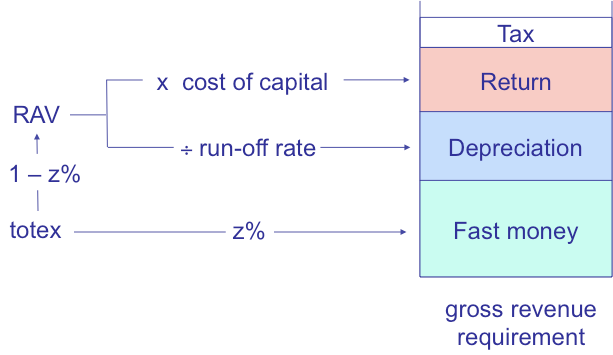
Ofgem's and Ofwat's current price controls for network companies do not provide rigidly for opex to be funded pound-for-pound as costs are incurred or for capex to be funded over the life of a built asset. Instead, the regulators lump together operating and capital expenditure into a single figure for total expenditure (totex). They then split all totex in fixed proportions between 'fast money' and additions to a company's RAB ('slow money').
Figure 2
The so-called fast money provides for a proportion of a regulated firm's expenditure to be matched by revenue. The remaining totex is then paid by customers in instalments. The RAB remains a running account of the expenditures that firms have incurred but not yet been paid for. However, Ofgem's and Ofwat's RABs can contain an element of day-to-day operating spend as well as physical investment.
In circumstances where a company under
- or over-spends against its totex allowance, the regulator may subsequently provide for all or some of the under- or over-spend to be passed on to customers via a deferred adjustment mechanism. 38 Crucially, this pass-on may take the form of an additional amount of fast money and a RAB addition, in fixed proportions, regardless of whether the under- or over-spend is in the form of opex or capex.
According to the IASB deliberations, any upward or downward adjustment to fast money would constitute regulatory income/expense and a corresponding regulatory asset/liability. However, any portion of over/underspend that is remunerated via an adjustment to RAB would not be recognised.
An example may help clarify the potential effect on the accounts. Assume that a company in a given year has £100 of revenues and a £100 costs allowance. Suppose also that this company incurs an overspend of £20m in year 0 and is entitled to pass the whole of this additional expense on to customers in future years via a deferred adjustment mechanism. Suppose also that the regulator's chosen mechanism splits the deferred adjustment 60:40 between a £12m fast money adjustment to be collected in year 2 and a £8m RAB adjustment.
Where there is no direct relationship between PPE and the RAB, the IASB's proposals on how to treat these adjustments could result in accounting that does not fully reflect the underlying economics.
Imagine, for instance, that the £20m was wholly attributable to operating expenses. Under the proposed Standard, the company would be able to accrue £12m of regulatory income in year 0, but would not recognise the £8m RAB adjustment. This would result in a recorded loss of £8m in the published accounts, even though in economic terms the whole of the £20m overspend is fully recoverable from consumers.
| Year 0 | |
|---|---|
| Revenue | £100m |
| Regulatory income/(expense) | £12m |
| Costs | (£120m) |
| Profit | (£8m) |
Conversely, it could be that an overspend is wholly attributable to additional capex. The overspend would not impact the costs reported in the company's income statement in year
- However, as confirmed by preparers, the company would be able to recognise a regulatory asset for £12m and accrue £12m of additional regulatory income. In this case, the company would report an incremental profit of £12m in its year 0 financial statements, even though in economic and regulatory terms the overspend results in no financial benefit. 39
regulatory asset would unwind as future revenues are charged to customers. As customers are charged and revenue is recognised, the regulatory asset would be reduced and a regulatory expense would be recognised. Cumulatively, the P&L impact of the regulatory asset will be neutral as it is just accounting for timing differences. However, the fact that the cost overrun on capex would be on balance sheet and the current proposals would allow a fast P&L recovery may be an issue. In circumstances where a company under
- or over-spends against its totex allowance, the regulator may subsequently provide for all or some of the under- or over-spend to be passed on to customers via a deferred adjustment mechanism. 38 Crucially, this pass-on may take the form of an additional amount of fast money and a RAB addition, in fixed proportions, regardless of whether the under- or over-spend is in the form of opex or capex.
According to the IASB deliberations, any upward or downward adjustment to fast money would constitute regulatory income/expense and a corresponding regulatory asset/liability. However, any portion of over/underspend that is remunerated via an adjustment to RAB would not be recognised.
An example may help clarify the potential effect on the accounts. Assume that a company in a given year has £100 of revenues and a £100 costs allowance. Suppose also that this company incurs an overspend of £20m in year 0 and is entitled to pass the whole of this additional expense on to customers in future years via a deferred adjustment mechanism. Suppose also that the regulator's chosen mechanism splits the deferred adjustment 60:40 between a £12m fast money adjustment to be collected in year 2 and a £8m RAB adjustment.
Where there is no direct relationship between PPE and the RAB, the IASB's proposals on how to treat these adjustments could result in accounting that does not fully reflect the underlying economics.
Imagine, for instance, that the £20m was wholly attributable to operating expenses. Under the proposed Standard, the company would be able to accrue £12m of regulatory income in year 0, but would not recognise the £8m RAB adjustment. This would result in a recorded loss of £8m in the published accounts, even though in economic terms the whole of the £20m overspend is fully recoverable from consumers.
| Year 0 | |
|---|---|
| Revenue | £100m |
| Regulatory income/(expense) | £12m |
| Costs | (£120m) |
| Profit | (£8m) |
Conversely, it could be that an overspend is wholly attributable to additional capex. The overspend would not impact the costs reported in the company's income statement in year
- However, as confirmed by preparers, the company would be able to recognise a regulatory asset for £12m and accrue £12m of additional regulatory income. In this case, the company would report an incremental profit of £12m in its year 0 financial statements, even though in economic and regulatory terms the overspend results in no financial benefit. 39
| Year 0 | |
|---|---|
| Revenue | £100m |
| Regulatory income/(expense) | £12m |
| Costs | (£100m) |
| Profit | £12m |
This may present regulated companies with a problem during regulatory periods in which they are required, for whatever reason, to spend more than the regulator's initial price control allowances and build up a substantial entitlement to compensating revenue via deferred totex adjustment mechanisms.
5.2.2 Inflation indexation
As noted in Section 2.2, most regulators provide for inflation indexation of the RAB. This means that the 'allowed return' component of allowed revenue is structured as an index-linked return
- i.e., as a percentage return on an inflation-indexed RAB (see figure 1 in section 2.1).
Most rate-regulated companies in the UK also finance themselves, at least in part, using index-linked debt. [^40] This creates a natural match between a company's liabilities and its regulatory asset because the additional cost that a company faces each year in respect of the indexation of the principal owed to lenders in line with inflation will be broadly matched by indexation of the RAB.
Under the current IFRS requirements the match may not be readily apparent to a user of financial statements because IFRS:
- requires companies to recognise as interest expenses for both the interest paid in-year to lenders and the accretion of the principal owed to the lender; [^41] but
- does not permit companies to recognise the indexation of the RAB.
Box 5: Inflation indexation of the RAB
Suppose a company borrows £100m of index-linked debt with a coupon of 3%. Suppose also that a regulator covers the resulting borrowing cost in full when it calculates allowed revenues.
If inflation is 2% in the year immediately after the company issues its debt, the interest expense will be recorded in the company's accounts as (3% + 2%) x £100m = £5m.
The revenue provided by the regulator in this year will normally be 3% x £100m = £3m, with the 2% inflation accretion covered by a contemporaneous 2% indexation of the RAB. [^42] However, IFRS does not permit the company to recognise the value of this RAB increase in its financial statements.
This results in a mismatch.
The company reports revenue of £3m and expense of £5m, giving a net loss of profit of £2m, even though the regulator covers the cost of debt in full.
The situation then becomes more extreme in the event of high inflation.
If, for example, inflation is 10% not 2%, the interest expense recorded in the company's accounts will be (3% + 10%) x £100m = £13m. The revenue will remain at £3m, giving a net loss of profit of £10m. However, the £10m is offset in full by the increase in the value of the RAB in line with inflation.
For completeness, the same applies if inflation is lower than usual, or even negative. If say, inflation is -1%, the interest expense recorded in the company's accounts will be (3% - 1%) x £100m = £2m, the revenue will remain at £3m, giving a net gain of profit of £1m. However, the £1m will be exactly matched by a £1m deduction from the RAB.
Note that a mismatch between reported costs, revenues and regulatory entitlements may be present even if a company issues fixed-rate nominal debt rather than index-linked debt. Suppose that a company borrows £100m at a fixed rate of interest of 5% incurring costs of £5m per annum. A UK regulator will typically cover the 5% cost with an in-year return of 3% and RAB inflation indexation worth 2%. The company will account for the £3m in-year return in its revenues but not the £2m of RAB indexation, giving the impression of a financial loss where no economic loss exists in practice.
This may be as significant an issue as the mismatch in the account for index-linked debt and index-linked returns. However, for the sake of readability, the discussion that follows focuses mainly on the scenario depicted in Box 5.
In principle, the company's financial statements should convey that there is a long-term match between assets and liabilities and, in principle, any exercise to improve accounting in regulated industries would provide for such alignment. However, and as noted in greater detail Section 3, the IASB has indicated as part of its tentative decisions pursuant to the ED that inflation adjustments to the regulatory capital base should not be recognised as a regulatory asset. [^43]
This means that even after the proposed new standard will come into effect, revenues will not be adjusted for the inflation component meant to cover index-linked borrowing costs, thus failing to represent the economic financial performance of the company. [^44],[^45]
5.2.3 Deferred taxes
Another potential gap in the new proposals in the ED and subsequent tentative decisions relates to tax.
Table 1 in section 2 of this report noted that IFRS accounting rules require companies to recognise one-off charges associated with restatement of future tax liabilities when there is a change in the country's tax rules.
The regulatory treatment of tax varies from sector to sector, but most of the UK regulators provide regulated companies with a matching amount of revenue in the year(s) when corporation tax payments are actually made to HMRC. Therefore, in all likelihood, any change in deferred tax balances will trigger an exactly offsetting change to future revenues at the point when tax is actually paid.
In principle, as taxes are allowable expenses, the ED ought to allow deferred tax liabilities/assets to be recognised as regulatory assets/liabilities if they are going to affect future regulated rates.
The issue, however, is that the expectation that tax will be matched by revenues as payments are incurred is a convention and not typically codified in a formal regulatory mechanism. This may make it difficult for regulated firms to claim that there is an enforceable right and therefore meet the recognition criteria for regulatory income/expense (and associated regulatory asset/liability) in the event of a change to tax rules that gives rise to a deferred tax liability/asset.
There is an expectation among stakeholders that the IASB may conduct additional work on the topic.
Pending this further consideration, the current situation, that a change in tax rules can affect reported profits even though there is no economic gain or loss to the company over the long term, may persist.
5.3 Summary
Table 4 below brings the preceding discussion together by showing how the four case studies from Table 1 in Section 2 of the report would likely be impacted by the proposed Standard.
Table 4 – Continuation of case studies from Table 1
| Case study 1: Revenue over-/under-recovery | Case study 2: Inflation shock |
|---|---|
| Most revenue correction mechanisms take the form of a formulaic adjustment to prices or revenues n years after the under- or over-recovery of revenue occurs. Under the proposed new Standard, such payments due from or to customers would for the first time be recognised as regulatory income and regulatory expense in financial statements. | As noted in Table 1, regulators generally allow for the effects of inflation on companies' financing costs via the annual inflation indexation of companies' RABs. The accounting treatment of RAB indexation will not change under the proposed new Standard, but companies will continue to recognise the corresponding increase in their liabilities (whether index-linked or not). This will maintain the current mismatch in the way in which companies account for changes in the economic value of their assets and liabilities. |
| ✓ | ✗ |
| However, the more complex volume adjustment mechanisms that the CAA applies in the aviation industry when there is a higher- or lower-than-expected number of passengers or flights are designed in such a way as to spread payments to and from customers over a longer period and thus are implemented in part via formulaic adjustments to future year price controls and in part via adjustments to RABs. It is possible that under the IASB's proposals companies would be able to recognise only the former portion as regulatory income/expense. | |
| ? |
| Case study 3: Interest rates | Case study 4: Changes in tax rules |
|---|---|
| Different regulators true-up for changes in interest rates is different ways. Ofwat, for instance, has said [^46] that it will true-up revenue for changes in interest rates within a subsequent regulatory period. Water companies' entitlements to future revenue is expected to qualify as regulatory income and regulatory expense. | It is conceivable that the proposed Standard may not change the way in which companies account for the change in future revenues that regulators will likely make in response to changes in statutory tax rates if an enforceable right/obligation cannot be established. This would mean that increases and reductions in companies' deferred tax liabilities would continue to impact regulated companies' reported profits. |
| ✓ | ? |
| The CAA, on the other hand, has indicated that it will true-up via an adjustment to the RAB [^47]. This will mean that companies regulated by the CAA, unlike companies regulated by Ofwat, will not be able to recognise corresponding regulatory income/expense. | |
| ✗ |
These examples help to illustrate the only partial impact of the ED on the challenges that the UK's regulated companies have recently been encountering.
5.4 Assessment
As matters currently stand, the accounting changes brought by the ED and subsequent proposals from the IASB go some way towards improving the financial reporting of rate-regulated entities (see Section 5.1). Stakeholders of all types (regulators, preparers, users) agree that accounting for timing differences in revenue recognition will provide a more comprehensive picture of the financial performance and position of these companies, thus helping users conduct their assessment of rate-regulated for investing or lending purposes.
However, and as confirmed by stakeholder engagement, the current proposals may not fully reflect the underlying economics of rate-regulated businesses in the UK (see Section 5.2). [^48]
This in turn would affect comparability and generalist users' ability to interpret the financial statements of UK rate-regulated entities, thus significantly diminishing the intended effects of the proposed accounting.
As the IASB has only tentatively deliberated on some topics (such as the recognition of allowable expenses/performance incentives that go to the RAB in case of a non-direct relationship, and inflation adjustment), and has yet to consider other topics (such as deferred taxes, or enforceability in situations where there does not seem to be a well-defined regulation for regulatory adjustments, with judgement involved on both the regulators and companies' sides), this report should be read as a means of providing additional UK-specific evidence in relation to those in future deliberations.
6. ECONOMIC EFFECTS
The final substantive section of the report focuses primarily on whether the proposed standard is likely to have an adverse effect on the UK economy, setting out an assessment of wider economic effects arising from the ED and subsequent IASB deliberations/proposals.
6.1 Candidate economic effects
In the Basis for Conclusions accompanying the ED, [^49] the IASB stated that it expects that the proposed Standard would:
- give a clearer and more complete picture of the relationship between the revenues and costs of regulated entities;
- provide users of financial statements with better insights into a regulated entity's prospects for future cash flows;
- improve comparability of published accounts across companies; and
- save users from incurring the costs of collecting and processing additional information about regulatory performance to supplement the information found in statutory accounts.
This section assesses how these [^50] benefits might flow through into wider economic effects.
According to economic theory, the principal ways in which a change in accounting standards could have a broader economic impact (including on the UK economy) would be via:
- the effect of higher transparency/comparability on capital allocations;
- the greater accountability of management (agents) towards their shareholders and other stakeholders (principals) that greater transparency/comparability brings; and
- the behavioural changes brought by said transparency.
A change in accounting should in principle provide a better reflection of the underlying economics in a firm or industry without altering it. However, other economic effects may arise and deserve an assessment. These potential effects include:
- effects on competition between firms;
- an increase or reduction in the economic output of affected firms;
- an increase or reduction in firms' expenditures, investments and overall efficiency;
- a change in the prices charged or products offer to customers;
- a change in government tax revenues; and/or
- secondary, knock-on effects on the wider economy and on economic growth.
All of these potential economic effects are assessed in the discussion that follows. Prior to conducting the assessment, however, consideration is given to the roles of regulators and investors in rate-regulated industries, as these affect the nature of the assessment vis-a-vis industries that are not subject to economic regulation and operate in a competitive environment.
6.2 The role of regulators
The ED and subsequent deliberations/proposals apply specifically to companies that have activities subject to economic regulation. The consequences of the proposed Standard for regulated entities, their investors and customers therefore need to be looked at in the context of the particular character of these sectors of the UK economy.
Unlike companies in competitive industries, regulated companies are generally not in the position to compete with rival firms for business. Regulated companies also have less control over prices, expenditures and investment decisions compared to unregulated firms, due to the important role that economic regulators play in capping prices and/or revenues, setting expenditure allowances and designing economic incentives, including via deferred adjustment mechanisms.
This means that the actions of the regulators are likely to be central to the 'transmission mechanism' that could potentially see the proposed new Standard and consequent improved accounting have wider economic effects.
In this regard, it is important to note that the UK regulators do not rely solely on the financial information that regulated companies report in their accounts. In most sectors, regulators have devised their own separate reporting requirements which oblige companies to prepare and publish separate "regulatory accounts" and/or annual performance reports. These annual returns (See Box 6 below) are typically produced in accordance with "regulatory accounting rules" that can depart from the requirements in accounting standards applied in the UK, i.e., UK-adopted International Accounting Standards and UK GAAP alike.
Box 6
Return on Regulatory Equity (RORE)
One important development in recent years has been the growing prominence of Return on Regulatory Equity (RORE) as a measure of regulated companies' financial performance, as opposed to more conventional accounting measures like operating profit or profit after tax. RORE is a metric that measures a company's out-turn returns after allowing for the effects of the regulatory mechanisms that the regulator includes in a price control, including the value of the deferred adjustment mechanisms identified in Section
- It is essentially an economic measure, expressed as a percentage return on equity capital, which is easy to compare to the allowed return on equity that regulators factor upfront into a price control.
More and more regulatory reporting in the regulated sectors nowadays focuses around RORE. In addition, companies increasingly talk in terms of RORE with their investors. For example, it is quite common to see regulated companies and their parents report RORE values as part of quarterly, half-year and annual results. Companies may also provide investors with forecasts of RORE alongside forecasts of accounting profits.
Given the relevance of regulators in driving important economic decisions for entities in scope, and not just in their supervision (as imay happen in financial services), a legitimate question is whether the accounting rules that will result from the Standard will change or influence regulators' approach to economic regulation.
To shed some light on this matter, we conducted stakeholder interviews with UK regulators during July/August 2023 (see Appendix 1). The key message emerging from these conversations was that regulators' long-standing reliance on bespoke regulatory reporting measures, and consequent quite limited use of financial statements, means that a change in regulated company's accounting is not likely to have any significant direct impact on regulators' decision-making. The regulators told us, in particular, that:
- the proposed Standard will not provide a regulator with additional information, since the regulators already have visibility of companies' performance, including accrued regulatory income/expenses, through their own reporting frameworks;
- the amount of profit reported in companies' accounts is not typically a measure that regulators attach any great weight to when formulating regulatory interventions; and
- the decisions that the regulators make about expenditure allowances, investment programmes and allowed prices/revenues are driven primarily by economic analysis, and, as such, are unlikely to be affected by any or backward- or forward-looking accounting requirements.
This indicates that the economic effects of a change in IFRS may be quite contained in the rate-regulated sectors given the decision-making taking place within regulated firms will continue to be shaped primarily by regulatory price control decisions and regulatory rules, and distinct from the way in which companies' financial performance and financial position are reported in the financial statements.
6.3 The users' perspective
The discussion in Section 6.2 does not mean that a change in regulated entities' accounting will have no impact on outcomes in regulated industries. Better accounting is specifically aimed at providing more transparent and comparable information to users of financial statements, and in particular to the primary users of financial statements: equity investors, analysts and researchers; lenders; and credit rating agencies. [^51] As a consequence, the impact on users of financial statements of the improved reporting of regulated entities' financial performance and financial position also needs to be considered.
As part of this study, we spoke to regulated companies', investors and rating agencies. The main takeaway from these conversations is that investors in regulated sectors – both actual and potential – are not a homogenous group. In particular, a clear difference exists between "specialist users", who have an in-depth knowledge of rate-regulated industries, and "generalist users", who may invest in a rate-regulated entity as part of their portfolio strategy but do not necessarily have in-depth knowledge of how rate-regulated business works.
The specialist users interviewed consider that they have an in-depth understanding of the regulatory rules in the sectors. These users tend to make use of both financial statements and regulatory reporting to build a detailed picture of regulated companies' underlying financial performance and underlying financial position. These interviewees found it difficult to envisage how the proposed Standard would materially affect a specialist investor's information set or, consequently, their behaviour.
By contrast, it became clear from the interviews that generalist investors may not have the time or the expertise to navigate complex regulatory documentation. These investors are much more likely to place reliance on the income statement and statement of financial position published in a regulated companies' accounts. They are also less likely to supplement the picture they obtain from financial statements with information from other sources.
Interviewees suggested that the proposed standard would have more tangible impact on these less knowledgeable investors, as it would add to their information about regulated firms' performance and provide a better picture of the firm's true financial position. This better understanding may, in turn, affect such investors' decision-making, including whether they invest in regulated companies and at what price.
6.4 Assessment
With this important context in mind, we assess that the economic effects of the proposed Standard could be as follows.
6.4.1 Allocation of investor capital
Many rate-regulated companies are large businesses, with comparably large capital requirements. If regulated companies are to continue to supply services to customers and continue investing, it is important that they access both debt and equity finance efficiently and at the most beneficial rate.
On balance, our interviewees considered that more accurate reporting of regulated companies' total allowed compensation would be helpful to investors, as well as analysts and rating agencies (with the caveats as noted in Section 6.3 above), and to generalist investors in particular. [^52] While this does not in and of itself mean that there would be a directly identifiable impact on capital allocations to the regulated sectors, it does suggest that any future effects of better reporting are more likely to be positive than negative.
6.4.2 Cost of equity capital
The cost of capital is the return that investors expect in exchange for the financial capital that they put into a company.
With reference specifically to the cost of equity capital, there is considerable evidence that one of the key factors that investors care about is the degree to which future returns from their investment will be correlated with returns elsewhere in the market. As a rule of thumb:
- if returns oscillate in a similar way to the market as a whole, investors will expect to earn a return that is broadly in line with the market average;
- if returns show only weak covariance with overall stock market returns, investors will typically be willing to accept a lower-than-average rate of return; and
- if returns move in tandem with the market, but in a more exaggerated way, investors will demand a higher-than-average rate of return.
This is important in the context of the discussion in Sections 2.2 and 5 of this paper as one of the key implications of the proposed new standard would be to make it clearer to investors that regulated entities are often protected against certain types of macroeconomic events.
Under the current accounting, not only the degree of protection against economic fluctuations is sometimes obscured (see Box 2), but headline profit/loss figures may show more correlation with economic fluctuations than exists in reality. For example, the immediate effect of a sudden increase in input costs, interest rates or tax rates could, in certain circumstances, be an unexpected headline loss figure. However, most rate-regulated companies would be able to recover at least some of these costs in the future.
It follows that one of the main benefits of the proposed new Standard, insofar as it enables companies to better convey their underlying economic performance through their published reporting, could be to provide investors with a better anchoring for their assessments of riskiness.
To illustrate this potential effect on equity markets, the left-hand panel of Figure 3 below depicts the variability of returns that investors might see in regulated returns under current accounting requirements. The right-hand panel then shows in a very stylised way how investors' perceptions might affect the covariance of individual companies' and market returns if published accounts were to better capture the protections that companies get from regulators' deferred adjustment mechanisms.
Figure 3
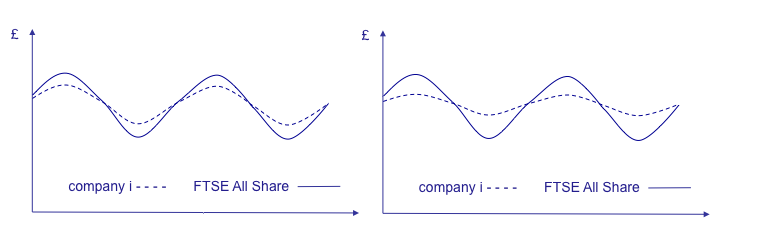
Note: This is an illustrative example. In real-life, the variance of share price of company i might be higher than the variance of the stock market as a whole due to company-specific, non-systematic 'noise' in share price movements.
All other things being held equal, investors may be expected to attach a lower cost of capital to the company on the right-hand side of this chart, on account of the lower covariance with overall stock market returns.
To provide an illustrative quantification of the possible impact, Table 5 sets out a stylised calculation of the cost of equity capital for a conventional regulated company. The calculation combines estimates of:
- the risk-free rate of return in the economy;
- the expected return on a portfolio of stocks and shares; and
- a firm-specific measure of the riskiness of a particular company relative to the market as a whole, known as 'beta'. [^53]
In a standard asset pricing model the cost of capital for a firm is calculated as the risk-free rate plus a risk premium (equal to the differential between the expected market return and the risk-free rate), multiplied by beta.
The final column shows what would happen to the cost of capital in an illustrated case where beta moved down by 0.01, from 0.75 to 0.74, as a result of the adoption of the standard and investors' consequent better appreciation of the risk protections that regulated firms enjoy (leaving all else equal). [^54] The table shows that under this scenario the cost of equity in the regulated sectors would move marginally lower by 0.04 of a percentage point, from 7.69% to 7.65%.
Note: Further discussion of the figures used in Table 5 is provided in Appendix 5.
Table 5: Illustrative calculation of the cost of equity capital for a regulated network
| Calculated cost of equity under current IFRS | Calculated cost of equity under proposed Standard | |
|---|---|---|
| Risk-free rate (%) | 4.5% | 4.5% |
| Expected market return (%) | 8.75% | 8.75% |
| Beta | 0.75 | 0.74 |
| Cost of equity (%) | 7.69% | 7.65% |
All other things being equal, any reduction in the cost of equity capital will make the shareholder financing for regulated entities cheaper. This, in turn, will flow through into lower prices for customers via a potential downward reduction in the allowed return.
However, as noted in Section 5, whilst the IASB's proposals are overall deemed to represent an improvement over existing accounting practices, they fall short of providing a complete depiction of the economics of UK rate-regulated business. As a consequence, any anticipated positive effects on the equity cost of capital may be diminished.
6.4.3 Cost of debt capital
The proposed accounting may be expected to have a positive effect on the cost of debt capital too. As noted, the accounting in principle should provide a better picture of rate-regulated companies' underlying financial performance and position. [^55] This in turn would provide lenders with a better understanding of:
- a company's current profitability after considering the impact on financial performance of regulatory income/expenses;
- future cash flows arising from deferred adjustments, as indicated by regulatory assets net of regulatory liabilities.
It is unlikely that the accounting proposals would change the underlying solvency of rate-regulated entities (as associated cash flows associated will remain unaltered). Nevertheless, through improved transparency, it is reasonable to expect that the standard will have a non-negative effect on the cost and the availability of debt capital.
One specific issue that was raised during our interviews, however, was the possibility that the proposed Standard could alter the value of specific financial ratios that some lenders and rating agencies monitor. In particular, as the proposed Standard will cause certain entries within a company's accounts to change in value (as compared to the figures that the company would report under current IFRS), some key financial ratios and performance indicators may deterministically improve or worsen, even if the underlying financial performance of the company remains unaltered. Any lowering of ratios could then have unintended results such as:
- non-compliance with covenants the company has made to lenders; or
- rating agencies adjusting their assessments of the company's credit risk downwards.
There was a specific suggestion in our interviews that a particular adverse effect on ratios could crystallise at the point of transition to the new Standard if, prior to implementation, companies had built up a stock of deferred revenue adjustments from previous years and were required in future to enter a regulatory expense in accounts upon the collection of those deferred revenue entitlements. A company in this position would potentially suffer the 'double whammy' of not having been able to recognise deferred revenue at the point of accrual and not being able to recognise profit in the year when revenue is collected from customers.
While it holds that individual ratios and indicators may be affected at the point of transition, feedback from stakeholders suggested that credit rating agencies do not consider ratios/indicators for a given period in isolation but factor in changes brought in by the accounting standard when assessing companies' credit risk. Stakeholders also noted that in an exceptional event, like an accounting change, covenants may be adjusted to reflect the new accounting regime, though this may lead to extra one-off legal costs for companies. However, the scale of the issue is currently unknown as no in-depth assessment of how changes in ratios/financial indicators would affect debt covenants was conducted as part of this study.
6.4.4 Comparability
Another issue to be considered with respect to capital allocation is comparability between and within businesses, and between and within jurisdictions. Feedback from stakeholders suggested that the proposed accounting may give rise to comparability issues. Examples of situations where the accounting proposals would lead to comparability issues are:
- Comparability between companies in the same jurisdiction: In the UK, regulators cater for deferred adjustments differently, some relying more than others on RAB adjustments (see Appendix 4). This would make comparison between companies in different sectors, and sometimes even in the same sector, harder to perform;
- Comparability within businesses: In the UK, some rate-regulated entities have international operations, including in jurisdictions where a direct relationship between RAB and PPE can be established, or are subsidiaries of foreign companies where a direct relationship may be established, regulatory agreements have stronger enforceability, or regulatory adjustments work differently, with different degrees of allocation of allowable expenses/performance incentives to the RAB;
- Comparability between jurisdictions: the IASB proposals may reduce comparability between UK companies and foreign companies in jurisdictions where a direct relationship can be established. They may also reduce comparability between jurisdictions where adjustments to future revenues are based on more informal but enforceable agreements and jurisdictions where the agreements are legally binding or have stronger protection.
Considered together, all of the above suggest that the IASB's current proposed accounting requirements could lead to a less efficient capital allocation than if the underlying economics of rate-regulated business was better reflected (see Section 5).
6.4.5 Stewardship
A possible effect that our interviewees envisaged would be that better understanding of a company's performance among investors may lead to more informed and better targeted investor pressure on management. This in turn could lead to better governance, and, ultimately, better stewardship. For example, one interviewee suggested that as the proposed standard prescribes a very granular unit of account [^56], this will incentivise management to forecast performance at a project level, thus facilitating their performance evaluation, as well as production and dissemination of information within the firm. This would be a positive economic effect, potentially conducive to the UK public good.
6.4.6 Broader change in behaviour
Some interviewees suggested that the proposed accounting may have positive consequences for how information is disseminated within and outside rate-regulated entities, with associated changes in behaviours.
For example, one interviewee suggested that “there will be a lot more scrutiny of information both by the regulator and internally" and while the proposed standard “would not make a huge impact on the business internally... it will [create] more joined-up, coherent information" between regulatory and financial reporting.
Another interviewee suggested that better accounting may enhance the understanding of wider stakeholders about the sector, adding clarity about how the sector operates, potentially changing perceptions. For example, journalists may better understand how the sector works and develop a better understanding of how companies are structured – which will be helpful in terms of public perception of rate-regulated entities (see footnote on dividends by water companies). [^57]
While there were some suggesting that the information the exposure draft requires is already produced and well-known by players in the field, this was not supported by majority of stakeholders we interviewed.
Stakeholders nevertheless agreed overall that the magnitude of associated behavioural effects, if any, would be minimal, also because regulators are not expected to alter their behaviour based on the anticipated accounting changes (see Section 6.2).
6.4.7 Auditability
Some stakeholders noted that, an improved Standard would mean that numbers and indicators used by specialist users and currently reported in regulatory accounts will appear in financial
statements and become subject to audit, leading to improvement in the quality of rate-regulated companies' reporting and enhancing management's accountability and stewardship. The downside of this consideration is that audit costs are likely to increase, especially for mechanisms that are complex to audit such as totex (see Box 4), though the increase may be expected to be contained given that core regulatory tables are already audited.40 The additional costs will likely be passed on to customers. On balance, however, the economic effect is expected to be non-negative.
6.4.8 Competition between firms
Many of the entities in scope are either natural monopolies or possess significant market power. Such firms typically do not face competitive threats from other firms. Accordingly, the proposed Standard is not anticipated to have any effect on competition in these markets, a point also confirmed through the stakeholder interviews.
The main exception is the energy supply companies (to the extent that they are in scope – see section 4.2). The energy supply businesses do compete against one another for customers, and the possibility that the proposed standard could impact future tariff offerings cannot be ruled out. However, an interview with one of the licensees in this sector indicated that any effects on competition between firms are likely to be negligible in comparison to the other determinants of prices.
6.4.9 Economic output in regulated industries
Regulated companies typically have universal service obligations that require them to provide connections and/or services to any customer on request. The quality of service provided to customers is also regulated through performance standards written into sectoral legislation and companies' licences.
It is unlikely that the proposed Standard would alter these requirements. Hence, there is no reason to think that the proposed Standard would change the level of economic output in the regulated industries. This point was also confirmed by the stakeholder interviews.
6.4.10 Regulated firms' expenditures, investment and efficiency
The levels of employment, capital formation, input purchases and productivity in the regulated industries are shaped by the system of price regulation set out in Section 2 of this paper.
The regulators were unable to identify any link between the accounting standards used by a regulated company and the regulator's price control allowances or incentives. Instead, the regulators were firmly of the view that they form decisions on costs and incentive design based on economic fundamentals and independently of companies' accounting requirements. The regulators' incentives, in turn, are the key determinant of regulated companies' actual expenditures. We have no reason to think that the proposed Standard would fundamentally alter the ultimate (regulator-set) financial rewards and penalties that arise from out
- or under-performing against a price control. Accordingly, it is unlikely that the proposed Standard should have a material effect on the amount of labour, capital or other inputs that regulated firms employ.
6.4.11 Prices charged to customers
Regulated companies do not set their own price level. We noted in Section 6.2 that it is unlikely that regulators would change their calculation of many of the building blocks in the standard price control calculation, especially those building blocks relating to opex and the payback of capex. However, a change in the cost of capital could potentially be a much larger amount (see Section 6.4.2).
The change shown in the final row of the Table 5 above has to be viewed in the context of the size of the regulated industries' combined regulatory asset base, around £250 billion, and combined regulatory equity base, around £100 billion.41 The maths suggests that every 0.01 reduction in beta and every consequent 0.04 percentage point reduction in the cost of equity could reduce required revenues across the regulated industries by £40 m per annum.
This type of impact would – if it occurred – constitute a potentially non-negligible economic benefit for UK households and businesses.
6.4.12 Wider impact on the economy, including on economic growth
The proposed accounting is not expected to have any major macroeconomic effects or to negatively affect economic growth, though some potentially negative economic effects at a microeconomic level or at an industry level may be anticipated. This assessment is based on the following considerations:
- companies in scope represent a relatively small share of the UK economy. As noted in Section 4, companies in scope accounted for £104.8 billion in revenues as of 2021 year-end, corresponding to 4.82% of GDP;
- the market capitalisation of listed companies in scope was 3.34% of the market capitalisation of the London Stock Exchange as of May 2023;
- as companies in scope are entities subject to economic regulation, second-order microeconomic effects potentially arising from the standard are expected to be nil or minimal (see also Section 6.2).
At a microeconomic level the main concern remains capital allocation. As noted in Section 5, whilst the IASB's proposals are overall deemed to represent an improvement over existing accounting practices, they fall short of providing a complete depiction of the economics of UK rate-regulated business. As a consequence, any anticipated positive effects on efficient capital allocation brought by improved accounting may be diminished as:
- generalist investors may not necessarily find information in the financial statements more accessible;
- comparability between companies may not be achieved.
It must be noted that, while the market capitalisation of rate-regulated companies is a small share of total market capitalisation, this is largely due to listed rate-regulated entities being relatively few large entities. Of the 12 listed groups in scope, five are FTSE100 companies, and two are FTSE250 companies. Therefore, while swings in the stock prices of these companies are unlikely to sway the market as a whole, these companies have a wide investors' base which includes retail investors who are often "headline" generalist users of financial statements, who are unlikely to benefit from the accounting proposals as they currently stand.
Finally, it must be noted that these companies provide (directly or indirectly) a wide range of business and retail customers with essential services. Therefore, ensuring that they access the capital they require at the best conditions is vital for these entities to continue providing these services to their customer base. This holds especially true at the time of writing, as both water and energy companies are soon expected to commit to large infrastructure investments to enhance their networks/grid and reduce pollutants emission in their transition to net zero.
6.5 Conclusions about wider economic effects
Based on the work carried out for this report, the overall initial assessment of wider economic effects is that, on balance, the exposure draft and subsequent deliberations to date (December 2023) may lead to a non-negative effect on the economy as a whole. .
However, and as noted in Section 5, whilst the IASB's proposals are overall deemed to represent an improvement over existing accounting practices, they fall short of providing a complete depiction of the economics of UK rate-regulated business. As a consequence, any anticipated positive effects on efficient capital allocation brought by improved accounting may be limited.
This assessment is preliminary in nature as it was conducted on accounting proposals up to December 2023 and predates the publication of a final standard by the IASB. A similar assessment based on the final issued standard in the future, may arrive at different conclusions.
7. CONCLUSIONS
The analysis set out in this paper indicates that the IASB's proposed accounting under the ED and subsequent deliberations may be expected to result in improved financial reporting, though there are areas in which the accounting may not fully reflect the underlying economics of UK rate-regulated business.
More specifically, the report identifies a number of areas – particularly as regards UK regulators' use of RABs when implementing deferred adjustments, the treatment of inflation indexation, and the treatment of deferred tax – where the reporting of companies' financial performance and financial position might not improve. This indicates that there is scope for further refinement and improvement of the proposed standard to make it more applicable to UK circumstances.
The preliminary economic assessment conducted In this report on the effects of the accounting proposals as they stand as of December 2023 is that no major macroeconomic effects are expected. However, this assessment is subject to change as the IASB deliberates on additional topics in anticipation of a standard being published in 2025.
Appendix 1: Methodology
This evidence shown in this report was drawn mostly from two sources.
- The report draws on desk-based research, including a detailed analysis of regulatory agreements between companies subject to rate-regulation and UK economic regulators.
- Qualitative research was also conducted to provide evidence for the main arguments of the report. We conducted Microsoft Teams interviews with 15 stakeholders, using a semi-structured interview approach and interviewing stakeholders of different types (preparers, users, auditors, regulators) to obtain a diverse sample. Interviews lasted between 30 and 60 minutes. Interviews took place during July/August 2023. The interview questions mainly focused on whether the proposed accounting under the IASB's Exposure Draft Regulatory Assets and Regulatory Liabilities and subsequent deliberations fairly represents the underlying economics of rate-regulated companies, and on the potential economic effects of the proposed accounting. Some accounting topics were also covered.
Following the tenets of qualitative research methods, a very diverse sample of interviewees was drawn in order to obtain a plurality of views. In particular, the sample covered both preparers and regulators belonging to different industries (aviation, energy, water), as well as various types of users (specialist investors focusing on public companies, specialist private equity investors, generalist investors, users of financial statements who are not investors). The following methodology was used to draw the list of interviewees:
- The UKEB and First Economics conducted some initial research to identify stakeholder categories of interest;
- A number of interviewees were secured using personal pre-existing contacts;
- A number of interviewees were secured through the UKEB Rate Regulated Activity Technical Advisory Group (RRA TAG);
- Some interviewees were reached thanks to the suggestion of other interviewees (snowballing).
To encourage participation and frank discussion responses have been kept anonymous.
Appendix 2: Measurement: estimation of future cash flows
Estimating future cash flows
An entity is required to include all (and only those) future cash flows arising from a regulatory asset or regulatory liability taking into consideration all reasonable and supportable information that is available without undue cost or effort about past events and about conditions existing at the end of the reporting period, as well as current expectations about future conditions other than future changes in the regulatory agreement or in legislation.
Cash flows arising from a regulatory assets or regulatory liability are those that are within the boundary of the regulatory agreement and result from the entity charging customers a regulated rate that recovers the regulatory asset by including part of the TAC for goods or services supplied in past periods or fulfils the regulatory liability by deducting amounts included in revenue in past periods.
Cash flows are within the boundary of the regulatory agreement if they result from an enforceable present right (obligation) that the entity has at the end of the reporting period to add (deduct) amounts in determining a future regulated rate and that addition (deduction) would occur on or before the latest future date at which the right (obligation) permits the addition (requires the deduction).
The Exposure Draft proposes that an entity assess the boundary of a regulatory agreement at each reporting date, considering all changes in facts and circumstances.
Cash flows from regulatory interest
Regulatory interest compensates or charges an entity for the time lag until the regulatory asset is recovered or the regulatory liability is settled. Cash flows arising from regulatory interest would be included in the cash flows arising from a regulatory asset or regulatory liability.
If there is uncertainty about the timing or amount of future cash flows, the Exposure Draft proposes that the entity would be required to assess whether the uncertainty is borne by the entity or by its customers.
Methods to estimate uncertain future cash flows
The Exposure Draft proposes two possible methods of estimating uncertain future cash flows, namely:
- The 'most likely amount' method; and
- The 'expected value' method.
An entity would be allowed to use either of the two methods whichever of these two methods better predicts the cash flows and would need to apply the selected method until it has recovered the regulatory asset or fulfilled the regulatory liability. The entity is not required to apply the same method across all regulatory assets and liabilities and should also consider whether it would better predict the cash flows by aggregating of any of the regulatory assets or regulatory liabilities.
Discounting estimated future cash flows
The discount rate
The estimated future cash flows of a regulatory asset or regulatory liability would be discounted to their present value by using the regulatory interest rate.
The Exposure Draft defines the regulatory interest rate as the rate provided by a regulatory agreement to compensate an entity for the time lag until recovery of a regulatory assets or to charge the entity for the time lag until fulfilment of a regulatory liability. The entity would be required to assess the sufficiency of the interest rate in compensating it for the time value of money and for the uncertainty in the amount and timing of the future cash flows arising from a regulatory asset.
If a regulatory agreement provides for uneven interest rates, the Exposure Draft proposes that the entity would estimate a single interest rate without considering possible future changes in the regulatory interest rate.
Subsequent measurement
After initial recognition, an entity would measure a regulatory asset or liability by updating the estimated amounts and timings of future cash flows arising from the regulatory asset or liability at each reporting date to reflect conditions existing at that date and by continuing to use the discount rate determined on initial recognition unless the regulatory interest rate changes.
When remeasurement result in regulatory income or expense arising from remeasuring the related liability or asset through other comprehensive income (OCI)
Appendix 3: References
The main documents reviewed as sources of information about the accounting proposed by the IASB, the regulatory framework and deferred revenue adjustment mechanisms in the UK's regulated industries were as follows.
- CAA (2023), Economic Regulation of Heathrow Airport Limited: H7 Final Decision
- CAA (2023), Economic Regulation of NATS (En Route) plc: Final Decision for the NR23 (2023 to 2027) Price Control Review
- IASB (2021), “Exposure Draft: Regulatory Assets and Regulatory Liabilities"
- IASB (2021), “Regulatory Assets and Regulatory Liabilities: Illustrative Examples"
- IASB (2022), "Inflation adjustment of the regulatory capital base".
- IASB (2022), "Regulatory assets and regulatory liabilities arising from differences between the regulatory recovery period and the assets' useful lives"
- IASB (2022), “Other items included in the regulatory capital base"
- IASB (2023) "The direct (no direct) relationship concept—Report on findings from the survey"
- IASB (2023), Consultative Group for Rate Regulation, Paper AP1, Disclosures.
- IASB (2024), “Disclosures—Drafting"
- Ofcom (2020), Wholesale voice markets review 2021-26
- Ofcom (2021), Promoting competition and investment in fibre networks: Wholesale fixed telecoms market review 2021-26
- Ofcom (2024), Review of second class safeguard caps 2024
- Ofgem (2016), Cap and floor regime: unlocking investment in electricity interconnectors
- Ofgem (2020), RIIO-2 Final Determinations
- Ofgem (2022), RIIO-ED2 Final Determinations
- Ofgem (2021), Smart meter communication licence
- Ofwat (2015), Project licence: Bazalgette Tunnel Limited
- Ofwat (2019), PR19 Final Determinations
- Ofwat (2020), PR19 Reconciliation Rulebook: Guidance Document
- ORR (2019), 2019 periodic review of HS1 Ltd (PR19) final determination decision document
- ORR (2023), Periodic review of Network Rail: Final determination
- Utility Regulator (2017), Transmission & Distribution 6th Price Control (RP6): Final Determination
- Utility Regulator (2020), SONI price control 2020-25: Final determination
- Utility Regulator (2021), Water & sewerage services price control 2021-27: PC21 final determination
- Utility Regulator (2022), Price control for Northern Ireland's gas transmission networks GT22: Final determination
- Utility Regulator (2022), GD23 – Gas Distribution Price Control 2023-2028: Final Determination
- Water Industry Commission for Scotland (2021), Final determination: strategic review of charges 2021-27
Appendix 4: Deferred adjustment mechanisms
The table overleaf catalogues the main categories of deferred adjustment mechanism that the UKEB has identified in operation in the UK's regulated industries.
The key is as follows:
- green = adjustment via direct additions to / deductions from future year(s) allowed revenue
- red = adjustment via additions to / deductions from the RAB
- amber = adjustment via a combination of reveue and RAB
- * = capex only
Readers are advised to refer to the regulators' source publications for a complete explanation of the working of these mechanisms.
| Regulator | CAA | CAA | Ofcom | Ofcom | Ofgem |
|---|---|---|---|---|---|
| Sector | Airports | Air traffic control | Post | Telecoms | Electricity transmission |
| Revenue cap or price cap | Price cap | Price caps | Price caps | Price caps | Revenue cap |
| No. of rate regulated entities, of which - | 1 | 1 | 1 | 3 | |
| - no. of entities using IFRS | 1 | 1 | 1 | not counted during this study | 2 |
| - no of entities with parent using IFRS | 1 | 1 | 1 | 3 | |
| - no. of entities/parents listed on stock market | 0 | 0 | 1 | 2 | |
| Deferred adjustment mechanisms | |||||
| Inflation indexation of RAB | |||||
| Inflation true-up | |||||
| Correction of revenue over-/under-recovery | |||||
| Volume risk-sharing arrangement | |||||
| Adjustment for prior year bad debt | |||||
| General % of sharing of under-/over-spending | * | * | |||
| Bespoke sharing for specific cost items | |||||
| Adjustment for unanticipated capital projects | |||||
| True-up for changes in input price inflation | |||||
| Disallowances for inefficient cost items | |||||
| True-up for changes in the cost of debt | |||||
| True-up for changes in the cost of equity | |||||
| True-up for changes in tax rules | |||||
| Rewards/penalties for service etc. | |||||
| Other |
| Regulator | Ofgem | Ofgem | Ofgem | Ofgem | Ofgem |
|---|---|---|---|---|---|
| Sector | Electricity distribution | Gas transmission | Gas distribution | Electricity transmission (offshore) | Interconnectors |
| Revenue cap or price cap | Revenue cap | Revenue cap | Revenue cap | Revenue cap | Cap and floor |
| No. of rate regulated entities, of which - | 14 | 1 | 5 | 24 | 9 |
| - no. of entities using IFRS | 5 | 1 | 1 | 14 | 2 |
| - no of entities with parent using IFRS | 11 | 1 | 1 | 14 | 5 |
| - no. of entities/parents listed on stock market | 8 | 1 | 0 | 0 | 4 |
| Deferred adjustment mechanisms | |||||
| Inflation indexation of RAB | |||||
| Inflation true-up | |||||
| Correction of revenue over-/under-recovery | |||||
| Volume risk-sharing arrangement | |||||
| Adjustment for prior year bad debt | |||||
| General % of sharing of under-/over-spending | |||||
| Bespoke sharing for specific cost items | |||||
| Adjustment for unanticipated capital projects | |||||
| True-up for changes in input price inflation | |||||
| Disallowances for inefficient cost items | |||||
| True-up for changes in the cost of debt | |||||
| True-up for changes in the cost of equity | |||||
| True-up for changes in tax rules | |||||
| Rewards/penalties for service etc. | |||||
| Other |
| Regulator | Ofgem | Ofgem | Ofgem | Ofwat | Ofwat |
|---|---|---|---|---|---|
| Sector | Smart meter communications | System operator | Electricity/gas suppliers | Water/sewerage undertakers | Infrastructure project |
| Revenue cap or price cap | Revenue cap | Revenue cap | Price cap | Revenue and price caps | Revenue cap |
| No. of rate regulated entities, of which - | 1 | 1 | >50 | 16 | 1 |
| - no. of entities using IFRS | 1 | 0 | 4 | 8 | 1 |
| - no of entities with parent using IFRS | 1 | 1 | 27 | 13 | 1 |
| - no. of entities/parents listed on stock market | 1 | 1 | 16 | 4 | 0 |
| Deferred adjustment mechanisms | |||||
| Inflation indexation of RAB | |||||
| Inflation true-up | |||||
| Correction of revenue over-/under-recovery | |||||
| Volume risk-sharing arrangement | |||||
| Adjustment for prior year bad debt | |||||
| General % of sharing of under-/over-spending | |||||
| Bespoke sharing for specific cost items | |||||
| Adjustment for unanticipated capital projects | |||||
| True-up for changes in input price inflation | |||||
| Disallowances for inefficient cost items | |||||
| True-up for changes in the cost of debt | |||||
| True-up for changes in the cost of equity | |||||
| True-up for changes in tax rules | |||||
| Rewards/penalties for service etc. | |||||
| Other |
| Regulator | ORR | Utility Regulator | Utility Regulator | Utility Regulator | Utility Regulator |
|---|---|---|---|---|---|
| Sector | Rail network | Electricity network | Gas transmission | Gas distribution | Water/sewerage undertaker |
| Revenue cap or price cap | Charge list | Revenue cap | Revenue cap | 2 x revenue cap, 1 x price cap | Price cap |
| No. of rate regulated entities, of which - | 2 | 1 | 4 | 3 | 1 |
| - no. of entities using IFRS | 1 | 1 | 1 | 0 | 1 |
| - no of entities with parent using IFRS | 2 | 1 | 3 | 1 | 0 |
| - no. of entities/parents listed on stock market | 0 | 0 | 0 | 0 | 0 |
| Deferred adjustment mechanisms | |||||
| Inflation indexation of RAB | |||||
| Inflation true-up | |||||
| Correction of revenue over-/under-recovery | |||||
| Volume risk-sharing arrangement | |||||
| Adjustment for prior year bad debt | |||||
| General % of sharing of under-/over-spending | * | ||||
| Bespoke sharing for specific cost items | |||||
| Adjustment for unanticipated capital projects | |||||
| True-up for changes in input price inflation | |||||
| Disallowances for inefficient cost items | |||||
| True-up for changes in the cost of debt | |||||
| True-up for changes in the cost of equity | |||||
| True-up for changes in tax rules | |||||
| Rewards/penalties for service etc. | |||||
| Other |
| Regulator | Utility Regulator | Utility Regulator | Utility Regulator | WIC |
|---|---|---|---|---|
| Sector | System operator | Electricity supply | Gas supply | Water/sewerage undertaker |
| Revenue cap or price cap | Revenue cap | Price cap | Price cap | Revenue cap |
| No. of rate regulated entities, of which - | 1 | 1 | 2 | 1 |
| - no. of entities using IFRS | 0 | 1 | 0 | 1 |
| - no of entities with parent using IFRS | 0 | 0 | 2 | n/a |
| - no. of entities/parents listed on stock market | 0 | 0 | 1 | 0 |
| Deferred adjustment mechanisms | ||||
| Inflation indexation of RAB | ||||
| Inflation true-up | ||||
| Correction of revenue over-/under-recovery | ||||
| Volume risk-sharing arrangement | ||||
| Adjustment for prior year bad debt | ||||
| General % of sharing of under-/over-spending | ||||
| Bespoke sharing for specific cost items | ||||
| Adjustment for unanticipated capital projects | ||||
| True-up for changes in input price inflation | ||||
| Disallowances for inefficient cost items | ||||
| True-up for changes in the cost of debt | ||||
| True-up for changes in the cost of equity | ||||
| True-up for changes in tax rules | ||||
| Rewards/penalties for service etc. | ||||
| Other |
Appendix 5: The cost of capital for the UK's regulated entities
Section 6 of the report explained that a company’s cost of equity can be calculated by reference to the values of the risk-free rate, the expected market return and a firm’s beta:
Cost of equity = risk-free rate + beta x ( expected market return – risk-free rate )
The UK's regulators put in considerable effort to understand the prevailing values of each of the terms when setting regulated entities' price controls. A brief summary of current thinking in this area is as follows.
A. Risk-free rate
The return on a riskless asset is, strictly speaking, a hypothetical construct; in real life there is no such thing as an investment that is completely free of risk. Regulators therefore look for the closest available proxies for a riskless asset, typically focusing their attention on government bonds with long maturities.
Figure A1 plots the yields on 20-year UK government bonds.
Figure A1
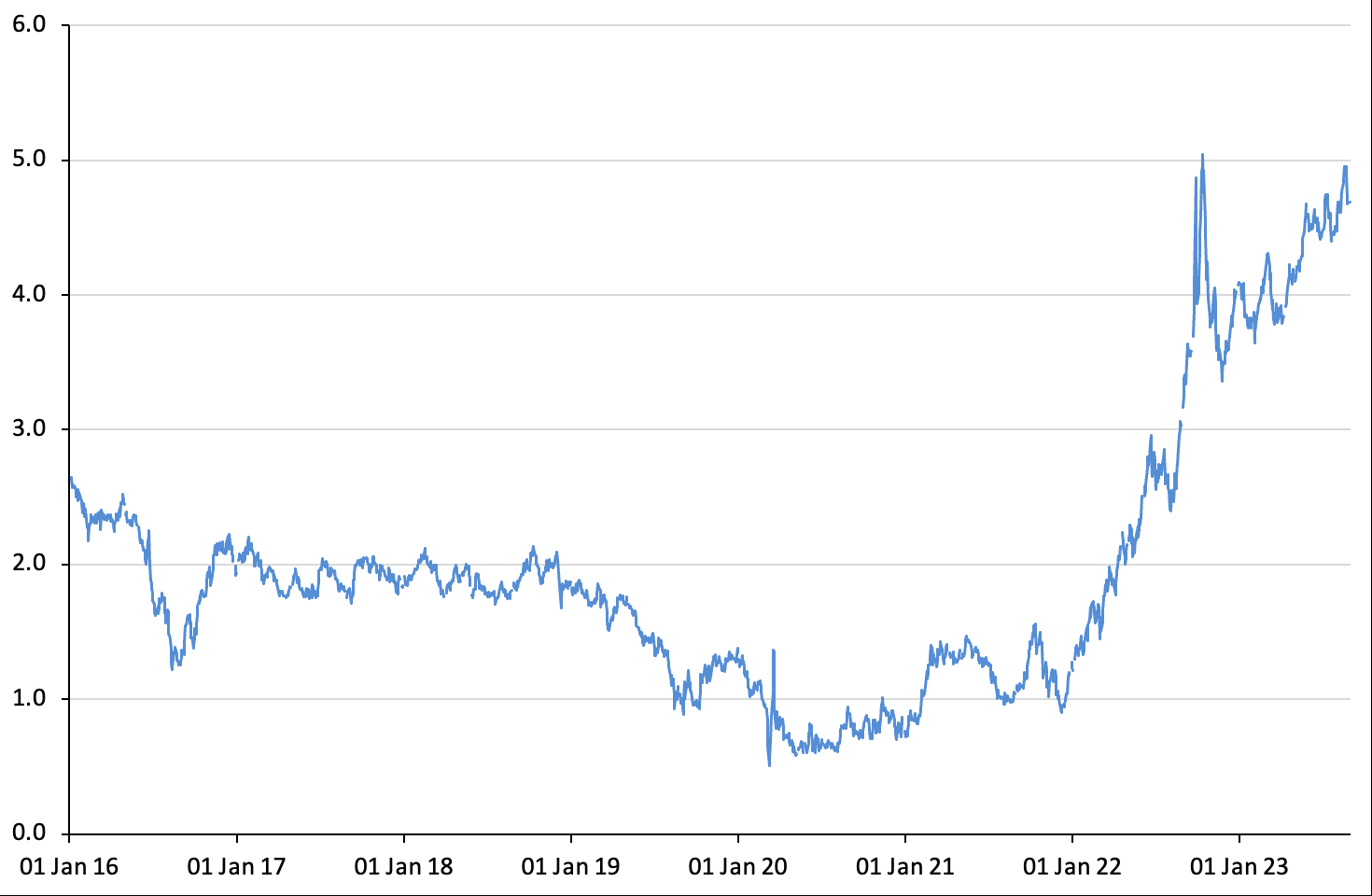
Source: Bank of England website.
The chart shows that yields on government bonds have moved up quite sharply in the last 18 months in tandem with increases in global interest rates. During August 2023, an investor would have been able to lock in a near "risk-free" annualised return of a little over 4.5% per annum.
B. The expected market return
The return that investors expect to earn when they put their money into stock markets is not something that is directly observable. A regulator will typically look at a range of evidence to infer what the expected market return might be. This might entail looking at:
- the returns that stock markets have historically returned to investors;
- analysts' published views;
- the results of surveys that are conducted periodically to collate investor and other expert views;
- modelled estimates of the returns that an investor will earn if they buy into the market at current valuations and collect the stream of returns that companies are promising to pay or are expected to pay in the coming years.
Regulators generally prefer to use the first of these lenses. A number of reports42 have been published in the last five years which have examined historical stock market data going back to 1900 in an effort to establish the returns that investors have made on average from investing in equity. The broad consensus that has emerged from this work is that historical stock market returns in the UK have averaged between 6.2% and 7.5% per annum in real terms (i.e. after controlling for inflation).
Regulators' recent point estimate values have all fallen in the range 6.5% to 6.8%. Converting these real values into nominal terms in line with expected inflation of 2% gives an equivalent range for the nominal expected market return of 8.6% to 8.9%.
C. Beta
A firm's beta will usually be calculated through regression analysis. The regression equation will be of the form:
R₁ = α + β . Rₘ
where R₁ is the return that an investor gets when it holds the shares in company i Rₘ is the return on a market portfolio, and β – the slope of the regression line – is the CAPM beta.
Figure A2
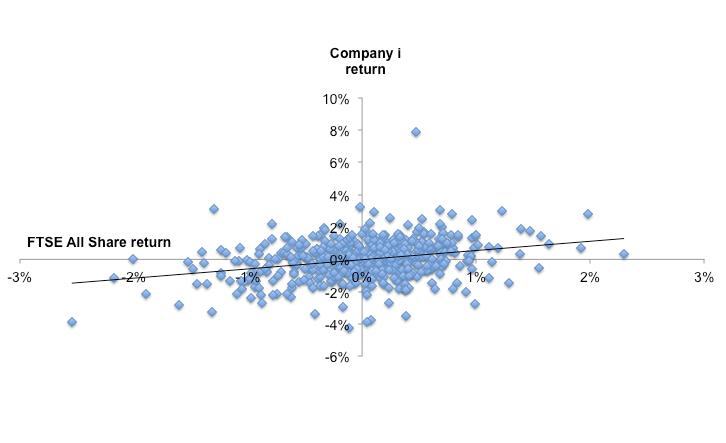
The main obstacle that regulators face when running these regressions is that very few of the UK regulated entities have their shares listed on a stock market. Across the different regulated sectors, only three of the UK water companies (Severn Trent, United Utilities and Pennon) and only two of the owners of energy networks (National Grid and SSE) have a share price, for instance. This means that regulators increasingly have rely on comparator companies for empirical beta estimates and in some cases – e.g. in the aviation sector – even look outside of the UK for data.
The most recent decisions from Ofgem and Ofwat, after reviewing the available data, put the betas of the GB energy networks and the England & Wales water companies at 0.76 and 0.71 respectively.
D. Summary
These calibrations means that the cost of equity for a conventional network business might currently be of the order of:
Cost of equity = risk-free rate + beta x ( expected market return – risk-free rate )
= 4.5% + 0.75 x (8.75% - 4.5%)
= 7.69%
Footnotes
-
The UKEB is the UK National Standard-setter for international accounting standards. The UKEB influences, endorses and adopts new or amended international accounting standards issued by the IASB for use by UK companies. IFRS accounting standards are required to be used by approximately 1,400 UK listed entities, and roughly 15,000 unlisted entities in addition choose to use these standards voluntarily. The UKEB consults publicly with stakeholders that have an interest in financial reporting in the UK so that it can develop and represent evidence-based UK views with the aim of acting as the UK voice on IFRS financial reporting. ↩
-
Available at: https://www.ifrs.org/content/dam/ifrs/project/rate-regulated-activities/published-documents/ed2021-rra.pdf ↩
-
IFRS 14 was not adopted for use in the EU (and therefore in the UK, as the standard was issued before Brexit) and does not form part of UK-adopted International Accounting Standards. ↩
-
See: National Audit Office (2014), A short guide to economic regulation; and UK Regulators Network (2014), UK regulated infrastructure: an investor guide. ↩
-
Rate-regulation or "price regulation" can therefore be interpreted as a subset of economic regulation. ↩
-
The revenue entitlement will usually index every year with inflation. The implications that this has for the structuring of returns is discussed in section 2.2. ↩
-
Available at: http://www.first-economics.com/guides.html ↩
-
Throughout the document the term RAB will be used. The IASB in the ED and subsequent deliberations uses the term Regulatory Capital Base (RCB). ↩
-
Some regulatory regimes provide for sharing rules, in which the financial consequences or under- and over-spending are shared between companies and their customers. ↩
-
This contrasts to "cost-based regulation", where the focus is more on cost reimbursement. ↩
-
A more detailed explanation of the rationale for this approach is provided in: John Earwaker (2024), Guide to economic regulation - part 4 ↩
-
IFRS reflects an accrual accounting approach with revenue recognised as it is earned irrespective of whether customers have paid the invoice. The nuance here is that IFRS 15 Revenues from Contracts with Customers represents the direct relationship between customer and utility, where the customer is billed for units consumed at a tariff rate. The revenue is recognised as the company fulfills the performance obligation, i.e., provision of water or electricity. However, from an economics perspective, the IFRS 15 revenue only represents the revenue entitlement based on the regulators initial budget/allowance/price control. During the period in question the utility may have provided additional value (or poor service which is penalised) which is adjusted against the regulator entitlement in the future. Currently this adjustment transaction is not covered by any IFRS standard and only gets captured by IFRS 15 in the couple of years time when the tariffs are adjusted. So, whle IFRS 15 captures all revenue on an accruals/receivable basis as the service provision is received by customers, the regulator adjustments are outside the scope of IFRS 15 and so essentially cash accounted when they are adjusted into the IFRS 15 revenue. The ED and subsequent accounting proposals aim to fill this gap. ↩
-
This example is taken from the ED, paragraphs 13-14 and IASB (2021), Snapshot: Regulatory Assets and Regulatory Liabilities. ↩
-
Atkins and Frontier Economics (2020), Economic impact of covid-19 on the water sector. ↩
-
See, for example, Severn Trent's preliminary announcement of annual results for the year ending 31 March 2021, p.9. ↩
-
The language of this section borrows from the exposure draft itself, its basis for conclusions, its illustrative examples and other IASB papers. ↩
-
The definitions of regulatory assets, liabilities, income, expenses are taken verbatim from the ED, page 5. ↩
-
See Section 2. Regulatory agreements are defined in the ED as a "A set of enforceable rights and obligations that determine a regulated rate to be applied in contracts with customers." ↩
-
See, for example, Competition Commission (2012), Phoenix Natural Gas Ltd. (NB: the Competition Commission was the CMA's direct predecessor). ↩
-
Paragraph 71 of the ED requires that An entity is permitted to offset regulatory assets and liabilities if it has a legally enforceable right to offset them by including them in the same regulated rate and if the entity expects to include the amounts resulting from the recovery or fulfilment of those regulatory assets and liabilities in the same regulated rate for goods or services supplied in the same future period. ↩
-
IASB (2023) "The direct (no direct) relationship concept—Report on findings from the survey". ↩
-
IASB (2022), “Regulatory assets and regulatory liabilities arising from differences between the regulatory recovery period and the assets' useful lives”. ↩
-
IASB (2022), "Other items included in the regulatory capital base”. ↩
-
IASB (2023), Consultative Group for Rate Regulation, Paper AP1, Disclosures. ↩
-
IASB (2024) Paper 9E, "Disclosures—Drafting" ↩
-
See IASB (2021), Regulatory Assets and Regulatory Liabilities: Illustrative Examples. ↩
-
See IASB (2022), "Inflation adjustment of the regulatory capital base". ↩
-
In certain cases, we have a reasonable degree of confidence that companies will be in scope - e.g. regulated water companies and energy networks. In other cases, we are aware of features of the regulatory regime and/or market that create additional complexity e.g. interconnectors and energy suppliers. ↩
-
The table records energy suppliers as a separate row entry due to (a) the size of numbers; and (b) the uncertainty that exists at the current time as to whether the licensees will be in or out of scope. ↩
-
For completeness, it must be noted that not all revenues of the aforementioned companies is attributable to rate-regulated business, as some of the groups listed above run diversified operations that include non-regulated business. ↩
-
In accordance with regulation 7(1) of the Statutory Instrument (SI) 2019/685 International Accounting Standards and European Public Limited-Liability Company (Amendment etc.) (EU Exit) Regulations, the UKEB must assess whether a standard meets the endorsement criteria, including an assessment of the long term public good in the UK. As part of the assessment of the long-term public good, the UKEB needs to establish whether a standard is likely to improve the quality of financial reporting. Therefore, developing an understanding of whether the proposed accounting will be a better reflection of the underlying economics is a crucial step against meeting this endorsement criterion. ↩
-
This example is the continuation of the one sketched in Box 2, taken from the ED, paragraphs 13-14 and IASB (2021), Snapshot: Regulatory Assets and Regulatory Liabilities. ↩
-
IASB (2023) Paper 9B, "The direct (no direct) relationship concept—Report on findings from the survey". ↩
-
See also IASB (2022), “Regulatory assets and regulatory liabilities arising from differences between the regulatory recovery period and the assets' useful lives", paragraph 12 ↩
-
Additional analyses performed in-house show that the congruence between RAB and accounting values varies between sectors, with some companies' RAB values historically tracking book values quite closely but other companies' seeing large divergences. However, in all cases there is sufficient distinctiveness in the rules that regulators apply when calculating and rolling forward RABs including, but not limited to the depreciation rules that regulators use, the inflation indexation of the RAB, and the right that regulators have to make upward and downward RAB adjustments in respect of non-capital items – to rule out the existence of a “direct relationship". ↩
-
Interviews and further stakeholder engagement focused on the direct/no direct relationship concept. Stakeholders suggested that: - In principle, all regulatory assets/liabilities should be recognised to provide a complete picture of the underlying economics of rate-regulated business, even in absence of a direct relationship; - generalist users would benefit from having a complete picture, whilst specialist users would be able to obtain the information they need from other sources; - a reconciliation of PPE and the RAB would not be possible or would be unpractical and costly to perform; - allowable expenses and performance incentives that are added to the RAB may in general be tracked, and the corresponding regulatory assets/liabilities may be estimated on a materially correct basis; - on the other hand, regulatory assets arising from differences in the useful lives of assets may not be possible or meaningful to calculate; - unrecognised regulatory assets/liabilities in absence of a direct relationship may account for material or significant amounts. One preparer for example noted that a significant share of an adjustment mechanisms overspend would be allocated through the RAB, and that unrecognised regulatory assets arising from such mechanism may be material. However, at the time of writing the authors haven't conducted a full assessment of the scale of the issue; - disclosures may help, though the IASB at the time of writing still had to deliberate on the topic. ↩
-
See for example: CAA (2023), Appendix F to Final Decision for the NR23 price control review (2023 to 2027) - RAB Rules ↩
-
For a general description of how deferred adjustment mechanisms work, see Section 2.1. ↩↩
-
Some overlap between PPE and regulatory assets may arise. In the example above there would be an overlap between PPE and regulatory assets in Year 0 for £12 m. A preparer noted that the additional £20 m to PPE will unwind as depreciation over the asset life, while the £12m regulatory ↩↩
-
While regulatory accounts are generally audited in all UK sectors subject to rate regulation, this is a point worth noting as neither the regulatory accounts nor the financial statements account for deferred adjustments in the way the new standard will require. ↩
-
These figures refer only to companies with a regulatory asset base and, hence, are not directly comparable to the figures quoted in section 4. ↩
-
See, for example, Wright, Burns, Mason and Pickford (2018), Estimating the cost of capital for implementation of price controls by UK regulators, and the Competition & Market Authority's analysis in CMA (2021), Anglian Water Services Limited, Bristol Water plc, Northumbrian Water Limited and Yorkshire Water Services Limited price determinations: final report. ↩