UKEB IFRS 17 DECA
UK ENDORSEMENT BOARD 11 NOVEMBER 2021 IFRS 17 DECA
This [Draft] Endorsement Criteria Assessment (ECA) includes extracts of information from IASB® IFRS 17 Effects Analysis and IASB® IFRS 17 Basis for Conclusions used with permission from the IFRS® Foundation. The IFRS® Foundation retains intellectual property rights including copyright over this material.
Copyright © 2021 IFRS® Foundation Used with permission of the IFRS Foundation. All rights reserved. Reproduction and use rights are strictly limited. Please contact the IFRS Foundation for further details at [email protected]. Copies of IASB® publications may be obtained from the IFRS Foundation's Publications Department. Please address publication and copyright matters to [email protected] or visit the IFRS Foundation's webshop at http://shop.ifrs.org.
Disclaimer To the extent permitted by applicable law, the IASB and the IFRS Foundation expressly disclaim all liability howsoever arising from this publication or any translation thereof whether in contract, tort or otherwise to any person in respect of any claims or losses of any nature including direct, indirect, incidental or consequential loss, punitive damages, penalties or costs. Information contained in this publication does not constitute advice and should not be substituted for the services of an appropriately qualified professional.
[TOC] The UKEB welcomes stakeholders' views on the potential adoption of IFRS 17 *Insurance Contracts
- for use in the UK.
If you wish to comment on this [Draft] Endorsement Criteria Assessment please complete the 'Your Details' form and use the 'Invitation to Comment' template. Both documents can be found on the IFRS 17 Project page on the UKEB website.
Please submit your comments to: [email protected] by close of business on 3 February 2022.
Executive Summary
Background
1The UK Endorsement Board (UKEB) is responsible for endorsement and adoption of international accounting standards (issued by the International Accounting Standards Board in the form of International Financial Reporting Standards, or IFRS) for use in the United Kingdom (UK). The UKEB is therefore the UK's National Standard Setter for IFRS.
2The primary objective of adoption of IFRS for use in the UK is to harmonise the financial information presented by relevant companies in order to ensure:
a) a high degree of transparency and international comparability of financial statements; and
b) the efficient allocation of capital, including the smooth functioning of capital markets in the United Kingdom1.
3This [Draft] Endorsement Criteria Assessment (ECA) presents the work performed by the UKEB to assess whether IFRS 17 Insurance Contracts2, issued by the International Accounting Standards Board, meets the UK's statutory requirements for adoption of IFRS as set out in Statutory Instrument 2019/685 (the Regulations)3.
4Although the Regulations refer only to 'adoption', for the purposes of this [Draft] ECA the term endorsement is generally used when referring to the criteria set out in the Regulations and to the assessment of IFRS 17 against those criteria, reflecting general usage.
5Our assessment addresses the three key endorsement criteria set out in the Regulations:
a) Whether IFRS 17 meets the criteria of understandability, relevance, reliability and comparability required of the financial information needed for making economic decisions and assessing the stewardship of management;
b) Whether IFRS 17 is likely to be conducive to the long term public good in the UK; and
c) Whether IFRS 17 is not contrary to the true and fair view principle for individual and consolidated accounts.
6The work to support these assessments has spanned many months and has been responsive to stakeholder input throughout. Key components of this work include:
a) Extensive technical analysis, including meetings with the UKEB's Insurance Technical Advisory Group and the Association of British Insurers;
b) Outreach activities including webinars, surveys of insurance companies and users of their accounts, interviews and roundtable discussions; and
c) In-house economic analysis and research and review of external studies, including an economic report prepared for the UKEB.
IFRS 17 Insurance Contracts
7A summary of the requirements of IFRS 17 is presented in section 2 of this [Draft] ECA. IFRS 17 establishes principles for the recognition, measurement, presentation and disclosure of insurance contracts within the scope of the standard. It is intended to replace the current interim accounting standard on insurance contracts, IFRS 4 Insurance Contracts. IFRS 4 does not prescribe the recognition, measurement or presentation of insurance contracts. Rather it allows entities to use a wide variety of accounting practices, reflecting national accounting requirements. This means that the financial position and results of subsidiaries, included in the group accounts, may not be consolidated on a consistent basis.
Technical accounting criteria
8Section 3 of this [Draft] ECA addresses whether IFRS 17 meets the criteria of understandability, relevance, reliability and comparability required of the financial information needed for making economic decisions and assessing the stewardship of management (referred to in this [draft] ECA as the technical accounting criteria).
9In carrying out this assessment we have considered all principal aspects of IFRS 17. However, in the interests of efficiency and effectiveness we have reported a detailed analysis against the technical accounting criteria only in relation to significant issues (an 'exceptions-based approach'). In this context ‘significant issues' means aspects of the standard:
a) where there is a question over whether IFRS 17's requirements on that aspect meet all the technical accounting criteria; and
b) which have a potentially significant impact in the UK: that is, the issue is likely to be material to at least some companies and/or the efficient and effective functioning of UK capital markets.
10The process adopted to identifying significant issues, described in more detail in Section 3, spanned many months and has been responsive to stakeholder input throughout that period.
11Insurance contracts create a wide variety of often complex bundles of rights and obligations for the issuer. No international accounting standard could address explicitly every scenario that arises under typical UK insurance contracts. However, our [tentative] conclusion is that IFRS 17 sets out clear principles that can be applied to insurance contracts typical in the UK and that will result in understandable, relevant, reliable and comparable information for users of the accounts. In some cases, it will be particularly important for management to provide appropriate disclosures, as required by IFRS 17 and more generally by IFRS Standards4, to achieve the objectives of understandability, relevance, reliability and comparability.
12Overall, our [tentative] conclusion is that IFRS 17 meets the criteria of understandability, relevance, reliability and comparability required of the financial information needed for making economic decisions and assessing the stewardship of management.
UK long term public good
13The UKEB's analysis of whether IFRS 17 is likely to be conducive to the long term public good in the UK is presented in section 4 of this [Draft] ECA. That section:
a) Presents an overview of the insurance sector in the UK and the relevant population of insurance companies that will be directly affected by the UKEB's IFRS 17 adoption decision;
b) Discusses whether IFRS 17 is likely to improve the quality of financial reporting in the UK;
c) Considers the costs and benefits likely to result from the use of IFRS 17 in the UK; and
d) Considers whether the use of IFRS 17 is likely to have an adverse effect on the economy of the UK, including on economic growth.
14Implementing IFRS 17 will lead to improvements in the financial reporting for insurance contracts by specifying a comprehensive set of recognition, measurement, presentation and disclosure requirements for the first time. This will lead to financial reporting that faithfully reflects the substance of the contracts in scope and is prepared and presented on a consistent basis, making it more comparable from year to year, between different companies in the insurance sector as well as across jurisdictions. Such financial information is more useful to investors and other users of accounts, who have an interest in holding management to account for their stewardship of the company and in making buy, sell or hold decisions in relation to equity or debt instruments.
15Aggregate one-off IFRS 17 implementation costs for all UK insurance companies adopting IFRS 17 are estimated at approximately £1.18 billion. Of this, approximately £0.5 billion had been incurred by 30 June 2020 and significant further cost has been incurred since then. While these costs are significant, they represent 1% or less of their average annual Gross Written Premiums over the last 5 years.
16Users of insurance company accounts are the main beneficiaries of the enhanced transparency and comparability expected to result from IFRS 17. This was reflected in our outreach with analysts and other users of accounts. The majority of users of insurance company accounts were optimistic that the changes introduced by IFRS 17 would improve comparability between insurance companies and increase transparency in insurance company accounts. However, they expected to be able to make a more complete assessment only after more detailed engagement with insurance companies on their IFRS 17 implementation.
17Views on the likely impact of IFRS 17 on the cost of capital for insurance companies are mixed. While some stakeholders consider that the cost of capital may increase in the short term, others consider that IFRS 17 may result in a lower cost of capital for UK insurance companies in the longer term.
18Although not quantified, some insurance companies also expect to realise ongoing indirect benefits from improvements in systems and data management, and from process efficiencies resulting from the IFRS 17 implementation.
19As the standard aims to enhance transparency and comparability in financial reporting, the implementation of IFRS 17 should also be beneficial for auditors and regulators.
20Overall, the application of IFRS 17 is not expected to result in significant additional net ongoing costs for stakeholders in the UK insurance sector.
21It is possible that IFRS 17 will prompt some changes to insurance product offerings or pricing strategies. However, those changes are not anticipated to be of substantial detriment to the UK economy. IFRS 17 is not expected to adversely affect competition in the insurance industry between entities applying the standard and those that do not apply it. At an international level, IFRS 17 might increase competition, as large global groups may exploit cross-country synergies post-adoption, leading to positive effects on the UK economy. The proposed EU carve out is not expected to have significant consequences for competition for customers and may provide an advantage for UK companies in the competition for capital if they apply IFRS 17 as issued by the IASB.
22IFRS 17 is not expected to have an adverse effect on the economy of the UK in relation to cost of capital and access to finance for insurance companies, as the enhanced transparency and comparability of insurance company accounts expected from use of IFRS 17 is likely to be positively evaluated by investors. Similarly, it is not expected that IFRS 17 will have a significant effect on the investment or hedging strategies of insurance companies.
23The standard is expected to have a minor, non-adverse effect on tax revenues over the medium and long term.
24IFRS 17 is expected to have a neutral to positive effect on economic growth and on financial stability. The expected improvement in the transparency and comparability of insurance company accounts should promote the efficient allocation of capital and the ability of investors to hold management to account. In addition, IFRS 17 is expected to provide new information that will be useful for supervisory monitoring and should allow users of accounts to better evaluate the financial position of insurance companies, leading to greater market confidence.
25As part of our work, we also considered the potential effects on the UK economy of not adopting IFRS 17. Not adopting the standard would result in users of accounts not being able to benefit from the enhanced transparency and comparability expected from reporting under IFRS 17. Assuming other jurisdictions adopt IFRS 17, this would be likely to put UK insurance companies at a relative disadvantage compared with companies applying IFRS 17, with a potential disadvantage in terms of their cost of capital or reduced access to global capital markets.
26Overall, our [tentative] conclusion is that the use of IFRS 17 is likely to be conducive to the long term public good in the UK.
True and fair view principle
27Section 5 of the [Draft] ECA addresses whether IFRS 17 is not contrary to the true and fair view principle for individual and consolidated accounts. Responsibility for ensuring that a company's accounts give a true and fair view lies with the directors of the company. The true and fair view endorsement criterion in the Regulations requires an assessment of whether a specific standard or amendment is not contrary to the true and fair view principle. In determining whether IFRS 17 is not contrary to the true and fair view principle, therefore, we have considered whether IFRS 17 contains any requirement that would prevent accounts prepared using the standard, including any disclosures required to be provided by the directors, from giving a true and fair view.
28A holistic approach has been taken to the assessment of IFRS 17 against the true and fair view endorsement criterion, considering the standard as a whole, including its interaction with other UK-adopted international accounting standards.
29Our assessment has not identified any requirement of IFRS 17 that would prevent individual or consolidated accounts prepared using the standard, including the disclosures it requires, from fairly reflecting the economic substance of insurance contracts. On this basis, the assessment has not identified any requirement of IFRS 17 that would prevent those accounts from giving a true and fair view of the entity's or group's assets, liabilities, financial position and profit or loss.
30We therefore [tentatively] conclude that IFRS 17 is not contrary to the true and fair principle set out in the Regulations.
[Tentative] adoption decision
31On the basis of its assessments against the endorsement criteria, the UKEB [tentatively] concludes that IFRS 17 meets the statutory requirements for adoption of international accounting standards for use in the UK. The UKEB is therefore of the [tentative] view that it will adopt IFRS 17 for use in the UK.
1. Legislative framework and our approach to the assessment
Purpose of [Draft] Endorsement Criteria Assessment
1.1The purpose of this [Draft] Endorsement Criteria Assessment (ECA) is to determine whether IFRS 17 Insurance Contracts, issued by the International Accounting Standards Board (IASB®) in May 2017 and further amended in June 20205], meets the UK's statutory requirements for adoption of international accounting standards and whether it should be adopted for use in the UK.
1.2In July 2021 the IASB published Exposure Draft ED/2021/8 Initial Application of IFRS 17 and IFRS 9 – Comparative Information (Proposed Amendment to IFRS 17). The IASB plans to complete any resulting amendment by the end of 2021. On the assumption that the IASB issues the final amendment before the finalisation of this ECA, the intention is to cover the amendment in the overall assessment of IFRS 17 in the ECA. However, as set out in our comment letter to the IASB dated 23 September 20216, the amendment is not expected to be widely used in the UK and is not expected to give rise to any significant issues for the purposes of this assessment or the adoption decision7.
Legislative background to endorsement criteria
1.3The statutory requirements for adoption of an international accounting standard for use in the UK are set out in The International Accounting Standards and European Public Limited-Liability Company (Amendment etc.) (EU Exit) Regulations 2019 No. 685 (the Regulations, or SI 2019/685).
1.4The primary objective of adoption of international accounting standards (referred to in this [Draft] ECA as ‘IFRS® Standards', except when we are referring to them in the context of our obligations under the Regulations) for use in the UK as set out in SI 2019/685 is to harmonise the financial information presented by relevant companies in order to ensure:
a) a high degree of transparency and international comparability of financial statements; and
b) the efficient allocation of capital, including the smooth functioning of capital markets in the United Kingdom.8
1.5Regulation 7(1) of SI 2019/685 requires that an international accounting standard can only be adopted if:
- “the standard is not contrary to either of the following principles—
- an undertaking's accounts must give a true and fair view of the undertaking's assets, liabilities, financial position and profit or loss;
- consolidated accounts must give a true and fair view of the assets, liabilities, financial position and profit or loss of the undertakings included in the accounts taken as a whole, so far as concerns members of the undertaking;
- the use of the standard is likely to be conducive to the long term public good in the United Kingdom; and
- the standard meets the criteria of understandability, relevance, reliability and comparability required of the financial information needed for making economic decisions and assessing the stewardship of management.”
1.6The legislation itself therefore provides a broad structure for the endorsement work needed to assess IFRS 17 for use in the UK, including setting out the key questions that must be addressed. The UK Endorsement Board's (UKEB's) approach to these criteria is explained in the following paragraphs.
Approach to the endorsement criteria
1.7This [Draft] ECA addresses the endorsement criteria in the following order:
a) Whether the standard meets the criteria of understandability, relevance, reliability and comparability required of the financial information needed for making economic decisions and assessing the stewardship of management (Regulation 7(1)(c));
b) Whether the standard is likely to be conducive to the long term public good in the UK (Regulation 7(1)(b)); and
c) Whether the standard is not contrary to the true and fair view requirement for individual financial statements and consolidated financial statements (Regulation 7(1)(a)).
1.8Each of the criteria in paragraph 1.7 above is addressed in a separate section which includes detailed explanations of the criteria and the UKEB's approach. A high-level summary of our approach to the endorsement criteria is set out below.
1.9A holistic approach has been taken to the assessment of whether a standard is not contrary to the principle that both the individual and consolidated financial statements must give a true and fair view (see the full text of the requirement in paragraph 1.5 above), considering the standard as a whole. For this reason, we have reported our assessment of IFRS 17 against this endorsement criterion at the end of this [Draft] ECA, after having reported our assessment of whether the standard's requirements meet the technical accounting criteria and the long term public good requirements.
Understandability, relevance, reliability and comparability9
1.10The criteria of understandability, relevance, reliability and comparability required of the financial information needed for making economic decisions and assessing the stewardship of management are derived from the qualitative characteristics of financial statements set out in the Framework for the Preparation a Presentation of Financial Statements adopted by the IASB in April 2001 (the IASB's Framework). These qualitative characteristics became part of the criteria for endorsement and adoption of IFRS for use in the European Union in the EU's IAS Regulation (1606/2002), and, subsequently, in the UK in SI 2019/685.
1.11To ensure we maintain consistency with the on-shored suite of UK-adopted IFRS, our description of these criteria – referred to collectively in this [Draft] ECA as the 'technical accounting criteria' – and our interpretation of their meaning are therefore based on the analysis included in the IASB's Framework.
1.12Financial information should be readily understandable by users with a reasonable knowledge of business and economic activities and accounting, and a willingness to study the information with reasonable diligence.
1.13Information is relevant if it is capable of making a difference in the decision-making of users or in their assessment of the stewardship of management. The information may aid predictions of the future, confirm or change evaluations of the past or both.
1.14Financial information is reliable if, within the bounds of materiality, it:
a) can be depended on by users to represent faithfully the economic substance of what it either purports to represent or could reasonably be expected to represent;
b) is complete; and
c) is free from material error and bias.
1.15Information is comparable if it enables users to identify and understand similarities in, and differences between, items. Information about an entity should be comparable with similar information about other entities and with similar information about the same entity for another period.
1.16Each technical accounting criterion is viewed as an absolute (objective) standard to attain, rather than as a relative (comparative) test (for example as compared to current UK accounting practice for insurance contracts).
1.17In carrying out this [tentative] assessment against the technical accounting criteria, we have considered all principal aspects of IFRS 17, using an exceptions-based approach. This means assessing all UK-specific concerns arising from the requirements in the standard against the technical accounting criteria but reporting the detailed analysis only in relation to priority and other significant issues. Further details on the exceptions-based approach, including the approach taken to identifying topics for consideration have been included in section 3.
Whether IFRS 17 is likely to be conducive to the long term public good in the UK
1.18Regulation 7(2) of SI 2019/685 sets out certain matters that have to be considered in the assessment of whether a standard is likely to be conducive to the long term public good in the UK. These are:
a) “whether the use of the standard is likely to improve the quality of financial reporting;
b) the costs and benefits that are likely to result from the use of the standard; and
c) whether the use of the standard is likely to have an adverse effect on the economy of the United Kingdom, including on economic growth.”
1.19The primary objectives of the IASB's project to develop IFRS 17 were to: (i) make insurance companies' financial statements more useful to investors and other users of financial statements; and (ii) insurance accounting practices more consistent across jurisdictions and products. Therefore, our consideration of whether IFRS 17 is likely to improve the quality of financial reporting includes testing whether the standard is likely to meet those IASB objectives by comparing the requirements in IFRS 17 with current UK accounting practice for insurance contracts under IFRS 4 Insurance Contracts.
1.20The effective date of IFRS 17 is 1 January 2023 and we are not aware of any company in the UK that intends to apply the standard at an earlier date. Our assessment is therefore entirely an ‘ex ante' assessment and is based on our informed expectations and those of stakeholders consulted thus far.
1.21Under the terms of the Small Business, Enterprise and Employment Act 201510 the UK Endorsement Board (UKEB) is not a 'relevant regulator', one which is required to undertake impact assessments in accordance with the governance requirements of the Department for Business, Energy and Industrial Strategy (BEIS). This [Draft] ECA does not therefore include a detailed quantitative analysis of the impact of IFRS 17. Nevertheless, as a matter of good practice, we have considered the BEIS governance requirements as a reference point when assessing whether IFRS 17 is likely to be conducive to the long term public good in the UK, in particular in respect of the costs and benefits likely to result from its use.
1.22The legislation requires consideration and assessment of the long term public good in the UK. Therefore, when assessing the costs and benefits arising from the use of IFRS 17, the initial costs of implementation of IFRS 17 were considered together with the expected ongoing costs and benefits in future years, to allow a balanced assessment over the longer-term.
1.23In considering whether IFRS 17 is likely to have an adverse effect on the economy of the UK, the assessment considered the potential impact of the standard on the insurance sector, including on factors such as products, pricing and competition. It goes on to assess wider economic effects, including on capital markets, the cost of capital for insurers, tax payments and financial stability.
The Standard is not contrary to the true and fair view requirement for individual and consolidated financial statements11
1.24The objective of general purpose financial reporting is to recognise, measure, present and disclose transactions and events so that the accounts fairly reflect the economic substance of those underlying transactions and events. The assessment against the true and fair view endorsement criterion therefore considers whether IFRS 17 is not contrary to:
a) the individual accounts fairly reflecting the economic substance of transactions and events such that the accounts give a true and fair view of the undertaking's assets, liabilities, financial position and profit or loss; or
b) the consolidated accounts fairly reflecting the economic substance of transactions and events such that the consolidated accounts give a true and fair view of the assets, liabilities, financial position and profit or loss of the undertakings included in the accounts taken as a whole, so far as concerns members of the undertaking.
A holistic approach
1.25A holistic approach has been taken to the assessment of IFRS 17 against the endorsement criteria, considering the standard as a whole. This is considered appropriate because meaningful assessments against the long term public good and true and fair view criteria can be undertaken only by considering the impact of the standard taken as a whole.
1.26Although the assessment of whether IFRS 17 meets the technical accounting criteria necessarily considers its specific and detailed requirements, including their impact on the accounting for particular contracts and transactions, the conclusion reflects a balanced overall judgement as to whether the standard, taken as a whole, meets the technical accounting criteria.
Structure of this [Draft] Endorsement Criteria Assessment
1.27The remainder of this [Draft] ECA is structured as follows:
- Description of IFRS 17 and its requirements (Section 2)
- Technical accounting criteria assessment (Section 3)
- UK long term public good assessment (Section 4)
- True and fair view assessment (Section 5)
- [Tentative] adoption decision (Section 6)
- Appendices
- Appendix A - Glossary
- Appendix B - Assessment of remaining significant issues
2. Description of IFRS 17
Background, context and objectives
2.1IFRS 17 Insurance Contracts was issued in May 2017 and subsequently amended in June 2020 [and December 202112]. It replaces IFRS 4 Insurance Contracts and is effective for annual reporting periods beginning on or after 1 January 2023. Earlier application is permitted but only for entities that apply IFRS 9 Financial Instruments on or before the date of initial application of IFRS 17.
2.2This standard is the result of significant work by the International Accounting Standards Board (IASB) over many years, including the publication of several consultation documents13 and consultation with multiple stakeholders14. The IASB's aim was to develop a comprehensive new international accounting standard that can be applied to all types of insurance contracts.
2.3IFRS 17 is intended to replace the current interim accounting standard on insurance contracts, IFRS 4, issued in March 2004. IFRS 4 does not prescribe requirements for the recognition, measurement or presentation of insurance contracts and allows entities to use a wide variety of accounting practices, reflecting national accounting practices.
2.4The objective of IFRS 17 is set out in paragraph 1 of the standard:
“IFRS 17 establishes principles for the recognition, measurement, presentation and disclosure of insurance contracts within the scope of the Standard. The objective of IFRS 17 is to ensure that an entity provides relevant information that faithfully represents those contracts. This information gives a basis for users of financial statements to assess the effect that insurance contracts have on the entity's financial position, financial performance and cash flows.” [IFRS 17: 1]
2.5This section of the [Draft] Endorsement Criteria Assessment (ECA) provides an overview of the principal requirements of IFRS 17. It does not attempt to represent a comprehensive guide to the standard but sets out only a high-level summary of its key features.
2. Description of IFRS 17
Background, context and objectives
2.1 IFRS 17 Insurance Contracts was issued in May 2017 and subsequently amended in June 2020 [and December 2021]12. It replaces IFRS 4 Insurance Contracts and is effective for annual reporting periods beginning on or after 1 January 2023. Earlier application is permitted but only for entities that apply IFRS 9 Financial Instruments on or before the date of initial application of IFRS 17.
2.2 This standard is the result of significant work by the International Accounting Standards Board (IASB) over many years, including the publication of several consultation documents13 and consultation with multiple stakeholders14. The IASB's aim was to develop a comprehensive new international accounting standard that can be applied to all types of insurance contracts.
2.3 IFRS 17 is intended to replace the current interim accounting standard on insurance contracts, IFRS 4, issued in March 2004. IFRS 4 does not prescribe requirements for the recognition, measurement or presentation of insurance contracts and allows entities to use a wide variety of accounting practices, reflecting national accounting practices.
2.4 The objective of IFRS 17 is set out in paragraph 1 of the standard:
“IFRS 17 establishes principles for the recognition, measurement, presentation and disclosure of insurance contracts within the scope of the Standard. The objective of IFRS 17 is to ensure that an entity provides relevant information that faithfully represents those contracts. This information gives a basis for users of financial statements to assess the effect that insurance contracts have on the entity's financial position, financial performance and cash flows.” [IFRS 17: 1]
2.5 This section of the [Draft] Endorsement Criteria Assessment (ECA) provides an overview of the principal requirements of IFRS 17. It does not attempt to represent a comprehensive guide to the standard but sets out only a high-level summary of its key features.
Description of IFRS 17's main accounting requirements
Scope
2.6 IFRS 17 identifies as insurance contracts those contracts under which the entity accepts significant16 insurance risk from another party (the policyholder) by agreeing to compensate the policyholder if a specified uncertain future event (the insured event) adversely affects the policyholder. [IFRS 17 Appendix A] The definition of insurance contract remains unchanged from that in IFRS 4.
“Like IFRS 4, IFRS 17 applies to all companies that issue insurance contracts and not only to insurance companies”. [IASB Effects Analysis17 p.21]
“Non-financial companies providing insurance services are generally not expected to apply IFRS 17 because of the scope exclusions in the Standard”. [IASB Effects Analysis p.21]
2.7 IFRS 17 applies to:
- insurance contracts (including reinsurance contracts) an entity issues;
- reinsurance contracts an entity holds; and
- investment contracts with discretionary participation features18 an entity issues, provided the entity also issues insurance contracts. [IFRS 17:3]
2.8 Investment contracts with discretionary participation features often have characteristics such as long maturities, recurring premiums and high acquisition cash flows which are more commonly found in insurance contracts than in most other financial instruments. These contracts are sometimes linked to the same underlying pool of assets as insurance contracts or share in the performance of insurance contracts. Although these contracts do not meet the definition of insurance contracts (as they do not include a transfer of significant insurance risk), they are accounted for under IFRS 17, subject to some modifications to the general requirements, but only if the entity also issues insurance contracts. Other companies apply IFRS 9 to such contracts.
“Feedback received by the Board indicated that few investment contracts with discretionary participation features are issued by non-insurers. As a result, most of these contracts are expected to continue to be accounted for as insurance contracts rather than as financial instruments applying IFRS 9". [IASB Effects Analysis p.14]
2.9 Some 'fixed-fee service contracts', such as roadside assistance contracts, meet the definition of an insurance contract, even though their primary purpose is the provision of services for a fixed fee. IFRS 17 introduces an irrevocable choice to account for such contracts by applying either IFRS 17 or IFRS 15 Revenue from Contracts with Customers if certain conditions are met. An entity can make this irrevocable accounting choice on a contract-by-contract basis.
2.10 Some other contracts meet the definition of an insurance contract but limit the compensation for insured events to the amount otherwise required to settle the policyholder's obligation created by the contract (for example, loans with death waivers). An entity is required to make an irrevocable choice to account for these contracts either by applying IFRS 9 or IFRS 17 (unless those contracts are specifically excluded by paragraph 7 of IFRS 17). This irrevocable choice is made for each portfolio of insurance contracts.
2.11 The scope of IFRS 17 specifically excludes various items that may meet the definition of an insurance contract, including a) warranties provided by a manufacturer, dealer or retailer in connection with the sale of its goods or services to a customer and b) some credit card contracts (but only if the entity does not reflect an assessment of the insurance risk associated with an individual customer in setting the price of the contract with that customer). An entity applies other relevant IFRS Standards to account for these items.
Separation of components
2.12 IFRS 17 separates specified embedded derivatives, distinct investment components and distinct performance obligations from the insurance contracts. An entity applies the requirements in IFRS 17 to the remaining components of the host insurance contract.
2.13 The IASB's aim in separating such non-insurance components from an insurance contract is to improve comparability. Accounting for such components using other applicable IFRS standards makes them more comparable to similar contracts issued as separate contracts and it allows users of financial statements to better compare financial information of entities in different businesses or industries.
Level of aggregation
2.14 IFRS 17 divides insurance contracts into groups for purposes of recognition and measurement. An entity is required to identify portfolios of insurance contracts. Under IFRS 17, "a portfolio comprises contracts subject to similar risks and managed together". [IFRS 17: 14].
2.15 In accordance with IFRS 17, once a portfolio is identified, an entity divides it into a minimum of three different sub-groups:
- a group of contracts that are onerous at initial recognition;
- a group of contracts that at initial recognition have no significant possibility of becoming onerous subsequently; and
- a group of the remaining contracts in the portfolio.
2.16 An entity is not allowed to include contracts issued more than one year apart in the same group, therefore, further sub-groups might be necessary. This requirement is often referred to as the 'annual cohorts' requirement and is intended to prevent perpetual open portfolios19.
2.17 An entity establishes the groups at initial recognition (and adds contracts under certain circumstances) but it does not subsequently reassess the composition of the groups.
Recognition and measurement
2.18 An insurance contract typically combines features of a financial instrument and a service contract; these components are commonly interrelated. The measurement models20 in IFRS 17 account for both components. The measurement of obligations at a current value is consistent with the requirements for comparable financial instruments. Recognising profit as services are provided is also consistent with the requirements in IFRS 15. For groups of onerous insurance contracts, recognising expected losses immediately is consistent with the recognition of losses for onerous contracts in accordance with IFRS 15 and IAS 37 Provisions, Contingent Liabilities and Contingent Assets.
2.19 IFRS 17 requires entities to measure groups of insurance contracts at:
- A current estimate of the future cash flows, including an adjustment for the timing and risk of those cash flows (the fulfilment cash flows); and
- An amount representing the unearned profit relating to services still to be provided (the contractual service margin).
2.20 In the IASB's view, “IFRS 17 provides consistent principles for all aspects of the accounting for insurance contracts. It also removes the diversity in insurance accounting for companies that have been applying IFRS Standards, enabling investors, analysts and others to meaningfully compare companies, contracts and industries". [IASB Effects Analysis p.7]
Profit recognition
2.21 Under IFRS 17, an entity recognises the profit from a group of insurance contracts over the period the entity provides insurance contract services, and as the entity is released from risk. If a group of contracts is or becomes loss-making, an entity recognises the loss immediately. As mentioned above, this is broadly consistent with the general principles in IFRS 15 and IAS 37.
2.22 IFRS 17 Appendix A defines 'insurance contract services' as comprising insurance coverage, investment return-service (for insurance contracts without direct participation features) and investment-related service (for insurance contracts with direct participation features).
2.23 Claims and expenses (other than insurance acquisition expenses see paragraph 2.54 below) are recognised when incurred.
Presentation of income and expenses
2.24 IFRS 17 requires entities to present separately insurance revenue (that excludes the receipt of any investment component21), insurance service expenses (that excludes the repayment of any investment components) and insurance finance income or expenses.
2.25 As noted above, IFRS 17 requires entities to exclude investment components from insurance revenue and incurred claims. This presentation aims to faithfully represent the similarities between financial instruments (accounted for under IFRS 9) and investment components embedded in insurance contracts, resulting in enhanced comparability with the financial information of entities in other industries, such as banking.
2.26 Consistently with IAS 1 Presentation of Financial Statements, requiring insurance finance income or expense to be presented separately from the insurance service result aims to provide useful information about different aspects of the entity's performance.
“IFRS 17 is expected to reveal economic volatility of insurance contracts, making the performance of insurance companies more transparent. At the same time, the insurance service result will not be affected by changes in discount rates. IFRS 17 also permits companies to report the effects of changes in discount rates in other comprehensive income”. [IASB Effects Analysis p.87]
2.27 Entities are required to make an accounting policy choice for each portfolio of insurance contracts on how to present insurance finance income or expenses. Such insurance finance income or expenses is either all included in profit or loss or is disaggregated between profit or loss and other comprehensive income22.
Disclosures
2.28 IFRS 17 paragraph 93 states that “The objective of the disclosure requirements is for an entity to disclose information in the notes that, together with the information provided in the statement of financial position, statement(s) of financial performance and statement of cash flows, gives a basis for users of financial statements to assess the effect that contracts within the scope of IFRS 17 have on the entity's financial position, financial performance and cash flows".
2.29 To achieve this disclosure objective, information is required about the amounts recognised in the financial statements, the significant judgements and changes in those judgements, and the nature and extent of risks that arise from insurance contracts. In situations in which complying with the specific disclosure requirements is not sufficient to meet the disclosure objective, IFRS 17 requires an entity to disclose additional information necessary to meet that objective.
2.30 By specifying the objective of the disclosures, the IASB aims to ensure that entities provide the information that is most relevant for their circumstances and to emphasise the importance of communication to users of financial statements rather than compliance with detailed and prescriptive disclosure requirements.
Transition
2.31 Unless impracticable, an entity is required to apply the standard retrospectively. When full retrospective application is impracticable for a group of contracts, an entity has a free choice to adopt either:
- the modified retrospective approach, or
- the fair value approach.
2.32 The modified retrospective approach permits specific modifications to retrospective application. These modifications allow an entity to determine specified matters at the transition date rather than at initial recognition of a group of insurance contracts and use specified proxies for some requirements.
2.33 Under the fair value approach, an entity is required to determine the contractual service margin23 at the transition date. This is calculated as the difference between the measurement of the fair value of a group of insurance contracts and the fulfilment cash flows of the group as at that date.
2.34 The choice of transition method is made at the level of a group of contracts24.
Reinsurance
2.35 IFRS 17 Appendix A defines a reinsurance contract as “an insurance contract issued by one entity (the reinsurer) to compensate another entity for claims arising from one or more insurance contracts issued by that other entity (underlying contracts)".
2.36 An entity that holds a reinsurance contract does not normally have a right to reduce the amounts it owes to the underlying policyholder by amounts it expects to receive from the reinsurer (in other words the entity retains in full the liability to the underlying policyholder). As a result, IFRS 17 requires a reinsurance contract held to be accounted for separately from the underlying insurance contracts to which it relates, to reflect its separate rights and obligations.
2.37 The general requirements in IFRS 17 are modified for reinsurance contracts held to reflect the different nature of such contracts.
2.38 One key modification relates to income recognition for reinsurance contracts held when they cover onerous groups of underlying insurance contracts. On initial recognition of onerous underlying insurance contracts an entity is required to recognise the loss immediately in profit or loss. Provided that an entity entered into the group of reinsurance contracts held before or at the same time as the onerous underlying insurance contracts are recognised, the entity recognises the corresponding loss recoveries from reinsurance contracts held in profit or loss at the same time25. Subsequently, the adjusted net gain (or net cost) of purchasing the reinsurance contract is recognised in profit or loss over the coverage period of the reinsurance contract.
2.39 Reinsurance contracts issued should be accounted for by the reinsurer using either the general model or the premium allocation approach, in the same way as other insurance contracts issued (see the overview of accounting models below).
Overview of accounting models
I - General Measurement Model (GMM)
2.40 The GMM is applied to all insurance contracts, unless they are insurance contracts with direct participation features to which the Variable Fee Approach applies (refer to paragraphs 2.58 to 2.69 below) or insurance contracts to which the entity has elected to apply the Premium Allocation Approach (refer to paragraphs 2.70 to 2.74 below).
Initial recognition
2.41 On initial recognition26 an entity measures insurance contracts at the total of:
- The fulfilment cash flows, which comprise:
- The present value of probability-weighted expected cash flows (which reflect financial risk); and
- An explicit risk adjustment for non-financial risk (such as insurance risk).
- The contractual service margin (or unearned profit).
Estimates of future cash flows
2.42 An entity is required to include in the measurement of a group or insurance contracts all the future cash flows within the boundary of each contract in the group. These:
- incorporate, in an unbiased way, all reasonable and supportable information available without undue cost or effort about the amount, timing and uncertainty of those future cash flows;
- reflect the perspective of the entity (provided that relevant market variables are consistent with observable market prices); and
- are current and explicit.
2.43 In accordance with paragraph 34 of IFRS 17, cash flows are within the boundary of an insurance contract “if they arise from substantive rights and obligations that exist during the reporting period in which the entity can compel the policyholder to pay the premiums or in which the entity has a substantive obligation to provide the policyholder with insurance contract services."
Discount rates
2.44 IFRS 17 does not prescribe the specific discount rates to be used but sets out high-level principles27. In accordance with IFRS 17 paragraph 36, the discount rates applied to the estimates of future cash flows "shall:
- Reflect the time value of money, the characteristics of the cash flows and the liquidity characteristics of the insurance contracts;
- Be consistent with observable current market prices (if any) for financial instruments with cash flows whose characteristics are consistent with those of the insurance contracts, in terms of, for example, timing, currency and liquidity; and
- Exclude the effect of factors that influence such observable market prices but do not affect the future cash flows of the insurance contracts".
Risk adjustment for non-financial risk
2.45 IFRS 17 requires entities to reflect the risk that is inherent in insurance contracts by considering a risk adjustment for non-financial risk in the measurement of the fulfilment cash flows28.
2.46 IFRS 17 Appendix A defines risk adjustment for non-financial risk as “the compensation an entity requires for bearing the uncertainty about the amount and timing of the cash flows that arises from non-financial risk as the entity fulfils insurance contracts”.
Contractual service margin
2.47 The contractual service margin is the balance sheet item representing the unearned profit the entity will recognise as it provides services in respect of a group of insurance contracts.
2.48 The contractual service margin is a residual amount, measured at the amount that results in no income or expenses on initial recognition. However, for contracts that are onerous at initial recognition, entities are required to recognise a loss in profit or loss for the net outflow and the contractual service margin is zero.
Subsequent measurement
2.49 The carrying amount of a group of insurance contracts at the end of each reporting period is the sum of:
- The liability for remaining coverage comprising:
- The fulfilment cash flows related to future service allocated to the group at that date.
- The contractual service margin of the group at that date.
- The liability for incurred claims, comprising the fulfilment cash flows related to past service allocated to the group at that date. [IFRS 17: 40]
2.50 Changes in the carrying amounts of the above liabilities are recognised in profit or loss, presenting separately the effects corresponding to insurance revenue, insurance service expenses and insurance finance income or expenses.
Contractual service margin – subsequent measurement
2.51 In each period, an entity recognises as insurance revenue an amount of the contractual service margin representing the provision of insurance contract services arising from the group of insurance contracts in that period.
2.52 The recognition of the contractual service margin in profit or loss is determined by identifying coverage units that reflect the quantity of benefits provided under the insurance contracts and their expected coverage period29.
2.53 At the end of the reporting period, the remaining contractual service margin on the balance sheet represents the profit in the group of insurance contracts that has not yet been recognised in profit or loss because it relates to future service30.
In the UK, the GMM is expected to be applied to insurance contracts such as life insurance (protection business), annuity contracts and longer-term general insurance contracts.
Insurance acquisition expenses
2.54 Insurance acquisition expenses are cash flows arising from the costs of selling, underwriting and starting a group of insurance contracts that are directly related to the portfolio to which the group belongs. An allocation of such cash flows is treated as within the boundary of an insurance contract and is included in the estimate of future cash flows.
2.55 Any insurance acquisition cash flows paid before the relevant group of contracts is recognised are recognised as an asset, and then derecognised and subsumed within the CSM determined on initial recognition of a group of contracts. An entity continues to recognise an asset for insurance acquisition cash flows to the extent that the asset relates to groups that will include insurance contracts expected to arise from renewals.
2.56 The standard's approach reduces the CSM at initial recognition. Consequently, as the CSM is released, insurance acquisition expenses are reflected in profit or loss as a reduction in revenue. To recognise the fact that insurance contracts are generally priced to recover acquisition costs, the standard requires the part of the premium that is intended to cover insurance acquisition expenses to be added back to insurance revenue over the coverage period. The same amount is recognised as insurance service expenses over the same period.
2.57 At the end of each reporting period an entity is required to assess the recoverability of any asset for insurance acquisition cash flows if facts and circumstances indicate the asset may be impaired.
2 - Variable Fee Approach (VFA)
2.58 The VFA is applied to insurance contracts with direct participation features.
2.59 In accordance with IFRS 17 paragraph B101, insurance contracts with direct participation features are “insurance contracts that are substantially investment-related service contracts under which an entity promises an investment return based on underlying items".
2.60 In addition, IFRS 17 specifies certain conditions to qualify as an insurance contract with direct participation features. The objective of these conditions is to ensure that insurance contracts with direct participation features are contracts under which the entity's obligation to the policyholder is the net of:
- The obligation to pay the policyholder an amount equal to the fair value of the underlying items; and
- A variable fee for future services.
2.61 The variable fee for future services comprises the amount of the entity's share of the fair value of the underlying items, less fulfilment cash flows that do not vary based on the returns on underlying items.
2.62 An entity performs an assessment of the eligibility for the VFA at inception of the contract and it is not reassessed subsequently, unless the contract is modified31.
2.63 Reinsurance contracts issued and reinsurance contracts held cannot be insurance contracts with direct participation features for the purposes of IFRS 17 and hence cannot qualify for the VFA32.
2.64 The VFA is largely the same as the GMM, except for the measurement of the contractual service margin after initial recognition, which is adjusted to reflect the variable nature of the fee. The entity's share of the change in fair value of the underlying items is treated as relating to future service and therefore included in the contractual service margin and recognised over time as insurance contract services are provided.
2.65 A primary measurement difference between the GMM and the VFA impacts both the timing and the presentation in profit or loss of changes in the fulfilment cash flows arising from time value of money and financial risks:
- Under the VFA, these changes are regarded as part of the variability of the fee for future service and recognised in the contractual service margin. This is then recognised through insurance revenue in line with the provision of insurance contract services, as the contractual service margin is recognised; and
- Under the GMM, these changes are recognised immediately as insurance finance income or expense.
2.66 Adjustments to the contractual service margin are determined using current discount rates, unlike the GMM where the adjustments to the contractual service margin are determined using locked-in discount rates.
Risk Mitigation Option
2.67 Insurance entities are exposed to financial risks arising from insurance contracts. When applying the VFA, the contractual service margin is adjusted for these changes so there is not an immediate effect in profit or loss.
2.68 Insurance entities often enter into arrangements (for example using derivatives as hedging instruments) to mitigate the effect of financial risks arising from insurance contracts. The effect of these arrangements is generally accounted for in profit or loss.
2.69 Provided certain criteria are met, insurance entities applying the VFA are allowed (but not required) to present in profit or loss the income and expenses arising from financial risk on both the insurance contracts and the related risk mitigation arrangements. This allows entities to reduce accounting mismatches that otherwise would occur33.
In the UK, the VFA is expected to be applied to insurance contracts such as unit-linked contracts and with-profits contracts34.
3 - Premium Allocation Approach (PAA)
2.70 The PAA is optional. Entities may simplify the measurement of a group of insurance contracts that would otherwise be accounted for under the GMM by using the PAA if, and only if, at inception of the group:
- the PAA provides a reasonable approximation to the GMM; or
- The coverage period of each contract in the group is one year or less.
Initial recognition
2.71 The initial measurement of the liability equals the premium received. Unless the group of insurance contracts is onerous, the entity does not identify explicitly the components otherwise used in IFRS 17 to measure the insurance contracts, i.e., the estimate of future cash flows, the time value of money and the effects of risk.
Subsequent measurement
2.72 Subsequently, the liability for remaining coverage is recognised over the coverage period on the basis of the passage of time, unless the expected pattern of release from risk differs significantly from the passage of time, in which case it is recognised based on the expected timing of incurred claims and benefits.
2.73 Under the PAA, entities:
- should accrete interest on the liability for remaining coverage only for groups of insurance contracts that have a significant financing component;
- assess whether groups of contracts are onerous only when facts and circumstances indicate that a group of insurance contracts has become onerous; and
- are permitted to recognise all insurance acquisition cash flows as an immediate expense.
2.74 The liability for incurred claims is measured using the GMM. However, as a practical expedient the entity is not required to adjust future cash flows for the time value of money and the effect of financial risk if those cash flows are expected to be paid or received in one year or less from the date the claims are incurred.
In the UK, the PAA is expected to be applied to insurance contracts such as short-term general insurance and short-term life contracts. The PAA is similar to current accounting in the UK under IFRS 4 for general insurance contracts.
Presentation requirements
Statement of Financial Position
2.75 IFRS 17 simplifies the presentation of the statement of financial position but requires an entity to present groups of insurance (or reinsurance) contracts that are in an asset position separately from groups of insurance (or reinsurance) contracts that are in a liability position.
IFRS 17 balance sheet: required insurance-related line items
| Insurance contract assets | Insurance contract liabilities |
|---|---|
| Reinsurance contract assets | Reinsurance contract liabilities |
Statement of Financial Performance
2.76 IFRS 17 requires an entity to disaggregate the amounts recognised in the statement of profit or loss and other comprehensive income into:
- An insurance service result; and
- Insurance finance income or expenses.
2.77 An entity is also required to present income or expenses from reinsurance contracts held separately from expenses or income from insurance contracts issued.
IFRS 17 illustrative income statement
| Insurance revenue | XXX |
| Incurred claims and expenses | (XXX) |
| Net expenses from reinsurance contracts | (XXX) |
| Insurance service result | XXX |
| Investment income35 | XXX |
| Insurance finance income or expenses | (XXX) |
| Net financial result | XXX |
| Profit or loss | XXX |
| Other comprehensive income | |
| Investment income36 | XXX |
| Insurance finance income and expenses (optional) | (XXX) |
| Total other comprehensive income | XXX |
| Comprehensive income | XXX |
“The total profit or loss of a group of insurance contracts is the difference between total cash inflows and outflows arising from the contracts.
IFRS 17 does not change the total profit or loss of a group of insurance contracts recognised over the duration of the contracts. IFRS 17 changes the amounts recognised in each reporting period and how the components of the profitability of the contracts are disaggregated in the statement of comprehensive income”. [IASB Effects Analysis p.85]
3. Technical accounting criteria assessment
Approach to the assessment against the technical accounting criteria
3.1 SI 2019/685 requires an assessment of whether IFRS 17 "meets the criteria of understandability, relevance, reliability and comparability required of the financial information needed for making economic decisions and assessing the stewardship of management" [regulation 7(1)(c)]. We refer to these criteria collectively as the technical accounting criteria.
3.2 An explanation of the basis for and our interpretation of the technical accounting criteria is provided in Section 1.
Development of approach
3.3 In carrying out this assessment we have considered all principal aspects of IFRS 17. However, in the interests of efficiency and effectiveness we have reported a detailed analysis against the technical accounting criteria only in relation to significant issues (an 'exceptions-based approach').
3.4 There are a number of aspects of the standard in respect of which stakeholders have not raised significant concerns. For example, the measurement of estimated future cash flows for groups of contracts is a fundamental element of IFRS 17 and is addressed in the standard by specific requirements and extensive application guidance. However, based on our work and on information from stakeholders, we are not aware of significant endorsement concerns in relation to these requirements in the UK. Therefore, under an exceptions-based approach, we have not included a detailed report on the assessment of this issue in this [Draft] Endorsement Criteria Assessment (ECA). Similarly, no significant concerns have been raised concerning IFRS 17's requirements in relation to aspects including the scope of the standard, the definition of insurance risk, recognition and derecognition, or disclosure.
3.5 The detailed analyses against the technical accounting criteria in this [Draft] ECA therefore focus on issues raised by UK stakeholders or on significant issues identified by the UKEB Secretariat. All such issues have been discussed with the Insurance Technical Advisory Group (TAG)37.
3.6 The analysis against the technical accounting criteria has been performed on a topic-by-topic, rather than on a criterion-by-criterion basis to minimise repetition.
Identification of 'significant issues'
3.7 In this context 'significant issues' means aspects of the standard:
- where there is a question over whether IFRS 17's requirements on that aspect meet all the technical accounting criteria; and
- which have a potentially significant impact in the UK: that is, the issue is likely to be material to at least some companies and/or the efficient and effective functioning of UK capital markets.
3.8 The process adopted to identifying significant issues has spanned a number of months and has been responsive to stakeholder input throughout that period. Principal components of that work included:
- desktop analysis of the standard, the basis for its requirements, and of commentaries and technical analyses issued by, for example, accounting firms and professional bodies;
- consideration of feedback from UK stakeholders (including the Financial Reporting Council) on IFRS 17 as issued in 2017 and their input to the amendments finalised in 2020, including comment letters submitted to the IASB;
- review of submissions to EFRAG from UK stakeholders, discussions with EFRAG staff and review of EFRAG's Draft and Final Endorsement Advice;
- discussions with insurance companies and the Association of British Insurers, and review of responses to the UKEB Preparer survey;
- consideration of investor and analyst views expressed to the IASB during its outreach work38, discussions with UK-based analysts and rating agencies and review of responses to the UKEB User survey; and
- input from the Insurance TAG, initially in developing the group's work plan and subsequently in developing its forward agenda on an ongoing basis.
3.9 A further consideration during this process was to separate out issues that had the potential to be endorsement issues from those that were questions of interpretation or implementation. The distinction between endorsement and interpretation or implementation issues is not always clear cut. However, a number of issues arising from the process set out above has been judged to be interpretation or implementation questions so are not reported on in this [Draft] ECA. For example, such issues could include requirements of IFRS 17 which are considered to meet the technical accounting criteria but which are complex or require significant judgement to apply to particular fact patterns.
3.10 Our outreach has provided assurance that there are no further significant issues of concern to UK stakeholders that we have not addressed. For example, our surveys of insurance companies and users of insurance company accounts asked respondents to highlight issues for consideration during the endorsement assessment. Similarly, in recent meetings with users of accounts we have asked for them to inform us of any
3.9 A further consideration during this process was to separate out issues that had the potential to be endorsement issues from those that were questions of interpretation or implementation. The distinction between endorsement and interpretation or implementation issues is not always clear cut. However, a number of issues arising from the process set out above have been judged to be interpretation or implementation questions so are not reported on in this [Draft] ECA. For example, such issues could include requirements of IFRS 17 which are considered to meet the technical accounting criteria but which are complex or require significant judgement to apply to particular fact patterns.
3.10 Our outreach has provided assurance that there are no further significant issues of concern to UK stakeholders that we have not addressed. For example, our surveys of insurance companies and users of insurance company accounts asked respondents to highlight issues for consideration during the endorsement assessment. Similarly, in recent meetings with users of accounts we have asked for them to inform us of any additional issues: no significant new matters have arisen. The issue of this [Draft] ECA for public consultation provides stakeholders with a further opportunity to raise issues with us and to ensure the completeness of the assessment.39
Identification of ‘priority issues’
3.11 A subset of significant issues, referred to as 'priority issues', has been identified. These are issues that are likely to have one or more of the following features:
- they relate to a pervasive aspect of the standard;
- they have generated significant UK public interest and/or controversy;
- they are estimated to be material to UK insurers; and/or
- they are significant to the long term public good assessment of IFRS 17.
3.12 Detailed individual assessments of priority issues were presented to the UKEB for discussion at Board meetings.
Presentation in the [Draft] ECA
3.13 As explained above, our approach involves reporting our assessment against the technical accounting criteria for each significant issue.
3.14 Assessments of the priority issues have been included in this section of the [Draft] ECA – see below from paragraph 3.19. The priority issues are:
- Profit recognition – Contractual Service Margin (CSM) allocation for annuities;
- Discount rates;
- Grouping insurance contracts: profitability buckets and annual cohorts; and
- With-profits: inherited estates.
3.15 The assessments of the remaining significant issues have been included in Appendix B. The topics assessed there are:
- Risk adjustment for non-financial risk;
- Interest accretion at the locked in rate for CSM under the General Measurement Model (GMM);
- Recognition of income from reinsurance to match losses from onerous underlying contracts;
- Contracts acquired in their settlement period;
- Contracts that change nature over time;
- Other comprehensive income option;
- Transition requirements; and
- Other VFA issues:
- Ineligibility of reinsurance contracts for VFA;
- Prohibition of retrospective application of the risk mitigation option;
- Eligibility for VFA when there are mutualised cash flows; and
- Non-profit contracts written by a with-profits fund.
3.16 In assessing the priority issues below and the remaining significant issues in Appendix B we identified some risks to the technical accounting criteria, either through our own analysis or through stakeholder feedback. We have also set out mitigating factors that we believe must be weighed against those risks. Such risks often arise from the balance that needs to be struck between competing objectives, for example between the objectives of relevance and comparability, or between reliability and comparability. The identification of risks in an assessment does not necessarily imply that, on balance, for that particular set of IFRS 17's requirements the technical endorsement criteria are not met.
3.17 In conducting our overall assessment against the technical accounting criteria we have adopted an absolute, rather than a relative, approach. This means that the assessment is an absolute one against the criteria (does IFRS 17 provide information that is understandable, relevant, reliable and comparable?) rather than a relative one (does IFRS 17 provide information that is more understandable, relevant, reliable and comparable than current, or any other, accounting?)40 Consideration of whether IFRS 17 is likely to improve the quality of financial reporting is separate from this assessment and is included in Section 4 (the IFRS 17 long term public good assessment).
3.18 Our overall conclusion on whether IFRS 17 as a whole meets the technical accounting criteria is set out at the end of this Section 3.
Priority issues
A: Profit recognition – CSM allocation for annuities
Introduction
3.19 The CSM is the balance sheet item representing the unearned profit the entity will recognise as it provides services in respect of a group of insurance contracts. The issues discussed below relate to the recognition of that profit for annuities, including bulk purchase annuities (BPAs), under IFRS 17's general measurement model (GMM).
3.20 IFRS 17 sets out, at a high level, how CSM should be recognised in profit or loss in each period but does not provide detailed guidance or detailed requirements for particular product types. Significant judgement is required to apply the standard's requirements in the case of annuities and BPAs, including in respect of determining coverage units that represent the provision of service under a group of insurance contracts.
3.21 Some stakeholders are concerned that, depending on the interpretation of IFRS 17's requirements, the accounting will not fairly reflect the economic substance of the transactions, will not provide useful or understandable financial information and will therefore not meet the technical accounting criteria. These stakeholders are also concerned that an inappropriate accounting outcome could have a material impact on annuity providers and a detrimental impact on the UK annuity market (see also Section 4 paragraphs 4.155 – 4.165).
3.22 Other stakeholders, however, have a different interpretation of the service provided under these contracts and of how IFRS 17 requires that service to be reflected in the allocation of CSM. They are concerned about the wider implications and unforeseen consequences for other insurance products should their view not prevail.
IFRS 17 requirements
Initial recognition
3.23 On initial recognition of a group of insurance contracts, IFRS 17 requires an entity to recognise a CSM, a component of the asset or liability for the group of insurance contracts that represents the unearned profit the entity will recognise as it provides insurance contract services in the future. [IFRS 17: 32, 38]
3.24 At initial recognition, the CSM is measured at an amount that, unless the group of contracts is onerous, results in no income or expense from:
- the initial recognition of an amount for the fulfilment cash flows;
- any cash flows at initial recognition; and
- the derecognition of any asset or liability from pre-recognition cash flows such as acquisition costs. [IFRS 17:38]
Subsequent measurement
3.25 In each period, an entity will recognise as insurance revenue an amount of CSM representing the insurance contract services provided by the group of insurance contracts in that period. [IFRS 17:44(e)]
3.26 An entity that issues insurance contracts without direct participation features recognises profit when it provides insurance coverage or any service relating to investment activities (investment-return service). [IFRS 17: Appendix A - definition of 'insurance contract services']
3.27 The recognition of the CSM in profit or loss is determined by identifying coverage units that reflect the quantity of benefits provided under the insurance contracts and their expected coverage period. [IFRS 17: B119]
3.28 At the end of the reporting period, the remaining CSM on the balance sheet represents the profit in the group of insurance contracts that has not yet been recognised in profit or loss because it relates to future service. [IFRS 17:43]
Investment return service
3.29 IFRS 17 requires an entity to identify coverage units for insurance contracts considering the quantity of benefits and the expected coverage period of investment-return service, if any, in addition to the insurance coverage. [IFRS 17: BC283A41]
3.30 An investment-return service is provided only if:
- an investment component exists, or the policyholder has a right to withdraw an amount;
- the entity expects that amount to include an investment return; and
- the entity expects to perform investment activity to generate that investment return. [IFRS 17: B119B]
Disclosures
3.31 Entities are required to disclose quantitative information about when they expect to recognise in profit or loss the CSM remaining at the end of the reporting period, providing time bands. [IFRS 17:109]
3.32 Determining the quantity of benefits provided by an insurance contract considering either investment-return service or investment-related service42 in addition to insurance coverage adds complexity and judgement (IFRS 17: BC366B). IFRS 17 also requires an entity to disclose significant judgements made in applying the Standard. This includes the approach used to determine the relative weighting of the benefits provided by insurance coverage and investment-return service. [IFRS 17: 117(c)(v)]
Determination of CSM amortisation – accounting impact
Initial recognition
3.33 At initial recognition, the CSM is equal to the present value of risk-adjusted future cash inflows less the present value of risk-adjusted future cash outflows. For a group of profitable insurance contracts, no amount is recognised in profit or loss on initial recognition. Profit is instead deferred on the balance sheet and recognised in profit or loss over the coverage period.
3.34 The CSM represents the margin the entity has charged for the services provided, in addition to bearing risk. The expected margin charged for bearing risk is instead represented by the risk adjustment for non-financial risk. [IFRS 17: BC222]
Subsequent measurement
3.35 IFRS 17 contains no requirements or guidance specifically for annuities. IFRS 17's general requirements, however, mean that profits from annuities will be spread over the coverage period. The coverage period is the probability-weighted average duration of the contracts in the group (based on life expectations). The pattern of CSM release will be a matter of judgement and interpretation of the meaning of 'quantity of benefits' in the context of annuities. [IFRS 17: B119(a)]
3.36 The conditions for recognition of an investment-return service (see paragraphs 3.29 – 3.30 above), and in particular the fact that policyholders have no withdrawal rights once the pay-out phase starts, mean that an investment-return service typically cannot be recognised in the annuity pay-out phase. An exception might arise when guarantee periods apply (i.e. when policyholders or their estate receive payments for the whole of the guaranteed period, irrespective of whether the policyholder dies in that period): in such cases the guaranteed amount may represent an investment component and an investment-return service may be recognised.
3.37 Similarly, in the case of deferred annuities, no insurance coverage can be recognised in the deferral period except to the extent of any death or disability benefit. This is because there can be no insured event leading to a pay-out during the deferral period. For deferred annuities, therefore, the expectation is for an investment-return service to be recognised in the deferral phase and insurance coverage in the pay-out phase.
3.38 When both insurance coverage and investment-return services exist, entities will need to weight coverage units between the two services (i.e. typically between the deferral and pay-out phases).
3.39 The pattern of expected cash flows and the release of the risk adjustment for non-financial risk are already included in the measurement of the fulfilment cash flows. Therefore, they are not relevant factors in determining the satisfaction of the performance obligation and provision of service. [IFRS 17: BC279(a)]
[Tentative] Assessment against the endorsement criteria
3.40 IFRS 17 requires the CSM to be recognised in profit or loss over the coverage period of the group of insurance contracts, and in a pattern that reflects the provision of service. This will result in relevant information because it will enable users to evaluate the performance of an entity in line with the provision of service. This results in faithful representation of an entity's performance obligations and of its financial performance over the coverage period.
3.41 Recognising the CSM in line with the provision of both insurance coverage and an investment-return service will provide relevant information to users of financial statements, reflecting the provision of all services under the contract. This benefit will be particularly important for contracts that have an insurance coverage period that differs from the period in which the policyholder benefits from an investment-return service. 43 [IFRS 17: BC283B]
3.42 Recognition of an investment-return service only when the policyholder benefit is not contingent on an insured event (e.g. policyholder survival) is likely to result in relevant information. In other cases, the investment activity serves to enhance the insurance coverage benefits rather than provide a separate benefit. The fact that the IASB specified conditions that are required to identify, but are not determinative of, the existence of an investment-return service, allows entities to consider their facts and circumstances and apply judgement when determining whether an insurance contract that meets the conditions provides an investment-return service, thereby enhancing relevance. [IFRS 17: BC283E]
3.43 The revenue recognition approach in IFRS 17 is broadly consistent with the approach in IFRS 15 Revenue from Contracts with Customers, because revenue is recognised in line with the provision of service. Recognising revenue in this way increases the understandability of insurers' financial statements and the comparability of their financial statements with financial statements from entities across other industries.
3.44 The disclosures required by paragraph 109 of IFRS 17, showing in which future periods an entity expects to recognise the CSM on the balance sheet, will provide users of accounts with useful information about the expected pattern of service provision, increasing the understandability of financial statements. [IFRS 17: BC283F] More generally, the disclosure required by IFRS 17 paragraph 117 of the significant judgements made in applying the standard, including the inputs, assumptions and estimation techniques used, should help users of accounts to assess the specific approach to CSM allocation applied.
Potential challenges to the endorsement criteria and mitigations
3.45 IFRS 17 does not prescribe how an entity should determine the quantity of benefits provided under a contract, and thus how to determine the coverage units and their corresponding weighting. Given the possibility that different methods can be used for this calculation, there is a risk that the IFRS 17's requirements in relation to CSM amortisation will lead to a divergence in application. This could result in financial statements that are not easily comparable or understandable, particularly for annuity products given their long duration.
3.46 Determining the quantity of benefits provided under the contract, and hence the amount of CSM to recognise in profit or loss, will require the use of significant judgement. The application of this judgement may lack consistency and/or neutrality and hence introduce a risk to reliability.
3.47 In particular, different views have developed for interpreting the requirements of IFRS 17 to determine coverage units that appropriately reflect the insurance coverage service provided for annuities, including bulk purchase annuities, in the pay-out phase:
- Under one view the quantity of benefits reflects solely the payments made to the policyholder for each period;
- An alternative view is that the quantity of benefits incorporates both the regular payment and the extension of insurance coverage to provide a guaranteed income for the rest of the policyholder's life. The latter is sometimes referred to as the 'peace of mind' service. This is noted to be a key feature of an annuity as the policyholder only retains the ability to make a claim in future periods if the insured event (survival) occurs in the current period.
3.48 However, the risks to comparability and reliability are balanced by the objective of relevance. The IASB decided not to prescribe detailed methodologies for specific product groups but instead chose to adopt a principle-based approach, consistent with other IFRS Standards, requiring entities to use judgement to determine an appropriate treatment for each product group. As noted by the IASB's Transition Resource Group for IFRS 17 (TRG) in May 2018,44 the determination of coverage units is not an accounting policy choice but involves judgements and estimates, applied in a systematic and rational way, to best achieve the principle of reflecting the services provided in each period.
3.49 In the case of annuities under IFRS 17, the impact of an entity's CSM allocation approach may be significant due to the very long term nature of the contracts and the materiality of the amounts involved. However, the requirement to determine the service provided to policyholders and the coverage units that reflect the quantity of benefits delivered does not impose demands on management or a level of judgement that is inherently greater than, or inconsistent with, those required under other IFRS Standards. For example, determining an approach to revenue recognition can require complex judgements in other industries involving long term or complex contracts. The required disclosures (see paragraphs 3.31 – 3.32 above) also mitigate concerns about the degree of judgement required.
3.50 Over time, and potentially before the first sets of accounts prepared using IFRS 17 are published, it is also likely that a consensus to determining coverage units and hence to CSM allocation for typical UK annuity products will develop. This should reduce the principal concerns over diversity in application and enhance comparability of financial information.
3.51 Further, once entities have made their initial determination of coverage units, subsequent accounting will not require significant judgement. The application of an entity's approach to determining coverage units will be in essence a mechanistic process and will need to be applied consistently. This will help ensure comparability between periods.
3.52 Although additional subjectivity and complexity may be introduced by including an investment-return service in addition to insurance coverage in determining coverage units for insurance contracts without direct participation features, this is balanced by the objective of relevance (see paragraphs 3.40-3.42 above). Further, this risk will be mitigated by the disclosure required by IFRS 17: 117(c)(v) of the approach used to determine the relative weighting of insurance coverage and investment-return service.
3.53 The appropriate approach to determining coverage units, for example whether that described in paragraph 3.47(a) or that in 3.47(b) above, is essentially a matter of interpretation. As noted by the IASB's TRG in May 2018, different methods can be used to determine the quantity of benefits as long as they achieve the objective of reflecting the insurance service provided in each period. The standard's objective and principles are clear on this question, and current difficulties in finding a consensus in the case of annuities do not necessarily indicate that the technical accounting criteria as a whole are not met.
B: Discount rates
Introduction
3.54 IFRS 17 requires groups of insurance contracts to be initially measured as the total of the fulfilment cash flows and the contractual service margin (CSM). The fulfilment cash flows represent an explicit, unbiased and probability-weighted estimate of the present value of the future cash flows that will arise as the entity fulfils the insurance contracts, including a risk adjustment for non-financial risk.
3.55 The measurement of the fulfilment cash flows involves significant judgements, including the determination of the discount rates used to calculate the present value of future expected cash flows. This judgement is a fundamental element of the standard's measurement requirements and is likely to be significant in the measurement of a large proportion of insurance contracts.
3.56 IFRS 17 does not mandate any particular discount rate or, when the appropriate discount rates are not directly observable in the market, any particular estimation technique. Some stakeholders have questioned therefore whether this will impair reliability and/or comparability. In particular, the determination of an illiquidity premium when a bottom-up approach45 is applied is considered to require significant judgement, and some stakeholders have expressed the view that no illiquidity premium should be applied. In addition, some stakeholders consider the fact that the standard provides a choice of approaches (top-down or bottom-up) may present a risk to comparability between insurers.
IFRS 17 requirements
3.57 IFRS 17 requires the discount rates applied to estimates of future cash flows to reflect the time value of money, the characteristics of the cash flows and the liquidity characteristics of the insurance contracts. [IFRS 17:36]
3.58 The standard also requires the discount rates applied to be consistent with observable current market prices (if any) and to exclude the effect of factors that influence such observable market prices but do not affect the future cash flows of the insurance contracts. [IFRS 17:36]
3.59 IFRS 17's application guidance contains further specific requirements regarding the determination of discount rates. When appropriate discount rates are not directly observable in the market, entities shall estimate them. IFRS 17 does not require a particular estimation technique but states that entities shall:
- Maximise the use of observable inputs;
- Reflect all reasonable and supportable information on non-market variables available without undue cost or effort (which shall not contradict available and relevant market data); and
- Reflect current market conditions from the perspective of a market participant. [IFRS 17: B78]
3.60 For cash flows of contracts that do not vary based on returns on underlying items, the discount rate reflects the yield curve in the appropriate currency for instruments that expose the holder to no or negligible credit risk, adjusted to reflect the liquidity characteristics of the group of insurance contracts. [IFRS 17: B79]
3.61 IFRS 17: B80 states that an entity “may determine discount rates by adjusting a liquid risk-free yield curve to reflect the differences between the liquidity characteristics of the financial instruments that underlie the rates observed in the market and the liquidity characteristics of the insurance contracts (a bottom-up approach)."
3.62 IFRS 17: B81 permits an alternative approach to determining the discount rate: “Alternatively, an entity may determine the appropriate discount rates for insurance contracts based on a yield curve that reflects the current market rates of return implicit in a fair value measurement of a reference portfolio of assets (a top-down approach). An entity shall adjust that yield curve to eliminate any factors that are not relevant to the insurance contracts, but is not required to adjust the yield curve for differences in liquidity characteristics of the insurance contracts and the reference portfolio.”
3.63 IFRS 17: B74(b) requires cash flows that vary based on the returns on any financial underlying items to be:
- discounted using rates that reflect that variability; or
- adjusted for the effect of that variability and discounted at a rate that reflects the adjustment made.
3.64 IFRS 17: B75 clarifies that the variability is a relevant factor whether it arises from contractual terms or because the entity exercises discretion, and regardless of whether the entity holds the underlying items.
3.65 When cash flows are subject to a guarantee of a minimum return, IFRS 17: B76 states that this must be reflected in the discount rate by way of an adjustment to the rate that reflects the variability of the returns on the underlying items.
Disclosures
3.66 Disclosures required by IFRS 17 on the discount rates used by entities include the following:
- Separate disclosure of amounts in respect of insurance finance income or expenses in the reconciliations from opening to closing balances of insurance contract liabilities (and assets) under IFRS 17: 100-101; [IFRS 17: 105(c)]
- The amount and an explanation of total insurance finance income or expenses, including its relationship with the investment return on assets; [IFRS 17: 110]
- Significant judgements and changes in judgements, including specifying the inputs, assumptions and estimation techniques used. This includes the process for estimating inputs and the approach used to determine discount rates; [IFRS 17: 117]
- The yield curve (or range of yield curves) used to discount cash flows; [IFRS 17: 120] and
- A sensitivity analysis for each type of market risk showing how profit or loss and equity would have been affected by changes in risk exposures, including the relationship between these sensitivities and those arising from financial assets held by the entity. [IFRS 17: 128]
Determination of discount rates – accounting impact
Initial recognition
3.67 On initial recognition of a group of insurance contracts, the rate used to discount future cash flows affects the measurement of the fulfilment cash flows. For profitable contracts the impact of applying a higher or lower rate is reflected in (and offset by) the CSM so there is no immediate effect on profit or equity, i.e. applying a higher or lower rate does not lead to an upfront profit or loss.
3.68 For a group of contracts that is only marginally profitable the precise discount rate applied can affect the likelihood that the group is initially assessed as onerous. For a group of contracts that is onerous on initial recognition, the discount rate applied affects the amount of the loss that is initially recognised.
Subsequent measurement
3.69 The unwinding of the discount applied to the fulfilment cash flows is recognised as insurance finance expense, over the period the cash flows are expected to occur. A higher discount rate results in a higher insurance finance expense over that period. For profitable contracts the impact in insurance finance expense of applying a higher or lower rate is offset over the coverage period by the release of the corresponding amount recognised in CSM (see paragraph 3.67 above). There is likely to be a net impact on profit or loss for individual periods as the pattern of CSM release is unlikely to match precisely the pattern of the discount unwind.
3.70 Any remeasurement of an illiquidity premium in subsequent periods may result in experience adjustments across the duration of the insurance liabilities. These would be recognised in profit or loss as insurance finance income or expense in the period in which they occurred.
3.71 The relationship of total insurance finance income or expenses to total investment income is shown in profit or loss.
[Tentative] Assessment against the endorsement criteria
Recognising the time value of money on a current basis
3.72 The timing of cash flows has a significant impact on most insurers' business model. Recognising the time value of money is central to insurance business and as a concept is well-understood by users of insurers' accounts. Reflecting the timing of future cash flows in their measurement is also consistent with the accounting for other items under IFRS Standards such as pensions, provisions and financial assets. Discounting future cash flows therefore provides relevant and understandable information.
3.73 The requirement to use updated (current) discount rates promotes a faithful representation of an insurer's economic position and helps ensure that changes in risks are reflected on a timely basis, thereby enhancing the reliability and relevance of the accounting information.
Characteristics of the insurance contract cash flows
3.74 IFRS 17 requires the discount rates applied to be based on the characteristics of the cash flows being discounted [IFRS 17: 36]. This means that discount rates – and insurance finance expenses - reflect the nature of the insurance contract liabilities and thereby provide relevant information.
3.75 Unless assets held are matched perfectly with the liabilities they back, they are likely to be affected differently by changes in market interest rates. Applying discount rates that reflect the characteristics of the contract cash flows rather than asset-based rates promotes transparency and results in a more faithful representation of the insurer's economic position, enhancing reliability and relevance.
3.76 IFRS 17 requires that discount rates reflect the liquidity characteristics of the insurance contracts. Many entities use highly liquid, high quality bonds as a proxy for risk-free rates. However, the holder can often sell such bonds in the market at short notice without incurring significant costs or affecting the market price. By contrast, for many insurance contracts, the insurer cannot be compelled to make payments earlier than when the insured events occur, or before the dates specified in the contract.46 Including liquidity characteristics in the determination of the appropriate discount rate therefore recognises economic characteristics of the liability that are not present in a risk-free but highly liquid asset rate. Considering the effects of liquidity is consistent with the concepts in the Conceptual Framework for Financial Reporting and the requirements in other IFRS Standards such as IAS 36 Impairment of Assets. This leads to a more faithful representation of liabilities and insurance finance expense, enhancing reliability, and to more relevant information.
3.77 The 'bottom-up' approach (see paragraph 3.61 above) is based on highly liquid, high-quality bonds, adjusted to include a premium for the illiquidity. Given the potential difficulty of identifying an illiquidity premium in isolation, IFRS 17 permits a 'top-down’ approach based on the expected returns of a reference portfolio of assets, adjusted to eliminate factors not relevant to the liability, for example market and credit risk (see also paragraph 3.62 above). Judgement is required to determine the credit risk adjustment and the reference portfolio. However, no adjustment for any remaining liquidity differences are required. If, as is expected to generally be the case, the liquidity characteristics of the reference portfolio are closer to those of the insurance liabilities than highly liquid, high-quality bonds, this may help ensure reliable information.47
Discount rates for cash flows that vary based on the returns on underlying items
3.78 As noted above, IFRS 17 requires discount rates to reflect the characteristics of the cash flows being discounted. When cash flows vary based on the returns on underlying items, consistency with this principle requires the use of discount rates that reflect that variability (applying B74-76).
3.79 The measurement of insurance contract liabilities on this basis thereby provides relevant information. It also results in a more faithful representation of the insurer's economic position, promoting reliability.
Other constraints on the determination of the discount rate
3.80 The requirements that discount rates applied are consistent with observable current market prices, reflecting current market conditions from the perspective of a market participant, and maximise the use of observable inputs means that the rates determined are less subjective, as they do not reflect purely an entity view. This supports the provision of information that is reliable and comparable.
3.81 The requirements to exclude non-relevant factors and to reflect all reasonable and supportable information on non-market variables available without undue cost or effort (which shall not contradict available and relevant market data) enhance the relevance of the resulting information.
Disclosures
3.82 As noted in paragraph 3.66 above, IFRS 17 requires extensive and detailed disclosures in respect of discount rates. These disclosures include explanations of recognised amounts, explanations of significant judgements and the nature and extent of risks arising from the use of discount rates. In addition to these disclosures, IFRS 17: 132 requires disclosures on the liquidity risk arising from insurance contracts, including a description of how the entity manages the liquidity risk and separate maturity analyses for insurance contracts issued and reinsurance contracts held.
Potential challenges to the endorsement criteria and mitigations
3.83 In aggregate the disclosures therefore support the relevance and understandability of the accounting impact of the discount rates applied.
3.84 The fact that IFRS 17 does not mandate any particular discount rate or, when the appropriate discount rates are not directly observable in the market, any particular estimation technique may be considered a risk to reliability and/or comparability. In particular, the determination of the illiquidity premium when a bottom-up approach is applied is generally recognised to require considerable judgement. In addition, the fact that the standard provides a choice of approaches (top-down or bottom-up) may be a risk to comparability between insurers.
3.85 IFRS 17 acknowledges the inherent limitations in estimating adjustments to observable rates [IFRS 17: B74]. Accounting requirements that involve significant judgement can present a challenge to reliability and often represent a balance between the demands of relevance and reliability. In the case of discount rates in IFRS 17, there are several factors which serve to mitigate concerns regarding reliability:
- As noted above (paragraph 3.80), the requirement for consistency with observable current market prices and for maximum use of observable inputs should help make the determination of discount rates less subjective.
- In principle, the application of judgement in this area should not present major difficulties for insurers, as such judgements and estimates are integral to insurance business and insurers have extensive relevant experience.
- The required disclosures (see paragraph 3.66 above) will provide evidence of the approach taken and facilitate users' assessments of management's judgements.
3.86 IFRS 17's overall objective and principles in this area are clear and the standard's requirements and application guidance mitigate the challenge to reliability. The standard's requirements result in a degree of judgement that is consistent with that required under other IFRS Standards.
3.87 The approach taken by IFRS 17 results in information that is likely to be relevant and reliable for all entities, rather than a more prescriptive approach which results in information that is appropriate in only some circumstances. Absolute precision is not possible but is also not necessary, and appropriate discount rates can be determined without resulting in excessive measurement uncertainty.
3.88 As noted in paragraphs 3.67 - 3.68 above, unless groups of contracts are onerous or only marginally profitable, the discount rate applied in the measurement of fulfilment cash flows does not have an immediate impact on reported profit or equity. Finance income or expense reported in the income statement, and the related disclosures (see paragraph 3.66(b) above), will provide information on the relationship between insurance finance income or expense and investment income on assets.
3.89 Regarding comparability, the requirements for insurers to use discount rates that are consistent with observable market prices and reflect current market conditions, and to maximise observable inputs, serve to reduce concerns over comparability with other entities.
3.90 The required disclosures also mitigate risks to comparability, in particular those of significant judgements, the inputs, assumptions and estimation techniques used, and the process for estimating inputs and the approach used to determine discount rates. Disclosure of the yield curve used should facilitate comparisons with other insurers. In aggregate the disclosures should highlight differences between entities and facilitate analysis of performance.
39 At the time of writing, some stakeholders wish to continue discussions with the UKEB in connection with the reinsurance-to-close transactions described in Appendix B (see Contracts acquired in their settlement period)
40 When an assessment of a specific significant issue in this section or in Appendix B uses comparative language (e.g. 'more relevant' or 'enhances comparability'), the intended comparison is with the effect of not including the requirement, rather than with current UK accounting practice under IFRS 4. The overall assessment of IFRS 17 against the technical accounting criteria remains an absolute one.
41 Information presented in the format [IFRS 17: BCXX] refers to IASB® IFRS 17 Basis for Conclusions.
42 For insurance contracts with direct participation features, an entity provides an investment-related service by managing the underlying items on the behalf of the policyholder.
43 In June 2020, in response to feedback that IFRS 17 did not appropriately reflect that many contracts combine insurance coverage and service relating to investment activities, and that the timing of provision of service relating to investment activities and insurance coverage might differ, the IASB amended IFRS 17 to permit entities to recognise CSM in profit or loss for the provision of investment-return services, in addition to insurance coverage service.
44 [https://www.ifrs.org/content/dam/ifrs/meetings/2018/may/trg-for-ifrs-17/ap05-quantity-of-benefits-for-identifying-coverage-units.pdf](https://www.ifrs.org/content/dam/ifrs/meetings/2018/may/trg-for-ifrs-17/ap05-quantity-of-benefits-for-identifying-coverage-units.pdf) [https://www.ifrs.org/content/dam/ifrs/meetings/2018/may/iasb/ap02a-ic.pdf](https://www.ifrs.org/content/dam/ifrs/meetings/2018/may/iasb/ap02a-ic.pdf)
45 See paragraphs 3.61 - 3.62 below for explanations of the bottom -up and top-down approach.
46 See IFRS 17: BC193
47 IFRS 17: BC196 "The Board expects a reference portfolio will typically have liquidity characteristics closer to the liquidity characteristics of the group of insurance contracts than highly liquid, high-quality bonds. Because of the difficulty in assessing liquidity premiums, the Board decided that in applying a top-down approach an entity need not make an adjustment for any remaining differences in liquidity characteristics between the reference portfolio and the insurance contracts.”
3.90The required disclosures also mitigate risks to comparability, in particular those of significant judgements, the inputs, assumptions and estimation techniques used, and the process for estimating inputs and the approach used to determine discount rates. Disclosure of the yield curve used should facilitate comparisons with other insurers. In aggregate the disclosures should highlight differences between entities and facilitate analysis of performance.
C: Grouping insurance contracts: profitability buckets and annual cohorts
Introduction
3.91Risk-pooling is central to the insurance business model. [^48] Measuring profitability on an individual contract level may not reflect this so some level of aggregation in the accounting for insurance contracts is generally considered appropriate. IFRS 17's requirements aim to balance the loss of information caused by aggregating contracts with the operational burden of collecting information, and to ensure that useful information about profitability is not lost.
3.92The IASB's main objectives in requiring annual cohorts[^49] include ensuring that:
- changes in profitability are captured;
- losses from onerous contracts are identified and recognised promptly; and
- profits are recognised over the group's coverage period and not longer.
3.93Some stakeholders have expressed concerns that the annual cohort requirement will not result in useful information for contracts that share risks across policyholder cohorts. When the IASB considered proposing amendments to the standard, it considered such concerns and challenges but decided to retain the annual cohort requirement. It therefore did not ask a question on annual cohorts when it issued the Exposure Draft for the 2020 Amendments. Nevertheless, some stakeholders (mostly from the European Union) continued to request changes and exemptions from the annual cohort requirement. [^50]
IFRS 17 requirements
Initial recognition
3.94IFRS 17 requires an entity to recognise and measure groups of insurance contracts. Groups are determined by:
- Identifying portfolios of contracts – a portfolio comprises contracts subject to similar risks and managed together; [IFRS 17:14]
- Dividing portfolios into a minimum of three groups, sometime referred to as 'profitability buckets':
- A group of contracts that are onerous at initial recognition, if any;
- A group of contracts that at initial recognition have no significant possibility of becoming onerous, if any; and
- A group of the remaining contracts, if any; [IFRS 17:16]
- Dividing the profitability buckets into groups of contracts issued not more than one year apart (annual cohorts). [IFRS 17:22]
3.95For contracts to which the entity applies the premium allocation approach, an entity assumes that no contracts are onerous at initial recognition, unless facts and circumstances indicate otherwise. [IFRS 17:18]
Subsequent measurement
3.96Entities must apply IFRS 17's recognition and measurement requirements to the groups of contracts determined as set out above. Entities must not reassess the composition of groups subsequently. [IFRS 17:24]
Disclosures
3.97IFRS 17 does not contain specific disclosure requirements relating to the determination of portfolios, profitability buckets or groups of contracts. However, the standard requires the disclosure of qualitative and quantitative information about the amounts recognised in the accounts and the significant judgements made to enable the effect of insurance contracts on the entity's financial position and performance to be assessed. [IFRS 17: 93] The significant judgements made include the methods used to measure insurance contracts and the processes for estimating the inputs to those methods. It is expected that these disclosures would include the basis for determining portfolios and groups of contracts. [IFRS 17: 117]
Annual cohorts – accounting impact
3.98IFRS 17's level of aggregation requirements are likely to mean an increase in the number of units of account for insurers compared with current practice. Fulfilment cash flows are permitted to be estimated at a higher level of aggregation than a group of contracts as long as they can then be allocated appropriately to groups of contracts to meet the standard's measurement requirements for groups. [IFRS 17:24]
3.99The annual cohorts requirement is expected to lead to the earlier recognition of losses when contracts become onerous subsequent to initial measurement, compared to the outcome if there were no annual cohort requirement.
3.100IFRS 17's objective is to identify contracts that are onerous as individual contracts. However, if an entity can determine that a set of contracts will all be in the same group, then it can measure that set to determine whether in aggregate the contracts are onerous or not. The same principle applies to the identification of contracts that have no significant possibility of becoming onerous subsequently. [IFRS 17: BC129]
[Tentative] Assessment against the endorsement criteria
3.101The insurance business is one of risk pooling and risk sharing so some level of aggregation is appropriate. For example, when an entity issues a number of identical insurance contracts it has an expectation of a particular level of aggregate claims. The probability of claims might change for some contracts within the group with the result that they would be onerous if accounted for on an individual contract basis, even though the aggregate result of the group of contracts remains as expected. Defining IFRS 17's unit of account as a group of contracts therefore provides relevant information.
3.102The requirement to divide portfolios of insurance contracts into 'profitability buckets' provides useful information about loss-making groups of contracts, and hence an entity's pricing decisions, thereby supporting the relevance of the financial statements. This requirement also means that groups of loss-making contracts are not offset against groups of profitable contracts.
3.103For groups of contracts that are not onerous, dividing contracts between groups of contracts that have no significant possibility of becoming onerous and other groups reduces the risk of losses not being recognised on a timely basis, should future changes in conditions make previously profitable contracts loss-making. Such losses might otherwise be offset against profits on other contracts. IFRS 17's requirement therefore supports the relevance and reliability of the financial information.
3.104The prohibition on grouping contracts issued more than one year apart avoids the possibility of perpetually open portfolios and the associated loss of useful information, thereby enhancing relevance, reliability and inter-period comparability:
- Annual cohorts provide information on the development of profitability over time. Without annual cohorts different levels of profitability in different periods would be intermingled and profits would not always be recognised in the period they were earned.
- The requirement for annual cohorts also means that the CSM for a group of contracts cannot persist beyond the duration of contracts in the group: that is, it avoids the continued recognition of CSM for a group for which the contracts are no longer in force.
- Annual cohorts mean that losses from onerous contracts are likely to be identified and recognised promptly, when facts and circumstances change.
3.105IFRS 17's requirements ensure a degree of standardisation in the way entities aggregate insurance contracts, promoting comparability across entities, while permitting entities to identify portfolios in a way which reflects individual business models and circumstances, thereby ensuring relevance.
3.106Disclosures of significant judgements are expected to address methods of determining groups of contracts, and any changes in such methods, enhancing understandability and enabling comparability.
3.107The benefits of including a time-based cohort requirement are set out in the preceding paragraphs. Specifying annual cohorts as the unit of account, while strictly arbitrary, aligns with the traditional underwriting year view of planning and reporting performance and represents a practical convention that is easily understandable.
Potential challenges to the endorsement criteria and mitigations
'Profitability buckets'
3.108Some stakeholders consider that IFRS 17's requirement to divide contracts between those that 'have no significant possibility of becoming onerous' and 'other' requires a significant degree of judgement and at the fringes might be arbitrary. Further, the requirement does not always reflect the way an insurer manages its business: some entities monitor profitability at the level of portfolios. While there is general support for the objective of avoiding the offset of profitable contracts against onerous ones, these stakeholders perceive a risk that the resulting financial information is less relevant and reliable and hence less useful to users of the accounts.
3.109However, these risks need to be balanced against the benefits of profitability buckets as set out above. Absent IFRS 17's requirements, contracts could be grouped at a higher level of aggregation, for example at the level of the portfolio, with the risk that onerous contracts could be offset against profitable contracts and information about onerous contracts could be lost. Feedback from users indicates that they particularly welcome the fact that IFRS 17 will promote the identification of onerous contracts at initial recognition and subsequently.
3.110Less profitable groups of contracts have less resilience to adverse changes and hence carry a greater risk of becoming onerous. “A difference in the likelihood of a contract being or becoming onerous is an important economic difference between groups of insurance contracts. Grouping contracts that have different likelihoods of becoming onerous reduces the information provided to users of financial statements.” [IFRS 17: BC134] By prohibiting the grouping of insurance contracts that have substantially different likelihoods of becoming onerous, IFRS 17 supports the relevance of information provided to users of financial statements. It is therefore appropriate to account for such groups separately.
Risk sharing across annual cohorts
3.111Some stakeholders are concerned that annual cohorts do not provide useful information when insurance contracts share risks across generations of policyholders (i.e. across different annual cohorts). For example, benefits to certain policyholders may be reduced to meet claims of other policyholders, and profits on contracts incepted in one year may support returns to policyholders of contracts incepted in other years. These stakeholders consider that annual cohorts fail to reflect the sharing of risks across cohorts, reducing the relevance of the resulting information.
3.112Risk sharing across different annual cohorts, in particular when management exercises discretion as to the timing and allocation of policyholder profit shares, imposes the need to allocate adjustments to fulfilment cash flows, and hence profits, between cohorts. Some stakeholders are concerned that such allocations will be arbitrary, because profits are not determinable on an annual cohort basis, and in their view will therefore adversely affect relevance and impair reliability.
3.113However, the effect of profit-sharing between generations of policyholders is captured by the requirements of IFRS 17: B67 – B71: the measurement of the fulfilment cash flows takes into account the way that the cash flows of one group affect, or are affected by, cash flows of other groups. Profit-sharing between policyholder cohorts does not mean that the entity's share of profits (captured in the CSM) remains the same over time: this could change from one year to the next and the accounting should reflect this. Scenarios in which the entity bears no share of risk at all are rare. The entity will therefore bear its share, and that share will be different from period to period depending on pricing decisions, how insurance risks and claim levels evolve, and market conditions.
3.114The annual cohorts requirement therefore provides relevant information about the entity's profitability, irrespective of profit-sharing between cohorts of policyholders. By contrast, removing the annual cohort requirement would result in variable levels of profitability being averaged across cohorts, and a loss of information about changes in profitability. This is particularly important when the effect of guarantees is partly borne by the entity and during periods of challenging market conditions. Profits reported might mask the fact that, for example, newer contracts were subsidising older contracts or, conversely, that aggressive pricing of new business was being subsidised by more profitable established business. Consequently, annual cohorts are likely to support the relevance of financial information, better enabling users of accounts to assess future prospects as well as the stewardship of management. In particular, annual cohorts “ensure that trends in the profitability of a portfolio of contracts [are] reflected in the financial statements on a timely basis". [IFRS 17: BC 136]
3.115Further, even in cases where management has discretion over the allocation of policyholder profits, the overall split between the entity and the body of policyholders as a whole is generally specified (as, for example, in a typical UK with-profits fund). This means that the entity's share is not arbitrary but objectively identifiable, and hence reliable. In any event, this judgement is required to determine the CSM of new business, irrespective of the annual cohort requirement.
3.116The objective of IFRS 17 is to prescribe a level of aggregation that balances the risk of an excessive level of granularity and numbers of groups (disregarding the risk pooling inherent in insurance business), with the risk of the loss of information relating to profitability and the identification of onerous contracts. The annual cohorts requirement represents a practical approach based on a straightforward and understandable convention. Overall, the standard strikes a balance that is likely to provide useful information in the great majority of cases.
D: With-profits: inherited estates
Background
3.117The Financial Conduct Authority (FCA) describes a with-profits policy as follows:
“A with-profits policy is a long-term insurance contract. It provides benefits to customers through eligibility to participate in discretionary distributions based on profits arising from the life insurer's business or from a particular part of the life insurer's business. Distributions are typically made in the form of bonuses that are added to the value of the policy annually. “[^51]
3.118Inherited estates are a feature of some UK with-profits funds. The inherited estate ('the estate') represents assets in the fund that have built up over time and have not been paid out to policyholders. These assets are surplus to those required to meet current contractual obligations and can be used at the discretion of management to enhance benefits of current and/or future policyholders. The exact sources of the estate are typically unknown, but may be due to seed capital, retention of capital in the business, historic decisions not to distribute all profits as they arose to shareholders and/or policyholders, and the investment return on those profits.
3.119In the UK the allocation of profits arising in the with-profits fund, including the estate, and the application of the estate to support the business, is generally subject to the fund's Principles and Practices of Financial Management and possibly the entity's Articles of Association and other sources of governance. These documents determine how any profits from the fund are attributed to policyholders and shareholders, typically requiring 90% to be attributed to policyholders.
3.120The same 90%/10% allocation between policyholders and shareholders respectively typically also applies to the estate, to the extent it is available for distribution and not needed to support current and expected future business. Any surplus attributable to shareholders is not accessible by shareholders except to the extent that policyholder bonuses are declared, or an attribution exercise is approved by the court.
3.121Most UK with-profits funds are now closed to new business. The closure of a fund may lead to greater clarity over the future use of the inherited estate, including because of a court-approved attribution exercise. For example, some closed with-profits funds (in particular those resulting from demutualisations) do not allow any profits to be allocated to shareholders.
3.122IFRS 17 does not explicitly address the accounting for inherited estates. However, application of the standard implicitly requires judgements to be made as to the division of the inherited estate between shareholders and policyholders (between equity and liabilities), both on transition and on subsequent measurement.
3.123As set out in more detail below, a number of technical questions arise including how a liability should be recognised under IFRS 17 for the policyholders' share of the estate and how IFRS 17 requires the shareholders' share to be accounted for.
3.124The precise accounting will depend on facts and circumstances, but there is an emerging consensus that IFRS 17 requires a liability to be recognised for the policyholders' share of the estate. The principal stakeholder concern, therefore, relates to the accounting for the shareholders' share of the estate.
3.125The principal concern of some stakeholders is that the accounting treatment under IFRS 17 will not always fairly reflect the entity's contractual position because they think profit will be recognised before shareholders are unconditionally entitled to it. Although the details and the extent of the concern differ depending on whether the fund is open or closed, the fundamental issue can arise in both cases.
3.126Information on the prevalence and significance of with-profits inherited estates is included in Section 4 (paragraphs 4.166 – 4.176).
IFRS 17 requirements
3.127IFRS 17 requires the estimates of future cash flows of a group of contracts to include all the future cash flows within the boundary of each contract in the group. Paragraph 33 states that the estimates shall
- “incorporate, in an unbiased way, all reasonable and supportable information available without undue cost or effort about the amount, timing and uncertainty of those future cash flows (see paragraphs B37-B41). To do this, an entity shall estimate the expected value (i.e. the probability weighted mean) of the full range of possible outcomes.
- reflect the perspective of the entity [......]
- be current – the estimates shall reflect conditions existing at the measurement date, including assumptions at that date about the future [.....]
- [.....].”
3.128IFRS 17's Application Guidance contains specific guidance relating to contracts with cash flows that affect or are affected by cash flows to policyholders of other contracts. [^52] This is the case where contracts require the policyholder to share with policyholders of other contracts the returns on the same specified pool of underlying items [B67]. B68 states that:
“The fulfilment cash flows of each group reflect the extent to which the contracts in the group cause the entity to be affected by expected cash flows, whether to policyholders in that group or to policyholders in another group. Hence the fulfilment cash flows for a group:
- include payments arising from the terms of existing contracts to policyholders of contracts in other groups, regardless of whether those payments are expected to be made to current or future policyholders; and
- exclude payments to policyholders in the group that, applying (a), have been included in the fulfilment cash flows of another group.”
3.129IFRS 17: B70 clarifies that “ different practical approaches can be used to determine the fulfilment cash flows of groups of contracts that affect or are affected by cash flows to policyholders of contracts in other groups. In some cases, an entity might be able to identify the change in the underlying items and resulting change in the cash flows only at a higher level of aggregation than the groups. In such cases, the entity shall allocate the effect of the change in the underlying items to each group on a systematic and rational basis."
3.130IFRS 17: B71 explains that an entity is also permitted to establish a residual liability that is not allocated to specific groups:
“After all insurance contract services have been provided to the contracts in a group, the fulfilment cash flows may still include payments expected to be made to current policyholders in other groups or future policyholders. An entity is not required to continue to allocate such fulfilment cash flows to specific groups but can instead recognise and measure a liability for such fulfilment cash flows arising from all groups.”
3.131For insurance contracts with direct participation features, the CSM is adjusted by the change in the amount of the entity's share of the fair value of the underlying items [IFRS 17:45(b)]. The entity's obligation to the policyholder is the net of (a) the obligation to pay the policyholder an amount equal to the fair value of the underlying items and (b) a variable fee that the entity deducts from (a). [IFRS 17: B104]
3.132The CSM is defined in IFRS 17 Appendix A as “A component of the carrying amount of the asset or liability for a group of insurance contracts representing the unearned profit the entity will recognise as it provides insurance contract services under the insurance contracts in the group”.
Disclosures
3.133IFRS 17 does not contain disclosure requirements relating specifically to with-profits contracts or inherited estates. Such contracts would be included in the disclosures required generally to explain recognised amounts (IFRS 17 paragraphs 97 to 116).
3.134IFRS 17 paragraph 117 also requires an entity to disclose significant judgements and changes in judgements, including specifying the inputs, assumptions and estimation techniques used to measure insurance contracts.
3.135In addition, IFRS 17 paragraph 94 contains the general requirement that, if the specific disclosures required by the standard are not enough to meet the overall objective of enabling users of the accounts to assess contracts' effect on the entity's financial position, financial performance and cash flows, an entity shall disclose additional information necessary to meet this objective.
With-profits inherited estates - accounting impact
Transition
3.136Given the number of years since the inception of most with-profits contracts, it is expected that a fully retrospective transition approach will be impracticable in many cases. It is likely, therefore, that for many groups of contracts entities will apply a fair value approach (FVA) on transition.
3.137Under the FVA, the CSM is determined as the difference between the fair value of a group of contracts at transition and the fulfilment cash flows at that date. For funds with an inherited estate, an assessment would need to be made of the extent to which a proportion of the inherited estate should be included in the calculation, because of an expectation it will be paid out to policyholders in the future. The amount of the inherited estate considered attributable to policyholders would be included in the measurement of fulfilment cash flows with the difference from fair value being the CSM. Any remaining excess of assets backing the estate would be recognised as equity on transition.
3.138The analysis between CSM and equity on transition will be a matter of judgement based on the specific facts and circumstances of the inherited estate, which may differ depending on whether the fund is open or closed to new policyholders. There is likely to be greater certainty over the amount and timing of payments out of the estate to policyholders in the case of a closed fund. However, our understanding is that entities will recognise an increase in equity on transition: this is because while under current accounting in the UK the amount of an inherited estate is generally treated in full as a liability, under IFRS 17 at least some of the amount will be treated as attributable to shareholders and recognised as equity.
Subsequent measurement
3.139Under IFRS 17, UK with-profits business generally will be accounted for under the Variable Fee Approach (VFA), as policyholders participate in a clearly defined pool of underlying items. This reflects the contracts' nature as primarily investment-related contracts with participation features.
3.140IFRS 17 recognises that some insurance contracts have cash flows that affect the cash flows to policyholders of other contracts, as is generally the case for UK with-profits contracts. The standard requires the fulfilment cash flows of each group to reflect the extent to which contracts in the group cause the entity to be affected by expected cash flows, whether to policyholders in that group or to policyholders in another group, regardless of whether those payments are expected to be made to current or future policyholders (IFRS 17: B68).
3.141After transition, changes in the fair value of the inherited estate (e.g. due to investment return) will need to be allocated between policyholders and shareholders in accordance with the fund's Principles and Practices of Financial Management. Again, this will be a matter of judgement based on the specific facts and circumstances of the case, and stakeholders have differing views as to the precise mechanics under IFRS 17. However, there seems to be consensus that the policyholders' share (typically 90%) is required to be recognised as a fulfilment cash flow liability under IFRS 17: B70 or B71 (see paragraphs 3.129 and 3.130 above).
3.142The shareholders' share (typically 10%) of any change in fair value of the inherited estate will then be recognised as either CSM or directly as profit. The analysis under IFRS 17 does not seem clear cut, and stakeholder views may differ depending on whether the fund is closed or open:
- If the inherited estate assets are considered to be 'underlying items' for current with-profits contracts, then the shareholders' share will form part of the variable fee under the VFA and will adjust the CSM. The CSM will then be released to profit as investment services are provided, for example in line with asset shares. This may be the assessment for a closed fund.
- Alternatively, and typically for an open fund, some stakeholders consider that (a) the inherited estate assets are not underlying items as they support both current and future policyholders, and (b) no CSM can be recognised because IFRS 17 does not allow for a CSM other than for groups of current contracts. In this case the shareholders' share will be recognised directly as profit.
[Tentative] Assessment against the endorsement criteria
Recognising the interests of policyholders and shareholders
3.143IFRS 17 does not explicitly address the inherited estates that have arisen in UK with-profits funds. These are UK-specific features and give rise to some areas of judgement and complexity in applying IFRS 17's requirements.
3.144However, generally it will be clear from the entity's Principles and Practices of Financial Management or other governance documents that the surplus represented by the estate will be shared by both policyholders and shareholders. This may also be clear from regulation and past business practice, which are required to be taken into account in determining an entity's substantive rights and obligations. [IFRS 17: 2] Typically in the UK, policyholders collectively (both current and future, if the fund is still open) have expectations to share in the estate. This may be through the process of smoothing returns or meeting guarantees in adverse economic conditions, special distributions of excess surplus or as a result of an attribution exercise. Recognising the relative interests of policyholders and shareholders in the estate, as will be required by IFRS 17, should enable a faithful representation of the insurer's economic position. This is not the case under current accounting, under which a liability is recognised for both the policyholder and shareholder shares, although these is no present obligation for the latter, so IFRS 17 will support relevance and reliability.
3.145Treating the policyholders' share (typically 90%) as part of fulfilment cash flows within insurance contract liabilities will result in relevant and understandable information. It is clear from IFRS 17's requirements that fulfilment cash flows are the entity's best estimate of cash flows and should consider all potential scenarios (see paragraph 3.127 above). The fact that the ultimate attribution of the estate may be subject to uncertainty does not affect this principle. [^53] This treatment will also be comparable with that for other insurance contract liabilities, whether from with-profits or other business, enhancing consistency within the entity. This is not the case under current accounting (IFRS 4 Insurance Contracts as applied in the UK), under which the accounting is triggered by the declaration of policyholder bonuses and is thereby subject to management discretion. Consequently, IFRS 17 will support comparability.
3.146As explained above, the recognition of the shareholders' share (typically 10%) in equity on transition or as profit on subsequent measurement (whether via CSM release or directly to profit or loss) may differ depending on the entity's application of judgement to its particular facts and circumstances. However, recognition of the shareholders' interest in the estate in some form reflects the fact that the amount represents surplus which has arisen from past activities and is in excess of the fulfilment cash flow liability. This treatment provides relevant and understandable information because it is based on the underlying contractual arrangements and the constitution of the company, and so is consistent with shareholders' reasonable expectations.
Disclosures
3.147As noted in paragraph 3.133 above, IFRS 17 does not require specific disclosures in respect of UK with-profits contracts or inherited estates. However, disclosures required by IFRS 17 include explanations of recognised amounts, explanations of significant judgements and estimates and the nature and extent of risks arising from insurance contracts (see paragraphs 3.134 – 3.135 above). Sufficient disclosures will need to be provided in respect of any with-profits inherited estate to meet IFRS 17's general disclosure objective. [^54]
3.148In aggregate these disclosure requirements extend beyond those in IFRS 4 and should therefore support the understandability of the impact of inherited estates on the entity's financial position, financial performance and cash flows.
Potential challenges to the endorsement criteria and mitigations
3.149While there may be several implementation or interpretation challenges when applying IFRS 17 to UK with-profits business, the principal concern raised by some stakeholders relates to the treatment of the shareholders' interest in the inherited estate.
3.150These stakeholders note that the estate supports both current and future contracts and that its ownership is not yet determined. In their view IFRS 17 will lead to surplus (profit) being recognised before all potential services in respect of that surplus have been provided. In addition, as transfers to shareholders can be made only on the basis of declared bonuses, or on court approval of a reattribution scheme, profits will be recognised before shareholders are unconditionally entitled to it. Some stakeholders therefore consider that the accounting will not faithfully represent the entity's contractual position, impairing relevance and reliability.
3.151Discussions with stakeholders, including at the UKEB's Insurance Technical Advisory Group, indicated that recognition of the shareholders' interest as equity (whether directly in equity on transition or through profit or loss) was not considered a clear-cut decision but, on balance and having explored other possibilities, was seen as the most appropriate treatment. It was noted that the inherited estate arose from past service and past events and, although it might be utilised to support current and future policyholders, no current service obligation existed.
3.152Treatment as equity would be in accordance with the IASB's Conceptual Framework, which by definition classifies claims against the entity's assets that are not liabilities as equity. Recognition in equity does not necessarily mean there is an earned profit from past events (consider for example capital contributions, grant income or credits arising on equity-settled share-based payments), nor that the amount is immediately accessible by shareholders.
3.153Profit recognition under IFRS 17 will inevitably be different from current practice, under which shareholder profits are recognised only when transfers to shareholders take place based on bonus declarations. The profit recognition regime under IFRS 4 as applied in the UK is therefore very different from the asset/liability framework that underpins IFRS.
3.154Stakeholders also note that it is not unique for profit to be recognised in accounts without it necessarily being immediately accessible to shareholders. They note that an estate can function as a resource even if not accessible immediately in cash or other transferable form. Even if ring-fenced, an inherited estate can still earn profit for the entity, including by supporting the issue of future policies in which the entity will have an interest. Reflecting the shareholders' interest in the inherited estate in equity therefore reflects the entity's underlying economic position.
3.155The required disclosures (see paragraphs 133 - 135 above) are designed to provide evidence of the approach taken and facilitate users' assessments of management's judgements. The required disclosures also enhance relevance and will mitigate risks to comparability, in particular those of the inputs, assumptions and estimation techniques used. In aggregate the disclosures should highlight differences between entities, in terms of facts and circumstances and management's expectations, and facilitate analysis of performance.
3.156Users of accounts informed us that they were familiar with assessing the extent to which profit is immediately accessible or ‘locked in'. Clear disclosure and potentially separate presentation (e.g. in equity) would continue to be important as users felt it unlikely that the accounting alone could ‘tell the whole story'. Further, specialist insurance investors broadly understand the nature of the estate and already receive additional disclosures in this area (both within and outside the annual accounts) on which to base their own analysis. Such additional information might include analyses of the inherited estate and expectations as to its future use and can continue to be provided. [^55]
3.157The fact that IFRS 17 does not contain detailed requirements in this area means that entities must develop an accounting treatment that reflects their particular facts and circumstances and is therefore relevant and understandable. This is not unexpected when implementing a major new international standard. International financial reporting standards are developed as principle-based to allow widespread use and cannot include specific accounting requirements for every type of product or transaction. This facilitates consistent application of measurement and presentation requirements without excessive prescriptive rule-making. IFRS 17 will need to be interpreted and practical approaches and appropriate disclosures developed which reflect the underlying economics and are in line with the standard's principal objectives.
Overall [tentative] conclusion on whether IFRS 17 meets the technical accounting criteria
3.158In drawing our conclusion as to whether IFRS 17 meets the technical accounting criteria we have considered:
- Requirements of the standard that do not give rise to any significant issues, and on which we have therefore not reported in detail in this [Draft] ECA (see paragraph 3.4 above);
- Priority issues stakeholders have raised with us, set out above; and
- Remaining significant issues, set out in Appendix B.
3.159In assessing the priority and other significant issues we identified some risks to the technical accounting criteria either through our own analysis or through stakeholder feedback. We have also set out mitigating factors that we believe must be weighed against those risks. Such risks often arise from the balance that needs to be struck between competing objectives, for example between the objectives of relevance and comparability, or between reliability and comparability. The identification of risks in an assessment does not necessarily imply that, on balance, for that particular set of IFRS 17's requirements the technical endorsement criteria are not met.
3.160Insurance contracts create a wide variety of often complex bundles of rights and obligations for the issuer. No international accounting standard could explicitly address every scenario that arises under typical UK insurance contracts. However, our conclusion is that IFRS 17 sets out clear principles can be applied to insurance contracts typical in the UK and that will result in understandable, relevant, reliable and comparable information for users of the accounts. In some cases, including in the case of those significant issues addressed in this [Draft] ECA, it will be particularly important for management to provide appropriate disclosures as required both by IFRS 17 and more generally by IFRS Standards to achieve the objectives of understandability, relevance, reliability and comparability. We have taken account of such disclosure requirements in our assessment and in coming to our conclusion.
3.161Overall, therefore, we [tentatively] conclude that IFRS 17 meets the criteria of understandability, relevance, reliability and comparability required of the financial information needed for making economic decisions and assessing the stewardship of management.
4. UK long term public good assessment
Basis for adoption of international accounting standards
4.1SI 2019/685 regulation 7 (1) (b) permits the adoption of an accounting standard only when use of the standard is likely to be conducive to the long term public good in the United Kingdom.
4.2SI 2019/685 regulation 7 (2) requires that:
“In deciding whether the use of a standard is likely to be conducive to the long term public good in the United Kingdom, the Secretary of State[^56] must have regard, in particular, to the following matters-
- whether the use of the standard is likely to improve the quality of financial reporting;
- the costs and benefits that are likely to result from the use of the standard; and
- whether the use of the standard is likely to have an adverse effect on the economy of the United Kingdom, including on economic growth.”
Structure of the assessment
4.3Each of the requirements of SI 2019/685 regulation 7 (2) has been addressed in turn in the following sections of this report, and in the order set out in that regulation. Our approach and the evidence underpinning our assessment are explained within each section.
4.4First, however, to provide context for the assessments against the three long term public good criteria, in paragraphs 4.5 – 4.29 below we have provided an overview of the UK insurance sector.
The UK insurance sector
4.5This section provides contextual information about the UK insurance sector, our population of interest (insurance companies that apply UK-adopted IFRS) and its economic significance.
4.6The UK insurance and long-term savings57 industry is strategically important for the UK economy. It is the largest in Europe and the fourth largest in the world, with estimated annual total gross written premiums of £264 billion58 and employing approximately 310,000 people, just over one third of whom are employed directly by insurance companies.
4.7At £2.04 trillion59 the amount of assets managed by UK insurance undertakings is highly significant. According to a Credit Swiss 2021 Wealth Report, at the end of 2020 UK household wealth amounted to £11 trillion60, meaning that insurance companies' assets were equivalent to approximately 18% of UK household wealth. This amount was invested in the following asset classes (AUM = assets under management):
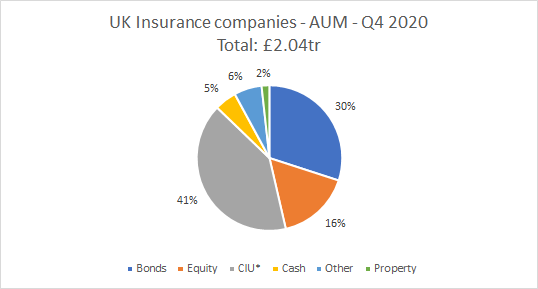
Source: EIOPA. *CIU: Collective Investment Undertaking. These include Undertakings for the Collective Investment in Transferable Securities (UCITS), mutual funds that are issued in Europe and comply with European regulation.
Relevant population of insurers
4.8The insurance sector can be divided between two major classes of business, life and non-life (general) insurance61.
- Life insurers provide protection products (e.g. term life insurance), retirement products (e.g. annuities) and savings and investment products (e.g. endowment policies).
- General insurers provide health, motor, home, travel, commercial and other protection insurance.
4.9In 2020 life insurers accounted for 70% of gross written premiums in the UK and 87.7% of assets under management. General insurers made up 30% of gross written premiums and 12.3% of assets under management62.
4.10To provide insurance services in the UK, a company must be authorised by the Prudential Regulation Authority (PRA), a regulatory body that is part of the Bank of England (BoE). This is true also for subsidiaries of foreign insurance companies.
4.11As of July 2021, the PRA had authorised 362 entities in the UK63 to issue insurance contracts. The list includes subsidiaries of non-insurance entities, such as banking groups. The list encompasses entities that prepare accounts using UK-adopted IFRS (IFRS before 1 January 2021), as well as entities that prepare accounts using UK GAAP. It also includes entities that are inactive.
4.12Section 403(1) of the Companies Act 2006 specifies that the group accounts of a parent company whose securities are, on its balance sheet date, admitted to trading on a UK regulated market64 must be prepared in accordance with UK-adopted IFRS. Where a UK listed company is not required to prepare consolidated accounts, its accounts may be prepared in accordance with either UK GAAP or UK-adopted IFRS65.
4.13UK companies listed on unregulated markets such as AIM66 (a UK market for trading securities that is not a 'regulated market') are not required (but are permitted) to prepare annual accounts in accordance with UK-adopted IFRS under the Companies Act 2006. However, market rules stipulate the use of UK-adopted IFRS when preparing annual accounts.
4.14UK unlisted companies have the option to prepare their accounts using either UK-adopted IFRS or UK GAAP.67 4.15Foreign companies listed on UK regulated markets are permitted to use IFRS Standards as issued by the International Accounting Standards Board (IASB) or other standards, as deemed by UK legislation to be equivalent to UK-adopted IFRS68.
4.16Based on the above, the population of insurers that will be directly affected by the UK's IFRS 17 adoption decision therefore comprises:
- UK companies listed on a UK regulated market or AIM, and required to apply UK-adopted IFRS in their consolidated accounts: and
- Listed and unlisted UK companies that voluntarily apply UK-adopted IFRS.
4.17The table below provides information on this population of insurers, with the data taken from the latest available financial information (2020 in most cases).
UK insurance companies applying IFRS
| ENTITY NAME | CLASS OF BUSINESS | LISTED in the UK? | TURNOVER (GWP) (£'M) | % OF IFRS REPORTERS TOTAL |
|---|---|---|---|---|
| Prudential plc | Life insurance | Yes | 33,16669 | 21.2% |
| Aviva plc | Composite insurer | Yes | 29,015 | 18.5% |
| Legal & General Group Plc | Life insurance | Yes | 12,545 | 8.0% |
| Scottish Widows Limited70 | Life insurance | Yes | 8,205 | 5.2% |
| RSA Insurance Group Limited71 | Non-Life insurance | See footnote 15 | 7,282 | 4.6% |
| Total: 5 largest insurance companies by GWP | 90,213 | 57.5% | ||
| Remaining UK listed insurance companies (or part of UK listed groups) | 32,239 | 20.5% | ||
| All UK listed insurance companies | 122,452 | 78.0% | ||
| Unlisted UK insurance companies applying IFRS | 34,603 | 22.0% | ||
| All UK insurance companies applying IFRS | 157,056 | 100.0% |
4.18We identified 52 insurance companies that use IFRS in the UK, with total gross written premiums of approximately £157 billion. This represents roughly 60% of gross written premiums in the total UK market. These figures include banking groups that have an insurance subsidiary.
4.19Of these 52 companies, 18 are listed (including one company listed on AIM). Their total market capitalisation was nearly £104 billion as of August 202172.
Lloyd's of London
4.20Lloyd's of London is an insurance and reinsurance market place. In 2020 it accounted for £35.5 billion in gross written premiums. Lloyd's of London produces pro-forma financial statements on an aggregated basis under UK GAAP73. Individual entities operate on the market through syndicates. While the syndicates apply UK GAAP, the groups that own those syndicates may apply IFRS in their consolidated accounts in the same way as any other group – and are required to do so if they are listed. We are aware of four such listed insurance companies with Lloyd's of London operations that produce group accounts using IFRS.
Other entities
4.21Other entities that issue or might issue insurance contracts as defined in IFRS 17 are not included in the above assessment for the following reasons.
UK branches of foreign entities
4.22Prior to the end of the UK's transition period (31 December 2020), insurers established in any European Economic Area (EEA) member state could use the passporting regime to establish a branch or provide services (without a UK branch) in the UK without being authorised by the PRA74.
4.23After 31 December 2020 such insurers are still able to conduct insurance business in the UK if the insurer successfully applied to the UK's Temporary Permissions Regime (TPR) before 31 December 2020. However, as they are not required to report according to IFRS Standards, foreign branches are not directly affected by UK's decision on adoption of IFRS 17.
4.24All insurers within the TPR must obtain PRA authorisation within three years, or they will be required to wind down their UK activities75.
4.25In 2019 branches of foreign companies made up only 0.15% of total gross written premiums in the UK76. Their relevance is expected to dwindle even further following the expiry of TPR77.
Companies with limited insurance activities ('non-insurance companies')
4.26IFRS 17 provides scope exclusions78 in respect of certain specific types of contract or obligation that might otherwise meet the definition of an insurance contract. The scope exclusions provided by IFRS 17 can be expected to cover a large proportion of insurance contracts issued by non-insurance companies. Therefore, although a significant impact on an individual entity cannot be ruled out, in general the impact of IFRS 17 on non-insurers in the UK is expected to be minor79.
4.27Should non-insurance companies not meet the scope exclusions allowed in IFRS 17, it is expected that many of these insurance contracts will qualify for the Premium Allocation Approach (PAA), as the contracts are for coverage periods of one year or less. The PAA model provides a simplified measurement model including an option to not apply discounting if the liability for incurred claims is expected to be settled one year or less from the date the claims were incurred. (For further information on the PAA see Section 2.)
4.28The intention of the IASB was that the impact of IFRS 17 outside the insurance sector should be minimal. Given the scope exclusions, together with the simplifications provided by the PAA, it is expected that this will be the case in the UK.
4.29Accordingly, the impact of IFRS 17 on non-insurance companies is not included in this long term public good assessment.80
Will IFRS 17 improve the quality of financial reporting?
IFRS 17's objectives
4.30IFRS 17 paragraph 1 sets out the objective of the standard:
“IFRS 17 Insurance Contracts establishes principles for the recognition, measurement, presentation and disclosure of insurance contracts within the scope of the Standard. The objective of IFRS 17 is to ensure that an entity provides relevant information that faithfully represents those contracts. This information gives a basis for users of financial statements to assess the effect that insurance contracts have on the entity's financial position, financial performance and cash flows.”
4.31IFRS 17 replaces IFRS 4 Insurance Contracts. As an interim standard, IFRS 4 did not prescribe the measurement of insurance contracts but grandfathered existing local accounting practices, permitting changes only if they were deemed to be an improvement on those existing practices. For this reason there is currently diversity in practice between jurisdictions and within the consolidated accounts of some insurance groups. By contrast, IFRS 17 is a comprehensive international accounting standard that establishes principles for the recognition, measurement and presentation of insurance contracts for the first time.
4.32The IASB's IFRS 17 Effects Analysis81 states on page 3 that “IFRS 17 addresses many inadequacies in the existing wide range of insurance accounting practices" and in section 4.1 provides an overview of improved requirements introduced by the standard. The following paragraphs highlight the principal areas where IFRS 17 is likely to lead to improvements in the accounting for insurance contracts in the UK and is by no means a comprehensive analysis of all possible improvements.
4.33First, however, this section provides a brief overview of the basis for current UK accounting practice for insurance contracts under IFRS 4.
Basis for current UK accounting practice under IFRS 4
4.34Many UK insurers that currently apply UK-adopted IFRS adopted IFRS in 2005. IFRS 4 permits the continuation of previously applied local Generally Accepted Accounting Practice (GAAP) so current accounting for insurance contracts in the UK is heavily based on accounting under old (pre-2005) UK GAAP.
4.35For UK accounting purposes insurance business is divided between general insurance and long-term (or 'life') insurance. These categories follow definitions contained in law82 and accounting requirements and practices have developed over time to accommodate the differences between the two categories.
4.36Current UK accounting practice for insurance contracts under IFRS 4 is a confluence of several elements:
- Company law – although companies applying IFRS do not have to comply with the presentation requirements and accounting principles and rules of the Companies Act83, companies may have opted to continue to apply certain presentation and other accounting requirements of the Act.
- Prudential regulation – prudential reporting requirements are relevant because the provisions calculated for regulatory purposes84 form the basis for the provisions reported in the accounts. In particular, long-term business provisions are determined using a modified statutory solvency basis, except for with-profits business which is determined using the regulatory realistic capital basis. Companies could choose, but were not required, to update their accounting policies for the effect of Solvency II.
- Accounting standard – insurers that adopted IFRS from 2005 agreed85 to apply the only insurance specific accounting standard issued by the then UK Accounting Standards Board (ASB), FRS 27 Life Assurance. The principal requirement of FRS 27 was for with-profits liabilities to be determined using the 'realistic balance sheet approach' (i.e. another modified regulatory basis).
- Industry guidance – the Statement of Recommended Practice for Insurance Business published by the Association of British Insurers (the ABI SORP)86 provided recommended accounting practice for both general and long-term insurance business. For the measurement of long-term business, the ABI SORP confirmed the modified statutory solvency basis.
4.37Together the above elements provide the basis for current UK accounting under IFRS 4. Comprising a mixture of law, regulation and accounting requirements they lack a coherent conceptual basis and do not provide consistent principles to underpin insurance accounting.
4.38The ASB formally acknowledged that UK accounting for life insurance was in need of improvement in its 2005 report to HM Treasury titled 'Financial Reporting for Life Assurance'87, published after the issuance of FRS 27 Life Assurance. In its report, the ASB noted that through FRS 27 it had addressed some of the more significant issues identified from its work on life assurance. However, it concluded that there were “major issues relating to life assurance accounting that will need to be addressed by the IASB". These issues included:
- measurement of liabilities (including the treatment of undeclared future bonuses on with-profits policies);
- profit recognition (even after FRS 27 the ASB noted that the profit recognition regime was very different from that which underpinned most developments in financial reporting outside insurance); and
- equity versus liability classification.
As explained in more detail in Section 388, IFRS 17 will require or facilitate improvements in these areas.
Improvements introduced by IFRS 17
4.39One of the main improvements brought about by IFRS 17 is the removal of the IFRS 4 exemption from the requirements in IAS 8 Accounting Policies, Changes in Accounting Estimates and Errors on the development and application of accounting policies. Specifically, that exemption means that an insurer applying IFRS 4 to contracts in the scope of that standard is not required to consider whether its accounting policies are consistent with the IASB's Framework89 or other IFRS Standards, nor whether its accounting policies result in information that is relevant and reliable.
4.40According to the IASB:
“IFRS 17 removes this exemption in IFRS 4 so that, when applying IFRS 17, accounting policies for insurance contracts must result in information that is useful for users of financial statements.” [IASB IFRS 17 Effects Analysis, p. 34]
On this basis alone, IFRS 17 represents an improvement in financial reporting.
Consistent principles
4.41IFRS 17 specifies particular accounting models to recognise and measure insurance contracts, replacing the current accounting practice that lacks consistent principles. The accounting models result in measurement of the liability for remaining coverage and revenue and profit recognition that are broadly consistent with IFRS 1590, and measurement of the liability for incurred claims that is broadly consistent with IAS 37.91 This change will lead to significant improvements in comparability and understandability of the resulting financial information.
4.42IFRS 4 permits companies to depart from the requirement in IFRS Standards to apply uniform accounting policies for similar transactions. In consolidated accounts, therefore, multinational insurers may currently use a combination of different accounting frameworks (e.g. consolidating information prepared using IFRS, UK GAAP, US GAAP or other local GAAPs). IFRS 17 specifies the use of uniform accounting policies and consistent application of its requirements to all the financial information included in the accounts. This will significantly improve comparability between insurers.
Improved scope
4.43Compared with that of IFRS 4, the scope of IFRS 17 has been improved by the provision of an option to apply IFRS 15 Revenue from Contracts with Customers to fixed fee service contracts (see paragraph 2.9 in Section 2).92 This means that companies that issue such service contracts (for example for maintenance or roadside assistance) but that do not otherwise issue insurance contracts will not have to apply IFRS 17, reducing their costs and enhancing the understandability of their accounts.
4.44The scope of IFRS 17 has also been improved by the option to exclude from IFRS 17 contracts that meet the definition of an insurance contract but limit the compensation for insured events to the amount otherwise required to settle the policyholder's obligation created by the contract (for example, loans with death waivers).93 In addition, a company need apply IFRS 17 to credit cards and similar contracts only if it reflects an assessment of the insurance risk associated with an individual customer in setting the price of the contracts. In many cases the application of IFRS 9 Financial Instruments to such contracts will provide more relevant information and will reduce costs for companies.94
Transparent liability measurement
4.45The measurement of insurance liabilities under current UK accounting lacks transparency, as typically it includes implicit margins for risk and prudence. IFRS 17 requires an explicit risk adjustment for non-financial risk to be calculated, included in the measurement and disclosed. It also requires an unbiased estimate of the present value of future cash flows to be determined, included in the measurement and disclosed. IFRS 17 will therefore provide greater insight into the risks associated with an entity's insurance contracts, and insurance contract liabilities measured and disclosed in accordance with IFRS 17 will represent more relevant information and a more faithful representation of the entity's obligations.
4.46Under current UK accounting, non-life insurance contract liabilities may be measured on a discounted or undiscounted basis, typically influenced by conditions set out in law. IFRS 17 requires all estimated future cash flows to be reported on a discounted basis.95 This will enhance consistency between insurance liabilities and other long term liabilities that are also measured on a discounted basis (including financial liabilities, provisions and pensions), and provide a more faithful representation of an entity's financial position.
4.47In addition, IFRS 17 requires discount rates to be updated, to be consistent with observable current market prices, and to reflect the characteristics of the cash flows and the liquidity of the contracts. Under current accounting, discount rates are sometimes based on the return on the assets backing the insurance liabilities. IFRS 17 will provide a more faithful representation of an entity's economic position and the economic cost of insurance claims for all insurance contracts. In particular, any economic mismatches between the insurance liabilities and the assets backing them will be reported.
Grouping of contracts
4.48Current UK accounting under IFRS 4 contains no consistent requirements regarding the level of aggregation of contracts (the ‘unit of account'). By introducing clear requirements96 on this that apply to all types of insurance business, IFRS 17 will ensure that insurers group contracts in similar ways. Further, IFRS 17's requirements for the identification of 'profitability buckets' and the annual cohorts restriction mean that onerous contracts will be promptly and transparently identified, at inception and subsequently. IFRS 17 will therefore provide more relevant and reliable information on an entity's profitability and changes in its profitability, and greater consistency with the accounting for other types of contracts.
Consistent profit recognition
4.49Profit recognition under current accounting in the UK for insurance contracts lacks a consistent basis. For example, current profit recognition bases for annuities and with-profits contracts are very different, resulting in very different profit recognition profiles: for annuities a significant proportion of profit is recognised at inception but for with-profits contracts the majority of profit is recognised towards the end of the contract term.97 IFRS 17 requires the application of a consistent approach that is not dependent on product type. The IASB IFRS 17 Effects Analysis describes the approach as follows:
“IFRS 17 requires a company to recognise profit according to the way it is earned from:
- the contractual service margin – recognised as profit as the company provides services over the coverage period; and
- the risk adjustment – recognised in profit or loss as the company is released from risk over the coverage period and the settlement period.
IFRS 17 requires a consistent approach for the recognition and measurement of the contractual service margin, and for the determination of explicit risk adjustments.” [IASB IFRS 17 Effect Analysis p. 33]
4.50The accounting model applied (whether the General Measurement Model, Variable Fee Approach or Premium Allocation Approach see Section 2 above) will depend on the economic characteristics of the relevant group of contracts rather than on regulatory definitions, improving the relevance of the financial information and ensuring the accounting provides a faithful representation of the effect of the contracts.
4.51The current practice of recognising premiums for some long-term contracts on a receivable basis will be changed on implementation of IFRS 17. Further, IFRS 17 specifies that deposit components are excluded from revenue, consistent with the treatment of deposits in financial instruments. Revenue will be recognised as services are provided, improving comparability and consistency of revenue recognition with other types of contracts under IFRS.
4.52The reconciliation of changes in the Contractual Service Margin (CSM) referred to below (paragraph 4.59) will also provide useful insight into profitability:
“The Board expects that such information about the current and future profitability of insurance contracts will significantly improve the transparency of reporting for insurance contracts and provide important additional information for investors and other users of financial statements for their decision-making."[IASB IFRS 17 Effects Analysis p.43]
Improved presentation
4.53Current accounting provides no consistent presentation of revenue from insurance contracts. The metric ‘earned premiums' is usually presented as representing revenue for general insurance but not for life insurance business. Under IFRS 17 insurance revenue will be consistently presented for all insurance contracts,98 enhancing comparability between insurers and with entities in other sectors.
4.54The standardised structure of the income statement introduced by IFRS 17,99 and in particular the separation of the insurance service result from insurance finance income or expenses, will enhance comparability between insurers and improve the understanding of the drivers of performance. The requirement to explain the relationship between insurance finance income or expenses and the investment return on the entity's assets will provide a clearer insight into the effect of economic changes on an entity's assets and liabilities, and of any economic mismatches.
4.55Current insurance entity income statements include a variety of line items that can lack transparency. For example, the commonly used line item 'change in insurance contract liabilities' may incorporate several elements, including the implicit accretion of the liability, the effect of changes in assumptions, the effect of new business and the impact of premiums presented as revenue but not yet reflected in profit. However, these elements are not always consistently disclosed and may not be the same in each entity.
4.56IFRS 17 will mean that similar transactions are presented similarly by all insurance companies. This has not always been the case under IFRS 4. For example, UK insurance companies have presented deferred acquisition costs in a variety of ways, including as an intangible asset, as a prepayment or as an asset of indeterminate classification.
4.57Under current accounting in the UK, components of the rights and obligations arising from insurance contracts are presented in different line items on the balance sheet (for example, in deferred acquisition costs, receivables and insurance contract liabilities). The requirement under IFRS 17 to present a single insurance contract asset or liability for a group of contracts, comprising all insurance components of the contracts (with further disaggregation in the notes), will represent a simplification and enhance understandability.
Enhanced disclosures
4.58IFRS 17's extensive and standardised disclosure requirements will enhance transparency and understandability. For example, IFRS 17 requires reconciliations from the opening to the closing balances of key balance sheet items100 including the liability for remaining coverage, any loss component and the liability for incurred claims. Separate reconciliations are also required for the estimate of the present value of future cash flows, the risk adjustment and the CSM. These extensive new disclosures will provide users of accounts with greater understanding of how the carrying amounts of insurance contracts have changed.
4.59Similarly, the extensive disclosures required by IFRS 17 of changes in the CSM101 and of when the entity expects to recognise CSM in future102 will provide more consistent insight into developments in an entity's past and expected profitability. Changes in the CSM relate mainly to the recognition of income in profit or loss reflecting the provision of services in the period. However, they may arise for other reasons, including the effect of new contracts added to the group and changes in claims expectations, and the reconciliations will explain such changes, enhancing transparency and understandability.
Costs and benefits of applying IFRS 17
Introduction
4.60Regulation 7(2)(b) of SI 2019/685 requires the UK long term public good assessment to have particular regard to the costs and benefits that are likely to result from the use of the standard.
4.61The purpose of this section of the [Draft] ECA is to address Regulation 7(2)(b). Consideration has been given to costs and benefits for insurance companies, primary users of insurance company accounts and other stakeholders.
4.62Other sections of this [draft] ECA also address what are, in a broad sense, the likely costs and benefits of applying IFRS 17. In particular, the section above concerning whether the standard is likely to improve the quality of financial reporting sets out key benefits of the standard, and aspects of the assessment below of IFRS 17's wider economic impact also describe costs and benefits likely to result from the standard. While this section makes reference to such wider costs and benefits, its focus is on the more direct effects on expenditure and operational benefits.
4.63In its IFRS 17 Effects Analysis the IASB advised stakeholders that applying IFRS 17 may involve significant time, effort, and cost to gather new information, employ or develop people with appropriate skills and make changes to their financial systems. In addition, the IASB noted that transition to IFRS 17 will require a significant level of engagement with, and education of, users.
4.64While stakeholders have generally quantified the costs of implementing IFRS 17, they have not quantified the costs of complying with IFRS 17 on an ongoing basis. In addition, the evaluation of anticipated benefits is primarily qualitative, due largely to the challenges of quantifying benefits accurately prior to implementation.
4.65Information on costs and anticipated benefits has been sourced from UKEB User and Preparer surveys103, a User roundtable104 and webinars105 as well as from interviews with individual stakeholders. Sixteen insurance companies responded to the Preparer survey, representing approximately 67% of the total gross written premiums of all UK insurance companies using IFRS. Twenty-one users participated in the User survey with representation from analysts, ratings agencies and investor associations. Nine analysts also attended the User roundtable to discuss the key themes identified in the User survey. In addition, we also held a series of interviews with preparers, users and regulators in September 2021 to validate aspects of our assessment.
4.66The assessment has also considered external research from a range of third parties, as referenced in this section.
Costs
Insurance companies: implementation costs
Direct costs
4.67A 2018 KPMG report106 observed that IFRS 17 'marks the biggest single change to insurance accounting — bigger than the introduction of IFRS itself, since up till now IFRS has carried forward the use of pre-existing bases of accounting for insurance contracts with minimal harmonization.'
4.68This is reflected in the feedback from Insurance companies that participated in the Preparer survey. Survey participants anticipated implementation costs in the range of £3.5m to £191m, with the aggregate cost being approximately £783m107. Life insurance companies' costs were typically greater (69% of the aggregate survey costs) than other types of insurance companies due to the longer coverage periods of their contracts and the higher volumes of data required to meet the requirements of IFRS 17.
4.69Extrapolating the aggregated costs from the survey for all UK IFRS reporters equates to an approximate total implementation cost of £1.18 billion108. For context, most survey participants in the preparers survey noted that the costs represented 1% or less of their annual Gross Written Premiums, calculated as an average over the last 5 years.
Indirect costs
4.70Some participants in the Preparer survey found that achieving compliance with IFRS 17 would require major change programmes extending outside the finance and actuarial functions109 and impacting data, systems and processes. Consequently, many IFRS 17 implementation programmes have required significant investment and are several years in duration.
Footnotes:
57 This refers to insurance contracts that function as long-term savings products (e.g. endowment policies and pensions savings products) 58 OECD data: https://stats.oecd.org/Index.aspx?DataSetCode=PT5#. Estimates vary depending on the reporting organisation: as of 2019, according to Swiss RE, insurance business written in the United Kingdom amounted to about £285bn (Swiss RE Institute, Sigma Report N 3/2021, “World insurance: the recovery gains pace"); this figure is higher than one provided by EY (£253bn) and one provided by Insurance Europe (£223bn). The reason for the differences is not clear. 59 As reported by the Bank of England: https://www.bankofengland.co.uk/prudential-regulation/publication/2020/insurance-data-release-information-and-format-a-call-for-feedback 60 And EIOPA: https://www.eiopa.europa.eu/tools-and-data/insurance-statistics_en Credit Swiss Wealth Reports and Global Wealth Databooks can be found here: https://www.credit-suisse.com/about-us/en/reports-research/global-wealth-report.html 61 According to UK law, an insurer must be separately authorised to write either life or non-life insurance business. While historically a few companies were authorised to write both (composite insurers), currently no new composite licences may be granted. See https://uk.practicallaw.thomsonreuters.com/0-501-2031?transitionType=Default&contextData=(sc.Default) 62 Gross Written Premium Breakdown: Swiss RE Sigma Report 3/2021 AUM breakdown: EIOPA data 63 See list published by the Bank of England: https://www.bankofengland.co.uk/-/media/boe/files/prudential-regulation/authorisations/which-firms-does-the-pra-regulate/2021/list-of-authorised-insurers/list-of-uk-insurers-july-2021.pdf 64 The following are UK regulated markets: IPSX; The London Metal Exchange; ICE Futures Europe; London Stock Exchange; Euronext - Euronext London; NEX Exchange; Cboe Europe Equities Regulated Market. 65 See FCA Handbook: 1.pdf (fca.org.uk) 66 See AIM Rules: AIM Rules for Companies (01012021)_1.pdf (londonstockexchange.com) 67 See section 395 for individual accounts and section 403 for group accounts 68 UK SI 2019/707, regulations 67 and 68. Equivalent standards are: * IFRS Standards as adopted by the European Union. * Generally Accepted Accounting Principles of Japan. * Generally Accepted Accounting Principles of the United States of America. * Generally Accepted Accounting Principles of the People's Republic of China. * Generally Accepted Accounting Principles of Canada. * Generally Accepted Accounting Principles of Korea. 69 Gross written premium amount presented in Prudential's Annual Report 2020 USD$42,521 translated to GBP using average exchange rate for the year to date (1 USD : 0.78 GBP) as disclosed in Prudential's Annual Report 2020 note A1 Exchange rates (page 215). 70 Scottish Widows Limited is a subsidiary of the Lloyds Banking Group 71 Source RSA Annual Report as at 31 December 2020. RSA was acquired in June 2021 and has since been delisted from UK exchanges. 72 This figure excludes the market capitalisation of financial and non-financial companies that have insurance businesses, such as Scottish Widows Limited, HSBC Life or Tesco Underwriting. The gross written premiums attributed to these businesses are, however, included in the figures displayed in the table. 73 The Society of Lloyd's prepares its own financial statements using IFRS. 74 https://www.fca.org.uk/brexit/temporary-permissions-regime-tpr 75 https://www.dacbeachcroft.com/en/gb/articles/2021/january/life-after-passporting-the-insurance-sector/ 76 As reported by the OECD: https://stats.oecd.org/Index.aspx?DataSetCode=INSIND 77 A similar point is made in the Economic Report. 78 IFRS 17:7 79 Further information on the impact of IFRS 17 on non-insurers is provided in an ICAEW Financial Reporting Faculty Factsheet. 80 For the avoidance of doubt, insurance companies that are subsidiaries of non-insurance companies (e.g. banks) are included in the assessment. 81 IFRS Standards Effects Analysis - IFRS 17 Insurance Contracts (May 2017). See link: IFRS 17 Effects Analysis 82 These terms were defined in The Financial Services and Markets Act 2000 (Regulated Activities) Order 2001 83 Requirements relating to insurance companies were set out in the Companies Act 1985 (Insurance Companies Accounts) Regulations 1993, this was superseded by the Companies Act 2006 and The Large and Medium-sized Companies and Groups (Accounts and Reports) Regulations 2008 (SI 2008/410) 84 The relevant piece of regulation in 2005 was the Integrated Prudential Sourcebook 2004. This was superseded in 2007 and again in 2016 by Solvency II 85 Major insurance and bancassurance groups, with the support of the ABI, entered into a Memorandum of Understanding with the ASB in December 2004 under which they undertook to apply the requirements of FRS 27 in their IFRS accounts 86 The ABI SORP was last updated in 2006 and has subsequently been withdrawn 87 https://www.frc.org.uk/getattachment/2757d651-1f05-4dd6-a1cf-79a648b8a540/Life_Assurance_Report_to_HM-Treasury-June-2005.pdf 88 See in particular the discussion relating to with-profits inherited estates in Section 3 89 Now superseded by the IASB's Conceptual Framework (2018) 90 IFRS 15 Revenue from Contracts with Customers 91 IAS 37 Provisions, Contingent Liabilities and Contingent Assets 92 IFRS 17:8 93 IFRS 17: 8A 94 IFRS 17: 7(h) 95 Except, in measuring the liability for incurred claims under the PAA, when cash flows are expected to be paid or received in one year or less. IFRS 17:59 96 See Section 2 and the more detailed discussion in Section 3 - Priority issue C 97 For more detail see the discussions in paragraphs 4.151 – 4.176 below 98 IFRS 17:83 99 IFRS 17:80–82 et seq 100 IFRS 17:98–105B 101 IFRS 17: 101; 104 102 IFRS 17: 109 103 Refer to UKEB website for the IFRS 17 Preparer and User Survey Summaries 104 Refer to UKEB website for the IFRS 17 User Roundtable Summary 105 Refer to UKEB website for the IFRS 17 webinars 106 KPMG - Can you see clearly now? Analysts' views on IFRS 17 and the insurance reporting landscape (December 2018) 107 One survey participant chose not to disclose their implementation costs but noted that they were similar in nature to their Solvency II implementation cost. Their implementation cost was estimated by using a regression model based on their Gross Written Premium and was broadly in line with their Solvency II costs. 108 Participants in the UKEB Preparers survey account for over £100 billion in gross written premiums, representing approximately 67% of the UK insurance sector. As the survey covered most, but not all the IFRS-adopting insurance companies in the UK, the information collected through the survey was extrapolated to estimate the total overall cost of compliance. The portion of costs attributable to non-surveyed insurance companies was estimated by a linear regression model based on the below equation: Cost of compliance _i= β_0+ ẞ_1 Gross Written (Premiums) _i+ u_i Coefficients ẞ0 and ẞ1 were used to estimate the cost of compliance for insurance companies where we did not have costs but were able to identify gross written premiums. 109 The Global Public Policy Committee (GPPC) is a global forum of the six largest accounting networks. The GPPC also noted in their paper 'Implementation of IFRS 17 Insurance Contracts - Considerations for those charged with governance' (2020) that there would be wide-ranging potential business impacts on insurance companies encompassing 'strategy, planning, equity and income patterns, pricing, products and distribution channels, taxation, KPIs used to measure management compensation and capital management.'
Insurance companies: implementation costs
Direct costs
4.67 A 2018 KPMG report[^106] observed that IFRS 17 'marks the biggest single change to insurance accounting — bigger than the introduction of IFRS itself, since up till now IFRS has carried forward the use of pre-existing bases of accounting for insurance contracts with minimal harmonization.'
4.68 This is reflected in the feedback from Insurance companies that participated in the Preparer survey. Survey participants anticipated implementation costs in the range of £3.5m to £191m, with the aggregate cost being approximately £783m[^107]. Life insurance companies' costs were typically greater (69% of the aggregate survey costs) than other types of insurance companies due to the longer coverage periods of their contracts and the higher volumes of data required to meet the requirements of IFRS 17.
4.69 Extrapolating the aggregated costs from the survey for all UK IFRS reporters equates to an approximate total implementation cost of £1.18 billion[^108]. For context, most survey participants in the preparers survey noted that the costs represented 1% or less of their annual Gross Written Premiums, calculated as an average over the last 5 years.
Indirect costs
4.70 Some participants in the Preparer survey found that achieving compliance with IFRS 17 would require major change programmes extending outside the finance and actuarial functions[^109] and impacting data, systems and processes. Consequently, many IFRS 17 implementation programmes have required significant investment and are several years in duration.
4.71 Survey participants took a range of approaches to achieve compliance with IFRS 17 based on a 'gap analysis' from their current state to their target compliant state. These included narrow scope 'compliance only' approaches through to wider scope 'finance transformations' delivering wider operational changes in addition to achieving compliance with IFRS 17.
4.72 Examples of wider transformational activities included:
- The upgrade, replacement or decommissioning of legacy finance or actuarial systems;
- Creation of 'data lakes' to store finance and actuarial data including tools to interrogate and visualise that data;
- Process re-engineering, automation and documentation, particularly around key governance controls and the working day timetable; and
- Enhanced data policies, architecture, sourcing, remediation and controls.
4.73 In some cases, the costs of these wider transformation approaches were included in the reported total cost of IFRS 17 compliance. One survey participant noted their total reported IFRS 17 implementation cost included a significant level of actuarial and finance transformation costs and therefore should not be interpreted as directly attributable to the cost of compliance. However, due to the integrated nature of the programme it was difficult to isolate the actual compliance cost.
4.74 Other participants viewed these types of costs, for example replacing a general ledger, as direct costs of compliance on the basis that the costs would not necessarily have been incurred had they not been a factor in enabling IFRS 17 compliance.
4.75 It is possible, therefore, that not all the reported costs are directly attributable to achieving IFRS 17 compliance and that the total may to some extent be over-stated.
4.76 Survey participants advised that the cost of implementing IFRS 17 was significant due to a range of factors including:
- Insurance companies operating legacy finance and actuarial systems, inflexible operational environments or with data integrity issues were required to make significant investments in strategic solutions;
- Delays to the finalisation of IFRS 17 by the IASB had the effect of slowing industry consensus and engagement with audit firms. This also impeded third party providers from offering 'production ready' calculation tools, meaning that a significant amount of the research and development fell to the insurance companies;
- Brexit negotiations caused uncertainty relating to whether UK companies were required to comply with EU or UK-adopted IFRS; and
- The Covid-19 pandemic introduced unexpected delays and additional costs as resources and management attention were diverted from the implementation of the standard.
4.77 Most UK insurance companies plan to apply IFRS 9 Financial Instruments at the same time as they apply IFRS 17 (1 January 2023). Nearly all survey participants considered the implementation costs of IFRS 9 to be 'negligible'. Most were delivering IFRS 9 requirements as part of the wider IFRS 17 programme or as part of business as usual.
Ongoing costs
4.78 The IASB's IFRS 17 Effects Analysis notes that the IASB 'expects companies to incur incremental costs in applying IFRS 17 on an ongoing basis'. They also acknowledged that the 'ongoing costs to maintain accounting and actuarial systems, processes and internal controls are expected to be higher for many companies compared with those incurred when applying IFRS 4'.
4.79 Most survey participants had yet to fully assess and quantify the impact of IFRS 17 on 'business as usual' costs as their solutions were still in development. However, 64% anticipated that costs were likely to increase to ‘some extent' while 36% expected no material change. Examples of additional ongoing costs included additional audit fees, licence costs for IFRS 17 specialist software and additional finance and actuarial resources to manage the reporting processes.
4.80 However, the majority noted they were anticipating either neutral or negligible cost increases after identifying operational efficiencies in their transformation programmes.
4.81 The requirements of the standard that survey participants anticipated causing the most significant on-going costs were:
- The grouping of contracts into profitability buckets — this requirement is considered to significantly increase the amount of management review required.
- The grouping of contracts into annual cohorts - maintaining, processing and storing significantly more data is expected to require additional data warehousing and new visualisation tools and licence fees for third-party software.
- The use of historic 'locked-in' discount rates as well as current rates — would require more management time and new or upgraded actuarial models, incurring extended or new licence fees.
- Risk adjustment – as the computation and disclosure of the risk adjustment and related confidence levels were considered highly judgmental, they would require additional modelling capabilities and management time.
- Disclosures and granularity of reporting - The new and extensive disclosures would result in increased ongoing reporting costs both internally (e.g. skilled reporting resources) and externally (e.g. audit costs).
- Eligibility testing for determining VFA at an individual contract level – e.g. when new business is written by a with-profit fund.
4.82 Of the survey participants that were responding on behalf of a group, 45% expected subsidiaries to have to prepare individual entity accounts using policies other than IFRS 17. Of these, all expected that this would lead to both greater differences in accounting between subsidiary and group and increased annual financial reporting costs.
Other external sources relating to costs for insurance companies
EFRAG - Final Endorsement Advice Appendix III (June 2020)
4.83 EFRAG amended their 2018 insurance company survey in June 2020 and separately identified the four UK participants. Overall, they found that implementation costs had significantly increased for participants since 2018. For context, EFRAG also noted that each of the listed participants had paid average annual dividends in excess of €1 billion for the past 5 years (excluding share repurchases).
EFRAG Estimated costs and savings profile (Appendix III)
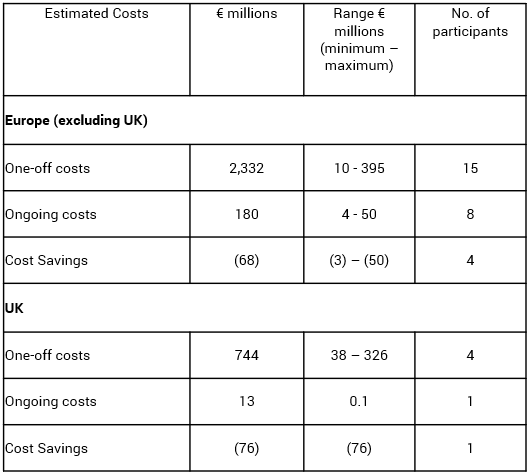
4.84 The four UK participants' implementation costs, when converted to pounds equate to an aggregate of £630m with a range of £32m - £275m and cost savings (for one participant) of £64m.39
4.85 In the Preparer survey, the four participants with the largest implementation costs had a lower aggregate cost of £565m and a wider cost range of £91m to £191m, with no cost savings reported. During the follow up interviews with a sample of insurance companies in September, all advised that their implementation cost profiles had not significantly changed. The reasons for the apparent differences from EFRAG's results are unclear40.
4.86 However, in broad alignment with the Preparer survey41, EFRAG also found that for all participants by mid-2020, 42% of insurance company implementation costs had already been incurred at the time of their assessment.
4.87 EFRAG noted that 21% of their total participants had identified material estimated cost savings. These related mainly to internal changes including increased use of automation, a switch to internal solutions, improved interfaces between group and local entities and other operational efficiencies42.
SAS43 Perspectives and approaches to IFRS 17 (2018)
4.88 SAS surveyed 100 senior executives working in the UK insurance industry and identified that insurance companies were preparing for major changes to their data and accounting and actuarial systems to achieve compliance with IFRS 17. They also found that over 80% of respondents anticipated having to make significant investments in these areas.
4.89 The SAS survey also found that nearly all their survey participants (97%) expected IFRS 17 would increase the cost and complexity of their operations. Their respondents (90%) also anticipated that the costs would exceed those incurred for the implementation of Solvency II.
Users: costs
4.90 The UKEB User survey found that most users consider the accounts their 'most important' source of information when assessing insurance companies. Approximately two thirds of users anticipated significant operational changes relating to collecting new data, rebuilding valuation model inputs, updating processes and training staff. However, despite these anticipated operational changes, most did not consider either implementation or ongoing costs would be significant.
Sunk costs
4.91 In developing IFRS 17 the IASB undertook an evaluation of the costs and benefits of the standard to decide whether the standard should be issued. However, the assessment of costs and benefits in this DECA is being performed in accordance with the statutory endorsement criteria in SI 2019/685, and relates to the separate, and later, decision by the UKEB as to whether to adopt IFRS 17 for use in the UK.
4.92 Guidance in the Government's 'Green Book44 indicates that expenditure 'already incurred' (i.e. incurred prior to the implementation of a policy or regulation) should in principle be excluded from the appraisal of costs and benefits i.e., treated as 'sunk cost'. The rationale is that only costs and benefits affected by decisions still to be made should be included in the analysis.
4.93 Although the UKEB is not required to comply with the Green Book, in this context it has adhered to Green Book principles as far as possible. The Green Book approach to sunk costs has therefore been referred to in determining an appropriate approach for our assessment of IFRS 17. This approach to sunk costs is also broadly consistent with the requirement of SI 2019/685, which requires consideration of “the costs and benefits that are likely to result from the use of the standard” in the context of a UK long term public good assessment [emphasis added].
4.94 IFRS 17 was issued by the IASB in May 2017 with an effective date of January 2021. However, the effective date was postponed to January 2023 following further amendments proposed in June 201945, which were finalised in June 2020.
4.95 As the lead-in time for compliance with IFRS 17 spans several years, insurance companies could not afford to defer the commencement of their implementation programs until after the formal adoption of the standard for use in the UK. Survey participants indicated that approximately 44% (£347m) of their total implementation costs had been incurred by 30 June 2020. Based on the estimated overall industry implementation cost of £1.18 billion, this would suggest that £518m (i.e. 44%) had been incurred by the industry by 30 June 2020.
4.96 Determining an appropriate point before which IFRS 17 implementation costs should be treated as sunk is a matter of judgement. Key factors considered include:
- the date all significant recognition, measurement and presentation requirements in IFRS 17 were finalised by the IASB;
- the month in which a substantive IFRS 17 UK endorsement project commenced; and
- the date from which stakeholders could reasonably be considered to have a legitimate expectation that the UKEB will adopt IFRS 17 for use in the UK.
4.97 Both a) and b) occurred during quarter 2 of 2020. A legitimate expectation that the UKEB will adopt IFRS 17 is considered to have arisen on the sharing of the complete IFRS 17 DECA package for the UKEB's 28 October 2021 Board meeting. On this basis, the costs incurred by insurance companies up to the end of June 2020 represents the minimum that should be viewed as sunk costs. Although not quantified, significant further costs have been incurred by insurance companies since that date and would therefore also fall to be treated as sunk costs.
4.98 Whilst the analysis of costs above recognises the significant implementation costs incurred by insurance companies, the UKEB took into account the fact that, were it to decide not to adopt IFRS 17 for use in the UK, it is unlikely that implementation costs incurred to date could be reversed or recouped. Therefore, the focus of the assessment of costs in this DECA and the basis for the adoption decision are the net long term costs from use of IFRS 17.
4.99 Insurance companies have incurred most of the implementation costs and some have identified indirect benefits from that investment. To the extent those benefits arise directly from the costs incurred prior to October 2021, those benefits would also be excluded. These indirect benefits are very difficult to quantify. However, as most participants in the Preparer survey noted limited or no benefits, any such benefits would be highly unlikely to have a significant impact on the assessment of total net sunk costs or on an adoption decision.
Benefits
Insurance companies: benefits
Direct benefits
4.100 The Preparer survey found that approximately two thirds of participants anticipated negligible or no benefits from the implementation of IFRS 17. This view was not unexpected as most of the IFRS 17 implementation costs fall on insurance companies while most of the expected benefits arise for users of their accounts.
4.101 Most survey participants anticipated moderate benefits from the opportunity to streamline internal systems and processes and gain a better understanding of their data. Of those responding on behalf of a group most also anticipated moderate benefits from achieving greater consistency of accounting treatment between entities in the group. Two large insurance groups rated these benefits as significant46.
4.102 The top five most common potential benefits identified by insurance companies in the preparer survey were:
- Greater comparability with other insurance companies – disclosure of risk adjustments and related confidence levels will enable the level of risk in reserves to be assessed more accurately. The CSM, and its projection for new business, will demonstrate the actual profitability achieved;
- Internal systems streamlining – enhancements of actuarial and finance systems and the removal of legacy systems and associated maintenance costs and risks;
- A better understanding of data - greater insight into financial performance through increased granularity of profitability information;
- More useful information for users – by providing a better understanding of insurance businesses the sector may potentially become more attractive to investors; and
- Greater alignment with Solvency II – due to the importance shareholders and other external stakeholders place on understanding the capital position and dividend capacity.
4.103 Some insurance companies also observed during interviews that they were likely to find the additional disclosures required by IFRS 17 useful for gaining insight into their peers' approaches and performance. Given a single international basis of accounting, international insurance groups should also benefit from reduced training costs and from more flexible deployment of staff.
Indirect benefits
4.104 In addition to achieving compliance, some participants commented that they had identified several non-financial indirect benefits. These were difficult to quantify as they related to a range of areas such as improvements in the completeness and accuracy of policy and claims data, more efficient processes and effective controls or refreshed technology infrastructure. It is therefore possible that wider recognition of the benefits to insurance companies of implementing IFRS 17 and applying the standard on an ongoing basis may emerge over time 47.
4.105 While several Preparer survey participants noted similar indirect benefits, they did not disclose quantifiable cost savings. In follow up interviews participants noted that, where cost savings had been identified, they were not considered significant and had been used to offset anticipated increases in business-as-usual costs. Others noted that while they were expecting to realise operational improvements and efficiencies, these had not resulted in any significant cost savings.
4.106 From paragraph 4.221 we discuss cost of capital for insurance companies. Although stakeholder views were mixed, the [tentative] conclusion is that in the long-term insurance companies may potentially benefit from a lower cost of capital and improved access to capital. Given the scale of insurance company balance sheets, even a small reduction in cost of capital could result in significant gains to insurance companies over the long term.
External sources relating to benefits for insurance companies
EFRAG - Final Endorsement Advice Appendix III (June 2020)
4.107 EFRAG noted that none of the four UK participants in their survey considered that the benefits of IFRS 17 would outweigh the costs. This contrasted with the result for the other participants in their survey, 38 per cent of whom considered that the benefits of applying the standard would outweigh the costs. EFRAG's assessment also noted that some insurance companies viewed IFRS 17 as an opportunity to improve internal data, processes and systems and that many companies noted these as significant improvements that would have long term benefits for their organisations.
SAS - A Transformation in Progress - Perspectives and approaches to IFRS 17 (2018)
4.108 SAS found that 84 per cent of their survey participants believed that the changes from IFRS 17 would deliver additional benefits for their organisation beyond compliance, while only 12 per cent viewed the implementation of the standard as purely a compliance exercise.
4.109 In contrast to the UKEB Preparer survey results, SAS also found that UK insurance companies broadly welcomed the standard and that '87 per cent believe it will either be crucial for the survival of the insurance industry or will at least increase robustness for the future'.
4.110 While the reasons for the apparent disparity between the results of the SAS survey and the UKEB Preparer survey are unclear, factors could include the role and seniority of participants and the timing of the survey. The SAS participants may have placed greater weight on a longer term, strategic and post-implementation perspective while the UKEB survey sought responses from participants directly involved with implementation and who may have reflected a more technical view based on their experiences. In addition, the UKEB Preparer survey was more recent (2020 compared with 2018), so respondents would have had more exposure to the practical challenges and implications of implementation.
Users: benefits
4.111 Based on feedback from the User survey, roundtable and interviews, most users considered that accounts prepared under IFRS 17 would represent an improvement over current accounting by insurance companies and that, for them, the benefits would exceed the costs.
4.112 Nearly all participants in the User survey anticipated that IFRS 17 would result in better comparability between the financial statements of insurance companies and were optimistic about the realisation of the intended benefits. Most also expressed frustration with the current accounting for insurance contracts, with several highlighting challenges arising from inconsistent accounting practices and less insightful disclosures.
4.113 Users anticipated that insurance companies would start to share detailed information on the impact of IFRS 17 in Q2 or Q3 of 202248, and expressed a desire for more and earlier engagement from insurance companies. They noted that until they had access to accounts prepared on an IFRS 17 basis it would be challenging to provide a definitive view on the overall potential benefits.
4.114 User survey participants were asked to rank anticipated benefits in order of their significance. The top five are summarised below49:
- Consistent revenue and profit recognition - users considered that IFRS 17 should help resolve the main causes of the lack of comparability of financial information presented by insurance companies. The recognition of revenue as services are provided over the coverage period would result in more consistent recognition of revenue and profits. In addition, for life companies in particular, the relationship between new business and the back book would become more transparent.
- Detailed disclosure of key assumptions and estimates - disclosures of discount rates were considered a significant improvement that would provide greater insight regarding management expectations and the level of prudence inherent in estimates. The requirement for explicit differentiation between the risk adjustment for non-financial risk and the CSM was expected to provide greater insight into the emergence of profit.
- Measurement principles being closer to Solvency II - users anticipated that the fact that the IFRS 17 measurement basis (broadly best estimate plus risk adjustment) aligned more closely to Solvency II would make it easier to understand and interpret an entity's accounting and capital positions.
- Separate reporting of underwriting and investing results - users will be able to distinguish between and assess management performance in respect of the main drivers of profitability from insurance company activities i.e., the provision of insurance coverage and investment activities.
- Identification of onerous contracts - as gains and losses on these contracts can no longer be offset, they will become transparent to users through the loss component.
4.115 A majority of users surveyed did not consider that the principle-based nature of the standard would allow excessive judgement by insurance companies. However, a majority thought that alternative performance measures would still be required.
4.116 The UKEB conducted a roundtable discussion with users in June 2021. In addition to the points noted above, in relation to benefits, that discussion also identified that users valued the greater simplicity and clarity of the statement of profit or loss and other comprehensive income under IFRS 17. It was expected to provide them with much greater insight into the separate sources of income and expenses of insurance companies.
4.117 Further information on the expected improvements in financial reporting which will benefit users of insurance company accounts is set out earlier in this Section 4 under the heading 'Will IFRS 17 improve the quality of financial reporting'.
External sources relating to benefits for users
EFRAG - Final Endorsement Advice Appendix III (June 2020)
4.118 EFRAG also concluded that overall, most users anticipated greater benefits than costs. Key benefits identified were similar to those identified in the UKEB outreach and related to 'the identification of onerous contracts, profit earned as services are provided, disclosure of the assumptions used and measurement being closer to Solvency II, split of the underwriting and investing results.
KPMG: analysts' views on IFRS 17 and the insurance reporting landscape (December 2018)
4.119 KPMG conducted a global survey of 20 insurance analysts and noted that they found the current financial information challenging to use (see diagram below). The most common challenges were noted as 'different discount rates currently used to discount liabilities, the different allowances insurers make for prudent margins and the use of inconsistent measurement bases.'
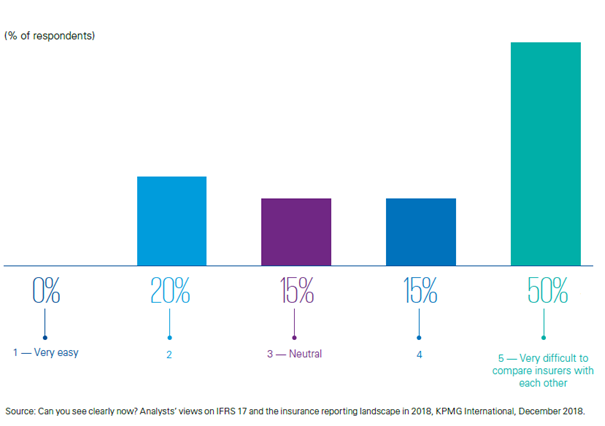
Source: Can you see clearly now? Analysts' views on IFRS 17 and the insurance reporting landscape in 2018, KPMG International, December 2018.
4.120 KPMG concluded that analysts expected some significant benefits from IFRS 17. However, at the time of the survey they were not sufficiently familiar with the requirements of the standard to draw firm, detailed conclusions.
Aon50 – The Impact of IFRS 17 on Key Performance Indicators (February 2020)
4.121 Aon hosted a roundtable in London with representatives from rating agencies (AM Best, Moodys, Fitch, Standard & Poor's), auditors (BDO and Deloitte) and investment banking (Berenberg) to seek a high-level consensus on the shape of future insurance company KPIs.
4.122 Analysts foresaw that the change in the CSM would form the basis of a KPI within the life insurance sector. This was because it '...shows trends in performance by making it clearer how expenses, claims, strength of underwriting interact with the profitability of groups.'
4.123 Participants in the Aon roundtable discussion also noted that under IFRS 17 the income statement may 'more transparently' demonstrate the actual value of the investment function for the first time. Participants expected the reported relationship between investment income and the unwinding of the discount on insurance liabilities would provide new insights into the investment function.
4.124 Overall, Aon roundtable participants supported the standard, noting that ‘although the requirements are complex, analysts consider IFRS 17 a major improvement to financial reporting in the insurance industry".
Other stakeholders
Auditors: costs and benefits
4.125 Auditors are likely to be required to undertake specialist training on the requirements of IFRS 17 and audit teams may require additional expertise in relation to actuarial methodology, systems and data analytics. Auditors may also need to invest in new tools and technologies to assess data and to replicate actuarial modelling.
4.126 Accountancy Europe51 advised the EFRAG TEG52 in July 2020 that auditors were likely to require '...significant investments in technology such as digital auditing platforms, big data analysis and the required computational capabilities as well as the application of artificial intelligence in actuarial models to conduct IFRS 17 audits.'
4.127 In the UK most insurance companies are audited by the largest audit firms. These firms have been preparing for the impact of IFRS 17 on their audits and advisory work for some time and have sufficient resources to scale up as necessary. In addition, participants in the Preparer survey expect some of these costs to be passed on to insurance companies through advisory fees and increased audit fees. While some costs may be borne by auditors to enhance their offering, the assumption is that the majority is likely to be passed on to insurance companies due to the increased complexity of the audit. The investment in developing IFRS 17 expertise can also be shared across international networks, not borne solely in the UK.
4.128 Auditors are expected to benefit from having a comprehensive set of accounting requirements to audit against and from being able to benchmark more readily due to a higher level of consistency in insurance company accounting practices53. In addition, there may also be benefits for auditors from not being required to understand the range of local GAAPs currently used by insurance companies, and from the increased transferability of staff across international networks.
Regulators: costs and benefits
4.129 In their IFRS 17 Effects Analysis the IASB noted that IFRS 17 '... is not designed with the objective of being suitable for regulatory and tax frameworks.' The IASB also stated that they would only expect regulators and tax authorities to incur costs if their requirements depended on financial reporting.
4.130 The IASB IFRS 17 Effects Analysis also noted that due to the consistency introduced by the standard there could be a potential reduction in the costs associated with '...analysing differences between financial reporting data and regulatory or tax reporting data of insurance companies that may be currently incurred by regulators and tax authorities'.
4.131 In the UK, the main regulators relevant to insurance companies are the Prudential Regulation Authority (PRA) and the Financial Conduct Authority (FCA), responsible for the prudential regulation and supervision of insurance companies.
4.132 The PRA does not use company accounts as the primary basis for the regulation of insurance companies so it is not likely that the introduction of IFRS 17 will significantly change their activities or costs.
4.133 As IFRS 17 aims to enhance transparency and comparability in insurance company financial reporting, the implementation of IFRS 17 is in general expected to be beneficial for regulators.
4.134 As the UK regulator for auditors, accountants and actuaries, the FRC has an interest in promoting improvements in financial reporting and in audit quality. Feedback from the FRC indicates that IFRS 17 will enhance the FRC's ability to conduct reviews of both insurance company accounts and audits of those accounts. This is because IFRS 17 establishes comprehensive requirements for the recognition, measurement and presentation of insurance contracts under IFRS for the first time. In particular, the FRC welcomes the fact that IFRS 17 will require recognition and measurement principles for insurance contracts that are more consistent with IFRS as a whole, and considers that the improved comparability expected under IFRS 17 will enable users to better benchmark insurance company accounts, both within the UK and across other jurisdictions. In addition, the FRC expects that the application of IFRS 17 will assist it in identifying best practice in the audit of insurance company accounts.
4.135 HMRC is likely to incur costs in familiarising staff with IFRS 17, evaluating the impacts and delivering any legislative change that might be required. The standard should produce greater consistency in insurance accounts and assist HMRC's ability to identify tax risk.
Summary of costs and benefits for stakeholders
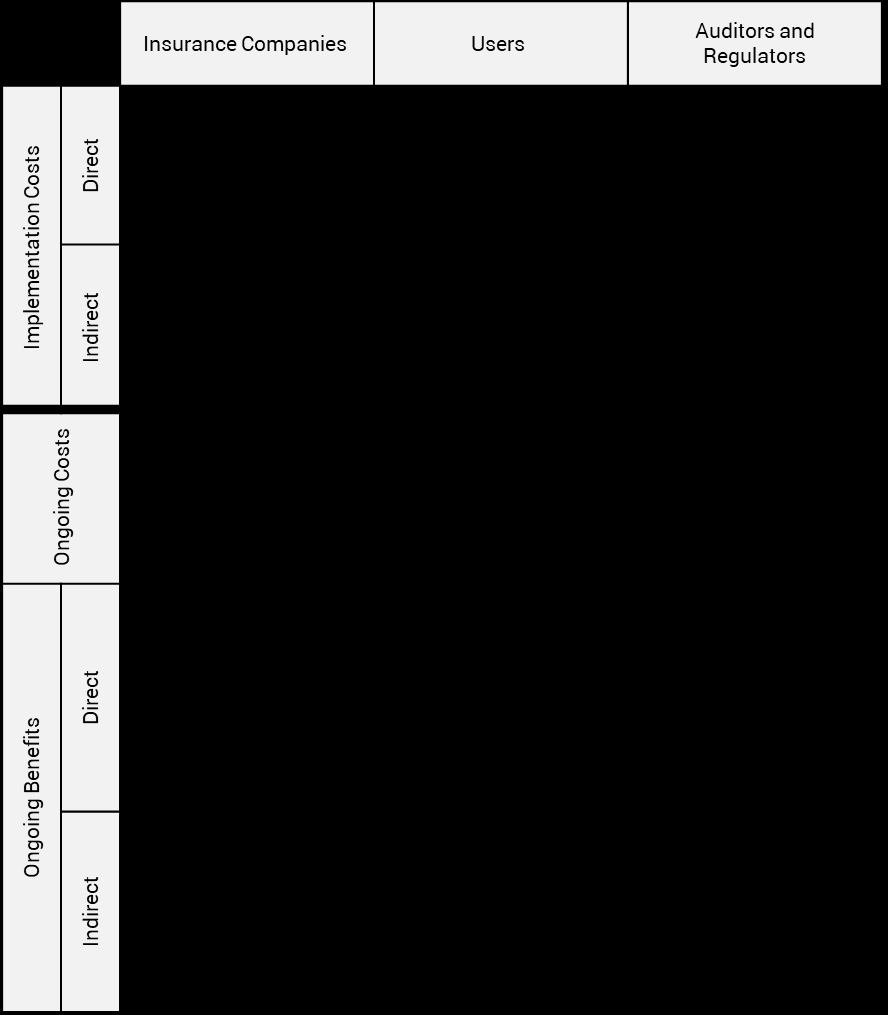
Net of £0.5 billion sunk costs – NB this is likely to be an understatement (see paragraph 4.97)54
Likely effect on the economy of the UK
Introduction
4.136 In this section we assess whether IFRS 17 is likely to have an adverse effect on the economy of the UK. This evaluation is one of the elements of the broader assessment of whether the standard is conducive to the UK long term public good (see paragraph 4.2 above).
4.137 IFRS 17 is expected to lead to substantial changes in the way insurers account for insurance contracts, with consequential effects on the way their financial position and profitability are reported in their financial statements.
4.138 Financial reporting standards are developed to report the economic activities and transactions undertaken by companies in a way that is useful to users, including being transparent and understandable to their investors. However, it is possible that such changes in how companies report their activities will bring about an indirect change to how they conduct their business.
4.139 Any material changes to how business is conducted by individual insurance companies is, in turn, likely to have an impact on the UK economy. As evidenced in the sector overview (paragraphs 4.5 - 4.29 above), the insurance sector is an important industry for the UK, accounting for £264 billion of gross written premiums in 2020 and managing over £2 trillion of assets (approximately 11% of domestic savings), reflecting its potential macroeconomic impact. Moreover, insurance companies using IFRS represent an important share of the UK industry, accounting for approximately 60% of the gross written premiums.
4.140 In this section, therefore, we consider the potential impact of IFRS 17 on the UK economy, focusing on the following areas:
- Business conducted by the insurance industry, including product mix and pricing strategies;
- Competitive landscape of the UK insurance industry;
- Wider use of IFRS; and
- Macroeconomic impact, in particular on:
- cost of capital and investment decisions by investors;
- investment decisions by insurance companies;
- credit ratings;
- financial stability and tax revenues; and
- economic growth.
Likely effect on the economy of the UK
Introduction
4.136In this section we assess whether IFRS 17 is likely to have an adverse effect on the economy of the UK. This evaluation is one of the elements of the broader assessment of whether the standard is conducive to the UK long term public good (see paragraph 4.2 above).
4.137IFRS 17 is expected to lead to substantial changes in the way insurers account for insurance contracts, with consequential effects on the way their financial position and profitability are reported in their financial statements.
4.138Financial reporting standards are developed to report the economic activities and transactions undertaken by companies in a way that is useful to users, including being transparent and understandable to their investors. However, it is possible that such changes in how companies report their activities will bring about an indirect change to how they conduct their business.
4.139Any material changes to how business is conducted by individual insurance companies is, in turn, likely to have an impact on the UK economy. As evidenced in the sector overview (paragraphs 4.5 - 4.29 above), the insurance sector is an important industry for the UK, accounting for £264 billion of gross written premiums in 2020 and managing over £2 trillion of assets (approximately 11% of domestic savings), reflecting its potential macroeconomic impact. Moreover, insurance companies using IFRS represent an important share of the UK industry, accounting for approximately 60% of the gross written premiums.
4.140In this section, therefore, we consider the potential impact of IFRS 17 on the UK economy, focusing on the following areas:
- Business conducted by the insurance industry, including product mix and pricing strategies;
- Competitive landscape of the UK insurance industry;
- Wider use of IFRS; and
- Macroeconomic impact, in particular on:
- cost of capital and investment decisions by investors;
- investment decisions by insurance companies;
- credit ratings;
- financial stability and tax revenues; and
- economic growth.
4.141Finally, we consider the impact on the UK long term public good if IFRS 17 were not to be adopted for use in the UK.
4.142Our assessment is based on evidence gathered from stakeholders by the UKEB (including the Economic Report55, the Preparer survey, the User survey, the User roundtable and follow-up interviews), additional quantitative analyses, third party studies and an in-house economic assessment. See paragraph 4.65 for further detail.
Potential impact on business conducted by UK insurance industry
Impact on product mix and pricing strategies
4.143As set out in Section 2, IFRS 17 will change the way insurance companies report their profits. Changes to accounting and reporting requirements do not alter the underlying economics of a business, only the way those same economics are reflected in the companies' accounts. In theory, therefore, changes in insurance product design, mix or price should not arise as a direct result of applying IFRS 17 (see also IASB Effects Analysis).
4.144In practice, however, new accounting standards can bring more clarity to the underlying economics of transactions, sometimes highlighting risks or costs that were previously less apparent. For example, under IFRS 17 the reporting of profits and losses in individual years may change significantly in some cases56. This may bring about changes in underlying business practices, including changes to product offering and pricing. Such effects are considered to be more likely and significant for life insurance companies than for general insurers, given the greater impact of IFRS 17 on long duration contracts (see also IASB Effects Analysis).
4.145As part of our work, we considered specific aspects of IFRS 17 which may have an impact on products and pricing: reporting of onerous contracts and CSM allocation. In addition, we refer specifically to the standard's impact on two particular product types – annuities and with-profits contracts – addressed as priority areas within Section 3 above. These represent a significant proportion of UK insurance business and stakeholders have asserted that their accounting treatment is particularly affected by IFRS 17. Finally, our assessment of these topics considered the views of UK stakeholders and then concludes by evaluating whether the potential impacts on products and pricing are likely to have an adverse effect on the UK economy.
Onerous contracts
4.146As explained in Section 2, IFRS 17 requires the separate identification of groups of contracts that are onerous at inception as well as the regular updating of fulfilment cash flows. The latter requirement facilitates the prompt identification of groups of contracts that subsequently become onerous. Losses on onerous contracts are required to be recognised immediately in profit or loss. This greater transparency may prompt some insurance companies to change product offerings, reprice existing products or withdraw entirely from a particular product segment.
4.147Evidence collected in-house is consistent with the idea that IFRS 17's requirements for recognition of onerous contracts might affect product offering or pricing. For example, the Economic Report noted that reporting requirements concerning onerous contracts may deter offering products that are onerous at the outset.
4.148The majority of respondents to the User survey believe that IFRS 17 is likely or very likely to have an impact on product offering (57% of the respondents) and pricing (52% of the respondents). According to several respondents, pricing strategies are expected to change due to the recognition of onerous contracts at the outset. One respondent said that "the identification of onerous or less profitable groups of contracts may lead to a re-evaluation of the pricing of those products" and another noted that "separate disclosure and immediate recognition of onerous contracts could lead insurers to focus on reducing the extent of onerous contracts, possibly through price changes".
4.149Views expressed by insurance companies during interviews varied according to the nature of their business. General insurers were more likely to expect IFRS 17 to have an impact, as the ability to bundle together onerous and non-onerous contracts of different types (say home and car insurance) will be lost. For example, one insurance company commented that new business teams would need to be aware of the accounting impact of onerous contracts and that this would influence the business written, and another noted that onerous contract accounting under IFRS 17 would probably affect product offering and pricing. However, two insurers offering predominantly annuities did not anticipate any significant impact, as they are unlikely to write onerous business.
4.150Evidence collected by third party organisations is also consistent with the expectation that IFRS 17's requirements regarding onerous contracts might affect product offering or pricing. For example, using survey-based evidence, EFRAG noted that some of their respondents would probably avoid pricing methods leading to the recognition of onerous contracts at inception57.
CSM allocation
4.151IFRS 17 will require an insurance company to recognise the contractual service margin (CSM) (the unearned profit that the company expects to recognise) as it provides services over the insurance coverage period. For some products this will represent a significant change from current accounting practice in the UK under IFRS 4 (see paragraphs 4.49 – 4.52 above).
4.152The Economic Report (page 23) noted that "while the underlying economics (of the insurance business) is unchanged, the way that profits are reported annually will change. It is possible that this will prompt some changes in insurers' product mix and pricing, either because they think this is necessary to secure investor confidence and a low cost of capital ... or because the financial incentives of individual senior managers depend on reported profits".
4.153This view is widespread amongst users of financial statements. A majority of respondents to the User survey believe that IFRS 17 is likely or very likely to have an impact on product offering and pricing. They largely anticipated changes to take place in the life insurance sector, with one respondent stating that "life insurance products will require redesign to maximise performance under IFRS 17", and another commenting that "life insurance products [will] become more attractive due to the ability to identify profit emergence in audited accounts". One user noted that annuity contracts could lose their attractiveness as less profit would be recognised at inception, while another considered that fewer products with guarantees may be offered.
4.154Insurance companies also appear to share this view, for example one noted that IFRS 17 was particularly likely to affect annuities, as the majority of profit will no longer be recognised at inception.
CSM allocation for annuities
4.155As explained in Section 3, some UK stakeholders are concerned that certain interpretations of IFRS 17's requirements may result in accounting outcomes that have a material and potentially detrimental impact on the UK annuity market58.
4.156Annuity business is long term business, with average policy duration of around 15 years for individual annuities59. Average duration in the Bulk purchase annuities (BPA)60 market is longer, as a significant proportion of contracts are still in the investment phase (deferred annuities). In both cases, however, groups of contracts generally have a very long tail: that is, a relatively small minority of contracts in a cohort may be in force for many decades (for example where contract benefits pass to a much younger individual).
4.157The UK annuity market includes a mix of both individual and BPA but these businesses differ in levels of maturity:
Individual annuities
- The individual annuity market is mature and declining, due largely to pensions freedoms introduced by the 2014 Pensions Reform Act61. For example, in a 2018 report62, PwC noted that new individual annuities sold in the UK declined by 78% between 2013 and 2016.
- Nevertheless, the size of the back book means this remains a major business. ABI data from 2019 indicates there were 6.1m pension annuities in the UK63. FCA information shows that new business was provided by roughly 20 entities, though business is now concentrated in only five main groups64. Assets under management backing annuity liabilities amount to approximately £300 billion65.
Bulk purchase annuities
- By contrast, the BPA business is increasing in significance and is the main growth area within the UK insurance market. BPA transactions amounted to £31.6bn in 2020, as reported by PensionAge66, and Hymans Robertson report that almost £150bn BPA business has been written by eight active market participants in the period 2009 to 202067.
- Hymans Robertson forecast BPA transactions to average around £40bn per year up to 2030. Although declining after 2030, their forecast shows continued high levels of BPA transactions up to 2040 (average over £20bn p.a.). The level of transactions is driven by pension schemes' de-risking strategies and buy-outs.
4.158Current accounting under IFRS 4 is heavily based on accounting under old (pre-2005) UK GAAP, as set out in the ABI SORP. At inception, conservative reserves are established for expected future cash outflows. However, the premiums received (typically single upfront premiums) generally exceed the reserves and the difference is recognised immediately as profit (sometimes referred to as 'day 1 gains'). In addition to any gains or losses from experience variances and changes in assumptions, further future margins generally arise from the unwinding of the reserves. The typical profit profile includes a large day-1 gain followed by smaller and declining gains spread over the contract life.
4.159IFRS 17 by contrast stipulates that profit is recognised in line with the provision of service over the coverage period. Under IFRS 17 the profit profile for a group of contracts is expected to be smoother, though also declining68. However, the absence of day-1 gains means that profit recognition will be significantly slower than under current practice.
4.160It is not possible to accurately assess the impact of different annuity profit recognition approaches as data is not publicly available. The graph below illustrates the cumulative profit expected to be recognised for a hypothetical BPA transaction assuming a mix of deferred and immediate annuities and reflecting an insurer's actuarial estimates69. The graph shows (i) the difference between profit recognition profile under the current accounting requirements; and (ii) the expected profit recognition profile under the two principal approaches70. The difference between the current requirements and IFRS 17 mainly arises at inception. However, differences between the two different BPA CSM allocation methods persist for a long period. As evident from the graph, cumulative profits eventually converge in the long run for all three approaches, demonstrating that, over the life of the contracts, profits earned are not affected by IFRS 17.

Source: hypothetical illustrative example provided by an insurance company
4.161No data is available on the likely transitional impact from this change across the industry, but stakeholders expect material reductions in equity. The scale of the impact will further depend on the approach adopted on transition to IFRS 17: a retrospective approach is expected to result in greater transitional impacts than a fair value approach71. A fair value approach is expected to be adopted for a large proportion of individual annuity business reflecting the maturity of the market and the impracticality of retrospective application72. By contrast, retrospective approaches are expected to be applied to a large proportion of BPA business since the recent expansion in this market lends itself to easy access to inception data and application of the retrospective approaches.
4.162Some insurance companies have suggested that a potential consequence of enforcing a slower method of CSM allocation (such as the annuity outgo method illustrated in the graph above) is that it may encourage structuring transactions. This could enable groups of contracts to be traded to release profit that has built up in the CSM, which in turn may result in uneven profit recognition.
4.163Overall, it is clear that IFRS 17 will have an impact on the reported profits of annuity providers, with profits from annuity contracts expected to be recognised significantly more slowly under IFRS 17 compared with current practice. The nature and extent of the impact will depend on the precise CSM allocation methodologies applied, which are still in discussion.
4.164Feedback from annuity providers indicates that, if they can use a method with similar profit recognition outcomes to the annuity sum assured (ASA) approach illustrated in the graph above, then accounting for annuities under IFRS 17 should not lead to a significant adverse impact on the industry. However, if annuity providers are required under IFRS 17 to apply a CSM allocation method that results in much slower profit recognition than under the ASA, then in the view of some companies IFRS 17 could:
- Encourage structuring transactions aimed at crystallising profits earlier; and
- Discourage investment in the annuity and BPA business and provide an advantage to companies not required to apply IFRS 17.
4.165However, given the profitable and growing nature of the BPA business and that cash flows from annuity contracts will not change as a direct result of IFRS 17, it seems unlikely that financial reporting changes brought about by implementation of IFRS 17 will directly result in a significant reduction in this market. In addition, from interviews with annuities providers it emerged that they are not planning to change their product offering/pricing as a direct result of IFRS 17. This view was supported by feedback from users who also noted that profit recognition for annuities under IFRS 17 might have a positive benefit on insurance company governance, as it would enforce a longer-term perspective. It is however possible that IFRS 17 implementation could lead to greater use of alternative performance measures as insurance companies try to explain the changes in profit recognition to their investors.
With-profits business
4.166With-profits business has been a feature of the UK long-term investment and savings industry for several decades and the assets under management of with-profits funds amount to in excess of £250bn73 (roughly 12.5% of the total assets under management for insurance companies in the UK).
4.167However, a significant proportion of UK with-profits funds is now closed to new business and the market is in decline. The FCA reported that “total with-profits assets were approximately £426bn as at 2001, £411bn as at 2005, £333bn as at 2010 and £296bn as at 2015”. As of 2017, the FCA reported £274bn74. UKEB Secretariat estimates, based on Barnett Waddingham reports (see footnote 144) and review of company annual reports, suggest that nearly half of the assets under management attributable to with-profit funds are linked to closed funds.
4.168Of these closed funds, a number will already have been subject to inherited estate75 attribution exercises. In these cases, the ownership of any inherited estate may have been established by court-approved schemes, so some of the principal judgements under IFRS 17 will be less challenging.
4.169Some UK mutual entities have open with-profits funds; however, it is understood that these entities do not plan to use IFRS 17 to prepare their accounts.
4.170Based on feedback from stakeholders and our analysis, we estimate that the principal remaining UK inherited estates amount to approximately £30 billion in aggregate, held by three listed UK insurance groups. Of this, a significant proportion (roughly one third) relates to closed funds. Based on the 90/10 profit-sharing arrangements typical in the UK, this implies a shareholders' share of the inherited estate of approximately £3 billion across the three insurance groups. On an ongoing basis, it is only the annual change in the value of the inherited estate that would directly affect profits.
4.171In Section 3 we discuss the effect that IFRS 17 is expected to have on the accounting for with-profits contracts. In general, that analysis suggests that profits from with-profits contracts will be recognised earlier than is the case under current accounting under IFRS 4. In particular, the shareholders' share of any inherited estate may be recognised as profit. Further information on this effect and the potential impact for the insurance industry is considered below.
Current UK accounting practice under IFRS 4
4.172In the UK, with-profits business is generally accounted for in accordance with FRS 27 Life Assurance, as permitted by IFRS 4 grandfathering rules. FRS 27 states that the Fund for Future Appropriations (FFA) is the balance sheet item required by Schedule 9A to the Companies Act 1985 to comprise all funds the allocation of which, either to policyholders or to shareholders, has not been determined by the end of the accounting period. Consequently, the inherited estate formed part of the FFA. In the UK, under IFRS 4, the inherited estate is generally treated in full as a liability.
4.173Generally, current profit recognition practices closely reflect the regulatory requirements. Profit is recognised equal to the shareholder transfer for a period and is determined with reference to the declared policyholder bonuses. Regulatory requirements mean that insurers are not permitted to make any payment to shareholders out of the with-profits fund unless it can be financed by the fund without causing a deficit and it is made at the same time as the related distribution to policyholders. Changes in the value of the estate (e.g. resulting from investment returns) do not result directly in distributions to policyholders so remain part of the FFA and do not impact the income statement. Since UK with-profits policies typically involve a significant terminal bonus, profits tend to be ‘back end loaded'.
The impact of IFRS 17
4.174Under IFRS 17, UK with-profits business is expected to be accounted for under the Variable Fee Approach (VFA). This reflects the contracts' nature as primarily investment-related contracts with participation features whereby policyholders participate in a clearly defined pool of underlying items. In broad terms this means that the shareholders' share of changes in the fair value of the underlying pool of assets will form part of the variable fee, which is taken to the CSM. The future release of the CSM to profit or loss is designed to reflect the provision of investment services.
4.175On implementation of IFRS 17 profit recognition for such contracts is expected to be significantly accelerated compared with current practice under IFRS 4, where profits are 'back-ended' as referred to in paragraph 4.173 above. Net credits to equity in respect of with-profits business may therefore arise on transition to IFRS 17, although quantitative data on the likely impact is not available at the time of writing.
4.176Overall, this analysis, when taken together with the scale of the relevant listed insurance groups (whose aggregate annual profits amount to several £ billion), indicates that the treatment under IFRS 17 of with-profits inherited estates or the accelerated profit recognition of with-profits business are unlikely to have a significant impact on the UK insurance industry or on the wider UK economy.
Products and pricing – other feedback
4.177Third party studies also point towards a potential impact of IFRS 17 on product offering and pricing. For example, surveys by Deloitte and EFRAG concluded that IFRS 17 is likely to have some impact on product mix and pricing76.
4.178While users expect some changes to product offering and pricing arising from implementation of IFRS 17, insurance companies generally expect such impact to be negligible except in the case of annuity business. Some 80% of the respondents to the Preparer survey believed that IFRS 17 will have a negligible impact on product design and pricing, 13% thought it might have a moderate impact, and only 7% (one respondent) thought it might have a significant impact77. Respondents who believe the impact will be negligible stated that it is "unlikely that a financial reporting standard will change the product design", and that "the economics are not impacted".
4.179The evidence we collected is consistent with that gathered within the EU. For example, the European Insurance and Occupational Pensions Authority (EIOPA) published a report in 2018 suggesting that IFRS 17 would be akin to a regulatory intervention that would not alter the economics of the insurance business78. Similarly, the EFRAG Economic Study pointed out that "according to the majority of industry stakeholders interviewed, financial reporting does not play a big role in product mix and pricing", while capital requirements and regulation do. Finally, evidence collected by EFRAG in their stakeholder engagement suggested that some changes to product offering/pricing might be expected, but that these were minor and it would be difficult to predict and quantify their direction.
Products and pricing - [tentative] summary
4.180Our current analysis indicates a low magnitude of changes to product offering and pricing in the UK arising as a result of implementation of IFRS 17, and the overall impact to be insignificant when compared with the overall insurance business in the UK.
4.181One potential impact of the implementation of IFRS 17 may be a generalised increase in premiums as more onerous contracts are recognised in the accounting and insurance companies try to enhance the profitability of such contracts. However, we believe that another more probable response is that insurance companies wishing to enhance the profitability of their contracts look to enhance their initial screening processes to better reflect the underlying risks in their contract offerings or increase premiums for risky contracts only79.
4.182Regarding annuity business, our [tentative] conclusion is that the impact is more likely to be dependent on the precise CSM allocation methodologies applied than on the requirements of the standard itself. However, it seems unlikely that the change in financial reporting caused by IFRS 17 will have a direct and adverse impact on UK annuity business.
4.183Given the scale of the relevant listed insurance groups, our analysis of the impact of IFRS 17 on with-profits business indicates that the treatment under IFRS 17 of with-profits inherited estates, or the accelerated profit recognition of with-profits business compared with current practice, are unlikely to have a significant impact on the UK insurance industry.
4.184In the main, the aspects of the standard that stakeholders have identified as likely to affect product offering or pricing are intended to better reflect the underlying economics of the insurance business (see Section 2). The changes will arguably result in better economic performance by insurance companies and enhanced capital allocation. There is little evidence to indicate that such changes may lead to an adverse effect on the UK economy, including on economic growth.
Effects on competitive landscape of UK insurance industry
4.185We have identified the following ways in which IFRS 17 may influence competition in the insurance sector:
- In the UK, the significant implementation costs and increased transparency of financial position and profitability associated with IFRS 17 may give a competitive advantage to companies not required to use IFRS 17;
- At an international level, the standard might encourage competition among multinational companies. In addition, insurers in jurisdictions that adopt the standard with carve-outs (as the EU is expected to do) may enjoy a competitive advantage (through reduced implementation costs or reduced transparency) over companies from jurisdictions where the standard is adopted in full; and
- IFRS 17 might affect mergers and acquisitions (M&A) in the industry.
Competition in the UK from insurers not required to apply IFRS 17
4.186As explained in detail above (paragraphs 4.67 – 4.89), companies applying IFRS 17 will incur significant implementation costs and, potentially, marginally increased ongoing costs. In addition, IFRS 17 is expected to result in enhanced reporting transparency, in particular in relation to onerous contracts (see Section 2 and paragraph 4.48 above). Entities not applying IFRS 17 will not incur the additional costs associated with implementation of the standard and might retain more flexibility in their product offering and pricing (see paragraphs 4.143 – 4.150 above), giving those companies a competitive advantage. These asymmetries may lead to differences in products, pricing or services offered by the two different types of companies.
4.187The analysis below considers whether IFRS 17 might adversely affect the competitive position of UK insurers applying IFRS 17 compared with insurers not required to apply IFRS 17, mainly unlisted UK insurers80. Several factors indicate that any such adverse effect is unlikely to be significant.
- The cost of implementing IFRS 17, while significant in absolute terms, is not expected to be very significant in relative terms (see paragraph 4.69 above). In addition, the primary cost impact relates to initial implementation rather than ongoing costs, so represent a one-time impact.
- The 52 UK insurance companies applying IFRS account for roughly 60% of gross written premiums in the UK (see paragraph 4.18 above). The remaining 40% of revenues are dispersed among numerous smaller entities, attributable to more than 150 companies using UK GAAP.
- Some of the largest unlisted insurance companies already apply IFRS voluntarily and have not indicated that they intend to revert to UK GAAP.
4.188In an industry in which scale can provide a competitive advantage, these potential advantages of not applying IFRS 17 are unlikely to prove decisive. The impact of applying IFRS 17 on competition within the UK market is therefore not likely to be significant.
4.189This view is supported by other evidence we obtained:
- The Economic Report noted that: "the general impression gained from insurer interviews was that IFRS 17 will not affect the competitiveness of UK insurers materially. While there were administrative costs associated with the change that were significant for the units within insurers responsible for providing financial reporting materials, these costs spread out across all the policies sold were unlikely to materially affect costs and therefore competitiveness."
- Most respondents (67%) to the Preparer survey either perceived the competitive impacts from insurers not required to apply IFRS 17 as negligible or had yet to fully assess the impact on their competitiveness. Out of 16 respondents, only one expected a significant impact on competition (but did not provide any rationale) and four a 'moderate' impact.
- Most respondents to the User survey did not perceive any significant domestic or international disadvantages to UK insurers from applying IFRS 17.
- Participants at the User roundtable noted that IFRS 17 should create no significant disadvantages to UK insurers either domestically or internationally.
4.190In conclusion, based on the evidence collected we do not expect IFRS 17 to alter domestic competition equilibrium.
International competition
4.191The IASB asserted that the application of IFRS 17 is expected to reduce costs for international businesses, and by implication make them relatively more competitive, as they may be able to exploit synergies with other jurisdictions where IFRS 17 will be applied81.
4.192This may help UK multinational insurance companies to enhance their competitiveness and consolidate their positions abroad, leading to positive effects on the UK economy.
4.193Additionally, it may make the UK market more attractive to international companies, as the enhanced levels of transparency and comparability of information available to the market improve the possibility of exploiting synergies across different IFRS-adopting jurisdictions.
4.194The Economic Report noted that "for pan-European businesses IFRS 17 would increase synergies with European offices. This might also make the UK market more attractive for insurers based in jurisdictions which adopt IFRS 17."
4.195While this might be seen by individual UK insurers as a challenge, enhanced competition from international companies would likely benefit the UK economy as a whole, for example in terms of more affordable premiums for policyholders or an enhanced variety of products. Currently, however, there is no evidence to suggest any potential effect is likely to be significant.
EU carve out
4.196In July 2021 the European Commission's Accounting Regulatory Committee proposed an optional exemption from IFRS 17's annual cohorts requirement for intergenerationally-mutualised and cash flow matched contracts. Final European adoption of the standard and the carve out is anticipated by the end of 2021.
4.197Such contracts comprise a majority of the life insurance markets in several EU jurisdictions82. The carve out would permit companies not to apply paragraph 22 of IFRS 1783 to these contracts, described in the draft Regulation as:
- "groups of insurance contracts with direct participation features and groups of investment contracts with discretionary participation features as defined in Appendix A to the Annex84 to this Regulation, and with cash flows that affect or are affected by cash flows to policyholders of other contracts as laid down in paragraphs B67 and B68 of Appendix B of that Annex,
- groups of insurance contracts that are managed across generations of contracts and that meet the conditions laid down in Article 77b of Directive 2009/138/EC and have been approved by supervisory authorities for the application of the matching adjustment."
4.198The draft Regulation proposes that the European Commission should review the exemption by 31 December 2027, taking into account the IASB's post-implementation review of IFRS 17.
4.199The proposed EU carve out is optional, so it will be possible for EU-listed entities - those registered in the EU as well as foreign registrants – to apply IFRS 17 as issued by the IASB. Informal feedback from some stakeholders indicates that insurance companies in some EU Member States are not likely to use the carve out option. However, some listed entities from EU Member States with large insurance businesses, including France, Spain and Italy, are currently expected to use the optional carve out. We have therefore considered the potential implications of an EU carve out for UK entities, should the UK adopt IFRS 17 as issued.
4.200No UK insurance entities have listings on an exchange in the EEA, and we are aware of only one EU-listed insurance group which also has a UK listing85.
4.201Operational factors such as cost and complexity may affect groups operating across the EU and the UK differently:
- UK-based groups with operations in the EU: based on stakeholder feedback, UK life businesses have only limited operations in the EU. The accounting needs of any EU subsidiaries would depend on the financial reporting requirements in the relevant jurisdiction, but it is likely that such subsidiaries would need to prepare local GAAP accounts. They are currently reporting under two different accounting frameworks so are unlikely to be significantly affected by a difference between UK and EU-adopted IFRS.
- EU-based groups with operations in the UK: UK subsidiaries86 of EU listed entities will be required to prepare UK entity accounts in accordance with UK law, i.e. applying either UK GAAP or UK-adopted IFRS. Should the subsidiary need to prepare accounts on a different basis for consolidation purposes, the subsidiary would incur additional implementation and ongoing costs. However, based on our analysis there are few UK subsidiaries of EU listed parents with significant life business, and those parent companies may not elect to use the carve out.
4.202The EU carve out may have an impact on competition for capital. The carve out is expected to reduce the recognition of losses on onerous contracts (as defined under the standard), thereby potentially concealing economic losses and enhancing perceived performance. However, EU entities making use of the EU carve out would have to disclose the fact that they are using the carve out. Although the greater flexibility in financial reporting afforded by a carve out might appear an advantage from a preparer perspective, from the Users roundtable it emerged that investors are concerned that this will hamper comparability between insurance companies, as the carve-out will reduce transparency about onerous contracts. According to the participants at the roundtable, insurance companies choosing to use the carve out will need to justify their position. This user reaction could indicate that companies adopting the carve-out might become less attractive for investors in the medium- to long-term.
4.203The stakeholder outreach and the Economic Report suggest that accounting differences such as a carve out for annual cohorts are unlikely to affect the competitiveness of insurers in the product market. Decisions regarding pricing and product offering are likely to be made at portfolio level and driven more by capital requirements and taxation. Although lower accounting costs might theoretically offer an advantage, in the context of the relevant insurers' total cost base this seems unlikely to have an impact.
4.204Overall, the proposed EU carve out is not expected to have significant consequences for competition for insurance companies in the UK or internationally. In competition for capital, an overall advantage is expected for UK insurance companies in the enhanced transparency afforded by applying IFRS 17 as issued by the IASB, making them more attractive to potential investors.
Impact on mergers and acquisitions (M&A)
4.205In general, M&A activity brings synergies and productivity enhancements in an industry. In recent years, a significant amount of M&A activity has taken place in the insurance sector, both globally and in the UK. Deloitte, for example, reported a total of nearly 40 M&A events in the European insurance sector, with a value of over EUR 22 billion, during 201787. More recently, EY reported that in the UK during H1 2021 a total of 33 deals was observed, with a market value of £3.9 billion88. We have therefore considered whether IFRS 17 might negatively impact M&A activity.
4.206Respondents to the Preparer survey had mixed views: a third considered IFRS 17 will have a negligible effect on M&As, while another third had not yet assessed its impact. 27% of respondents expected some moderate effects on M&A activity. Two insurance companies took the view that "IFRS 17 disclosures and consistency of reporting make it easier for potential acquirers to identify and evaluate takeover targets" and could potentially spur M&A activity. On the other hand, some insurers thought that IFRS 17 might deter M&A activity, especially in the non-life segment. One respondent noted that "IFRS 17 will encourage diversified product portfolios and be a potential barrier to entry. This may impact mergers and acquisitions in the insurance industry".
4.207Feedback from insurance companies during interviews suggested that:
- In the short run, IFRS 17 might result in fewer M&As due to transitional disruption (lack of familiarity with the new financial information). In the long-run M&A activity may be easier as valuation would be easier.
- IFRS 17 might make the acquisition of a life book less desirable for insurers not already applying the GMM, due to the costs involved in establishing the GMM accounting model. However, dividends, cash and solvency measurement will not change so the influence of the standard is expected to be limited in the longer term.
- One participant noted "the treatment of onerous contracts could... deter insurers subject to IFRS 17 from acquiring firms not subject to the standard" and another reported that "IFRS 17 may affect takeover prices in the short term, as acquiring firms have to think about the administrative costs with bringing the target firm's
reporting systems into line with the new standard". However, this respondent "did not foresee it having a major bearing on firms' acquisition policies".
4.208 The lack of a clear consensus in insurance companies' opinions indicates that the likely impact of IFRS 17 on M&As is difficult to predict. The fact that IFRS 17 is expected to enhance transparency and comparability of financial information produced by insurance companies, thus enhancing the ability to identify and value potential targets, might result in an increase in M&A activity and the resultant synergy and productivity enhancements. On the other hand, improved valuations resulting from such enhanced transparency may reduce the number of attractively priced targets.
4.209 Overall, it is considered unlikely that IFRS 17 will have a significant impact on UK M&A activity. We expect no or at most a slightly positive impact on the UK economy in this regard.
Wider impacts of IFRS 17
Better governance processes
4.210 The academic literature documents a positive relationship between financial reporting practices and governance89. At a microeconomic level, standardised, comparable and clear reporting practices, which lead to a fair and transparent picture of a company's economic activity, are important to hold the management accountable for their decisions. This reduces management's incentives to act in their own interest, encouraging the alignment of their interests to those of the company (the principal/agent problem)90.
4.211 No corporate governance practice could fully align the principals' and the agents' interests in the absence of objective documentation of management's decisions. At a national level, however, a correlation between good accounting practices and stringent governance practices is generally observed, as they support the investors' ability to hold management accountable for their decisions.
4.212 Given the expectation that IFRS 17 is expected to improve the quality of insurers' financial reporting (see paragraphs 4.30 – 4.59 above), we would anticipate a generalised improvement in governance processes among insurance companies following the application of IFRS 1791.
4.213 In interviews with insurance companies, views were mixed, but a few expressed the view that IFRS 17 might lead to improved internal governance processes:
- One company expected risk and audit committees to become more involved as more detailed data and analysis will be provided in external statements;
- Another company expected closer working across the actuarial and accounting teams arising from the need to harmonise the two functions. Implementation of IFRS 17 has helped increase mutual awareness, improved the organisational culture and reduced operational risk; and
- Another company identified the possibility of enhancements to the processes in place for the production of accounts disclosures.
4.214 Enhanced governance practices have broader consequences that are likely to positively affect the UK long term public good. The academic literature has found that better corporate governance practices are associated with enhanced institutional ownership, especially across borders, which in turns stimulates good corporate governance practices, triggering a virtuous cycle92.
Use of IFRS 17 by unlisted companies
4.215 As noted in paragraph 4.12, UK legislation requires that IFRS is mandatory only for the consolidated accounts of companies listed on a regulated market, with other companies permitted to apply IFRS on a voluntary basis. Some 30 unlisted UK insurance entities currently voluntarily apply IFRS, but a greater number use UK GAAP. We have considered whether the adoption of IFRS 17 in the UK may affect unlisted insurers' choice of accounting framework.
4.216 Unlisted companies decide to adopt IFRS for different reasons. Generally, privately held companies adopt IFRS with the view to obtaining better funding opportunities as well as a viable exit for private equity backers, for example when preparing for a future public equity listing 93.
4.217 Given the scale of one-off implementation costs that the application of IFRS 17 entails, it seems unlikely in the short term that privately held UK insurance companies will have a significant incentive to move from UK GAAP to IFRS 17. In the longer term, as understanding and experience with IFRS 17 increases and if, as expected, the standard becomes recognised as the basis for higher quality financial reporting, the perception of the balance of costs and benefits for privately held UK insurers may change.
4.218 Another reason privately held insurance companies may be interested in moving to using IFRS and IFRS 17 is if they are currently applying FRS 101 Reduced Disclosure Framework under UK GAAP. FRS 101 requires the application of UK-adopted IFRS recognition and measurement requirements but with reduced disclosures. If IFRS 17 formed part of UK-adopted IFRS, however, UK insurance companies would no longer be permitted to apply FRS 10194. This is because the definition of an entity qualifying for the reduced disclosure framework excludes entities that are required to comply with Schedule 3 of The Large and Medium-sized Companies and Groups (Accounts and Reports) Regulations 2008 (SI 2008/410) (i.e. insurance companies) and that have contracts within the scope of IFRS 17. Such companies would therefore need to choose between UK GAAP recognition and measurement and IFRS. When held by parents reporting under IFRS and preparing IFRS accounting information for consolidation purposes, the preparation of individual accounts using IFRS would avoid the need for such insurance companies to prepare two sets of accounting records. This scenario could affect unlisted insurers that are part of either UK or overseas groups.
4.219 It is possible that some unlisted insurers already applying IFRS might revert to UK GAAP to avoid having to apply IFRS 17 and incur the associated costs with its implementation. Mutual insurance companies accounted for approximately £20 billion gross written premiums in 201695. Two of the largest mutual insurers96 recently decided to move from IFRS to UK GAAP, raising the question of whether IFRS 17 was a determinant of their decision, and to what extent. In discussion, only one of the two identified IFRS 17 as a reason for moving away from IFRS. One mutual insurer's decision was based primarily on operational factors and it stated that there were no technical accounting issues that would have prevented them applying IFRS 17. In addition, the entity recognised they might have to move back to IFRS in the future. The other, however, considered that IFRS 17 would lead to less useful information given their mutual structure (particular concerns related to uncertainty over the relevance of IFRS 17's CSM and risk adjustment accounting requirements in a mutual context).
4.220 As a general principle, the more businesses apply IFRS the larger the benefits in terms of transparency and comparability for users of accounts as well as the wider market. The two mutual entities identified above represent less than 1% of UK gross written premiums. Further, we are not aware of any other insurers reverting to UK GAAP. It is therefore unlikely that an adverse effect on the UK economy will result from any insurance companies moving to UK GAAP to avoid implementation of IFRS 17.
Macroeconomic impact
Cost of capital and investment decisions by investors
4.221 IFRS 17 aims to enhance the transparency of insurers' accounts and, as noted above, enhanced comparability of financial information within the sector is one of the main perceived benefits of the standard. The following paragraphs consider whether increased transparency and comparability might potentially result in greater confidence in the accounts and whether this might translate into benefits for insurance companies such as attracting capital from a wider range of investment sources at a lower cost.
4.222 There is a substantial body of academic evidence that points to a negative relationship between the quality of financial disclosure and cost of capital. Diamond and Verrecchia (1991) demonstrate theoretically that higher information arising from financial disclosure should translate into lower cost of capital. 97 Since this contribution, empirical papers have largely confirmed this theoretical prediction. Lambert, Leuz and Verrecchia (2006) show that the quality of accounting information is associated with a reduction in the cost of capital. 98 Barth, Konchitchki and Landsma (2013) focus specifically on the earnings-returns relationship, showing that firms with more transparent earnings are associated with a lower cost of capital.99 Daske, Hail, Leuz and Verdi (2013) show that voluntary IAS/IFRS adopters that seriously commit to the reporting standard (as opposed to “label” adopters who do not fundamentally change their reporting) do enjoy better stock liquidity and lower cost of capital.100 101
4.223 Since IFRS 4 does not prescribe the measurement or presentation of insurance contracts but largely permits the continuation of existing local practices, the impact of the application of IFRS 17 by insurance companies would be comparable to the transition to IFRS Standards by other companies.
4.224 To perform the evaluation, quantitative analysis of insurance company share price data was conducted to assess their cost of capital. To assess whether IFRS 17 might be associated with a reduction in the cost of capital, qualitative data was collected through stakeholder engagement and evidence from third-party studies.
4.225 The following graph compares Weighted Average Cost of Capital (WACC) for life and non-life insurance companies listed in the UK. For illustrative purposes, the average WACC for FTSE 100 companies and for banks102 is also included. WACC is a commonly used cost of capital measure that takes into account both equity and debt cost of capital.
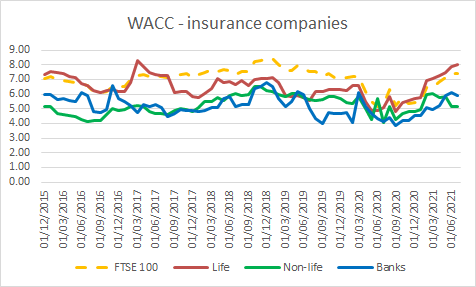
Source: LSEG (for the list of companies), Thompson Reuters Eikon (for WACC). The period 2015 to 2021 was selected based on the availability of data.
4.226 As evident from the graph, for the period considered, life insurance companies are characterised by a higher WACC than both the banking sector and the non-life insurance segment, with the difference in WACC between life insurance and banking companies averaging 0.6 percentage points over the period considered, and the difference in WACC between life and non-life insurance companies averaging 1.2 percentage points over the period considered. The non-life insurance segment has a WACC more comparable to that of the banking sector. The reasons for the differences in WACC are likely to relate to a variety of factors, including perhaps investors' current perception that life insurance company accounts lack transparency. The analysis suggests that life insurance companies are likely to benefit more than general insurance companies should IFRS 17 lead in the long term to a lower cost of capital for insurance companies, as some suggest (see stakeholder views from paragraph 4.235).
4.227 We have also considered current indicators of market volatility. We calculated market betas by running a Carhart four factor model103 to estimate market betas for life insurance, non-life insurance and, for illustrative purposes, banking companies104. Market betas are a measure of market volatility that tells whether the market excess returns of a portfolio over risk-free returns are less, equally or more volatile than the market excess returns. A beta higher (lower) than one in absolute terms indicates that a portfolio excess returns are more (less) volatile than the excess returns on the market. 105 In addition, they are positively correlated with the equity cost of capital, i.e. a higher beta translates into a higher cost of equity for a given portfolio.
Carhart 4-factor model - beta estimates
Line chart showing beta estimates for Banks, Life insurance, and Non-life insurance over time.
Source: UKEB calculations based on data provided by the LSEG (for the list of companies), Thompson Reuters Eikon (for individual companies' EoD prices) and Tharyan (2018) (for the three factor model indicators risk-free returns, market returns, HML, SMB, momentum). The estimation is performed for the 2010 to 2017 period because more recent data is currently not available.
4.228 As evident from the graph, life insurance companies have similar betas to banking companies, and a higher beta than non-life insurance companies. Over the sample period, banking companies had an average beta equal to 1.14, life insurance companies had an average beta equal to 0.99 and non-life insurance companies had an average beta equal to 0.41. These results suggest that returns of life insurance companies move broadly in line with market conditions, while non-life insurance companies are less volatile. Therefore, the equity cost of capital for non-life insurance companies is expected to be lower than for life insurance companies.
4.229 To cross-validate the results above, we considered the volatility as measured by the standard deviation of returns, an indicator of uncertainty strongly correlated with the equity cost of capital. We looked at the difference between life and non-life insurance companies and, as above, we compared these estimates with those for the banking sector and the FTSE 100 for illustrative purposes.
4.230 The following chart reports daily volatility, calculated as the rolling standard deviations of daily returns over a 20-day period:
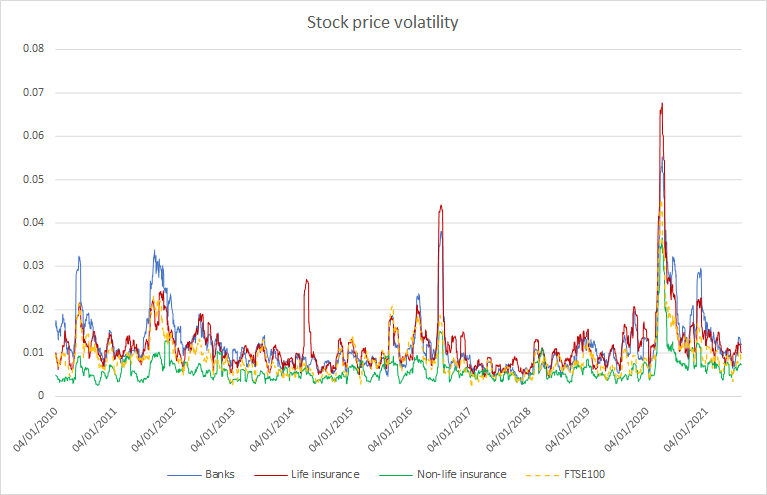
Source: UKEB calculations based on data provided by the LSEG (for the list of companies), Thompson Reuters Eikon (for individual companies' EoD prices).
4.231 From Figure 6 it appears that life insurance companies are characterised by overall levels of volatility comparable both with companies in the banking sector and the market as a whole (confirming the findings from the four-factor model estimate above), while non-life insurance companies face lower volatility levels.
4.232 These analyses, taken together, further suggest that life insurance companies have the most to gain from the enhanced transparency and comparability in financial reporting expected from use of IFRS 17 in terms of equity cost of capital, general cost of capital (as measured by the WACC) and stock market volatility.
4.233 The Economic Report suggested “that the potential impacts of IFRS 17 on the cost of capital for insurers could differ”, with “the transparency implied by the new reporting standards [likely to] benefit life insurers more, since existing problems with understanding financial reports in the sector are more pronounced in that sector given the longer duration of policies in this sector.” The study also noted that gains for UK insurance companies were anticipated to be lower than for companies in some other jurisdictions as the UK insurance industry was already considered relatively transparent.
4.234 The Economic Report also made the point that in the short run investors (and in particular generalist investors) might need time to adapt to the financial information produced as a result of implementation of the new standard.
4.235 Feedback from both preparers and users reflects those mixed views. Some believe that in the short-term uncertainty about how to interpret insurance company results might temporarily push the cost of capital up. In the long term some stakeholders expect IFRS 17 to be associated with a reduction in the cost of capital for insurance companies.
4.236 Most respondents to the Preparer survey did not expect IFRS 17 to result in a decrease in the cost of capital for insurance companies. The investor relations department of one UK insurance company confirmed during outreach that they didn't expect the cost of capital to go down as a result of IFRS 17, as they perceived that generalist investors would struggle to understand the industry.
4.237 Half of the respondents to the User survey did not anticipate IFRS 17 to affect the cost of capital of insurance companies, as they believe this is largely driven by Solvency II and economic fundamentals. 30% believe that the cost of capital will go up in the short-run due to a lack of investor familiarity, and only 15% expect the cost of capital to go down in the long-run due to increased transparency. 65% of the respondents agree that changes to the cost of capital, if present, will mostly affect the life insurance segment.
4.238 According to participants in the User roundtable, IFRS 17 created a “toolkit” which users could use to perform better analyses of insurance companies. However, they noted that generalist investors might still struggle to understand insurers' financials due to the inherent specialised nature of the insurance business. Users suggested that educational materials and early engagement with insurance companies will be important to help users interpret the accounts correctly upon first use of IFRS 17.
4.239 Participants in the User roundtable also noted that IFRS 17 will provide greater insight into the underlying economics and provide an additional lens through which to view insurers. This may result in a change in the cost of capital. However, there was no consensus on the direction of the change.
4.240 In the long run, we anticipate enhanced transparency and comparability to have a small positive or neutral effect on the cost of capital for UK insurance companies. While some consider that the cost of capital for insurance companies might go up in the short term, evidence suggests that insurance companies are planning mitigating steps such as educating and actively engaging with investors, thus limiting any short-term volatility and decreasing uncertainty on transition. This was confirmed during our outreach with insurance companies in September 2021 they indicated that they are actively educating internal stakeholders and are expecting (and preparing) to engage with users of financial reports during 2022, mostly during the second half of the year.
4.241 On balance, and based on the quantitative analyses and the stakeholder feedback and work by third-party organisations106, IFRS 17 is not expected to have an adverse effect on the economy of the UK in relation to cost of capital and access to finance for insurance companies.
Investment decisions by insurance companies
4.242 As set out above (paragraph 4.7), UK insurers manage just over £2trn of investment assets. We have therefore considered whether IFRS 17 might affect the investment behaviour of insurance companies in relation to asset allocation. The likely impact of IFRS 17 on investment and hedging strategies was assessed using third-party studies and qualitative data collected through stakeholder engagement.
4.243 The Economic Report supports the EFRAG study conclusion that the joint application of IFRS 9 and IFRS 17 is likely to have a limited impact on UK insurance companies, as current value accounting is already their predominant practice for investment assets107.
4.244 80% of respondents to the Preparer survey expected IFRS 17 to have a negligible impact on investment strategies, which in their view were driven primarily by the need to achieve satisfactory returns for policyholders while maintaining regulatory compliance. One comment summarises their position as follows: “Our investment strategy is to seek to secure the highest total return whilst maintaining an acceptable overall risk level, having regard to the currency, nature and outstanding duration of the liabilities. This is not expected to change significantly as a result of IFRS 17".
4.245 The Preparer survey also asked whether hedging strategies were likely to change as a result of IFRS 17. Most insurance companies considered that hedging strategies were unlikely to be affected, with 60% of respondents expecting IFRS 17 to have a negligible impact. Instead, regulatory compliance was cited as more important, with four insurers mentioning Solvency II or solvency considerations as the main drivers for hedging strategies 108.
4.246 Based on this evidence, IFRS 17 is not expected to have a significant effect on investment or hedging strategies.
Impact on credit ratings
4.247 Feedback from credit rating agencies indicated that IFRS 17 is not expected to have a significant impact on their assessment of insurance companies. One credit rating agency noted that they anticipate the standard will provide better insight into insurance companies' performance and financial position and make the economics more visible and therefore understandable, though they do not expect ratings changes as a direct result of IFRS 17.
4.248 Similar conclusions were drawn by EFRAG: “In terms of rating, two major rating agencies (FITCH and S&P) commented that IFRS 17 is unlikely to directly affect insurers' ratings because the economic substance of their balance sheets will not change 109.
Financial stability
4.249 Insurance companies are large and integrated financial institutions that could pose challenges to national, supranational (i.e. European) and global financial stability in case of a default110. The Financial Stability Board (FSB) identified nine insurers as global systemically important financial institutions111. Of those, two (Aviva and Prudential Plc) are UK listed insurers.
4.250 As set out in paragraphs 4.30 – 4.59, IFRS 17 is expected to improve the quality of financial reporting of insurers. By enhancing transparency and comparability, and in particular by requiring the prompt recognition of losses from onerous contracts and reducing the possibility of day-1 profit recognition, IFRS 17 should better reflect the profitability and financial position of insurance companies. This in turn should promote the efficient allocation of capital and the ability of investors to hold management to account for their stewardship. Therefore, over the long term, IFRS 17 is expected on balance to have a positive impact on UK financial stability.
4.251 The evidence on the topic supports this view. For example, EIOPA draws the conclusion that “IFRS 17 is expected to reflect volatility in the balance sheet of insurers through a current valuation based on current inputs from financial markets... That is a reflection of economic reality and to the extent that economic reality is reflected, the impact on financial stability is nevertheless positive, as market participants do expect changes in the valuation and equity when economic reality changes112.“
4.252 The Bank of International Settlements (BIS) surveyed 20 insurance supervisors globally (including the PRA113) to assess their view on the role of IFRS 17 in enhancing financial stability, as well as wider impact of the standard on the insurance business. Most of the surveyed jurisdictions indicated that they expected IFRS 17 to contribute positively to financial stability. In addition, IFRS 17 disclosure requirements are expected to provide new sets of information that will be useful for supervisory monitoring of insurance companies.
4.253 According to the same report, however, few of the jurisdictions plan to adopt IFRS 17 for regulatory purposes. In the UK, the PRA does not plan to use IFRS 17 for regulatory purposes 114,115.
4.254 Overall, IFRS 17 is likely to improve the ability of users of insurance company accounts to better assess their financial position. This may lead to less volatility in insurance companies' stock prices in the long run (especially for life insurance companies). Additionally, given the size of the insurance sector's total market capitalisation in the UK, the reduced volatility is likely to contribute to enhancing the market's stability overall. IFRS 17 is therefore expected to have a neutral to positive effect on financial stability.
Tax revenues
4.255 Insurance companies are an important contributor to UK tax revenues. It is therefore important to assess whether IFRS 17 is likely to impact those revenue streams. To evaluate if it is likely to be the case, this report uses quantitative data on the insurance business, and qualitative data collected through stakeholder engagement.
4.256 According to the City of London and PwC, the financial services industry as a whole was the source of £75.6 billion in tax revenues as of 2020, of which ABI members contributed £16.1 billion 116.
4.257 However, not all of this tax revenue will be affected by IFRS 17. For example, £6 to £7 billion can be attributed to Insurance Premium Tax (IPT)117, an indirect tax on insurance revenues that affects non-life insurers (and, according to ABI estimates, accounts for nearly 60% of their tax contribution). Further, a proportion of the tax contribution from life insurers relates to tax deducted at source, of which, according to the ABI, nearly 40% can be attributed to Pay As You Earn (PAYE) taxes on annuities.
4.258 IFRS 17 will only directly affect corporation tax payments. The starting point for the determination of corporation tax liabilities is the profit reported in the financial statements, so any changes in reported profits caused by IFRS 17 will impact corporation tax liabilities. IFRS 17 is expected to affect the reported profits of life insurance contracts more than those of general insurance contracts, resulting in a greater potential effect on the corporation tax payments of life insurance companies.
4.259 However, as over the life of a contract the amount of profit will remain the same, the effect is not expected to be significant at a national level. In addition, the acceleration of profit recognition for some contracts is expected broadly to be offset by slower recognition of profit for other contracts. Furthermore, according to HMRC data, the corporation tax revenue attributable to life insurance companies amounted to £0.9 billion for fiscal year 2018-2019. By comparison, corporation tax attributable to the financial sector was over £11 billion. Corporation tax attributable to non-life insurance business was included in tax revenues attributable to the financial sector as a whole and was therefore not separately quantifiable. However, as the non-life industry is smaller than the life industry, corporation tax payments by non-life businesses are not expected to be significantly in excess of those from life businesses. As a consequence, IFRS 17 is expected to directly affect only a small proportion of the total tax contribution from the insurance sector in the UK.
4.260 The transition to IFRS 17 is expected to result in significant one-off adjustments to UK insurance company equity balances. To the extent they relate to UK business, a significant proportion of these adjustments is expected to be subject to UK corporation tax. For the UK insurance industry as a whole, there could therefore be a one-off impact on tax payments from the sector on implementation of IFRS 17.
4.261 This potential transitional impact on tax revenues has not yet been quantified. The UK government proposes to introduce regulations for insurance companies to spread the transitional impact of IFRS 17 for corporation tax purposes.
4.262 Although IFRS 17 might have a significant impact on the tax liabilities of an individual insurance company in the short term, the standard is not expected to have a major effect at a national level. IFRS 17 directly affects only a relatively small proportion of the industry's total tax contribution which is unlikely to change significantly. As a consequence, it is not considered likely that IFRS 17's impact on tax revenues will have an adverse effect on the UK economy.
Economic growth
4.263 The insurance sector is a significant part of the UK economy and insurance companies applying IFRS represent a majority of the revenues in the industry. As a result, it is important to consider whether the use of IFRS 17 may have an impact on economic growth.
4.264 The supply of insurance products in the UK is not expected to decrease as a result of the use of the standard. In general, IFRS 17 is likely to have only a minor effect on product offering and pricing, the direction of which is difficult to predict at this stage. Insurance companies most likely to be affected by IFRS 17, annuity providers, confirmed they do not anticipate direct changes to product offering or pricing as a result of implementing IFRS 17. These companies envisage a potential impact on the prevalence of transfers of business between insurance companies, but this is dependent on the precise CSM allocation methodologies applied and, even if this effect materialises, it is not expected to impair economic growth.
4.265 We have not found any evidence that the demand for insurance products will decline as a result of use of the standard.
4.266 In absence of major anticipated changes to either the supply or demand of insurance products, the overall size of the industry should remain stable. No significant change in the overall level of investing activity by insurance companies is therefore expected (see also paragraphs 4.242 – 4.246 above).
4.267 The transparency brought about by IFRS 17 is expected to have some positive long-term effects on the attractiveness of insurance companies to investors. This may in turn improve insurance companies' valuation on stock markets, reducing their cost of capital in the long-run and enhancing their access to capital markets. In addition, there might be positive effects on internal governance processes. International competition is expected to improve, as is the standing of UK insurance companies at the international level, all leading to likely positive effects on UK policyholders.
4.268 Considering the points above, insurance companies are likely to be more or equally competitive in the long run. This is anticipated to have a neutral to positive effect on economic growth.
Consideration of the consequences of not adopting the standard
4.269 In this section we consider the consequences for insurance companies, for users of their financial statements and for the wider UK economy if IFRS 17 as a whole is not adopted for use in the UK (the “non-adoption scenario”). We have also assumed that IFRS 17 is or remains adopted in other jurisdictions, and that the EU adopts the standard as modified by the introduction of an EU optional carve out of the annual cohorts requirement for certain types of contracts (see paragraphs 4.196 – 4.204).
Users of insurance company accounts
4.270 Paragraphs 4.30 – 4.59 set out the ways in which IFRS 17 is expected to result in improved financial reporting. Under the non-adoption scenario, the benefits that users of financial statements would be expected to gain from IFRS 17 would not be realised. Insurance companies would continue to apply IFRS 4 and users would therefore not benefit from more comparable and transparent financial reporting. Although users of insurance company accounts would avoid IFRS 17 familiarisation costs, as explained in paragraph 4.90 above, these are not expected to be significant.
Insurance companies
4.271 In a non-adoption scenario, a potential outcome could be that UK and foreign capital markets funds would flow towards companies providing the more transparent financial reporting, those residing in jurisdictions that apply IFRS 17. However, the size and importance of the UK insurance sector together with the fact that investors consider a plurality of information sources (not only financial statements) when making investment decisions, are likely to continue to play a key role in retaining investor interest and capital. Therefore, non-adoption of IFRS 17 is likely to have a small adverse long-term effect on the cost of capital for UK insurance companies.
4.272 If foreign insurance companies using IFRS 17 were to benefit from more sources of capital and potentially from a lower cost of capital, this could in turn provide those companies with a competitive advantage over UK companies.
4.273 From a cost perspective, a decision not to adopt IFRS 17 at this stage would enable insurance companies to terminate their IFRS 17 implementation programs and potentially avoid further expenditure. However, as evidenced in our assessment of the costs of applying IFRS 17 (paragraphs 4.67 – 4.89 above), UK insurance companies have long prepared for the transition to IFRS 17 and have already invested considerable resources in the expectation that the standard will be adopted for use in the UK. In particular, implementation of the systems changes needed to provide the data required by IFRS 17 have been underway for some time. A non-adoption scenario would mean that a large proportion of the implementation costs incurred by insurance companies so far would be “lost”. Further, the wider potential benefits to insurance companies of applying IFRS 17118 would not be realised.
4.274 Overall, therefore, non-adoption of IFRS 17 would be a potentially negative outcome from the perspective of the UK long term public good:
- Investors and other users of insurance company financial statements would not benefit from more comparable and transparent financial reporting.
- In the long term, capital investment might flow from UK insurance companies to other sectors or insurance companies residing in IFRS 17-adopting jurisdictions. As a result, UK insurance companies would not benefit from more abundant, more differentiated and potentially cheaper capital in the long term. This could potentially give insurance companies from IFRS 17-adopting jurisdictions a competitive advantage over UK insurance companies.
- UK insurance companies would lose much of the resource already invested to ensure compliance with IFRS 17 as well as failing to realise the wider potential benefits of applying the standard.
4.275 These considerations suggest that non-adoption of IFRS 17 for use in the UK would not be likely to be conducive to the UK long term public good.
[Tentative] overall conclusion on UK long term public good
Quality of financial reporting
4.276 Overall, implementing IFRS 17 will lead to improvements in the quality of financial reporting for insurance contracts by specifying a comprehensive set of recognition, measurement, presentation and disclosure requirements for the first time. This will lead to financial reporting that is more useful to investors and other users of accounts, providing information that is consistent and comparable and that faithfully reflects the economic substance of the contracts in scope.
4.277 Key aspects of IFRS 17 that are expected to lead to improvements in financial reporting include the following:
- Improved scope;
- More transparent liability measurement;
- Consistent profit recognition;
- More consistent and clearer presentation of items in the primary financial statements; and
- Extensive specified disclosures.
4.278 Since IFRS 17 represents a fundamental change in the accounting for insurance contracts, transition to the new standard may be complex in some cases. It is likely to take time for preparers and users of insurance company accounts to become familiar with the new requirements, including with the presentation of the primary statements. However, our assessment demonstrates that the longer-term benefits are expected to outweigh these complexities. As one user commented to us:
“There will be a lot of headaches on day one but it's a price worth paying if the market gravitates to a consistent approach.”
Costs and benefits
4.279 Participants in the Preparer survey anticipate aggregate IFRS 17 implementation costs of £783m. These are one-off costs related to the implementation of IFRS 17. Extrapolating these costs for all UK IFRS reporters gives a total implementation cost of approximately £1.18 billion. Some £0.5 billion of this total had been incurred by 30 June 2020 and significant further cost has been incurred since then.
4.280 While these costs are significant when taken in isolation, most participants in the UKEB Preparer survey advised that they represent 1% or less of their average annual Gross Written Premiums over the last 5 years.
[Tentative] overall conclusion on UK long term public good
Quality of financial reporting
4.276 Overall, implementing IFRS 17 will lead to improvements in the quality of financial reporting for insurance contracts by specifying a comprehensive set of recognition, measurement, presentation and disclosure requirements for the first time. This will lead to financial reporting that is more useful to investors and other users of accounts, providing information that is consistent and comparable and that faithfully reflects the economic substance of the contracts in scope.
4.277 Key aspects of IFRS 17 that are expected to lead to improvements in financial reporting include the following:
- Improved scope;
- More transparent liability measurement;
- Consistent profit recognition;
- More consistent and clearer presentation of items in the primary financial statements; and
- Extensive specified disclosures.
4.278 Since IFRS 17 represents a fundamental change in the accounting for insurance contracts, transition to the new standard may be complex in some cases. It is likely to take time for preparers and users of insurance company accounts to become familiar with the new requirements, including with the presentation of the primary statements. However, our assessment demonstrates that the longer-term benefits are expected to outweigh these complexities. As one user commented to us:
“There will be a lot of headaches on day one but it's a price worth paying if the market gravitates to a consistent approach.”
Costs and benefits
4.279 Participants in the Preparer survey anticipate aggregate IFRS 17 implementation costs of £783m. These are one-off costs related to the implementation of IFRS 17. Extrapolating these costs for all UK IFRS reporters gives a total implementation cost of approximately £1.18 billion. Some £0.5 billion of this total had been incurred by 30 June 2020 and significant further cost has been incurred since then.
4.280 While these costs are significant when taken in isolation, most participants in the UKEB Preparer survey advised that they represent 1% or less of their average annual Gross Written Premiums over the last 5 years.
4.281 At the time of the survey and again in recent follow up interviews insurance companies advised they had yet to determine the impact of IFRS 17 on ongoing costs. However, most anticipated only a minor impact due to the expectation that any additional costs would at least partially be offset by cost savings from operational efficiencies.
4.282 Users of insurance company accounts, including regulators, are not expected to incur significant additional cost because of IFRS 17. While auditors may bear some of the additional cost themselves, preparers expect a significant proportion to be passed on to them due to the increased complexity of audits.
4.283 Users of insurance company accounts are the main beneficiaries of the enhanced transparency and comparability expected to result from IFRS 17. This was reflected in our outreach with investors and other users of accounts. Most users surveyed were optimistic that the changes introduced by IFRS 17 would improve comparability between insurance companies and increase transparency in insurance company accounts. They expected to be able to make a more complete assessment of the overall benefits following more detailed engagement with insurance companies and review of companies' initial accounts prepared under IFRS 17.
4.284 One consequence of enhanced transparency is the potential impact on cost of capital for insurance companies. Although there was no clear consensus on this, in the longer term insurance companies may potentially benefit from lower cost of capital and improved access to capital. Given the scale of insurance company balance sheets, even a small reduction in cost of debt capital could result in significant gains to insurance companies over the long term.
4.285 Some respondents to the Preparer survey also recognised that enhanced transparency and consistency in financial reporting would provide them with greater insight into competitor performance. Other respondents, who had undertaken a wider transformation approach to compliance, also expected to realise ongoing indirect benefits from improvements in systems and data management and from process efficiencies. These benefits had not been quantified.
4.286 Auditors are expected to benefit from having a more comprehensive set of accounting requirements to audit against, and from a higher level of consistency in insurance company accounting practices. As the standard aims to enhance transparency and comparability in financial reporting, the implementation of IFRS 17 should also be beneficial for regulators.
4.287 Overall, therefore, the application of IFRS 17 is not expected to result in significant additional net ongoing costs for stakeholders in the insurance sector.
Effect on the economy of the UK
4.288 IFRS 17 may have some effects on insurance companies' product mix or pricing, though changes are not anticipated to be substantial or detrimental for UK policy holders. Providers of annuities, the product most likely to be influenced by the use of IFRS 17 according to stakeholder feedback, have indicated that they do not plan to change their product offering as a direct result of the standard. However, they highlight that the impact on annuity business is likely to depend on the CSM allocation method applied.
4.289 IFRS 17 is not expected to adversely affect competition between insurance companies applying the standard and those that do not apply it. The cost advantage arising from not applying IFRS 17 is unlikely to give the smaller insurance companies that do not use IFRS a competitive edge over the typically larger companies applying IFRS.
4.290 IFRS 17 may increase competition at an international level, as large global groups may exploit synergies post-adoption. This is likely to have a positive impact on the UK economy. The proposed EU carve out is not expected to have significant consequences for competition for customers and may provide an advantage for UK companies in the competition for capital if they apply IFRS 17 as issued by the IASB. There is no clear consensus on the expected impact of IFRS 17 on M&A activity. Overall, however, it is considered unlikely that IFRS 17 will have a significant impact on UK M&A activity. We expect no or a slightly positive impact on the UK economy in this regard.
4.291 IFRS 17 is not expected to lead to any major insurance companies changing their accounting framework to UK GAAP. IFRS 17 could lead to some insurance companies, particularly those currently applying FRS 101, switching to IFRS to avoid the use of multiple GAAPs within a group. The use of IFRS 17 may also improve internal governance processes.
4.292 IFRS 17 is expected to have a neutral to positive effect on the cost of capital of insurance companies, as the enhanced transparency and comparability of insurance company accounts expected from use of IFRS 17 is likely to be positively evaluated by investors in the long term. If changes occur, life insurance companies are expected to benefit most from any potential reductions in the cost of capital.
4.293 IFRS 17 is not expected to have any significant negative effect on the investment or hedging strategies of insurance companies.
4.294 IFRS 17 is expected to have a neutral to positive effect on financial stability. The expected improvement in the transparency and comparability of insurance company accounts should promote the efficient allocation of capital and the ability of investors to hold management to account. In addition, IFRS 17 is expected to provide new information that will be useful for supervisory monitoring and should allow users of accounts to better evaluate the financial position of insurance companies, leading to greater market confidence and a potential reduction in share price volatility in the long run.
4.295 The standard is expected to have a minor, non-adverse effect on tax revenues over the medium and long term.
4.296 Our assessment did not find evidence that IFRS 17 will lead to significant changes in either demand or supply of insurance products, or in the overall level of investing activity by insurance companies. Further, the additional transparency brought by the standard may have a beneficial impact on capital markets for insurance companies and on competition for UK policyholders. Overall, therefore, IFRS 17 is expected to have a neutral to positive effect on economic growth.
4.297 Not adopting IFRS 17 would be likely to have a negative effect on the UK economy. Users of accounts would not be able to benefit from the enhanced transparency and comparability expected to be achieved under IFRS 17. In turn, UK insurance companies would not benefit from any potential reduction in their cost of capital in the long run and would not benefit from improved access to capital markets compared with under the current accounting regime. Assuming that other jurisdictions adopt the standard (and, in particular, the EU), this would likely put UK insurance companies at a relative disadvantage compared with IFRS-adopting companies in other jurisdictions.
4.298 The use of IFRS 17 is therefore not expected to have an adverse effect on the UK economy, including on economic growth.
4.299 Overall, therefore, and based on the above assessments, the use of IFRS 17 is likely to be conducive to the long term public good in the United Kingdom.
5 True and fair view assessment
Legislative basis
5.1 The UKEB is required to consider whether an international accounting standard being assessed for use in the UK meets certain legislative criteria set out in Regulation 7 (1) of SI 2019/685. The first criterion set out in that regulation requires that an international accounting standard can be adopted only if:
“the standard is not contrary to either of the following principles-
- an undertaking's accounts must give a true and fair view of the undertaking's assets, liabilities, financial position and profit or loss;
- consolidated accounts must give a true and fair view of the assets, liabilities, financial position and profit or loss of the undertakings included in the accounts taken as a whole, so far as concerns members of the undertaking; [....]”190
5.2 In this section of the [Draft] ECA we consider whether IFRS 17 meets this endorsement criterion. For the sake of brevity, we refer to our assessment against this endorsement criterion as 'the true and fair view assessment' and to the principles set out in Regulation 7 (1) (a) as the ‘true and fair view principle'. However, these abbreviated expressions do not imply that our assessment has considered anything other than the full terms of the endorsement criterion set out above. In addition, our assessment is separate from the directors' duties, stipulated in legislation191, in relation to the need for a specific set of accounts to present a true and fair view of an undertaking or group's assets, liabilities, financial position and profit or loss.
Approach to the true and fair view assessment
5.3 The objective of general purpose financial reporting is to recognise, measure, present and disclose transactions and events so that the accounts fairly reflect the economic substance of those underlying transactions and events. The true and fair view assessment considers whether IFRS 17 is not contrary to:
- the individual accounts fairly reflecting the economic substance of transactions and events such that the accounts give a true and fair view of the undertaking's assets, liabilities, financial position and profit or loss; or
- the consolidated accounts fairly reflecting the economic substance of transactions and events such that the consolidated accounts give a true and fair view of the assets, liabilities, financial position and profit or loss of the undertakings included in the accounts taken as a whole, so far as concerns members of the undertaking.
5.4 Responsibility for ensuring that a company's accounts give a true and fair view lies with the directors of the company. The true and fair view endorsement criterion in Regulation 7 (1)(a) requires an assessment of whether a specific standard or amendment is not contrary to the true and fair view principle. In determining whether IFRS 17 is not contrary to the true and fair view principle, we have therefore considered whether IFRS 17 contains any requirement that would prevent accounts prepared using the standard, including any disclosures required to be provided for a specific company (whether under UK-adopted IFRS192 or the Companies Act 2006), from giving a true and fair view.
5.5 A holistic approach has been taken to the assessment of IFRS 17 against the true and fair view endorsement criterion, considering the standard as a whole, including its interaction with other UK-adopted international accounting standards.
Interaction with other UK-adopted international accounting standards
5.6 We have considered whether any requirement of IFRS 17 would necessarily create distortions in its interaction with other UK-adopted international accounting standards. As insurance companies typically have significant holdings of financial assets, our assessment included consideration of whether distortions would necessarily arise from the interaction of IFRS 17 with the requirements in IFRS 9 Financial Instruments.
5.7 IFRS 17 requires the measurement of insurance obligations at a current value, consistent with the requirements for comparable financial instruments. Most UK insurers account for the majority of their financial assets at fair value through profit or loss. Accounting mismatches arising from the application of IFRS 17 and IFRS 9 (which are not a feature of the underlying economics but instead originate from the accounting requirements) are therefore not expected to be significant or widespread. Where any such accounting mismatches do arise, IFRS 17 and IFRS 9 together provide accounting tools that enable companies to mitigate their effect. Such tools include the risk mitigation option for contracts to which the variable fee approach applies193 and the other comprehensive income option for insurance finance income and expense in IFRS 17194, and hedge accounting and the fair value option in IFRS 9. However, where accounting mismatches remain, and where these are significant to an entity's accounts, companies may need to make additional disclosures to explain their effect, in accordance with the requirements of IFRS 17.
5.8 Feedback from stakeholders and our own assessments of significant technical accounting issues in Section 3 above and in Appendix B have not indicated that distortions from the interaction of IFRS 17 with other UK-adopted international accounting standards are a major concern for UK stakeholders.
[Tentative] Conclusion
5.9 Sections 3 and 4 of this [Draft] ECA conclude that IFRS 17 is likely to improve the quality of financial reporting and that the standard meets the technical accounting criteria. The technical accounting criteria also refer to reliability which includes the notion of faithful representation of the economic substance of transactions and events (see Section 1 above). The technical accounting criteria assessment therefore further underpins the overall true and fair view assessment.
5.10 Our assessment has not identified any requirement of IFRS 17 that would prevent individual accounts prepared using the standard, including the disclosures it requires, from fairly reflecting the economic substance of insurance contracts. On this basis, the assessment has not identified any requirement of IFRS 17 that would prevent those accounts from giving a true and fair view of the entity's assets, liabilities, financial position and profit or loss.
5.11 SI 2019/685 requires an assessment of whether IFRS 17 is not contrary to the true and fair view principle for both individual and consolidated accounts. While feedback from some stakeholders has indicated that preparation of consolidated accounts may in some cases be more complex under IFRS 17, we are not aware of any reason why the IFRS 17 true and fair view assessment should conclude differently for consolidated accounts.
5.12 We therefore [tentatively] conclude that IFRS 17 is not contrary to the true and fair principle set out in Regulation 7 (1) (a) of SI 2019/685.
6 [Tentative] Adoption decision
6.1 The [draft] Endorsement Criteria Assessment (ECA) includes [tentative] conclusions for each of the endorsement criteria as follows:
- Paragraphs 3.158 - 3.161 of the Technical accounting criteria assessment (Section 3)
- Paragraphs 4.276 - 4.299 of the UK long term public good assessment (Section 4)
- Paragraphs 5.9 - 5.12 of the True and fair view assessment (Section 5)
6.2 On the basis of these assessments, the UKEB [tentatively] concludes that IFRS 17 meets the statutory endorsement criteria. The UKEB is therefore of the [tentative] view that it will adopt IFRS 17 for use in the UK.
6.3 Once the UKEB has considered comments from stakeholders on this [Draft] ECA, it expects each member of the UKEB to provide an indicative vote on the adoption of IFRS 17 in a public meeting. In accordance with the UKEB Terms of Reference, the vote is then formalised by circulation outside the meeting of a written vote (in paper or electronic form). That written vote constitutes proper evidence of the decision of members of the UKEB. The outcome of the written vote, the adoption statement (if a positive vote) and the other related documents will be published on the UKEB website within 3 working days.
Appendix A
Glossary
A
- ABI - Association of British Insurers
- AIM - Alternative Investment Market. A sub-market of the London Stock Exchange that is not a 'regulated market'
- ASB - Accounting Standards Board in the UK effective until 2012, when it was replaced by the Financial Reporting Council
- AUM - Assets under management
B
- BEIS - Department for Business, Energy and Industrial Strategy
- BIS - Bank for International Settlements
- BoE - Bank of England
- BPA - Bulk purchase annuities
C
- CSM - Contractual Service Margin
D
E
- ECA - Endorsement Criteria Assessment
- Economic Report – the economic report on the impact of IFRS 17 prepared by Europe Economics and finalised in November 2020
- EEA - European Economic Area
- EFRAG - European Financial Reporting Advisory Group
- EFRAG Economic Study - the economic study prepared for EFRAG by LE Europe and VVA Group, updated and finalised in June 2020
- EIOPA - European Insurance and Occupational Pensions Authority
- EU - European Union
F
- FCA - the Financial Conduct Authority
- FRA - the fully retrospective approach to transition to IFRS 17
- FRC - Financial Reporting Council
- FRS 101 - FRS 101 Reduced Disclosure Framework under UK GAAP
- FTSE 100 - a share index of the 100 companies listed on the London Stock Exchange with the highest market capitalisation
- FVA - the fair value approach to transition to IFRS 17
G
- GAAP - Generally Accepted Accounting Practice
- GMM - General Measurement Model in IFRS 17
H
- HMRC - Her Majesty's Revenue & Customs, the UK tax authority
I
- IAS 37 – IAS 37 Provisions, Contingent Liabilities and Contingent Assets
- IASB - International Accounting Standards Board
- IASB Effects Analysis – the IFRS Standards Effects Analysis for IFRS 17, issued by the IASB in May 2017
- IASB Conceptual Framework – the IASB's Conceptual Framework for Financial Reporting, issued in 2010 and revised in 2018
- IASB Framework – Framework for the Preparation and Presentation of Financial Statements adopted by the IASB in April 2001
- IFRS - International Financial Reporting Standard
- IFRS 4 – IFRS 4 Insurance Contracts
- IFRS 9 – IFRS 9 Financial Instruments
- IFRS 15 – IFRS 15 Revenue from Contracts with Customers
- IFRS 17 – IFRS 17 Insurance Contracts
- IFRS Standards – the suite of international accounting standards issued by the IASB
J
K
L
M
- M&A – Mergers and acquisitions
- MRA – the modified retrospective approach to transition to IFRS 17
N
O
P
- PAA - Premium Allocation Approach in IFRS 17
- PRA - the Prudential Regulation Authority, part of the Bank of England
- Preparer survey - the on-line survey of insurance companies conducted by the UKEB in September and October 2020
Q
R
- RMO – Risk Mitigation Option in IFRS 17
S
- SI 2019/685 -– The International Accounting Standards and European Public Limited-Liability Company (Amendment etc.) (EU Exit) Regulations 2019 No. 685
- Solvency II - a directive in EU law that codified and harmonised EU insurance regulation. It relates to the amount of capital that EU insurance companies must hold to reduce the risk of insolvency
T
- TAG - Insurance Technical Advisory Group (TAG) - provided technical support to the UK Endorsement Board secretariat in developing advice regarding the assessment of IFRS 17 against the endorsement criteria. The Insurance TAG is an advisory group rather than a decision-making body and its advice forms one element only of the evidence considered by the UKEB in coming to an adoption decision
- TPR - Temporary Permissions Regime
- TRG - the IASB's Transition Resource Group for IFRS 17
U
- UKEB - the UK Endorsement Board
- User roundtable – the roundtable discussion for users of insurance company accounts hosted by the UKEB in June 2021
- User survey - the on-line survey of users of insurance company accounts conducted by the UKEB in May 2021
V
- VFA - Variable Fee Approach in IFRS 17
W
- WACC - Weighted Average Cost of Capital
X
Y
Z
Appendix B
Assessment of remaining significant issues
Our approach to the assessment of IFRS 17 against the technical accounting criteria specified in SI 2019/685 regulation 7 (1) (c) is set out in Section 3 of this [Draft] ECA. The remaining significant technical accounting issues assessed in this Appendix cover:
- Risk adjustment for non-financial risk;
- Interest accretion at the locked-in rate for CSM under the GMM;
- Recognition of income from reinsurance to match losses from onerous underlying contracts;
- Contracts acquired in their settlement period;
- Contracts that change nature over time;
- Other comprehensive income option;
- Transition requirements; and
- Other VFA issues:
- Ineligibility of reinsurance contracts for VFA;
- Prohibition of retrospective application of the risk mitigation option;
- Eligibility for VFA when there are mutualised cash flows; and
- Non-profit contracts written by a with-profits fund.
Broadly, issues relating to measurement have been presented first, followed by issues related to presentation and transition. The ‘other VFA issues' at the end represent narrower issues that are expected to affect fewer insurers and/or be less significant (material).
Risk adjustment for non-financial risk
IFRS 17 requirements
IFRS 17 defines the risk adjustment for non-financial risk (RA) as "the compensation an entity requires for bearing the uncertainty about the amount and timing of the cash flows that arises from non-financial risk as the entity fulfils insurance contracts”. [IFRS 17 Appendix A] An entity shall apply the RA to the estimate of the present value of future cash flows when measuring a group of insurance contracts. [IFRS 17:37] The RA also reflects the degree of diversification benefit the entity includes when determining the compensation it requires for bearing non-financial risk, and both favourable and unfavourable outcomes in a way that reflects the entity's degree of risk aversion. [IFRS 17: B88] The RA shall be included in the measurement of insurance contracts in an explicit way, as it is conceptually separate from the estimates of future cash flows and the discount rates that adjust those cash flows. [IFRS 17: B90] IFRS 17 is principle-based and does not specify the estimation technique(s) to be used to determine the RA, but states the characteristics that the RA shall have. [IFRS 17: B91] An entity shall apply judgement when determining an appropriate estimation technique for the RA. When applying that judgement, an entity shall also consider whether the technique provides concise and informative disclosure so that users of financial statements can benchmark the entity's performance against the performance of other entities. [IFRS 17: B92] In the case of reinsurance contracts held, an entity shall determine the RA so that it represents the amount of risk being transferred by the holder of the group of reinsurance contracts to the issuer of those contracts. [IFRS 17: 64 and Illustrative Example 11]
Disclosures
Disclosures are required about significant judgements and changes in judgements made by an entity in applying IFRS 17. Specifically, an entity shall disclose the inputs, assumptions and estimation techniques used, such as the approach used to determine the RA, including whether changes in the RA are disaggregated into an insurance service component and an insurance finance component or are presented in full in the insurance service result. [IFRS 17: 117(c)(ii)] An entity shall also disclose the confidence level used to determine the RA. If an entity uses a technique other than the confidence level technique for determining the RA, it shall disclose the technique used and the confidence level corresponding to the results of that technique. [IFRS 17: 119]
Accounting impact
Initial recognition - On initial recognition of a group of insurance contracts, the RA affects the measurement of the fulfilment cash flows. [IFRS 17: 32] For profitable contracts the impact of applying a higher or lower RA is reflected in (and offset by) the contractual service margin (CSM) so there is no immediate effect on profit or equity. For a group of contracts that is only marginally profitable the RA applied can affect the likelihood that the group is initially assessed as onerous. For a group of contracts that is onerous on initial recognition, the RA applied affects the amount of the loss that is initially recognised. Subsequent measurement
- Since the RA is part of the fulfilment cash flows [IFRS 17: 32(a)(iii)], changes in the RA that relate to prior/current service are recognised in profit or loss in the period in which they occur. The portion of the RA relating to the liability for remaining coverage is recognised in insurance revenue as the risk is released, while the portion of the RA relating to the liability for incurred claims is recognised in insurance service expenses [IFRS 17: 41a, 42a-b]. Changes in the risk adjustment that relate to future service adjust the contractual service margin as specified in paragraphs B96-B100 [IFRS 17: 44c]. An entity is permitted (but not required) to disaggregate the change in the RA between the insurance service result and insurance finance income or expenses. If an entity does not make such a disaggregation, it shall include the entire change in the RA as part of the insurance result. [IFRS 17: 81] Current UK accounting standards do not require an explicit risk adjustment over and above best estimate liabilities, but this risk is typically included in the measurement as an implicit margin. It is expected that all UK insurance entities will be affected by the application of the RA requirements in IFRS 17, and many entities are likely to encounter some complexities in its calculation. The relative size of the RA compared with the present value of estimated future cash flows will vary depending on the expected variability in insurance outcomes, diversification benefits and the entity's risk appetite.
[Tentative] Assessment against the technical accounting criteria
The fact that there is a market for risk is the core principle of the insurance industry, and therefore it is relevant to include an explicit RA in an insurer's financial statements. This:
- Provides a clearer insight into the insurance contracts, distinguishing risk-generating liabilities from risk-free liabilities.
- Results in a profit recognition pattern that reflects both the profit recognised for bearing risk and the profit recognised for providing services.
- Reveals circumstances in which the entity has charged insufficient premiums for bearing the risk that the claims might ultimately exceed expected premiums.
- Reports changes in estimates of risk promptly and in an understandable way.
The complexity of the methods needed to calculate the RA might introduce a risk to the reliability of these estimates. The RA, and in particular the RA for certain products such as non-proportional reinsurance, is difficult to estimate reliably without the use of complex actuarial methodologies, which might represent a challenge for smaller entities. However, this risk is mitigated by the fact that even relatively small insurers are likely to need to calculate the risks covered by the RA for the purpose of current regulatory reporting. The degree of flexibility allowed in the calculation of the RA, as well as the level of expert judgement needed, in particular for some lines of business and within consolidated insurance and reinsurance group structures, may present a challenge to reliability and comparability, both between different entities and between successive reporting periods. However, this flexibility is consistent with the principle-based approach elsewhere in IFRS 17 and with the approach for a similar risk adjustment for non-financial risk in IFRS 13 Fair Value Measurement. The RA is a new concept in financial reporting under IFRS for insurers and reinsurers. The calculation of the RA is a technically challenging area and the details of the calculation may present a challenge to the understandability of financial statements for some users of accounts. Further, the RA will potentially be volatile between reporting periods in ways that are complex and therefore difficult to relate directly to the performance of the business, and this may therefore lead to reduced understandability of accounts. However, the overall concept of allowing for the uncertainty in estimates of insurance liabilities is not complex, can be explained by insurers and is generally already understood by users of insurers' accounts. In addition, disclosures such as those on significant judgements, estimation techniques used and the confidence level will mitigate concerns over reliability, comparability and understandability of the RA and will help users of financial statements gain an understanding of its nature and impact. The option to either disaggregate the RA between the insurance service result and insurance finance income or expenses or to present the full RA in the insurance service result may reduce comparability between entities. However, this risk is balanced by the fact that optionality allows entities to assess the relative costs and benefits of disaggregation in their particular circumstances. Overall, the inclusion of a separate RA improves transparency in an insurer's financial statements and hence enhances the relevance of the information. Coupled with IFRS 17's disclosure requirements, the requirement for an explicit RA also enhances comparability between entities within the insurance industry and also between successive reporting periods.
Interest accretion at the locked-in rate for CSM under the GMM
IFRS 17 requirements
Entities applying the general measurement model (GMM) are required to measure the fulfilment cash flows and the contractual service margin (CSM) at two different types of discount rates:
- Fulfilment cash flows are measured based on current discount rates. [IFRS 17: 40 and B72(a)]
- The CSM is measured based on the discount rate determined at initial recognition (the locked-in discount rate). This means the locked-in rates are used for:
- Accreting interest on the CSM.
An entity shall apply discount rates determined at the date of initial recognition and applicable to nominal cash flows that do not vary based on the returns of any underlying items. [IFRS 17: 44 and B72(b)]
- Measuring changes to the CSM arising from changes in fulfilment cash flows that relate to future service, such as:
- Experience adjustments arising from premiums received in the period that relate to future service and related cash flows.
- Changes in estimates of the present value of the future cash flows in the liability for remaining coverage (except for those related to the effects of the time value of money and financial risk).
An entity shall apply the discount rates which reflect the characteristics of the cash flows determined on initial recognition of the group of insurance contracts. [IFRS 17: 44 and B72(c)]
- Accreting interest on the CSM.
Accounting impact
The application of current discount rates for fulfilment cash flows and locked-in discount rates for CSM leads to a difference that represents the cumulative effect of changes in financial variables on the underlying change in estimates between the date the insurance contracts were initially recognised and the date of the change in estimates. Such a difference gives rise to a gain or loss that is included in profit or loss or other comprehensive income, depending on the accounting policy choice an entity makes for the presentation of insurance finance income or expenses. [IFRS 17: BC275] (For more information on this accounting policy choice refer to the Other Comprehensive Income Option assessment in this Appendix below). We expect most UK insurers will account for their financial assets at fair value through profit or loss under IFRS 9 Financial Instruments and will therefore not use the OCI option available in IFRS 17 to disaggregate the presentation of insurance income or expenses. This means that, for most UK insurers, the impact of changes in interest rates arising from both their financial assets and the fulfilment cash flows of their insurance contracts accounted for under the GMM will be recognised in profit or loss. The gain or loss resulting from the use of a locked-in rate for the CSM may therefore result in volatility in profit or loss. This issue is likely to be more significant for long-duration insurance contracts accounted for under the GMM. The financial impact of applying a locked-in rate rather than a current rate cannot yet be quantified, but stakeholders have estimated that it could be significant.
Interest accretion at the locked-in rate for CSM under the GMM
IFRS 17 requirements
Entities applying the general measurement model (GMM) are required to measure the fulfilment cash flows and the contractual service margin (CSM) at two different types of discount rates:
- Fulfilment cash flows are measured based on current discount rates. [IFRS 17: 40 and B72(a)]
- The CSM is measured based on the discount rate determined at initial recognition (the locked-in discount rate). This means the locked-in rates are used for:
- Accreting interest on the CSM. An entity shall apply discount rates determined at the date of initial recognition and applicable to nominal cash flows that do not vary based on the returns of any underlying items. [IFRS 17: 44 and B72(b)]
- Measuring changes to the CSM arising from changes in fulfilment cash flows that relate to future service, such as:
- Experience adjustments arising from premiums received in the period that relate to future service and related cash flows.
- Changes in estimates of the present value of the future cash flows in the liability for remaining coverage (except for those related to the effects of the time value of money and financial risk). An entity shall apply the discount rates which reflect the characteristics of the cash flows determined on initial recognition of the group of insurance contracts. [IFRS 17: 44 and B72(c)]
Accounting impact
The application of current discount rates for fulfilment cash flows and locked-in discount rates for CSM leads to a difference that represents the cumulative effect of changes in financial variables on the underlying change in estimates between the date the insurance contracts were initially recognised and the date of the change in estimates. Such a difference gives rise to a gain or loss that is included in profit or loss or other comprehensive income, depending on the accounting policy choice an entity makes for the presentation of insurance finance income or expenses. [IFRS 17: BC275] (For more information on this accounting policy choice refer to the Other Comprehensive Income Option assessment in this Appendix below). We expect most UK insurers will account for their financial assets at fair value through profit or loss under IFRS 9 Financial Instruments and will therefore not use the OCI option available in IFRS 17 to disaggregate the presentation of insurance income or expenses. This means that, for most UK insurers, the impact of changes in interest rates arising from both their financial assets and the fulfilment cash flows of their insurance contracts accounted for under the GMM will be recognised in profit or loss. The gain or loss resulting from the use of a locked-in rate for the CSM may therefore result in volatility in profit or loss. This issue is likely to be more significant for long-duration insurance contracts accounted for under the GMM. The financial impact of applying a locked-in rate rather than a current rate cannot yet be quantified, but stakeholders have estimated that it could be significant.
[Tentative] Assessment against the technical accounting criteria
The CSM does not represent future cash flows but represents the unearned profit in the contract, measured at the point of initial recognition and adjusted only for specified amounts. [IFRS 17: BC274] Changes in financial conditions do not give rise to changes in the value of future margins, as the amount paid by a policyholder when they receive services does not change in line with interest rates. Using a locked-in rate for calculating interest on the CSM means performance reflects contract pricing at the time the insurance contract was written and therefore enhances relevance. When changes in fulfilment cash flows (such as changes in estimates and experience adjustments) relate to future service, the expected profit relating to that future service changes and therefore adjust the CSM. [IFRS 17: BC276C] Using a locked-in rate to determine adjustments to the CSM for changes in estimates of cash flows that relate to future service provides relevant information as it ensures consistency with the measurement of the CSM on initial recognition and avoids reflecting adjustments for changes in assumptions relating to financial risk. A core benefit introduced by IFRS 17 is the presentation of insurance income and expenses separately from the insurance service result. The use of locked-in rates allows the insurance service result to be unaffected by changes in interest rates, to be more clearly separable from the insurance finance result and therefore to assist users of financial statements understanding an entity's performance. The requirement to calculate interest on the CSM is consistent with IFRS 15 Revenue from Contracts with Customers, which requires an entity to adjust the promised consideration to reflect the time value of money if the contract has a significant financing component. This consistency with IFRS 15 therefore enhances comparability with other entities. Applying locked-in interest rates to the CSM could potentially impair the relevance of the insurance finance result as it could be distorted by cumulative finance adjustments (such as to reflect the cumulative effect of changes in financial variables on underlying changes in estimates). This could result in volatility in the insurance finance result, the direction and size of which are not a function of the underlying features of the contract but rather the changes in interest rates since initial recognition of the insurance contracts. Due to its complex nature this adjustment may also impair understanding of an entity's performance. However, some insurers could potentially mitigate this volatility in profit or loss by electing to disaggregate its insurance finance income or expense in profit or loss and other comprehensive income, effectively transferring such volatility to the other comprehensive income. IFRS 17's disclosure requirements should also help to mitigate concerns over understandability: IFRS 17: 110 requires an entity to explain the total amount of insurance finance income or expenses and its relationship with the investment return on assets. Such disclosures should assist users in understanding the information presented in an entity's financial statements.
Recognition of income from reinsurance to match losses from onerous underlying contracts
IFRS 17 requirements
IFRS 17 requires a company to account for reinsurance contracts held separately from underlying insurance contracts issued [IFRS 17: BC 298]. On initial recognition of, or on addition of onerous contracts to, groups of insurance contracts that are expected to be loss making, a company must recognise the loss immediately in profit or loss. When such insurance contracts are covered by reinsurance contracts held, IFRS 17 requires an entity to recognise corresponding income from reinsurance in profit or loss [IFRS 17: 66A] at the same time if, and only if, the entity enters into the group of reinsurance contracts held before or at the same time as the onerous underlying insurance contracts are recognised [IFRS 17: B119C]. The income recognised from a group of reinsurance contracts held is calculated by multiplying:
- the loss recognised on the underlying insurance contracts; and
- the percentage of claims on the underlying insurance contracts that the entity expects to recover from the group of reinsurance contracts held [IFRS 17: B119D].
If the group of onerous underlying insurance contracts includes contracts that are not covered by reinsurance, the Standard permits an entity to apply a systematic and rational method of allocation to determine the proportion of losses recognised that relate to insurance contracts covered by the group of reinsurance contracts held [IFRS 17: B119E]. The standard requires an entity to establish a loss-recovery component of the asset for remaining coverage of a group of reinsurance contracts held that determines amounts that entities will recognise in profit or loss in subsequent periods as reversals of recoveries of losses [IFRS 17: 66B]. The loss-recovery component is adjusted subsequently to reflect changes in the loss component of the onerous group of underlying insurance contracts. The carrying amount of the loss-recovery component cannot exceed the portion of the carrying amount of the loss component of the onerous underlying insurance contracts the entity expects to recover from reinsurance [IFRS 17: B119F].
Disclosures
IFRS 17 requires the separate presentation of amounts relating to reinsurance contracts held and underlying insurance contracts in profit or loss [IFRS 17: 82] and on the balance sheet [IFRS 17: 99b]. An entity is also required to adapt the disclosure requirements of paragraphs 100-109 to reflect the features of reinsurance contracts held that are different from insurance contracts issued [IFRS 17: 98].
Accounting impact
Subject to certain requirements being met, an entity is permitted to recognise income from reinsurance to offset the upfront loss recognised at initial recognition of onerous underlying contracts. This reduces the negative effect on profit or loss on day one. The recognition of income in profit or loss is not dependent on whether the group of reinsurance contracts held is in a net gain or a net cost position. Although the overall ultimate net cost of reinsurance over its coverage period remains unaffected, entities with net cost reinsurance will effectively increase the amount of losses deferred – income is recognised immediately, in the form of the loss recovery, but the net cost deferred over time is increased, as illustrated by the following example.
| Insurance contracts issued | Reinsurance contracts held | Total | |||
|---|---|---|---|---|---|
| Premiums | 100 | Reinsurance premiums | (65) | Net premiums | 35 |
| Claims | (150) | Claim recoveries | 60 | Net claims | (90) |
| Loss | (50) | Net cost | (5) | Net position | (55) |
The percentage of claims expected to be recovered from reinsurance is 40% and the loss-recovery is 20.
| Recognised at inception | Recognised over time | |
|---|---|---|
| Insurance revenue | 0 | 100 |
| Insurance service expenses | (50) | (100) |
| Insurance contracts issued | (50) | 0 |
| Reinsurance premiums | 0 | (65) |
| Amounts recovered from reinsurance | 20 | 40 |
| Reinsurance contracts held | 20 | (25) |
| Profit/(loss) | (30) | (25) |
The adjustment to determine the amount of income to recognise in profit or loss is calculated by multiplying a claims recovery percentage by the loss on the onerous underlying contracts, disregarding any contribution to the loss on those contracts made by other expenses or the risk adjustment. Such expenses are frequently not recoverable from reinsurers.
[Tentative] Assessment against the technical accounting criteria
Recognising information about the expected loss recoveries on reinsurance contracts provides relevant information because it complements the information about expected losses on underlying insurance contracts. IFRS 17's requirement ensures that income from reinsurance is recognised at the same time that losses are recognised on the underlying contracts, thereby avoiding a mismatch. Recognising corresponding income on reinsurance contracts held that are in a net gain position provides relevant information because it reflects the right that the entity has to recover the losses from reinsurance and therefore better reflects the economics of the transaction. Stakeholders have informed us that this situation is prevalent for UK protection products because it is not uncommon for the underlying contracts to be onerous when considered in isolation, but profitable after reinsurance. Conversely, recognising income on reinsurance contracts held in a net cost position, and thereby deferring recognition of the net cost of the reinsurance contracts, may not faithfully represent the economics of the contracts and may seem imprudent, impairing reliability. However, an entity has the right to recover claims from the reinsurer regardless of whether claim recoveries are expected to be higher or lower than the reinsurance premiums paid. Further, it is consistent with the principles of IFRS 17 that the cost of the reinsurance coverage (the premiums paid by the entity to the reinsurer) is recognised over the duration of the contract as the reinsurer provides service. This treatment also reflects the fact that the entity has the right to recover not only expected claims but also unexpected claims. The recognition of income upfront when the group of reinsurance contracts held is in a net cost position might impair the understandability of financial performance for users of
the accounts. It will not necessarily be readily apparent from the accounts whether the relevant group of reinsurance contracts held is in a net cost or net gain position, nor will the extent to which future losses on reinsurance are expected be immediately apparent. This may also impair comparability. However, losses and loss recoveries will be presented in separate line items in profit or loss and separately in the notes, providing useful information and mitigating the risk to understandability and comparability. Users with a more sophisticated level of understanding should be able to interpret the financial information and identify that the loss-recovery component carried forward will be recognised as an additional cost in future periods. The timing constraint in IFRS 17 paragraph B119C may result in income statement volatility, reducing relevance. For example, the income offset is not available for underlying insurance contracts issued during the period of a reinsurance contract renegotiation even though such contracts may be shielded by reinsurance during this period. Furthermore, the timing constraint results in complexities for insurance contracts covered by 'losses occurring during' reinsurance contracts, as some contracts eligible to be reinsured under the contract would not meet the requirements for income offset. However, stakeholders had also expressed concerns that the recognition of upfront income from reinsurance would be open to abuse, enabling entities to achieve a desired accounting outcome by entering into reinsurance contracts with the intention of deferring losses on underlying contracts. The requirement to have entered into the group of reinsurance contracts held before, or at the same time, as the loss is recognised on the group of onerous underlying insurance contracts, mitigates this risk to reliability. The timing constraint therefore strikes a balance between the objectives of relevance and reliability. The calculation of the loss-recovery component is determined by the overall loss on the underlying insurance contracts, including expenses that may not be recoverable under the reinsurance contract held. The accounting implies that the reinsurance contract covers elements of the loss that will in fact not be recovered, so may not give a faithful representation of the transaction, impairing reliability. However, stakeholders have indicated that they do not anticipate the expenses to be a material item in the fulfilment cash flows. Furthermore, the simplifying assumption that the loss on insurance contracts is caused solely by claims reduces complexity and cost to preparers.
Contracts acquired in their settlement period
IFRS 17 requirements
In accordance with the principles of IFRS 3 Business Combinations, IFRS 17 requires entities to account for insurance contracts acquired (whether in a transfer of insurance contracts that do not form a business, or in a business combination within the scope of IFRS 3) as if they had entered into the contracts on the date of the transaction [IFRS 17: B93]. Therefore, an entity must assess whether a contract meets the definition of an insurance contract based on the facts and circumstances available on the date of the transaction. In the case of insurance contracts acquired in their settlement period, paragraph B5 of IFRS 17 states that when insurance contracts cover events that have already occurred, but the financial effect of which is still uncertain, the insured event is the determination of the ultimate cost of those claims. 124 As the insured event has not yet occurred, the insurance contract liability is classified as a liability for remaining coverage. When the insurance contracts are acquired, unless the premium allocation approach (PAA) is applied, the acquirer recognises a contractual service margin (CSM) equal to any positive difference between the consideration received or paid and the fulfilment cash flows at the acquisition date. If the insurance contracts acquired are onerous, the excess of the fulfilment cash flows over the consideration paid or received is either recognised as part of goodwill or a gain on a bargain purchase for contracts acquired in a business combination, or as a loss in profit or loss for contracts acquired in a transfer. A loss component is established and subsequently measured in accordance with IFRS 17: 49-52 [IFRS 17: B95A]. As the contract is in its settlement period and the ultimate cost of the claims remains uncertain, the acquirer recognises a liability for remaining coverage. On subsequent measurement, the acquirer recognises insurance revenue for the reduction in the liability for remaining coverage for services provided in the period. The CSM is recognised in profit or loss as insurance revenue over the expected claims settlement period, based on coverage units. Insurance service expenses will be recognised in profit or loss based on the actual claims settlement amounts in each reporting period.
Disclosures
Entities are required to separately present amounts resulting from contracts acquired from other entities in transfers of insurance contracts or business combinations [IFRS 17: 108(a)].
Accounting impact
Certain IFRS 17 requirements create a difference in accounting between contracts issued by the entity and contracts acquired in portfolio transfers or business combinations. The classification of the insurance contract liability as a liability for remaining coverage or incurred claims does not affect the calculation of the fulfilment cash flows but does affect other aspects of recognition and measurement. Claims liabilities for contracts issued by an entity are accounted for as a liability for incurred claims. However, if the same contracts are acquired, and assuming the ultimate cost of the claims is uncertain, the insurance contract liabilities are expected to be accounted for as a liability for remaining coverage. This in turn means that insurance revenue is recognised and that
such contracts may be recognised under the general measurement model (GMM), for example when the period to ultimate settlement is greater than one year. This may create an operational burden for insurance companies that might otherwise only apply the PAA to contracts they issue.
[Tentative] Assessment against the technical accounting criteria
Treating the insured event as the determination of the ultimate cost of the claims and recognising insurance revenue in profit or loss over the period that insurance service is provided is consistent with IFRS 17's general measurement model and the requirements of IFRS 15 Revenue from Contracts with Customers. The required treatment of acquired contracts therefore provides relevant and more comparable information. IFRS 17's requirements for acquired contracts are broadly consistent with acquisition accounting under IFRS 3 and will therefore enhance understandability and comparability with other IFRS reporters. This will further enhance the transparency of insurance companies' financial information. Initially, IFRS 17's requirements for contracts acquired in their settlement period may potentially reduce understandability because the recognition of insurance revenue may not be aligned with users' current expectations. It may be unclear what insurance service is provided to the policyholder, and therefore why insurance revenue is recognised by the acquirer. Some stakeholders have also questioned whether analysts will need to adjust reported revenue and may request additional disclosures to enable analysis of performance. However, concerns about understandability are likely to decline over time and will be mitigated by IFRS 17's disclosure requirements. In particular, the standard requires separate disclosure of the effect on the balance sheet of contracts acquired from other entities in the period, enhancing understandability. [IFRS 17: 108] The treatment of contracts acquired in their settlement period required by IFRS 17 might reduce comparability between insurance contracts acquired pre
- and post-transition to IFRS 17. A transition relief available in the modified retrospective approach125 permits an entity to account for a liability for claims settlement of a contract acquired before the date of transition as a liability for incurred claims, rather than as a liability for remaining coverage. Insurance contracts acquired in their settlement period after the date of transition must be accounted for as a liability for remaining coverage. However, the risk to comparability from this relief is outweighed by the considerations around practicability, which significantly enhances reliability, because reliable information cannot be provided in the absence of the required information. IFRS 17's requirements might also reduce comparability between acquired and issued contracts. Contracts in their settlement period that were issued by the entity would be accounted for as a liability for incurred claims. Changes in the liability for incurred claims would be recognised in profit or loss as insurance service expenses, not insurance revenue. Conversely, if acquired, the entity would account for the same obligations as a liability for remaining coverage, because the insured event becomes the determination of the ultimate cost of the claims. However, where acquisitions of insurance contracts are a significant part of its business, or significant in the context of a reporting period, an entity is likely to need to explain the impact of acquisitions to users of the accounts in any event. The disclosure requirements
noted above, and the general IFRS 17 requirement to provide additional disclosures where necessary to enable users of the accounts to assess the effect of contracts on the entity's financial position, financial performance and cash flows [IFRS 17: 94], mitigate these risks to comparability. Stakeholders have expressed particular concerns with reference to the Lloyd's Reinsurance-to-close (RITC) model. When a Year of Account is closed, remaining insurance liabilities are typically reinsured into the following Year of Account. In certain circumstances this process may lead to those insurance liabilities being accounted for as acquired in their settlement period. Corporate members that increase their level of participation in the following year, in certain circumstances, may need to account for their increased share as contracts acquired. This could result in different CSMs for different elements of the corporate member's participation in the underlying insurance contracts, or potentially the use of two different accounting models (GMM and PAA) for the same underlying group of contracts. This could create an operational burden and stakeholders have questioned whether the accounting treatment would be understandable. However, this is likely to affect only a small number of specialist insurers and is likely to be a significant issue only when the corporate member's level of participation changes. Disclosures should also mitigate risks to understandability. IFRS 17's requirements will mean a change to current accounting practice in the UK so may pose initial risks to understandability. However, these risks need to be balanced with the objective of consistency with other IFRS Standards and hence enhanced comparability and relevance.
Contracts that change nature over time
IFRS 17 requirements
UK with-profits savings contracts commonly contain a guaranteed annuity option (“GAO”) giving the policyholder the option to take out an annuity at retirement at a guaranteed rate. These contracts typically have participating features during the savings phase but there is no participation once the annuity option vests. Under IFRS 17, the accounting model applied is determined at inception or, in some circumstances, may be assessed at transition under the modified retrospective and fair value approaches [IFRS 17: B102, C9(b), C21(b)]. The entity's contractual obligations and the policyholder's overall costs and benefits under the contract do not change at the point the annuity vests. Therefore, it is unlikely that the contract boundary requirements in paragraph 34 of IFRS 17 are met at the annuity vesting date. The contract boundary therefore includes both a with-profits savings phase and an annuity pay-out phase that would be accounted for under separate measurement models were they stand-alone contracts: the with-profits savings phase would likely be accounted for under the variable fee approach (VFA) and the annuity pay-out phase would likely be accounted for under the general measurement model (GMM). If IFRS 17's contract boundary requirements are not met, the entire contract will be accounted for under a single approach and it is likely that some, but not all, of these contracts will meet the VFA eligibility criteria. This is partly dependent on the assessment date and whether the guarantee is ‘'in the money' at that date. A main measurement difference between the GMM and the VFA is that changes in the fulfilment cash flows arising from time value of money and financial risks are:
- regarded as part of the variability of the fee for future service and recognised in the contractual service margin (CSM) under the VFA [IFRS 17: 45]; and
- recognised immediately in profit or loss as insurance finance income or expense (IFIE) under the GMM [IFRS 17: 87].
Accounting impact
If IFRS 17's contract boundary requirements are not met, then the insurer will not account for a new contract at the vesting date, but rather for a single contract that includes both the savings phase and the annuity pay-out phase. The result of IFRS 17's requirements is that:
- the VFA may be applied to the vested annuity despite there being no significant savings element or underlying items post-vesting (see A below); or
- the entire contract including the participating phase may fail VFA eligibility testing and require measurement under the GMM, despite there being a significant savings element and underlying items prior to vesting (see B below).
The primary measurement difference between the accounting models impacts both the timing and presentation in profit or loss of changes in the fulfilment cash flows arising from time value of money and financial risks:
- Under the VFA, changes will be recognised in line with the provision of service, as the CSM is recognised, through insurance revenue; and
- Under the GMM, changes will be recognised immediately as IFIE.
Scenario B is expected to be more prevalent in the UK since this type of contract was predominantly issued a number of years ago and, since the accounting model will therefore often be determined at transition, it is less likely that the VFA eligibility criteria will be met.
A- Accounting for annuities under the VFA
Adjusting the CSM for changes in the fulfilment cash flows arising from the time value of money and financial risks can reduce the reported CSM. This is because, as the discount rate on the fulfilment cash flows is unwound, the corresponding expense is adjusted against the CSM. Ignoring any changes in discount rates, the unwind of the discounting will increase the likelihood that the CSM reduces to zero and the contracts become onerous, thereby resulting in greater volatility in profit or loss. Accounting for annuities under the VFA will therefore result in a decrease in insurance revenue, as the reduction in CSM reduces the corresponding amounts recognised in profit or loss. The risk mitigation option (RMO), under which changes in the effect of the time value of money and financial risks are recognised in profit or loss rather than in CSM, would be effective in reducing these issues, however eligibility is dependent on each insurer's risk management practices.
B- Accounting for with-profits contracts under the GMM
Under the GMM, the unwind of the discounting and changes in financial risks that under the VFA would be within the 'variable fee' earned on with-profits contracts, will be recognised directly in IFIE in profit or loss. This has the opposite effect to that for annuities under the VFA, increasing both insurance revenue (because the CSM is not reduced) and insurance finance expense over the life of the contract. The fulfilment cash flows during the savings phase will include the future cashflows relating to the annuity pay-out phase, bringing the profit margin that the annuity company or fund expects to make into the CSM. This is likely to introduce mismatches with the returns on backing assets that are managed on a Solvency II basis (which typically includes the cost of the GAO to the with-profits fund at market prices), and which will also be recognised directly in profit or loss. The additional complexities of including cash flows beyond vesting in with-profits fulfilment cash flows, and applying different accounting models to annuities depending on whether they are stand-alone or arose from a savings contract with a GAO, will increase implementation costs for impacted insurers. However, while these costs may be significant they are not expected to be prohibitive.
[Tentative] Assessment against the technical accounting criteria
Including all phases of the contract in the fulfilment cashflows will faithfully represent all the insurers' rights and obligations that arise from policyholders' options in these contracts, and thereby provide relevant information. The inability to reassess the measurement model ensures that IFRS 17 maintains clear and consistent contract boundary requirements across all types of insurance contracts, promoting comparability of financial information. Treating annuities sold on a stand-alone basis separately from annuities resulting from a savings contract with a GAO reflects the facts that a combined contract might be priced differently from a stand-alone contract, and that pricing is likely to have been at different times and under different market conditions. Further, even when the option is not at a guaranteed rate, the annuity may not always vest at pure market rates. IFRS 17's requirements are therefore likely to provide more relevant information. The VFA model was developed by the IASB to give a faithful representation of the different nature of the fee in participating contracts. Therefore, the inability to apply the VFA to the with-profits phase of the contract may be considered to provide less relevant information during that phase. However, it would have been difficult to define any
exception sufficiently tightly to prevent unintended consequences. Further, any exception would probably have needed to be optional, impairing comparability. Applying the VFA to the non-participating annuity phase of the contract may result in less relevant information as the entity's profit from an annuity is not earned as a variable fee. In the annuity pay-out phase, entities apply asset-liability matching strategies, to position themselves to satisfy their performance obligations. If contracts in the annuity pay-out phase are measured under the VFA, movements in the value of assets are reflected in profit or loss, and movements in the value of insurance liabilities will adjust the CSM, resulting in accounting volatility in profit or loss that arguably does not reflect the economic position, resulting in less relevant information. However, the risk mitigation option is likely to be effective in reducing these issues. In addition, as explained above, this scenario is likely to be less prevalent. While a sophisticated user of the accounts might understand how the entity earns profit from with-profits contracts and from annuities, the impact of IFRS 17's requirements means that the accounts may be more difficult to understand. In addition, due to the timing of the accounting model determination, which under the MRA and FVA126 may be at transition, some with-profits contracts with GAOs will meet the eligibility requirements for the VFA and others will not. Entities will therefore apply different measurement models to similar contracts, potentially impairing comparability. IFRS 17 requires an entity to disclose quantitative and qualitative information about amounts recognised in its financial statements, any significant judgements and changes in those judgements, and the nature and extent of risks from insurance contracts. An entity must consider the level of detail necessary to satisfy the disclosure requirements and additional disclosures could mitigate the challenge to understandability and comparability. The inability to reassess the accounting model at the annuity vesting point will create the need for significant judgements, including: the likelihood of the annuity option vesting; the apportionment of CSM between the savings phase and the annuity phase; appropriate discount rates given changes in cash flow liquidity characteristics and risks between the phases of the contract. This degree of judgement may create a risk to the comparability and reliability of financial statements. However, IFRS 17 will require significant judgments in a number of areas and those required in this case do not introduce a significant level of additional judgement. A similar level of judgement is required under current accounting and regulatory reporting.
Other comprehensive income option
IFRS 17 requirements
In accordance with IFRS 17, Insurance Finance Income or Expenses (IFIE) mainly comprises the change in the carrying amount of the group of insurance contracts arising from the effect of (and changes in) the time value of money and financial risk. [IFRS 17: 87 (a) and (b)] For IFIE not arising from Risk Mitigation activities127, IFRS 17 allows an entity to make an accounting policy choice (the OCI Option) between:
- including IFIE for the period in profit or loss; or
- disaggregating IFIE for the period between profit or loss and Other Comprehensive Income (OCI). [IFRS 17: 88-90]
An entity shall apply its choice of accounting policy to portfolios of insurance contracts. In assessing the appropriate accounting policy for a portfolio of insurance contracts, applying paragraph 13128 of IAS 8 Accounting Policies, Changes in Accounting Estimates and Errors, the entity shall consider for each portfolio the assets that the entity holds and how it accounts for those assets. [IFRS 17: B129] IFRS 17 prescribes three specific approaches or bases of disaggregation of IFIE between profit or loss and OCI, which depend on the method that the entity applies to account for the insurance contract (i.e. the general measurement model, the variable fee approach or the premium allocation approach), and whether it relates to insurance contracts with direct participation features for which the entity holds the underlying items. [IFRS 17: B130-B134 and Illustrative Examples 15 and 16] For insurance contracts with direct participation features, an entity's eligibility for one of the disaggregation approaches may change depending on whether it holds the underlying items. In such circumstances, an entity would change the basis of disaggregation accordingly and IFRS 17 provides specific guidance on how to account for that change. [IFRS 17: B135-B136]
Disclosures
An entity shall disclose and explain the total amount of IFIE in the reporting period. In particular, an entity shall explain the relationship between IFIE and the investment return on its assets, to enable users of its financial statements to evaluate the sources of finance income or expenses recognised in profit or loss and OCI. [IFRS 17: 110] If an entity chooses to disaggregate IFIE into amounts presented in profit or loss and amounts presented in OCI, the entity shall disclose an explanation of the methods used to determine the IFIE recognised in profit or loss. [IFRS 17: 118]
For contracts with direct participation features, if an entity changes the basis of disaggregation (i.e. when there is a change in whether an entity holds the underlying items), it shall disclose, in the period when the change in approach occurred:
- the reason why the entity was required to change the basis of disaggregation;
- the amount of any adjustment for each financial statement line item affected; and
- the carrying amount of the group of insurance contracts to which the change applied at the date of that change. [IFRS 17: 113]
Accounting impact
The measurement of insurance contracts under IFRS 17 results in possible accounting mismatches because of the different possible bases of accounting for assets backing the insurance contracts. The OCI Option enables entities to reduce any such accounting mismatches. If disaggregated, the amount in profit or loss is based on a systematic allocation of the expected IFIE over the duration of the group of insurance contracts. This would allow the partial offset in profit or loss of the IFIE arising from financial assets held by the entity. The remaining amount of IFIE (the impact of changes in financial assumptions, e.g. for interest rates) is presented in OCI. For insurance contracts with direct participation features for which the entity holds the underlying items, an amount that eliminates accounting mismatches is included in profit or loss rather than an amount based on a systematic allocation. We do not expect the disaggregation of IFIE in profit or loss and OCI to be widely adopted in the UK as most UK insurers account for the majority of their financial assets at fair value through profit or loss.
[Tentative] Assessment against the technical accounting criteria
In circumstances when it enables insurers to reduce or in certain cases eliminate accounting mismatches between insurance liabilities and their supporting investment assets, disaggregating IFIE between profit or loss and OCI will provide more relevant and understandable information. Aligning the accounting treatment of investment assets (which in some cases are accounted for at amortised cost or at fair value through OCI under IFRS 9 Financial Instruments) and related insurance liabilities will reduce volatility in profit or loss and enable performance to be interpreted more clearly. A potential consequence of the OCI Option is that profit or loss becomes a less complete measure of an insurer's economic position and hence could be seen as less reliable. Isolating the effect of changes in financial assumptions and reporting it in OCI might make an insurer's profit or loss appear more stable. Investors and other users of financial statements might need to perform additional analysis to fully understand an insurer's overall performance, and entities may need to introduce new accounting ratios or performance measures. However, the disclosure requirements (including the explanation of the disaggregation methods used to determine the amount of IFIE presented in profit or loss and OCI) will mitigate this risk to reliability, enabling users to compare approaches and performance more easily between insurers. Further, the use of OCI to report certain effects of financial reporting is not unfamiliar to users of financial statements (for example, under IAS 39 Financial Instruments: Recognition and Measurement, IFRS 9 or other IFRS Standards), so the accounts should be understandable. The IASB introduced the OCI Option as an accounting policy choice to allow entities to avoid the costs and complexity of using OCI when the benefits of doing so do not
outweigh those costs. Any optionality within a standard reduces comparability. Similar accounting ratios calculated for different entities may disguise different underlying performance depending on whether the option is adopted. This may impede users from adequately comparing the results of different insurers. Furthermore, the OCI Option is applicable on a portfolio-by-portfolio basis. This means that performance between portfolios will be less comparable. However, it is anticipated that the OCI Option will be more appropriate for certain types of business, depending on the accounting policy applied to the assets backing the insurance liabilities. Therefore, in practice the option may be applied consistently by type of business or by entities employing similar asset/liability strategies. This could mitigate the extent to which comparability is compromised across insurers on these bases. The mechanism for determining the disaggregation between profit or loss and OCI is potentially complex. Entities will need to apply a significant degree of judgement, introducing a risk to the reliability and comparability of financial statements. However, the standard's requirements do not result in a degree of judgement that is inconsistent with that required under other IFRS Standards, and the disclosure requirements referred to above should serve to mitigate these risks. Any risks to comparability or reliability need to be balanced against the enhanced relevance of the financial information in cases when use of the OCI Option enables entities to reduce or eliminate accounting mismatches. The specific disclosures required by IFRS 17 should also mitigate these risks. Users of insurers' accounts are likely to need to become familiar with new performance measures in any event, as IFRS 17 introduces significant change in a number of areas.
Transition requirements
IFRS 17 requirements
IFRS 17 Insurance Contracts requires an entity to restate comparative information about insurance contracts for the annual period immediately before the date of initial application [IFRS 17: C1]. Unless it is impracticable to do so, IFRS 17 requires an entity to apply the Standard retrospectively [IFRS 17: C3]. If, and only if, it is impracticable to apply IFRS 17 fully retrospectively an entity can adopt:
- the modified retrospective approach, or
- the fair value approach. [IFRS 17: C5]
The choice of transition method is made at the level of a group of contracts [IFRS 17: C5]. The modified retrospective approach (MRA) permits specific modifications to retrospective application. They allow an entity to determine specified matters at the transition date rather than at initial recognition of a group of insurance contracts and use specified proxies for some requirements. Under the fair value approach (FVA), IFRS 17 requires an entity to determine the contractual service margin (CSM) or loss component of the liability for remaining coverage at the transition date. This is calculated as the difference between the measurement of the fair value of a group of insurance contracts and the fulfilment cash flows of the group as at that date [IFRS 17: C20].
Disclosures
An entity is required to explain how it determined the measurement of insurance contracts at the transition date, to enable users to understand the nature and significance of the methods used and judgements made [IFRS 17: 115]. An entity is required to disclose separate reconciliations of the contractual service margin and insurance revenue for:
- insurance contracts that existed at the transition date to which the entity has applied the modified retrospective approach;
- insurance contracts that existed at the transition date to which the entity has applied the fair value approach; and
- all other insurance contracts [IFRS 17: 114].
Additional disclosures are required for groups of insurance contracts for which the entity disaggregates insurance finance income or expenses between profit or loss and other comprehensive income [IFRS 17: 116].
Accounting impact
The FVA may result in more significant measurement differences compared to the full retrospective approach (FRA) or MRA. IFRS 13 Fair Value Measurement indicates that the fair value includes the profit margin required by a market participant to accept the obligations under the insurance contracts. Therefore, a CSM is likely to arise under the FVA, whereas if the same groups of contracts were measured under the FRA or MRA no CSM might be recognised. An entity's choice between transition approaches will impact shareholder's equity on transition and the release of profit in subsequent periods from the insurance contracts in force at transition. Profits from some groups of insurance contracts may be recognised as an adjustment to equity on transition, bypassing profit or loss. Profits on other groups may
be recognised in profit or loss twice, once under IFRS 4 Insurance Contracts and again through the CSM under IFRS 17. The higher the CSM on transition, the lower the accumulated profit from groups of insurance contracts recognised in shareholders' equity and the more profit to be recognised in future periods. This may impact the ability of insurers to pay dividends, meet solvency capital requirements or the determination of tax payments. There may also be implications for users of financial statements, in terms of assessing performance of the entity on transition and at future dates. The cost and complexity of the different transition approaches will depend on an entity's circumstances. It is likely to be more expensive to apply the FRA or MRA to insurance contracts issued a significant time before the transition date, whereas the FVA may be more complex than the FRA or MRA for short term contracts and contracts issued close to transition, where the availability of information is greater.
[Tentative] Assessment against the technical accounting criteria
Restating comparatives for all in-force contracts at transition is expected to give rise to consistent reporting before and after transition, leading to increased relevance and comparability of results. Retrospective application is considered to result in relevant and reliable information because insurance contracts would be recognised and measured as if IFRS 17 had always been applied. The MRA is not considered to result in significantly less relevant or reliable information than the full retrospective approach because it enables entities to achieve the closest outcome to a full retrospective application, without undue cost or effort. The conditional alternatives permitted under the transition requirements can give rise to a possible impact on comparability because of the resulting diversity in practice. The FVA is not a proxy for the FRA or MRA and therefore will not result in an application that is directly comparable. Whilst the MRA intends to achieve an outcome as close to the full retrospective approach as possible, using specified simplifications, the fair value approach aims to determine the CSM in the absence of historical cash flow information. For example, when measuring groups of onerous contracts at the transition date, applying the market participant's view under the FVA is likely to result in recognition of a CSM, because the market participant will need to be compensated to take on the insurance obligations. Therefore, future profits will be recorded on these previously onerous groups of contracts. These profits would not have arisen had a retrospective approach been followed. The availability of the FVA option may reduce the application of the MRA, as preparers elect to apply the FVA, avoiding the need to obtain historical cash flow information and incur associated costs. There is a potential risk that the availability of a choice between the MRA and the FVA will reduce the reliability of financial information because preparers may have an incentive to apply an approach because of the impact it has on reported performance. Further, it may be difficult to measure reliably the fair value of insurance contracts under the FVA because there is a lack of observable market inputs and the FVA will require a high degree of judgement. The IASB acknowledged that the choice of transition methods would reduce comparability but noted that if an entity has relatively little reasonable and supportable information available, and would therefore need to use many of the permitted modifications, the cost of the MRA might exceed the benefits [IFRS 17: BC373].
The comparability effects are therefore mitigated by the benefits in terms of practicality, which significantly enhance reliability because reliable information cannot be provided in the absence of the required information. In addition, the reduced comparability could be mitigated by the separate disclosures required for each transition approach that an entity applies. Disclosures are required to enable users to understand the nature and significance of the methods used and judgements applied. These will increase the reliability, understandability and comparability of the financial statements because they require the separate presentation of different groups of contracts, facilitating analysis and comparison. A misalignment arises between the transition requirements of IFRS 17 and IFRS 9 Financial Instruments because IFRS 9 does not require restatement of comparatives on transition [IFRS 9: 7.2.15]. If preparers do not restate comparatives relating to financial instruments, it may be more difficult for users to assess the interaction between insurance liabilities and the financial assets backing them. [The IASB has proposed a narrow-scope amendment to IFRS 17 for addressing such a misalignment and to enable entities to improve the usefulness of the comparative information presented on initial application of IFRS 17 and IFRS 9. The proposed amendment is currently under consultation and is expected to be finalised before the end of 2021200.]
Other VFA issues: (i) Ineligibility of reinsurance contracts for VFA
IFRS 17 requirements
The variable fee approach (VFA) was introduced to account for insurance contracts with direct participation features. In these contracts, the insurer shares in the performance of underlying items with the policyholders. The VFA modifies the general measurement model (GMM) in IFRS 17 to reflect that these contracts are substantially investment-related service contracts, and that the entity charges a fee for those services, based on its share of the fair value of the underlying items. IFRS 17 defines insurance contracts with direct participation features [IFRS 17: B101] and requires the VFA eligibility assessment to be performed at an individual contract level. Reinsurance contracts held and reinsurance contracts issued cannot be insurance contracts with discretionary participation features under IFRS 17 [IFRS 17: B109] and are therefore ineligible for the VFA. The IASB noted that an entity and the reinsurer do not share in the returns on underlying items, so reinsurance contracts held do not meet the VFA eligibility criteria in paragraph B101 of IFRS 17. Furthermore, the IASB considered that a reinsurance contract held should be accounted for separately from the underlying insurance contracts issued [IFRS 17: BC248].
Disclosures
Entities applying the VFA are required to make additional disclosures about the composition of the underlying items and their fair value [IFRS 17: 111]. If an entity chooses to apply the risk mitigation option in paragraph B115 of IFRS 17, it is required to disclose the effect of that choice on the adjustment to the contractual service margin (CSM) in the current period [IFRS 17: 112].
Accounting impact
Reinsurance contracts held are measured under the GMM. When underlying business is measured under the VFA this can give rise to accounting mismatches in respect of the treatment of changes in financial risks. Under the VFA, the impact of changes in financial risks (including the time value of money) adjust the CSM [IFRS 17: 45; B113], whereas under the GMM the impact of such changes are recognised directly in profit or loss. Subject to certain conditions in paragraph B116 of IFRS 17, the Standard permits the use of the risk mitigation option (RMO) to reduce any accounting mismatches. Under the RMO, when applying the VFA an entity may choose not to recognise in the CSM the effect of some or all of the changes in the time value of money and financial risk on the entity's share of underlying items and the fulfilment cash flows. The effect is instead recognised directly in profit or loss [IFRS 17: B115], as it is under the GMM. The RMO may be applied when reinsurance contracts held are used to mitigate financial risk as part of a previously documented risk-management objective and strategy [IFRS 17: B116]. Feedback received notes that there are instances of reinsurance transactions in the UK when the reinsurer is responsible for tracking and providing the benefits that are ultimately paid under the underlying VFA contracts. This might occur, for example, in intra-group reinsurance arrangements or when a book of with-profits business is disposed of and reinsurance is put in place prior to a formal legal transfer becoming effective. In such instances, some stakeholders consider the reinsurance contracts might meet the VFA eligibility criteria described in paragraph B101 of IFRS 17, but this would be overridden by the prohibition imposed by paragraph B109 of IFRS 17.
[Tentative] Assessment against the technical accounting criteria
In principle, the inability to apply the same measurement model to the underlying insurance contracts and the corresponding reinsurance contracts held may result in accounting mismatches that are difficult to explain to users of financial statements, reducing their understandability. However, accounting for reinsurance contracts held independently from the corresponding underlying contracts issued appropriately reflects the entity's separate contractual rights and obligations, thereby ensuring a more faithful representation thus enhancing reliability. Accounting for the reinsurance contract held under the VFA simply because the underlying contracts were eligible for the VFA would not give a faithful representation of the entity's contractual position (because the entity and the reinsurer do not share in the returns on underlying items) and hence could impair reliability. When reinsurance is a means of transferring the economic risk and reward of the underlying VFA portfolio to the reinsuring entity, such contracts could meet the VFA eligibility criteria set out in IFRS 17. However, the specific prohibition on measuring reinsurance under the VFA may result in such contracts being accounted for under a measurement model that does not reflect the intended economic effect of the transaction. In such instances the information is likely to be less relevant. However, application of the RMO is expected to eliminate most of the accounting mismatches that could arise from applying the VFA to the underlying insurance contracts and the GMM to the reinsurance contracts held, although it may not remove them entirely. IFRS 17 therefore provides a means to mitigate this risk to relevance. Furthermore, if such mismatches arise from intra-group arrangements they are unlikely to affect the consolidated accounts prepared for investors and other external users of the accounts. If residual mismatches arise in connection with disposals, they are likely to be short-term and if material can be explained by way of additional disclosures. Removing the prohibition on applying the VFA to reinsurance contracts might give rise to other unintended consequences that would need addressing.
Other VFA issues: (ii) Prohibition of retrospective application of the risk mitigation option
IFRS 17 requirements
Under the variable fee approach (VFA), the impact of changes in financial risk on the entity's share of underlying items adjusts the contractual service margin (CSM). If an entity uses certain contracts to mitigate financial risk, however, the impact of changes in financial risk on those items is recognised directly in profit or loss. Subject to certain conditions in paragraph B116 of IFRS 17, the Standard permits an entity, when using the VFA, to apply the risk mitigation option (RMO) to reduce such accounting mismatches. Applying the RMO, an entity may choose not to recognise in the CSM the effect of some or all of the changes in the time value of money and financial risk. The effect is instead recognised directly in profit or loss [IFRS 17: B115]. The RMO is available to entities that mitigate the effect of financial risk on either the amount of the entity's share of the underlying items or the fulfilment cash flows set out in paragraph B113(b) of IFRS 17, provided that the entity uses derivatives, reinsurance contracts held or non-derivative financial instruments measured at fair value through profit or loss for risk mitigation [IFRS 17: B115, B116]. IFRS 17 does not permit entities to apply the RMO to periods before the transition date. Entities can apply the RMO prospectively on or after the date of transition as long as the risk mitigation relationships are designated before application [IFRS 17: C3(b)]. If certain conditions are met, an entity that could otherwise apply IFRS 17 retrospectively is permitted instead to apply the fair value transition approach to groups of insurance contracts with direct participation features. The conditions are that the entity must choose to apply the RMO to the groups prospectively from the transition date and, prior to the transition date, the entity must have been using derivatives, reinsurance contracts held or non-derivative financial instruments measured at fair value through profit or loss to mitigate financial risk arising from the group of insurance contracts [IFRS 17: C5A].
Disclosures
If an entity chooses not to adjust the CSM for some changes in the fulfilment cash flows, applying paragraph B115 (i.e. applying the RMO), it must disclose the effect of that choice on the adjustment to the CSM in the current period.
Accounting impact
The inability to apply the RMO in periods before the transition date may result in mismatches between changes in the value of assets and liabilities, even though entities may have adopted risk mitigation strategies. The impact of changes in financial variables on insurance liabilities will be recognised in the CSM on transition, but the corresponding impact of changes in measurement of related assets will be recognised in retained earnings. Applying the fair value approach to transition, this mismatch does not exist because the group of insurance contracts will be measured using current estimates of financial assumptions and the derivatives (or the non-derivative financial instruments) will be measured at fair value. Therefore, equity on the transition date reflects the impact of previous changes in financial variables on both the fulfilment cash flows and the fair value of the financial instruments.
[Tentative] Assessment against the technical accounting criteria
Stakeholders have expressed concerns that the inability to apply the RMO to periods prior to transition will lead to a distortion of brought-forward amounts, in particular retained earnings and the CSM. Mismatches between changes in value of assets and liabilities may arise on transition even when entities are adopting risk mitigation strategies. The presence of these accounting mismatches may make financial statements less understandable to users. The RMO was introduced to more effectively represent the economic effects of the entity's transactions and therefore to reduce accounting mismatches arising from the treatment of insurance liabilities and the instruments used to hedge them. The inability to apply the RMO retrospectively could result in less relevant information as accounting mismatches could arise on transition to IFRS 17. However, consistent with the transition requirements for hedge accounting in IFRS 9 Financial Instruments, the IASB concluded that retrospective application of the RMO would give rise to the risk of use of hindsight. This risk is heightened by the fact that the application of the RMO is optional and documentation after the event would enable entities to elect the risk mitigation relationships to which they would apply the option (IFRS 17: BC393). Therefore, prohibiting retrospective application of the RMO reduces the risk of bias and results in more reliable financial information. The prohibition of retrospective application of the RMO has the potential to reduce comparability between the accounting for groups of insurance contracts for which entities apply risk mitigation before and after the transition date (IFRS 17: BC393B). The RMO can be applied prospectively, reducing accounting mismatches arising on or after the transition date, but accounting mismatches present prior to transition will not be eligible to be mitigated. However, if it had been permitted, retrospective application of the RMO would have been optional, so might have given rise to other concerns about comparability in any event. Further, the option to apply the fair value approach to transition under IFRS 17: C5A will enable entities to avoid the distortion related to risk mitigation activities from previous periods. This option may be appropriate in some circumstances and for some types of contracts, mitigating concerns over the relevance of financial information.
Other VFA issues: (iii) Eligibility for VFA when there are mutualised cash flows
IFRS 17 requirements
IFRS 17 requires insurance contracts with direct participation features to be accounted for under the variable fee approach (VFA). Contracts with direct participation features are substantially investment-related service contracts under which an entity promises an investment return based on underlying items. These contracts are characterised by: the policyholder participating in a share of a clearly identifiable pool of underlying items; the expectation that the policyholder will receive a substantial share of the fair value returns on the underlying items; and the payments to policyholders varying with the change in fair value of the underlying items [IFRS 17: B101]. Paragraph B107 of IFRS 17 requires an entity to perform the assessment for VFA eligibility at a contract level, rather than at the level of the group of insurance contracts. If insurance contracts in a group affect the cash flows to policyholders of contracts in other groups, when assessing whether an insurance contract meets the eligibility requirements for the VFA, the Standard requires an entity to consider the cash flows that the entity expects to pay the policyholders determined by applying paragraphs B68-B70 [IFRS 17: B103]. Paragraph B69 of IFRS 17 sets out the following simplified example of contracts with cash flows that affect or are affected by cash flows to policyholders of other contracts: An entity has 2 groups of insurance contracts (Group A and Group B) where the policyholders share returns on the same specified pool of underlying items and some policyholders are required to bear a reduction in their share of the return because of guaranteed payments to other policyholders. In this case the future payments to policyholders in Group A are expected to be reduced from a share in the returns on underlying items of CU350 to CU250 because of payments of a guaranteed amount to policyholders in Group B. The fulfilment cash flows of Group A would include the payment of CU100 (i.e. would be CU 350) and the fulfilment cash flows of Group B would exclude the amount of CU100.
Accounting impact
The eligibility assessment under IFRS 17: B101 determines whether contracts are measured using the VFA. In the case of mutualised insurance contracts, two opposing views have arisen to determine the cash flows the entity expects to pay to the policyholder when performing the VFA eligibility assessment:
- Approach 1: The amounts include only those the entity expects to pay to the current policyholders of the contracts in the group (i.e. the post-mutualisation cash flows of CU250 in the example above).
- Approach 2. The amounts include all the cash flows the entity expects to pay to all policyholders – those in the group and those in other groups that the cash flows are shared with - in the current and future periods (i.e. the pre-mutualisation cash flows of CU350 in the example above).
Stakeholders note that the example in B69 (see above) does not necessarily indicate the correct approach to the VFA eligibility assessment since B69 is in a section of IFRS 17 dealing with which cash flows are within the contract boundary, rather than VFA eligibility. Stakeholders suggest that Approach 2 (performing the VFA eligibility assessment based on pre-mutualisation cash flows) will result in more contracts being eligible for the VFA than Approach 1.
[Tentative] Assessment against the technical accounting criteria
On transition to IFRS 17, the date of assessment for VFA eligibility of a contract depends on the transition approach applied. The assessment date used may also affect whether or not a contract meets the VFA eligibility requirements. For example, a savings contract with investment guarantees which are in-the-money at the transition date but not in the money at inception might satisfy the variability criterion under B101(c) if assessed at inception but not if assessed at the transition date. The VFA eligibility assessment is particularly relevant to UK with-profits business. Although most UK with-profits funds are closed to new business, there are still significant assets under management within with-profits funds where there is mutualisation of cash flows. The relevance and understandability of financial information is increased if insurance contracts are accounted for under an accounting model that is designed for the characteristics of the insurance contracts. The VFA eligibility criteria help ensure that the VFA is applied only to contracts that are substantially investment-related service contracts with direct participation features. Stakeholder feedback indicates that Approach 2 above is likely to lead to appropriate accounting outcomes for many products. IFRS 17 may be open to interpretation when determining which estimated cash flows to include when performing the VFA eligibility assessment. There is a risk that the different interpretations of the Standard's requirements will result in a divergence in practice, reducing comparability, because insurance contracts sharing similar characteristics will be accounted for under different measurement models by different entities. However, the assessment of VFA eligibility is already an area of significant judgement so this particular aspect of the assessment may not result in a material additional impairment of comparability. Further, stakeholder feedback suggests that, when facts and circumstance align, there is likely to be industry consensus on the applicable approach, mitigating concerns about comparability. The fact that different approaches to transition may affect the VFA eligibility assessment also has the potential to result in inconsistent application in practice, reducing comparability. However, when an entity does not have reasonable and supportable information to apply a fully retrospective transition approach, the choice of which date to apply the VFA eligibility assessment on transition permits entities to apply judgement and measure the contracts under the measurement model that more closely aligns with the characteristics of the contracts, thereby enhancing relevance.
Other VFA issues: (iv) Non-profit contracts written by a with-profits fund
IFRS 17 requirements
As noted above (see Other VFA issue (iii): Eligibility for VFA when there are mutualised cash flows), IFRS 17 requires insurance contracts with direct participation features to be accounted for under the variable fee approach (VFA). Contracts with direct participation features are substantially investment-related service contracts under which an entity promises an investment return based on underlying items. These contracts are characterised by: the policyholder participating in a share of a clearly identifiable pool of underlying items; the expectation that the policyholder will receive a substantial share of the fair value returns on the underlying items; and the payments to policyholders varying with the change in fair value of the underlying items [IFRS 17: B101]. For insurance contracts with direct participation features, the contractual service margin (CSM) is adjusted by the change in the amount of the entity's share of the fair value of the underlying items [IFRS 17:45(b)]. The entity's obligation to the policyholder is the net of (a) the obligation to pay the policyholder an amount equal to the fair value of the underlying items and (b) a variable fee that the entity deducts from (a). [IFRS 17: B104] In some cases, non-participating insurance contracts (‘non-profit contracts') have been written by with-profits funds. Under these arrangements, profits and losses from such non-profit contracts sometimes accrue to an inherited estate, and sometimes to the with-profits policyholders. In the latter case, this means that the non-profit contracts function as underlying items for the with-profits contracts. IFRS 17 does not include any specific requirements addressing this scenario.
Accounting impact
In cases when surpluses from non-profit contracts accrue to with-profits policyholders, as 'underlying items' for the with-profits contracts the non-profit contracts must be measured at fair value for the purpose of the VFA accounting. This may result in an accounting mismatch with the measurement of the non-profit contracts as insurance contracts in their own right under IFRS 17. For example, the measurement of the non-profit contracts as insurance contracts will generally involve the release of risk adjustment and CSM to profit as revenue. These amounts are unlikely to precisely match (offset) the change in their fair value as underlying items, reflected in the VFA accounting for the with-profits contracts and included as insurance finance expense. While ultimately a timing issue which unwinds, the mismatch will impact reported profit for the periods affected.
[Tentative] Assessment against the technical accounting criteria
Stakeholders acknowledged the likelihood of accounting mismatches arising under IFRS 17, as described above. In principle, accounting standards should avoid creating accounting mismatches, as they can impair relevance and understandability. However, mismatches in some specific cases are an inevitable consequence of the mixed measurement framework that underpins IFRS. In discussions with stakeholders at the UKEB's Insurance Technical Advisory Group, members of that group noted that such an accounting mismatch might also occur with other types of underlying items, whenever such investment assets were not accounted for at fair value. Further, these stakeholders noted that accounting mismatches occurred in other areas of accounting so the scenario was not unique. In considering this issue during the finalisation of the Standard, the IASB decided not to create exceptions to the normal requirements because doing so would add significant complexity to the Standard and would risk unduly disrupting implementation. We understand that this specific issue affects only a very small number of entities and, overall, risks to relevance and understandability need to be balanced against the objective of reducing complexity.
Contact Us
UK Endorsement Board 8th Floor
| 125 London Wall | London | EC2Y 5AS | United Kingdom [email protected] Web: www.endorsement-board.uk
Footnotes
-
SI 2019/685 regulation 5(a) – see footnote 3 ↩
-
IFRS 17 was issued in May 2017 and further amended in June 2020. In July 2021 the IASB published Exposure Draft ED/2021/8 Initial Application of IFRS 17 and IFRS 9 – Comparative Information (Proposed Amendment to IFRS 17). The IASB plans to complete any resulting amendment to IFRS 17 by the end of 2021. ↩
-
The UK's statutory requirements for adoption of international accounting standards are set out in The International Accounting Standards and European Public Limited-Liability Company (Amendment etc.) (EU Exit) Regulations 2019 no. 685 (the Regulations, or SI 2019/685). Link ↩
-
In particular, the disclosure requirements of IAS 1 paragraph 17 (c) which requires "additional disclosures when compliance with the specific requirements in IFRSs is insufficient to enable users to understand the impact of particular transactions, other events and conditions on the entity's financial position and financial performance." ↩
-
Sometimes also referred to as 'endorsement criteria'. While the relevant legislation uses only the term 'adoption' and does not refer to 'endorsement', for the purposes of this [Draft] ECA the term 'endorsement' is generally used when referring to the assessment of IFRS 17 against the statutory adoption criteria, reflecting general usage. This is not intended to imply the existence of two distinct statutory functions or processes. ↩
-
See Section 3 from paragraph 3.7 for an explanation of the identification of 'significant' issues ↩
-
SI 2019/685 regulation 5(a) ↩
-
Refer to Section 3, Technical accounting criteria assessment. ↩
-
Refer to Section 4: UK long term public good assessment https://www.legislation.gov.uk/ukpga/2015/26/contents/enacted ↩
-
Refer to Section 5, True and fair view assessment. ↩
-
In July 2021 the IASB published Exposure Draft ED/2021/8 Initial Application of IFRS 17 and IFRS 9 – Comparative Information (Proposed Amendment to IFRS 17). The IASB plans to complete any resulting amendment by the end of 2021. ↩↩
-
The 2007 Discussion Paper (receiving 162 comment letters), the 2010 Exposure Draft (receiving 251 comment letters), the 2013 Exposure Draft (receiving 194 comment letters) and the 2019 Exposure Draft Amendments to IFRS 17 (receiving 123 comment letters). ↩↩
-
Including users and preparers of financial statements, actuaries, auditors, regulators and others. ↩↩
-
Including users and preparers of financial statements, actuaries, auditors, regulators and others. ↩
-
IFRS 17: B18-B23 provide application guidance on the assessment of whether the insurance risk is significant. ↩
-
IFRS Standards Effects Analysis - IFRS 17 Insurance Contracts (May 2017). See link: IFRS 17 Effects Analysis ↩
-
IFRS 17 defines 'investment contract with discretionary participation features' as a financial instrument that provides a particular investor with the contractual right to receive, as a supplement to an amount not subject to the discretion of the issuer, additional amounts:
- that are expected to be a significant portion of the total contractual benefits;
- the timing or amount of which are contractually at the discretion of the issuer; and
- that are contractually based on: <ol markdown="1" type="i">
- the returns on a specified pool of contracts or a specified type of contract;
- realised and/or unrealised investment returns on a specified pool of assets held by the issuer; or
- the profit or loss of the entity or fund that issues the contract.
-
For a detailed assessment of the level of aggregation requirements refer to section 3 priority issue C: 'Grouping insurance contracts: profitability buckets and annual cohorts'. ↩
-
There are three measurement models in IFRS 17. These are discussed in more detail in paragraphs 2.40 – 2.74 below: 'Overview of accounting models'. ↩
-
IFRS 17 defines 'investment component' as the amounts that an insurance contract requires the entity to repay to a policyholder in all circumstances, regardless of whether an insured event occurs. ↩
-
For a detailed assessment of the Other comprehensive income option refer to Appendix B Assessment of remaining significant issues, pages 146–148. ↩
-
Or the loss component of the liability for remaining coverage, in the case of a group of onerous contracts. ↩
-
For a detailed assessment of the transition requirements refer to Appendix B Assessment of remaining significant issues, pages 149–151. ↩
-
For a detailed assessment of the recognition of income from reinsurance to match losses from onerous underlying contracts refer to Appendix B Assessment of remaining significant issues, pages 137–139. ↩
-
For a detailed assessment of the IFRS 17 requirements for contracts acquired in their settlement period refer to Appendix B Assessment of remaining significant issues, pages 140–142. ↩
-
For a detailed assessment of the requirements relating to discount rates refer to Section 3 priority issue B: 'Discount rates'. ↩
-
For a detailed assessment of the risk adjustment for non-financial risk refer to Appendix B Assessment of remaining significant issues, pages 132–134. ↩
-
For a detailed assessment of IFRS 17's requirements for the allocation of the contractual service margin refer to Section 3 priority issue A: 'Profit recognition - allocation of CSM for annuities'. ↩
-
For a detailed assessment of IFRS 17's requirements in respect of interest accretion at the locked-in rate under the GMM refer to Appendix B Assessment of remaining significant issues, pages 135–136. ↩
-
For a detailed assessment of Other VFA issues 'Eligibility for VFA when there are mutualised cash flows' refer to Appendix B Assessment of remaining significant issues, pages 156–157. ↩
-
For a detailed assessment of the ineligibility of reinsurance contracts for the VFA refer to Appendix B Assessment of remaining significant issues, pages 152–153. ↩
-
For a detailed assessment of the prohibition of retrospective application of the risk mitigation option refer to Appendix B Assessment of remaining significant issues, pages 154–155. ↩
-
For a detailed assessment of IFRS 17's requirements for the accounting of different aspects of with-profits contracts refer to: * Section 3 priority issue D: 'With-profits: inherited estates'. * Appendix B Assessment of remaining significant issues - Contracts that change nature over time. * Appendix B Assessment of remaining significant issues - Other VFA issues: (iv) Non-profit contracts written by a with-profits fund. ↩
-
This line item presents investment income arising from financial assets measured at Fair Value through Profit or Loss and interest income on assets measured at Amortised Cost and at Fair Value through Other Comprehensive Income. ↩
-
This line item presents investment income arising from financial assets measured at Fair Value through Other Comprehensive Income. ↩
-
https://www.endorsement-board.uk/endorsement-projects/ifrs-17/technical-advisory-group ↩
-
For example, see IASB Board Paper 2A from July 2017, summarising 35 discussions with 153 investors and analysts https://www.ifrs.org/content/dam/ifrs/meetings/2017/july/iasb/ap02a-insurance-contracts.pdf ↩
-
It is not clear what the figures in the range column mean for the one UK participant that provided information on ongoing costs and cost savings ↩
-
The identities of the four UK participants in EFRAG's survey were not disclosed. The fact that estimates were made at different times may account for some of the apparent differences. ↩
-
Refer to the Sunk Costs section below. ↩
-
Refer to paragraphs 4.105 for UK Preparer survey views on cost savings. ↩
-
SAS - is a global analytics organisation that provides IFRS 17 consultancy and products. The SAS research was informed by a UK-based survey. The report can be accessed at: https://www.risklibrary.net/regulation/compliance/transformation-progress-perspectives-andapproaches-ifrs-17-29356 ↩
-
The Green Book is guidance issued by HM Treasury on how to appraise policies, programmes and projects. ↩
-
IASB Amendments to IFRS Insurance Contracts. These amendments were intended in part to reduce implementation costs by simplifying areas of the standard. ↩
-
At the AM Best webinar 'IFRS 17 What will users do?' held in April 2021, a panellist observed 'Now that the standard is set there has been a lot of automation of controls and analysis which frees up time. Better data provides more insight. Some concepts in IFRS 17 do link more closely to the commercial side and sales side of the business. Historically, it was driven more by regulatory requirements'. ↩
-
One user observed that the standard may encourage insurance companies to reconsider issuing products with fundamentally 'good economics' but that were currently too difficult to explain to investors. For example, investors struggled to support participating with-profits business as profitability was sometimes difficult to demonstrate. In this user's view, the enhanced transparency expected to be provided by IFRS 17 may potentially help revitalise certain products in the market. ↩
-
Similar time frames were also noted by PwC in their survey of global insurance companies' readiness for Transition. They found that most insurance companies with stakeholder engagement plans were intending to disclose their opening balance sheet 'between 12 to 15 months after the transition date' and the majority of those would disclose comparative income statement information 'between 3 to 6 months after the effective date'. ↩
-
Further details on the relevant accounting requirements under IFRS 17 are included in Technical Assessment Criteria section of this [Draft] ECA ↩
-
Aon plc is a global professional services firm providing a broad range of risk, retirement and health solutions. Their report can be found here 'The Impact of IFRS 17 on Key Performance Indicators February 2020'. ↩
-
Accountancy Europe informs accounting policy debate in Europe and represents 50 professional organisations from 35 countries that represent 1 million qualified accountants, auditors, and advisors. ↩
-
EFRAG - TEG IFRS 17 Auditability Issues Paper (2020). Proposed wording in DEA Appendix III: Audit considerations of IFRS 17. ↩
-
EFRAG also concluded that the audit profession had concluded that '...IFRS 17 is auditable and that it [the audit profession] has not received any evidence to the contrary'. (EFRAG IFRS 17 Insurance Contracts: Costs and benefits of applying IFRS 17 Appendix III 2018) ↩
-
Net of £0.5 billion sunk costs – NB this is likely to be an understatement (see paragraph 4.97) ↩
-
Institute and Faculty of Actuaries, 2019, IFRS 17: Profit profiles under IFRS 4 and IFRS 17. Available at: https://www.actuaries.org.uk/system/files/field/document/IFRS%2017_Profit%20profiles%20under%20IFRS%204%20and%20IFRS%2017_20190717.pdf ↩
-
See also EFRAG Economic Study, 2018, page 41: "Under the current accounting practices (IFRS 4), life insurance undertakings interviewed reported that they group contracts in large pools to calculate profitability. Following the implementation of IFRS 17, losses cannot be diluted in a large pool and must be made explicit when they are recognised. According to some life insurance undertakings, this may lead them to increase the premium in contracts where the risk is perceived to be higher and/or change the product offering." (Emphasis added). ↩
-
This view emerged explicitly in interviews with two insurers specialised in annuity products. ↩
-
Under an annuity contract, in return for a lump-sum payment or series of payments, an insurer will issue the policyholder regular disbursements, beginning either immediately or at some future point. ↩
-
Bulk purchase annuity transactions are a method of de-risking pension plans. Buy-in transactions provide security for pension scheme members through an insurance policy to secure all or part of all future pensions and benefits due to be paid to members. Buy-out transactions support trustees who want to settle their pension liabilities. The pension scheme pays a fixed amount up front to the insurer which assumes liability for all future pensions and benefits due to be paid to members. ↩
-
The Act makes the purchase of an annuity with pension savings optional, whereas before it was compulsory. ↩
-
PwC (2018), "Navigating the future: UK Life & Pensions: A roadmap to succeed in a fast-changing sector" ↩
-
ABI (2020), “UK Insurance & Long-Term Savings - Key Facts” ↩
-
See https://www.ftadviser.com/pensions/2020/03/04/provider-deals-push-annuity-sales-at-l-g/. Hodge transferred its annuities business to the US insurer RGA in February 2021: https://uk.news.yahoo.com/reinsurance-group-america-agrees-purchase-140000343.html ↩
-
UKEB Secretariat estimate based on company financial statements and feedback from stakeholders. ↩
-
See https://www.pensionsage.com/pa/Longevity-risk-transfers-reach-record-breaking-558bn-2020.php. Other estimates are provided by Willis Tower Watson: https://www.willistowerswatson.com/en-GB/Insights/2021/01/looking-back-at-2020-de-risking-report-2021 and FITCH: https://www.fitchratings.com/research/insurance/uk-annuity-market-is-growing-quickly-31-03-2021. ↩
-
Hymans Robertson (2021), “Risk Transfer Report" and LCP (2020), “Pensions de-risking report: Buy-ins, buy-outs and longevity swaps" ↩
-
In broad terms, for a group of contracts more CSM is recognised in the earlier years due to factors including the accretion of interest on the CSM and expectations of policyholder deaths. The release of the risk adjustment also contributes to profit over the duration of the group of contracts but, as the risk adjustment is expected to be relatively small compared with the CSM, it is unlikely to materially affect the overall profit or loss recognised for groups of annuity contracts in individual periods. ↩
-
The two IFRS 17 profiles are not wholly comparable because the annuity sum assured approach inherently includes profit for both phases but the illustration assumes no investment return service under the annuity outgo approach in the deferred phase. IFRS 17 enables companies to recognise an investment return service during the deferred stage so in practice the difference between the two methodologies would be far less than what the chart suggests. ↩
-
The BPA CSM allocation approaches under IFRS 17 being considered by the industry are: discounted annuity sum assured; and discounted annuity outgo. ↩
-
A discussion of IFRS 17's transition requirements is included in Appendix B. ↩
-
We understand that the data required for a retrospective approach to transition is typically not considered available for business that incepted earlier than around 2016. ↩
-
Secretariat estimate based mainly on Barnett Waddingham (2021), draft UK With-Profits Funds Investment performance and strategy 2021. Most recent available version: https://www.barnett-waddingham.co.uk/comment-insight/research/uk-with-profits-funds-investment-performance-and-strategy-2020/ ↩
-
Source: see footnote 1. This long-term declining trend is reported also in O'Brien (2009), The UK with-profits life insurance industry: a market review. ↩
-
Inherited estates are a feature of some UK with-profits funds. They represent assets in the fund that are surplus to those required to meet present contractual obligations. Further explanations are set out in Section 3. ↩
-
Deloitte (2018), IFRS 17 Business Impacts, available at: https://www2.deloitte.com/content/dam/Deloitte/ca/Documents/audit/ca-IFRS17-Business-Impact-Web-article-EN-AODA.pdf; EFRAG (2018), IFRS 17 Insurance Contracts - Appendix III - paper prepared for the EFRAG TEG meeting, 16 September 2020, available at: https://www.efrag.org/Assets/Download?assetUrl=%2Fsites%2Fwebpublishing%2FMeeting%20Documents%2F2008101755157682%2F02-07A%20-%20Appendix%20III%20IFRS%2017%20DEA%20-%20version%2011%20September%20-%20EFRAG%20TEG%2020-09-16.pdf ↩
-
This respondent was an annuity provider. ↩
-
ΕΙΟΡΑ (2018), Analysis of IFRS 17 Insurance Contracts. ↩
-
As well-documented in the academic literature, high insurance premiums typically attract riskier contract types, a phenomenon called adverse selection. In addition, high insurance premiums give policyholders more incentive to engage in riskier behaviour upon starting their contract, a phenomenon called moral hazard. While it can be argued that IFRS 17 will lead to an increase in all insurance premiums, this would be likely to trim the demand for insurance products at the least risky edge of the curve, where, at the margin, a segment of less risky individuals simply would not see the benefit of purchasing an insurance product (for an overview of the academic literature on the coverage-risk correlation, see Cohen and Siegelman, 2009). A more likely strategy to enhance the profitability of the contracts would be to enhance initial screening processes, and/or increase premiums for risky contracts only. ↩
-
The competitive threat from UK branches of overseas entities is considered negligible (see paragraph 4.25 above). ↩
-
IASB (2018), IFRS Effects Study: "insurance companies with operations in multiple jurisdictions are expected to reduce costs by applying a globally consistent model for their insurance contracts.” ↩
-
No detailed analysis has been carried out of which UK products would fall within the definitions proposed by ARC (see the next paragraph). However, based on informal feedback from stakeholders, the definitions would probably capture most UK with-profits and annuity business. ↩
-
IFRS 17 para. 22 contains the annual cohort requirement ↩
-
The 'Annex' refers to IFRS 17, so Appendix A to the Annex means IFRS 17's definitions and Appendix B to the Annex means IFRS 17's Application Guidance. ↩
-
FBD Holdings, listed on Euronext Dublin, has a cross-listing on the LSEG. ↩
-
Business conducted through UK branches of overseas companies is insignificant in the context of the market as a whole. See paragraph 4.25 above. ↩
-
See https://www2.deloitte.com/uk/en/pages/mergers-and-acquisitions/articles/insurance-m-and-a-update.html ↩
-
See https://www.ey.com/en_uk/news/2021/07/the-number-of-uk-financial-services-m-a-deals-is-rising-following-a-subdued-2020 ↩
-
See for example Major and Marques (2009); Verriest, Gaeremynck and Thornton (2011). ↩
-
Accounting Standards Board (2007): Stewardship/accountability as an objective of financial reporting. https://www.iasplus.com/en/binary/efrag/0706stewardship.pdf ↩
-
EFRAG, Appendix III, noted that "one user saw a potential for significant improvements in corporate governance which may lead to benefits for regulators through better understanding of pricing policies, onerous contracts and risks." EIOPA noted that IFRS 17 "due to its principle-based nature and requirement of market-consistent valuation will encourage fair and transparent accounting practices with a likely positive impact on both market confidence and corporate governance." ↩
-
See for example Miguel A. Ferreira, Pedro Matos, The colors of investors' money: The role of institutional investors around the world, Journal of Financial Economics, Volume 88, Issue 3, 2008, Pages 499-533. Moritz Bassemir (2018) Why do private firms adopt IFRS?, Accounting and Business Research, 48:3, 237-263, DOI: 10.1080/00014788.2017.1357459 ↩
-
Bassemir, M, Novotny-Farkas, Z. IFRS adoption, reporting incentives and financial reporting quality in private firms. J Bus Fin Acc. 2018; 45: 759–796. https://doi.org/10.1111/jbfa.12315 ↩
-
FRS 101 was amended to this effect in July 2019 https://www.frc.org.uk/getattachment/5601deae-29ac-48d3-903b-90dc26100a78/Amends-to-FRS-101-WEB-READY.pdf ↩
-
ICMIF 2016 Market Insights ↩
-
Combined annual gross written premiums of some £1.6 bn in 2020 ↩
-
Diamond, D. and Verrecchia, R. (1991) Disclosure, Liquidity, and the Cost of Capital. Journal of Finance, 46, 1325-1360. https://doi.org/10.1111/j.1540-6261.1991.tb04620.x ↩
-
LAMBERT, R., LEUZ, C. and VERRECCHIA, R.E. (2007), Accounting Information, Disclosure, and the Cost of Capital. Journal of Accounting Research, 45: 385-420. https://doi.org/10.1111/j.1475-679X.2007.00238.x ↩
-
Mary E. Barth, Yaniv Konchitchki, Wayne R. Landsman, Cost of capital and earnings transparency, Journal of Accounting and Economics, Volume 55, Issues 2-3, 2013, Pages 206-224, ISSN 0165-4101, https://doi.org/10.1016/j.jacceco.2013.01.004. ↩
-
DASKE, H., HAIL, L., LEUZ, C. and VERDI, R. (2013), Adopting a Label: Heterogeneity in the Economic Consequences Around IAS/IFRS Adoptions. Journal of Accounting Research, 51: 495-547. https://doi.org/10.1111/1475-679X.12005. ↩
-
For a more comprehensive review of the effects of financial reporting on corporate investment, see also: Roychowdhury, S et al., The effects of financial reporting and disclosure on corporate investment: A review, Journal of Accounting and Economics, https://doi.org/10.1016/j.jacceco.2019.101246. For another study on the topic see Lee, Walker and Christensen (2008), Mandating IFRS: its Impact on the Cost of Equity Capital in Europe, ACCA research report 108. ↩
-
While recognising differences in business models between banks and insurers, banks nevertheless provide a closer comparison than the market as a whole given their financial intermediation role and the structure of their balance sheets. For the common similarities and differences between banks and insurance companies see https://voxeu.org/article/how-insurers-differ-banks-implications-systemic-regulation and https://link.springer.com/article/10.1057/gpp.2008.13 ↩
-
Carhart four factors are downloaded from https://reshare.ukdataservice.ac.uk/852704/. Tharyan, Rajesh (2018). Fama-French factors and Benchmark portfolios for the UK. ↩
-
We estimate the model using monthly batches at a daily frequency. ↩
-
Negative betas have a different meaning from an investment/hedging point of view, as a negative beta reflects a portfolio the performance of which goes in the opposite direction with respect to the market – i.e. it represents a hedge/insurance against market movements. ↩
-
The EFRAG Economic Study states that "Most stakeholders interviewed ... agreed on the fact that in the long run, the new accounting standards will bring increased transparency on the financial reporting practices of European insurance companies, improving their ability to raise capital on the market. Furthermore, it was stressed this change could make the insurance industry more attractive to a generalist investor, which would reduce the cost of equity in the long run" EFRAG also reported that "based on the EFRAG User Outreach, a majority of the specialist and generalist users expected the cost of capital to decrease or not to change while a minority expected an increase. Some specialist users considered that an initial rise in the cost of capital of the industry as a whole was expected due to the need for all market participants to adapt to the new approach. Subsequently, a decrease in the cost of capital was expected." ↩
-
Our own analysis of a sample of 17 insurance company accounts confirmed this to be the case, with approximately 90% by value measured at fair value through profit or loss. ↩
-
Evidence collected by EFRAG is consistent with this. The EFRAG Economic Study notes that IFRS 17, per se, should not have an impact on asset allocation, but raises the point that the joint application of IFRS 9 and IFRS 17 might have an effect on jurisdictions where assets are not assessed at current values (such as the United States, or some continental European countries such as Italy). In the United Kingdom, where current value accounting is the predominant practice, no major effects are expected. See EFRAG Economic Study (2018), Section 5.3. See also IASB's IFRS 17 Effects analysis (2017), Section 7.1 ↩
-
EFRAG, IFRS 17 Insurance Contracts - Appendix III (2020), paper prepared for the EFRAG TEG Meeting, 16 September 2020. ↩
-
See ESRB (2017) Recovery and resolution for the EU insurance sector: a macroprudential perspective: https://www.esrb.europa.eu/pub/pdf/reports/esrb.reports170817_recoveryandresolution.en.pdf ↩
-
ΕΙΟΡΑ (2017) Systemic risk and macroprudential policy in insurance: https://www.eiopa.europa.eu/sites/default/files/publications/pdfs/003systemic_risk_and_macroprudential_policy_in_insurance.pdf ↩
-
https://www.fsb.org/wp-content/uploads/2016-list-of-global-systemically-important-insurers-G-Slls.pdf ↩
-
EIOPA, Analysis of IFRS 17 Insurance Contracts (2018), page 12. In the UK, insurance companies are supervised by the Prudential Regulation Authority (PRA), a division of the Bank of England (BoE). For the approach of the PRA towards the supervision of insurance companies, see https://www.bankofengland.co.uk/prudential-regulation/publication/pras-approach-to-supervision-of-the-banking-and-insurance-sectors ↩
-
The PRA's role is not to make an assessment of accounting standards against the endorsement criteria. The PRA is an official observer on the UK Endorsement Board, was represented at EIOPA and is a member of the IAIS, who reported on the assessment of IFRS 17 implementation on financial stability and commented in letters to the IASB. ↩
-
IFRS 17 was "not designed with the objective of being suitable for regulatory and tax frameworks.” (IASB, IFRS 17 Effects Analysis, page 63). It is hence up to individual jurisdictions to decide whether to use the standard (or parts of it) for regulatory purposes. ↩
-
ABI (2021), Total Tax Contribution survey of the members of the Association of British Insurers (ABI), https://www.abi.org.uk/globalassets/files/publications/public/tax/2021-abi-total-tax-contribution.pdf - ABI members include almost all major UK insurers ↩
-
UK Endorsement Board calculation based on the City of London and PwC report mentioned above. See Statista data: https://www.statista.com/statistics/284349/insurance-premium-tax-receipts-collected-in-the-united-kingdom-uk/ ↩
-
For example, such wider benefits could include: improvements in policy and claims data integrity, new insights from data manipulation, more efficient processes and effective controls, improvements in organisational culture and potential opportunities for innovation. ↩
-
The full text of the Regulation is set out in Section 1 of this [Draft] ECA ↩
-
CA 2006 s393 ↩
-
Including in accordance with IFRS 17 paragraph 94 and IAS 1 paragraphs 17(c) and 31, which require the provision of additional disclosures when compliance with the specific requirements in IFRS 17 or otherwise in IFRS is insufficient to enable users of financial statements to understand the impact of particular transactions, other events and conditions on the entity's financial position and financial performance ↩
-
See paragraphs 2.67 – 2.69 in Section 2 above ↩
-
See 'Other Comprehensive Income option' in Appendix B ↩
-
This assessment is written on the assumption that contracts acquired in their settlement period meet the definition of insurance contract. ↩
-
The relief is available only to the extent that an entity does not have reasonable and supportable information to apply a fully retrospective approach [IFRS 17: C8] ↩
-
MRA = modified retrospective approach to transition; FVA = fair value approach to transition ↩
-
IFRS 17 paragraphs B115-B118 provide specific requirements to the presentation of IFIE arising from Risk Mitigation activities, which dictate the presentation in profit or loss depending on the type of instruments used for risk mitigation (i.e. derivatives, non-derivative financial instruments measured at fair value through profit or loss or reinsurance contracts held). However, this are not in the scope of this assessment. ↩
-
IAS 8, paragraph 13, states 'An entity shall select and apply its accounting policies consistently for similar transactions, other events and conditions, unless IFRS specifically requires or permits categorisation of items for which different policies may be appropriate. If an IFRS requires or permits such categorisation, an appropriate accounting policy shall be selected and applied consistently to each category'. ↩
-
In July 2021 the IASB published Exposure Draft ED/2021/8 Initial Application of IFRS 17 and IFRS 9 – Comparative Information (Proposed Amendment to IFRS 17). The IASB plans to complete any resulting amendment by the end of 2021. ↩