Project Initiation Plan - Endorsement of May 2020 Amendments
Introduction
Purpose
1International accounting standards1 adopted by the European Union as at 31 December 2020 were incorporated into UK law as UK-adopted international accounting standards.
2The Statutory Instrument (SI/2019/685(5)(b))2 gave the Secretary of State for the Department for Business, Energy and Industrial Strategy (BEIS) the statutory function to endorse and adopt any new (or amended) international accounting standards issued by the IASB. This statutory function was delegated to the UKEB3 on 22 May 2021.
3This project sets out the plan to endorse and adopt certain IASB Annual Improvements to IFRS Standards from the 2018-2020 Cycle and a group of narrow-scope amendments issued by the IASB in May 2020 (with an effective date of 1 January 2022, with earlier application permitted).
4The UKEB must consider these amendments for endorsement and formal adoption in the UK so that UK entities are able to apply them from the effective date of the amendments of 1 January 2022.
Background
5The IASB issues amendments to international accounting standards as part of its continuous effort to maintain and improve maintain IFRS Standards and to support consistent application. Proposals for amendments often arise from questions submitted to the IFRS Interpretations Committee.
6Amendments that are sufficiently minor or narrow in scope are bundled together in a single Exposure Draft document (even though they may be unrelated). Such amendments are called 'annual improvements'. These amendments meet the criteria in paragraphs 6.10-6.13 of the IASB's Due Process Handbook4 and are limited to changes that clarify the wording in the standards, or correct relatively minor unintended consequences, oversights or conflicts between existing requirements. Annual improvements are normally, but not always, issued on an annual basis.
7Amendments that do not meet the criteria for annual improvements but that meet the criteria in paragraph 5.16 of the IASB's Due Process Handbook are considered 'narrow' in scope (and called 'narrow-scope amendments'). Narrow-scope amendments address concerns about a specific aspect of a standard without causing major or significant changes in practice. They are issued and exposed for public comment (separately from annual improvements) when the IASB determines that the narrow-scope amendment merits separate consultation and outreach.
8Over the last few years, the EU has adopted a number of narrow-scope amendments (including annual improvements) to international accounting standards every year. For example, during 2020 the EU endorsed and adopted four different narrow-scope amendments5. The EU process for adoption of some narrow-scope amendments issued by the IASB during 2020 had not been completed before the UK's Exit from the EU. The EU is expecting to complete the adoption of the amendments covered by this paper in Q3 20216.
9Similarly, we expect the UKEB to regularly consider the development of such amendments and their endorsement and adoption for use in the UK.
Scope of this project
10Due to the nature of the narrow-scope amendments included in this project, we intend to bundle them together for the purposes of endorsement and adoption. A list of these amendments is included below. A brief description of each amendment is set out in Appendices 2-3 of this paper. This project includes three amendments from the Annual improvements to IFRS® Standards 2018-2020 cycle (Annual Improvements):
- Amendments to IFRS 1 First-time Adoption of International Financial Reporting Standards—Subsidiary as a First-time Adopter.
- Amendments to IFRS 9 Financial Instruments—Fees in the ‘10 per cent' Test for Derecognition of Financial Liabilities.
- Amendments to IAS 41 Agriculture—Taxation in Fair Value Measurements.
11The IASB issued four amendments in its 2018–2020 annual improvements cycle. This project excludes the amendment that changed an Illustrative Example in IFRS 16 Leases, because Illustrative Examples are not an integral part of a Standard and the endorsement and adoption process applies only to text that is an integral part of a Standard.
12This project includes three further narrow-scope amendments, issued separately:
- Amendments to IAS 37 Provisions, Contingent Liabilities and Contingent Assets—Onerous Contracts—Cost of Fulfilling a Contract.
- Amendments to IAS 16 Property, Plant and Equipment—Proceeds before Intended Use.
- Amendments to IFRS 3 Business Combinations—Reference to the Conceptual Framework.
13Another narrow-scope amendment, Classification of Liabilities as Current or Non-Current (Amendments to IAS 1), originally published in January 2020, with a further amendment published in July 2021, to defer the effective date until annual periods beginning on or after 1 January 2023, has been excluded from this project. We understand that the IASB is planning to reopen this amendment for further discussion. Because of this the IASB are planning to defer its application to 1 January 2024. We expect to consider this amendment as a separate project and will communicate to the Board on further developments in due course.
14Narrow-scope amendments published by the IASB in 2021 will be considered for endorsement and adoption next year unless there is a need to adopt these amendments as a matter of urgency.
Key planning assumptions, outreach and timeline
Assumptions
15We have made the following assumptions in developing this project plan:
- The amendments are minor and/or narrow in scope as they meet the IASB's annual improvements criteria and/or meet the IASB's criteria for narrow-scope amendments.
- The amendments have been subject to public consultation. Given that the amendments were published by the IASB in May 2020, before the UK's Exit from the EU and before the creation of the UKEB, the Board or the Secretariat has not been involved in influencing the IASB's proposals. However, to confirm that views from UK stakeholders were fully considered by the IASB for each amendment, we reviewed the UK responses to the proposals, IASB staff feedback summaries and the basis for conclusions for each final amendment. Our findings revealed that:
- The comments from UK stakeholders were fully considered by the IASB when finalising the amendments.
- The IASB considered the suggestions made by UK respondents and, where it agreed, incorporated them into the final amendments. In situations where the IASB decided not to take forward some of the suggestions made, it provided the rationale for its decisions (i.e. in the basis for conclusions or in staff papers discussing the specific amendment). Appendix 4 of this paper provides a high-level summary of some of the main comments made by UK respondents and the actions taken by the IASB when dealing with those comments.
Outreach
16The next step in our process is to develop a draft Endorsement Criteria Assessment (DECA) to determine whether the UK's statutory requirements for endorsement and adoption are met for the amendments included in this project. Our outreach activities should be proportionate to the minor and/or narrow in scope nature of the amendments. Therefore, once the DECA is published for comment on the UKEB website, our focus will be to obtain as many responses as possible on the DECA.
Project timeline
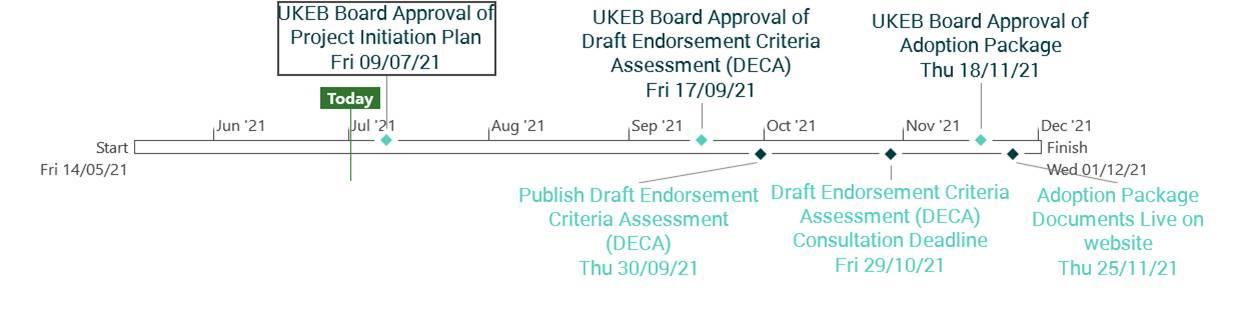
17The proposed high-level project timeline is as follows:
| Date | Milestones |
|---|---|
| 9 July – Board meeting | Approve Project Initiation Plan |
| 17 September – Board meeting | Approve Draft Endorsement Criteria Assessment (DECA) |
| w/c 27 September | Publish DECA (5-week comment period until 29 October) |
| Public consultation period | 27 September–29 October 2021 [~5 weeks] |
| 18 November – Board meeting | Adoption package comprising the UKEB Board approval of: • Draft Endorsement Criteria Assessment (ECA) • Draft Adoption statement • Draft Feedback statement • Draft Compliance with due process statement |
Footnotes
-
This term has the meaning given in SI 2019/685 by referring to Article 2 of Regulation (EC) No 1606/2002 of the European Parliament and of the Council of 19 July 2002 on the application of international accounting standards: "...'international accounting standards' shall mean International Accounting Standards (IAS), International Financial Reporting Standards (IFRS) and related Interpretations (SIC-IFRIC interpretations), subsequent amendments to those standards and related interpretations, future standards and related interpretations issued or adopted by the International Accounting Standards Board (IASB)". ↩
-
The International Accounting Standards and European Public Limited-Liability Company (Amendment etc.) (EU Exit) Regulations 2019 No 685: https://www.legislation.gov.uk/uksi/2019/685/made ↩
-
The International Accounting Standards (Delegation of Functions (EU Exit) Regulations 2021 No 609: https://www.legislation.gov.uk/uksi/2021/609/contents/made ↩
-
Appendix 1 reproduces the criteria for annual improvements and narrow-scope amendments. ↩
-
These included Amendments to IFRS 4 Insurance Contracts-deferral of IFRS 9, IFRS 16 Leases Covid 19-Related Rent Concessions, IFRS 3 Business Combinations and IFRS 9, IAS 39 and IFRS 7: Interest Rate Benchmark Reform. Source: EU Endorsement Status Report, 14 January 2021 (page 2). ↩
-
Source: EU Endorsement Status Report, 7 May 2021. ↩
-
Exposure Draft ED/2019/2 Annual improvements to IFRS Standards 2018–2020 was issued for comment in May 2019. The comment period was open until 20 August 2019. ↩