Feedback Statement - Adoption of May 2020 Amendments
17 February 2022
The UK Endorsement Board (UKEB)
The UKEB is responsible for endorsement and adoption of IFRS for use in the UK and is therefore the UK's National Standard Setter for IFRS. The UKEB also leads the UK's engagement with the IFRS Foundation on the development of new standards, amendments and interpretations.
The purpose of this Feedback Statement
This document presents the views of UK stakeholders received during the UKEB's public consultation on the Draft Endorsement Criteria Assessment (DECA) of three IASB's annual improvements amendments and three IASB's narrow-scope amendments and explains how the UKEB has addressed those views in the final ECA.
1. Background
The IASB issues amendments to international accounting standards to maintain and improve IFRS Standards.
In May 2020 the IASB finalised and published the 'May 2020 Amendments':
- four IASB annual improvements 1 from Annual Improvements to IFRS® Standards 2018–2020 and
- three narrow-scope amendments that were published separately by the IASB.
The UKEB was not able to directly influence the May 2020 Amendments as the IASB finalised them before the creation of the UKEB.
The UKEB commenced work on the adoption of the May 2020 Amendments in the second half of 2021.
The UKEB Secretariat reviewed the comments from UK stakeholders to understand how they had been considered by the IASB when finalising those Amendments.
The Secretariat's desk-based research indicated that the May 2020 Amendments had been subject to public consultation and comments from UK stakeholders had been submitted directly to the IASB and/or to the European Financial Reporting Advisory Group (EFRAG).
The Board approved the DECA at its September 2021 Board meeting. The DECA was published for comment on 29 September 2021 (comments due by 30 November 2021).
2. Description of May 2020 Amendments (1/2)
The ECA considered as part of the assessment the following IASB annual improvements:
| Amendments to IFRS 1 First-time Adoption of International Financial Reporting Standards—Subsidiary as a First-time Adopter | Amendments to IFRS 9 Financial Instruments—Fees in the ‘10 per cent’ Test for Derecognition of Financial Liabilities | Amendments to IAS 41 Agriculture—Taxation in Fair Value Measurements |
|---|---|---|
| Simplifies the transition to IFRS Standards for a subsidiary that becomes a first-time adopter of IFRS Standards. This is to avoid the need to maintain parallel sets of accounting records based on different dates of transition. Allows a subsidiary that becomes a first-time adopter of IFRS Standards to apply the exemption in paragraph D16(a) of IFRS 1 to measure cumulative translation differences for all foreign operations using the amounts reported by its parent, based on the parent's date of transition to IFRS Standards. |
Clarifies which fees an entity includes when it applies the '10 per cent' test in paragraph B3.3.6 of IFRS 9 in assessing whether to derecognise a financial liability. The borrower includes only fees paid or received between the borrower and the lender, including fees paid or received by either the entity or the lender on the other's behalf. |
Promotes consistency of the requirements in IAS 41 with the requirements in IFRS 13 Fair Value Measurement. Removes the requirement in paragraph 22 of IAS 41 to exclude cash flows for taxation when measuring the fair value of a biological asset using a present value technique. |
Description of May 2020 Amendments (2/2)
The ECA considered as part of the assessment the following IASB narrow-scope amendments:
| Amendments to IAS 37 Provisions, Contingent Liabilities and Contingent Assets—Onerous Contracts—Cost of Fulfilling a Contract | Amendments to IAS 16 Property, Plant and Equipment—Proceeds before Intended Use | Amendments to IFRS 3 Business Combinations—Reference to the Conceptual Framework |
|---|---|---|
| Clarifies which costs to include in estimating the 'cost of fulfilling' a contract for the purpose of assessing whether that contract is onerous. Specifies that the 'cost of fulfilling' a contract comprises the 'costs that relate directly to the contract'. These costs can either be: - incremental costs of fulfilling that contract; or - an allocation of other costs that relate directly to fulfilling contracts. |
Provides guidance on the accounting for sale proceeds and related production costs. Prohibits an entity from deducting from the cost of property, plant and equipment any proceeds received from selling items produced while bringing that asset to the location and condition necessary for it to be capable of operating in the manner intended by management. Instead, an entity recognises the proceeds from selling such items and related cost, in profit or loss. |
Requires an entity to refer to the latest version of the Conceptual Framework (2018) when determining what constitutes an asset or a liability. To avoid an unintended consequence of updating that reference, the amendment to IFRS 3 also adds an exception that specifies that, for some types of liabilities and contingent liabilities, an entity applying IFRS 3 should instead apply IAS 37 or IFRIC 21 Levies. |
3. Outreach approach
Due to the minor and narrow-scope nature of the May 2020 Amendments, the UKEB Secretariat's consultation activities were focused on obtaining responses on the DECA.
4. UKEB public consultation on the Draft ECA
The UKEB's public consultation on the Draft ECA took place between 29 September 2021 and 30 November 2021.
During the consultation period the UKEB and its Secretariat encouraged stakeholders to respond to the DECA through News Alerts and through advertising through the usual channels.
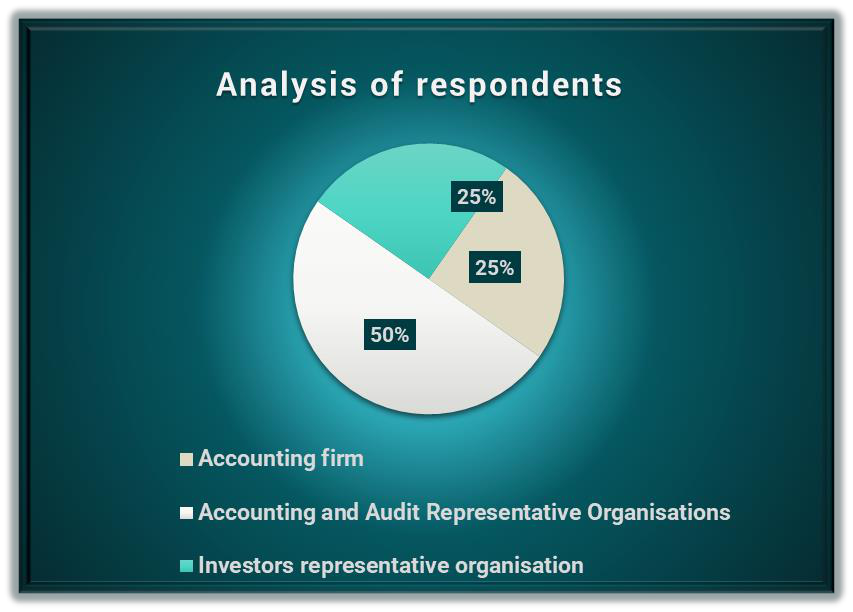
A total of 4 formal responses were received from stakeholders.
The graph below provides an analysis of respondents by type of organisation represented.
5. Overall assessment
During the public consultation of the DECA a total of four formal responses were received from stakeholders, three of them fully supporting the UKEB's assessment against the technical criteria in paragraph 1 of Regulation 7 SI 2019/685. These respondents fully supported the adoption of the May 2020 Amendments. One of these respondents mentioned that these amendments should be available for use in the UK as soon as possible.
One respondent considered that the UKEB's assessment did not address the true and fair test required by Regulation 7(1)(a) in SI 2019/685 as it was replaced with "something different, 'reflecting economic substance". In response to this feedback the relevant paragraphs were reviewed to more accurately reflect the UKEB's assessment work.
Disclaimer
- This feedback statement has been produced in order to set out the UKEB response to stakeholder comments received on the Draft Endorsement Criteria Assessment for the May 2020 annual improvements and narrow-scope amendments with an effective date of 1 January 2022 and should not be relied upon for any other purpose.
- The views expressed in this feedback statement are those of the UKEB at the point of publication.
- Any sentiment or opinion expressed within this feedback statement will not necessarily bind the conclusions, decisions, endorsement or adoption of any new or amended IFRS by the UKEB.
Contact Us
UK Endorsement Board
8th Floor | 125 London Wall | London | EC2Y 5AS | United Kingdom