PIR 10-12 Feedback Statement
26 June 2021
Following the UK's exit from the European Union, the Department for Business, Energy and Industrial Strategy (BEIS) has established the UK Endorsement Board (UKEB) to fulfil statutory functions of influencing the development and subsequent adoption of International Accounting Standards for use in the UK.
Prior to the delegation of statutory functions to the UKEB, the UKEB Secretariat began influencing activities in preparation for the delegation. This feedback statement forms part of those influencing activities.
The views expressed by the UKEB Secretariat in this feedback statement are separate from, and will not necessarily affect the conclusions in, any endorsement and adoption assessment on new or amended International Accounting Standards to be provided to the Secretary of State or the UKEB, now that powers have been delegated.
Purpose of this feedback statement
This feedback statement presents the views of UK stakeholders received during the UKEB Secretariat's outreach activities on the IASB's Post-implementation Review of IFRS 10, IFRS 11 and IFRS 12 and explains how the UKEB Secretariat's comment letter addressed those views.
Overview
The IASB issued IFRS 10, IFRS 11 and IFRS 12 in May 2011.* These standards were effective on 1 January 2013.
- IFRS 10 established a single consolidation model, based on the principle of control.
- IFRS 11 required the classification of joint arrangements based on rights and obligations as well as the elimination of the accounting policy option for joint ventures
- IFRS 12 combined and enhanced disclosure requirements of subsidiaries, joint arrangements, associates and unconsolidated structured entities.
In December 2020 the IASB published its RFI for the PIR of IFRS 10, IFRS 11 and IFRS 12 and asked stakeholders if:
- An entity applying the Standards provides information that helps users and provides a faithful representation of financial position and financial performance.
- Areas of Standards pose challenges or could result in inconsistent application.
- Implementing the Standards led to unexpected costs.
The UKEB Secretariat published its final response on 26 May 2021.
- In developing its response the UKEB Secretariat consulted publicly with UK stakeholders.
- The response concluded that overall the Standards achieved their objectives.
- The response included recommendations limited to those few areas where the application of the Standards could be significantly improved.
*All Standards have been subsequently amended.
Outreach approach
The UKEB Secretariat's outreach activities took place during March 2021 and April 2021.
The outreach approach was underpinned by the UKEB's guiding principles of thought leadership, transparency, independence, and accountability.
To develop our response and obtain a balanced range of views on the issues identified by the IASB, we gathered evidence from stakeholder roundtables and interviews, desk-based reviews of annual reports from a sample of UK listed companies, and public consultation on the UKEB Secretariat's draft comment letter.
The stakeholder groups included investors, preparers, and audit firms and one regulator.
Outreach activities resulted in different comments and views on the issues identified by the IASB. All comments and views were considered in reaching our final position.
Stakeholder views and the development of UKEB's final position on IFRS 10, IFRS 11 & IFRS 12
IFRS 10 Assessment of control
IASB questions, stakeholder views, and UKEB Secretariat position
| IASB Question | Stakeholder Views | UKEB secretariat draft position | UKEB secretariat final position |
|---|---|---|---|
| Does IFRS 10 enable an investor to identify the relevant activities of an investee? | There is sufficient guidance to identify relevant activities, although significant judgement is required. | ||
| Does IFRS 10 enable an investor to determine if rights are protective rights? | There is sufficient guidance to assess whether rights are protective or substantive. | ||
| Does IFRS 10 enable an investor that does not hold a majority of the voting rights to assess whether it has the practical ability to direct an investee's relevant activities? How frequently do these assessments happen? Is the cost of obtaining the information significant? | Assessment of control without majority voting rights is infrequent and the cost is not disproportionate. | Assessment of control without majority voting rights is infrequent and the cost is not disproportionate. |
IFRS 10 Assessment of control (2)
IASB questions, stakeholder views, and UKEB Secretariat position
| IASB Question | Stakeholder Views | UKEB secretariat draft position | UKEB secretariat final position |
|---|---|---|---|
| Does IFRS 10 enable an investor to determine whether a decision-maker is a principal or an agent? | There is sufficient guidance to assess if a decision-maker is acting as a principal or as agent, although significant judgement is sometimes required. | ||
| Does IFRS 10 enable an investor to assess whether control exists because another party is acting as a de facto agent? How frequently is such an assessment needed? | There is sufficient guidance to assess control in the absence of contractual arrangements. | There is sufficient guidance to assess control in the absence of contractual arrangements. | |
| This assessment is needed most frequently where a parent has two subsidiaries, both of which have an ownership interest in a sub-subsidiary. |
Investment entities (IFRS 10)
IASB questions, stakeholder views, and UKEB Secretariat position
| IASB Question | Stakeholder Views | UKEB secretariat draft position | UKEB secretariat final position |
|---|---|---|---|
| Do the typical characteristics and the investment entity definition lead to consistent outcomes? | Mixed. Some questioned the value of disclosing why an investment entity is classified as such when it meets the definition but does not exhibit the typical characteristics. Mixed. Some observed that some types of fund do not meet the application guidance on typical characteristics for investment entities. Outcomes for all types of funds may not be appropriate. | We recommend a review of this disclosure requirement. Outcomes are consistent. | We recommend a review of this disclosure requirement. Outcomes are consistent, but we recommend a review of the application guidance for investment entities. |
| Is there loss of information when an investment entity records at fair value its investment in a subsidiary that is an investment entity? | Mixed. Some observed that there is a loss of information when an intermediate investment entity subsidiary is not consolidated, because any assets or debt in the intermediate investment entity are not visible at group level. | Outcomes are consistent and there is no loss of information. | Outcomes are consistent but we recommend investment entities are required to consolidate intermediate subsidiaries which are themselves investment entities to avoid loss of information. |
Changes to group structure (IFRS 10)
IASB questions, stakeholder views, and UKEB Secretariat position
| IASB Question | Stakeholder Views | UKEB secretariat draft position | UKEB secretariat final position |
|---|---|---|---|
| How frequently does the relationship between investor and investee alter in a way which is not addressed in IFRS standards? Where there is loss of control, does remeasuring the retained interest at fair value provide relevant information? | Infrequently. | Yes, remeasuring retained interest at fair value provides relevant information. | Yes, remeasuring retained interest at fair value provides relevant information. |
| Where an investor acquires control of a subsidiary that does not constitute a business as defined in IFRS 3, what accounting is used? How frequently do these transactions occur? | There is diversity in practice, as some entities apply IFRS 3 and other apply IFRS 10. These transactions are increasing in frequency. | When an investor acquires a controlling interest in a single asset entity that does not constitute a business there is diversity in practice. We recommend IASB undertakes a project to research divergent practice in this area with a view to improving consistency and comparability. |
Collaborative arrangements (IFRS 11)
IASB questions, stakeholder views, and UKEB Secretariat position
| IASB Question | Stakeholder Views | UKEB secretariat draft position | UKEB secretariat final position |
|---|---|---|---|
| How widespread are collaborative arrangements that do not meet the IFRS 11 definition of 'joint arrangement' because the parties to the arrangement do not have joint control? | Collaborative arrangements outside the scope of IFRS 11 are widespread, particularly in the extractives sector. | Collaborative arrangements outside the scope of IFRS 11 are widespread, particularly in the extractives sector. | |
| How do entities that apply IFRS Standards account for such collaborative arrangements? Is the accounting a faithful representation of the arrangement and why? | These collaborative arrangements are accounted for by applying other IFRS Standards. This provides a faithful representation. | These collaborative arrangements are accounted for by applying other IFRS Standards. This provides a faithful representation. | These collaborative arrangements are accounted for by applying other IFRS Standards. This provides a faithful representation. |
- Includes stakeholder views from all outreach activities
Other facts and circumstances (IFRS 11)
IASB questions, stakeholder views, and UKEB Secretariat position
| IASB Question | Stakeholder Views | UKEB secretariat draft position | UKEB secretariat final position |
|---|---|---|---|
| How frequently is consideration of other facts and circumstances necessary? | It is necessary to consider other facts and circumstances frequently to determine whether a joint arrangement is a joint venture or a joint operation. | It is necessary to consider other facts and circumstances frequently to determine whether a joint arrangement is a joint venture or a joint operation. | |
| Can an investor applying IFRS 11 determine the classification of a joint arrangement by using the other facts and circumstances guidance? | Mixed. Some thought the guidance in IFRS 11 is sufficient. Others advocated incorporating relevant IFRIC decisions into IFRS 11. | The other facts and circumstances guidance is sufficient. | The guidance on other facts and circumstances is not always sufficient. We recommend the principles from the IFRIC March 2015 update are added to IFRS 11. |
| Does applying IFRS 11 enable a joint operator to report its assets, liabilities, revenue and expenses in a relevant and faithful manner? | Mixed. Some stated that IFRS 11 allowed a joint operator to so report. Others noted that more clarity was needed on accounting for a joint operator's share of a right-of-use asset. | IFRS 11 allows a joint operator to report its assets, liabilities, revenue and expenses in a relevant and faithful manner. | We recommend additional guidance on accounting for a joint operator's share when a joint operator has a right-of-use asset. |
IFRS 12
IASB questions, stakeholder views, and UKEB Secretariat position
| IASB Question | Stakeholder Views | UKEB secretariat draft position | UKEB secretariat final position |
|---|---|---|---|
| Can entities meet the IFRS 12 disclosure objective by applying IFRS 12 disclosure requirements? | Mixed. Users recommended enhanced disclosures for material non-controlling interests. One stakeholder asked whether the disclosure requirements for unconsolidated structured entities have proved useful as an indicator of potential risk. | Recommended enhanced disclosures for material non-controlling interests and guidance on the level of aggregation and disaggregation of disclosures. | Additional recommendation to reconsider current disclosure requirements for unconsolidated structured entities and the extent to which disclosures for unconsolidated structured entities have proved useful as an indicator of potential risk. Retained recommendations from draft response. |
- Includes stakeholder views from all outreach activities
Outreach events and participants
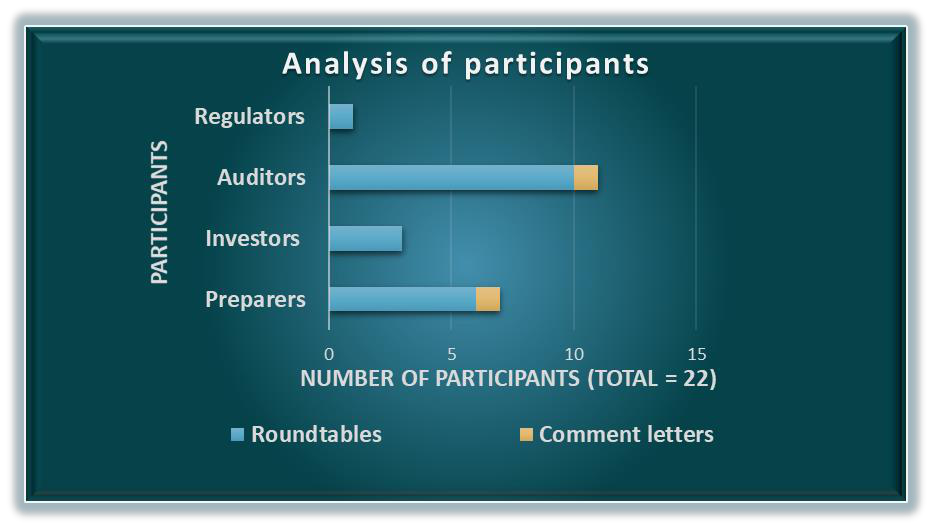
- In total, 22 stakeholders participated in outreach activities.
- The table provides an analysis of participants by outreach activity and by type of organisation represented.
- Comment letters received are published on the UKEB website here.
Disclaimer
This feedback statement has been produced in order to set out the UKEB Secretariat's response to stakeholder comments received on IASB's Request for Information on the PIR of IFRS 10, IFRS 11 and IFRS 12 and should not be relied upon for any other purpose.
The views expressed in this feedback statement are those of the UK Endorsement Board Secretariat at the point of publication.
Any sentiment or opinion expressed within this feedback statement will not necessarily bind the conclusions, decisions, endorsement or adoption of any new or amended IFRS by the UKEB or the Secretary of State.
Contact Us
UK Endorsement Board
8th Floor | 125 London Wall | London | EC2Y 5AS | United Kingdom