UKEB 2025/2028 Regulatory Strategy (Draft)
The UKEB does not accept any liability to any party for any loss, damage or costs however arising, whether directly or indirectly, whether in contract, tort or otherwise from action or decision taken (or not taken) as a result of any person relying on or otherwise using this document or arising from any omission from it.
© 2024 All Rights Reserved
1. Chair's Introduction
Looking Back: The First UKEB Regulatory Strategy 2022/25
The UKEB was established in 2021 to influence the development of new international accounting standards and to consider them for adoption for use by UK companies. These statutory functions require us to act in the UK's long-term public good, supporting capital allocation through the provision of transparent and comparable financial information that is decision-useful for investors.
The Board's first regulatory strategy, covering the three-year period to March 2025, was aimed at balancing the set-up of necessary organisational structures with delivery of its statutory functions.
Highlights of the UKEB's achievements during this period include:
- Adoption of IFRS 17 Insurance Contracts. The standard was a fundamental overhaul of accounting for insurance contracts, introduced to ensure an entity provides relevant information to its investors that faithfully represents those contracts.
- Adoption of 14 narrow scope amendments to IFRS, including a number of urgent amendments.
- Monitoring and influencing the IASB's redeliberation of live standard-setting through discussion at UKEB Board meetings.
- Publication of 13 comment letters to the International Accounting Standards Board (IASB) on their work. In addition, the UKEB sent 2 comment letters to the International Sustainability Standards Board (ISSB) providing feedback on their work.
- Completion of pro-active research projects on: Subsequent Measurement of Goodwill; Connectivity between IASB and ISSB standards; and Accounting for Intangible Assets. These projects led to the publication of six well received research reports, timed to feed into the IASB and ISSB's ongoing work in these areas, and contributed to the international debate on these issues.
- Active participation in discussions at international standard setting fora, including at the IASB's Accounting Standards Advisory Forum (ASAF), as well as other international and UK events. We also worked collaboratively with other national standard setters to issue a joint letter to the IASB and ISSB on connectivity in financial reporting.
- Engaging in the UK Government's work to assess IFRS Sustainability Disclosure Standards for endorsement, for use in the UK, through our membership of the UK
- Sustainability Disclosure Technical Advisory Committee (TAC) and UK Sustainability Disclosure Policy Implementation Committee (PIC).
- Developing, consulting on and finalising the UKEB's Due Process Handbook.
- Setting up four standing advisory groups (Accounting Firms and Institutes, Investors, Preparers and Academics), an ad-hoc advisory group on Rate-regulated Activities, and two working groups to provide support to the UKEB Secretariat's work on Financial Instruments and Sustainability. The insights provided by these groups have been critical in ensuring that the Board is informed of the views of key UK stakeholder groups.
Context for the UKEB Regulatory Strategy 2025/28
The UKEB considers long-term public good in all of its work. This includes addressing the implications for UK economic growth and competitiveness, the needs of investors and businesses, and supporting effective and efficient capital allocation through comparable and proportionate reporting standards. This is underpinned by the statutory requirement for the UKEB to consider the UK's long-term public good as part of its endorsement process.
The UK and international business landscape has changed significantly since 2022, with increasing technological innovation and a shift towards a greener economy. As the business world adjusts to a new economic reality that may be carbon-constrained, corporate reporting must continue to balance the needs of investors and capital markets, for understandable and transparent financial information, with the cost for companies.
Within the international standard setting sphere, this change in the business world has been reflected by the expansion of the IFRS Foundation to incorporate a sister Board to the IASB, the ISSB, and the shift in the IASB's focus to projects on intangibles, accounting for renewable electricity contracts and connectivity. The IASB is also expected to consult stakeholders on its next five-year agenda during this regulatory strategy period, which will determine the extent to which these themes need to be addressed through accounting standard setting.
In the UK, the appointment of the Financial Conduct Authority as a member of the IFRS Foundation's Monitoring Board provides an opportunity for further collaboration and an enhanced UK voice in support of international accounting and sustainability reporting standards.
As part of the UK Government's commitment to international sustainability standards and the establishment of the UK Sustainability Reporting Standards (UK SRS) endorsement framework, the UKEB is represented on both advisory committees – TAC and PIC.
The challenges and opportunities that form the context for the UKEB's regulatory strategy for the 2025/28 period include:
- Maintaining the UKEB's strong, influential voice amongst the international standard setting community.
- Maintaining and building on the UKEB's reputation for robust, evidence-based research, designed to feed into the IASB and ISSB's ongoing work, and contribute to the international debate on these issues.
- Using the UKEB's convening powers to engage with a range of stakeholders, both in the UK and internationally, to help achieve the UKEB's mission and statutory functions.
- Attracting and retaining sufficient and qualified Secretariat resource, in a tight market, to ensure the UKEB maintains the headcount and skillset needed to fulfil its statutory functions.
- Ensuring a robust governance and due process framework that is proportionate and fit for purpose.
- Ensuring stable funding whilst maintaining the Board's technical independence.
- Ensuring diversity, equity and inclusion at all levels of the organisation.
Pauline Wallace Chair
2. Our Purpose
The UKEB was established with a specific set of statutory functions and mission, to be achieved via a core set of values.
Statutory Functions
The statutory functions of the UKEB, as delegated to it by the Secretary of State for the Department for Business, Energy and Industrial Strategy (BEIS) in May 20211, are to:
- participate in, and contribute to, the development of a single set of international financial reporting standards; and
- adopt international accounting standards when they meet the criteria in Statutory Instrument 2019/685 ‘The International Accounting Standard and European Public Limited-Liability Company (Amendments etc.) (EU Exit) Regulations 2019'.
The objectives for adoption of IFRS for use in the UK are to ensure:
- a high degree of transparency and international comparability of financial statements; and
- the efficient allocation of capital, including the smooth functioning of capital markets in the UK.
Mission
To serve the UK long-term public good by leading the debate on the development of high-quality international accounting standards that are suitable for adoption in the UK. To achieve this the UKEB develops and synthesises UK views on financial reporting and presents them in the international arena, to maintain an influential and effective UK voice.
Values
The UKEB operates in the public interest, following the seven principles of public life, our four guiding principles, and the principles for dealing with resources in public sector organisations in the UK.
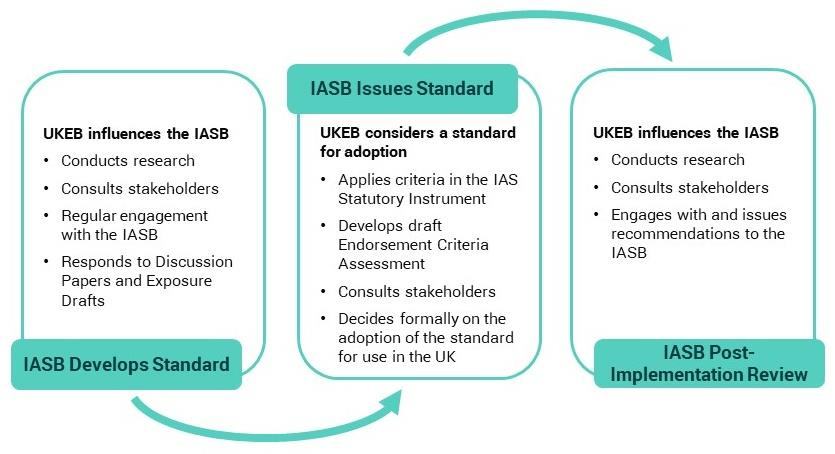
The UKEB's influencing and adoption assessment cycle is summarised as follows:
3. Our Strategy
Our regulatory strategy sets out the strategic objectives that will help the Board navigate future changes to the business or standard setting environments.
3.1 Strategic Objectives 2025/28
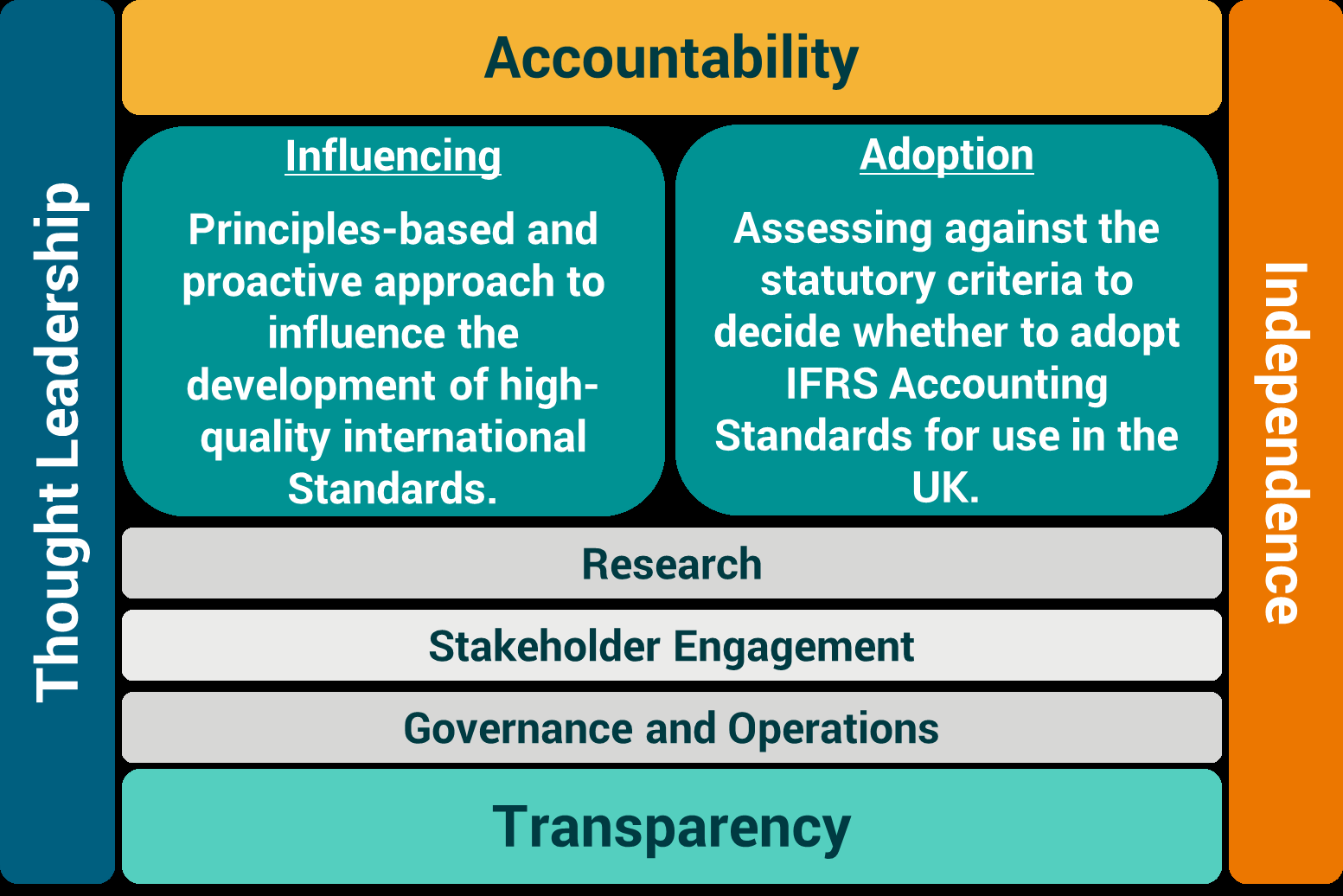
The UKEB's strategic objectives are derived from its statutory functions. The UKEB's strategic approach to carrying out its statutory functions and achieving its objectives builds on the approach taken in the UKEB's first three-year strategy, for the period 2022/25.
Our 2025/28 strategy will, among other things, guide the UKEB in identifying priorities, deciding on how to use its resources efficiently, and making informed decisions.
The UKEB's strategy has two main objectives which are to:
- Influence and provide thought leadership during the development of international financial reporting standards2; and
- Assess international accounting standards for adoption for use in the UK.
To facilitate the delivery of these objectives, the UKEB will:
- Conduct evidence-based research;
- Undertake stakeholder engagement; and
- Maintain a robust governance and operations framework.
More details on the UKEB's strategic objectives for 2025/28 are set out below.
3.2 Influencing and Thought Leadership
The UKEB's planned influencing activities for 2025/28 will continue to be flexible to address any changes to the IASB's work plan, including any changes arising from its Agenda Consultation, whilst remaining responsive to Board agenda time, staff resource constraints, and compliance with the Due Process Handbook.
The UKEB will take a principles-based, proactive and risk-based approach to influencing the IASB and other global players. This will aid the development of high-quality international accounting standards that promote transparent and comparable financial information, and the smooth functioning of capital markets. In particular, it will:
- Influence the IASB early in its standard development cycle.
- Showcase UK thought leadership and research to influence the global standard setting debate and amplify them by highlighting the findings to the IASB and other international organisations.
- Seek to promote connectivity between IFRS Accounting Standards and IFRS Sustainability Disclosure Standards by considering the connectivity implications for IFRS Accounting Standards, arising from the issuance of IFRS Sustainability Disclosure Standards, and by influencing the work of the relevant UK and international bodies.
- Influence the relevant bodies, including the IASB, ISSB or UK Government, as appropriate, by highlighting any emerging issues and proposing potential solutions.
3.3 Assessing International Accounting Standards for Adoption
The UKEB will assess all new and amended international accounting standards for adoption in the UK on a timely basis. In particular, it will:
- Assess new standards and amendments against the statutory adoption criteria.
- Conduct proportionate engagement with relevant stakeholders to ensure that the practical implications for UK companies, their investors and other stakeholders of implementing those standards and amendments have been appropriately established and assessed.
- Liaise with IASB board members and staff to ensure a full understanding of the technical issues and bases for conclusions.
- Seek to ensure that all material issues relevant to the assessment of the impact of the standard on the UK long-term public good have been identified and assessed, including through the monitoring of other national standard setters' endorsement work.
3.4 Conducting Evidence-Based Research
The UKEB will support its influencing and adoption activities by developing evidence-based recommendations and demonstrating thought leadership on emerging issues, from a UK perspective. This will include:
- Using any relevant UK research and stakeholder feedback as key components of the UKEB's evidence-based and persuasive influencing and thought leadership activities; and
- Developing an active research programme, addressing new and emerging issues in international accounting, with a particular focus on topics included in, or likely to be included in, the IASB's long-term agenda.
3.5 Undertaking Stakeholder Engagement
The UKEB's annual workplan allocates time to formal stakeholder engagement. In the UK, this engagement is conducted through the Board's advisory and working groups as well as outreach with other UK stakeholders, as relevant. Internationally, stakeholder engagement is undertaken through attendance at international meetings, including the UKEB's membership of the IASB's Accounting Standards Advisory Forum (ASAF), to contribute to the international standard setting debate. On stakeholder engagement, the UKEB will:
- Further develop the UKEB's domestic and international profile by:
3.6 Maintaining a Robust Governance and Operations Framework
A robust governance and operations framework is key to ensuring the requisite level of support to facilitate the achievement of UKEB's statutory functions and effective risk management. In particular, the UKEB will:
- Ensure the governance and operations framework allows it to fulfil its statutory functions and is aligned with the culture and values of the organisation.
- Maintain the independence of its technical decision-making.
- Collaborate effectively with the FRC, in its role as the UKEB's outsourced services provider.
- Continue to seek opportunities to further enhance the UKEB's stakeholder engagement capability.
- Maintain tight budgetary control, aligned to the Managing Public Money principles.
4. Assessing Our Impact
The UKEB will consider the following key elements when assessing the impact of implementing its strategic objectives.
4.1 Influencing and Thought Leadership
The impact of the UKEB's work to influence the development of international accounting standards will be monitored through our:
- Regular monitoring of the UKEB's impact on IASB projects;
- Contributions at international standard setting forums, including ASAF; and
- Interaction with other stakeholders, including national and regional standard setters, bilaterally, and via contributions at formal conferences, such as the International Forum of Accounting Standard Setters.
The UKEB's work in relation to promoting connectivity will be assessed through:
- Regular monitoring of the impact of the UKEB's work and research in this area on IASB projects, and advice provided to the Secretary of State on the endorsement of ISSB standards;
- Contributions at international standard setting forums; and
- Interaction with other stakeholders including national and regional standard setters.
4.2 Assessing International Accounting Standards for Adoption
The UK legislative framework prescribes the process for deciding whether to adopt new standards for use in the UK. It is multi-faceted, requiring consideration from technical accounting, economic, and legal perspectives. In addition, it stipulates consultation with relevant stakeholders. Adequate time will be allocated to enable: appropriate consideration of relevant UK-specific technical, economic and legal implications; project-specific outreach with relevant stakeholders; and regular engagement at Board level.
The effectiveness of the UKEB's adoption of international accounting standards will be measured through:
- Addressing key UK-specific issues raised by stakeholders during the endorsement process;
- Decisions on whether to adopt a new standard or amendment being made on a timely basis; and
- Compliance with the Due Process Handbook in delivering the technical workplan.
4.3 Conducting Evidence-Based Research
Key measures of the success of UKEB research work will include:
- UKEB research being showcased at international standard setting forums, including ASAF; and
- Presentation of UKEB research during national and international conferences on corporate reporting.
4.4 Undertaking Stakeholder Engagement
Key measures of success for the UKEB's stakeholder engagement processes will include:
- Successful campaigns to recruit new candidates to the relevant advisory and working groups;
- Dialogue with, and responses from, stakeholders on UKEB's consultations;
- UKEB's collaborative work with other national standard setters; and
- Reappointment of the UKEB to ASAF.
4.5 Maintaining a Robust Governance and Operations Framework
The effectiveness of the governance and operations framework is monitored via the following core areas:
- Compliance with the Memorandum of Understanding, Terms of Reference and Service Level Agreement;
- Effective and efficient management of internal resource and outsourced services;
- Ensuring actual costs are managed in line with agreed budget/ forecast and adherence to Managing Public Money principles; and
- Identifying, mitigating and monitoring key risks that would otherwise impede the UKEB's ability to achieve its strategic objectives.
Additional indicators of the Board's overall effectiveness in meeting its statutory objectives are incorporated in the following annual reports:
- Board effectiveness review;
- A report to the Secretary of State setting out how the Board has discharged its delegated functions; and
- A report to the FRC setting out how the Board has fulfilled its governance and due process responsibilities.
Contact Us
UK Endorsement Board 10 South Colonnade | London | E14 4PU | United Kingdom www.endorsement-board.uk
Footnotes
-
Following the changes announced on 7 February 2023, oversight of the UKEB's discharge of its statutory functions moved from BEIS to the Department for Business and Trade (DBT). ↩
-
The Secretary of State for the Department of Business and Trade (DBT) requested that, in addition to its statutory responsibilities, the UKEB consider the interplay between IFRS Accounting Standards and IFRS Sustainability Disclosure Standards. As part of this additional work, a UKEB Board member sits on the UK Sustainability Disclosure Technical Advisory Committee, which is tasked with assessing the IFRS Sustainability Disclosure Standards from a technical perspective and advising the Secretary of State for Business and Trade on whether their endorsement would be conducive to the long-term public good in the UK. Additionally, the UKEB Secretariat is a member of the DBT chaired Policy Implementation Committee which is tasked with coordinating the implementation of UK Sustainability Reporting Standards by the UK Government and under FCA Listing Rules. ↩