ECA - IFRS 18 Presentation and Disclosure in Financial Statements
December 2025
The UKEB does not accept any liability to any party for any loss, damage or costs howsoever arising, whether directly or indirectly, whether in contract, tort or otherwise from any action or decision taken (or not taken) as a result of any person relying on or otherwise using this document or arising from any omission from it.
© 2025 All Rights Reserved
- Executive summary
- Introduction
- I. Section 1: UK statutory requirements for adoption and the approach to the endorsement criteria assessment
- Introduction
- UK statutory requirements
- Approach to the endorsement criteria
- Technical accounting criteria: Relevance, Reliability, Understandability and Comparability
- Whether IFRS 18 is likely to be conducive to the long term public good in the UK
- True and fair view assessment
- True and fair view assessment
- Adoption decision
- Does IFRS 18 lead to a significant change in accounting practice?
- 2. Section 2: Main requirements in IFRS 18
- Introduction
- Background
- Entities in scope for the assessment of IFRS 18
- Entities with specified main business activities
- Main requirements in IFRS 18
- Overview of the elements imported from IAS 1
- Overview of the main requirements in IFRS 18 (and what has changed)
- Specified categories and required subtotals in the statement of profit or loss
- Requirements for entities with specified main business activities
- Required subtotals, items to be presented in the primary financial statements and presentation of additional line items and subtotals
- Disclosures about management-defined performance measures (MPMs)
- Requirements on aggregation and disaggregation
- Limited changes to the statement of cash flows
- Limited changes to the statement of financial position
- Transition requirements
- Limited changes to the statement of financial position
- Transition requirements
- 3. Section 3: Technical accounting criteria assessment
- Introduction
- Approach to the assessment against the technical accounting criteria
- Assessment of main requirements in IFRS 18
- Specified categories and required subtotals in the statement of profit or loss
- Assessment against the endorsement criteria
- Disclosures about management-defined performance measures (MPMs)
- Assessment against the endorsement criteria
- Aggregation and disaggregation
- Assessment against the endorsement criteria
- Limited changes to the statement of cash flows
- Assessment against the endorsement criteria
- Overall conclusion on whether IFRS 18 meets the technical accounting criteria
- 4. Section 4: UK long term public good assessment
- Introduction
- Is use of IFRS 18 likely to improve the quality of financial reporting?
- Approach for this assessment
- Improvements introduced by IFRS 18
- Management-defined performance measures
- Aggregation and disaggregation
- Limited changes to IAS 7
- Potential improvement from interaction across the main changes
- Summary of whether IFRS 18 is likely to improve the quality of financial reporting
- Economic impact assessment
- Economic impact assessment
- Analysis of wider economic effects
- Users
- First-order indirect effects - capital market effects
- Background information
- Effects considered
- Application of the methodology
- Potential impact on new public listings
- Second-order indirect effects
- Third-order indirect effects
- Consideration of the consequences of not adopting IFRS 18 (counterfactual analysis)
- Overall assessment of long term public good
- 5. Section 5: True and fair view assessment
- 6. Section 6: Is IFRS 18 likely to lead to a significant change in accounting practice?
- 6. Section 6: Is IFRS 18 likely to lead to a significant change in accounting practice?
- Appendix A: Glossary
- 6. Section 6: Is IFRS 18 likely to lead to a significant change in accounting practice?
- Appendix A: Glossary
- Appendix D: Quantitative assessment of implementation costs
- Appendix E: Capital markets effects: additional results
Executive summary
Background
1The UK Endorsement Board (UKEB) is responsible for the endorsement and adoption of international accounting standards issued by the International Accounting Standards Board (IASB) in the form of International Financial Reporting Standards (IFRS) for use in the United Kingdom (UK). The UKEB is therefore the UK's National Standard Setter for IFRS.
2This Endorsement Criteria Assessment (ECA) presents the work conducted by the UKEB to assess whether IFRS 18 Presentation and Disclosure in Financial Statements, issued by the International Accounting Standards Board in April 2024, meets the UK's statutory requirements for adoption of IFRS as set out in Regulation 7 of Statutory Instrument 2019/685 (the Regulations).
3Although the Regulations refer only to 'adoption', for the purposes of this ECA, the term endorsement is generally used when referring to the assessment of IFRS 18 against the criteria set out in the Regulations.
4This assessment addresses the three endorsement criteria set out in the Regulations:
- whether IFRS 18 meets the criteria of understandability, relevance, reliability and comparability required of the financial information needed for making economic decisions and assessing the stewardship of management;
- whether IFRS 18 is likely to be conducive to the long term public good in the UK; and
- whether IFRS 18 is not contrary to the true and fair view principle for individual and consolidated accounts.
5These endorsement criteria are described in more detail in Section 1. Sections 3, 4 and 5 discuss whether these criteria are met.
6The ECA also addresses, in Section 6, whether IFRS 18 is likely to lead to a significant change in accounting practice as set out in Regulation 11 of Sl 2019/685.
Work to support these assessments
7The work to support these assessments has spanned several months and has been responsive to stakeholder input throughout. The UKEB conducted the following activities to collect evidence to assess whether IFRS 18 meets the technical and the long term public good assessment criteria for endorsement:
- Surveys: During Q3 2024, the UKEB conducted two surveys, one for preparers and one for users (including feedback from listed small- and medium-cap entities)1.
- Engagement with UKEB Advisory Groups and with its Financial Instruments Working Group (FIWG).
- Webinar poll: In July 2024, the UKEB held a joint webinar with the IASB to discuss the key requirements of IFRS 18 and its implications. During the webinar, participants were asked to respond to a poll on the costs and benefits of adoption.
- Questionnaire to auditors: During Q3 2024, the UKEB sent a short questionnaire to members of the UKEB Accounting Firms and Institutes Advisory Group (AFIAG) to gather views on the likely costs and benefits of adoption.
- Interviews: During Q4 2024, the UKEB conducted 15 interviews with preparers to gather evidence for the long term public good assessment (including with three preparers from listed small- and medium-cap entities).
- Other engagement: The UKEB engaged bilaterally with UK regulators, professional accounting bodies, industry associations, users and other national and regional standard setters.
- A desktop analysis of the requirements in IFRS 18, the basis for these requirements and its effects analysis, accounting firms' publications and work by other standard setters.
IFRS 18 Presentation and Disclosure in Financial Statements
8IFRS 18 replaces IAS 1 Presentation of Financial Statements. Most requirements from IAS 1 have been incorporated into IFRS 18 unchanged or with minor revisions. Section 2 of this ECA provides a summary of the requirements in IFRS 18 including an analysis of the requirements brought forward from IAS 1.
9IFRS 18 sets out general presentation and disclosure requirements that apply across the primary financial statements and the notes. It has an effective date of 1 January 2027, with earlier application permitted (subject to UKEB adoption in the UK). IFRS 18 does not change how entities recognise and measure items in the financial statements.
10IFRS 18 also introduces consequential amendments to the mandatory sections of other IFRS Accounting Standards. These changes are part of the UKEB's adoption assessment. The amendments primarily involve updating references and relocating certain paragraphs from IAS 1 to other standards, without altering the text2.
Technical accounting criteria
11Section 3 of this ECA addresses whether IFRS 18 meets the criteria of understandability, relevance, reliability and comparability required of the financial information needed for users of accounts and investors in making economic decisions and assessing the stewardship of management (referred to in this ECA as the technical accounting criteria).
12The assessment of IFRS 18 against the technical accounting criteria considers this Standard as a whole, including the requirements transferred from IAS 1. A detailed analysis against the technical accounting criteria is reported only in relation to the specific issues where stakeholders raised some practical challenges (an 'exceptions-based approach') (refer to Appendix B).
13In conducting this overall assessment against the technical accounting criteria, the UKEB is required to adopt an absolute, rather than a relative, approach.
14Overall, the UKEB concluded that IFRS 18 meets the technical accounting criteria.
UK long term public good
15The UKEB's analysis of whether IFRS 18 is likely to be conducive to the long term public good in the UK is presented in Section 4 of this ECA. In line with the Regulations, this section:
- presents an overview of the improvements introduced by the Standard and discusses whether IFRS 18 is likely to improve the quality of financial reporting in the UK;
- considers the costs and benefits likely to result from the use of IFRS 18 in the UK; and
- considers whether the use of IFRS 18 is likely to have an adverse effect on the economy of the UK, including on economic growth.
16Considering whether IFRS 18 is likely to improve the quality of financial reporting involved comparing the main new requirements in IFRS 18 with current practice. This means that the approach for this assessment was a relative one.
17The assessment concludes that implementing IFRS 18 will lead to improvements in the quality of financial reporting in the UK by enhancing transparency and comparability of the information presented. It will also improve the disclosure requirements for management-defined performance measures and enhance the requirements for grouping and disaggregating financial information.
18The economic impact assessment of IFRS 18 in this ECA begins with the assessment of costs and benefits associated with its use.
19Users reported that the implementation of IFRS 18 should result in a more efficient use of time spent analysing financial statements, potentially increasing the quality of analysis and reports. Users indicated that they would be able to better compare performance between entities and over time, enhance their assessment of individual entities' performance and allocate capital more efficiently between entities. Users also indicated that they anticipated incurring minimal implementation costs. Preparers indicated that they expect to incur relatively small implementation costs (both one-off and ongoing) as a result of applying IFRS 18. Preparers expect one-off monetary costs to be largely associated with extra audit fees, familiarisation and changes to templates (non-monetary staff time reallocation costs). Preparers expect ongoing implementation costs to be much lower than one-off implementation costs, and to be subsumed into business as usual within a few years.
20The UKEB conducted quantitative analysis to obtain a high-level estimate of expected implementation costs for all UK-listed entities. The estimation provides an indicative range for implementation costs across the entire population of entities that would be required to apply IFRS 18 and should not be interpreted as an accurate forecast of implementation costs. The most likely point estimate within the range (reported in Appendix D), across the approximately 1,400 listed entities that are required to apply IFRS is that that total implementation costs would approximate £400 million (one-off and ongoing), of which approximately £100 million are expected to be actual extra monetary costs, while the rest represent opportunity costs associated with staff time reallocation. Total estimated implementation costs amount to approximately 0.02% of listed entities' operating expenses as of the 2023 year-end.
21The analysis of wider economic effects indicates that IFRS 18 may plausibly lead to wider capital market effects that would on average benefit preparers in the medium- to long-run. A quantitative analysis of such effects shows that small market-wide reductions in the cost of capital would be enough for UK-listed entities applying IFRS to indirectly recover their implementation costs in the medium- to long-term. The UKEB cannot predict with certainty whether any such market-wide effects will materialise and, if so, their magnitude.
22IFRS 18 is not expected to lead to wider economic effects that are detrimental to the UK economy, including on economic growth.
True and fair view principle
23An analysis of a non-adoption scenario shows that not implementing IFRS 18 for use in the UK would have a potentially detrimental effect on the UK economy (see paragraphs 4.110–4.115).
24Overall, the UKEB concluded that the use of IFRS 18 is likely to be conducive to the long term public good in the UK.
Is IFRS 18 likely to lead to a significant change in accounting practice?
25Section 5 of the ECA addresses whether IFRS 18 is not contrary to the true and fair view principle for both individual and consolidated accounts (Regulation 7(1)(a) of SI 2019/685 (namely, the assets, liabilities, financial position and profit or loss)) in the context of the preparation of the accounts as a whole. This assessment also considered the disclosures required by the Standard and its interaction with other UK-adopted international accounting standards.
26The assessment has not identified any IFRS 18 requirement that would prevent individual or consolidated accounts prepared using IFRS 18 from giving a true and fair view of the entity's assets, liabilities, financial position and profit or loss. Consequently, the UKEB concluded that IFRS 18 is not contrary to the true and fair view principle set out in Regulation 7(1)(a) of SI 2019/685.
27Section 6 of the ECA addresses whether IFRS 18 is likely to lead to a significant change in accounting practice. If a standard adopted by the UKEB per Regulation 6 of SI 2019/685 is likely to lead to a 'significant change in accounting practice', the requirements in paragraph 3 of Regulation 11 of SI 2019/685 apply. Subject to said requirements, the UKEB is required to:
- carry out a review of the impact of the adoption of the Standard; and
- publish a report setting out the conclusions of the review no later than 5 years after the date on which the standard takes effect (being the first day of the first financial year in respect of which it must be used).
28The UKEB considers that IFRS 18 does not introduce significant changes in accounting practice. It introduces new presentation and disclosure requirements without changing how entities recognise and measure items in the financial statements. As a result, it concludes that IFRS 18 is not likely to lead to a significant change in accounting practice and does not meet the criteria for a mandatory post-implementation review (PIR) under Regulation 11 in SI 2019/685.
Introduction
Purpose
1The UK Endorsement Board (UKEB) is responsible for the endorsement and adoption of international accounting standards issued by the International Accounting Standards Board (IASB) in the form of International Financial Reporting Standards, (IFRS) for use in the United Kingdom (UK). The UKEB is therefore the UK's National Standard Setter for IFRS.
2The purpose of this Endorsement Criteria Assessment (ECA) is to determine whether IFRS 18 Presentation and Disclosure in Financial Statements (the Standard), issued by the IASB in April 2024, meets the UK's statutory requirements for adoption as set out in Regulation 7 of Statutory Instrument 2019/6853 (SI 2019/685).
3The Standard has an effective date of 1 January 2027 with earlier application permitted (subject to the UKEB adoption in the UK). If an entity applies IFRS 18 for an earlier period, it shall disclose that fact in the notes.
4The UKEB actively influenced the development of IFRS 18. This included the Secretariat submitting a Final Comment Letter4 on 30 September 2020, prior to the delegation of authority to the UKEB Board, in response to the IASB's Exposure Draft ED/2019/7 General Presentation and Disclosures5.
Background to the Standard
5Section 2 in this ECA provides a brief description of the main requirements in IFRS 18, including an analysis of the requirements brought forward from IAS 1.
Scope of the adoption assessment
6IFRS 18 replaces IAS 1 Presentation of Financial Statements and introduces consequential amendments to the mandatory sections of other IFRS Accounting Standards. These changes are part of the UKEB's adoption assessment. The amendments primarily involve updating references and relocating certain paragraphs from IAS 1 to other standards, without altering the text6.
7UK-adopted international accounting standards comprise only the mandatory sections of standards.7 The Bases for Conclusions, Implementation Guidance, and Illustrative Examples of the IFRS Accounting Standards are not adopted by the UKEB and amendments to these non-mandatory sections are not considered in this ECA.8
Structure of the assessment
8The UKEB's analysis is presented in the following sections:
- Section 1 describes UK statutory requirements for adoption of new or amended international accounting standards and the approach to the endorsement criteria assessment;
- Section 2 describes:
- the entities in scope for the assessment of IFRS 18; and
- the main requirements in IFRS 18 and what has changed, including an overview of the elements imported from IAS 1.
- Sections 3–5 discuss whether IFRS 18 meets the requirements for adoption described in Section 1. More specifically:
- Section 3: addresses whether IFRS 18 meets the technical accounting criteria and explains the approach to the assessment of these criteria. Appendix B includes an individual assessment of the specific technical issues raised by UK stakeholders.
- Section 4: analyses whether IFRS 18 is likely to be conducive to the long term public good in the UK. Appendices C, D and E provide extra evidence in support of this assessment.
- Section 5: considers whether IFRS 18 is not contrary to the true and fair view principle for individual and consolidated accounts.
- Section 6 considers whether IFRS 18 is likely to lead to a significant change in accounting practice.
I. Section 1: UK statutory requirements for adoption and the approach to the endorsement criteria assessment
Introduction
1.1This section describes UK statutory requirements for adoption of new or amended international accounting standards and the approach to the endorsement criteria assessment.
UK statutory requirements
1.2Paragraph 1 of Regulation 7 of SI 2019/6859 requires that an international accounting standard only be adopted if:
- the standard10 is not contrary to either of the following principles—
- an undertaking's accounts must give a true and fair view of the undertaking's assets, liabilities, financial position and profit or loss;
- consolidated accounts must give a true and fair view of the assets, liabilities, financial position and profit or loss of the undertakings included in the accounts taken as a whole, so far as concerns members of the undertaking;
- the use of the standard is likely to be conducive to the long term public good in the United Kingdom; and
- the standard meets the criteria of understandability, relevance, reliability and comparability required of the financial information needed for making economic decisions and assessing the stewardship of management.
Approach to the endorsement criteria
1.3This ECA assesses the criteria above in the following order:
- Whether the Standard meets the criteria of relevance, reliability, understandability and comparability required of the financial information needed for making economic decisions and assessing the stewardship of management (Regulation 7(1)(c)). We refer to these criteria collectively as the 'technical accounting criteria' (refer to Section 3).
- Whether use of the Standard is likely to be conducive to the long term public good in the UK (Regulation 7(1)(b)). Regulation 7(2) of SI 2019/685 includes specific areas to consider for this assessment (refer to Section 4). They are:
- whether the Standard is likely to improve the quality of financial reporting;
- the costs and benefits that are likely to result from the use of the Standard; and
- whether the use of the Standard is likely to have an adverse effect on the economy of the UK, including on economic growth.
- Whether the Standard is not contrary to the principle that an entity's accounts must give a true and fair view (Regulation 7(1)(a)) (refer to Section 5).
Technical accounting criteria: Relevance, Reliability, Understandability and Comparability11
1.4A description of the technical accounting criteria12 is provided below:
| Technical criteria assessment | |
|---|---|
| Relevance | Information is relevant if it is capable of making a difference in the decision-making of users or in their assessment of the stewardship of management. The information may aid predictions of the future, confirm or change evaluations of the past, or both. |
| Reliability | Financial information is reliable if, within the bounds of materiality, it: |
- can be depended on by users to represent faithfully what it either purports to represent or could reasonably be expected to represent;
- is complete; and
- is free from material error and bias.
| | Understandability | Financial information should be readily understandable by users with a reasonable knowledge of business and economic activities and accounting, and a willingness to study the information with reasonable diligence. | | Comparability | Information is comparable if it enables users to identify and understand similarities in, and differences among, items. Information about an entity should be comparable with similar information about other entities and with similar information about the same entity for another period. |
1.5In conducting the overall assessment against the technical accounting criteria, the UKEB adopts an absolute, rather than a relative, approach. This means that this is an absolute assessment against the criteria (does IFRS 18 provide information that is understandable, relevant, reliable and comparable?) rather than a relative one (does IFRS 18 provide information that is more understandable, relevant, reliable and comparable than current, or any other, accounting?).
1.6When the assessment of any individual aspect or requirement of IFRS 18 uses comparative language (e.g. 'more comparable'), the objective is not to reflect a real comparison in relative terms, but to explain that that individual aspect or requirement has the potential to “enhance” one or more of the qualitative characteristics.
1.7A comparative consideration of whether IFRS 18 is likely to improve the quality of financial reporting is separate from this assessment and is included within the UK long term public good assessment in Section 4.
1.8As explained in Section 3 the assessment of the technical accounting criteria considers all principal aspects of IFRS 18. However, in the interest of efficiency and effectiveness the UKEB has reported a detailed analysis against the technical accounting criteria only in relation to significant issues (an 'exceptions-based approach').
Whether IFRS 18 is likely to be conducive to the long term public good in the UK13
1.9Regulation 7(2) of SI 2019/685 sets out certain matters that are required to be considered in the assessment of whether a standard is likely to be conducive to the long term public good in the UK. These are:
"[...]
- whether the use of the standard is likely to improve the quality of financial reporting;
- the costs and benefits that are likely to result from the use of the standard; and
- whether the use of the standard is likely to have an adverse effect on the economy of the United Kingdom, including on economic growth.”
1.10When assessing whether the use of IFRS 18 is likely to improve the quality of financial reporting, the UKEB performs a relative assessment of whether the information required by IFRS 18 is likely more understandable, relevant, reliable and comparable than that specified by IAS 1 Presentation of Financial Statements.
1.11When assessing the costs and benefits that are likely to result from the use of IFRS 18 the UKEB considers both the initial direct costs/benefits associated with the implementation of IFRS 18 as well as the expected ongoing costs and benefits over future years. This allows an assessment of the economic effects over the longer-term, consistent with the assessment of the long-term public good in the UK.
1.12When assessing whether the use of IFRS 18 is likely to have an adverse effect on the economy of the United Kingdom, including on economic growth, the UKEB assesses the potential impact of the standard beyond direct costs and benefits, including capital market effects (e.g. cost of capital), microeconomic factors such as products, pricing and competition, and the national economy.
True and fair view assessment14
1.13The first adoption criterion set out in Regulation 7(1) of SI 2019/685 requires that an international accounting standard can be adopted only if:
1.9Regulation 7(2) of SI 2019/685 sets out certain matters that are required to be considered in the assessment of whether a standard is likely to be conducive to the long term public good in the UK. These are:
"[...]
- whether the use of the standard is likely to improve the quality of financial reporting;
- the costs and benefits that are likely to result from the use of the standard; and
- whether the use of the standard is likely to have an adverse effect on the economy of the United Kingdom, including on economic growth.”
1.10When assessing whether the use of IFRS 18 is likely to improve the quality of financial reporting, the UKEB performs a relative assessment of whether the information required by IFRS 18 is likely more understandable, relevant, reliable and comparable than that specified by IAS 1 Presentation of Financial Statements.
1.11When assessing the costs and benefits that are likely to result from the use of IFRS 18 the UKEB considers both the initial direct costs/benefits associated with the implementation of IFRS 18 as well as the expected ongoing costs and benefits over future years. This allows an assessment of the economic effects over the longer-term, consistent with the assessment of the long-term public good in the UK.
1.12When assessing whether the use of IFRS 18 is likely to have an adverse effect on the economy of the United Kingdom, including on economic growth, the UKEB assesses the potential impact of the standard beyond direct costs and benefits, including capital market effects (e.g. cost of capital), microeconomic factors such as products, pricing and competition, and the national economy.
True and fair view assessment14
1.13The first adoption criterion set out in Regulation 7(1) of SI 2019/685 requires that an international accounting standard can be adopted only if:
"[....] the standard is not contrary to either of the following principles—
- an undertaking’s accounts must give a true and fair view of the undertaking’s assets, liabilities, financial position and profit or loss;
- consolidated accounts must give a true and fair view of the assets, liabilities, financial position and profit or loss of the undertakings included in the accounts taken as a whole, so far as concerns members of the undertaking; [....]"
1.14For the sake of brevity, the UKEB refers to the assessment against this endorsement criterion as 'the true and fair view assessment' and to the principles set out in Regulation 7(1)(a) as the 'true and fair principle'. However, these abbreviated expressions do not imply that the assessment has considered anything other than the full terms of the endorsement criterion set out above.
1.15The duty of the UKEB under Regulation 7(1)(a) is to determine generically whether that standard is 'not contrary' to the true and fair principle before a standard is applied to a set of accounts. In other words, it is an ex-ante assessment. The UKEB has therefore considered whether IFRS 18 contains any requirement that would prevent accounts prepared using IFRS 18 from giving a true and fair view.
1.16The approach is to determine whether IFRS 18 is not contrary to the true and fair principle in respect of any of the specific items identified in Regulation 7(1)(a) (namely, the assets, liabilities, financial position and profit or loss) in the context of the preparation of the accounts as a whole. A holistic approach has been taken to this assessment, considering the impact of IFRS 18 taken as a whole, including its interaction with other UK-adopted international accounting standards.
1.17For the purposes of the assessment, the UKEB considers the requirement in paragraph 15 of IAS 1 for financial statements to 'present fairly the financial position, financial performance and cash flows of an entity'15 to be equivalent to the Companies Act 2006 requirement for accounts to give a true and fair view.
1.18This assessment is separate from the duty of directors under section 393(1) of the Companies Act 2006, which requires directors to be satisfied that a specific set of accounts gives a true and fair view of an undertaking's or group's assets, liabilities, financial position and profit or loss.
Adoption decision
1.19Sections 3, 4 and 5 discuss whether IFRS 18 meets the requirements for adoption described in Section 1.
1.20On the basis of these assessments, and subject to any stakeholder feedback, the UKEB concludes that IFRS 18 meets the statutory endorsement criteria. The UKEB is therefore of the view that it will adopt IFRS 18 for use in the UK.
Does IFRS 18 lead to a significant change in accounting practice?
1.21A standard adopted by the UKEB under Regulation 6 of SI 2019/685 that it considers is likely to lead to a 'significant change in accounting practice', is subject to the requirements in paragraph 3 of Regulation 11 of SI 2019/685 that the UKEB:
"[...]
- carry out a review of the impact of the adoption of the standard; and
- publish a report setting out the conclusions of the review no later than 5 years after the date on which the standard takes effect (being the first day of the first financial year in respect of which it must be used).”
1.22Section 6 of the ECA discusses whether IFRS 18 leads to a significant change in accounting practice.
2. Section 2: Main requirements in IFRS 18
Introduction
2.1This section describes:
- The entities in scope for the assessment of IFRS 18.
- The main requirements in IFRS 18 and what has changed, including an overview of the elements imported from IAS 1 Presentation of Financial Statements without change.
Background
2.2IFRS 18 is a new IFRS Accounting Standard aimed at improving how entities communicate their financial performance in their financial statements and replaces IAS 1. The IASB developed IFRS 18 in response to strong demand from stakeholders, particularly from users of financial statements, for improvements to the reporting of financial performance.
2.3The IASB did not reconsider all aspects of IAS 1 when developing IFRS 18 but focused on the statement of profit or loss.
2.4IFRS 18 does not change how entities recognise and measure items in the financial statements.
2.5The objective of IFRS 18 is as follows:
"1 This Standard sets out requirements for the presentation and disclosure of information in general purpose financial statements (financial statements) to help ensure they provide relevant information that faithfully represents an entity’s assets, liabilities, equity, income and expenses”.
2.6Paragraphs 10–12 of IFRS 18 define a complete set of financial statements as follows:
"10 A complete set of financial statements comprises:
- a statement (or statements) of financial performance for the reporting period [...];
- a statement of financial position as at the end of the reporting period;
- a statement of changes in equity for the reporting period;
- a statement of cash flows for the reporting period;
- notes for the reporting period;
- comparative information in respect of the preceding period [...];
- a statement of financial position as at the beginning of the preceding period [...]."
2.7Paragraphs 11–12 of IFRS 18 further explain that:
"11 The statements listed in paragraphs 10(a)-10(d) (and their comparative information) are referred to as the primary financial statements. [...]."
"12 An entity shall present its statement(s) of financial performance as either:
- a single statement of profit or loss and other comprehensive income, with profit or loss and other comprehensive income presented in two sections [...]
- a statement of profit or loss and a separate statement presenting comprehensive income that shall begin with profit or loss [....]."
Entities in scope for the assessment of IFRS 18
2.8All entities that prepare financial statements using UK-adopted international accounting standards are required to apply IFRS 18 retrospectively from 1 January 2027 with earlier application permitted (subject to the UKEB adoption in the UK).
2.9In the UK, entities listed on the London Stock Exchange (LSE)16 that prepare group accounts are required to use IFRS Accounting Standards to prepare their consolidated accounts. As an illustration, Table 1 provides information on UK listed entities for 2023 year-ends:
| Table 1: Characteristics of entities in scope | |
|---|---|
| Number of listed entities | Approximately 1,400 (including 300 stand-alone funds and trusts) that prepare their financial statements in accordance with UK-adopted international accounting standards. |
| Total assets (FY 2023) | £12.4 trillion |
| Total revenues (FY 2023) | £2.12 trillion |
| Market capitalisation | £2.65 trillion |
Source: Thomson Reuters-Eikon.
2.10It is important to note that approximately 14,000 unlisted entities take the option in UK law to use UK-adopted International Accounting Standards (source: UKEB estimates based on FAME, Companies Watch and other proprietary data).
Entities with specified main business activities
2.11IFRS 18 includes specific requirements for entities that have specified main business activities. These are entities that17:
- Invest in assets as a main business activity (e.g. investment entities as defined by IFRS 10 Consolidated Financial Statements, investment property entities and insurers).
- Provide financing to customers as a main business activity (e.g. banks and other lending institutions, entities that provide financing to customers to enable those customers to buy an entity’s products, or lessors that provide financing to customers in finance leases).
2.12Entities in the Banking, Insurance, Financial Services and Real Estate sectors are expected to have specified main business activities. In the UK, roughly 30% of UK-listed entities belong to one of these sectors. Table 2 (see on the next page) provides further detail.
| Table 2: Industries most likely to have specified main business activities | ||||
|---|---|---|---|---|
| Number of entities | Proportion of listed entities | Market cap (£ billion) | Proportion of market cap | |
| Banks & Financial Services | 328 | 24% | 564 | 21% |
| Life and non-life insurance | 17 | 1% | 77 | 3% |
| Real Estate | 72 | 5% | 63 | 2% |
| Total | 417 | 30% | 704 | 27 |
| All other industries | 983 | 70% | 1,946 | 73% |
| Grand total | 1,400 | 100% | 2,650 | 100% |
Source: UKEB calculations based on Reuters-Eikon data February 2025
2.13The market capitalisation of entities in these sectors was approximately £704 billion, 26% of the total market capitalisation of the LSE.
2.14This analysis does not include entities in other industries that may also undertake specified main business activities, such as entities that provide financing to enable those customers to buy the entity’s products, or lessors that provide financing to customers in finance leases (paragraphs B32(b)−(c) of IFRS 18)18.
2.15Consequently, the prevalence of entities with specified main business activities is expected to be higher.
2.16IFRS 18 also contains specific requirements for entities that have:
- Investments in associates and joint ventures accounted for using the equity method (‘equity-accounted investments').
- Non-controlling interests.
2.17The UKEB Secretariat analysed Reuters-Eikon data to ascertain the prevalence of these among UK-listed entities. The prevalence of equity-accounted investments is discussed in paragraphs B13–B14. The prevalence of non-controlling interests is discussed in paragraph B40.
Main requirements in IFRS 18
2.18IFRS 18 includes 282 paragraphs19. As indicated in Table 3 below, some paragraphs were imported from IAS 1 or based on IAS 1.
| Table 3: Paragraphs in IFRS 18 | ||
|---|---|---|
| # of paragraphs in IFRS 18 | % | |
| New paragraphs in IFRS 18 | 159 | 56% |
| Paragraphs brought forward from IAS 1 into IFRS 18 unchanged or with minor revisions [(i) in Table 4] | 91 | 32% |
| Paragraphs based on IAS 1 but substantially changed and replaced by new requirements in IFRS 18 [(iii) in Table 4] | 32 | 12% |
| Standard, Appendix B and C total | 282 | 100% |
Overview of the elements imported from IAS 1
2.19IAS 1 includes 158 paragraphs that were either brought forward unchanged or with minor revisions into IFRS 18, IFRS 7 Financial Instruments: Disclosures or IAS 8 Accounting Policies, Changes in Accounting Estimates and Errors20; or, substantially changed and replaced by new requirements in IFRS 18. This is shown in Table 4 below.
| Table 4: Paragraphs in IAS 1 | ||
|---|---|---|
| # of paragraphs in IAS 1 | % | |
| IAS 1 paragraphs brought forward unchanged or with minor revisions into: | ||
| (i) IFRS 18 | 91 | 58% |
| (ii) IAS 8 or IFRS 7 | 35 | 22% |
| Subtotal | 126 | 80% |
| (iii) IAS 1 paragraphs that were substantially changed and replaced by new requirements in IFRS 18 | 32 | 20% |
| Total | 158 | 100% |
2.20Table 5 below provides an overview of the main topics in IAS 1 that were brought forward into IFRS 18, IFRS 7 or IAS 8.
| Table 5: Main topics in IAS 1 brought forward unchanged into IFRS 18, IFRS 7 or IAS 8 | |
|---|---|
| Main topic | |
| General features of the financial statements | - Going concern and accrual basis of accounting (moved to IAS 8). - Offsetting. - Frequency of reporting. - Comparative information. - Consistency of presentation. - Identification of the financial statements. |
| Content of the primary financial statements | - Information in the statement of financial position: ◦ list of line items (including presentation of tax expenses and a single amount for the total of discontinued operations); and ◦ current/non-current distinction of assets or liabilities. - Information in the statement of financial performance: ◦ list of line items, presentation of the profit or loss and other comprehensive income (OCI) totals; ◦ allocations of profit or loss to non-controlling interests (NCIs) and to owners of the parent; and ◦ information to be presented in the OCI section. - Information in the statement of changes in equity and requirements for share capital and other reserves. |
| Content of the notes | - Structure. - Disclosure of accounting policy information (moved to IAS 8). - Sources of estimation uncertainty (moved to IAS 8). - Puttable financial instruments classified as equity (moved to IFRS 7). - Capital disclosures. |
Overview of the main requirements in IFRS 18 (and what has changed)
2.21IFRS 18 introduces new presentation and disclosure requirements and more detailed guidance in the form of application guidance, which IAS 1 did not have. The following section discusses the main requirements in IFRS 18 and what has changed (for example, in respect of the requirements in IAS 1).
- Specified categories and required subtotals in the statement of profit or loss.
- Mandatory disclosures about management-defined performance measures (or 'MPMs') in a single note.
- Enhanced requirements on the aggregation, disaggregation, location and labelling of items across the primary financial statements and the notes.
2.22IFRS 18 also:
- Makes limited amendments to IAS 7 Statement of Cash Flows21 and to the statement of financial position.
- Includes transition requirements.
Specified categories and required subtotals in the statement of profit or loss
Specified categories
2.23IFRS 18 requires entities to classify income and expenses into five categories, three of which are new (i.e. operating, investing and financing). This is a departure from IAS 1, which does not have a requirement to classify income and expenses into "classes” or “categories". These categories are discussed below:
- the operating category (paragraph 52 of IFRS 18) includes income and expenses (i) not classified in the investing, financing, income taxes or discontinued operations categories including income and expenses that are volatile, unusual or non-recurring (i.e. it is the default category); and (ii) arising from a company’s main business activities if they do not meet the requirements to be classified in any of the other categories;
- the investing category (paragraphs 53–58 of IFRS 18) includes income and expenses from: (i) investments in associates, joint ventures and unconsolidated subsidiaries. This classification is irrespective of whether an entity invests in assets as a main business activity; (ii) cash and cash
2.24IFRS 18 also includes requirements for the classification of certain items of income and expense. In this respect:
- equivalents; and (iii) other assets that generate a return individually and largely independently of the company’s other resources;
- the financing category (paragraphs 59–66 of IFRS 18) includes income and expenses from:
- liabilities arising from transactions that involve only the raising of finance (e.g. interest expenses on debt instruments issued); and
- liabilities (other than those described in (c)(i) above) arising from transactions that do not involve only the raising of finance.
- income taxes (paragraph 67 of IFRS 18), include tax expense or tax income included in the statement of profit or loss applying IAS 12 Income Taxes; and any related foreign exchange differences; and
- discontinued operations (paragraph 68 of IFRS 18) include income and expenses from discontinued operations required by IFRS 5 Non-current Assets Held for Sale and Discontinued Operations.
Requirements for entities with specified main business activities
2.25An entity is required in accordance with paragraph 49 of IFRS 18 to assess whether it has either (or both22) of the following specified main business activities:
- investing in particular type of assets; and/or
- providing financing to customers.
2.26As an exception to the general classification requirements, paragraphs 55–58 and 65–66 of IFRS 18 require entities with a specified main business activity to classify in the operating category some of their income and expenses that would otherwise have been included in investing or financing categories. This would allow entities with specified main business activities to present key measures of performance in the operating category.
Required subtotals, items to be presented in the primary financial statements and presentation of additional line items and subtotals
2.27IFRS 18 brings forward from IAS 1 the requirement to present totals for profit or loss and for other comprehensive income. IFRS 18 requires the presentation of two new subtotals—'operating profit or loss' and 'profit or loss before financing and income taxes' (paragraph 69 of IFRS 18)23.
2.28IFRS 18 brings forward from IAS 1 the requirement to present separately in the primary financial statements specific line items (e.g. paragraphs 75 and 103 of IFRS 18), but only if the line item is necessary to provide a useful structured summary. Otherwise, the line item is disclosed in the notes if it provides material information (paragraphs 23–24, 42 and B8 of IFRS 18).
2.29An entity can present additional line items and subtotals subject to the requirements in paragraph 24 of IFRS 18: for example, if such presentation provides a useful structured summary; or, if the additional line items or subtotals fit the specified structure of the primary financial statements.
Disclosures about management-defined performance measures (MPMs)
2.30UK entities that currently report Alternative Performance Measure or 'APMs' generally use the guidelines issued by the European Securities and Markets Authority’s Guidelines on Alternative Performance Measures (ESMA APM guidelines)24,25. These guidelines are considered best practice26 but do not constitute mandatory requirements27. The location of these measures varies in the UK but generally entities place their APMs in the annual report outside the financial statements28.
2.31IFRS 18 requires the integration of a subset of APMs (i.e. those that meet the definition of an MPM) as part of an entity's financial statements. An MPM is defined in paragraph 117 of IFRS 18 as a subtotal of income and expense used in public communications outside financial statements that communicates management’s view of an aspect of the financial performance of the entity as a whole to users and that is not listed in paragraph 118 of IFRS 18 or specifically required by IFRS Accounting Standards. There is a presumption in paragraph 119 of IFRS 18 that a subtotal of income and expenses, that an entity uses in public communications outside its financial statements, communicates to users of financial statements the management’s view of an aspect of the financial performance of the entity as a whole. This presumption can be rebutted with reasonable and supportable information (paragraph 120 of IFRS 18).
2.32Paragraphs 122–123 of IFRS 18 require an entity to disclose information about all its MPMs in a single note to the financial statements, including:
- a description of the aspect of financial performance that it communicates, including why management believes the MPM provides useful information about the entity’s financial performance;
- a description of how the MPM is calculated;
- a reconciliation between the MPM and the most directly comparable subtotal listed in paragraph 118 of IFRS 18 or total or subtotal specifically required to be presented or disclosed by IFRS Accounting Standards. This includes the disclosure of the income tax effect and the effect on non-controlling interests (NCIs) for each item disclosed in the reconciliation; and
- a description of how the company determined the income tax effect.
2.33Furthermore, if an entity changes the calculation of an MPM, introduces a new MPM or ceases to use a previously disclosed MPM, it is required to disclose in accordance with paragraph 124 of IFRS 18 an explanation of the change, the reasons for the change and provide restated comparative information (unless it is impracticable).
Requirements on aggregation and disaggregation
2.34IAS 1 required the presentation or disclosure of material information29. IFRS 18 builds on these requirements by introducing new and defined roles for the primary financial statements and for the notes which an entity considers in providing material information:
- The role of the primary financial statements is to provide useful structured summaries of an entity’s recognised assets, liabilities, equity, income, expenses and cash flows (paragraph 16 of IFRS 18).
- The role of the notes is to provide material information necessary to enable investors to understand the items in the primary financial statements; and to supplement the primary financial statements with additional information to achieve the objective of the financial statements (paragraph 17 of IFRS 18).
2.35IFRS 18 also:
- Introduces principles for aggregating and disaggregating information with reference to similar and dissimilar characteristics and provides application guidance to assist entities in making these judgements (paragraph 41 of IFRS 18).
- Requires entities to determine how to label and describe the items presented and disclosed. For example, it requires entities to consider whether a more informative label exists before labelling items as 'other' (paragraph 43 of IFRS 18).
- Provides enhanced guidance to assess how to present operating expenses in the statement of profit or loss based on either the nature of expenses or the function of the expenses within the entity. An entity can also provide a 'mixed presentation' (i.e. by classifying some expenses by function and others by nature), if this provides the most useful structured summary (paragraph 78 of IFRS 18).
- Requires an entity presenting expenses classified by function in the operating category of the statement of profit or loss to disclose in a single note additional information by nature (paragraph 83 of IFRS 18). This requirement is limited to five specified expenses by nature: depreciation, amortisation, employee benefits, impairment losses (and reversals of impairment losses) and write-downs of inventories (and reversals of write-downs of inventories). The amounts presented or disclosed need not be the amounts recognised as an expense in the period. They could include amounts that have been recognised as part of the carrying amount of an asset (paragraph B84 of IFRS 18)30.
Limited changes to the statement of cash flows
Starting point for the indirect method
2.36Paragraph 20 of IAS 7 requires the use of the 'profit or loss' total as the starting point for the indirect reconciliation of cash flows from operating activities. The Illustrative examples accompanying IAS 7, however, use 'profit before tax' as the starting point for determining net cash flows from operating activities, which has led to diversity of practice.
2.37IFRS 18 amends paragraph 20 of IAS 7 to require all entities to use the operating profit subtotal as the starting point for the indirect method of reporting cash flows from operating activities.
Classification of interest and dividends paid and/or received
2.38Paragraphs 31–34 of IAS 7 allow entities to choose how to present cash flows arising from interest and dividends, leading to significant diversity in practice in the presentation of these line items.
2.39IFRS 18 amends paragraphs 31–34 of IAS 7 to remove the presentation alternatives for cash flows related to interest and dividends paid and received. For all entities IAS 7 (as amended by IFRS 18) requires the classification of dividends paid as cash flows from financing activities. The approach to the classification of interest paid and interest and dividends received depends on whether an entity has a specified main business activity as follows:
- For an entity without a specified main business activity, IAS 7 requires the classification of interest paid as cash flows from financing activities (including interest capitalised as part of the costs of an asset applying IAS 23 Borrowing Costs). Interest and dividends received are classified as cash flows from investing activities.
- For an entity with a specified main business activity, IAS 7 requires the classification of dividends received, interest paid and interest received in a single category in the statement of cash flows (operating, investing or financing activities). IAS 7 requires that this classification be consistent with the classification of the income and expenses corresponding to such cash flows. If an entity classifies related income and expenses in more than one category of the statement of profit or loss, an entity should make an accounting policy choice to classify the cash flows in one of the corresponding categories of the statement of cash flows.
Limited changes to the statement of financial position
2.40Paragraph 103(d) of IFRS 18 adds a requirement to present goodwill separately.
Transition requirements
2.41Paragraph C2 of IFRS 18 requires an entity to apply IFRS 18 retrospectively applying IAS 8 and to restate comparative information for the prior year presented.
2.42If an entity applies IAS 34 Interim Financial Reporting in preparing condensed interim financial statements in the first year of applying IFRS 18, it is required to present the headings that it expects to use in applying IFRS 18 and subtotals consistent with the requirements in IFRS 18. In addition, an entity is required to disclose reconciliations for each line item presented in the statement of profit or loss for the comparative periods immediately preceding the current and cumulative current periods.
2.43At the date of initial application of IFRS 18, an entity eligible to apply paragraph 18 of IAS 28 Investments in Associates and Joint Ventures is permitted by paragraph C7 of IFRS 18 to change its election for measuring an investment in an associate or joint venture from the equity method to fair value through profit or loss in accordance with IFRS 9 Financial Instruments31. If an entity makes such a change, the entity shall apply the change retrospectively by applying IAS 8. An entity applying paragraph 11 of IAS 27 Separate Financial Statements is required to make the same change in its separate financial statements.
Limited changes to the statement of financial position
2.40Paragraph 103(d) of IFRS 18 adds a requirement to present goodwill separately.
Transition requirements
2.41Paragraph C2 of IFRS 18 requires an entity to apply IFRS 18 retrospectively applying IAS 8 and to restate comparative information for the prior year presented.
2.42If an entity applies IAS 34 Interim Financial Reporting in preparing condensed interim financial statements in the first year of applying IFRS 18, it is required to present the headings that it expects to use in applying IFRS 18 and subtotals consistent with the requirements in IFRS 18. In addition, an entity is required to disclose reconciliations for each line item presented in the statement of profit or loss for the comparative periods immediately preceding the current and cumulative current periods.
2.43At the date of initial application of IFRS 18, an entity eligible to apply paragraph 18 of IAS 28 Investments in Associates and Joint Ventures is permitted by paragraph C7 of IFRS 18 to change its election for measuring an investment in an associate or joint venture from the equity method to fair value through profit or loss in accordance with IFRS 9 Financial Instruments31. If an entity makes such a change, the entity shall apply the change retrospectively by applying IAS 8. An entity applying paragraph 11 of IAS 27 Separate Financial Statements is required to make the same change in its separate financial statements.
3. Section 3: Technical accounting criteria assessment
Introduction
3.1This section addresses whether IFRS 18 meets the technical accounting criteria and explains the approach to the assessment of these criteria.
Approach to the assessment against the technical accounting criteria
3.2SI 2019/685 requires an assessment of whether IFRS 18 meets the following criteria in regulation 7(1)(c):
"...(c) the standard meets the criteria of understandability, relevance, reliability and comparability required of the financial information needed for making economic decisions and assessing the stewardship of management."
3.3These criteria are referred collectively as the ‘technical accounting criteria'. An explanation of the basis for and our interpretation of the technical accounting criteria is provided in Section 1. This section sets out the principal aspects of IFRS 18 and assesses those requirements against the technical accounting criteria.
3.4The assessment against the technical accounting criteria considers IFRS 18 as a whole, including the requirements carried over from IAS 1 Presentation of Financial Statements32. However, in the interest of efficiency and effectiveness a detailed analysis against these criteria is reported only in relation to specific technical issues where UK stakeholders raised some practical challenges (an 'exceptions-based approach'). These issues are analysed in Appendix B against the technical accounting criteria and are the:
- Classification of income and expenses from associates and joint ventures accounted for using the equity method in the investing category.
- Accounting policy choice for the classification of income and expenses for entities that provide financing to customers.
- Disclosure of the income tax effect and the effect on non-controlling interests (NCI) in the management-defined performance measure reconciliation.
3.5In conducting this overall assessment against the technical accounting criteria, the UKEB is required to adopt an absolute, rather than a relative, approach.
3.6Outreach has provided assurance that there are no further issues that UK stakeholders consider need to be addressed in the ECA.
3.7The UKEB notes that the IASB issued IFRS 18 after reaching an overall consensus, following extensive consultations with a wide range of constituents, including those from the UK. The main rationale behind the final IASB decisions is described in the Basis for Conclusions of IFRS 18 and has been used as part of the technical criteria assessment. The UKEB recognises that IFRS 18 is intended to define principle-based requirements which could be applied in a consistent manner across entities and industries.
3.8The UKEB's overall conclusion on whether IFRS 18 as a whole meets the technical accounting criteria is set out at the end of this section.
Assessment of main requirements in IFRS 18
3.9This section includes an assessment of the main requirements of IFRS 18 against the technical accounting criteria. For a detailed description of these requirements refer to Section 2 of this ECA.
3.10Input for this assessment was obtained from:
- A review of the survey results from the UKEB Preparer survey and from the UKEB User survey (including feedback from listed small- and medium-cap entities) and from the UKEB's webinar poll.
- Engagement with UKEB Advisory Groups and with its Financial Instruments Working Group.
- Interviews with preparers (including with preparers from listed small- and medium-cap entities) and users.
- A desktop analysis of the requirements in IFRS 18 and the basis for these requirements.
3.11Overall, the UKEB received positive feedback from stakeholders that IFRS 18 leads to financial information that is understandable, relevant, reliable and comparable.
Specified categories and required subtotals in the statement of profit or loss
Accounting impact
3.12The requirements for the classification of income and expenses in separate categories (and specific classification rules depending on the entity's main business activities) and for the presentation of specific subtotals are expected to reduce diversity in practice and enhance users' ability to understand and compare information across different companies.33
3.13IFRS 18 requires all entities to present an 'operating' category which is a residual category. This will have an impact on how entities report their operating results. For example, entities will not be able to exclude from the operating category income and expenses that are volatile, unusual or non-recurring34. Any change in an entity's definition of operating profit may also require investors to make changes to the calculation of their metrics.
3.14The impact of the new presentation and classification requirements and subtotals will depend on an entity's current reporting practices. If an entity's practices differ from the new classification requirements for income and expenses, an entity may incur higher costs to implement any necessary changes to their current systems. However, some of these costs may be reduced through the application of classification reliefs for 'undue cost or effort' applicable to specific income and expenses35.
3.15Practical challenges that may arise as IFRS 18 is implemented are as follows:
- The classification of income and expenses in the operating category may differ for entities already presenting an operating profit subtotal. For example, evidence from the Preparer survey showed that some entities currently present the share of the profit or loss of associates and joint ventures accounted for using the equity method in the operating category, which is not permitted in IFRS 1836.
- The new structure of the statement of profit or loss may change the subtotals that are currently used for determining management incentives, income tax or compliance with covenants.
- For conglomerates with diverse business activities, determining the 'main business activity' may be challenging.
Assessment against the endorsement criteria
3.16The new requirements for specified categories and required subtotals will provide investors with relevant and reliable information to make informed decisions as the evidence obtained from the UKEB surveys suggests that the new structure in the statement of profit or loss better aligns with how investors analyse the statement of profit or loss.
3.17Feedback from the UKEB User survey indicated that the introduction of new specified categories and required subtotals such as 'operating profit' will give investors:
- a comparable and consistent starting point for their analyses given that currently IAS 1 does not provide a structure to the statement of profit or loss or require the presentation of an ‘operating profit' subtotal;
- additional useful information about the entity's operating performance and its performance before the effect of financing. This will result in more relevant and reliable information for users' decision making; and
- a better understanding of the drivers of financial performance. This should improve users' ability to compare performance between entities and between reporting periods for the same entity.
3.18The use of the operating category as the 'default' category will also ensure that all income and expenses from an entity's main business activities (including any non-recurring, unusual or volatile items), are presented in the same category, which also facilitates comparability between entities.
3.19IFRS 18 prescribes the classification of certain items of income and expense and exceptions to the general classification requirements for entities with specified main business activities. For example, IFRS 18 allows an accounting policy choice for the classification of income and expenses for entities that provide financing to customers. Having exceptions to the general classification principles may introduce a risk to the comparability of the information presented. However, these requirements were developed to ensure that investors obtain relevant and useful information about an entity's performance.
Disclosures about management-defined performance measures (MPMs)
Accounting impact
3.20IFRS 18 requires the integration of APMs that meet the definition of MPMs in a single note as part of an entity's financial statements37. Entities already disclosing information about APMs may need to revisit those APMs that are used in public communications as some may meet the definition of MPMs and will need to be disclosed in the financial statements. Feedback received from the UKEB's outreach activities revealed that listed small- and medium-cap entities tend to present a high number of these measures in their annual reports. Therefore, it is expected that these entities will be revisiting their performance measures to comply with the MPM requirements.
3.21Feedback from the UKEB Preparer survey and from the UKEB User survey (referred to as “UKEB surveys”) supports the MPM requirements as the required disclosures around MPMs and disclosing these measures in a single note will bring discipline, transparency and confidence to those measures38.
3.22Feedback from the UKEB Preparer survey showed that UK current practices for communicating performance measures are mostly aligned with the requirements for MPMs. However, the introduction of MPM requirements is expected to result in changes to:
- How an entity identifies performance measures. Since MPMs are a subset of APMs, entities will need to carefully consider which of their APMs meet the definition of MPMs in IFRS 18 to subject these measures to the requirements for MPMs39. This may require system changes to capture all the performance measures that meet this definition. This may also prompt entities to revisit the purpose and relevance of their own APMs (including MPMs) used in their external communications.
- The content of what is communicated about each MPM. IFRS 18 requires additional information that some entities may currently not disclose40 to enable users to understand how a measure is calculated. IFRS 18 permits the use of alternative approaches for calculating the income tax effects for each reconciling item included in the MPM reconciliation to reduce the cost of application41.
- The location of performance measures (i.e. IFRS 18 requires the disclosure of all MPMs in a single note within the financial statements). This will trigger a change in the location of APMs that meet the definition of MPMs and that are currently provided outside the financial statements. MPMs will also be subject to audit.
Assessment against the endorsement criteria
3.23It is anticipated, based on the results from the UKEB surveys, that the requirements for MPMs will add more discipline, transparency and credibility for these measures, therefore increasing the relevance and reliability of these measures for users.
3.24Presenting these measures in a single note to the financial statements will help users locate and access information on MPMs more easily. The disclosure requirements to describe each MPM in a clear and understandable manner will improve users' understanding of how entities view their performance42. This will also enhance the reliability of individual measures because with all this information users are expected to be able to make a complete assessment of these measures. The reliability of these measures is subject to assurance through the audit process.
3.25MPMs are, by definition, entity-specific measures and are not necessarily comparable across entities. However, the requirement in IFRS 18 to provide comparative information for all MPM disclosures will make it easier for users to track an entity's performance over time.
3.26The different approaches available to determine the income tax effects of the reconciling items43 may introduce a risk to the comparability and reliability of the information presented. However, this could be mitigated by the relevance of the information presented, given that the information required to be disclosed about MPMs is useful for users' analyses (e.g. information on income tax and NCI effects, see paragraph B42 in this ECA).
Aggregation and disaggregation
Accounting impact
3.27The results from the UKEB surveys reflected that respondents supported the requirements for aggregating and disaggregating items in the financial statements (including the requirements applicable to the presentation and disclosure of an analysis of operating expenses) as they will bring increased clarity and transparency of the information presented or disclosed. It will also prompt entities to provide more detailed and granular information in their financial statements (for example, about their operating expenses) than they may currently provide.
3.28The disclosure of information about non-recurring or unusual items is also expected to be improved given the requirements in IFRS 18 for disaggregating items with dissimilar characteristics and the requirement to provide more informative labels.
3.29The application of the principles of aggregation and disaggregation may involve the exercise of judgement as they may be interpreted differently, leading to inconsistent application and lack of comparability. For example, presenting fewer or more line items in the primary financial statements will depend on an entity considering whether this information provides a useful structured summary.
Assessment against the endorsement criteria
3.30The relevance of financial information is enhanced with consistent principles for aggregation and disaggregation as it will help entities group or disaggregate material information that users can use in their analysis to make predictions or confirm or change evaluations of the past. The guidance on labelling of items should lead to informative and relevant description of items, enabling users to understand the nature of the items included in the financial statements.
3.31The application guidance in IFRS 18 will also assist entities in making judgements for grouping or disaggregating items based on similar or dissimilar characteristics and for labelling and describing the items presented and disclosed. This will improve the understandability and relevance of this information as well as its reliability (as it will enhance the faithful representation of the characteristics of each item presented or disclosed).
3.32The degree of judgement involved in the application of the principles for aggregation and disaggregation, may create a risk to the comparability and reliability of financial statements. However, this is consistent with other requirements in IFRS 18 that require judgement and with other IFRS Accounting Standards that also require the exercise of judgement.
3.33When entities choose to disclose the amounts that have been recognised as part of the carrying amount of an asset in the disclosure of the five specified operating expenses by nature44, this information may be challenging to understand for users (given that an entity will choose to disclose the cost amounts rather than the amounts recognised as an expense in the period). However additional disclosures could mitigate these challenges45.
Limited changes to the statement of cash flows
Accounting impact
3.34IFRS 18 amends IAS 7 to require operating profit as the starting point for the reconciliation of cash flows under the indirect method. This will remove some of the reconciling items that entities currently present. IFRS 18 also removes the presentation alternatives for cash flows related to interest and dividends paid and received.
Assessment against the endorsement criteria
3.35The UKEB expects that requiring entities to use the operating profit subtotal as a consistent starting point will make the statement of cash flows more consistent and help investors analyse and compare entities' cash flows. This change will also simplify the presentation of cash flows from operating activities making this information more relevant and understandable.
3.36The UKEB expects that removing the classification alternatives for cash flows related to interest and dividends paid and received will make the statement of cash flows more consistent and comparable. This would also provide relevant information for users about the role of interest and dividends in an entity's business activities.
Overall conclusion on whether IFRS 18 meets the technical accounting criteria
3.37In drawing its conclusion as to whether IFRS 18 meets the technical accounting criteria the UKEB has considered:
- the main requirements in IFRS 18 (see paragraphs 3.12–3.36 above); and
- specific issues stakeholders have raised, which are set out in Appendix B.
3.38The UKEB conclusion is that IFRS 18 sets out clear principles that can be applied to the financial statements and that will result in understandable, relevant, reliable and comparable information for users of the financial statements.
3.39In some cases (including for those issues raised by stakeholders which are addressed in Appendix B), it will be particularly important for management to provide appropriate disclosures as required both by IFRS 18 and more generally by IFRS Accounting Standards to achieve the objectives of understandability, relevance, reliability and comparability. We have taken account of such disclosure requirements in our assessment and in coming to our conclusion.
3.40Overall, therefore, the UKEB concludes that IFRS 18 meets the criteria of understandability, relevance, reliability and comparability required of the financial information needed for making economic decisions and assessing the stewardship of management.
4. Section 4: UK long term public good assessment
Introduction
4.1This section analyses whether IFRS 18 is likely to be conducive to the long term public good in the UK. The assessment is based on the following:
- An analysis of whether the use of IFRS 18 is likely to improve the quality of financial reporting.
- An economic impact assessment, focusing on:
- The costs and benefits of applying IFRS 18.
- The wider economic effects associated with the application of IFRS 18.
- The consequences of not adopting IFRS 18 (counterfactual analysis).
4.2Each of the sections above contributes to the Board's overall assessment of whether IFRS 18 is conducive to the long term public good in the UK.
4.3Appendices C, D and E contain information that supplements the analysis in this section.
Is use of IFRS 18 likely to improve the quality of financial reporting?
Approach for this assessment
4.4Regulation 7(2)(a) of SI 2019/685 requires the UK long term public good assessment to consider whether the use of the standard is likely to improve the quality of financial reporting. As explained in paragraph 1.10 of this ECA, in conducting this assessment the UKEB adopts a relative approach. This assessment also considers whether IFRS 18 is likely to meet the IASB's objective of improving how companies communicate in their financial statements in response to investor demands for better information about financial performance46.
Improvements introduced by IFRS 18
4.5The IASB developed IFRS 18 in response to strong demand from stakeholders, particularly from users of financial statements, for improvements to the reporting of financial performance as IFRS Accounting Standards do not have detailed requirements on:
- the classification of income and expenses in the statement of profit or loss;
- the subtotals to present above 'profit or loss' in the statement of profit or loss; and
- grouping or disaggregation of information in the primary financial statements and in the notes to the financial statements.
4.6The absence of such requirements has led to diversity in practice, making it difficult for users to analyse and compare companies' performance.
4.7In addition, there are no mandatory requirements around the use of Alternative Performance Measures or 'APMs'47.
4.8The following paragraphs highlight the principal areas where IFRS 18 is likely to lead to improvements in the quality of financial reporting for entities in the UK. Relevant feedback from the UKEB surveys48 has also been reproduced.
Categories and subtotals
New specified subtotals and new structure for the statement of profit or loss
4.9The introduction of new specified subtotals and required categories in the statement of profit or loss is expected to provide users with:
- Additional useful information about the entity's operating performance and its performance before financing. This will result in more relevant and reliable information for users' decision making.
- Improved comparability through new required categories (operating, investing and financing) and through a definition of operating profit and a consistent starting point for their analyses. This will also enable users to understand financial information more easily as currently IAS 1 does not provide a structure to the statement of profit or loss.
4.10The use of the operating category as the 'default' category, will also ensure that all income and expenses from an entity's main business activities are presented in the same category, which will facilitate comparability between entities.
4.11These views are shared by respondents to the UKEB surveys:
UKEB User survey
Respondents agreed that the new structure and defined subtotals in the income statement will be useful as this will:
- improve users' ability to compare performance:
- between entities (91% of respondents); and
- between reporting periods for the same entity (86% of respondents);
- improve the understanding of the drivers of financial performance (77% of respondents).
UKEB Preparer survey
Respondents who agreed with the requirements on defined categories and subtotals [...] observed a number of benefits derived from these requirements. They think that these requirements will:
- help provide more comparable information [...] that would help users with their analysis;
- enhance the understandability of an entity's business activities.
Management-defined performance measures
Enhanced relevance, understandability and reliability of MPM information
4.12The integration of a subset of APMs (i.e. those that meet the definition of an MPM in IFRS 18) as part of an entity's financial information will enhance the reliability and transparency for users of these measures and will add discipline in the disclosure of these measures.
4.13The requirements on MPMs (e.g. the disclosure of tax and NCI effects in the MPM reconciliation) will also provide more relevant and understandable information for users on the entity-specific performance measures that qualify as MPMs and enable users to make any adjustments they consider necessary in their analyses.
4.14These views are shared by respondents to the UKEB surveys as shown below:
UKEB User survey
86% of respondents observed that auditing MPMs will enhance users' confidence in, and the credibility of, these measures.
77% of respondents were of the view that the requirements on MPMs will help users understand how entities view their performance.
UKEB Preparer survey
56% of respondents considered that the requirements on MPMs will represent an improvement over current practices for communicating financial performance. Some of the reasons provided were that:
- Including these measures in a single location in a note to the financial statements will bring discipline, transparency and confidence on those measures as they will be subject to external audit.
- The MPM requirements will improve understandability and comparability of these measures for users.
Aggregation and disaggregation
Enhanced comparability, understandability and relevance of the information presented or disclosed
4.15IFRS 18 enhances the requirements in IAS 1 for grouping and disaggregating of financial information. It also introduces new and defined roles for the primary financial statements and the notes to guide the presentation and disclosure of information. These will result in greater disaggregation in the primary financial statements and notes that would allow users to better understand and forecast performance metrics.
4.16IFRS 18 also enhances the guidance around the presentation and disclosure of an analysis of operating expenses, including new requirements for disclosure of operating expenses by nature49. This will result in more comparable, understandable and relevant information for users.
4.17The guidance on labelling of items should also lead to more informative and relevant description of items, enabling users to better understand the nature of the items included in the financial statements.
4.18These views are shared by respondents to the UKEB surveys as shown below:
UKEB User survey
77% of respondents agreed that the guidance on the use of the label ‘other' and requiring the disaggregation of large ‘other' items will enhance comparability.
UKEB Preparer survey
61% of respondents supported the requirements on aggregation and disaggregation because they:
- Improve the comparability and consistency of the information presented and/or disclosed across different entities and industries.
- Enhance the understandability, relevance and reliability of the primary financial statements.
Limited changes to IAS 7
Enhanced comparability, understandability and relevance of cash flows information
4.19Requiring the operating profit subtotal as a consistent starting point for the reconciliation of cash flows under the indirect method will simplify the reconciliation of cash flows from operating activities making this information more relevant and understandable. It will also make the statement of cash flows more consistent and help investors analyse and compare entities' cash flows.
4.20Removing alternatives for the classification of cash flows related to interest and dividends paid or received, will make the statement of cash flows more consistent and comparable. This will also provide more relevant information for users.
Potential improvement from interaction across the main changes
4.21The enhanced principles of aggregation and disaggregation, including the concept of a 'useful structured summary', and the requirements of categories and subtotals should result in a more understandable structure of the statement of profit or loss. Most respondents in a global survey50 conducted by CFA Institute expected that improvements in the structure of the statement of profit or loss and enhanced disaggregation of statement of profit or loss can also reduce the need for APMs.
Summary of whether IFRS 18 is likely to improve the quality of financial reporting
4.22Stakeholders, and users in particular, suggested that implementing IFRS 18 will lead to:
- improvements to the presentation and disclosure of information in the primary financial statements and the notes; and
- financial information that is more useful and relevant to users.
Therefore, the UKEB concludes that IFRS 18 is likely to improve the quality of financial reporting in the UK.
Economic impact assessment
4.23The economic impact assessment considers the following:
- Government guidance.
- An analysis of costs and benefits that are likely to result from the use of IFRS 18.
- Whether the use of IFRS 18 is likely to have an adverse effect on the economy of the UK, including on economic growth (wider economic effects).
- The consequences of not adopting IFRS 18 (counterfactual analysis).
4.24This economic impact assessment is based on evidence collected largely from listed entities, including entities quoted on the Alternative Investment Market (AIM). This is for two reasons:
- Firstly, unlisted entities apply IFRS voluntarily. Therefore, from a cost and benefits perspective, unlisted entities that choose to apply IFRS when preparing their financial statements are expected to do so if the benefits of using IFRS Accounting Standards when preparing their financial statements exceed the costs.
- Secondly, granular information on unlisted entities applying IFRS is not readily available from data vendors. This makes monetary estimation of costs for unlisted entities unfeasible51 and stakeholder engagement impractical to perform.
4.25Most of the considerations drawn in the economic impact assessment will probably apply to unlisted entities that use IFRS when preparing their financial statements. This is because IFRS 18 requirements will apply equally, regardless of whether an entity is listed or not. However, the economic impact assessment in
a) improvements to the presentation and disclosure of information in the primary financial statements and the notes; and b) financial information that is more useful and relevant to users.
Therefore, the UKEB concludes that IFRS 18 is likely to improve the quality of financial reporting in the UK.
Economic impact assessment
4.23 The economic impact assessment considers the following:
- Government guidance.
- An analysis of costs and benefits that are likely to result from the use of IFRS 18.
- Whether the use of IFRS 18 is likely to have an adverse effect on the economy of the UK, including on economic growth (wider economic effects).
- The consequences of not adopting IFRS 18 (counterfactual analysis).
4.24 This economic impact assessment is based on evidence collected largely from listed entities, including entities quoted on the Alternative Investment Market (AIM). This is for two reasons:
- Firstly, unlisted entities apply IFRS voluntarily. Therefore, from a cost and benefits perspective, unlisted entities that choose to apply IFRS when preparing their financial statements are expected to do so if the benefits of using IFRS Accounting Standards when preparing their financial statements exceed the costs.
- Secondly, granular information on unlisted entities applying IFRS is not readily available from data vendors. This makes monetary estimation of costs for unlisted entities unfeasible51 and stakeholder engagement impractical to perform.
4.25 Most of the considerations drawn in the economic impact assessment will probably apply to unlisted entities that use IFRS when preparing their financial statements. This is because IFRS 18 requirements will apply equally, regardless of whether an entity is listed or not. However, the economic impact assessment in this document refers explicitly to circumstances where identified economic effects would probably apply differently for unlisted entities.
Government guidance
4.26 The UK government's Better Regulation Framework (BRF) provides a set of guidelines on how to conduct economic impact assessments for UK government departments52.
4.27 The UKEB currently is not required to apply the BRF. However, the UKEB considered and agreed that it should broadly follow the BRF guidance. Accordingly, the costs and benefits analysis (CBA) for the adoption of IFRS 18 was developed to be broadly consistent with the BRF53.
4.28 In the analysis that follows, the UKEB followed the principle of proportionality of assessment. This means “ensuring the appropriate level of resources is invested in gathering and analysing evidence on the impacts of a policy". In the case of the UKEB the adoption of a new accounting standard is considered “a policy”54.
Analysis of costs and benefits likely to result from the use of IFRS 18
Objective
4.29 The assessment of the long-term public good requires an analysis of costs and benefits associated with the use of IFRS 18.
4.30 The CBA looks at the economic impact in terms of direct compliance costs (one-off and ongoing). It also considers direct benefits for stakeholders affected: preparers, users and other stakeholder categories (i.e. auditors, regulators). As is common with financial reporting regulation, preparers are expected to incur most compliance costs, largely for the direct benefit of users of financial statements. Indirect effects are considered in the wider economic effects section.
4.31 The analysis of costs and benefits associated with the implementation of IFRS 18 focuses on incremental costs and benefits, (i.e. costs and benefits incurred as a direct result of meeting the requirements of the Standard).
4.32 Qualitative and quantitative evidence on costs comprises both expected monetary costs (e.g. external audit) and staff reallocation costs (e.g. because of familiarisation, changes to internal processes).
Collection of evidence
4.33 Evidence was collected using different research tools:
- Surveys: During Q3 2024, the UKEB conducted two surveys, one for preparers and one for users, to collect evidence to assess whether IFRS 18 meets the technical and the long term public good assessment criteria for endorsement55.
- Engagement with UKEB Advisory Groups and with its Financial Instruments Working Group (FIWG).
- Webinar poll: In July 2024, the UKEB held a joint webinar with the IASB to discuss the key requirements of IFRS 18 and its implications. During the webinar, participants were asked to respond to a poll on the costs and benefits of adoption, the results of which are summarised in Appendix C.
- Questionnaire to auditors: During Q3 2024, the UKEB sent a short questionnaire to members of the Accounting Firms and Institutes Advisory Group (AFIAG) to gather views on the likely costs and benefits of adoption.
- Interviews: During Q4 2024, the UKEB conducted a total of 15 interviews with preparers as part of the outreach for the assessment of long term public good (including with three preparers from listed small- and medium-cap entities) and one with a user. The interviews were aimed at gathering additional quantitative information on implementation costs, as well as detailed contextual information.
- Other engagement: The UKEB engaged bilaterally with UK regulators, professional accounting bodies, industry associations, users and other national and regional standard setters to understand their views on the costs and benefits associated with the adoption of IFRS 18.
Users
Benefits for users
4.34 Respondents to the UKEB User survey were asked to provide information about benefits, such as incremental cost reductions, as well as incremental one-off and ongoing costs associated with the implementation of IFRS 18.
4.35 On direct benefits, users reported that the more consistent structure for the statement of profit or loss should result in more efficient use of time spent analysing financial statements and an increase in the quality of analysis/reports. Nearly half of the respondents also believed that the IFRS 18 will lead to enhanced company assessments. Chart 1 provides a visual representation of the results:
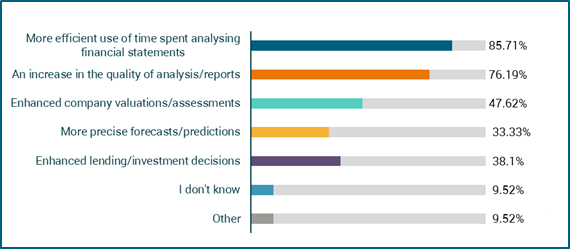
Note: The chart reports the share of responses as a percentage of the total number of responses (22).
4.36 The UKEB Preparer survey provided additional evidence on the potential benefits for users of IFRS 18. Specifically, the survey asked preparers to indicate whether they expected IFRS 18 to affect:
- The comparability of the entity's reporting of financial performance: 60% of respondents indicated that they anticipate a mild to strong positive effect.
- The transparency of the entity's financial performance: 51% of respondents indicated that they anticipate a mild to strong positive effect.
- The reporting of an entity's financial performance in line with underlying economics: 31% of respondents indicated that they anticipate a mild to strong positive effect, however 44% indicated that they do not anticipate any effect.
Preparers anticipate that users will reap ongoing benefits.
4.37 These results are consistent with IFRS 18 enhancing the quality of financial reporting (paragraphs 4.4-4.22).
Costs for users
4.38 On implementation costs, users reported that they:
- Expected one-off costs to be nil in the majority of cases, and lower than 1% of their operating costs in the remaining cases. Feedback from comment boxes suggested that costs are in general anticipated to be negligible (i.e. not close to 1% of operating costs).
- Did not expect to incur any ongoing costs.
- Did not generally expect ongoing cost reductions.
Preparers
Benefits for preparers
4.39 The UKEB Preparer Survey and interviews asked preparers to provide information about benefits, such as incremental cost reductions, as well as incremental one-off and ongoing costs, associated with the implementation of IFRS 18.
4.40 The information from preparers suggests that they do not anticipate IFRS 18 to bring any direct benefits or cost savings to preparers. Some preparers expected indirect benefits to be delivered as a result of the enhanced interaction between users and capital markets (e.g. potential cost of capital reductions).
Costs for preparers
4.41 The majority of stakeholders indicated that they expected incremental one-off costs to be small.
4.42 Comments from interviewees indicated that:
- IFRS 18 implementation is not anticipated to be costly. This is because IFRS 18 changes presentation and disclosure but not the recognition and measurement of the components of financial statements. Interviewees noted that implementation costs would comprise both monetary costs (e.g. external audit) and staff time reallocation costs (e.g. familiarisation).
- Implementation costs are a function of complexity and not just size. Costs associated with the implementation of IFRS 18 are not just a function of an entity's size but are correlated with the complexity of the business (e.g. investments in joint ventures and associates accounted for using the equity method or non-controlling interests)56. IFRS 18, however, includes cost mitigations that are likely to affect the scale of one-off costs57.
- Approach to compliance will vary. When adopting IFRS 18, some preparers indicated that they would make only the minimum necessary changes to comply with IFRS 18, while others indicated that they would thoroughly re-think their profit or loss presentation as well as their disclosures. Most entities positioned themselves between these two approaches.
- MPMs costs/benefits assessment: entities indicated that they will include MPMs in the notes only if they perceive benefits to outweigh implementation costs.
Appendix C reports more detailed information (see paragraph C17(a)-(c)).
4.43 Most preparers indicated that one-off costs are anticipated to be much higher than ongoing costs.
- One-off costs: The cost categories most likely to be affected upon implementation are accounts preparation, familiarisation, changes to data handling processes and controls, audit costs. One interviewee indicated that management time dedicated when handling the transition may lead to some one-off costs (i.e. management's time reallocation). Preparers indicated that all cost categories -except for audit costs- would result in a reallocation of finance department staff time in most cases. The costs associated with the reallocation of staff time would represent an opportunity cost58 as staff will not be able to spend this time on other productive activities. Opportunity costs would not have direct monetary consequences on entities.
- Ongoing costs: Most preparers anticipated incurring some incremental audit costs on an ongoing basis. Preparers expect to incur other costs on an ongoing basis, associated, for example, with accounts preparation and changes to data handling processes and controls. These are expected to be smaller than audit costs and largely attributable to staff time reallocations (i.e. an opportunity cost). On balance, preparers suggested that incremental ongoing costs, including audit fees, will be subsumed into business as usual and therefore would not lead to staff time reallocation or extra monetary costs after a few years. In some instances, preparers indicated that increases in audit fees are expected to be permanent. Results from the Preparer survey suggests that preparers anticipate incurring ongoing costs from implementing IFRS 18 for five years on average.
4.44 Preparers were asked to rank the different topics in IFRS 18 in terms of costliness to implement. The following emerged:
- Categories and subtotals: Preparers listed this as one of the costliest sets of requirements upon implementation, but not an on ongoing basis. This is because these requirements entail a change in the presentation of the statement of profit and loss that will lead to a one-off change in templates. This is most likely to entail a reallocation of finance department staff time (e.g. to adjust templates for the presentation and classification of line items in the statement of profit or loss in line with the requirements in IFRS 18). In addition, preparers anticipate that auditors will dedicate extra time on a one-off basis to audit relevant changes to the presentation of the statement of profit or loss. However, not all preparers expect the structure of the statement of profit and loss to change significantly as a result of IFRS 18. For example, feedback from the UKEB Preparer survey showed that some entities may already be separating investing and financing items in the statement of profit or loss and therefore do not expect the implementation costs for these changes to be significant. When IFRS 18 requirements are not expected to significantly alter presentation (i.e. entities with "low complexity”, see paragraph 4.42 (b)), implementation costs are anticipated to be minimal. Some preparers, however, indicated that classification requirements are perceived to be complex and may require potential system changes.
- Management-defined performance measures: Preparers' views on this aspect were split as follows:
- Requirements on MPMs will cause higher implementation costs: These preparers emphasised that, while MPMs are not individually difficult to prepare, the volume and complexity of the required disclosures and the fact that they are subject to audit would lead to an increase in one-off and ongoing costs.
- Requirements on MPMs will not cause high implementation costs: These preparers indicated that incremental costs would be minimal because either they report APMs by following similar practices to those required for MPMs, or they make limited use of APMs.
- Aggregation and disaggregation: Some preparers listed aggregation and disaggregation as a costly set of requirements on a one-off basis. This was mostly due to changes in the accounting system associated with disclosing items by nature in the notes and audit costs increases associated with considering the new required disaggregation.
- Limited amendments to the statement of cash flows: Preparers associated this set of requirements with low implementation costs because their current practices for reporting cash flows will be significantly affected by the limited changes made in IFRS 18.
4.46 The UKEB distributed a short questionnaire to AFIAG members to gather auditors' views on costs and benefits associated with the implementation of IFRS 18. Auditors' views on costs are summarised in the preparers' costs section as auditors pass extra costs on to preparers.
4.47 AFIAG members indicated that the magnitude of one-off costs will largely depend on the nature and complexity of the business rather than just its size, confirming preparers' views. Considering IFRS 18 requirements, one-off audit costs may be higher depending on:
- The presence of specified main business activities.
- The number of investments in associates and joint ventures accounted for using the equity method.
- The number and nature of MPMs.
- The presence of non-controlling interests.
- The prevalence of foreign exchange transactions.
- Changes derived from the application of the aggregation or disaggregation requirements.
4.48 AFIAG members indicated that ongoing costs are anticipated to be much smaller than one-off implementation costs.
Quantitative assessment of implementation costs
4.49 The UKEB conducted a quantitative assessment of the cost impact to preparers associated with the implementation of IFRS 18 with the purpose of:
- triangulating the qualitative evidence reported above; and
- obtaining an important input in the analysis of capital market effects developed in paragraphs 4.85–4.100 below.
4.50 The results discussed suggest that the estimation of costs is complex and likely to vary across different types of entities, though costs are expected to be relatively small. Therefore, the quantitative analysis that follows should be interpreted as a high-level estimate. The estimation provides an indicative range for implementation costs across the entire population of approximately 1,400 publicly listed entities that would be required to apply IFRS 18 and should not be interpreted as an accurate forecast of implementation costs59.
4.51 The quantitative assessment was based on:
- A regression model of implementation costs on consolidated revenues (source: Reuters-Eikon) using a sample of 18 responses from the UKEB Preparer survey and interviews.
- A subsequent market-wide extrapolation based on the regression results.
# Limitations of the analysis
4.52 The following limitations apply:
- Sample size: the assessment is based on a small sample, not representative of the population.
- Model specification: the regression model is very simple, including only one variable (revenues).
- No causality: the interpretation of the results is a correlation and should not be interpreted as causal.
4.53 The assessment is based on ex-ante cost estimates provided by finance department staff. The UKEB made all possible efforts to limit bias and imprecision when collecting data. Specifically, when drafting the survey and in the interview questionnaires the UKEB ensured that preparers were invited to carefully consider the composition and size of implementation costs. Questionnaires were thoroughly reviewed internally and by stakeholders (e.g. by the UKEB Academic Advisory Group). Follow-up interviews were conducted to challenge and validate the figures when the cost estimates necessitated further explanations, which led to revised figures in a limited number of cases. Survey responses were triangulated with interview responses. While preparers' assessments were preliminary and ex-ante, the above precautions ensured that preparers' estimates were the result of a thorough process.
# Estimated implementation costs
4.54 As noted, the estimation was based on a regression model. This delivered a point estimate, i.e. the most statistically likely outcome, and a range within which the point estimate lies with a given probability, known as a confidence interval60. The cost estimates reported in the main text below are based on the point estimate, as it is the most statistically likely outcome as per estimation model. However, based on the regression model, implementation costs lie within a range. Appendix D provides further detail on the lower and upper bounds of the estimation.
4.55 The assessment indicated that estimated implementation costs based on the regression point estimate could approximately be in the order of:61, 62
- £65 million of extra one-off monetary costs, comprised largely of audit fees.
- £200 million of extra one-off costs. These are attributable largely to familiarisation with IFRS 18, changes to templates and data handling processes. Most of these costs are expected to be opportunity costs associated with staff time reallocation.
- £45 million of extra ongoing monetary costs, comprised largely of audit fees (present value over a five-year period).
- £75 million of extra ongoing costs. These are attributable largely to accounts preparation, data handling processes and accounting systems maintenance (present value over a five-year period). Most of these costs are expected to be opportunity costs associated with staff time reallocation.
4.56 Total implementation costs are the sum of the above figures for the approximately 1,400 publicly listed entities that would be required to apply IFRS 18. These are estimated to be in the order of £400 million. Of these, only approximately £110 million are expected to be actual extra monetary costs, the rest being opportunity costs. Total implementation costs amount to approximately 0.02% of listed entities' operating expenses as of the 2023 year-end. This result is consistent with feedback from preparers.
4.57 The following should be considered for added context:
- Preparers who responded to the Preparer survey/interviews responded on behalf of groups required to prepare consolidated accounts. Therefore, estimates of implementation costs are at a group level and include implementation costs that subsidiaries may incur63.
- On average, preparers expect monetary and non-monetary ongoing costs to be subsumed into business as usual within a five-year period (as estimated using survey responses), which is the period used to calculate present values.
- It is possible that preparers exercised caution when responding, and estimates may lie at the higher end of the distribution.
- A similar analysis was not conducted for unlisted entities that use UK-adopted international accounting standards, on proportionality grounds.
4.58 The technical details of the analysis, including summary statistics, are described in Appendix D.
Proportionate engagement with small- and medium-cap entities
4.59 The UKEB conducted targeted proportionate engagement with entities quoted on AIM to conduct an initial assessment of whether IFRS 18 is expected to impose disproportionately large costs on small- and medium-cap entities. The proportionate engagement with entities quoted on AIM was as follows:
- Five Preparer survey responses.
- Three interviews64.
- A presentation of preliminary results from the economic assessment of IFRS 18 to the Accounting, Auditing & Financial Reporting Expert Group (AAFREG) of the Quoted Companies Alliance (an industry body representing small- and medium-sized quoted entities in the UK).
4.60 Feedback from the engagement suggested that:
- Small- and medium-cap entities quoted on AIM have limited resources dedicated to technical accounting, and therefore are more likely to start compliance closer to the implementation date of IFRS 18.
- Familiarisation and audit costs are the cost categories most likely to be affected by the implementation of IFRS 18 for these entities.
- Smaller-sized businesses tend, on average, to be characterised by lower levels of complexity because, for example, they make fewer acquisitions or are less likely to conduct international operations. Implementation costs, and especially monetary costs, are therefore likely to be “scalable” and proportional to the size of the entity. However, some smaller entities may face relatively higher time allocation or opportunity costs at initial implementation of the standard, due to their limited availability of internal resources dedicated to technical accounting.
4.61 Small and medium-cap entities indicated that the benefits associated with the adoption of IFRS 18 are broadly in line with the overall assessment in the ECA, such as more comparable and transparent presentation of financial performance that better reflects the underlying economics of the business.
4.62 This initial feedback suggested that, cost-wise, listed small- and medium-cap entities are unlikely to be disproportionately affected by the adoption of IFRS 18.65 These entities also expected to reap similar benefits overall. The UKEB therefore did not conduct further targeted engagement with listed small- and medium-cap entities.
Costs and benefits for regulators
4.63 The UKEB contacted several UK financial and economic regulators to ask whether IFRS 18 is anticipated to create extra costs or benefits to their organisation, and if so, why. For example, the UKEB asked whether IFRS 18 may lead to a revision of regulatory templates, the development of additional procedures to regulate the new requirements, or additional costs to enforce the new requirements.
4.64 Regulators indicated that IFRS 18 is not anticipated to generate any significant extra costs for them. 66
Summary of costs and benefits analysis67
4.65 Users anticipate significant benefits from the application of IFRS 18. For example, users reported that the implementation of IFRS 18 should result in more efficient use of time spent analysing financial statements and an increase in the quality of analysis/reports. Preparers have also acknowledged that users are likely to reap benefits from the implementation of IFRS 18, for example enhanced comparability on the statement of profit or loss between entities. Users also indicated that they anticipate incurring minimal implementation costs.
4.66 Preparers indicated that they expect to incur both one-off and ongoing incremental costs as a result of applying IFRS 18, though they expect them to be small. Implementation costs will comprise both monetary costs (e.g. extra audit costs) and staff time reallocation (e.g. familiarisation, changes to internal processes). Preparers expect one-off costs associated with extra audit fees, familiarisation and changes to templates to comprise most of the costs. Preparers expect ongoing implementation costs to be much lower that the one-off implementation costs. They also expect these costs to be subsumed into business as usual in a few years' time.
4.67 The UKEB conducted quantitative analysis to obtain a high-level estimate of expected implementation costs for all UK-listed entities. Estimated implementation costs (one-off and ongoing) are approximately £400 million, of which approximately £110 million are expected to be actual extra monetary costs, while the rest represent opportunity costs associated with staff time reallocation. Total implementation costs amount to approximately 0.02% of listed entities operating expenses as of 2023 year-end.
4.68 It is acknowledged that preparers will incur most of the direct compliance costs, with users reaping most of the direct benefits associated with the implementation of IFRS 18.
4.69 However, the fact that users expect to reap benefits from the increased transparency arising from the implementation of IFRS 18 suggests that capital allocation decisions may improve as a result of enhanced analysis/decision-making. Enhanced capital allocation may translate into beneficial capital market effects, such as an appreciation of traded securities or a reduction in the cost of capital for entities. Therefore, based on this initial assessment, it is plausible that preparers are, on average, likely to recover their implementation costs in the longer term68. The next section will discuss the likelihood of any such effects.
Analysis of wider economic effects
Structure of the analysis
4.70 The assessment of the long term public good involves a consideration of whether the use of IFRS 18 is likely to have an adverse effect on the economy of the UK, including on economic growth. This ECA will refer to these as “wider economic effects" in the remainder of this section.
4.71 The analysis of wider economic effects looks at:
- Transmission mechanisms: For example, whether the adoption of a Standard would lead to a change in how information circulates within relevant organisations, different internal processes or a different assessment of competition. Transmission mechanisms include effects on management's stewardship.
- First-order indirect effects (capital market effects): These are indirect effects due to the enhanced interaction between users and capital markets attributable to the change in accounting, such as effects on liquidity or volatility in public equity markets, and cost of capital.
- Second-order indirect effects: Microeconomic effects on preparers, users and other stakeholders that go beyond capital market effects. Examples include any effects on management compensation schemes, covenants, dividend payments and tax obligations that may arise from changes in accounting line items69. In addition, microeconomic effects such as product or pricing decisions, competition, economic output or productivity and capital investment are considered.
- Third order indirect effects: Micro- and macro-economic effects that go beyond preparers/users, such as:
- Externalities: The impact of a transaction on a third party which is not directly involved in the transaction itself, for instance, financial reporting impacting not just the capital markets ecosystem but other parties (e.g. economic and financial regulators, tax authorities, other stakeholders such as competitors, suppliers or employees).
- Network effects: Economic impacts that increase in magnitude as the number of network users increases, e.g. credit cards, social media.
- Macroeconomic effects: Economic impacts that spread to the national economy.
Chart 2: Direct and wider economic effects associated with the adoption of a new accounting standard
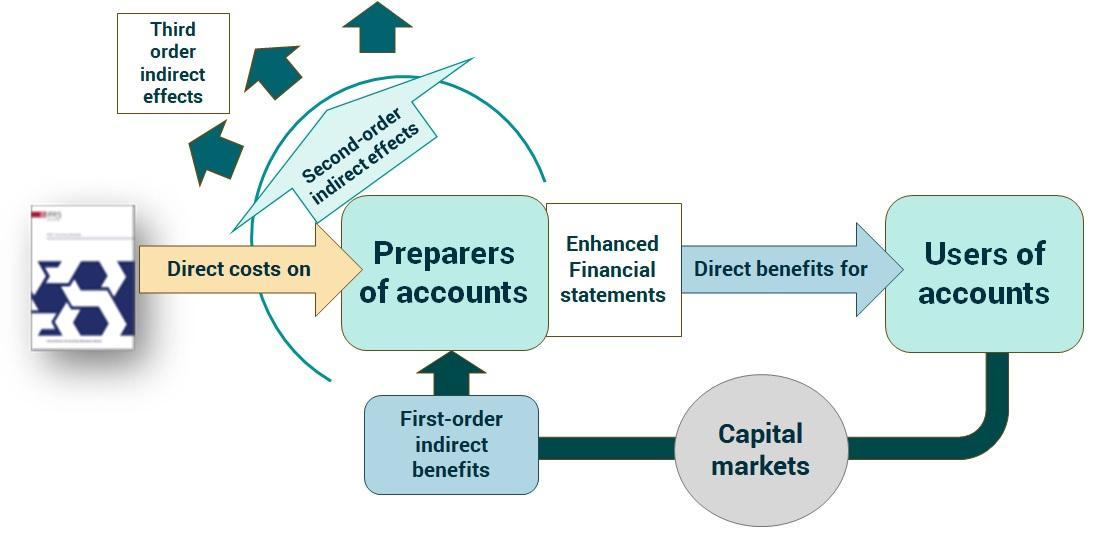
Source: UKEB
Collection of evidence
4.73 To assess wider economic impacts, the UKEB collected evidence using a range of research tools, as follows:
- Surveys: Both UKEB surveys contained questions on transmission mechanisms and indirect economic effects.
- Cost of capital analysis: The UKEB developed a methodology to assess whether, at a market level, capital market effects potentially associated with the application of IFRS 18 may deliver indirect monetary benefits that would allow preparers to indirectly recover implementation costs. The methodology also allows the assessment of the plausibility of the results.
- Qualitative analysis: The UKEB assessed second- and third-order economic effects qualitatively, using desk-based research and economic reasoning70.
Transmission mechanisms
Preparers
4.74 The UKEB Preparer survey included questions on the wider economic impact of IFRS 18, focusing on transmission mechanisms.
4.75 Preparers were asked to indicate the extent to which they expected the implementation of IFRS 18 to affect management's stewardship and other transmission mechanisms, such as whether IFRS 18 would affect how information circulates within an entity or internal processes.
4.76 Management's stewardship: Respondents were asked to indicate whether they expected IFRS 18 to affect:
- Presentation of management's use of economic resources to users: 61% of respondents indicated that they anticipate no effect.
- Transparency over management's performance in financial reporting: 53% of respondents indicated that they expect no effects.
- Management's discretion in presenting the entity's financial performance: The opinions on this outcome were divided, with 49% of respondents indicating that they anticipate IFRS 18 to lead to less management discretion in presenting entities' financial performance. However, 42% of respondents indicate that they anticipate no effect.
4.77 On balance, preparers' views were that IFRS 18 is unlikely to affect management's stewardship.
4.78 Other transmission mechanisms: Respondents were asked to indicate whether they expected IFRS 18 to affect:
- How information circulates within the organisation.
- Streamlining of internal systems and processes.
- Disclosure of proprietary information, where more disclosures were interpreted to be a negative effect.
- Competitors' assessment of the entity's performance, where a better assessment was interpreted to have a negative effect.
- Internal assessment of competitors' financial performance, where a better assessment was interpreted to have a positive effect.
- Risk of litigation, where lower risk was interpreted to have a positive effect.
4.79 Respondents either clearly indicated that no effect was expected or had split opinions with no clear pattern emerging. On balance, preparers' views were that IFRS 18 is unlikely to affect any of the above outcomes.
Users
4.80 The UKEB User survey asked respondents to indicate whether the Standard would affect a number of transmission mechanisms.
4.81 On the items listed below, users indicated that IFRS 18 will either slightly improve or greatly improve their ability to analyse financial statements:71
- To compare entities' performance over multiple periods (74%).
- To assess an individual entity's performance (74%).
- To compare entities' performance with other entities (74%).
- To conduct research (68%).
- To understand how entities measure their own performance (58%).
- To allocate time spent analysing financial statements efficiently (58%).
4.77On balance, preparers' views were that IFRS 18 is unlikely to affect management's stewardship.
4.78Other transmission mechanisms: Respondents were asked to indicate whether they expected IFRS 18 to affect:
- How information circulates within the organisation.
- Streamlining of internal systems and processes.
- Disclosure of proprietary information, where more disclosures were interpreted to be a negative effect.
- Competitors' assessment of the entity's performance, where a better assessment was interpreted to have a negative effect.
- Internal assessment of competitors' financial performance, where a better assessment was interpreted to have a positive effect.
- Risk of litigation, where lower risk was interpreted to have a positive effect.
4.79Respondents either clearly indicated that no effect was expected or had split opinions with no clear pattern emerging. On balance, preparers' views were that IFRS 18 is unlikely to affect any of the above outcomes.
Users
4.80The UKEB User survey asked respondents to indicate whether the Standard would affect a number of transmission mechanisms.
4.81On the items listed below, users indicated that IFRS 18 will either slightly improve or greatly improve their ability to analyse financial statements: 71
- To compare entities' performance over multiple periods (74%).
- To assess an individual entity's performance (74%).
- To compare entities' performance with other entities (74%).
- To conduct research (68%).
- To understand how entities measure their own performance (58%).
- To allocate time spent analysing financial statements efficiently (58%).
- To allocate capital efficiently between entities (53%).
4.82Only 32% of respondents indicated that IFRS 18 would help users better assess a company's solvency and only 37% of respondents indicated that IFRS 18 would enhance users' ability to conduct credit ratings. These results are not surprising, considering that IFRS 18 mainly deals with the presentation of financial performance (and therefore is not likely to alter balance sheet line items or balance sheet ratios).
4.83There was a suggestion that IFRS 18 could be helpful to lenders, because:
- For some lenders (e.g. leveraged finance specialists) adjusted EBITDA is an important metric. Paragraph 118(b) of IFRS 18 permits the disclosure of a subtotal (i.e. operating profit or loss before depreciation, amortisation and impairments within the scope of IAS 36 Impairment of Assets, or 'OPDAI') 72 that provides similar information to many of the EBITDA measures currently provided. If a company provides an EBITDA subtotal in its public communications that is not calculated in the same way as OPDAI, that subtotal would be an MPM, so the entity will need to provide disclosures about how it is calculated.
- Better principles for disaggregation would give some items greater visibility in the primary financial statements and provide information on the key drivers of cost (i.e. whether cost is part of their operating business).
4.84It is worth noting that unlisted entities include unlisted groups which may access external finance, even if they do not rely on public capital markets. Moreover, in some specific circumstances (e.g. absence of intra-group guarantees), lenders also consider subsidiaries' financial statements in detail 73. Therefore, improvements to the structure of the statement of financial performance, better aggregation and disaggregation criteria, and MPMs, to the extent that they are used by subsidiaries, would help users of these entities assess the financial performance and position of entities and enhance their decision-making.
First-order indirect effects - capital market effects
4.85This section applies a methodology developed by the UKEB to assess whether, at a market level, capital market effects potentially associated with the application of IFRS 18 may deliver indirect monetary benefits that would allow preparers to indirectly recover implementation costs. The methodology is based on evidence, grounded in research, and makes use of updated market data.
4.86The analysis that follows shows that small and plausible market-wide reductions in the cost of capital would be enough for UK-listed entities applying IFRS to indirectly recover their implementation costs in the medium- to long-term 74.
Background information
4.87Users suggested that they may improve decision-making and enhance their capital allocation decisions on securities markets as a result of IFRS 18.
4.88In line with economic theory and evidence, improved presentation of accounts resulting from IFRS 18 requirements should lead to enhanced trading activity, more liquidity, and a reduction in bid/ask spreads on securities markets 75. Investors may demand lower returns for holding securities. In the longer term:
- Market-wide cost of capital on public capital markets might go down 76.
- The prices of publicly traded securities might, on average, increase 77.
4.89Preparers indicated that they expect to incur direct costs associated with the implementation of IFRS 18. However, to the extent that capital market effects materialise (e.g. a market-wide decrease in cost of capital and/or a consequent increase in market capitalisation), preparers would reap indirect benefits in the longer term. These may allow preparers to partly cover, break even on, or even outweigh implementation costs, albeit indirectly.
4.90The analysis that follows permits the UKEB to:
- quantify the magnitude of capital market effects that would allow preparers to recover implementation costs in the medium- to long-term; and
- assess whether these magnitudes are plausible.
4.91The figures obtained are not predictions of securities prices' trends or cost of capital reductions associated with IFRS 18 and should not be interpreted as such.
Effects considered
4.92The methodology considers the following concurrent market-wide effects potentially associated with the introduction of an accounting standard:
- An increase in market capitalisation, leading to an increase of shareholders' wealth at a market level 78.
- A decrease in the cost of equity, leading to more projects funded through public equity capital at a market level.
- An increase in the outstanding value of listed bonds, leading to an increase of bondholders' wealth at a market level.
- A decrease in the cost of debt, leading to more projects funded through public debt capital at a market level.
4.93Table 6 shows the interaction between these market-wide effects:
| Equity | Debt | |
|---|---|---|
| Securities already issued (wealth effects) | Increase in market capitalisation | Increase in the outstanding value of corporate bonds |
| Securities to be issued in the future (investment effects) | Decrease in the cost of equity leading to more projects funded through public equity | Decrease in the cost of debt leading to more projects funded through publicly traded corporate bonds |
Source: UKEB
4.94These effects are likely to be correlated, for example because a reduction in the cost of capital would lead to projects being funded through equity/debt in the future but would also lead to changes in the market value of securities 79. Nonetheless, they should be considered as separate effects as:
- the effect on cost of capital on future capital flows is of interest to entities that plan to raise capital in the future; but
- increases in the value of traded securities affect the market in its entirety.
Application of the methodology
4.95Market-wide implementation costs for preparers are the starting point for the analysis. The UKEB estimated market-wide implementation costs (one-off and ongoing costs) for preparers to be approximately £400 million (see paragraph 4.56).
4.96The UKEB considered a hypothetical scenario where:
- 75% of the costs are recovered through equity markets (equally split between an increase in market capitalisation and an increase in the value of projects funded through equity); and
- 25% of the costs are recovered through bond markets (equally split between an increase in the value of bonds outstanding and an increase in the value of projects funded through fixed income) 80.
4.97Table 7 on the next page shows that the following capital effects need to materialise for preparers to recover implementation costs in the medium- to long-term:
| Chosen scenario | Proportion of implementation costs assigned to each potential capital market effect | Potential capital effects associated with the adoption of IFRS 18 in basis points |
|---|---|---|
| Increase in market capitalisation | 37.5% | 0.5 Bps |
| Decrease in the cost of equity leading to more projects funded through public equity | 37.5% | 3.2 Bps |
| Increase in the outstanding value of corporate bonds | 12.5% | 0.6 Bps |
| Decrease in the cost of debt leading to more projects funded through publicly traded corporate bonds | 12.5% | 0.2 Bps |
Note: allocations are arbitrary. Appendix E contains results associated with different allocations.
Source: UKEB calculations based on LSE and Reuters-Eikon data. A basis point is a hundredth of a percentage point. Increases in the market value of securities would affect the market in its entirety. Increases in the value of projects funded through equity/debt would affect only companies that plan on raising funds through capital markets in the future. It is acknowledged that these concurrent effects are likely to be correlated.
4.98The analysis suggests that to allow preparers to recover implementation costs of approximately £400 million (see paragraph 4.56), the following effects should happen concurrently:
- Increase in market capitalisation: Market capitalisation for the UK listed market should increase by £146 million, or 0.5 Bps (basis points) using its value as of October 2024 (£2.69 trillion) 81.
- Decrease in the cost of equity leading to more projects funded through public equity: Cost of equity should decrease by 3.2 Bps for the present value (PV) of projects funded through equity to increase by £146 million (the present value of equity issuances over a ten-year forecast is equal to £143 billion; baseline cost of equity: 11.23%).
- Increase in the outstanding value of corporate bonds: The outstanding value of corporate bonds issued by UK companies on public bond markets should increase by £49 million, or by 0.6 Bps using its value as of October 2024 (£759 billion).
- Decrease in the cost of debt leading to more projects funded through publicly traded corporate bonds: Cost of debt should decrease by 0.2 Bps for the PV of projects funded through debt to increase by £49 million (present value of public corporate bond issuances over a ten-year forecast is equal to £491.75 billion; baseline cost of debt: 5.03%).
4.99The UKEB considered that the figures obtained are plausible 82. A plausibility assessment is reported in Appendix E. There is a caveat that the results cannot be used to conclude or predict what capital market effects will materialise, if any, as a result of IFRS 18.
4.100The analysis shows that small and plausible reductions in the market-wide cost of capital would be enough for UK-listed entities applying IFRS to indirectly recover their implementation costs in the medium- to long-term.
Potential impact on new public listings
4.101It is possible that:
- presenting additional subtotals such as OPDAI; and
- reconciling MPMs with the most directly comparable subtotal
may help users of financial statements involved in public equity listings (e.g. underwriters, nominated advisors) to better contextualise entities' financial performance. To the extent that reporting requirements in IFRS 18 convey better information that can facilitate public equity listings, this may represent a small incentive for entities to list on UK public equity markets.
Second-order indirect effects
Effects on management compensation schemes, covenants, dividend payments and tax obligations
4.102The UKEB Preparer survey asked respondents to indicate whether IFRS 18 is anticipated to affect the following items:
- Management compensation schemes.
- Covenants.
- Dividend payments.
- Tax obligations that may arise from changes in accounting line items.
4.103Most preparers expected no effect on any of these items. A preparer commented that "the new standard won't have impact on measurement. Presentational differences from a statutory perspective will not impact any of the above measures".
Other second-order indirect effects
4.104The following second-order microeconomic effects on preparers are discussed:
- Effects on product or pricing decisions: The requirements of IFRS 18 are not expected to affect the underlying economics that determines the prices charged or the nature of products supplied by entities. Therefore, no effects on product and pricing decisions are expected.
- Effects on competition: IFRS 18 is not anticipated to affect the determinants of competition between entities (e.g. product or pricing decisions or barriers to entry or exit). IFRS 18 is anticipated to provide more comparable information about preparers, thus potentially enhancing preparers' ability to benchmark or assess their competitors. This suggests that IFRS 18 may have a minor role in fostering a competitive economic environment between entities.
- An increase/reduction in preparers' economic output or productivity: The changes in presentation and disclosure requirements in IFRS 18 are not expected to affect the preparers' output, or their productivity. However, a reduction in the cost of capital that may materialise as a result of implementing IFRS 18 may lead to an increase in capital investment.
- An increase/reduction in capital investments: IFRS 18 is not anticipated to directly alter preparers' output outlook or their strategic vision for the future and therefore is not likely to affect the entity's long-term capital needs. However, it is noted that a potential reduction in the cost of capital associated with IFRS 18 may lead preparers to fund more projects through public equity or debt, resulting in higher investment and/or a different capital structure.
Third-order indirect effects
Network effects
4.105IFRS 18 is not expected to be associated with network effects. Industries where network externalities are present (e.g. tech) are not likely to be more or less affected than other industries by IFRS 18. The requirements are not anticipated to affect the number of people accessing the platforms or services provided by such entities.
Externalities
4.106Economists view the provision of publicly available financial reporting as a positive externality, affecting parties beyond the capital markets ecosystem (such as regulators, tax agencies, other stakeholders) 83. Therefore, enhancements to financial reporting brought by IFRS 18 are expected to improve the quality of the "public good" provided by preparers. This is a small, positive economic effect. It should be noted that the requirements of IFRS 18 are not anticipated to generate negative externalities.
Macroeconomic effects, including economic growth
4.107No significant macroeconomic effects are anticipated as a direct result of IFRS 18 requirements. However, as noted in the First-order indirect effects - capital market effects section above, IFRS 18 could:
- Positively affect the prices of traded securities. This would translate into higher shareholders' and bondholders' wealth.
- Reduce the cost of capital. If actualised, this would translate into enhanced investment opportunities for entities applying IFRS 18.
4.108To the extent that capital market effects materialise, they could have a small positive effect on the consumption and investment components of GDP. The UKEB assessment is that IFRS 18 is not anticipated to have negative effects on economic growth.
Summary of the analysis of wider economic effects
4.109The analysis of wider economic effects suggests that:
- IFRS 18 may plausibly lead to market-wide capital market effects that would benefit preparers in the medium- to long-run. A quantitative analysis of such effects conducted using an in-house methodology suggests that preparers may indirectly recover their implementation costs. The UKEB cannot predict, however, whether any such effects will materialise and, if so, of what magnitude.
- Capital market effects, to the extent that they materialise, could have a small positive effect on the consumption and investment components of GDP.
- IFRS 18 is not expected to lead to wider economic effects that are detrimental to the UK economy, including on economic growth.
Consideration of the consequences of not adopting IFRS 18 (counterfactual analysis)
4.110This section considers the consequences of not adopting IFRS 18 for use in the UK (the 'non-adoption scenario'). The analysis assumes that IFRS 18 is widely adopted in other jurisdictions.
4.111In a non-adoption scenario, UK entities applying UK-adopted international accounting standards would not incur incremental costs associated with the adoption of the standard (see paragraph 4.56 for a market-wide estimate of implementation costs).
4.112However, in a non-adoption scenario, benefits for users associated with the adoption of IFRS 18 would not materialise. UK and overseas investors may redirect funds to jurisdictions that apply IFRS 18. In the long-term, non-adoption of IFRS 18 would be likely to have an adverse effect on UK capital markets, potentially leading to an increase in the cost of capital or reductions in the price of their traded securities for UK entities. The size and importance of UK capital markets are likely to play a key role in retaining investor interest and capital, which is a mitigating factor. However, in line with the analysis shown in paragraphs 4.85–4.100, even small adverse capital market effects (such as cost of capital increases) may lead to indirect adverse effects to companies in the medium- to long-term. These would likely outweigh implementation costs associated with the adoption of the standard itself 84.
4.113In addition, non-adoption may lead to some other adverse wider economic effects, for example:
- Entities in other jurisdictions using IFRS 18 may be able to attract additional sources of capital and potentially benefit from a lower cost of capital, which could provide them with a competitive advantage over UK companies.
- UK unlisted entities that apply UK-adopted international accounting standards may choose to list in jurisdictions that apply full IFRS.
4.114Finally, feedback from preparers suggested that UK listed entities cross-listed abroad could incur extra costs if UK-adopted international accounting standards were to deviate from IFRS Accounting Standards as issued by the IASB. However, cross-listed entities may still have to apply IFRS 18 to their financial statements. For example, entities cross-listed in the US filing a Form 20-F can prepare their financial statements using IFRS Accounting Standards as issued by the IASB. That would limit potential negative capital market effects for these entities.
4.115These considerations suggest that, on balance, not adopting IFRS 18 for use in the UK would have a potentially detrimental effect on the UK economy.
Overall assessment of long term public good
4.116There are three aspects to consider when assessing whether the use of IFRS 18 is likely to be conducive to the long term public good in the UK. These are:
- Whether IFRS 18 is likely to improve the quality of financial reporting.
- The costs and benefits that are likely to result from the use of IFRS 18.
- Whether the use of IFRS 18 is likely to have an adverse effect on the economy of the UK, including on economic growth.
4.117The conclusions drawn on each of these aspects as summarised below.
Quality of financial reporting
4.118Implementation of IFRS 18 is likely to improve the quality of financial reporting by specifying enhanced presentation and disclosure requirements for the financial statements. This will lead to financial reporting that is more useful to investors and other users of accounts, providing information that is more relevant, reliable and transparent. The new requirements in IFRS 18 are also likely to facilitate comparability and lead to clearer presentation and disclosure of information in the financial statements.
Costs and benefits
4.119Users anticipate significant benefits from the application of IFRS 18. For example, users reported that the enhanced presentation of financial performance brought by IFRS 18 should result in more efficient use of time spent analysing financial statements and an increase in the quality of analysis/reports. Users also indicated that they anticipate incurring minimal implementation costs.
4.120Preparers indicated that they will incur both one-off and ongoing incremental costs as a result of applying IFRS 18, though they expect them to be small. Preparers expect one-off costs to be largely associated with extra audit fees, familiarisation and changes to templates. Preparers expect ongoing implementation costs to be much lower that one-off implementation costs, and to be subsumed into business as usual in a few years' time.
Effect on the economy of the UK
4.121While it is acknowledged that preparers will incur most of the direct compliance costs, the fact that users expect to reap benefits from the increased transparency arising from the implementation of IFRS 18 suggests that their capital allocation decisions may improve. Enhanced capital allocation may translate into beneficial capital market effects, such as an appreciation of traded securities or a reduction in the cost of capital for entities.
4.122The analysis of wider economic effects suggests that IFRS 18 may plausibly lead to wider capital market effects that would benefit preparers in the medium- to long-run. A quantitative analysis of such effects conducted using an in-house methodology suggests that small and plausible market-wide reductions in the cost of capital would be enough for UK-listed entities applying IFRS to indirectly recover their implementation costs in the medium- to long-term. The UKEB cannot predict however whether any such effects will materialise and, if so, of what magnitude.
4.123Any capital market effects associated with the application of IFRS 18, to the extent that they materialise, could have a small positive effect on the consumption and investment components of GDP.
4.124IFRS 18 is not expected to lead to wider economic effects that are detrimental to the UK economy, including on economic growth.
Counterfactual analysis
4.125Overall, not implementing IFRS 18 for use in the UK would have a potentially negative outcome from the perspective of the UK long term public good.
Overall assessment
4.126The assessment is based on the holistic consideration of the evidence reported above.
4.127Overall, based on a holistic assessment of the evidence reported in this section, the UKEB considered that the use of IFRS 18 is likely to be conducive to the long term public good in the UK.
5. Section 5: True and fair view assessment
Introduction
5.1This section considers whether IFRS 18 is not contrary to the true and fair view principle for individual and consolidated accounts.
Legislative basis and our approach to the assessment
5.2The UKEB is required to consider whether an international accounting standard being assessed for use in the UK meets certain legislative criteria set out in Regulation 7 (1) of SI 2019/685. The first criterion set out in that regulation requires that an international accounting standard can be adopted only if:
5.3"[....] the standard is not contrary to either of the following principles–
- an undertaking's accounts must give a true and fair view of the undertaking's assets, liabilities, financial position and profit or loss;
- consolidated accounts must give a true and fair view of the assets, liabilities, financial position and profit or loss of the undertakings included in the accounts taken as a whole, so far as concerns members of the undertaking; [....]”
In this section of the ECA, we consider whether IFRS 18 meets this endorsement criterion. For the sake of brevity, we refer to our assessment against this endorsement criterion as 'the true and fair view assessment' and to the principles set out in Regulation 7(1)(a) as the 'true and fair view principle'. However, these abbreviated expressions do not imply that our assessment has considered anything other than the full terms of the endorsement criterion set out above.
5.4The duty of the UKEB under Regulation 7(1)(a) is to determine generically, before a standard is applied to a set of accounts, whether that standard is 'not contrary' to the true and fair view principle. In other words, it is an ex-ante assessment. We have therefore considered whether IFRS 18 contains any requirement that would prevent accounts prepared using the standard from giving a true and fair view.
5.5Our approach is to determine whether IFRS 18 is not contrary to the true and fair view principle in respect of any of the items identified in Regulation 7(1)(a) (namely, the assets, liabilities, financial position and profit or loss) in the context of the preparation of the accounts as a whole. In carrying out our assessment of the impact of IFRS 18, we have also considered the disclosures required by the Standard and its interaction with other UK-adopted international accounting standards.
5.6For the purposes of our assessment, we consider the requirement in paragraph 15 of IAS 1 for financial statements to “present fairly the financial position, financial performance and cash flows of an entity” to be equivalent to the Companies Act 2006 requirement for accounts to give a true and fair view. IFRS 18 has moved paragraphs 15–24 of IAS 1 relating to fair presentation to IAS 8 (as paragraphs 6A–6J). Text relocated to IAS 8 was left unchanged. The true and fair view (or fair presentation) override, previously in paragraph 19, is retained within IAS 8 as paragraph 6E. This change is effective on 1 January 2027.
5.7Our assessment is separate from the duty of directors under section 393(1) of the Companies Act 2006, which requires directors to be satisfied that a specific set of accounts gives a true and fair view of an undertaking's or group's assets, liabilities, financial position and profit or loss.
Interaction with other UK-adopted international accounting standards
5.8We have considered whether any requirement of IFRS 18 would necessarily create distortions in its interaction with other UK-adopted international accounting standards. IFRS 18 introduces presentation and disclosure requirements that improve the relevance of financial information and do not change the recognition and measurement of the items in the financial statements. Therefore, it is unlikely that IFRS 18 will have a negative impact on other UK-adopted international accounting standards.
5.9In addition, feedback from stakeholders and our own assessments of significant technical accounting issues in Section 3 and in Appendix B have not indicated that any distortions arising from the interaction of IFRS 18 with other UK-adopted international accounting standards are a major concern for UK stakeholders.
True and fair view assessment
5.10Consultation feedback on the ECA indicated that stakeholders generally agreed with the UKEB's conclusion that IFRS 18 was not contrary to the true and fair view principle.
5.11Section 3 of this ECA concludes that IFRS 18 as a whole meets the technical accounting criteria. The technical accounting criteria refer to reliability which includes the notion of faithful representation of the economic substance of transactions and events (see Section 1 of the ECA). The technical accounting criteria assessment therefore further underpins the overall true and fair view assessment.
5.12Our assessment has not identified any requirement of IFRS 18 that would prevent individual accounts prepared using the Standard from giving a true and fair view of the entity's assets, liabilities, financial position and profit or loss. We are satisfied, therefore, that the circumstances in which the application of IFRS 18 would result in accounts which did not give a true and fair view would be extremely rare.
5.13SI 2019/685 requires an assessment of whether IFRS 18 is not contrary to the true and fair view principle for both individual and consolidated accounts. We have not identified any reason why the IFRS 18 true and fair view assessment should conclude differently for consolidated accounts.
Overall conclusion
5.14Overall, therefore, we conclude that IFRS 18 is not contrary to the true and fair view principle set out in Regulation 7 (1) (a) of SI 2019/685.
6. Section 6: Is IFRS 18 likely to lead to a significant change in accounting practice?
Introduction
6.1This section considers whether IFRS 18 is likely to lead to a significant change in accounting practice for the purposes of the statutory requirements set out below.
UK statutory requirements
6.2Paragraphs 1–4 of Regulation 11 of SI 2019/685 require a review of the impact of the adoption of an international accounting standard 85 when this standard is likely to lead to a significant change in accounting practice. These paragraphs are reproduced below (emphasis added):
- "The Secretary of State must publish a statement setting out the Secretary of State's policy on what amounts to a significant change in accounting practice, and must keep this policy statement under review.
- Paragraphs (3) and (4) apply in relation to the adoption of any standard by the Secretary of State under regulation 6 which the Secretary of State considers likely to lead to a significant change in accounting practice.
- The Secretary of State must–
- carry out a review of the impact of the adoption of the standard; and
- publish a report setting out the conclusions of the review no later than 5 years after the date on which the standard takes effect (being the first day of the first financial year in respect of which it must be used).
6. Section 6: Is IFRS 18 likely to lead to a significant change in accounting practice?
Introduction
6.1This section considers whether IFRS 18 is likely to lead to a significant change in accounting practice for the purposes of the statutory requirements set out below.
UK statutory requirements
6.2Paragraphs 1-4 of Regulation 11 of SI 2019/685 require a review of the impact of the adoption of an international accounting standard85 when this standard is likely to lead to a significant change in accounting practice. These paragraphs are reproduced below (emphasis added):
(1) The Secretary of State must publish a statement setting out the Secretary of State's policy on what amounts to a significant change in accounting practice, and must keep this policy statement under review. (2) Paragraphs (3) and (4) apply in relation to the adoption of any standard by the Secretary of State under regulation 6 which the Secretary of State considers likely to lead to a significant change in accounting practice. (3) The Secretary of State must—
- carry out a review of the impact of the adoption of the standard; and
- publish a report setting out the conclusions of the review no later than 5 years after the date on which the standard takes effect (being the first day of the first financial year in respect of which it must be used).
(4) The Secretary of State may carry out subsequent reviews from time to time, and in the event of doing so the Secretary of State must publish a report setting out the conclusions of any review conducted."
Due Process Handbook requirements
What constitutes a significant change in accounting practice?
6.3Paragraph 1 of Regulation 11 of SI 2019/685 does not define the term 'significant change in accounting practice'. However, it does require the UKEB to publish a statement setting out its policy on what amounts to a significant change in accounting practice. This can be found in paragraph 8.6 of the UKEB Due Process Handbook:
Whether or not a standard adopted under Regulation 6 is likely to lead to a 'significant change in accounting practice' will usually depend on the number of entities affected and the impact on those entities and may require judgement. It usually occurs when a new standard is issued by the IASB.
Approach to the assessment
6.4In this section we consider whether IFRS 18 is likely to lead to a 'significant change in accounting practice'.
6.5The UKEB has considered for this assessment:
- the number of entities that will be affected by IFRS 18; and
- the potential impact on entities applying the requirements in IFRS 18.
The number of entities that will be affected by IFRS 18
6.6As discussed in Section 2 (paragraphs 2.8–2.10) IFRS 18 will impact all entities across all sectors that prepare financial statements using UK-adopted international accounting standards. In other words, all entities listed on the London Stock Exchange preparing consolidated accounts will be required to apply it. Additionally, approximately 14,000 unlisted entities that use the option in UK law to use UK-adopted international accounting standards will also be required to adopt it. These entities will be required to apply IFRS 18 retrospectively from 1 January 2027, with earlier application permitted (subject to the UKEB adoption in the UK).
Potential impact on entities applying the requirements in IFRS 18
6.7IFRS 18 is a new general standard on presentation and disclosure in financial statements that will replace IAS 1.
6.8IFRS 18 is not expected to bring a significant change in accounting practice as:
- Approximately 80% of the requirements in IAS 1 have been carried forward into IFRS 18 (or into IAS 8 or IFRS 7) with limited or no changes. Likewise, a few of the new requirements in IFRS 18 are based on previous requirements in IAS 1 (see Tables 3–5 in Section 2, paragraphs 2.18–2.20).
- It does not include requirements on how entities recognise and measure items in the financial statements. This means that entities will continue applying the same recognition and measurement principles in measuring financial performance (i.e. it will not affect net profit after interest and tax). This means that IFRS 18 is not fundamentally changing the way financial information is generated.
- It introduces new presentation and disclosure requirements mainly aimed at improving the relevance (e.g. aggregation requirements), reliability (e.g. requirements on MPMs) and comparability of the financial statements. It also enhances how information about financial performance is communicated in the financial statements.
- The current practices for reporting financial information in the UK may already be consistent with some of the new requirements in IFRS 18. For example, the results from the UKEB Preparer survey indicated that some respondents may already be:
- Presenting the results from equity-accounted investments outside their main business operations.
- Presenting their adjusted performance measures in the financial statements and/or providing information about the tax for each reconciling item and about the effects of non-controlling interests for each reconciling item.
- Disclosing information on the five specified operating expenses by nature.
- The implementation of IFRS 18 may help entities reconsider their presentation and disclosure practices to consider whether improvements to those practices can be made (in terms of changes to its systems, charts of accounts or mappings). However, as discussed in Section 4, these changes are not expected to be costly or significant.
Overall conclusion
6.9IFRS 18 does not introduce significant changes in accounting practice. It introduces new presentation and disclosure requirements without changing how entities recognise and measure items in the financial statements. As a result, the UKEB concludes that IFRS 18 is not likely to lead to a significant change in accounting practice and does not meet the criteria for a mandatory post-implementation review (PIR) under Regulation 11 in SI 2019/685.
Appendix A: Glossary
| Term | Description ```
6. Section 6: Is IFRS 18 likely to lead to a significant change in accounting practice?
Introduction
6.1This section considers whether IFRS 18 is likely to lead to a significant change in accounting practice for the purposes of the statutory requirements set out below.
UK statutory requirements
6.2Paragraphs 1-4 of Regulation 11 of SI 2019/685 require a review of the impact of the adoption of an international accounting standard85 when this standard is likely to lead to a significant change in accounting practice. These paragraphs are reproduced below (emphasis added):
(1) The Secretary of State must publish a statement setting out the Secretary of State's policy on what amounts to a significant change in accounting practice, and must keep this policy statement under review. (2) Paragraphs (3) and (4) apply in relation to the adoption of any standard by the Secretary of State under regulation 6 which the Secretary of State considers likely to lead to a significant change in accounting practice. (3) The Secretary of State must—
- carry out a review of the impact of the adoption of the standard; and
- publish a report setting out the conclusions of the review no later than 5 years after the date on which the standard takes effect (being the first day of the first financial year in respect of which it must be used).
(4) The Secretary of State may carry out subsequent reviews from time to time, and in the event of doing so the Secretary of State must publish a report setting out the conclusions of any review conducted."
Due Process Handbook requirements
What constitutes a significant change in accounting practice?
6.3Paragraph 1 of Regulation 11 of SI 2019/685 does not define the term 'significant change in accounting practice'. However, it does require the UKEB to publish a statement setting out its policy on what amounts to a significant change in accounting practice. This can be found in paragraph 8.6 of the UKEB Due Process Handbook:
Whether or not a standard adopted under Regulation 6 is likely to lead to a 'significant change in accounting practice' will usually depend on the number of entities affected and the impact on those entities and may require judgement. It usually occurs when a new standard is issued by the IASB.
Approach to the assessment
6.4In this section we consider whether IFRS 18 is likely to lead to a 'significant change in accounting practice'.
6.5The UKEB has considered for this assessment:
- the number of entities that will be affected by IFRS 18; and
- the potential impact on entities applying the requirements in IFRS 18.
The number of entities that will be affected by IFRS 18
6.6As discussed in Section 2 (paragraphs 2.8–2.10) IFRS 18 will impact all entities across all sectors that prepare financial statements using UK-adopted international accounting standards. In other words, all entities listed on the London Stock Exchange preparing consolidated accounts will be required to apply it. Additionally, approximately 14,000 unlisted entities that use the option in UK law to use UK-adopted international accounting standards will also be required to adopt it. These entities will be required to apply IFRS 18 retrospectively from 1 January 2027, with earlier application permitted (subject to the UKEB adoption in the UK).
Potential impact on entities applying the requirements in IFRS 18
6.7IFRS 18 is a new general standard on presentation and disclosure in financial statements that will replace IAS 1.
6.8IFRS 18 is not expected to bring a significant change in accounting practice as:
- Approximately 80% of the requirements in IAS 1 have been carried forward into IFRS 18 (or into IAS 8 or IFRS 7) with limited or no changes. Likewise, a few of the new requirements in IFRS 18 are based on previous requirements in IAS 1 (see Tables 3–5 in Section 2, paragraphs 2.18–2.20).
- It does not include requirements on how entities recognise and measure items in the financial statements. This means that entities will continue applying the same recognition and measurement principles in measuring financial performance (i.e. it will not affect net profit after interest and tax). This means that IFRS 18 is not fundamentally changing the way financial information is generated.
- It introduces new presentation and disclosure requirements mainly aimed at improving the relevance (e.g. aggregation requirements), reliability (e.g. requirements on MPMs) and comparability of the financial statements. It also enhances how information about financial performance is communicated in the financial statements.
- The current practices for reporting financial information in the UK may already be consistent with some of the new requirements in IFRS 18. For example, the results from the UKEB Preparer survey indicated that some respondents may already be:
- Presenting the results from equity-accounted investments outside their main business operations.
- Presenting their adjusted performance measures in the financial statements and/or providing information about the tax for each reconciling item and about the effects of non-controlling interests for each reconciling item.
- Disclosing information on the five specified operating expenses by nature.
- The implementation of IFRS 18 may help entities reconsider their presentation and disclosure practices to consider whether improvements to those practices can be made (in terms of changes to its systems, charts of accounts or mappings). However, as discussed in Section 4, these changes are not expected to be costly or significant.
Overall conclusion
6.9IFRS 18 does not introduce significant changes in accounting practice. It introduces new presentation and disclosure requirements without changing how entities recognise and measure items in the financial statements. As a result, the UKEB concludes that IFRS 18 is not likely to lead to a significant change in accounting practice and does not meet the criteria for a mandatory post-implementation review (PIR) under Regulation 11 in SI 2019/685.
Appendix A: Glossary
| Term | Description ```
|---|---|
</div>
apply this accounting policy choice in different ways which could lead to diversity in practice.
## Appendix B
### Assessment against the technical accounting criteria
<a class="section__global-number" href="#paragraph-B25" id="paragraph-B25">B25</a>This section assesses:
<ol markdown="1" type="a">
<li markdown="1">the requirement to classify income and expenses that relate to the provision of finance to customers as part of the operating category; and</li>
<li markdown="1">the accounting policy choice to present income and expenses that are not related to the provision of financing to customers either in the financing category or in the operating category.</li>
</ol>
### Classification of income and expenses related to the provision of finance to customers
<a class="section__global-number" href="#paragraph-B26" id="paragraph-B26">B26</a>The requirement to classify income and expenses that relate to the provision of finance to customers as part of the operating category will lead to:
<ol markdown="1" type="a">
<li markdown="1">**relevant** financial information for users’ decision-making process as it will enable entities to present in ‘operating’ the income and expenses that are related to an entity’s main business activities and present key measures of operating performance. For example, as acknowledged by the IASB in paragraph BC180 of IFRS 18, it will enable an entity to present the difference between the interest revenue from that main business activity and the related interest expense incurred to obtain the financing needed for that main business activity.</li>
<li markdown="1">**reliable** information as entities will be able to provide a faithful representation of the results for an entity’s operations for the period.</li>
<li markdown="1">**comparable** information for users, as well as allowing users to have a better understanding of an entity’s operating performance.</li>
</ol>
### The accounting policy choice to present income and expenses that are not related to the provision of financing to customers
<a class="section__global-number" href="#paragraph-B27" id="paragraph-B27">B27</a>The UKEB acknowledges that having an accounting policy choice to present income and expenses that are *not related* to the provision of financing to customers either in the *financing category* or in the *operating category* may pose some risks to the comparability of the information presented in the statement of profit or loss and lead to diversity in practice.
<a class="section__global-number" href="#paragraph-B28" id="paragraph-B28">B28</a>As acknowledged by the IASB (refer for example to paragraphs BC182 and BC185 of the Basis for Conclusions in IFRS 18), this accounting policy choice arises because it might not be possible for certain entities, for example those with a central treasury function, to easily distinguish the income and expenses from liabilities that relate to providing financing to customers in a non-arbitrary way and without undue cost or effort. Therefore, any risks to comparability need to be balanced against other criteria or mitigating factors depending on the choice an entity makes. For instance, a choice to:
<ol markdown="1" type="a">
<li markdown="1">Classify income and expenses that are unrelated to the provision of financing to customers in the financing category will lead to enhanced relevance and reliability of the information presented as it would provide users with a fair representation of an entity’s business performance (i.e. by classifying income and expenses that are unrelated to the provision of finance to customers outside an entity’s operations).</li>
<li markdown="1">Classify all income and expenses that arise from transactions that involve only the raising of finance in the operating category (including the portion that is unrelated to the provision of finance), could potentially reduce the relevance and reliability of the information presented, as the operating category will include income and expenses that are unrelated to the entity’s main business operations. However, avoiding arbitrary allocations may also enhance the relevance and reliability of the information presented. In addition, the potential loss of comparability would be mitigated by the benefits of providing preparers with a practical option that would reduce their costs of application, when they are unable to easily distinguish between income and expenses that relate to the provision of finance to customers.</li>
</ol>
<a class="section__global-number" href="#paragraph-B29" id="paragraph-B29">B29</a>The reduced comparability can also be mitigated by separate disclosures [^95] so that users are able to understand the choice made by the entity as well as the nature and significance of the income and expenses recognised *within* and *outside* the operating category. This could help users analyse and compare the information presented.
## Issue 3: Disclosure of the income tax effect and the effect on non-controlling interests (NCIS) in the MPM reconciliation
### IFRS 18 requirements
<a class="section__global-number" href="#paragraph-B30" id="paragraph-B30">B30</a>IFRS 18 requires an entity to disclose information about its MPMs in a single note to the financial statements, including the disclosure of the income tax effect and the effect on NCIs for each item disclosed in the MPM reconciliation (in line with paragraph 123(d) of IFRS 18).
### Accounting impact
<a class="section__global-number" href="#paragraph-B31" id="paragraph-B31">B31</a>Paragraph B141 of IFRS 18 requires an entity to determine the income tax effects of the underlying transactions using the following approaches:
<ol markdown="1" type="a">
<li markdown="1">At the statutory tax rate applicable to the transaction. [^96]</li>
<li markdown="1">Based on a reasonable pro-rata allocation of the current and deferred tax of the entity.</li>
<li markdown="1">By using another method that achieves a more appropriate allocation.</li>
</ol>
<a class="section__global-number" href="#paragraph-B32" id="paragraph-B32">B32</a>This section will focus on the disclosure of the income tax effect and the effect on NCIs for each reconciling item in the MPM reconciliation.
<a class="section__global-number" href="#paragraph-B33" id="paragraph-B33">B33</a>As mentioned in paragraph 2.30, most UK entities currently use ESMA’s guidelines to report Alternative Performance Measures (APMs). These guidelines do not require an entity to disclose the income tax effect and the effect on NCIs for each reconciling item in the reconciliation of APMs.
<a class="section__global-number" href="#paragraph-B34" id="paragraph-B34">B34</a>Entities may already disclose information about APMs in the financial statements by providing a reconciliation of the APM to the most directly reconcilable line item, subtotal or total presented in the financial statements. However, entities may need to change this disclosure to comply with the requirement in IFRS 18 to disclose within the MPM reconciliation the income tax effect and the effect on NCIs for each reconciling item.
### Impact of the disclosure of the income tax effect
<a class="section__global-number" href="#paragraph-B35" id="paragraph-B35">B35</a>The impact of disclosing the income tax effect for each reconciling item in the MPM reconciliation would depend on the entities’ current practices in disclosing information about performance measures.
<a class="section__global-number" href="#paragraph-B36" id="paragraph-B36">B36</a>Desk-based research indicates that most entities currently disclose the aggregated tax effect for the combined reconciling items (and not for each individual reconciling item) [^97] and that only some preparers include the tax effect for each reconciling item [^98].
<a class="section__global-number" href="#paragraph-B37" id="paragraph-B37">B37</a>The results from the UKEB Preparer survey indicated that just over half of the respondents do not include the tax effect for each reconciling item. The reasons are that:
<ol markdown="1" type="i">
<li markdown="1">their reconciliation is to operating profit so adding the tax effects is viewed as unnecessary;</li>
<li markdown="1">the tax effects would be immaterial;</li>
<li markdown="1">the tax effects would be of little value, as users in other jurisdictions do not normally request this information; and</li>
<li markdown="1">the tax effects are normally provided aggregated for the combined reconciling items and not for each individual reconciling item.</li>
</ol>
<a class="section__global-number" href="#paragraph-B38" id="paragraph-B38">B38</a>Entities that currently disclose aggregated tax effects or no tax effects in their reconciliations of performance measures are expected to incur additional costs to prepare this disclosure. The amount of costs would depend on whether the information is readily available internally. Nonetheless, all entities may incur additional costs in having the reconciliation of MPMs audited, as entities may need to develop or revise the internal processes and/or prepare documentation for preparing the reconciliation. The details of the cost implications of auditing these performance measures are in [Section 4](https://www.endorsement-board.uk/guidance-on-audit-matters#section-4) and [Appendix C](https://www.endorsement-board.uk/guidance-on-audit-matters#appendix-c).
<a class="section__global-number" href="#paragraph-B39" id="paragraph-B39">B39</a>One AFIAG member noted that the requirements on the effects of tax and NCIs in the MPM reconciliations could lead to additional work, but not necessarily useful information [^99]. Another member welcomed more guidance around these requirements.
<a class="section__global-number" href="#paragraph-B40" id="paragraph-B40">B40</a>The UKEB Secretariat conducted an analysis of Reuters-Eikon data' on the prevalence of NCI amounts among UK listed entities. This analysis showed that at a market level, NCI amounts are immaterial, as they account for approximately 2.5% of total net assets for 2023 year-ends. For a limited number of UK-listed entities (less than 50), non-controlling interests made up greater than 10% of net assets.
### Assessment against the technical accounting criteria
<a class="section__global-number" href="#paragraph-B41" id="paragraph-B41">B41</a>Feedback from users indicates that information on tax and NCI effects is useful for making necessary adjustments for their analysis. As mentioned in paragraphs BC384–BC385 of IFRS 18, users need information about the amounts of the adjustments attributable to owners of the parent and the tax effects of those adjustments to be able to adjust management’s adjusted earnings per share (EPS) figure to calculate their own EPS measure (which will be based only on the adjustments they want to consider in their analysis). Therefore, having the required information for each reconciling item and within the financial statements would improve both the confirmatory and predictive value of this information. This will provide users with relevant information.
<a class="section__global-number" href="#paragraph-B42" id="paragraph-B42">B42</a>In addition, feedback received by the IASB from users indicates that having high-level information about the tax effects (by applying the different approaches in paragraph B141 of IFRS 18) would meet user needs (refer to paragraph BC386 of IFRS 18). Some PAG members noted that the three approaches available to calculate the income tax effects for each item disclosed in the MPM reconciliation should allow entities to obtain reasonable estimates of the tax effects for each reconciling item. This could potentially reduce the complexity and potential costs of preparing this information. Although input from one member suggests that these options may be more difficult to apply for circumstances where an entity has for example, the Pillar 2 top-up tax [^100].
<a class="section__global-number" href="#paragraph-B43" id="paragraph-B43">B43</a>The requirement in IFRS 18 to disclose how the income tax effects are calculated [^101] along with the assurance from the auditing of this information is also expected to provide users with **reliable** MPM information.
<a class="section__global-number" href="#paragraph-B44" id="paragraph-B44">B44</a>The requirement to disclose the tax and NCI effects and how tax effects are calculated has also been welcomed by the user community, as it is expected to improve transparency on the calculation of MPMs and enable users to **understand** the underlying calculation of these performance measures.
<a class="section__global-number" href="#paragraph-B45" id="paragraph-B45">B45</a>Likewise, the requirements in IFRS 18 to disclose any changes on how an entity determines the income tax effects of reconciling items as well as restated comparative information [^102] will enable users to **compare** the financial performance both from one financial period to another and across different entities.
## Issue 4: Classification of insurance finance income and expenses in the operating category
### Presentation and disclosure requirements
#### IFRS 17 Insurance Contracts
<a class="section__global-number" href="#paragraph-B46" id="paragraph-B46">B46</a>IFRS 17 requires the separate presentation of insurance finance income and expenses.
<a class="section__global-number" href="#paragraph-B47" id="paragraph-B47">B47</a>In accordance with IFRS 17 [^103], insurance finance income and expenses mainly comprise the change in the carrying amount of the group of insurance contracts arising from the effect of (and changes in) the time value of money and financial risk, including the change in discount rate of insurance liabilities.
<a class="section__global-number" href="#paragraph-B48" id="paragraph-B48">B48</a>For insurance finance income and expenses not arising from risk mitigation activities [^104], entities are required to make an accounting policy choice for each portfolio of insurance contracts on how to present insurance finance income and expenses. In accordance with paragraphs 88–90 of IFRS 17, such insurance finance income and expenses can be presented either:
<ol markdown="1" type="a">
<li markdown="1">in profit or loss; or,</li>
<li markdown="1">disaggregated between profit or loss and other comprehensive income (OCI). This is known as the ‘OCI option’. IFRS 17 prescribes three specific approaches or bases of disaggregation of insurance finance income and expenses between profit or loss and OCI, which depend on the method that the entity applies to account for the insurance contract, and whether the insurance finance income and expenses relate to insurance contracts with direct participation features for which the entity holds the underlying items. [^105]</li>
</ol>
<a class="section__global-number" href="#paragraph-B49" id="paragraph-B49">B49</a>IFRS 17 requires an entity to disclose and explain the total amount of insurance finance income and expenses in the reporting period. In particular, an entity is required to explain the relationship between insurance finance income and expenses and the investment return on its assets, to enable users of its financial statements to evaluate the sources of finance income or expenses recognised in profit or loss and OCI. [^106]
<a class="section__global-number" href="#paragraph-B50" id="paragraph-B50">B50</a>If an entity chooses to disaggregate insurance finance income and expenses into amounts presented in profit or loss and amounts presented in OCI, the entity is required to disclose an explanation of the methods used to determine the insurance finance income and expenses recognised in profit or loss. [^107]
#### IFRS 18
<a class="section__global-number" href="#paragraph-B51" id="paragraph-B51">B51</a>Paragraph 47 of IFRS 18 introduces new mandatory categories for the classification of income and expenses (operating, investing or financing). Entities for which investing and/or financing are their main business activities are required to classify income and expenses from those main business activities in the operating category [^108]. Additionally, paragraph 69 of IFRS 18 mandates a new subtotal named 'operating profit or loss'.
### Accounting impact
<a class="section__global-number" href="#paragraph-B52" id="paragraph-B52">B52</a>Paragraph 64(b) of IFRS 18 requires the presentation of “insurance finance income and expenses included in the statement of profit or loss applying IFRS 17 Insurance Contracts” to be in the operating category.
<a class="section__global-number" href="#paragraph-B53" id="paragraph-B53">B53</a>IFRS 18 mandates a new subtotal named 'operating profit or loss'. The use of the OCI option under IFRS 17 together with the different measurement approaches for financial assets backing the insurance contracts under IFRS 9 *Financial Instruments* may result in differences in the 'operating profit or loss' being presented. Such differences already exist in 'profit or loss' presented under IAS 1.
<a class="section__global-number" href="#paragraph-B54" id="paragraph-B54">B54</a>For insurers that measure their financial assets at fair value through profit or loss (FVTPL) and do not apply the OCI option, the fair value changes in the financial assets and the effect of changes in the time value of money and financial risk on the insurance contract balances will be included in the 'operating profit or loss' being presented.
<a class="section__global-number" href="#paragraph-B55" id="paragraph-B55">B55</a>Most UK insurers do not apply the OCI option in IFRS 17 [^109].
### Assessment against the technical accounting criteria
<a class="section__global-number" href="#paragraph-B56" id="paragraph-B56">B56</a>The requirement in IFRS 18 to classify insurance finance income and expenses in 'operating profit or loss' could improve users' **understanding** of the drivers of performance for an insurance business, as it indicates that such income and expenses relate to an insurer's main business activities. It will also provide them with a consistent starting point for their analysis (and therefore with **relevant** information). Without this requirement, the effect of market fluctuations affecting the insurance liabilities could end up in a different category from the related effect on the financial assets backing those liabilities, which, even though the related effect may not be closely matching, would reduce the relevance and understandability of financial information.
<a class="section__global-number" href="#paragraph-B57" id="paragraph-B57">B57</a>A potential consequence of this classification is that the 'operating profit or loss' may appear more volatile for insurers which do not apply the OCI option. This might reduce the perceived **relevance** and **reliability** of some financial information (especially when the business is longer-term and the market fluctuations are short-term).
<a class="section__global-number" href="#paragraph-B58" id="paragraph-B58">B58</a>However, IFRS 18 will allow preparers to continue providing their own measures of performance (i.e. MPMs [^110]), thereby mitigating the risk to relevance and reliability. The disclosure requirements in IFRS 17 [^111] and in IFRS 18 [^112] (including the disclosures on MPMs) are also likely to improve **understandability** of these measures.
<a class="section__global-number" href="#paragraph-B59" id="paragraph-B59">B59</a>Mandating an ‘operating profit or loss' subtotal that includes the market movements in an insurer's assets and liabilities does not reduce comparability. Rather, it simply highlights the limitations to comparability that already exist, due to the application of different measurement approaches under IFRS 9 and whether the OCI option is applied under IFRS 17.
<a class="section__global-number" href="#paragraph-B60" id="paragraph-B60">B60</a>The concern that comparability would be reduced across insurers depending on whether the insurer chooses to apply the OCI option permitted in IFRS 17 has previously been addressed by the UKEB when assessing IFRS 17 for adoption [^113]. As referred in this assessment, any risks to comparability or reliability need to be balanced against the enhanced relevance of the financial information. The specific disclosures required by IFRS 17 or IFRS 18 may also mitigate these risks.
## Appendix C: Evidence about costs and benefits for preparers
<a class="section__global-number" href="#paragraph-C1" id="paragraph-C1">C1</a>This Appendix reports detailed evidence that underpins the costs and benefits analysis conducted as part of the long-term public good assessment in [Section 4](https://www.endorsement-board.uk/guidance-on-audit-matters#section-4).
### Survey results
<a class="section__global-number" href="#paragraph-C2" id="paragraph-C2">C2</a>The UKEB Preparer survey gathered information about incremental one-off and ongoing costs, with preparers having the option to express them as either:
<ol markdown="1" type="a">
<li markdown="1">a percentage of the costs of preparing accounts as of previous year-end (referred to as **baseline costs** in the remainder of [Appendix C](https://www.endorsement-board.uk/guidance-on-audit-matters#appendix-c)) [^114]; or</li>
<li markdown="1">a percentage of operating costs.</li>
</ol>
<a class="section__global-number" href="#paragraph-C3" id="paragraph-C3">C3</a>Questions on direct implementation costs focused on the following categories:
<ol markdown="1" type="a">
<li markdown="1">Familiarisation.</li>
<li markdown="1">Accounting system changes.</li>
<li markdown="1">Changes to data handling processes and controls.</li>
<li markdown="1">Accounts preparation.</li>
<li markdown="1">Communication with third parties.</li>
<li markdown="1">Audit costs.</li>
<li markdown="1">Legal costs.</li>
</ol>
<a class="section__global-number" href="#paragraph-C4" id="paragraph-C4">C4</a>In summary, respondents indicated the following:
<ol markdown="1" type="a">
<li markdown="1">Incremental one-off costs expressed as a share of baseline costs. Preparers anticipated incurring some one-off costs as a result of IFRS 18. In particular, entities expected to incur extra audit costs (approximately 30% of the respondents expected these to be 5% of their baseline costs or above), accounts preparation costs (25% of the respondents expected these to be 5% of their baseline costs or above) and familiarisation costs (9% of the respondents expected these to be 5% of their baseline costs or above). Overall, however, preparers expected one-off costs to be relatively small, with the majority of respondents indicating that they expected them to be lower than 5% of baseline costs for all cost categories.</li>
<li markdown="1">Incremental ongoing costs expressed as a share of baseline costs. Preparers anticipated incurring some ongoing costs as a result of adopting IFRS 18. These were expected to be much smaller than one-off costs. Preparers expected to incur extra audit costs on an ongoing basis, but also some accounts preparation and accounting system maintenance costs. For all cost categories, the majority of respondents expected incremental ongoing costs to be nil or less than 1% of baseline costs.</li>
<li markdown="1">Incremental one-off costs expressed as a share of operating costs. Consistent with the rest of the results, preparers anticipated incurring some one-off costs as a result of IFRS 18, particularly related to external audit, accounting system changes, accounts preparation and familiarisation. However, when expressed as a shared of operating costs, preparers considered these to be minimal: for all cost categories, most respondents expected incremental one-off costs to be negligible or less than 1% of operating costs.</li>
<li markdown="1">Incremental ongoing costs expressed as a share of operating costs. Consistent with the rest of the results, preparers anticipated incurring some ongoing costs as a result of IFRS 18, though they expected these to be smaller than one-off costs. Preparers expected to incur extra audit costs on an ongoing basis, but also some accounts preparation and accounting system maintenance costs. For all cost categories, most respondents expected incremental ongoing costs to be negligible or less than 1% of operating costs.</li>
</ol>
<a class="section__global-number" href="#paragraph-C5" id="paragraph-C5">C5</a>On balance, preparers suggested that they expect to incur ongoing costs for a few years, until they are subsumed into business as usual. Views varied:
<ol markdown="1" type="a">
<li markdown="1">At one extreme, some preparers anticipated incurring extra ongoing costs permanently.</li>
<li markdown="1">At the other extreme, some preparers suggested that they would incur no ongoing costs at all.</li>
</ol>
On average, preparers expected to incur extra costs for a period of five years before they were subsumed into business as usual.
<a class="section__global-number" href="#paragraph-C6" id="paragraph-C6">C6</a>The survey results are broadly consistent with the results of third-party research discussed later in this Appendix.
<a class="section__global-number" href="#paragraph-C7" id="paragraph-C7">C7</a>The UKEB survey results are also broadly consistent with the those of a poll conducted by ICAEW during a webinar on IFRS 18 held in October 2024, which aimed to gather audience feedback on the expected challenges of the Standard's implementation [^115].
<a class="section__global-number" href="#paragraph-C8" id="paragraph-C8">C8</a>The poll provided four categories of expected implementation challenges:
<ol markdown="1" type="a">
<li markdown="1">Accounts preparation.</li>
<li markdown="1">Accounting system changes.</li>
<li markdown="1">Familiarisation with IFRS 18 requirements.</li>
<li markdown="1">Changes to data handling processes and controls.</li>
</ol>
<a class="section__global-number" href="#paragraph-C9" id="paragraph-C9">C9</a>Respondents could also choose “All of the above” and “No challenge” options.
<a class="section__global-number" href="#paragraph-C10" id="paragraph-C10">C10</a>Chart 3 provides a visual representation of these results as follows:
<div class="chart-description" markdown="1">**Chart 3: Expected implementation challenges (ICAEW survey results)**

The chart shows the following distribution of expected implementation challenges:
* All challenges expected: 37%
* Accounts preparation costs: 20%
* Familiarisation with IFRS 18 requirements: 19%
* Accounting system changes: 11%
* Changes to data handling processes and controls: 9%
* No challenges expected: 4%
</div>
Source: UKEB analysis of ICAEW data.
### Engagement with advisory groups
<a class="section__global-number" href="#paragraph-C11" id="paragraph-C11">C11</a>Advisory groups provided the following feedback on preparers' costs and benefits associated with IFRS 18:
<ol markdown="1" type="a">
<li markdown="1">PAG: Members observed that applying IFRS 18 would lead to limited implementation costs (as compared to the size of an entity's operations) and would generally not require significant changes to the general ledger of accounts. It was observed that, at the time of stakeholder engagement, many preparers were likely to be at an early implementation stage, which would limit the availability of cost estimates. Paragraph D3 provides detail on how the UKEB tackled this limitation.</li>
<li markdown="1">IAG: A member of the IAG commented that the IFRS 18 requirements may lead to more transparent financial information and allow entities to present financial information in a way that is consistent with their business model.</li>
<li markdown="1">AFIAG: Members observed that the approach taken by entities in implementing IFRS 18 will influence the level of costs that they will incur on adoption. For example, some entities may take a simple 'compliance approach' whereas others may take a 'wider compliance approach' in their implementation of IFRS 18 and look for additional areas of improvement in the presentation and disclosure of their financial information. These entities are likely to incur higher implementation costs.</li>
</ol>
### UKEB Webinar poll results
<a class="section__global-number" href="#paragraph-C12" id="paragraph-C12">C12</a>Webinar participants were asked about the costs they expected to incur to implement IFRS 18 on transition and in the first year of adoption. Out of 43 responses:
<ol markdown="1" type="a">
<li markdown="1">12% said IFRS 18 would involve very low implementation costs as their practices were mostly aligned with the requirements in IFRS 18;</li>
<li markdown="1">53% said IFRS 18 would involve some changes to systems, procedures and/or current practices;</li>
<li markdown="1">23% said IFRS 18 would involve significant and costly changes to systems, procedures and/or current practices; and</li>
<li markdown="1">the rest (12%) did not know.</li>
</ol>
<a class="section__global-number" href="#paragraph-C13" id="paragraph-C13">C13</a>The categories utilised in the webinar poll are not directly comparable to those utilised in the UKEB Preparer Survey. However, approximately 65% of the respondents indicated that IFRS 18 is expected to lead to “some” or “very low” implementation costs. The UKEB considered this evidence to be in line with that of the UKEB Preparer survey and the interviews.
### Results from qualitative interviews
<a class="section__global-number" href="#paragraph-C14" id="paragraph-C14">C14</a>A total of 15 interviews were conducted between Q4 2024 and Q1 2025.
<a class="section__global-number" href="#paragraph-C15" id="paragraph-C15">C15</a>Interview questions were based on the survey questions, and focused on implementation costs [^116], [^117].
<a class="section__global-number" href="#paragraph-C16" id="paragraph-C16">C16</a>Interviewees were asked to discuss incremental costs of IFRS 18 implementation, either as a share of baseline costs or as a share of operating costs. The results were broadly in line with the UKEB survey results.
<ol markdown="1" type="a">
<li markdown="1">One-off costs as a share of baseline costs: Interviewees considered familiarisation and audit to be the cost categories that would experience the highest percentage increase. Legal costs and communication with third parties were the cost categories that were expected to experience the lowest percentage increase.</li>
<li markdown="1">Ongoing as a share of baseline costs: Audit was the cost category expected to face the highest percentage increase, while legal costs and accounting system maintenance were the cost categories associated with the lowest percentage increase.</li>
<li markdown="1">Implementation costs as a share of operating costs: Interviewees indicated that expected implementation costs would be minimal as compared to operating costs.</li>
</ol>
<a class="section__global-number" href="#paragraph-C17" id="paragraph-C17">C17</a>The following overarching themes emerged from the interviews:
<ol markdown="1" type="a">
<li markdown="1">IFRS 18 implementation is not anticipated to be particularly costly: Interviewees suggested that implementation of IFRS 18 is not going to be particularly burdensome, especially compared with other recent standards, such as IFRS 15 *Revenues from Contracts with Customers*, IFRS 16 *Leases* and IFRS 17 *Insurance Contracts*. The main reason is that IFRS 18 does not change the recognition and measurement of the components of financial statements. Preparers expected the additional disclosures, in particular relating to MPMs, to not be highly burdensome to prepare or audit, as most preparers already disclose Alternative Performance Measures (APMs). Implementation costs would comprise both monetary costs (e.g. external audit) and staff reallocation costs (e.g. familiarisation). Some preparers indicated that they already present their statement of profit or loss in a way that is consistent with IFRS 18 requirements and therefore they do not anticipate incurring any major implementation costs.</li>
<li markdown="1">Implementation costs are a function of complexity, and not just size: Preparers indicated that implementation costs associated with IFRS 18 are not just a function of company size but also of the complexity of the business. More specifically, the size of implementation costs would depend on whether the business has: specified main business activities; investments in joint ventures and associates accounted for using the equity method; non-controlling interests; and/or foreign exchange transactions. Preparers suggested that two companies of similar size may face very different implementation costs depending on the complexity of their businesses. These features are more likely to affect one-off costs rather than ongoing costs. IFRS 18 includes cost mitigations that are likely to affect the scale of one-off costs. Estimates provided by preparers were consistent with this assertion.</li>
<li markdown="1">Approach to compliance will vary: Preparers indicated that they expect to approach the implementation of IFRS 18 differently. Some would make only the minimum necessary changes to comply with IFRS 18, whereas others would use the implementation of IFRS 18 as an opportunity to thoroughly re-think their profit or loss presentation as well as their disclosures. Most entities positioned themselves between these two approaches, with more complex businesses more likely to reconsider their approach to presentation.</li>
</ol>
<a class="section__global-number" href="#paragraph-C18" id="paragraph-C18">C18</a>On the individual items that comprise implementation costs, interviewees provided the following feedback:
<ol markdown="1" type="d">
<li markdown="1">Familiarisation: respondents noted that familiarisation would entail reallocation of existing staff time to tasks such as reading IFRS 18, preparing and disseminating accounting papers and organising internal seminars. Most respondents indicated that no extra monetary costs will be incurred (e.g. external training). Some respondents considered meetings with auditors to discuss the new requirements as part of their familiarisation costs.</li>
<li markdown="1">Changes to accounting systems: preparers generally agreed that they were not anticipating undergoing major accounting system changes as a result of applying IFRS 18 requirements. Some preparers indicated that changes can be performed in-house (i.e. staff time re-allocation) and would require relatively simple re-mapping to relabel the income and cash flow statements, and to move items to different categories (e.g. from the operating to the investing category).</li>
<li markdown="1">Changes to data handling processes and controls: preparers noted that most internal accounting changes would affect templates (i.e. accounts preparation) but not the underlying data processes and controls because IFRS 18 does not affect recognition and measurement.</li>
<li markdown="1">Accounts preparation: Most preparers indicated that IFRS 18 will lead to some incremental costs associated with the adjustment of templates (one preparer commented: “everything has to be mapped”). How the adjustment of templates will be tackled will largely depend on internal processes. Some preparers indicated that the process will be done manually and in-house and involving staff time reallocation without extra monetary costs. Preparers noted that while the amendment of templates was anticipated to be a significant one-off change, associated ongoing cost would be much smaller. Some preparers said that incremental costs for them would be minimal as they already present information in line with IFRS 18 requirements.</li>
<li markdown="1">Communication with third parties: preparers anticipated incremental costs associated with communication with third parties to be minimal. In some cases, communication to investors, banks and shareholders would be done through an agency (thus leading to extra monetary costs) while in some other cases it would be done internally, leading to staff time reallocation.</li>
<li markdown="1">Legal costs: preparers anticipated incremental legal costs to be minimal or nil. A preparer said that they would incur extra legal costs to re-assess their covenants.</li>
<li markdown="1">Audit costs: consistent with the UKEB survey results, most interviewees anticipated audit costs to increase as a result of the implementation of IFRS 18. The size of the increase varied between preparers. Preparers with relatively less complex operations anticipate smaller extra audit costs. A preparer stated: “Once [the] auditors believe [we] have an acceptable interpretation of IFRS 18, there may be some work to do, but not big". Another preparer said that audit fees would be “more in the first year" but going forward would be less than 1% of baseline costs. A preparer stated that once IFRS 18 is implemented, the ongoing audit costs will be part of their day-to-day responsibilities. Another preparer said IFRS 18 adds no extra time to their audit.</li>
<li markdown="1">Other costs: Some preparers noted that there would be some management time reallocation to support the process changes associated with the implementation of IFRS 18.</li>
</ol>
<a class="section__global-number" href="#paragraph-C19" id="paragraph-C19">C19</a>Interviewees' views on the length of time for which ongoing costs were expected to be experienced were consistent with those from the UKEB Preparer Survey.
### Third-party work on the economic assessment of IFRS 18
<a class="section__global-number" href="#paragraph-C20" id="paragraph-C20">C20</a>Desk-based research formed part of the evidence that the UKEB used for the ECA. This section summarises the work carried out by other organisations on the costs and benefits of applying IFRS 18. The results of third-party research are broadly in line with those reported by the UKEB in this ECA.
### IASB Effects Analysis
<a class="section__global-number" href="#paragraph-C21" id="paragraph-C21">C21</a>When the IASB published IFRS 18, the Effects Analysis alongside the Standard reported on the likely costs and benefits associated with the new requirements at an international level.
<a class="section__global-number" href="#paragraph-C22" id="paragraph-C22">C22</a>The IASB gathered evidence on the topic largely through consultation, outreach with stakeholders (users, preparers, regulators, standard-setters, accounting firms and academics) and fieldwork.
<a class="section__global-number" href="#paragraph-C23" id="paragraph-C23">C23</a>The main points of the IASB's analysis are as follows.
#### Implementation costs:
<a class="section__global-number" href="#paragraph-C24" id="paragraph-C24">C24</a>Preparers: Preparers are expected to incur some implementation costs, attributable mainly to: changes in internal processes and controls; changes to information systems; training for staff and management; and communication (internally and to third parties). Most implementation costs are anticipated to be one-off. The size of ongoing costs will largely depend on how IFRS 18 is applied. For example, companies might incur ongoing costs if application of the requirements leads to a change in how they communicate performance. The Standard may also result in ongoing costs if a company's processes require the manual collection of data. Ongoing costs are, nonetheless, expected to gradually reduce and be subsumed into business as usual.
<a class="section__global-number" href="#paragraph-C25" id="paragraph-C25">C25</a>Users: Users are likely to incur some minor costs to adjust models and methods of analysis to the new requirements.
<a class="section__global-number" href="#paragraph-C26" id="paragraph-C26">C26</a>Regulators: Regulators may face some costs to revise regulatory templates and possibly develop procedures to regulate the new requirements (e.g. the enforcement of the new requirements for MPMs).
<a class="section__global-number" href="#paragraph-C27" id="paragraph-C27">C27</a>Auditors: Auditors are likely to incur higher costs to evaluate the judgements entities will make to apply the new requirements (e.g. on presentation and disaggregation) and to audit the new requirements.
#### Benefits for users
<a class="section__global-number" href="#paragraph-C28" id="paragraph-C28">C28</a>Comparability: IFRS 18 is expected to enhance comparability of financial statements by standardising the structure of the statement of profit or loss and requiring preparers to report consistent subtotals, particularly operating profit. As a result, users are expected to use time more efficiently when analysing financial statements. Users will also benefit from the use of the operating profit subtotal as a starting point for the indirect method of reporting cash flows from operating activities.
<a class="section__global-number" href="#paragraph-C29" id="paragraph-C29">C29</a>Transparency: The new aggregation and disaggregation requirements may lead to decision-useful items that were aggregated in the past being presented separately in the financial statements. As a result, users would benefit from additional
[^95]: In line for example with paragraph 117 of IAS 1 which requires an entity to disclose material accounting policy information. Note: IFRS 18 moved this paragraph to IAS 8 (as paragraph 27A).
[^96]: This 'simplified' approach was developed by the IASB to alleviate the costs of preparing disclosures about the tax effects (Paragraph BC386 of IFRS 18).
[^97]: Section 15 of [FRC Thematic Review: Alternative Performance Measures (APMs)](https://www.frc.org.uk/frc-thematic-review-alternative-performance-measures-apms), October 2021.
[^98]: Section 1 of Financial Reporting Council (FRC)'s [Thematic Review: Alternative Performance Measures (APMs)](https://www.frc.org.uk/frc-thematic-review-alternative-performance-measures-apms), (October 2021) states that "Disclosures about tax relating to individual categories of adjusting items were not always provided, and APM accounting policies rarely explained tax matters, including companies' policies for classifying unusual tax items as adjusting items."
[^99]: This may be that a simplified approach for calculating income tax effects may exclude some tax effects.
[^100]: However, PAG members did not consider the effect of the Pillar 2 top-up tax to be significant, as the effect will be limited to operations in the jurisdictions that have a corporate tax rate of less than 15%.
[^101]: In paragraph 123(d) and B141 of IFRS 18.
[^102]: In line with paragraph 124 of IFRS 18.
[^103]: Paragraph 87 (a) and (b) of IFRS 17.
[^104]: Paragraphs B115–B118 of IFRS 17 provide specific requirements to the presentation of insurance finance income and expenses arising from risk mitigation activities, which dictate the presentation in profit or loss depending on the type of instruments used for risk mitigation (i.e. derivatives, non-derivative financial instruments measured at fair value through profit or loss or reinsurance contracts held).
[^105]: Paragraphs B130–B134 and Illustrative Examples 15 and 16 in IFRS 17.
[^106]: Paragraph 110 of IFRS 17.
[^107]: Paragraph 118 of IFRS 17.
[^108]: Paragraphs 49–50 of IFRS 18 introduce the notion of entities with specified main business activities, which are entities that invest in assets or that provide financing to customers. An entity with a specified main business activity classifies in the operating category some income and expenses that would have been classified in the investing or financing category if the activity were not a main business activity.
[^109]: See page 24 of [KPMG's publication: Insurers' 2024 annual financial statements-Real time IFRS 17 (April 2025)](https://home.kpmg/uk/en/home/insights/2024/02/insurers-2024-annual-financial-statements-real-time-ifrs-17.html).
[^110]: Refer to paragraphs 121–125 of IFRS 18.
[^111]: See paragraphs B49–B50 above.
[^112]: For example, in line with paragraph 24 of IFRS 18 which allows entities to present additional line items and subtotals if such presentations are necessary for a primary financial statement to provide a useful structured summary.
[^113]: Refer to page 170 in [UKEB's IFRS 17 Endorsement Criteria Assessment (ECA)](https://www.endorsement-board.uk/UKEB's%20IFRS%2017%20Endorsement%20Criteria%20Assessment%20(ECA)).
[^114]: Baseline costs were defined in the survey as costs a company incurred to prepare their most recent set of annual financial statements. The following instructions were included in the survey: the cost figure is at group level (consolidated), if possible; comprised of: ongoing accounting system maintenance, staff costs; audit and legal costs; inclusive of any costs incurred to prepare interim reporting; exclusive of, to the extent possible, costs of producing non-financial statements information, such as the first half of the annual report or investors' presentations.
[^115]: ICAEW "[Introducing IFRS 18: the new standard on presentation and disclosure in financial statements](https://www.icaew.com/technical/financial-reporting/ifrs/ifrs-18-presentation-and-disclosure-in-financial-statements)".
[^116]: Specifically, the interviews sought information on: demographics; the structure and composition of their baseline costs; the structure and composition of the incremental costs associated with the implementation of the standard; any cost savings or other direct benefits associated with the standard; qualitative information the costs associated with implementing specific requirements; whether they would like to state a revised/second opinion on the cost estimates or aggregate costs.
[^117]: Interview questions available at: [Implementation Costs Questions.pdf](https://www.endorsement-board.uk/documents/Implementation%20Costs%20Questions.pdf)
C24Preparers: Preparers are expected to incur some implementation costs, attributable mainly to: changes in internal processes and controls; changes to information systems; training for staff and management; and communication (internally and to third parties). Most implementation costs are anticipated to be one-off. The size of ongoing costs will largely depend on how IFRS 18 is applied. For example, companies might incur ongoing costs if application of the requirements leads to a change in how they communicate performance. The Standard may also result in ongoing costs if a company's processes require the manual collection of data. Ongoing costs are, nonetheless, expected to gradually reduce and be subsumed into business as usual.
C25Users: Users are likely to incur some minor costs to adjust models and methods of analysis to the new requirements.
C26Regulators: Regulators may face some costs to revise regulatory templates and possibly develop procedures to regulate the new requirements (e.g. the enforcement of the new requirements for MPMs).
C27Auditors: Auditors are likely to incur higher costs to evaluate the judgements entities will make to apply the new requirements (e.g. on presentation and disaggregation) and to audit the new requirements.
Benefits for users
C28Comparability: IFRS 18 is expected to enhance comparability of financial statements by standardising the structure of the statement of profit or loss and requiring preparers to report consistent subtotals, particularly operating profit. As a result, users are expected to use time more efficiently when analysing financial statements. Users will also benefit from the use of the operating profit subtotal as a starting point for the indirect method of reporting cash flows from operating activities.
C29Transparency: The new aggregation and disaggregation requirements may lead to decision-useful items that were aggregated in the past being presented separately in the financial statements. As a result, users would benefit from additional (audited) decision-useful information. In addition, requirements on MPMs will improve the transparency of APMs that meet the IFRS 18 MPM criteria.
EFRAG Endorsement Advice on IFRS 18
C30In May 2025, EFRAG submitted its Final Endorsement Advice on IFRS 18 to the European Commission86. This assessment summarises EFRAG's technical and economic analysis on IFRS 18. In its Endorsement Advice, EFRAG confirmed the initial assessment that IFRS 18 satisfies the criteria for endorsement in the EU and therefore is recommended for endorsement87.
C31For its assessment, EFRAG gathered evidence through desk-based research, an analysis of 2023 annual reports and associated press releases of 45 European listed entities88. EFRAG also considered the feedback received during its field testing, targeted stakeholder outreach and from EFRAG's technical expert groups and working groups.
C32A summary of EFRAG's main observations derived from its economic analysis is presented below. Their results are broadly in line with those reported in this ECA.
Implementation costs
C33Preparers: Reporting entities will incur some initial one-off costs, but ongoing costs to comply with the new requirements should be relatively low. These results are in line with those reported in this ECA (see paragraph 4.43).
C34Users: EFRAG does not anticipate any significant costs. While users will need to become familiar with the new requirements, the costs involved are anticipated to be minimal. These results are in line with those reported in this ECA (see paragraph 4.36).
Benefits
C35Users: Users provided positive feedback, indicating that:
- The new structure for the statement of profit or loss will allow for better analysis and improved comparability. These results are in line with those reported in this ECA (see paragraphs 3.16–3.19).
- The disclosure of MPMs in a single note and the reconciliation requirements will improve the reliability of such information. These results are in line with those reported in this ECA (see paragraphs 3.24–3.25).
- The enhanced aggregation and disaggregation requirements will lead to better understandability of the information presented. These results are in line with those reported in this ECA (see paragraphs 3.30–3.31).
C36Preparers: IFRS 18 will lead to a better presentation of preparers' performance, which may be associated with a more efficient capital allocation. These results are in line with those reported in this ECA (see paragraphs 4.85–4.100).
Appendix D: Quantitative assessment of implementation costs
Method and limitations
D1The UKEB conducted an indicative monetary estimate of implementation costs to entities that will be required to implement IFRS 18.
D2This assessment provides an indicative range for implementation costs. It should not be interpreted as an accurate forecast of implementation costs.
D3To assess implementation costs, the UKEB used the following approach:
- Sample collection: The UKEB surveyed/interviewed a sample of preparers asking them to report monetary estimates of anticipated implementation costs89.
- Regression model estimation: For the entities sampled, implementation costs were regressed against revenues, as revenues are expected to be highly correlated.
- Extraction of market-wide estimates: The regression estimates were used to predict implementation costs for the UK-listed entities that did not provide information during stakeholder engagement. Market-wide estimates were then obtained by totalling all entity-level estimates.
D4Sample data points on implementation costs were retained only from survey respondents/interviewees who reported absolute monetary cost estimates90. Cost data points were generally utilised as reported.
D5The following limitations apply:
- Sample size: the assessment is based on a small sample, not representative of the population.
- Model specification: the regression model is very simple, including only one variable (revenues).
- No causality: the interpretation of the results is not causal, and the regression estimates ought to be interpreted as correlations.
- Ex-ante estimates: the assessment is based on ex-ante cost estimates provided by finance department staff. The UKEB made all possible efforts to limit bias and imprecision when collecting data (see paragraph 4.50). However, it is possible that preparers exercised caution, and estimates may lay at the higher end of the distribution.
Analysis of sample responses
D6The UKEB collected 18 observations from survey responses and interviews91.
D7The UKEB also collected consolidated revenue amounts (source: Reuters-Eikon) as implementation costs are typically correlated with the size of an entity92.
D8Summary statistics for these respondents are as follows:
| Indicator | Minimum | Maximum | Average | Median |
|---|---|---|---|---|
| Revenues | £1.5 million | Approx. £15 billion | £3.2 billion | £1.6 billion |
| One-off costs | £0 | £3 million | £312,000 | £100,000 |
| Ongoing costs (per annum) | £0 | £150,000 | £29,000 | £10,000 |
Sources: Reuters-Eikon, UKEB proprietary data. Sample comprised of 18 companies. Data collected through the UKEB Preparer Survey and 1-2-1 interviews.
D9Entities in the sample ranged from relatively new businesses listed on AIM to more established businesses included in the FTSE100. This is reflected in the range of revenues, spanning from as little as £1.5 million to as much as and over £10 billion. Entities belonged to a variety of industries, including technology, asset managers, manufacturers and utilities.
D10Implementation cost estimates are comprised of both external monetary costs (e.g. audit fees, legal costs) and staff time reallocation. This ensured the inclusion of opportunity costs in the estimates.
D11One-off costs spanned from as little as zero to a maximum of £3 million. The maximum is attributable to a large entity with revenues in the range of tens of billions of pounds. Median implementation costs equal £100,000, meaning that half of the respondents in the sample anticipated spending £100,000 or less on a one-off basis. Average (mean) implementation costs were equal to £312,000. The mean average being higher than the median reflects the presence of large entities in the sample.
D12Ongoing costs spanned from as little as zero to a maximum of £150,000. The maximum is attributable to a large entity with operations in the range of tens of billions of pounds. Median implementation costs equal £10,000, meaning that half of the respondents in the sample anticipated spending £10,000 or less per year on an ongoing basis. Average (mean) implementation costs were equal to £29,000. The mean average being higher than the median reflects the presence of large entities in the sample.
D13Both the mean average and median ongoing costs are approximately 10% of one-off costs.
Regression model estimation
D14The UKEB estimated the following regression model:
One – off implementation Costsᵢ = β₀ + β₁Revenuesᵢ + uᵢ(1)
D15Where one-off implementation costs are the cost figures collected through stakeholder engagement, revenues are an indicator of company size, and uᵢ is an error term.
D16The model delivered the following estimates93:
| Dependent variable | One-off implementation costs |
|---|---|
| Revenues - β₁ | 0.000128*** |
| (5.03) | |
| Constant - β₀ | -95,404.3 |
| (0.09) |
Source: UKEB estimates using Reuters-Eikon and proprietary data. t statistics in parentheses. * p<0.05, ** p<0.01, *** p<0.001. R-squared: 61%. Number of observations: 18.
D17The estimates have the following interpretation:
- Revenues: β₁: The estimate indicates that a company whose revenues are £1 billion or larger is anticipated to spend an additional £128,000 in one-off costs. There is a statistically strong relationship between revenues and one-off costs: the null that the coefficient is equal to zero is rejected with 99% probability. The estimate lies between 0.00007 and 0.00018 with 95% probability.
- Constant: β₀: The negative coefficient does not have a meaningful economic interpretation. This coefficient is statistically not distinguishable from zero, suggesting that implementation costs are scalable. This result is consistent with feedback from interviewees and data points collected from survey respondents and interviewees.
D18Based on the estimates obtained, a company with revenues equal to £3.2 billion (the average in the sample) would spend approximately £410,000 on a one-off basis.
Extraction of market-wide estimates
D19The regression coefficients are used to extrapolate implementation costs for entities for which cost information was not obtained.
D20Extrapolation to the population of entities that would be required to apply IFRS 18 delivers market-wide one-off approximate estimates as below:
| Lower bound estimate β₁ = 0.000073 | Mid-point estimate β₁ = 0.000128 | Upper bound estimate β₁ = 0.00018 | |
|---|---|---|---|
| £155 million | £265 million | £380 million |
Source: UKEB estimates using Reuters-Eikon and proprietary data. The estimates are normally distributed, which means that lower and upper bounds are not as likely as the mid-point estimate.
D21The estimates are comprised of incremental external monetary costs, such as audit fees and legal costs, as well as opportunity costs associated with staff time reallocation (such as familiarisation, changes to templates and data handling processes). With reference to the mid-point estimate of £270 million, an approximate allocation of costs based on an analysis of survey results indicates that approximately £65 million could be attributed to incremental audit fees, with the remaining costs attributable to staff-time reallocation.
D22In the sample, ongoing costs per annum are on average 10% of one-off costs (see Table 8 and paragraph D13). The UKEB used this rule of thumb to estimate market-wide implementation costs using the formula below.
D23Ongoing costs: Ongoing costs per entity are calculated as the present value (PV) of annual ongoing costs. These were calculated using the following formula:
Total ongoing costs = $\sum_{i=1}^{5}$ Annual ongoing costs * (1 + 3.5%)-ⁱ (2)
D243.5% is the rate typically used to discount costs and benefits in the BRF. The appraisal period is 5 years based on survey and interview results94.
D25Applying equation (2) delivers the following PV estimates for ongoing implementation costs:
| Lower bound estimate | Mid-point estimate | Upper bound estimate | |
|---|---|---|---|
| £71 million | £120 million | £175 million |
Source: UKEB estimates using Reuters-Eikon and proprietary data. PV value calculation based on a 10-year appraisal period, using a 3.5% discount rate.
D26The estimates are comprised of incremental external monetary costs, such as audit fees and legal costs, as well as opportunity costs associated with staff time reallocation (such as familiarisation, changes to templates and data handling processes). With reference to the mid-point estimate of £120 million, an approximate allocation of costs based on an analysis of survey results indicates that approximately 40% of these costs, or £45 million, could be attributed to incremental audit fees, with the remaining costs due to staff-time reallocation.
Appendix E: Capital markets effects: additional results
E1This Appendix reports the results of an analysis of capital markets effects to the assessment of IFRS 18, using five scenarios.
Inputs to the analysis
E2The UKEB estimated market-wide implementation costs (one-off and ongoing costs) for preparers to be approximately £400 million (see paragraph 4.56).
E3Due to the fact that exact monetary effects are impossible to predict with accuracy, the estimated market-wide implementation costs are allocated to market-wide effects on cost of capital using five scenarios.
| Scenario | (1) | (2) | (3) | (4) | (5) |
|---|---|---|---|---|---|
| Increase in market capitalisation | 25% | 50% | 75% | 37.5% | 45% |
| Decrease in the cost of equity leading to more projects funded through public equity | 75% | 50% | 25% | 37.5% | 45% |
| Increase in the outstanding value of corporate bonds | 0% | 0% | 0% | 12.5% | 5% |
| Decrease in the cost of debt leading to more projects funded through publicly traded corporate bonds | 0% | 0% | 0% | 12.5% | 5% |
Source: UKEB
Results
E5The cost of capital analysis for IFRS 18 implementation delivered the following results.
| Scenario as per Table 7: | (1) | (2) | (3) | (4) | (5) |
|---|---|---|---|---|---|
| Increase in market capitalisation | 0.36 | 0.71 | 1.07 | 0.54 | 0.64 |
| Decrease in the cost of equity leading to more projects funded through public equity | 6.44 | 4.29 | 2.15 | 3.22 | 3.86 |
| Increase in the outstanding value of corporate bonds | 0.00 | 0.00 | 0.00 | 0.64 | 0.07 |
| Decrease in the cost of debt leading to more projects funded through publicly traded corporate bonds | 0.00 | 0.00 | 0.00 | 0.24 | 0.10 |
Source: UKEB calculations based on LSE and Reuters-Eikon data. A basis point is a hundredth of a percentage point.
Are the figures plausible?
E6Stakeholder engagement shows that users have confidence that IFRS 18 requirements will deliver direct benefits, thereby enhancing their decision-making. This is supportive of IFRS 18 potentially delivering a cost of capital reduction and being associated with an increase in the price of traded securities. Therefore, it is plausible to expect that preparers will reap indirect benefits that will materialise through capital markets in the longer term. This would allow them to recover the implementation costs they will have incurred upon implementing IFRS 18.
E7As for the magnitudes, this analysis suggests that capital markets might plausibly deliver effects that would allow preparers to recover implementation costs in Scenario 4, as noted below:
- A decrease in the cost of equity of 3.2 Bps is credible considering that:
- The adoption of IFRS in the UK in 2005 was associated with a likely cost of equity reduction of approximately 100 Bps95.
- Recent research commissioned by the AASB shows that adoption of IFRS 15 and IFRS 16 in Australia was associated with a 100-190 Bps reduction in cost of capital96.
- Compared with the baseline cost of capital (11.23%), the required change is small, amounting to 0.3% of baseline cost of capital.
- The required change is also small as compared to the year-on-year volatility of comparable cost of equity measures as reported in academic research.
- A decrease in the cost of debt of 0.2 Bps is credible considering that the adoption of IFRS in 2005 was associated with a likely cost of debt reduction of approximately 30 Bps97. Compared with the baseline cost of capital (4.05%), the required change is small, amounting to 0.01% of baseline cost of capital.
- The associated increases in the value of traded securities (increase in market capitalisation and in the outstanding value of corporate bonds) are small as compared to the size of the market and well within the range of day-to-day price volatility of securities listed98.
Contact Us UK Endorsement Board 1 Harbour Exchange
| London | E14 9GE www.endorsement-board.uk
Footnotes
-
The UKEB Preparer survey collected 46 responses and the UKEB User survey collected 22 responses. ↩
-
Some text was moved from IAS 1 to IAS 8 Accounting Policies, Changes in Accounting Estimates and Errors (IFRS 18 changed the title of IAS 8 to Basis of Preparation of Financial Statements) and to IFRS 7 Financial Instruments: Disclosures. ↩
-
Link to SI 2019/685. ↩
-
Link to Final Comment Letter. ↩
-
IASB ED/2019/7 Exposure Draft: General Presentation and Disclosures ↩
-
Some text was moved from IAS 1 to IAS 8 Accounting Policies, Changes in Accounting Estimates and Errors (IFRS 18 changed the title of IAS 8 to Basis of Preparation of Financial Statements) and to IFRS 7 Financial Instruments: Disclosures. ↩
-
The term 'standard' is used to refer to amendments to international accounting standards, in line with the definition of 'international accounting standards' in SI 2019/685, which includes 'subsequent amendments to international accounting standards'. ↩
-
The introduction to the IASB's yearly bound volumes differentiates between mandatory and non-mandatory sections of the standards. Mandatory pronouncements relate to IFRS Standards, IAS Standards, Interpretations and Mandatory Application Guidance. These are UK-adopted international accounting standards. Non-mandatory guidance includes Bases for Conclusion, Dissenting Opinions, Implementation Guidance and Illustrative Examples, together with the IFRS Practice Statements. These are not adopted by the UKEB as they are not international accounting standards, as defined in SI 2019/685. ↩
-
Link to Regulation 7 of SI 2019/685. ↩
-
The term "standard" includes standards (International Accounting Standards (IAS), International Financial Reporting Standards (IFRS)), amendments to those standards and related Interpretations (Standing Interpretations Committee / International Financial Reporting Interpretations Committee interpretations) issued or adopted by the IASB. This ECA relates to amendments to those standards. ↩
-
Refer to Section 3 Technical accounting criteria assessment. ↩
-
These descriptions are based on the qualitative characteristics of financial statements in the Framework for the Preparation and Presentation of Financial Statements adopted by the IASB in April 2001. These qualitative characteristics became part of the criteria for endorsement and adoption of IFRS in the EU's IAS Regulation (1606/2002), and, subsequently, in SI 2019/685. ↩
-
Refer to Section 4 UK long-term public good assessment. ↩
-
IFRS 18 moved paragraph 15 of IAS 1 to IAS 8 (as paragraph 6A) and changed the title of IAS 8 from Accounting Policies, Changes in Accounting Estimates and Errors to Basis of Preparation of Financial Statements. Text moved to IAS 8 was left unchanged. This change is effective on 1 January 2027. ↩
-
UK law and the Financial Conduct Authority’s Disclosure Guidance and Transparency Rules require the application of UK-adopted international accounting standards in the consolidated financial statements of UK companies whose securities are admitted to trading on a UK-regulated market. Additionally, UK entities quoted on the Alternative Investment Market (AIM) are required to produce consolidated financial statements in accordance with UK-adopted international accounting standards in accordance with AIM rules (AIM Rule 19). See information on the IASB website and Deloitte IAS Plus and FCA Listing Disclosure and Transparency Rules. ↩
-
The examples below are based on paragraphs B31–B32 of IFRS 18. ↩
-
For example, an entity that sells heavy machinery may lease equipment to customers under a lease. ↩
-
This is considering the main body of the Standard and Appendices B (Application guidance) and C (Effective date and transition). ↩
-
IFRS 18 changed the title of IAS 8 from Accounting Policies, Changes in Accounting Estimates and Errors to Basis of Preparation of Financial Statements. Text moved from IAS 1 to IAS 8 was left unchanged. This change is effective on 1 January 2027. ↩
-
IFRS 18 also made some minor consequential amendments to other IFRS Accounting Standards (i.e. IAS 33 Earnings per Share and IAS 34 Interim Financial Statements), but these amendments are not specifically addressed in this ECA. ↩
-
Some entities, for example investment and retail banks, may have both specified main business activities (i.e. investing in assets and providing financing to customers). ↩
-
An entity that provides financing to customers as a main business activity and that makes an accounting policy choice to classify in the operating category income and expenses from all liabilities that arise from transactions that involve only the raising of finance cannot present this subtotal. ↩
-
ESMA APM guidelines, 5th October 2015 ↩
-
As mentioned in FRC’s Thematic Review: Alternative Performance Measures (APMs), (October 2021), the ESMA APM guidelines are considered to provide helpful guidance and reflect best practice. ↩
-
Section 2 of Financial Reporting Council (FRC)’s Thematic Review: Alternative Performance Measures (APMs), (October 2021). ↩
-
Paragraph 9 of Financial Conduct Authority’s publication Brexit: our approach to EU non-legislative materials (October 2020) states that “…we consider that the EU non-legislative material will remain relevant post-IPCD”. ↩
-
Refer to: An alternative picture of performance, PwC (January 2016). ↩
-
For example, paragraphs 29–31 of IAS 1 include general requirements for the aggregation and disaggregation of information in the primary financial statements and the notes, including a requirement for an entity to present separately each 'material class of similar items'. ↩
-
This is done for simplification purposes. For example, applying paragraph 39 of IAS 2 Inventories, an entity might present a line item for changes in inventories of finished goods and work in progress. ↩
-
Paragraph 18 of IAS 28 permits an entity which has an investment in an associate or a joint venture that is held by or indirectly through, a venture capital organisation, mutual fund, unit trust and similar entities to measure this investment at fair value through profit or loss in accordance with IFRS 9. ↩↩
-
IAS 1 was originally adopted in the European Union (of which we were part before 2021) on 29 September 2003 Refer to: Commission Regulation (EC) No 1725/2003 of 29 September 2003 adopting certain international accounting standards in accordance with Regulation (EC) No 1606/2002 of the European Parliament and of the Council (Text with EEA relevance). ↩
-
Refer to paragraph BC3(a) in the Basis for Conclusions of IFRS 18. ↩
-
Entities can provide additional information about aspects of their financial performance through the presentation of additional line items, further disaggregation or the disclosure of MPMs (e.g. the presentation of an adjusted operating profit subtotal that excludes non-recurring or unusual expenses). ↩
-
Some of these classification reliefs are described in paragraph 2.24. ↩
-
Refer to the discussion in Appendix B (Issue 1: Classification of income and expenses from associates and joint ventures accounted for using the equity method in the investing category). ↩
-
For a further description of these requirements see paragraphs 2.31–2.33. ↩
-
This has been acknowledged by the IASB in paragraph BC3(c) in the Basis for Conclusions of IFRS 18. ↩
-
Paragraph 119 of IFRS 18 requires an entity to presume that a subtotal of income and expenses that it uses in its public communications outside its financial statements communicates to users of financial statements management's view of an aspect of the financial performance of the entity as a whole, unless applying paragraph 120, where the entity rebuts the presumption. ↩
-
For example, IFRS 18 requires the disclosure of information about the income tax effect and the effect on non-controlling interests for each reconciling item in the MPM reconciliation. Issue 3 Disclosure of the income tax effect and the effect on non-controlling interests in the MPM reconciliation in Appendix B, analyses the accounting impact of this requirement and provides a separate assessment. ↩
-
Paragraph B141 of IFRS 18 allows an entity to calculate the income tax effects (a) for the underlying transaction(s) at the statutory tax rate(s) applicable to the particular transaction(s) (i.e. this is considered a 'simplified approach'); (b) based on a reasonable pro-rata allocation of the current and deferred tax of the entity; or (c) using another method that achieves a more appropriate allocation. ↩
-
This is, by explaining how measures are calculated (e.g. which items are excluded or included from a particular subtotal), what they intend to communicate, how they relate to the financial statements and how they may have changed over time. ↩
-
See footnote 41. ↩
-
This is done for simplification purposes (see paragraph B84 of IFRS 18 and paragraph 2.35(d) in this ECA). ↩
-
In line with paragraph B84(b) of IFRS 18 an entity is required to provide a qualitative explanation of the amounts disclosed that are not the amounts recognised as an expense in the period. ↩
-
This objective is mentioned on page 3 of IASB IFRS 18 Effects Analysis. ↩
-
See paragraph 2.30. ↩
-
As explained in paragraph 3.10 these surveys were part of UKEB's outreach activities. ↩
-
See paragraph 2.35(d). ↩
-
Section 3.2.1 of Bridging the gap: Ensuring effective on-GAAP and performance reporting (2016) by CFA Institute. ↩
-
For example, the number of unlisted entities mentioned in Table 1 is an unconsolidated figure, and the exact number of unlisted groups applying UK-adopted international accounting standards is unknown. Following from the above, the number of unlisted entities would include subsidiaries of listed companies, which would be considered in the monetary assessments of market-wide costs and benefits, as evidence is collected at a group level. ↩↩
-
The BRF applies to "regulatory provisions", defined in paragraph 2.3 of the BRF. Paragraph 2.4 of the BRF clarifies that provisions in scope are made by ministers. See the BRF here. ↩
-
The BRF is ground in the principles of the Green Book, which applies to public entities more broadly (e.g. regulators, arm's length bodies). The Green Book was also consulted to ensure consistency. ↩
-
Regulatory Policy Committee, Proportionality Guidance. ↩
-
The UKEB Preparer survey collected 46 responses and the UKEB User survey collected 22 responses. ↩
-
As noted throughout the ECA, implementation costs associated with IFRS 18 are anticipated to be limited. Although entities with greater complexity are expected to face relatively higher implementation costs, because of anticipated changes to templates, communication costs and one-off audit costs. However, that does not imply that costs are anticipated to be high in absolute terms. ↩
-
For example, IFRS 18 provides relief from some classification requirements if those requirements would result in undue cost or effort (see paragraph 2.24). Preparers generally did not know whether they will be using these relief options at the time of the engagement. ↩
-
An opportunity cost is the value of the next best next alternative foregone when making a choice. ↩
-
As noted, it was not feasible to conduct a monetary estimation of implementation costs for unlisted entities due to data unavailability. ↩
-
As the regression estimate is normally distributed, the lower and upper bound estimates are not as likely to happen. ↩
-
These are based on the most likely estimates within a range of outcomes as per estimation model. The reader should interpret the allocation between monetary and non-monetary costs as indicative and approximate and refer to Appendix D for further details. ↩
-
At the March 2025 Board meeting, the UKEB presented a larger estimate for ongoing costs. This was due to the application of a 10-year appraisal period. The appraisal period was revised as a further investigation of data from the Preparer survey and 1-2-1 interviews suggested that five years is a more realistic appraisal period. ↩
-
The number of subsidiaries of UK-listed groups is estimated to be approximately 78,000 (UKEB calculation based on data obtained from Reuters-Eikon). This figure includes both UK domestic (21,000 entities) and international overseas (57,000 entities) subsidiaries. The number of subsidiaries that apply IFRS (either UK-adopted IAS or IFRS as adopted in other jurisdictions) is not known. ↩
-
Entities quoted on AIM vary in size, and some have sizable market capitalisation. The average (total) market capitalisation of the eight companies the UKEB engaged with for this ECA was approximately £240 million (£1.6 billion) as of June 2025. The total market capitalisation of these companies was 0.06% of the market capitalisation on the LSEG (Source: Reuters-Eikon). ↩
-
The invitation to comment on the IFRS 18 [Draft] ECA explicitly asked stakeholders to consider whether they agree with the UKEB assessment that, cost-wise, IFRS 18 is not likely to disproportionately affect smaller- and medium-cap entities. Out of four stakeholders who explicitly answered this question, three agreed with the UKEB assessment. One preparer noted that "Yes [we agree with the assessment], although as smaller and medium-sized private business we expect the effort to be relatively more strenuous than for larger listed peers. Bigger groups have established IFRS reporting infrastructure and larger finance teams... we agree the costs are not disproportionate overall." A comment letter from a user group concluded that "Your conclusion that complexity rather than size will drive cost sounds reasonable, and hence smaller firms should not be impacted". ↩
-
Feedback from a regulator suggested that, to the extent that regulators utilise financial statements, the benefits for them would be similar to the benefits that are expected to accrue to investors, e.g. ability to better compare companies or contextualise their financial performance. ↩
-
The results reported in this ECA are broadly in line with those reported by third-party research. See Appendix C for further detail. ↩
-
Feedback received during public consultation suggested that in the insurance sector, "legal entities" will incur most of the costs associated with the assessment of specified main business activities. However, as these entities do not receive much coverage from analysts on a stand-alone basis, insurance groups may not reap benefit from improved interaction with users and financial statements. ↩
-
These effects are considered indirect as they occur after implementation. ↩
-
The Preparer survey included questions on direct effects other than costs as well as some second-order effects. Because the results indicated that preparers consider there will be minimal or no wider economic effects, further quantitative analysis or stakeholder engagement was not considered proportionate. ↩
-
The options assessed are considered transmission mechanisms as they refer to specific tasks/actions that users could conduct differently as a result of the standard, thus enhancing their interaction with capital markets. This ECA notes that the difference between direct benefits and transmission mechanisms is subtle and subject to interpretation. ↩↩
-
An entity can label the subtotal OPDAI as 'EBITDA' if an entity has no income and expenses in the investing category, such that all its earnings are included in operating profit (see paragraphs BC364–BC365 in the Basis for Conclusions of IFRS 18). ↩
-
It is worth noting that unlisted entities include unlisted groups which may access external finance, even if they do not rely on public capital markets. Moreover, in some specific circumstances (e.g. absence of intra-group guarantees), lenders also consider subsidiaries' financial statements in detail. Therefore, improvements to the structure of the statement of financial performance, better aggregation and disaggregation criteria, and MPMs, to the extent that they are used by subsidiaries, would help users of these entities assess the financial performance and position of entities and enhance their decision-making. ↩
-
The results of this analysis would not apply to unlisted entities due to the focus on funds raised on public securities markets. ↩
-
The chain of events that leads to a reduction in the cost of capital in equity markets is well-understood from a theoretical perspective. Enhanced financial reporting provides investors with additional information, attracting more capital from less informed investors and lowering the risk of holding a given stock. This leads to enhanced trading activity and a reduction in bid/ask spreads, i.e. an increase in liquidity. See Hanlon and Truong (2025). ↩
-
Individual companies may experience cost of capital reductions or increases. ↩
-
Consistent with the dividend discount model, the price of traded securities would increase as a result of cost of capital reduction. ↩
-
While increases in stock valuations do not accrue any direct monetary value to companies, management and shareholders look closely at the company's stock price because: * Increases in market valuations represent an increase in shareholders' wealth and are a sign that managers (the agents) are working in shareholders' (the principals') best interests. * Management's remuneration is often based on stock price performance, either through bonuses or because they are remunerated with stocks/stock options. * Increases in market valuation demonstrate investor confidence in the company's business and management. In addition, an increase in market capitalisation may lead to small positive economic effects at a macroeconomic level. ↩
-
The UKEB considered that estimating the degree of correlation would be neither feasible nor proportionate. ↩
-
The UKEB utilised a scenario-based approach as the methodology cannot be used to conduct predictions. The splits are arbitrary and indicative. The UKEB chose a 75% equity/25% debt scenario because feedback from stakeholders suggested that equity investors are the ones who would benefit the most from use of IFRS 18. Therefore, equity markets are expected to deliver most capital market effects that might materialise after the implementation of IFRS 18. However, feedback from stakeholders suggested that lenders could still reap value from the changes brought by IFRS 18. Consequently, it is plausible to anticipate that part of the indirect benefits for preparers could materialise through public bond markets. Appendix E contains results relating to other scenarios. ↩
-
An application of the Gordon Growth Model, a popular model used to determine the value of a stock assuming that dividends that grow at a constant rate, suggests that cost of equity should decrease by 0.02 Bps to achieve this increase (source: UKEB calculations based on Reuters-Eikon data). ↩
-
Specifically, when considering reductions in the cost of equity, it should be noted that the adoption of IFRS in the European Union in 2005 was associated with a likely cost of equity reduction of approximately 100 Bps in the UK. Moreover, recent research commissioned by the AASB shows that adoption of IFRS 15 and IFRS 16 in Australia was associated with a 100-190 Bps reduction in cost of capital. There is a caveat that results from the aforementioned research were drawn from research that does not implement causal inference, and therefore it is possible that the reported correlations are more sizable than actual effects. ↩
-
Meeks and Meeks (2002): "it is held that accounting information possesses some of the characteristics of a 'public good': once the information has been released to one customer, it becomes available to all (i.e. non excludability); and one person's consumption of the good does not diminish the amount left for others." ↩
-
This assertion was made by simply interpreting the results shown in paragraphs 4.93–4.94 and Table 7 with a "negative sign", e.g. reduction in the present value of projects funded through equity associated with an increase in the cost of capital. ↩
-
International accounting standards are adopted in accordance with Regulations, 6–8 of SI 2019/685. ↩↩↩
-
On 15 November 2024, EFRAG published its Draft Endorsement Advice (DEA) on IFRS 18 and invited stakeholders to submit comments by 26 March 2025. After considering the feedback received to its public consultation, EFRAG submitted its Final Endorsement Advice to the European Commission on 5 May 2025. ↩
-
To assess the long term public good, EFRAG analyses: (a) whether the standard improves financial reporting, (b) the costs and benefits associated with the standard, and (c) whether the standard might have an adverse effect on the European economy, including financial stability and economic growth. ↩
-
The sample of 45 European listed entities was taken from S&P Europe 350 Index and STOXX 600 constituents, which apply IFRS Accounting Standards. The entities included in the sample are drawn from a number of countries (15), industries (15) and sizes (market capitalisation:<£20 Billion, 20-50, 50-90, 90-150, >£150 Billion). ↩
-
Both the survey and the interview questionnaires invited preparers to carefully ponder the composition and the size of implementation costs. This limits the risk that the data collected was based on approximate assessments. Follow-up interviews were conducted to validate the figures when the cost estimates necessitated further explanations, which led to revised figures in a limited number of cases. ↩
-
Many respondents only reported relative costs estimates as a share of baseline/operating costs. No further calculations were conducted as relative figures were considered too broad to infer precise estimates. ↩
-
Two outliers were removed from the analysis. ↩
-
It is acknowledged that, for the implementation of IFRS 18, implementation costs are related to both size and complexity, however complexity cannot be easily measured, so for the purpose of this calculation only size is used. ↩
-
In terms of economic interpretation, the intercept, β_0, is a fixed cost component that would be incurred by any company no matter their features. The respective coefficients, β_1 and β_2, relate to the variable cost component relating different indicators. For example, coefficient β1 would indicate by how much implementation costs would increase subject to a unit increase in the size indicator. ↩
-
At the March 2025 Board meeting, the UKEB presented a larger estimate for ongoing costs. This was due to the application of the standard 10-year appraisal period suggested by the BRF. The appraisal period was revised, as a further investigation of data from the Preparer survey and interviews suggested that five years is a more realistic appraisal period. ↩
-
Source: UKEB analysis based on desktop research and econometric models using Reuters-Eikon data. ↩
-
Hanlon and Truong (2025). The cited paper does not rely on causal inference, therefore the results reported must be interpreted as correlations. It is plausible that actual effects could be of a lower magnitude. The UKEB acknowledges that the paper focuses on the adoption of different accounting standards in a different jurisdiction from the UK. ↩
-
Florou and Kosi (2015) find that the cost of public debt decreased, on average, by 36 basis points for companies that mandatorily adopted IFRS. The research is a cross-country study that includes the UK. The UK is the largest individual jurisdiction in the sample by number of companies. ↩
-
The UKEB considered that market volatility may be attributed to a variety of causes that are unrelated to IFRS. The comparison with market volatility is to sense-check that the expected change is small compared with (and surely not larger than) the physiological fluctuations in market prices. ↩