Report on the carrying out of functions 2024-25
July 2025
Report on the carrying out of functions designated under the International Accounting Standards (Delegation of Functions) (EU Exit) Regulations 2021
Presented to Parliament pursuant to Regulation 17 of the International Accounting Standards and European Public Limited-Liability Company (Amendment etc.) (EU Exit) Regulations 2019
OGL
© copyright 2025
This publication is licensed under the terms of the Open Government Licence v3.0 except where otherwise stated. To view this licence, visit nationalarchives.gov.uk/doc/open-government-licence/version/3.
Where we have identified any third-party copyright information you will need to obtain permission from the copyright holders concerned.
This publication is available at: www.gov.uk/official-documents.
Any enquiries regarding this publication should be sent to the UK Endorsement Board, 13th Floor, 1 Harbour Exchange Square, London, E14 9GE or sent by email to [email protected].
- About the UKEB
- UKEB Highlights for the Year
- UKEB Technical Work on Financial Reporting
- Early Stage Influencing – Research
- Intangibles Research Project - ongoing
- Statement of Cash Flows Research Project - ongoing
- Influencing Development of IFRS Accounting Standards
- IASB Consultations
- IFRS Interpretations Committee
- Outreach
- UKEB Influencing projects completed in 2024/25
- Financial Instruments with Characteristics of Equity
- Business Combinations – Disclosures, Goodwill and Impairment
- Rate-regulated Activities
- Power Purchase Agreements – Proposed Amendments to IFRS 9 and IFRS 7
- Amendments to IFRS 19 Subsidiaries without Public Accountability: Disclosures
- Climate-related and Other Uncertainties in the Financial Statements
- Equity Method
- Provisions – Targeted Improvements
- Proposed Amendments to the IFRS Foundation Due Process Handbook
- Other UKEB Influencing projects underway during 2024/25
- Endorsement and adoption
- UKEB Technical Work on Sustainability Reporting
- Working with Other International Organisations
- Organisational Structure and Our People
- Governance and Transparency
About the UKEB
Background
1The Companies Act 2006 sets out the duty for UK registered entities to produce individual and group accounts, and the applicable accounting framework to be used.
2Public companies, listed on a regulated market in the UK, are the largest and most economically significant entities in the UK. In return for better access to retail and institutional investor capital, they are held to higher levels of transparency and accountability.
3In accordance with this proportionate approach to reporting requirements, the 1,400 UK public companies are required to use UK-adopted international accounting standards for their group accounts. These standards are developed for use across multiple jurisdictions. They aim to ensure entities produce consistent and comparable financial statements, to provide transparency for international investors and facilitate cross-border investments.
4Private companies may choose to produce their annual accounts using either UK-adopted international accounting standards or domestic accounting standards, known as UK GAAP (Generally Accepted Accounting Principles). An estimated 14,000 of the UK’s largest registered private companies reported under UK-adopted international accounting standards in 2024/25, on a voluntary basis.
5Currently, 148 jurisdictions require IFRS-based Standards for all or most publicly listed companies, including the UK and all EU countries. A further 11 jurisdictions permit their use.
Our Purpose and Legal Remit
6The International Accounting Standards and European Public Limited Liability Company (Amendment etc.) (EU Exit) Regulations 2019 (SI 2019/685) confers on the Secretary of State (SoS) for Business, Energy and Industrial Strategy (‘BEIS’)1 functions relating to the adoption of IFRS Accounting Standards for application in the UK.
7Under Chapter 4 of those Regulations, the SoS has the power to delegate those functions to a designated body. In May 2024, this power was exercised. The International Accounting Standards (Delegation of Functions) (EU Exit) Regulations 2021 (SI 2021/609) conferred powers for the adoption of new or amended international accounting standards to the UK Accounting Standards
Endorsement Board (‘UKEB’). This delegation of powers to the UKEB, an independent body, came into force on 22 May 2021.
8International accounting standards, known as IFRS Accounting Standards, are issued by the International Accounting Standards Board (‘IASB’). The Regulations also require the UKEB to influence the IASB’s development of a single set of global international financial reporting standards.
9The UKEB consults publicly with stakeholders that have an interest in financial reporting in the UK, with the aim of acting as the UK’s voice on IFRS financial reporting. Taking a proportionate approach, the UKEB uses its stakeholder outreach to develop and represent evidence-based UK views.
UK Growth and Competitiveness
10Chapter 3 of The International Accounting Standards and European Public Limited Liability Company (Amendment etc.) (EU Exit) Regulations 2019 (SI 2019/685) confers responsibility for the adoption of international accounting standards for use in the UK, in order to ensure:
- a high degree of transparency and international comparability of financial statements; and
- the efficient allocation of capital, including the smooth functioning of the UK capital markets.
11Regulation 7 of Statutory Instrument 2019/685 sets out the basis for adoption of international accounting standards for use in the UK.
12The UKEB may only adopt a new or amended standard if it is of the view that its use is likely to be conducive to the long term public good in the UK. In making that decision, the UKEB must have regard to whether the use of the standard is likely to have an adverse effect on the UK economy, including on economic growth.
13This approach is addressed throughout the UKEB’s research, influencing and endorsement for adoption work. The Board considers the UK public good, long-term interest and economic growth at each stage of a project. This includes addressing the implications for UK economic growth and competitiveness, the needs of investors and businesses, and supporting effective and efficient capital allocation through comparable and proportionate reporting standards.
Endorsement and Adoption Criteria
15The UKEB may only adopt an international accounting standard if the standard is not contrary to the principles set out in the legislation and if the Board decides that use of the standard is likely to be conducive to the long term public good in the UK.
In accordance with regulation 7(1) of Statutory Instrument 2019/685, the adoption criteria are:
- the standard is not contrary to either of the following principles-
- an undertaking’s accounts must give a true and fair view of the undertaking’s assets, liabilities, financial position and profit or loss;
- consolidated accounts must give a true and fair view of the assets, liabilities, financial position and profit or loss of the undertakings included in the accounts taken as a whole, so far as concerns members of the undertaking;
- the use of the standard is likely to be conducive to the long term public good in the United Kingdom; and
- the standard meets the criteria of understandability, relevance, reliability and comparability required of the financial information needed for making economic decisions and assessing the stewardship of management.
In deciding whether the use of the standard is likely to be conducive to the long term public good in the United Kingdom, the Board is required to consider:
- whether the quality of financial reporting is likely to be improved;
- the costs and benefits; and,
- whether an adverse effect on the UK economy, including economic growth, is likely.
Mission, Vision, Values and Legislative Criteria
16The UKEB was established with a specific mission and vision, to be achieved via a core set of values, as outlined below:
Mission
To serve the UK public good by leading the development and synthesis of UK views on financial reporting and representing them in the international arena, ensuring that the UK’s voice is influential in the development of high-quality international accounting standards that are suitable for adoption in the UK.
Vision
To maintain the high quality of UK financial reporting that underpins confidence in the UK’s capital markets and reinforces its reputation for transparency.
Values
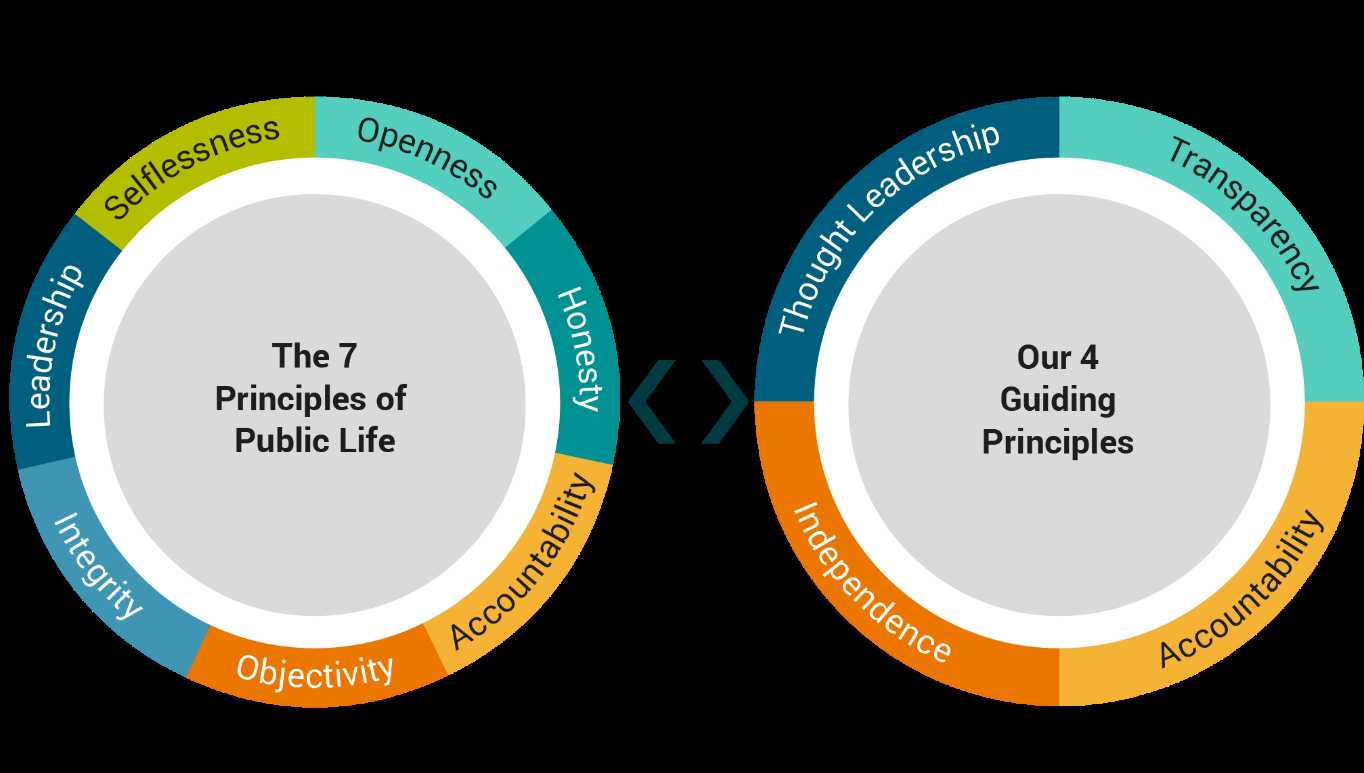
The UKEB operates in the public interest, following the seven principles of public life and our four guiding principles: Independence, Accountability, Thought Leadership, and Transparency.
Legislative Criteria
The UKEB must consider each new standard or amendment against criteria set out in legislation.
This diagram illustrates the UKEB's process for influencing and adopting IASB standards:
-
UKEB influences the IASB
- Conducts research
- Consults stakeholders
- Regular engagement with IASB
- Responds to Discussion Papers/Exposure Drafts
- (Leads to) IASB develops standard
-
IASB issues standard
-
UKEB considers standard for adoption
- Applies criteria in IAS Statutory Instrument
- Develops draft Endorsement Criteria Assessment and consults stakeholders
- Formally adopts the standard for use in the UK
-
UKEB influences the IASB
- Conducts research
- Consults stakeholders
- Engages with and issues recommendations to IASB
- (Leads to) IASB Post-Implementation Review
UKEB Highlights for the Year
This diagram highlights UKEB activities for 2024/25:
- Structural: 4 new Board Members appointed to replace Members stepping down at the end of their appointments in 2025.
- Research:
- Intangibles: 2 reports published
- Statement of Cash Flows and Related Matters
- Influencing:
- Outreach with UK stakeholders
- 9 Comment Letters (to IASB & DPOC)
- Presentations at UK and international fora
- Endorsements: Endorsed 7 amendments to existing standards for use in the UK
UKEB Technical Work on Financial Reporting
Early Stage Influencing – Research
17Research projects relate directly to the UKEB guiding principle of thought leadership. They also relate to the other UKEB guiding principles, as follows:
- Accountability: Research projects allow for early engagement with stakeholders. They also provide a wider range of evidence to support later decision making. All of which supports greater accountability to stakeholders.
- Independence: The UKEB assesses projects and acts in the UK’s long-term public good.
- Transparency: Research is discussed in public at UKEB Board meetings, may be published as a report or paper, and forms the basis of presentations and outreach. This provides transparent engagement with the evidence and findings.
18Research projects build on, and complement, the UKEB’s influencing strategy. The objective of research projects is to influence and improve financial reporting, both in the UK and globally. This helps the Board meet the statutory requirements to contribute to the development of a single set of international accounting standards.
19The UKEB’s research projects are aimed at:
- identifying, and promoting new ways of thinking about and solving, deficiencies in financial reporting, new and emerging issues, and complex financial reporting problems;
- influencing the long-term agenda and development of IFRS Standards;
- informing Board deliberations on accounting matters through the provision of wider evidence; and,
- supporting the work of the IFRS Foundation and others responsible for IFRS Standards.
Intangibles Research Project - ongoing
20The UKEB undertook a comprehensive research project to consider how the accounting for, and reporting of, intangible items could be improved to provide investors with more useful general purpose financial statements to enable better informed decisions.
21The project, commenced in January 2022, has:
- Explored UK stakeholders’ views on the accounting for intangibles under International Accounting Standards.
- Reviewed the nature and extent of current reporting practices for intangibles among listed UK companies using IFRS standards.
- Engaged with investors to better understand their perspectives on the current and future reporting of intangibles in the financial statements.
22In March 2023, the UKEB published 'Accounting for Intangibles: UK Stakeholders’ Views'. The report set out stakeholder views on the accounting for intangibles under international accounting standards within the context of the wider economic impact of intangibles in the UK.
23In May 2024, the UKEB published Accounting for Intangibles: a Quantitative Analysis of UK Financial Reports and Accounting for Intangibles: a Survey of Users’ Views. In July 2024, the UKEB also published a high-level summary of the three reports.
24The UKEB has presented the research in national and international fora, including the Institute of Chartered Accountants in England and Wales (ICAEW), Corporate Reporting Users Forum (CRUF), the British Accounting and Finance Association (BAFA), the IASB’s Accounting Standards Advisory Forum (ASAF) and the International Forum of Accounting Standard Setters (IFASS).
25The research was also presented at a UK Intellectual Property Office Event: “Investing in Innovation”, hosted and addressed by the UK’s Minister for AI and IP Viscount Camrose at the House of Commons. The event explored topics including intellectual property, financing, and investment, in the UK.
26The Intangibles research project is due to be completed during 2025/26, when a workstream to influence the IASB’s review of accounting requirements for Intangible Assets is expected to commence. The UKEB will use the findings from its reports as part of the evidence base in its future work on intangibles and to inform its contributions to future influencing work relating to the international standard on accounting for intangibles.
Statement of Cash Flows Research Project - ongoing
27The UKEB’s project, commenced in December 2024, will provide evidence to support the IASB’s decision on the scope of their project. The initial research will also address possible ways of improving the perceived deficiencies. The IASB plans to discuss the initial research outcomes and determine next steps in the first quarter of 2025.
28The UKEB project on the statement of cash flows and related matters supports meeting its responsibilities regarding thought leadership in accordance with the UKEB Terms of Reference. It will also help deliver the UKEB’s 2024-25 Regulatory Strategy (page 8) aim to influence the IASB early in its development cycle.
29The research will leverage previous work undertaken by the IASB, FRC and UKEB. It will gather primary evidence on the improvements investors and creditors want made to the statement of cash flows, and preparer views on these possible improvements. This will provide a foundation for the UKEB to propose potential solutions for the problems already identified by the IASB.
30Between December 2024 and March 2025, the UKEB conducted interviews with a diverse range of preparers and users of financial statements, and invited users to complete a short User poll.
31On 12 March 2025, the UKEB presented the findings from the preparer and user interviews undertaken, and a review of a sample of annual reports of UK listed companies, to the International Forum of Accounting Standard Setters (IFASS).
32The UKEB will now consider whether:
- the UKEB papers, developed to that point, should be consolidated into a single comprehensive report for publication; and
- whether additional research is appropriate and feasible given the IASB’s project plan and UKEB priorities at that time.
Influencing Development of IFRS Accounting Standards
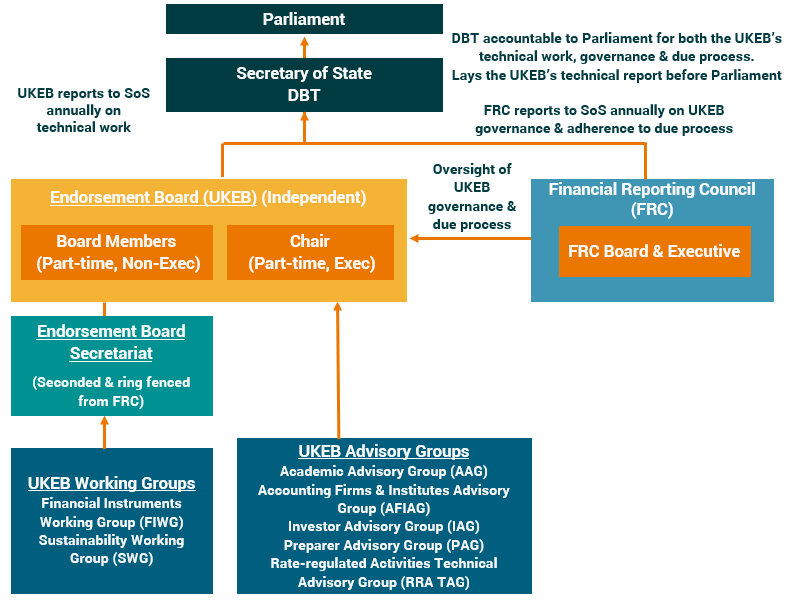
33The UKEB’s influencing activities contribute to the development of international financial reporting standards that:
- support the efficient allocation of capital and help to maintain the UK’s position as a leading capital market;
- improve the quality of information reported by UK entities;
- address emerging issues in the UK financial reporting environment; and,
- take account of the costs and benefits of financial reporting standards for UK stakeholders.
34The UKEB’s values are demonstrated through a proactive approach to the technical assessment of IASB proposals, including stakeholder outreach on them. The publication of feedback statements explaining how the UKEB has responded to stakeholder input for each major influencing project also helps deliver transparency and accountability.
IASB Consultations
35The UKEB influences the IASB by contributing to its research agenda and responding to documents it issues under its due process. The IASB usually issues the following types of documents for consultation:
- Exposure Drafts of proposed:
- New IFRS Accounting Standards;
- Amendments to existing Standards, issued to maintain and improve IFRS Accounting Standards and to support consistent application; and
- Packages of unrelated amendments together due to their minor, narrow scope. These amendments, known as ‘Annual Improvements’ clarify wording, or correct minor unintended consequences, oversights or conflicts between existing requirements.
- Post-implementation Reviews (‘PIRs’) of new standards or major amendments. PIRs are issued around 3 years after publication to assess whether the new requirements are working as intended.
IFRS Interpretations Committee
36The IFRS Interpretations Committee (‘IFRIC’) works with the IASB in maintaining and supporting the consistent application of IFRS Accounting Standards. IFRIC responds to questions about the application of IFRS Accounting Standards and does other work at the request of the IASB. Draft IFRIC Interpretations are published with an Invitation to Comment which sets out the matters identified as being of particular significance.
37The UKEB’s Due Process Handbook notes that the UKEB expects to respond to a limited number of tentative agenda decisions published by IFRIC. Some factors the UKEB considers when deciding whether to respond may be:
- the degree of impact of the tentative agenda decision on UK companies (for example, in cases where the tentative agenda decision is expected to affect a significant number of UK companies);
- disagreement with the Interpretations Committee’s analysis; or
- the usefulness of the explanations and clarifications included in the tentative agenda decision.
Outreach
38The UKEB’s influencing activities also include:
- seeking views from UK stakeholders on emerging issues to influence the IASB’s future work plan;
- engaging with other national standard setters to influence global views and to start discussions on areas of importance or concern to UK stakeholders; and
- conducting outreach activities on current projects to ensure that the views of UK stakeholders are highlighted to the IASB and taken into consideration during the standard setting process.
39The UKEB’s outreach on all influencing projects includes discussions with stakeholders, and public consultation on the Board’s draft comment letters to the IASB.
40The UKEB conducts outreach activities proportionate to the size and impact of proposals under consideration. These may include surveys, roundtables, panel events, public consultation on draft comment letters, and field testing.
UKEB Influencing projects completed in 2024/25
41During 2024/25, the UKEB completed nine influencing projects:
- Financial Instruments with Characteristics of Equity;
- Business Combinations - Disclosures, Goodwill and Impairment;
- Rate-regulated Activities;
- Power Purchase Agreements;
- Amendments to IFRS 19 Subsidiaries without Public Accountability: Disclosures,
- Climate-related and Other Uncertainties in the Financial Statements (see UKEB Work on Sustainability Reporting);
- Equity Method;
- Provisions – Targeted Improvements; and
- Proposed Amendments to the IFRS Foundation Due Process Handbook.
Financial Instruments with Characteristics of Equity
Content
42In November 2023, the IASB published the Exposure Draft (‘ED’) Financial Instruments with Characteristics of Equity.
43The IASB’s proposed amendments aim to address the challenges companies face in reporting on financial instruments they have issued. The ED proposes amendments to IAS 32 Financial Instruments: Presentation, IFRS 7 Financial Instruments: Disclosures, and IAS 1 Presentation of Financial Statements.
44The proposals include:
- clarification of the underlying classification principles of IAS 32 to help companies distinguish between financial liabilities and equity reported on their statement of financial position;
- disclosures to further explain complexities around instruments that have both financial liability and equity characteristics; and
- presentation requirements for amounts—including profit and total comprehensive income—attributable to ordinary shareholders separately from amounts attributable to other holders of equity instruments
Outreach
45The full approach to outreach is set out in the Feedback Statement published on the relevant project page of the UKEB website.
Final Comment Letter
46The UKEB Final Comment Letter was submitted to the IASB on 3 April 2024. The letter supported the IASB’s objectives in developing the ED proposals. The UKEB broadly supported the proposals, noting that it would be important to provide clarity and minimise the risk of diversity in accounting practice in this complex area.
Business Combinations – Disclosures, Goodwill and Impairment
Content
47In March 2024, the IASB published Exposure Draft (‘ED’) Business Combinations – Disclosures, Goodwill and Impairment.
48The ED was issued in response to feedback received by the IASB as part of its Post-implementation Review (‘PIR’) of IFRS 3 Business Combinations. Stakeholders responding to the PIR raised concerns about:
- investors receiving insufficient information about the performance of acquisitions;
- impairment tests being costly and complex;
- impairment losses on goodwill sometimes being recognised too late; and
- amortisation of goodwill.
49The ED proposed amendments to IFRS 3 Business Combinations, to improve the information companies disclose about the performance of business combinations; and, to amendments to the impairment test of cash-generating units containing goodwill, in IAS 36 Impairment of Assets.
Outreach
50The full approach to outreach is set out in the Feedback Statement published on the relevant project page of the UKEB website.
Final Comment Letter
51The UKEB published its Final Comment Letter on 22 July 2024. The letter was broadly supportive of the package of proposed amendments, to the disclosure requirements in IFRS 3 and the impairment test in IAS 36, which aim to provide investors with better information about post-acquisition performance of acquired entities.
52The letter included various recommendations, including taking a principles-based approach to identifying the most important business combinations, and proposed a process to achieve this. The UKEB also recommended the IASB introduce disclosure requirements to address the risk that management use optimistic inputs when calculating value in use that could avoid or further delay the recognition of impairment losses.
Rate-regulated Activities
Content
53In January 2021, the IASB published Exposure Draft (‘ED’) Regulatory Assets and Regulatory Liabilities. The new standard is proposed to replace IFRS 14 Regulatory Deferral Accounts. It would require companies subject to rate regulation to give investors better information about their financial performance.
54The UKEB published its Final Comment Letter on 4 August 2021. The letter was supportive of the proposals in the ED which were expected to lead to some improvement in financial reporting for companies within scope.
55However, a new concept (the direct (no direct) relationship concept) was developed after the consultation on the ED. The new concept fundamentally changes the requirements included in the ED and directly impacts the recognition and measurement for rate-regulated entities subject to incentive-based regulation.
56The nature of rate-regulation for utilities in the UK is incentive-based. UK entities operating under incentive-based regulation that are within scope of the ED typically have no direct relationship between their property, plant and equipment (PPE) and regulatory capital base (RCB). Consequently, applying the IASB’s proposed approach to recognising regulatory assets and regulatory liabilities may not reflect the full extent of an entity’s financial performance and financial position.
Outreach
57The UKEB established the Rate-regulated Activities Technical Advisory Group (see paragraph 157) to obtain the views of stakeholders with an interest in accounting by UK rate-regulated entities, including preparers, auditors and investors. The UKEB has used the advice from the Advisory Group to help develop views provided to the IASB throughout the project to ensure the IASB is fully aware of the UK-specific issues and has the opportunity to address them before it issues the final standard.
Letter to the IASB
58On 30 July 2024, the UKEB sent a letter to the IASB, accompanied by the 'Consolidated report on the UKEB Secretariat’s top-down approach'. The letter highlighted the UKEB’s concerns with the IASB’s tentative decisions relating to the direct (no direct) relationship concept. The consolidated report summarises the UKEB Secretariat’s work on the top-down approach carried out to date.
Power Purchase Agreements – Proposed Amendments to IFRS 9 and IFRS 7
Content
59In May 2024, the IASB published Exposure Draft (‘ED’) Contracts for Renewable Electricity Proposed Amendments to IFRS 9 and IFRS 7. The ED was issued in response to the IFRS Interpretations Committee’s (IFRIC) consideration of a submission relating to the application of certain requirements of IFRS 9 Financial Instruments (IFRS 9) to contracts for renewable energy.
60Increasingly, Power Purchase Agreements (PPAs) are being used by companies entering into agreements to purchase renewable energy in order to decarbonise their productions processes and products. This partly arises from the introduction of company reporting requirements which require entities to disclose their greenhouse gas emissions and progress towards net zero commitments.
61The ED focused on how to apply the ‘own use’ exception in IFRS 9 to physical PPAs in which the underlying non-financial item:
- Cannot be stored economically; and
- Is required to either be consumed or sold within a short time as determined by the market structure in which the item is bought and sold.
62The scope of the proposals was restricted to contracts for renewable electricity where the source of electricity is nature dependent, and that expose the purchaser to substantially all the volume risk through ‘pay as produced’ features.
63The ED also included proposals relating to hedge accounting and introduced additional disclosure requirements for contracts within the scope of the amendments.
Outreach
64The full approach to outreach is set out in the Feedback Statement published on the relevant project page of the UKEB website.
Final Comment Letter
65The UKEB published its Final Comment Letter (FCL) on 6 August 2024, which supported the IASB’s responsiveness in addressing the challenges faced by entities accounting for contracts for renewable electricity.
66The UKEB advised that the need to provide clarity and minimise the risk of diversity in accounting practice was highlighted by stakeholder demands for increased transparency on the use of those contracts. However, the FCL also advised that the narrow scope of the ED should be retained to avoid the risk of unintended consequences.
Amendments to IFRS 19 Subsidiaries without Public Accountability: Disclosures
Content
67In July 2024, the IASB published Exposure Draft (‘ED’) Amendments to IFRS 19 Subsidiaries without Public Accountability: Disclosures.
68IFRS 19, issued on 9 May 2024, is a voluntary IFRS Accounting Standard for use by subsidiaries without public accountability, which have a parent company that applies IFRS Accounting Standards for its consolidated financial statements.
69When issued, it only included reduced disclosures in respect of IFRS Accounting Standards issued before 28 February 2021. The ED includes amendments to new or amended Standards issued after that date.
70The ED also consulted on the disclosure requirements:
- in the Amendments to the Classification and Measurement of Financial Instruments (Amendments to IFRS 9 and IFRS 7) issued on 30 May 2024 that included consequential amendments to IFRS 19; and
- for eligible subsidiaries in the forthcoming IFRS Accounting Standard Regulatory Assets and Regulatory Liabilities.
71The proposals applied the principles for reducing disclosures that the IASB used in developing IFRS 19, and agreed to follow in maintaining the standard. These principles identify information users of financial statements of companies without public accountability are particularly interested in, including: liquidity and solvency; measurement uncertainty; and disaggregation of amounts.
Outreach
72The full approach to outreach is set out in the Feedback Statement published on the relevant project page of the UKEB website.
Final Comment Letter
73The UKEB published its Final Comment Letter on 28 November 2024. The letter supported the principles used by the IASB but noted the relatively few reductions in required disclosures. The UKEB encouraged the IASB to give greater consideration to proportionality, to maintain the attractiveness of the standard and to meet the objective of a reduced disclosure framework.
74The UKEB is commencing the endorsement phase of its work on IFRS 19. The new Standard and the final amendments will be considered for endorsement together, as a package.
Climate-related and Other Uncertainties in the Financial Statements
Content
75In July 2024, the IASB published Exposure Draft (‘ED’) Climate-related and Other Uncertainties in the Financial Statements – Proposed illustrative examples.
76The IASB received strong stakeholder feedback to its Third Agenda Consultation indicating concerns regarding the effects of climate-related risks in the financial statements and the level consistency with information outside the financial statements.
77In February 2023, the UKEB commenced a comprehensive research project on reporting climate-related matters in financial statements. The evidence gathered provided insight into UK companies’ experience of reporting on climate-related matters and on connectivity between the respective sustainability reporting and financial reporting. The UKEB published two reports2 and presented the research in national and international fora, including the International Forum of Accounting Standard Setters (IFASS) to stimulate international debate on this matter.
78In response to this feedback, the IASB commenced a project which led to the issuance of an ED containing a series of illustrative examples which indicate how an entity could apply the requirements in IFRS Accounting Standards to report the effects of climate-related and other uncertainties in its financial statements. The IASB has sought to reinforce connectivity with IFRS Sustainability Disclosure Standards when developing the examples.
79The illustrative examples are proposed to accompany IFRS Accounting Standards and will not form an integral part of the Standards.
Outreach
80The full approach to outreach is set out in the Feedback Statement published on the relevant project page of the UKEB website.
Final Comment Letter
81The UKEB published its Final Comment Letter on 3 December 2024. The letter was supportive of the examples development but highlighted that non-mandatory illustrative examples are not a substitute for standard-setting, and should not be used to drive changes in accepted practice. The letter also provided suggestions to enhance the examples.
Equity Method
Content
82In September 2024, the IASB published Exposure Draft (‘ED’) Equity Method of Accounting – IAS 28 Investments in Associates and Joint Ventures (revised 202x).
83IFRS Accounting Standards require the application of the equity method of accounting to investments in joint ventures and associates in consolidated financial statements. It is also permitted in separate financial statements for investments in subsidiaries, joint ventures and associates.
84The ED sets out proposed amendments to IAS 28 to answer application questions about how to apply the equity method of accounting. It also proposes improvements to the disclosure requirements to enhance the information companies provide about these investments
85The proposed amendments aim to reduce diversity in practice and provide users of financial statements with more comparable and useful information. As IAS 28 was first published in 1989, the IASB also proposed a reordering of the Standard in a more logical and consistent way.
Outreach
86The full approach to outreach is set out in the Feedback Statement published on the relevant project page of the UKEB website.
Final Comment Letter
87The UKEB published its Final Comment Letter on 16 December 2024. The letter supported the proposals in the ED.
Provisions – Targeted Improvements
Content
88In November 2024, the IASB published Exposure Draft (‘ED’) Provisions – Targeted Improvements. The ED proposes amendments to IAS 37 Provisions, Contingent Liabilities and Contingent Assets.
89The targeted improvements to IAS 37 aim to clarify:
- when an entity recognises a provision - including whether and, if so, when an obligation conditional on an entity’s own future actions is a ‘present obligation’ and hence a liability;
- whether the rate at which an entity discounts a provision for the time value of money should reflect the entity’s own credit risk, that is, the possibility that it may fail to fulfil its obligation; and
- whether a provision for an obligation to deliver goods or services should comprise only the incremental costs of fulfilling the obligation or also include an allocation of other directly related costs.
Outreach
90The full approach to outreach is set out in the Feedback Statement published on the relevant project page of the UKEB website.
Final Comment Letter
91The UKEB published its Final Comment Letter on 13 March 2025. The letter supported the targeted improvements to the measurement requirements, subject to some suggested enhancements. However, the UKEB raised concerns about the recognition criteria. Detailed comments on the principal areas of concern were provided, in addition to answers to the Rfl’s specific questions.
Proposed Amendments to the IFRS Foundation Due Process Handbook
Content
92In December 2024, the IFRS Foundation Trustees published Exposure Draft (‘ED’) Proposed Amendments to the IFRS Foundation Handbook.
93The IFRS Foundation’s Due Process Handbook (the Handbook) is the standard setting ‘manual’ for the work of the IASB, the ISSB and the IFRS Interpretations Committee (IFRIC), which builds on the due process requirements in the IFRS Foundation Constitution. It helps to deliver transparency and accountability as well as explaining the process for stakeholder engagement.
94The proposed amendments reflect the creation of the ISSB in the Due Process Handbook (as it was last updated in 2020, before the creation of the ISSB); and make targeted enhancements and clarifications, based on the Foundation’s recent experiences.
95The proposed enhancements and clarifications include, inter alia:
- amendments to the objective and timing of PIRs;
- amendments to the requirements for annual improvements, to specify that they may include minor or narrow-scope amendments that update a requirement or material accompanying an IFRS Standard; and
- requiring the DPOC to review the due process a board followed before a major new IFRS Standard or Amendment is issued.
Outreach
96The full approach to outreach is set out in the Feedback Statement published on the relevant project page of the UKEB website.
Final Comment Letter
97The UKEB published its Final Comment Letter on 1 April 20253. The letter was broadly supportive of the proposals in the Handbook to formalise connectivity between the boards and their respective sets of standards.
98However, the UKEB raised concerns about a number of issues, including: the full due process not being applied to the SASB standards; the focus of Post-Implementation Reviews (PIRs); the length and timing of comment periods; and the scope of economic assessments. Detailed comments on the principal areas of concern were provided, in addition to answers to the Rfl’s specific questions.
Other UKEB Influencing projects underway during 2024/25
99The UKEB monitors the IASB’s work and the decisions it makes at its board meetings. The UKEB has commenced desk-based research and early-stage stakeholder engagement on the projects listed below and is awaiting decisions from the IASB.
| Influencing Projects |
|---|
| PIR - IFRS 16 Leases |
| IFRS 9 Amortised Cost Measurement |
| Dynamic Risk Management |
| Pollutant Pricing Mechanisms |
| Statement of Cash Flows and Related Matters |
| Use of Hyper-inflationary presentation |
Endorsement and adoption
100The UKEB assesses an international accounting standard against statutory criteria. A standard may only be adopted if it is not contrary to the principles set out in the legislation4 and if the Board decides that use of the standard is likely to be conducive to the long term public good in the UK.
101The following diagram is the high-level process the UKEB follows to adopt a standard for use in the UK. It includes the requirement for decisions to be published within 3 days.
High-level process for UKEB to adopt a standard:
- IFRS Issued
- Assess IFRS against Endorsement Criteria (see page 6)
- Draft Endorsement Criteria Assessment (DECA)
- Public Consultation
- Final Endorsement Criteria Assessment (ECA)
- Tentative vote to adopt - in a public meeting
- Final written vote
- ADOPTED
- Standard Posted to UKEB website within 3 days
Completed Endorsement Projects
102During the year the UKEB completed three endorsement projects. These were narrow-scope amendments to existing UK-adopted international accounting standards.
| Project Details |
|---|
| Lack of Exchangeability (Effective date: 1 January 2025) |
| Lack of Exchangeability (Amendments to IAS 21) |
| Annual Improvements – Volume II (Effective date: 1 January 2026) |
| Amendment to IFRS 9 Financial Instrument – Transaction Price |
| Amendment to IFRS 9 Financial Instrument – Lessee derecognition of lease liabilities |
| Amendment to IFRS 7 Financial Instruments: Disclosures – Gain or Loss on Derecognition |
| Amendment to IFRS 1 First-time Adoption of International Financial Reporting Standards – Hedge accounting by a first-time adopter |
| Amendment to IFRS 10 Consolidated Financial Statement - Determination of a ‘de-facto’ agent |
| Amendment to IAS 7 Statement of Cash Flows – Cost Method |
Lack of Exchangeability: adopted on 15 July 2024 and published on 19 July 2024
103Lack of Exchangeability. Amendments to IAS 21 The Effects of Changes in Foreign Exchange Rates was published by the IASB on 15 August 20235. The Amendments are limited in scope and address the gap arising from the lack of specific requirements for company reporting in IAS 21 when a lack of exchangeability between two currencies is not temporary.
104The Amendments clarify the requirements in IAS 21: to assess exchangeability by defining ‘exchangeable’ and ‘not exchangeable’; the estimation objective for estimating the spot exchange rate when there is a lack of exchangeability; and specify disclosure requirements about how a currency, not exchangeable into another currency, affects the entity’s financial position, financial performance, and cash flows.
105The Amendments address diversity in international practice and improve the usefulness of the information provided to the users. This will allow investors to assess the materiality of a lack of exchangeability on the business and to understand the judgements management made in determining exchange rates used in accounting for transactions impacted by a lack of exchangeability.
Assessment and Endorsement of the Amendments
106The UKEB assessed the Lack of Exchangeability (Amendments to IAS 21 The Effects of Changes in Foreign Exchange Rates) against each of the criteria under the basis for adoption in Regulation 7 of the IAS Regulations. The UKEB also consulted a representative range of stakeholders interested in the quality and availability of accounts in accordance with Regulation 8 of the IAS Regulations.
107The Board was satisfied that the Amendments meet the criteria in Regulation 7 and decided to adopt the Amendments on 15 July 2024.
108Application of these Amendments to UK-adopted international accounting standards is mandatory for financial years beginning on or after 1 January 2025, and application to financial years beginning before 1 January 2025 is permitted.
109Further information, including the UKEB’s Endorsement Criteria Assessment, Feedback Statement and Adoption Statement, is available on the UKEB’s website: here.
Annual Improvements to IFRS Accounting Standards – Volume II: adopted on 11 February 2025 and published on 13 February 2025
110Annual Improvements to IFRS Accounting Standards – Volume 11 (Amendments to IFRS 1, 7, 9, 10 and IAS 7) (‘the Amendments’) was published by the IASB on 18 July 20246.
111Annual Improvements are amendments that are sufficiently minor or narrow in scope and are bundled together in a single document (even though the amendments are unrelated). These amendments are limited to changes that clarify the wording in the standards, or correct relatively minor unintended consequences, oversights or conflicts between existing requirements.
112These Amendments are a collection of six separate minor amendments to the mandatory sections of five IFRS Accounting Standards:
- IFRS 9 Financial Instrument - Transaction price. The amendment deletes a reference and revises the wording.
- IFRS 9 Financial Instrument - Lessee derecognition of lease liabilities. The amendment clarifies a lessee’s accounting for derecognition of a lease liability.
- IFRS 7 Financial Instruments: Disclosures - Gain or loss on derecognition. The amendment updates an obsolete cross-reference and streamlines wording.
- Implementation Guidance accompanying IFRS 7 Financial Instruments: Disclosures - Disclosure of deferred difference between fair value and transaction price. The amendment aligns wording.
- Implementation Guidance accompanying IFRS 7 Financial Instruments: Disclosures - Credit risk disclosures. The amendment adds a statement and simplifies wording.
- IFRS 1 First-time Adoption of International Financial Reporting Standards - Hedge accounting by a first-time adopter. The amendment aligns terminology and adds cross- referencing.
- IFRS 10 Consolidated Financial Statement - Determination of a ‘de facto’ agent. The amendment clarifies requirements.
Assessment and Endorsement of the Amendments
113The UKEB assessed the Annual Improvements to IFRS Accounting Standards – Volume 11 against each of the criteria under the basis for adoption in Regulation 7 of the IAS Regulations. The UKEB also consulted a representative range of stakeholders interested in the quality and availability of accounts in accordance with Regulation 8 of the IAS Regulations.
114The Board was satisfied that the Amendments meet the criteria in Regulation 7 and decided to adopt the Amendments on 11 February 2025.
115Application of the Amendments to UK-adopted international accounting standards is mandatory for financial years beginning on or after 1 January 2026, and application to financial years beginning before 1 January 2026 is permitted.
116Further information, including the UKEB’s Endorsement Criteria Assessment, Feedback Statement and Adoption Statement, is available on the UKEB’s website: here.
Other UKEB Endorsement projects underway during 2024/25
Adoption decision likely in 2025/26
The UKEB will ensure that any IFRS Accounting Standard it endorses is likely to be conducive to the public good in the UK, that its use is likely to have an adverse effect on the UK economy, including on economic growth, and takes account of costs and benefits.
Amendments to IFRS 9 and IFRS 7 (Effective date: 1 January 2026) Amendments to the Classification and Measurement of Financial Instruments – Amendments to IFRS 9 and IFRS 7 were published, by the IASB, in May 2024. The UKEB completed its Influencing project in July 2023, and the amendments were adopted in April 2025. The amendments provide further clarification and requirements.
Amendments to IFRS 9 and IFRS 7 (Effective date: 1 January 2026) Amendments to IFRS 9 and IFRS 7 – Contracts Referencing Nature-dependent Electricity were published, by the IASB, in December 2024. The UKEB responded to the IASB’s Exposure Draft in August 2024 (see Influencing). The amendments clarify how certain requirements of IFRS 9 and IFRS 7 should be applied to contracts for renewable energy.
New standard - IFRS 18 (Effective date: 1 January 2027) IFRS 18 Presentation and Disclosure in Financial Statements was published, by the IASB, in April 2024. IFRS 18 includes new requirements for presentation and disclosure in the financial statements, with a focus on the income statement. The requirements respond to investors’ concerns about the comparability and transparency of companies’ performance reporting.
New standard - IFRS 19 (Effective dated: 1 January 2027) IFRS 19 Subsidiaries without Public Accountability: Disclosures was published, by the IASB, in May 2024. IFRS 19 is a new voluntary reduced disclosure framework that responds to preparers’ requests to permit subsidiaries with a parent, that applies IFRS Accounting Standards in its consolidated financial statements, to apply IFRS Accounting Standards with reduced disclosure requirements.
UKEB Technical Work on Sustainability Reporting
Our remit
117The Memorandum of Understanding between the UKEB, the Secretary of State for Business, Energy and Industrial Strategy (BEIS) and the Financial Reporting Council (FRC) requires the UKEB to consider any additional areas of work when requested to do so by the Secretary of State.
118In 2022, the Secretary of State asked the UKEB to also respond to consultations from the International Sustainability Standards Board (ISSB), to provide views from our perspective as the body responsible for endorsing and adopting international accounting standards in the UK.
119The UKEB work in this area focused on how the sustainability standards issued by the ISSB interact with accounting standards issued by the IASB. Specifically, whether their combined effect will result in sustainability disclosures provided by companies that are connected to the information presented in the financial statements and are decision-useful for investors.
Endorsement of IFRS Sustainability Disclosure Standards
120In acknowledgement of the importance of connectivity between financial statements and sustainability disclosures to investors, the UKEB is part of the UK Sustainability Reporting Standards framework.
121Accordingly, the UKEB:
- has been appointed to the UK Sustainability Disclosure Technical Advisory Committee (TAC); and,
- is represented on the UK Sustainability Disclosure Policy Implementation Committee (PIC).
122The TAC assesses the IFRS Sustainability Disclosure Standards (UK SRS) on a technical basis and provides independent advice and recommendations to the Secretary of State. The PIC considers whether the endorsement of any IFRS Sustainability Disclosure Standard has significant interactions with the remits of their respective organisations.
Working with Other International Organisations
124In applying the principle of thought leadership, the UKEB is required, under its Terms of Reference to represent UK views in international fora, with the aim of influencing debate. It is also required to engage with national standard-setters in other jurisdictions, and international accounting and reporting bodies, in order to ensure the UK voice is impactful and that best practice is promulgated internationally.
Working with ASAF
125The Accounting Standards Advisory Forum (ASAF) is a key advisory body of the IASB. ASAF enables the IASB to obtain a broad range of national and regional input from standard setters in jurisdictions, from across the world, on major technical issues related to the IASB’s standard setting activities.
126Its membership is limited to 12 members, plus the Chair. The membership represents a balance of national standard-setters and regional standard-setting bodies from the major economic regions of the world. The UKEB was appointed, as one of the three members from Europe region, in June 2021. In October 2024, the IASB announced the UKEB’s reappointment, for a further three-year period, to 2027.
127ASAF met four times in the 2024/5 financial year (July 2024, September 2024, December 2024 and March 2025). The UKEB was represented at all meetings.
128The UKEB membership enabled the Chair and Technical Director to present the findings of the UKEB’s Intangible Assets Research Project at the July 2024 ASAF meeting, for consideration of the IASB and the other members of that group.
Working with IFASS
129The International Forum of Accounting Standard Setters (IFASS) is a group of national accounting standard setters from around the world. The forum provides an opportunity for national accounting standards setters, and others interested in financial reporting, to discuss current issues in financial reporting.
130The IASB participates in these meetings on an equal footing with national standard setters. In addition, the IASB uses IFASS to conduct outreach, especially for queries lodged with the IFRS Interpretations Committee, to gather information on the practical relevance, prevalence, and current practice of potential agenda item requests.
131The group usually meets twice a year. This financial year it met in April 2024, September 2024 and March 2025. The meetings were attended by the UKEB Chair and Technical Director.
132At the April 2024 IFASS meeting, the UKEB presented the UKEB’s Intangibles research, for consideration by the members. At that meeting, the UKEB also joined panels discussing Rate-regulated activities and IFRS 19 Subsidiaries without Public Accountability.
133At the September 2024 IFASS meeting, the UKEB Technical Director moderated a panel discussion on Connectivity between Financial Reporting and Sustainability Reporting and presented further research on intangibles.
134At the March 2025 IFASS meeting, the UKEB Chair gave a presentation on the UKEB’s research project on the Statement of Cash Flows and Related Matters, for consideration by the members. At that meeting the UKEB Technical Director also joined panels discussing Provisions – Targeted Improvements, and Addressing key accounting challenges, and moderated a panel discussing Connectivity of financial statements information and sustainability reporting – practical applications.
Working with other National Standard-setters
135The UKEB engages with other national standard-setters (‘NSS’) on various projects in order to learn from their work and to develop an understanding of issues and concerns in other jurisdictions and proposed approaches to their escalation or resolution.
NSS Sustainability Forum
136The UKEB set up a National Standard-setters (NSS) Sustainability Forum to develop an understanding of connectivity issues between IFRS Accounting Standards and IFRS Sustainability Disclosure Standards, consider possible solutions that would address the stakeholder needs for connectivity between information presented in companies’ sustainability reports and financial reports, and share them with the ISSB and IASB as they develop high-quality international standards.
137Its membership is limited to national standard-setters, with a particular interest in, or responsibility for, the overlap between IFRS Accounting Standards and IFRS Sustainability Disclosure Standards.
138The Forum members have collaborated on presentations to IFASS on connectivity. The member bodies also published a joint letter to the ISSB, in October 2023, highlighting common concerns regarding the ISSB’s Agenda Consultation. As a result, the ISSB prioritised work to assist jurisdictions implementing IFRS S1 and IFRS S2, and to ensure connectivity with the IASB’s standards.
Organisational Structure and Our People
UKEB Board
140The UKEB Board, is comprised of the Chair and 12 Members. Collectively, they bring together a range of relevant backgrounds and expertise.
141The Chair is appointed by the Secretary of State. The Members are appointed by the Chair, with the approval of the Secretary of State for Business and Trade, following a fair and open appointment process.
142Members are appointed for a period of 3 years. The appointment may be renewed for a further period of up to 3 years at the discretion of the Secretary of State. In exceptional circumstances, one further term may be granted for a maximum of 12 months.
Our Structure
UKEB Advisory Groups
143The UKEB has four standing advisory groups: Academic, Accounting Firms and Institutes, Investor, and Preparer. Ad hoc groups are established for specific projects. Currently, there is an ad hoc technical advisory group for Rate-regulated Activities.
144These groups are not decision-making bodies in their own right. They act as advisory, consultative groups which provide specialist knowledge and information as input into the Board’s technical decision-making.
145The advisory groups, established in 2022 provide the UKEB with a regular mechanism for obtaining timely input from stakeholder groups on active projects, while balancing resource needs.
146The meetings of these groups also helps to amplify the UKEB’s views across the domestic and international corporate reporting community, and to drive the debate of contemporary issues in the general corporate reporting community This, in turn, improves the general understanding of those issues across the board.
147The advisory groups are chaired by UKEB Board Members and members of the group are appointed in their personal capacities.
148The members of the advisory groups are senior, high calibre individuals. Their appointment illustrates the importance of the UKEB to UK stakeholders and that the UKEB is engaging with the full range of UK stakeholders. Biographies for the members of each group are available on the UKEB website.
Academic Advisory Group (AAG)
149Members of the AAG include academics with expertise and experience in the use of accounting by individuals, organisations, or government; academics with an interest in accounting policy, governance and environmental issues, quantitative analysis, wider corporate reporting, and economics.
150The group currently has 10 members, including the Chair. Its inaugural meeting was held in September 2022. Under the Terms of Reference, the group meets twice per year.
Accounting Firms and Institutes Advisory Group (AFIAG)
151Members of the AFIAG have a close interest in the use and implementation of international accounting standards. They include individuals from large and medium-sized professional services firms in the UK, and from UK Accounting Institutes.
152The group currently has 12 members, including the Chair. Its inaugural meeting was held in July 2022. Under the Terms of Reference, the group meets three times per year.
Investor Advisory Group (IAG)
153Members of the IAG have practical experience in analysing and using financial reporting information. Members can include “buy-side” fund managers, institutional investors, and retail investors, as well as participants from “sell-side” investment banks and ratings agencies.
154The group currently has 12 members, including the Chair. Its inaugural meeting was held in October 2022. Under the Terms of Reference, the group meets three times per year.
Preparer Advisory Group (PAG)
155Members of the PAG have considerable practical experience of financial reporting, with knowledge and understanding of the financial reporting issues faced by IFRS reporters and include individuals from large accounting firms and publicly listed UK companies.
156The group currently has 11 members, including the Chair. Its inaugural meeting was held in July 2022. Under the Terms of Reference, the group meets three times per year.
Rate-regulated Activities Technical Advisory Group (RRA TAG)
157Members of the ad hoc RRA TAG include preparers working in rate-regulated industries, users of accounts with a particular interest in accounts of entities that undertake rate-regulated activities; and individuals from professional services firms in the UK who provide services to entities with rate-regulated activities.
158The group currently has 10 members, including the Chair. Its inaugural meeting was held in March 2023. Under the Terms of Reference, the group meets up to a maximum of six times per year. During 2024/25, the RRA TAG met four times.
UKEB Working Groups
159The UKEB’s working groups provide access to specialist technical knowledge and expertise on certain projects. These solely advise the Secretariat, and the membership of these groups may change as the focus of the group’s work evolves.
160Currently, the UKEB has working groups for Financial Instruments and Sustainability. The groups are chaired by senior members of the Secretariat.
Governance and Transparency
Regulatory Strategy and Workplan
161The UKEB 2025/28 Regulatory Strategy (Draft), was open for consultation from 17 December 2024 to 6 February 2025. The final strategy and workplan was published on 1 April 2025. Its sets the UKEB’s second three-year strategy.
162The UKEB’s expected technical workplan, incorporated within the Regulatory Strategy, includes a variety of upcoming adoption, influencing and research projects. The UKEB will focus on those aspects of the IASB agenda that are of highest priority to UK stakeholders, in line with the Board’s ongoing aim to obtain maximum value from its available resources.
163Given the need to align our work programme with that of the IASB, some technical projects listed on the UKEB workplan may be rolled forward to the next financial year to accommodate delays in the IASB’s workplan.
Public Board Meetings
164The Board’s technical decision-making is carried out in a fully transparent manner via public Board meetings. Members of the public can choose to observe the discussions live or watch an online recording.
165The meetings are attended by Official Observers from the Department for Business and Trade (‘DBT’), Bank of England, Financial Conduct Authority (‘FCA’), Financial Reporting Council (‘FRC’) and HM Revenue & Customs (‘HMRC’), all of whom have speaking rights.
166UKEB has a Board Meetings Transparency Policy which sets out the key principles the Board considers when deciding which matters it discusses in public Board meetings, and which matters are discussed in private.
Published Board Papers
167Meeting agenda and Board papers on technical matters are published on the UKEB website in advance and a summary of decisions and minutes are published afterwards.
168The agenda and summary minutes of the UKEB’s private Board meetings are also published on the UKEB website.
Footnotes
-
Following the changes announced on 7 February 2023, oversight of UKEB's discharge of its statutory functions has moved from BEIS to the Department for Business and Trade. ↩
-
Climate-related Matters: Summary of Connectivity Research, July 2023 and A Study in Connectivity Analysis of 2022 UK Company Annual Reports, September 2023 ↩
-
The project has been included in the 2024/25 report as the letter was sent to the IASB on 28 March 2025. ↩
-
The International Accounting Standards and European Public Limited Liability Company (Amendment etc.) (EU Exit) Regulations 2019 ↩
-
The IASB’s proposals were set out in Exposure Draft ED/2021/4 Lack of Exchangeability. The UKEB Secretariat submitted its Final Comment Letter to the IASB on 31 August 2021. ↩
-
The IASB’s proposals were set out in Exposure Draft ED/2023/1 Annual Improvements to IFRS Accounting Standards – Volume 11. The UKEB submitted its Final Comment Letter to the IASB on 14 September 2023. ↩