7 IASB General Update
25 September 2025 Agenda Paper 7
Executive Summary
Purpose of the paper
This paper provides the Board with an update on projects the Secretariat is currently monitoring, including the work of the IFRS Interpretations Committee.
As agreed with the Board, the Secretariat monitors projects being undertaken by the IASB and IFRS Interpretations Committee. This is undertaken to inform the Board about the progress and decisions being made by the IASB on active projects. Discussion by the Board may also help inform interactions with international standard setter meetings, including the IASB's Accounting Standards Advisory Forum (ASAF).
Summary of the Issue
Topics addressed in this paper include topics discussed by the IASB at its July 2025 meeting as well as topics on the October 2025 ASAF agenda.
Topics for discussion
- Intangible Assets (ASAF Agenda)
- Statement of Cash Flows and Related Matters (ASAF Agenda)
- Business Combinations—Disclosures, Goodwill and Impairment (ASAF Agenda)
- Equity Method (ASAF Agenda)
- Interpretations Committee Update
Topics for noting
- Financial Instruments with Characteristics of Equity
- Fourth Agenda Consultation
Decisions for the Board
Topics for discussion
Intangible Assets (Appendix A)
1Do Board Members have views on secretariat concerns that the case studies risk exploring topics of limited applicability and not addressing broader principles?
2Do Board Members have comments on the selected test cases, cloud computing and agile software development. Do you agree with the IASB's analysis of the principles and topics to explore further? Do you think anything is missing and, if so, what?
3Do Board Members have comments on the potential test cases, AI and data resources. Do you agree with the IASB's initial view not to select AI or data resources as specific test cases for further exploration? If not, why? Are there any other concerns you have heard from stakeholders in your jurisdiction?
4Do Board Members believe there are other potential test cases the IASB should consider?
Statement of Cash Flows and Related Matters (Appendix B)
1Do Board Members have any comments on:
- the proposed response to the questions to be asked by the IASB in the ASAF meeting, set out in the table in Annex 1 of Appendix B?
- the other UKEB Secretariat comments in Annex 1 of Appendix B?
2Do Board Members agree that UKEB Advisory Groups (investors and preparers) are consulted to obtain feedback in order to provide a written response to the IASB staff in relation to:
- the seven examples provided in Annex 1 of Appendix B and the initial IASB staff assessment thereon?
- other classification issues for which the IASB staff have requested a written response in Annex 2 of Appendix B?
Business Combinations—Disclosures, Goodwill and Impairment (Appendix C)
Proposed exemption (IFRS 3)
1Does the Board have examples of situations in which disclosing performance and expected synergy information would breach statutory legal or regulatory requirements in the UK?
2Does the Board think an entity should be exempt from disclosing information in these situations?
3Does the Board have examples of any other negative social or operational consequences arising from disclosure of performance or expected synergy information that would not already be captured by the exemption?
4Does the Board think an entity should be exempt from disclosing information in these situations?
5Does the Board believe the IASB staff recommended wording (see paragraph C18 of Appendix C) will be successful in accommodating the necessary examples without unduly extending the scope of the exemption?
6Does the Board have any other suggestions to refine the scope of the exemption in a way that would accommodate the necessary examples without unduly extending the scope of the exemption?
7Considering the benefits and costs of developing examples (see Annex 1 page 21 of Appendix C), does the Board think the IASB should include examples of situations in which an entity can apply the exemption?
8Does the Board have examples of situations for which the IASB can develop examples, other than a product launch and breach of legal/regulatory requirements (see Annex 1 page 22 of Appendix C)?
9Does the Board have any comments or suggestions on the example developed by the IASB (see Annex 1 pages 23 and 24 of Appendix C)?
Proposed removal of constraint in respect of uncommitted future restructuring and enhancement cash flows used in value in use calculation (IAS 36)
10Considering the benefits and costs (see Annex 2 page 26 of Appendix C), does the Board think that the IASB should develop an example that illustrates cash flows that reflect an asset's 'current potential', as well as cash flows that do not reflect such potential?
11Would an example similar to that included in ASAF presentation (see Annex 2 pages 27-29 of Appendix C) help stakeholders better understand and apply the concept of an asset's ‘current potential’? Why or why not? If not, what changes would you suggest?
Equity Method (Appendix D)
1Do Board Members agree with the Secretariat view that when applying the equity method of accounting, acquisition-related costs should be recognised as part of the cost of the investment i.e. capitalised?
2Do Board Members agree with the Secretariat view that an investor should recognise dilution gains or losses in profit or loss?
3Do Board Members have any other matters they wish to raise at the October 2025 ASAF meeting?
Interpretations Committee Update (Appendix E)
1Do Board Members agree that the UKEB will NOT undertake substantive work at this time on the following issue:
- Classification of a Foreign Exchange Difference from an Intragroup Monetary Liability (or Asset) (IFRS 18)?
2In the light of the Interpretations Committee's tentative conclusions, and assuming there are no substantive changes to the conclusions once published, do Board Members agree that the UKEB will NOT respond to the Interpretations Committee's invitation to comment on:
- Economic Benefits from Use of a Battery under an Offtake Arrangement (IFRS 16)?
3In light of the Interpretations Committee's tentative conclusions do Board Members continue to agree that the UKEB will NOT respond to the Interpretations Committee's invitation to comment on:
- Determining and Accounting for Transaction Costs (IFRS 9); and
- Embedded Prepayment Option (IFRS 9)?
Topics for noting
Do Board Members have any comments or questions on the topics for noting?
Recommendation
N/A
Appendices
- Appendix A: Intangible Assets
- Appendix B: Statement of Cash Flows and Related Matters
- Appendix C: Business Combinations—Disclosures, Goodwill and Impairment
- Appendix D: Equity Method
- Appendix E: Interpretations Committee Update
- Appendix F: Financial Instruments with Characteristics of Equity
- Appendix G: Fourth Agenda Consultation
- Appendix H: List of IASB projects
Appendix A: Intangible Assets
Project Stage
| IASB | Research / Pipeline | Discussion paper | Redeliberation | Exposure Draft | Redeliberation | Final standard | Post Implementation Review |
|---|---|---|---|---|---|---|---|
| UKEB | Research / Influencing | Research / Influencing | Monitoring | Influencing | Monitoring | Endorsement | Influencing |
IASB Next Milestone:
- Decide project direction
Purpose of this paper
A1This paper asks for Board Members' feedback to inform the Accounting Standards Advisory Forum (ASAF) meeting on 2 October 20251.
On 2 October 2025, seek ASAF members' views on whether:
- The staff have accurately identified and described the principles and topics to explore further for selected test cases (cloud computing and agile software development).
- There is a need to select artificial intelligence-related data and solutions (AI) and data resources as test cases and why.
Background
A2Following the Third Agenda Consultation in 2022, the IASB added a project on intangible assets to its research pipeline to “comprehensively review” the requirements in IAS 38 Intangible Assets. The IASB commenced the project in April 2024 and has discussed stakeholder feedback and the output of research activities at subsequent meetings.
A3In anticipation of this project the UKEB undertook extensive stakeholder research and published three reports:
- the UK stakeholders' views on the accounting for intangibles under IFRS Accounting Standards (insert links to reports for new members);
- A survey of users' views; and
- a Quantitative Analysis of UK Financial Reports
The key findings of each report are summarised in Annex 1.
A4At its June 2025 meeting, the IASB discussed the project plan for exploring the initial streams of work in the Intangible Assets project over the next twelve months. It was agreed that the following two activities would be the focus of H2 2025:
- Q3 2025: Identifying test cases; developing outreach strategy and materials; desktop research.
- Q4 2025: Consulting stakeholders (including ASAF in October and December)
A5Please see Annex 2 of this paper for the IASB's broader project plan.
October 2025 ASAF meeting
A6The IASB staff have developed four test cases, two have been “selected” and two are "potential":
- The selected test cases are cloud computing arrangements and agile software development.
- The potential test cases are AI and data resources.
A7In identifying the topics to be used as test cases, the IASB staff reviewed:
- the current requirements of IAS 38;
- the March 2019 and March 2021 IFRS Interpretations Committee Agenda Decisions and the staff papers and Committee meetings relating to those Agenda Decisions;
- feedback from stakeholders received to date;
- work of other national standard-setters, including the FASB's recent proposed Accounting Standards Updates (ASU) Targeted Improvements to the Accounting for Internal Use Software (Subtopic 350-40); and
- a limited sample of entities' disclosures on cloud computing arrangements.
Selected test cases
A8During the IASB's initial research, cloud computing and agile software development were the topics frequently raised by stakeholders. The staff therefore think it is likely that these topics are relevant for a wider range of the newer types of intangible assets, and the new ways of developing and using them.
Cloud computing arrangements
A9Cloud computing arrangements involve an agreement between a customer and cloud service provider for the on-demand delivery of computing services, including software and infrastructure, over the internet. Examples of cloud computing arrangements include Software as a Service (SaaS), Platform as a Service (PaaS) and Infrastructure as a Service (IaaS).
A10Feedback received by the IASB staff indicated that almost all stakeholders who commented on application issues regarding cloud computing arrangements were primarily concerned with SaaS arrangements. On this basis, the staff selected SaaS arrangements as test case for cloud computing arrangements.
Findings on SaaS arrangements from IASB research
A11Research conducted on SaaS arrangements by the IASB staff revealed the following:
- There has been a change from 'software-on-premises' models to cloud computing arrangements which has resulted in a significant expense in the income statements of entities. This increase in expenses further affects the EBITDA and other profitability measures communicated to users of financial statements.
- There is some evidence of structuring SaaS arrangements to achieve a desired accounting outcome and of diversity in applying the IAS 38 requirements.
- A review of the annual reports of a sample of 24 international companies (it is not clear which jurisdictions were examined) revealed the following relating to disclosures on cloud computing arrangements: - Most customer entities did not specifically mention cloud computing arrangements in their financial statements. - A few customer entities transition to cloud computing in the front half of their annual reports with no further disclosures being made. - Some supplier entities differentiated between revenue from software licenses and cloud computing arrangements in their revenue accounting policies. - Some suppliers disclosed specific KPIs related to cloud computing revenues in their investor presentation and annual reports.
IASB staff analysis of findings
A12The IASB staff think the initial findings warrant further research about the definition of an intangible asset and related guidance including:
- the meaning of control.
- whether the IASB can add guidance to help entities distinguish between an intangible asset, a lease contract and a service contract.
- how the Conceptual Framework guidance on executory contracts apply to SaaS arrangements.
A13Please refer to Annex 3 for the principles and topics the IASB expect to explore in the case studies.
Findings from the UKEB research on intangibles
The UKEB research findings were as follows:
- Stakeholders, particularly academics, identified a range of intangibles they thought IAS 38 currently failed to appropriately consider for recognition including cloud computing for high-tech companies as these are a key asset that is not being captured2.
- The Survey of Users' View and the Qualitative Analysis of UK Financial Reports did not specifically identify any findings on cloud computing from users of financial statements.
Agile software development
A14Agile software development is a methodology focused on iterative and incremental progress, allowing an entity to deliver software to customers or stakeholders more quickly. The approach emphasises delivering small, incremental changes to a product rather than delivering a complete product at the end of a development cycle.
Findings from IASB research
A15The boundary between the research phase and the development phase is becoming increasingly blurred in agile software development practices.
A16The existing recognition requirements in IAS 38, which apply two distinct phases, do not reflect current software development practices.
A17It may be difficult to identify costs related to research, those related to development and those related to maintenance.
A18Stakeholders mentioned that entities now use agile or iterative methods to develop software, rather than the waterwall method, to reduce risks and obtain flexibility.
A19A review of the annual reports of a sample of 23 international companies (it is not clear which jurisdictions were examined) revealed that:
- Some entities disclosed general capitalisation accounting policies related to internally developed assets in their accounting policy notes.
- None of the sampled entities disclose specific accounting policies related to agile software development.
- A few entities mentioned a trend toward AI and cloud-driven software development in the first half of their reports but did not highlight any features of agile software development.
IASB staff analysis of findings
A20The IASB staff think these initial findings warrant further research into the definition, recognition and measurement requirements in IAS 38 and how these could be improved to help entities in providing information about agile software development.
A21Please refer to Annex 3 for the principles and topics the IASB expect to explore in the case studies.
UKEB view from research on intangibles
- Cloud computing arrangements and agile software development did not feature in the UKEB research. Software development was identified as an issue for recognition, both in terms when internally generated software could be recognised, and how recognition differed for internally developed and acquired software.
- Users and prepares seemed much more interested in the recognition of research and development related intangibles.
Potential test cases
AI and data resources
A22Although feedback from stakeholders to the IASB indicates that AI and data resources are becoming “important drivers of entity value and entities are investing increasingly in these resources”, they have not been selected as test cases. The IASB staff think the issues related to these topics will be addressed through exploring the selected test cases as the concerns expressed by stakeholders were the same.
UKEB view from research on intangibles
- Stakeholders were of the view that the recognition and measurement specified in IAS 38 fails to capture the economics of many intangibles, especially internally generated one. They specifically identified items such as algorithms, data, cryptocurrency and artificial intelligence, as areas of concern.
IASB Question for ASAF
A23The IASB staff will be asking ASAF members for comments on:
- Whether staff have accurately identified and described the principles and topics to explore further for selected test cases (cloud computing and agile software development).
- There is a need to select artificial intelligence-related data and solutions (AI) and data resources as test cases and why.
A24The UKEB Secretariat have concerns about the case studies selected and the principles and topics the IASB expect to explore.
A25In previous discussions with the IASB (including the March 2025 ASAF meeting) the UKEB emphasised the importance of an approach that would address stakeholder feedback through a focus on the underpinning principles of the standard, rather than developing bespoke accounting for specific types of assets. A principles-based approach is preferred as this is most likely to provide solutions that are future proofed.
A26The case studies proposed by the IASB appear to be of quite limited applicability. Cloud computing may be growing in relevance, but it's materiality to most entities has not been established. Cloud computing did not feature in UKEB research on prevalence of recognised intangibles. Agile software development seems relevant to only a few entities. While it is possible that specific case studies could elicit useful principles these cases appear to be quite niche, and explore similar issues
A27In addition, the principles and topics proposed seem to emphasise targeted amendments to address very specific issues, rather than exploring broader principles. There seems to be a risk that the topics explored lead to “rules” rather than principles. This could limit their usefulness to develop broad based principles.
A28The Secretariat believe it would be more useful for the IASB to choose case studies that have wider relevance and focus on exploring broader principles around recognition and measurement. Accounting for research and development, accounting for carbon credits, customer relationships are examples of areas where the UKEB has heard wide ranging concerns and offer opportunities to explore principles that may resonate with a wider range of preparers and users.
Questions for the Board
- Do Board members have views on secretariat concerns that the case studies risk exploring topics of limited applicability and not addressing broader principles?
- Do Board members have comments on the selected test cases, cloud computing and agile software development. Do you agree with the IASB's analysis of the principles and topics to explore further? Do you think anything is missing and, if so, what?
- Do Board members have comments on the potential test cases, AI and data resources. Do you agree with the IASB's initial view not to select AI or data resources as specific test cases for further exploration? If not, why? Are there any other concerns you have heard from stakeholders in your jurisdiction?
- Do Board members believe there are other potential test cases the IASB should consider?
Annex 1: Summary of UKEB key findings
A29The UKEB has previously published three reports summarising the research work on the accounting for intangibles. These reports were:
- the UK stakeholders' views on the accounting for intangibles under IFRS Accounting Standards (insert links to reports for new members);
- A survey of users' views; and
- a Quantitative Analysis of UK Financial Reports
Key findings from UK stakeholders' view
A30The key findings in this report were that stakeholders generally believe:
- IAS 38 is not wholly aligned with the current Conceptual Framework.
- The disclosure about intangibles expenditure in financial statements could be enhanced, with more disaggregation of information.
- Both Qualitative and quantitative factors should influence materiality judgements about intangibles.
Key findings from a survey of users' views
A31The key findings in this report were as follows:
- 85% of survey respondents told us that intangibles are 'very or extremely' economically important.
- Only 52% of survey respondents said that the current financial statement information is 'very or extremely useful. So there appears to be an expectation gap in this area.
- Almost three quarter of respondents reported that they make adjustments to the intangibles figures in financial statements.
Key findings from the quantitative analysis of UK financial reports
A32The key findings in this report were as follows:
- A wide variety of categories and terminology is used to describe intangible assets in the financial statements.
- Smaller companies are likely to have R&D and software intangibles (internally generated) and a wider range of intangible assets than larger companies.
- Intangibles are most prevalent in health care, consumer staples and technology industries. However, technology companies' largest intangible was frequently customer relationships.
A33Investors are looking for enhanced disclosure.
Annex 2: IASB work stream
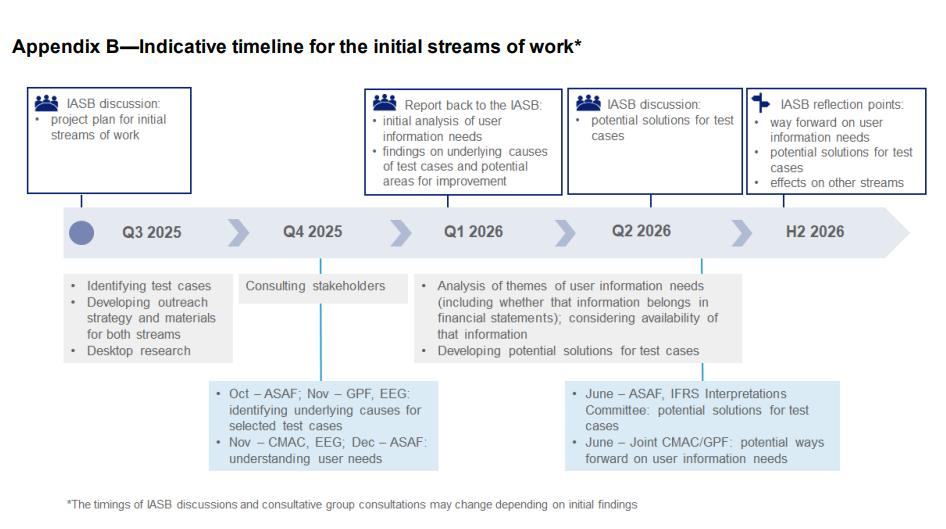
The timings of IASB discussions and consultative group consultations may change depending on initial findings
Annex 3: IASB principles and topics to explore in the case studies
Cloud-computing arrangements
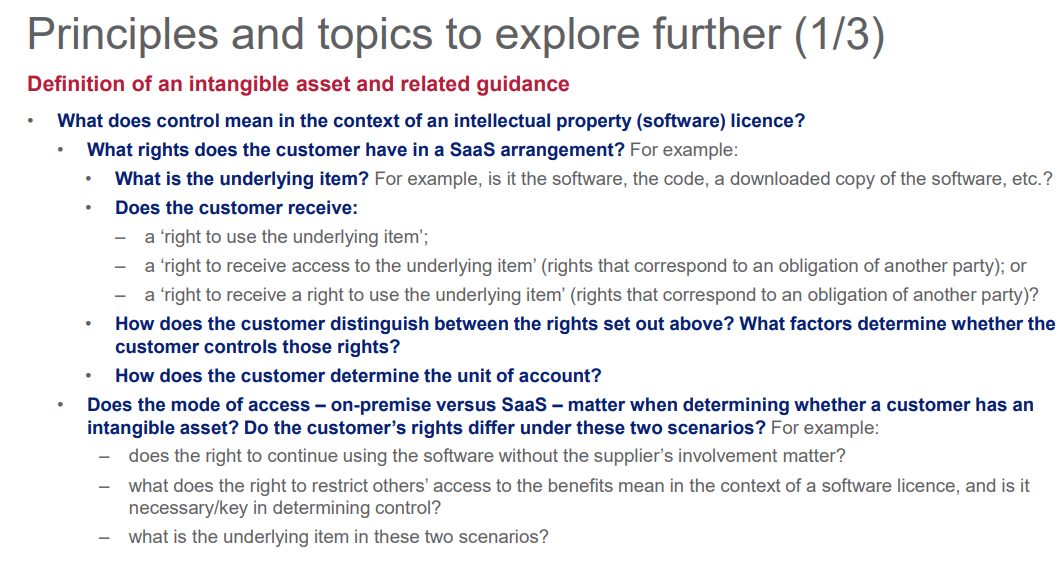
Principles and topics to explore further (1/3)
Definition of an intangible asset and related guidance
- What does control mean in the context of an intellectual property (software) licence?
- What rights does the customer have in a SaaS arrangement? For example:
- What is the underlying item? For example, is it the software, the code, a downloaded copy of the software, etc.?
- Does the customer receive:
- a 'right to use the underlying item';
- a 'right to receive access to the underlying item' (rights that correspond to an obligation of another party); or
- a 'right to receive a right to use the underlying item' (rights that correspond to an obligation of another party)?
- How does the customer distinguish between the rights set out above? What factors determine whether the customer controls those rights?
- How does the customer determine the unit of account?
- Does the mode of access – on-premise versus SaaS – matter when determining whether a customer has an intangible asset? Do the customer's rights differ under these two scenarios? For example:
- does the right to continue using the software without the supplier's involvement matter?
- what does the right to restrict others' access to the benefits mean in the context of a software licence, and is it necessary/key in determining control?
- what is the underlying item in these two scenarios?
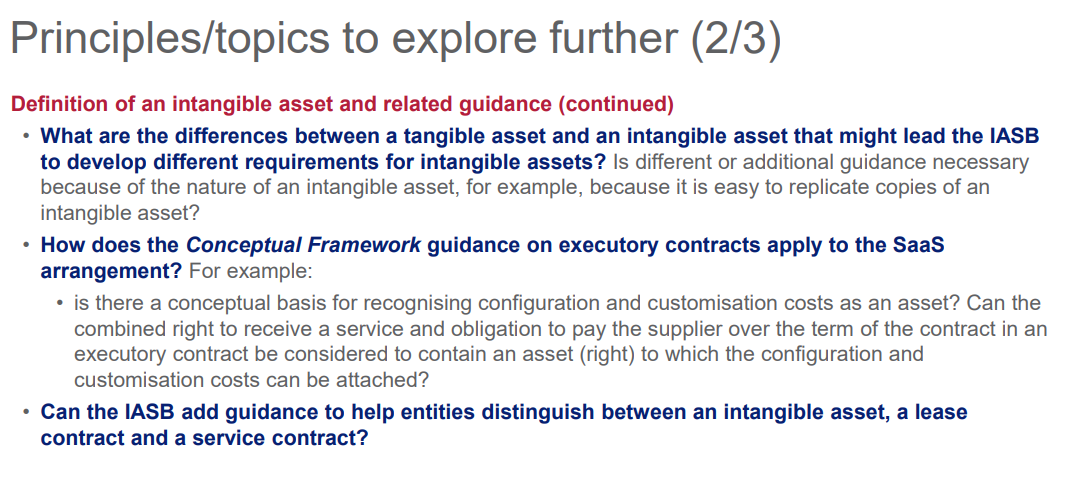
Principles/topics to explore further (2/3)
Definition of an intangible asset and related guidance (continued)
- What are the differences between a tangible asset and an intangible asset that might lead the IASB to develop different requirements for intangible assets? Is different or additional guidance necessary because of the nature of an intangible asset, for example, because it is easy to replicate copies of an intangible asset?
- How does the Conceptual Framework guidance on executory contracts apply to the SaaS arrangement? For example:
- is there a conceptual basis for recognising configuration and customisation costs as an asset? Can the combined right to receive a service and obligation to pay the supplier over the term of the contract in an executory contract be considered to contain an asset (right) to which the configuration and customisation costs can be attached?
- Can the IASB add guidance to help entities distinguish between an intangible asset, a lease contract and a service contract?
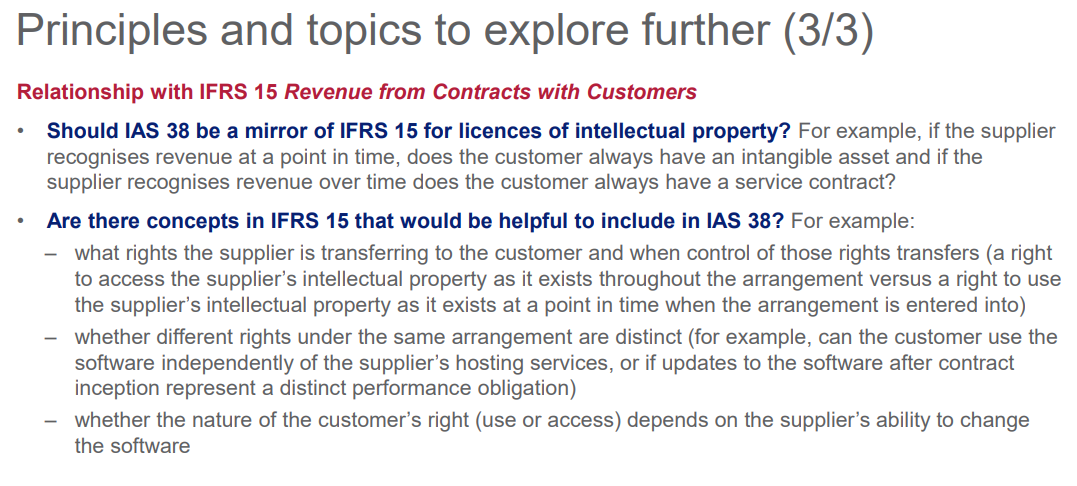
Principles/topics to explore further (3/3)
Footnotes
Agenda Paper 7: Appendix A
Annex 3: IASB principles and topics to explore in the case studies
Cloud-computing arrangements
Principles and topics to explore further (1/3)
Definition of an intangible asset and related guidance
- What does control mean in the context of an intellectual property (software) licence?
- What rights does the customer have in a SaaS arrangement? For example:
- What is the underlying item? For example, is it the software, the code, a downloaded copy of the software, etc.?
- Does the customer receive:
- a 'right to use the underlying item';
- a 'right to receive access to the underlying item' (rights that correspond to an obligation of another party); or
- a 'right to receive a right to use the underlying item' (rights that correspond to an obligation of another party)?
- How does the customer distinguish between the rights set out above? What factors determine whether the customer controls those rights?
- How does the customer determine the unit of account?
- Does the mode of access – on-premise versus SaaS – matter when determining whether a customer has an intangible asset? Do the customer's rights differ under these two scenarios? For example:
- does the right to continue using the software without the supplier's involvement matter?
- what does the right to restrict others' access to the benefits mean in the context of a software licence, and is it necessary/key in determining control?
- what is the underlying item in these two scenarios?
Principles/topics to explore further (2/3)
Definition of an intangible asset and related guidance (continued)
- What are the differences between a tangible asset and an intangible asset that might lead the IASB to develop different requirements for intangible assets? Is different or additional guidance necessary because of the nature of an intangible asset, for example, because it is easy to replicate copies of an intangible asset?
- How does the Conceptual Framework guidance on executory contracts apply to the SaaS arrangement? For example:
- is there a conceptual basis for recognising configuration and customisation costs as an asset? Can the combined right to receive a service and obligation to pay the supplier over the term of the contract in an executory contract be considered to contain an asset (right) to which the configuration and customisation costs can be attached?
- Can the IASB add guidance to help entities distinguish between an intangible asset, a lease contract and a service contract?
Principles and topics to explore further (3/3)
Relationship with IFRS 15 Revenue from Contracts with Customers
- Should IAS 38 be a mirror of IFRS 15 for licences of intellectual property? For example, if the supplier recognises revenue at a point in time, does the customer always have an intangible asset and if the supplier recognises revenue over time does the customer always have a service contract?
- Are there concepts in IFRS 15 that would be helpful to include in IAS 38? For example:
- what rights the supplier is transferring to the customer and when control of those rights transfers (a right to access the supplier's intellectual property as it exists throughout the arrangement versus a right to use the supplier's intellectual property as it exists at a point in time when the arrangement is entered into)
- whether different rights under the same arrangement are distinct (for example, can the customer use the software independently of the supplier's hosting services, or if updates to the software after contract inception represent a distinct performance obligation)
- whether the nature of the customer's right (use or access) depends on the supplier's ability to change the software
Agile software development
Principles and topics to explore further (1/2)
Definition and related guidance
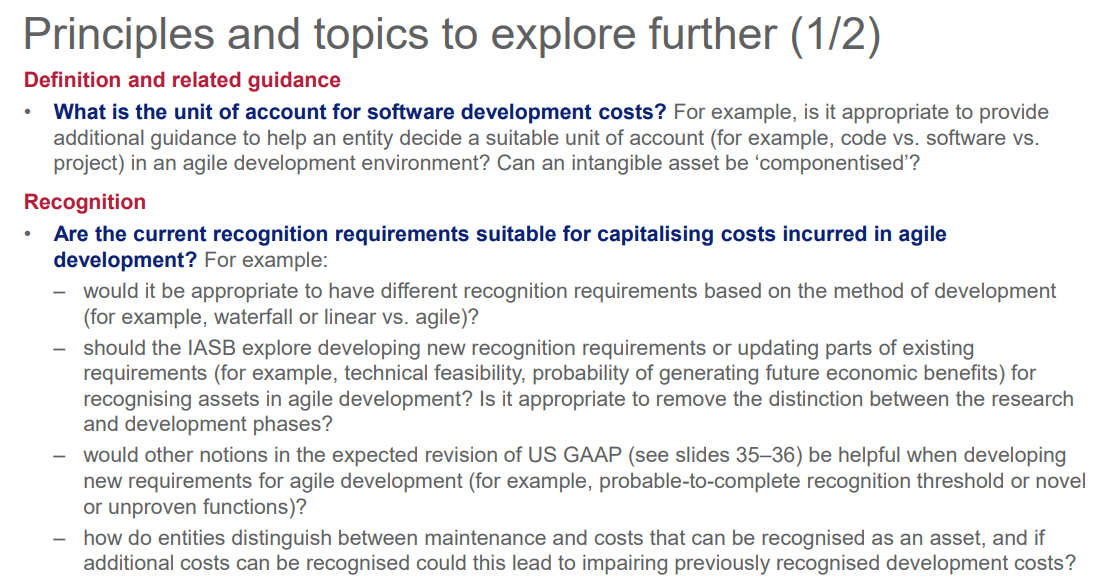
- What is the unit of account for software development costs? For example, is it appropriate to provide additional guidance to help an entity decide a suitable unit of account (for example, code vs. software vs. project) in an agile development environment? Can an intangible asset be 'componentised'?
Recognition
- Are the current recognition requirements suitable for capitalising costs incurred in agile development? For example:
- would it be appropriate to have different recognition requirements based on the method of development (for example, waterfall or linear vs. agile)?
- should the IASB explore developing new recognition requirements or updating parts of existing requirements (for example, technical feasibility, probability of generating future economic benefits) for recognising assets in agile development? Is it appropriate to remove the distinction between the research and development phases?
- would other notions in the expected revision of US GAAP (see slides 35-36) be helpful when developing new requirements for agile development (for example, probable-to-complete recognition threshold or novel or unproven functions)?
- how do entities distinguish between maintenance and costs that can be recognised as an asset, and if additional costs can be recognised could this lead to impairing previously recognised development costs?
Principles and topics to explore further (2/2)
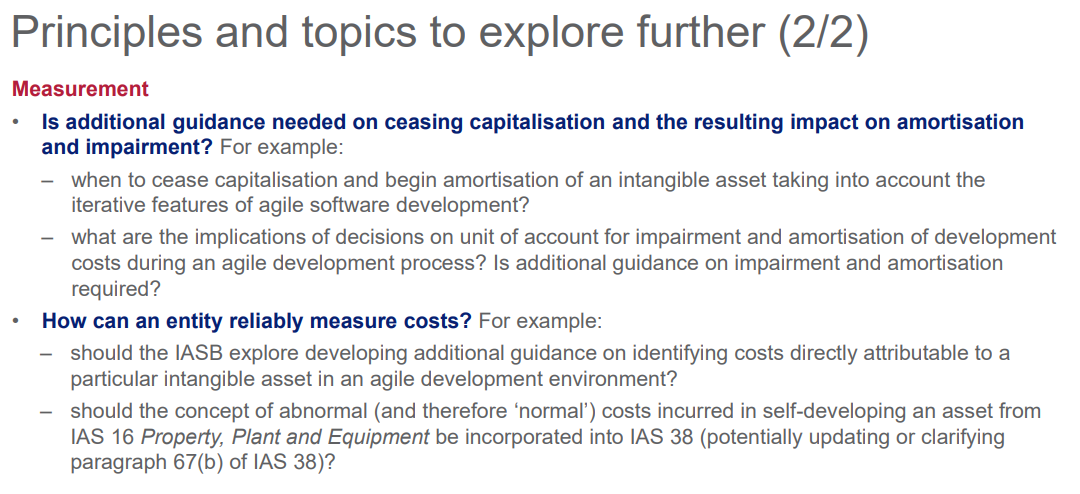
Measurement
- Is additional guidance needed on ceasing capitalisation and the resulting impact on amortisation and impairment? For example:
- when to cease capitalisation and begin amortisation of an intangible asset taking into account the iterative features of agile software development?
- what are the implications of decisions on unit of account for impairment and amortisation of development costs during an agile development process? Is additional guidance on impairment and amortisation required?
- How can an entity reliably measure costs? For example:
- should the IASB explore developing additional guidance on identifying costs directly attributable to a particular intangible asset in an agile development environment?
- should the concept of abnormal (and therefore 'normal') costs incurred in self-developing an asset from IAS 16 Property, Plant and Equipment be incorporated into IAS 38 (potentially updating or clarifying paragraph 67(b) of IAS 38)?
25 September 2025 Agenda Paper 7: Appendix B
Appendix B: Statement of Cash Flows and Related Matters
Project Stage
| IASB | Research / Pipeline | Discussion paper | Redeliberation | Exposure Draft | Redeliberation | Final standard | Post Implementation Review |
|---|---|---|---|---|---|---|---|
| UKEB | Research / Influencing | Research / Influencing | Monitoring | Influencing | Monitoring | Endorsement | Influencing |
| UKEB project page |
Purpose of this paper
B1. This paper:
- Provides the Board with an update1 on the status of the Statement of Cash Flows and Related Matters project, following the IASB meeting in July 2025. At that meeting, IASB members discussed improving the transparency of information about cash flow measures not specified in IFRS Accounting Standards.
- Asks for Board views on the proposed response to the questions asked by the IASB in the Accounting Standards Advisory Forum (ASAF) meeting to be held on 2 October 2025. The questions address potential ways to improve the consistent application of the classification requirements in IAS 7 Statement of Cash Flows.
On 2 October 2025, the IASB will ask2 ASAF members' views on the IASB staff's initial assessment: * of four possible underlying factors that might contribute to inconsistent application of the classification requirements in IAS 7; and * that the classification for seven examples, previously identified by ASAF members as being inconsistently classified, can generally be determined applying IAS 7.
B2. At a future meeting, the IASB will update ASAF members on its progress in analysing the classification issues, including presenting the findings from a request to ASAF members for written feedback on other specific items3 – see Annex 2 of this paper.
Background
B3. The IASB added a project on the Statement of Cash Flows and Related Matters to its research pipeline following feedback on its Request for Information: Third Agenda Consultation4.
B4. The IASB began work on this project in September 2024. The initial focus was research to gather evidence of the nature and extent of the perceived deficiencies and the likely benefits of developing new financial reporting requirements for IAS 7 Statement of Cash Flows.
B5. The IASB has now commenced its discussion of the project scope and direction.
B6. At its May 2025 meeting, the IASB discussed: the topics to include or exclude from the project plan; the project approach for topics related to financial institutions; and, a draft timeline for work on the project.
B7. The IASB decided that it would assess potential ways to improve:
- the transparency of information communicated about cash flow measures not specified in IFRS Accounting Standards (discussed at the joint CMAC-GPF meeting in June 2025 and the July 2025 IASB meeting);
- the consistent application of requirements for classification of cash flows i.e. operating, investing or financing (on the October 2025 ASAF agenda);
- the disaggregation of cash flow information in the financial statements (to be discussed at the September 2025 IASB meeting);
- the reporting of information about non-cash transactions in the financial statements (to be discussed at future IASB meetings); and
- the consistent application of the definition of 'cash equivalents' (to be discussed at future IASB meetings).
B8. Based on feedback from the Third Agenda Consultation, the usefulness of the statement of cash flows for financial institutions was perceived to be a significant issue. However, based on subsequent feedback, the IASB decided to defer this element of the project until other matters are addressed.
IASB July 2025 discussion
Improving the transparency of information about cash flow measures not specified in IFRS Accounting Standards
B9. The July 2025 IASB meeting focused on cash flows measures not specified in IFRS Accounting Standards and how the requirements for management-defined performance measures (MPMs) in IFRS 18 Presentation and Disclosure in Financial Statements could be extended to also apply to cash flow measures5.
B10. The IASB made the following tentative decisions:
- to expand the existing requirements for MPMs under IFRS 18 to include cash flow measures that are not already covered;
- to apply the IFRS 18 definition of MPMs to cash flow measures without change;
- to extend the IFRS 18 rebuttable presumption for qualifying MPMs6, so it also applies to cash flow measures;
- to broaden the overall disclosure objective and the specific disclosure requirements in IFRS 18 so they include cash flow measures; and
- not to extend a specific IFRS 18 requirement to cash flow measures with respect to income tax and non-controlling interests – entities will not be required to disclose the income tax effect and the impact of non-controlling interests on each item in the reconciliation for cash flow MPMs.
B11. UKEB research suggests that MPMs should be extended to cash flow measures not specified in IFRS Accounting Standards, including the most widely used measure of free cash flow:
- Paragraph A132 of the first UKEB research paper noted that one respondent to the September 2024 UKEB preparer survey on IFRS 18 highlighted the lack of a definition of free cash flow as one of the biggest challenges with IFRS. Free cash flow is an often-used management and investor metric. Guidance would be useful, given that the analyst community generally reconcile from an alternative performance measure (APM). If free cash flow is captured as a MPM, a more useful reconciliation would be included in the notes to the financial statements.
- Paragraphs C135–C139 of the third UKEB research paper and paragraphs 34c) and 98–106 of the UKEB fourth research paper, noted UK stakeholder support for expanding MPMs to cash flow measures and suggestions that the IASB could consider what sub-totals would be useful to be disclosed in the statement of cash flows to facilitate the reconciliation of cash flow MPMs.
ASAF meeting October 2025
Classification requirements in IAS 7
B12. Feedback received by the IASB during outreach with stakeholders, indicated that for some cash inflows or outflows:
- There is inconsistent application of the classification requirements in IAS 7, leading to diversity in practice (e.g. deferred and contingent consideration in a business combination and government grants) – this is the subject of:
- the ASAF meeting on 2 October 2025 (see Annex 1 of this paper); and
- a separate request for a written response from ASAF members by 3 November 2025 (see Annex 2 of this paper).
- The classification requirements in IAS 7 are applied consistently, but stakeholders (mainly preparers and users) disagree with the classification (e.g. lease payments, income tax payments) – the IASB staff will conduct further analysis on whether the classification of some items in IAS 7 could be changed. These will be discussed at a later IASB meeting.
Inconsistent application of classification requirements in IAS 7
B13. The IASB concluded that their stakeholders mostly focused on specific cash inflows or outflows rather than on the classification requirements themselves. Their feedback varied in specificity—ranging from narrowly defined items (e.g., government grants related to assets) to broader concepts (e.g., variable consideration).
B14. IASB staff concluded they have sufficient understanding of the underlying fact patterns to assess when the following factors they have identified might contribute to inconsistent application of classification for some items7:
- cash flows do not meet the definitions of ‘investing' or 'financing' activities (resulting in a default classification as 'operating');
- classification of cash flows is linked to cash flow classification of related items;
- initial transaction is a non-cash transaction; and
- classification of cash flows depends on the principal revenue-producing activities.
B15. However, they also noted that the feedback was often unclear:
- about the underlying fact pattern;
- what was causing the issue; and
- its pervasiveness.
This makes it difficult to assess whether the classification of the items identified during outreach can generally be determined applying the requirements in IAS 7.
B16. The items8 where feedback was unclear are set out in Annex 2 of this paper. The IASB has requested written feedback on the underlying fact patterns from ASAF members, so that they are able to analyse whether the issues relate to:
- inconsistent application of the classification requirements in IAS 7; or
- application issues related to other IFRS Accounting Standards (e.g. identification of whether a sale and lease back arrangement qualifies as a sale applying IFRS 15 Revenue from Contracts with Customers).
B17. The IASB will use the feedback to assess whether any of the issues raised during outreach require action. Specifically, they will determine whether:
- no action is needed, meaning preparers should be able to classify cash flows consistently by applying IAS 7; or
- further action might be needed, such as:
- limited standard setting (e.g., minor wording amendments);
- referring the issue to the IFRS Interpretations Committee; or
- providing illustrative examples to support consistent application.
UKEB research
B18. UKEB research identified that most users considered classification of cash flows a lower priority than other concerns with the statement of cash flows, such as disaggregation and non-cash information.
B19. However, UK stakeholders suggested the IASB introduce new requirements for companies to disclose cash flows relating to tax as a separate classification, rather than classifying as 'operating' by default. Alternatively, tax could be allocated to operating, investing and financing activities, although this could be seen as arbitrary and provide little useful information.
B20. UK stakeholders also identified other areas where IFRS Accounting Standards are silent on how certain items should be classified, such as multiple component transactions9.
B21. UK stakeholders suggested new disclosures, such as the disaggregation of exceptional items and derivatives, including details of the extent of such cash flows included in each category i.e. operating, investing and financing.
B22. The UKEB Secretariat plans to consult with UKEB Advisory Groups10 on those classification items set out in Annex 2.
ASAF Questions
B23. At the ASAF meeting, members will be asked to comments on initial assessments of seven examples. IASB staff think they have sufficient understanding of the underlying fact patterns:
- to assess the factors contributing to inconsistent application of IAS 7; and
- to conclude that the classification for that example can generally be determined applying IAS 7.
B24. If ASAF members disagree with the IASB staff assessment, they are asked for specific fact patterns and supporting evidence in their respective jurisdiction, and whether there are any other factors that might contribute to inconsistent application of the classification requirement in IAS 7.
B25. Annex 1 to this paper presents these examples, together with the IASB staff views and UKEB Secretariat initial assessments.
Questions for the Board
- Do Board Members have any comments on:
- the proposed response to the questions to be asked by the IASB in the ASAF meeting, set out in the table in Annex 1 to this paper?
- the other UKEB Secretariat comments in Annex 1?
UKEB consultation
B26. UKEB research indicates that the areas of concern identified in Annex 1 are also seen in the UK, and the contributing factors identify are consistent with UKEB research. However, the Secretariat suggests that in order to provide a comprehensive response to the specific questions, more extensive consultation should be undertaken with UK stakeholders (i.e. UKEB Advisory Groups), in particular, with regard to specific fact patterns and supporting evidence requested by the IASB.
B27. Given the limited amount of time before the ASAF meeting on 2 October 2025, the Secretariat proposes to consult with UKEB Advisory Groups during October 2025 on the classification items due to be discussed at ASAF.
B28. If the Board agrees, the Secretariat plans to include feedback on those items, along with feedback on classification of items in Annex 2, in a paper to be presented to the Board at the 30 October 2025 UKEB meeting, prior to providing a written response to the IASB by 3 November 2025.
B29. The Secretariat has proposed a response to the questions asked by the IASB in the ASAF meeting to be held on 2 October 2025 in Annex 1.
Questions for the Board
- Do Board Members agree that UKEB Advisory Groups (investors and preparers) are consulted to obtain feedback in order to provide a written response to the IASB staff in relation to:
- the seven examples provided in Annex 1 to this paper and the initial IASB staff assessment thereon?
- other classification issues for which the IASB staff have requested a written response in Annex 2 to this paper?
Next steps
B30. The Secretariat will use the Board's feedback at this meeting as the basis for initial feedback at the ASAF meeting.
B31. Subject to Board approval, the Secretariat will consult with UKEB Advisory Groups on items included in Annex 1 and Annex 2 to this paper. This will be included in a paper for Board discussion at the 30 October 2025 UKEB meeting, and subsequent written response to the IASB.
B32. The IASB will continue to assess potential ways to improve financial reporting in relation to each of the topics included in the project plan11, as set out in paragraph B7 above.
B33. The UKEB Secretariat will continue to monitor the IASB's redeliberation and tentative decisions and will provide the Board with updates in due course.
Annex 1: Classification of cash flows – ASAF questions
B34. ASAF members will be asked to provide feedback at the 2 October 2025 meeting on some items ASAF members previously identified as having inconsistent application of the classification requirements in IAS 712 (see table below, as per slide 12 of October 2025 ASAF Agenda Paper 3).
B35. The IASB's initial analysis identified four underlying scenarios that might contribute to inconsistent application of the requirements in IAS 7:
- cash flows do not meet the definitions of investing or financing activities (resulting in a default classification as operating);
- classification of cash flows is linked to cash flow classification of related items;
- initial transaction is a non-cash transaction; and
- classification of cash flows depends on the principal revenue-producing activities.
B36. The IASB provides seven examples to illustrate those four scenarios. The table below sets out those examples, together with the IASB staff views and UKEB initial assessment. The latter is based on UKEB research since November 2024.
| Example | IASB staff assessment - Initial view | [Q1] UKEB Secretariat – initial view of IASB staff assessment | [Q1] UKEB Secretariat – initial view of other factors that might contribute to inconsistent classification |
|---|---|---|---|
| Underlying factor/Scenario 1: Cash flows do not meet the definitions of 'investing' or 'financing' activities (resulting in a default classification as 'operating') | |||
| Example 1: Payments related to business combinations that do not form part of the consideration that leads to the recognition of the acquiree's net assets | The classification of these payments can generally be determined applying IAS 7 | Agree that cash flows do not meet the definitions of 'investing' or 'financing'13, and that activities that are not 'investing' or 'financing' should be classified as 'operating'. However, due to the lack of guidance on such payments, companies make judgements, which lead to diversity in application. UKEB research suggests that judgement is used to determine the classification of these payments, which can lead to diversity in categorisation of cash flows:
|
IFRS 3 Business Combinations makes no reference to the statement of cash flows. |
| Example 2: Payments to unfunded defined benefit pension schemes | The classification of these payments can generally be determined applying IAS 7 | whether classification is operating or investing.
During UKEB outreach, feedback received was not specific to unfunded defined benefit scheme, but rather pension costs more generally. |
IAS 26 Accounting and Reporting by Retirement Benefit Plans makes no reference to the statement of cash flows |
| Example 3: Variable consideration | The classification of these payments can generally be determined applying IAS 7 | Agree that cash flows may not meet the definitions of investing, or financing, so may lead to diversity in application. However, feedback from UKEB research, suggests that guidance could be helpful – per paragraph A48 of the first UKEB research paper, there are a range of transactions where no specific guidance exists, leading to diversity in practice, including payment of variable consideration in a business combination |
IFRS 3 Business Combinations makes no reference to the statement of cash flows, despite references to contingent consideration (not variable consideration). IFRS 15 Revenue from Contracts with Customers makes no reference to the statement of cash flows, despite the objective of the disclosure requirements is for an entity to disclose sufficient information to enable users of financial statements to understand the nature, amount, timing and uncertainty of |
| Underlying factor/Scenario 2: Classification of cash flows is linked to cash flow classification of related items | |||
| Example 4: Payments related to derivatives and hedges | The classification of these payments can generally be determined applying IAS 7 (i.e., their classification should follow the classification of the cash flows of the underlying asset, liability or expense) | Agree that classification of cash flows related to derivatives and hedges is linked to cash flow classification of related items. Per paragraph 170–172 of the fourth research paper, IAS 7 paragraph 16 states that "when a contract is accounted for as a hedge of an identifiable position, the cash flows of the contract are classified in the same manner as the cash flows of the position being hedged". However, IAS 7 does not specify whether such cash flows should be separately identifiable. In addition, the Standard does not provide guidance on economic hedges or derivatives where hedge accounting is not applied. |
IAS 7 does not specify whether such cash flows should be separately identifiable. UKEB research highlighted that UK listed companies typically provide limited information on the cash effects of derivatives in the statement of cash flows.
|
| Example 5: Receipt of government grants | The classification of these payments can generally be determined applying IAS 7 (i.e., their classification should follow the classification of the cash flows of the underlying asset, liability or expense) | Agree that classification of cash flows is linked to classification of related items. However:
|
Receipts of government grants can be non-cash. There is lack of guidance on how such transactions should be disclosed.
|
| Example | IASB staff assessment - Initial view | [Q1] UKEB Secretariat – initial view of IASB staff assessment |-------------------------------------------------------------------------------------------------------------------------------------------------------------------------------------------------------------------------------------------------------------------------------------------------------------------------------------------------------------------------------------------------------------------------------------------------------------------------------------------------------------------------------------------------------------------------------------------------------------------------------------------------------------------------------------------------------------------------------------------------------------------------------------------------------------------------------------------------------------------------------------------------------------------------------------------------------------------------------------------------------------------------------------------------------------------------------------------------------------------------------------------------------------------------------------------------------------------------------------------------------------------------------------------------------------------------------------------------------------------------------------------------------------------------------------------------------------------------------------------------------------------------------------------------------------------------------------------------------------------------------------------------------------------------------------------------------------------------------------------------------------------------------------------------------------------------------------------------------------------------------------------------------------------------------------------------------------------------------------------------------------------------------------------------------------------------------------------------------------------------------------------------------------------------------------------------------------------------------------------------------------------------------------------------------------------------------------------------------------------------------------------------------------------------------------------------------------------------------------------------------------------------------------------------------------------------------------------------------------------------------------------------------------------------------------------------------------------------------------------------------------------------------------------------------------------------------------------------------------------------------------------------------------------------------------------------------------------------------------------------------------------------------------------------------------------------------------------------------------------------------------------------------------------------------------------------------------------------------------------------------------------------------------------------------------------------------------------------------------------------------------------------------------------------------------------------------------------------------------------------------------------------------------------------------------------------------------------------------------------------------------------------------------------------------------------------------------------------------------------------------------------------------------------------------------------------------------------------------------------------------------------------------------------------------------------------------------------------------------------------------------------------------------------------------------------------------------------------------------------------------------------------------------------------------------------------------------------------------------------------------------------------------------------------------------------------------------------------------------------------------------------------------------------------------------------------------------------------------------------------------------------------------------------------------------------------------------------------------------------------------------------------------------------------------------------------------------------------------------------------------------------------------------------------------------------------------------------------------------------------------------------------------------------------------------------------------------------------------------------------------------------------------------------------------------------------------------------------------------------------------------------------------------------------------------------------------------------------------------------------------------------------------------------------------------------------------------------------------------------------------------------------------------------------------------------------------------------------------------------------------------------------------------------------------------------------------------------------------------------------------------------------------------------------------------------------------------------------------------------------------------------------------------------------------------------------------------------------------------------------------------------------------------------------------------------------------------------------------------------------------------------------------------------------------------------------------------------------------------------------------------------------------------------------------------------------------------------------------------------------------------------------------------------------------------------------------------------------------------------------------------------------------------------------------------------------------------------------------------------------------------------------------------------------------------------------------------------------------------------------------------------------------------------------------------------------------------------------------------------------------------------------------------------------------------------------------------------------------------------------------------------------------------------------------------------------------------------------------------------------------------------------------------------------------------------------------------------------------------------------------------------------------------------------------------------------------------------------------------------------------------------------------------------------------------------------------------------------------------------------------------------------------------------------------------------------------------------------------------------------------------------------------------------------------------------------------------------------------------------------------------------------------------------------------------------------------------------------------------------------------------------------------------------------------------------------------------------------------------------------------------------------------------------------------------------------------------------------------------------------------------------------------------------------------------------------------------------------------------------------------------------------------------------------------------------------------------------------------------------------------------------------------------------------------------------------------------------------------------------------------------------------------------------------------------------------------------------------------------------------------------------------------------------------------------------------------------------------------------------------------------------------------------------------------------------------------------------------------------------------------------------------------------------------------------------------------------------------------------------------------------------------------------------------------------------------------------------------------------------------------------------------------------------------------------------------------------------------------------------------------------------------------------------------------------------------------------------------------------------------------------------------------------------------------------------------------------------------------------------------------------------------------------------------------------------------------------------------------------------------------------------------------------------------------------------------------------------------------------------------------------------------------------------------------------------------------------------------------------------------------------------------------------------------------------------------------------------------------------------------------------------------------------------------------------------------------------------------------------------------------------------------------------------------------------------------------------------------------------------------------------------------------------------------------------------------------------------------------------------------------------------------------------------------------------------------------------------------------------------------------------------------------------------------------------------------------------------------------------------------------------------------------------------------------------------------------------------------------------------------------------------------------------------------------------------------------------------------------------------------------------------------------------------------------------------------------------------------------------------------------------------------------------------------------------------------------------------------------------------------------------------------------------------------------------------------------------------------------------------------------------------------------------------------------------------------------------------------------------------------------------------------------------------------------------------------------------------------------------------------------------------------------------------------------------------------------------------------------------------------------------------------------------------------------------------------------------------------------------------------------------------------------------------------------------------------------------------------------------------------------------------------------------------------------------------------------------------------------------------------------------------------------------------------------------------------------------------------------------------------------------------------------------------------------------------------------------------------------------------------------------------------------------------------------------------------------------------------------------------------------------------------------------------------------------------------------------------------------------------------------------------------------------------------------------------------------------------------------------------------------------------------------------------------------------------------------------------------------------------------------------------------------------------------------------------------------------------------------------------------------------------------------------------------------------------------------------------------------------------------------------------------------------------------------------------------------------------------------------------------------------------------------------------------------------------------------------------------------------------------------------------------------------------------------------------------------------------------------------------------------------------------------------------------------------------------------------------------------------------------------------------------------------------------------------------------------------------------------------------------------------------------------------------------------------------------------------------------------------------------------------------------------------------------------------------------------------------------------------------------------------------------------------------------------------------------------------------------------------------------------------------------------------------------------------------------------------------------------------------------------------------------------------------------------------------------------------------------------------------------------------------------------------------------------------------------------------------------------------------------------------------------------------------------------------------------------------------------------------------------------------------------------------------------------------------------------------------------------------------------------------------------------------------------------------------------------------------------------------------------------------------------------------------------------------------------------------------------------------------------------------------------------------------------------------------------------------------------------------------------------------------------------------------------------------------------------------------------------------------------------------------------------------------------------------------------------------------------------------------------------------------------------------------------------------------------------------------------------------------------------------------------------------------------------------------------------------------------------------------------------------------------------------------------------------------------------------------------------------------------------------------------------------------------------------------------------------------------------------------------------------------------------------------------------------------------------------------------------------------------------------------------------------------------------------------------------------------------------------------------------------------------------------------------------------------------------------------------------------------------------------------------------------------------------------------------------------------------------------------------------------------------------------------------------------------------------------------------------------------------------------------------------------------------------------------------------------------------------------------------------------------------------------------------------------------------------------------------------------------------------------------------------------------------------------------------------------------------------------------------------------------------------------------------------------------------------------------------------------------------------------------------------------------------------------------------------------------------------------------------------------------------------------------------------------------------------------------------------------------------------------------------------------------------------------------------------------------------------------------------------------------------------------------------------------------------------------------------------------------------------------------------------------------------------------------------------------------------------------------------------------------------------------------------------------------------------------------------------------------------------------------------------------------------------------------------------------------------------------------------------------------------------------------------------------------------------------------------------------------------------------------------------------------------------------------------------------------------------------------------------------------------------------------------------------------------------------------------------------------------------------------------------------------------------------------------------------------------------------------------------------------------------------------------------------------------------------------------------------------------------------------------------------------------------------------------------------------------------------------------------------------------------------------------------------------------------------------------------------------------------------------------------------------------------------------------------------------------------------------------------------------------------------------------------------------------------------------------------------------------------------------------------------------------------------------------------------------------------------------------------------------------------------------------------------------------------------------------------------------------------------------------------------------------------------------------------------------------------------------------------------------------------------------------------------------------------------------------------------------------------------------------------------------------------------------------------------------------------------------------------------------------------------------------------------------------------------------------------------------------------------------------------------------------------------------------------------------------------------------------------------------------------------------------------------------------------------------------------------------------------------------------------------------------------------------------------------------------------------------------------------------------------------------------------------------------------------------------------------------------------------------------------------------------------------------------------------------------------------------------------------------------------------------------------------------------------------------------------------------------------------------------------------------------------------------------------------------------------------------------------------------------------------------------------------------------------------------------------------------------------------------------------------------------------------------------------------------------------------------------------------------------------------------------------------------------------------------------------------------------------------------------------------------------------------------------------------------------------------------------------------------------------------------------------------------------------------------------------------------------------------------------------------------------------------------------------------------------------------------------------------------------------------------------------------------------------------------------------------------------------------------------------------------------------------------------------------------------------------------------------------------------------------------------------------------------------------------------------------------------------------------------------------------------------------------------------------------------------------------------------------------------------------------------------------------------------------------------------------------------------------------------------------------------------------------------------------------------------------------------------------------------------------------------------------------------------------------------------------------------------------------------------------------------------------------------------------------------------------------------------------------------------------------------------------------------------------------------------------------------------------------------------------------------------------------------------------------------------------------------------------------------------------------------------------------------------------------------------------------------------------------------------------------------------------------------------------------------------------------------------------------------------------------------------------------------------------------------------------------------------------------------------------------------------------------------------------------------------------------------------------------------------------------------------------------------------------------------------------------------------------------------------------------------------------------------------------------------------------------------------------------------------------------------------------------------------------------------------------------------------------------------------------------------------------------------------------------------------------------------------------------------------------------------------------------------------------------------------------------------------------------------------------------------------------------------------------------------------------------------------------------------------------------------------------------------------------------------------------------------------------------------------------------------------------------------------------------------------------------------------------------------------------------------------------------------------------------------------------------------------------------------------------------------------------------------------------------------------------------------------------------------------------------------------------------------------------------------------------------------------------------------------------------------------------------------------------------------------------------------------------------------------------------------------------------------------------------------------------------------------------------------------------------------------------------------------------------------------------------------------------------------------------------------------------------------------------------------------------------------------------------------------------------------------------------------------------------------------------------------------------------------------------------------------------------------------------------------------------------------------------------------------------------------------------------------------------------------------------------------------------------------------------------------------------------------------------------------------------------------------------------------------------------------------------------------------------------------------------------------------------------------------------------------------------------------------------------------------------------------------------------------------------------------------------------------------------------------------------------------------------------------------------------------------------------------------------------------------------------------------------------------------------------------------------------------------------------------------------------------------------------------------------------------------------------------------------------------------------------------------------------------------------------------------------------------------------------------------------------------------------------------------------------------------------------------------------------------------------------------------------------------------------------------------------------------------------------------------------------------------------------------------------------------------------------------------------------------------------------------------------------------------------------------------------------------------------------------------------------------------------------------------------------------------------------------------------------------------------------------------------------------------------------------------------------------------------------------------------------------------------------------------------------------------------------------------------------------------------------------------------------------------------------------------------------------------------------------------------------------------------------------------------------------------------------------------------------------------------------------------------------------------------------------------------------------------------------------------------------------------------------------------------------------------------------------------------------------------------------------------------------------------------------------------------------------------------------------------------------------------------------------------------------------------------------------------------------------------------------------------------------------------------------------------------------------------------------------------------------------------------------------------------------------------------------------------------------------------------------------------------------------------------------------------------------------------------------------------------------------------------------------------------------------------------------------------------------------------------------------------------------------------------------------------------------------------------------------------------------------------------------------------------------------------------------------------------------------------------------------------------------------------------------------------------------------------------------------------------------------------------------------------------------------------------------------------------------------------------------------------------------------------------------------------------------------------------------------------------------------------------------------------------------------------------------------------------------------------------------------------------------------------------------------------------------------------------------------------------------------------------------------------------------------------------------------------------------------------------------------------------------------------------------------------------------------------------------------------------------------------------------------------------------------------------------------------------------------------------------------------------------------------------------------------------------------------------------------------------------------------------------------------------------------------------------------------------------------------------------------------------------------------------------------------------------------------------------------------------------------------------------------------------------------------------------------------------------------------------------------------------------------------------------------------------------------------------------------------------------------------------------------------------------------------------------------------------------------------------------------------------------------------------------------------------------------------------------------------------------------------------------------------------------------------- ---------------------------------------------------------------------------------------------------------------------------------------------------------------------------------------------------------------------------------------------------------------------------------------------------------------------------------------------------------------------------------------------------------------------------------------------------------------------------------------------------------------------------------------------------------------------------------------------------------------------------------------------------------------------------------------------------------------------------------------------------------------------------------------------------------------------------------------------------------------------------------------------------------------------------------------------------------------------------------------------------------------------------------------------------------------------------------------------------------------------------------------------------------------------------------------------------------------------------------------------------------------------------------------------------------------------------------------------------------------------------------------------------------------------------------------------------------------------------------------------------------------------------------------------------------------------------------------------------------------------------------------------------------------------------------------------------------------------------------------------------------------------------------------------------------------------------------------------------------------------------------------------------------------------------------------------------------------------------------------------------------------------------------------------------------------------------------------------------------------------------------------------------------------------------------------------------------------------------------------------------------------------------------------------------------------------------------------------------------------------------------------------------------------------------------------------------------------------------------------------------------------------------------------------------------------------------------------------------------------------------------------------------------------------------------------------------------------------------------------------------------------------------------------------------------------------------------------------------------------------------------------------------------------------------------------------------------------------------------------------------------------------------------------------------------------------------------------------------------------------------------------------------------------------------------------------------------------------------------------------------------------------------------------------------------------------------------------------------------------------------------------------------------------------------------------------------------------------------------------------------------------------------------------------------------------------------------------------------------------------------------------------------------------------------------------------------------------------------------------------------------------------------------------------------------------------------------------------------------------------------------------------------------------------------------------------------------------------------------------------------------------------------------------------------------------------------------------------------------------------------------------------------------------------------------------------------------------------------------------------------------------------------------------------------------------------------------------------------------------------------------------------------------------------------------------------------------------------------------------------------------------------------------------------------------------------------------------------------------------------------------------------------------------------------------------------------------------------------------------------------------------------------------------------------------------------------------------------------------------------------------------------------------------------------------------------------------------------------------------------------------------------------------------------------------------------------------------------------------------------------------------------------------------------------------------------------------------------------------------------------------------------------------------------------------------------------------------------------------------------------------------------------------------------------------------------------------------------------------------------------------------------------------------------------------------------------------------------------------------------------------------------------------------------------------------------------------------------------------------------------------------------------------------------------------------------------------------------------------------------------------------------------------------------------------------------------------------------------------------------------------------------------------------------------------------------------------------------------------------------------------------------------------------------------------------------------------------------------------------------------------------------------------------------------------------------------------------------------------------------------------------------------------------------------------------------------------------------------------------------------------------------------------------------------------------------------------------------------------------------------------------------------------------------------------------------------------------------------------------------------------------------------------------------------------------------------------------------------------------------------------------------------------------------------------------------------------------------------------------------------------------------------------------------------------------------------------------------------------------------------------------------------------------------------------------------------------------------------------------------------------------------------------------------------------------------------------------------------------------------------------------------------------------------------------------------------------------------------------------------------------------------------------------------------------------------------------------------------------------------------------------------------------------------------------------------------------------------------------------------------------------------------------------------------------------------------------------------------------------------------------------------------------------------------------------------------------------------------------------------------------------------------------------------------------------------------------------------------------------------------------------------------------------------------------------------------------------------------------------------------------------------------------------------------------------------------------------------------------------------------------------------------------------------------------------------------------------------------------------------------------------------------------------------------------------------------------------------------------------------------------------------------------------------------------------------------------------------------------------------------------------------------------------------------------------------------------------------------------------------------------------------------------------------------------------------------------------------------------------------------------------------------------------------------------------------------------------------------------------------------------------------------------------------------------------------------------------------------------------------------------------------------------------------------------------------------------------------------------------------------------------------------------------------------------------------------------------------------------------------------------------------------------------------------------------------------------------------------------------------------------------------------------------------------------------------------------------------------------------------------------------------------------------------------------------------------------------------------------------------------------------------------------------------------------------------------------------------------------------------------------------------------------------------------------------------------------------------------------------------------------------------------------------------------------------------------------------------------------------------------------------------------------------------------------------------------------------------------------------------------------------------------------------------------------------------------------------------------------------------------------------------------------------------------------------------------------------------------------------------------------------------------------------------------------------------------------------------------------------------------------------------------------------------------------------------------------------------------------------------------------------------------------------------------------------------------------------------------------------------------------------------------------------------------------------------------------------------------------------------------------------------------------------------------------------------------------------------------------------------------------------------------------------------------------------------------------------------------------------------------------------------------------------------------------------------------------------------------------------------------------------------------------------------------------------------------------------------------------------------------------------------------------------------------------------------------------------------------------------------------------------------------------------------------------------------------------------------------------------------------------------------------------------------------------------------------------------------------------------------------------------------------------------------------------------------------------------------------------------------------------------------------------------------------------------------------------------------------------------------------------------------------------------------------------------------------------------------------------------------------------------------------------------------------------------------------------------------------------------------------------------------------------------------------------------------------------------------------------------------------------------------------------------------------------------------------------------------------------------------------------------------------------------------------------------------------------------------------------------------------------------------------------------------------------------------------------------------------------------------------------------------------------------------------------------------------------------------------------------------------------------------------------------------------------------------------------------------------------------------------------------------------------------------------------------------------------------------------------------------------------------------------------------------------------------------------------------------------------------------------------------------------------------------------------------------------------------------------------------------------------------------------------------------------------------------------------------------------------------------------------------------------------------------------------------------------------------------------------------------------------------------------------------------------------------------------------------------------------------------------------------------------------------------------------------------------------------------------------------------------------------------------------------------------------------------------------------------------------------------------------------------------------------------------------------------------------------------------------------------------------------------------------------------------------------------------------------------------------------------------------------------------------------------------------------------------------------------------------------------------------------------------------------------------------------------------------------------------------------------------------------------------------------------------------------------------------------------------------------------------------------------------------------------------------------------------------------------------------------------------------------------------------------------------------------------------------------------------------------------------------------------------------------------------------------------------------------------------------------------------------------------------------------------------------------------------------------------------------------------------------------------------------------------------------------------------------------------------------------------------------------------------------------------------------------------------------------------------------------------------------------------------------------------------------------------------------------------------------------------------------------------------------------------------------------------------------------------------------------------------------------------------------------------------------------------------------------------------------------------------------------------------------------------------------------------------------------------------------------------------------------------------------------------------------------------------------------------------------------------------------------------------------------------------------------------------------------------------------------------------------------------------------------------------------------------------------------------------------------------------------------------------------------------------------------------------------------------------------------------------------------------------------------------------------------------------------------------------------------------------------------------------------------------------------------------------------------------------------------------------------------------------------------------------------------------------------------------------------------------------------------------------------------------------------------------------------------------------------------------------------------------------------------------------------------------------------------------------------------------------------------------------------------------------------------------------------------------------------------------------------------------------------------------------------------------------------------------------------------------------------------------------------------------------------------------------------------------------------------------------------------------------------------------------------------------------------------------------------------------------------------------------------------------------------------------------------------------------------------------------------------------------------------------------------------------------------------------------------------------------------------------------------------------------------------------------------------------------------------------------------------------------------------------------------------------------------------------------------------------------------------------------------------------------------------------------------------------------------------------------------------------------------------------------------------------------------------------------------------------------------------------------------------------------------------------------------------------------------------------------------------------------------------------------------------------------------------------------------------------------------------------------------------------------------------------------------------------------------------------------------------------------------------------------------------------------------------------------------------------------------------------------------------------------------------------------------------------------------------------------------------------------------------------------------------------------------------------------------------------------------------------------------------------------------------------------------------------------------------------------------------------------------------------------------------------------------------------------------------------------------------------------------------------------------------------------------------------------------------------------------------------------------------------------------------------------------------------------------------------------------------------------------------------------------------------------------------------------------------------------------------------------------------------------------------------------------------------------------------------------------------------------------------------------------------------------------------------------------------------------------------------------------------------------------------------------------------------------------------------------------------------------------------------------------------------------------------------------------------------------------------------------------------------------------------------------------------------------------------------------------------------------------------------------------------------------------------------------------------------------------------------------------------------------------------------------------------------------------------------------------------------------------------------------------------------------------------------------------------------------------------------------------------------------------------------------------------------------------------------------------------------------------------------------------------------------------------------------------------------------------------------------------------------------------------------------------------------------------------------------------------------------------------------------------------------------------------------------------------------------------------------------------------------------------------------------------------------------------------------------------------------------------------------------------------------------------------------------------------------------------------------------------------------------------------------------------------------------------------------------------------------------------------------------------------------------------------------------------------------------------------------------------------------------------------------------------------------------------------------------------------------------------------------------------------------------------------------------------------------------------------------------------------------------------------------------------------------------------------------------------------------------------------------------------------------------------------------------------------------------------------------------------------------------------------------------------------------------------------------------------------------------------------------------------------------------------------------------------------------------------------------------------------------------------------------------------------------------------------------------------------------------------------------------------------------------------------------------------------------------------------------------------------------------------------------------------------------------------------------------------------------------------------------------------------------------------------------------------------------------------------------------------------------------------------------------------------------------------------------------------------------------------------------------------------------------------------------------------------------------------------------------------------------------------------------------------------------------------------------------------------------------------------------------------------------------------------------------------------------------------------------------------------------------------------------------------------------------------------------------------------------------------------------------------------------------------------------------------------------------------------------------------------------------------------------------------------------------------------------------------------------------------------------------------------------------------------------------------------------------------------------------------------------------------------------------------------- -------------------------------------------------------------------------------------------------------------------------------------------------------------------------------------------------------------------------------------------------------------------------------------------------------------------------------------------------------------------------------------------------------------------------------------------------------------------------------------------------------------------------------------------------------------------------------------------------------------------------------------------------------------------------------------------------------------------------------------------------------------------------------------------------------------------------------------------------------------------------------------------------------------------------------------------------------------------------------------------------------------------------------------------------------------------------------------------------------------------------------------------------------------------------------------------------------------------------------------------------------------------------------------------------------------------------------------------------------------------------------------------------------------------------------------------------------------------------------------------------------------------------------------------------------------------------------------------------------------------------------------------------------------------------------------------------------------------------------------------------------------------------------------------------------------------------------------------------------------------------------------------------------------------------------------------------------------------------------------------------------------------------------------------------------------------------------------------------------------------------------------------------------------------------------------------------------------------------------------------------------------------------------------------------------------------------------------------------------------------------------------------------------------------------------------------------------------------------------------------------------------------------------------------------------------------------------------------------------------------------------------------------------------------------------------------------------------------------------------------------------------------------------------------------------------------------------------------------------------------------------------------------------------------------------------------------------------------------------------------------------------------------------------------------------------------------------------------------------------------------------------------------------------------------------------------------------------------------------------------------------------------------------------------------------------------------------------------------------------------------------------------------------------------------------------------------------------------------------------------------------------------------------------------------------------------------------------------------------------------------------------------------------------------------------------------------------------------------------------------------------------------------------------------------------------------------------------------------------------------------------------------------------------------------------------------------------------------------------------------------------------------------------------------------------------------------------------------------------------------------------------------------------------------------------------------------------------------------------------------------------------------------------------------------------------------------------------------------------------------------------------------------------------------------------------------------------------------------------------------------------------------------------------------------------------------------------------------------------------------------------------------------------------------------------------------------------------------------------------------------------------------------------------------------------------------------------------------------------------------------------------------------------------------------------------------------------------------------------------------------------------------------------------------------------------------------------------------------------------------------------------------------------------------------------------------------------------------------------------------------------------------------------------------------------------------------------------------------------------------------------------------------------------------------------------------------------------------------------------------------------------------------------------------------------------------------------------------------------------------------------------------------------------------------------------------------------------------------------------------------------------------------------------------------------------------------------------------------------------------------------------------------------------------------------------------------------------------------------------------------------------------------------------------------------------------------------------------------------------------------------------------------------------------------------------------------------------------------------------------------------------------------------------------------------------------------------------------------------------------------------------------------------------------------------------------------------------------------------------------------------------------------------------------------------------------------------------------------------------------------------------------------------------------------------------------------------------------------------------------------------------------------------------------------------------------------------------------------------------------------------------------------------------------------------------------------------------------------------------------------------------------------------------------------------------------------------------------------------------------------------------------------------------------------------------------------------------------------------------------------------------------------------------------------------------------------------------------------------------------------------------------------------------------------------------------------------------------------------------------------------------------------------------------------------------------------------------------------------------------------------------------------------------------------------------------------------------------------------------------------------------------------------------------------------------------------------------------------------------------------------------------------------------------------------------------------------------------------------------------------------------------------------------------------------------------------------------------------------------------------------------------------------------------------------------------------------------------------------------------------------------------------------------------------------------------------------------------------------------------------------------------------------------------------------------------------------------------------------------------------------------------------------------------------------------------------------------------------------------------------------------------------------------------------------------------------------------------------------------------------------------------------------------------------------------------------------------------------------------------------------------------------------------------------------------------------------------------------------------------------------------------------------------------------------------------------------------------------------------------------------------------------------------------------------------------------------------------------------------------------------------------------------------------------------------------------------------------------------------------------------------------------------------------------------------------------------------------------------------------------------------------------------------------------------------------------------------------------------------------------------------------------------------------------------------------------------------------------------------------------------------------------------------------------------------------------------------------------------------------------------------------------------------------------------------------------------------------------------------------------------------------------------------------------------------------------------------------------------------------------------------------------------------------------------------------------------------------------------------------------------------------------------------------------------------------------------------------------------------------------------------------------------------------------------------------------------------------------------------------------------------------------------------------------------------------------------------------------------------------------------------------------------------------------------------------------------------------------------------------------------------------------------------------------------------------------------------------------------------------------------------------------------------------------------------------------------------------------------------------------------------------------------------------------------------------------------------------------------------------------------------------------------------------------------------------------------------------------------------------------------------------------------------------------------------------------------------------------------------------------------------------------------------------------------------------------------------------------------------------------------------------------------------------------------------------------------------------------------------------------------------------------------------------------------------------------------------------------------------------------------------------------------------------------------------------------------------------------------------------------------------------------------------------------------------------------------------------------------------------------------------------------------------------------------------------------------------------------------------------------------------------------------------------------------------------------------------------------------------------------------------------------------------------------------------------------------------------------------------------------------------------------------------------------------------------------------------------------------------------------------------------------------------------------------------------------------------------------------------------------------------------------------------------------------------------------------------------------------------------------------------------------------------------------------------------------------------------------------------------------------------------------------------------------------------------------------------------------------------------------------------------------------------------------------------------------------------------------------------------------------------------------------------------------------------------------------------------------------------------------------------------------------------------------------------------------------------------------------------------------------------------------------------------------------------------------------------------------------------------------------------------------------------------------------------------------------------------------------------------------------------------------------------------------------------------------------------------------------------------------------------------------------------------------------------------------------------------------------------------------------------------------------------------------------------------------------------------------------------------------------------------------------------------------------------------------------------------------------------------------------------------------------------------------------------------------------------------------------------------------------------------------------------------------------------------------------------------------------------------------------------------------------------------------------------------------------------------------------------------------------------------------------------------------------------------------------------------------------------------------------------------------------------------------------------------------------------------------------------------------------------------------------------------------------------------------------------------------------------------------------------------------------------------------------------------------------------------------------------------------------------------------------------------------------------------------------------------------------------------------------------------------------------------------------------------------------------------------------------------------------------------------------------------------------------------------------------------------------------------------------------------------------------------------------------------------------------------------------------------------------------------------------------------------------------------------------------------------------------------------------------------------------------------------------------------------------------------------------------------------------------------------------------------------------------------------------------------------------------------------------------------------------------------------------------------------------------------------------------------------------------------------------------------------------------------------------------------------------------------------------------------------------------------------------------------------------------------------------------------------------------------------------------------------------------------------------------------------------------------------------------------------------------------------------------------------------------------------------------------------------------------------------------------------------------------------------------------------------------------------------------------------------------------------------------------------------------------------------------------------------------------------------------------------------------------------------------------------------------------------------------------------------------------------------------------------------------------------------------------------------------------------------------------------------------------------------------------------------------------------------------------------------------------------------------------------------------------------------------------------------------------------------------------------------------------------------------------------------------------------------------------------------------------------------------------------------------------------------------------------------------------------------------------------------------------------------------------------------------------------------------------------------------------------------------------------------------------------------------------------------------------------------------------------------------------------------------------------------------------------------------------------------------------------------------------------------------------------------------------------------------------------------------------------------------------------------------------------------------------------------------------------------------------------------------------------------------------------------------------------------------------------------------------------------------------------------------------------------------------------------------------------------------------------------------------------------------------------------------------------------------------------------------------------------------------------------------------------------------------------------------------------------------------------------------------------------------------------------------------------------------------------------------------------------------------------------------------------------------------------------------------------------------------------------------------------------------------------------------------------------------------------------------------------------------------------------------------------------------------------------------------------------------------------------------------------------------------------------------------------------------------------------------------------------------------------------------------------------------------------------------------------------------------------------------------------------------------------------------------------------------------------------------------------------------------------------------------------------------------------------------------------------------------------------------------------------------------------------------------------------------------------------------------------------------------------------------------------------------------------------------------------------------------------------------------------------------------------------------------------------------------------------------------------------------------------------------------------------------------------------------------------------------------------------------------------------------------------------------------------------------------------------------------------------------------------------------------------------------------------------------------------------------------------------------------------------------------------------------------------------------------------------------------------------------------------------------------------------------------------------------------------------------------------------------------------------------------------------------------------------------------------------------------------------------------------------------------------------------------------------------------------------------------------------------------------------------------------------------------------------------------------------------------------------------------------------------------------------------------------------------------------------------------------------------------------------------------------------------------------------------------------------------------------------------------------------------------------------------------------------------------------------------------------------------------------------------------------------------------------------------------------------------------------------------------------------------------------------------------------------------------------------------------------------------------------------------------------------------------------------------------------------------------------------------------------------------------------------------------------------------------------------------------------------------------------------------------------------------------------------------------------------------------------------------------------------------------------------------------------------------------------------------------------------------------------------------------------------------------------------------------------------------------------------------------------------------------------------------------------------------------------------------------------------------------------------------------------------------------------------------------------------------------------------------------------------------------------------------------------------------------------------------------------------------------------------------------------------------------------------------------------------------------------------------------------------------------------------------------------------------------------------------------------------------------------------------------------------------------------------------------------------------------------------------------------------------------------------------------------------------------------------------------------------------------------------------------------------------------------------------------------------------------------------------------------------------------------------------------------------------------------------------------------------------------------------------------------------------------------------------------------------------------------------------------------------------------------------------------------------------------------------------------------------------------------------------------------------------------------------------------------------------------------------------------------------------------------------------------------------------------------------------------------------------------------------------------------------------------------------------------------------------------------------------------------------------------------------------------------------------------------------------------------------------------------------------------------------------------------------------------------------------------------------------------------------------------------------------------------------------------------------------------------------------------------------------------------------------------------------------------------------------------------------------------------------------------------------------------------------------------------------------------------------------------------------------------------------------------------------------------------------------------------------------------------------------------------------------------------------------------------------------------------------------------------------------------------------------------------------------------------------------------------------------------------------------------------------------------------------------------------------------------------------------------------------------------------------------------------------------------------------------------------------------------------------------------------------------------------------------------------------------------------------------------------------------------------------------------------------------------------------------------------------------------------------------------------------------------------------------------------------------------------------------------------------------------------------------------------------------------------------------------------------------------------------------------------------------------------------------------------------------------------------------------------------------------------------------------------------------------------------------------------------------------------------------------------------------------------------------------------------------------------------------------------------------------------------------------------------------------------------------------------------------------------------------------------------------------------------------------------------------------------------------------------------------------------------------------------------------------------------------------------------------------------------------------------------------------------------------------------------------------------------------------------------------------------------------------------------------------------------------------------------------------------------------------------------------------------------------------------------------------------------------------------------------------------------------------------------------------------------------------------------------------------------------------------------------------------------------------------------------------------------------------------------------------------------------------------------------------------------------------------------------------------------------------------------------------------------------------------------------------------------------------------------------------------------------------------------------------------------------------------------------------------------------------------------------------------------------------------------------------------------------------------------------------------------------------------------------------------------------------------------------------------------------------------------------------------------------------------------------------------------------------------------------------------------------------------------------------------------------------------------------------------------------------------------------------------------------------------------------------------------------------------------------------------------------------------------------------------------------------------------------------------------------------------------------------------------------------------------------------------------------------------------------------------------------------------------------------------------------------------------------------------------------------------------------------------------------------------------------------------------------------------------------------------------------------------------------------------------------------------------------------------------------------------------------------------------------------------------------------------------------------------------------------------------------------------------------------------------------------------------------------------------------------------------------------------------------------------------------------------------------------------------------------------------------------------------------------------------------------------------------------------------------------------------------------------------------------------------------------------------------------------------------------------------------------------------------------------------------------------------------------------------------------------------------------------------------------------------------------------------------------------------------------------------------------------------------------------------------------------------------------------------------------------------------------------------------------------------------------------------------------------------------------------------------------------------------------------------------------------------------------------------------------------------------------------------------------------------------------------------------------------------------------------------------------------------------------------------------------------------------------------------------------------------------------------------------------------------------------------------------------------------------------------------------------------------------------------------------------------------------------------------------------------------------------------------------------------------------------------------------------------------------------------------------------------------------------------------------------------------------------------------------------------------------------------------------------------------------------------------------------------------------------------------------------------------------------------------------------------------------------------------------------------------------------------------------------------------------------------------------------------------------------------------------------------------------------------------------------------------------------------------------------------------------------------------------------------------------------------------------------------------------------------------------------------------------------------------------------------------------------------------------------------------------------------------------------------------------------------------------------------------------------------------------------------------------------------------------------------------------------------------------------------------------------------------------------------------------------------------------------------------------------------------------------------------------------------------------------------------------------------------------------------------------------------------------------------------------------------------------------------------------------------------------------------------------------------------------------------------------------------------------------------------------------------------------------------------------------------------------------------------------------------------------------------------------------------------------------------------------------------------------------------------------------------------------------------------------------------------------------------------------------------------------------------------------------------------------------------------------------------------------------------------------------------------------------------------------------------------------------------------------------------------------------------------------------------------------------------------------------------------------------------------------------------------------------------------------------------------------------------------------------------------------------------------------------------------------------------------------------------------------------------------------------------------------------------------------------------------------------------------------------------------------------------------------------------------------------------------------------------------------------------------------------
are equipped to perform this role effectively, even if the rationale is not publicly disclosed.
C34 A few members referenced the International Sustainability Standards Board's (ISSB) approach in IFRS S1 General Requirements for Disclosure of Sustainability-related Financial Information, which allows companies to withhold commercially sensitive information without requiring disclosure of the rationale. They noted that this may offer a useful precedent.
Further consultation
C35 IASB members agreed a consultation plan, beginning with the internal development of examples, followed by targeted outreach, on applying the proposed exemption, with preparers, users and other stakeholder groups. This would use the developed examples to:
- test scenarios where the exemption might apply; and
- explore how entities might aggregate information, including whether they should disclose when information is presented differently under the proposal.
C36 Feedback from these consultations will inform further analysis. IASB staff will present the findings, updated analysis and recommendations at a future IASB meeting.
ASAF questions
C37 The questions below are the questions asked of ASAF members for the 2 October 2025 meeting. Board views and discussion will help inform the UKEB feedback at that meeting.
| Questions for the Board |
|---|
| These questions relate to ASAF Agenda Paper 1A, the relevant extracts of which can be found in Annex 1, including the IASB staff cost/benefit analysis and proposed example. |
| 7. Considering the benefits and costs of developing examples (see Annex 1 page 21), does the Board think the IASB should include examples of situations in which an entity can apply the exemption? |
| 8. Does the Board have examples of situations for which the IASB can develop examples, other than a product launch and breach of legal/regulatory requirements8 (see Annex 1 page 22)? |
| 9. Does the Board have any comments or suggestions on the example developed by the IASB (see Annex 1 pages 23 and 24)? |
8 As per slide 16 of ASAF Agenda Paper 1A, the IASB has so far identified only the following situations which might be generic enough to allow them to develop examples: - product launch; and - breach of a statutory/legal requirement.
IASB July 2025 meeting
C38 The IASB met, on 22 July 20259, to discuss the feedback on three areas:
- the auditability of information about a business combination's performance, expected synergies, and possible audit expectation gap;
- the proposal to remove the requirement to exclude cashflows from uncommitted future restructurings and asset enhancement when calculating value in use (VIU) of an asset or a cash-generating unit (CGU); and
- the proposals to require an entity to disclose in which reportable segment a CGU containing goodwill is included, and remove requirements to calculate VIU on a pre-tax basis.
C39 As a result of these discussions, ASAF members will be asked to provide further guidance on:
- whether the IASB should develop an example that illustrates cash flows that reflect an asset's current potential, as well as cash flows that do not reflect such potential; and
- whether the IASB staff example, provided in the ASAF papers (see Annex 2), is effective.
Tentative decisions
Auditability
C40 The IASB was not asked to make any decisions.
Restructuring and asset enhancement cash flows
C41 The IASB was not asked to make any decisions.
Other IAS 36 proposals
C42 The IASB tentatively decided to retain the proposals:
- to require an entity to disclose the reportable segment in which a CGU, or group of CGUs, containing goodwill is included;
- to remove the requirement for an entity to use pre-tax cash flows and a pre-tax discount rate for calculating VIU; and
9 IASB staff papers for this meeting include 18 Cover Paper, 18A Auditability and audit, 18B Restructuring and asset enhancement cashflows, 18C Other IAS 36 proposals.
- to require an entity to disclose whether the discount rate used in calculating VIU in use is pre-tax or post-tax.
All 13 IASB members agreed with this decision.
Auditability
IASB staff analysis
C43 Many respondents to the ED raised concerns around the auditability of, and a possible audit expectation gap for, the proposed performance and expected synergy information. Some respondents to the ED suggested collaborating with the International Auditing and Assurance Standards Board (IAASB) to develop a solution for auditing the information.
C44 IASB staff analysis identified the items auditors would be required to verify:
- Key objectives and related targets (KOTs) – IASB staff believe an auditor would:
- be required to verify whether the disclosed KOTs are what key management personnel (KMPs) receive to review the business combination; and
- not be required to verify the reasonableness of the KOTs.
- Subsequent performance information.
- Expected synergy information.
C45 The IASB staff paper noted that:
- Accounting firms agreed that while they would be able to verify whether information disclosed by an entity had been received by management to review a business combination, it would be difficult to verify the reasonableness of the information.
- Users might misunderstand the nature of the audit work undertaken. An audit that merely confirms management's review of the information—without assessing its reasonableness or appropriateness—might not be beneficial to users.
- The audit expectation gap would be pronounced when considering actual performance in subsequent periods. The acquisition-date disclosures reflect management's expectation at the time of the transaction. However, a user would expect an auditor to verify the accuracy against actual performance in subsequent periods. This could be challenging, particularly if the KOTs are qualitative or are based on measures not defined in IFRS Accounting Standards.
C46 Respondents to the ED suggested that, to manage the audit expectation gap, the IASB could:
- require an entity to explicitly state in the financial statements that the disclosed KOTs and expected synergy information are:
- solely based on information used and prepared by management, based on their acquisition-date best estimates; and
- expectations that might not be realised in the future and might not be comparable to similar measures provided by other entities;
- require an entity to disclose the basis of preparation for any targets based on measures not defined in IFRS Accounting Standards; and
- provide further guidance and illustrative examples to assist preparers and auditors.
IASB discussion
C47 IASB members clarified that the auditor's role is to verify the accuracy of disclosed information, not to evaluate the outcome of the transaction. Members also highlighted the importance of managing perceptions of audit reports to avoid misunderstandings about the scope of reasonable assurance.
C48 IASB members considered user feedback requesting more detailed disclosures in the financial statements on the nature, timing, and value of expected synergies. They discussed the distinction between key objectives set by management (KOTs), which are auditable, and expected synergies, which are more difficult to audit due to their reliance on assumptions and inherent uncertainty.
C49 Some IASB members suggested requiring entities to disclose the basis of preparation for KOTs. However, concerns were raised about whether this would sufficiently address the expectation gap or improve the practicality of auditing expected synergies.
C50 IASB members emphasised the need to clearly distinguish between organic growth and growth resulting from business combinations in financial statements. They also discussed the challenges of verifying the reasonableness of costs associated with acquisitions.
C51 IASB members stressed the importance of engaging with auditors, regulators, and preparers to align expectations around the exemption and related disclosures. IASB staff were asked to analyse the issue of auditability further, and the IASB will redeliberate this matter at a future meeting.
Restructuring and asset enhancement cash flows
IASB staff analysis
C52 The IASB staff analysis noted there were mixed views on the proposal to remove the requirement to exclude cashflows from uncommitted future restructurings and asset enhancement when calculating VIU of an asset or a cash-generating unit (CGU):
- While many respondents agreed with the proposal, many also disagreed.
- Some who agreed suggested providing further application guidance such as defining 'current condition' and 'current potential' of an asset or adding illustrative examples.
- Many who disagreed said removing this requirement could increase the level of judgement required to calculate VIU and increase management over-optimism. Some who disagreed said the proposal could worsen the problem of impairment losses on goodwill sometimes being recognised too late.
C53 Based on their analysis, the IASB staff do not plan further analysis and suggest the IASB should not pursue:
- additional safeguards or constraints related to restructuring or enhancement cash flows included in the calculation of VIU – similar suggestions were considered in developing the ED and are likely to add costs and reduce the benefits of the proposal;
- additional disclosure requirements about restructuring and enhancement cash flows - likely to add costs because entities would have to separately track restructuring and enhancement cash flows;
- clarifying the interaction with IAS 37; and
- clarifying the remaining differences between VIU and Fair Value Less Cost of Disposal (FVLCD), or reconsidering whether to maintain both methods. They believe paragraph 53A of IAS 36 explains the difference sufficiently.
C54 IASB staff suggest the IASB should retain the proposal to remove the restraint to exclude future restructuring and enhancement cash flows when calculating VIU of an asset or a CGU, from IAS 36.
C55 IASB staff plan to consult further on whether to develop an example(s) that could accompany the proposal and, if so what an example(s) could illustrate.
IASB discussion
C56 IASB members discussed the scope of the proposal, with some clarifying that removing the restriction could extend beyond goodwill and business combinations, potentially affecting broader asset impairment under IAS 36. This could have significant implications across industries, particularly during economic downturns.
C57 IASB members, who previously opposed the proposal, reiterated concerns that it does not adequately address management over-optimism and may delay the recognition of impairment losses.
C58 Members stressed the importance of using precise and translatable terminology. The term 'current potential' was flagged as particularly ambiguous. Concerns were raised about the term 'uncommitted restructuring', as it may be misleading. While restructurings may be uncommitted from an accounting perspective, they are often operationally committed. Another IASB member called for consistent interpretation of terms like 'commitment' and 'current condition' across IFRS standards, including IAS 36, IAS 37, and IFRS 5.
C59 One member expressed regret that messaging around the proposal focused on cost reduction rather than reduced complexity and improved objectivity, which may have contributed to mixed stakeholder feedback.
C60 Supporters of the proposal argued that aligning impairment testing, with management's business plans and assumptions, enhances relevance and reduces subjectivity. They noted that management's forecasts typically undergo rigorous internal governance and adjusting them for accounting purposes may introduce unnecessary complexity.
C61 One IASB member questioned whether removing the restriction blurs the distinction between VIU and fair value less cost of disposal (FVLCD), and whether maintaining separate measurement bases remains justified. Other IASB members clarified that this is a focused amendment, not a fundamental review of IAS 36, and considered concerns about convergence between VIU and FVLCD outside the scope of the project.
C62 Another IASB member, while supportive of removing the constraint, acknowledged that allowing future restructurings and enhancements introduces subjectivity. They noted that regulators raised similar concerns and cautioned that IASB inaction could be perceived as dismissive.
C63 In its discussions, the IASB directed staff to consult about the possibility of developing an example to help stakeholders better understand and apply the concept of 'current potential' of an asset to be restructured, improved or enhanced. This topic and the other developed examples will be discussed at the ASAF meeting on 2 October 2025.
ASAF questions
C64 The questions below are the questions asked of ASAF members for the 2 October 2025 meeting. Board views and discussion will help inform the UKEB feedback at that meeting.
| Questions for the Board |
|---|
| These questions relate to ASAF Agenda Paper 1B, the relevant extracts of which can be found in Annex 2, including the IASB staff cost/benefit analysis and proposed example. |
| 10. Considering the benefits and costs (see Annex 2 page 26), does the Board think that the IASB should develop an example that illustrates cash flows that reflect an asset's 'current potential', as well as cash flows that do not reflect such potential? |
| 11. Would an example similar to that included in ASAF presentation (see Annex 2 pages 27-29) help stakeholders better understand and apply the concept of an asset's 'current potential'? Why or why not? If not, what changes would you suggest? |
Disclosure of reportable segments and calculation basis for VIU
IASB staff analysis
C65 This session discussed the proposals to:
- require an entity to disclose in which reportable segment a CGU, or group of CGUs, containing goodwill is included (reportable segment disclosure); and
- remove the requirement to calculate VIU using pre-tax cash flows and a pre-tax discount rate but add a requirement to disclose whether the discount rate used is pre-tax or post-tax (allowing use of post-tax discount rate).
C66 Most respondents to the ED supported the proposals. However, some disagreed, questioning whether management over-optimism is a genuine concern and that the issue is best addressed by auditors and regulators.
C67 IASB staff recommended not pursuing further suggestions from respondents, related to:
- management over-optimism; and
- the proposal to remove the requirement to calculate VIU using pre-tax cash flows and a pre-tax discount rate.
IASB discussion
C68 IASB members discussed the importance of using internally consistent assumptions for cash flows and discount rates, aligning impairment testing with management's business plans to reduce subjectivity.
C69 Concerns were raised about the potential for over-optimism in management projections, with some members suggesting that a more conservative discount rate may help mitigate this risk.
C70 Several IASB members supported the development of application guidance and illustrative examples, particularly to clarify disclosures of key assumptions related to uncommitted restructurings and enhancements.
C71 Members made the tentative decisions described at paragraph C42 above.
Next steps
C72 In line with the redeliberation plan, outlined in Agenda Paper 18G January 2025 IASB meeting, and the next steps discussed in recent IASB meetings, it is expected that:
- the IASB staff will consult on aspects of feedback on the ED's proposals. This is expected to include consultation at the October and December 2025 ASAF meetings.
- the IASB will:
- continue redeliberating other aspects of the requirements for an entity to disclose performance and expected synergy information; and
- redeliberate other proposals, as and when time permits.
C73 Redeliberation is expected to continue into 2026. The IASB plans to make tentative decisions prior to voting on the entire package of proposals.
C74 The UKEB Secretariat will continue to monitor the IASB's redeliberation and tentative decisions and will provide the Board with updates in due course.
Annex 1: ASAF PAPER 1A
This is an extract of relevant information from the IASB ASAF presentation, including the examples referred to in the ASAF questions. The full presentation can be found here.
ASAF Paper 1A covers: ASAF questions 1-6 (refinement to wording of the exemption) and ASAF questions 7-9 (cost/benefit and examples).
Breach of statutory legal and regulatory requirements
Agenda Paper 18A to the IASB's June 2025 analyses feedback on the situations in which an entity should be able to apply the exemption. Slide 23 in Appendix B summarises our initial views.
- Respondents said the proposed exemption should cover situations in which disclosure of information would breach statutory legal / regulatory requirements. We understand from respondents that they think the exemption as currently worded might not apply to such situations. This is because the exemption applies only when the achievement of an acquisition-date key objective is prejudiced and compliance with legal and regulatory requirements—often essential for the success of a business combination—would often not be a key objective of a business combination.
- We accept respondents' arguments that compliance with statutory legal and regulatory obligations, while essential for the success of a business combination, might not always be identified as a key objective for that business combination. For example, an entity's only key objective for a business combination might be to increase revenue growth which might be unaffected by financial penalties that might result from failing to comply with laws and regulations. We agree that in this situation, an entity would not be able to apply the exemption as currently drafted. However, in drafting the Exposure Draft we intended—and think the IASB should explore—allowing entities to apply the exemption to situations in which disclosure of information would breach legal / regulatory requirements.
- IASB members were generally aligned with our analysis and initial views and suggested we explore this further.
Negative social and operational consequences
For reasons similar to those discussed in slide 9 in the context of breach of legal and regulatory requirements:
- respondents said the proposed exemption might not—but should—cover situations that would expose the entity to social or operational risks (including those arising from restructuring initiatives)—for example, loss of a key supplier or key employees.
- we suggested the IASB explore refining the exemption to cover such situations mentioned above.
- while IASB members understood respondents' views, some IASB members requested more examples of negative social and operational consequences that would result from disclosing performance or expected synergy information that would not already be covered by the proposed exemption.
Possible refinement to the wording of the proposed exemption
- The proposed exemption allows an entity to not disclose a specific item of information if doing so can be expected to prejudice seriously 'the achievement of any of the acquirer's acquisition-date key objectives for the business combination'.
- We think the wording of the proposed exemption could be refined to more clearly accommodate the situations discussed in slides 9 and 10.
- This could be done by:
- changing the wording of the exemption to, for example, allow an entity to not disclose some of the required information if doing so can be expected to prejudice seriously 'the success of a business combination'; and
- specifying that the achievement of an acquisition-date key objective is one—but not the only—example of the success of a business combination.
- However, some IASB members expressed concerns that such a wording refinement could result in unintentionally expanding the exemption beyond the situations being considered.
Benefits and costs of developing examples
We acknowledge feedback requesting examples of specific situations in which an entity can apply the exemption and can see how doing so could be beneficial. However, the exemption is by nature designed to be highly entity and fact specific and consequently:
- it would be difficult to develop examples that are generic and relevant enough to apply to a large number of entities across multiple jurisdictions.
- there is a risk of an entity inappropriately analogising the example to its situation without appropriately considering all the relevant facts and circumstances. For example, if we included 'product launch' as an example of a situation in which the exemption could apply, it could result in entities applying the exemption every time there is a product launch without fully considering the need for the exemption in that specific situation.
- developing and listing only a few situations/ examples in which an entity can apply the exemption might make it more challenging for entities to apply the exemption in other situations. The examples might be seen as the only allowable situations in which the exemption can be used and could lead to more challenging discussions on why an entity might need to use the exemption in other situations.
Developing examples
We have so far identified only the following situations which might be generic enough to allow us to develop examples:
- product launch; and
- breach of a statutory/ legal requirement.
Appendix A illustrates a possible example related to product launch. It illustrates both a situation in which an entity might be able to apply the exemption and one in which it might not. The example in the appendix includes information we think we can include in an example to help stakeholders apply the exemption.
Any example we may include with the final amendments could differ in content and format from what has been presented here. We are not asking for drafting suggestions on the example.
Example applying the exemption to a product launch
Scenario 1—entity might be able to apply the exemption
Entity A acquires a business. Its key objective for the business combination is to leverage the acquiree's research and development work to launch a new unique product in 20X3 that is not currently available in the market. Information about the acquiree's prior research and development work on the new product is not publicly available.
The entity assesses that if it discloses information about its key objective—i.e. to launch the new product in 20X3—a competitor could use that information and develop and launch its own competing product before the entity can do so.
In this situation the entity might be able to use the exemption from disclosing its key objective for the product launch. In particular, in applying proposed paragraph B67D of IFRS 3 (see Exposure Draft), the entity considers, amongst other things: * effect of disclosing the information—a competitor could use that information and develop and launch its own competing product before the entity can do so; * public availability of the information—information about the new product is not publicly available.
The entity would still need to consider other applicable requirements and application guidance (for example, would disclosing the information result in a 'seriously prejudice') before concluding on whether it can use the exemption.
Scenario 2—entity might not be able to apply the exemption
Entity A acquires a business. The acquiree is developing a pharmaceutical product that is undergoing public trials. Entity A's key objective from the business combination is to obtain regulatory approval for, and launch, the new product by 20X3.
Information about the acquiree's research and development work and the trials is publicly available. Due to the nature of the R&D, competitors are unlikely to be able to develop, test and gain regulatory approval to launch first.
In this situation, the entity is unlikely to be able to use the exemption from disclosing its key objective for the product launch. In particular, in applying proposed paragraph B67D of IFRS 3 (see Exposure Draft), the entity considers, amongst other things: * effect of disclosing the information—competitors are unlikely to be able to develop, test and gain regulatory approval to launch first; * public availability of the information—information about the new product is publicly available.
Annex 2: ASAF PAPER 1B
This is an extract of relevant information from the IASB ASAF presentation, including the examples referred to in the ASAF questions. The full presentation can be found here.
ASAF Paper 1B covers ASAF questions 10 and 11 (cost/benefit and examples).
Developing an example
In its discussions in July 2025, IASB members acknowledged there could be benefits and costs associated with updating or developing examples to help stakeholders better understand and apply the concept of an asset's current potential. For instance:
- providing examples of cash flows that reflect an asset's current potential and cash flows which don't reflect such current potential can help stakeholders better understand and apply the concept of an asset's current potential.
- however, any example would, by its nature, be limited in terms of the facts and circumstances it can illustrate. This could lead to further questions and application challenges when entities have fact patterns and circumstances that differ from those illustrated within the example.
We have tried to develop an example that would illustrate cash flows that reflect an asset (or CGU)'s current potential and cash flows which don't reflect such current potential. Appendix A to this paper includes that example.
Example: Background
At the end of 20X1, entity G tests a production facility for impairment. The facility is a cash-generating unit (CGU).
The facility consists of two sections:
- Section A, which is currently operational and generating cash flows; and
- Section B, which is an unused warehouse with potential to be developed to extend the facility's existing production capacity.
Management has assessed that developing and operating Section B as an extension of the facility's existing production capacity is financially feasible and has approved the budget which includes the cash flows from the development plan. Section B has the necessary zoning, operational and regulatory permits needed for the development.
Management's approved budget includes estimates of:
- future cash inflows and outflows from the continued operation of Section A.
- future cash outflows required to develop Section B. This work is expected to be completed by 20X3.
- future cash inflows and outflows from operating Section B after the planned completion of the development work in 20X3.
The forecasted cash inflows and outflows included in the approved budget are reasonable and supportable.
In addition to the planned development of Section B, management is contemplating acquiring an adjacent piece of land to further extend the production facility. However, management is currently in the process of assessing the financial feasibility of this plan and the entity has not yet acquired the land or obtained necessary zoning, operational and regulatory permits related to this additional piece of land.
Example: Application of proposed IAS 36 requirements
Development of Section B
Proposed paragraph 44A(b)—see slide 8—requires the asset (or CGU) to have the current potential to be restructured, improved or enhanced, and the cash flow projections associated with the restructuring, improvement or enhancement to meet the requirements in paragraph 33 of IAS 36.
Applying this paragraph, management assesses that:
- the production facility has the current potential to be restructured, improved or enhanced through the development of Section B because:
- the entity already owns Section B;
- the entity has the necessary zoning, operational and regulatory permits needed for the development; and
- the development is financially feasible.
- the cash flow projections meet the requirements in paragraph 33(a) and 33(b) of IAS 36. The cash flow projections are reasonable and supportable and they are part of the approved budgets. In calculating value in use (VIU), management must apply paragraph 33(c) of IAS 36 when estimating any cash flow projections beyond the period covered by the approved budget.
Example: Application of proposed IAS 36 requirements
Consequently, management includes any cash flows from the planned development of Section B in calculating VIU of the production facility. The VIU calculation would—include:
- cash inflows and outflows from the continued operation of Section A;
- cash outflows from the planned development of Section B; and
- cash inflows and outflows from operating Section B after development work is completed in 20X3.
Acquisition of adjacent piece of land
Applying proposed paragraph 44A(b) of IAS 36, management assesses that its plan to acquire an adjacent piece of land does not form part of the production facility's current potential. In particular:
- the entity has not acquired the adjacent piece of land;
- the entity does not have the necessary zoning, operational and regulatory permits needed for the acquisition and subsequent development; and
- management has not assessed whether the acquisition and subsequent development is financially feasible.
Consequently, management does not include any future cash flows from the planned acquisition and development in calculating the production facility's VIU.
Appendix D: Exposure Draft Equity Method of Accounting—IAS 28 Investments in Associates and Joint Ventures (revised 202x)
Project Stage
| IASB | Research / Pipeline | Discussion paper | Redeliberation | Exposure Draft | Redeliberation | Final standard | Post Implementation Review |
|---|---|---|---|---|---|---|---|
| UKEB | Research / Influencing | Research / Influencing | Monitoring | Influencing | Monitoring | Endorsement | Influencing |
IASB Next Milestone:
- Decide Project Direction Q4 2025
Context
D1The Equity Method of Accounting IAS 28 Investments in Associates and Joint Ventures (revised 202x) Exposure Draft was published by the IASB in September 2024 and proposed amendments to:
- clarify and add to the requirements in IAS 28 Investments in Associates and Joint Ventures to answer application questions about how to apply the equity method of accounting;
- reorder the requirements in a more logical and consistent way to help companies with the application of the Standard i.e. improve the understandability; and
- improve the disclosure requirements in IFRS 12 Disclosure of Interests in Other Entities and IAS 27 Separate Financial Statements to complement the proposed amendments to IAS 28.
D2The UKEB undertook a 'light touch' approach in responding to the ED 1 and is not aware of pervasive or material concerns for the UK arising from the proposals. Therefore, the UKEB supports the proposals in the ED.
D3The IASB discussed stakeholder feedback on the ED in May 2025 (refer to Annex 1 for a summary). In June 2025, the IASB agreed to proceed with redeliberating the proposals in the ED (refer to Annex 2 for the plan). The IASB was not asked to make any decisions at those meetings.
Accounting Standards Advisory Forum (ASAF)
D4The Equity Method ED is on the agenda for the 2 October 2025 meeting of the IASB Accounting Standards Advisory Forum (ASAF). The IASB staff will seek ASAF members' views on the following specific proposals in the ED:
- measurement of the 'cost of the associate'—acquisition-related costs; and
- other changes in an investor's ownership interest—dilution gains or losses.
Measurement of the 'cost of the associate'—acquisition-related costs 2
Background
D5The ED included proposals on the measurement of the cost of an associate.
D6Appendix A of the ED defines the terms 'cost of the associate or joint venture' as: "Fair value of the consideration transferred, including the fair value of any previously held ownership interest (or any investment retained) in the associate or joint venture, measured at the date an investor obtains significant influence or a joint venturer obtains joint control".
D7Most respondents who commented on this proposal said that acquiring an ownership interest that leads to significant influence often involves considerable acquisition-related costs.
D8These respondents were concerned that the proposed defined term 'cost of the associate' does not address such costs and suggested that the IASB should specify whether such costs should be expensed as incurred or recognised as part of the cost of the investment.
D9From the feedback received on the ED, the IASB staff paper (Agenda Paper 13B of the May 2025 IASB meeting) identified four views 3 on how such costs should be accounted for:
| View | Accounting treatment | Rationale |
|---|---|---|
| View A | Recognised in profit and loss as incurred i.e. expensed |
|
| View B | Recognised as part of the cost of the investment i.e. capitalised |
|
| View C | Expensed or capitalised | The recognition of acquisition-related costs might depend on whether the transaction is an acquisition of an asset or an acquisition of a business |
| View D | Capitalise only incremental acquisition-related costs | Similar to the requirements in IFRS 9 Financial Instruments for financial assets not measured at fair value through profit or loss. Due diligence costs, which are often the most significant acquisition-related costs, generally fall outside the definition in IFRS 9, as they are incurred before the transaction is completed and might be incurred even if the deal does not complete. |
UKEB Secretariat views
D10The UKEB Secretariat's view is that acquisition-related costs should be recognised as part of the cost of the investment i.e. capitalised, when applying the equity method of accounting.
D11This is consistent with the general definition of cost in IFRS whereby assets are measured on initial recognition at cost. Generally, cost includes the purchase price and other costs directly attributable to the acquisition or issuance of the asset, such as professional fees for legal services, transfer taxes and other transaction costs.
Question for the Board
| 1. | Do Board Members agree with the Secretariat view that when applying the equity method of accounting, acquisition-related costs should be recognised as part of the cost of the investment i.e. capitalised? |
|---|---|
Other changes in an investor's ownership interest—dilution gains or losses
Background
D12An investor's interest in an associate is diluted, for example, when the associate issues new shares and the investor does not subscribe to any new shares (or subscribes them to a lower proportion than its percentage of ownership).
D13There is no requirement on how to present the investor's share of other changes in the associate's net assets, such as a change related to a new share issue.
D14The ED proposed an investor:
- recognises in profit or loss, gains or losses from disposals of an investor's ownership interest;
- applies the same accounting treatment as for disposals to other decreases in ownership interest; and
- disclose dilution gains or losses for the period.
D15Most of the respondents supported the ED proposal on the presentation of dilutions gains or losses. However, a few respondents disagreed noting that:
- it is not clear if the proposal applies to an 'indirect' dilution; 6
- it is not clear if an investor that partially subscribes to an associate's share issue should separately recognise a purchase and a dilution, or only the net dilution;
- the proposals do not address how to account for an associate's share-based payment during the vesting period of the granted instruments.
D16From the feedback received on the ED, the IASB staff paper (Agenda Paper 4B of the October 2025 ASAF meeting) identified the following possible alternatives:
- Alternative A—no recognition of dilution gains or losses;
- Alternative B—presentation of dilution gains or losses in equity; and
- Alternative C—presentation of dilution gains or losses in other comprehensive income (OCI).
UKEB Secretariat views
D17We welcome the proposal in the ED on the presentation of dilution gains or losses in the investor's profit or loss, given that IAS 28 does not include requirement on how to present such gains or losses. This is a positive step towards reducing the diversity in applying the equity method in IAS 28.
D18We agree that transactions leading to dilution gains or losses are economically similar to purchases and disposals of ownership interests. We, therefore, support the ED proposal.
Question for the Board
| 2. | Do Board Members agree with the Secretariat view that an investor should recognise dilution gains or losses in profit or loss? |
|---|---|
Question for the Board
| 3. | Do Board Members have any other matters they wish to raise at the October 2025 ASAF meeting? |
|---|---|
Next steps
D19At its June 2025 meeting, the IASB decided to proceed with redeliberating the proposals in the ED (refer to Annex 2).
D20Considering the timing of discussions and next steps, the staff anticipate that the IASB's main redeliberations will be completed in the second quarter of 2026.
D21The UKEB Secretariat will continue to monitor the IASB's redeliberations and decisions, and will provide the Board with relevant updates.
Annex 1: June 2025 IASB meeting summary
Feedback on project objective and approach
D22Although the ED did not ask for feedback on the project objectives or approach, many respondents commented on them. Most respondents who commented agreed with the project objectives, with a few respondents suggesting the IASB should consider a wider project on the equity method in its upcoming Fourth Agenda Consultation. Some respondents, mainly from Asia-Oceania, said that the IASB should have undertaken a fundamental review of the equity method.
Feedback on ED proposals
D23The feedback received by the IASB on the key proposals contained in the ED are summarised in the table below:
| ED proposals | Overall feedback |
|---|---|
| Measurement of the cost of an associate (see Agenda Paper 13B of the May 2025 IASB meeting) (ASAF question 2 October 2025) | Almost all respondents agreed |
| Changes in an investor's ownership interest, particularly the cost and benefit of including in the carrying amount of the investment, the investor's additional share of the fair value of an investee's net assets, for additional purchases (see Agenda Paper 13B of the May 2025 IASB meeting) (ASAF question 2 October 2025) | Mixed support |
| Recognition of an investor's share of losses—losses not recognised on the purchase of an additional interest | Most respondents agreed |
| Separate presentation of the investor's share of profit or loss and share of other comprehensive income, when the carrying amount of the investment has been reduced to nil (see Agenda Paper 13C of the May 2025 IASB meeting) | Mixed support |
| Impairment indicators—replacing ‘decline...below cost’ of an investment with 'decline...to less than its carrying amount' | Almost all respondents agreed |
| Impairment indicators—removal of the reference to 'significant or prolonged' decline in fair value (see Agenda Paper 13C of the May 2025 IASB meeting) | Mixed support (mostly from preparers) |
| Transactions with associates—an investor recognises gains and losses in full resulting from all 'upstream' and 'downstream' transactions with its associates and joint ventures, including transactions involving the loss of control of a subsidiary | Most respondents agreed |
| Proposed amendments to the disclosure requirements in IFRS 12 Disclosure of Interests in Other Entities | |
| An investor or a joint venturer discloses: | Respondents generally agreed |
|
Respondents generally agreed |
| IAS 27 Separate Financial Statements | |
| Retaining paragraph 10 of IAS 27 unchanged i.e. the ED proposals would apply to investments in subsidiaries to which the equity method is applied in the investor's separate financial statements | Mixed support |
| Proposed amendment to IAS 27 to require a parent, if it uses the equity method for its investments in subsidiaries in separate financial statements, to disclose the gains or losses resulting from its 'downstream' transactions with its subsidiaries | Most respondents who commented agreed |
| Transition requirements | |
| Retrospectively applying the requirement to recognise gain or loss in full on transactions with associates or joint ventures (see Agenda Paper 13F of the May 2025 IASB meeting) | Mixed support |
| Proposed amendments to IFRS 19 Subsidiaries without Public Accountability: Disclosures (see Agenda Paper 13E of the May 2025 IASB meeting) | |
| Require an eligible subsidiary: | |
|
Almost all respondents agreed |
|
Many respondents agreed |
Annex 2: Project plan for redeliberation of ED proposals
D24The IASB staff proposed the following tentative plan for redeliberation:
| Topics | Tentative IASB meeting |
|---|---|
| Measurement of cost of an associate | Q4 2025 |
| Changes in an investor's ownership interest while retaining significant influence | Q3 2025 |
| Other changes in an investor's ownership interest while retaining significant influence | Q4 2025 |
| Recognition of the investor's share of losses | |
| Impairment indicators (decline in fair value) | |
| Transition | |
| Transactions with associates | |
| Disclosures – IFRS 12 | Q1 2026 |
| Investments in subsidiaries to which the equity method is applied in separate financial statements | |
| Disclosures – IAS 27 |
Annex 2: Project plan for redeliberation of ED proposals
D24The IASB staff proposed the following tentative plan for redeliberation:
| Topics | Tentative IASB meeting |
|---|---|
| Measurement of cost of an associate | Q4 2025 |
| Changes in an investor's ownership interest while retaining significant influence | Q3 2025 |
| Other changes in an investor's ownership interest while retaining significant influence | Q4 2025 |
| Recognition of the investor's share of losses | |
| Impairment indicators (decline in fair value) | |
| Transition | |
| Transactions with associates | |
| Disclosures – IFRS 12 | Q1 2026 |
| Investments in subsidiaries to which the equity method is applied in separate financial statements | |
| Disclosures – IAS 27 |
Appendix E: Interpretations Committee Update
| UKEB Project Status: | Monitoring |
|---|---|
| IASB Next Milestone: | N/A |
Background
E1The UKEB's Due Process Handbook notes that the UKEB expects to respond to a limited number of tentative agenda decisions published by the IFRS Interpretations Committee (Interpretations Committee or IFRIC). Some factors to consider when deciding whether to respond may be:
- the degree of impact of the tentative agenda decision on UK companies (for example, in cases where the tentative agenda decision is expected to affect a significant number of UK companies);
- disagreement with the Interpretations Committee's analysis; or
- usefulness of the explanations and clarifications included in the tentative agenda decision.
E2The Interpretations Committee met on 16 September 2025. The next Interpretations Committee meeting is on 25 to 26 November 2025.
E3In addition to the Agenda Decisions noted below, the Interpretations Committee provided input on:
- Business Combinations – Disclosures, Goodwill and Impairment; and
- Statement of Cash flows and Related Matters.
These discussions form part of the wider stakeholder engagement on these projects and are not discussed in this update.
Interpretations Committee agenda items
E4Below is an overview of the items that are part of IFRIC's agenda:
| Project/Topic | Current IFRIC status | Last IFRIC/IASB meeting discussed | UKEB status |
|---|---|---|---|
| Items under consideration | |||
| Classification of a Foreign Exchange Difference from an Intragroup Monetary Liability (or Asset) (IFRS 18) | Initial consideration | Sep 2025 (IFRIC) | Initial consideration Sep 2025 |
| Economic Benefits from Use of a Battery under an Offtake Arrangement (IFRS 16) | Initial consideration | Sep 2025 (IFRIC) | Initial consideration of TAD Sep 2025 |
| Tentative Agenda Decisions (TAD) open for comment | |||
| Updates to Committee's agenda decisions for IFRS 18 | TAD published in June 2025 (deadline 6 Oct 25) | June 2025 (IFRIC) | UKEB Comment Letter presented for Board approval (Sep 2025) |
| Determining and Accounting for Transaction Costs (IFRS 9) | TAD published in June 2025 (deadline 6 Oct 25) | June 2025 (IFRIC) | Monitoring only |
| Embedded Prepayment Option (IFRS 9) | TAD published in June 2025 (deadline 6 Oct 25) | June 2025 (IFRIC) | Monitoring only |
| Finalised Agenda Decision | |||
| Assessing Indicators of Hyperinflationary Economies (IAS 21) | The IASB did not object to the finalisation of the agenda decision | July 2025 (IASB) | - |
E5The remainder of this update summarises the items considered as part of the Interpretations Committee's agenda. New material introduced in this update (as compared to the latest Interpretations Committee Update presented to the Board) is underlined. For full details please refer to the IFRS website.
E6The Board is asked to consider the following questions as it reviews the update summaries of the Committee's agenda items on the following pages.
Questions for the Board
- Do Board Members agree that the UKEB will NOT undertake substantive work at this time on the following issue:
- Classification of a Foreign Exchange Difference from an Intragroup Monetary Liability (or Asset) (IFRS 18)?
- Economic Benefits from Use of a Battery under an Offtake Arrangement (IFRS 16)?
- Determining and Accounting for Transaction Costs (IFRS 9); and
- Embedded Prepayment Option (IFRS 9)?
Items under consideration (1/2)
| Topic | Classification of a Foreign Exchange Difference from an Intragroup Monetary Liability (or Asset) (IFRS 18) |
|---|---|
| Standard | IFRS 18 Presentation and Disclosure in Financial Statements |
| Question7 | Applying the requirements of IAS 21 The Effects of Changes in Foreign Exchange Rates, the foreign exchange differences arising from the translation of intercompany monetary assets and liabilities are not eliminated upon consolidation because the monetary item represents a commitment to convert one currency into another and exposes the reporting entity to a gain or loss through currency fluctuations. This can happen, for example, when a parent entity provides an intercompany loan denominated in the parent entity's functional currency to its subsidiary and the subsidiary's functional currency differs from that of the parent entity. |
| Clarification is requested on which category in the consolidated statement of financial performance the aforementioned foreign exchange differences should be classified as when the underlying asset and liability are eliminated on consolidation. Five views were presented in the submission. | |
| Tentative Committee's conclusion | Members' views were split, and the Interpretations Committee could not reach a conclusion on this topic. This matter will be discussed by the IASB at a future meeting. |
| Comment | Feedback on the UKEB Preparer survey on IFRS 18 from UK preparers did not raise specific concerns regarding this issue. The Secretariat has not been made aware of any other information that would inform the degree of impact this topic could have on UK companies. |
| It is recommended that the UKEB monitors the issue but does not undertake further work at this time. |
Items under consideration (2/2)
| Topic | Economic Benefits from Use of a Battery under an Offtake Arrangement (IFRS 16)8 |
|---|---|
| Standard | IFRS 16 Leases |
| Question9 | The following provides only a summary of two separate submissions to the IFRS Interpretations Committee pipeline on the same topic. Please refer to the IFRS website for the full details. |
| Both submissions note that there are currently diverging accounting treatments regarding Battery Energy Storage System (BESS) agreements in gross pool electricity markets10, where a single customer agrees to utilise 100% of the capacity of the battery, known as a 100% Offtake Agreement. | |
| The customer is able to direct the battery owner to charge and discharge the battery (which cannot be substituted), i.e. buy and sell electricity at different spot prices. The intention can be to profit from the price variability, to hedge their retail pool market purchases, etc. | |
| A fixed amount is paid by the customer for the use of the battery. The fixed amount (typically a fee per day, week or year) reflects the size of the battery and duration of use and is payable regardless of whether the battery is charged or discharged. There is net settlement between the fixed amount and the transactions at spot prices. | |
| In considering whether the above agreement is, or contains, a lease as defined in IFRS 16, both submitters note that the diverging accounting treatments arise from two different views on paragraph B9(a) of IFRS 16 specifically: | |
“the right to obtain substantially all of the economic benefits from use of the identified asset ...; and". |
|
| Proponents of the first view note that there is a lease since the primary benefit of the battery is storage, not generation of electricity. Therefore, there is a crucial distinction when compared to the fact pattern in the December 2021 agenda decision Economic Benefits from Use of a Windfarm (IFRS 16 Leases). |
| Topic | Economic Benefits from Use of a Battery under an Offtake Arrangement (IFRS 16)8 |
|---|---|
| Proponents of the second view note that there is no lease due to the structure of the gross pool electricity market since the primary benefit of the battery is the electrons or electricity it holds and there can be no value without the physical output of electrons or electricity into the gross pool market. As such, this is similar to the fact pattern in the above December 2021 agenda decision and a similar conclusion should be made, i.e. that there is no lease. | |
| Tentative Committee's conclusion | The Interpretations Committee concluded that the principles and requirements in IFRS Accounting Standards provide an adequate basis to determine whether, under the battery offtake arrangement described in the fact pattern, the electricity retailer has the right to obtain substantially all of the economic benefits from use of the battery. Consequently, subject to addressing members' comments at the September 2025, the Interpretations Committee will publish a tentative agenda decision which will explain the reasons for not adding a standard-setting project to the IASB's work plan. |
| Comment | The Secretariat notes that the UK has net pool electricity markets11, i.e. the customers contract directly with the energy sellers and the contracts are physically deliverable. The second view on both submissions is formed based on the structure of a gross pool electricity market. |
| At its June 2025 Board meeting, the UKEB decided it would not undertake further work on this matter at this time. | |
| At the September 2025 meeting it is recommended that the UKEB continues to monitor this issue but does not undertake further work at this time. |
Tentative Agenda Decisions open for comment (1/3)
| Topic | Updates to Committee's agenda decisions for IFRS 18 |
|---|---|
| Standard | IFRS 18 Presentation and Disclosure in Financial Statements |
| Deadline | 6 October 2025 |
| Background12 | At its June 2025 meeting, the Interpretations Committee tentatively decided to propose: |
|
|
| Comment | At its June 2025 Board meeting, the UKEB decided it would respond in support of the tentative agenda decision incorporating the proposed updates to the ten agenda decisions, assuming there are no substantive changes to the proposed updates13 when the tentative agenda decision is published. |
| A Project Initiation Plan, a Final Comment Letter and a draft Due Process Compliance Statement has been presented to the Board separately at this Board meeting on 25 September 2025 (refer to Agenda Papers 5, 5A–5C). |
Tentative Agenda Decisions open for comment (2/3)
| Topic | Determining and Accounting for Transaction Costs (IFRS 9)14 |
|---|---|
| Standard | IFRS 9 Financial Instruments |
| Deadline | 6 October 2025 |
| Question15 | Transaction costs are defined in IFRS 9 as incremental costs that are directly attributable to the acquisition, issue or disposal of a financial asset or financial liability. An incremental cost is one that would not have been incurred if the entity had not acquired, issued or disposed of the financial instrument. |
| Clarification is requested on what is meant by the term “incremental” and therefore whether transaction costs can include preparatory costs incurred. Examples of such preparatory costs include legal and advisory fees for reviewing the terms and conditions of the contract as well as professional fees for the valuation of collateral. If such preparatory costs could be included, additional clarification is requested on how those costs should be accounted for if the related financial instrument is not recognised until the subsequent period. | |
| Tentative conclusion16 | Evidence gathered by the Interpretations Committee to date indicates no diversity in applying IFRS 9 that could have a material effect on entities’ financial statements with regards to determining and accounting for costs incurred before entering into a contractual arrangement. Feedback suggests that: |
|
|
| Based on its findings, the Interpretations Committee concluded that the matter described in the request does not have widespread effect. Consequently, the Interpretations Committee tentatively decided not to add a standard-setting project to the work plan. |
| Topic | Determining and Accounting for Transaction Costs (IFRS 9)14 |
|---|---|
| Comment | At its April 2025 meeting, members of the Financial Instruments Working Group (FIWG) said that they were not aware of widespread material diversity. In practice, transaction costs within the scope of IFRS 9 would include such preparatory costs and would typically be accounted for as a prepayment if the related financial asset or financial liability was expected to be recognised in the subsequent period. This accounting practice seems consistent with the accounting guidance from EY and KPMG. |
| The above is consistent with the tentative agenda decision. | |
| At its May 2025 and June 2025 Board meetings, the UKEB decided it would not undertake further work on this matter at this time. The UKEB continues to monitor this issue. |
Tentative Agenda Decisions open for comment (3/3)
| Topic | Embedded Prepayment Option (IFRS 9)17 | | Standard | IFRS 9 Financial Instruments | | Deadline | 6 October 2025 | | Question18 | Prepayment options embedded in a debt or insurance host contract are not closely related to the host contract unless one of two exceptions apply. The second exception (namely paragraph B4.3.5(e)(ii) of IFRS 9) notes that for a prepayment option to be closely related to the host contract, “the exercise price of a prepayment option reimburses the lender for an amount up to the approximate present value of lost interest for the remaining term of the host contract. Lost interest is the product of the principal amount prepaid multiplied by the interest rate differential. The interest rate differential is the excess of the effective interest rate of the host contract over the effective interest rate the entity would receive at the prepayment date if it reinvested the principal amount prepaid in a similar contract for the remaining term of the host contract." | | Standard | IFRS 9 Financial Instruments | | Deadline | 6 October 2025 | | Tentative conclusion19 | Evidence gathered by the Interpretations Committee to date indicates no diversity in practice that could have a material effect on entities' financial statements with regards to interpreting the term 'the entity' in paragraph B4.3.5(e)(ii) of IFRS 9. Feedback suggests that stakeholders read the requirements as referring to the lender. | | | Based on its findings, the Interpretations Committee concluded that the matter described in the request does not have widespread effect. Consequently, the Interpretations Committee tentatively decided not to add a standard-setting project to the work plan. | | Comment | Feedback from members of the FIWG indicated that there was no observed diversity in practice on the interpretation of “the entity", which is considered to refer to "the lender". | | | The above is consistent with the tentative agenda decision. | | | At its May 2025 and June 2025 Board meetings, the UKEB decided it would not undertake further work on this matter at this time. The UKEB continues to monitor this issue. |
Appendix F: Financial Instruments with Characteristics of Equity
Project Stage
| IASB | Research / Pipeline | Discussion paper | Redeliberation | Exposure Draft | Redeliberation | Final standard | Post Implementation Review |
|---|---|---|---|---|---|---|---|
| UKEB | Research / Influencing | Research / Influencing | Monitoring | Influencing | Monitoring | Endorsement | Influencing |
IASB Next Milestone: Final Amendments
UKEB Final Comment Letter (published 3 April 2024)
Purpose of this paper
F1The purpose of this paper is to provide the Board with an update on the IASB's redeliberation of certain proposals in the Exposure Draft Financial Instruments with Characteristics of Equity (ED).
F2At their June 2025 meeting, the IASB discussed and voted on possible refinements to the presentation and disclosure proposals in the ED, to take account of stakeholder feedback. A summary is provided at paragraphs F10 to F13 and F20 to F21, below.
F3At their July 2025 meeting, the IASB discussed the stakeholder feedback received in relation to the ED proposals on the effects of relevant laws and regulations, and the reclassification of financial liabilities and equity instruments. A summary is provided at paragraphs F22 to F33, below.
F4The IASB has previously explored whether to expedite presentation and disclosure amendments ahead of those related to classification and other disclosures in the ED and has tentatively decided not to do so20. This is in line with the UKEB's recommendation at the Accounting Standards Advisory Forum (ASAF) in March 202521.
Background
F5In November 2023, the IASB issued the ED. Given the increase in complex financial instruments with both liability and equity characteristics, the IASB sought to clarify the classification requirements and principles of IAS 32 Financial Instruments: Presentation through the proposals in the ED. The ED also included presentation and disclosure proposals in response to calls from users for “better information about the characteristics of financial liabilities and equity instruments that are not captured by classification alone, and about the amounts attributable to ordinary shareholders of an entity”22. The UKEB issued its Final Comment Letter (FCL) in response to the ED in April 2024.
IASB June 2025 Discussion
Presentation
F6In October 2024 and February 2025, the IASB discussed potential changes to the presentation proposals in the ED. These discussions were summarised in the November 2025 and February 2025 UKEB meeting papers.
F7From March to May 2025, the updated proposals were tested with stakeholders, including the IASB's consultative groups. Most stakeholders agreed with the IASB's updated ‘simplified’ approach which aims to “provide information about the rights that different equity holders have to participate in the current period's profit or loss based on the instrument's contractual terms”23 regardless of what has been declared for the period or distributed. Stakeholders observed that the approach would satisfy the information needs of users while addressing concerns raised by ED respondents such as the cost and difficulty of implementation24. In addition, the approach is expected to signal to users that an entity may have a complex equity structure and enhance the accuracy of valuations25.
F8Most stakeholders also welcomed the alignment of the presentation approach with IAS 33 Earnings per Share requirements.
F9Some stakeholders, including the UKEB26, asked for clarification of the presentation approach, including “guidance on the meaning of the terms 'ordinary shares', 'participating instruments' and 'non-participating instruments', and how to allocate profit or loss between these instruments”27.
Summary of the updated proposals and tentative decisions
F10The IASB tentatively decided to amend IFRS 18 Presentation and Disclosure in Financial Statements to require an entity to separately present in the statement of profit or loss, the profit or loss attributable to ordinary shareholders (as defined in IAS 33), participating rights holders28 and non-participating rights holders29. This categorisation will be based on contractual rights to profit or loss participation as at the reporting date.
F11The ED had proposed amendments to IAS 130 Presentation of Financial Statements which would require an entity to present additional information in the statement of financial position and the statement of changes in equity. The IASB tentatively decided that these proposals will be withdrawn and replaced with additional disclosure requirements.31
F12There was an additional staff recommendation which attracted some debate at the meeting. The presentation proposals in the ED included a requirement "to present either in the statement of changes in equity or in the notes, the amount of dividend recognised as distributions to ordinary shareholders and to other owners."32 The IASB staff recommended that to maintain consistency with the refined presentation approach set out in paragraph F10 above, entities should be required to present “the amounts of dividends recognised as distributions to ordinary shareholders, participating rights holders, and non-participating rights holders during the period, and the related amount of dividends per share.”33
F13IASB members expressed concerns about the potential for this recommendation to lead to confusion and application questions because, although the presentation proposals at F10 are based on contractual rights to profit or loss at the reporting date, this additional requirement is based on instruments and related distributions. The IASB staff agreed to reconsider whether to retain the recommendation, and if so, to explore potential refinements such as introducing a tabular format, and removing the requirement to provide dividend per share information.
Disclosure
F14In October 2024 and February 2025, the IASB discussed potential changes to the disclosure proposals in the ED. These discussions were summarised in the November 2025 and February 2025 UKEB meeting papers.
F15From March to May 2025, the updated proposals were tested with stakeholders, including the IASB's consultative group. Most stakeholders welcomed the changes made by the IASB, which were expected to address concerns about the volume, cost and complexity of preparing the disclosures which were originally proposed in the ED (see paragraph A48 of the FCL).
F16A few stakeholders raised concerns about the practical difficulty of aggregating instruments by class for the purposes of the disclosures, given the complexity and significant variation of instruments issued by entities. The IASB staff have clarified that the basis of aggregation would be shared characteristics of instruments, and that the proposals do not require disclosure on an instrument-by-instrument basis.34
F17The main concern raised in the UKEB FCL related to practical aspects of the priority of claims on liquidation disclosures35 including the challenge for groups to establish the priority of instruments on liquidation since claims are made against individual legal entities.
F18The IASB has removed the word 'priority' and changed the focus of these proposals away from liquidation. It has clarified that an entity would be required to make disclosures which enable users “to understand the nature of claims against the entity that arise from its financial liabilities and equity instruments, as at the reporting date...”36 (emphasis added).
F19Changing the focus away from liquidation would address stakeholder concerns about the difficulty of disclosing information on the basis of a theoretical liquidation event, including the impact of laws and regulations, and be consistent with the going concern basis of preparing financial statements.37
Summary of the updated proposals and tentative decisions
F20The IASB tentatively decided to retain the proposed disclosure requirements in the ED, subject to various refinements38. A detailed comparison between the ED proposals and the staff's recommendations is provided in a table at Appendix A to the June 2025 IASB Paper 5B.
F21The proposed amendments to IFRS 7 Financial Instruments: Disclosures will automatically extend to IFRS 19 Subsidiaries without Public Accountability: Disclosures. To address stakeholder concerns that these disclosure proposals would be disproportionately burdensome for eligible subsidiaries applying IFRS 19 (i.e. those without public accountability), the IASB staff considered the possibility of further reductions to the disclosure proposals in paper 5C of the June 2025 IASB Papers. Ultimately, the IASB staff decided that no further reductions were required for these disclosure proposals. The implications for IFRS 19 of further disclosure proposals resulting from the FICE project will be considered at future IASB meetings.
IASB July 2025 discussion
The effects of relevant laws or regulations
F22The July 2025 IASB meeting paper 5A considers the ED proposal to clarify IAS 32 in respect of the effects of relevant laws or regulations on classification of the instrument i.e., if a right or obligation created by relevant laws or regulations would arise regardless of whether it is included in the contract, an entity would not consider it in classifying the instrument.
F23Although the UKEB has welcomed the proposals as a pragmatic solution to questions that arise around the extent to which a legal requirement is part of the contractual terms, the FCL raised a question about how the provisions would apply to certain capital instruments issued by UK banks.
F24Many of the IASB's other stakeholders identified significant concerns in relation to the proposals including whether they would be at odds with other IFRS requirements to consider all relevant laws and regulations and the overall substance of the contract39. Some stakeholders also highlighted the potential for unintended consequences such as a reduction in the comparability of financial statements across jurisdictions arising from different legal frameworks and from different interpretations of the requirements40.
F25As such, the IASB staff concluded that the extent of disagreement across a broad population of stakeholders indicated that the proposals as drafted would not achieve the IASB's objectives. The IASB staff recommended the withdrawal of the proposed requirements related to the effects of relevant laws or regulations on the classification of financial instruments as set out in the ED.
IASB discussion
F26All 13 IASB members present at the meeting tentatively agreed to withdraw the proposals as set out above. Members observed that although there was diversity
F21. The proposed amendments to IFRS 7 Financial Instruments: Disclosures will automatically extend to IFRS 19 Subsidiaries without Public Accountability: Disclosures. To address stakeholder concerns that these disclosure proposals would be disproportionately burdensome for eligible subsidiaries applying IFRS 19 (i.e. those without public accountability), the IASB staff considered the possibility of further reductions to the disclosure proposals in paper 5C of the June 2025 IASB Papers. Ultimately, the IASB staff decided that no further reductions were required for these disclosure proposals. The implications for IFRS 19 of further disclosure proposals resulting from the FICE project will be considered at future IASB meetings.
IASB July 2025 discussion
The effects of relevant laws or regulations
F22. The July 2025 IASB meeting paper 5A considers the ED proposal to clarify IAS 32 in respect of the effects of relevant laws and regulations on classification of the instrument i.e., if a right or obligation created by relevant laws or regulations would arise regardless of whether it is included in the contract, an entity would not consider it in classifying the instrument.
F23. Although the UKEB has welcomed the proposals as a pragmatic solution to questions that arise around the extent to which a legal requirement is part of the contractual terms, the FCL raised a question about how the provisions would apply to certain capital instruments issued by UK banks.
F24. Many of the IASB's other stakeholders identified significant concerns in relation to the proposals including whether they would be at odds with other IFRS requirements to consider all relevant laws and regulations and the overall substance of the contract41. Some stakeholders also highlighted the potential for unintended consequences such as a reduction in the comparability of financial statements across jurisdictions arising from different legal frameworks and from different interpretations of the requirements42.
F25. As such, the IASB staff concluded that the extent of disagreement across a broad population of stakeholders indicated that the proposals as drafted would not achieve the IASB's objectives. The IASB staff recommended the withdrawal of the proposed requirements related to the effects of relevant laws or regulations on the classification of financial instruments as set out in the ED.
IASB discussion
F26. All 13 IASB members present at the meeting tentatively agreed to withdraw the proposals as set out above. Members observed that although there was diversity in practice, addressing the issue would go beyond the narrow scope of the FICE project and the costs would outweigh potential benefits43.
The reclassification of financial liabilities and equity instruments
F27. The July 2025 IASB meeting paper 5B considers the proposed requirements in the ED relating to reclassification of a financial instrument after initial recognition. For example, issues could arise in practice if external factors other than a change to contractual terms alters the substance of the contract, such as a change in the entity's functional currency or it's group structure44.
F28. Feedback from the IASB's stakeholders was mixed.
F29. Most stakeholders, including the UKEB45, agreed with the proposed requirements to reclassify for changes in external circumstances46 but highlighted the need for additional clarifications and application guidance to support implementation47 and a common understanding of the term "external circumstances".
F30. However, many stakeholders (including the UKEB) suggested the IASB consider requiring reclassification for situations where a contractual term starts or stops being effective with the passage of time, thus changing the substance of the contractual arrangement. Stakeholders noted that prohibiting reclassification in such circumstances could be misleading and represent a change in what is currently being done in practice.
IASB discussion
F31. The IASB was not asked to make any decisions.
F32. A few IASB members highlighted the importance of distinguishing between reclassification and derecognition; and one member asked the staff to identify a clear principle around the concept of “external circumstances."
F33. IASB members expressed support for exploring reclassification as a result of passage of time changes (see paragraph F30 above). However, there was some debate at the meeting around whether the IASB should allow reclassifications in both directions i.e. from equity to liabilities as well as from liability to equity and the potential risks of 'flip-flopping' between classifications.
Next steps
F34. The IASB agenda for September 2025 includes further consideration of the reclassification requirements, and initial consideration of feedback on the shareholder discretion topic.
Appendix G: IASB Fourth Agenda Consultation
Executive Summary
Project Stage
| IASB | Research / Pipeline | Discussion paper | Redeliberation | Exposure Draft | Redeliberation | Final standard | Post Implementation Review |
|---|---|---|---|---|---|---|---|
| UKEB | Research / Influencing | Research / Influencing | Monitoring | Influencing | Monitoring | Endorsement | Influencing |
IASB project page: Fourth Agenda Consultation
IASB deliberations
G1. At the IASB's July 2025 meeting the Board discussed the Fourth Agenda Consultation project direction. The IASB considered the implications and opportunities presented by the ISSB's tentative decision to begin its second Agenda Consultation in late 2026 and issue a Request for Information (RFI) in 2027.
G2. The IASB Chair noted that, if the IASB were to align its approach with the ISSB, it would represent a 1-year delay from the IASB's current approach. However, he considered that avoiding multiple stakeholder consultations and receiving holistic feedback may outweigh any delay.
G3. The IASB Executive Technical Director advised the IASB that due process required the Fourth Agenda Consultation to commence before July 2027. She commented that no decisions had been taken regarding the format of a possible concurrent approach with the ISSB's consultation.
G4. IASB members were broadly supportive of a concurrent consultation with the ISSB.
Due Process Oversight Committee
G5. The IFRS Foundation's Due Process Oversight Committee (DPOC) met on 2nd September 2025, to consider a potential concurrent IASB/ISSB Agenda Consultation.
G6. The IASB Chair and ISSB Vice Chair advised the DPOC that they were intentionally describing the approach as 'concurrent' and not ‘joint' at this stage. This was to recognise that stakeholders may have an interest in only one or potentially both agendas and they wanted to emphasize to stakeholders the aligned timing and not the form the RFI may take.
G7. DPOC members gave their full support to a concurrent consultation approach.
Next Steps
G8. The IASB will decide on any changes to the Fourth Agenda Consultation approach at its September 2025 meeting. As the IASB meeting will be held after the UKEB papers are published an update will be provided at a future UKEB meeting.
Appendix H: List of active IASB projects
This Appendix provides a list of all active IASB projects48, including links to the IASB project page and, where relevant, to the UKEB project page and any UKEB reports or comment letters. Items highlighted in grey are changed from the last report.
List of IASB projects
| Amortised Cost Measurement |
| UKEB Project Type: Monitoring |
| IASB Next Milestone: Exposure Draft H2 2026 |
| Business Combinations–Disclosures, Goodwill and Impairment |
| UKEB Project Type: Monitoring |
| IASB Next Milestone: Decide Project Direction H2 2026 |
| UKEB project page (Influencing)) |
| UKEB Project Initiation Plan (Published March 2024) |
| UKEB Draft Comment Letter (Published May 2024) |
| UKEB Final Comment Letter (Published July 2024 |
| UKEB Feedback Statement (Published July 2024) |
| UKEB Due Process Compliance Statement (Published September 2024) |
| Climate-related and Other Uncertainties in the Financial Statements |
| UKEB Project Type: Monitoring |
| IASB Next Milestone: Final illustrative examples Oct 2025 |
| UKEB project page |
| UKEB Project Initiation Plan (Published July 2024) |
| UKEB Draft Comment Letter (Published September 2024) |
| UKEB Final Comment Letter (Published December 2024) |
| UKEB Feedback Statement (Published December 2024) |
| UKEB Due Process Compliance Statement (Published December 2024) |
| Dynamic Risk Management |
| UKEB Project Type: Monitoring |
| IASB Next Milestone: Exposure Draft Q4 2025 |
| Equity Method |
| UKEB Project Type: Monitoring |
| IASB Next Milestone: Decide Project Direction Q4 2025 |
| UKEB project page |
| UKEB Project Initiation Plan (Published October 2024) |
| UKEB Draft Comment Letter (Published October 2024) |
| UKEB Final Comment Letter (Published December 2024) |
| UKEB Feedback Statement (Published December 2024) |
| UKEB Due Process Compliance Statement (Published January 2025) |
| Financial Instruments with Characteristics of Equity |
| UKEB Project Type: Monitoring |
| IASB Next Milestone: Final Amendments 2026 |
| UKEB project page |
| UKEB Project Initiation Plan (Published October 2023) |
| UKEB Draft Comment Letter (Published February 2024) |
| UKEB Final Comment Letter (Published April 2024) |
| UKEB Feedback Statement (Published April 2024) |
| UKEB Due Process Compliance Statement (Published April 2024) |
| Fourth Agenda Consultation |
| UKEB Project Type: Monitoring |
| IASB Next Milestone: Decide Project Direction Sep 2025 |
| Intangible Assets |
| UKEB Project Type: Monitoring |
| IASB Next Milestone: Decide Project Direction 2026 |
| UKEB project page |
| Accounting for Intangibles UK Stakeholders' Views' (Published March 2023) |
| UKEB Project Initiation Plan Updated (Published June 2023) |
| Accounting for Intangibles a Quantitative Analysis of UK Financial Reports (Published May 2024) |
| Accounting for Intangibles a Survey of Users' Views' (Published May 2024) |
| Post-implementation Review of IFRS 16–Leases |
| UKEB Project Type: Influencing |
| IASB Next Milestone: Request for Information Feedback Q1 2026 |
| UKEB Project page |
| UKEB Project Initiation Plan (Published June 2025) |
| UKEB Draft Comment Letter (Published July 2025) |
| Provisions–Targeted Improvements |
| UKEB Project Type: Monitoring |
| IASB Next Milestone: Decide Project Direction Q4 2025 |
| UKEB project page |
| UKEB Project Initiation Plan (Published October 2024) |
| UKEB Draft Comment Letter (Published December 2024) |
| UKEB Final Comment Letter (Published March 2025) |
| Rate-regulated Activities |
| UKEB Project Type: Monitoring |
| IASB Next Milestone: IFRS Accounting Standard Q4 2025 |
| UKEB project page (Pre-endorsement)) |
| UKEB Preliminary Economic Assessment (Published April 2024) |
| UKEB letter to the IASB (Published July 2024) |
| UKEB Secretariat's top-down approach (Published July 2024) |
| UKEB project page (Influencing)) |
| UKEB Draft Comment Letter (Published July 2021) |
| UKEB Final Comment Letter (Published August 2021) |
| UKEB Feedback Statement (Published April 2022) |
| Statement of Cash Flows and Related Matters |
| UKEB Project Type: Monitoring |
| IASB Next Milestone: Decide Project Direction Q4 2025 |
| UKEB project page |
| UKEB Project Initiation Plan (Published December 2024) |
| UKEB updated Project Initiation Plan (Published June 2025) |
| UKEB Research Paper 1 Statement of Cash Flows: Background and Key Issues (Published December 2024) |
| UKEB Research Paper 2 Statement of Cash Flows: Non-mandatory and Voluntary Cash Flow Disclosures Provided by UK Listed Companies (Published February 2025) |
| UKEB Research Paper 3 Statement of Cash Flows: UK User and Preparer Perspectives (Published March 2025) |
| UKEB Research Paper 4 Statement of Cash Flows: UK Users' views on potential ways forward (Published July 2025) |
| Translation to a Hyperinflationary Presentation Currency (IAS 21) |
| UKEB Project Type: UKEB Deferred Project |
| IASB Next Milestone: Final Amendment Nov 2025 |
Footnotes
-
UKEB Equity Method of Accounting Final comment letter was submitted on 16 December 2024. ↩↩↩
-
This topic will be discussed at the October 2025 ASAF subject to IASB's agreement at its September 2025 meeting to add that application question to the scope of the Equity Method project. ↩↩↩
-
See IASB Staff Paper Agenda 13B of the IASB May 2025 meeting, paragraphs 9–13. ↩↩
-
Paragraph 6.5 of the Conceptual Framework for Financial Reporting states: "The historical cost of an asset when it is acquired or created is the value of the costs incurred in acquiring or creating the asset, comprising the consideration paid to acquire or create the asset plus transaction costs". ↩↩
-
Which states that the cost of an investment in an associate determined in accordance with paragraph 10 of IAS 28 comprises its purchase price and any directly attributable expenditures necessary to obtain it. ↩↩
-
If an associate has subsidiaries, the investor's share of the associate's net assets is based on the associate's consolidated financial statements. If an associate's subsidiary issues shares to a third party, the investor's percentage of ownership in the associate (the 'legal' ownership interest) does not change but the investor's share of the associate's consolidated net assets (the 'economic' ownership interest) changes. ↩↩
-
This provides a summary of the question only. Please refer to the IFRS website for the full details. ↩↩
-
Previously referred to as 'Customer rights in offtake battery energy storage system arrangements'. ↩↩↩↩↩
-
This provides a summary of the question only. Please refer to the IFRS website for the full details. ↩↩↩↩
-
In a gross pool electricity market, all purchases and sales of electricity are cleared through a market operator on a gross basis, without the market operator taking delivery or on-selling electricity. There is no bilateral contract fulfilment between an actual seller (generator) and an actual buyer (customer). ↩↩
-
See paragraph 51 of the June 2023 IASB Staff Paper Agenda Reference 2 Initial consideration. ↩↩
-
This provides a summary of the background only. Please refer to the IFRS website for the full details. ↩↩
-
Details of the agenda decisions referencing IAS 1 were presented to the Board at its June 2025 meeting and can be found in UKEB 26 June 2025 Agenda Paper 9: Appendix E: Interpretations Committee Update. ↩↩
-
Previously referred to as 'Incremental Transaction Costs'. ↩↩
-
This provides a summary of the question only. Please refer to the IFRS website for the full details. ↩
-
This provides a summary of the Interpretations Committee's tentative conclusion only. Please refer to the IFRS website for the full details. ↩
-
Previously referred to as 'Assessing Whether to Separate an Embedded Prepayment Option from Host Contract'. ↩
-
This provides a summary of the question only. Please refer to the IFRS website for the full details. ↩
-
This provides a summary of the Interpretations Committee's tentative conclusion only. Please refer to the IFRS website for the full details. ↩
-
IASB meeting update June 2025 ↩
-
Paragraph 55 of the ASAF meeting summary ↩
-
Paragraph IN6, Introduction to the ED ↩
-
Paragraph 55 of the June 2025 IASB Paper 5A ↩
-
Paragraph 11 of the October 2024 IASB Paper 5A ↩
-
Paragraph 15 of the June 2025 IASB Paper 5A notes that "separate presentation of profit or loss attributable to non-participating instruments would enhance the accuracy of investors' valuations...because it would highlight the amount not to be included in earnings measures used for ordinary share valuation purposes." ↩
-
Accounting Standards Advisory Forum March 2025 meeting summary, paragraph 40 ↩
-
Paragraph 18 of the June 2025 IASB Paper 5A ↩
-
Defined as the right to participate in profit or loss with ordinary shares, with the amount varying based on the entity's profit or loss for the period. ↩
-
Defined as the right to contractually specified amounts (for example, fixed dividends or coupons) before the determination of the profit or loss that is allocated to ordinary shareholders and participating rights holders. ↩
-
IAS 1 will be superseded by IFRS 18 Presentation and Disclosure in Financial Statements for annual periods beginning 1 January 2027. ↩
-
A detailed outline of the updated proposal is provided in the June 2025 IASB meeting summary ↩
-
Paragraph 72 of the June 2025 IASB Paper 5A. This requirement was included in the ED because users wanted better information about distribution of profits among equity instrument holders to understand how an entity distributes its returns to ordinary shareholders, see paragraph BC252 of the Basis for Conclusions on the ED. ↩
-
Paragraph 74 of the June 2025 IASB Paper 5A ↩
-
See paragraphs 16 to 17 of the June 2025 IASB Paper 5B. ↩
-
Paragraphs A49 to A54 of the FCL ↩
-
Paragraph 42 of the June 2025 IASB Paper 5B ↩
-
Paragraph 44 of the June 2025 IASB Paper 5B ↩
-
As set out in the June 2025 IASB update meeting summary ↩
-
Paragraphs 13 - 17 of July 2025 IASB Paper 5A ↩
-
Paragraphs 18 - 31 of July 2025 IASB Paper 5A ↩
-
Paragraphs 13 - 17 of July 2025 IASB Paper 5A ↩
-
Paragraphs 18 - 31 of July 2025 IASB Paper 5A ↩
-
The IASB Chair noted that he accepted the staff recommendation "reluctantly and with huge disappointment." His comments may be viewed in the July 2025 IASB meeting webcast (21:53)) ↩
-
Page 15 of the ED ↩
-
See paragraphs 10 - 14 of the FCL ↩
-
The IASB staff gave two examples in July 2025 IASB Paper 5B, being a change in an entity's functional currency or its group structure. ↩
-
Paragraph 13 of the FCL and paragraphs 14 - 18 of July 2025 IASB Paper 5B ↩
-
This list does not include projects related to the IFRS Interpretations Committee or IASB's projects outside the UKEB's work remit (such as the Second Comprehensive Review of the IFRS for SMEs Accounting Standard and Management Commentary). ↩