6 Post-Implementation Review of IFRS 16 Leases
25 September 2025 Agenda Paper 6 OFFICIAL - PUBLIC
Executive Summary
| Project Stage | Research / Pipeline | Discussion paper | Redeliberation | Exposure Draft | Redeliberation | Final standard | Post Implementation Review |
|---|---|---|---|---|---|---|---|
| IASB | Research / Pipeline | Discussion paper | Redeliberation | Exposure Draft | Redeliberation | Final standard | Post Implementation Review |
| UKEB | Research / Influencing | Research / Influencing | Monitoring | Influencing | Monitoring | Endorsement | Influencing |
Project Type: Influencing Project Scope: Limited
Purpose of the paper
The purpose of this paper is to obtain Board's approval:
- to issue a Final Comment Letter (FCL) (Appendix A) in response to the IASB Request for Information (RFI): Post-implementation Review (PIR) of IFRS 16 Leases;
- for the publication of the Feedback Statement (Appendix B); and
- of the draft Due Process Compliance Statement (DPCS) (Appendix C).
Summary of the Issue
The IASB is undertaking a PIR of IFRS 16 to assess whether the new requirements are working as intended. The RFI1 was published by the IASB on 17 June 2025 with a comment deadline of 15 October 2025. The RFI is seeking feedback on:
- Stakeholders' experiences relating to IFRS 16 and their overall views on the Standard;
- Matters in IFRS 16 that the IASB has identified as areas of interest to examine further in this post-implementation review;
- Suggestions for improvements to future transition requirements; and
- Other information relevant to the PIR of IFRS 16 not specifically addressed in the RFI, including its relationships with the requirements in other IFRS Accounting Standards such as applying IFRS 16 with IFRS 15 Revenue from Contracts with Customers when assessing whether the transfer of an asset in a sale and leaseback transaction is a sale2.
The UKEB's Draft Comment Letter (DCL) was published for UK stakeholder comment on 25 July 2025 with a deadline of 8 September 2025.
Decisions for the Board
1Subject to any amendments arising at this meeting, does the Board approve:
- The FCL for issue to the IASB and publication on the UKEB website?
- The Feedback Statement for publication on the UKEB website?
- The [draft] DPCS?
Recommendation
The Secretariat recommends that, the Board approves the FCL and Feedback Statement for issue and publication, subject to any amendments agreed at this meeting.
Appendices
- Appendix A Final Comment Letter
- Appendix B Feedback Statement
- Appendix C [Draft] Due Process Compliance Statement
Background
1The IASB issued its RFI on the PIR of IFRS 16 Leases on 17 June 2025. The comment period ends on 15 October 2025.
2The background to PIR of IFRS 16 can be found in the project implementation plan (PIP). An education session on the PIR of IFRS 16 was provided to the Board on 24 June 2025. The Secretariat conducted desk-based research and a preparer survey. In addition, the PIR was discussed with the UKEB Advisory Groups.
3The DCL was approved at the 15 July 2025 UKEB meeting and published on the UKEB website on 25 July 2025, with a comment deadline of 8 September 2025. The DCL noted the following:
- There is general support for IFRS 16, and no fatal flaws have been identified.
- The ongoing costs of applying IFRS 16 remains high. These ongoing costs could be mitigated by simplifying some requirements and/or extending the exemptions currently in IFRS 16.
- There are wider concerns about the accounting for sale and leaseback transactions that may warrant a focused project to clarify the requirements.
4UKEB news alerts and LinkedIn posts were used to raise awareness of the publication of the DCL.
Outreach on the DCL
5Due to the limited scope of the project and the findings from initial outreach activities, no additional outreach was conducted once the DCL was published.
6Two comment letters from preparers were received in response to the DCL. One respondent asked that their response not be made publicly available, so it has only been made available to UKEB members. The other letter is available on the UKEB website3. Both respondents generally agreed with the UKEB's conclusions but each raised specific issues.
Volatility created by a variable rate subject to substantial fluctuations
7One stakeholder raised concerns about the volatility created by applying IFRS 16 to leases based on variable rates that are subject to substantial fluctuations in the short term.
8If the lease payments included in the initial measurement of the lease liability comprise variable lease payments that depend on an index or a rate, IFRS 16 paragraph 27(b) requires the lease liability to be “initially measured using the index or rate as at the commencement date”. The lease liability and asset are subsequently adjusted each period for changes in the index. If the index, such as a shipping index, is subject to significant fluctuations, this can lead to large changes in the lease liability over time.
9The stakeholder believes that this volatility is not economically representative of the actual liability arising at the balance sheet date. An unusually low or high rate at measurement date would not be representative of the index rates expected to prevail over the majority of the lease term.
10When developing IFRS 16, the IASB considered this issue in some detail. They discussed if the use of forecasting techniques should be permitted to determine the expected effects of changes in an index instead. However, they concluded (paragraph BC166 of the Basis for Conclusions of IFRS 16) that:
- Forecasting changes in an index or a rate requires macroeconomic information that may not be readily available to all entities, possibly resulting in measurement uncertainty.
- The usefulness of the enhanced information obtained using such a forecast often might not justify the costs of obtaining it.
- When considering allowing a lessee to use forward rates when measuring lease liabilities, the IASB decided not to do so because this would reduce comparability between those using forward rates and those not doing so.
11The Secretariat believes the IASB's rationale set out in paragraph BC166 remains appropriate, particularly based on cost/benefit and comparability. Therefore, no amendments to the DCL have been proposed. However, the UKEB will continue to monitor the project and consider the relevance of this feedback.
Treatment of property leased and then sub-let.
12Another stakeholder raised concerns about the divergence in treatment between IFRS 9 Financial Instruments and IFRS 16 requirements that can arise when a property is leased and then sub-let.
13The stakeholder considers these two transactions to be similar and is concerned that the accounting treatment varies depending on the counterparty.
- If the property is leased from and then sub-let back to the same party (the original lessor), the current IFRS guidance deems no transfer to take place. The sub-lease transaction is recognised and measured in accordance with paragraph 103 of IFRS 16 and subsequently IFRS 9.
- However, if the third party acquiring the sub-lease is different from the original lessor, a transfer is deemed to have taken place, and the right of use asset and lease liability are recognised and measured in accordance with IFRS 16.
14Therefore, the Secretariat's view is that the difference in accounting treatment is reasonable and no amendments to the DCL have been proposed. However, the UKEB will continue to monitor the project and consider the relevance of this feedback.
FCL
15No substantive changes have been made to the DCL. The contextual information included in boxes in the DCL (the green boxes) for stakeholder information have been removed.
Questions for the Board
1Subject to any amendments arising at this meeting, does the Board approve:
- The FCL for issue to the IASB and publication on the UKEB website?
- The Feedback Statement for publication on the UKEB website?
- The draft DPCS?
Next steps
16The FCL will be submitted to the IASB by 15 October 2025. The FCL together with the Feedback Statement will be published on the UKEB website. The DPCS will be updated to reflect final project steps and presented to the October 2025 UKEB meeting for noting.
Project timeline
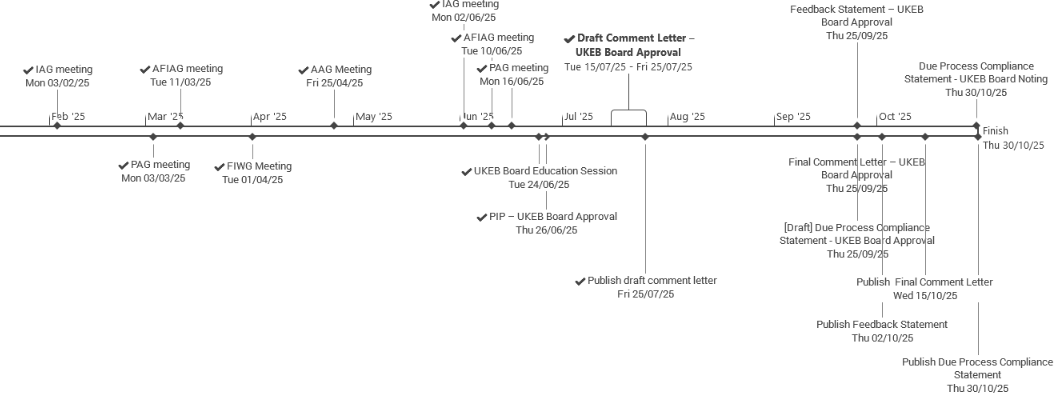
| Date | Milestones |
|---|---|
| 24 June 2025 | Board Education Session |
| 26 June 2025 | Project Initiation Plan for Board Approval |
| 15 July 2025 | Draft Comment Letter for Board approval |
| 25 July 2025 | Draft Comment Letter published on UKEB website |
| DCL consultation period (45 days): 25 July 2025 – 8 September 2025 | |
| 25 September 2025 | Board review of Final Comment Letter, Feedback Statement, draft Due Process Compliance Statement |
| By 15 October 2025 | Final Comment Letter submitted to IASB |
| 30 October 2025 | Due Process Compliance Statement for noting. |
Post-implementation Review of IFRS 16 Leases - Project timeline.
17The diagram below is a graphical view of the mandatory milestone activities described above.
Appendix A: Final Comment Letter
25 September 2025 Agenda Paper 6: Appendix A OFFICIAL - PUBLIC
Dr Andreas Barckow Chair International Accounting Standards Board Columbus Building 7 Westferry Circus Canary Wharf London E14 4HD
[Date]
Dear Dr Barckow
Invitation to Comment: Post-implementation Review of IFRS 16 Leases
1The UK Endorsement Board (UKEB) is responsible for endorsement and adoption of IFRS Accounting Standards for use in the UK and therefore is the UK's National Standard Setter for IFRS Accounting Standards. The UKEB also leads the UK's engagement with the IFRS Foundation on the development of new standards, amendments and interpretations. This letter is intended to contribute to the Foundation's due process. The views expressed by the UKEB in this letter are separate from, and will not necessarily affect the conclusions in, any endorsement and adoption assessment on new or amended international accounting standards undertaken by the UKEB.
2There are currently approximately 1,500 entities with equity listed on the London Stock Exchange that prepare their financial statements in accordance with IFRS.4 In addition, UK law allows unlisted companies the option to use IFRS and approximately 14,000 such companies currently take up this option.5
3The UKEB welcomes the opportunity to provide comments on the International Accounting Standards Board (IASB)'s Post-implementation Review of IFRS 16 Leases (PIR). Given that:
- a PIR is primarily focused on assessing whether the effects of applying a standard are as intended; and,
- the IASB has a number of active and pipeline projects in its workplan;
the UKEB's work has focused on identifying substantial and pervasive matters only.
4In developing this letter, the UKEB consulted with a range of stakeholders in the UK, including conducting a survey of preparers on the ongoing costs and benefits of applying the Standard.
5The UKEB has concluded:
- There is general support for IFRS 16, and no fatal flaws have been identified.
- The quality and comparability of financial information about leases is largely as expected. IFRS 16 disclosures are more useful than those previously reported under IAS 17.
- The ongoing costs of applying IFRS 16 appear to remain high. However, this was identified as a probable outcome in the IASB's Effects Analysis for IFRS 16.
- Consistent with the UKEB's response to the IASB's Post-implementation Review of IFRS 15 Revenue from Contracts with Customers we have not been made aware of any significant issues relating to the interaction between IFRS 15 and the requirements of IFRS 16 Leases.
6If you have any questions about this response, please contact the UKEB project team at [email protected].
Yours sincerely
Paul Lee Chair UK Endorsement Board
Appendix A: Questions on Request for Information: Post-implementation Review IFRS 16 Leases
Overall assessment of IFRS 16
Question 1–Overall assessment of IFRS 16
- In your view, is IFRS 16 meeting its objective and are its core principles clear? If not, please explain why not.
- In your view, are the overall improvements to the quality and comparability of financial information about leases largely as the IASB expected? If your view is that the overall improvements are significantly lower than expected, please explain why.
- In your view, are the overall ongoing costs of applying the requirements and auditing and enforcing their application largely as the IASB expected? If your view is that the overall ongoing costs are significantly higher than expected, please explain why, how you would propose the IASB reduce these costs and how your proposals would affect the benefits of IFRS 16.
Objectives
A1The UKEB considers that the Standard is meeting its objective and that the core principles are clear. We have not been made aware of any fatal flaws in IFRS 16.
Improvements
A2The UKEB considers that the quality and comparability of the financial information about leases have been improved, and those overall improvements are not significantly lower than expected.
A3While some users have suggested that they are recasting IFRS 16 disclosures back to IAS 17 numbers, the UKEB's Investor Advisory Group believes this effect is most likely transitory – mainly arising from long-dated leases and analysts' need for longer term trend data.
Ongoing Costs
A4The UKEB acknowledges that the ongoing costs of applying IFRS 16 appear to remain high. However, this is not wholly unexpected considering the IASB's Effects Analysis for IFRS 16 anticipated that there would be additional costs related to6:
- Determining discount rates;
- Initial direct costs; and,
- Remeasurement of lease assets and lease liabilities.
A5Outreach with our stakeholders suggested that there may be opportunities for mitigating some of these ongoing costs by considering simplification of some of the requirements in IFRS 16. The main drivers of the ongoing costs of applying IFRS 16 they highlighted are:
- remeasurement of lease assets and lease liabilities;
- collecting information for disclosures; and
- determining the appropriate discount rate.
A6Stakeholders also identified the short-term lease and low-cost exemptions as being less helpful than expected. They noted:
- The definition of short-term lease in IFRS 16 Appendix A Defined Terms creates a "brightline” of “12 months or less". They suggest this may be too restrictive in some circumstances.
- The guidance in IFRS 16 BC100, with the “US$5,000” is often treated as a "brightline" which then requires recognition of otherwise immaterial leases.
A7The UKEB has not had the opportunity to undertake the detailed research required to identify specific solutions at this time. However, the IASB could explore:
- Simplifying the discount rate requirements. For example, allowing a lessee to use its obtainable borrowing rate as an alternative to the lessee's incremental borrowing rate.
- Removing or amending the perceived “rule-based” low-value and short-term exemptions to support a more principle-based application of materiality to accounting for lease arrangements.
Usefulness of information resulting from lessees' application of judgement
Question 2–Usefulness of information resulting from lessees' application of judgement
- Do you agree that the usefulness of financial information resulting from lessees' application of judgement is largely as the IASB expected? If your view is that lessees' application of judgement has a significant negative effect on the usefulness of financial information, please explain why.
- Do you agree that the requirements in IFRS 16 provide a clear and sufficient basis for entities to make appropriate judgements and that the requirements can be applied consistently? If not, please explain why not.
- If your view is that the IASB should improve the usefulness of financial information resulting from lessees' application of judgement, please explain:
- what amendments you propose the IASB make to the requirements (and how the benefits of the solution would outweigh the costs); or
- what additional information about lessees' application of judgement you propose the IASB require entities to disclose (and how the benefits would outweigh the costs).
A8The UKEB considers that financial information resulting from lessees' application of judgement contributes to enhanced comparability as it allows an entity to present its assessment of the facts and circumstances.
Usefulness of information about lessees' lease-related cash flows
Question 3–Usefulness of information about lessees' lease-related cash flows
- Do you agree that the improvements to the quality and comparability of financial information about lease-related cash flows that lessees present and disclose are largely as the IASB expected? If your view is that the improvements are significantly lower than expected, please explain why.
A9The UKEB considers that lease-related cash flows should be addressed as part of the Statement of Cash Flows and Related matters project currently being undertaken by the IASB.
Ongoing costs for lessees of applying the measurement requirements
A10UKEB research related to the project on Cash Flows and Related Matters has indicated that stakeholders want better information on cash flows related to leases. Current disclosures do not generally allow users to link information between the statement of financial position, the income statement and the cash flows. This is particularly relevant where there has been merger and acquisition activity.
Question 4–Ongoing costs for lessees of applying the measurement requirements
- Do you agree that the ongoing costs of applying the measurement requirements in IFRS 16 are largely as the IASB expected? If your view is that the ongoing costs are significantly higher than expected, please explain why, considering how any entity-specific facts and circumstances (such as IT solutions) add to these costs.
- If your view is that the ongoing costs are significantly higher than expected, please explain how you propose the IASB reduce these costs without a significant negative effect on the usefulness of financial information about leases.
A11As noted above (A4), the UKEB acknowledges that the ongoing costs of applying IFRS 16 appear to remain high. However, this is not unexpected considering the IASB's Effects Analysis for IFRS 16. There may be opportunities for mitigating some of these ongoing costs by considering simplification of some of the requirements in IFRS 16.
A12Please see response to Question 1.
Potential improvements to future transition requirement
Question 5–Potential improvements to future transition requirements
Based on your experience with the transition to IFRS 16, would you recommend the IASB does anything differently when developing transition requirements in future standard-setting projects? If so, please explain how your idea would ensure:
- users have enough information to allow them to understand the effect of any new requirements on entities' financial performance, financial position and cash flows; and
- preparers can appropriately reduce their transition costs when implementing new requirements for the first time.
A13The UKEB is not aware of any significant concerns with the transition requirements.
A14Preparers have indicated to the UKEB that they appreciated the practical expedient available on transition, this simplified their accounting at transition date.
A15However, it is possible that not requiring full retrospective application has contributed to some users recasting IFRS 16 disclosures back to IAS 17 numbers.
Other matters relevant to the assessment of the effects of IFRS 16
Question 6.1–Applying IFRS 16 with IFRS 9 to rent concessions
- How often have you observed the type of rent concession described in Spotlight 6.1?
- Have you observed diversity in how lessees account for rent concessions that has had, or that you expect to have, a material effect on the amounts reported, thereby reducing the usefulness of information?
- If your view is that the IASB should act to improve the clarity of the requirements, please describe your proposed solution and explain how the benefits of the solution would outweigh the costs.
A16The UKEB is aware of the IFRIC suggestion and acknowledge that there could be diversity in practice. However, the UKEB has not [to date] been made aware of pervasive concerns with applying IFRS 16 with IFRS 9 to rent concessions in the UK.
Question 6.2–Applying IFRS 16 with IFRS 15 when assessing whether the transfer of an asset in a sale and leaseback transaction is a sale
- How often have you observed difficulties in assessing whether the transfer of an asset in a sale and leaseback transaction is a sale?
- Have you observed diversity in seller-lessees' assessments of the transfer of control that has had, or that you expect to have, a material effect on the amounts reported, thereby reducing the usefulness of information?
- If your view is that the IASB should act to help seller-lessees determine whether the transfer of an asset is a sale, please describe your proposed solution and explain how the benefits of the solution would outweigh the costs.
A17The UKEB's view remains consistent with its response to the IASB's Post-implementation Review of IFRS 15 Revenue from Contracts with Customers (Final Comment Letter - Post-Implementation Review of IFRS 15 Revenue from Contracts with Customers), "We have been made aware of any significant issues relating to the interaction between IFRS 15 and the requirements of other IFRS, in particular IFRS 16 Leases".
Question 6.3–Applying IFRS 16 with IFRS 15 to gain or loss recognition in a sale and leaseback transaction
- Do you agree that restricting the amount of gain (or loss) an entity recognises in a sale and leaseback transaction results in useful information?
- What new evidence or arguments have you identified since the IASB issued IFRS 16 that would indicate that the costs of applying the partial gain or loss recognition requirements, and the usefulness of the resulting information, differ significantly from those expected?
- If your view is that the IASB should improve the cost-benefit balance of applying the partial gain or loss recognition requirements, please describe your proposed solution.
A18The UKEB has not been made aware of any specific issues around applying the partial gain or loss recognition requirements.
Question 6.4–Other matters relevant to the assessment of the effects of IFRS 16
- Are there any further matters the IASB should examine as part of the post-implementation review of IFRS 16? If so, please explain why, considering the objective of a post-implementation review.
A19The UKEB has not identified any other significant matters relevant to the assessment of the effects of IFRS 16.
Feedback Statement
Final Comment Letter (FCL) 25 September 2025
OFFICIAL - PUBLIC
The UK Endorsement Board (UKEB) is responsible for endorsement and adoption of IFRS for use in the UK and therefore is the UK's National Standard Setter for IFRS. The UKEB also leads the UK's engagement with the IFRS Foundation on the development of new standards, amendments and interpretations.
The comment letter to which this feedback statement relates forms part of those influencing activities and is intended to contribute to the IFRS Foundation's due process.
The views expressed by the UKEB in its comment letter are separate from, and will not necessarily affect the conclusions in, any endorsement and adoption assessment on new or amended international accounting standards undertaken by the UKEB.
- Executive Summary
- Background
- Outreach on the DCL
- Volatility created by a variable rate subject to substantial fluctuations
- Treatment of property leased and then sub-let.
- FCL
- Next steps
- Project timeline
- Post-implementation Review of IFRS 16 Leases - Project timeline.
- Appendix A: Final Comment Letter
- Invitation to Comment: Post-implementation Review of IFRS 16 Leases
- Appendix A: Questions on Request for Information: Post-implementation Review IFRS 16 Leases
- Overall assessment of IFRS 16
- Objectives
- Improvements
- Ongoing Costs
- Usefulness of information resulting from lessees' application of judgement
- Usefulness of information about lessees' lease-related cash flows
- Ongoing costs for lessees of applying the measurement requirements
- Potential improvements to future transition requirement
- Other matters relevant to the assessment of the effects of IFRS 16
- Feedback Statement
- Purpose of this Feedback Statement
- Description of the project
- UKEB public consultation on the DCL
- Disclaimer
- Contact Us
- Appendix C: DRAFT Due Process Compliance Statement: Post-implementation Review of IFRS 16 Leases
- Conclusion
Purpose of this Feedback Statement
This Feedback Statement presents the views of UK stakeholders received during the UKEB's public consultation on the draft comment letter (DCL) relating to the IASBs Request for Information (RFI) for their Post-implementation Review (PIR) of IFRS 16 Leases.
This feedback statement presents the views of UK stakeholders received during the UKEB's outreach activities on the IASB's RFI and explains how the UKEB's Final Comment Letter (FCL) addressed those views.
Description of the project
- In June 2025, the IASB published the Request for Information on the PIR of IFRS 16 Leases.
- The PIR assesses whether the standard is meeting its objectives, can be applied consistently, provides useful information to users, and implementation costs are as expected. The IASB's possible actions following the PIR are to:
- produce educational materials;
- conduct follow-up research work for possible standard setting; or
- take no action
- The IASB's RFI is seeking feedback on:
- Stakeholders' experiences relating to IFRS 16 and their overall views on the Standard;
- Matters in IFRS 16 that the IASB has identified as areas of interest to examine further in this post-implementation review;
- Suggestions for improvements to future transition requirements; and
- Other information relevant to the PIR of IFRS 16 not specifically addressed in the RFI, including its relationships with the requirements in other IFRS Accounting Standards.
UKEB public consultation on the DCL
- Prior to publishing the DCL, we gathered stakeholder feedback through discussions with:
- UKEB Advisory Groups:
- Investor Advisory Group
- Accounting Firms and Institutes Advisory Group
- Preparer Advisory Group
- Preparers – through a preparer survey
- UKEB Advisory Groups:
- Stakeholder feedback was reflected in the DCL.
- The DCL and ITC were published for consultation for 45 days, between 25 July 2025 and 8 September 2025.
- During the consultation period the UKEB promoted awareness of the DCL and ITC and encouraged stakeholders to respond through News Alerts, LinkedIn posts, and the UKEB website.
- Two formal responses from stakeholders were received, both being preparers.
- One submission received was published on the UKEB website while the other one was not made publicly available at the stakeholder's request. However, this letter was made available to UKEB members.
- All stakeholder comments and views were considered in finalising the UKEB's FCL.
| UKEB draft position | Further stakeholder views | UKEB final position |
|---|---|---|
| Question 1: Overall assessment of IFRS 16 | ||
| The UKEB considers that the Standard is meeting its objective and that the core principles are clear. We have not been made aware of any fatal flaws in IFRS 16. | Largely supportive of UKEB draft position. One stakeholder raised concern about the volatility created by applying IFRS 16 to leases based upon a variable rate that are subject to substantial fluctuations in the short term. If the lease payments included in the initial measurement of the lease liability comprise variable lease payments that depend on an index or a rate, IFRS 16 paragraph 27(b) requires the lease liability to be "initially measured using the index or rate as at the commencement date". If the index such as a shipping index is subject to significant fluctuations in the short term, this can lead to the liability at balance sheet date not being economically representative of the actual liability if it was calculated based on the index rates expected to prevail over the majority of the lease term. | Consistent with draft position. The IASB considered this issue during the development of IFRS 16. They concluded (paragraph BC166 of the Basis for Conclusions of IFRS 16) that permitting the use of forecast rates of forward rates may lead to measurement uncertainty and comparability issues, and that the enhanced information obtained might not be justifiable on cost benefit grounds. The UKEB agrees with the IASB's rationale and, therefore, no amendments to the DCL have been proposed. |
| The UKEB considers that the quality and comparability of the financial information about leases have been improved, and those overall improvements are not significantly lower than expected. | Supportive of UKEB draft position. | Consistent with draft position. |
| The UKEB acknowledges that the ongoing costs of applying IFRS 16 appear to remain high although this is not wholly unexpected considering the IASB's Effects Analysis for IFRS 16. The UKEB proposed ways to mitigating some of the ongoing costs such as including a materiality-based approach to low-value and short-term exemptions. | Supportive of UKEB draft position with one stakeholder explicitly supporting the materiality-based approach proposed by the UKEB. | Consistent with draft position. |
| Question 2: Usefulness of information resulting from lessees' application of judgement | ||
| The UKEB considers that financial information resulting from lessees' application of judgement contributes to enhanced comparability as it allows an entity to present its assessment of the facts and circumstances. | One stakeholder is supportive of the UKEB's conclusion while the other stakeholder neither agreed nor disagreed but only noted 'no comment'. | Consistent with draft position. |
| Question 3: Usefulness of information resulting from lessees' lease-related cash flows | ||
| The UKEB considers that lease-related cash flows should be addressed as part of the Statement of Cash Flows and Related matters project currently being undertaken by the IASB. | Supportive of UKEB draft position. | Consistent with draft position. |
| Question 4: Ongoing costs for lessees of applying measurement requirements | ||
| The UKEB acknowledges that the ongoing costs of applying IFRS 16 appear to remain high. However, this is not unexpected considering the IASB's Effects Analysis for IFRS 16. There may be opportunities for mitigating some of these ongoing costs by considering simplification of some of the requirements in IFRS 16. | Supportive of UKEB draft position. See also the comment made for Question 1. | Consistent with draft position. |
| Question 5-6.3 | ||
| The UKEB is not aware of any significant concerns relating to these questions | Supportive of UKEB draft position. | Consistent with draft position. |
| Question 6.4: Other matters relevant to the assessment of the effects of IFRS 16 | ||
| The UKEB has not identified any other significant matters relevant to the assessment of the effects of IFRS 16. | One stakeholder is supportive of the UKEB draft position while the other stakeholder raised a specific concern relating to the divergence in treatment between IFRS 9 and IFRS 16 of property leased and then sub-let to the original lessor vs to another third party. | Consistent with draft position. The UKEB considers that the difference in accounting treatment reflects the economics of the different transactions. Therefore, no amendments to the DCL have been proposed. |
Disclaimer
This Feedback Statement has been produced in order to set out the UKEB's response to stakeholder comments received on the UKEB's draft comment letter on the IASB's Request for Information for their Post-implementation Review of IFRS 16 Leases and should not be relied upon for any other purpose.
The views expressed in this Feedback Statement are those of the UK Endorsement Board at the point of publication.
Any sentiment or opinion expressed within this Feedback Statement will not necessarily bind the conclusions, decisions, endorsement or adoption of any new or amended IFRS by the UKEB.
Contact Us
UK Endorsement Board 13th Floor | 1 Harbour Exchange | London | E14 9GE www.endorsement-board.uk
Appendix C: DRAFT Due Process Compliance Statement: Post-implementation Review of IFRS 16 Leases
The International Accounting Standards Board (IASB) published its Request for Information (RFI) for the Post-implementation Review (PIR) of IFRS 16 Leases8 on 17 June 2025. The IASB comment period ends on 15 October 2025.
Influencing process
Project preparation
| Step | Mandatory / optional9 | Metrics or evidence | UKEB Secretariat comments |
|---|---|---|---|
| Added to UKEB technical work plan [Due Process Handbook (Handbook) 4.30] | Mandatory | Project included in the UKEB published technical work plan | The PIR of IFRS 16 Leases was included in the UKEB technical work plan published in October 2024. |
| Project Initiation Plan (PIP) [Handbook 5.4 to 5.8, A1 to A2 and A12 to A14] | Mandatory | Project initiation plan (PIP) draft with project outline (background, scope, project objective) and approach for influencing (key milestones and timing) | The Secretariat included mandatory milestones for the project and considered, as appropriate, other milestones and activities. The PIP was approved at the 26 June 2025 Board meeting. |
| Mandatory | Outreach plan for stakeholders and communication approach outlined | The PIP (referred to above) included the outreach plan and approach. | |
| Mandatory | Resources allocated | One project director supported and overseen by one senior project director, with communications and economics team support. | |
| Education sessions [Handbook 4.10] | Optional | Board provided with education sessions | The Board was provided with an education session on 24 June 2025. |
Desk-based research
| Step | Mandatory / optional | Metrics or evidence | UKEB Secretariat comments |
|---|---|---|---|
| Desk-based research [Handbook 5.9 and A3] | Optional | Review of relevant documentation | The Secretariat has reviewed: - The IASB's work on the PIR; - Other standard-setters' views; and - Accounting manuals and press releases for guidance and illustrative examples. |
Outreach
| Step | Mandatory / optional | Metrics or evidence | UKEB Secretariat comments |
|---|---|---|---|
| Outreach activities [Handbook 5.10 to 5.12 and A4 to A8] | Mandatory | Evidence of consultation | Due to the limited scope nature of the project, consultation activities were focused consultation with advisory groups and on obtaining responses to the Draft Comment Letter (DCL). The UKEB received two comment letters. One comment letter received was published on the UKEB website while the other one was not published as the stakeholder requested that the letter was not made publicly available. However, it was made available to UKEB members. |
Draft Comment Letter (DCL)
| Step | Mandatory / optional | Metrics or evidence | UKEB Secretariat comments |
|---|---|---|---|
| DCL published for comment (mandatory unless impracticable) [Handbook paragraphs 5.13 to 5.17 and A4(d)] | Mandatory | Comment period set for responses to DCL | The DCL was published for consultation for 45 days on 25 July 2025 (comment period deadline: 8 September 2025). |
| Mandatory | Review and approval at a UKEB public meeting | The DCL was reviewed and approved at the Board meeting on 26 June 2025. | |
| Mandatory | DCL published on website for public consultation | The DCL was published for consultation for 45 days on 25 July 2025 (comment period deadline: 8 September 2025). |
Project finalisation and project closure
| Step | Mandatory / optional | Metrics or evidence | UKEB Secretariat comments |
|---|---|---|---|
| Final Comment Letter (FCL) [Handbook paragraph 5.18 and A4(d)] | Mandatory | Public responses to DCL considered and published on website | The UKEB received two comment letters on of which was published on the UKEB website while one letter was not published as the stakeholder requested that the letter was not made publicly available. However, the letter was made available to UKEB members. All responses were assessed, reflected as appropriate in the FCL and summarised in the Feedback Statement. |
| Mandatory | FCL approved by the UKEB in public meeting | The FCL was presented to the Board for approval on 25 September 2025. | |
| Mandatory | FCL submitted to the IASB and posted on UKEB website | The FCL was submitted to the IASB and posted on the UKEB website on 15 October 2025. | |
| Feedback Statement [Handbook 5.19 to 5.22 and A9 to A11] | Mandatory | Feedback Statement approved for publication by the UKEB in a public meeting | A draft of the Feedback Statement was presented for approval to the Board at its 25 September 2025 public meeting. The Board approved the draft Feedback Statement, subject to editorial changes. |
| Mandatory | Feedback Statement published on the UKEB website | The final Feedback Statement was published on the UKEB website on 26 September 2025. |
Due Process Compliance Statement (DPCS)
| Step | Mandatory / optional | Metrics or evidence | UKEB Secretariat comments |
|---|---|---|---|
| Due Process Compliance Statement (DPCS) [Handbook 5.23 to 5.26 and A12 to A14] | Mandatory | DPCS approved by the UKEB in public meeting | A draft DPCS was presented for approval to the Board at its 25 September 2025 public meeting. A final DPCS was presented for noting at the Board's 30 October 2025 meeting. |
| Mandatory | DPCS published on the UKEB website | The final DPCS was published on the UKEB website after the 30 October 2025 Board meeting. |
Ongoing communications
| Step | Mandatory / optional | Metrics or evidence | UKEB Secretariat comments |
|---|---|---|---|
| Public Board meetings [Handbook 4.10] | Mandatory | UKEB public meetings held to discuss technical project | The Board received an overview of the project in June 2025. The Board approved the PIP at its meeting on 26 June 2025, DCL at its meeting on 15 July 2025 and FCL at its meeting on 25 September 2025. |
| Secretariat papers [Handbook 4.20] | Mandatory | Board meeting papers posted and publicly available usually no later than 5 working days before a Board meeting. | The UKEB's meeting papers were published on the UKEB website 5 working days before the public meetings. Meeting minutes and recordings were made publicly available via the UKEB website. |
| Project webpage [Handbook 4.25(b)] | Mandatory | Project webpage contains a project description with up-to-date information on the project. | Complete: The project webpage has been updated regularly on a timely basis. |
| Subscriber Alerts [Handbook 4.24] | Optional | Evidence that subscriber alerts have occurred | Complete: Subscribers were alerted via email 5 days before each Board meeting, with links to the agenda, papers and the option to dial in to observe the discussion. |
| News Alerts [Handbook 4.24] | Optional | News Alert to announce publication of key documents | Complete: News Alerts and LinkedIn posts calling for comments were published on the following dates: - 25 July 2025 (both) - 25 July 2025 (both) - 3 September 2025 (News Alert) - 4 September 2025 (LinkedIn post) |
Conclusion
This project complies with the applicable due process steps, as set out in the December 2022 Handbook.
Footnotes
-
IASB PIR of IFRS 16 RFI - 17 June 2025. ↩
-
Refer to the UKEB draft Comment Letter. ↩
-
Comment letter received. ↩
-
UKEB calculation based on LSEG and Eikon data, June 2025. This calculation includes companies listed on the Main market as well as on the Alternative Investment Market (AIM). ↩
-
UKEB estimate based on FAME, Company Watch and other proprietary data. ↩
-
IFRS 16 Effects Analysis page 34 ↩
-
See paragraphs A104 and A112 of the first UKEB research paper Statement of Cash Flows: Background and Key Issues and paragraphs C13f), C31, C91, C100, C105, C108d), C121, C182b) of the third UKEB research paper Statement of Cash Flows: UK User and Preparer Perspectives. ↩
-
IASB Request for Information on the Post-implementation Review of IFRS 16 Leases. ↩
-
In accordance with the Due Process Handbook. ↩