4 IFRS 19 Subsidiaries without Public Accountability Disclosures
25 September 2025 Agenda Paper 4
Executive Summary
Project Stage
| IASB | Research / Pipeline | Discussion paper | Redeliberation | Exposure Draft | Redeliberation | Final standard | Post Implementation Review |
|---|---|---|---|---|---|---|---|
| UKEB | Research / Influencing | Research / Influencing | Monitoring | Influencing | Monitoring | Endorsement | Influencing |
Project Scope
Moderate
Purpose of the paper
The purpose of this paper is to:
- Update the Board on IASB developments and project activities since the publication of the Project Initiation Plan (PIP), in July 2025.
- Obtain Board feedback on (draft) sections 1 and 2 of the Draft Endorsement Criteria Assessment (DECA) for IFRS 19 Subsidiaries without Public Accountability: Disclosures (the Standard) 1.
- Seek the Board’s views on the approach to the technical accounting criteria assessment.
Summary of the Issue
The DECA sets out the UKEB's assessment of whether the Standard meets the statutory criteria for adoption set out in SI 2019/685 2. The usual structure of DECAs for previous significant endorsement and adoption projects have included the following sections:
- Executive Summary
- Introduction
- a description of the UK statutory requirements for adoption of new and amended international accounting standards at Section 1;
- a description of the main requirements in IFRS 19 and the entities in scope for the assessment of IFRS 19 at Section 2;
- an assessment of whether the Standard meets the statutory criteria for adoption:
- Section 3: Technical accounting criteria assessment;
- Section 4: UK long term public good assessment;
- Section 5: True and fair view assessment; and
- an assessment of whether the Standard leads to a significant change in accounting practice at Section 6.
Given the nature of IFRS 19 as a voluntary, disclosure-only standard, the Board asked whether the DECA for this project can be streamlined. This paper includes suggestions for streamlining the DECA to both the structure and content.
Secondly, drafts of the Introduction and sections 1 and 2 are being presented at this meeting, along with an overview of the suggested content of Section 3.
Other draft sections of the DECA will be brought to the October 2025 Board meeting.
The full DECA is currently scheduled to be presented at the November 2025 Board meeting.
The Standard, which is voluntary, has an effective date of 1 January 2027, with earlier application permitted (subject to UKEB adoption in the UK). The Board's project plan indicates a final decision on endorsement and adoption in good time for companies to apply to the relevant subsidiaries.
Questions and decision for the Board
- Does the Board agree to streamline the DECA by moving the Section 1 content to an Appendix to the DECA? Does the Board also agree that this approach can be applied to future DECAs?
- Is the proposed approach to the technical accounting criteria assessment in line with the Board's expectations for a proportionate approach this project?
- Does the Board wish to take a 'by exception' approach to the technical accounting criteria assessment of the detailed disclosure requirements in the standard? If so, are any material issues missing from the list identified?
- Does the Board recommend any other work be undertaken for the technical criteria assessment?
Recommendation
- We recommend the Board provides comments on the draft sections of the DECA of IFRS 19, in line with the questions above.
Appendices
Appendix A Draft Endorsement Criteria Assessment IFRS 19 Subsidiaries without Public Accountability: Disclosures (sections 1 and 2)
IFRS 19 Subsidiaries without Public Accountability: Disclosures - Draft Endorsement Criteria Assessment
Background
1In May 2024, the International Accounting Standards Board (IASB) issued IFRS 19 Subsidiaries without Public Accountability: Disclosures.
2IFRS 19 is a new reduced disclosure IFRS Accounting Standard. It was developed as part of the IASB's Disclosure Initiative – a set of projects aimed at improving the effectiveness of financial statement disclosures.
3The objective of IFRS 19 is to enable eligible subsidiaries to simplify their reporting systems and processes, reducing the costs of preparing their financial statements, whilst maintaining the usefulness of financial information to users.
4The Board approved a Project Initiation Plan (PIP) for the IFRS 19 endorsement project at its July 2025 meeting, with a moderate project scope 3.
5In August 2025, the IASB issued Amendments to IFRS 19 Subsidiaries without Public Accountability: Disclosures (the Amendments) 4 which included limited reductions to disclosure requirements for new or amended IFRS Accounting Standards issued between 28 February 2021 and May 2024.
6As set out in the PIP, the UKEB endorsement project will assess whether to adopt, for use in the UK, as a single package:
- IFRS 19 Subsidiaries without Public Accountability: Disclosures,
- the amendments to IFRS 19 published in August 2025; and
- the issued consequential amendments to IFRS 19 5.
7IFRS 19, including the Amendments, (the Standard) has an effective date of 1 January 2027, with earlier application permitted (subject to the UKEB adoption in the UK). If an entity applies IFRS 19 for an earlier period, it shall disclose that fact.
IASB update - Amendments
8The UKEB Secretariat has conducted analysis of the issued Amendments. They reflect all of the tentative decisions taken by the IASB resulting from its deliberations on the feedback received on the Exposure Draft 6.
DECA
9The Secretariat notes that in many respects, the Amendments are aligned with the views expressed in the UKEB comment letter.
10Appendix A of this paper contains draft sections of the DECA for discussion at this Board meeting. The draft sections being presented are:
- Section 1, which describes the UK statutory requirements for adoption of new and amended international accounting standards; and
- Section 2, which describes the main requirements in IFRS 19 and the entities in scope for the assessment of the Standard including the potential accounting impact of IFRS 19 in the UK.
11The Board's discussions at this meeting will be reflected in the redrafting and in the development of the remaining DECA sections of the DECA.
Section 1: UK statutory requirements for adoption and the approach to the endorsement criteria
12The UKEB DECAs and ECAs have, so far, followed the structure set out in the table below:
| Section | Content |
|---|---|
| Exec Summary | Background; work undertaken; summary of following sections |
| Introduction | Purpose; scope; structure of the assessment |
| Section 1 | UK statutory requirements for adoption and the approach to the endorsement criteria assessment |
| Section 2 | Entities in scope; main requirements of the Standard |
| Section 3 | Whether the Standard meets the technical accounting criteria assessment; approach to the assessment of these criteria |
| Section 4 | Whether the Standard is likely to be conducive to the UK long term public good |
| Section 5 | True and fair view assessment |
| Section 6 | Whether the Standard is likely to lead to a significant change in accounting practice |
13Section 1 of a DECA explains the role of the UKEB, the statutory requirements for adoption and the approach to the endorsement criteria assessment in template text.
14It sets out sections of the Regulations 7, the technical accounting criteria and the other matters to be considered and determined by the Board. The section also explains how the UKEB carries out its assessment of a new or amended Standard.
15When the UKEB was established, stakeholders were unsure of the UKEB's purpose and powers. This section, at the start of a DECA ‘set the scene' for the document and ensured that respondents to the DECA were clear about the endorsement framework and process.
16The UKEB has now established its position, both in the UK and internationally, as the UK's national standard-setter for international accounting standards issued by the IASB. Most of our stakeholders are now unlikely to read Section 1 thoroughly before moving into the body of the endorsement criteria assessment.
17Therefore, we propose moving the content of Section 1 into an Appendix. This would mean that the DECA moves straight into the substantive issues relating to the specific Standard or amendment being considered, including the scope and main requirements. This change would also make the main document shorter and more accessible.
18Including the main content of Section 1 in an Appendix would ensure that the statutory information is still readily available to stakeholders who are not familiar with them, as it would be published as part of the DECA.
19To note, the [Draft] Adoption decision would be retained in the front part of the DECA.
Question for the Board
- Does the Board agree to streamline the DECA by moving the Section 1 content to an Appendix to the DECA? Does the Board also agree that this approach can be applied to future DECAs?
Next steps and timeline
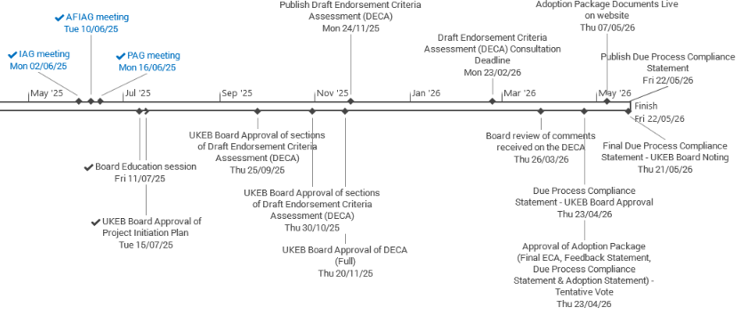
35Subject to amendments to the draft Sections 1 and 2 of the DECA required by the Board, the Secretariat will bring further sections of the DECA to the October 2025 Board meeting. The remaining sections are:
- Section 3: Technical accounting criteria assessment;
- Section 4: UK long term public good assessment;
- Section 5: True and fair view assessment; and
- Section 6: an assessment of whether the Standard leads to a significant change in accounting practice
36The complete DECA, including revised versions of the sections in Appendix A, will be presented to the Board for approval at its November 2025 meeting, prior to publication for stakeholder consultation.
37In accordance with the PIP, the proposed timeline aims for the Board to consider whether to adopt the Standard in April 2026. There have been no changes to the timeline, set out below, since it was presented in July 2025.
| Date | Milestone |
|---|---|
| 15 July 2025 | Presentation of PIP |
| 21 August 2025 | IASB published Amendments to IFRS 19 |
| 25 September 2025 | Board: review sections of the DECA |
| 30 October 2025 | Board: review sections of the DECA |
| 20 November 2025 | Board: Approval of the full DECA for stakeholder consultation |
| Estimated DECA consultation period (90 days): 24 Nov 2025 – 22 Feb 2026 | |
| Q3 and Q4 2025 | UKEB advisory groups discussions (AAG, AFIAG, IAG and PAG) |
| Q3 2025 | Limited targeted outreach with UK preparers and users |
| Q4 2025 and Q1 2026 | Targeted interviews with users and preparers |
| 26 March 2026 | Board: review of comments received on the DECA |
| Secretariat: preparation of ECA | |
| 23 April 2026 | Board: Consideration of Adoption Package 9 |
| Board Members provide a tentative vote | |
| First half of May 2026 | Voting form sent to Board Members |
| Publication of voting outcome and Adoption Package on UKEB website | |
| 21 May 2026 | Board: Due Process Compliance Statement for noting |
Collection of evidence
20Evidence for the DECA has been collected through stakeholder outreach and desk-based research.
UK Generally Accepted Accounting Principles (UK GAAP) comparisons
21Stakeholder outreach, to date, has confirmed that most UK eligible subsidiaries of UK listed and overseas groups prepare their entity financial statements under UK GAAP, with many applying Financial Reporting Standard (FRS) 101 Reduced Disclosure Framework.
22Eligible subsidiaries applying IFRS 19 will follow the recognition, measurement and presentation requirements in other IFRS Accounting Standards.
23FRS 101 has recognition, measurement and presentation requirements which are substantially aligned with IFRS Accounting Standards, and therefore with IFRS 19.
24By contrast, FRS 102 differs significantly from IFRS Accounting Standards for some topics of the recognition, measurement and presentation. As a result, the impact on the financial statements of an eligible subsidiary transitioning from FRS 102 to IFRS 19 could be significant, depending on the nature of the transactions, events and conditions to which the UK eligible subsidiary is subject.
25At its July 2025 meeting, the Board approved the publication of 'An overview of the UK Accounting Framework and of the overarching differences between IFRS 19 and FRS 101' 8 (FRS 101 comparison) as educational material on the project webpage.
26The Secretariat has conducted desk-based analysis to identify and summarise the key differences between FRS 102 and IFRS Accounting Standards (FRS 102 comparison). This comparison takes into account the changes in the most recent version of FRS 102, published in September 2024, which has an effective date of 1 January 2026. It will be presented at a later Board meeting.
Stakeholder outreach
27As indicated in the PIP, limited targeted outreach with preparers and users has been undertaken to inform the development of the DECA sections, in particular, the Section 4 Long Term Public Good (LTPG) assessment.
28Since the PIP was published, the Secretariat has conducted five preparer interviews across different industries, and two user interviews with bank lending departments. Nine additional instances of feedback from preparers, and one instance of evidence from a user have been received.
29The main themes of the outreach, conducted since July 2025, are set out in the table below. These have been reflected in [draft] Section 2 of the DECA being presented to the Board at this meeting, and will be reflected in the remaining sections, as appropriate.
Feedback from Preparers
- Substantial variation between UK listed groups: number of eligible subsidiaries, geographical concentrations and extent of centralisation of subsidiary financial statements preparation at group level, in shared service centres or in individual jurisdictions where the subsidiaries are registered.
- Use of IFRS 19 may be attractive for overseas subsidiaries, subject to their eligibility, jurisdictional adoption and whether they currently report under full IFRS or local GAAP. There are clear benefits for those subsidiaries currently using full IFRS.
- FRS 101 remains attractive for UK subsidiaries of UK groups. Overall, it requires fewer disclosures than IFRS 19, including exemption from preparing a statement of cash flows.
- Some groups are at an early stage of assessing IFRS 19 and have not yet evaluated the costs and benefits of using IFRS 19.
- Staged approaches to implementation are being considered, with selected eligible subsidiaries acting as pilots for a reporting period, before wider implementation.
- Benefits expected to relate to streamlining of processes and increased consistency, including fewer reconciling items in local GAAP to IFRS reconciliations to prepare and have audited.
- Audit fee reductions are expected to be modest, as they will depend on previous GAAP used.
Feedback from Users
- Bank lending departments are particularly interested in the subsidiaries' financial statements when external borrowings are not supported by parent or intra-group guarantees.
- One lender indicated that disclosures in the notes to the financial statements of subsidiaries are used by exception in many contexts, for example if there is information in a primary statement that requires further analysis.
- IASB's principles for disclosure reductions are broadly aligned to these users' information needs.
- Introduction of IFRS 19 as an option for preparing UK eligible subsidiary financial statements is not expected to introduce additional complexity for users.
- Information about the cash flows of a subsidiary is useful in assessing repayment capacity. The requirement to prepare a statement of cash flows under IFRS 19 will provide relevant information to users.
- Other users (e.g. financial modelling teams in banks, trade credit insurers, suppliers, regulators) may have different information needs, but typically can request additional information from management.
- Widespread use of IFRS 19 rather than local GAAPs could result in more timely financial reporting for lenders.
- Familiarisation costs are expected to be modest.
Approach to the Technical Accounting Criteria Assessment (to be included in Section 3 of the DECA)
30The PIP, for this moderate scope project, stated that the assessment of the Standard against the technical accounting criteria, in Section 3, will consider IFRS 19, as a whole. It will aim to focus on the usefulness of the financial statements prepared under IFRS 19, rather than considering the disclosures in full IFRS Accounting Standards which are eliminated in IFRS 19.
31Section 3 will assess whether the reduced disclosures will enable users to adequately understand the financial position, performance and cash flows of eligible subsidiaries. The assessment will specifically consider the information needs of the users e.g. bank lending departments.
Outline of Suggested Content of Technical Accounting Criteria Assessment
32The Secretariat intends to test the issues set out below against the technical accounting criteria. The focus of the work would be to assess whether the requirements in IFRS 19 continue to deliver the users' financial information needs in relation to the subsidiaries in scope.
33The issues, set out in the table, are proposed for assessment, in line with the proportionate approach set out in the PIP.
| Key Issue | Technical criteria |
|---|---|
| Scope | |
| The definition of public accountability in IFRS 19 differs from the Companies Act 2006 (CA06) definition of a public interest entity (PIE) | Understandability Comparability |
| An intermediate parent without public accountability may apply IFRS 19, provided it has an ultimate parent that produces consolidated financial statements available for public use (CA06 exempts the intermediate parents requirement to prepare group accounts). | Relevance Understandability Comparability |
| Fiduciary capacity - lack of alignment with how the Standard addresses fiduciary duty compared to UK legislation | Understandability Comparability |
| Electing / Revoking an election to apply the Standard | |
| A company can revoke its election to apply IFRS 19. However, a company moving from UK GAAP to UK adopted IAS would be restricted under CA06 from moving between IAS accounts and Companies Act accounts | Reliability Comparability |
| First time adopters of IAS, when moving from Companies Act accounts, are required to report under IFRS 1 | Reliability |
| Key aspects of reductions in disclosures (by exception only) | |
| A complete set of financial statements is required under IFRS 19 (i.e. including a statement of cash flows). | Relevance |
| In addition to the IFRS 19 related party transactions requirements, CA06 sets out information on related undertakings required whether preparing Companies Act or IAS accounts. | Relevance |
| Although the disclosure requirements under IFRS 3 Business Combinations are reduced under IFRS 19, key information must be provided where significant for investors. | Relevance Reliability Understandability |
| IFRS 7 Financial Instruments disclosures: • limited reductions compared to full IFRS • disclosure requirements on liquidity risk required • certain IFRS 7 credit risk disclosures apply to eligible subsidiaries providing financing to customers as a main business activity- proportionate to the needs of users of the financial statements. |
Relevance |
| IFRS 12 Disclosure of Interests in Other Entities - reduced disclosures apply to intermediate parents preparing consolidated financial statements using IFRS 19, if they are not exempted under CA06 from the requirement to prepare group accounts | Relevance |
34In addition, the Board's views are requested on whether the assessment against the technical criteria should take a by exception approach, focusing on key aspects of reduced disclosures that may impact the users' ability to obtain relevant information.
Questions for the Board
- Is the proposed approach to the technical accounting criteria assessment in line with the Board's expectations for a proportionate approach on this project?
- Does the Board wish to take a 'by exception' approach to the technical accounting criteria assessment of the detailed disclosure requirements in the standard? If so, are any material issues missing from the list identified?
- Does the Board recommend that any other work be undertaken for the technical criteria assessment?
Endorsement and adoption timeline
Sections 1 & 2: Draft Endorsement Criteria Assessment
IFRS 19 Subsidiaries without Public Accountability: Disclosures
September 2025
Introduction
Purpose
1The UK Endorsement Board (UKEB) is the UK National Standard Setter for IFRS 1, responsible for the endorsement and adoption of international accounting standards,) for use in the UK.
2The purpose of this [Draft] Endorsement Criteria Assessment (ECA) is to determine whether IFRS 19 Subsidiaries without Public Accountability: Disclosures (the Standard) issued by the International Accounting Standards Board (IASB) in May 2024 and as amended subsequently 2, meets the UK's statutory requirements for adoption as set out in Regulation 7 of Statutory Instrument 2019/685 3 (SI 2019/685).
3The Standard has an effective date of 1 January 2027 with earlier application permitted (subject to adoption for use in the UK). If an entity applies IFRS 19 for an earlier period, it shall disclose that fact in the notes.
4The UKEB actively influenced the development of IFRS 19. This included submitting Final Comment Letters:
- On 23 February 2022 4, in response to the IASB's Exposure Draft ED/2021/7 Subsidiaries without Public Accountability: Disclosures 5 (ED); and
- On 28 November 2024 6, in response to the IASB's Exposure Draft ED/2024/5 Amendments to IFRS 19 Subsidiaries without Public Accountability: Disclosures (the ‘catch-up' ED) 7.
Background to the Standard
5Section 2 of this [Draft] ECA provides a brief description on the development of IFRS 19, the main requirements in the Standard, including a high-level analysis of the potential accounting impact in the UK.
Scope of the adoption assessment
6IFRS 19 is a new voluntary international reduced disclosure standard as part of IFRS Accounting Standards.
7The IASB issued consequential amendments to IFRS 19 when issuing the following amendments to IFRS Accounting Standards:
- Amendments to IFRS 9 and IFRS 7–Amendments to the Classification and Measurement of Financial Instruments, issued in May 2024; and
- Amendments to IFRS 9 and IFRS 7–Contracts Referencing Nature-dependent Electricity, issued in December 2024.
8These consequential amendments to IFRS 19 were not considered as part of the adoption of these amendments. These consequential amendments to IFRS 19 form part of the UKEB's adoption assessment of the Standard.
9In addition, in August 2025, the IASB issued Amendments to IFRS 19 Subsidiaries without Public Accountability: Disclosures (the ‘Amendments') which included limited reductions to disclosure requirements for new or amended IFRS Accounting Standards issued between 28 February 2021 and May 2024.
10For the purposes of this adoption assessment, any reference to IFRS 19 or the Standard means the Standard as issued in May 2024, including the consequential amendments and the Amendments i.e. the amended Standard.
11IFRS 19 contains reduced disclosure requirements for IFRS 14 Regulatory Deferral Accounts. IFRS 14 is not endorsed in the UK and the reduced disclosure requirements set out under the subheading 'IFRS 14 Regulatory Deferral Accounts' have not been included in the scope of this adoption assessment.
12UK-adopted international accounting standards comprise only the mandatory sections of standards 8. The Bases for Conclusions, Implementation Guidance, and Illustrative Examples of the IFRS Accounting Standards are not adopted by the UKEB and amendments to these non-mandatory sections are not considered in this [Draft] ECA 9.
Structure of the assessment
13The UKEB's analysis is presented in the following sections:
- Section 1 describes UK statutory requirements for the adoption of new or amended international accounting standards and the approach to the endorsement criteria assessment;
- Section 2 outlines:
- the approach to the development of IFRS 19 and the entities in the scope of the Standard;
- the main requirements in the Standard;
- users of subsidiaries' financial statements and their information needs; and
- the potential accounting impact of IFRS 19 in the UK.
- Sections 3–5 discuss whether IFRS 19 meets the requirements for adoption described in Section 1. More specifically:
- Error! Bookmark not defined.: addresses whether IFRS 19 meets the technical accounting criteria and explains the approach to the assessment of these criteria;
- Section 4: analyses whether IFRS 19 is likely to be conducive to the long term public good in the UK; and
- Section 5Error! Bookmark not defined.: considers whether IFRS 19 is not contrary to the true and fair view principle for individual and consolidated accounts.
- Section 6 considers whether IFRS 19 is likely to lead to a significant change in accounting practice.
1. Section 1: UK statutory requirements for adoption and the approach to the endorsement criteria assessment
Introduction
1.1This section sets out the UK statutory requirements for the adoption of new or amended international accounting standards, and the endorsement criteria assessment approach.
UK statutory requirements
1.2Paragraph 1 of Regulation 7 of SI 2019/685 10 requires that an international accounting standard only be adopted if:
- the standard 11 is not contrary to either of the following principles—
- an undertaking's accounts must give a true and fair view of the undertaking's assets, liabilities, financial position and profit or loss;
- consolidated accounts must give a true and fair view of the assets, liabilities, financial position and profit or loss of the undertakings included in the accounts taken as a whole, so far as concerns members of the undertaking;
- the use of the standard is likely to be conducive to the long term public good in the United Kingdom; and
- the standard meets the criteria of understandability, relevance, reliability and comparability required of the financial information needed for making economic decisions and assessing the stewardship of management.
Approach to the endorsement criteria
1.3This [Draft] ECA assesses the criteria above, in the following order:
- Whether the Standard meets the criteria of relevance, reliability, understandability and comparability required of the financial information needed for making economic decisions and assessing the stewardship of management (Regulation 7(1)(c)). We refer to these criteria collectively as the 'technical accounting criteria' (refer to Section 3).
- Whether use of the Standard is likely to be conducive to the long term public good in the UK (Regulation 7(1)(b)). Regulation 7(2) of SI 2019/685 includes specific areas to consider for this assessment (refer to Section 4). They are:
- whether the Standard is likely to improve the quality of financial reporting;
- the costs and benefits that are likely to result from the use of the Standard; and
- whether the Standard is likely to have an adverse effect on the economy of the UK, including on economic growth.
- Whether the Standard is not contrary to the principle that an entity's accounts must give a true and fair view (Regulation 7(1)(a)) (refer to Section 5).
Technical accounting criteria: Relevance, Reliability, Understandability and Comparability 12
1.4A description of the technical accounting criteria 13 is provided below:
| Technical criteria assessment | |
|---|---|
| Relevance | Information is relevant if it is capable of making a difference in the decision-making of users or in their assessment of the stewardship of management. The information may aid predictions of the future, confirm or change evaluations of the past, or both. |
| Reliability | Financial information is reliable if, within the bounds of materiality, it: a) can be depended on by users to represent faithfully what it either purports to represent or could reasonably be expected to represent; b) is complete; and c) is free from material error and bias. |
| Understandability | Financial information should be readily understandable by users with a reasonable knowledge of business and economic activities and accounting, and a willingness to study the information with reasonable diligence. |
| Comparability | Information is comparable if it enables users to identify and understand similarities in, and differences among, items. Information about an entity should be comparable with similar information about other entities and with similar information about the same entity for another period. |
1.5In conducting the overall assessment against the technical accounting criteria, the UKEB adopts an absolute, rather than a relative, approach. This is an absolute assessment against the criteria (does IFRS 19 provide information that is understandable, relevant, reliable and comparable?) rather than a relative one (does IFRS 19 provide information that is more or less understandable, relevant, reliable and comparable than current, or any other, accounting standard(s) i.e. UK Generally Accepted Accounting Principles (UK GAAP) or full IFRS Accounting Standards?).
1.6[As explained in Section 3, in the interest of efficiency and effectiveness the UKEB has conducted a high-level analysis against the technical accounting criteria by considering IFRS 19 as a whole, rather than the individual disclosure requirements of the Standard (a ‘holistic approach'). The objective is to explain that financial statements prepared under IFRS 19 have the potential to 'enhance' or 'maintain' one or more of the qualitative characteristics.]
1.7A separate comparative consideration of whether IFRS 19 is likely to enhance or maintain the quality of financial reporting is included within the UK long term public good assessment in Section 4.
Whether IFRS 19 is likely to be conducive to the long term public good in the UK 14
1.8Regulation 7(2) of SI 2019/685 sets out certain matters that are required to be considered in the assessment of whether a standard is likely to be conducive to the long term public good in the UK. These are:
"[...]
- whether the use of the standard is likely to improve the quality of financial reporting;
- the costs and benefits that are likely to result from the use of the standard; and
- whether the use of the standard is likely to have an adverse effect on the economy of the United Kingdom, including on economic growth.”
1.9When assessing whether the use of IFRS 19 is likely to improve or maintain the quality of financial reporting, the UKEB performs a relative assessment of whether the information required by IFRS 19 is likely more or less understandable, relevant, reliable and comparable than that specified by UK GAAP or full IFRS Accounting Standards respectively.
1.10When assessing the costs and benefits that are likely to result from the use of IFRS 19 the UKEB considers both the initial costs/benefits associated with the implementation of IFRS 19, as well as the expected ongoing costs and benefits over future years. This allows an assessment of the economic effects over the longer-term, consistent with the assessment of the long-term public good in the UK.
1.11When assessing whether the use of a new accounting standard is likely to have an adverse effect on the economy of the United Kingdom, including on economic growth, the UKEB assesses the potential impact of the standard beyond direct costs and benefits, including capital market effects (e.g. cost of capital), microeconomic factors such as products, pricing and competition, and the national economy.
True and fair view assessment 15
1.12The first adoption criterion, set out in Regulation 7(1) of SI 2019/685, states that an international accounting standard can only be adopted if:
"[....] the standard is not contrary to either of the following principles—
- an undertaking's accounts must give a true and fair view of the undertaking's assets, liabilities, financial position and profit or loss;
- consolidated accounts must give a true and fair view of the assets, liabilities, financial position and profit or loss of the undertakings included in the accounts taken as a whole, so far as concerns members of the undertaking; [....]”
1.13For the sake of brevity, UKEB refers to the assessment against this endorsement criterion as 'the true and fair view assessment' and to the principles set out in Regulation 7(1)(a) as the ‘true and fair principle’. However, these abbreviated expressions do not imply that the assessment has considered anything other than the full terms of the endorsement criterion set out above.
1.14The duty of the UKEB under Regulation 7(1)(a) is to determine generically, whether that standard is 'not contrary' to the true and fair principle. In other words, it is an ex-ante assessment. The UKEB has therefore considered whether the IFRS 19 contain any requirements that would prevent accounts prepared using the IFRS 19 from giving a true and fair view.
1.15The approach is to determine whether IFRS 19 is not contrary to the true and fair principle in respect of any of the specific items identified in Regulation 7(1)(a) (namely, the assets, liabilities, financial position and profit or loss) in the context of the preparation of the accounts as a whole. A holistic approach has been taken to this assessment, considering the impact of IFRS 19 taken as a whole, including its interaction with other UK-adopted international accounting standards.
1.16For the purposes of the assessment, the UKEB considers the requirement in paragraph 6A IAS 8 Basis of Preparation of Financial Statements to 'present fairly the financial position, financial performance and cash flows of an entity' 16 to be equivalent to the Companies Act 2006 requirement for accounts to give a true and fair view.
1.17This assessment is separate from the duty of directors under section 393(1) of the Companies Act 2006, which requires directors to be satisfied that a specific set of accounts gives a true and fair view of an undertaking's or group's assets, liabilities, financial position and profit or loss.
[Draft Adoption decision]
1.18Sections 3, 4 and 5 set out how IFRS 19 meets the requirements for adoption described in Section 1.
1.19[On the basis of these assessments, and subject to any stakeholder feedback received, the UKEB [tentatively] concludes that IFRS 19 meets the statutory endorsement criteria. Therefore, the UKEB is [tentatively] of the view that it will adopt IFRS 18 for use in the UK.]
Does IFRS 19 lead to a significant change in accounting practice?
1.20A standard adopted by the UKEB, under Regulation 6 of SI 2019/685, that it considers is likely to lead to a 'significant change in accounting practice', is subject to the requirements in paragraph 3 of Regulation 11 of SI 2019/685. This requires the UKEB to:
"[...]
- carry out a review of the impact of the adoption of the standard; and
- publish a report setting out the conclusions of the review no later than 5 years after the date on which the standard takes effect (being the first day of the first financial year in respect of which it must be used)".
1.21Error! Bookmark not defined. discusses whether IFRS 19 leads to a significant change in accounting practice.
2. Section 2: Main requirements in IFRS 19 and accounting impact
Introduction
2.1This section outlines:
- the approach to the development of IFRS 19 and the entities in the scope of the Standard;
- the main requirements in the Standard;
- users of subsidiaries' financial statements and their information needs; and
- the potential accounting impact of IFRS 19 in the UK.
Development of IFRS 19
2.2IFRS 19 is a new reduced disclosure IFRS Accounting Standard. It was developed as part of the IASB's Disclosure Initiative – a set of projects aimed at improving the effectiveness of financial statement disclosures. The IASB developed IFRS 19 in response to demand from stakeholders, particularly from preparers who requested that eligible subsidiaries should be permitted to apply the recognition, measurement and presentation requirements of IFRS Accounting Standards but with reduced disclosure requirements.
2.3When IFRS 19 was published, the IASB updated its guidance for developing and drafting disclosure requirements in IFRS Accounting Standards to incorporate the approach to developing disclosure requirements in IFRS 19 17.
2.4Initially, the IASB took the view that eligible subsidiaries were a subset of small and medium-sized entities (SMEs 18). Therefore, the IFRS for SMEs Accounting Standard disclosure requirements were used as a starting point to develop IFRS 19.
2.5To help the IASB develop the disclosure requirements for the IFRS for SMEs Accounting Standard, it developed six broad principles to identify information that would be important to users of the accounts. These principles are set in the table below:
| Table 1: Principles for reducing disclosure requirements 19 |
|---|
| Principle |
| a) Short-term cash flows, obligations, commitments and contingencies |
| b) Liquidity and solvency |
| c) Measurement uncertainties |
| d) Accounting policy choices |
| e) Disaggregation of amounts |
| f) Capital markets |
2.6The principles were used to assess the disclosure requirements in full IFRS Accounting Standards and to identify the disclosures to be retained in IFRS 19, in order to provide the users of the eligible subsidiaries' financial statements with sufficient and useful information.
2.7The IASB also intends to apply these principles in the future maintenance of IFRS 19 i.e. in determining whether new or amended disclosure requirements proposed as part of new IFRS Accounting Standards should be required by IFRS 19.
2.8In addition, the IASB considered costs and benefits when determining the disclosure requirements in IFRS Accounting Standards that should be retained in IFRS 19.
2.9However, the IASB made some exceptions to its overall approach:
- For those standards 20 that were not reflected in the IFRS for SMEs Accounting Standard, the disclosures in the full IFRS Accounting Standards were used as the starting point. The principles for reducing disclosure requirements, and cost and benefit assessment, were then applied.
- The IASB discussed aspects of the disclosure reduction proposals for twelve IFRS standards in detail in response to stakeholder feedback on the ED 21.
- No disclosure reductions were proposed for three IFRS standards 22.
- Some of the IFRS 19 credit risk disclosures under IFRS 7 Financial Instruments: Disclosures are only required for entities in scope that provide financing to customers as a main business activity, as this was considered proportionate to users' information needs for these entities 23.
- The IASB excluded from IFRS 19 the disclosure objectives included in individual IFRS Accounting Standards.
2.1In finalising IFRS 19, the IASB aligned the language used in the Standard with that used in full IFRS Accounting Standards. The change was made as a result of feedback to the Exposure Draft which had featured the simplified language used in the IFRS for SMEs Accounting Standard.
Scope of the Standard
2.10IFRS 19 is an elective Standard. Paragraph 7 of IFRS 19 sets out the eligibility criteria that an entity is required to satisfy to apply the Standard:
"An entity may elect to apply this Standard in its consolidated, separate or individual financial statements if, and only if, at the end of the reporting period:
- it is a subsidiary;
- it does not have public accountability [....]; and
- it has an ultimate or intermediate parent that produces consolidated financial statements available for public use that comply with IFRS Accounting Standards."
2.11Paragraph 11 of IFRS 19 defines public accountability 24:
"An entity has public accountability if:
- its debt or equity instruments are traded in a public market or it is in the process of issuing such instruments for trading in a public market (a domestic or foreign stock exchange or an over-the-counter market, including local and regional markets); or
- it holds assets in a fiduciary capacity for a broad group of outsiders as one of its primary businesses (for example, banks, credit unions, insurance companies 25, securities brokers/dealers, mutual funds and investment banks often meet this second criterion).”
Eligible UK entities in scope
2.12In the UK, IFRS 19 is expected to impact:
- UK subsidiaries of UK group companies;
- UK group companies with overseas subsidiaries; and
- UK subsidiaries of group companies with overseas parents.
2.13Current estimates put the potential maximum number of subsidiaries owned by entities listed on the London Stock Exchange (LSE), as of January 2025, eligible to apply IFRS 19, using the scope and definitions of the Standard 26 at approximately 78,000. It includes approximately 21,000 subsidiaries domiciled in the UK and 57,000 subsidiaries domiciled abroad 27 28.
2.14UK law permits unlisted UK registered companies the option to use UK-adopted international accounting standards, and approximately 14,000 such companies take up this option 29. It is acknowledged that subsidiaries of unlisted groups (which do not have public accountability) are in the scope of IFRS 19 and may elect to apply the Standard if they satisfy the eligibility criteria in IFRS 19 30. However, due to lack of data availability, it was not possible to estimate the number of eligible subsidiaries owned by private or foreign-domiciled groups.
Main requirements in IFRS 19
Overview of the Standard
2.15IFRS 19 aims to simplify the preparation of individual financial statements for eligible subsidiaries by reducing the required disclosures in their financial statements, compared with disclosure requirements in full IFRS Accounting Standards.
2.16The objective of IFRS 19 as stated in paragraph 1 of the Standard is as follows:
"IFRS 19 Subsidiaries without Public Accountability: Disclosures specifies the disclosure requirements an entity is permitted to apply instead of the disclosure requirements in other IFRS Accounting Standards."
2.17IFRS 19 does not change the recognition, measurement or presentation requirements in other IFRS Accounting Standards. These must still be followed by entities applying IFRS 19.
2.18To illustrate the approach IFRS 19 takes, in reporting items of inventory, an eligible subsidiary applies:
- the recognition, measurement and presentation requirements in IAS 2 Inventories; and
- the disclosure requirements in IFRS 19, under the subheading 'IAS 2 Inventories'.
2.19The disclosure requirements in IFRS Accounting Standards are sometimes accompanied by guidance on how to satisfy those requirements, either in paragraphs accompanying the disclosure requirements or in a separate section of application guidance or implementation guidance. IFRS 19 does not include this guidance on disclosures. The guidance on applying disclosure requirements set out in other IFRS Accounting Standards remains available to preparers 31.
2.20Paragraph 6, of IFRS 19, requires entities to provide additional disclosures if they consider that users would not be able to understand a subsidiary's financial position, financial performance and cash flows from the disclosures provided under IFRS 19.
Statement of compliance
2.22IFRS 19 is part of IFRS Accounting Standards. An eligible subsidiary which applies IFRS 19 asserts its compliance with IFRS Accounting Standards and states that it has applied IFRS 19.
Comparative information
2.23IFRS 19 allows eligible subsidiaries that elect to apply the Standard in one reporting period to later revoke that prior election. Furthermore, an entity is not prohibited from electing to apply IFRS 19 again, after a previous revocation of an election to apply the Standard.
2.24The table below summarises the requirements in IFRS 19 for comparative information to be provided in the current period when an entity elects or revokes a prior election to apply the Standard, or when it is no longer eligible to apply the Standard in the current period.
| Table 2: IFRS 19 requirements on comparative information |
|---|
| Comparative information requirements |
| IFRS 19 applied to current period, full IFRS applied to previous period |
| Comparative information (that is, information for the preceding period) is required for all amounts reported in the current period's financial statements i.e. fewer disclosures in the current period under IFRS 19, unless IFRS 19 or another IFRS Accounting Standard permits or requires otherwise. |
| Full IFRS applied to current period, IFRS 19 was applied to previous period |
| Comparative information is required, in respect of the preceding period, for all amounts reported in the current period's financial statements i.e. more disclosures in the current period under full IFRS Accounting Standards, unless another IFRS Accounting Standard permits or requires otherwise. |
Maintenance of IFRS 19 32
2.25When finalising IFRS 19, the IASB agreed an approach to maintenance of the Standard to ensure it keeps pace with changes in disclosure requirements in other IFRS Accounting Standards. Under this approach, Exposure Drafts (EDs) of proposed new and amended IFRS Accounting Standards that include disclosure requirements will also include proposals for reduced disclosure requirements for eligible subsidiaries. The final standard or amendments will include consequential amendments to IFRS 19. Therefore, the UKEB's endorsement assessments of any future standards or amendments will include consideration of the consequential amendments to IFRS 19.
Users of subsidiaries' financial statements and their information needs
2.26Financial statements of subsidiaries without public accountability typically have few users and do not tend to attract a lot of investor interest. Typically, the main users are internal, such as parent entities. The few external users are primarily providers of credit such as bank lending departments. Other external users may include non-controlling shareholders and suppliers.
2.27Typically, internal users of subsidiaries' financial statements can request additional information directly from management. Therefore, they are unlikely to rely solely on publicly available financial statements to satisfy their information needs. Whilst some external users, e.g. bank lending departments can also request additional information, it is not available to the other external users such as non-controlling shareholders.
2.28UKEB desk-based research indicates that non-controlling interests (NCI) are not significant among UK listed entities. The following table summarises data from the 2023 consolidated financial statements of UK listed entities:
| Table 3: Prevalence of non-controlling interests (NCIs) in UK listed entities 33 |
|---|
| Dimension |
| Total value of NCIS |
| Proportion of aggregate net assets represented by NCIs |
| Proportion of UK listed entities reporting NCIs in equity |
Source: UKEB calculations based on Reuters-Eikon data. Figures are consolidated and do not comprise intercompany transactions, meaning that the sum of NCIs for individual subsidiaries is likely to be higher.
2.29In addition, the proportion of FTSE 100 listed entities reporting NCIs was much higher than that for FTSE 250 and FTSE 350 listed entities, indicating that NCIs are concentrated among larger companies by market capitalisation. NCIs are most commonly reported by entities in the energy and basic materials industry sectors.
2.30Outreach with preparers suggests that the main external user group of their subsidiaries' financial statements is providers of credit such as bank lending departments. These lenders are particularly interested in the subsidiaries' financial statements when external borrowings are not supported by parent or intra-group guarantees.
2.31Providers of credit to eligible subsidiaries are likely to be focused on information about the liquidity and solvency of the eligible subsidiary, consistent with the principles for reducing disclosures in IFRS 19. [Preliminary] outreach with bank lending departments has confirmed that these principles provide them with useful information that meets their needs in analysing financial statements of subsidiaries without public accountability. Specifically, lenders indicated that information about the cash flows of a subsidiary is useful in assessing repayment capacity i.e. liquidity and solvency 34.
Accounting impact of IFRS 19
Background
2.32The objective of IFRS 19 is to simplify the preparation of subsidiary financial statements whilst maintaining the usefulness of the financial statements to their users.
2.33Currently, subsidiaries of groups, preparing consolidated financial statements using full IFRS Accounting Standards, either use local Generally Accepted Accounting Principles (GAAP) or full IFRS Accounting Standards to prepare their individual financial statements.
- If local GAAP is used, subsidiaries have to prepare financial information on a full IFRS basis for group reporting, as well as preparing financial information on a local GAAP basis for their statutory financial statements. This dual reporting means that reconciliations between local GAAP and full IFRS Accounting Standards information are typically needed. If such entities are able to apply IFRS 19 instead, the recognition, measurement and presentation of items would be aligned with full IFRS Accounting Standards, eliminating the need for such dual reporting and reconciliations.
- If full IFRS Accounting Standards are currently used, eligible subsidiaries will continue to have aligned recognition, measurement and presentation of items, but will benefit from the reduced disclosure requirements by applying IFRS 19.
Impact on UK accounting frameworks
2.34Section 395 of the Companies Act 2006 (the Act) defines the accounting frameworks to be used by an individual UK company when preparing its financial statements. It specifies the use of one of the following two accounting frameworks for the preparation of accounts 35:
- UK-adopted International Accounting Standards (IAS individual accounts); or
- the framework set out in the Companies Act (Companies Act individual accounts).
2.35UK registered companies (except for charities) may choose to use either of these two frameworks when preparing their individual accounts.
2.36[IFRS 19 endorsed for use in the UK is part of UK-adopted international accounting standards. Accordingly, eligible subsidiaries electing to use IFRS 19 will be preparing IAS accounts.]
2.37The figure below provides a visual representation of the implication of IFRS 19 for UK accounting frameworks.
Figure 1: Implications of IFRS 19 for UK accounting frameworks
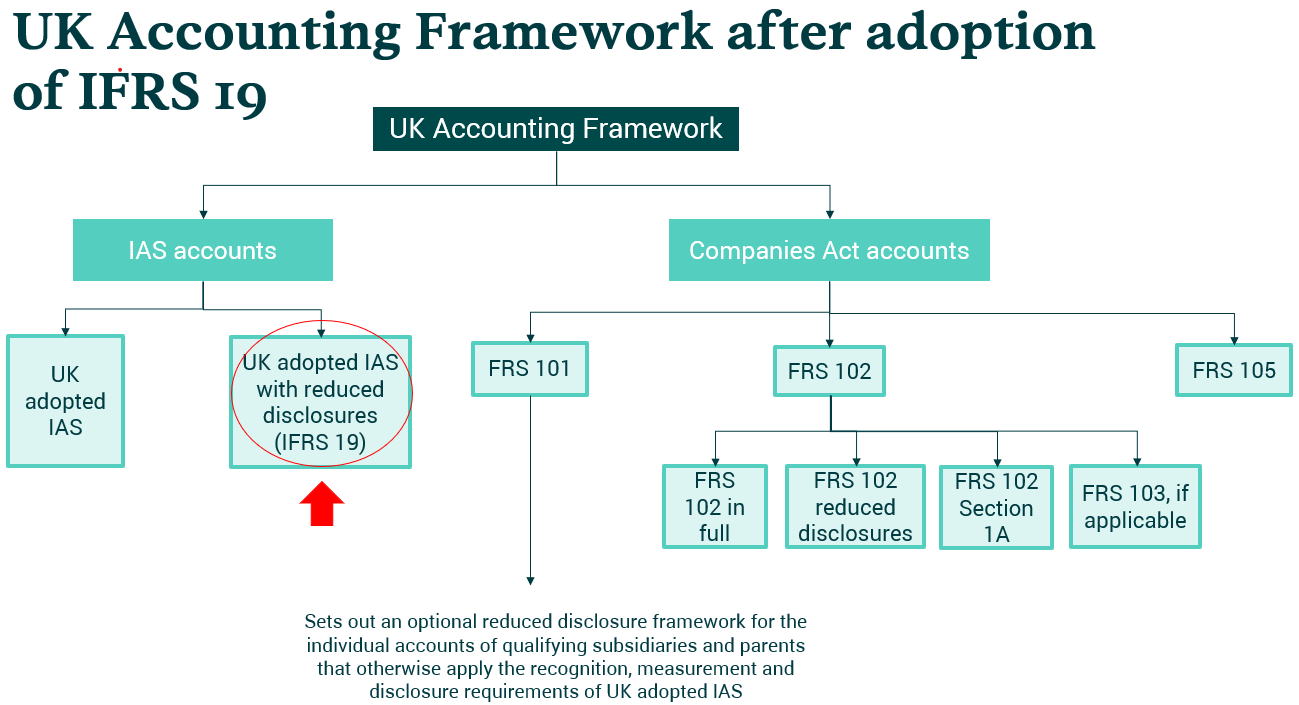
2.38Although there are two UK accounting frameworks, the different financial reporting standards and options under UK GAAP result in different options for the preparation of Companies Act accounts.
2.39If Companies Act accounts are prepared, subsidiaries of UK listed groups may apply:
- the Financial Reporting Standard 102 The Financial Reporting Standard applicable in the UK and the Republic of Ireland (FRS 102); or
- if they are qualifying entities 36, they may elect to apply Financial Reporting Standard 101 Reduced Disclosure Framework (FRS 101).
2.40Some subsidiaries may qualify to use FRS 105 The Financial Reporting Standard applicable to the Micro-Entities Regime.
2.41[IFRS 19 [if adopted for use in the UK] does not introduce a new accounting framework, as it falls under the current IAS accounts framework].
2.42[Preliminary] feedback from UKEB outreach with users, in particular bank lending departments, indicated that the introduction of IFRS 19 will not introduce significant additional complexity to the UK Accounting Framework. These users regularly deal with multiple existing accounting standards and raised no concerns about the introduction of IFRS 19 as an option for preparing subsidiary financial statements.
Reduced disclosure standards in the UK
2.43FRS 101, the reduced disclosure Standard under the Companies Act accounts framework, is conceptually similar to IFRS 19. It permits eligible entities to apply recognition, measurement and presentation requirements in IFRS Accounting Standards, with some amendments in place for compliance with the Companies Act.
2.44The scope and disclosure requirements of FRS 101 and IFRS 19 differ in some respects. In particular, FRS 101 is not restricted to entities that do not have public accountability, whereas IFRS 19 is restricted to subsidiaries that do not have public accountability. Broadly, fewer disclosures are required under FRS 101 than under IFRS 19. Refer to Appendix B for more details on the key differences between the two standards.
2.45Desk-based research and feedback from outreach with preparers has indicated widespread use of FRS 101 for preparation of UK subsidiary financial statements. Initial preparer feedback also suggests that most UK groups are likely to continue to use FRS 101 to prepare the financial statements of UK subsidiaries. One reason for continuing to use FRS 101 is that it exempts entities from the requirement to prepare a statement of cash flows. There is no equivalent exemption under IFRS 19.
2.46The Companies Act 2006 37 sets out information to be given in notes to the accounts 38. The required information includes certain company administrative facts, material off-balance sheet arrangements, directors' remuneration, details of directors' advances, credits and guarantees. These disclosure requirements are applicable to companies preparing IAS accounts. Some of the disclosure requirements are also applicable to Companies Act accounts prepared in accordance with FRS 101.
2.47However, the Large and Medium-sized Companies and Groups (Accounts and Reports) Regulations 2008 39 set out a number of requirements relating to, for example, formats for accounts, historical cost accounting rules, fair value accounting, information supplementing the balance sheet (e.g. share capital, allotted share capital that consists of redeemable shares) that are applicable to Companies Act accounts prepared in accordance with FRS 101. By contrast, these requirements do not apply to IAS accounts.
2.48Based on outreach conducted by the UKEB, no concerns were raised by preparers or accounting firms about the possibility that the introduction of IFRS 19 may add complexity to the UK accounting framework.
2.49[Preliminary] UKEB outreach with bank lending departments suggests that the impact of a change from full IFRS Accounting Standards or UK GAAP to IFRS 19 would be modest, with little effect on the models and processes used in their analysis. A UK-based credit ratings agency has also published analysis that is materially aligned with this view.
Potential accounting impact
2.50The accounting impact for overseas subsidiaries of UK groups transitioning to IFRS 19 will depend on:
- the accounting framework used prior to transition (full IFRS Accounting Standards or local GAAP); and,
- the degree of alignment between local GAAP requirements and IFRS Accounting Standards.
2.51The accounting impact for UK subsidiaries, of both UK groups and overseas groups, transitioning to IFRS 19 will depend on the framework option used to prepare the subsidiary financial statements prior to transition to IFRS 19 (see Figure 1). The table below outlines the accounting implications of switching to IFRS 19 from the most common different UK frameworks and options.
| Table 4: Accounting impact of IFRS 19 for UK subsidiaries |
|---|
| Accounting impact of applying IFRS 19 |
| Recognition, measurement and presentation |
| Full IFRS Accounting Standards to IFRS 19 |
| No impact |
| On transitioning to IFRS 19, entities continue to apply the same recognition, measurement and presentation requirements as in full IFRS Accounting Standards. |
| FRS 101 to IFRS Accounting Standards (IFRS 19) |
| No significant impact–recognition and measurement |
| An entity transitioning from FRS 101 to IFRS Accounting Standards will need to consider transitional requirements applicable for its first financial statements prepared in accordance with IFRS 1 First-time Adoption of International Financial Reporting Standards. |
| Given that the recognition and measurement requirements under FRS 101 are substantially aligned with IFRS Accounting Standards, there will be no significant changes when switching to IFRS 19, except for those few amendments in FRS 101 to IFRS Accounting Standards for compliance with the Act and the Regulations. For example, under IFRS Accounting Standards an entity that makes a “bargain purchase" recognises the resulting gain immediately in profit or loss. By contrast, under FRS 101 entities must recognise an amount of “negative goodwill" in the balance sheet, to be released to profit or loss over time. |
| Potential impact on presentation |
| However, there may be some impacts on presentation, for example: • a statement of cash flows, which is not required by FRS 101, will have to be prepared. • If, when applying FRS 101, an entity chooses the option of presenting the balance sheet and profit and loss statement in accordance with one of the Companies Act 2006 formats, the presentation of these primary statements will have to be amended to comply with the presentation requirements in IFRS Accounting Standards. |
| FRS 102 to IFRS Accounting Standards (IFRS 19) |
| Potentially significant impact |
| An entity transitioning from FRS 102 to IFRS Accounting Standards will need to consider transitional requirements applicable for its first financial statements prepared in accordance with IFRS 1 First-time Adoption of International Financial Reporting Standards. |
| For the recognition and measurement requirements in FRS 102 that are substantially aligned to IFRS Accounting Standards, transitioning to IFRS 19 will have no impact. |
| For those recognition and measurement requirements that, although based on the principles in IFRS Accounting Standards, are simplified, transitioning to IFRS 19 will lead to changes to recognition and measurement. For example, FRS 102 Section 20 Leases is based on the principles of IFRS 16 Leases with some simplified requirements for: • Recognition exemption for leases of low-value assets. • Discount rate. • Lease modifications. |
| There are also some recognition and measurement requirements in FRS 102 that are significantly different compared to IFRS Accounting Standards. Transitioning to IFRS 19 will result in significant changes to recognition and measurement in the following areas: • Deferred Tax; • Financial Instruments; • Business Combinations; For example, an entity will no longer be permitted to amortise purchased goodwill and will instead be required to test it for impairment annually as required by IFRS 3 Business Combinations and IAS 36 Impairment. • Joint Arrangements • Investment Property • Intangible Assets; and • Borrowing Costs If an entity takes the option to expense borrowing costs for a qualifying asset when applying FRS 102, these will have to be capitalised when transitioning to IFRS 19 as required by IAS 23 Borrowing Costs. Whether an entity presents financial statements in accordance with Part 1 of Schedule 1 to SI 2008/410 (‘statutory formats') or adapt the format of the profit and loss account and/or of the balance sheet to follow the requirements of FRS 102 ('adapted formats'), the presentation of these primary statements which are different compared to IFRS Accounting Standards and will have to be amended 41. |
| FRS 102 with reduced disclosures to IFRS Accounting Standards (IFRS 19) |
| Section 1A Small Entities of FRS 102 sets out different presentation and disclosure requirements for companies both entitled to and choosing to apply the small companies regime. |
| Potentially significant impact |
| Such an entity is still subject to the recognition, measurement and presentation requirements in FRS 102, so the impact of transition to IFRS 19 for recognition, measurement and presentation would be as for FRS 102 above, with the additional impact, for example: • a statement of cash flows, which is not required by Section 1A of FRS 102, will have to be prepared. |
Appendix A: Glossary
| Term | Description |
|---|---|
| The Amended Standard | IFRS 19, the Amendments and further consequential amendments published by the IASB in 2024 |
| The Amendments | Amendments to IFRS 19 |
| BRF | UK Government Better Regulation Framework |
| CA | The Companies Act |
| CBA | Cost benefit analysis |
| Disclosure Initiative | An initiative resulting in several IASB projects, including the development of IFRS 19 |
| ECA | Endorsement Criteria Assessment |
| ED | Exposure Draft |
| EFRAG | European Financial Reporting Advisory Group |
| FCL | Final Comment Letter |
| FRS 101 | Reduced Disclosure Framework (a UK Financial Reporting Standard) |
| FRS 102 | The Financial Reporting Standard applicable in the UK and Republic of Ireland (a UK Financial Reporting Standard) |
| FRS 105 | The Financial Reporting Standard applicable to the Micro-Entities Regime (a UK Financial Reporting Standard) |
| FTSE | Financial Times Stock Exchange |
| GAAP | Generally Accepted Accounting Principles |
| IASB | International Accounting Standards Board |
| IFRS | International Financial Reporting Standard(s) |
| LSE | London Stock Exchange |
| NCI | Non-Controlling Interest (a minority shareholder) |
| Notes | Disclosure notes to the financial statements |
| Primary financial statements | The following statements and their comparative information are referred to as 'primary financial statements'. They include: • a statement (or statements) of financial performance for the reporting period; • a statement of financial position as at the end of the reporting period; • a statement of changes in equity for the reporting period; and • a statement of cash flows for the reporting period; |
| PIE | Public Interest Entity |
| PIR | Post-implementation review |
| SI | Statutory Instrument |
| SMEs | Small and Medium-sized Entities |
| SSC | Shared Service Centre |
| The Standard | IFRS 19 Subsidiaries without Public Accountability: Disclosures |
| UKEB | UK Endorsement Board |
Appendix B: Overarching differences between IFRS 19 and FRS IOI
The table below highlights the overarching differences between the two standards:
| Topic | Overarching differences |
42For the purposes of FRS 101, qualifying entity is defined as a member of a group where the parent of that group prepares publicly available consolidated financial statements which are intended to give a true and fair view (of the assets, liabilities, financial position and profit or loss) and that member is included in the consolidation. Thee following are not qualifying entities:
- charities;
- entities that are both required to apply Schedule 3 to the Regulations and have contracts that are within the scope of IFRS 17 Insurance Contracts, and
- entities that are not companies but are both required to apply requirements similar to those in Schedule 3 to the Regulations and have contracts that are within the scope of IFRS 17.
43See paragraph AG9 of FRS 100 Application of Financial Reporting Requirements for the full list of Generally Accepted Accounting Principles (GAAP) which the UK government has recognised as equivalent to UK-adopted international accounting standards.
44IFRS 19 Basis for Conclusions, paragraph BC3.
45FRS 101 Basis for Conclusions, paragraph 7.
Contact Us
UK Endorsement Board 13th Floor | 1 Harbour Exchange | Harbour Exchange Square | London | E14 9GE www.endorsement-board.uk
Footnotes
-
IFRS 19 Subsidiaries without Public Accountability: Disclosures ↩↩
-
The International Accounting Standards and European Public Limited-Liability Company (Amendment etc.) (EU Exit) Regulations 2019 No. 685 (SI 2019/685) ↩↩
-
UKEB July 2025 Project Initiation Plan IFRS 19 Subsidiaries without Public Accountability: Disclosures ↩↩
-
Amendments to IFRS 19 Subsidiaries without Public Accountability: Disclosures, August 2025 ↩↩
-
Following the publication of IFRS 19 on 9 May 2024, the IASB issued consequential amendments to IFRS 19 in two separate amendments to IFRS Accounting Standards. ↩↩
-
UKEB March 2025 IASB General Update Agenda Paper 10A contains analysis of the IASB's tentative decisions and a comparison with the UKEB comment letter. ↩↩
-
The International Accounting Standards and European Public Limited-Liability Company (Amendment etc.) (EU Exit) Regulations 2019 ↩↩
-
The term 'standard' is used to refer to amendments to international accounting standards, in line with the definition of 'international accounting standards' in SI 2019/685, which includes 'subsequent amendments to international accounting standards'. ↩↩
-
The introduction to the IASB's yearly bound volumes differentiates between mandatory and non-mandatory sections of the standards. Mandatory pronouncements relate to IFRS Standards, IAS Standards, Interpretations and Mandatory Application Guidance. These are UK-adopted international accounting standards. Non-mandatory guidance includes Bases for Conclusion, Dissenting Opinions, Implementation Guidance and Illustrative Examples, together with the IFRS Practice Statements. These are not adopted by the UKEB as they are not international accounting standards, as defined in SI 2019/685. ↩↩
-
The term "standard" includes standards (International Accounting standards (IAS), International Financial Reporting standards (IFRS)), amendments to those standards and related Interpretations (Standing Interpretations Committee / International Financial Reporting Interpretations Committee interpretations) issued or adopted by the IASB. ↩
-
Refer to Section 3 Technical accounting criteria assessment. ↩
-
These descriptions are based on the qualitative characteristics of financial statements in the Framework for the Preparation and Presentation of Financial Statements adopted by the IASB in April 2001. These qualitative characteristics became part of the criteria for endorsement and adoption of IFRS in the EU's IAS Regulation (1606/2002), and, subsequently, in SI 2019/685. ↩
-
Refer to Section 4 UK long-term public good assessment. ↩
-
Refer to Section 5 True and fair view assessment. ↩
-
The requirement in paragraph 6A of IAS 8 was moved from paragraph 15 of IAS 1 Presentation of Financial Statements unchanged following the issuance of IFRS 18 Presentation and Disclosure in Financial Statements. The title of IAS 8 was changed from Accounting Policies, Changes in Accounting Estimates and Errors to Basis of Preparation of Financial Statements. This change is effective on 1 January 2027. ↩
-
This guidance was developed as part of the IASB's project on Disclosure Initiative–Targeted Standards-level Review of Disclosures. The guidance can be accessed here. ↩
-
The IFRS for SMEs Accounting Standard defines SMEs as entities without public accountability. The definition of public accountability in IFRS 19 is the same as in the IFRS for SMEs Accounting Standard except that IFRS 19 is restricted to subsidiaries. ↩
-
IASB (2023) Guidance for developing and drafting disclosure requirements in IFRS Accounting Standards, paragraph 47D. ↩
-
IFRS 15 Revenue from Contracts with Customers, IFRS 16 Leases and IFRS 18 Presentation and Disclosure in Financial Statements. ↩
-
For example, in relation to statement of compliance, financial instruments, fair value measurement. ↩
-
IFRS Accounting Standard for which full disclosures apply under IFRS 19 include:
- ↩
-
IFRS 19 paragraphs 69–71. ↩
-
In May 2025, the IASB published Educational Module 1 IFRS for SMEs Accounting Standard (Third Edition) Small and Medium Sized Entities, which provides further guidance on assessing whether an entity has public accountability. ↩
-
In the Basis for Conclusions of IFRS 19 paragraph 82, the IASB explained that a subsidiary that insures the risks only of entities in the same group (such as its parent or fellow subsidiaries) (sometimes called a 'captive insurer') and is not otherwise publicly accountable, might be eligible to apply IFRS 19 because it holds assets in a fiduciary capacity but not for a broad group of outsiders. Entities which issue insurance contracts but are not insurers may also meet the criteria to be eligible subsidiaries. ↩
-
This calculation is based on data obtained from Reuters. Subsidiaries that are likely to have public accountability have been excluded from the analysis. These include Banks, Brokerage Services, Collective Investment Fund Operators, Credit Unions, Hedge Funds, Insurers, Investment Managers and Microfinanciers. ↩
-
These figures were calculated by collating a comprehensive list of subsidiaries from the group structure of each listed entity. ↩
-
Due to the classification methodology within the Reuters database, these figures refer to entities that are classified as subsidiaries based on a quantitative measure of ownership (i.e. ownership of 50% +1 of voting stock) as opposed to the qualitative measure of control defined in IFRS 10 Consolidated Financial Statements. ↩
-
UKEB estimate based on FAME (company information in the UK and Ireland produced by the Bureau Van Dijk, a Moody's analytics company), Company Watch financial analytics and other proprietary data. ↩
-
The IFRS 19 eligibility criteria include that the entity does not have public accountability and has a parent (ultimate or intermediate) that produces consolidated financial statements available for public use that comply with IFRS Accounting Standards ↩
-
IFRS 19 Basis for Conclusions, paragraph 53. ↩
-
IFRS 19 Basis for Conclusions paragraphs 108–113. ↩
-
Excluding banks, insurance companies, funds and trusts ↩
-
Additionally, as part of the second comprehensive review of the IFRS for SMEs Accounting Standard the IASB conducted a survey and interviewed users of financial statements of companies without public accountability. The feedback among other indicated the principles used to reduce disclosures satisfy users' information needs. As indicated above, given that eligible subsidiaries are a subset of companies without public accountability these principles satisfy the information needs of users of eligible subsidiaries' financial statements. The feedback from the survey and interviews can be accessed here. ↩
-
A similar provision for consolidated (group) accounts is included in section 403 of the Act. An eligible subsidiary is permitted to apply IFRS 19 in its consolidated financial statements i.e. intermediate parents. ↩
-
See Appendix B for the definition of a qualifying entity under FRS 101. ↩
-
See Appendix B ↩
-
Companies Act 2006, paragraphs 410A–413 ↩
-
The IASB published a Disclosure Tracker in December 2024, which maps the disclosure requirements in IFRS 19 to their equivalents in other IFRS Accounting Standards. It is intended that this tracker will be updated on an ongoing basis. The tracker can be accessed here. ↩
-
See FRC's Factsheet 12 on Presentation of the financial statements. ↩
-