Results from UKEB User Survey on IFRS 18

The UKEB launched a survey for UK users of financial statements to gather their views on IFRS 18 Presentation and Disclosure in Financial Statements as part of its outreach activities. The survey closed on 30 September 2024. The information collected from this survey helped the UKEB assess the impact of IFRS 18 on UK organisations adopting the Standard if it were adopted for use in the UK. Responses were used by the UKEB as evidence for the assessment of the endorsement and adoption of IFRS 18.
Background
1This paper summarises the results of the UKEB Users survey on IFRS 18 Presentation and Disclosure in Financial Statements and provides:
- An overview of respondents followed by a summary of their views.
- A detailed summary of the feedback received on the main technical requirements of IFRS 18. More specifically on:
- categories and subtotals;
- management-defined performance measures (MPMs);
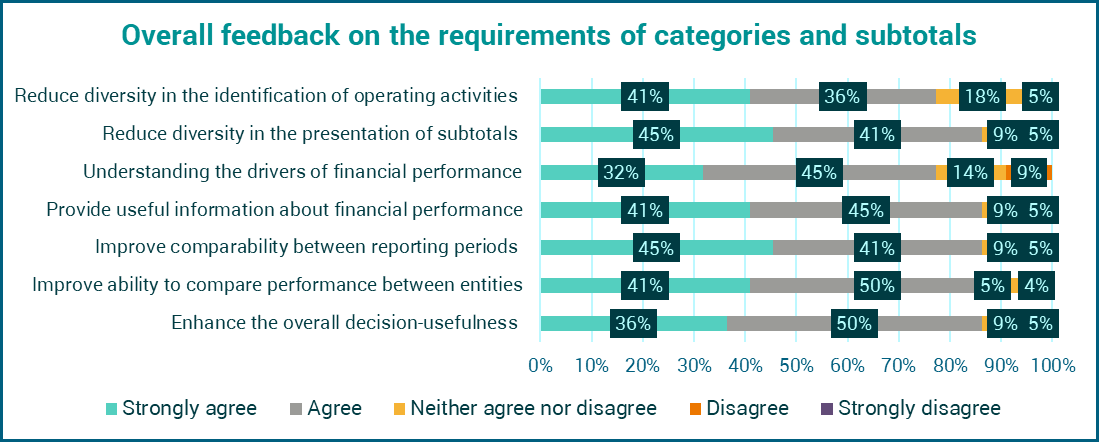
- aggregation and disaggregation; and
- limited changes to the statement of cash flows.
- A detailed summary of the feedback received on the perceived costs and benefits of IFRS 18 and the wider economic impact, comprised of assessments of:
- implementation costs;
- direct benefits; and
- wider economic effects.
Overview of survey responses
Demographics
2The survey gathered a total of 22 responses. A total of 77% of respondents were located within the UK (some of which also trade in the UK) and 23% were located outside the UK and trade in the UK. A total 41% of respondents invest in/lend to/trade in/analyse/rate UK companies. See Chart 1 below.
Chart 1: Demographics of the respondents in the users' survey
Demographics of the respondents in the users' survey
- The respondent invests in/lends to/trades in/analyses/rates UK companies: 41%
- The respondent is based in the UK: 77%
(Horizontal bar chart showing percentages for these two statements, ranging from 0% to 100%)
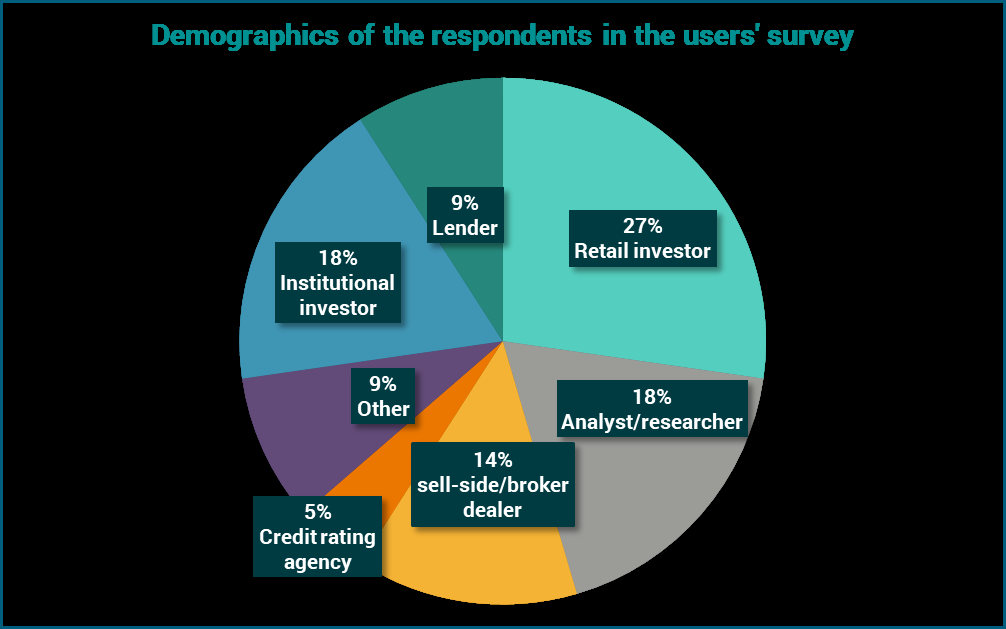
3The occupation of the respondents is shown in Chart 2 below:
Chart 2: Occupation of the respondents in the users' survey
Familiarity with the requirements in IFRS 18
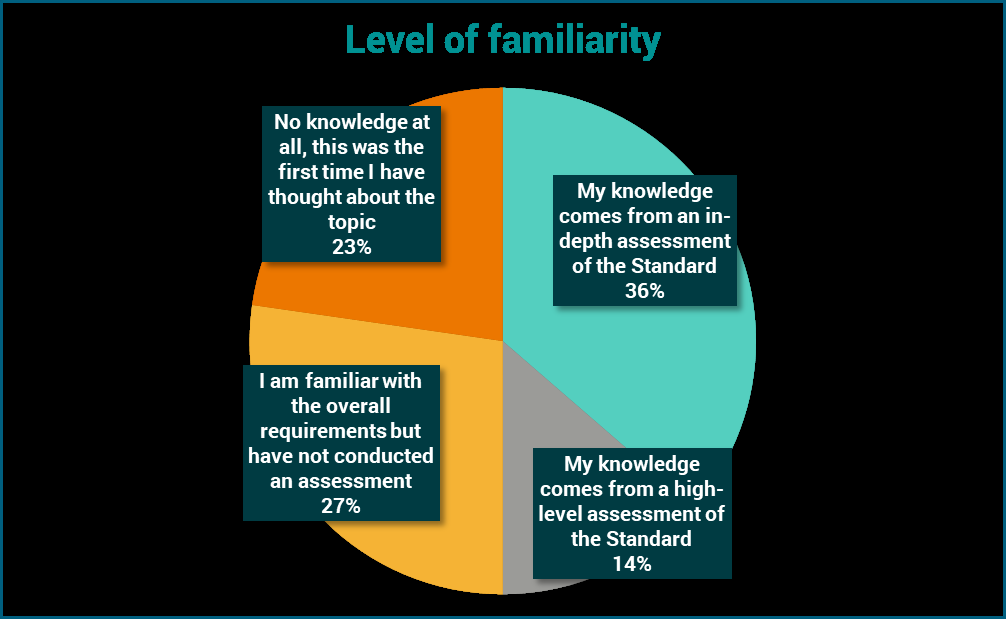
480% of respondents reported being familiar with the requirements in IFRS 18. However, amongst those respondents only a third reported having done an in-depth assessment of the Standard. These results are shown in Chart 3 below.
Chart 3: Level of familiarity
Overall views on IFRS 18
5Respondents showed support of specific aspects of the requirements of IFRS 18. When asked about the overall support of the requirements in IFRS 18 (using a scale of 1 (no knowledge) to 10 (extensive knowledge)), respondents allocated an average rating of 7.0.
6Respondents highlighted only a few areas of concern or difficulty that are described in this report.
Section 1: Feedback on technical requirements
7The survey obtained users' views received on the main technical requirements of IFRS 18.
Categories and subtotals
Benefits of new structure and defined subtotals in the income statement
8Respondents agree that the new structure and defined subtotals in the income statement will be useful (see Chart 4). This is because it will:
- enhance the overall decision-usefulness of IFRS financial statements (86%). In this respect two respondents mentioned that:
- the new structure appears clearer and more logical; and
- standardised subtotals would facilitate benchmarking and sector comparisons; and
- the structure is aligned with how most respondents view the financial statements.
- improve users' ability to compare performance:
- between entities (91%); and
- between reporting periods for the same entity (86%).
- provide decision-useful information about financial performance (86%);
- improve the understanding of the drivers of financial performance (77%); and
- reduce diversity in:
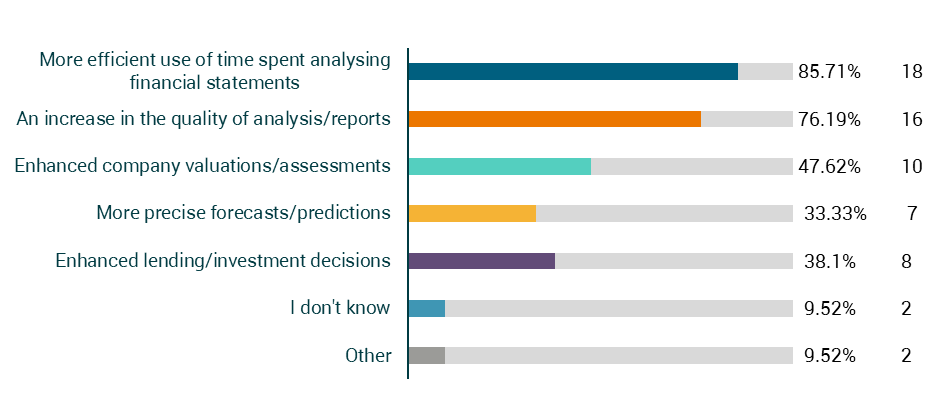
- the presentation of subtotals amongst entities (86%). Some respondents indicated that they welcomed the presentation of an 'operating profit' subtotal.
- the identification of operating activities amongst entities (77%). One respondent observed that including additional subtotals would help respondents 'tell their own story'.
Chart 4: Overall feedback on the requirements of categories and subtotals
9One respondent (a lender) observed that the new prescribed structure is not significantly different from the structure currently used by some entities.
10Two respondents observed that the new structure will be useful as a starting point for users' analysis.
Classification requirements for associates and joint ventures accounted for using the equity method
Benefits observed
1164% of respondents agreed with the requirement to classify income and expenses from investments in associates and joint ventures accounted for using the equity method in the investing category. Of the remaining respondents, 23% neither agreed not disagreed, and only the remaining 13% showed disagreement.
12Respondents mentioned that this classification is useful because:
- the equity method combines income and expenses that users of financial statements would usually analyse separately;
- the entity is not able to exercise control over the associate and joint ventures; and
- users normally consider the results from equity method investments separately to avoid distorting user's analysis of operating margins.
13One respondent (a retail investor) noted that while “ultimately this is the only way to ensure consistency”, it would be helpful to require a company to explain which of their investments in associates and joint ventures are integral or closer to the entity's core operations. Along similar lines, another respondent noted that they agreed with this presentation "as long as it's made clear where it's presented and on what basis".
14One respondent suggested that “The removal of equity accounted entities from the operating line is a huge win for users of financial statements”.
Challenges identified
15A few respondents (13%) disagreed with the classification of income and expenses derived from investments in associates and joint ventures in the investing category. Some respondents indicated in the comment box that when those investments are integral or close to the entity's core operations the classification in the operating category would be more appropriate.
Management-defined performance measures
Benefits observed
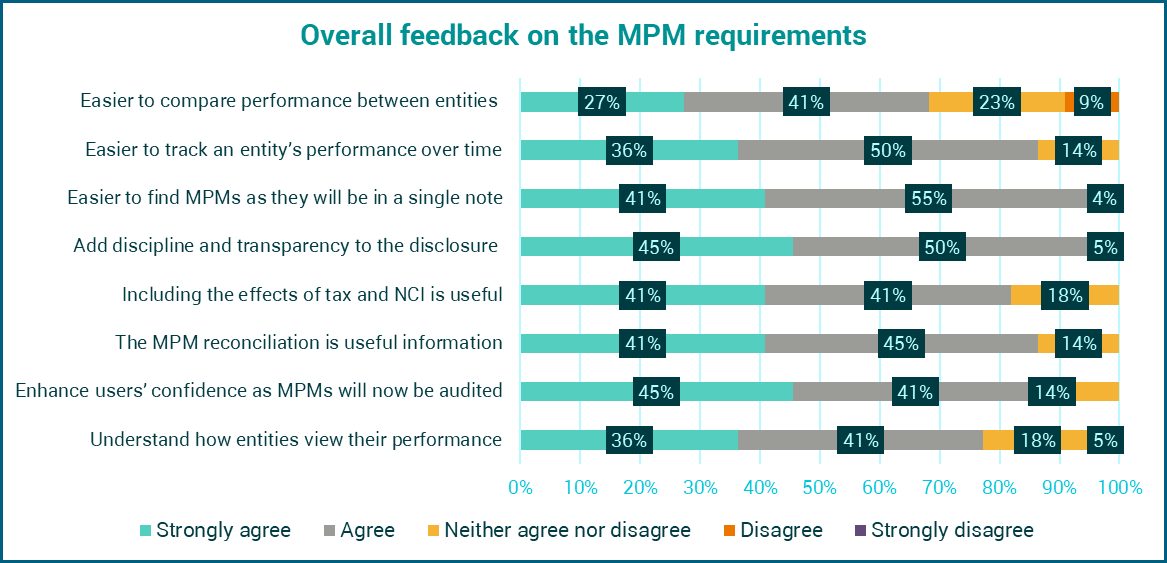
1695% of respondents agree that the requirements on MPMs will be useful because these requirements will add discipline and transparency to the disclosure of MPMs. Many users (86%) observed that auditing MPMs will enhance users' confidence in and credibility of these measures. See Chart 5.
17Many respondents (77%) were of the view that the requirements on MPMs will help users understand how entities view their performance and 86% of them agree that the requirements on MPMs will make it easier for users to track an entity's performance over time. Additionally, many respondents (68%) also think that the MPM requirements will help users compare performance between entities in the same period.
1895% agree that the requirements on MPMs will make it easier for users to find those measures in the financial statements (as they will be disclosed in a single note).
1986% of the respondents found it useful to require a reconciliation of MPMs to the most comparable subtotal.
2082% of the respondents found it useful to require information about the tax effect and the effect of non-controlling interests (NCI) for each reconciling item1.
Chart 5: Overall feedback on the MPM requirements
21One respondent (a retail investor) suggested that an explicit requirement to disclose comparative information from previous years2 as well as requiring the presentation of actual versus target performance measures would also be helpful.
Other views
22Respondents' views were split, with no clear majorities emerging (see Chart 6), on the following issues:
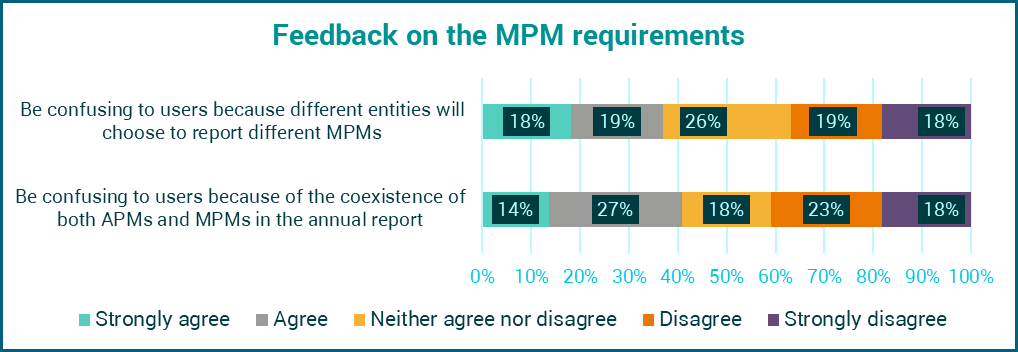
- Whether users will get confused with the disclosure of MPMs and APMs in different sections of the annual report (40% of respondents agreed; 20% neither agreed or disagreed; 40% disagreed).
- Whether the reporting by entities of different MPMs may confuse users (41% of respondents agreed; 18% neither agreed or disagreed; 41% disagreed).
Chart 6: Feedback on the MPM requirements
23In this respect:
- Two respondents (an institutional investor, lender) agree that confusion and lack of comparability is inevitable because management will choose to provide different performance measures in different sections of the annual report.
- A few other respondents (institutional investors, analysts and researchers) consider that no confusion should arise as users are sophisticated enough to understand the nature of MPMs and APMs.
24A respondent (credit rating agency) observed that management will continue using both APMs and MPMs to steer the narrative around business performance.
Aggregation and disaggregation
Benefits observed
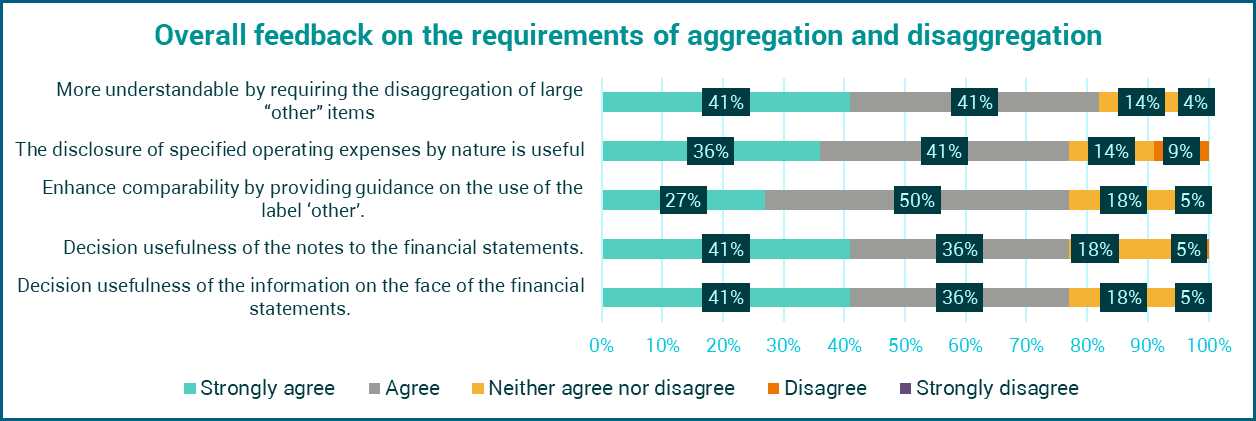
2577% of respondents agreed that the requirements on aggregation and disaggregation will enhance the decision usefulness of:
- the information on the face of the financial statements; and
- the notes to the financial statements.
26Respondents also indicated that the requirements will bring increased clarity and transparency of the information presented/disclosed.
2777% of respondents agreed that the guidance on the use of the label 'other' and requiring the disaggregation of large 'other' items will enhance comparability.
2882% of respondents agreed that the guidance on the use of the label 'other' will also enhance 'understandability' and would potentially prevent companies from "masking" performance drivers.
2977% of respondents also agreed that information on specified operating expenses by nature in the notes (if an entity presents operating expenses by function on the face of the income statement) will be useful.
Chart 7: Overall feedback on the requirements of aggregation and disaggregation
Challenges identified
3013% of respondents showed some concern that the aggregation and disaggregation principles may be interpreted in different ways leading to a loss of comparability.
Limited changes on the statement of cash flows
Benefits observed
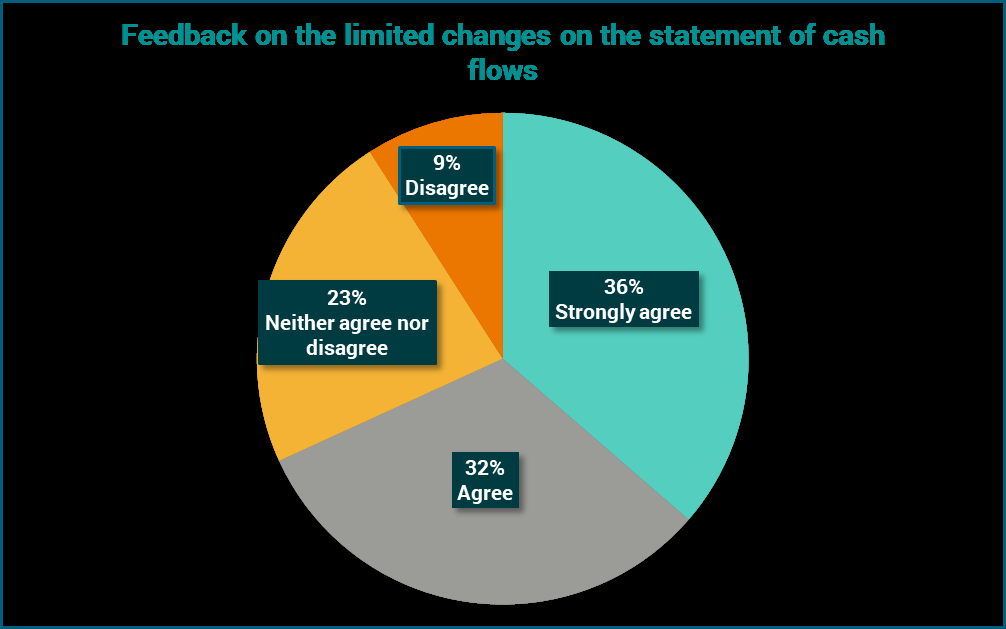
3168% of respondents agreed that the limited amendments to IAS 7 Statement of Cash Flows will improve the usefulness of the statements of cash flows (see Chart 8). Some of these respondents commented that this is because:
- having a consistent starting point (i.e. 'operating profit') for reporting cash flows from operating activities is helpful because this will enhance the comparability of the statement of cash flows and will be easier to interpret by users; and
- standardising the classification of interest and dividend cash flows in the statement of cash flows will lead to consistency and better comparability of this information across entities.3
Chart 8: Feedback on the limited changes on the statement of cash flows
Challenges identified
32Two respondents (an institutional investor, a retail investor) noted their disappointment that IFRS 18 had not sought full alignment between the categories in the income statement and the activities in the statement of cash flows. One respondent (sell-side broker-dealer) noted that banks do not find the statement of cash flows useful.
Section 2: Feedback on costs and benefits and the wider economic impact
33The survey investigated users' views and collected information as input to the long-term public good (LTPG) assessment on IFRS 18.
34In its LTPG assessment, the survey obtained data on:
- direct costs to users:
- incremental one-off costs;
- incremental ongoing costs;
- direct benefits for users; and
- the wider economic impact of IFRS 18.
Direct costs to users
35Respondents were asked about incremental one-off and ongoing costs, as well as about incremental cost reductions associated with the adoption of IFRS 18.
One-off costs
36Respondents were asked to provide an estimate of the extra one-off costs related to the analysis of the first set of financial statements after the implementation of IFRS 18. Costs were expressed as a share of their operating costs, when applicable. The cost categories identified were:
- familiarisation;
- analysis of revised data from financial systems; and
- changes in internal processes or systems for analysing financial statements.
C2A total of 18 users responded to this question as follows:
- Users, ranging between 55% and 61% depending on the cost category considered, indicated that one-off costs were expected to be nil; and
- The remaining portion of the responses indicated one-off costs were expected to be lower than 1% of operating costs (only one respondent suggested that familiarisation costs may be between 1% and 5% of operating costs).
37One analyst noted that “The main cost will be a one-time change to our models that is far outweighed by the benefits”. One retail investor noted that: “The cost, if any, will be time, not monetary, but worthwhile for users/investors.”
Ongoing costs
38Users were asked to provide an estimate of any annual extra costs that they anticipated their organisation would incur on the analysis of revised data from IFRS 18 financial statements on an ongoing basis. Costs had to be indicated as a share of their operating costs. Comments suggested that users do not expect any significant ongoing costs.4
Ongoing cost reductions
39Users were asked to provide an estimate of any annual cost reductions that they anticipate their organisation will incur on the analysis of revised data from IFRS 18 financial statements on an ongoing basis.
40Comments suggested that most users do not expect significant ongoing cost reductions.
41However, two users mentioned cost savings.
- An institutional investor noted: “Overall this will reduce modelling costs on an ongoing basis as the presentation of the numbers is more closely aligned with how our standard model is constructed.”
- An analyst noted: “Savings will be ongoing (but will taper off as the saving are internalised into our new modelling).”
42Another user commented on how the standard may lead to a more efficient allocation of resources: “There will be no cost cuts as the resources will be spent on doing more strategic analysis on the value chains of the businesses and the competitive dynamics for the industries.”
Direct benefits for users
43Academic literature suggests that enhanced financial reporting can lead to a number of direct benefits for users, such as more efficient use of time spent analysing financial statements or improved decision-making/capital allocation. Accordingly, the implementation of IFRS 18 may be expected to provide users with similar benefits.
44The users' survey draws from the academic literature to investigate direct benefits for users. In particular, the survey asked users to indicate whether they expected IFRS 18 to lead to any of the following benefits:
- more efficient use of time spent analysing financial statements;
- an increase in the quality of analysis/reports;
- enhanced company valuations/assessments;
- more precise forecasts/predictions; and
- enhanced lending/investment decisions.
Users were asked to select all the options that applied.
45The results suggest that most respondents believe that the standard will be associated with more efficient use of time spent analysing financial statements (86%), and an increase in the quality of analysis/reports (76%). A significant percentage of users believe the standard will lead to enhanced company assessments (48%).5 Chart 9 below provides a graphical representation.
Chart 9: Direct benefits of IFRS 18 to users of primary financial statements
Wider economic impact
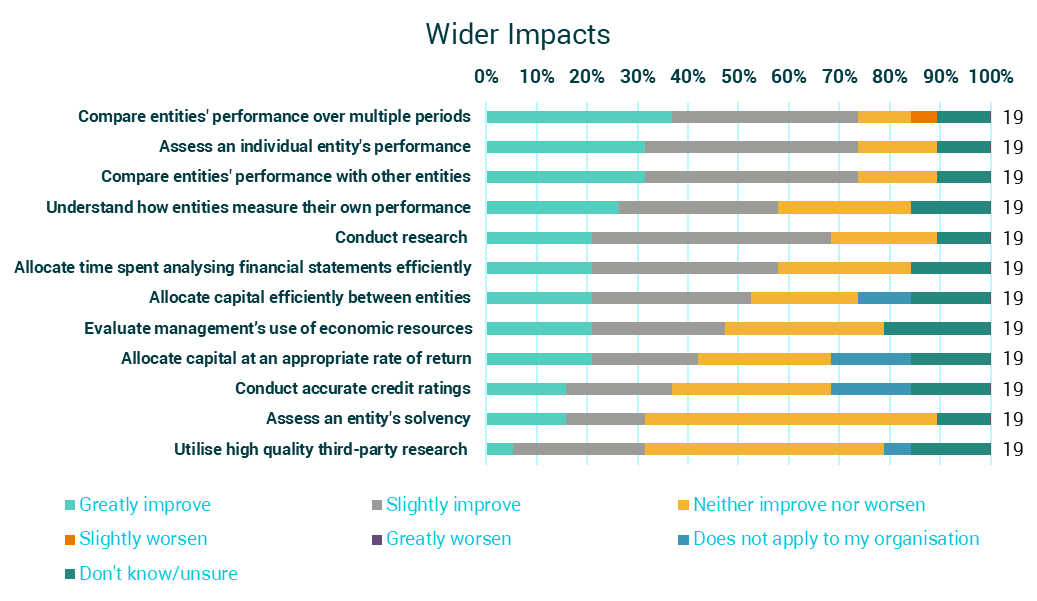
46A total of 19 users provided their views on the wider economic impact of IFRS 18. On the items listed below, users indicated that IFRS 18 will either slightly improve or greatly improve their ability to analyse financial statements:
- compare entities' performance over multiple periods;
- assess an individual entity's performance;
- compare entities' performance with other entities;
- understand how entities measure their own performance;
- conduct research;
- allocate time spent analysing financial statements efficiently; and
- allocate capital efficiently between entities.
47On some responses were more split. These were:
- evaluate management's use of economic resources (47% [improve], 32% [neither improve nor worsen], 0% [worsen], 0% [does not apply to my organisation], 21% [don't know/unsure]),
- allocate capital at an appropriate rate of return (42% [improve], 26% [neither improve nor worsen], 0% [worsen], 16% [does not apply to my organisation], 16% [don't know/unsure]),
- conduct accurate credit ratings (37% [improve], 31% [neither improve nor worsen], 0% [worsen], 16% [does not apply to my organisation], 16% [don't know/unsure), and
- utilise high quality third-party research (32% [improve], 47% [neither improve nor worsen], 0% [worsen], 5% [does not apply to my organisation], 16% [don't know/unsure).
48For the assessment of a company's solvency, a narrow majority of respondents indicated that no effect was anticipated. This result is expected considering that IFRS 18 mainly deals with the presentation of financial performance (and therefore would not alter balance sheet line items or ratios).
49It is worth noting that almost no respondents indicated that the standard will negatively impact any of the activities mentioned. Chart 10 in the next page provides a graphical representation of these results.
Chart 10: Wider economic impacts of IFRS 18 (users)
50In summary, in terms of the direct benefits to users (consisting mostly of retail investors, institutional investors, and analysts/researchers), the preliminary view is that they agree that IFRS 18 will lead to more efficient use of time spent analysing financial statements, and an increase in the quality of analysis/reports. There is also agreement that the standard will enhance company valuations/assessments and will also allocate capital efficiently between entities.
51Users believe that the implementation of IFRS 18 will neither improve nor worsen the ability of their organisation to utilise high quality third-party research.
Footnotes
-
One respondent was against allowing choices in calculating the tax effect for reconciling items (i.e. where respondents provide a reasonable estimate of these tax effects). ↩
-
The Secretariat observes that paragraph 32 of IFRS 18 requires comparative information for information disclosed in the notes to the financial statements. ↩
-
One respondent showed concern that the approach for classifying interest and dividends cash flows is not aligned with US GAAP. ↩
-
Some comments are reported: "Nil", "Negligible", "Very marginal", "All costs will be one-time", "not applicable". ↩
-
The numbers for the previous percentages do not need to add up to 100% as respondents could select multiple items. ↩