Results from UKEB Preparer Survey on IFRS 18
OFFICIAL - PUBLIC

The UKEB launched a survey for UK preparers of financial statements to gather their views on IFRS 18 Presentation and Disclosure in Financial Statements as part of its outreach activities. The survey closed on 30 September 2024. The information collected from this survey helped the UKEB assess the impact of IFRS 18 on UK organisations adopting the Standard if it were adopted for use in the UK. Responses were used by the UKEB as evidence for the assessment of the endorsement and adoption of IFRS 18.
Background
1This paper summarises the results of the UKEB Preparer survey on IFRS 18 Presentation and Disclosure in Financial Statements and provides:
- An overview of respondents followed by a summary of their views.
- A detailed summary of the feedback received on the main technical
requirements of IFRS 18. More specifically on:
- categories and subtotals;
- management-defined performance measures (MPMs);
- aggregation and disaggregation; and
- limited changes to the statement of cash flows.
- A detailed summary of the feedback received on the perceived costs and
benefits of IFRS 18 and the wider economic impact, comprised of
assessments of:
- implementation costs;
- direct benefits; and
- wider economic effects.
Overview of survey responses
Demographics
2The survey gathered a total of 46 responses from preparers using UK-adopted International Accounting Standards in their financial statements that are either listed or incorporated in the UK. Responses (96%) were submitted on behalf of a group. The remaining responses (4%) came from individual entities.
3Of the responding entities:
- 41% are listed on the FTSE 100;
- 22% are listed on the FTSE 250;
- 11% are listed on the Alternative Investment Market (AIM); and
- 26% are either UK private companies or UK subsidiaries of companies listed abroad.
4The responses came from a broad representation of eleven key UK sectors ranging from the financial services sector, through to real estate and basic materials (see Chart 1 below).
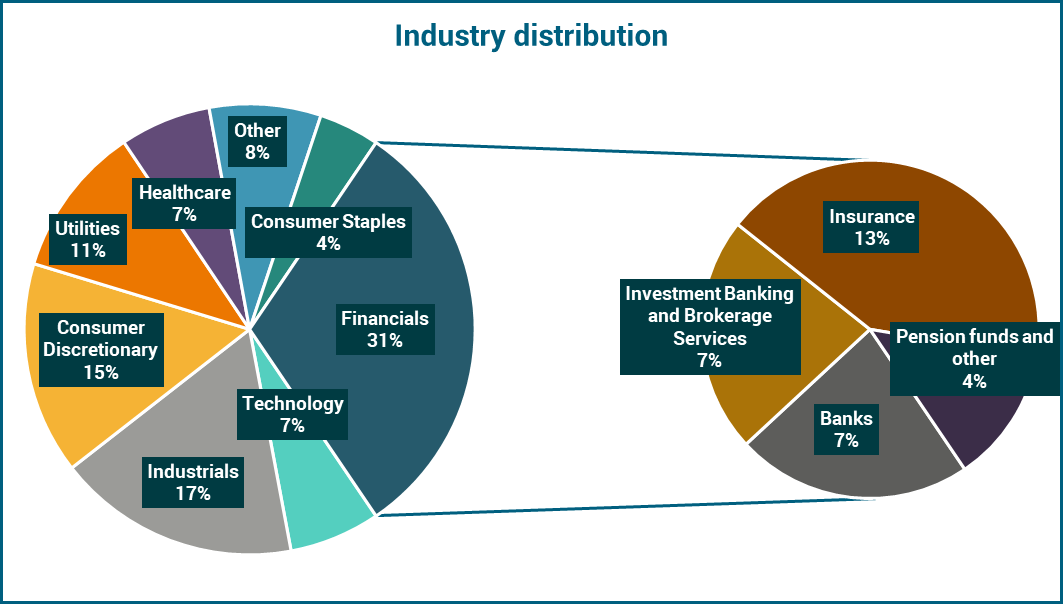
519 respondents (41%) have at least one of the two specified main business activities as defined in IFRS 18 (i.e. either they invest in assets or provide financing to customers or carry out both activities). Among these respondents:
- 11 entities invest in assets as a main business activity;
- 4 entities provide financing to customers as a main business activity; and
- 4 entities have both specified main business activities.
Familiarity with the requirements in IFRS 18
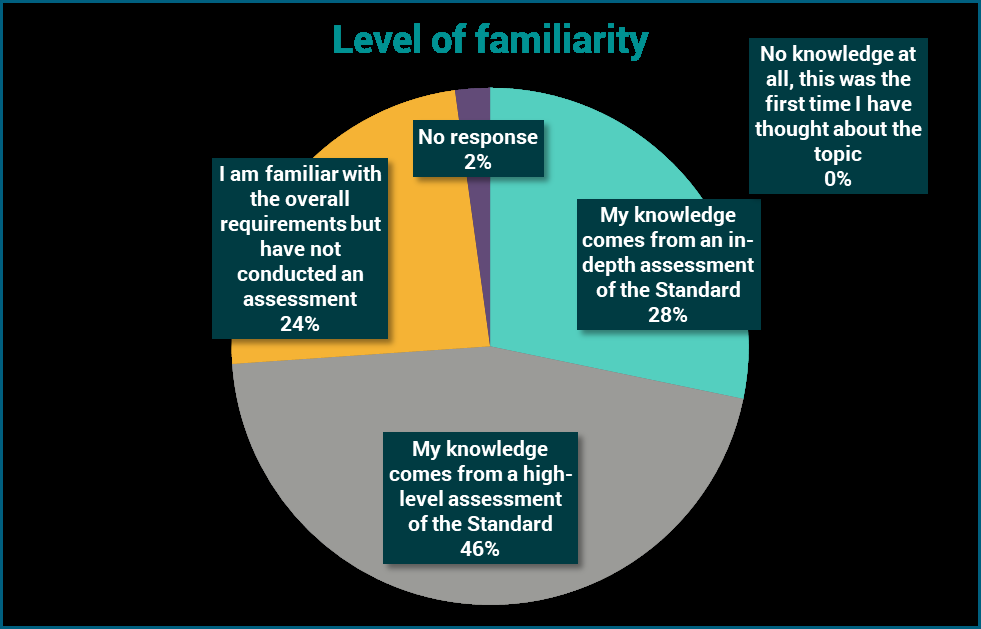
6Respondents1 reported being familiar with the requirements in IFRS 18. However, amongst those respondents just over a quarter reported having done an in-depth assessment of the Standard. These results are shown in Chart 2 below.
Overall views
Overall rating
7Respondents were generally supportive of specific aspects of the requirements of IFRS 18. When asked about the overall support of the requirements in IFRS 18 (using a scale of 1 (no knowledge) to 10 (extensive knowledge)), the average rating for all respondents was 62. This was due to potential areas of concern or difficulty that are described in this report.
Expected changes
8Four respondents (9%) observed that the application of IFRS 18 is not expected to bring significant changes to the data they currently collect. These respondents also considered that IFRS 18 is not expected to bring significant changes to the way they are presenting or disclosing information.
9One respondent did not consider that there was a need for a new standard on presentation and disclosure. Another respondent did not foresee many benefits on the application of IFRS 18 for their particular industry.
Whether there is enough time to implement IFRS 18
10One respondent noted that the effective date of IFRS 18 of 1 January 2027, is reasonable and allows sufficient time to implement the Standard. On the contrary, another respondent suggested that the timeline of adoption may be challenging. It was also noted that for entities that have dual listings and are required to provide more than one comparative period it may take them longer to implement IFRS 18.
Section 1: Feedback on technical requirements
Categories and subtotals
11The survey obtained respondents' views on:
- The overall requirements on defined categories and subtotals.
- The requirements for entities with specified main business activities (that either they invest in assets or provide financing to customers or carry out both activities).
- The classification of income and expenses from investments in associates and joint ventures accounted for using the equity method in the investing category (i.e. equity-accounted investments).
- The transitional provisions in paragraph C7 of IFRS 18 that allow an eligible entity to change its election for measuring an investment in an associate or joint venture from the equity method to fair value through profit or loss (applying paragraph 18 of IAS 28 Investments in Associates and Joint Ventures).
Overall requirements on defined categories and subtotals
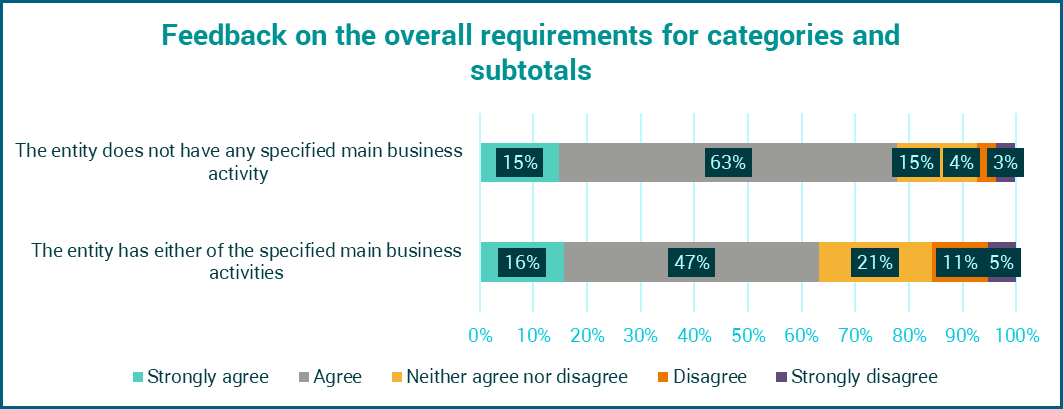
12The survey included a question about the overall requirements for defined categories and subtotals. This question was answered by respondents that have (and that do not have) specified main business activities. As shown in Chart 3 below:
- 78% of the respondents who do not have a specified main business activity strongly agree or agree with these requirements, 15% were neutral, 4% disagree with these requirements and 3% strongly disagree; and
- 63% of the respondents that have specified main business activities strongly agree or agree with these requirements; 21% were neutral, 11% disagree with these requirements and 5% strongly disagree.
Why did respondents agree with the requirements on defined categories and subtotals?
13Respondents who agreed with the requirements on defined categories and subtotals (this includes those respondents who reported having and not having specified main business activities) observed a number of benefits derived from these requirements. They think that these requirements will:
- help achieve more consistency in the presentation of information in the income statement across entities and potentially reduce diversity in practice;
- help provide more comparable information (e.g. a more comparable operating profit line) that would help users with their analysis;
- provide entities with flexibility to tailor their financial information to 'tell their story'. For example, entities may be able to add extra subtotals or to include MPMs that would help a user understand an entity's performance;
- enhance the understandability of an entity's business activities;
- potentially remove the need to include some adjusted performance measures; and
- increase the relevance of financial performance information for users.
Why did respondents disagree with the requirements on defined categories and subtotals?
14Respondents who were neutral or who agree or strongly disagree with the requirements on defined categories and subtotals (this includes those respondents who reported having and not having specified main business activities) observed a few challenges derived from these requirements. A summary of these challenges is presented below:
- One respondent indicated that these requirements leave some room for interpretation which could in turn lead to a loss of comparability.
- Respondents reported that some requirements may add unnecessary
complexity for preparers and/or would appear confusing to users. For
example:
- One respondent commented that the classification of foreign currency exchange differences in different categories of the income statement would add complexity as it would require entities to trace the nature of the transactions giving raise to differences which would involve changes in accounting systems3.
- One respondent commented that classifying interest income on cash equivalents (in investing) and interest expense on borrowings (in financing) would be confusing to users.
- One respondent commented that applying the requirements for the classification of fair value gains and losses from derivatives would be complex (as fact patterns may vary) and would involve systems changes.
- One respondent was of the view that EBITDA should have been a required subtotal in IFRS 18 as it is a widely used subtotal.
- One respondent observed that the classification of single transactions in different categories may lead to confusion. For example, when applying IFRS 16 Leases, IFRS 18 requires the depreciation of the right-of-use assets to be classified in the operating category, and the finance charges to be classified in the financing category. (although one respondent acknowledged that this subtotal could potentially be derived from the current structure).
Requirements for entities with specified main business activities
Overview of responses
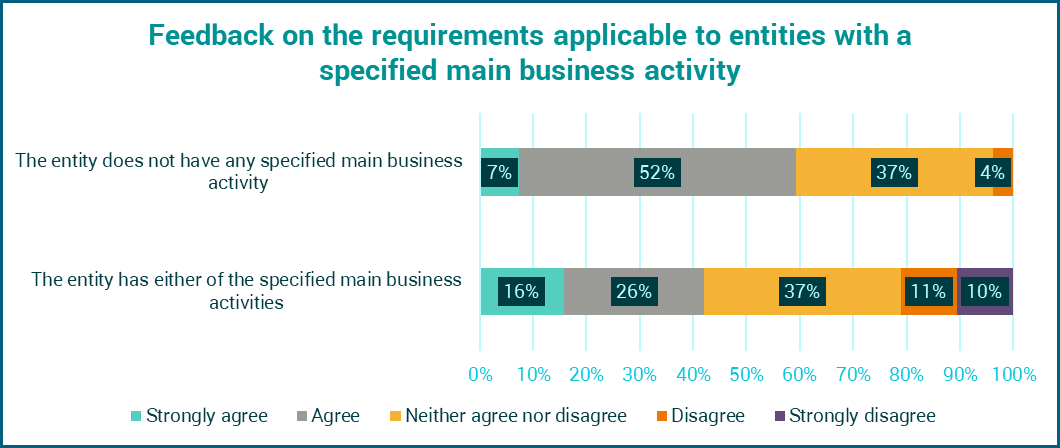
15The survey included a question about the requirements for entities with specified main business activities. This question was answered by respondents that reported having (and not having) specified main business activities. As shown in Chart 4 below:
- 59% of the respondents who do not have a specified main business activity strongly agree or agree with these requirements, 37% were neutral and 4% disagree with these requirements; and
- 42% of the respondents who have a specified main business activity strongly agree or agree with these requirements; 37% were neutral, 11% disagree with these requirements and 10% strongly disagree.
Why did respondents agree with the requirements for entities with specified main business activities?
16Respondents who agreed with the requirements for entities with specified main business activities (this includes respondents who reported having and not having specified main business activities) observed the following benefits derived from these requirements. They will:
- bring more comparability and consistency for investor's analysis;
- provide a more faithful representation of the nature of an entity's main business activities (for example, by excluding from operating profit income and expenses not directly related to an entity's main business activities); and
- allow these entities to portray their operations in a better way by giving them a choice in the presentation of certain income and expenses.
17One respondent from the insurance sector agreed that the requirements on categories and subtotals will be an improvement but noted that IFRS 17 Insurance Contracts has already helped enhance comparability (for entities within the scope of this Standard).
Why did respondents disagree with the requirements for entities with specified main business activities?
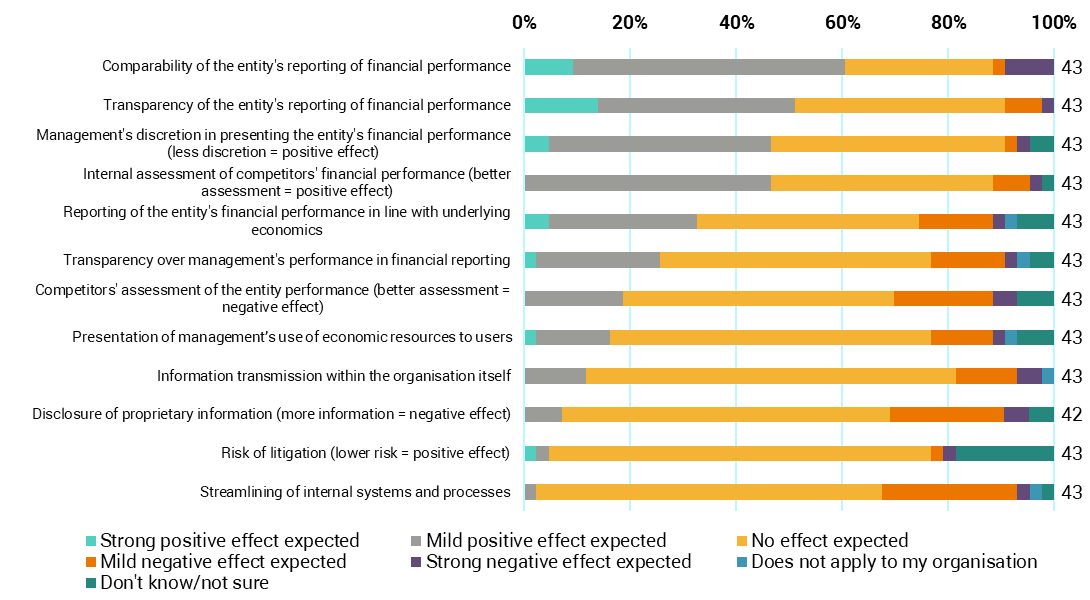
18Respondents who reported not having main specified business activities did not report concerns on the specific requirements applicable to entities with specified main business activities apart from one respondent who commented that the required separation of financing and investing results would require costly system changes (e.g. for a subsidiary that will need to split intercompany results across the different categories by its nature).
19Respondents who reported having main specified business activities (these include those that were neutral or that they disagree or strongly disagree with the requirements for specified main business activities) expressed the following concerns:
- Two respondents observed that allowing an accounting policy choice4 for entities that provide financing to customers as a main business activity would lead to a loss of comparability.
- One respondent from the real estate sector observed that IFRS 18 will change the classification of some income and expenses that they normally exclude from 'operating' (for example 'revaluation gains and losses') and therefore they may have to rely on MPMs to continue excluding these items from their operations.
- Two respondents from the insurance sector were not convinced that the
required categorisation in IFRS 18 will result in better comparability across
the insurance sector.
- One respondent commented that more guidance is needed to understand the link between the requirements in IFRS 17 and the presentation and disclosure requirements in IFRS 18 to make sure that they are consistent.
- One respondent observed that it is too early to determine the impact of the requirements for banks.
Classification of income and expenses from equity-accounted investments
Overview of responses
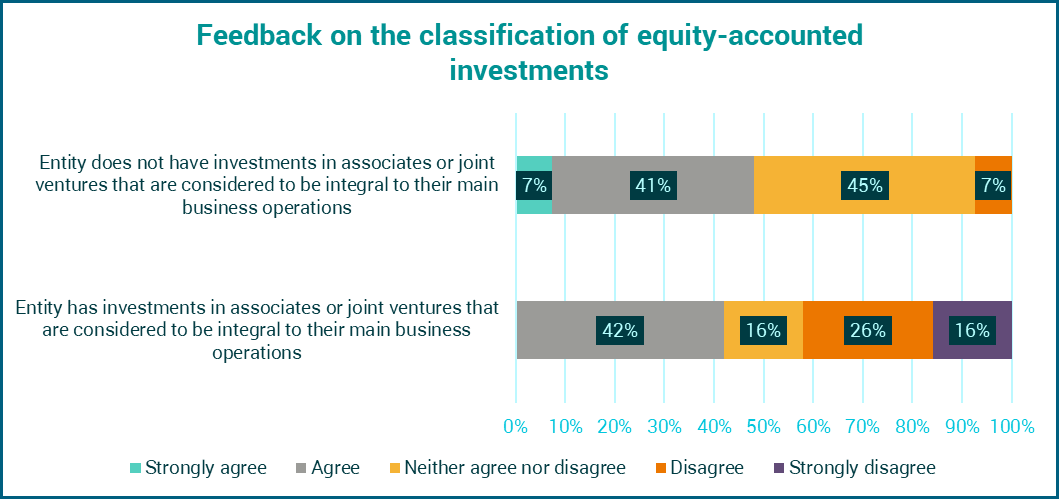
20The survey included a question about the requirements for classifying income and expenses from investments in associates and joint ventures accounted for using the equity method. This question was answered by respondents who reported having (or not having) investments in associates and joint ventures that are considered 'integral' to their main operations. As shown in Chart 5 below:
- 48% of the respondents who reported not having 'integral' investments in associates and joint ventures strongly agree or agree with the classification requirements for income and expenses derived from equity- accounted investments in 'investing'; 45% were neutral and 7% disagree with these requirements.
- 42% of the respondents who reported having 'integral' investments in associates and joint ventures agree with the classification requirements for income and expenses derived from equity-accounted investments in 'investing'; 16% were neutral; 26% disagree with these requirements and 16% strongly disagree.
Why did respondents agree with the requirement to classify income and expenses derived from equity-accounted investments in 'investing'?
21Respondents consider that the requirement to classify income and expenses derived from equity-accounted investments in ‘investing' will bring more comparability and consistency in the presentation of these income and expenses.
22Respondents that were ‘neutral' to this requirement observed that they:
- do not have investments in associates and joint ventures accounted for using the equity method; or,
- do not consider their investments in associates and joint ventures to be either material and/or integral to their main business operations.
Why did respondents disagree with the requirement to classify income and expenses derived from equity-accounted investments in 'investing'?
23Respondents who disagreed with the requirement to classify income and expenses derived from equity-accounted investments in ‘investing' (around 26% from a variety of sectors) think that entities should have flexibility to classify equity-accounted investments in the operating category when these investments are:
- considered as part of the entity's main business operations; or
- considered strategic partnerships. For example, joint ventures are commonly used in large-scale infrastructure projects that require substantial capital to develop and structure large-scale infrastructure projects.
24In the view of some of these same respondents, not having flexibility to classify these investments in the operating category may:
- limit the understanding of the true nature and strategic value of those investments and of an entity's main business operations;
- signal that management is making poor investment decisions in the case of investments in associates and joint ventures that are making losses;
- create a presentation mismatch for insurance companies as the operating category would only include expenses related to insurance contract liabilities and no associated investment results from the assets (that are used to back insurance contracts). In their view this would not provide useful information for users.
25One respondent observed that adding a subtotal of operating profit and income and expenses from associates and joint ventures accounted for using the equity method would not help users understand that these investments are part of an entity's main business activities.
26One respondent noted that it will continue using alternative performance measures to indicate that its equity-accounted investments are part of their main business operations.
Transitional provisions to permit an eligible entity to change the measurement basis of an investment in an associate or joint venture
27Paragraph C7 of the Transitional Provisions in IFRS 18 permit an eligible entity to change its election for measuring an investment in an associate or joint venture from the equity method to fair value through profit or loss. The survey asked for comments on this relief.
Why did respondents agree with the election offered on transition?
28Many respondents (54%) were neutral on the election offered on transition to IFRS 185. Some respondents commented that this is because they do not have investments in associates and joint ventures accounted for using the equity method.
29Some respondents (24%) agreed with the election offered on transition to IFRS 18, because it provides respondents with a one-time opportunity:
- to classify the income and expenses from investments in associates and joint ventures in the operating category if these investments are made in the course of an entity's main business activities; and
- to better reflect the value of their investments in associates and joint ventures.
Why did respondents disagree with the election offered on transition?
30Some respondents (21%) did not support the election offered on transition to IFRS 18 because:
- introducing an election would impair comparability across entities in the same sector/industry;
- the election offered on transition is limited to eligible entities6;
- using fair value to measure an investment in an associate or joint venture
would:
- increase earnings volatility in profit and loss, which may lead to the presentation of additional performance measures;
- add a layer of complexity and subjectivity in the measurement of these investments, for example, in determining the fair value of unlisted investees; and
- be onerous as entities will be required to prepare disclosures under other IFRS Accounting Standards.
Feedback on management-defined performance measures
31The survey obtained respondents' views on the requirements in IFRS 18, particularly on:
- The overall MPM requirements.
- The level of consistency of current practices with the requirements for calculating and disclosing MPMs.
Overall MPM requirements
Why did respondents agree with the MPM requirements?
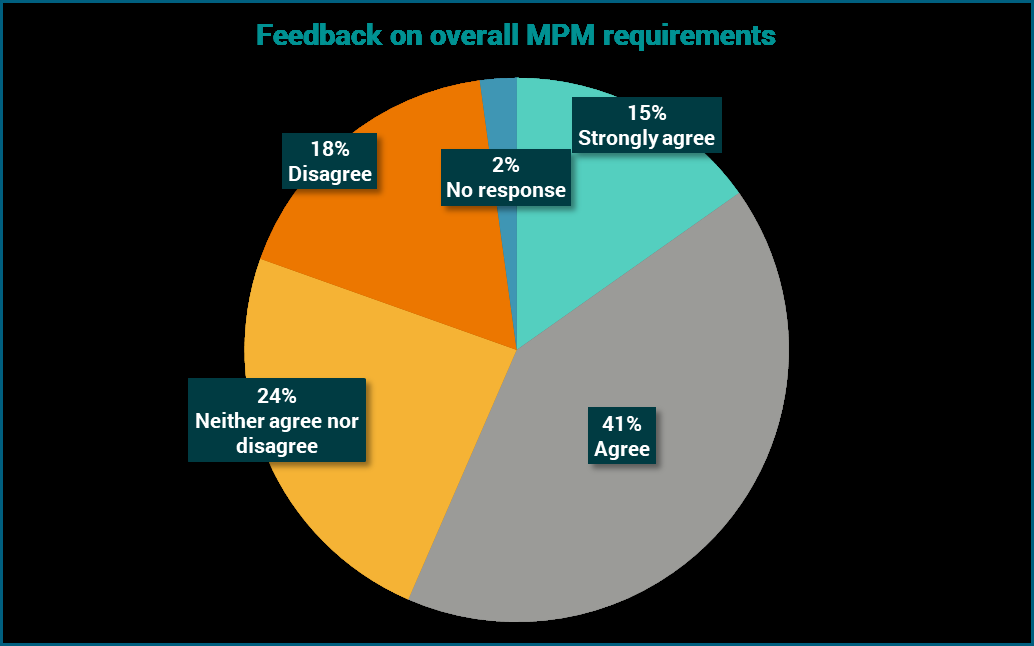
3256% of respondents considered that the requirements on MPMs will represent an improvement over current practices for communicating financial performance. See Chart 6 below. Some of the reasons provided were that:
- including these measures in a single location in a note to the financial statements will bring discipline, transparency and confidence on those measures as they will be subject to external audit; and
- the MPM requirements will improve understandability and comparability of these measures for users.
Why did respondents were neutral or disagree with the MPM requirements?
33Respondents who were neutral (24%) or who disagree (18%) with the MPM requirements expressed the following concerns:
- 15% of respondents observed that having two sets of performance measures (Alternative Performance Measures or ‘APMs' and MPMs), located in different sections of the annual report would be confusing for users. In addition, it would be unclear if any specific performance measure is more relevant than the other.
- 11% of respondents observed that entities with dual listings in other jurisdictions may be subject to different rules when disclosing its non- GAAP performance measures, creating inconsistencies and confusion to users. For example, the requirement to disclose MPMs in the financial statements may be inconsistent with the requirements set out by the US securities regulator to disclose alternative performance measures outside the financial statements.
- 4% of respondents disagreed with MPMs being only subtotals of income and expenses and observed that other measures, including for example, net debt or adjusted cash flow metrics are important in some industries for evaluating the performance of an entity. One of those respondents also expressed confusion about which measures would be within the scope of the MPM requirements and was of the view that IFRS 18 does not gives enough guidance in this respect.
- One respondent noted that as the definition of the operating category does not permit insurers to exclude certain items (e.g. fair value investment variances or economic assumption changes) they will rely on MPMs to make adjustments to operating profit.
- A few respondents were of the view that subjecting MPMs to auditing could present challenges for both preparers (i.e. could increase audit fees) and auditors (i.e. could add complexity to the audit process).
- One respondent did not see the benefit of transferring their APMs to the financial statements and viewed this as an onerous task.
Other views
34Respondents questioned the need to have a new set of requirements given that many entities already follow ESMA's Guidelines on Alternative Performance Measures (APMs)7 which are considered fit for purpose.
35A couple of respondents8 explicitly mentioned an increase of their adjusted performance measures following their implementation of IFRS 17 (one noted that this was due to IFRS 17 not reflecting interest rate risk in line with management).
36One respondent expressed support for the overall objective of the MPM disclosure requirements but questioned whether their own performance measures (which explain differences between their statutory results and the regulatory allowed revenues) would in fact meet the definition of MPMs.
Level of consistency of current practices with the requirements for calculating and disclosing MPMs
37The survey asked respondents if their current practices for communicating performance measures were aligned (or not) with the requirements for MPMs in IFRS 18.
38The following practices were reported to be aligned with the following MPM requirements:
- Disclosure of how MPMs are calculated. Around 96% of respondents noted that their current practice is consistent with this requirement. In addition, 89% agree that they include an explanation of why, in management's view, their alternative performance measures provide useful information about the entity's financial performance.
- Reconciliation between their MPMs and the most directly comparable subtotal listed in IFRS 18 or total/subtotal specifically required by other IFRS Accounting Standards: Around 91% of respondents noted that they add this reconciliation.
- Explanation of why, in management's view, the MPM provides useful information about the entity's financial performance. Around 89% of respondents noted that their current practice is consistent with this requirement.
- Clear explanations of any changes on their MPMs (including changing their calculation, introducing or removing performance measures): Around 78% agree that they provide these explanations. A few of these respondents also noted that they have not made changes to their performance measures recently.
39The following practices were reported not be aligned with the following MPM requirements:
- Inclusion of the tax effect for each reconciling item and a description of
how this tax effect is determined. Around 57% of respondents identified
that their current practices are not consistent with the requirements in
IFRS 18 to include the tax effect for each reconciling item and a
description of how this tax effects is determined. This is because:
- their reconciliation is to operating profit so adding the tax effects is viewed as unnecessary;
- the tax effects would be immaterial;
- the tax effects would be of little value, as users in other jurisdictions do not normally request this information; and
- the tax effects are normally provided aggregated for the combined reconciling items and not for each individual reconciling item.
- Inclusion of the effect on non-controlling interests for each reconciling item. Around 59% of respondents identified that their current practices are not consistent with the requirements in IFRS 18 to include the effect on non-controlling interests for each reconciling item. This is because these effects are considered immaterial or the entity does not have NCIs.
Aggregation and disaggregation
40The survey obtained respondents' views on the requirements in IFRS 18, particularly on:
- the principles of aggregation and disaggregation; and
- the disclosure of specified operating expenses by nature (depreciation, amortisation, employee benefits, inventory write-downs (including reversals) and impairment losses (including reversals) when an entity presents line items classified by function.
General views on the requirements for aggregation and disaggregation
Why did respondents agree with the requirements on aggregation and disaggregation?
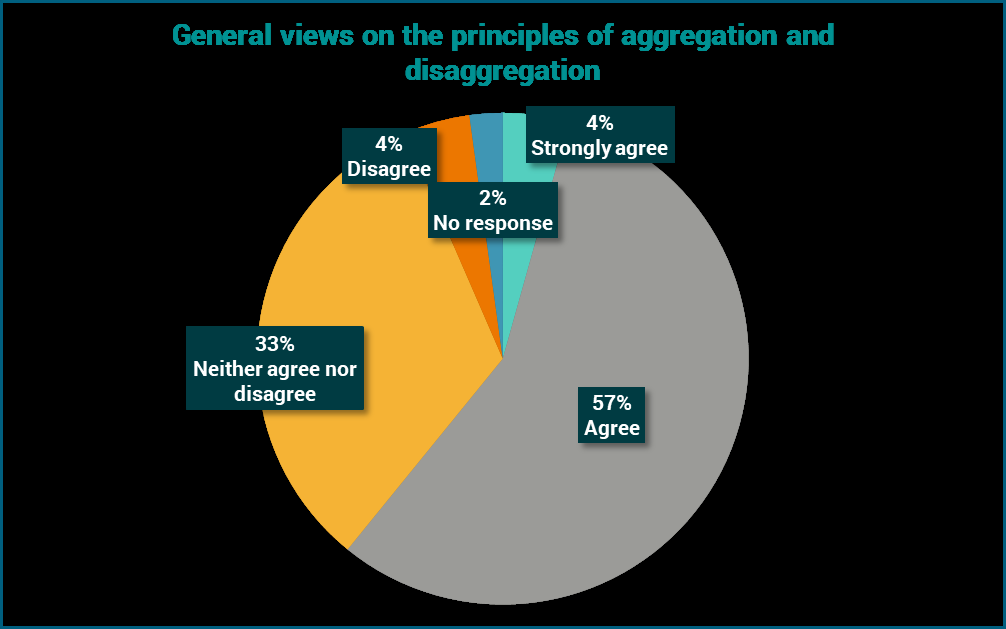
4161% of respondents supported the requirements on aggregation and disaggregation. See Chart 7 below. This is because these requirements:
- Improve the comparability and consistency of the information presented and/or disclosed across different entities and industries (i.e. by introducing principles-based guidance on how to group and separate items based on their shared/dissimilar characteristics).
- Enhance the understandability, relevance and reliability of the primary
financial statements as they require entities to:
- provide useful structured summaries that would avoid excessive detail or clutter in the primary financial statements; and
- disaggregate large "other" balances.
- Help users of financial statements identify and understand the main sources of income and expenses, and how they relate to the entity's main business activities.
- Supplement the existing materiality principles and guidance.
- Make preparers reconsider how they aggregate and disaggregate information which could result in better information for users.
Why did respondents were neutral or disagree with the requirements on aggregation and disaggregation?
42Respondents who were neutral to the requirements on aggregation and disaggregation (around 20% of total respondents) thought that the requirements on aggregation and disaggregation will have a small effect on the information they currently include in their financial statements as they think that some of these principles are implicit in other requirements or guidance in IFRS Accounting Standards. For example, they observe that:
- IAS 1 Presentation of Financial Statements, requires entities to add lines, headings or subtotals in the financial statements to help users understand an entity's financial performance.
- The Conceptual Framework for Financial Reporting, requires entities to group items in the financial statements on the basis of shared characteristics.
- IFRS 17 includes requirements to disaggregate specific items in the income statement and in the statement of financial position.
43Other respondents (6%) were of the view that introducing principle-based guidance on aggregation was concerning because it would require:
- significant judgement in determining an appropriate aggregation or disaggregation basis, for example, on the application of materiality judgements or on the disaggregation of large 'other' balances;
- long narrative disclosures to explain how information was aggregated or disaggregated; or
- different interpretations and/or different approaches leading to inconsistent application and a lack of comparability (which to one of the respondents appears to be in opposition with the objectives of IFRS 18).
44One respondent noted that it was too early to determine the impact of the requirements on aggregation and disaggregation on its financial information.
45Two respondents observed that the illustrative examples in IFRS 18 would not be useful for particular sectors or industries. These respondents think that more industry-specific examples should be developed. For instance, it was observed that the illustrative examples in IFRS 18:
- show items that would be immaterial for some sectors (e.g. for the gas, water and multiutilities sector); or
- do not show items that are commonly presented in some industries (e.g. credit impairment losses are normally material for banks).
46One respondent observed that it is unclear how the guidance on aggregation and disaggregation in IFRS 18 interacts with the proposed illustrative example 8 ('Disclosure of disaggregated information') in IASB's Exposure Draft ‘Climate- related and Other Uncertainties in the Financial Statements' (issued in July 2024)9.
47One respondent found the interaction of the guidance on aggregation and disaggregation with the requirements of XBRL unclear.
Disclosure of specified operating expenses by nature
48The survey asked respondents to rate the level of difficulty in gathering information on specified operating expenses by nature. For approximately a third of respondents this question was not applicable. The following summarises their responses for the disclosure of:
- Depreciation: Approximately half of the respondents (52%) found disclosing this information ‘easy' or 'very easy'. A small proportion of respondents were neutral (4%) or found disclosing this information rather complex (13%). 31% indicated that this was not applicable.
- Amortisation: Approximately half of the respondents (52%) found disclosing this information ‘easy' or 'very easy'. A small proportion of respondents were neutral (7%) or found disclosing this information rather complex (9%). 32% indicated that this was not applicable.
- Impairment losses (including reversals of impairment losses): Approximately half of the respondents (52%) found disclosing this information 'easy' or 'very easy'. A small proportion of respondents were neutral (9%) or found disclosing this information rather complex (7%). 32% indicated that this was not applicable.
- Inventory write downs (including reversals of write-downs of inventories). Approximately a third of respondents (33%) found disclosing this information 'easy' or 'very easy'. A small proportion of respondents were neutral (4%) or found disclosing this information rather complex (9%). 54% indicated that this was not applicable.
- Employee benefits: Around 37% of respondents found disclosing this information 'easy' or 'very easy'. A small proportion of respondents were neutral (4%). A third of respondents (30%) found this disclosure 'somewhat complex' or 'very complex'. No further reasons were provided in this respect. 29% indicated that this was not applicable.
Challenges identified
49For a few respondents it is unclear if the required specified information by nature will be useful for users.
Limited changes on the statement of cash flows
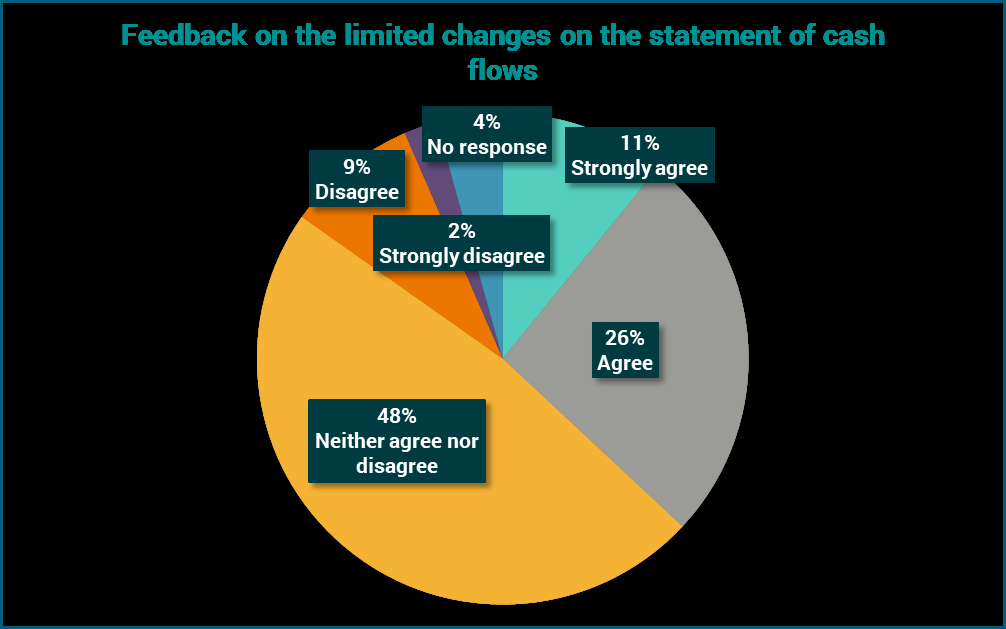
50The survey included a question about the extent to which respondents thought that the limited amendments to IAS 7 Statement of Cash Flows would improve the usefulness of the statement of cash flows. As shown in Chart 8 in the next page:
- 48% of the respondents were neutral about these limited changes;
- 37% of respondents agreed or strongly agreed with these changes;
- 11% of respondents disagree or strongly disagreed with these changes; and
- 4% of respondents did not respond to this question.
Why were respondents neutral to these changes?
51Respondents who were neutral to the limited changes to the statement of cash flows observed that:
- Their current practices for reporting cash flows will not be significantly
affected by the limited changes made to the statement of cash flows.
Some of the individual reasons provided are that:
- The respondent reports cash flows from operating activities using the direct method.
- The respondents already report cash flows in line with the limited changes made to the statement of cash flows.
- These changes are considered ‘minor' or not significant. For example, they
observe that:
- Cash flows from interest/dividends are already required in IAS 7 and are only being reclassified into other categories of the statement of cash flows.
- Having 'operating profit' as a starting point only reduces the number of items that should be reconciled as part of the indirect reconciliation of cash flows.
Why did respondents agree to the limited changes to the statement of cash flows?
52Respondents who agreed with the limited changes to the statement of cash flows think that:
- Having a consistent starting point (i.e. 'operating profit') for reporting cash flows from operating activities is helpful.
- Reducing options will enhance comparability and reduce diversity in practice.
Why did respondents disagree to the limited changes to the statement of cash flows?
53Respondents who disagree with the limited changes to the statement of cash flows observe the following:
- Three respondents think that there should be full alignment between the categories in the income statement and the activities in the statement of cash flows because otherwise they think that users will be confused. For example, derived from the requirements in IFRS 18, depreciation of property, plant and equipment will be classified in the operating category in the income statement, whereas the related capital expenditures would be classified as part of the investing category in the statement of cash flows.
- Referring to the requirements in IAS 7 (that are not part of the limited changes to the statement of cash flows), one respondent questioned why 'operating' should be a default category in the statement of cash flows.
- Two respondents from the insurance sector, one respondent from the aerospace and defense sector noted that the statement of cash flows is not useful/has limited usefulness for their industries.
- One respondent noted that the classification of dividends from associates and joint ventures is ambiguous and may lead to diversity in practice.
Other views
54One respondent noted that including a definition of 'free cash flow' (which the respondent observes is often used) and guidance on how to reconcile this alternative performance measure would have been a more useful change.
Section 2: Feedback on perceived costs and benefits and the wider economic impact
55The survey collected information as input to the long-term public good (LTPG) assessment. This is an economic assessment that the UKEB performed relating to costs and benefits incurred by stakeholders and wider economic effects on the UK economy.
56In the part on LTPG assessment, the survey obtained data on:
- incremental one-off costs;
- as a percentage of baseline costs; and
- as a percentage of operating costs;
- incremental ongoing costs:
- as a percentage of baselines costs; and
- as a percentage of operating costs.
- the wider economic impact of IFRS 18.
- at group level (consolidated), if possible;
- comprised of: ongoing accounting system maintenance, staff costs; audit and legal costs;
- inclusive of any costs incurred to prepare interim reporting;
- exclusive of, to the extent possible, costs of producing non-financial statements information, such as the first half of the annual report or investors' presentations.
Direct implementation costs
Survey questions
58Direct implementation costs for preparers were estimated by asking preparers' finance departments to forecast the extra costs that they expected to incur as a result of implementing IFRS 18.
59In line with the Better Regulation Framework (2023) and the principles of the Green Book (2022), the estimates focused on incremental costs (i.e. costs expected to be incurred as a direct result of meeting the requirements of the standard that preparers would not incur otherwise). Costs were also split into one- off implementation and ongoing costs.
60Based on the literature on the topic and industry practice, direct implementation costs are found to be comprised of the following cost categories:
- familiarisation;
- accounting system changes;10
- changes to data handling processes and controls;11
- accounts preparation;12
- communication with third parties;
- audit costs;13 and
- legal costs.14
61Consistently with the Better Regulation Framework, direct implementation costs were expressed in relation to a counterfactual. A counterfactual is the costs that preparers would have incurred in absence of the standard.
62The UKEB considered that the counterfactual should be, when available, the cost respondents incurred to prepare the most recent set of financial statements, referred to as 'baseline cost' in the remainder of this appendix. When unavailable15, operating cost as per previous year-end were used as a counterfactual.
63The analysis of the responses differs depending on the counterfactual used. Although overall the results are comparable as preparers were asked to report about the same categories of incremental ongoing and one-off costs regardless of the counterfactual used (i.e. baseline vs operating costs).
64Of all respondents, 24 provided information on incremental one-off costs as a share of baseline costs and 17 respondents chose to report incremental costs as a share of operating costs. The remaining respondents did not provide any granular incremental cost information.
Incremental costs as a share of baseline costs
Incremental one-off costs
65On average, respondents anticipated incremental one-off costs to be relatively small, with the majority of respondents indicating that they expected them to be lower than 5% of baseline costs for all cost categories.16
66Concerning individual17 incremental one-off costs categories:
- Audit costs were deemed to be the cost category likely to increase the most. The increase was assessed to be relatively small, with 13% of the respondents expecting minimal cost changes, and more than 50% expecting an increase lower than 5% of baseline cost. More than 30% of the respondents however expected a change greater than 5%, of which over 17% anticipate an increase of more than 10% of baseline costs;
- Accounts preparation was the cost category preparers suggested would experience the second-largest change. This is likely due to the nature of IFRS 18, as the standard mostly affects presentation in the financial statement. While no respondents stated that the change in accounts preparation costs as a result of IFRS 18 would be nil, over 70% of respondents state that the incremental one-off costs in this cost category as a result of IFRS 18 will be less than 5% of baselines costs. Over 25% of respondents, however, expected a change of greater than 5% of baseline costs, with over 8% expecting a cost increase of more than 10%.
- Familiarisation was the cost category preparers suggested would experience the third-largest change. Nonetheless, more than 90% of respondents stated the incremental one-off cost of familiarisation as a result of the standard would be no more than 5% of baselines costs. Over 8% of respondents stated that this cost would increase by more than 5% but no respondents said the increase in this cost would be more than 10%.
- In the case of changes to data handling processes and controls, communication with third parties, and legal costs, respondents, ranging from 56.50% (change in data handling processes) to 82.60% (legal costs), expect extra one-off costs to be either Nil or less than 1% of baseline costs. A relatively small segment of respondents, ranging from 30.40% (changes to data handling processes and controls; and communication with third parties) to 13.00% (legal costs) believe these incremental costs will occupy between 1% and 5% of baseline costs. An even smaller segment of respondents believe that the change in costs will be at the higher end of costs - more than 5% of baseline costs - ranging from 13.00% (changes to data handling processes and controls) to 4.30% (legal costs). No respondents report that the changes in these cost categories will exceed 10% of baseline costs.
Chart 9: Incremental one-off costs as a share of baseline costs
Horizontal stacked bar chart showing the percentage distribution of respondents' views on one-off costs across different categories (Audit, Accounts preparation, Familiarisation, Accounting system changes, Changes to data handling processes and controls, Communication with third parties, Legal) as a share of baseline costs. Categories include: Nil, <1% of baseline cost, 1% and 5% of baseline cost, 5% and 10% of baseline cost, >10% of baseline cost.
Incremental ongoing costs
67A total of 22 respondents provided information on incremental one-off costs as a share of baseline costs. Over 71% of respondents in all cost categories expected incremental ongoing costs to be nil or less than 1% of baseline costs, suggesting that incremental ongoing costs are expected to be lower than one-off costs, and in general small. Further detail:
- Audit costs represented the cost category with the highest expected extra cost as a share of baseline costs. Still, 71.5% of respondents believed the incremental ongoing audit costs as a result of the standard will be less than 1% of baseline costs or nil. 19.0% of respondents said that it will be between 1% and 5% of baseline costs, and 9.5% of respondents said that these costs will be between 5% and 10% of baseline costs. No respondents anticipated that these costs will be more than 10% of baseline costs.
- Accounts preparation was the cost category with the second largest expected change. Over 81% of respondents said the extra ongoing costs will be less than 1% of baseline costs or nil. The percentage of respondents saying that these costs will be between 1% and 5% of baseline costs was similar to that of audit costs (18.2%). No respondents believed these costs would account for more than 5% of baseline costs
- Accounting system maintenance represents the cost categories with the joint fourth-highest expected incremental ongoing costs. Over 45% of respondents said these costs would be zero. 46% of respondents said these costs will be less than 1% of baseline costs. 9% of respondents said these costs will be between 1% and 5% of baseline costs. No respondents said these costs will exceed 5% of baseline costs.
- Changes to data handling processes and controls showed the same data/results as accounting system maintenance with similar results for communication with third parties. For these costs, over 90% of respondents said these costs will be less than 1% of baseline costs, with around 50% of respondents saying these costs will be zero.
- For legal costs, over 95% of respondents said they will be less than 1% of baseline costs with 67% of all respondents saying they will be zero.
Chart 10: Ongoing costs reported as a percentage of baseline costs
Horizontal stacked bar chart showing the percentage distribution of respondents' views on ongoing costs across different categories (Audit, Accounts preparation, Accounting system maintenance, Changes to data handling processes and controls, Communication with third parties, Legal) as a share of baseline costs. Categories include: Nil, <1% of baseline cost, 1% and 5% of baseline cost, 5% and 10% of baseline cost, >10% of baseline cost.
Incremental costs as a share of operating costs
68Respondents were asked to provide information about the same incremental one- off and ongoing costs categories as respondents who expressed incremental costs as a share of baseline costs. Looking at incremental one-off and ongoing costs as a share of operating costs allows one to express incremental cost relative to the size of the respondent's operating activities.
Incremental one-off costs
69Audit costs were the cost category anticipated to be mostly affected, as nearly 18% of the respondents indicated that they expect an increase between one and five percent of operating costs. However, for all cost categories, including audit costs, over 80%, of the respondents estimated that incremental one-off costs would be nil or less than one percent of operating cost. In the case of legal (internal and external) costs, over 53% of respondents, stated that these will be nil.
Chart 11: One-off costs reported as a percentage of operating costs
Horizontal stacked bar chart showing the percentage distribution of respondents' views on one-off costs across different categories (Audit, Accounting system changes, Accounts preparation, Familiarisation, Changes to data handling processes and controls, Communication with third parties, Legal) as a percentage of operating costs. Categories include: Nil, <1% of operating cost, 1% and 5% of operating cost, >5% of operating costs.
Incremental ongoing costs
70Only 15 out of 17 respondents completed questions concerning ongoing costs as a percentage of operating costs. For all cost categories at least 86% of respondents estimated incremental ongoing costs to be either nil or less than 1% of operating costs.
71Audit costs were the cost category anticipated to be mostly affected, with 13% of the respondents indicating that they expect an increase between one and five percent of operating costs.
72In the case of accounting system maintenance, changes to data handling processes and controls, legal (internal and external), and communication with third parties, the majority of respondents, at least 60% of them, estimated the costs would be nil.
73A seemingly significant percentage of respondents, over 46%, estimated that accounts preparation costs will be nil.
Chart 12: Ongoing costs reported as a percentage of operating costs
Horizontal stacked bar chart showing the percentage distribution of respondents' views on ongoing costs across different categories (Audit, Accounts preparation, Accounting system maintenance, Changes to data handling processes and controls, Legal, Communication with third parties) as a percentage of operating costs. Categories include: Nil, <1% of operating cost, 1% and 5% of operating cost, >5% of operating cost.
74To gather extra information about the impact of implementation costs on day-to- day operations, follow-up emails were sent to preparers who expressed their implementation costs as a share of baseline costs, asking them to also express them as a share of operating costs. Preparers confirmed that, when expressed as a share of operating costs, incremental adoption costs would be between close to nil and no more than 1% of operating costs.
75Consistently, one responded noted: 'Incremental ongoing costs after implementation should be relatively low, as should implementation costs when compared with other standards.'
76One comment suggested that the impact on business will largely depend on how aligned their presentation is with the future requirements: 'Given that our current methodology appears very similar to what IFRS 18 is proposing and the changes are fairly transparent I would not consider that this would result in significant cost increments.'
77A respondent raised concern that the standard does not address the needs of specific industries/entities, considering the difficulty of catering for specific industry needs when issuing an accounting standard. They said ‘[I] [a]gree with the overall aim of the standard but the finer points will lead to additional costs for some entities...[there] [h]as to be consideration of the industry effect which is difficult to standardise amongst all financial statements.'
Implementation costs: absolute estimates
78Respondents were asked to provide a baseline cost estimate in £ million, if available. Only three entities gave an estimate, ranging from £0.5 million to £1.6 million.
79In a follow-up discussion on the topic, a preparer clarified how baseline costs were calculated. They noted that, given the requirements in IFRS 18, baseline costs were comprised of finance department costs related to the preparation of the accounts at year-end. In other words, they would not be comprised of day-to-day operating costs of the finance department, as the standard does not affect recognition and measurement. Consistently, this preparer estimated incremental ongoing costs associated with the adoption of IFRS 18 to be small.
80Respondents were also asked to provide estimates in £ million for incremental one-off and ongoing costs associated with implementation of IFRS 18. A total of 10 respondents provided this information (including the ones who provided information on baseline costs):
- Incremental one-off costs estimates ranged from a minimum of £50,000 to a maximum of £500,000.
- Incremental ongoing costs estimates ranged from a minimum of £0 to a maximum of £100,000.
81The UKEB is currently recruiting additional survey respondents and conducting 1- 2-1 interviews to obtain more cost data to extrapolate a market-wide estimate.
Wider economic effects
82Preparers were asked about wider economic effects/impact of associated with IFRS 18.
83Preparers were asked to indicate the extent to which they expected the implementation of IFRS 18 to affect several outcomes. A list of different outcomes was provided, focusing on three main topics: anticipated benefits for users, management and stewardship and other economic effects. 45 respondents provided an answer to this question.
Anticipated benefits to users
84The first three outcomes related to anticipated benefits for users. Respondents were asked to indicate whether they expected IFRS 18 to affect:
- The reporting of entity's financial performance in line with underlying economics. This outcome split opinions, with 44% of respondents indicating that they anticipate no effect, a sizable share of respondents (31%) indicating that they anticipate a mild to strong positive effect, and nearly 16% of the respondents indicating that a mild to strong negative effect was anticipated. In the sample, 2% of respondents said this did not apply to their organisation, and 7% of respondents said they did not know or were unsure.
- The comparability of the entity's reporting of financial performance. A majority of respondents, 60%, indicated that they anticipate a mild to strong positive effect, 28% of respondents stated no effect was expected, and 12% of respondents stated they anticipated a mild to string negative effect.
- The transparency of the entity's financial performance. A slight majority of respondents (51%) indicated that they anticipate a mild to strong positive effect, though it is worth noting that over 40% of respondents did not anticipate an effect, while 9% of respondents stated a mild to strong negative effect was expected.
Management and stewardship
85The second three outcomes related to preparers' views on management and stewardship. Respondents were asked to indicate whether they expected IFRS 18 to affect:
- Management's discretion in presenting the entity's financial performance. This outcome split opinions, with the largest share of respondents (49%) indicating that they anticipate a mild to strong positive effect, 42% of respondents indicating that they anticipate no effect, 5% of respondents indicating that they expect a mild to strong negative effect and 4% saying they do not know or are unsure.,
- Presentation of management's use of economic resources to users. A clear majority of respondents, 61%, indicated that they anticipate no effect, 16% said they expect a mild to strong positive effect, 14% said they expect a mild to strong negative effect, 2% said this did not apply to their organisation, 7% said they did not know or were unsure, and
- Transparency over management's performance in financial reporting. A narrow majority of respondents (53%) indicated that they expected no effects, with the remaining responses leaning slightly towards a positive effect (24%). There was some indication that negative effects may be expected (16%), 2% of respondents said this question did not apply to their organisation, and 5% of respondents said they did not know or were unsure.
Other transmission mechanisms
86This list of outcomes related to preparers' views on mechanisms that may impact the underlying economics of the business.18 These were:
- Information transmission within the organisation.
- Streamlining of internal systems and processes.
- Disclosure of proprietary information, where more disclosures were interpreted to be a negative effect.
- Competitors' assessment of the entity performance, a better assessment was interpreted to be a negative effect.
- Internal assessment of competitors' financial performance, where a better assessment was interpreted to be a positive effect.
- Risk of litigation, where lower risk was interpreted to be a positive effect.
87For most of the outcomes listed, large majorities of respondents indicated that no effect was expected.
88The only exception was the internal assessment of competitors' financial performance, for which a mild positive effect was expected by 44% of respondents, contrasting with 40% who believed that no effect was expected (the remaining 16% either expected a negative effect or did not have an opinion).
89The survey allowed respondents to indicate if there were other effects not listed. Most respondents indicated that no other effects were expected.
90Comments from preparers include:
- "In our view, the additional costs especially for the audit of financial statements are outweighed by the benefits".
- "The standard will make companies' financial performance easier to compare and will provide more information for investors' analysis. At the same time the standard will require additional implementation and external audit costs."
91Some comments suggested further investigation:
- A preparer suggested that “regulators and other bodies who require financial information to be presented in a particular way, and who rely on IFRS as a starting point, may also end up incurring costs”.
- A preparer noted that “Certain changes in presentation may move the revenue [thresholds] that categorised the entity from small to medium size entity, potentially resulting in incremental disclosures burden."
92The UKEB Secretariat will undertake further proportionate investigation to consider these comments.
Further economic impacts
93Preparers were also asked for their opinion on the effects of IFRS 18 on the following items:
- Management compensation schemes.
- Covenants.
- Dividend payments.
- Tax liabilities.
94Preparers expected no effect on any of these items (between 74% to 86% indicated that no effect was expected). Preparers noted that:
- "the new standard won't have impact on measurement. Presentational differences from a statutory perspective will not impact any of the above measures"; and
- “given that the changes are presentational, and do not affect the recognition or measurement of assets, liabilities, income or expense, we do not expect that there would be any substantive effect based on a change in which financial performance information is structured and summarised."
Robustness checks
95Robustness checks for the IFRS 18 preparers survey have been conducted. The purposes of these robustness checks is to see if there is any bias in the results based on known characteristics of respondents that might encourage bias.
96To perform the robustness checks the analysis was conducted on restricted samples to check whether the exclusion of certain types of respondents alters the results. The robustness checks were based on:
- Familiarity with the standard (in-depth assessment, high-level assessment, overall familiarity, or none). During the analysis of the data, it was considered whether respondents who were not familiar with the standard could bias the results. Therefore, analyses were restricted to a group of respondents respectively comprised of those whose familiarity with IFRS 18 came from an in-depth assessment of the standard, and those whose familiarity with IFRS 18 came from an in-depth or a high-level assessment of the standard.
- Market segment (FTSE 100; FTSE 250; AIM; or Private/Parent Company listed Abroad). It was considered that the experience of large firms concerning IFRS 18 may be different from the experience of small firms. The possibility of respondents from large firms biasing the results was considered. Therefore, analyses were conducted grouping respondents by their market segment. The results from the survey were grouped by market segment to see if there were differences for any group compared to the overall results.
97Results from these robustness checks do not contradict the results from the main study.
Footnotes
-
One respondent did not respond to the question about familiarity. All other respondents had some levels of familiarity with IFRS 18 requirements. ↩
-
The calculation of the average rating excludes a partial response from a respondent who did not respond to this question. ↩
-
For example, in a situation where an entity borrows and then invests in one of the entities of a group and use derivatives to manage the net exposure would find it difficult to trace the nature of the foreign currency differences (as either investing or financing). ↩
-
In accordance with the requirements in IFRS 18, an entity that provides financing to customers applies the accounting policy choice to classify in the 'operating' category all income and expenses from liabilities that involve only the raising of finance or just the portion of income and expenses from liabilities that involve the raising of finance and that relate to the provision of financing to customers. ↩
-
At the date of initial application of IFRS 18, an entity eligible to apply paragraph 18 of IAS 28 Investments in Associates and Joint Ventures is permitted to change its election for measuring an investment in an associate or joint venture from the equity method to fair value through profit or loss in accordance with IFRS 9. If an entity applies this election, and if the investment is part of an entity's main business activities, the entity presents the income and expenses derived from these investments in the operating category. ↩
-
In accordance with paragraph 18 of IAS 28 this election can be applied when an investment in an associate or joint venture is held by, or is held indirectly through, an entity that is a venture capital organisation, or a mutual fund, unit trust and similar entities, including investment-linked insurance funds. ↩
-
The Guidelines can be found here ↩
-
All these respondents are from the Life Insurance and Non-Life Insurance sectors. ↩
-
The link to this ED is here. ↩
-
Accounting system is understood as the system (increasingly software) designed to record the accounting transactions and events of a business and account for them in a way that complies with its policies and procedures. ↩
-
Data handling is understood as the flowing of transaction data through processes and controls and the recording of these data flows in accounting information systems/software as well as the conversion of year-end and consolidation journals/adjustments into that data flow, before financial statements and notes disclosures are prepared. ↩
-
Accounts preparation is understood as the final step of preparation of financial statements and disclosure notes, assuming the data needed has been recorded and appropriate adjustments made. ↩
-
Comprised of both external and internal audit costs (when the latter are present). The revision and piloting process suggested that the two could be lumped together without loss of generality. ↩
-
Comprised of both external and internal legal costs (when the latter are present). The revision and piloting process suggested that the two could be lumped together without loss of generality. ↩
-
In some circumstances baseline costs may be considered a commercially sensitive information. In some circumstances, preparers may not possess the information at all. This design allowed us to gather information about costs from most respondents. In addition, expressing incremental costs as a percentage encouraged respondents to provide the information. This survey design, agreed on after extensive revision, testing and piloting, allowed the UKEB to increase the number of responses it received. ↩
-
In the charts that follow, cost categories are ranked by size of expected change. ↩
-
Asking respondents to express incremental costs as a percentage of the baseline costs allowed us to extract information about the cost categories most likely to be affected because baseline costs are typically a small fraction of operating costs. Put more simply, an incremental cost that is less than 1% of operating costs may result to be between 1% and 5%, or even greater than 5%, when calculated a share of the baseline costs of preparing financial statements. ↩
-
It was considered that preparers may have a view on the channels through which the adoption of IFRS 18 would alter/affect the companies' underlying economics, referred to as "transmission mechanisms" in the reminder of the paper. However, preparers may not be able to discuss end-effects, such as effects on pricing and competition and other economic effects. These will be discussed as part of the DECA. ↩