6 Provisions – Targeted Improvements
30 January 2025 Agenda Paper 6
Executive Summary
Project Stage
| IASB | Research / Pipeline | Discussion paper | Redeliberation | Exposure Draft | Redeliberation | Final standard | Post Implementation Review |
|---|---|---|---|---|---|---|---|
| UKEB | Research / Influencing | Research / Influencing | Monitoring | Influencing | Monitoring | Endorsement | Influencing |
Project Scope
Moderate
Purpose of the paper
The purpose of this paper is to facilitate Board discussion by providing a technical analysis of key principles in the proposed amendments in the IASB's Exposure Draft (ED) Provisions – Targeted Improvements, with a focus on the proposals to amend the present obligation recognition criterion. The Board discussion at today's meeting will inform the UKEB Final Comment Letter.
Summary of the Issue
The IASB published its ED in November 2024, proposing targeted amendments to IAS 37 Provisions, Contingent Liabilities and Contingent Assets. The IASB comment period closes on 12 March 2025.
At its November and December 2024 meetings, the UKEB held technical discussions leading to the publication of the UKEB Draft Comment Letter (DCL) on 20 December 2024. The DCL set out concerns that the proposals as drafted may create new interpretation issues.
The UKEB comment period closes on 10 February 2025.
Decisions for the Board
The Board is not asked to make any decisions but is invited to share views on any of the following:
Specific economic benefits
- Do you agree with the Secretariat's proposed request for clarification in relation to specific economic benefits?
Specific action
- Do you agree with the Secretariat's analysis and proposed recommendations in relation to identifying actions?
- Do you agree with the Secretariat's analysis and proposed recommendations in relation to the distinction between action and measurement basis?
- Do you agree with the Secretariat's analysis and proposed recommendations in relation to threshold-triggered costs?
- Overall, do Board members consider the dissatisfactions with IFRIC 21 will be addressed by the proposed clarifications to the past-event condition?
Transfer condition
- Do Board members have any comments or questions on the Secretariat's analysis of and recommendation in respect of the transfer condition?
Other
- Do Board members have any additional feedback on the IASB's proposed amendments and/or the Secretariat's technical analysis that you would like to share?
Recommendation
Not applicable.
Appendices
Appendix A Technical analysis
Exposure Draft: Provisions – Targeted Improvements
On 12 November 2024, the IASB published the Exposure Draft (ED) IASB/ED/2024/8 Provisions - Targeted Improvements proposing amendments to IAS 37 Provisions, Contingent Liabilities and Contingent Assets.
In the ED, the IASB proposes targeted improvements to three aspects of IAS 37:
- one of the criteria for recognising a provision – the requirement for the entity to have a present obligation as a result of a past event (the present obligation recognition criterion); and
- two aspects of the requirements for measuring a provision – those relating to:
- the costs an entity includes in estimating the future expenditure required to settle its present obligation; and
- the rate an entity uses to discount that future expenditure to its present value.
The IASB is also proposing amendments to the Guidance on implementing IAS 37. These amendments would update the guidance on applying the present obligation recognition criterion to reflect the proposed amendments to the requirements.
As part of the ED, the IASB also proposes withdrawing:
- IFRIC 6 Liabilities arising from Participating in a Specific Market – Waste Electrical and Electronic Equipment;
- IFRIC 21 Levies;
and replacing them with illustrative examples in the Guidance on implementing IAS 37.
The IASB comment period closes on 12 March 2025.
Appendix A: Provisions – Targeted Improvements – Technical analysis
Background
A1On 12 November 2024, the IASB published the Exposure Draft (ED) proposing amendments to IAS 37 Provisions, Contingent Liabilities and Contingent Assets. The IASB comment period closes on 12 March 2025.
A2In December, the UKEB published its Draft Comment Letter1. The UKEB comment period ends 10 February 2025.
Analysis of key principles
A3The Board held an initial technical discussion on the ED at its November 2024 2 meeting. At its December 2024 meeting 3 the Secretariat presented for Board consideration an initial technical analysis considering the application of the proposals to certain real life fact patterns relevant to some UK entities. This work helped identify key questions and areas where the UKEB believes further consideration is needed.
A4The purpose of this paper is to address those questions by performing an analysis of the key principles in the proposed amendments, with a focus on the proposals to amend the present obligation recognition criterion.
A5The Board is not asked to make any decisions, but it is invited to share views on the IASB proposals and/or the Secretariat's technical analysis. The Secretariat intends to use this discussion to inform the UKEB Final Comment Letter.
Present obligation recognition criterion
A6One of the main reasons the IASB proposes to amend the recognition criteria in IAS 37 is the difficulty faced by stakeholders in disentangling two distinct conditions within the present obligation recognition criterion. This has given rise to application challenges and resulted in the issuance of two IFRIC Interpretations 4 and an Agenda Decision 5.
A7In addition, IASB stakeholders have expressed dissatisfaction with IFRIC 21, as some consider it results in entities recognising some recurring periodic levies as expenses at a single point in time late in the period for which they are charged, or even after the end of that period. In those stakeholders' view, the substance of a recurring levy is that the entity is paying to operate over a period, and this substance would be more faithfully represented if entities recognised the expense systematically over that period.
A8The Secretariat considers that in many circumstances disentangling the 'obligation condition' and the 'past-event condition' would help to clarify the recognition criteria, providing a more robust structure to the assessment. For example, the proposed amendments may provide a more structured framework for assessing certain climate-related commitments, which were the subject of a submission to the IFRS Interpretations Committee leading to the publication of the Agenda Decision Climate-related Commitments.
A9However, we are also of the view that certain aspects of the proposals in relation to the obligation and past-event conditions need further clarification. We discuss these and our proposed recommendations in the following paragraphs.
A10In addition, the IASB proposes adding a third condition, the 'transfer condition', to the present obligation recognition criterion. The Secretariat presents its analysis and recommendations in relation to the transfer condition below.
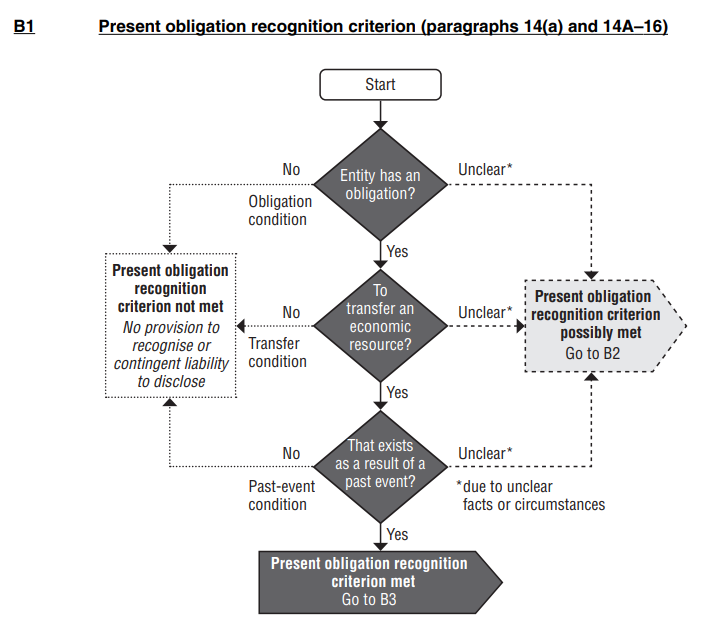
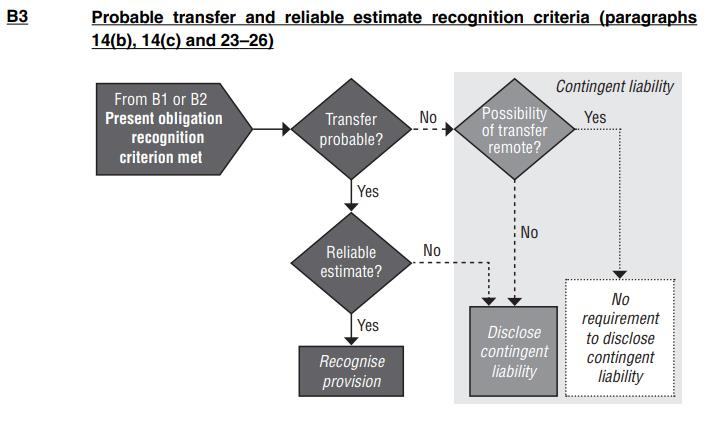
A11The decision tree summarising the proposed process of applying the three criteria for recognising a provision, as presented in the Guidance on implementing IAS 37 (the Guidance), is reproduced in the Annex to this paper.
No practical ability to avoid test
A12The proposed amendments introduce a no practical ability to avoid test as part of both the 'obligation condition' and the 'past-event condition'.
Analysis and recommendation
A13In our view, the proposed amendments do not explicitly articulate within the Standard the two subtly different ways such a test is intended to be applied. This is covered in paragraph BC29 of the Basis for Conclusions, which states that:
- ".......the 'no practical ability to avoid' requirement in the obligation condition refers to an entity's ability to avoid discharging a responsibility if it obtains specific benefits or takes a specific action, not its ability to avoid obtaining those benefits or taking that action. In other words, the obligation condition requires an assessment of the entity's practical ability to avoid settling an obligation once that obligation has been created, not the entity's practical ability to avoid obtaining the benefits or taking the action that creates the obligation.....".
- "......The entity's ability to avoid obtaining the benefits or taking the action is considered separately, in applying the past-event condition.”
A14It is therefore our understanding that the intended application of such a test is:
- Practical ability to avoid test within the obligation condition (ED paragraphs 14B(c) and 14F) – This test is in effect a test of the 'strength of the mechanism' (legal or constructive) imposing the obligation.
- Practical ability to avoid test within the past-event condition (ED paragraph 14Q) – This test arises only when two or more actions are needed to trigger the transfer of an economic resource. The test relates not to the strength of the mechanism but to the realistic options available to management in relation to any remaining actions as of the reporting date.
A15We recommend the IASB describes more explicitly, either in the Standard or in accompanying guidance that is integral to the Standard, the difference between the two tests and the intended application to facilitate consistent application of the proposals.
Past-event condition
Principle
A16The ED paragraph 14N states that "An entity's obligation becomes a present obligation that exists as a result of a past event when the entity:
- has obtained specific economic benefits or taken a specific action, as described in paragraphs 14B and 14D; and
- as a consequence of having obtained those benefits or taken that action, will or may have to transfer an economic resource it would not otherwise have had to transfer."
A17In addition, paragraph 140 states that “If the economic benefits are obtained, or the action is taken, over time, the past-event condition is met, and the resulting present obligation accumulates, over that time."
Specific economic benefits
A18The first sentence in paragraph 14D states that “The economic benefits the entity obtains could be, for example, cash, goods or services.” This sentence replicates almost exactly the Conceptual Framework paragraph CF 4.44. However, while CF 4.44 only mentions as examples 'goods or services', the ED adds 'cash'.
Analysis and recommendation
A19As noted above, the ED introduces concepts from the Conceptual Framework, but it should be noted that the Conceptual Framework applies to all transactions, not only to obligations in the scope of IAS 37. It is not clear what purpose the reference to obtaining economic benefits serves in this case.
A20If an obligation exists as a result of the entity having obtained specific economic benefits (the past event), then it seems likely that this would have resulted from an exchange transaction. Such an obligation would then be, for example, an account payable in the scope of IFRS 9 Financial Instruments or an amount payable to an employee in the scope of IAS 19 Employee Benefits and therefore not a provision in the scope of IAS 37. It therefore raises the question as to whether the reference to receiving economic benefits is relevant for the assessment of provisions.
A21In aiding understanding of the proposed amendments, it would be helpful if the IASB provided an example of a circumstance where an entity has a present obligation that exists as a result of a past event when the entity has obtained specific economic benefits (as opposed to taking an action) and such an obligation is in the scope of IAS 37 (i.e. not in the scope of other accounting standards). However, if a reference to receiving economic benefits is not directly relevant to the assessment in IAS 37, we would suggest removing it to avoid confusion and/or complexity.
Questions for the Board
- Do you agree with the Secretariat's proposed request for clarification in relation to specific economic benefits?
Specific action
A22Paragraph 14D, second sentence, states that "The action the entity takes could be, for example, operating in a specific market, causing environmental damage or other harm to another party, owning specific assets on a specific date, or constructing an asset that will need to be decommissioned at the end of its useful life."
A23In addition to the proposed requirements in paragraphs 14N and 140:
- Paragraph 14P provides guidance in relation to obligations triggered only if a measure of the entity's activity in a period (the assessment period) exceeds a specific threshold. Subsequently referred to as 'threshold-triggered costs'.
- Paragraph 14Q states that “In some situations, an entity has an obligation to transfer an economic resource only if it takes two (or more) separate actions, and the requirement to transfer an economic resource is a consequence of taking both (or all) these actions. In such situations, the past-event condition is met when the entity has taken the first action (or any of the actions) and has no practical ability to avoid taking the second action (or all the remaining actions)."
Analysis and recommendations
Identifying actions
A24We understand that the identification of the relevant actions(s) is not a question of management's judgement but based on the relevant 'mechanism' imposing the responsibility on the entity. For example, it could be the specific details of a constructive obligation, the terms and conditions of a contract, or in the case of a levy, such a mechanism would be the corresponding legislation. However, that is not specifically stated in the proposed amendment to the Standard.
A25In the Secretariat's view, this seems a sensible approach and conclusions would be based on specific facts and circumstances. We therefore consider it would be helpful to include, as part of the Standard, the rationale in paragraph BC36: “The IASB noted that whether an entity's obligation to transfer an economic resource requires only one action of the entity (perhaps taken over time), or a combination of two or more separate actions, will depend on the precise facts of the mechanism that has created the obligation—for example, the precise terms of a contract or requirements of legislation. Management would reach a conclusion by assessing all the relevant facts of the mechanism, including, for example, facts about the effects on the obligation of variations in an entity's circumstances."
A26This should also be more clearly articulated in the analysis and conclusions for the different examples presented in the Guidance.
Examples
We consider the analysis of some of the proposed examples could be perceived as confusing or even contradictory. For example:
- Example 13B considers that there are two distinct actions, that is, operating in the entity's current annual reporting period and operating as a bank on the last day of that same period. It is not clear from the fact pattern why operating in the period is a separate action.
- It would be helpful to explain the rationale for the differences from the conclusion in Example 13C, where only one action is identified. By analogising to Example 13B, without further clarification it could be argued that ownership of the property throughout the year is an action, and an assessment would be needed as to whether the entity has a practical ability to avoid ownership of that property as of year-end.
- It would also be beneficial to explain the apparently different approach in the proposed guidance for threshold-triggered costs, which assumes that the generation of revenue during a period represents only one action (as noted in view 3 in April 2024 - IASB staff Agenda Paper 22B6).
Question for the Board
- Do you agree with the Secretariat's analysis and proposed recommendations in relation to identifying actions?
A27Additional areas we consider should be more clearly articulated include:
- the distinction between an action and a measurement basis; and
- how far into the future the IAS 37 assessment should be performed.
Distinction between action and measurement basis
A28We consider that the distinction between what is merely a measurement basis and what is an 'action' for purposes of the proposed amendments should be made clearer. We consider that this would be helpful because at present the examples in the Guidance seem to blur this distinction.
A29In assessing the proposed amendments, we presume the intended meaning is:
- An action - affects whether an entity has an obligation to transfer an economic resource.
- A measurement basis -affects only the amount of that obligation.
A30If that is the intended meaning, it should be more clearly articulated in the guidance and the proposed examples.
Examples
- As proposed, Example 13A assumes that the generation of revenue in the market in 20X0 is an 'action'. However, given that the fact pattern notes that only entities operating in the market on 1 January 20X1 are within the scope of the levy, it could be argued that the generation of revenue during 20X0 is not an action but only the basis for measuring the obligation.
- There are levies where for practical reasons the measurement is based on an earlier reporting period. For example, the amount of Bank of England Levy payable is based on the average amount of deposits held in a specified three-month period prior to the start of the Levy Year (the Reference Period). However, where an institution has become an eligible institution during the Reference Period, the Bank of England may use such other period of no more than three months as it sees fit. Would the fact that an alternative measurement period could be applied in certain circumstances have an impact on the assessment of the relevant actions? Could the existence of an alternative measurement period support the argument that it is not 'an action' (as it might not be directly applicable to all institutions in scope of the levy) but only a measurement basis?
- As noted above, Example 13B considers that there are two actions, that is, operating in the entity's current annual reporting period and operating as a bank on the last day of that period. We understand that the conclusion on the first action may depend on the fact that the amount charged is adjusted when the chargeable period is not equal to 12 months. This may imply that the operation as a bank during the period is also necessary to trigger the obligation, and is not only a measurement basis. However, this is not explicit in the fact pattern. We recommend clarifying the rationale for the pro rata reduction to be considered an action.
A31In addition to expanding the explanations of Examples 13A and 13B, a possible way to reinforce the distinction between an action and a measurement basis could be by expanding the analysis of some of the proposed examples. It could potentially be done by adding an alternative scenario - with slightly modified facts from the base scenario - explaining the rationale for reaching a different a conclusion based on the different facts. For example, if in a base scenario it was concluded there were two separate actions, the alternative scenario could discuss what would need to be different for concluding that one of those actions was only a measurement basis.
Question for the Board
- Do you agree with the Secretariat's analysis and proposed recommendations in relation to the distinction between action and measurement basis?
How far into the future the IAS 37 assessment should be performed
A32In analysing the proposed amendments an additional question that arises is how far into the future the IAS 37 assessment should be performed. That is, the number of periods that should be assessed in relation to the 'no practical ability to avoid' test (within the past-event condition).
A33In our view, the answer to that question depends on whether an obligation is triggered by only one or by more than one separate action.
Only one action
A34It is our understanding that the no practical ability to avoid test (within the past event condition) is not applicable for obligations triggered by only one action.
A35If the relevant action has been taken before the end of the reporting period, the past event condition is met. A provision is accounted for (assuming the other recognition criteria are also met). Potential future obligations do not need to be considered as the relevant actions triggering those future obligations have not yet been taken, and the entity does not have to consider whether it can avoid taking actions in future periods.
This can be illustrated by considering our understanding of the UK Bank Levy 7 as follows:
- This illustration assumes that there is only one action identified (i.e. operating as a bank on the last day of the entity's reporting period, that is 31 December).
- In the period from 1 January to 30 December the entity would not be required to assess whether it has a practical ability to avoid operating as a bank on 31 December. As a result, the entity does not accrue a provision over that period. The provision is accounted for in full, at a single point in time, on 31 December.
- The actions relevant for future levies have not yet been taken and the entity is not required to assess its practical ability to avoid operating as a bank in subsequent reporting periods.
Two (or more) separate actions
A36In such situations, the past-event condition is met when the entity has taken the first action and has no practical ability to avoid taking the second action (or all the remaining actions).
A37In performing this assessment, all the relevant actions must be identified. Those are the actions directly linked to the obligation in the current reporting period.
This could be illustrated as follows:
- This illustration assumes that an entity is subject to a levy. The entity identifies two different actions as per the levy legislation, which are actionable in the current period (Year X0) and the immediate subsequent period (Year X1), respectively.
- In considering the no practical ability to avoid test, the entity will only consider the actions in Year X0 and Year X1, as those are the only periods linked to the entity's legal obligation in the current period. The actions in Year X2 and onwards will only be relevant for the entity's legal obligation in the subsequent year.
- In the reporting period ending 31 Dec. X1, and only once the entity has taken the action in Year X1, it will assess whether it has no practical ability to avoid taking the action in the Year X2. The same logic would apply to the assessment in subsequent reporting periods. The entity only considers whether it can avoid the second action in each relevant future year once it has taken the first action in each future year.
A38We think the analysis above is clear from the requirements and we therefore do not propose raising this topic in the UKEB Final Comment Letter.
Threshold-triggered costs
A39The proposed guidance on threshold-triggered cost seems clear and straight-forward when it comes to assessing income statement-related thresholds. The accounting outcome seems sensible. Although it might increase the level of estimation uncertainty as part of the assessment of the present obligation recognition criterion, in reaching a conclusion on whether a provision should be recognised, an entity would also need to consider whether the probable outflow criterion (IAS 37 14.b) and reliable estimate criterion (IAS 37 14c) are met.
A40It is, however, not so clear whether, and if so how, the threshold-triggered cost guidance might apply when the threshold is a balance sheet-based measure, as it is the case for some levies. A balance-sheet measure does not generally accrue in a similar manner than an income statement measure and it could potentially remain at a similar level throughout a reporting period.
Example
The Bank of England Levy brings in scope banks with a specified average amount of deposits during a specified period. Would the Bank of England Levy be subject to the threshold-triggered cost guidance? If so, how would its application interact with the guidance for obligations triggered by the entity taking two or more separate actions?
Questions for the Board
- Do you agree with the Secretariat's analysis and proposed recommendations in relation to threshold-triggered costs?
- Overall, do Board members consider the dissatisfactions with IFRIC 21 will be addressed by the proposed clarifications to the past-event condition?
Transfer condition
A41The ED proposes adding a third condition to the present obligation recognition criterion, that is, the nature of the obligation should be to transfer an economic resource (the transfer condition).
A42The ED paragraph 14L also states that "An obligation to exchange economic resources with another party is not an obligation to transfer an economic resource to that party unless the terms of the exchange are unfavourable to the entity. Accordingly, the obligations arising under an executory contract – for example, a contract to receive goods in exchange for paying cash – are not obligations to transfer an economic resource unless the contract is onerous".
A43However, the concept of transfer as used in the ED is not clear. Stakeholder feedback also suggests the distinction between the concepts transfer and exchange, as drafted in the ED, may not always be clear cut (for example, in the case of levies) and therefore the practical application of this condition may be difficult.
Analysis and recommendation
A44In our view, the introduction of this explicit condition in IAS 37 is problematic because the Amendments appear to give the term 'transfer' a specific, narrow meaning that it does not have elsewhere in IFRS. The ED seems to present the concept of transfer as a 'one-way' transaction, for which the entity gets nothing in return. This use of the term transfer is slightly different to how it is currently used in other IFRS accounting standards where it has a simple, neutral meaning (e.g. IFRS 15 Revenue from Contracts with Customers paragraph 2, where a transfer is part of an exchange). Therefore, stating that "An obligation to exchange economic resources with another party is not an obligation to transfer an economic resource" can be confusing: in IFRS generally, an exchange includes an obligation to transfer an economic resource.
A45Further, this use of the term 'transfer' is not clearly supported by the Conceptual Framework. Paragraph CF 4.39 lists examples of obligations to transfer an economic resource, but most of those could in fact be part of exchange transactions. The Conceptual Framework does not discuss the concept of exchange.
A46It is our understanding that the addition of the transfer condition is intended to reinforce the scope of the Standard. That is, that an entity does not recognise a provision for a future exchange transaction (an executory contract), unless that transaction is onerous. Indeed, the question arises as to whether the transfer condition is needed at all given that the scope of IAS 37 already excludes executory contracts (unless onerous). In our view, omitting the transfer condition would not change the conclusion of any of the proposed examples in the Guidance.
A47However, we understand that by adding this as a concrete step in the recognition criteria the intention is to create an explicit and therefore more robust assessment than would result from reliance on the scope exception alone. In our view, this seems reasonable and not accounting for obligations from executory contracts (unless onerous) is the right outcome.
A48In light of the above, we recommend the IASB considers whether refining the terminology might improve the understandability of the transfer condition. For example, could the transfer condition be described as meaning a 'net' transfer? Or could the condition be described in terms of what is not permitted, i.e. that a provision is not recognised for a future exchange transaction (unless onerous)? In any event, and in particular given the inconsistency with the use of the term elsewhere in IFRS, we consider that more explanation is required.
Minor point regarding the IAS 37 scope paragraph
A49We observe that the current description of the scope exception could be clearer. IAS 37 paragraph 2 states that “The Standard shall be applied by all entities in accounting for provisions, contingent liabilities and contingent assets, except: a) those resulting from executory contracts, except where the contract is onerous...." In our view, this is confusing because we would not expect any provisions to result from executory contracts. It would be clearer to either omit this entirely or to say that the Standard excludes obligations arising from executory contracts (except where the contract is onerous).
A50In our view the current project to make targeted amendments to IAS 37 would be a good opportunity to clarify this aspect of the scope.
Outsourcing vs internal costs
A51The UKEB Draft Comment Letter, at paragraph A10, notes that questions arise as to whether outsourcing the settlement of an obligation (for instance, to provide clean-up services) could impact recognition of provisions by converting the obligation into an exchange.
A52After further consideration, in the Secretariat's view, outsourcing the settlement of the obligation does not impact the assessment of such an obligation. Outsourcing results in the entity entering into a separate transaction giving rise to a new obligation. The fundamental obligation (e.g. to clean up an operating site) is potentially owed to the Government on behalf of the public at large, while the outsourcing creates a new (contractual) obligation owed to a third party. Those are two separate obligations (or units of account) which should be assessed separately. In our view, this should be made clearer in the Standard and/or the Guidance.
Questions for the Board
- Do Board members have any comments or questions on the Secretariat's analysis of and recommendation in respect of the transfer condition?
Other
- Do Board members have any additional feedback on the IASB's proposed amendments and/or the Secretariat's technical analysis that you would like to share?
Next steps
A53On Tuesday 28 January 2025, the IASB will be asked to make a decision on whether to extend the comment period for the ED, and if so, what the extension period should be. The Secretariat will provide a verbal update to the Board at its January meeting on the outcome of this decision.
- If the IASB decided to extend the comment period, the Board will be asked for views on next steps on this project. Amendments to the approved Project Initiation Plan might be needed.
- If a decision is made by the IASB not to extend the comment period, the Secretariat will present a Final Comment Letter (and related Feedback Statement and draft Due Process Compliance Statement) for Board consideration and approval at its February 2025 meeting, as per the Project Initiation Plan.
Annex: IASB’s proposed Decision Tree
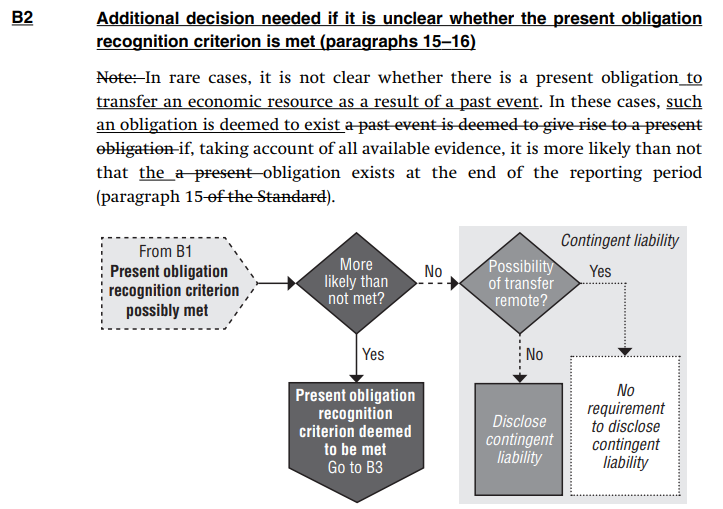
A54Proposed amendments to decision tree in the Guidance on implementing IAS 37 9:
B Decision tree
The decision tree and supporting explanation are deleted and a new three-part decision tree and supporting explanation are added. For ease of reading, the changes to the decision tree are not marked. Other new text is underlined and other deleted text is struck through.
This three-part decision tree summarises the process of applying the three criteria for recognising a provision set out in paragraphs 14-26.The purpose of this diagram is to summarise the main recognition requirements of the Standard for provisions and contingent liabilities.
B1 Present obligation recognition criterion (paragraphs 14(a) and 14A-16)
B2 Additional decision needed if it is unclear whether the present obligation recognition criterion is met (paragraphs 15–16)
Note: In rare cases, it is not clear whether there is a present obligation to transfer an economic resource as a result of a past event. In these cases, such an obligation is deemed to exist a past event is deemed to give rise to a present obligation if, taking account of all available evidence, it is more likely than not that the a present obligation exists at the end of the reporting period (paragraph 15 of the Standard).
B3 Probable transfer and reliable estimate recognition criteria (paragraphs 14(b), 14(c) and 23-26)
Footnotes
-
The corresponding Invitation to Comment can be found on the UKEB website. ↩
-
UKEB November 2024 Agenda Paper 6. A recording of the meeting can be accessed here. ↩
-
UKEB December 2024 Agenda Paper 6. A recording of the meeting can be accessed here. ↩
-
IFRIC 6 Liabilities arising from Participating in a Specific Market - Waste Electrical and Electronic Equipment and IFRIC 21 Levies. ↩
-
Agenda Decision Climate-related Commitments (IAS 37). ↩
-
The IASB tentative decision on threshold-triggered costs was based on view 3, which notes that irrespective of whether the measure of the entity's activity is below or above the threshold, there is only one activity (e.g. generating revenue or emitting gasses). ↩
-
The Secretariat understands the UK Bank Levy is charged if an entity is a bank or a building society at the end of its annual reporting period and its aggregate chargeable equity and liabilities exceed a £20 billion allowance. If a bank ceased operating as a bank prior to that date, it is not subject to the levy for the full reporting period. Where an entity's reporting period is not equal to 12 months, then an adjustment is made to the chargeable equity and liabilities to reflect the relevant period. ↩
-
Refer to IASB Jan 2025 - Agenda Paper 22 and related Appendix. A recording will be available here. ↩
-
Source: IASB's Exposure Draft: Provisions – Targeted Improvements, Proposed amendments to Guidance on implementing IAS 37, Section B Decision tree. ↩