5 Financial Instruments with Characteristics of Equity
Executive Summary
| Project Type | Influencing |
|---|---|
| Project Scope | Moderate |
Purpose of the paper
The purpose of this paper is to:
1Present a preliminary analysis paper (Appendix A) for consideration by the Board. It provides analysis of key topics not discussed by the Board at its December 2023 meeting, namely obligations to purchase own equity (NCI put options) and contingent settlement provisions. It also considers transition.
2Obtain Board feedback and approval for publication of the Draft Comment Letter (DCL) (Appendix B) and the accompanying Invitation to Comment (Appendix C) on the IASB Exposure Draft (ED) Financial Instruments with Characteristics of Equity: Amendments to IAS 32, IFRS 7 and IAS 1 (the Amendments).
Summary of the issue
The IASB's ED addresses certain application issues in accounting for aspects of financial instruments with characteristics of equity which have resulted in diversity in practice. It proposes amendments to IAS 32, IFRS 7 and IAS 1. It was issued on 29 November 2023 with the comment period closing on 29 March 2024.
The preliminary analysis paper included at Appendix A summarises the issues that led the IASB to address certain topics included in the ED, the IASB's proposals and UK stakeholder feedback received to date.
The DCL supports the IASB's objectives and makes recommendations to enhance the ED's proposals.
Decisions for the Board
Preliminary analysis: questions
The Board may wish to consider the following questions during its discussion:
1Does the Board have any questions or comments on the proposals on:
- obligations to redeem own equity?
- contingent settlement provisions?
- transition?
DCL and Invitation to Comment
2Subject to addressing any comments raised during the meeting, does the Board approve the DCL for publication and draft Invitation to Comment for stakeholder feedback?
Recommendation
The Secretariat recommends that the Board approves the DCL and accompanying draft Invitation to Comment.
Appendices
Appendix A Financial Instruments with Characteristics of Equity – Proposed Amendments to IFRS 9, IFRS 7 and IAS 1: Preliminary Analysis Appendix B Draft Comment Letter Appendix C Draft Invitation to Comment
Background
1In the light of increased complexity of financial instruments with both financial liability and equity characteristics, the IASB has sought to improve the consistency, completeness, and clarity of the classification requirements of IAS 32. The IASB issued the Amendments on 29 November 2023 with a comment period that closes on 29 March 2024. They cover the following topics:
- The fixed-for-fixed condition
- Reclassification
- The effects of laws and regulations
- Shareholders' discretion
- Obligations to redeem own equity
- Contingent settlement provisions
- Presentation
- Disclosure
- Effective date and transition
2In order to provide information on the topics covered in the ED but that were not discussed at the Board's December meeting, the preliminary analysis paper summarises the issues that led the IASB to address those topics, the IASB's proposals and stakeholder feedback received to date.
Draft comment letter
3The DCL is attached for consideration and approval, with the accompanying Invitation to Comment. Overall, the DCL supports the IASB's objectives but makes recommendations to enhance the ED's proposals.
4We propose to issue the DCL for a minimum 30-day comment period ending on 8 March 2024.
Research and outreach
5To inform the drafting of the DCL, the Secretariat has conducted desk-based research, including reviewing the ED and other relevant publications from accounting firms.
6In September 2023, November 2023 and January 2024, the Secretariat discussed the IASB's proposals with the Financial Instruments Working Group. The Secretariat has also discussed the proposals with the Accounting Firms and Institutes Advisory Group, the Investors' Advisory Group and a variety of other relevant stakeholders Their feedback has been set out in the Preliminary Analysis papers submitted to the Board in December 2023 and as part of this paper.
Questions for the Board
1Does the Board have any questions or comments on the proposals on:
- obligations to redeem own equity?
- contingent settlement provisions?
- transition?
2Subject to addressing any comments raised during the meeting, does the Board approve the DCL for publication and draft Invitation to Comment for stakeholder feedback?
Next steps
7In line with the PIP, outreach with stakeholders will continue between now and mid-March 2024, including via publication of the DCL on the UKEB website and discussion with the Preparers' Advisory Group and other relevant advisory groups.
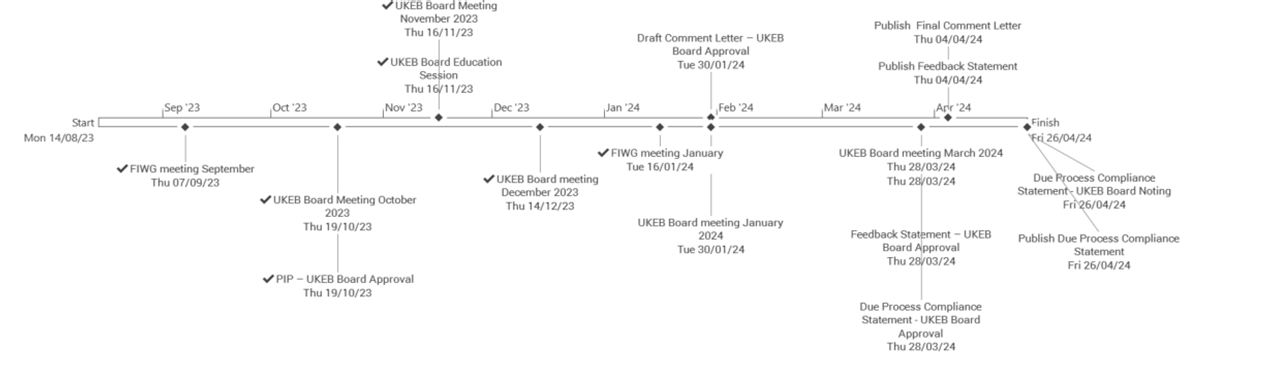
8The Secretariat plans to bring the Final Comment Letter, Feedback Statement and draft Due Process Compliance Statement to the March 2024 meeting for Board approval. Further information on the project timeline is presented in the table below.
| Milestone/activity | Brief description | Status |
|---|---|---|
| Technical project added to UKEB technical work plan (mandatory) [Handbook 4.30(b)] | Added to UKEB technical work plan. | Completed. |
| Education session on IASB proposals on FICE (optional) [Handbook 4.10] | Education sessions on the FICE project were provided to the board in November 2022 and November 2023, and a supplementary education session was provided in December 2023. | Completed. |
| Desk-based research (optional) [Handbook 5.9] | The Secretariat is undertaking a programme of desk-based research, including review of IASB staff papers, publications from regulators, accounting firms and other relevant sources including accounting manuals as well as the ED. | In progress. |
| Outreach activities (mandatory) [Handbook 5.11] | The Financial Instruments Working Group has discussed the proposals at three meetings. In addition, we have sought feedback from:
|
In progress. |
| Project Initiation Plan (PIP) (mandatory) [Handbook 5.4 to 5.8] | The Board approved the Project Initiation Plan in October 2023. | Completed. |
| Draft comment letter (DCL) published for comment (generally mandatory) [Handbook paragraphs 5.13 to 5.17] | This paper. | In progress. |
| UKEB submits final comment letter (FCL) to the IASB (mandatory) [Handbook paragraph 5.18] | The IASB comment period closes on 29 March 2024. | To be completed: to be submitted as soon as possible after the 28 March 2024 Board meeting. |
| Feedback statement and due process compliance statement for influencing stage of project | Secretariat to publish Feedback Statement and Due Process Compliance Statement on UKEB website. | To be completed. |
Timeline
 ## Appendix A: Financial Instruments with Characteristics of Equity – Proposed Amendments to IAS 32, IFRS 7 and IAS 1
| Preliminary Analysis {: #section-appendix-a }
Obligations to redeem own equity
What is the issue?
A1Put options on non-controlling interests (NCI puts) are common in many jurisdictions, including the UK. They are granted to provide non-controlling interest holders with liquidity and the right to sell their shares to the majority shareholder in the future. They can be exercisable at either a variable strike price or a fixed strike price at a specified future date (or period).
A2IAS 32 Financial Instruments: Presentation paragraph 23 requires a contract that contains an obligation for an entity to purchase its own equity instruments for cash or another financial asset to be recognised as a financial liability. The liability is recognised initially at the present value of the redemption amount and is reclassified from equity. Subsequently the financial liability is measured in accordance with IFRS 9 Financial Instruments.
A3The IASB noted there is evidence of diversity in practice in accounting for NCI puts and at its July 2022 meeting1, the IASB discussed long-standing practice questions arising from this paragraph and possible clarifications it could make.
A4All the firms present accounting policy choices in this area on where the debit entry for a NCI put should go, between NCI and other equity. 2 The firms' accounting manuals appear to agree that reclassification to equity is required on the expiry of a put option. The firms suggest also that obligations to redeem an entity's own equity instruments that are required to be settled in a variable number of a different type of the entity's own equity instruments should be a financial liability.3
A5The IASB4 notes that any clarifications affecting the application of paragraph 23 of IAS 32 would apply to all obligations to redeem own equity instruments regardless of whether they relate to NCI or other issued shares. Clarifications would also apply to obligations arising from both forward purchase contracts and written put options, as long as they are settled on a gross physical basis (i.e., consideration is paid in exchange for own equity instruments). If the obligations were net cash settled or net share settled, derivative accounting would apply.
IASB proposals
A6The IASB has proposed amending IAS 32 to clarify that:
- IAS 32 paragraph 23 also applies to an obligation to redeem an entity's own equity instruments that is required to be settled in a variable number of a different type of the entity's own equity instruments (that is, not only to transactions to be settled in cash or another financial asset). (ED paragraph 23)
- If the obligation to redeem an entity's own equity instruments involves non-controlling interests, the debit entry is initially recognised against a component of equity other than non-controlling interests. In the case of an entity's other obligations to purchase its own shares and “if the entity does not yet have access to the rights and returns associated with ownership to which the obligation relates (the rights and returns have not legally or in substance been transferred to the entity), these equity instruments would continue to be recognised. The initial amount of the financial liability would, therefore, be removed from a component of equity other than non-controlling interests or issued share capital”. (ED paragraph AG27B)
- An entity is required to use the same approach for initial and subsequent measurement of financial liabilities within the scope of that paragraph—that is, the entity would ignore the probability and estimated timing of the holder exercising the written put option in initial and subsequent measurement. (ED paragraph 23)
- When remeasuring the financial liability, an entity is required to recognise gains or losses in profit or loss. (ED paragraph 23)
- On expiry of a written put option on an entity's own equity instruments:
- the financial liability is reclassified to the same component of equity as that from which it was reclassified on initial recognition of the put option; and
- the cumulative amount in retained earnings related to remeasuring the financial liability could be reclassified to another component of equity but is not reversed in profit or loss. (ED paragraph AG27C)
- Written put options and forward purchase contracts on an entity's own equity instruments are required to be presented gross instead of net. (ED paragraph AG27D)
A7In addition, paragraph 23 of IAS 32 will no longer cross refer to IFRS 9 Financial Instruments for subsequent measurement.
To what extent could these proposals result in a change in UK practice?
A8Stakeholders have indicated that a number of these are areas where diversity of practice currently exists, and that the clarifications should reduce this.
A9AFIAG and FIWG members observed that the proposal described at paragraph A6(c) above may amount to a change from current UK practice. FIWG stakeholders considered that this proposal was unlikely to affect UK banks, but could affect entities which do not routinely issue financial instruments with characteristics of equity.
A10They told us that the introduction of the sentence “The redemption amount is discounted, assuming redemption will occur at the earliest possible redemption date specified in the contract" in paragraph 23 might lead to a change in measurement for some instruments in the UK. They have noted two particular types of NCI put options where the mandating of the ‘earliest possible redemption date' could lead to changes from current UK practice. For example:
- Put options containing a stepped level of payments depending on the timing of exercise e.g. exercisable for £1 in first 12 months, £1m thereafter.
- Put options with variable payments, depending on time of exercise, e.g. redemption at a multiple of EBITDA at different points in time.
A11FIWG members noted that while they did not consider that the proposed changes in relation to measurement in paragraph 23 were perfect, they were unable to identify an alternative solution. They also noted that this is an area where there is existing diversity of practice. In their view the proposals, including the removal of the cross reference to IFRS 9 for subsequent measurement, would reduce that diversity.
A12They observed that instruments such as that in A10(a) were relatively uncommon. They noted that if an entity was party to such a contract, and was exposed to increases in payments in future periods, it was important that this information was disclosed.
A13FIWG members expressed mixed views on the adequacy of these requirements in relation to instruments with variable payments, such as payment linked to a multiple of EBITDA, which we understand to be relatively common. There was no clear view that either additional instruction in the standard, or additional guidance would necessarily resolve this. We have received other feedback, however, that this guidance is underdeveloped. We have indicated in the DCL that it would be helpful for the IASB to make clear their expectations on how instruments with variable payments would be measured under these proposals.
A14Where the outflow of cash required to settle the liability could be greater than the carrying value of the liability due to a variable feature such as a link to EBITDA, it is important that this is explained to users. While some FIWG attendees thought such disclosure might be caught by the general disclosure requirement of IAS 1.112(c), we consider that it would be preferable to include a specific requirement to provide information about the exposure to instruments accounted for under paragraph 23, where the ultimate amount required to settle the instrument could be greater than the carrying value, as a result of factors other than discounting.
A15AFIAG members supported the requirement for gross presentation of contractual obligations to purchase own equity, as set out in the first sentence of paragraph AG27D. However, it was indicated that the second sentence could be interpreted as permitting derivative accounting where the holder, but not the issuer, had the ability to elect for net settlement of the contract. As net settlement is not within the control of the issuer, it was not clear why gross presentation should not also be required in this example. We have drafted a recommendation to require gross presentation unless the issuer has the discretion to net settle the instrument, in which case derivative accounting would apply.
What is the ongoing impact likely to be?
A16Stakeholders considered that these proposals would drive consistency and provide useful information in many cases.
A17Stakeholders observed that the difficult questions on the interaction between the scope of the guidance on this area within IAS 32, IFRS 2 Share-based Payments and, to a lesser extent, IFRS 3 Business Combinations remain unaddressed.
Proposed analysis and recommendations within the Draft Comment Letter (DCL)
- Welcome the proposals.
- Recommend IASB clarify its intention on the application of this proposal to obligations to redeem own equity that include variability, such as a link to EBITDA.
- Recommend a disclosure requirement to alert users to any unusual measurement outcomes from applying paragraph 23.
Contingent settlement provisions
What is the issue?
A18Paragraph 25 of IAS 32 Financial Instruments: Presentation sets out requirements for accounting for contingent settlement provisions as follows:
“A financial instrument may require the entity to deliver cash or another financial asset, or otherwise to settle it in such a way that it would be a financial liability, in the event of the occurrence or non-occurrence of uncertain future events (or on the outcome of uncertain circumstances) that are beyond the control of both the issuer and the holder of the instrument, such as a change in a stock market index, consumer price index, interest rate or taxation requirements, or the issuer's future revenues, net income or debt-to-equity ratio. The issuer of such an instrument does not have the unconditional right to avoid delivering cash or another financial asset (or otherwise to settle it in such a way that it would be a financial liability). Therefore, it is a financial liability of the issuer unless:
(a) the part of the contingent settlement provision that could require settlement in cash or another financial asset (or otherwise in such a way that it would be a financial liability) is not genuine;
b) the issuer can be required to settle the obligation in cash or another financial asset (or otherwise to settle it in such a way that it would be a financial liability) only in the event of liquidation of the issuer; or
(c) the instrument has all the features and meets the conditions in paragraphs 16A and 16B.”
Following feedback on practice issues, the IASB is proposing to make clarificatory amendments in this area.
IASB proposals
A19The IASB5 has proposed the following amendments to IAS 32 in relation to contingent settlement provisions:
- To clarify that financial instruments with contingent settlement provisions may be compound instruments. (ED paragraph 25 and 32A)
- To clarify that the liability component of a compound financial instrument with contingent settlement provisions, which could require immediate settlement if a contingent event occurs, is measured “on initial recognition and subsequently at the present value of the settlement amount. The settlement amount is discounted, assuming settlement will occur at the earliest possible settlement date specified within the contract.” The entity would ignore the probability and estimated timing of the contingent event in initial and subsequent measurement. (ED paragraph 25A)
- To clarify that payments at the discretion of the issuer are recognised in equity, even if all the proceeds are allocated initially to the liability component of a compound instrument. (ED paragraphs 32A and AG37)
- To specify that the term 'liquidation' in paragraph 25(b) of IAS 32 refers to when an entity is in the process of permanently ceasing operations. (ED paragraph 11)
- To specify that an assessment of whether a contract term is 'not genuine' under paragraph 25(a) of IAS 32 is not made by considering only the probability of the contingent event occurring. (ED paragraph AG28)
To what extent could these proposals result in a change in UK practice? What is the ongoing impact likely to be?
A20At the time of writing, no stakeholders have expressed concerns over the proposals listed at paragraphs A19.a) and A19.d) above.
A21Both AFIAG and FIWG members welcomed the consistency afforded by the proposed requirement (paragraph A19.b) above) to measure contingent settlement provisions at the full amount of the contingent obligation, i.e. the amount repayable assuming the earliest possible repayment date. However, they thought that at present, in the absence of guidance, preparers and auditors were using judgement to reach sensible answers, and they expressed reservations about disturbing this practice. Both groups expressed concerns that in some cases the proposed requirements may lead to unexpected outcomes, for example in scenarios where instruments have stepped, or variable, contingent settlement features, such as those set out in A10 in relation to NCI puts.
A22A FIWG member raised a specific concern relating to the introduction of these new measurement proposals in ED paragraph 25A. Much of the IASB's discussion of contingent settlement features in this project has been in relation to compound financial instruments, where for example a contingent feature gives rise to a liability component in an instrument also containing an equity component. .
A23However, by including this new measurement requirement in paragraph 25A, this appears to widen the scope of this provision further than suggested within a number of these discussions – e.g. to include debt instruments with contingent settlement features, such as features relating to tax or law changes, or even covenants. The introduction of wider measurement requirements into IAS 32 is beyond the original scope of this project, and risks unintended consequences. We have drafted a recommendation to relocate the new requirements to the paragraphs in IAS 32 that address compound instruments.
A24Both AFIAG and FIWG members commented that the proposals do not include guidance on how to account for a contingent settlement provision that should be measured at an amount greater than the proceeds of the instrument. Under the proposals, entities may be required to recognise a loss on day 1. For example, if an instrument is issued at £1, which may be redeemed at £1.02 if a contingent settlement provision applies, it should be recognised at £1.02. Stakeholders would welcome clarity on how this difference should be dealt with on day 1. Stakeholders have further commented that if it is intended that the initial recognition amount is capped at the fair value of the instrument at issue, or proceeds, it is not currently clear how to account for the same instrument on day 2. We have requested clarity on the required accounting in such scenarios.
A25FIWG stakeholders considered that these changes were unlikely to affect the way that banks account for AT1 instruments. They agreed with the IASB's proposal, and its rationale, for bifurcating instruments into a liability and an equity component measured at £nil (paragraph A19.c)). They further considered that the clarification on whether a contract term is 'not genuine' was consistent with UK practice (paragraph A19.e)).
Proposed analysis and recommendations within the DCL
- Welcome clarifications in relation to the majority of the proposals.
- Clarification on measurement of contingent settlement provisions appears to go beyond the scope of the project, by introduction of new initial and subsequent measurement provisions, that could apply more widely than anticipated, e,g, to common features in debt instruments.
- Recommend scope of change is restricted to the debt components of compound instruments only to ensure a clear scope and to reduce application questions. Disclosure recommendations if IASB does decide to proceed.
Transition
IASB proposals
A26The IASB has proposed that entities should apply these amendments retrospectively, restating comparatives.
A27For an entity already applying IFRS Accounting Standards:
- To require the entity to treat the fair value at the beginning of the earliest comparative period presented as the amortised cost of the financial liability at that date if it is impracticable (as defined in IAS 8 Accounting Policies, Changes in Accounting Estimates and Errors) for the entity to apply the effective interest method retrospectively.
- Not to require the entity to separate the liability and equity components if the liability component of a compound financial instrument with a contingent settlement provision was no longer outstanding at the date of initial application.
- To require the entity to disclose the nature and amount of any changes in classification resulting from initial application.
- To provide transition relief from the quantitative disclosures in paragraph 28(f) of IAS 8.
- Not to provide any transition relief from the requirements in IAS 34 Interim Financial Reporting for interim financial statements issued within the annual period in which the entity first applies the amendments.
A28For first-time adopters, not to require any additional transition relief.
Proposed analysis and recommendations within the DCL
- Welcome clarifications in relation to the majority of the proposals.
- Clarification on measurement of contingent settlement provisions appears to go beyond the scope of the project, by introduction of new initial and subsequent measurement provisions, that could apply more widely than anticipated, e,g, to common features in debt instruments.
- Recommend scope of change is restricted to the debt components of compound instruments only to ensure a clear scope and to reduce application questions. Disclosure recommendations if IASB does decide to proceed.
Transition
IASB proposals
A26 The IASB has proposed that entities should apply these amendments retrospectively, restating comparatives.
A27 For an entity already applying IFRS Accounting Standards:
- To require the entity to treat the fair value at the beginning of the earliest comparative period presented as the amortised cost of the financial liability at that date if it is impracticable (as defined in IAS 8 Accounting Policies, Changes in Accounting Estimates and Errors) for the entity to apply the effective interest method retrospectively.
- Not to require the entity to separate the liability and equity components if the liability component of a compound financial instrument with a contingent settlement provision was no longer outstanding at the date of initial application.
- To require the entity to disclose the nature and amount of any changes in classification resulting from initial application.
- To provide transition relief from the quantitative disclosures in paragraph 28(f) of IAS 8.
- Not to provide any transition relief from the requirements in IAS 34 Interim Financial Reporting for interim financial statements issued within the annual period in which the entity first applies the amendments.
A28 For first-time adopters, not to require any additional transition relief.
What is the likely impact of transition?
A29 The IASB has proposed full retrospective application with targeted exceptions where this is impracticable.
A30 Feedback from stakeholders has indicated that the financial sector would not find full retrospective application onerous. However, smaller entities who do not routinely issue financial instruments with characteristics of equity would incur additional costs in implementing the transition.
A31 FIWG and AFIAG members observed that classification of financial instruments with characteristics of equity continues to generate questions for technical specialists within accounting firms. Whilst these amendments may not generate a high volume of changes in classification, there is likely to be significant work involved in reviewing financial instruments in issue.
A32 Feedback from representatives of smaller and mid-tier accountancy firms has highlighted the practical and cost challenges the changes may present for some of their clients. They felt it was unlikely that all the required information to assess the classification of existing instruments would be held on current IT systems, and was likely to require detailed review of documentation by external advisers. It was noted that in many cases this would be unlikely to result in any change in classification, but would nonetheless mean significant cost for limited benefit.
A33 We understand from feedback that private equity firms commonly use instruments which may be affected by the proposals when they invest funds. These investments are often made through bespoke, complex structures, and retrospective restatement may require significant cost to engage external advisers to review these structures. There may be limited changes to classification arising from such work, but the costs could be significant, and benefits may be limited, as the investee companies are typically privately owned.
A34 If instruments were required to be retrospectively reclassified from equity to a financial liability, it would be necessary to measure their fair value at inception, which could also prove onerous and difficult to perform without hindsight.
Impacts related to specific proposals
Fixed-for-fixed condition
A35 Stakeholders commented that as the proposed assessment of whether preservation adjustments are permitted does not take the likelihood of existing shareholders' rights being diminished into account, this may constitute a change from at least some current practice. Where share issues are based on an approximative formula, it is unlikely but conceivable that future shareholders may be placed in a marginally better position relative to existing shareholders.
A36 Certain instruments previously classified as equity may therefore no longer pass the test. For example, certain instruments may narrowly fail the preservation adjustment, which could lead to reclassification for a small number of instruments, principally from equity to financial liability. Stakeholders did not consider that this would prove an issue when issuing new instruments, but it may be difficult for some existing instruments to remain classified as fixed-for-fixed under the amendments.
A37 Feedback from stakeholders indicates that full retrospective assessment of these requirements for existing instruments may lead to significant costs. It is not clear that the benefits of making such a reassessment outweigh the costs where exercise points may already have expired. For example, consider an instrument issued a number of years ago containing conversion options, and which had been assessed at date of issue as meeting the fixed-for-fixed criterion. If conversion at any point in the past would have failed to meet the definition of a preservation adjustment, our understanding from discussions with stakeholders is that the instrument would have to be reclassified on transition as a liability, even though the remaining conversion features would meet the definition of preservation adjustments.
Shareholder discretion
A38 In applying a factor-based assessment retrospectively, there is a risk that it will be difficult for entities not to incorporate an element of hindsight into the assessment.
Presentation
A39 Some stakeholders expressed concern over the practical ability to distinguish reserves attributable to ordinary shareholders from those attributable to other shareholders. This requirement could be particularly difficult to apply retrospectively to the reserves of private equity vehicles with different classes of ordinary share capital allocated in accordance with a formula.
Effects of laws
A40 As stakeholder feedback indicates that these proposals are not expected to give rise to changes in practice in the UK, there is likely to be minimal impact on transition.
Proposed analysis and recommendations within the DCL
- Welcome proposals.
- Recommend transitional relief from full retrospective application along similar lines to the practical expedient provided by IFRS 16 Leases, or if not, requiring full retrospective application only for instruments issued after a certain point, for example, within five years of the effective date.
- Recommend IASB consider transition relief on the 'fixed-for-fixed' condition to assess only those features still outstanding at transition date. .
- Recommend where it is impracticable to apply presentation requirements retrospectively, entities should be permitted only to present prospective information.
Questions for the Board
- Does the Board have any questions or comments on the proposals on:
- obligations to redeem own equity?
- contingent settlement provisions?
- transition?
Dr Andreas Barckow Chairman International Accounting Standards Board Columbus Building 7 Westferry Circus Canary Wharf London E14 4HD
XX April 2024
Dear Dr Barckow
Exposure Draft IASB/ED/2023/5 Financial Instruments with Characteristics of Equity: Proposed amendments to IAS 32, IFRS 7 and IAS 1
1 The UK Endorsement Board (UKEB) is responsible for endorsement and adoption of IFRS Accounting Standards for use in the UK and therefore is the UK's National Standard Setter for IFRS Accounting Standards. The UKEB also leads the UK's engagement with the IFRS Foundation on the development of new standards, amendments and interpretations. This letter is intended to contribute to the Foundation's due process. The views expressed by the UKEB in this letter are separate from, and will not necessarily affect the conclusions in, any endorsement and adoption assessment on new or amended international accounting standards undertaken by the UKEB.
2 There are currently approximately 1,500 entities with equity listed on the London Stock Exchange that prepare their financial statements in accordance with IFRS.6 In addition, UK law allows unlisted companies the option to use IFRS and approximately 14,000 such companies currently take up this option.7
3 We welcome the opportunity to provide comment on the International Accounting Standards Board (IASB) Exposure Draft (ED) Financial Instruments with Characteristics of Equity: Proposed amendments to IAS 32, IFRS 7 and IAS 1 (the Amendments). In developing this letter, we have consulted with stakeholders in the UK, including preparers, accounting firms and institutes, and users of accounts.
4 We support the IASB's objectives in developing the Amendments, and we are broadly supportive of the proposals. We consider it important to provide clarity and minimise the risk of diversity in accounting practice in this complex area. Our main observations and recommendations are set out in the paragraphs that follow. Responses to the IASB's specific questions about the ED are included in the Appendix to this letter.
Reclassification
5 We welcome the IASB's efforts to clarify this important area. However, we are concerned that the proposals in their current form constitute a change to established practice, which could lead to the classification of financial instruments diverging from their substance.
6 Stakeholders considered that, especially for non-derivatives, preventing reclassification in respect of contractual terms that become, or stop being, effective with the passage of time could result in the provision of misleading information. This is due to their view that the continuing recognition of a financial liability in such circumstances may no longer faithfully represent the substance of the financial instrument. Examples of these include the expiry of a contingent settlement provision and a change in terms with the passage of time that results in the instrument meeting the criteria for equity classification.
7 We recommend that the IASB considers requiring reclassification for passage of time adjustments, which would lead to greater consistency with the current application of IAS 32 and avoid some of the concerning outcomes highlighted by stakeholders. We do not consider that such a requirement would significantly increase costs or complexity for most preparers.
8 However, if the IASB decides to proceed with the proposals in the ED unamended, we recommend that the IASB provide clearer guidance on the distinction between reclassification and derecognition, and when each would apply. We believe that in some of the examples raised with us, and in the example in BC 143, derecognition of a liability or liability component may be the appropriate outcome and may address some of the concerns highlighted with this proposal.
9 Our detailed comments on reclassification are in paragraphs A34 to A45 of the appendix.
Obligations to redeem an entity's own equity instruments
10 We welcome the IASB's objective of clarifying this complex area.
11 In general, UK stakeholders have indicated that they support the IASB's proposals. They note that a number of these are areas where diversity of practice currently exists, and that the clarifications should reduce this.
12 We understand the proposed requirement in relation to initial and subsequent measurement of the obligations is a pragmatic solution that will provide useful information in many instances.
13 However, stakeholders tell us that in some cases the proposal could lead to a change in measurement for some instruments and, potentially, to financial information that is not useful. In particular, the introduction in paragraph 23 of the ED of the sentence “The redemption amount is discounted, assuming redemption will occur at the earliest possible redemption date specified in the contracť" could lead to a change in measurement of some relatively common instruments in the UK - NCI put options with redemption amounts linked to EBITDA.
14 We recommend the IASB clarify its intention on the application of this proposal to obligations to redeem own equity that include variability, such as a link to EBITDA, for which the earliest possible redemption date may not lead to meaningful information.
15 In instances where the requirements lead to the amount recognised being less than the potential full settlement amount, we consider that disclosure would be important in mitigating any reduction in the usefulness of information provided to users of financial statements. We recommend the introduction of a disclosure requirement which explains situations where the full settlement amount may differ from the amount recognised.
16 Our detailed comments on obligations to redeem own equity are in paragraphs A17 to A25 of the appendix.
Contingent settlement provisions
17 The introduction of initial and subsequent measurement requirements within IAS 32 that differ from existing measurement models within IFRS 9 appears to go beyond the original scope of this project, and beyond clarification of classification outcomes.
18 Stakeholders considered that in the current absence of guidance, preparers and auditors were using judgement to reach pragmatic answers. They expressed some reservations about disturbing this practice. Stakeholders have noted similar concerns to some of those referred to in paragraph 12, as the same measurement requirements are proposed in paragraphs 23 and 25A.
19 In relation to the proposals on initial and subsequent measurement of the financial liability arising from a contingent settlement provision, stakeholders have expressed concern that the introduction of new measurement guidance in paragraph 25A appears to apply to any contingent settlement feature in debt instruments, as well as to features of a compound instrument. They are concerned that this paragraph would apply to common features within debt instruments such as tax or law change clauses, or loan covenants, leading to unintended consequences.
20 We recommend that the scope of the measurement proposals referred to in paragraphs 16 and 17 should be restricted to financial liability components of compound financial instruments.
21 We also recommend the IASB provides further guidance on the required initial and subsequent accounting where a contingent settlement feature settlement amount exceeds the fair value of the instrument at issue, for example where the probability of the contingent event taking place is low.
22 Our detailed comments on contingent settlement provisions are in paragraphs A26 to A32 of the appendix.
Fixed-for-fixed
23 We broadly welcome the IASB's proposals in this area. However, the wording of ED paragraph 22C(b)(iii) has caused some confusion among stakeholders as to whether a passage of time adjustment could only be derived from a fixed rate, and whether there was any requirement for the rate to be reasonable. We recommend that further explanation is required to be clear on the meaning of “proportional" in terms of fixing the present value.
24 Stakeholders also felt that it would be helpful to provide further examples of successful and unsuccessful passage of time adjustments, to supplement the single example accompanying the proposals. In particular, stakeholders would welcome examples of features that applied over a period of time, not just at maturity, with clear guidance of whether they would qualify as passage of time adjustments. One common instrument highlighted was variable rate convertible debt with accrued interest.
25 Our detailed comments on settlement in an entity's own equity instruments are in paragraphs A9 to A16 of the appendix.
Disclosures
26 Overall, we welcome the proposals. Our stakeholders consider that they are expected to enhance the quality of disclosure on financial instruments with characteristics of equity.
27 However, until preparers have had the opportunity to field test the proposed disclosures, it is difficult to provide full feedback on the operability, or cost implications, of the additional disclosures. We recommend the IASB undertakes field testing of these proposals before finalising the requirements.
28 We have received feedback from stakeholders that the priority of liquidation disclosures required by paragraphs 30A and 30B of IFRS 7 may be operationally difficult to prepare. This information may not be routinely collected on a consolidated level and may be difficult to assess or audit, especially where a group has entities operating in a number of different countries with different liquidation frameworks. We recommend the IASB reconsiders this requirement.
29 Our detailed comments on disclosures are in paragraphs A46 to A53 of the appendix.
Transition
30 We are broadly supportive of the proposals for full retrospective adoption, as we recognise this should lead to greater comparability of issued instruments.
31 However, while this should not give rise to undue cost or effort for larger, more sophisticated entities such as financial institutions, concerns have been raised by representatives of small and medium sized accounting firms, and private equity investors. These stakeholders tell us that for such entities complex structures are relatively commonplace, and that the need for full retrospective restatement could lead to significant additional costs. Many entities would have to engage professional advisers to assist with application of the new requirements.
32 Private equity investors, for example, would have to review a significant volume of bespoke structures, typically a number of years old, at significant expense. They expect that such costs would be required to be passed on to investors in their funds. They generally did not consider that there would be any significant benefit for users of the financial statements in these cases, as, generally, classification outcomes were not expected to change. They also commented that the relevant financial statements of investees would be of little general interest, as typically these companies are in private ownership, and changes in classification would be unlikely to alter the economics of the investments for the investors.
33 We recommend that consideration be given to providing transitional relief from full retrospective application, for example along similar lines to the practical expedient provided in IFRS 16 Leases paragraphs C3 and C4. Alternatively, we have also highlighted certain other possible transition provisions to address specific concerns.
34 Our detailed comments on transition are in paragraphs A55 to A69 of the appendix.
Laws and regulations
35 As drafted, it is currently not clear how these provisions would apply to Additional Tier 1 capital instruments issued by banks in the UK. We recommend providing further clarity in the Basis for conclusions and through an illustrative example on how these provisions apply in scenarios where regulations require the inclusion of a loss absorption feature, but the issuer has some discretion over the form of that feature.
36 Our detailed comments on laws and regulations are in paragraphs A1 to A8 of the appendix.
37 If you have any questions about this response, please contact the project team at [email protected].
Yours sincerely
Pauline Wallace Chair UK Endorsement Board
Appendix A: Questions on ED Financial Instruments with Characteristics of Equity – Proposed amendments to IAS 32, IFRS 7 and IAS I
Question 1—The effects of relevant laws or regulations (paragraphs 15A and AG24A–AG24B of IAS 32)
The IASB proposes to clarify that:
- only contractual rights and obligations that are enforceable by laws or regulations and are in addition to those created by relevant laws or regulations are considered in classifying a financial instrument or its component parts (paragraph 15A); and
- a contractual right or obligation that is not solely created by laws or regulations, but is in addition to a right or obligation created by relevant laws or regulations shall be considered in its entirety in classifying the financial instrument or its component parts (paragraph AG24B).
Paragraphs BC12–BC30 of the Basis for Conclusions explain the IASB's rationale for these proposals. Do you agree with these proposals? Why or why not?
If you disagree with any of the proposals, please explain what you suggest instead and why.
A1 The IASB has set out two examples of how these proposals may affect financial instruments: accounting for a financial instrument in a jurisdiction with a legal minimum dividend and accounting for a financial instrument with a bail-in feature.
A2 We welcome the proposals as a pragmatic solution to questions that arise around the extent to which a legal requirement is part of the contractual terms. They are not expected to give rise to significant changes in UK practice.
A3 Stakeholders considered that paragraph 15A(b) duplicated paragraph 15A(a) without enhancing the clarity of accounting. In particular, paragraph 15A(b) raised questions about accounting for scenarios in which the law or regulation provides a choice or does not specify how its requirements should be met. We recommend that the IASB remove paragraph 15A(b).
A4 As the UK does not have a legal minimum dividend, this amendment may affect foreign subsidiaries of UK groups but is not expected to affect UK practice.
Additional Tier 1 Instruments
A5 Stakeholders have noted that, as drafted, it is not clear how these provisions would apply to AT1 instruments issued in the UK. Paragraph BC13(a) states that "banks are required by law to include a loss absorption feature in these instruments". UK banks may choose to issue AT1 instruments, but are not compelled to issue such instruments as part of their regulatory capital. In addition, it is currently unclear how the proposals would apply to AT1 instruments in situations in which a legal or regulatory requirement could be satisfied in several ways. For example, in order to qualify as regulatory capital, an AT1 instrument must have a loss absorption feature. However, this could take the form of a conversion feature or a write down feature, neither of which are specified in law, but which would be specified in the contract. Is it the IASB's intention that this scenario is taken into account in classification?
A6 We recommend that the IASB includes an illustrative example based on paragraph BC13 in order to clarify how laws and regulations might apply to AT1 instruments, and which could usefully address the following fact pattern:
“Consider an AT1 instrument issued by an entity to meet regulatory requirements. It is a perpetual instrument with obligations that arise only on liquidation of the issuer.
The regulations require the instrument to have a loss absorption feature which operates either through conversion to common shares at a trigger point of at least a set percentage of the entity's Common Equity Tier 1 capital, or through a write-down mechanism which comes into force at a trigger point of at least a set percentage of the entity's Common Equity Tier 1 capital.
The regulations therefore require a loss absorption feature but provide choices for how the requirement might be satisfied.”
A7 In addition, stakeholders have observed that the explanations in the Basis for Conclusions supporting the changes in relation to financial instruments with bail-in features could be enhanced, to avoid the risk of confusion. The IASB refers to 'bail-in' provisions in Additional Tier 1 (AT1) instruments in paragraph BC13. The description appears to conflate loss absorption features, which may be required by regulation for an instrument to qualify as regulatory capital, with bail-in, which, in the UK, is a resolution tool available to the regulator under legislation.
A8 If BC13(a) is intended to apply to instruments such as AT1 instruments, we recommend that paragraph BC13(a) refers to ‘loss absorption provisions', rather than 'bail-in provisions'. We also recommend the language is softened to reflect the relevant regulatory requirements. For example: ‘In order to qualify as Additional Tier 1 regulatory capital, such instruments may be required by regulation to include a loss absorption feature...'.
Question 2—Settlement in an entity’s own equity instruments (paragraphs 16, 22, 22B–22D, AG27A and AG29B of IAS 32)
The IASB proposes to clarify when the fixed-for-fixed condition in paragraph 16(b)(ii) of IAS 32 is met by specifying that the amount of consideration to be exchanged for each of an entity’s own equity instruments is required to be denominated in the entity’s functional currency, and either:
- fixed (will not vary under any circumstances); or
- variable solely because of:
- preservation adjustments that require the entity to preserve the relative economic interests of future shareholders to an equal or lesser extent than those of current shareholders; and/or
- passage-of-time adjustments that are predetermined, vary with the passage of time only, and have the effect of fixing on initial recognition the present value of the amount of consideration exchanged for each of the entity’s own equity instruments (paragraphs 22B–22C).
The IASB also proposes to clarify that if a derivative gives one party a choice of settlement between two or more classes of an entity’s own equity instruments, the entity considers whether the fixed-for-fixed condition is met for each class of its own equity instruments that may be delivered on settlement. Such a derivative is an equity instrument only if all the settlement alternatives meet the fixed-for-fixed condition (paragraph AG27A(b)).
The IASB further proposes to clarify that a contract that will or may be settled by the exchange of a fixed number of one class of an entity’s own non-derivative equity instruments for a fixed number of another class of its own non-derivative equity instruments is an equity instrument (paragraph 22D).
Paragraphs BC31–BC61 of the Basis for Conclusions explain the IASB's rationale for these proposals. Do you agree with these proposals? Why or why not? If you disagree with any of the proposals, please explain what you suggest instead and why.
A9 We welcome the proposed clarifications. In general, UK stakeholders have welcomed these proposals, and consider that they will reduce diversity in practice.
Preservation adjustments
A10 We consider the wording of the requirement at 22C(a)(ii) could be enhanced to provide greater clarity. Future equity holders have no current interest in the entity's own equity instruments, so it is not clear how their interest can be preserved. We recommend the requirement is reworded as follows:
"(ii) preserves the economic interests of the future holders of the entity's own equity instruments (the future equity instrument holders) current equity instrument holders to an equal or lesser greater extent, relative to the economic interests of the current equity instrument holders future holders of the entity's own equity instruments (the future equity instrument holders)"; and..."
A11 We consider that this reworded requirement should then be accompanied by an illustrative example of a successful preservation adjustment.
Passage-of-time adjustments
A12 The wording of ED paragraph 22C(b)(iii) has caused some confusion among stakeholders. Some understood the term “a present value” to mean that only adjustments set at variable rates could meet the definition of a passage-of-time adjustment; others thought that both fixed and variable rates could do so. Equally, some understood “any difference in the amounts of consideration to be exchanged on each possible settlement date represents compensation proportional to the passage of time” to imply that compensation should be reasonable; others thought it simply meant that the return would vary as time passes, irrespective of reasonableness.
A13 In order to provide clarity on this point, we recommend that additional explanation of the meaning of 'proportional' be provided, e.g. “Compensation should change at a rate that remains arithmetically constant with the passage of time. It should not vary with other factors like inflation or interest rates.” If this is indeed the IASB's intention, stakeholders considered this requirement more restrictive than current UK practice, in which financial instruments linked to benchmark rates of interest are generally considered to meet the fixed-for-fixed condition.
A14 We recommend that the IASB consider whether its proposed requirements may be overly restrictive in prohibiting instruments that are linked to benchmark rates, such as interest or inflation, from meeting the fixed-for-fixed condition.
A15 Furthermore, to enhance understanding of this adjustment, we recommend that the requirement should be complemented with additional illustrative examples of successful and unsuccessful passage-of-time adjustments, to supplement the single example currently provided.
A16 In particular, a number of stakeholders indicated they would welcome examples of features that applied over a period of time, not just at maturity, with clear guidance on whether they would qualify as passage of time adjustments. One common instrument highlighted was variable rate convertible debt with accrued interest. We would be happy to share our ideas for potential examples, should you wish to pursue this recommendation.
Question 3—Obligations to purchase an entity’s own equity instruments (paragraphs 23 and AG27B–AG27D of IAS 32)
The IASB proposes to clarify that:
- the requirements in IAS 32 for contracts containing an obligation for an entity to purchase its own equity instruments also apply to contracts that will be settled by delivering a variable number of another class of the entity’s own equity instruments (paragraph 23).
- on initial recognition of the obligation to redeem an entity’s own equity instruments, if the entity does not yet have access to the rights and returns associated with ownership of the equity instruments to which the obligation relates, those equity instruments would continue to be recognised. The initial amount of the financial liability would, therefore, be removed from a component of equity other than non-controlling interests or issued share capital (paragraph AG27B).
- an entity is required to use the same approach for initial and subsequent measurement of the financial liability—measure the liability at the present value of the redemption amount and ignore the probability and estimated timing of the counterparty exercising that redemption right (paragraph 23).
- any gains or losses on remeasurement of the financial liability are recognised in profit or loss (paragraph 23).
- if a contract containing an obligation for an entity to purchase its own equity instruments expires without delivery:
- the carrying amount of the financial liability would be removed from financial liabilities and included in the same component of equity as that from which it was removed on initial recognition of the financial liability.
- any gains or losses previously recognised from remeasuring the financial liability would not be reversed in profit or loss. However, the entity may transfer the cumulative amount of those gains or losses from retained earnings to another component of equity (paragraph AG27C).
- written put options and forward purchase contracts on an entity’s own equity instruments that are gross physically settled—consideration is exchanged for own equity instruments—are required to be presented on a gross basis (paragraph AG27D).
Paragraphs BC62–BC93 of the Basis for Conclusions explain the IASB's rationale for these proposals. Do you agree with these proposals? Why or why not? If you disagree with any of the proposals, please explain what you suggest instead and why.
A17 We support the IASB's objective of clarifying this complex area.
A18 In general, UK stakeholders have indicated that they support the IASB's proposals listed above at 3(a), 3(b), 3(d), 3(e) and 3(f). They note that a number of these are areas where diversity of practice currently exists, and that the clarifications should reduce this.
A19 We also welcome the proposed requirement 3(c) as a pragmatic solution that will provide useful information in many instances. However, stakeholders tell us that on occasion that proposal could lead to illogical outcomes.
A20 Stakeholders considered that the introduction of the sentence “The redemption amount is discounted, assuming redemption will occur at the earliest possible redemption date specified in the contracť” in paragraph 23 of the ED could lead to a change in measurement for some instruments in the UK. They noted two particular types of NCI put options where the mandating of the 'earliest possible redemption date' could lead to changes from current UK practice. For example:
- Put options containing a stepped level of payments depending on the timing of exercise e.g. exercisable for £1 in first 12 months, £1m thereafter.
- Put options with variable payments, depending on time of exercise, e.g. redemption at a multiple of EBITDA at different points in time.
A21 We recommend the IASB clarify its intention on the application of this proposal to obligations to redeem own equity that include variability, such as a link to EBITDA.
A22 In cases when the requirements lead to the amount recognised being less than the potential full settlement amount, we consider that disclosure would be important in mitigating any reduction in the usefulness of information provided to users of financial statements. We recommend the introduction of a disclosure requirement that explains situations where the full settlement amount may differ from the amount recognised from applying paragraph 23.
Net settlement at the election of the issuer
A23 We support the requirement for gross presentation of contractual obligations to purchase own equity as set out in the first sentence of paragraph AG27D. However, our interpretation of the second sentence is that derivative accounting would be permitted where the holder, but not the issuer, had the ability to elect for net settlement of the contract. As net settlement is not within the control of the issuer, it was not clear why gross presentation should not also be required in this example.
A24 We recommend that paragraph AG27D should require gross presentation unless the issuer has the discretion to net settle the instrument, in which case derivative accounting would apply.
Scope
A25 Stakeholders further observed that the difficult questions on the interaction between the scope of the guidance on this area within IAS 32, IFRS 2 Share-based Payments and, to a lesser extent, IFRS 3 Business Combinations remain unaddressed by this ED. We would welcome future efforts by the IASB to clarify these interactions.
Question 4—Contingent settlement provisions (paragraphs 11, 25, 25A, 31, 32A, AG28 and AG37 of IAS 32)
The IASB proposes to clarify that:
- some financial instruments with contingent settlement provisions are compound financial instruments with liability and equity components (paragraphs 25 and 32A);
- the initial and subsequent measurement of the financial liability (or liability component of a compound financial instrument) arising from a contingent settlement provision would not take into account the probability and estimated timing of occurrence or non-occurrence of the contingent event (paragraph 25A);
- payments at the issuer’s discretion are recognised in equity even if the equity component of a compound financial instrument has an initial carrying amount of zero (paragraphs 32A and AG37);
- the term ‘liquidation’ refers to the process that begins after an entity has permanently ceased its operations (paragraph 11); and
- the assessment of whether a contractual term is ‘not genuine’ in accordance with paragraph 25(a) of IAS 32 requires judgement based on the specific facts and circumstances and is not based solely on the probability or likelihood of the contingent event occurring (paragraph AG28).
Paragraphs BC94–BC115 of the Basis for Conclusions explain the IASB’s rationale for these proposals.
Do you agree with these proposals? Why or why not? If you disagree with any of the proposals, please explain what you suggest instead and why.
A26 Stakeholders have not raised any concerns in relation to questions 4(a), (c), (d) and (e).
A27 The introduction of initial and subsequent measurement requirements within IAS 32 that differ from existing measurement models within IFRS 9 appears to go beyond the original scope of this project, and beyond clarification of classification outcomes.
A28 We note that stakeholders considered that in the current absence of guidance, preparers and auditors were using judgement to reach pragmatic answers to the measurement of contingent settlement features. They expressed some reservations about disturbing this practice. In some instances, they considered that the proposed requirements may lead to unexpected outcomes.
A29 In relation to 4(b) on the initial and subsequent measurement of the financial liability, stakeholders have expressed concern that the introduction of new measurement guidance in paragraph 25A appears to apply to any contingent settlement feature in debt instruments, as well as to features of a compound instrument. They are concerned that this paragraph would apply to common features within debt instruments such as tax or law change clauses, or loan covenants.
A30 For this reason, we recommend restricting the scope of these requirements to the debt components of compound financial instruments only, for example through relocating paragraph 25A to paragraph 29A, within the part of the standard that deals with compound instruments.
A31 Alternatively, if the IASB does proceed with the inclusion of paragraph 25A, we recommend consideration is given to including disclosure requirements similar to those suggested for obligations to redeem an entity’s own equity instruments, on the same rationale.
A32 We also note that under the proposals, entities may be required to recognise a loss on day 1. For example, if an instrument is issued at £1, which may be redeemed at £1.02 if a contingent settlement provision applies, it should be recognised at £1.02. It is not currently clear how to account for the same instrument on day 2. Restricting the scope of the requirements to the debt components of compound financial instruments only would reduce the frequency of such application questions. Nonetheless, we would still welcome clarity on the required accounting in such a scenario.
Question 5—Shareholder discretion (paragraphs AG28A–AG28C of IAS 32)
The IASB proposes:
- to clarify that whether an entity has an unconditional right to avoid delivering cash or another financial asset (or otherwise to settle a financial instrument in such a way that it would be a financial liability) depends on the facts and circumstances in which shareholder discretion arises. Judgement is required to assess whether shareholder decisions are treated as entity decisions (paragraph AG28A).
- to describe the factors an entity is required to consider in making that assessment, namely whether:
- a shareholder decision would be routine in nature—made in the ordinary course of the entity’s business activities;
- a shareholder decision relates to an action that would be proposed or a transaction that would be initiated by the entity’s management;
- different classes of shareholders would benefit differently from a shareholder decision; and
- the exercise of a shareholder decision-making right would enable a shareholder to require the entity to redeem (or pay a return on) its shares in cash or another financial asset (or otherwise to settle it in such a way that it would be a financial liability) (paragraph AG28A(a)–(d)).
- to provide guidance on applying those factors (paragraph AG28B).
Paragraphs BC116–BC125 of the Basis for Conclusions explain the IASB’s rationale for these proposals.
Do you agree with these proposals? Why or why not? If you disagree with any of the proposals, please explain what you suggest instead and why.
A33 We welcome the IASB’s guidance on this complex area of judgement. Stakeholders considered that analysis following the proposals would support a range of diverse existing practices, due to the continuing extent of judgement involved. However, the proposals would provide useful additional guardrails to help determine classification.
Question 6—Reclassification of financial liabilities and equity instruments (paragraphs 32B–32D and AG35A of IAS 32)
The IASB proposes:
- to add a general requirement that prohibits the reclassification of a financial instrument after initial recognition, unless paragraph 16E of IAS 32 applies or the substance of the contractual arrangement changes because of a change in circumstances external to the contractual arrangement (paragraphs 32B–32C).
- to specify that if the substance of the contractual arrangement changes because of a change in circumstances external to the contractual arrangement, an entity would:
- reclassify the instrument prospectively from the date when that change in circumstances occurred.
- measure a financial liability reclassified from equity at the fair value of that financial liability at the date of reclassification. Any difference between the carrying amount of the equity instrument and the fair value of the financial liability at the date of reclassification would be recognised in equity.
- measure an equity instrument reclassified from a financial liability at the carrying amount of the financial liability at the date of reclassification. No gain or loss would be recognised on reclassification (paragraph 32D).
- provide examples of changes in circumstances external to the contractual arrangement requiring reclassification (paragraph AG35A).
Paragraphs BC126–BC164 of the Basis for Conclusions explain the IASB’s rationale for these proposals.
Do you agree with these proposals? Why or why not? If you disagree with any of the proposals, please explain what you suggest instead and why.
Would the proposal to reclassify the instrument prospectively from the date when a change in circumstances occurred give rise to any practical difficulties? If so, please describe those practical difficulties and the circumstances in which they would arise.
A34 We welcome the IASB’s efforts to clarify this important area. However, we are concerned these proposals in their current form constitute a change to established practice, which could lead to the classification of financial instruments diverging from their substance.
A35 The lack of guidance on reclassification may imply that the Standard prohibits it except where expressly stated, as suggested by ED paragraphs BC136 to BC137. However, stakeholders’ requests for clarification, and references to reclassification within paragraph 23 of the Standard which are now proposed to be removed, indicate that the Standard was not widely understood in this way, which has led to the development of diverse practices. Over the years, accounting firms have developed extensive guidance on reclassification to assist entities in providing up-to-date, relevant classification information to users.
A36 Stakeholders considered that, especially for non-derivatives, preventing reclassification in respect of contractual terms that become, or stop being, effective with the passage of time could result in the provision of misleading information. This is due to their view that the continuing recognition of a financial liability in such circumstances may no longer faithfully represent the substance of the financial instrument. Examples include the expiry of a contingent settlement provision and a change in terms that results in the instrument meeting the criteria for equity classification:
- An entity issues preference shares redeemable in cash, should a contingent event such as a change of control occur within a 12-month period. However, if no such event occurs, subsequent dividends are discretionary and redemption is not required until liquidation. Under the ED proposals, reclassification would be prohibited as the expiry of the cash redemption obligation is anticipated within the contract. After the 12-month period the preference shares would be equity in substance but under the proposals they would remain classified as a financial liability.
- An entity issues a bond with a dividend that is mandatory for three years, but which subsequently becomes discretionary. The same analysis would apply. After three years, the bond would be equity in substance, but under the proposals it would remain classified as a financial liability.
- An entity issues a bond with a conversion feature that is variable in the first three years, but which subsequently becomes fixed. The same analysis would apply. After three years, the bond would meet the criteria for classification as equity, as it would meet the fixed-for-fixed condition, but under the proposals it would remain classified as a financial liability.
A37 Contrary to the statement in BC 132, stakeholders have also drawn our attention to a situation where an equity instrument meeting the criteria for equity classification may subsequently meet the definition of a financial liability. For example: an entity might issue a perpetual instrument with discretionary coupons and an issuer call option exercisable after, say, 5 years. The instrument meets the definition of an equity instrument at issue. However, if the entity exercises the call option, and this cannot be cancelled, the entity has a contractual obligation to repay the instrument until settlement (in say 3 months).
A38 The IASB has drawn an analogy with the IFRS 9 requirements for classification of financial assets. However, those classification requirements are for measurement purposes. Financial liabilities are a separate element of the financial statements from equity. The reclassification proposals therefore relate to a more fundamental distinction within the financial statements. (Conceptual Framework paragraph 4.1 (a)).
A39 We therefore consider that the IASB proposals represent a potential change in classification outcomes for some instruments, which stakeholders are concerned may reduce the usefulness of the financial statements. ED BC143 states that “Reclassification would be prohibited if the substance of the contractual arrangement changes because of a contractual term that becomes, or stops, being effective during the instrument’s life, and therefore the instrument would continue to be classified as a financial liability.” A liability could therefore continue to be recognised that no longer meets the definition of a liability provided within the Conceptual Framework.
A40 Given the above concerns, we recommend that the IASB considers requiring reclassification for passage-of-time adjustments.
A41 ED paragraph BC145 states that the requirement to assess whether an instrument should be reclassified at each reporting date would “increase costs and complexity for preparers”. However, stakeholder feedback indicates that many entities are already undertaking such assessments. Furthermore, the disclosure requirement at ED IFRS 7.30F requires assessment of whether terms and conditions have become, or have stopped being, effective with the passage of time. We therefore do not consider that reassessing instruments for the passage-of-time at the reporting date would add significant cost or effort.
Interaction with derecognition criteria
A42 It is possible that many of these concerns would be addressed by enhancing the discussion of the interaction of the requirements on reclassification and derecognition.
A43 ED paragraph BC143 also appears at odds with our understanding of current derecognition practices, in that it indicates that if a contractual clause ‘becomes, or stops being, effective’ as a result of the passage of time, the instrument would continue to be recognised as a liability. A number of stakeholders told us that in this situation, they would expect derecognition.
A44 We consider that the Basis for Conclusions should clarify whether the IASB distinguishes between an obligation ‘expiring’ (refer IFRS 9 paragraph 3.3.1) and ‘ceasing to be effective’ and, if so, on what basis and when each would apply. If the IASB decides to retain the proposal to prohibit reclassification for the passage of time, we recommend that guidance is included to indicate the circumstances in which a derecognition assessment of a liability component of a financial instrument would be applied.
A45 In addition, ED paragraphs BC128 and BC129 refer to derecognition of a financial instrument rather than the components described in the definition of a compound instrument (IAS 32 paragraph 28). However, IFRS 9 B3.3.1 refers to “a financial liability (or part of it)” in the context of liability derecognition. We recommend adopting that wording.
Question 7—Disclosure (paragraphs 1, 3, 12E, 17А, 20, 30A–30J and B5A–B5L of IFRS 7)
The IASB proposes:
- to expand the objective of IFRS 7 to enable users of financial statements to understand how an entity is financed and what its ownership structure is, including potential dilution to the ownership structure from financial instruments issued at the reporting date (paragraph 1).
- to delete the reference to derivatives that meet the definition of an equity instrument in IAS 32 from paragraph 3(a) of IFRS 7.
- to move paragraphs 80A and 136A from IAS 1 to IFRS 7. These paragraphs set out requirements for disclosures relating to financial instruments classified as equity in accordance with paragraphs 16A–16B and/or paragraphs 16C–16D of IAS 32 (paragraphs 12E and 30I). The IASB also proposes to expand paragraph 80A to cover reclassifications if there are changes in the substance of the contractual arrangement from a change in circumstances external to the contractual arrangement.
- to amend paragraph 20(a)(i) of IFRS 7 to require an entity to disclose gains or losses on financial liabilities containing contractual obligations to pay amounts based on the entity’s performance or changes in its net assets, separately from gains or losses on other financial liabilities in each reporting period.
- to include disclosure requirements for compound financial instruments in IFRS 7 (paragraph 17A).
The IASB proposes to require an entity to disclose information about:
- the nature and priority of claims against the entity on liquidation arising from financial liabilities and equity instruments (paragraphs 30A–30B);
- the terms and conditions of financial instruments with both financial liability and equity characteristics (paragraphs 30C–30E and B5B–B5H);
- terms and conditions that become, or stop being, effective with the passage of time (paragraph 30F);
- the potential dilution of ordinary shares (paragraphs 30G–30H and B5I–B5L); and
- instruments that include obligations to purchase the entity’s own equity instruments (paragraph 30J).
Paragraphs BC170–BC245 of the Basis for Conclusions explain the IASB’s rationale for these proposals.
Do you agree with the proposals? Why or why not? If you disagree with any of the proposals, please explain what you suggest instead and why.
A46 Overall, stakeholders welcomed the proposals, as they are expected to enhance the quality of disclosure on financial instruments with characteristics of equity.
A47 Stakeholders were uncertain as to the extent to which the disclosure proposals would give rise to changes in UK practice. Many banks and building societies are already making many of these disclosures.
A48 However, until preparers have had the opportunity to field test the proposed disclosures, it is difficult to provide full feedback on the operability, or cost implications, of the additional disclosures. We recommend the IASB undertakes field testing of these proposals before finalising the requirements.
Priority on liquidation
A49 Stakeholder have told us that information on the priority of instruments on liquidation may be of limited relevance in regulated financial sectors, in which regulatory resolution may be a more likely outcome than liquidation. Entities in those sectors may have to highlight that liquidation is one possible outcome among several.
A50 Stakeholders have indicated that it could be operationally difficult for groups to establish the priority of instruments on liquidation, as proposed IFRS 7 paragraph 30B(a)(ii) requires, where they are held in different legal entities. Consolidating such claims could be confusing to users, as those claims relate to different legal entities within the group, which may be based in different countries with different legal frameworks governing liquidation. Providing a summarised position at consolidated level may not provide useful information.
A51 Stakeholders have also told us that this information is not currently routinely collected at a group level, and that there could be significant costs associated with collecting and auditing the information required for these disclosures.
A52 We recommend that the IASB consider whether the disclosure aims of 30A and 30B can be achieved without requiring an assessment of priority on liquidation, simply by referring to secured and unsecured claims, and subordinated and unsubordinated claims.
A53 Stakeholders also questioned whether entities would be able to disclose how significant uncertainty about how laws or regulations could affect priority on liquidation (ED paragraph 30E(c)) without disclosing sensitive legal advice. We recommend removing this paragraph.
Question 8—Presentation of amounts attributable to ordinary shareholders (paragraphs 54, 81B and 107–108 of IAS 1)
The IASB proposes to amend IAS 1 to require an entity to provide additional information about amounts attributable to ordinary shareholders. The proposed amendments are that:
- the statement of financial position shows issued share capital and reserves attributable to ordinary shareholders of the parent separately from issued share capital and reserves attributable to other owners of the parent (paragraph 54);
- the statement of comprehensive income shows an allocation of profit or loss and other comprehensive income attributable to owners of the parent between ordinary shareholders and other owners of the parent (paragraph 81B);
- the components of equity reconciled in the statement of changes in equity include each class of ordinary share capital and each class of other contributed equity (paragraph 108); and
- dividend amounts relating to ordinary shareholders are presented separately from amounts relating to other owners of the entity (paragraph 107).
Paragraphs BC246–BC256 of the Basis for Conclusions explain the IASB’s rationale for these proposals.
Do you agree with these proposals? Why or why not? If you disagree with any of the proposals, please explain what you suggest instead and why.
Would the proposed requirement to allocate issued share capital and reserves between ordinary shareholders and other owners of the parent give rise to any practical difficulties in determining the required amounts? If so, please describe those practical difficulties and specify areas in which further guidance would be helpful.
A54 We welcome the proposals in this area, as they increase the visibility of complex capital structures for users.
Question 9—Transition (paragraphs 97U–97Z of IAS 32)
The IASB proposes to require an entity to apply the proposed amendments retrospectively with the restatement of comparative information (a fully retrospective approach). However, to minimise costs, the IASB proposes not to require the restatement of information for more than one comparative period, even if the entity chooses or is required to present more than one comparative period in its financial statements.
For an entity already applying IFRS Accounting Standards, the IASB proposes:
- to require the entity to treat the fair value at the transition date as the amortised cost of the financial liability at that date if it is impracticable (as defined in IAS 8 Accounting Policies, Changes in Accounting Estimates and Errors) for the entity to apply the effective interest method in IFRS 9 Financial Instruments retrospectively (paragraph 97X);
- not to require the entity to separate the liability and equity components if the liability component of a compound financial instrument with a contingent settlement provision was no longer outstanding at the date of initial application (paragraph 97W);
- to require the entity to disclose, in the reporting period that includes the date of initial application of the amendments, the nature and amount of any changes in classification resulting from initial application of the amendments (paragraph 97Z);
- to provide transition relief from the quantitative disclosures in paragraph 28(f) of IAS 8 (paragraph 97Y); and
- no specific transition requirements in relation to IAS 34 Interim Financial Reporting for interim financial statements issued within the annual period in which the entity first applies the amendments.
For first-time adopters, the IASB proposes to provide no additional transition requirements.
Paragraphs BC262–BC270 of the Basis for Conclusions explain the IASB’s rationale for these proposals.
Do you agree with these proposals? Why or why not? If you disagree with any of the proposals, please explain what you suggest instead and why.
Would the proposal to apply the proposed amendments retrospectively give rise to any other cases in which hindsight would be necessary? If so, please describe those cases and the circumstances in which the need for hindsight would arise.
A55 In general, we welcome the IASB’s proposal of full retrospective application with targeted exceptions where this is impracticable, as we consider this approach will enhance the comparability of financial reporting.
A56 However, while this should not give rise to undue cost or effort for larger, more sophisticated entities such as financial institutions, concerns have been raised by representatives of small and medium sized accounting firms, and private equity investors. These stakeholders tell us that for such entities complex structures are relatively commonplace, and that the need for full retrospective restatement could lead to significant additional costs. Many entities would have to engage professional advisers to assist with application of the new requirements.
A57 Private equity investors, for example, would have to review a significant volume of bespoke structures, typically a number of years old, at significant expense. They expect that such costs would be required to be passed on to investors in their funds. They generally did not consider that there would be any significant benefit for users of the financial statements in these cases, as, generally, classification outcomes were not expected to change. They also commented that the relevant financial statements of investees would be of little general interest, as typically these companies are in private ownership, and changes in classification would be unlikely to alter the economics of the investments for the investors.
A58 Change in classification as a result of retrospective application of the requirements may present particular challenges in relation to hedge accounting. For entities which have previously applied hedge accounting in respect of a liability which is required to be restated as equity, which cannot be hedged, early termination of hedge accounting may incur additional cost and work. Equally, if entities reclassify an equity instrument as a financial liability, hedge accounting could have been applied in the past and now may need to be applied in the future. Sufficient lead time will be required to enable entities to prepare for transition.
A59 If instruments were required to be retrospectively reclassified from equity to a financial liability, it would be necessary to measure their fair value at inception, which could also prove onerous and difficult to perform without hindsight.
A60 Owing to the likelihood for the cost of transition to outweigh the benefits of implementing these proposals for some companies, we recommend that consideration should be given to providing transitional relief from full retrospective application, along similar lines to the practical expedient provided in IFRS 16 Leases paragraph C3 and C4. As an alternative, the IASB may wish to consider requiring full retrospective application for all instruments issued after a certain point, for example within five years, of the effective date. This would ensure that many instruments were reassessed on transition, whilst removing the instruments for which reassessment would likely prove operationally most difficult.
A61 We recommend that if financial instruments had been extinguished in the prior year period, they should not be required to be restated.
Fixed-for-fixed condition
A62 Stakeholders commented that as the proposed assessment of whether preservation adjustments are permitted or not does not take the likelihood of existing shareholders’ rights being diminished into account, this may constitute a change from at least some current practice.
A63 Where share conversions include formula-based adjustments designed to broadly preserve existing shareholder interests, it is possible that future shareholders may be placed in a marginally better position relative to existing shareholders. Certain instruments previously classified as equity may therefore no longer pass the test. For example, certain instruments may narrowly fail the preservation adjustment, which could lead to reclassification for a small number of instruments, principally from equity to financial liability. Stakeholders did not consider that this would prove an issue when issuing new instruments, but it may be difficult for some existing instruments to remain classified as fixed-for-fixed under the amendments.
A64 Full retrospective assessment of these requirements for existing instruments may lead to significant costs. It is not clear that the benefits of making such a reassessment outweigh the costs where exercise points may already have expired. For example, consider an instrument issued a number of years ago containing conversion options, and which had been assessed at date of issue as meeting the fixed-for-fixed criterion. If a conversion mechanism at any point in the past would have failed to meet the definition of a preservation adjustment, our understanding is that the instrument would have to be reclassified on transition as a liability, even if the remaining (future) conversion features met the definition of preservation adjustments.
A65 We recommend that the IASB consider transition relief to assess classification at the date of initial application, on the basis of the facts and circumstances at that date, including an assessment only of features that have not expired at that date.
Presentation
A66 Some stakeholders expressed concern over the practical ability to distinguish reserves attributable to ordinary shareholders from those attributable to other shareholders. This requirement could be particularly difficult to apply retrospectively to the reserves of private equity vehicles with different classes of ordinary share capital allocated in accordance with a formula.
A67 We recommend that where it is impracticable to apply this requirement retrospectively, entities should be permitted to present this information prospectively.
Shareholder discretion
A68 In applying a factor-based assessment retrospectively, there is a risk that it will be difficult for entities not to incorporate an element of hindsight into the assessment, because, for example, entities will know whether a decision was taken in the routine course of business or not.
A69 We recommend that the IASB requires entities to make the judgement as at the date of transition, or to permit the use of hindsight when retrospectively adopting these requirements.
Question 10—Disclosure requirements for eligible subsidiaries (paragraphs 54, 61A–61E and 124 of [IFRS XX])
The IASB proposes amendments to the draft Accounting Standard [IFRS XX Subsidiaries without Public Accountability: Disclosures], which will be issued before the proposals in the Exposure Draft are finalised.
[IFRS XX] will permit eligible subsidiaries to apply the recognition, measurement and presentation requirements in IFRS Accounting Standards with reduced disclosures.
The IASB’s proposals select appropriate disclosure requirements from those proposed for IFRS 7, based on the IASB’s agreed principles for reducing disclosures.
Paragraphs BC257–BC261 explain the IASB’s rationale for the selected disclosures.
Do you agree with these proposals? Why or why not? If you disagree with any of the proposals, please explain what you suggest instead and why, taking into consideration the reduced disclosure principles described in BC258.
A70 The application of the IFRS Accounting Standard Subsidiaries without Public Accountability: Disclosures (forthcoming standard) in the UK is conditional on the endorsement of the standard by the UKEB. The UKEB has not yet begun its endorsement assessment and the following comments should be viewed in that context.
A71 We welcome the IASB’s identification of consequential amendments to the forthcoming standard in this ED. We think this is an efficient approach that should ensure disclosure requirements for eligible subsidiaries keep pace with the development of IFRS Accounting Standards for the parent entity’s consolidated financial statements.
A72 We support the application of the IASB’s agreed principles for reducing disclosures for the forthcoming standard to the full set of disclosures proposed in this ED. Consequently, we broadly agree with the proposed reduced disclosures for eligible subsidiaries. However, the concerns raised above on the full set of proposed disclosures apply equally to eligible subsidiaries, where applicable.
A73 We are, however, concerned that the cost-benefit considerations of the proposed reduced disclosures for eligible subsidiaries are not clearly laid out in this ED. We draw your attention to our recommendation in paragraph A48, that field testing of the disclosure proposals takes place before finalising the requirements. We recommend that the IASB reconsiders the cost-benefit considerations of the proposed reduced disclosures for eligible subsidiaries arising from this ED in the light of such field testing.
Invitation to Comment
Call for comments on the UKEB Draft Comment Letter on Financial Instruments with Characteristics of Equity: Proposed amendments to IAS 32, IFRS 7 and IAS 1
Deadline for completion of this Invitation to Comment:
Midday, Friday 8 March 2024
Please submit to: [email protected]
Introduction
The objective of this Invitation to Comment is to obtain input from stakeholders on the UKEB Draft Comment Letter (DCL) on Financial Instruments with Characteristics of Equity: Proposed amendments to IAS 32, IFRS 7 and IAS 1 (the Amendments), published by the International Accounting Standards Board (IASB) on 28 November
- The IASB’s comment period ends on 29 March 2024.
UK endorsement and adoption process
The UK Endorsement Board (UKEB) is responsible for endorsement and adoption of IFRS for use in the UK and therefore is the UK’s National Standard Setter for IFRS. The UKEB also leads the UK’s engagement with the IFRS Foundation (Foundation) on the development of new standards, amendments and interpretations. This DCL is intended to contribute to the IASB’s due process. The views expressed by theEB in the DCL are separate from, and will not necessarily affect the conclusions in, any endorsement and adoption assessment on new or amended International Accounting Standards undertaken by the UKEB.
Who should respond to this Invitation to Comment?
Stakeholders with an interest in the quality of accounts prepared in accordance with international accounting standards.
How to respond to this Comment?
Please download this document, answer any questions on which you would like to provide views, and return it together with the ‘Your Details’ form to [email protected] by midday on Friday 8 March 2024.
Brief responses providing views on individual questions are welcome, as well as comprehensive responses to all questions.
Privacy and other policies
The data collected through responses to this document will be stored and processed by the UKEB. By submitting this document, you consent to the UKEB processing your data for the purposes of influencing the development of and adopting IFRS for use in the UK. For further information, please see our Privacy Statements and Notices and other Policies (e.g. Consultation Responses Policy and Data Protection Policy) 1.
The UKEB’s policy is to publish on its website all responses to formal consultations issued by the UKEB unless the respondent explicitly requests otherwise. A standard confidentiality statement in an e-mail message will not be regarded as a request for non-disclosure. If you do not wish your signature to be published, please provide the UKEB with an unsigned version of your submission. The UKEB prefers to publish responses that do not include a personal signature. Other than the name of the organisation/individual responding, information contained in the “Your Details” document will not be published. The UKEB does not edit personal information (such as telephone numbers, postal or e-mail addresses) from any other response document submitted; therefore, only information that you wish to be published should be submitted in such responses.
Questions
Effects of relevant laws or regulations
1The UKEB's draft comment letter welcomes the proposals as a pragmatic solution to questions that arise around the extent to which a legal requirement is part of the contractual terms. Do you agree with this view? Please explain why or why not.
| Yes | No | ||
|---|---|---|---|
2Please include any comments you may have in response to question 1:
Click or tap here to enter text.
3The UKEB's draft comment letter recommends:
- the removal of paragraph 15A(b).
- the introduction of a further illustrative example on this topic.
- that paragraph BC13(a) refers to ‘loss absorption provisions' rather than 'bail in provisions' and that the language is modified to reflect regulatory requirements.
Do you agree with these recommendations? Please explain why or why not.
| Yes | No | ||
|---|---|---|---|
4Please include any comments you may have in response to question 3:
Click or tap here to enter text.
Fixed-for-fixed condition
5The UKEB draft comment letter welcomes the proposals in this area. Do you agree with this view? Please explain why or why not.
| Yes | No | ||
|---|---|---|---|
6Please include any comments you may have in response to question 5:
Click or tap here to enter text.
7The UKEB draft comment letter recommends that additional explanation of the meaning of 'proportional' be provided along with additional illustrative examples. Do you agree with this recommendation? Please explain why or why not.
| Yes | No | ||
|---|---|---|---|
8Please include any comments you may have in response to question 7:
Click or tap here to enter text.
9The UKEB draft comment letter recommends:
- rewording the requirement at paragraph 22C(a)(ii).
- that the IASB consider whether its proposed requirements may be overly restrictive in prohibiting instruments that are linked to benchmark rates, such as interest or inflation, from meeting the fixed-for-fixed condition.
Do you agree with these recommendations? Please explain why or why not.
| Yes | No | ||
|---|---|---|---|
| ☒ |
10Please include any comments you may have in response to question 9:
Click or tap here to enter text.
Obligations to purchase an entity's own equity instruments
11The UKEB's draft comment letter generally welcomes the proposals listed at questions 3(a), 3(b), 3(d), 3(e) and 3(f). Do you agree with this support? Please explain why or why not.
| Yes | No | ||
|---|---|---|---|
12Please include any comments you may have in response to question 11:
Click or tap here to enter text.
13The UKEB's draft comment letter recommends:
- that the IASB clarify its intention on the application of this proposal to obligations to redeem own equity that include variability, such as a link to EBITDA.
- introducing a disclosure requirement to explain to users situations where the full settlement amount may differ from the amount recognised from applying paragraph 23.
Do you agree with these recommendations? Please explain why or why not.
| Yes | No | ||
|---|---|---|---|
14Please include any comments you may have in response to question 13:
Click or tap here to enter text.
Contingent settlement provisions
15The UKEB's draft comment letter observes that stakeholders have not raised any concerns in relation to questions 4(a), (c), (d) and (e). Do you have any concerns relating to these proposals? Please explain why or why not.
| Yes | No | ||
|---|---|---|---|
16Please include any comments you may have in response to question 15:
Click or tap here to enter text.
17The UKEB's draft comment letter recommends:
- restricting the scope of these proposals to the debt components of compound financial instruments only.
- the IASB provides further guidance on the required initial and subsequent account where a contingent settlement feature settlement amount exceeds the fair value of the instrument at issue, for example where the probability of the contingent event taking place is low.
- the IASB considers including disclosure requirements similar to those suggested for obligations to redeem an entity's own equity instruments, on the same rationale (see question 13(b)).
Do you agree with these recommendations? Please explain why or why not.
| Yes | No | ||
|---|---|---|---|
18Please include any comments you may have in response to question 17:
Click or tap here to enter text.
Reclassification
19The UKEB's draft comment letter recommends the IASB considers:
- requiring reclassification for passage-of-time adjustments.
- redrafting BC paragraphs 128, 129 and 143.
Do you agree with these recommendations? Please explain why or why not.
| Yes | No | ||
|---|---|---|---|
| ☒ |
20Please include any comments you may have in response to question 19:
Click or tap here to enter text.
Disclosure
21Overall, the UKEB's draft comment letter welcomed the IASB's proposals on disclosure. Do you agree with this view?
| Yes | No | ||
|---|---|---|---|
22Please include any comments you may have in response to question 21:
Click or tap here to enter text.
23The UKEB's draft comment letter recommends:
- the IASB undertakes field testing of these proposals before finalising the requirements.
- consideration of whether the disclosure aims of 30A and 30B can be achieved without requiring an assessment of priority on liquidation, simply by referring to secured and unsecured claims, and subordinated and unsubordinated claims.
- removing ED paragraph 30E(c).
Do you agree with these recommendations? Please explain why or why not.
| Yes | No | ||
|---|---|---|---|
24Please include any comments you may have in response to question 23:
Click or tap here to enter text.
Shareholder discretion
25The UKEB's draft comment letter welcomes the requirements on shareholder discretion. Do you agree with the support for these proposals? Please explain why or why not.
| Yes | No | ||
|---|---|---|---|
26Please include any comments you may have in response to question 25:
Click or tap here to enter text.
Presentation
27The UKEB's draft comment letter welcomes the presentation requirements. Do you agree with the support for these proposals? Please explain why or why not.
| Yes | No | ||
|---|---|---|---|
Footnotes
-
These policies can be accessed from the footer in the UKEB website here: https://www.endorsement-board.uk ↩↩
-
Deloitte D3.6-6; KPMG 2.5.690.10-30; PwC Ex 26.206.2; EY Chapter 42 6.2.2. ↩
-
KPMG 7.3.150.20, EY Chapter 42 5.2.1, PwC 43.38; Deloitte 6-7, which considers a written put option over shares in a subsidiary. Deloitte 6-6 indicates that, in relation to a written put to purchase a fixed number of a shares of a subsidiary in exchange for a variable number of parent’s equity instruments equal to a monetary amount, an entity has an accounting policy choice, of either recognising a financial liability or a derivative measured at fair value through profit or loss. ↩
-
See the September 2022 Agenda Paper 5 paragraph 10 for the detailed discussion. ↩
-
IASB December 2021 Staff Papers 5A and 5B and February 2023 Staff Paper 5B. ↩
-
UKEB calculation based on LSEG and Eikon data, May 2023. This calculation includes companies listed on the Main market as well as on the Alternative Investment Market (AIM). ↩
-
UKEB estimate based on FAME (company information in the UK and Ireland produced by the Bureau Van Dijk, a Moody's analytics company), Company Watch financial analytics and other proprietary data. ↩