7 Post-Implementation Review of IFRS 15 Revenue from Contracts with Customers
Executive Summary
| Project Type | Influencing—Post-implementation Review |
|---|---|
| Project Scope | Moderate |
Purpose of the paper
The purpose of this paper is to obtain Board feedback and approval for publication of the Draft Comment Letter, and the accompanying invitation to comment questions, on the IASB's Request for Information (RFI) for the Post-implementation Review (PIR) of IFRS 15 Revenue from Contracts with Customers issued in June 2023.
Summary of the Issue
The IASB is seeking feedback on the IFRS 15 core principle and the five-step revenue recognition model, including the benefits to users of financial statements and the costs for preparers.
It should be noted that due to the timing of UKEB meetings, this DCL has been developed to an accelerated timeline. We have engaged with several of the UKEB Advisory Groups. Their feedback has been consistent and is reflected in the letter. Further outreach during the consultation period should help further refine the DCL over the coming months.
Decisions for the Board
Subject to addressing any comments raised during the meeting, the Board is asked to approve for publication the Draft Comment Letter and Draft Invitation to Comment for stakeholder feedback.
Recommendation
The Secretariat recommends that the Board approves for publication the Draft Comment Letter and Draft Invitation to Comment for stakeholder feedback.
Appendices
Appendix A Draft Comment Letter Appendix B Draft Invitation to Comment questions Appendix C Draft Invitation to Comment questions—Your details
Link to: Request for Information Post-implementation Review IFRS 15 Revenue from Contracts with Customers
Background
1In June 2023 the IASB published a Request for Information for the Post-implementation Review of IFRS 15 Revenue from Contracts with Customers on 29 June 2023. The IASB comment period ends on 27 October 2023.
2In accordance with its due process, the IASB is required to conduct a PIR of each new IFRS Accounting Standard and major amendment. The purpose of the PIR is to assess whether the standard or amendment is meeting its objectives, can be applied consistently, that information is useful to users of financial statements, and that implementation costs are as expected.
Research and outreach
3To inform the drafting of the Draft Comment Letter (DCL), the Secretariat has conducted desk-based research, including reviewing the IASB RFI and other relevant publications from accounting firms, and conducted outreach as follows:
- consulting the following UKEB Advisory Groups:
- Preparer Advisory Group (28 March and 12 June 2023);
- Investor Advisory Group (13 June 2023); and
- Rate-regulated Activities Technical Advisory Group (23 June 2023).
- a preparer round table with six preparers and one accounting firm;
- one-to-one interviews with one accounting firm, two users and four preparers; and
- discussions with the regulator (Corporate Reporting Review Team of the FRC).
5Outreach work will continue between now and October 2023.
Approach to the comment letter based on this feedback
6Overall feedback (paragraphs A1-A11 of the DCL) from outreach conducted with UK stakeholders:
- is consistent with the IASB's statement in the RFI that 'initial feedback suggests that IFRS 15 has achieved its objective¹ and is working well, though some stakeholders still find applying aspects of the requirements challenging'; and
- suggests that IFRS 15 does not contain "fatal flaws” and represent an improvement on the previous revenue recognition requirements.
7Our recommendations in the DCL are limited to those areas identified where we consider that narrow-scope amendments could be useful, without causing significant cost and disruption to entities already applying the standard. Two areas of concern relate to determining the transaction price (paragraphs A17-A22 of the DCL) and principal versus agent considerations (paragraphs A25-A30 of the DCL).
Draft Comment Letter
8The DCL is attached at Appendix A to this paper. Subject to amendments suggested at the meeting, the Board is asked to consider the DCL for approval to publish for stakeholder consultation.
Invitation to Comment (ITC)
9The ITC at Appendix B to this paper asks stakeholders for fact patterns in which the requirements of IFRS 15 to determine:
- the transaction price in a contract—in particular the guidance on constraining estimates of variable consideration and consideration payable to a customer; and
- whether an entity is a principal or an agent—in particular, in relation to the concept of control and related indicators,
are unclear or are applied inconsistently.
Questions for the Board
- Do Board members have any comments or questions on the Draft Comment Letter at Appendix A or the questions asked in our draft Invitation to Comment questions included at Appendix B?
- Subject to any amendments identified, do Board members approve for publication the Draft Comment Letter at Appendix A and Draft Invitation to Comment questions at Appendix B?
Next steps
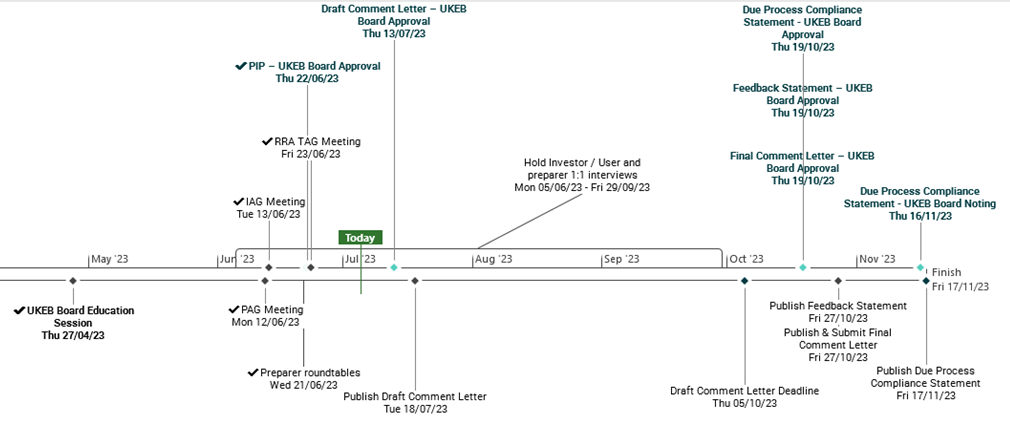
11In line with the PIP, outreach with stakeholders will continue between now and October 2023, including via publication of the DCL on the UKEB website.
12The draft Final Comment Letter, Feedback Statement and draft Due Process Compliance Statement will be brought to the October 2023 meeting for final approval by the Board.
13Further information on the project timeline is presented in the table below.
PIR of IFRS 15 Timeline
| Date | Milestone | |
|---|---|---|
| 3 November 2022 | Outreach—UKEB Accounting Firms and Institutes Advisory Group (AFIAG) | Complete |
| 27 April 2023 | Board: education session | Complete |
| 12 June 2023 | Outreach—UKEB Preparer Advisory Group (PAG) | Complete |
| 13 June 2023 | Outreach—UKEB Investor Advisory Group (IAG) | Complete |
| 21 June 2023 | Preparer roundtable | Complete |
| 22 June 2023 | Board: consideration and approval of PIP | Complete |
| 23 June 2023 | Outreach—UKEB Rate-regulated Activities Technical Advisory Group (RRA TAG) | Complete |
| 29 June 2023 | IASB publishes Request for Information | Complete |
| 13 July 2023 | Board: consideration and approval of DCL | This meeting |
| 18 July – 5 October 2023 | Secretariat: Publishes Draft Comment Letter, comment period 80 days | To be completed |
| July-October 2023 | Further outreach as described in the Project Initiation Plan. | To be completed |
| 19 October 2023 | Board: - consideration and approval of Final Comment Letter (FCL) - consideration and approval of Feedback Statement (FS) - consideration and approval of Due Process Compliance Statement (DPCS) |
To be completed |
| Expected 27 October 2023 | Secretariat: UKEB FCL submitted to IASB | To be completed |
| 16 November 2023 | Board: Final DPCS for noting | To be completed |
Timeline
PIR of IFRS 15 Project plan (as proposed in June 2023 PIP)
Dr Andreas Barckow Chairman International Accounting Standards Board Columbus Building 7 Westferry Circus Canary Wharf London E14 4HD
[27 October 2023]
Dear Dr Barckow
Appendix A: Invitation to Comment: Request for Information - Post-implementation Review: IFRS 15 Revenue from Contracts with Customers
1The UK Endorsement Board (UKEB) is responsible for endorsement and adoption of IFRS for use in the UK and therefore is the UK's National Standard Setter for IFRS. The UKEB also leads the UK's engagement with the IFRS Foundation on the development of new standards, amendments and interpretations. This letter is intended to contribute to the Foundation's due process. The views expressed by the UKEB in this letter are separate from, and will not necessarily affect the conclusions in, any endorsement and adoption assessment on new or amended International Accounting Standards undertaken by the UKEB.
2There are currently approximately 1,500 entities with equity listed on the London Stock Exchange that prepare their financial statements in accordance with IFRS.¹ In addition, UK law allows unlisted companies the option to use IFRS and approximately 14,000 such companies currently take up this option.²
3We welcome the opportunity to provide comment on the IASB's Request for Information—Post-implementation Review: IFRS 15 Revenue from Contracts with Customers (RFI). In developing this letter, we have consulted with a number of stakeholders, including preparers, accounting firms and institutes and users of accounts.
4Based upon the work undertaken [to date] we conclude the following:
- We agree that the feedback we have received [to date] is consistent the IASB's statement in the RFI 'initial feedback suggests that IFRS 15 has achieved its objective¹ and is working well, though some stakeholders still find applying aspects of the requirements challenging'.
- The five-step revenue recognition model is logical and provides the sequence in which judgements should be made. However, some stakeholders find applying aspects of the requirements challenging, especially where significant judgement is required, which may result in inconsistent outcomes.
- The implementation of the standard was costly for companies in some industries, (e.g. telecommunications, aerospace). In addition, the ongoing costs of applying IFRS 15 in those industries continue to be significant.
- Overall users highlight a notable improvement to the usefulness of company disclosure about revenue subsequent to the implementation of IFRS 15.
- The transition requirements in IFRS 15 achieved an appropriate balance between reducing costs for preparers of financial statements and providing useful information to users of financial statements.
- Preparers, particularly UK groups with US listings, and those credit analysts who assess companies reporting under IFRS and US GAAP, support retaining the current level of convergence between IFRS 15 and Topic 606.
5Our recommendations are limited to those few areas identified [to date] where we consider that improvement, and potentially standard setting activity, is required, without causing significant cost and disruption to entities already applying the standard:
- in determining the transaction price, we recommend the IASB reassess whether it could clarify the guidance on constraining estimates of variable consideration (paragraph 56 of IFRS 15) to explain the requirements in a more straightforward manner (see Appendix A paragraph A21); and
- regarding principal versus agent considerations, we recommend that the IASB:
- add guidance clarifying that the considerations relate to an entity's fulfilment of their individual contracts with a customer, rather than an entity considering other parties' (including their customer's) fulfilment of their contracts with their customers (see Appendix A paragraph A28); and
- expand the indicators of control to cover indicators that are more relevant to services and intangibles, to minimise the risk of the control framework for principal versus agent considerations being inappropriately applied and ensure greater consistency in practice (see Appendix A paragraph A29)
- we recommend that the IASB and the FASB continue to work together to ensure that there are no significant differences between the two standards (see Appendix A paragraph A46); and
- we encourage the IASB to publish non-authoritative supporting material in developing future standards, to help stakeholders' understandability and assist implementation of those standards (see Appendix A paragraph A7)
7If you have any questions about this response, please contact the project team at [email protected].
Yours sincerely
Pauline Wallace Chair UK Endorsement Board
Questions on Request for Information: Post-implementation Review IFRS 15 Revenue from Contracts with Customers
Overall assessment of IFRS 15
Question 1—Overall assessment of IFRS 15
- In your view, has IFRS 15 achieved its objective? Why or why not? Please explain whether the core principle and the supporting five-step revenue recognition model provide a clear and suitable basis for revenue accounting decisions that result in useful information about an entity's revenue from contracts with customers. If not, please explain what you think are the fundamental questions (fatal flaws) about the clarity and suitability of the core principle or the five-step revenue recognition model.
- Do you have any feedback on the understandability and accessibility of IFRS 15 that the IASB could consider:
- in developing future Standards; or
- in assessing whether, and if so how, it could improve the understandability of IFRS 15 without changing its requirements or causing significant cost and disruption to entities already applying the Standard—for example, by providing education materials or flowcharts explaining the links between the requirements?
- What are the ongoing costs and benefits of applying the requirements in IFRS 15 and how significant are they? If, in your view, the ongoing costs of applying IFRS 15 are significantly greater than expected or the benefits of the resulting information to users of financial statements are significantly lower than expected, please explain why you hold this view.
These questions aim to help the IASB understand respondents' overall views and experiences relating to IFRS 15. Sections 2–9 seek more detailed information on specific requirements.
Core principle of IFRS 15 and the five-step revenue recognition model
A1Our outreach indicates that IFRS 15 is generally working as intended, there are no fatal flaws, and the standard is viewed by stakeholders as an improvement on the previous revenue requirements. Our outreach also indicates that the core principle and the supporting five-step revenue recognition model provide a clear and suitable basis for revenue accounting decisions that result in useful information about an entity's revenue from contracts with customers.
A2During our outreach, UK preparers indicated that the implementation of IFRS 15 was a significant challenge for some industries. They also indicated that the ongoing application of the standard can require significant judgement and, as a result, outcomes may not be consistent, i.e. diversity in practice continues to exist.
A3We recommend the IASB reassess whether additional guidance could be added to the standard (see paragraphs A21, A28, A29) to assist preparers in their application of the standard.
Understandability and accessibility of IFRS 15
A4We received mixed feedback from preparers on improving the understandability and accessibility of IFRS 15. Whilst some preparers, facing ongoing challenges in applying the standard, such as in the software and telecommunications industries, support improvements to the understandability of IFRS 15 e.g. by providing illustrative examples using real life scenarios, others preparers consider that the requirements and structure of the standard are well understood in practice.
A5In response to the IASB's question on whether understandability of the standard could be improved by, for example, using flowcharts explaining the links between the requirements, one accounting firm expressed concern that flowcharts could make the guidance more prescriptive than was intended. They also cautioned that the use of decision trees in the guidance, as these might give rise to challenges, for example if applying to a long supply chain.
A6Given stakeholders' request for a period of stability in the application of the standard, we do not support improving the understandability of IFRS 15 by providing education material or providing flowcharts to explain the link between the requirements because, whilst the intention would be to leave the requirements of the standard unchanged, stakeholders might interpret this additional material as changes to the standard, triggering a re-assessment of existing contracts. As a result, this could cause significant cost and disruption to entities already applying the standard. Adding illustrative examples for an existing standard could lead to significant changes in practices that have already settled.
A7Instead, we recommend that, consistent with feedback received as part of the Third Agenda Consultation³, the IASB increase the understandability and accessibility of this standards by publishing non-authoritative supporting material, such as First-Time Guides and Frequently Asked Questions (FAQ).
Ongoing costs and benefits
A8Some preparers incurred significant one-off costs on the implementation of IFRS 15. They indicated that whilst ongoing costs had stabilised, in some sectors (e.g. telecommunications and aerospace) the ongoing costs remain significant. The main one-off costs on implementation identified by stakeholders were IT systems (re-design or modifications), processes (e.g., internal controls, reviewing contracts), hiring extra staff and training of personnel. The ongoing costs depend on several factors, such as the volume and/or complexity of contracts, evolution of business models (e.g. introduction of new products, innovation in sales strategies), the extent of manual input (e.g. logging contracts and manual period end adjustments) and the extent of additional internal controls.
A9For some industries where the ongoing costs of applying IFRS 15 continue to be significant, those preparers view that the costs of preparing some information outweigh the benefits. They, however, expressed concern that if fundamental changes are made to the standard as a result of the PIR, it will cause further significant cost and disruption.
A10Our desk-based research⁴ and outreach with stakeholders identified a number of benefits of IFRS 15:
- the five-step revenue recognition model provides UK preparers with a robust basis for analysing complex contracts;
- more guidance than under the previous revenue requirements was helpful in making judgements;
- more useful information, facilitates better and meaningful comparability of information between entities;
- greater collaboration between the finance team and operation team;
- improved internal controls; and
A11On balance, we believe [based on feedback to date] that whilst ongoing costs for some preparers of applying IFRS 15 may be greater than initially assessed, those costs do not outweigh the benefits of the resulting information to users of financial statements, and those benefits are not significantly lower than expected.
Identifying performance obligations in a contract
Question 2—Identifying performance obligations in a contract
- Does IFRS 15 provide a clear and sufficient basis to identify performance obligations in a contract? If not, why not?
Please describe fact patterns in which the requirements:
- are unclear or are applied inconsistently;
- lead to outcomes that in your view do not reflect the underlying economic substance of the contract; or
- lead to significant ongoing costs.
If diversity in application exists, please explain and provide supporting evidence about how pervasive the diversity is and explain what causes it. Please also explain how the diversity affects entities' financial statements and the usefulness of the resulting information to users of financial statements.
- Do you have any suggestions for resolving the matters you have identified?
A13Outreach with UK preparers indicated that they experienced challenges in identifying performance obligations for certain contracts, specifically identifying a 'distinct' good or service (or a bundles of services). There were also challenges around those activities that do not involve a transfer of goods and services, even though they might be necessary for fulfilling a contract, but are not considered performance obligations, such as setting up a manufacturing process or connecting a customer to a network. However, these preparers said the challenges experienced during the implementation phase have largely been overcome and practice has settled, but as business models change, further challenge may occur in reassessing performance obligations in new contracts.
A14Our outreach identified some companies within the same sector (such as telecommunications and utility companies) applying different judgements to similar transactions. This has resulted in different accounting practices. Users and the regulator also indicated that they are observing diversity in practice within certain sectors, which can impede comparability. Preparers have also indicated there is diversity in practice both between and within audit firms.
A15These preparers expressed concern that when auditors are rotated the accounting treatment was debated, and changed in some circumstances, adding cost to the application of the standard. During our outreach we did not identify specific examples of contracts with customers where change in auditors led to changes in accounting treatment, although ongoing debate with auditors was highlighted.
A16Some stakeholders suggested providing more application guidance or illustrative examples but did not provide any specific suggestions for resolving the matters mentioned.
Determining the transaction price
Question 3—Determining the transaction price
- Does IFRS 15 provide a clear and sufficient basis to determine the transaction price in a contract—in particular, in relation to accounting for consideration payable to a customer? If not, why not? Please describe fact patterns in which the requirements on how to account for incentives paid by an agent to the end customer or for negative net consideration from a contract are unclear or are applied inconsistently. If diversity in application exists, please explain and provide supporting evidence about how pervasive the diversity is and explain what causes it. Please also explain how the diversity affects entities' financial statements and the usefulness of the resulting information to users of financial statements.
- Do you have any suggestions for resolving the matters you have identified?
A17Whilst we received relatively little feedback on this topic, our outreach activities indicate that overall IFRS 15 provides a clear and sufficient basis to determine the transaction price in a contract.
A18Our outreach with preparers did not identify any specific concern in relation to accounting for consideration payable to a customer.
Variable consideration
A19The regulator's findings⁶ indicated that disclosures around the variable consideration constraint were either missing or incomplete and accounting policy disclosures are often unclear as to how, in practice, the company assesses, interprets or estimates the variable consideration constraint threshold when variable consideration is material.
A20The regulator further noted that some preparers find the language used in IFRS 15 on constraining estimates of variable consideration⁷ unnecessarily complicated. In their review of IFRS 15 disclosures, the regulator noted that some preparers have adapted the wording to explain in a more straightforward manner, but in some cases this has resulted in wording inconsistent with the standard.
A21We recommend the IASB reassess whether the additional guidance on constraining estimates of variable consideration could be added to the standard.
A22Despite significant judgement being required in estimating variable consideration, our outreach indicates that judgement can be applied to reach a satisfactory conclusion, so we do not recommend any changes, other than that suggested in paragraph A21. Our outreach also suggests, that despite initial challenges, entities have developed accounting policies for estimating variable consideration and there is no evidence of significant diversity in practice.
Determining when to recognise revenue
Question 4—Determining when to recognise revenue
- Does IFRS 15 provide a clear and sufficient basis to determine when to recognise revenue? If not, why not? Please describe fact patterns in which the requirements are unclear or are applied inconsistently—in particular, in relation to the criteria for recognising revenue over time. If diversity in application exists, please explain and provide supporting evidence about how pervasive the diversity is and explain what causes it. Please also explain how the diversity affects entities' financial statements and the usefulness of the resulting information to users of financial statements.
- Do you have any suggestions for resolving the matters you have identified?
A23Whilst our outreach did not specifically identify fact patterns in which the requirements in IFRS 15 may not be clear or sufficient or applied inconsistently in determining when to recognise revenue, accounting firms indicated that the application of the concept of control (i.e. when control passes) is one of the most often raised questions related to the application of the standard.
Indicators of control
A24Our outreach [to date] indicated that significant judgement is required to identify when control passes to the customer—over time or at a point in time, which is critical to the timing of revenue recognition. Stakeholders identified diversity in practice in the following contracts:
- software licences, for example, 'term-based' licences, i.e. where a licence is valid for a fixed term (say 3 years, 5 years, etc.). The licensee pays a fixed fee, either up front or annually and customer support is included as part of that fee. Some entities bifurcate the licence value and the ongoing support, whilst others spread the entire price over the term of the licence;
- services offered by water utility companies to property developers, for example, new connections to the water and wastewater networks. Some water companies defer the recognition of revenue on these connections over the useful economic life of the related assets, whereas other entities recognise such revenue upfront i.e. upon completion of the connection; and
- long term, developmental contracts for complex assets - products that are developed to a customer's specification, manufactured, and possibly installed/integrated into the customer's product. To recognise revenue over time, the entity must meet one of the three criteria set out in paragraph 35 of IFRS 15. Even if the entity has an enforceable right to payment, it can be challenging to determine whether the created asset has no apparent alternative use, whilst recognising that if an asset requires significant rework at significant cost for it to be suitable for another customer or another purpose, it will likely have no alternative use. This judgement leads some companies to determine that the created asset may have an alternative use and therefore does not meet the criteria to account for revenue over time, so recognises revenue at a point in time, whilst other entities, with seemingly similar contracts, are recognising revenue over time.
Principal versus agent considerations
Question 5—Principal versus agent considerations
- Does IFRS 15 provide a clear and sufficient basis to determine whether an entity is a principal or an agent? If not, why not? Please describe fact patterns in which the requirements are unclear or are applied inconsistently—in particular, in relation to the concept of control and related indicators. If diversity in application exists, please explain and provide supporting evidence about how pervasive the diversity is and explain what causes it. Please also explain how the diversity affects entities' financial statements and the usefulness of the resulting information to users of financial statements.
- Do you have any suggestions for resolving the matters you have identified?
A25Our desk-based research and outreach with stakeholders clearly identified principal versus agent considerations as an area of IFRS 15 that is challenging and requires significant judgement.
A26In our outreach [to date] UK preparers and accounting firms expressed two concerns on principal versus agent considerations:
- identifying the customer in the contract:
- In one fact pattern provided, a publisher of online games sells to a gaming platform, and in turn the platform provides access to their platform to an end-gamer. In some instances, the publisher provides customer support to the end-gamer. The first step of the five-step revenue recognition model is to identify the contract, and implicitly identify the customer. One accounting firm indicated that in this particular fact pattern, because the platform sells to the end-gamer and is a principal it does not mean that the publisher is therefore an agent by default, because the publisher is the principal in its contract to supply the game to the platform (only the performance obligation of the platform to provide the support services to the end-gamer, that it may outsource to the publisher, should require principal versus agent considerations).
- Another fact pattern provided relates to two water companies, who both receive capital contributions from property developers to connect their housing development to the water network. One view is that the developer is the water company's customer and as such the water company recognises revenue when the performance obligation to the developer has been met i.e. on initial connection of the development. Another view is that the end-users (home occupants) are the customer(s) and revenue is recognised on a different basis.
- the three indicators of control set out in paragraph B37 of IFRS 15. These indicators are intended to help an entity determine whether it obtains control of a specified good or service and is therefore the principal in the transaction. In the view of some UK stakeholders these indicators are more relevant to goods rather than services.
A28We recommend that the IASB add guidance on principal versus agent considerations by clarifying that the considerations relate an entity's fulfilment of their individual contract with their customer, rather than an entity considering other parties' (including their customer's) fulfilment of that other party's customer. One suggestion received from an accounting firm is to amend paragraph B34⁸ of the standard to add the words "the entity shall first determine the identity of their customer. Once the customer has been identified....”.
A29We strongly recommend that, and believe it would be helpful if, the indicators of control are expanded to cover indicators that are more relevant to services and intangibles. Adding such indicators would minimise the risk of the control framework for principal versus agent considerations being inappropriately applied and would lead to more consistency in practice.
A30Both recommendations above would be helpful to preparers and auditors, with the potential to reduce diversity in practice, without causing significant disruption to the application of the standard. Further, this will ensure that the standard remains robust and responds to changes in the business environment, with the growing importance of technology and services.
Licensing
Question 6—Licensing
- Does IFRS 15 provide a clear and sufficient basis for accounting for contracts involving licences? If not, why not? Please describe fact patterns in which the requirements are unclear or are applied inconsistently—in particular, in relation to matters described in Spotlight 6. If diversity in application exists, please explain and provide supporting evidence about how pervasive the diversity is and explain what causes it. Please also explain how the diversity affects entities' financial statements and the usefulness of the resulting information to users of financial statements.
- Do you have any suggestions for resolving the matters you have identified?
A31Overall, UK preparers indicated that the guidance on licencing in IFRS 15 is useful, and the guidance on the 'right to use' and 'right to access' is clear and sufficient. It was also noted that the standard is helpful when a business with complex licensing arrangements is acquired.
A32Our outreach also included feedback from preparers with material amounts of software as a service (SaaS) contracts, that the May 2022 IFRIC Principal versus agent agenda decision⁹ related to software licences was helpful in their interpretation of the standard.
A33Our outreach with stakeholders [to date] has not identified any fact patterns in which the requirements for accounting for contracts involving licences are unclear.
Disclosure requirements
Question 7—Disclosure requirements
- Do the disclosure requirements in IFRS 15 result in entities providing useful information to users of financial statements? Why or why not? Please identify any disclosures that are particularly useful to users of financial statements and explain why. Please also identify any disclosures that do not provide useful information and explain why the information is not useful.
- Do any disclosure requirements in IFRS 15 give rise to significant ongoing costs? Please explain why meeting the requirements is costly and whether the costs are likely to remain high over the long term.
- Have you observed significant variation in the quality of disclosed revenue information? If so, what in your view causes such variation and what steps, if any, could the IASB take to improve the quality of the information provided?
A34Consistent with the IASB's statement in the RFI that 'some users of financial statements, regulators and accounting firms said they saw some improvement in the usefulness of information entities disclosed about revenue after IFRS 15 was implemented', our outreach indicates that generally the IFRS 15 disclosure requirements have led to better quality disclosures that are useful to users.
A35Users of financial statements indicated that:
- the disaggregation of revenue into appropriate categories provides very useful information for their analysis, particularly for long-term contracts;
- contract balance disclosures are useful for credit analysts to reconcile revenue with cashflow;
- IFRS 15 better highlighted those companies with poor revenue accounting practices. However, an improvement has been noted since the implementation of the standard; and
- where diversity in practice exists, for example in the telecommunications industry, where not all companies had adopted the same practice for accounting for contract assets (e.g. handsets) on adoption of IFRS 15, whilst such diversity makes comparability a challenge, the disclosures were useful in identifying that diversity.
A36Whilst UK preparers indicated that overall, the disclosures are not burdensome, some expressed concern with the cost of providing a few disclosures of IFRS 15. In particular, contrary to users' views in paragraph A35(b) above, UK preparers indicated that the cost of providing disclosures relating to contract assets and contract liabilities and remaining performance obligations is significant, with little benefits to users. These preparers indicated that these disclosures are highly judgemental but did not explain why meeting the requirements is costly for them.
A37The regulator noted improvements in the quality of disclosures provided by companies reviewed since the implementation of IFRS 15. However, they observed relatively few companies have provided detailed disclosure of judgements, and changes in the judgements, made in applying the standard. Common issues with disclosures provided by companies, as noted by the regulator, include:
- missing disclosures about contract balances;
- descriptions of the nature of performance obligations and when these are satisfied in the accounting policies and linkage to information provided in the notes to the accounts;
- disaggregation of revenue disclosures—either missing or not sufficiently granular; and
- for performance obligations satisfied over time, the specific method used to recognise revenue and why that method faithfully depicts the transfer of the goods or services.
A38Relating to these issues, the regulator found that disclosures were either missing from the financial statements or lacked specificity rather than a flaw with disclosure requirements.
A39The regulator supports the principle-based disclosure guidance in paragraphs B87-89 on the disaggregation of revenue which, when appropriately followed, results in entity-specific information.
Transition requirements
Question 8—Transition requirements
- Did the transition requirements work as the IASB intended? Why or why not?
Please explain:
- whether entities applied the modified transition method or the practical expedients and why; and
- whether the transition requirements in IFRS 15 achieved an appropriate balance between reducing costs for preparers of financial statements and providing useful information to users of financial statements.
A41Overall, users indicated that whilst a fully retrospective method would be preferred, they did not have significant concerns with companies using the modified retrospective method. Analysts found the transition disclosures useful and in a number of instances companies provided further explanations to assist them in their analysis.
A42Based on feedback from our outreach, the transition requirements in IFRS 15 achieved an appropriate balance between reducing costs for preparers of financial statements and providing useful information to users of financial statements.
Applying IFRS 15 with other IFRS Accounting Standards
Question 9—Applying IFRS 15 with other IFRS Accounting Standards
- Is it clear how to apply the requirements in IFRS 15 with the requirements in other IFRS Accounting Standards? If not, why not? Please describe and provide supporting evidence about fact patterns in which it is unclear how to apply IFRS 15 with the requirements of other IFRS Accounting Standards, how pervasive the fact patterns are, what causes the ambiguity and how that ambiguity affects entities' financial statements and the usefulness of the resulting information to users of financial statements. The IASB is particularly interested in your experience with the matters described in Spotlights 9.1–9.3¹⁰.
- Do you have any suggestions for resolving the matters you have identified?
A43Our outreach endeavoured to identify fact patterns in which it is unclear how to apply IFRS 15 with the requirements of other IFRS, in particular, IFRS 3 Business Combinations, IFRS 9 Financial Instruments and IFRS 16 Leases. [To date] we have not been made aware of any significant issues on applying the requirements in IFRS 15 with the requirements in other IFRS Accounting Standards.
Convergence with Topic 606
Question 10—Convergence with Topic 606
- How important is retaining the current level of convergence between IFRS 15 and Topic 606 to you and why?
A44During our outreach preparers from UK groups with listing in the US strongly supported retaining the current level of convergence between IFRS 15 and Topic 606. One other preparer, whilst not against convergence, said the aim should not be to fully align the two set of standards.
A45A credit analyst who assesses US companies and companies reporting under IFRS was in favour of retaining convergence as it ensures better comparability of revenue recognition across jurisdictions.
A46We recommend that the IASB and the FASB continue to work together to ensure that there are no significant differences between the two standards.
Other matters
Question 11—Other matters
- Are there any further matters that you think the IASB should examine as part of the post-implementation review of IFRS 15? If yes, what are those matters and why should they be examined? Please explain why those matters should be considered in the context of this post-implementation review and the pervasiveness of any matter raised. Please provide examples and supporting evidence.
A47In the Exposure Draft Third Edition of the IFRS for SMEs Accounting Standard the IASB simplified application of the proposed revenue recognition model based on the five steps of revenue recognition model in IFRS 15 and presented them in the order in which SMEs are expected to apply them. We understand that during outreach meetings conducted by the IASB a few stakeholders suggested that the IASB could consider some of the proposals in the Exposure Draft in clarifying the requirements or guidance in IFRS 15 (for example, the guidance on principal versus agent considerations).
A48In considering these suggestions, we strongly recommend the IASB keep in mind that the two set of standards apply to a different population of entities. We would therefore be concerned if the IASB consider simplifications proposed in the Exposure Draft for SMEs which might not be appropriate for entities applying full IFRS.
A49[To date we have not identified any further matters in the UK that we think the IASB should examine.]
Appendix B: Invitation to Comment
Call for comments on the Request for Information—Post-implementation Review: IFRS 15 Revenue from Contracts with Customers
Deadline for completion of this Invitation to Comment:
Close of business, Thursday 5 October 2023
Please submit to:
Introduction
The objective of this Invitation to Comment is to obtain input from stakeholders on the UKEB's draft comment letter on the IASB's Request for Information – Post-implementation Review: IFRS 15 Revenue from Contracts with Customers.
Who should respond to this Invitation to Comment?
Stakeholders with an interest in the quality of accounts prepared in accordance with IFRS Accounting Standards.
How to respond to this Invitation to Comment
Please download this document, answer any questions on which you would like to provide views, and return it to [email protected] by close of business on Thursday 5 October 2023.
Brief responses to individual questions are welcome, as well as comprehensive responses to all questions.
Privacy and other policies
The data collected through submitting this document will be stored and processed by the UKEB. By submitting this document, you consent to the UKEB processing your data for the purposes of influencing the development of and adopting IFRS for use in the UK. For further information, please see our Privacy Statements and Notices and other Policies (e.g. Consultation Responses Policy and Data Protection Policy)¹.
The UKEB's policy is to publish on its website all responses to formal consultations issued by the UKEB unless the respondent explicitly requests otherwise. A standard confidentiality statement in an e-mail message will not be regarded as a request for non-disclosure. If you do not wish your signature to be published, please provide the UKEB with an unsigned version of your submission. The UKEB prefers to publish responses that do not include a personal signature. Other than the name of the organisation/individual responding, information contained in the “Your Details” document will not be published. The UKEB does not edit personal information (such as telephone numbers, postal or e-mail addresses) from any other response document submitted; therefore, only information that you wish to be published should be submitted in such responses.
Questions
Request for Information – Post-implementation Review: IFRS 15 Revenue from Contracts with Customers
The UKEB's draft comment letter focuses on the two significant areas where the UKEB consider that improvement, and potentially standard setting activity, is required. The two areas of concern relate to determining the transaction price and principal versus agent considerations.
1Do you have any comments on the views expressed in the UKEB's draft comment letter?
Response:
2Can you describe fact patterns in which the requirements in IFRS 15 to determine whether an entity is a principal or an agent are unclear or are applied inconsistently—in particular, in relation to the concept of control and related indicators?
Response:
3Can you describe fact patterns in which the requirements in IFRS 15 to determine the transaction price are unclear or applied inconsistently, in particular the guidance on:
- constraining estimates of variable consideration?
- consideration payable to a customer, such as how to account for incentives paid by an agent to the end customer or for negative net consideration from a contract?
Response:
4In addition to determining the transaction price and principal versus agent considerations (questions 3 and 5 in the IASB's Request for Information² - RFI) addressed in the UKEB's draft comment letter, the RFI covers a number of other topics as follows:
- Question 1 - Overall assessment of IFRS 15:
- Question 2 - Identifying performance obligations in a contract: does IFRS 15 provide a clear and sufficient basis to identify performance obligations in a contract? - Question 4 - Determining when to recognise revenue: does IFRS 15 provide a clear and sufficient basis to determine when to recognise revenue? - Question 6 - Licensing: does IFRS 15 provide a clear and sufficient basis for accounting for contracts involving licences? - Question 7 - Disclosure requirements: do the disclosure requirements in IFRS 15 result in entities providing useful information to users of financial statements? - Question 8 - Transition requirements: did the transition requirements work as the IASB intended? - Question 9 - Applying IFRS 15 with other IFRS Accounting Standards: is it clear how to apply the requirements in IFRS 15 with the requirements in other IFRS Accounting Standards? - Question 10 - Convergence with Topic 606: how important is retaining the current level of convergence between IFRS 15 and Topic 606 to you? - Question 11 - Other matters: do you have any suggestions to improve the IFRS 15 requirements on significant issues impacting the UK?
Results of our outreach suggest that in these areas IFRS 15 is working materially as intended. Do you have comments on this general conclusion?
Please explain your views, responding to the above questions and, if possible, provide examples.
Response:
Any Other Comments
The UKEB welcomes any other feedback on its draft comment letter or on the IASB's Request for Information.
5Are there any other comments on significant issues impacting the UK you would like to make on the IASB's Post Implementation Review of IFRS 15 Revenue from Contracts with Customers?
Response:
Thank you for completing this Invitation to Comment Please submit this document by close of business on Thursday 5 October 2023 to: [email protected]
Appendix C: Your details
Name:
Email address:
1Are you responding:
| On behalf of an organisation | ☐ |
| As an individual | ☐ |
2If responding on behalf of an organisation,
- Name of organisation:
- Please select what best describes the organisation:
| An organisation applying IFRS Accounting Standards | ☐ |
| A user of company accounts prepared under IFRS | ☐ |
| An auditor | ☐ |
| A regulator | ☐ |
| Other | ☐ |
If your response was 'Other', please describe:
- Is your organisation a listed entity?
| UK listed | ☐ |
| UK AIM listed | ☐ |
| Unlisted | ☐ |
- Please select which industry your organisation predominately operates in:
| Consumer Goods Sector | ☐ |
| Extractives & Minerals Processing Sector | ☐ |
| Financials Sector | ☐ |
| Food & Beverage Sector | ☐ |
| Health Care Sector | ☐ |
| Infrastructure Sector | ☐ |
| Renewable Resources & Alternative Energy Sector | ☐ |
| Resource Transformation Sector | ☐ |
| Services Sector | ☐ |
| Technology & Communications Sector | ☐ |
| Transportation Sector | ☐ |
3Would you be happy for UKEB to contact you by email if we wished to discuss some of your responses?
| Yes | ☐ |
| No | ☐ |
Privacy and other policies
The data collected through submitting this document will be stored and processed by the UKEB. By submitting this document, you consent to the UKEB processing your data for the purposes of influencing the development of and endorsing IFRS for use in the UK. For further information, please see our Privacy Statements and Notices and other Policies (e.g. Consultation Responses Policy and Data Protection Policy.)¹
The UKEB's policy is to publish on its website all responses to formal consultations issued by the UKEB unless the respondent explicitly requests otherwise. A standard confidentiality statement in an e-mail message will not be regarded as a request for non-disclosure. If you do not wish your signature to be published please provide UKEB with an unsigned version of your submission. The UKEB prefers to publish responses that do not include a personal signature. Other than the name of the organisation/individual responding, information contained in the “Your Details” document will not be published. The UKEB does not edit personal information (such as telephone numbers, postal or e-mail addresses) from any other response document submitted; therefore, only information that you wish to be published should be submitted in such responses.
Footnotes
-
The objective of IFRS 15 is to establish the principles that an entity shall apply to report useful information to users of financial statements about the nature, amount, timing and uncertainty of revenue and cash flows arising from a contract with a customer. ↩
-
UKEB calculation based on London Stock Exchange Group (LSEG) and Eikon financial analysis and Trading software data, May 2023. This calculation includes companies listed on the Main market as well as on the Alternative Investment Market (AIM). ↩
-
UKEB estimate based on FAME (company information in the UK and Ireland produced by Bureau Van Dijk, a Moody's analytics company), Company Watch financial analytics and other proprietary data. ↩
-
See page 17 and 18 of the Feedback Statement on the Third Agenda Consultation ↩
-
The Secretariat's desk-based research included reviewing: the IASB's work on the PIR of IFRS 15 (staff papers, RFI); accounting manuals and press releases for guidance and illustrative examples; IFRIC Agenda Decisions; UK FRC thematic reviews of IFRS 15 disclosures. ↩
-
Outreach activities included engaging with our UKEB Advisory Groups, a preparer roundtable and one-to-one interviews with preparers and users. ↩
-
See FRC's October 2019 and September 2020 Thematic Reviews of IFRS 15. ↩
-
IFRS 15 paragraph 56. ↩
-
Paragraph B34 with the suggested amended wording in brackets says "When another party is involved in providing goods or services to a customer, [the entity shall first determine the identity of their customer. Once the customer has been identified,] the entity shall determine whether the nature of its promise is a performance obligation to provide the specified goods or services itself (i.e. the entity is a principal) or to arrange for those goods or services to be provided by the other party (i.e. the entity is an agent). ↩
-
The Interpretations Committee issued an agenda decision in May 2022 Principal versus Agent: Software Reseller (IFRS 15 Revenue from Contracts with Customers) ↩
-
Spotlights 9.1–9.3 in the Request for Information outline the initial feedback heard by the IASB on the interaction between IFRS 15 and other IFRS Accounting Standards, in particular, IFRS 3 Business Combinations, IFRS 9 Financial Instruments and IFRS 16 Leases. These are not reproduced here. ↩
-
These policies can be accessed from the footer in the UKEB website here: https://www.endorsement-board.uk ↩
-
See IASB's document here: Request for Information: Post-implementation Review of IFRS 15—Revenue from Contracts with Customers ↩
-
These policies can be accessed from the footer in the UKEB website here: https://www.endorsement-board.uk ↩