5 IAS 1 Amendments (2020 and 2022) – Non-current Liabilities – Discuss feedback
22 June 2023 Agenda Paper 5
Executive Summary
| Project Type | Endorsement and adoption |
|---|---|
| Project Scope | Narrow-scope |
| Purpose of the paper | The purpose of this paper is to provide the Board with an update on the stakeholder feedback received for the Draft Endorsement Criteria Assessment (DECA) of IAS 1 Presentation of Financial Statements Narrow-scope Amendments 2020 and 2022. |
| Summary of the Issue | The DECA of IAS 1 Presentation of Financial Statements Narrow-scope Amendments 2020 and 2022 was published on 9 March 2023 and was open for stakeholder comments until 8 June 2023. We have received eight responses to the DECA and discussed the DECA with the Accounting Firms & Institutes Advisory Group (AFIAG). The feedback supports the conclusions of the Board and all respondents recommended endorsement without exception. However, one respondent highlighted areas that may require ongoing monitoring after adoption. The adoption package, including the ECA and a draft feedback statement will be shared with the Board at the July meeting. The Board will be asked to provide its tentative vote on the UK adoption of the Amendments at that meeting. |
| Decisions for the Board | The Board is not asked to make any decisions. Board members are asked whether they have any questions or comments on the update. |
| Recommendation | N/A |
Appendices
Appendix A Classification of Liabilities as Current or Non-current and Non-current Liabilities with Covenants – Amendments to IAS 1: update of feedback received for Draft Endorsement Criteria Assessment
Purpose
A1 The purpose of this paper is to provide the Board with an update on the responses received for the Draft Endorsement Criteria Assessment (DECA) of IAS 1 Presentation of Financial Statements Narrow-scope Amendments 2020 and 2022 since its publication.
Background
A2 In January 2020 and October 2022, the IASB issued narrow-scope amendments to IAS 1 Classification of Liabilities as Current or Non-current and Non-current Liabilities with Covenants.
A3 The background to both the 2020 and 2022 Amendments was previously discussed by the Board in November 2022 (UKEB meeting, Agenda Paper 7).
A4 The DECA for both the 2020 and 2022 Amendments was approved for publication by the Board in February 2023 (UKEB meeting, Agenda Paper 4) and was then published on 9 March 2023. The DECA was open for stakeholder comments until 8 June 2023.
Outreach subsequent to the publication of the DECA
Accounting Firms & Institutes Advisory Group Discussion
A5 In March 2023, the Secretariat presented the DECA to the Accounting Firms & Institutes Advisory Group (AFIAG) at the UKEB to encourage formal responses from the AFIAG members and their networks as well as to understand their views on the assertions made in the DECA regarding:
- Joint assessment and adoption approach;
- Technical Criteria Assessment and True and Fair View Assessment; and
- UK Long Term Public Good Assessment – cost and benefit analysis.
A6 AFIAG members agreed on the use of the joint approach and assertions made in the DECA. A member noted concerns with the meaning of 'settlement' however it was observed that this is not a pervasive issue in the UK. (See AFIAG meeting summary 30 March 2023 page 4 “Endorsement: IAS 1").
Other outreach
A7 The DECA was published on the UKEB website with news alerts both at the start and near the end of the consultation period to remind stakeholders to submit their formal responses. It was also promoted on the UKEB's LinkedIn account.
A8 The Secretariat emailed UK stakeholders who had submitted comments on the IASB's Exposure Drafts of both the 2020 and 2022 Amendments to make them aware of the UKEB endorsement activity. We also reached out to stakeholders we had previously engaged with during the influencing phase by email.
Feedback received
A9 We received eight responses to the DECA, with the following backgrounds:
- Five accounting firms;
- One professional body;
- One preparer; and
- One academic.
A10 The table below provides a summary of the feedback received on the major elements of the DECA:
| UKEB tentative assessment | Stakeholder views |
|---|---|
| Joint assessment and adoption | |
| The DECA tentatively concluded that joint assessment of the Amendments is appropriate; and provides the most relevant approach to assessing the endorsement criteria in Regulation 7 of SI 2019/6851. | All eight respondents agreed with the UKEB's tentative conclusion. |
| Technical criteria assessment | |
| The DECA tentatively concluded that if the 2020 and 2022 Amendments are applied jointly they meet the criteria of relevance, reliability, comparability and understandability required of the financial information needed for making economic decisions and assessing the stewardship of management, as required by Regulation 7(1) of SI 2019/6851. | All eight respondents agreed with the UKEB's tentative conclusion. One respondent, who did agree with the UKEB's tentative conclusion, raised a specific issue. They noted that the presentation requirements in paragraphs 76A(b) and 76B, when applied to financial instruments with convertible options, may not lead to useful information for the users of financial statements. See Annex 1 below. |
| True and fair view assessment | |
| The DECA tentatively concluded that the Amendments, when considered jointly, either alone or in conjunction with international accounting standards adopted for use in the UK, would not prevent individual or group accounts prepared using the Amendments from giving a true and fair view of the undertaking's or group's assets, liabilities, financial position and profit or loss, as required by Regulation 7(1) of SI 2019/6851. | All eight respondents agreed with the UKEB's tentative conclusion. As noted above, one respondent, who did agree with the UKEB's tentative conclusion, raised a specific issue. They noted that the presentation requirements in paragraphs 76A(b) and 76B, when applied to financial instruments with convertible options, may not lead to useful information for the users of financial statements. See Annex 1 below. |
| UK long term public good | |
| The DECA tentatively concluded that, having considered all relevant aspects, including the trade-off between the costs and benefits of implementing the Amendments, the Amendments were likely to be conducive to the long term public good in the UK as required by Regulation 7 of SI 2019/6851. | All eight respondents agreed with the UKEB's tentative conclusion. One respondent, who did agree with the UKEB's tentative conclusion, raised specific issues on the benefits for users and for preparers. They noted that the new requirements may not provide 'absolute clarity'. Also they are not mandated for the entities that present their statement of financial position based on liquidity and these entities may not provide the same level of information. See Annex 1 below. |
| Significant change in accounting practice? | |
| The DECA tentatively concluded that the Amendments are not likely to lead to a significant change in accounting practice and do not meet the criteria for a post-implementation review under Regulation 11 in SI 2019/6851. | All eight respondents agreed with the UKEB's tentative conclusion. One respondent, who did agree with the UKEB's tentative conclusion, raised an issue. They noted that the amendments 'could result in a significant change of the presentation of financial liabilities for some entities' and suggested the UKEB consider a review in the future. See Annex 1 below. |
A11 Considering the overall support we do not believe that the issues raised by one respondent, given they were supportive of the tentative conclusions reached, will require amendments to the ECA. However, these comments will be addressed as part of the feedback statement presented next month.
Next steps and timeline
A12 In accordance with the Project Initiation Plan (approved by the Board at its January 2023 meeting), the Board is expected to be asked at its July 2023 meeting to provide a tentative vote on the adoption of the Amendments based on the discussion of the 'adoption package' which will comprise:
- A final Endorsement Criteria Assessment (ECA);
- A Feedback Statement;
- A draft Due Process Compliance Statement;
- A draft Adoption Statement for the Amendments; and
- The text of the UK-adopted international accounting standard (Amendments to IAS 1).
| Question for the Board | |
|---|---|
| 1. | Do Board members have any questions or comments on the update? |
Annex 1: Extracts of a comment letter
One respondent raised specific issues in their comment letter. The relevant comments are extracted from the comment letter below.
Technical criteria assessment
2 Do you agree with the draft assessment of the Amendments against the technical criteria as set out on pages 13 – 15 of the DECA? (please select one option)
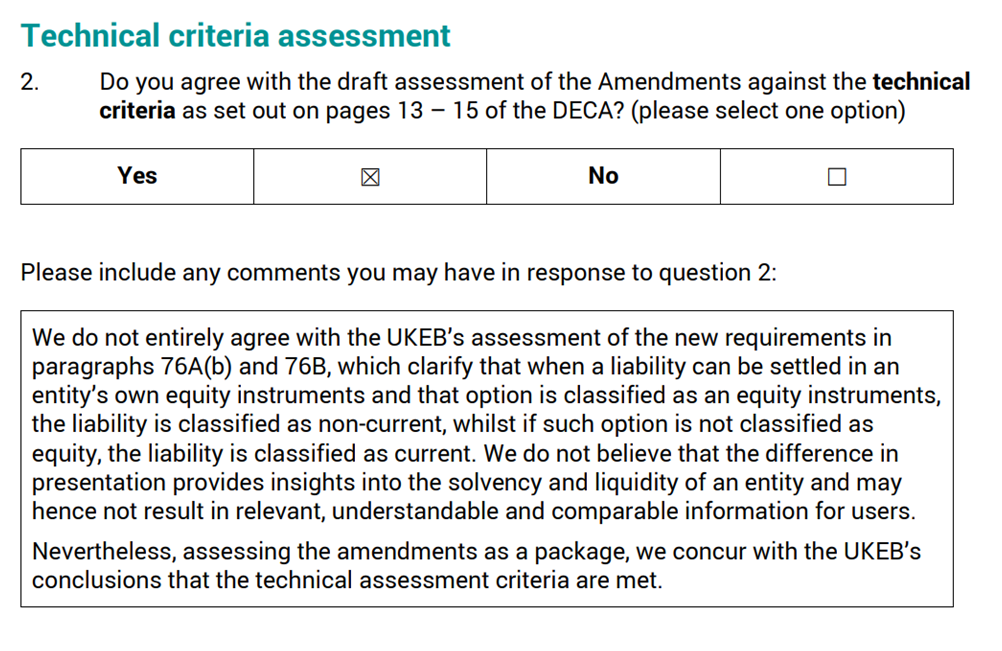
Please include any comments you may have in response to question 2:
We do not entirely agree with the UKEB's assessment of the new requirements in paragraphs 76A(b) and 76B, which clarify that when a liability can be settled in an entity's own equity instruments and that option is classified as an equity instruments, the liability is classified as non-current, whilst if such option is not classified as equity, the liability is classified as current. We do not believe that the difference in presentation provides insights into the solvency and liquidity of an entity and may hence not result in relevant, understandable and comparable information for users.
Nevertheless, assessing the amendments as a package, we concur with the UKEB's conclusions that the technical assessment criteria are met.
True and fair view
3 Do you agree with the draft assessment that the Amendments are not contrary to the true and fair view requirement as set out on pages 16 of the DECA? (please select one option)
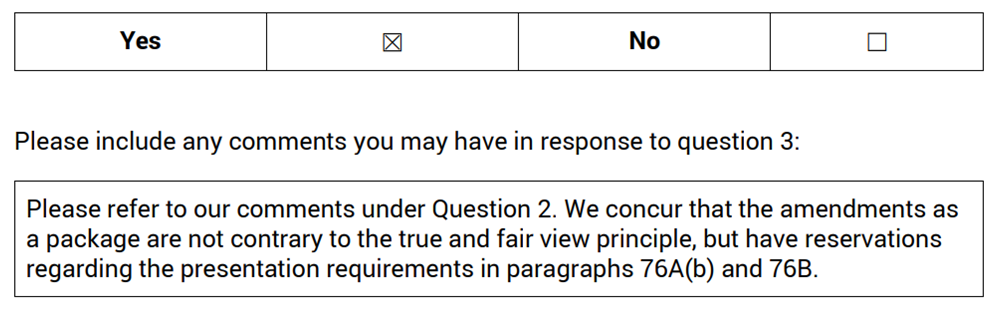
Please include any comments you may have in response to question 3:
Please refer to our comments under Question 2. We concur that the amendments as a package are not contrary to the true and fair view principle, but have reservations regarding the presentation requirements in paragraphs 76A(b) and 76B.
7 Do you agree with the initial assessment of benefits for users and preparers of the Amendments as set out on pages 18 of the DECA? (please select one option)
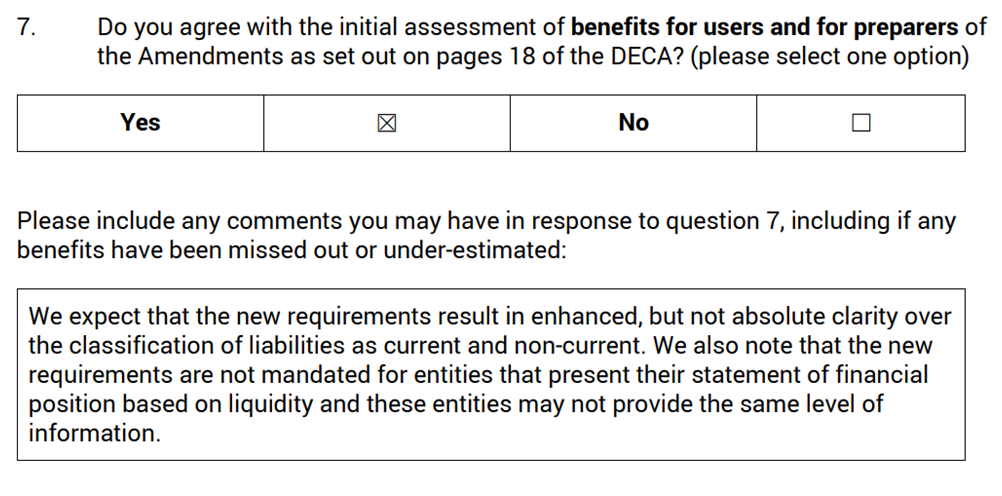
Please include any comments you may have in response to question 7, including if any benefits have been missed out or under-estimated.
We expect that the new requirements result in enhanced, but not absolute clarity over the classification of liabilities as current and non-current. We also note that the new requirements are not mandated for entities that present their statement of financial position based on liquidity and these entities may not provide the same level of information.
9 Do you agree with the draft assessment that the Amendments are not likely to lead to a 'significant change in accounting practice' as set out on page 19 of the DECA? (please select one option)
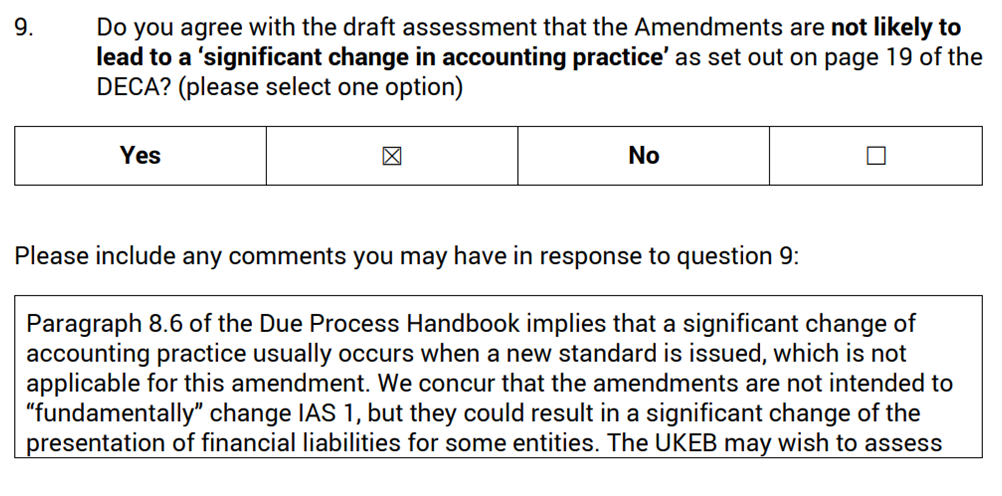
Please include any comments you may have in response to question 9:
Paragraph 8.6 of the Due Process Handbook implies that a significant change of accounting practice usually occurs when a new standard is issued, which is not applicable for this amendment. We concur that the amendments are not intended to “fundamentally” change IAS 1, but they could result in a significant change of the presentation of financial liabilities for some entities. The UKEB may wish to assess post-implementation of the new requirements, whether the projected benefits have materialised.