4 International Tax Reform—Pillar Two Model Rules (Amendments to IAS 12) DECA
22 June 2023 Agenda Paper 4
Executive Summary
| Project Type | Endorsement and adoption |
|---|---|
| Project Scope | Narrow-scope |
| Purpose of the paper | |
| The purpose of this paper is to: | |
| - Obtain Board feedback on the Draft Endorsement Criteria Assessment (DECA) for the narrow-scope amendments International Tax Reform–Pillar Two Model Rules (the Amendments). | |
| - Request the Board’s approval to publish the DECA on the UKEB website for stakeholder consultation. | |
| Summary of the Issue | |
| The Amendments provide a mandatory temporary exception from deferred tax accounting in relation to Pillar Two top-up taxes, and require an entity to disclose that it has applied the exception. They also require targeted disclosures. | |
| The purpose of the DECA is to assess whether the Amendments meet the statutory criteria for adoption set out in SI 2019/6851. The DECA includes: | |
| - a description of the UK statutory requirements for adoption of new and amended international accounting standards; | |
| - a description of the Amendments; and | |
| - an assessment of whether the Amendments meet the statutory criteria for adoption. | |
| The exception from deferred tax accounting will be effective immediately and retrospectively, together with the requirement to disclose that it has been applied. The targeted disclosure requirements will be effective for annual periods beginning on or after 1 January 2023. |
Decisions for the Board
Does the Board agree that, subject to any amendments or additions required by the Board, the DECA can be published for public consultation?
Recommendation
Subject to any amendments or additions required by the Board, the Secretariat recommends that the Board approves the DECA for public consultation.
Appendices
Appendix A [Draft] Endorsement Criteria Assessment of International Tax Reform–Pillar Two Model Rules (Amendments to IAS 12) Appendix B DECA–Invitation to Comment Appendix C Your Details
Purpose
1 The purpose of this paper is to:
a) Obtain Board feedback on the Draft Endorsement Criteria Assessment (DECA), included as Appendix A of this paper, for the narrow-scope amendments International Tax Reform–Pillar Two Model Rules (the Amendments). b) Request the Board’s approval to publish the DECA on the UKEB website for stakeholder consultation.
Background
2 In May 2023, the IASB issued the narrow scope amendments International Tax Reform–Pillar Two Model Rules (the Amendments).
Mandatory temporary exception
3 If adopted, the Amendments would introduce a mandatory temporary exception from deferred tax accounting in relation to Pillar Two top-up taxes and a requirement to disclose that this exception had been applied.
Targeted disclosure requirements
4 The Amendments would also introduce targeted disclosure requirements.
5 An entity would be required to disclose its current tax expense (income) related to Pillar Two income taxes separately, once the tax is in effect.
6 In periods when the legislation has been enacted or substantively enacted but is not yet in effect, an entity would be required to disclose known or reasonably estimable qualitative and quantitative information that helps users of financial statements understand the entity’s exposure to Pillar Two income taxes. Where an entity does not have known or reliably estimable information on its exposure to Pillar Two top-up taxes at the end of the reporting period, it would have to make a statement to this effect and disclose the progress it has made in assessing its exposure.
Transition and effective date
7 If adopted, the exception from deferred tax accounting would be effective immediately and retrospectively, together with the requirement to disclose that it has been applied. The targeted disclosure requirements would be effective for annual periods beginning on or after 1 January 2023 but would not be required for interim periods ending on or before 31 December 2023.
Stakeholder outreach
8 We gathered feedback on the IASB’s initial proposals by holding two roundtables, one for accounting firms and institutes and one attended by preparers and also open to investors, and a discussion with the Investor Advisory Group (IAG). This informed our final comment letter, submitted on 9 March 2023. The March meetings of the Preparer Advisory Group (PAG) and Accounting Firms and Institutes Advisory Group (AFIAG) confirmed the urgency of the Amendments.
9 The final Amendments issued in May 2023 reflect the principal comments in the UKEB comment letter. Since their issue we have conducted further stakeholder outreach, primarily to inform the long term public good assessment in the DECA.
10 The Secretariat held a discussion at the June meeting of the PAG on the balance of costs and benefits of applying the Amendments. The Secretariat also held separate discussions with two preparers who are not members of the PAG.
11 In addition, the Amendments were discussed with the IAG at its June 2023 meeting. IAG members welcomed the mandatory temporary exception and considered that the targeted disclosure requirements provided additional useful information.
12 The results of this additional outreach are reflected in the DECA. Stakeholders will have the opportunity to share their views on the costs and benefits arising from the Amendments in their responses to the DECA.
Next steps and timeline
13 In accordance with the PIP (approved by the Board in February 2023), and assuming the Board decides to adopt the Amendments, the UKEB project plan timeline will ensure adoption is completed before the end of July 2023.
Endorsement and adoption phase
14 Accounting firms and preparer stakeholders have observed that this matter is urgent, given current expectations that the relevant legislation will be enacted in the coming weeks. In accordance with the Due Process Handbook paragraph 6.29, the DECA will be open for public consultation for the minimum period of 14 days. Both the AFIAG and the PAG confirmed to us at their March meetings that in their view a short consultation period was necessary in this case.
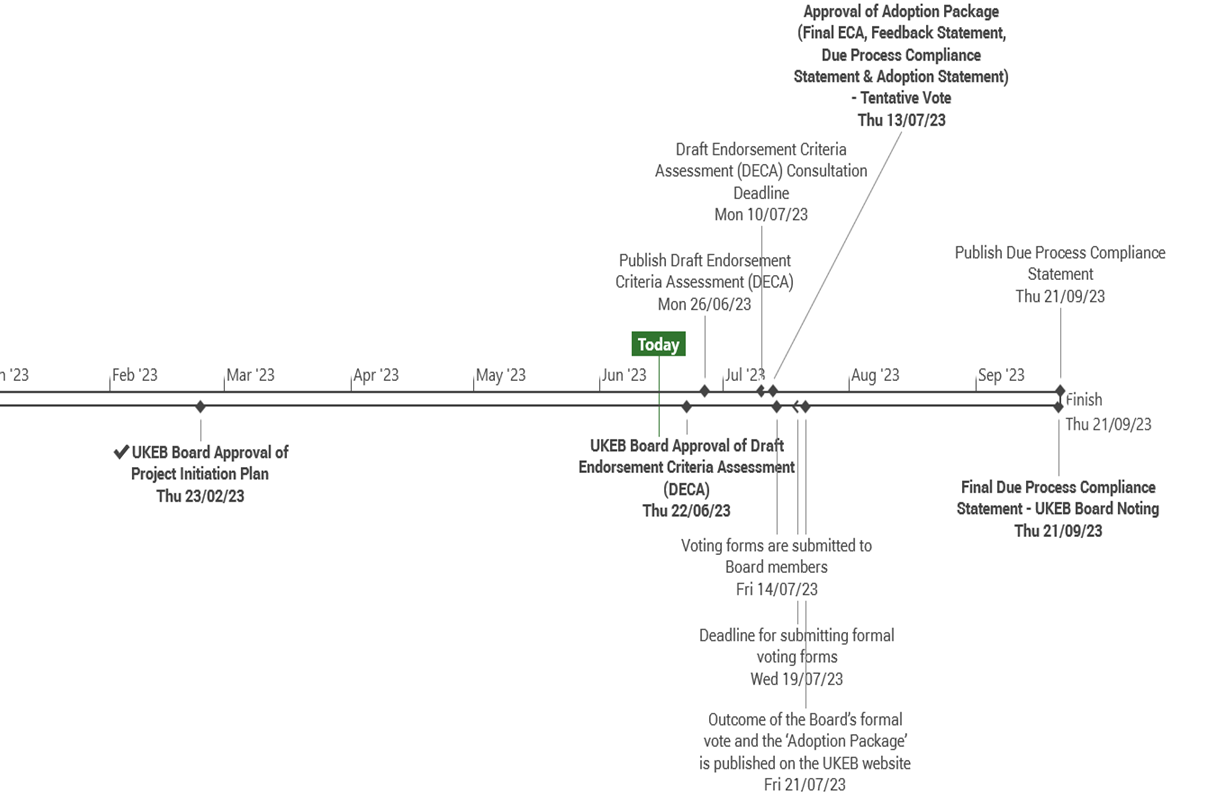
15 Subject to amendments or additions to the DECA required by the Board, the proposed timeline for publication, public consultation and subsequent finalisation of the ECA is set out in the table and diagram below.
| Date | Milestone |
|---|---|
| 22 June 2023 | Presentation of Draft Endorsement Criteria Assessment for approval |
| This meeting | |
| DECA consultation period (14 days, as permitted by the Due Process Handbook paragraph 6.29): 26 June 2023 to 10 July 2023 | |
| 10 July 2023 | Secretariat: Prepares the adoption package and a draft Due Process Compliance Statement for the project. The Board papers will be delivered late, as approved by the Board in its February meeting. |
| To be completed | |
| 13 July 2023 | Board: Considers an adoption package for approval and considers the draft Due Process Compliance Statement for the project. |
| To be completed | |
| Board members provide a tentative vote. | |
| 14 July 2023 | Voting form is sent to board members. |
| To be completed | |
| 19 July 2023 | Board: Deadline for submitting vote |
| To be completed | |
| 21 July 2023 | Secretariat: Publication of adoption decision |
| To be completed | |
| 21 September 2023 | Board: Final Due Process Compliance Statement for noting. |
| To be completed |
Question for the Board
1 Does the Board agree that, subject to any amendments or additions required by the Board, the DECA can be published for public consultation?
Endorsement and Adoption timeline (as proposed in February 2023 PIP)
The UKEB does not accept any liability to any party for any loss, damage or costs howsoever arising, whether directly or indirectly, whether in contract, tort or otherwise from any action or decision taken (or not taken) as a result of any person relying on or otherwise using this document or arising from any omission from it. © 2023 All Rights Reserved
- Executive Summary
- Decisions for the Board
- Recommendation
- Appendices
- Purpose
- Background
- Mandatory temporary exception
- Targeted disclosure requirements
- Transition and effective date
- Stakeholder outreach
- Next steps and timeline
- Endorsement and adoption phase
- Question for the Board
- Endorsement and Adoption timeline (as proposed in February 2023 PIP)
- Introduction
- I. Section 1: UK statutory requirements for adoption
- 2. Section 2: Description and assessment of the Amendments
- Appendix A: Glossary
- Appendix B: Invitation to Comment
- Your details
Introduction
Purpose
1 The purpose of this Draft Endorsement Criteria Assessment (DECA) is to determine whether International Tax Reform–Pillar Two Model Rules (Amendments to IAS 12) (the Amendments), issued by the International Accounting Standards Board (IASB) in May 2023, meet the UK’s statutory requirements for adoption as set out in Regulation 7 of Statutory Instrument (SI) 2019/6852.
2 The IASB’s proposals were set out in Exposure Draft ED/2023/1 International Tax Reform–Pillar Two Model Rules (Amendments to IAS 12) (the ED)3. The UKEB submitted its Final Comment Letter (FCL) on the ED to the IASB on 9 March 20234.
Background to the Amendments
3 The Pillar Two model rules introduce a minimum tax rate for entities and groups with turnover of €750m or above. In jurisdictions where an entity or group’s effective tax rate is below 15%, the Pillar Two model rules require the entity or group to top up the tax it pays to that rate.
4 Stakeholders expressed concern about the complexities of accounting for deferred tax in respect of the Pillar Two model rules. They also highlighted to the IASB that there is an urgent need for clarity due to the expected enactment of the Pillar Two model rules in 2023 across multiple jurisdictions, including the UK. In response to this feedback, the IASB developed the Amendments.
5 If adopted, the Amendments will introduce a mandatory temporary exception from deferred tax accounting in relation to Pillar Two income taxes, a requirement to disclose that this exception has been applied and targeted disclosure requirements. The exception from deferred tax accounting will be effective immediately and retrospectively, together with the requirement to disclose that it has been applied. The targeted disclosure requirements will be effective for annual periods beginning on or after 1 January 2023. Section 2 of this DECA provides a brief description of the Amendments.
Exclusions from the adoption assessment
6 The Amendments to the Basis for Conclusions of IAS 12 Income Taxes have not been included as part of the UKEB’s assessment as UK-adopted international accounting standards comprise only the mandatory sections of standards. Similar amendments will be made to the IFRS for Small and Medium-Sized Entities (SMEs) standard, which is not used in the UK.
7 This DECA does not therefore consider any amendments to the IAS 12 Basis for Conclusions or to the IFRS for SMEs.
Structure of the assessment
8 We have presented our analysis in the following sections:
a) Section 1: describes UK statutory requirements for adoption of new or amended international accounting standards; and b) Section 2: discusses how the Amendments meet the criteria in Section 1.
Do the Amendments lead to a significant change in accounting practice?
9 A standard adopted by the UKEB under Regulation 6 of SI 2019/685 that it considers is likely to lead to a “significant change in accounting practice”, is subject to the requirements in paragraph 3 of Regulation 11 of SI 2019/685 that the UKEB:
a) “carry out a review of the impact of the adoption of the standard; and b) publish a report setting out the conclusions of the review no later than 5 years after the date on which the standard takes effect (being the first day of the first financial year in respect of which it must be used)”.
10 Section 2 of the DECA discusses whether the Amendments lead to a significant change in accounting practice and concludes that they do not5.
I. Section 1: UK statutory requirements for adoption
UK statutory requirements
1.1 Paragraph 1 of Regulation 7 of SI 2019/685 requires that an international accounting standard only be adopted if:
a) “the standard6 is not contrary to either of the following principles– i. an undertaking’s accounts must give a true and fair view of the undertaking’s assets, liabilities, financial position and profit or loss; ii. consolidated accounts must give a true and fair view of the assets, liabilities, financial position and profit or loss of the undertakings included in the accounts taken as a whole, so far as concerns members of the undertaking; b) the use of the standard is likely to be conducive to the long term public good in the United Kingdom; and c) the standard meets the criteria of understandability, relevance, reliability and comparability required of the financial information needed for making economic decisions and assessing the stewardship of management.”
1.2 This DECA assesses the criteria above in the following order:
a) Whether the Amendments meet the criteria of relevance, reliability, understandability and comparability required of the financial information needed for making economic decisions and assessing the stewardship of management (SI 2019/685 Regulation 7(1)(c)). b) Whether the Amendments are not contrary to the principle that an entity’s accounts must give a true and fair view (SI 2019/685 Regulation 7(1)(a)). c) Whether use of the Amendments is likely to be conducive to the long term public good in the UK (Regulation 7(1)(b)). SI 2019/685 Regulation 7(2) includes specific areas to consider for this assessment. They are: i. whether the Amendments are likely to improve the quality of financial reporting; ii. the costs and benefits that are likely to result from the use of the Amendments; and iii. whether the Amendments are likely to have an adverse effect on the economy of the UK, including on economic growth.
Relevance, reliability, understandability and comparability7
1.3 Information is relevant if it is capable of making a difference in the decision-making of users8 or in their assessment of the stewardship of management. The information may aid predictions of the future, confirm or change evaluations of the past, or both.
1.4 Financial information is reliable if, within the bounds of materiality, it:
a) can be depended on by users to represent faithfully what it either purports to represent or could reasonably be expected to represent; b) is complete; and c) is free from material error and bias.
1.5 Financial information should be readily understandable by users with a reasonable knowledge of business and economic activities and accounting, and a willingness to study the information with reasonable diligence.
1.6 Information is comparable if it enables users to identify and understand similarities in, and differences among, items. Information about an entity should be comparable with similar information about other entities and with similar information about the same entity for another period.
1.7 In conducting our overall assessment against the technical accounting criteria we are required to adopt an absolute, rather than a relative, approach. Our assessment is therefore an absolute one against the criteria (do the Amendments provide information that is understandable, relevant, reliable and comparable?) rather than a relative one (do the Amendments provide information that is more understandable, relevant, reliable and comparable than current, or any other, accounting?). When an assessment of any individual aspect or requirement of the Amendments uses comparative language (e.g. ‘enhances comparability’), this does not mean that our objective is to reflect a real comparison in relative terms. Instead, our objective is to explain that any individual aspect or requirement of the Amendments has the potential to “enhance” one or more of the qualitative characteristics. Consideration of whether the Amendments are likely to improve the quality of financial reporting is separate from this assessment and is included within the UK long term public good assessment in Section 2.
True and fair view assessment
1.8 As noted above, the first adoption criterion set out in SI 2019/685 Regulation 7(1) requires that an international accounting standard can be adopted only if:
“[...] the standard is not contrary to either of the following principles–
a) an undertaking’s accounts must give a true and fair view of the undertaking’s assets, liabilities, financial position and profit or loss; b) consolidated accounts must give a true and fair view of the assets, liabilities, financial position and profit or loss of the undertakings included in the accounts taken as a whole, so far as concerns members of the undertaking; [...]”
1.9 For the sake of brevity, we refer to our assessment against this endorsement criterion as ‘the true and fair view assessment’ and to the principles set out in Regulation 7(1)(a) as the ‘true and fair principle’. However, these abbreviated expressions do not imply that our assessment has considered anything other than the full terms of the endorsement criterion set out above.
1.10 The duty of the UKEB under Regulation 7(1)(a) is to determine generically, before a standard is applied to a set of accounts, whether that standard is not contrary to the true and fair principle. In other words, it is an ex-ante assessment. We have therefore considered whether the Amendments contain any requirement that would prevent accounts prepared using the Amendments from giving a true and fair view.
1.11 Our approach is to determine whether the Amendments are not contrary to the true and fair principle in respect of any of the specific items identified in Regulation 7(1)(a) (namely, the assets, liabilities, financial position and profit or loss) in the context of the preparation of the accounts as a whole. A holistic approach has been taken to this assessment, considering the impact of the Amendments taken as a whole, including its interaction with other UK-adopted international accounting standards9.
1.12 For the purposes of our assessment, we consider the requirement in IAS 1 Presentation of Financial Statements for financial statements to “present fairly the financial position, financial performance and cash flows of an entity” to be equivalent to the Companies Act 2006 requirement for accounts to give a true and fair view.
1.13 Our assessment is separate from the duty of directors under section 393(1) of the Companies Act 2006, which requires directors to be satisfied that a specific set of accounts gives a true and fair view of an undertaking’s or group’s assets, liabilities, financial position and profit or loss.
[Draft] Adoption decision
1.14 Section 2 of this DECA discusses how the Amendments meet the statutory endorsement criteria set out in this Section.
1.15 On the basis of this assessment, [and subject to any stakeholder feedback,] the UKEB [tentatively] concludes that the Amendments meet the statutory endorsement criteria. The UKEB is therefore of the view that it will adopt the Amendments for use in the UK.
2. Section 2: Description and assessment of the Amendments
| International Tax Reform–Pillar Two Model Rules (Amendments to IAS 12) | |
|---|---|
| Title and issue date of final amendments | International Tax Reform–Pillar Two Model Rules (Amendments to IAS 12), issued on 23 May 2023. |
| Origin | In December 2021, the Organisation for Economic Co-operation and Development (OECD) finalised the model rules for Pillar Two, one of the two pillars designed to address the tax challenges presented by the globalisation and digitalisation of the economy. |
| The Pillar Two model rules introduce a minimum tax rate for multinational groups and entities with turnover of €750m or above. In jurisdictions where a group’s effective tax rate is below 15%, the Pillar Two model rules require the entity to increase the tax it pays to that rate, by applying a top-up tax. | |
| Stakeholders expressed concerns to the IASB about the uncertainty over how to account for deferred tax arising from the top-up tax. Questions raised include: | |
| - whether Pillar Two top-up taxes are in all circumstances income taxes within the scope of IAS 12 Income Taxes; | |
| - which tax rate to use to measure deferred taxes; | |
| - whether additional temporary differences arise from the Pillar Two model rules, i.e. is it possible to link the recovery or settlement of the carrying amount of assets or liabilities directly to future top-up tax payments; and | |
| - whether domestic temporary differences should be remeasured. | |
| Some stakeholders also commented that accounting for deferred tax related to Pillar Two top-up tax could be extremely complex and that the costs of doing so might therefore outweigh the benefits to users. | |
| Stakeholders have further observed that this matter is urgent, as some jurisdictions are already in the process of enacting or substantively enacting Pillar Two legislation and others, including the UK, are expected to do so by summer 2023. | |
| In response, the IASB published the ED on 9 January 2023 and, having considered stakeholder feedback, issued the Amendments on 23 May 2023. |
| What has changed? | The Amendments have added new paragraphs as follows: |
|---|---|
| - Paragraph 4A has been added to the Scope section of IAS 12. This paragraph clarifies that income taxes arising from the implementation of the Pillar Two model rules are within the scope of IAS 12. It requires an entity to apply a temporary exception from accounting for deferred taxes related to Pillar Two income taxes. | |
| - Paragraphs 88A to 88D have been added to the disclosure requirements in IAS 12. | |
| - Paragraph 88A requires an entity to disclose its application of the temporary exception under paragraph 4A. | |
| - Paragraph 88B requires an entity to disclose separately its current tax expense (income) related to Pillar Two income taxes, once the tax is in effect. | |
| - Paragraphs 88C and 88D require an entity to disclose known or reasonably estimable qualitative and quantitative information that helps users of financial statements understand the entity’s exposure to Pillar Two income taxes in periods when relevant legislation has been enacted or substantively enacted, but is not yet in effect. They also provide guidance on the form that such information could take. | |
| When entities do not have known or reasonably estimable information on their exposure to Pillar Two top-up taxes at the end of the reporting period, they should make a statement to this effect and disclose the progress they have made in assessing their exposure. | |
| There were no consequential amendments to any other international accounting standards. | |
| Transition requirements | The requirement for entities to apply the temporary exception is effective immediately and retrospectively. Entities must disclose that they have applied it (paragraphs 4A and 88A). |
| For periods beginning on or after 1 January 2023, entities are required to make the disclosures required by paragraph 88B in periods in which Pillar Two legislation is in effect and those required by paragraphs 88C and 88D in periods in which Pillar Two legislation is enacted or substantively enacted but not yet in effect. | |
| Entities are not required to make the disclosures under paragraphs 88B to 88D in financial statements for interim periods ending on or before 31 December 2023. |
| Technical accounting criteria assessment | |
|---|---|
| Relevance and reliability | In general, IAS 12 requires entities to account for deferred tax to recognise the future tax consequences inherent in the recognition of assets and liabilities. It might therefore appear that providing an exception from deferred tax accounting for Pillar Two top-up taxes could reduce the relevance and reliability of the financial information provided by an entity, as it will result in an entity omitting deferred tax information that would otherwise have been provided. |
| However, calculating deferred tax assets and liabilities in relation to Pillar Two top-up taxes would be extremely complex. The variables and assumptions in this calculation would in many cases be significant, requiring judgements that would be subjective and complex. The determination of deferred tax amounts in relation to Pillar Two top-up taxes could potentially be impracticable. For example, an entity would have to forecast its Pillar Two profits, adjusted under the numerous Pillar Two rules, its domestic tax payable and its resulting effective Pillar Two top-up tax across the useful lives of its assets and liabilities, potentially many years into the future. | |
| Stakeholders have expressed the view that entities and their auditors need more time to determine how to apply the principles of IAS 12 to deferred taxes arising from Pillar Two top-up tax. Until then, entities’ recognition and measurement of deferred tax assets and liabilities would not necessarily be based on reliable information in relation to Pillar Two top-up taxes. A temporary exception therefore avoids the recognition of deferred tax balances that are not reliable and that do not, therefore, provide useful information. It also preserves the relevance and reliability of the existing deferred tax assets and liabilities recognised in the accounts. | |
| Requiring entities to disclose whether they have taken the exception will enable users to identify that an entity may have deferred tax liabilities or assets related to Pillar Two top-up taxes, which they have neither recognised nor disclosed within the financial statements. This disclosure will enhance the relevance of the financial information. | |
| Disclosures in periods when Pillar Two legislation is in effect | In periods when Pillar Two legislation is in effect, entities will be required to disclose their current tax expense (income) relating to Pillar Two separately. Pillar Two is a significant international tax reform, and providing information on its current tax impact (income or expense) will be useful to users of accounts. As current tax expense (income) is calculated from known information, this disclosure could inform an assessment of possible future tax liabilities or assets as well as permitting users to evaluate past assessments. Disclosing this expense (income) separately will enhance the relevance of information provided, as it will aid users in assessing an entity’s potential future exposure to Pillar Two top-up taxes. |
| Disclosures in periods when Pillar Two legislation is enacted or substantively enacted, but not yet in effect | In periods when the Pillar Two legislation is enacted or substantively enacted, but not yet in effect, entities will be required to provide quantitative and qualitative information that helps users understand an entity’s exposure to Pillar Two top-up taxes at the end of the reporting period. Permitting entities to decide upon the information they provide to help users understand the entity’s exposure to Pillar Two will result in entity-specific information. |
| This approach has the potential to enhance the relevance of information provided on an entity’s exposure to Pillar Two top-up taxes, because entities will provide users with the information that they consider represents their exposure most faithfully, within the constraints of the IASB’s guidance on the form of that information. It could also enhance the reliability of the information provided, as the approach will allow entities to make disclosures based on the most robust information at their disposal. | |
| When entities do not have known or reasonably estimable information on their exposure to Pillar Two top-up taxes at the end of the reporting period, they should make a statement to this effect and disclose the progress they have made in assessing their exposure. Providing this alternative for entities which do not have known or reasonably estimable information at the end of the reporting period avoids requiring entities to disclose information that is not robust, thereby enhancing the overall relevance and reliability of the information provided. | |
| Understandability | Deferred tax amounts that result from complex law, calculations and judgements, using information that may not be reliable and methodologies that are potentially not comparable, risk not being understandable. Further, if entities were to account for deferred tax on Pillar Two top-up taxes, they would have to explain their methodologies, which could be extremely complex. For example, an entity may have to explain its decision-making on the recognition and measurement of temporary differences additional to those that exist between the carrying amounts of assets and liabilities in the statement of financial position and their domestic tax bases. |
| The Amendments therefore have the potential to enhance understandability. |
| Disclosures in periods when Pillar Two legislation is in effect | The requirement to present any Pillar Two top-up tax separately will allow users to identify the current tax effect of Pillar Two top-up taxes easily, enhancing understandability. This will in part mitigate the absence of deferred tax accounting in relation to Pillar Two top-up taxes. |
|---|---|
| Disclosures in periods when Pillar Two legislation is enacted or substantively enacted, but not yet in effect | Entities are required to provide qualitative and quantitative information about their exposure to Pillar Two top-up taxes, whilst retaining scope to make decisions on the form of that information. An entity will therefore be able to apply the requirement to its own circumstances, providing users with entity-specific information and thereby enhancing understandability. These disclosure requirements will also go some way to mitigating the absence of deferred tax accounting. |
| Comparability | The mandatory temporary exception avoids the risk that entities will make diverse interpretations of IAS 12’s requirements in relation to Pillar Two top-up taxes. It therefore helps avoid the inconsistent application of IAS 12, for example in whether and how to recognise and measure additional temporary differences, and therefore enhances comparability. |
| Requiring entities to disclose when they have applied the exception will give users confidence in the comparability of deferred tax assets and liabilities across entities within and outside the scope of the Pillar Two legislation. | |
| Disclosures in periods when Pillar Two legislation is enacted or substantively enacted but is not yet in effect | The Amendments do not specify the detailed quantitative and qualitative disclosures required, so the information provided by entities will not be uniform. However, this does not preclude comparability. As the requirement is to disclose known or reasonably estimable information that helps users understand the entity’s exposure to Pillar Two income taxes, entities can present information that faithfully depicts their specific tax position, thereby enhancing the true comparability of the information provided. |
| Transition requirements | Entities will not be required to account for deferred tax on Pillar Two top-up taxes due to the immediate and retrospective application of the Amendments, which will enhance the comparability of entities’ financial positions across financial reporting periods. |
| Conclusion | Overall, we conclude that the Amendments meet the criteria of understandability, relevance, reliability and comparability required of the financial information needed for making economic decisions and assessing the stewardship of management, as required by SI 2019/685. |
|---|---|
| ### Amendment is not contrary to the true and fair requirement | |
| Description | The previous section of this DECA concludes that the Amendments meet the technical accounting criteria, including that of reliability. Reliability includes the notion of faithful representation of the economic substance of transactions and events. The technical accounting criteria assessment therefore underpins the overall true and fair view assessment. |
| The Amendments maintain the existing requirements for recognition and measurement of deferred tax assets and liabilities, and provide an exception for deferred tax accounting in relation only to Pillar Two top-up taxes. Consequently, the Amendments are narrow in scope and do not introduce new principles. | |
| Conclusion | Our assessment has not identified any requirement of the Amendments, either alone or in conjunction with international accounting standards adopted for use in the UK, that would prevent individual or group accounts prepared using the Amendments from giving a true and fair view of the undertaking’s or group’s assets, liabilities, financial position and profit or loss. We are satisfied, therefore, that the circumstances in which the application of the Amendments would result in accounts which did not give a true and fair view would be extremely rare. |
| Overall, we conclude that the Amendments are not contrary to the true and fair view principle set out in Regulation 7(1) of SI 2019/685. | |
| ### UK long term public good | |
| Description of entities that will be impacted | The Amendments will affect entities with consolidated turnover over €750m. Depending on exchange rate fluctuations, they will affect approximately 200 listed UK groups and companies, as well as a number of private UK groups and companies. They will also affect UK subsidiaries of foreign groups which prepare accounts under IFRS. |
| Do the amendments improve financial reporting? | The Amendments provide a mandatory temporary exception from accounting for deferred taxes related to Pillar Two income taxes. They will improve the quality of financial reporting because they: |
|---|---|
| - avoid the recognition of unreliable deferred tax assets and liabilities in relation to Pillar Two top-up taxes; | |
| - avoid potential diversity of practice by removing the need for entities to interpret the IAS 12 requirements in relation to Pillar Two top-up taxes; and | |
| - ensure the provision of useful information on the expected and actual impact of Pillar Two top-up taxes through targeted disclosure requirements. | |
| Costs for preparers and users | Preparers: Given the Amendments are narrow in scope and will affect only a specified population of entities, we estimated preparers’ adoption costs by conducting a qualitative assessment of the costs likely to be borne by preparers, following the principle of proportionality. We assessed whether preparers would face costs related to: |
| - familiarisation; | |
| - design of data collection processes; | |
| - IT system changes; | |
| - governance processes; | |
| - external audit; and | |
| - other costs. | |
| Preparers in scope of the Pillar Two legislation considered that they have started incurring or will incur significant, i.e. greater than negligible but less than material, one-off costs to comply with the Amendments. These were largely related to familiarisation, the design of data collection processes and IT system changes. | |
| Some preparers thought that the one-off incremental cost of complying with the Amendments would be increased by the fact that the accounting disclosures will be required before tax compliance processes are in place (i.e before the completion of the first Pillar Two tax return). Preparers further observed that initial one-off costs will vary depending on how a group organises its accounting systems, whether by jurisdiction, business unit or on another basis. | |
| Preparers considered that the Amendments would have a smaller but still significant impact on their ongoing costs, including additional accounts preparation, changes in governance processes and external audit costs. One preparer we interviewed considered that these costs could be absorbed into business-as-usual processes; another felt it was too early to take a view. | |
| We expect other costs to be negligible or nil. | |
| The UKEB asked preparers what the cost of accounting for deferred tax in relation to Pillar Two top-up taxes would be in the absence of the Amendments. Some preparers considered that accounting for deferred tax in relation to Pillar Two top-up taxes would be very difficult, and therefore considered that the savings from not doing so would outweigh the costs of making the disclosures required by the Amendments. Other preparers thought that accounting for deferred tax in relation to Pillar Two top-up taxes was impracticable, and therefore the Amendments were required irrespective of cost. | |
| Users: Users of accounts confirmed to the UKEB that the costs arising to them as a result of the Amendments would be minimal, principally related to familiarisation. | |
| Benefits for preparers and users | Preparers: The principal benefit for preparers is that they will not be required to account for deferred tax in relation to Pillar Two income taxes. As explained above, preparers have confirmed to us that this could be extremely complex, if not wholly impracticable. |
| Preparers agreed that they would welcome the Amendments being made permanent. However, even if they did not become permanent, preparers welcomed the additional lead time the Amendments would afford them for determining how to account for deferred tax in relation to Pillar Two top-up taxes. | |
| Users: Users welcomed the mandatory temporary exception, as it would not result in a loss of decision-useful information. | |
| They considered the targeted disclosure requirements provided additional useful information. In the period in which the legislation is enacted or substantively enacted but not yet in effect, the disclosures will indicate a group’s exposure to Pillar Two top-up taxes and the extent to which a group is prepared for implementation. Once the legislation is effective, they welcomed the separate disclosure of a group’s current tax expense (income) in relation to Pillar Two top-up taxes. |
| Whether the Amendments are likely to have an adverse effect on the UK economy | The Amendments are not likely to have an adverse effect on the UK economy in that the Amendments improve entities’ efficiency. The Amendments should ensure that accounting requirements will at least not hinder implementation of the Pillar Two legislation. |
|---|---|
| We have not identified any factors that would indicate that the Amendments would lead to changes in business practices or operations that are detrimental to the UK economy. In addition, we do not expect the accounting under the Amendments to affect economic behaviour negatively, as the effects of deferred tax are accounting effects only, not related to economics. These assertions were confirmed by engagement with preparers and users. | |
| As a result, the Amendments are not likely to have an adverse effect on the UK economy, including on economic growth. | |
| Conclusion | Having considered all relevant aspects, including the trade-off between the costs and benefits of implementing the Amendments, the UKEB concludes that they are likely to be conducive to the long term public good in the UK as required by SI 2019/685. |
Do the Amendments lead to a significant change in accounting practice?
2.1 The UKEB is required to assess whether or not the Amendments are likely to lead to a ‘significant change in accounting practice’ and therefore meet the criteria for a post-implementation review.
2.2 The Amendments do not fundamentally change the basic requirements of IAS 12 or introduce new principles, nor do they impact the majority of entities.
2.3 As a result, the UKEB [tentatively] concludes that the Amendments are not likely to lead to a significant change in accounting practice and do not meet the criteria for a post-implementation review under Regulation 11 in SI 2019/685.
Appendix A: Glossary
| Term | Description |
|---|---|
| The Amendments | International Tax Reform–Pillar Two Model Rules (Amendments to IAS 12) |
| DECA | Draft Endorsement Criteria Assessment |
| ED | Exposure Draft |
| FCL | Final Comment Letter |
| IASB | International Accounting Standards Board |
| IAS | International Accounting Standard |
| IFRS | International Financial Reporting Standards |
| OECD | Organisation for Economic Co-operation and Development |
| SI | Statutory Instrument |
| SMEs | Small and Medium-sized Entities |
| UKEB | UK Endorsement Board |
Contact Us UK Endorsement Board 1 Victoria Street | London | SW1H 0ET | United Kingdom www.endorsement-board.uk
Appendix B: Invitation to Comment
Call for comments on Draft Endorsement Criteria Assessment of International Tax Reform–Pillar Two Model Rules (Amendments to IAS 12)
Deadline for completion of this Invitation to Comment:
Close of business, Monday 10 July 2023
Please submit to: [email protected]
Introduction
The objective of this Invitation to Comment is to obtain input from stakeholders on the endorsement and adoption of International Tax Reform–Pillar Two Model Rules (Amendments to IAS 12) (the Amendments), published by the International Accounting Standards Board (IASB) in May 2023. The Amendments provide a mandatory temporary exception from deferred tax accounting in relation to Pillar Two top-up taxes alongside targeted disclosure requirements. The exception from deferred tax accounting will be effective immediately and retrospectively, together with the requirement to disclose that it has been applied. The targeted disclosure requirements will be effective for annual periods beginning on or after 1 January 2023. The information collected from this Invitation to Comment is intended to help with the endorsement assessment.
UK endorsement and adoption process
The requirements for UK adoption are set out in Statutory Instrument 2019/68510.
The powers to formally adopt international accounting standards for use in the UK were delegated to the UK Endorsement Board in May 202111.
Who should respond to this Invitation to Comment?
Stakeholders with an interest in the quality of accounts prepared in accordance with IFRS Accounting Standards.
How to respond to this Invitation to Comment
Please download this document, answer any questions on which you would like to provide views, and return it to [email protected] by close of business on Monday 10 July, 2023.
Brief responses to individual questions are welcome, as well as comprehensive responses to all questions.
Privacy and other policies
The data collected through submitting this document will be stored and processed by the UKEB. By submitting this document, you consent to the UKEB processing your data for the purposes of influencing the development of and adopting IFRS for use in the UK. For further information, please see our Privacy Statements and Notices and other Policies (e.g. Consultation Responses Policy and Data Protection Policy)12.
The UKEB’s policy is to publish on its website all responses to formal consultations issued by the UKEB unless the respondent explicitly requests otherwise. A standard confidentiality statement in an e-mail message will not be regarded as a request for non-disclosure. If you do not wish your signature to be published, please provide the UKEB with an unsigned version of your submission. The UKEB prefers to publish responses that do not include a personal signature. Other than the name of the organisation/individual responding, information contained in the “Your Details” document will not be published. The UKEB does not edit personal information (such as telephone numbers, postal or e-mail addresses) from any other response document submitted; therefore, only information that you wish to be published should be submitted in such responses.
Assessment against endorsement criteria
Our draft assessment concludes that:
- the Amendments meet the criteria of relevance, reliability, understandability and comparability required of the financial information needed for making economic decisions and assessing the stewardship of management, as required by SI 2019/685 (see Regulation 7(1)(c));
- application of the Amendments is not contrary to the principle that an entity’s accounts must give a true and fair view as required by SI 2019/685 (see Regulation 7(1)(a)); and
- that the Amendments are likely to be conducive to the long term public good in the UK as required by SI 2019/685 (see Regulation 7(1)(b)), having considered:
- whether they will generally improve the quality of financial reporting;
- the costs and benefits that are likely to result from their use; and
- whether they are likely to have an adverse effect on the economy of the UK, including on economic growth.
Our assessment of the Amendments is set out in Section 2 of the DECA in the pages indicated below:
| Page | |
|---|---|
| Rationale for the Amendments | 10 |
| Technical accounting criteria assessment | 12-15 |
| True and fair view | 15 |
| UK long term public good (including costs and benefits for preparers and users) | 15-17 |
Questions
Technical accounting criteria assessment
1 Do you agree with the draft assessment of the Amendments against the technical accounting criteria? (please select one option)
| Yes | No |
|---|---|
| ☐ | ☐ |
2 Please include any comments you may have in response to question 1:
Click or tap here to enter text.
True and fair view
3 Do you agree with the draft assessment that the Amendments are not contrary to the true and fair view requirement? (please select one option)
| Yes | No |
|---|---|
| ☐ | ☐ |
4 Please include any comments you may have in response to question 3:
Click or tap here to enter text.
UK long term public good
5 Do you agree with the initial assessment of costs and benefits for preparers and for users of the Amendments? (please select one option)
| Yes | No |
|---|---|
| ☐ | ☐ |
6 Please include any comments you may have in response to question 5, including if any costs or benefits have been omitted:
Click or tap here to enter text.
7 Do you agree with the draft assessment that the Amendments are likely to be conducive to the long term public good in the UK? (please select one option)
| Yes | No |
|---|---|
| ☐ | ☐ |
8 Please include any comments you may have in response to question seven:
Click or tap here to enter text.
Thank you for completing this Invitation to Comment Please submit this document by close of business on Monday 10 July 2023 to: [email protected]
Your details
Name: Click or tap here to enter text. Email address: Click or tap here to enter text.
Are you responding:
| On behalf of an organisation | ☐ |
|---|---|
| As an individual | ☐ |
If responding on behalf of an organisation, Name of organisation: Click or tap here to enter text.
Please select what best describes the organisation:
| An organisation applying IFRS Accounting Standards | ☐ |
|---|---|
| A user of company accounts prepared under IFRS | ☐ |
| An auditor | ☐ |
| A regulator | ☐ |
| Other | ☐ |
If your response was ‘Other’, please describe: Click or tap here to enter text.
Is your organisation a listed entity?
| UK listed | ☐ |
|---|---|
| UK AIM listed | ☐ |
| Unlisted | ☐ |
Please select which industry your organisation predominately operates in:
| CONSUMER GOODS SECTOR | ☐ |
|---|---|
| EXTRACTIVES & MINERALS PROCESSING SECTOR | ☐ |
| FINANCIALS SECTOR | ☐ |
| FOOD & BEVERAGE SECTOR | ☐ |
| HEALTH CARE SECTOR | ☐ |
| INFRASTRUCTURE SECTOR | ☐ |
| RENEWABLE RESOURCES & ALTERNATIVE ENERGY SECTOR | ☐ |
| RESOURCE TRANSFORMATION SECTOR | ☐ |
| SERVICES SECTOR | ☐ |
| TECHNOLOGY & COMMUNICATIONS SECTOR | ☐ |
| TRANSPORTATION SECTOR | ☐ |
Would you be happy for UKEB to contact you by email if we wished to discuss some of your responses?
| Yes | ☐ |
|---|---|
| No | ☐ |
Privacy and other policies
The data collected through submitting this document will be stored and processed by the UKEB. By submitting this document, you consent to the UKEB processing your data for the purposes of influencing the development of and endorsing IFRS for use in the UK. For further information, please see our Privacy Statements and Notices and other Policies (e.g. Consultation Responses Policy and Data Protection Policy)13.
The UKEB’s policy is to publish on its website all responses to formal consultations issued by the UKEB unless the respondent explicitly requests otherwise. A standard confidentiality statement in an e-mail message will not be regarded as a request for non-disclosure. If you do not wish your signature to be published, please provide the UKEB with an unsigned version of your submission. The UKEB prefers to publish responses that do not include a personal signature. Other than the name of the organisation/individual responding, information contained in the “Your Details” document will not be published. The UKEB does not edit personal information (such as telephone numbers, postal or e-mail addresses) from any other document submitted; therefore, only information that you wish to be published should be submitted in such responses.
Footnotes
-
The International Accounting Standards and European Public Limited-Liability Company (Amendment etc.) (EU Exit) Regulations 2019 No. 685 ↩
-
The International Accounting Standards and European Public Limited-Liability Company (Amendment etc.) (EU Exit) Regulations 2019 No. 685 (SI 2019/685) ↩
-
ED/2023/1 International Tax Reform–Pillar Two Model Rules: Proposed Amendments to IAS 12 ↩
-
Final Comment Letter – International Tax Reform – Pillar Two Model Rules: Amendments to IAS 12 ↩
-
Mandatory pronouncements are International Financial Reporting Standards (IFRSs), International Accounting Standards (IASs), Interpretations and mandatory application guidance. Non-mandatory guidance includes the basis for conclusions, dissenting opinions, implementation guidance and illustrative examples, together with the IFRS practice statements. This categorisation is set out in the introduction to the IASB yearly bound volumes. ↩
-
The term “standard” includes standards (International Accounting Standards (IAS), International Financial Reporting Standards (IFRS)), amendments to those standards and related Interpretations (Standing Interpretations Committee / International Financial Reporting Interpretations Committee interpretations) issued or adopted by the IASB. This DECA relates to amendments to those standards. ↩
-
These descriptions are based on the qualitative characteristics of financial statements in the Framework for the Preparation and Presentation of Financial Statements adopted by the IASB in April 2001. These qualitative characteristics became part of the criteria for endorsement and adoption of IFRS in the EU’s IAS Regulation (1606/2002), and, subsequently, in SI 2019/685. ↩
-
In the Framework for the Preparation and Presentation of Financial Statements adopted by the IASB, the users of financial reports include present and potential investors, employees, lenders, suppliers and other trade creditors, customers, governments and their agencies and the public. While the UK has not adopted this Framework, in this document, ‘users’ is taken to have a similar meaning. ↩
-
Paragraph 15 of IAS 1 Presentation of Financial Statements. ↩
-
The International Accounting Standards and European Public Limited-Liability Company (Amendment etc.) (EU Exit) Regulations 2019: https://www.legislation.gov.uk/uksi/2019/685/made ↩
-
The International Accounting Standards (Delegation of Functions) (EU Exit) Regulations 2021: https://www.legislation.gov.uk/uksi/2021/609/contents/made ↩
-
These policies can be accessed from the footer in the UKEB website here: https://www.endorsement-board.uk ↩
-
These policies can be accessed from the footer in the UKEB website here: https://www.endorsement-board.uk ↩