7 Potential connectivity issues between Sustainability Disclosure Standards and Accounting Standards
23 March 2023 Agenda Paper 7
Executive Summary
Project Type: Monitoring Project Scope: Significant
Purpose of the paper
The ISSB has indicated that it will include a connectivity project in the Request for Information (RFI) in May 2023. The objective of this and the following series of discussion papers on the theme of connectivity, is to provide the UKEB with an opportunity to consider potential issues, ahead of the ISSB RFI.
Summary of the Issue
This is the first in a series of preparatory papers, focussing on connectivity between the ISSB [draft] IFRS Sustainability Standards and IASB Accounting Standards, for consideration and discussion by the UKEB. The main aim of these papers is to enable the Board to consider the key matters related to connectivity and to develop its own position in relation to connectivity matters, ahead of the ISSB's issuance of its RFI on its agenda priorities.
This paper focuses on the first topic in this series: the recognition and impairment of assets. Other papers currently planned for discussion at future Board meetings include:
- Liabilities and provisions
- Confidential and commercially sensitive information
- Recognition
- Fair value and measurement
- Disclosures
- Purpose and objectives of sustainability disclosures
- Scope of estimation uncertainty
- Communicating levels of uncertainty – hierarchy of disclosures
- Risk disclosures relating to financial assets
- Sustainability policy disclosures
- Reporting of outcomes against previously disclosed plans
- Internal transfer pricing vs internal carbon pricing
- Other considerations
- Scope of consolidated information
- Control
- Exemption from disclosure
- Conceptual Framework
- Implications for the Conceptual Framework and materiality
This paper contains two appendices for discussion at the Board meeting:
Appendix A: Preparatory papers: Background
Due to the common background for each topic in the series, a separate background paper has been prepared to avoid repetition.
Appendix B: Assets recognition and impairment – connectivity considerations
The first section of this paper explains the interaction of the preparatory paper series with the UKEB Due Process.
The paper also contains seven case studies, based on hypothetical annual report disclosures, for the Board to consider and discuss. The Board is asked to consider how stakeholders may assess these types of disclosures and if they present a potential disconnect.
Decisions for the Board
The Board is not asked to make any decisions. The following questions are relevant in relation to each of the appendices.
Appendix A: Preparatory papers: Background
1. Does the Board have any comments or questions on the analysis and background to the series of connectivity papers presented above?
Appendix B: Assets recognition and impairment – connectivity considerations
2. Does the Board have any comments or questions on the interaction with due process presented in this paper?
3. There are seven case studies for the Board to consider and discuss in relation to connectivity regarding asset recognition and impairment disclosures. Comments are sought on the following areas:
- Asset recognition – useful lives, opportunities, economic benefits, carbon assets and retirement.
- Asset impairment – best estimate and triggers.
4. Do Board members have any additional case study suggestions on asset recognition or impairment where connectivity may need further consideration?
Recommendation
The Board to consider and discuss the case studies relating to potential connectivity issues in relation to the recognition and impairment of assets.
Preparatory papers: Background
Interaction with UKEB due process
1. This series of papers will be focussing on connectivity between the ISSB [draft] IFRS Sustainability Standards and IASB Accounting Standards for consideration and discussion by the UKEB.
2. The ISSB intend to include a project on connectivity when it issues its Request for Information (RFI) May 2023. It is, therefore, time critical that the UKEB can develop a fuller understanding of this new area of activity so that it can provide a meaningful and evidence-based response to the ISSB on a timely basis. As such, the main aim of this series of papers is to enable the Board to consider the key matters related to connectivity and develop its own position in relation to connectivity matters, ahead of the ISSB's issuance of the RFI on its agenda priorities.
3. This work is preparatory and fact finding in nature, to gain an understanding of the UKEB views on these matters. Stakeholder feedback will be sought from UKEB advisory and working groups to help inform the Board discussion and enrich feedback to the ISSB.
4. In accordance with the UKEB Due Process, a PIP focusing on the UKEB's Draft Comment Letter (DCL) will be presented to the Board when the ISSB issues the RFI. This work will support the evidence base to contribute to that DCL to the ISSB.
5. In this context, paragraph 7.12 of the UKEB Due Process Handbook, relating to Research Programme: Main Outputs are relevant. This is reproduced below for information.
"A research document that includes the Board's preliminary views would normally be accompanied by an invitation to comment on those preliminary views. By contrast, a research document of a fact-finding nature which summarises pre-existing research, outreach, or stakeholder feedback on a particular accounting topic, would not normally include views and/or an invitation to comment."
Question for the Board
1. Do Board members have any comments or questions on the interaction with due process presented in this paper?
Connected information
6. The ISSB has made a tentative decision that it will issue a Request for Information (RFI) to inform the initial two-year work plan in May 2023. One of the four projects may include a joint project with the International Accounting Standards Board (IASB) regarding connectivity between the two boards standards.
7. Draft IFRS S1 General Requirements for Disclosure of Sustainability-related Financial Information (S1) contains a section regarding ‘connected information'1 which proposes that an entity will be required to provide users of general-purpose financial reporting with information that enables them to assess the connections between:
- various sustainability-related risks and opportunities;
- the governance, strategy and risk management related to those risks and opportunities, along with metrics and targets; and
- sustainability-related risks and opportunities and other information in general purpose financial reporting, including the financial statements.
8. The IASB has communicated that accounting standards adequately cater for all material risks or opportunities. Similarly, the ISSB has also communicated that the disclosure standards adequately connect information with the financial statements.
9. However, there is a growing concern and demand from stakeholders in the UK to improve the connectivity between the narrative reporting on sustainability related financial effects with the associated impacts on the financial statements. Examples of studies carried out and reports issued are those by Carbon Tracker2 and the FRC's Thematic Review3.
10. The scope of the UKEB work4 is to assess the overlap and connectivity between the requirements of IFRS Sustainability Disclosure Standards and those of IFRS Accounting Standards, as well as the information that results from the application of the two sets of standards. We will consider the content of the two ISSB Exposure Drafts5 and any practical needs for connectivity arising from their application via a series of papers for discussion by the UKEB.
11. The papers will focus on hypothetical case studies setting out the resulting potential disclosures or disclosure needs, with the aim of seeking to identify connectivity matters and themes. Given the ISSB's draft standard IFRS S2 Climate-related Disclosures (S2) incorporate the Task Force for Climate-related Financial Disclosures (TCFD) requirements, the examples will focus on climate reporting using available TCFD-based disclosures (essentially treating the TCFD disclosures as a proxy for the S2 related disclosures).
12. Stakeholder views will be sought from UKEB Advisory and Working Groups as well as other National Standard Setters (NSS) and presented for discussion at the April and September 2023 meetings of the International Forum of National Standard Setters (IFASS)6. When the ISSB RFI project on connectivity is launched, formal outreach with UK stakeholders will be conducted as part of the response to the ISSB.
13. We consider interoperability i.e., alignment between IFRS Sustainability Disclosure Standards and other jurisdictional sustainability initiatives (e.g., EFRAG's ESRS and the climate related disclosures proposed by the SEC) to be out of scope. We also consider that practical issues with the application of current accounting standards are separate from connectivity issues and therefore out of scope for the purposes of this series of preparatory papers.
Relationship between the IASB and ISSB Standards
14. The key relationship between the IASB and ISSB standards is that both are intended to report information about a reporting entity's business during the same reporting period and at the same time. The objective is to provide relevant and timely information to meet needs of investors. However, it is unclear how the resulting information will be connected so that investors are able to understand the full impact of an entity's management's sustainability-related decisions on the entity's profitability or financial position.
15. In the UK, our working assumption is that the information will be presented in the Annual Report. Companies are currently required to incorporate TCFD information in their Strategic Reports.
16. From a practical operational perspective, preparers will need to communicate and educate internal ESG reporting teams (who may be unfamiliar with accounting standards) and financial reporting (teams who may be unfamiliar with sustainability standards) to ensure connectivity within the Annual Report. As the information will be required at the same time, for the same financial period and across an entities value chain, there will be implications and connectivity requirements for data collection, reporting systems, processes and controls.
Differences and similarities between the standards
17. There are several differences between proposed IFRS Sustainability Disclosure Standards and the current IFRS Accounting Standards. Due to the forward-looking nature and longer time frames of sustainability risks and opportunities, the ISSB standards will likely require reporting entities to provide descriptions, numbers, or ranges of numbers in the narrative disclosures that won't necessarily connect directly to the financial statements.
18. As the information is prepared on a different basis, it is unlikely to be identical. However, users still need to be able to make connections, where appropriate, and understand the financial effects of sustainability matters, both in the narrative disclosures as well as in the financial statements, to the extent relevant.
19. Key differences identified so far include:
- Timeframe - sustainability disclosures require the disclosure of the financial effects over the short, medium, and long term but do not define those periods. IAS 1 Presentation of Financial Statements requires management to look at least 12 months from the end of the reporting period but also notes that this is a minimum and not a maximum limit when assessing going concern.
- Perspective - while accounting standards consider forward looking information such as with impairment testing and useful economic lives, they generally reflect historic cost values7. Sustainability disclosures are forward looking in nature and use scenarios, assumptions and estimates to forecast a range of possible future outcomes.
- Scope - sustainability disclosures require material information about sustainability-related risks and opportunities across a company's 'value chain'. The value chain is defined as the 'full range of activities, resources and relationships related to a company's business model and the external environment in which it operates. Accounting standards have a narrower definition of scope related to the legal reporting entity or group of companies8.
- Recognition - In certain instances, IFRS Sustainability Disclosure Standards are also concerned with recognition; for example, reporting levels of greenhouse gas emissions requires measurement and then consideration of the greenhouse gas emissions-related financial disclosures (in line with requirements in draft IFRS S1 and S2). This would not necessarily lead to an immediate recognition of an asset or liability in the financial statements9 but may lead to their recognition in a later period.
- Assurance – accounting standards are subject to independent audit by an established network of deeply experienced audit professionals. It is yet to be determined what level of assurance will be required for sustainability disclosures or who might undertake that work.
20. A key similarity is the ISSB's redeliberation to use the same definition of material as IFRS Accounting Standards. That is, information is material if “omitting, obscuring or misstating it could be reasonably expected to influence investor decisions".
IASB accounting standards: disclosure requirements
21. IAS 1, Presentation of Financial Statements, provides several overall disclosure requirements that are in addition to requirements specified in other topic-specific standards (for example those in IAS 36 Impairment and IAS 16 Property, Plant and Equipment). These overall requirements provide an ‘understanding' for stakeholders in relation to:
- Fair presentation (para. 17) and Materiality and aggregation (para. 31): 'provide additional disclosures when compliance with the specific requirements in IFRSs is insufficient to enable users to understand the impact of particular transactions, other events and conditions on the entity's financial position and financial performance.'
- Structure of the notes (para. 112c): The notes shall: ... '(c) provide information that is not presented elsewhere in the financial statements but is relevant to an understanding of any of them.'
- Accounting policy information (para. 117): 'disclose material accounting policy information – i.e., when considered together with other information included in an entity's financial statements, it can reasonably be expected to influence decisions that the primary users of general-purpose financial statements make on the basis of those financial statements.'
- Judgements (para. 122): judgements that management has made in the process of applying the entity's accounting policies and that have the most significant effect on the amounts recognised in the financial statements.'
- Sources of estimation uncertainty: a further requirement (paras. 125, 129) to: 'disclose information about the assumptions [the company] makes about the future, and other major sources of estimation uncertainty at the end of the reporting period, that have a significant risk of resulting in a material adjustment to the carrying amounts of assets and liabilities within the next financial year.'
ISSB sustainability disclosure standards: requirements
22. Draft IFRS S1 and S2 require the disclosure of the financial effects of sustainability and climate-related risks and opportunities. Draft IFRS S2 specifically requires the disclosure of information regarding an entity's exposure to climate-related risks and opportunities, including current and anticipated impacts on its business model, financial statements and cash flows.
23. Draft IFRS S2 requires disclosure of quantitative information (single amounts or a range) unless an entity is unable to do so. In that situation, an entity must disclose qualitative information. The objective of the approach is to allow investors to connect between different sustainability-related risks and opportunities and to understand how those items relate to the entity's financial statements.
24. Specific disclosures are required for physical (e.g., flood risk), transition (e.g., regulatory change risk) and climate-related opportunities (e.g., new technology) in relation to their current and anticipated financial effects:
- Financial impacts: how significant climate-related risks and opportunities have affected its most recently reported financial position, financial performance and cash flows;
- Quantitative and qualitative: if the entity is unable to disclose quantitative information for (a)–(d) above, an explanation of why that is the case is required and qualitative disclosures are required.
- Material risk: for information identified in (a) above for which there is a significant risk that there will be a material adjustment to the carrying amounts of assets and liabilities reported in the financial statements within the next financial year;
- Changes in financial position: how the entity expects its financial position to change over time, given its strategy to address significant climate-related risks and opportunities, reflecting:
- its current and committed investment plans and their anticipated effects on its financial position (for example, capital expenditure, major acquisitions and divestments, joint ventures, business transformation, innovation, new business areas and asset retirements); and,
- its planned sources of funding to implement its strategy;
- Timeframe: how an entity expects its financial performance to change over the short, medium and long terms, given its strategy to address significant climate-related risks and opportunities (for example, increased revenue from or costs of products and services aligned with a lower-carbon economy, consistent with the latest international agreement on climate change; physical damage to assets from climate events; and the costs of climate adaptation or mitigation); and
- Reporting Boundary – disclosures required regarding significant climate-related risks and opportunities on an entity's value chain where in that chain the significant climate-related risks and opportunities are concentrated.
Issuing new standards or amending existing standards?
25. In developing their respective standards, the IASB and ISSB would need to retain at the forefront of their decision-making that, both investors and entities think in a "connected” way about the linkup between financial statements and sustainability disclosures. The pressure for this connectivity is expected, in the first instance, for items that are material to communicate in both the financial statements and the sustainability disclosures. However, the need for connectivity is likely to become pervasive as further standards are developed by the ISSB.
26. The draft IFRS Sustainability Disclosure Standards have highlighted that entities cannot consider sustainability and climate-related issues in isolation. Consideration of how the sustainability-related reporting relates to the financial statements is essential, especially if any additional or new risks to the entity are identified because of that process. It is, therefore, possible that the new sustainability disclosure standards also have implications for the application of existing IFRS Accounting Standards. Some examples of the potentially affected application of IFRS Accounting Standards, include:
- Assets
- Recognition
- Impairment
- Liabilities and provisions
- Confidential and commercially sensitive information
- Recognition
- Fair value and measurement
- Disclosures
- Purpose and objectives of sustainability disclosures
- Scope of estimation uncertainty
- Communicating levels of uncertainty – hierarchy of disclosures
- Risk disclosures relating to financial assets
- Sustainability policy disclosures
- Reporting of outcomes against previously disclosed plans
- Internal transfer pricing vs internal carbon pricing
- Other considerations
- Scope of consolidated information
- Control
- Exemption from disclosure
- Conceptual Framework and materiality
- Implications for the Conceptual Framework
27. It is also likely that, in this new way of considering reporting by entities, the opposite is also true, and that issuing new or amended IFRS Accounting Standards may also have implications for the IFRS Sustainability Disclosure Standards.
Questions for the Board
2. Does the Board have any comments or questions on the analysis and background to the series of connectivity papers presented above?
Next steps
28. The topics of future papers are shown in the table below. They are based on the themes noted above and identified in the UKEB staff paper presented at the January 2023 meeting of IFASS10.
| UKEB meeting | Connectivity Topics |
|---|---|
| March | Asset recognition and impairment |
| April | Liabilities and provisions |
| May | Fair value and measurement |
| June | Disclosures |
| July | Other considerations |
| September | Conceptual Framework |
Assets recognition and impairment – connectivity considerations
Context
1. The ISSB's draft IFRS S1 General Requirements for Disclosure of Sustainability-related Financial Information (S1) and draft IFRS S2 Climate-related Disclosures (S2) require an entity to explain the anticipated financial effects of sustainability-related risks and opportunities over the short, medium and long term on its most recently reported financial position, financial performance and cash flows. In addition, the entity is required to explain how its strategy to address these risks and opportunities may affect its financial position and performance over time.
2. As noted in the background paper (Appendix 7A) paragraphs 42 to 44 of draft IFRS S1 set out the requirements for 'connected information' and that sustainability information may also need to be linked to the financial statements.
3. To promote alignment with the financial statements the ISSB has specified requirements to enable users to connect the disclosures where required. Draft IFRS S1 proposes that sustainability-related financial disclosures are:
- prepared for the same reporting entity and reporting period as the related financial statements;
- provided at the same time as the financial statements and within the general purpose financial report;
- include financial data and assumptions that are consistent with the corresponding financial data and assumptions in the financial statements, to the extent possible [considering IFRS Accounting Standards1]; and
- discuss significant differences between financial data and assumptions the entity uses to prepare its sustainability-related financial disclosures and the financial data and assumptions the entity uses to prepare its financial statements.
4. By contrast, IFRS Accounting Standards use specific criteria to determine when an entity can recognise an asset2 or should conduct a review for impairment3. Therefore, while an entity's strategy to address sustainability-related risks and opportunities may sometimes meet the accounting criteria for recognition or impairment, it is also possible that it may not meet the criteria to be recognised in the financial statements until an unspecified future period.
5. This tension between the reporting on sustainability matters and reporting in financial statements is already visible in countries, like the UK, where reporting on these matters is already required. However, except for mandatory Task Force on Climate-Related Financial Disclosures (TCFD) aligned climate-related financial disclosures, for all large entities, sustainability reporting is not formally standardised.
6. Several UK studies already exist examining the resulting disconnect between the information provided in the Strategic Report (which must contain the sustainability information) and that provided in the financial statements. We have provided some of this information as background material for the Board to consider ahead of the case study discussions as follow:
- Annex One to this paper 7B, provides examples of both good disclosures and areas for improvement examples from recent research4 in relation to asset recognition and impairment.
- Annex Two to this paper 7B, provides a broad overview of potential climate-related financial effects on asset recognition and impairments, as noted in research by others. The annex provides an attempt to summarise potential areas of business impact, financial reporting changes and associated accounting standards.
Assets - recognition and impairment case studies
7. This paper is the first in a series of UKEB preparatory papers on connectivity between the two sets of standards developed by the ISSB and IASB and whether they lead to connected information. In the first instance, these papers will be aimed at identifying and discussing potential areas of disconnect by considering the potential real-life effect of the ISSB requirements on company reporting.
8. The remainder of this paper presents a series of case studies informed by climate-related disclosures in 2022 FTSE annual reports. As the ISSB standards architecture relies on the TCFD framework and IFRS S2 focuses on climate related matters, for the purposes of these case studies, we have assumed that the TCFD disclosures provided by UK listed companies on a comply or explain basis are an appropriate proxy for the disclosures required by the ISSB's draft standards.
9. As noted in the background paper (Appendix 7A), we consider interoperability i.e., alignment between ISSB Standards and other jurisdictional sustainability initiatives to be out of scope of these case studies. Similarly, practical issues with the application of current accounting standards are also out of scope for consideration of these case studies.
10. The case studies are intended to stimulate Board discussion during the meeting. Board members are asked to consider each case study and consider the implications of the associated questions.
Case study one: Asset recognition – useful lives
A large group has disclosed their medium and long-term climate ambitions in the Strategic Report but have not yet finalised a strategic plan to address them. Where the Group has defined climate change targets and has a high degree of confidence, the related costs and benefits have been recognised in asset valuations, mainly impairments. This relates to approximately 20% of the company's total assets. In the notes to the financial statements there is no comment in relation to any other climate-related effects on the remaining assets.
Discussion topic one: How might a user of the financial statements determine which climate-related costs or opportunities have been reflected in the useful lives of the entity's assets? If there is a disconnect, what may help to resolve it?
Case study two: Asset impairment – best estimate
An entity has reported in the notes to the financial statements that while it had disclosed a range of climate-based scenarios in the front half of the Annual Report, none of these had been used to determine asset valuations. Management had concluded that none of those climate scenarios were aligned to their best estimate for valuing the assets of the entity and therefore no impairment had been recognised.
Discussion topic two: How might a user of the financial statements connect the range of outcomes from possible climate scenarios to the actual asset valuations in the balance sheet? As the organisation gets closer in time to its climate targets would this approach remain appropriate? If there is a disconnect, what may help to resolve it?
Case study three: Asset recognition – opportunities
Included in an entity's narrative reporting are extensive disclosures regarding a new team which is dedicated to building and accelerating early-stage companies to develop transformational technologies needed for decarbonisation, using significant direct investment. However, no assets have been recognised nor any disclosures made in the notes to the financial statements in relation to the teams' activities.
Discussion topic three: How might a user of the financial statements connect disclosures relating to climate-related opportunities to actual assets recognised in the financial statements? If there is a disconnect, what may help to resolve it?
Case study four: Asset impairment – triggers
In its Strategic Report, an entity has disclosed high level plans to achieve net zero by 2030. These include a significant investment to modify parts of its plant to enable the production of electric engines and to shut down the combustion engine line. While there are disclosures relating to the capitalisation of the new plant costs, there are no impairments noted for the combustion engine assets in the financial statements. The basis of preparation notes that climate change impact has been considered in the preparation of the financial statements, in terms of all critical accounting estimates and judgements. It is unclear how many years remain of the useful life of the combustion plant.
Discussion topic four: Would users of the financial statements be able to connect the financial effects on the useful lives, residual values and recoverable amounts of the combustion engine assets? At what point could they expect an impairment for those assets to be triggered? If there is a disconnect, what may help to resolve it?
Case study five: Asset recognition – economic benefits
An entity has disclosed significant costs incurred to upgrade air conditioning units across its global estate with an environmentally friendlier model. While the units will not increase the useful life of the buildings, they will significantly reduce the entity's greenhouse gas emissions in the long term.
Discussion topic five: Is there a benefit to the entity, and to wider society, of lower greenhouse gas emissions? Would a user of the financial statements expect to see this additional benefit quantified and recognised in the financial statements? If there is a disconnect, what may help to resolve it?
Case study six: Asset recognition – carbon assets
In the narrative reporting an entity has disclosed its ability to generate significant carbon credits from its production process. It uses these to both offset its own emissions as well as to trade on carbon exchanges. The amounts generated are material to the entity.
Discussion topic six: Would it be clear to a user of the financial statements how and where these assets had been disclosed? If there is a disconnect, what may help to resolve it?
Case study seven: Asset recognition – retirement obligations and opportunities
An entity has disclosed that it intends to close an open cast mine in the medium term and has recognised and disclosed the effect of a shortened asset life and related impairments in the financial statements. It was also disclosed in the Strategic Report that the company is in discussion with a local council to obtain a material contract to reuse the site for landfill. However, this potential reuse has not been disclosed in the financial statements and it is unclear it has been recognised in the asset valuation.
Discussion topic seven: Would it be clear to a user of the financial statements how the constructive obligation to reuse the site had been recognised in the financial statements? If there is a disconnect, what may help to resolve it?
Question for the Board
1. Do Board members have any additional case study suggestions on asset recognition or impairment where connectivity may need further consideration?
Annex One
11. For context, the excerpts below provide examples from FTSE 350 annual reports where researchers have identified good examples of connected climate-related information, and also examples where improvement is required.
12. Good example: Carbon Tracker5 noted British Petroleum's (BP) disclosure of impairment and useful lives of assets as a 'good' example.
bp/Oil & Gas
Key items of note
- Discussed outcome of assessing upstream and downstream asset lives and timing of relevant decommissioning
- Lowered long-term oil price assumptions used in estimating future cash flows in response to the energy transition; explained why long-term gas prices stayed constant
- Included costs from future potential carbon pricing and/or carbon emissions allowances to the extent possible or applicable in value in use calculations
Metric 1a was met bp indicated consideration of climate change and the transition to a lower carbon economy in preparing its financial statements. It explained the impact on oil and gas prices and carbon costs used to forecast cash flows for impairment testing, its assessment of remaining asset lives and the timing of decommissioning provisions.
Impairment testing Oil & Gas prices: bp increased oil price assumptions to 2030 "to reflect near-term supply constraints," (resulting in FY2021 net impairment reversals), but lowered long-term assumptions as it "expects an acceleration of the pace of transition to a lower carbon economy." Other than an increase in 2022 due to "short-term market conditions", it did not change gas price assumptions. It stated that its revised assumptions were in line with various external scenarios and transition paths that were aligned with the temperature goal of the Paris agreement. Carbon costs: bp included potential future carbon prices or costs of emissions in impairment tests to the extent applicable or possible, indicating that to date this was limited as "carbon pricing legislation in most jurisdictions where the group has interests is not in place and there is not sufficient information available as to the relevant policy makers' future intentions regarding carbon pricing to support an estimate". It believed that, as forecast prices are producer prices, it would be able to pass on any such future costs and so did not expect a materially negative impact on future cash flows.
Remaining useful lives of assets and timing of decommissioning provisions Upstream: While the energy transition may result in shorter asset lives, bp did not expect the useful lives of upstream assets asset to change since they would be fully depreciated in the next ten years. It also expected oil and gas to be an important component of its business during that time. Downstream: bp believed that the remaining useful lives of downstream assets lives (e.g., refineries) would be supported by ongoing demand for its products.
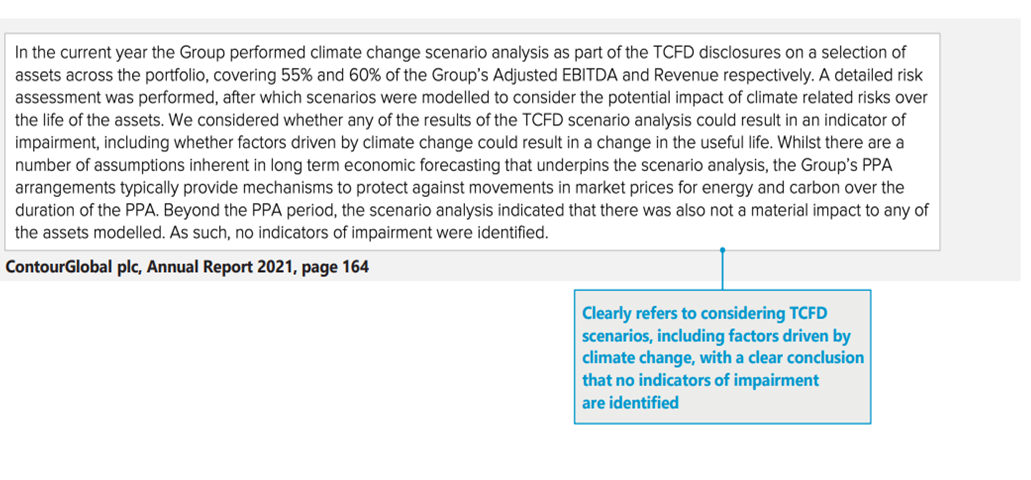
13. Good example: The Financial Reporting Council (FRC) noted in their latest Climate Thematic that Contour Global disclosure of impairment and useful lives was both consistent with TCFD and provided a clear conclusion on impairment.
In the current year the Group performed climate change scenario analysis as part of the TCFD disclosures on a selection of assets across the portfolio, covering 55% and 60% of the Group's Adjusted EBITDA and Revenue respectively. A detailed risk assessment was performed, after which scenarios were modelled to consider the potential impact of climate related risks over the life of the assets. We considered whether any of the results of the TCFD scenario analysis could result in an indicator of impairment, including whether factors driven by climate change could result in a change in the useful life. Whilst there are a number of assumptions inherent in long term economic forecasting that underpins the scenario analysis, the Group's PPA arrangements typically provide mechanisms to protect against movements in market prices for energy and carbon over the duration of the PPA. Beyond the PPA period, the scenario analysis indicated that there was also not a material impact to any of the assets modelled. As such, no indicators of impairment were identified.
ContourGlobal plc, Annual Report 2021, page 164
14. Improvement required: Carbon Tracker7 noted room for improvement in Glencore's financial statements in relation to impairment and useful lives of assets disclosures.
Glencore plc/Diversified Mining
Key item of note
- Disclosed various quantitative assumptions and estimates for fossil fuel business for impairment and closure provisions (e.g., long-term coal and oil prices, saleable tonnes and capacity, reserve depletion dates)
Glencore's fossil fuel activities include thermal and coking coal mining, oil production, oil refining, and coal marketing. It provided a variety of quantitative information per cash generating unit (CGU) for its impairment testing, including:
- "Non-current capital employed", which appeared to comprise PPE, intangibles, investments in associates and other, non-current advances and loans and inventories: Thermal coal, $10.6bn; Oil E&P, $0.4bn; Coking coal, $1.8bn; and Astron Energy, $0.8bn
- Long-term price assumptions for thermal coal ($67-83/t), oil ($60/bbl), and coking coal ($163/t)
- Life of mine saleable tonnes for thermal coal, oil E&P and coking coal, and projected year when 50% and 80% of reserves depleted
Metric was not met (but company provided some indication)
- Undiscounted amounts of closure and rehabilitation of relevant asset, with the average maturity of the provisions being 17 years for coal and oil assets.
Glencore did not provide the prices that it used to assess the impacts of carbon pricing regulations (even if it estimated that most or all may be passed on to the end-consumer). While it indicated that its overall production is "heavily weighted towards the earlier part of these mine lives and is broadly aligned with the IEA's SDS outlook for reducing coal demand", hence the reason for showing the 80% timing, it's unclear why it did not provide estimated timing for the entire Life of Mine or Life of Assets.
Glencore Annual Report 2021
15. Improvement required: The FRC8 also noted that some companies had provided insufficient detail in their financial statement's disclosures, especially when compared to extensive disclosures on climate in their strategic reports.
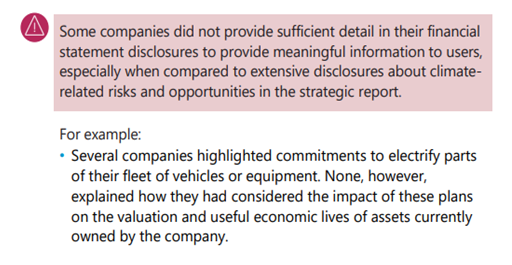
Some companies did not provide sufficient detail in their financial statement disclosures to provide meaningful information to users, especially when compared to extensive disclosures about climate-related risks and opportunities in the strategic report.
For example:
- Several companies highlighted commitments to electrify parts of their fleet of vehicles or equipment. None, however, explained how they had considered the impact of these plans on the valuation and useful economic lives of assets currently owned by the company.
Annex Two
16. The table below provides a broad summary of potential impacts regarding asset recognition and impairment from climate-related risks or opportunities which may lead to connectivity challenges for users:
- Restructuring part of the business (recognition, derecognition and impairment)
- Selling or abandoning a line of business (recognition and derecognition)
- Holding of carbon credits (recognition)
- Human capital (recognition)
- Expenditure incurred on modifications/enhancements to assets (recognition)
17. These are presented for information and as a potential prompt for further case studies that could also be considered.
| (a) Restructuring part of a business | |||
|---|---|---|---|
| Area | Potential business impacts | Potential financial reporting changes | Accounting standard(s) |
| I. Revision of useful lives and/or residual values of assets | • Changes in the expected pattern of consumption of economic benefits | • Change in depreciation rate impacting the depreciation charged | IAS 16 Property, Plant and Equipment |
| • Disclosure of a change in accounting estimate | |||
| II. Impairment indicators and recoverable amounts | • The change in expected use of the asset may constitute and | • Recognising an impairment | IAS 36 Impairment of Assets |
| impairment indicator, triggering an impairment review | • Associated disclosures | ||
| III. Time horizons | • Impairment reviews need to include projections based on budgets and forecasts up to a maximum of five years (unless a longer period can be justified). | • Alignment of recoverable amounts | IAS 36 Impairment of Assets |
| • Draft S2 requires, short, medium and long term, without defining these periods. | • Changes in estimates of recoverable amounts may impact expected cash flows | ||
| IV. Buying replacement assets | • If there is an executory contract for the entity to pay for the assets and the seller to deliver the assets | • Disclosure of the contractual commitment (unless it is an onerous contract) | IAS 16 Property, Plant and Equipment |
| (b) Selling or abandoning a line of business | |||
| Area | Potential business impacts | Potential financial reporting changes | Accounting standard(s) |
| I. The sale of a line of business where the planned sale is highly probable to take place within the next year | • A major line of business may qualify as a 'discontinued operation' (if the criteria of IFRS 5 are met) | • Change in the accounting for assets held for sale and discontinued operations, separating the affected assets from continuing operations | IFRS 5 Assets Held for Sale and Discontinued Operations |
| II. The sale of a line of business where there is a gradual shutting down. | • A gradual shut-down of a line of business may not necessarily meet the requirements above | • A gradual shut-down may lead to the accounting for this line of business to be less transparent to users | |
| (c) Holding of carbon credits | |||
| Area | Potential business impacts | Potential financial reporting changes | Accounting standard(s) |
| I. Purchase carbon credits can be held to either off-set against the entity's own emissions or to trade. | • The intention of the entity for holding the carbon credits will determine the accounting treatment, but there is diversity in practice, which may impact the comparability of the financial statements | • If carbon credits are held to offset against the entity's own emissions, it should be accounted for as an intangible asset | • IAS 38 Intangible Assets |
| • If held to trade, the carbon credits should be accounted for as inventory | • IAS 2 Inventories | ||
| (d) Human capital | |||
| Area | Potential business impacts | Potential financial reporting changes | Accounting standard(s) |
| I. Entities may identify human capital as significant risk or a significant opportunity under the requirements of draft IFRS S1 | • Investing in employees, for example, by providing training, may enhance the brand, lower turnover costs for the entity. | • Currently, entities cannot capitalise staff training due to having insufficient control over the associated expected future economic benefits | IAS 19 Employee Benefits and IAS 38 Intangible Assets |
| • This may be considered by users of the accounts as a future benefit. | |||
| (e) Expenditure incurred on modifications/enhancements to assets | |||
| Area | Potential business impacts | Potential financial reporting changes | Accounting standard(s) |
| I. Draft S2 requires the disclosure of plans for restructuring or asset enhancements when part of an entity's strategy to manage climate-related risks and opportunities | • Accounting Standards specify when assets are allowed to be recognised and the treatment of subsequent expenditure on those assets9. | • Expensing vs capitalisation of the costs incurred | IAS 16 Property, plant and Equipment |
| • Users may not appreciate these different treatments. | |||
| II. 'Green' assets (those that would have a more positive impact on the environment) | • Stakeholders may consider the additional costs for types of initiatives to be capitalized and amortised despite not having a clear future 'economic' benefit. | • If these costs do not meet the recognition criteria for an asset, they are treated as costs and expensed for financial accounting purposes | IAS 16 Property, plant and Equipment |
Footnotes
-
Click here for Carbon Tracker's report: Still Flying Blind - October 2022 ↩↩
-
Click here for FRC's Thematic Review of TCFD Disclosures and Climate in the Financial Statements - July 2022 ↩↩
-
Letter from Lord Callanan to the International Sustainability Standards Board regarding their exposure drafts IFRS S1 and IFRS S2 (1 August 2022) ↩↩
-
Note: only the text of the ISSB exposure drafts was available at the time of writing this paper ↩↩
-
International Forum of Accounting Standard Setters ↩
-
Conceptual Framework [paragraphs 3.4-3.6] notes that financial statements are prepared for a specified period of time and provide comparative information and under certain circumstances forward-looking information. ↩↩
-
Conceptual Framework [paragraph 3.10] A reporting entity is an entity that is required, or chooses, to prepare financial statements. A reporting entity can be a single entity or a portion of an entity or can comprise more than one entity. A reporting entity is not necessarily a legal entity. ↩↩
-
Conceptual Framework [paragraph 5.6] Only items that meet the definition of an asset, a liability or equity are recognised in the statement of financial position. ↩↩
-
The UKEB Staff Paper presented at the January 2023 IFASS meeting can be found here ↩